E-GOVERNANCE
Presented by:
Akanksha Gohil
What is E-Governance?
Electronic governance, popularly known as E-
governance, is the integration of Information and
Communication Technology (ICT) in all the processes,
with the aim of enhancing government ability to address
the needs of the general public. The basic purpose of e-
governance is to simplify processes for all, i.e.
government, citizens, businesses, etc. at National, State,
and local levels.
2
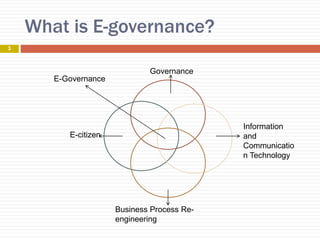
What is E-governance?
Governance
E-citizen
Information
and
Communicatio
n Technology
Business Process Re-
engineering
E-Governance
3
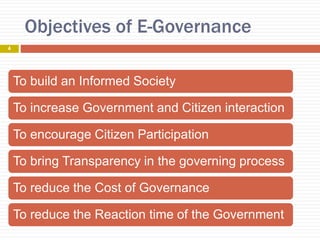
Objectives of E-Governance
To build an Informed Society
To increase Government and Citizen interaction
To encourage Citizen Participation
To bring Transparency in the governing process
To reduce the Cost of Governance
To reduce the Reaction time of the Government
4
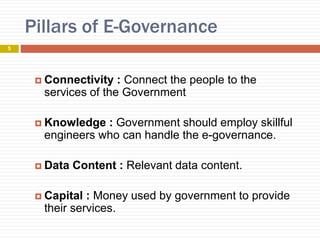
Pillars of E-Governance
 Connectivity : Connect the people to the
services of the Government
 Knowledge : Government should employ skillful
engineers who can handle the e-governance.
 Data Content : Relevant data content.
 Capital : Money used by government to provide
their services.
5
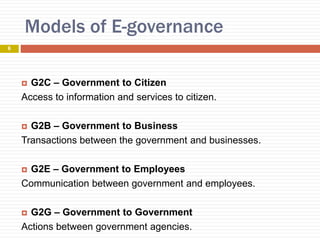
Models of E-governance
 G2C – Government to Citizen
Access to information and services to citizen.
 G2B – Government to Business
Transactions between the government and businesses.
 G2E – Government to Employees
Communication between government and employees.
 G2G – Government to Government
Actions between government agencies.
6
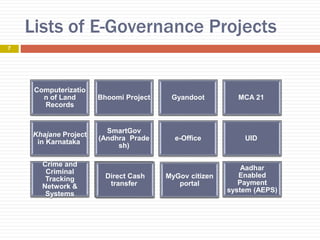
Lists of E-Governance Projects
Computerizatio
n of Land
Records
Bhoomi Project Gyandoot MCA 21
Khajane Project
in Karnataka
SmartGov
(Andhra Prade
sh)
e-Office UID
Crime and
Criminal
Tracking
Network &
Systems
Direct Cash
transfer
Aadhar
Enabled
Payment
system (AEPS)
MyGov citizen
portal
7
E-Governance Projects
 In Urban Areas:
 Transportation – CFST , RTC
 Online payment of bills and taxes - E-Mitra , SAMPARK, E-
Suvidha
 Information and public relation key services - Mahiti
Shakti, OLTP
 Municipal services - E-Panjeeyan, SDO Suite
 Roads and traffic management - I-GeoApproach Internet
Geometrics, RSPCB,
8
E-governance projects(Contd.)
 In Rural Areas
 Agriculture – Gyandoot, AGMARKNET
 Local information – Prajavani, E-Samadhan
 Disaster management - Chetana
 Land record management – Bhoomi, Land Record
Computerisation
 Panchayat - e-panchayat
9
E-governance in Health
 Availability of Treatment – National Health Portal
 Special Health Camps - Online Vaccination
Appointment for International Traveller , Mother and
Child Tracking System (MCTS)
 Child Care Centers - Anganwadi
10
E-governance in Education
 Providing computer education to children
–
Implementation of electronic
 Results for class X and class XII -
AISES(All India School Education Survey)
 Eligibility for scholarship - Online
Scholarship Management System
11
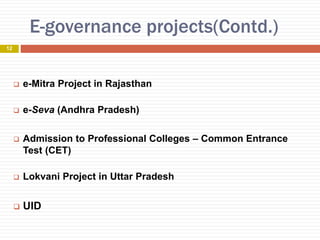
E-governance projects(Contd.)
 e-Mitra Project in Rajasthan
 e-Seva (Andhra Pradesh)
 Admission to Professional Colleges – Common Entrance
Test (CET)
 Lokvani Project in Uttar Pradesh
 UID
12
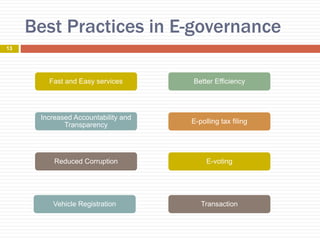
Best Practices in E-governance
Fast and Easy services
Increased Accountability and
Transparency
Reduced Corruption
Better Efficiency
E-polling tax filing
E-voting
Vehicle Registration Transaction
13
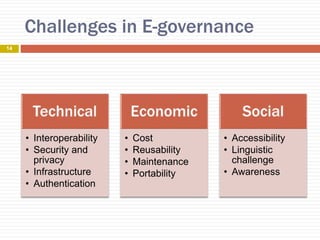
Challenges in E-governance
• Interoperability
• Security and
privacy
• Infrastructure
• Authentication
• Cost
• Reusability
• Maintenance
• Portability
• Accessibility
• Linguistic
challenge
• Awareness
14
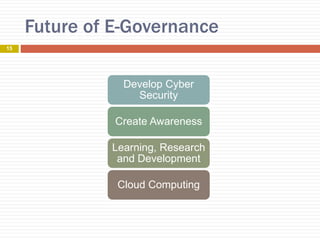
Future of E-Governance
Develop Cyber
Security
Create Awareness
Learning, Research
and Development
Cloud Computing
15
References
[1] Dr. Dinesh Chandra Misra, I.A.S,(Retd.), Feb 2-3, 2006, “Defining
E-government : a citizen-centric criteria-based approach”, 10th
National Conference on E-Governance, Bhopal, Madhya Pradesh,
India
[2] Nikita Yadav and V.B.Singh, “E-Governance: Past, Present and
Future in India”, Sep 2012, International Journal of Computer
Applications(0975-8887), Vol.53- No.7,
[3] Shailendra C. Jain Palvia and Sushil S.Sharma, “E-government and
E-governance: Defintions/Domain Framework and Status around
the World”, “Foundations of E-government”, Computer Society of
India
16
References (Contd.)
17
[4] “E-governance in India: Issues and Challenges”, Nagaraja. K, IOSR
Journal of Economics and Finance (IOSR-JEF), Vol 7, Issue 5,
Version IV, Sep-Oct, 2016
[5] https://www.nic.in/projects-all/
[6] Ake Gronlund, Thomas A. Horan, Orebo, “Introducing E-Gov:
History, Definitions and Issues”, Communications of the Association
for Information Systems (Volume 15, 2004)713-729.
THANK YOU
18

E governance - management information system

  • 1.
  • 2.
    What is E-Governance? Electronicgovernance, popularly known as E- governance, is the integration of Information and Communication Technology (ICT) in all the processes, with the aim of enhancing government ability to address the needs of the general public. The basic purpose of e- governance is to simplify processes for all, i.e. government, citizens, businesses, etc. at National, State, and local levels. 2
  • 3.
    What is E-governance? Governance E-citizen Information and Communicatio nTechnology Business Process Re- engineering E-Governance 3
  • 4.
    Objectives of E-Governance Tobuild an Informed Society To increase Government and Citizen interaction To encourage Citizen Participation To bring Transparency in the governing process To reduce the Cost of Governance To reduce the Reaction time of the Government 4
  • 5.
    Pillars of E-Governance Connectivity : Connect the people to the services of the Government  Knowledge : Government should employ skillful engineers who can handle the e-governance.  Data Content : Relevant data content.  Capital : Money used by government to provide their services. 5
  • 6.
    Models of E-governance G2C – Government to Citizen Access to information and services to citizen.  G2B – Government to Business Transactions between the government and businesses.  G2E – Government to Employees Communication between government and employees.  G2G – Government to Government Actions between government agencies. 6
  • 7.
    Lists of E-GovernanceProjects Computerizatio n of Land Records Bhoomi Project Gyandoot MCA 21 Khajane Project in Karnataka SmartGov (Andhra Prade sh) e-Office UID Crime and Criminal Tracking Network & Systems Direct Cash transfer Aadhar Enabled Payment system (AEPS) MyGov citizen portal 7
  • 8.
    E-Governance Projects  InUrban Areas:  Transportation – CFST , RTC  Online payment of bills and taxes - E-Mitra , SAMPARK, E- Suvidha  Information and public relation key services - Mahiti Shakti, OLTP  Municipal services - E-Panjeeyan, SDO Suite  Roads and traffic management - I-GeoApproach Internet Geometrics, RSPCB, 8
  • 9.
    E-governance projects(Contd.)  InRural Areas  Agriculture – Gyandoot, AGMARKNET  Local information – Prajavani, E-Samadhan  Disaster management - Chetana  Land record management – Bhoomi, Land Record Computerisation  Panchayat - e-panchayat 9
  • 10.
    E-governance in Health Availability of Treatment – National Health Portal  Special Health Camps - Online Vaccination Appointment for International Traveller , Mother and Child Tracking System (MCTS)  Child Care Centers - Anganwadi 10
  • 11.
    E-governance in Education Providing computer education to children – Implementation of electronic  Results for class X and class XII - AISES(All India School Education Survey)  Eligibility for scholarship - Online Scholarship Management System 11
  • 12.
    E-governance projects(Contd.)  e-MitraProject in Rajasthan  e-Seva (Andhra Pradesh)  Admission to Professional Colleges – Common Entrance Test (CET)  Lokvani Project in Uttar Pradesh  UID 12
  • 13.
    Best Practices inE-governance Fast and Easy services Increased Accountability and Transparency Reduced Corruption Better Efficiency E-polling tax filing E-voting Vehicle Registration Transaction 13
  • 14.
    Challenges in E-governance •Interoperability • Security and privacy • Infrastructure • Authentication • Cost • Reusability • Maintenance • Portability • Accessibility • Linguistic challenge • Awareness 14
  • 15.
    Future of E-Governance DevelopCyber Security Create Awareness Learning, Research and Development Cloud Computing 15
  • 16.
    References [1] Dr. DineshChandra Misra, I.A.S,(Retd.), Feb 2-3, 2006, “Defining E-government : a citizen-centric criteria-based approach”, 10th National Conference on E-Governance, Bhopal, Madhya Pradesh, India [2] Nikita Yadav and V.B.Singh, “E-Governance: Past, Present and Future in India”, Sep 2012, International Journal of Computer Applications(0975-8887), Vol.53- No.7, [3] Shailendra C. Jain Palvia and Sushil S.Sharma, “E-government and E-governance: Defintions/Domain Framework and Status around the World”, “Foundations of E-government”, Computer Society of India 16
  • 17.
    References (Contd.) 17 [4] “E-governancein India: Issues and Challenges”, Nagaraja. K, IOSR Journal of Economics and Finance (IOSR-JEF), Vol 7, Issue 5, Version IV, Sep-Oct, 2016 [5] https://www.nic.in/projects-all/ [6] Ake Gronlund, Thomas A. Horan, Orebo, “Introducing E-Gov: History, Definitions and Issues”, Communications of the Association for Information Systems (Volume 15, 2004)713-729.
  • 18.