Genetic diversification and intensification:
Experiences from Kongwa and Kiteto, Tanzania
Patrick Okori
ICRISAT
Africa RISING East and Southern Africa Review and Planning Meeting,
Malawi, 14-16 July 2015
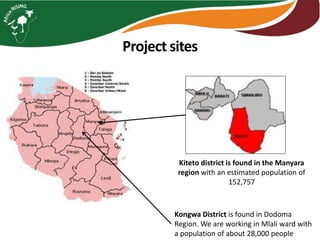
Project sites
Kiteto district is found in the Manyara
region with an estimated population of
152,757
Kongwa District is found in Dodoma
Region. We are working in Mlali ward with
a population of about 28,000 people
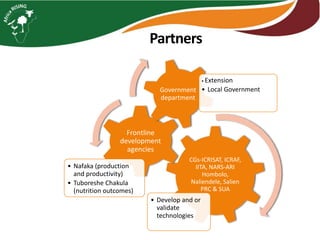
Partners
CGs-ICRISAT, ICRAF,
IITA, NARS-ARI
Hombolo,
Naliendele, Salien
PRC & SUA
• Develop and or
validate
technologies
Frontline
development
agencies
• Nafaka (production
and productivity)
• Tuboreshe Chakula
(nutrition outcomes)
Government
department
• Extension
• Local Government
The Team: Core implementers
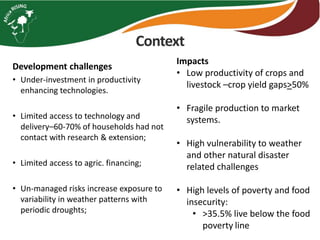
Context
Development challenges
• Under-investment in productivity
enhancing technologies.
• Limited access to technology and
delivery–60-70% of households had not
contact with research & extension;
• Limited access to agric. financing;
• Un-managed risks increase exposure to
variability in weather patterns with
periodic droughts;
Impacts
• Low productivity of crops and
livestock –crop yield gaps>50%
• Fragile production to market
systems.
• High vulnerability to weather
and other natural disaster
related challenges
• High levels of poverty and food
insecurity:
• >35.5% live below the food
poverty line
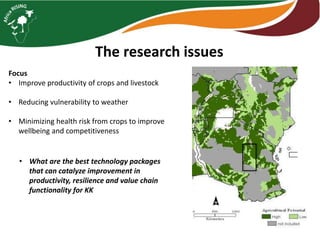
The research issues
Focus
• Improve productivity of crops and livestock
• Reducing vulnerability to weather
• Minimizing health risk from crops to improve
wellbeing and competitiveness
• What are the best technology packages
that can catalyze improvement in
productivity, resilience and value chain
functionality for KK
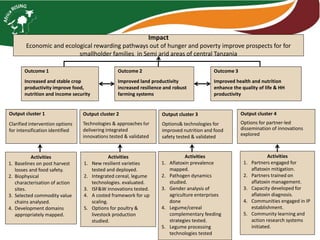
Impact
Economic and ecological rewarding pathways out of hunger and poverty improve prospects for for
smallholder families in Semi arid areas of central Tanzania
Output cluster 2
Technologies & approaches for
delivering integrated
innovations tested & validated
Activities
1. New resilient varieties
tested and deployed.
2. Integrated cereal, legume
technologies. evaluated.
3. ISF&W innovations tested.
4. A costed framework for up
scaling.
5. Options for poultry &
livestock production
studied.
Output cluster 3
Options& technologies for
improved nutrition and food
safety tested & validated
Activities
1. Aflatoxin prevalence
mapped.
2. Pathogen dynamics
studied.
3. Gender analysis of
agriculture enterprises
done
4. Legume/cereal
complementary feeding
strategies tested.
5. Legume processing
technologies tested
Output cluster 1
Clarified intervention options
for intensification identified
Activities
1. Baselines on post harvest
losses and food safety.
2. Biophysical
characterisation of action
sites.
3. Selected commodity value
chains analysed.
4. Development domains
appropriately mapped.
Output cluster 4
Options for partner-led
dissemination of innovations
explored
Activities
1. Partners engaged for
aflatoxin mitigation.
2. Partners trained on
aflatoxin management.
3. Capacity developed for
aflatoxin diagnosis.
4. Communities engaged in IP
establishment.
5. Community learning and
action research systems
initiated.
Outcome 1
Increased and stable crop
productivity improve food,
nutrition and income security
Outcome 2
Improved land productivity
increased resilience and robust
farming systems
Outcome 3
Improved health and nutrition
enhance the quality of life & HH
productivity
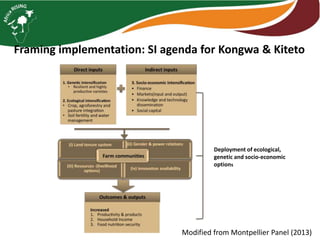
Modified from Montpellier Panel (2013)
Framing implementation: SI agenda for Kongwa & Kiteto
Deployment of ecological,
genetic and socio-economic
options
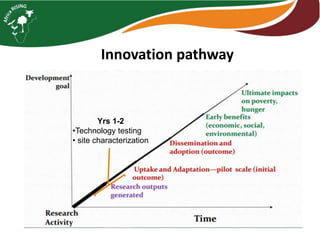
Innovation pathway
Yrs 1-2
•Technology testing
• site characterization
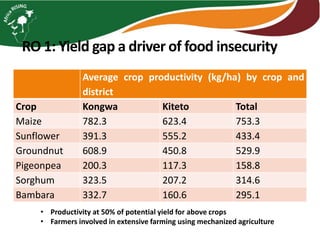
RO 1: Yield gap a driver of food insecurity
Average crop productivity (kg/ha) by crop and
district
Crop Kongwa Kiteto Total
Maize 782.3 623.4 753.3
Sunflower 391.3 555.2 433.4
Groundnut 608.9 450.8 529.9
Pigeonpea 200.3 117.3 158.8
Sorghum 323.5 207.2 314.6
Bambara 332.7 160.6 295.1
• Productivity at 50% of potential yield for above crops
• Farmers involved in extensive farming using mechanized agriculture
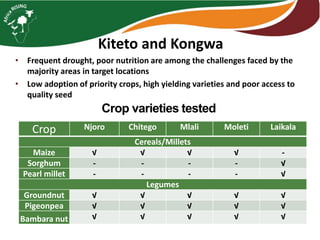
Kiteto and Kongwa
• Frequent drought, poor nutrition are among the challenges faced by the
majority areas in target locations
• Low adoption of priority crops, high yielding varieties and poor access to
quality seed
Crop Njoro Chitego Mlali Moleti Laikala
Cereals/Millets
Maize √ √ √ √ -
Sorghum - - - - √
Pearl millet - - - - √
Legumes
Groundnut √ √ √ √ √
Pigeonpea √ √ √ √ √
Bambara nut √ √ √ √ √
Crop varieties tested
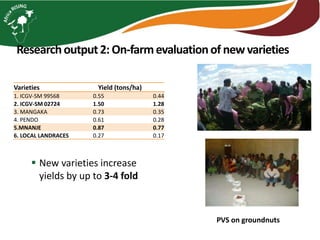
Researchoutput2: On-farmevaluationof newvarieties
PVS on groundnuts
 New varieties increase
yields by up to 3-4 fold
Varieties Yield (tons/ha)
1. ICGV-SM 99568 0.55 0.44
2. ICGV-SM 02724 1.50 1.28
3. MANGAKA 0.73 0.35
4. PENDO 0.61 0.28
5.MNANJE 0.87 0.77
6. LOCAL LANDRACES 0.27 0.17
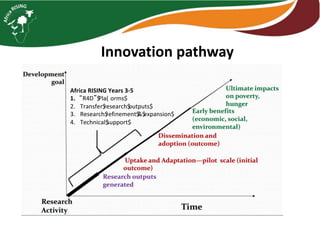
Innovation pathway
R4D $Pla( orms$
2. Transfer$research$outputs$
3. Research$refinement$&$expansion$
4. Technical$support$
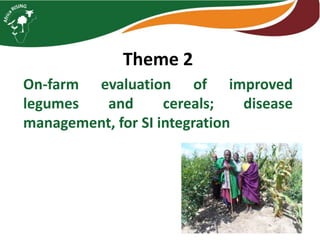
Theme 2
On-farm evaluation of improved
legumes and cereals; disease
management, for SI integration
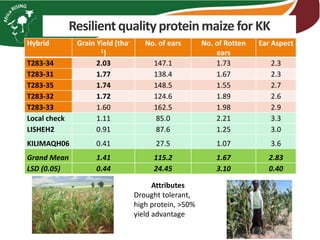
Resilient qualityproteinmaize for KK
Hybrid Grain Yield (tha-
1)
No. of ears No. of Rotten
ears
Ear Aspect
T283-34 2.03 147.1 1.73 2.3
T283-31 1.77 138.4 1.67 2.3
T283-35 1.74 148.5 1.55 2.7
T283-32 1.72 124.6 1.89 2.6
T283-33 1.60 162.5 1.98 2.9
Local check 1.11 85.0 2.21 3.3
LISHEH2 0.91 87.6 1.25 3.0
KILIMAQH06 0.41 27.5 1.07 3.6
Grand Mean 1.41 115.2 1.67 2.83
LSD (0.05) 0.44 24.45 3.10 0.40
Attributes
Drought tolerant,
high protein, >50%
yield advantage
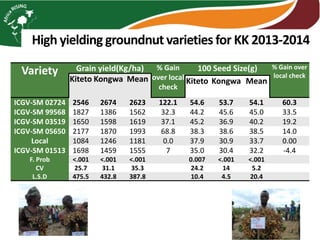
High yielding groundnut varieties for KK 2013-2014
Variety Grain yield(Kg/ha) % Gain
over local
check
100 Seed Size(g) % Gain over
local check
Kiteto Kongwa Mean Kiteto Kongwa Mean
ICGV-SM 02724 2546 2674 2623 122.1 54.6 53.7 54.1 60.3
ICGV-SM 99568 1827 1386 1562 32.3 44.2 45.6 45.0 33.5
ICGV-SM 03519 1650 1598 1619 37.1 45.2 36.9 40.2 19.2
ICGV-SM 05650 2177 1870 1993 68.8 38.3 38.6 38.5 14.0
Local 1084 1246 1181 0.0 37.9 30.9 33.7 0.00
ICGV-SM 01513 1698 1459 1555 7 35.0 30.4 32.2 -4.4
F. Prob <.001 <.001 <.001 0.007 <.001 <.001
CV 25.7 31.1 35.3 24.2 14 5.2
L.S.D 475.5 432.8 387.8 10.4 4.5 20.4
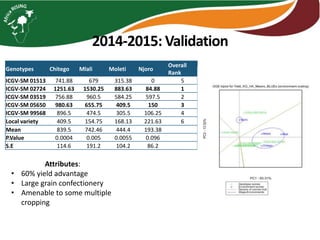
2014-2015: Validation
Genotypes Chitego Mlali Moleti Njoro
Overall
Rank
ICGV-SM 01513 741.88 679 315.38 0 5
ICGV-SM 02724 1251.63 1530.25 883.63 84.88 1
ICGV-SM 03519 756.88 960.5 584.25 597.5 2
ICGV-SM 05650 980.63 655.75 409.5 150 3
ICGV-SM 99568 896.5 474.5 305.5 106.25 4
Local variety 409.5 154.75 168.13 221.63 6
Mean 839.5 742.46 444.4 193.38
P.Value 0.0004 0.005 0.0055 0.096
S.E 114.6 191.2 104.2 86.2
Attributes:
• 60% yield advantage
• Large grain confectionery
• Amenable to some multiple
cropping
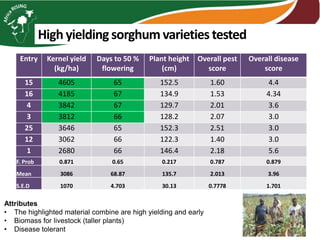
Entry Kernel yield
(kg/ha)
Days to 50 %
flowering
Plant height
(cm)
Overall pest
score
Overall disease
score
15 4605 65 152.5 1.60 4.4
16 4185 67 134.9 1.53 4.34
4 3842 67 129.7 2.01 3.6
3 3812 66 128.2 2.07 3.0
25 3646 65 152.3 2.51 3.0
12 3062 66 122.3 1.40 3.0
1 2680 66 146.4 2.18 5.6
F. Prob 0.871 0.65 0.217 0.787 0.879
Mean 3086 68.87 135.7 2.013 3.96
S.E.D 1070 4.703 30.13 0.7778 1.701
High yielding sorghum varieties tested
Attributes
• The highlighted material combine are high yielding and early
• Biomass for livestock (taller plants)
• Disease tolerant
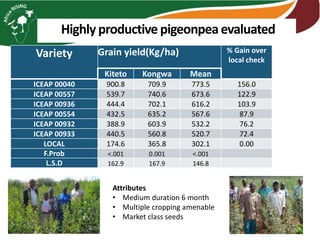
Highly productive pigeonpea evaluated
Variety Grain yield(Kg/ha) % Gain over
local check
Kiteto Kongwa Mean
ICEAP 00040 900.8 709.9 773.5 156.0
ICEAP 00557 539.7 740.6 673.6 122.9
ICEAP 00936 444.4 702.1 616.2 103.9
ICEAP 00554 432.5 635.2 567.6 87.9
ICEAP 00932 388.9 603.9 532.2 76.2
ICEAP 00933 440.5 560.8 520.7 72.4
LOCAL 174.6 365.8 302.1 0.00
F.Prob <.001 0.001 <.001
L.S.D 162.9 167.9 146.8
Attributes
• Medium duration 6 month
• Multiple cropping amenable
• Market class seeds
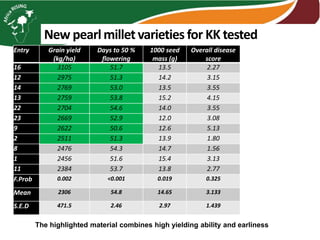
New pearlmillet varieties for KK tested
The highlighted material combines high yielding ability and earliness
Entry Grain yield
(kg/ha)
Days to 50 %
flowering
1000 seed
mass (g)
Overall disease
score
16 3105 51.7 13.5 2.27
12 2975 51.3 14.2 3.15
14 2769 53.0 13.5 3.55
13 2759 53.8 15.2 4.15
22 2704 54.6 14.0 3.55
23 2669 52.9 12.0 3.08
9 2622 50.6 12.6 5.13
2 2511 51.3 13.9 1.80
8 2476 54.3 14.7 1.56
1 2456 51.6 15.4 3.13
11 2384 53.7 13.8 2.77
F.Prob 0.002 <0.001 0.019 0.325
Mean 2306 54.8 14.65 3.133
S.E.D 471.5 2.46 2.97 1.439
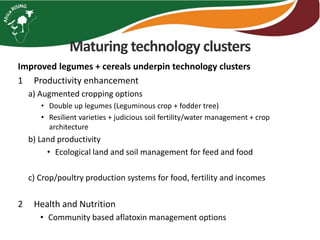
Maturing technology clusters
Improved legumes + cereals underpin technology clusters
1 Productivity enhancement
a) Augmented cropping options
• Double up legumes (Leguminous crop + fodder tree)
• Resilient varieties + judicious soil fertility/water management + crop
architecture
b) Land productivity
• Ecological land and soil management for feed and food
c) Crop/poultry production systems for food, fertility and incomes
2 Health and Nutrition
• Community based aflatoxin management options
Moving forward
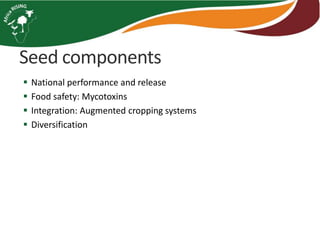
Seed components
 National performance and release
 Food safety: Mycotoxins
 Integration: Augmented cropping systems
 Diversification
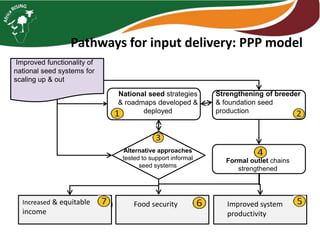
Improved functionality of
national seed systems for
scaling up & out
Improved system
productivity
Increased & equitable
income
Alternative approaches
tested to support informal
seed systems
National seed strategies
& roadmaps developed &
deployed
Strengthening of breeder
& foundation seed
production
Formal outlet chains
strengthened
Food security
Pathways for input delivery: PPP model
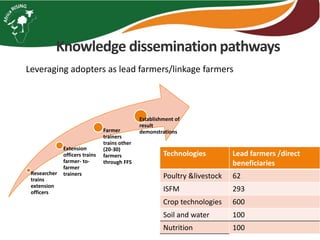
Knowledge dissemination pathways
Leveraging adopters as lead farmers/linkage farmers
Researcher
trains
extension
officers
Extension
officers trains
farmer- to-
farmer
trainers
Farmer
trainers
trains other
(20-30)
farmers
through FFS
Establishment of
result
demonstrations
Technologies Lead farmers /direct
beneficiaries
Poultry &livestock 62
ISFM 293
Crop technologies 600
Soil and water 100
Nutrition 100
Mature technology clusters
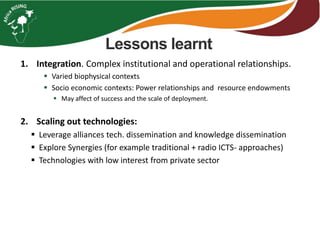
Lessons learnt
1. Integration. Complex institutional and operational relationships.
 Varied biophysical contexts
 Socio economic contexts: Power relationships and resource endowments
 May affect of success and the scale of deployment.
2. Scaling out technologies:
 Leverage alliances tech. dissemination and knowledge dissemination
 Explore Synergies (for example traditional + radio ICTS- approaches)
 Technologies with low interest from private sector
Africa Research in Sustainable Intensification for the Next Generation
africa-rising.net

Genetic diversification and intensification: Experiences from Kongwa and Kiteto, Tanzania

  • 1.
    Genetic diversification andintensification: Experiences from Kongwa and Kiteto, Tanzania Patrick Okori ICRISAT Africa RISING East and Southern Africa Review and Planning Meeting, Malawi, 14-16 July 2015
  • 2.
    Project sites Kiteto districtis found in the Manyara region with an estimated population of 152,757 Kongwa District is found in Dodoma Region. We are working in Mlali ward with a population of about 28,000 people
  • 3.
    Partners CGs-ICRISAT, ICRAF, IITA, NARS-ARI Hombolo, Naliendele,Salien PRC & SUA • Develop and or validate technologies Frontline development agencies • Nafaka (production and productivity) • Tuboreshe Chakula (nutrition outcomes) Government department • Extension • Local Government
  • 4.
    The Team: Coreimplementers
  • 5.
    Context Development challenges • Under-investmentin productivity enhancing technologies. • Limited access to technology and delivery–60-70% of households had not contact with research & extension; • Limited access to agric. financing; • Un-managed risks increase exposure to variability in weather patterns with periodic droughts; Impacts • Low productivity of crops and livestock –crop yield gaps>50% • Fragile production to market systems. • High vulnerability to weather and other natural disaster related challenges • High levels of poverty and food insecurity: • >35.5% live below the food poverty line
  • 6.
    The research issues Focus •Improve productivity of crops and livestock • Reducing vulnerability to weather • Minimizing health risk from crops to improve wellbeing and competitiveness • What are the best technology packages that can catalyze improvement in productivity, resilience and value chain functionality for KK
  • 7.
    Impact Economic and ecologicalrewarding pathways out of hunger and poverty improve prospects for for smallholder families in Semi arid areas of central Tanzania Output cluster 2 Technologies & approaches for delivering integrated innovations tested & validated Activities 1. New resilient varieties tested and deployed. 2. Integrated cereal, legume technologies. evaluated. 3. ISF&W innovations tested. 4. A costed framework for up scaling. 5. Options for poultry & livestock production studied. Output cluster 3 Options& technologies for improved nutrition and food safety tested & validated Activities 1. Aflatoxin prevalence mapped. 2. Pathogen dynamics studied. 3. Gender analysis of agriculture enterprises done 4. Legume/cereal complementary feeding strategies tested. 5. Legume processing technologies tested Output cluster 1 Clarified intervention options for intensification identified Activities 1. Baselines on post harvest losses and food safety. 2. Biophysical characterisation of action sites. 3. Selected commodity value chains analysed. 4. Development domains appropriately mapped. Output cluster 4 Options for partner-led dissemination of innovations explored Activities 1. Partners engaged for aflatoxin mitigation. 2. Partners trained on aflatoxin management. 3. Capacity developed for aflatoxin diagnosis. 4. Communities engaged in IP establishment. 5. Community learning and action research systems initiated. Outcome 1 Increased and stable crop productivity improve food, nutrition and income security Outcome 2 Improved land productivity increased resilience and robust farming systems Outcome 3 Improved health and nutrition enhance the quality of life & HH productivity
  • 8.
    Modified from MontpellierPanel (2013) Framing implementation: SI agenda for Kongwa & Kiteto Deployment of ecological, genetic and socio-economic options
  • 9.
    Innovation pathway Yrs 1-2 •Technologytesting • site characterization
  • 10.
    RO 1: Yieldgap a driver of food insecurity Average crop productivity (kg/ha) by crop and district Crop Kongwa Kiteto Total Maize 782.3 623.4 753.3 Sunflower 391.3 555.2 433.4 Groundnut 608.9 450.8 529.9 Pigeonpea 200.3 117.3 158.8 Sorghum 323.5 207.2 314.6 Bambara 332.7 160.6 295.1 • Productivity at 50% of potential yield for above crops • Farmers involved in extensive farming using mechanized agriculture
  • 11.
    Kiteto and Kongwa •Frequent drought, poor nutrition are among the challenges faced by the majority areas in target locations • Low adoption of priority crops, high yielding varieties and poor access to quality seed Crop Njoro Chitego Mlali Moleti Laikala Cereals/Millets Maize √ √ √ √ - Sorghum - - - - √ Pearl millet - - - - √ Legumes Groundnut √ √ √ √ √ Pigeonpea √ √ √ √ √ Bambara nut √ √ √ √ √ Crop varieties tested
  • 12.
    Researchoutput2: On-farmevaluationof newvarieties PVSon groundnuts  New varieties increase yields by up to 3-4 fold Varieties Yield (tons/ha) 1. ICGV-SM 99568 0.55 0.44 2. ICGV-SM 02724 1.50 1.28 3. MANGAKA 0.73 0.35 4. PENDO 0.61 0.28 5.MNANJE 0.87 0.77 6. LOCAL LANDRACES 0.27 0.17
  • 13.
    Innovation pathway R4D $Pla(orms$ 2. Transfer$research$outputs$ 3. Research$refinement$&$expansion$ 4. Technical$support$
  • 14.
    Theme 2 On-farm evaluationof improved legumes and cereals; disease management, for SI integration
  • 15.
    Resilient qualityproteinmaize forKK Hybrid Grain Yield (tha- 1) No. of ears No. of Rotten ears Ear Aspect T283-34 2.03 147.1 1.73 2.3 T283-31 1.77 138.4 1.67 2.3 T283-35 1.74 148.5 1.55 2.7 T283-32 1.72 124.6 1.89 2.6 T283-33 1.60 162.5 1.98 2.9 Local check 1.11 85.0 2.21 3.3 LISHEH2 0.91 87.6 1.25 3.0 KILIMAQH06 0.41 27.5 1.07 3.6 Grand Mean 1.41 115.2 1.67 2.83 LSD (0.05) 0.44 24.45 3.10 0.40 Attributes Drought tolerant, high protein, >50% yield advantage
  • 16.
    High yielding groundnutvarieties for KK 2013-2014 Variety Grain yield(Kg/ha) % Gain over local check 100 Seed Size(g) % Gain over local check Kiteto Kongwa Mean Kiteto Kongwa Mean ICGV-SM 02724 2546 2674 2623 122.1 54.6 53.7 54.1 60.3 ICGV-SM 99568 1827 1386 1562 32.3 44.2 45.6 45.0 33.5 ICGV-SM 03519 1650 1598 1619 37.1 45.2 36.9 40.2 19.2 ICGV-SM 05650 2177 1870 1993 68.8 38.3 38.6 38.5 14.0 Local 1084 1246 1181 0.0 37.9 30.9 33.7 0.00 ICGV-SM 01513 1698 1459 1555 7 35.0 30.4 32.2 -4.4 F. Prob <.001 <.001 <.001 0.007 <.001 <.001 CV 25.7 31.1 35.3 24.2 14 5.2 L.S.D 475.5 432.8 387.8 10.4 4.5 20.4
  • 17.
    2014-2015: Validation Genotypes ChitegoMlali Moleti Njoro Overall Rank ICGV-SM 01513 741.88 679 315.38 0 5 ICGV-SM 02724 1251.63 1530.25 883.63 84.88 1 ICGV-SM 03519 756.88 960.5 584.25 597.5 2 ICGV-SM 05650 980.63 655.75 409.5 150 3 ICGV-SM 99568 896.5 474.5 305.5 106.25 4 Local variety 409.5 154.75 168.13 221.63 6 Mean 839.5 742.46 444.4 193.38 P.Value 0.0004 0.005 0.0055 0.096 S.E 114.6 191.2 104.2 86.2 Attributes: • 60% yield advantage • Large grain confectionery • Amenable to some multiple cropping
  • 18.
    Entry Kernel yield (kg/ha) Daysto 50 % flowering Plant height (cm) Overall pest score Overall disease score 15 4605 65 152.5 1.60 4.4 16 4185 67 134.9 1.53 4.34 4 3842 67 129.7 2.01 3.6 3 3812 66 128.2 2.07 3.0 25 3646 65 152.3 2.51 3.0 12 3062 66 122.3 1.40 3.0 1 2680 66 146.4 2.18 5.6 F. Prob 0.871 0.65 0.217 0.787 0.879 Mean 3086 68.87 135.7 2.013 3.96 S.E.D 1070 4.703 30.13 0.7778 1.701 High yielding sorghum varieties tested Attributes • The highlighted material combine are high yielding and early • Biomass for livestock (taller plants) • Disease tolerant
  • 19.
    Highly productive pigeonpeaevaluated Variety Grain yield(Kg/ha) % Gain over local check Kiteto Kongwa Mean ICEAP 00040 900.8 709.9 773.5 156.0 ICEAP 00557 539.7 740.6 673.6 122.9 ICEAP 00936 444.4 702.1 616.2 103.9 ICEAP 00554 432.5 635.2 567.6 87.9 ICEAP 00932 388.9 603.9 532.2 76.2 ICEAP 00933 440.5 560.8 520.7 72.4 LOCAL 174.6 365.8 302.1 0.00 F.Prob <.001 0.001 <.001 L.S.D 162.9 167.9 146.8 Attributes • Medium duration 6 month • Multiple cropping amenable • Market class seeds
  • 20.
    New pearlmillet varietiesfor KK tested The highlighted material combines high yielding ability and earliness Entry Grain yield (kg/ha) Days to 50 % flowering 1000 seed mass (g) Overall disease score 16 3105 51.7 13.5 2.27 12 2975 51.3 14.2 3.15 14 2769 53.0 13.5 3.55 13 2759 53.8 15.2 4.15 22 2704 54.6 14.0 3.55 23 2669 52.9 12.0 3.08 9 2622 50.6 12.6 5.13 2 2511 51.3 13.9 1.80 8 2476 54.3 14.7 1.56 1 2456 51.6 15.4 3.13 11 2384 53.7 13.8 2.77 F.Prob 0.002 <0.001 0.019 0.325 Mean 2306 54.8 14.65 3.133 S.E.D 471.5 2.46 2.97 1.439
  • 21.
    Maturing technology clusters Improvedlegumes + cereals underpin technology clusters 1 Productivity enhancement a) Augmented cropping options • Double up legumes (Leguminous crop + fodder tree) • Resilient varieties + judicious soil fertility/water management + crop architecture b) Land productivity • Ecological land and soil management for feed and food c) Crop/poultry production systems for food, fertility and incomes 2 Health and Nutrition • Community based aflatoxin management options
  • 22.
  • 23.
    Seed components  Nationalperformance and release  Food safety: Mycotoxins  Integration: Augmented cropping systems  Diversification
  • 24.
    Improved functionality of nationalseed systems for scaling up & out Improved system productivity Increased & equitable income Alternative approaches tested to support informal seed systems National seed strategies & roadmaps developed & deployed Strengthening of breeder & foundation seed production Formal outlet chains strengthened Food security Pathways for input delivery: PPP model
  • 25.
    Knowledge dissemination pathways Leveragingadopters as lead farmers/linkage farmers Researcher trains extension officers Extension officers trains farmer- to- farmer trainers Farmer trainers trains other (20-30) farmers through FFS Establishment of result demonstrations Technologies Lead farmers /direct beneficiaries Poultry &livestock 62 ISFM 293 Crop technologies 600 Soil and water 100 Nutrition 100
  • 26.
  • 27.
    Lessons learnt 1. Integration.Complex institutional and operational relationships.  Varied biophysical contexts  Socio economic contexts: Power relationships and resource endowments  May affect of success and the scale of deployment. 2. Scaling out technologies:  Leverage alliances tech. dissemination and knowledge dissemination  Explore Synergies (for example traditional + radio ICTS- approaches)  Technologies with low interest from private sector
  • 28.
    Africa Research inSustainable Intensification for the Next Generation africa-rising.net

Editor's Notes

  • #17 All the five test varieties outperformed the local check, with ICGV-SM 02724 by two folds, ICGV-SM 02724 has a large seed size out yielding the local variety by 60 %