Grain Production Adaptability to
Climate Change in China
International Conference on Policies for Water and Food
Security in Dry Areas
24th to 26th of June, Cairo, Egypt
Liujing
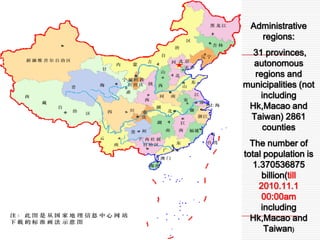
Administrative
regions:
31 provinces,
autonomous
regions and
municipalities (not
including
Hk,Macao and
Taiwan) 2861
counties
The number of
total population is
1.370536875
billion(till
2010.11.1
00:00am
including
Hk,Macao and
Taiwan)
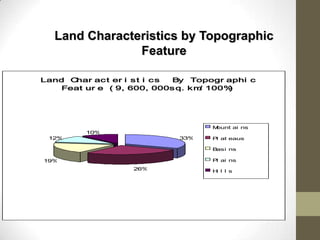
Land Characteristics by Topographic
Feature
Land Char act er i st i cs By Topogr aphi c
Feat ur e ( 9, 600, 000sq. km/ 100%)
33%
26%
19%
12%
10%
Mount ai ns
Pl at eaus
Basi ns
Pl ai ns
Hi l l s
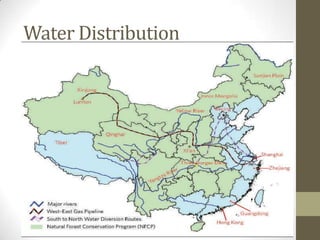
Water Distribution
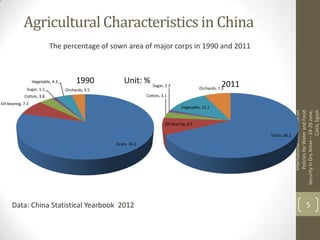
Agricultural Characteristics in China
InternationalConferenceon
PoliciesforWaterandFood
SecurityinDryAreas–24-26June,
Cairo,Egypt
5
Grain, 76.5
Oil-bearing, 7.3
Cotton, 3.8
Sugar, 1.1
Vegetable, 4.3
Orchards, 3.5
1990 Unit: %
Grain, 68.1
Oil-bearing, 8.5
Cotton, 3.1
Sugar, 1.2
Vegetable, 12.1
Orchards, 7.3
2011
The percentage of sown area of major corps in 1990 and 2011
Data: China Statistical Yearbook 2012
Features of the case study
InternationalConferenceonPoliciesforWaterandFoodSecurityinDryAreas–
24-26June,Cairo,Egypt
8
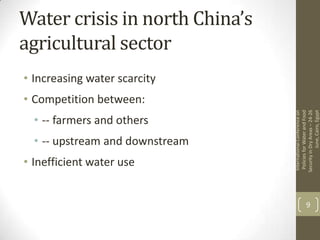
Water crisis in north China’s
agricultural sector
• Increasing water scarcity
• Competition between:
• -- farmers and others
• -- upstream and downstream
• Inefficient water use
InternationalConferenceon
PoliciesforWaterandFood
SecurityinDryAreas–24-26
June,Cairo,Egypt
9
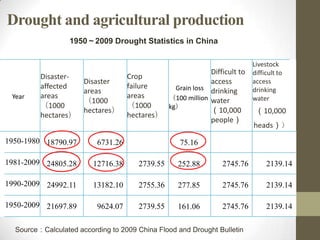
Drought and agricultural production
Year
Disaster-
affected
areas
(1000
hectares)
Disaster
areas
(1000
hectares)
Crop
failure
areas
(1000
hectares)
Grain loss
(100 million
kg)
Difficult to
access
drinking
water
(10,000
people)
Livestock
difficult to
access
drinking
water
(10,000
heads))
1950-1980 18790.97 6731.26 75.16
1981-2009 24805.28 12716.38 2739.55 252.88 2745.76 2139.14
1990-2009 24992.11 13182.10 2755.36 277.85 2745.76 2139.14
1950-2009 21697.89 9624.07 2739.55 161.06 2745.76 2139.14
1950~2009 Drought Statistics in China
Source:Calculated according to 2009 China Flood and Drought Bulletin
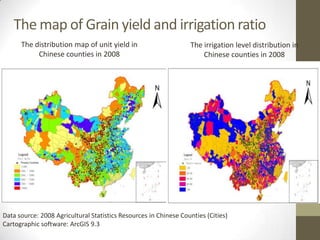
The map of Grain yield and irrigation ratio
The distribution map of unit yield in
Chinese counties in 2008
The irrigation level distribution in
Chinese counties in 2008
Data source: 2008 Agricultural Statistics Resources in Chinese Counties (Cities)
Cartographic software: ArcGIS 9.3
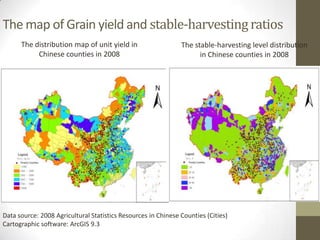
The map of Grain yield and stable-harvestingratios
The distribution map of unit yield in
Chinese counties in 2008
The stable-harvesting level distribution
in Chinese counties in 2008
Data source: 2008 Agricultural Statistics Resources in Chinese Counties (Cities)
Cartographic software: ArcGIS 9.3
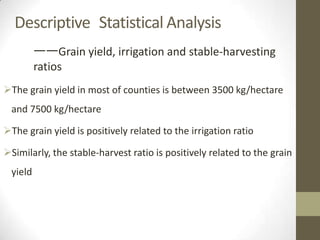
The grain yield in most of counties is between 3500 kg/hectare
and 7500 kg/hectare
The grain yield is positively related to the irrigation ratio
Similarly, the stable-harvest ratio is positively related to the grain
yield
Descriptive Statistical Analysis
——Grain yield, irrigation and stable-harvesting
ratios
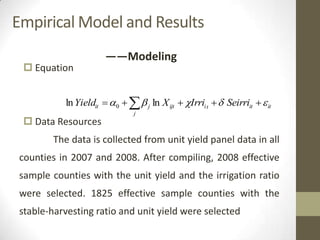
Empirical Model and Results
 Equation
 Data Resources
The data is collected from unit yield panel data in all
counties in 2007 and 2008. After compiling, 2008 effective
sample counties with the unit yield and the irrigation ratio
were selected. 1825 effective sample counties with the
stable-harvesting ratio and unit yield were selected
——Modeling
ititti
j
ijtjit SeirriIrriXYield    lnln 0
实证模型及结果
——模型设定
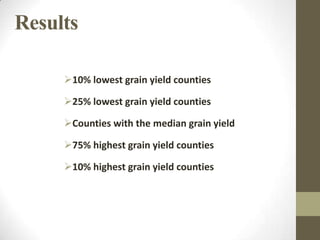
Results
10% lowest grain yield counties
25% lowest grain yield counties
Counties with the median grain yield
75% highest grain yield counties
10% highest grain yield counties
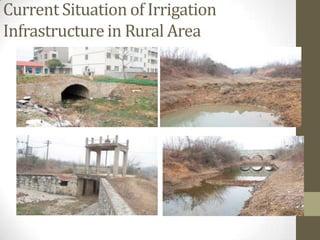
Current Situation of Irrigation
Infrastructure in Rural Area
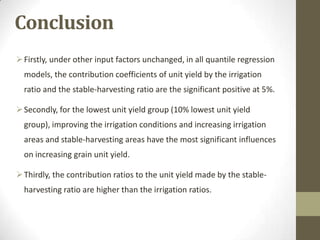
Conclusion
Firstly, under other input factors unchanged, in all quantile regression
models, the contribution coefficients of unit yield by the irrigation
ratio and the stable-harvesting ratio are the significant positive at 5%.
Secondly, for the lowest unit yield group (10% lowest unit yield
group), improving the irrigation conditions and increasing irrigation
areas and stable-harvesting areas have the most significant influences
on increasing grain unit yield.
Thirdly, the contribution ratios to the unit yield made by the stable-
harvesting ratio are higher than the irrigation ratios.
Thanks for listening
Questions, comments and suggestions are welcome

China: Adapting Grain Production to Climate Change

  • 1.
    Grain Production Adaptabilityto Climate Change in China International Conference on Policies for Water and Food Security in Dry Areas 24th to 26th of June, Cairo, Egypt Liujing
  • 2.
    Administrative regions: 31 provinces, autonomous regions and municipalities(not including Hk,Macao and Taiwan) 2861 counties The number of total population is 1.370536875 billion(till 2010.11.1 00:00am including Hk,Macao and Taiwan)
  • 3.
    Land Characteristics byTopographic Feature Land Char act er i st i cs By Topogr aphi c Feat ur e ( 9, 600, 000sq. km/ 100%) 33% 26% 19% 12% 10% Mount ai ns Pl at eaus Basi ns Pl ai ns Hi l l s
  • 4.
  • 5.
    Agricultural Characteristics inChina InternationalConferenceon PoliciesforWaterandFood SecurityinDryAreas–24-26June, Cairo,Egypt 5 Grain, 76.5 Oil-bearing, 7.3 Cotton, 3.8 Sugar, 1.1 Vegetable, 4.3 Orchards, 3.5 1990 Unit: % Grain, 68.1 Oil-bearing, 8.5 Cotton, 3.1 Sugar, 1.2 Vegetable, 12.1 Orchards, 7.3 2011 The percentage of sown area of major corps in 1990 and 2011 Data: China Statistical Yearbook 2012
  • 8.
    Features of thecase study InternationalConferenceonPoliciesforWaterandFoodSecurityinDryAreas– 24-26June,Cairo,Egypt 8
  • 9.
    Water crisis innorth China’s agricultural sector • Increasing water scarcity • Competition between: • -- farmers and others • -- upstream and downstream • Inefficient water use InternationalConferenceon PoliciesforWaterandFood SecurityinDryAreas–24-26 June,Cairo,Egypt 9
  • 10.
    Drought and agriculturalproduction Year Disaster- affected areas (1000 hectares) Disaster areas (1000 hectares) Crop failure areas (1000 hectares) Grain loss (100 million kg) Difficult to access drinking water (10,000 people) Livestock difficult to access drinking water (10,000 heads)) 1950-1980 18790.97 6731.26 75.16 1981-2009 24805.28 12716.38 2739.55 252.88 2745.76 2139.14 1990-2009 24992.11 13182.10 2755.36 277.85 2745.76 2139.14 1950-2009 21697.89 9624.07 2739.55 161.06 2745.76 2139.14 1950~2009 Drought Statistics in China Source:Calculated according to 2009 China Flood and Drought Bulletin
  • 11.
    The map ofGrain yield and irrigation ratio The distribution map of unit yield in Chinese counties in 2008 The irrigation level distribution in Chinese counties in 2008 Data source: 2008 Agricultural Statistics Resources in Chinese Counties (Cities) Cartographic software: ArcGIS 9.3
  • 12.
    The map ofGrain yield and stable-harvestingratios The distribution map of unit yield in Chinese counties in 2008 The stable-harvesting level distribution in Chinese counties in 2008 Data source: 2008 Agricultural Statistics Resources in Chinese Counties (Cities) Cartographic software: ArcGIS 9.3
  • 13.
    The grain yieldin most of counties is between 3500 kg/hectare and 7500 kg/hectare The grain yield is positively related to the irrigation ratio Similarly, the stable-harvest ratio is positively related to the grain yield Descriptive Statistical Analysis ——Grain yield, irrigation and stable-harvesting ratios
  • 14.
    Empirical Model andResults  Equation  Data Resources The data is collected from unit yield panel data in all counties in 2007 and 2008. After compiling, 2008 effective sample counties with the unit yield and the irrigation ratio were selected. 1825 effective sample counties with the stable-harvesting ratio and unit yield were selected ——Modeling ititti j ijtjit SeirriIrriXYield    lnln 0
  • 15.
  • 16.
    Results 10% lowest grainyield counties 25% lowest grain yield counties Counties with the median grain yield 75% highest grain yield counties 10% highest grain yield counties
  • 17.
    Current Situation ofIrrigation Infrastructure in Rural Area
  • 18.
    Conclusion Firstly, under otherinput factors unchanged, in all quantile regression models, the contribution coefficients of unit yield by the irrigation ratio and the stable-harvesting ratio are the significant positive at 5%. Secondly, for the lowest unit yield group (10% lowest unit yield group), improving the irrigation conditions and increasing irrigation areas and stable-harvesting areas have the most significant influences on increasing grain unit yield. Thirdly, the contribution ratios to the unit yield made by the stable- harvesting ratio are higher than the irrigation ratios.
  • 19.
    Thanks for listening Questions,comments and suggestions are welcome