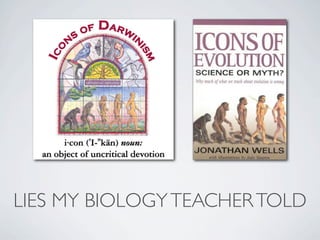
LIES MY BIOLOGY TEACHER TOLD
“Father's words, my studies,
and my prayers convinced me
that I should devote my life to
 destroying Darwinism, just as
       many of my fellow
   Unificationists had already
     devoted their lives to
  destroying Marxism. When
 Father chose me ... to enter a
    Ph.D. program in 1978, I
welcomed the opportunity to
   prepare myself for battle.”
SUN MYUNG MOON
     Founder of Unification Church

     Self-proclaimed Second Coming of Christ and
     “Savior” of humanity

     Owner of Washington Times and United Press
     International (UPI)

     “This small church has played a pivotal role in the
     development of the conservative movement …
     [and] the Christian Right” (Frederick Clarkson)

     “Moon has poured hundreds of millions of dollars
     into a plan to replace American democracy with a
     Unification theocracy.” (Barbara Forrest & Paul
     Gross).
JONATHAN WELLS

    1978 – Graduates Unification
    Theological Seminary with Masters in
    Religious Education

    1986 – Awarded Ph.D. in religious
    studies (Yale)

    1988 – Publishes book on Charles
    Hodge.
JONATHAN WELLS

    1989 – Begins Ph.D. in molecular and
    cellular biology (Berkeley)

    1994 – Receives Ph.D. for A confocal
    microscopy study of microtubule arrays
    involved in cortical rotation during the
    first cell cycle of Xenopus embryos.

    1994 – Begins postdoc at Berkeley
    (Strohman lab)
POSTDOCTORAL

   “He has done extensive work as a
   postdoctoral research biologist at the
   University of California at Berkeley”

   Actually a visiting scholar “working mostly at
   home, writing and doing library
   research” (Wells 1/99)

   Position arranged by Phil Johnson and funded
   from unknown outside sources.

   Obtains no publications from postdoctoral
   work
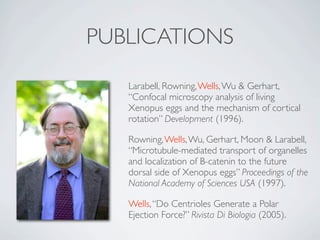
PUBLICATIONS

   Larabell, Rowning, Wells, Wu & Gerhart,
   “Confocal microscopy analysis of living
   Xenopus eggs and the mechanism of cortical
   rotation” Development (1996).

   Rowning, Wells, Wu, Gerhart, Moon & Larabell,
   “Microtubule-mediated transport of organelles
   and localization of B-catenin to the future
   dorsal side of Xenopus eggs” Proceedings of the
   National Academy of Sciences USA (1997).

   Wells, “Do Centrioles Generate a Polar
   Ejection Force?” Rivista Di Biologia (2005).
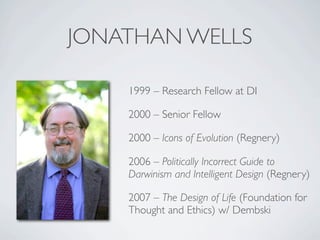
JONATHAN WELLS

    1999 – Research Fellow at DI

    2000 – Senior Fellow

    2000 – Icons of Evolution (Regnery)

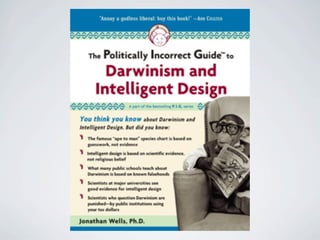
    2006 – Politically Incorrect Guide to
    Darwinism and Intelligent Design (Regnery)

    2007 – The Design of Life (Foundation for
    Thought and Ethics) w/ Dembski
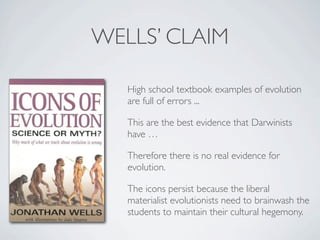
WELLS’ CLAIM

   High school textbook examples of evolution
   are full of errors ...

   This are the best evidence that Darwinists
   have …

   Therefore there is no real evidence for
   evolution.

   The icons persist because the liberal
   materialist evolutionists need to brainwash the
   students to maintain their cultural hegemony.
JONATHAN WELLS


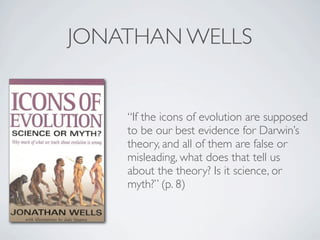
    “If the icons of evolution are supposed
    to be our best evidence for Darwin’s
    theory, and all of them are false or
    misleading, what does that tell us
    about the theory? Is it science, or
    myth?” (p. 8)
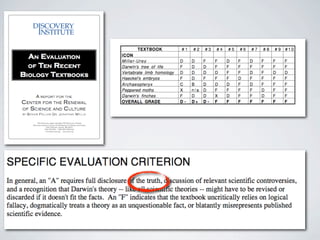
“[S]tudents should be warned, wherever necessary, that their books
misrepresent the truth. Warning labels such as those below can be
used for this purpose” (259)
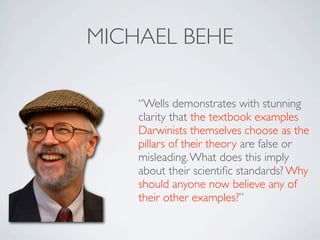
MICHAEL BEHE

    “Wells demonstrates with stunning
    clarity that the textbook examples
    Darwinists themselves choose as the
    pillars of their theory are false or
    misleading. What does this imply
    about their scientific standards? Why
    should anyone now believe any of
    their other examples?”
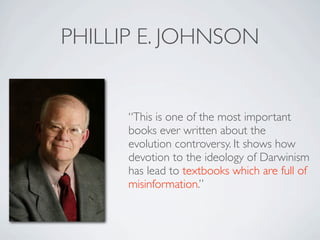
PHILLIP E. JOHNSON


      “This is one of the most important
      books ever written about the
      evolution controversy. It shows how
      devotion to the ideology of Darwinism
      has lead to textbooks which are full of
      misinformation.”
JONATHAN WELLS

    “[T]he icons of evolution have been
    advertised for years as the best evidence
    we have … Many of these biologists believe
    in Darwinian evolution because that’s what
    they learned from their textbooks.” [p. 229]

    “[D]ogmatic promoters of Darwinism did
    not see themselves as deceivers. Yet they
    seriously distorted the evidence – often
    knowingly. If this is fraud when a stock
    promoter does it, what is it when a
    scientists does it?” [p. 234]
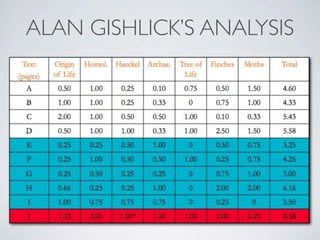
ALAN GISHLICK’S ANALYSIS
IN CONTEXT

  No textbook examined presents the
  “icons” as the “best evidences” for
  evolution.

  The “icons” are discussed in relation to
  evolutionary concepts (e.g. selection,
  adaptive radiation, importance of
  developmental processes) rather than
  as evidence.
WARNING: The Miller-Urey experiment probably
did not simulate the earth's early atmosphere, and
       it does not explain the origin of life.
logy!
                                          bio
                                     ar y
WARNING: The Miller-Urey experiment probably
                                 ion
did not simulate the earth'so lut atmosphere, and
                           ev early
       it does notlem  for the origin of life.
                    explain
              pr ob
           ta
        No
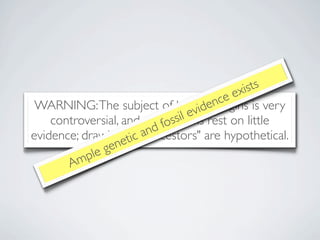
WARNING: The subject of human origins is very
    controversial, and most claims rest on little
evidence; drawings of "ancestors" are hypothetical.
xists
                                           ncee
                                       ide
 WARNING: The subject of human origins is very
                                    ev
    controversial, and most s   sil
                            fo claims rest on little
evidence; drawings tof a nd
                     ic "ancestors" are hypothetical.
               ge ne
           ple
       Am
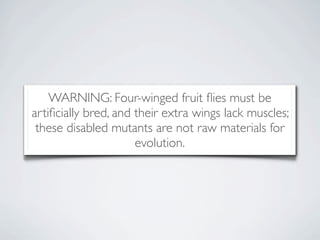
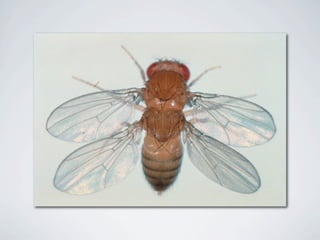
WARNING: Four-winged fruit flies must be
artificially bred, and their extra wings lack muscles;
 these disabled mutants are not raw materials for
                      evolution.
HORSE’S TOES


       6 weeks


                 8 weeks   5 months
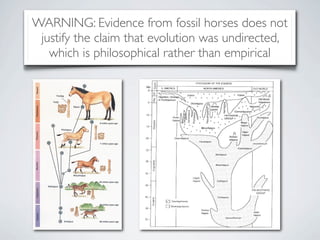
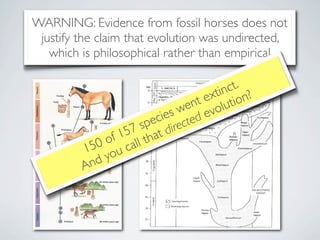
WARNING: Evidence from fossil horses does not
 justify the claim that evolution was undirected,
   which is philosophical rather than empirical
WARNING: Evidence from fossil horses does not
 justify the claim that evolution was undirected,
   which is philosophical rather than empirical

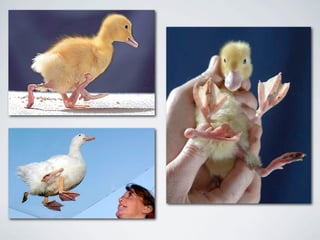
                                       ct.
                                    tin n?
                                  ex tio
                               nt olu
                             we ev
                          ies ted
                        ec rec
                     sp di
                  57 hat
               f 1 ll t
            0 o ca
         15 ou
         An dy
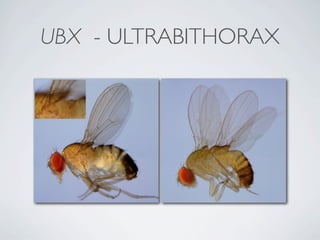
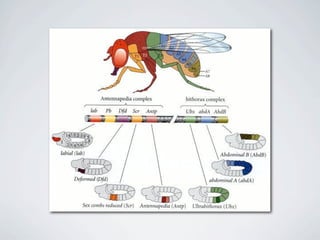
UBX - ULTRABITHORAX
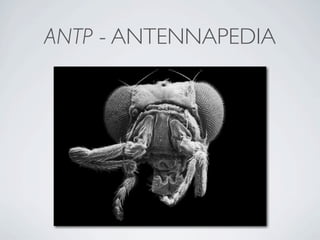
ANTP - ANTENNAPEDIA
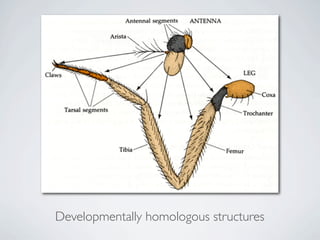
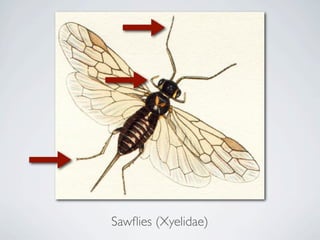
Developmentally homologous structures
Sawflies (Xyelidae)
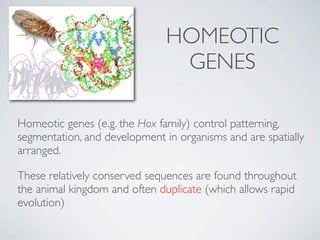
HOMEOTIC
                                GENES

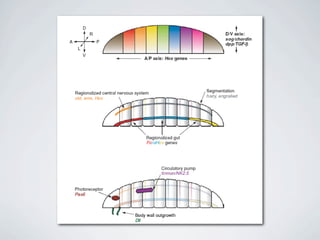
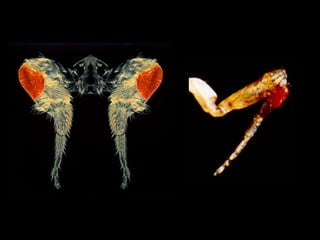
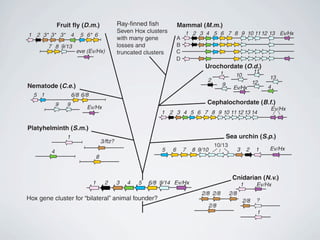
Homeotic genes (e.g. the Hox family) control patterning,
segmentation, and development in organisms and are spatially
arranged.

These relatively conserved sequences are found throughout
the animal kingdom and often duplicate (which allows rapid
evolution)
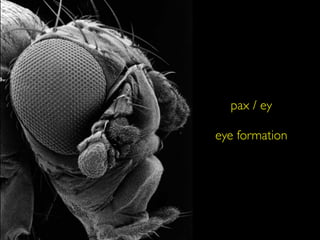
pax / ey

eye formation
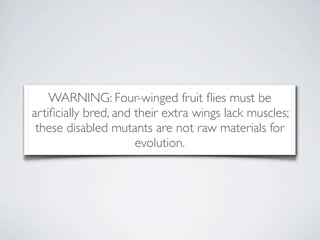
WARNING: Four-winged fruit flies must be
artificially bred, and their extra wings lack muscles;
 these disabled mutants are not raw materials for
                      evolution.
rate?
                                           tmust be
    WARNING: Four-winged fruit fliess    on
artificially bred, and their extra d  em lack muscles;
                                   s wings
                                 e
                               flinot raw materials for
 these disabled mutants ed
                        in g are
                    4-w
                   o evolution.
             ha td
          W
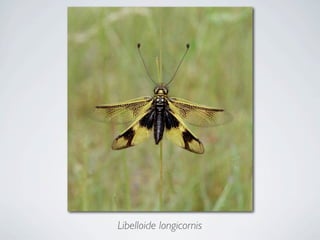
Libelloide longicornis
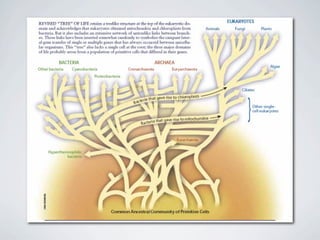
WARNING: Darwin's universal tree of life is
inconsistent with the fossil record of the Cambrian
  explosion and with recent molecular evidence.
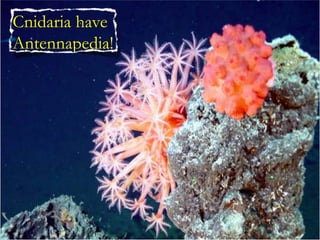
Cnidaria have
Antennapedia!
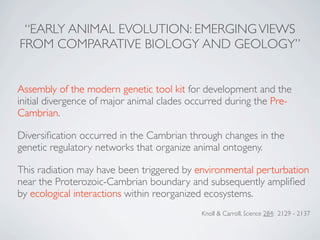
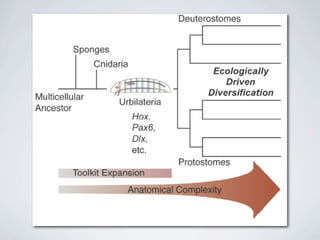
“EARLY ANIMAL EVOLUTION: EMERGING VIEWS
FROM COMPARATIVE BIOLOGY AND GEOLOGY”


Assembly of the modern genetic tool kit for development and the
initial divergence of major animal clades occurred during the Pre-
Cambrian.

Diversification occurred in the Cambrian through changes in the
genetic regulatory networks that organize animal ontogeny.

This radiation may have been triggered by environmental perturbation
near the Proterozoic-Cambrian boundary and subsequently amplified
by ecological interactions within reorganized ecosystems.
                                            Knoll & Carroll, Science 284: 2129 - 2137
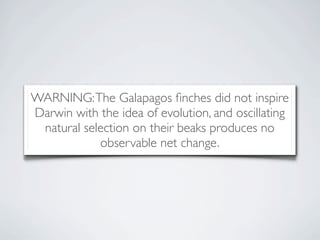
WARNING: The Galapagos finches did not inspire
Darwin with the idea of evolution, and oscillating
 natural selection on their beaks produces no
            observable net change.
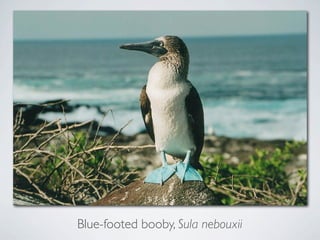
Blue-footed booby, Sula nebouxii
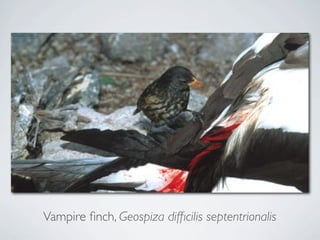
Vampire finch, Geospiza difficilis septentrionalis
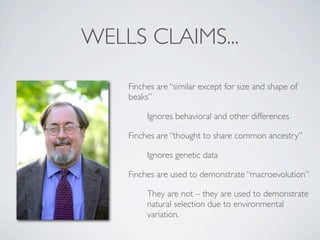
WELLS CLAIMS...

    Finches are “similar except for size and shape of
    beaks”

         Ignores behavioral and other differences

    Finches are “thought to share common ancestry”

         Ignores genetic data

    Finches are used to demonstrate “macroevolution”

         They are not – they are used to demonstrate
         natural selection due to environmental
         variation.
WHAT’S THE POINT?

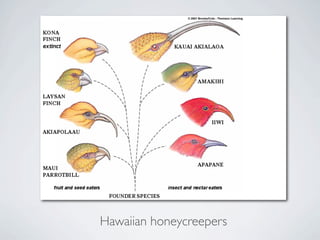
As example of adaptive radiation

       Evidence from genetics, biogeography, behavior, etc.

       Compare with cichlid fishes in East Africa and Hawaiian honeycreepers

As example of measurable natural selection

       Point is not to study (or claim) speciation

       Point is to discuss reasonable extrapolations if trend did continue

              c.f. astronomers studying comets
Hawaiian honeycreepers
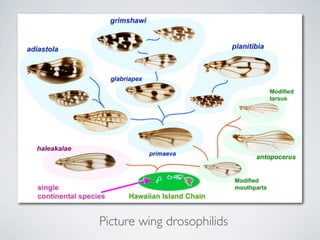
Picture wing drosophilids
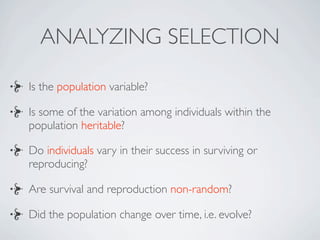
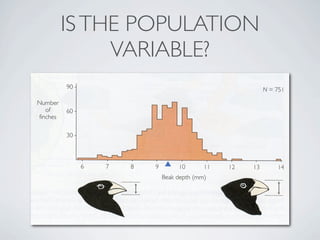
ANALYZING SELECTION

Is the population variable?

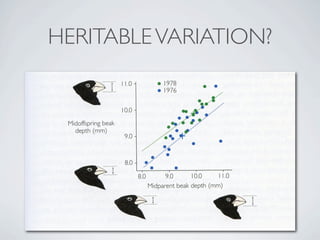
Is some of the variation among individuals within the
population heritable?

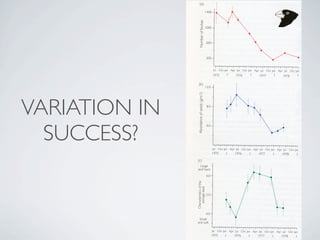
Do individuals vary in their success in surviving or
reproducing?

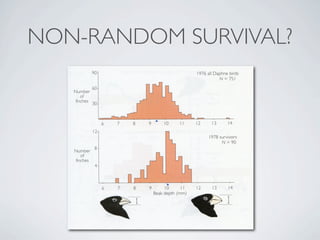
Are survival and reproduction non-random?

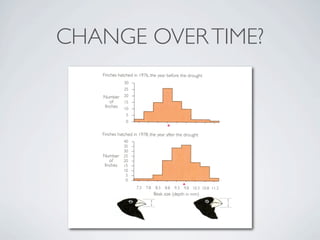
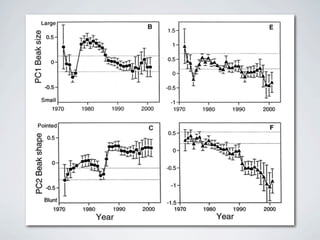
Did the population change over time, i.e. evolve?
IS THE POPULATION
     VARIABLE?
HERITABLE VARIATION?
VARIATION IN
  SUCCESS?
NON-RANDOM SURVIVAL?
CHANGE OVER TIME?
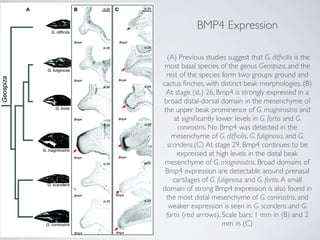
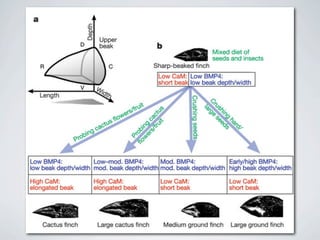
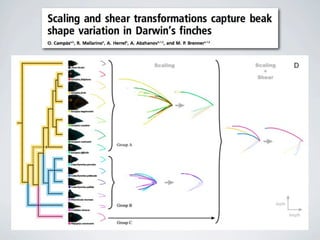
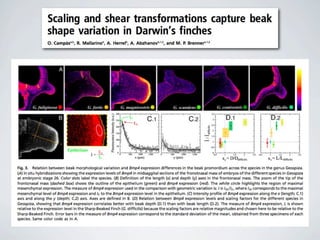
BMP4 Expression

 (A) Previous studies suggest that G. difficilis is the
 most basal species of the genus Geospiza, and the
 rest of the species form two groups: ground and
cactus finches, with distinct beak morphologies. (B)
 At stage (st.) 26, Bmp4 is strongly expressed in a
broad distal-dorsal domain in the mesenchyme of
the upper beak prominence of G. magnirostris and
    at significantly lower levels in G. fortis and G.
      conirostris. No Bmp4 was detected in the
   mesenchyme of G. difficilis, G. fuliginosa, and G.
 scandens.(C) At stage 29, Bmp4 continues to be
      expressed at high levels in the distal beak
 mesenchyme of G. magnirostris. Broad domains of
 Bmp4 expression are detectable around prenasal
    cartilages of G. fuliginosa and G. fortis. A small
domain of strong Bmp4 expression is also found in
 the most distal mesenchyme of G. conirostris, and
  weaker expression is seen in G. scandens and G.
 fortis (red arrows). Scale bars: 1 mm in (B) and 2
                       mm in (C)
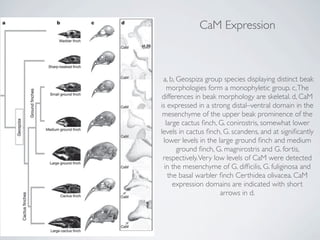
CaM Expression


 a, b, Geospiza group species displaying distinct beak
   morphologies form a monophyletic group. c, The
 differences in beak morphology are skeletal. d, CaM
is expressed in a strong distal–ventral domain in the
 mesenchyme of the upper beak prominence of the
   large cactus finch, G. conirostris, somewhat lower
levels in cactus finch, G. scandens, and at significantly
 lower levels in the large ground finch and medium
       ground finch, G. magnirostris and G. fortis,
 respectively. Very low levels of CaM were detected
  in the mesenchyme of G. difficilis, G. fuliginosa and
    the basal warbler finch Certhidea olivacea. CaM
      expression domains are indicated with short
                      arrows in d.
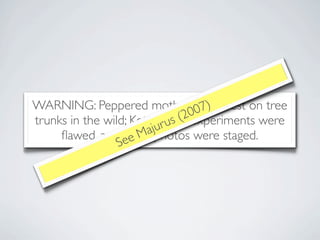
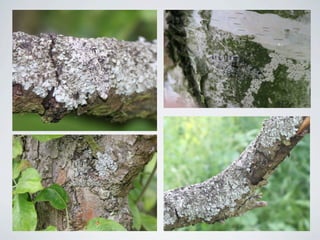
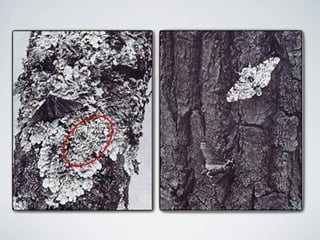
WARNING: Peppered moths do not rest on tree
trunks in the wild; Kettlewell's experiments were
     flawed, and these photos were staged.
)
WARNING: Peppered moths do7not rest on tree
                                  00
                                (2 experiments were
                         u r us
trunks in the wild; Kettlewell's
                       ajphotos were staged.
                    eM
     flawed, and these
                 Se
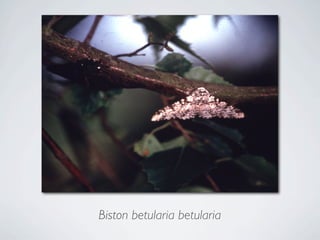
Biston betularia betularia
Biston betularia carbonaria
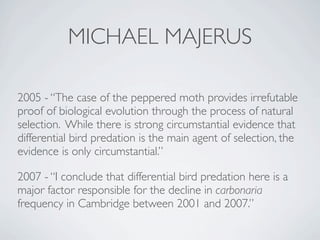
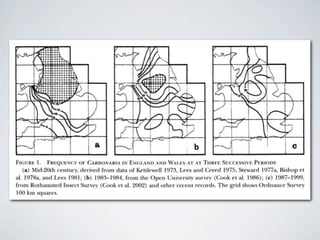
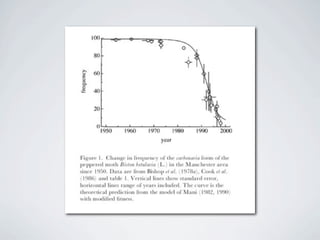
MICHAEL MAJERUS

2005 - “The case of the peppered moth provides irrefutable
proof of biological evolution through the process of natural
selection. While there is strong circumstantial evidence that
differential bird predation is the main agent of selection, the
evidence is only circumstantial.”

2007 - “I conclude that differential bird predation here is a
major factor responsible for the decline in carbonaria
frequency in Cambridge between 2001 and 2007.”
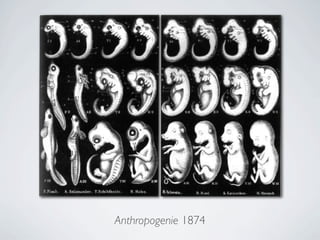
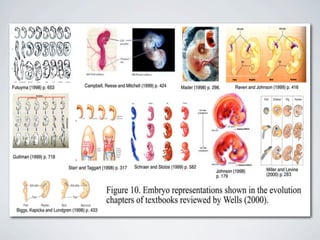
WARNING: These pictures make vertebrate
embryos look more similar than they really are
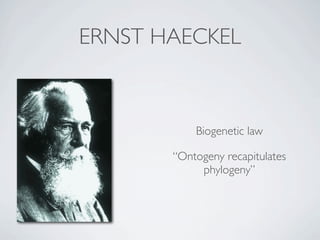
ERNST HAECKEL


           Biogenetic law

       “Ontogeny recapitulates
            phylogeny”
JONATHAN WELLS

    “Darwin was not an embryologist, so he
    relied for his evidence on the work of
    others. One of those was … Haeckel.
    Darwin wrote in The Origin of Species
    that Professor Haeckel ‘brought his
    great knowledge and abilities to bear on
    what he calls phylogeny, or the lines of
    descent of all organic beings. In drawing
    up the several series he trusts chiefly to
    embryological characters’.” [82]
Anthropogenie 1874
PROBLEMS

• Well’s
       implies Darwin is a fraud because he relied on Haeckel’s
 fraudulent images. He didn’t! Darwin’s discussion of
 embryology actually comes from Ernst Von Baer, not Haeckel.

• Haeckel’sAnthropogenie was published in 1874, 15 years after
 the publication of Origin.

• Darwin is praising Haeckel for his generation of phylogenies
 (6th edition, 1872).
WELLS QUOTING DARWIN

“Professor Haeckel in his ‘Generelle Morphologie’ and in another
works, has recently brought his great knowledge and abilities to
bear on what he calls phylogeny, or the lines of descent of all
organic beings. In drawing up the several series he trusts chiefly to
embryological characters
WELLS QUOTING DARWIN

“Professor Haeckel in his ‘Generelle Morphologie’ and in another
works, has recently brought his great knowledge and abilities to
bear on what he calls phylogeny, or the lines of descent of all
organic beings. In drawing up the several series he trusts chiefly to
embryological characters

but receives aid from homologous and rudimentary organs, as
well as from the successive periods at which the various forms of
life are believed to have first appeared in our geological
formations. He has thus boldly made a great beginning, and shows
us how classification will in the future be treated.”
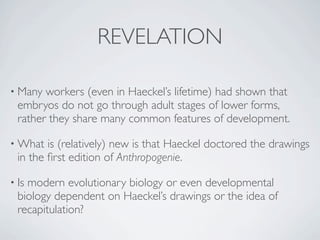
REVELATION

• Many  workers (even in Haeckel’s lifetime) had shown that
  embryos do not go through adult stages of lower forms,
  rather they share many common features of development.

• What   is (relatively) new is that Haeckel doctored the drawings
  in the first edition of Anthropogenie.

• Ismodern evolutionary biology or even developmental
  biology dependent on Haeckel’s drawings or the idea of
  recapitulation?
REVELATION
•   “And it was [Stephen Jay] Gould who (despite having known the truth for over twenty
    years) kept his mouth shut until [Michael Behe] exposed the problem.” (Wells, p. 109)

•   Gould, Ontogeny and Phylogeny, 1977:

          •   Invalidity of Biogenetic Law and detrimental effects of accepting.

          •   Notes that Wilhelm His “accused Haeckel of shocking dishonesty in repeating the
              same picture several times to show the similarity among vertebrates at early
              embryonic stages in several plates” (p. 430).

•   Richardson et al., Science, 1997

          •   Proof of fudging of photos

•   Behe, New York Times Op Ed, 8/13/1999
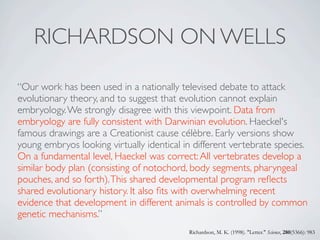
RICHARDSON ON WELLS

“Our work has been used in a nationally televised debate to attack
evolutionary theory, and to suggest that evolution cannot explain
embryology. We strongly disagree with this viewpoint. Data from
embryology are fully consistent with Darwinian evolution. Haeckel's
famous drawings are a Creationist cause célèbre. Early versions show
young embryos looking virtually identical in different vertebrate species.
On a fundamental level, Haeckel was correct: All vertebrates develop a
similar body plan (consisting of notochord, body segments, pharyngeal
pouches, and so forth). This shared developmental program reflects
shared evolutionary history. It also fits with overwhelming recent
evidence that development in different animals is controlled by common
genetic mechanisms.”
                                           Richardson, M. K. (1998). "Letter." Science, 280(5366): 983
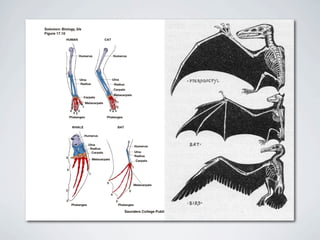
WARNING: If homology is defined as similarity
due to common ancestry, it cannot be used as
evidence for common ancestry; its causes are
                unknown.
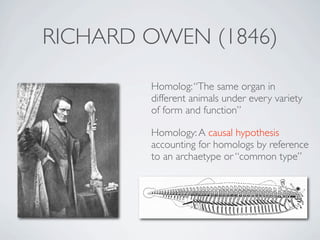
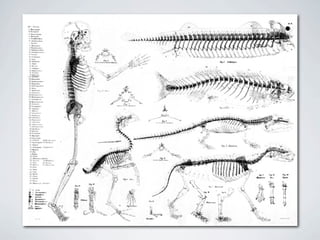
RICHARD OWEN (1846)

        Homolog: “The same organ in
        different animals under every variety
        of form and function”

        Homology: A causal hypothesis
        accounting for homologs by reference
        to an archaetype or “common type”
TAXIC HOMOLOGY

•A causal hypothesis accounting for homologs by common
 descent.

• The
    hypothesis is tested using cladistic methods which consider
 many characters simultaneously.

• Detected homologs are known as synapomorphies (shared
 derived characters).

• Similarity
         not due to common descent is homoplasy
 (homoplasts). This can be due to convergent evolution etc.
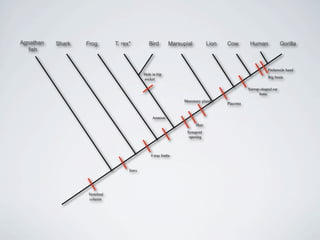
Agnathan   Shark   Frog        T. rex*          Bird        Marsupial           Lion   Cow          Human               Gorilla
   fish


                                                                                                               Prehensile hand!
                                             Hole in hip
                                             socket!                                                           Big brain!

                                                                                                   Stirrup-shaped ear
                                                                                                          bone!
                                                                 Mammary gland!
                                                                                       Placenta!


                                                  Amnion
                                                       !
                                                                        Hair!
                                                                   Synapsid
                                                                    opening
                                                                          !


                                                 4 true limbs!


                                     Jaws!


                   Vertebral
                   column!
DEVELOPMENTAL
                HOMOLOGY
•A causal hypothesis accounting for homologs by shared
 developmental modules or shared gene regulatory networks

• Thisis tested using the tools of evolutionary developmental
 biology.

• Ideally, morphological
                     taxic homologies are due to
 developmental homologies, but sometimes this isn’t the case.
 We don’t know why. The problem reflects our lack of
 knowledge about development rather than evidence against
 evolution.
JONATHAN WELLS

    Textbooks should explain that
    homologies are similarities of structure
    and function due not to common
    ancestry but to a common
    “archetype” (i.e. design).

    He wants to replace a testable model
    (taxic & developmental homology) with
    an untestable construct which is
    consistent with intelligent design and
    baraminology.
SIMILARITY

  “If similarity is the basis for
  classification, what shall we do when
  similarities conflict? The marsupial
  wolf is strikingly similar to the
  placental wolf in most features, yet it is
  like the kangaroo in one significant
  feature [the pouch]. Upon which
  similarity do we build our classification
  scheme?” [29]
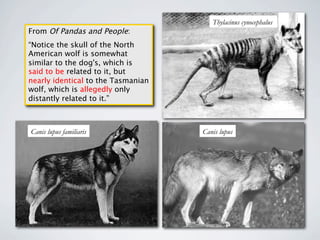
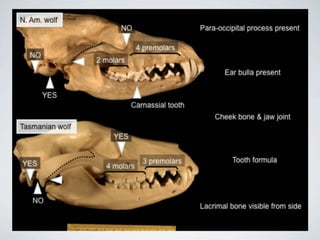
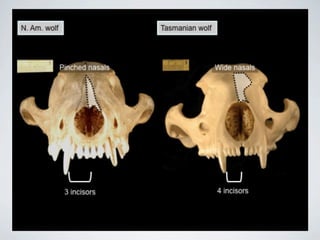
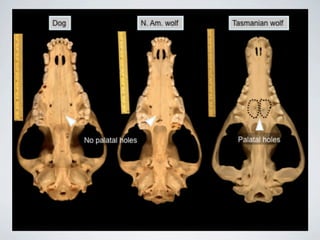
Thylacinus cynocephalus
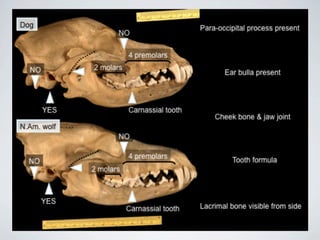
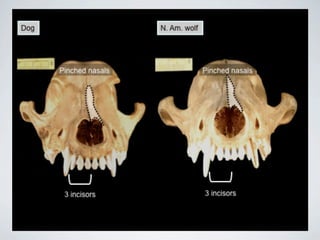
From Of Pandas and People:
“Notice the skull of the North
American wolf is somewhat
similar to the dog's, which is
said to be related to it, but
nearly identical to the Tasmanian
wolf, which is allegedly only
distantly related to it.”


Canis lupus familiaris              Canis lupus
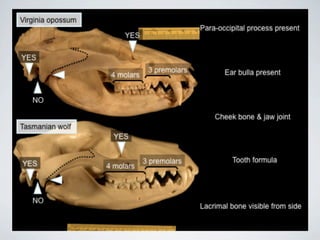
NOT JUST A POUCH
  OR A SKULL!


          Nuclear DNA

        Mitochondrial DNA

         Ribosomal genes
AND YET IT CONTINUES

[I]n skeletal structure, the North American wolf and the now-
extinct Tasmanian wolf are very close ... In some features, such as
their jaws and dentition, these wolves are nearly indistinguishable.
Yet the two animals differ fundamentally in their early development.
Despite the striking similarities in the adults, taxonomists focus on
this difference and therefore classify the two in widely different
categories. [p. 115]... The Tasmanian wolf is strikingly similar to the
North American wolf in most features. Yet the Tasmanian wolf is a
marsupial and hence similar in this one significant feature to the
kangaroo. Upon which similar features do we therefore build our
classification scheme? [Design of Life, 2007 p. 117; c.f. Pandas, p. 29]
WHY ICONS MATTERS

Icons Of Evolution

  • 1.
    LIES MY BIOLOGYTEACHER TOLD
  • 2.
    “Father's words, mystudies, and my prayers convinced me that I should devote my life to destroying Darwinism, just as many of my fellow Unificationists had already devoted their lives to destroying Marxism. When Father chose me ... to enter a Ph.D. program in 1978, I welcomed the opportunity to prepare myself for battle.”
  • 3.
    SUN MYUNG MOON Founder of Unification Church Self-proclaimed Second Coming of Christ and “Savior” of humanity Owner of Washington Times and United Press International (UPI) “This small church has played a pivotal role in the development of the conservative movement … [and] the Christian Right” (Frederick Clarkson) “Moon has poured hundreds of millions of dollars into a plan to replace American democracy with a Unification theocracy.” (Barbara Forrest & Paul Gross).
  • 4.
    JONATHAN WELLS 1978 – Graduates Unification Theological Seminary with Masters in Religious Education 1986 – Awarded Ph.D. in religious studies (Yale) 1988 – Publishes book on Charles Hodge.
  • 5.
    JONATHAN WELLS 1989 – Begins Ph.D. in molecular and cellular biology (Berkeley) 1994 – Receives Ph.D. for A confocal microscopy study of microtubule arrays involved in cortical rotation during the first cell cycle of Xenopus embryos. 1994 – Begins postdoc at Berkeley (Strohman lab)
  • 6.
    POSTDOCTORAL “He has done extensive work as a postdoctoral research biologist at the University of California at Berkeley” Actually a visiting scholar “working mostly at home, writing and doing library research” (Wells 1/99) Position arranged by Phil Johnson and funded from unknown outside sources. Obtains no publications from postdoctoral work
  • 7.
    PUBLICATIONS Larabell, Rowning, Wells, Wu & Gerhart, “Confocal microscopy analysis of living Xenopus eggs and the mechanism of cortical rotation” Development (1996). Rowning, Wells, Wu, Gerhart, Moon & Larabell, “Microtubule-mediated transport of organelles and localization of B-catenin to the future dorsal side of Xenopus eggs” Proceedings of the National Academy of Sciences USA (1997). Wells, “Do Centrioles Generate a Polar Ejection Force?” Rivista Di Biologia (2005).
  • 8.
    JONATHAN WELLS 1999 – Research Fellow at DI 2000 – Senior Fellow 2000 – Icons of Evolution (Regnery) 2006 – Politically Incorrect Guide to Darwinism and Intelligent Design (Regnery) 2007 – The Design of Life (Foundation for Thought and Ethics) w/ Dembski
  • 13.
    WELLS’ CLAIM High school textbook examples of evolution are full of errors ... This are the best evidence that Darwinists have … Therefore there is no real evidence for evolution. The icons persist because the liberal materialist evolutionists need to brainwash the students to maintain their cultural hegemony.
  • 14.
    JONATHAN WELLS “If the icons of evolution are supposed to be our best evidence for Darwin’s theory, and all of them are false or misleading, what does that tell us about the theory? Is it science, or myth?” (p. 8)
  • 15.
    “[S]tudents should bewarned, wherever necessary, that their books misrepresent the truth. Warning labels such as those below can be used for this purpose” (259)
  • 16.
    MICHAEL BEHE “Wells demonstrates with stunning clarity that the textbook examples Darwinists themselves choose as the pillars of their theory are false or misleading. What does this imply about their scientific standards? Why should anyone now believe any of their other examples?”
  • 17.
    PHILLIP E. JOHNSON “This is one of the most important books ever written about the evolution controversy. It shows how devotion to the ideology of Darwinism has lead to textbooks which are full of misinformation.”
  • 18.
    JONATHAN WELLS “[T]he icons of evolution have been advertised for years as the best evidence we have … Many of these biologists believe in Darwinian evolution because that’s what they learned from their textbooks.” [p. 229] “[D]ogmatic promoters of Darwinism did not see themselves as deceivers. Yet they seriously distorted the evidence – often knowingly. If this is fraud when a stock promoter does it, what is it when a scientists does it?” [p. 234]
  • 20.
  • 21.
  • 22.
    IN CONTEXT No textbook examined presents the “icons” as the “best evidences” for evolution. The “icons” are discussed in relation to evolutionary concepts (e.g. selection, adaptive radiation, importance of developmental processes) rather than as evidence.
  • 23.
    WARNING: The Miller-Ureyexperiment probably did not simulate the earth's early atmosphere, and it does not explain the origin of life.
  • 24.
    logy! bio ar y WARNING: The Miller-Urey experiment probably ion did not simulate the earth'so lut atmosphere, and ev early it does notlem for the origin of life. explain pr ob ta No
  • 25.
    WARNING: The subjectof human origins is very controversial, and most claims rest on little evidence; drawings of "ancestors" are hypothetical.
  • 26.
    xists ncee ide WARNING: The subject of human origins is very ev controversial, and most s sil fo claims rest on little evidence; drawings tof a nd ic "ancestors" are hypothetical. ge ne ple Am
  • 27.
    WARNING: Four-winged fruitflies must be artificially bred, and their extra wings lack muscles; these disabled mutants are not raw materials for evolution.
  • 33.
    HORSE’S TOES 6 weeks 8 weeks 5 months
  • 34.
    WARNING: Evidence fromfossil horses does not justify the claim that evolution was undirected, which is philosophical rather than empirical
  • 35.
    WARNING: Evidence fromfossil horses does not justify the claim that evolution was undirected, which is philosophical rather than empirical ct. tin n? ex tio nt olu we ev ies ted ec rec sp di 57 hat f 1 ll t 0 o ca 15 ou An dy
  • 36.
  • 37.
  • 38.
  • 39.
  • 40.
    HOMEOTIC GENES Homeotic genes (e.g. the Hox family) control patterning, segmentation, and development in organisms and are spatially arranged. These relatively conserved sequences are found throughout the animal kingdom and often duplicate (which allows rapid evolution)
  • 44.
    pax / ey eyeformation
  • 47.
    WARNING: Four-winged fruitflies must be artificially bred, and their extra wings lack muscles; these disabled mutants are not raw materials for evolution.
  • 48.
    rate? tmust be WARNING: Four-winged fruit fliess on artificially bred, and their extra d em lack muscles; s wings e flinot raw materials for these disabled mutants ed in g are 4-w o evolution. ha td W
  • 50.
  • 51.
    WARNING: Darwin's universaltree of life is inconsistent with the fossil record of the Cambrian explosion and with recent molecular evidence.
  • 54.
  • 55.
    “EARLY ANIMAL EVOLUTION:EMERGING VIEWS FROM COMPARATIVE BIOLOGY AND GEOLOGY” Assembly of the modern genetic tool kit for development and the initial divergence of major animal clades occurred during the Pre- Cambrian. Diversification occurred in the Cambrian through changes in the genetic regulatory networks that organize animal ontogeny. This radiation may have been triggered by environmental perturbation near the Proterozoic-Cambrian boundary and subsequently amplified by ecological interactions within reorganized ecosystems. Knoll & Carroll, Science 284: 2129 - 2137
  • 59.
    WARNING: The Galapagosfinches did not inspire Darwin with the idea of evolution, and oscillating natural selection on their beaks produces no observable net change.
  • 61.
  • 62.
    Vampire finch, Geospizadifficilis septentrionalis
  • 63.
    WELLS CLAIMS... Finches are “similar except for size and shape of beaks” Ignores behavioral and other differences Finches are “thought to share common ancestry” Ignores genetic data Finches are used to demonstrate “macroevolution” They are not – they are used to demonstrate natural selection due to environmental variation.
  • 64.
    WHAT’S THE POINT? Asexample of adaptive radiation Evidence from genetics, biogeography, behavior, etc. Compare with cichlid fishes in East Africa and Hawaiian honeycreepers As example of measurable natural selection Point is not to study (or claim) speciation Point is to discuss reasonable extrapolations if trend did continue c.f. astronomers studying comets
  • 65.
  • 66.
  • 67.
    ANALYZING SELECTION Is thepopulation variable? Is some of the variation among individuals within the population heritable? Do individuals vary in their success in surviving or reproducing? Are survival and reproduction non-random? Did the population change over time, i.e. evolve?
  • 69.
  • 70.
  • 71.
    VARIATION IN SUCCESS?
  • 72.
  • 73.
  • 75.
    BMP4 Expression (A)Previous studies suggest that G. difficilis is the most basal species of the genus Geospiza, and the rest of the species form two groups: ground and cactus finches, with distinct beak morphologies. (B) At stage (st.) 26, Bmp4 is strongly expressed in a broad distal-dorsal domain in the mesenchyme of the upper beak prominence of G. magnirostris and at significantly lower levels in G. fortis and G. conirostris. No Bmp4 was detected in the mesenchyme of G. difficilis, G. fuliginosa, and G. scandens.(C) At stage 29, Bmp4 continues to be expressed at high levels in the distal beak mesenchyme of G. magnirostris. Broad domains of Bmp4 expression are detectable around prenasal cartilages of G. fuliginosa and G. fortis. A small domain of strong Bmp4 expression is also found in the most distal mesenchyme of G. conirostris, and weaker expression is seen in G. scandens and G. fortis (red arrows). Scale bars: 1 mm in (B) and 2 mm in (C)
  • 76.
    CaM Expression a,b, Geospiza group species displaying distinct beak morphologies form a monophyletic group. c, The differences in beak morphology are skeletal. d, CaM is expressed in a strong distal–ventral domain in the mesenchyme of the upper beak prominence of the large cactus finch, G. conirostris, somewhat lower levels in cactus finch, G. scandens, and at significantly lower levels in the large ground finch and medium ground finch, G. magnirostris and G. fortis, respectively. Very low levels of CaM were detected in the mesenchyme of G. difficilis, G. fuliginosa and the basal warbler finch Certhidea olivacea. CaM expression domains are indicated with short arrows in d.
  • 80.
    WARNING: Peppered mothsdo not rest on tree trunks in the wild; Kettlewell's experiments were flawed, and these photos were staged.
  • 81.
    ) WARNING: Peppered mothsdo7not rest on tree 00 (2 experiments were u r us trunks in the wild; Kettlewell's ajphotos were staged. eM flawed, and these Se
  • 82.
  • 83.
  • 86.
    MICHAEL MAJERUS 2005 -“The case of the peppered moth provides irrefutable proof of biological evolution through the process of natural selection. While there is strong circumstantial evidence that differential bird predation is the main agent of selection, the evidence is only circumstantial.” 2007 - “I conclude that differential bird predation here is a major factor responsible for the decline in carbonaria frequency in Cambridge between 2001 and 2007.”
  • 90.
    WARNING: These picturesmake vertebrate embryos look more similar than they really are
  • 91.
    ERNST HAECKEL Biogenetic law “Ontogeny recapitulates phylogeny”
  • 92.
    JONATHAN WELLS “Darwin was not an embryologist, so he relied for his evidence on the work of others. One of those was … Haeckel. Darwin wrote in The Origin of Species that Professor Haeckel ‘brought his great knowledge and abilities to bear on what he calls phylogeny, or the lines of descent of all organic beings. In drawing up the several series he trusts chiefly to embryological characters’.” [82]
  • 93.
  • 94.
    PROBLEMS • Well’s implies Darwin is a fraud because he relied on Haeckel’s fraudulent images. He didn’t! Darwin’s discussion of embryology actually comes from Ernst Von Baer, not Haeckel. • Haeckel’sAnthropogenie was published in 1874, 15 years after the publication of Origin. • Darwin is praising Haeckel for his generation of phylogenies (6th edition, 1872).
  • 95.
  • 96.
    WELLS QUOTING DARWIN “ProfessorHaeckel in his ‘Generelle Morphologie’ and in another works, has recently brought his great knowledge and abilities to bear on what he calls phylogeny, or the lines of descent of all organic beings. In drawing up the several series he trusts chiefly to embryological characters
  • 97.
    WELLS QUOTING DARWIN “ProfessorHaeckel in his ‘Generelle Morphologie’ and in another works, has recently brought his great knowledge and abilities to bear on what he calls phylogeny, or the lines of descent of all organic beings. In drawing up the several series he trusts chiefly to embryological characters but receives aid from homologous and rudimentary organs, as well as from the successive periods at which the various forms of life are believed to have first appeared in our geological formations. He has thus boldly made a great beginning, and shows us how classification will in the future be treated.”
  • 99.
    REVELATION • Many workers (even in Haeckel’s lifetime) had shown that embryos do not go through adult stages of lower forms, rather they share many common features of development. • What is (relatively) new is that Haeckel doctored the drawings in the first edition of Anthropogenie. • Ismodern evolutionary biology or even developmental biology dependent on Haeckel’s drawings or the idea of recapitulation?
  • 100.
    REVELATION • “And it was [Stephen Jay] Gould who (despite having known the truth for over twenty years) kept his mouth shut until [Michael Behe] exposed the problem.” (Wells, p. 109) • Gould, Ontogeny and Phylogeny, 1977: • Invalidity of Biogenetic Law and detrimental effects of accepting. • Notes that Wilhelm His “accused Haeckel of shocking dishonesty in repeating the same picture several times to show the similarity among vertebrates at early embryonic stages in several plates” (p. 430). • Richardson et al., Science, 1997 • Proof of fudging of photos • Behe, New York Times Op Ed, 8/13/1999
  • 102.
    RICHARDSON ON WELLS “Ourwork has been used in a nationally televised debate to attack evolutionary theory, and to suggest that evolution cannot explain embryology. We strongly disagree with this viewpoint. Data from embryology are fully consistent with Darwinian evolution. Haeckel's famous drawings are a Creationist cause célèbre. Early versions show young embryos looking virtually identical in different vertebrate species. On a fundamental level, Haeckel was correct: All vertebrates develop a similar body plan (consisting of notochord, body segments, pharyngeal pouches, and so forth). This shared developmental program reflects shared evolutionary history. It also fits with overwhelming recent evidence that development in different animals is controlled by common genetic mechanisms.” Richardson, M. K. (1998). "Letter." Science, 280(5366): 983
  • 103.
    WARNING: If homologyis defined as similarity due to common ancestry, it cannot be used as evidence for common ancestry; its causes are unknown.
  • 105.
    RICHARD OWEN (1846) Homolog: “The same organ in different animals under every variety of form and function” Homology: A causal hypothesis accounting for homologs by reference to an archaetype or “common type”
  • 108.
    TAXIC HOMOLOGY •A causalhypothesis accounting for homologs by common descent. • The hypothesis is tested using cladistic methods which consider many characters simultaneously. • Detected homologs are known as synapomorphies (shared derived characters). • Similarity not due to common descent is homoplasy (homoplasts). This can be due to convergent evolution etc.
  • 110.
    Agnathan Shark Frog T. rex* Bird Marsupial Lion Cow Human Gorilla fish Prehensile hand! Hole in hip socket! Big brain! Stirrup-shaped ear bone! Mammary gland! Placenta! Amnion ! Hair! Synapsid opening ! 4 true limbs! Jaws! Vertebral column!
  • 111.
    DEVELOPMENTAL HOMOLOGY •A causal hypothesis accounting for homologs by shared developmental modules or shared gene regulatory networks • Thisis tested using the tools of evolutionary developmental biology. • Ideally, morphological taxic homologies are due to developmental homologies, but sometimes this isn’t the case. We don’t know why. The problem reflects our lack of knowledge about development rather than evidence against evolution.
  • 112.
    JONATHAN WELLS Textbooks should explain that homologies are similarities of structure and function due not to common ancestry but to a common “archetype” (i.e. design). He wants to replace a testable model (taxic & developmental homology) with an untestable construct which is consistent with intelligent design and baraminology.
  • 113.
    SIMILARITY “Ifsimilarity is the basis for classification, what shall we do when similarities conflict? The marsupial wolf is strikingly similar to the placental wolf in most features, yet it is like the kangaroo in one significant feature [the pouch]. Upon which similarity do we build our classification scheme?” [29]
  • 114.
    Thylacinus cynocephalus From OfPandas and People: “Notice the skull of the North American wolf is somewhat similar to the dog's, which is said to be related to it, but nearly identical to the Tasmanian wolf, which is allegedly only distantly related to it.” Canis lupus familiaris Canis lupus
  • 124.
    NOT JUST APOUCH OR A SKULL! Nuclear DNA Mitochondrial DNA Ribosomal genes
  • 125.
    AND YET ITCONTINUES [I]n skeletal structure, the North American wolf and the now- extinct Tasmanian wolf are very close ... In some features, such as their jaws and dentition, these wolves are nearly indistinguishable. Yet the two animals differ fundamentally in their early development. Despite the striking similarities in the adults, taxonomists focus on this difference and therefore classify the two in widely different categories. [p. 115]... The Tasmanian wolf is strikingly similar to the North American wolf in most features. Yet the Tasmanian wolf is a marsupial and hence similar in this one significant feature to the kangaroo. Upon which similar features do we therefore build our classification scheme? [Design of Life, 2007 p. 117; c.f. Pandas, p. 29]
  • 126.

Editor's Notes

  • #10 Regnery also publishes Ann Coulter / Newt Gingerich & books Swift boating John Kerry
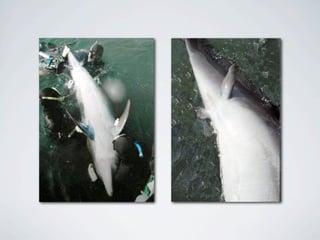
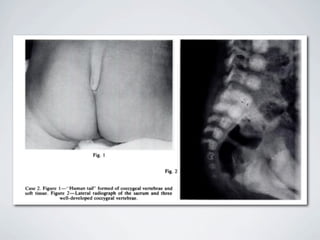
  • #31 Also human tails, webbed feet, snakes with legs etc