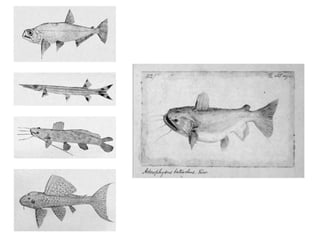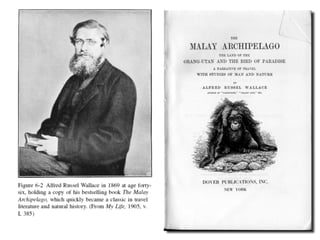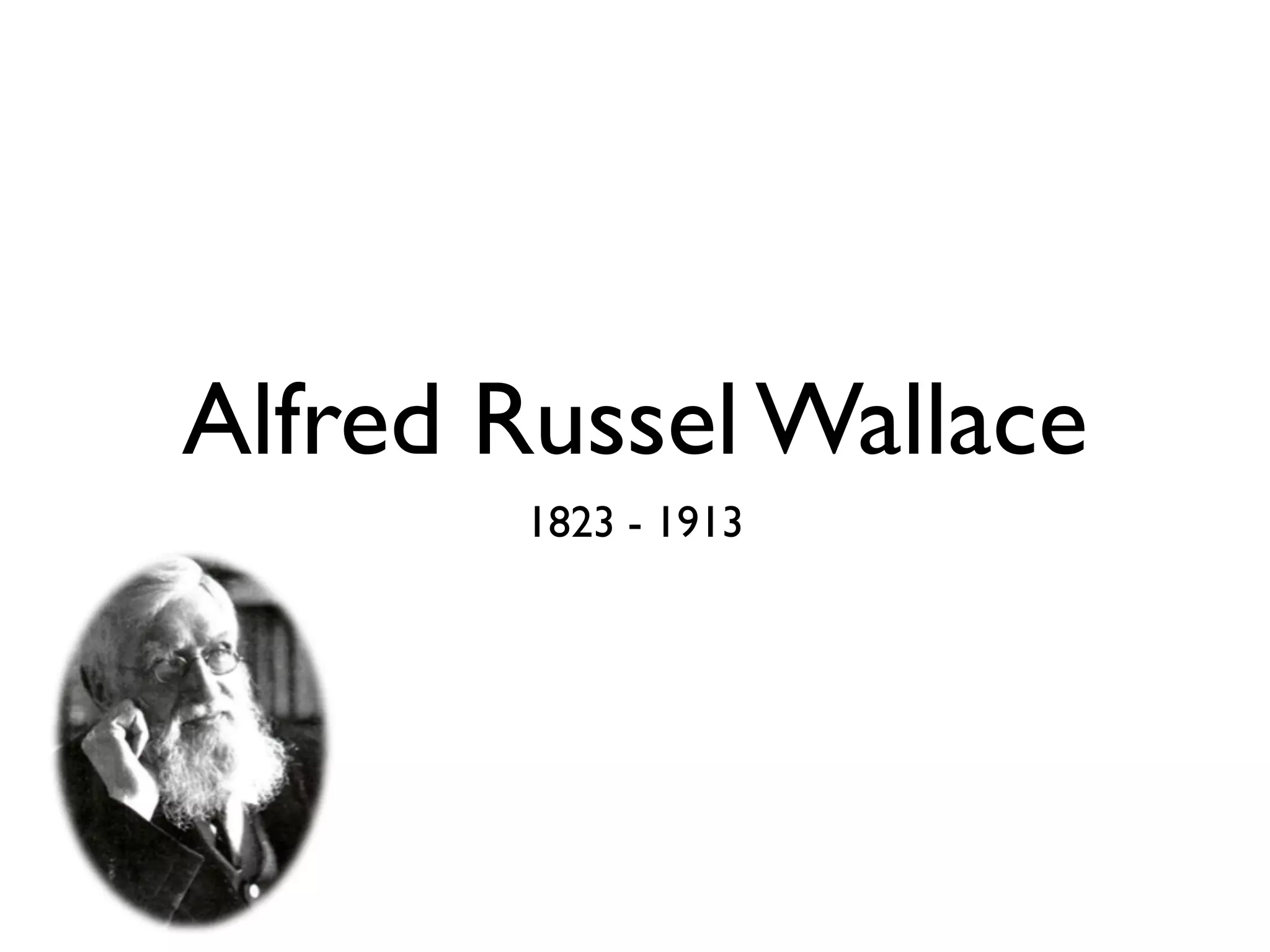
Alfred Russel Wallace
       1823 - 1913
Myths

Wallace was the real discoverer of natural selection
and Darwin stole the idea from him
Wallace fully accepted the power of natural selection
Wallace eventually spent his later years avoiding
evolution and examining issues which were wholly
marginal.
Wallace can be thought of as a “design theorist”
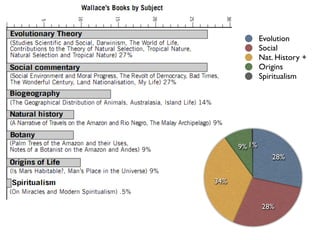
Evolution
              Social
              Nat. History +
              Origins
              Spiritualism


      9% 1%
                 28%


34%


              28%
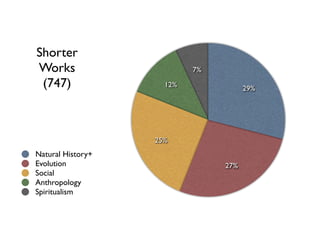
Shorter
Works                      7%

 (747)               12%              29%


                   25%
Natural History+
Evolution                       27%
Social
Anthropology
Spiritualism
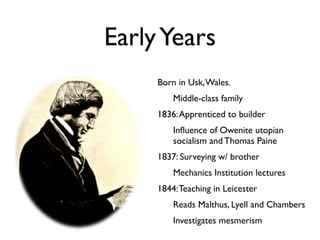
Early Years
     Born in Usk, Wales.
         Middle-class family
     1836: Apprenticed to builder
         Influence of Owenite utopian
         socialism and Thomas Paine
     1837: Surveying w/ brother
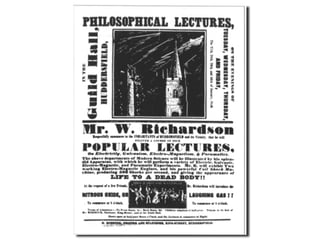
         Mechanics Institution lectures
     1844: Teaching in Leicester
         Reads Malthus, Lyell and Chambers
         Investigates mesmerism
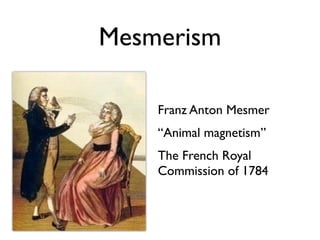
Mesmerism

    Franz Anton Mesmer
    “Animal magnetism”
    The French Royal
    Commission of 1784
On Vestiges
“I have a rather more favourable opinion of the ‘Vestiges’
than you [Bates] appear to have. I do not consider it a
hasty generalization, but rather as an ingenious hypothesis
strongly supported by some striking facts and analogies,
but which remains to be proven by more facts and the
additional light which more research may throw upon the
problem. It furnishes a subject for every student of nature
to attend to; every fact he observes will make either for
or against it, and it thus serves both as an incitement to
the collection of facts, and an object to which they can be
applied when collected.”
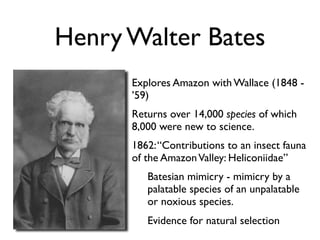
Henry Walter Bates
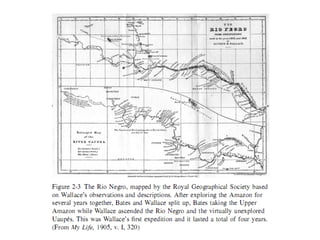
      Explores Amazon with Wallace (1848 -
      ’59)
      Returns over 14,000 species of which
      8,000 were new to science.
      1862: “Contributions to an insect fauna
      of the Amazon Valley: Heliconiidae”
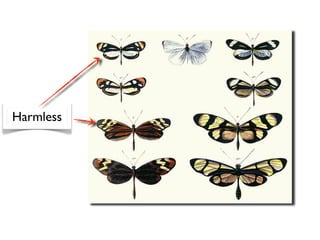
         Batesian mimicry - mimicry by a
         palatable species of an unpalatable
         or noxious species.
         Evidence for natural selection
Harmless
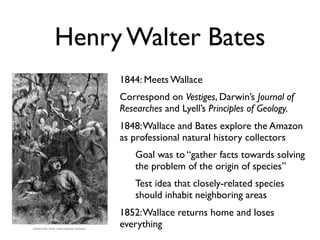
Henry Walter Bates
     1844: Meets Wallace
     Correspond on Vestiges, Darwin’s Journal of
     Researches and Lyell’s Principles of Geology.
     1848: Wallace and Bates explore the Amazon
     as professional natural history collectors
         Goal was to “gather facts towards solving
         the problem of the origin of species”
         Test idea that closely-related species
         should inhabit neighboring areas
     1852: Wallace returns home and loses
     everything
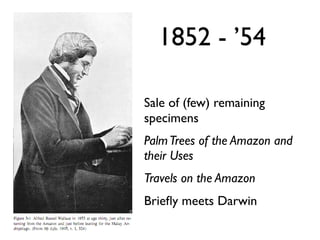
1852 - ’54

Sale of (few) remaining
specimens
Palm Trees of the Amazon and
their Uses
Travels on the Amazon
Briefly meets Darwin
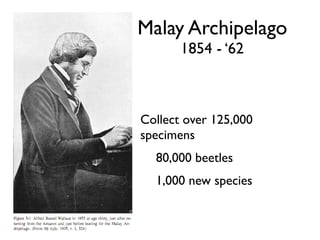
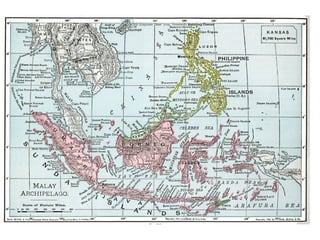
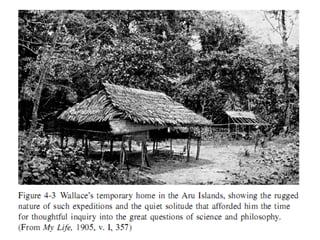
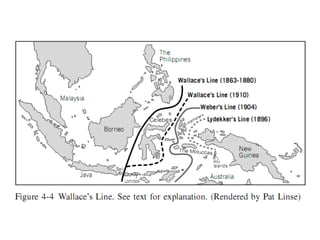
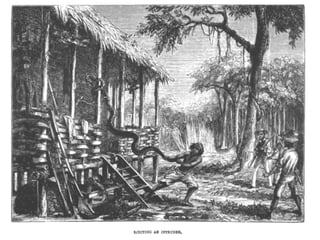
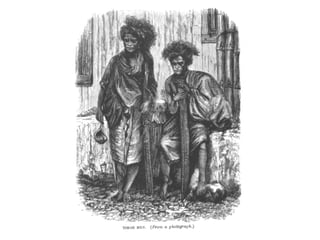
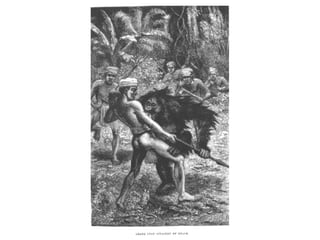
Malay Archipelago
       1854 - ‘62


Collect over 125,000
specimens
  80,000 beetles
  1,000 new species
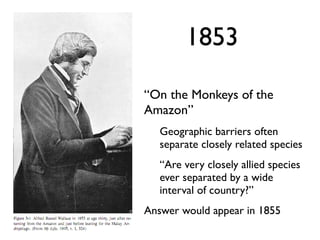
1853

“On the Monkeys of the
Amazon”
   Geographic barriers often
   separate closely related species
   “Are very closely allied species
   ever separated by a wide
   interval of country?”
Answer would appear in 1855
Species
“On the Law which has regulated the introduction of
new species” (1855)
Four geographical facts and five geological facts
One deduction (the “Sarawak Law”), namely:
   “Every species has come into existence coincident
   both in space and time with a pre-existing closely
   allied species.”
Transmutation!
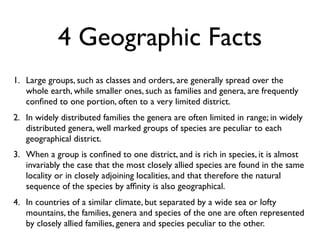
4 Geographic Facts
1. Large groups, such as classes and orders, are generally spread over the
   whole earth, while smaller ones, such as families and genera, are frequently
   confined to one portion, often to a very limited district.
2. In widely distributed families the genera are often limited in range; in widely
   distributed genera, well marked groups of species are peculiar to each
   geographical district.
3. When a group is confined to one district, and is rich in species, it is almost
   invariably the case that the most closely allied species are found in the same
   locality or in closely adjoining localities, and that therefore the natural
   sequence of the species by affinity is also geographical.
4. In countries of a similar climate, but separated by a wide sea or lofty
   mountains, the families, genera and species of the one are often represented
   by closely allied families, genera and species peculiar to the other.
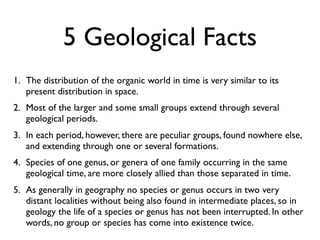
5 Geological Facts
1. The distribution of the organic world in time is very similar to its
   present distribution in space.
2. Most of the larger and some small groups extend through several
   geological periods.
3. In each period, however, there are peculiar groups, found nowhere else,
   and extending through one or several formations.
4. Species of one genus, or genera of one family occurring in the same
   geological time, are more closely allied than those separated in time.
5. As generally in geography no species or genus occurs in two very
   distant localities without being also found in intermediate places, so in
   geology the life of a species or genus has not been interrupted. In other
   words, no group or species has come into existence twice.
Reaction

Lyell: Began to see the possibility of transmutation
Blyth: “Good! Upon the whole!... Wallace has, I think
put the matter well”
Darwin: “[N]othing very new ... Uses my simile of tree
[but] it seems all creation with him.”
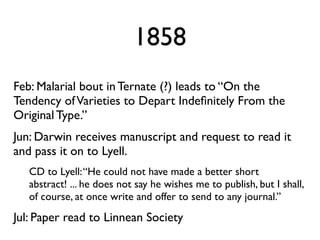
1858
Feb: Malarial bout in Ternate (?) leads to “On the
Tendency of Varieties to Depart Indefinitely From the
Original Type.”
Jun: Darwin receives manuscript and request to read it
and pass it on to Lyell.
   CD to Lyell: “He could not have made a better short
   abstract! ... he does not say he wishes me to publish, but I shall,
   of course, at once write and offer to send to any journal.”
Jul: Paper read to Linnean Society
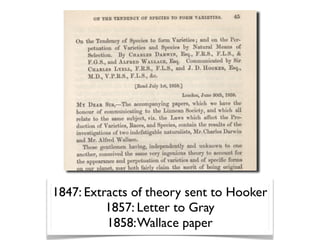
1847: Extracts of theory sent to Hooker
          1857: Letter to Gray
          1858: Wallace paper
Wallace
                            To Hooker Sep 1858
“Allow me in the first place sincerely to thank yourself & Sir Charles Lyell for your kind offices on
this occasion, & to assure you of the gratification afforded me both by the course you have
pursued & the favourable opinions of my essay which you have so kindly expressed. I cannot but
consider myself a favoured party in this matter, because it has hitherto been too much the
practice in cases of this sort to impute all the merit to the first discoverer of a new fact or a new
theory, & little or none to any other party who may, quite independently, have arrived at the same
result a few years or a few hours later.
	

   I also look upon it as a most fortunate circumstance that I had a short time ago commenced
a correspondence with Mr. Darwin on the subject of “Varieties,” since it has led to the earlier
publication of a portion of his researches & has secured to him a claim of priority which an
independent publication either by myself or some other party might have injuriously affected, —
for it is evident that the time has now arrived when these & similar views will be promulgated &
must be fairly discussed.
	

 It would have caused me such pain & regret had Mr. Darwin’s excess of generosity led him to
make public my paper unaccompanied by his own much earlier & I doubt not much more
complete views on the same subject, & I must again thank you for the course you have adopted,
which while strictly just to both parties, is so favourable to myself.”
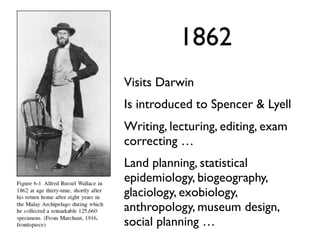
1862
Visits Darwin
Is introduced to Spencer & Lyell
Writing, lecturing, editing, exam
correcting …
Land planning, statistical
epidemiology, biogeography,
glaciology, exobiology,
anthropology, museum design,
social planning …
Ideas

•   Greenbelts (1882)           •   Fire hoses for riot
                                    control (1899)
•   Protection of rural areas
    as monuments (1882)         •   Mars is uninhabited
                                    (1907)
•   Labeling of goods (1885)
                                •   Overhunting causes
•   Paper money as                  extinctions at the end of
                                    the Pleistocene (1910)
    standard (1898)
Natural Selection

1863: “Remarks on Haughton’s Paper on the Bee’s Cell
and on the Origin of Species”
1867: “Creation by Law” (against Argyll)
1870: Contributions to the Theory of Natural Selection
1889: Darwinism
Darwin and Wallace
Natural Selection
   “environmental pressures on varieties” (ARW) versus “competition
   between individuals” (CD)
   NS “checks and corrects any irregularities almost before they
   become evident.”
   Denial of ubiquitous power specifically with regard to human mind.
Sexual selection
   Denial of (much) power
   Tropical Nature and Other Essays (1878) presented alternative and
   explained warning coloration of caterpillars etc
Wallace Effect

1889: Darwinism
When two populations of a species have diverged,
hybrid offspring would be less-well adapted and natural
selection would eliminate the hybrids.
Individuals who avoid hybridization (for whatever
reason) would be fitter.
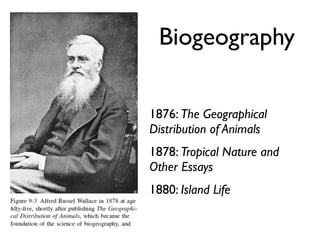
Biogeography

1876: The Geographical
Distribution of Animals
1878: Tropical Nature and
Other Essays
1880: Island Life
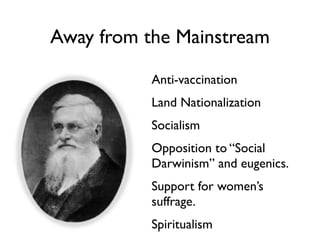
Away from the Mainstream

           Anti-vaccination
           Land Nationalization
           Socialism
           Opposition to “Social
           Darwinism” and eugenics.
           Support for women’s
           suffrage.
           Spiritualism
Selection and Humans
1864: “The Origin of Human Races and the Antiquity
of Man Deduced From the Theory of ‘Natural
Selection’”
Accepted human evolution as a two stage process:
body (bipedalism) and brain.
But cannot explain artistic/musical abilities, humor, or
philosophy (CD used sexual selection).
Spirit

Something in the “unseen universe of Spirit” had:
  created life from non-life,
  introduced consciousness to higher organisms, and
  generated the higher faculties in humans.
The development of human spirit was the reason for
the universe (anthropocentric teleology)
Spiritualism
   Wallace become interested in 1865
   “I thus learnt my first great lesson in the
   inquiry into [mesmerism], never to accept the
   disbelief of great men or their accusations of
   imposture or of imbecility, as of any weight
   when opposed to the repeated observation of
   facts by other men, admittedly sane and
   honest. The whole history of science shows us
   that whenever the educated and scientific men
   of any age have denied the facts of other
   investigators on a priori grounds of absurdity
   or impossibility, the deniers have always been
   wrong.”
   Science and philosophy, not religion
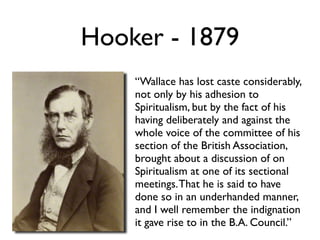
Hooker - 1879
    “Wallace has lost caste considerably,
    not only by his adhesion to
    Spiritualism, but by the fact of his
    having deliberately and against the
    whole voice of the committee of his
    section of the British Association,
    brought about a discussion of on
    Spiritualism at one of its sectional
    meetings. That he is said to have
    done so in an underhanded manner,
    and I well remember the indignation
    it gave rise to in the B.A. Council.”
Wallace
Spiritualism could explain historical events and provide a
moral theory
Spiritualism was testable and verifiable
Scientists have wrongly ignore the evidence for spiritualism;
   “[They] seem to think that it is an argument against the
   facts being genuine that they cannot all be produced and
   exhibited at will; and another argument against them, that
   they cannot be explained by any known laws. But neither
   can catalepsy, the fall of meteoric stones nor hydrophobia”
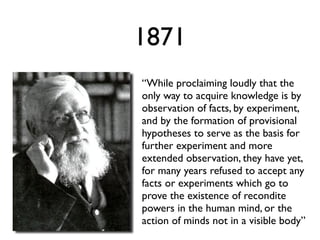
1871
“While proclaiming loudly that the
only way to acquire knowledge is by
observation of facts, by experiment,
and by the formation of provisional
hypotheses to serve as the basis for
further experiment and more
extended observation, they have yet,
for many years refused to accept any
facts or experiments which go to
prove the existence of recondite
powers in the human mind, or the
action of minds not in a visible body”
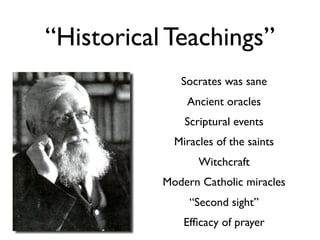
“Historical Teachings”
              Socrates was sane
               Ancient oracles
               Scriptural events
             Miracles of the saints
                  Witchcraft
           Modern Catholic miracles
                “Second sight”
               Efficacy of prayer
1875
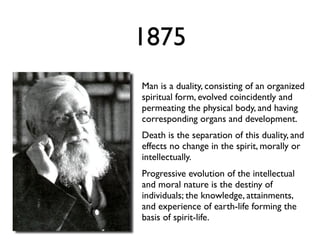
Man is a duality, consisting of an organized
spiritual form, evolved coincidently and
permeating the physical body, and having
corresponding organs and development.
Death is the separation of this duality, and
effects no change in the spirit, morally or
intellectually.
Progressive evolution of the intellectual
and moral nature is the destiny of
individuals; the knowledge, attainments,
and experience of earth-life forming the
basis of spirit-life.
Moral Force
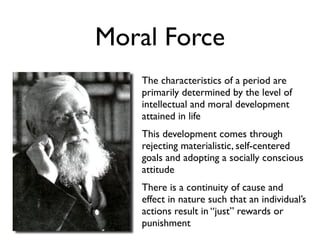
   The characteristics of a period are
   primarily determined by the level of
   intellectual and moral development
   attained in life
   This development comes through
   rejecting materialistic, self-centered
   goals and adopting a socially conscious
   attitude
   There is a continuity of cause and
   effect in nature such that an individual’s
   actions result in “just” rewards or
   punishment
Wallace and Design
Opposition to materialism and support for teleology &
purpose is equated with “intelligent design” and/or theistic
evolutionism.
If so, so what?
C.H. Smith: “Don’t fall for the facile understanding being
promoted by some agenda-driven observers who argue
that, just because Wallace was a spiritualist and believed
that ‘higher intelligences’ were influencing events here on
earth, that he also believed in miraculous, non-law-based
kinds of Godly intervention.”
Wallace
Now, in referring to the origin of man, and its possible determining causes, I have used
the words "some other power" - "some intelligent power" - "a superior intelligence" - "a
controlling intelligence," and only in reference to the origin of universal forces and laws
have I spoken of the will or power of "one Supreme Intelligence." These are the only
expressions I have used in alluding to the power which I believe has acted in the case of
man, and they were purposely chosen to show, that I reject the hypothesis of "first
causes" for any and every special effect in the universe, except in the same sense that
the action of man or of any other intelligent being is a first cause. In using such terms I
wished to show plainly, that I contemplated the possibility that the development of the
essentially human portions of man's structure and intellect may have been determined by
the directing influence of some higher intelligent beings, acting through natural and
universal laws. A belief of this nature may or may not have a foundation, but it is an
intelligible theory, and is not, in its nature, incapable of proof; and it rests on facts and
arguments of an exactly similar kind to those, which would enable a sufficiently powerful
intellect to deduce, from the existence on the earth of cultivated plants and domestic
animals, the presence of some intelligent being of a higher nature than themselves.
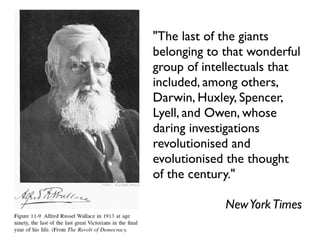
"The last of the giants
belonging to that wonderful
group of intellectuals that
included, among others,
Darwin, Huxley, Spencer,
Lyell, and Owen, whose
daring investigations
revolutionised and
evolutionised the thought
of the century."

             New York Times

13 wallace

  • 1.
  • 2.
    Myths Wallace was thereal discoverer of natural selection and Darwin stole the idea from him Wallace fully accepted the power of natural selection Wallace eventually spent his later years avoiding evolution and examining issues which were wholly marginal. Wallace can be thought of as a “design theorist”
  • 3.
    Evolution Social Nat. History + Origins Spiritualism 9% 1% 28% 34% 28%
  • 4.
    Shorter Works 7% (747) 12% 29% 25% Natural History+ Evolution 27% Social Anthropology Spiritualism
  • 5.
    Early Years Born in Usk, Wales. Middle-class family 1836: Apprenticed to builder Influence of Owenite utopian socialism and Thomas Paine 1837: Surveying w/ brother Mechanics Institution lectures 1844: Teaching in Leicester Reads Malthus, Lyell and Chambers Investigates mesmerism
  • 6.
    Mesmerism Franz Anton Mesmer “Animal magnetism” The French Royal Commission of 1784
  • 7.
    On Vestiges “I havea rather more favourable opinion of the ‘Vestiges’ than you [Bates] appear to have. I do not consider it a hasty generalization, but rather as an ingenious hypothesis strongly supported by some striking facts and analogies, but which remains to be proven by more facts and the additional light which more research may throw upon the problem. It furnishes a subject for every student of nature to attend to; every fact he observes will make either for or against it, and it thus serves both as an incitement to the collection of facts, and an object to which they can be applied when collected.”
  • 8.
    Henry Walter Bates Explores Amazon with Wallace (1848 - ’59) Returns over 14,000 species of which 8,000 were new to science. 1862: “Contributions to an insect fauna of the Amazon Valley: Heliconiidae” Batesian mimicry - mimicry by a palatable species of an unpalatable or noxious species. Evidence for natural selection
  • 9.
  • 11.
    Henry Walter Bates 1844: Meets Wallace Correspond on Vestiges, Darwin’s Journal of Researches and Lyell’s Principles of Geology. 1848: Wallace and Bates explore the Amazon as professional natural history collectors Goal was to “gather facts towards solving the problem of the origin of species” Test idea that closely-related species should inhabit neighboring areas 1852: Wallace returns home and loses everything
  • 17.
    1852 - ’54 Saleof (few) remaining specimens Palm Trees of the Amazon and their Uses Travels on the Amazon Briefly meets Darwin
  • 18.
    Malay Archipelago 1854 - ‘62 Collect over 125,000 specimens 80,000 beetles 1,000 new species
  • 22.
    1853 “On the Monkeysof the Amazon” Geographic barriers often separate closely related species “Are very closely allied species ever separated by a wide interval of country?” Answer would appear in 1855
  • 23.
    Species “On the Lawwhich has regulated the introduction of new species” (1855) Four geographical facts and five geological facts One deduction (the “Sarawak Law”), namely: “Every species has come into existence coincident both in space and time with a pre-existing closely allied species.” Transmutation!
  • 24.
    4 Geographic Facts 1.Large groups, such as classes and orders, are generally spread over the whole earth, while smaller ones, such as families and genera, are frequently confined to one portion, often to a very limited district. 2. In widely distributed families the genera are often limited in range; in widely distributed genera, well marked groups of species are peculiar to each geographical district. 3. When a group is confined to one district, and is rich in species, it is almost invariably the case that the most closely allied species are found in the same locality or in closely adjoining localities, and that therefore the natural sequence of the species by affinity is also geographical. 4. In countries of a similar climate, but separated by a wide sea or lofty mountains, the families, genera and species of the one are often represented by closely allied families, genera and species peculiar to the other.
  • 25.
    5 Geological Facts 1.The distribution of the organic world in time is very similar to its present distribution in space. 2. Most of the larger and some small groups extend through several geological periods. 3. In each period, however, there are peculiar groups, found nowhere else, and extending through one or several formations. 4. Species of one genus, or genera of one family occurring in the same geological time, are more closely allied than those separated in time. 5. As generally in geography no species or genus occurs in two very distant localities without being also found in intermediate places, so in geology the life of a species or genus has not been interrupted. In other words, no group or species has come into existence twice.
  • 26.
    Reaction Lyell: Began tosee the possibility of transmutation Blyth: “Good! Upon the whole!... Wallace has, I think put the matter well” Darwin: “[N]othing very new ... Uses my simile of tree [but] it seems all creation with him.”
  • 27.
    1858 Feb: Malarial boutin Ternate (?) leads to “On the Tendency of Varieties to Depart Indefinitely From the Original Type.” Jun: Darwin receives manuscript and request to read it and pass it on to Lyell. CD to Lyell: “He could not have made a better short abstract! ... he does not say he wishes me to publish, but I shall, of course, at once write and offer to send to any journal.” Jul: Paper read to Linnean Society
  • 28.
    1847: Extracts oftheory sent to Hooker 1857: Letter to Gray 1858: Wallace paper
  • 29.
    Wallace To Hooker Sep 1858 “Allow me in the first place sincerely to thank yourself & Sir Charles Lyell for your kind offices on this occasion, & to assure you of the gratification afforded me both by the course you have pursued & the favourable opinions of my essay which you have so kindly expressed. I cannot but consider myself a favoured party in this matter, because it has hitherto been too much the practice in cases of this sort to impute all the merit to the first discoverer of a new fact or a new theory, & little or none to any other party who may, quite independently, have arrived at the same result a few years or a few hours later. I also look upon it as a most fortunate circumstance that I had a short time ago commenced a correspondence with Mr. Darwin on the subject of “Varieties,” since it has led to the earlier publication of a portion of his researches & has secured to him a claim of priority which an independent publication either by myself or some other party might have injuriously affected, — for it is evident that the time has now arrived when these & similar views will be promulgated & must be fairly discussed. It would have caused me such pain & regret had Mr. Darwin’s excess of generosity led him to make public my paper unaccompanied by his own much earlier & I doubt not much more complete views on the same subject, & I must again thank you for the course you have adopted, which while strictly just to both parties, is so favourable to myself.”
  • 30.
    1862 Visits Darwin Is introducedto Spencer & Lyell Writing, lecturing, editing, exam correcting … Land planning, statistical epidemiology, biogeography, glaciology, exobiology, anthropology, museum design, social planning …
  • 31.
    Ideas • Greenbelts (1882) • Fire hoses for riot control (1899) • Protection of rural areas as monuments (1882) • Mars is uninhabited (1907) • Labeling of goods (1885) • Overhunting causes • Paper money as extinctions at the end of the Pleistocene (1910) standard (1898)
  • 38.
    Natural Selection 1863: “Remarkson Haughton’s Paper on the Bee’s Cell and on the Origin of Species” 1867: “Creation by Law” (against Argyll) 1870: Contributions to the Theory of Natural Selection 1889: Darwinism
  • 39.
    Darwin and Wallace NaturalSelection “environmental pressures on varieties” (ARW) versus “competition between individuals” (CD) NS “checks and corrects any irregularities almost before they become evident.” Denial of ubiquitous power specifically with regard to human mind. Sexual selection Denial of (much) power Tropical Nature and Other Essays (1878) presented alternative and explained warning coloration of caterpillars etc
  • 40.
    Wallace Effect 1889: Darwinism Whentwo populations of a species have diverged, hybrid offspring would be less-well adapted and natural selection would eliminate the hybrids. Individuals who avoid hybridization (for whatever reason) would be fitter.
  • 41.
    Biogeography 1876: The Geographical Distributionof Animals 1878: Tropical Nature and Other Essays 1880: Island Life
  • 42.
    Away from theMainstream Anti-vaccination Land Nationalization Socialism Opposition to “Social Darwinism” and eugenics. Support for women’s suffrage. Spiritualism
  • 43.
    Selection and Humans 1864:“The Origin of Human Races and the Antiquity of Man Deduced From the Theory of ‘Natural Selection’” Accepted human evolution as a two stage process: body (bipedalism) and brain. But cannot explain artistic/musical abilities, humor, or philosophy (CD used sexual selection).
  • 44.
    Spirit Something in the“unseen universe of Spirit” had: created life from non-life, introduced consciousness to higher organisms, and generated the higher faculties in humans. The development of human spirit was the reason for the universe (anthropocentric teleology)
  • 45.
    Spiritualism Wallace become interested in 1865 “I thus learnt my first great lesson in the inquiry into [mesmerism], never to accept the disbelief of great men or their accusations of imposture or of imbecility, as of any weight when opposed to the repeated observation of facts by other men, admittedly sane and honest. The whole history of science shows us that whenever the educated and scientific men of any age have denied the facts of other investigators on a priori grounds of absurdity or impossibility, the deniers have always been wrong.” Science and philosophy, not religion
  • 47.
    Hooker - 1879 “Wallace has lost caste considerably, not only by his adhesion to Spiritualism, but by the fact of his having deliberately and against the whole voice of the committee of his section of the British Association, brought about a discussion of on Spiritualism at one of its sectional meetings. That he is said to have done so in an underhanded manner, and I well remember the indignation it gave rise to in the B.A. Council.”
  • 48.
    Wallace Spiritualism could explainhistorical events and provide a moral theory Spiritualism was testable and verifiable Scientists have wrongly ignore the evidence for spiritualism; “[They] seem to think that it is an argument against the facts being genuine that they cannot all be produced and exhibited at will; and another argument against them, that they cannot be explained by any known laws. But neither can catalepsy, the fall of meteoric stones nor hydrophobia”
  • 49.
    1871 “While proclaiming loudlythat the only way to acquire knowledge is by observation of facts, by experiment, and by the formation of provisional hypotheses to serve as the basis for further experiment and more extended observation, they have yet, for many years refused to accept any facts or experiments which go to prove the existence of recondite powers in the human mind, or the action of minds not in a visible body”
  • 50.
    “Historical Teachings” Socrates was sane Ancient oracles Scriptural events Miracles of the saints Witchcraft Modern Catholic miracles “Second sight” Efficacy of prayer
  • 51.
    1875 Man is aduality, consisting of an organized spiritual form, evolved coincidently and permeating the physical body, and having corresponding organs and development. Death is the separation of this duality, and effects no change in the spirit, morally or intellectually. Progressive evolution of the intellectual and moral nature is the destiny of individuals; the knowledge, attainments, and experience of earth-life forming the basis of spirit-life.
  • 52.
    Moral Force The characteristics of a period are primarily determined by the level of intellectual and moral development attained in life This development comes through rejecting materialistic, self-centered goals and adopting a socially conscious attitude There is a continuity of cause and effect in nature such that an individual’s actions result in “just” rewards or punishment
  • 53.
    Wallace and Design Oppositionto materialism and support for teleology & purpose is equated with “intelligent design” and/or theistic evolutionism. If so, so what? C.H. Smith: “Don’t fall for the facile understanding being promoted by some agenda-driven observers who argue that, just because Wallace was a spiritualist and believed that ‘higher intelligences’ were influencing events here on earth, that he also believed in miraculous, non-law-based kinds of Godly intervention.”
  • 54.
    Wallace Now, in referringto the origin of man, and its possible determining causes, I have used the words "some other power" - "some intelligent power" - "a superior intelligence" - "a controlling intelligence," and only in reference to the origin of universal forces and laws have I spoken of the will or power of "one Supreme Intelligence." These are the only expressions I have used in alluding to the power which I believe has acted in the case of man, and they were purposely chosen to show, that I reject the hypothesis of "first causes" for any and every special effect in the universe, except in the same sense that the action of man or of any other intelligent being is a first cause. In using such terms I wished to show plainly, that I contemplated the possibility that the development of the essentially human portions of man's structure and intellect may have been determined by the directing influence of some higher intelligent beings, acting through natural and universal laws. A belief of this nature may or may not have a foundation, but it is an intelligible theory, and is not, in its nature, incapable of proof; and it rests on facts and arguments of an exactly similar kind to those, which would enable a sufficiently powerful intellect to deduce, from the existence on the earth of cultivated plants and domestic animals, the presence of some intelligent being of a higher nature than themselves.
  • 55.
    "The last ofthe giants belonging to that wonderful group of intellectuals that included, among others, Darwin, Huxley, Spencer, Lyell, and Owen, whose daring investigations revolutionised and evolutionised the thought of the century." New York Times