In The Beginning
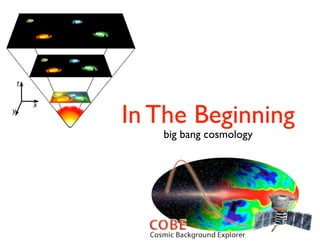
big bang cosmology
Einstein
Problem: Gravitational
attraction would cause the
universe to collapse.
Solution: Addition of the
cosmological constant to the
general theory creates an
anti-gravitational effect
Result: Preservation of the
eternal, static universe.
Modified Field Equation
Spacetime MatterConversion
Factors
Cosmological
Constant
Alexander Friedman
1888 - 1925
“On the possibility of a world
with constant negative
curvature of space” (1924)
What happens if the
Cosmological Constant (Λ)
has different values?
What happens if the universe
is expanding?
Friedman Equations
Georges Lemaître
1894 - 1966
Suggested that in an expanding
universe, galaxies should be
retreating at a velocity proportional
to their distance from us (1927)
Proposed a compact,“primeval
atom” or “Cosmic Egg” that
exploded, expanded and evolved
into the universe as we see it today.
William Herschel
1738 - 1822
Charles Messier
1730 – 1817
Catalog of 103 nebulous
and “deep sky” objects
(1781)
William Parsons,
Earl of Rosse, 1800 - 1867
Able to distinguish between
elliptical and spiral-shaped
nebulae.
Managed to make out
individual point sources in
some of these nebulae,
“Leviathan”
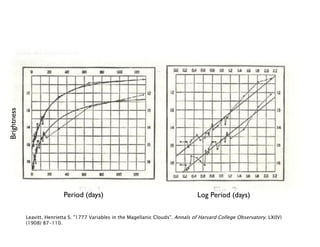
Henrietta Leavitt
1868 – 1921
Studying variable stars and
found that brighter ones
appeared to have longer
periods.
Estimating period of
variability allowed estimation
of their distance
Small Magellanic Cloud
Cepheids in the SMC
The Cepheids are huddled together and can be
assumed to be relatively close together
compared with distance to earth [200,000 light
years]
Therefore, a Cepheid in this sample that
appears twice as bright as another in the
sample is twice as intrinsically luminous.
Leavitt, Henrietta S. "1777 Variables in the Magellanic Clouds". Annals of Harvard College Observatory. LX(IV)
(1908) 87-110.
Period (days) Log Period (days)
Brightness
800x Sun 10,000x Sun
So What?
Cepheids are easily identifiable
They are relatively plentiful and scattered
throughout the universe
We can measure intrinsic luminosity from
period
Need calibration (direct measurement 1913 by
Ejnar Hertzsprung)
Stellar
Parallax
A “standard candle”
Find a Cepheid
Measure the period and thus derive the
intrinsic luminosity (how bright it is)
Measure the apparent luminosity (how bright
it appears to be)
Work out the distance that accounts for the
difference.
Doppler
Effect
Redshift (objects moving away)
Blueshift (objects getting closer)
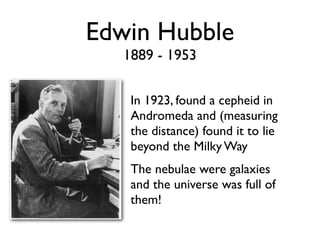
Edwin Hubble
1889 - 1953
In 1923, found a cepheid in
Andromeda and (measuring
the distance) found it to lie
beyond the Milky Way
The nebulae were galaxies
and the universe was full of
them!
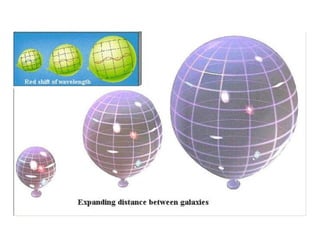
Hubble’s Law - 1929
Linear relationship between a
galaxy’s distance and
“apparent” recessional velocity
Implies universe is expanding
First observational support for
Lemaître’s prediction in 1927
Hubble’s Law - 1929
A B C D E F G
EDC F
Georges Lemaître
1894 - 1966
There was both “creation” and
“evolution” of the universe.
Friedmann-Lemaître-Robertson-
Walker (FLRW) Model
Howard Robinson (US) and Arthur Walker
(England) independently explored these ideas in the
1930’s.
Offers an exact solution of Einstein's field equations
of general relativity
Describes a simply connected, homogeneous [same
properties in all locations], isotropic [same
properties when viewed in any direction from any
location], expanding or contracting universe.
The αβγ
Paper
Ralph Alpher, [Hans Bethe]
& George Gamow pictured
the early universe as a
dense “soup” of protons,
neutrons and electrons.
Bigger and bigger atoms
were built by fusion in the
heat of the Big Bang.
The αβγ
Paper
Success: Model could
explain why the universe is
currently 90% Hydrogen
and 9% Helium.
Failure: Model could not
explain the formation of
elements heavier than
Helium.
George Gamow
1904 - 1968
With Alpher & Robert
Herman (1948) predicted an
“echo” of the Big Bang
Alpher & Herman (1949)
predicted that the radiation
should be in the radio
region of the EM spectrum
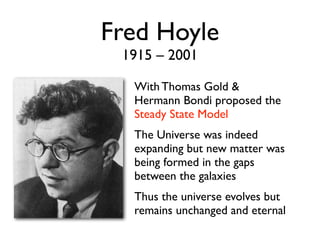
Fred Hoyle
1915 – 2001
With Thomas Gold &
Hermann Bondi proposed the
Steady State Model
The Universe was indeed
expanding but new matter was
being formed in the gaps
between the galaxies
Thus the universe evolves but
remains unchanged and eternal
Radio Astronomy
Discovery of young
galaxies and quasars at the
far reaches of the universe
Uneven distribution went
against Steady State model
which claimed the
universe should be similar
everywhere
Robert Wilson &
Arno Penzias
“Discovery” of the Cosmic
Microwave Background (CMB)
radiation as a background noise
(1964)
Nobel Prize in 1978
Was this sufficient evidence for
acceptance of the Big Bang?
Confirms black-body spectrum of CMB as
expected
Discovery of variations (anisotropies) in the
CMB which indicated tiny variations in the
density of the early universe
Stephen Hawking
The COBE results are “the
greatest discovery of the
century, if not of all times”.
The Nobel committee
stated that COBE can
“be regarded as the
starting point for
cosmology as a
precision science.”
High-precision CMB mapping yields age of the
universe of 13.73 ± 0.12 billion years
The End
Heat Death (Kelvin)
Big Rip
Big Crunch
Big Bounce
Multiverse
The Big Bang
The Big Bang

The Big Bang

  • 1.
    In The Beginning bigbang cosmology
  • 3.
    Einstein Problem: Gravitational attraction wouldcause the universe to collapse. Solution: Addition of the cosmological constant to the general theory creates an anti-gravitational effect Result: Preservation of the eternal, static universe.
  • 4.
    Modified Field Equation SpacetimeMatterConversion Factors Cosmological Constant
  • 5.
    Alexander Friedman 1888 -1925 “On the possibility of a world with constant negative curvature of space” (1924) What happens if the Cosmological Constant (Λ) has different values? What happens if the universe is expanding?
  • 6.
  • 9.
    Georges Lemaître 1894 -1966 Suggested that in an expanding universe, galaxies should be retreating at a velocity proportional to their distance from us (1927) Proposed a compact,“primeval atom” or “Cosmic Egg” that exploded, expanded and evolved into the universe as we see it today.
  • 10.
  • 11.
    Charles Messier 1730 –1817 Catalog of 103 nebulous and “deep sky” objects (1781)
  • 12.
    William Parsons, Earl ofRosse, 1800 - 1867 Able to distinguish between elliptical and spiral-shaped nebulae. Managed to make out individual point sources in some of these nebulae, “Leviathan”
  • 22.
    Henrietta Leavitt 1868 –1921 Studying variable stars and found that brighter ones appeared to have longer periods. Estimating period of variability allowed estimation of their distance
  • 26.
  • 27.
    Cepheids in theSMC The Cepheids are huddled together and can be assumed to be relatively close together compared with distance to earth [200,000 light years] Therefore, a Cepheid in this sample that appears twice as bright as another in the sample is twice as intrinsically luminous.
  • 28.
    Leavitt, Henrietta S."1777 Variables in the Magellanic Clouds". Annals of Harvard College Observatory. LX(IV) (1908) 87-110. Period (days) Log Period (days) Brightness
  • 29.
  • 30.
    So What? Cepheids areeasily identifiable They are relatively plentiful and scattered throughout the universe We can measure intrinsic luminosity from period Need calibration (direct measurement 1913 by Ejnar Hertzsprung)
  • 31.
  • 32.
    A “standard candle” Finda Cepheid Measure the period and thus derive the intrinsic luminosity (how bright it is) Measure the apparent luminosity (how bright it appears to be) Work out the distance that accounts for the difference.
  • 33.
    Doppler Effect Redshift (objects movingaway) Blueshift (objects getting closer)
  • 34.
    Edwin Hubble 1889 -1953 In 1923, found a cepheid in Andromeda and (measuring the distance) found it to lie beyond the Milky Way The nebulae were galaxies and the universe was full of them!
  • 38.
    Hubble’s Law -1929 Linear relationship between a galaxy’s distance and “apparent” recessional velocity Implies universe is expanding First observational support for Lemaître’s prediction in 1927
  • 39.
  • 40.
    A B CD E F G EDC F
  • 42.
    Georges Lemaître 1894 -1966 There was both “creation” and “evolution” of the universe.
  • 45.
    Friedmann-Lemaître-Robertson- Walker (FLRW) Model HowardRobinson (US) and Arthur Walker (England) independently explored these ideas in the 1930’s. Offers an exact solution of Einstein's field equations of general relativity Describes a simply connected, homogeneous [same properties in all locations], isotropic [same properties when viewed in any direction from any location], expanding or contracting universe.
  • 46.
    The αβγ Paper Ralph Alpher,[Hans Bethe] & George Gamow pictured the early universe as a dense “soup” of protons, neutrons and electrons. Bigger and bigger atoms were built by fusion in the heat of the Big Bang.
  • 47.
    The αβγ Paper Success: Modelcould explain why the universe is currently 90% Hydrogen and 9% Helium. Failure: Model could not explain the formation of elements heavier than Helium.
  • 48.
    George Gamow 1904 -1968 With Alpher & Robert Herman (1948) predicted an “echo” of the Big Bang Alpher & Herman (1949) predicted that the radiation should be in the radio region of the EM spectrum
  • 49.
    Fred Hoyle 1915 –2001 With Thomas Gold & Hermann Bondi proposed the Steady State Model The Universe was indeed expanding but new matter was being formed in the gaps between the galaxies Thus the universe evolves but remains unchanged and eternal
  • 50.
    Radio Astronomy Discovery ofyoung galaxies and quasars at the far reaches of the universe Uneven distribution went against Steady State model which claimed the universe should be similar everywhere
  • 51.
    Robert Wilson & ArnoPenzias “Discovery” of the Cosmic Microwave Background (CMB) radiation as a background noise (1964) Nobel Prize in 1978 Was this sufficient evidence for acceptance of the Big Bang?
  • 52.
    Confirms black-body spectrumof CMB as expected Discovery of variations (anisotropies) in the CMB which indicated tiny variations in the density of the early universe
  • 54.
    Stephen Hawking The COBEresults are “the greatest discovery of the century, if not of all times”.
  • 55.
    The Nobel committee statedthat COBE can “be regarded as the starting point for cosmology as a precision science.”
  • 58.
    High-precision CMB mappingyields age of the universe of 13.73 ± 0.12 billion years
  • 63.
    The End Heat Death(Kelvin) Big Rip Big Crunch Big Bounce Multiverse