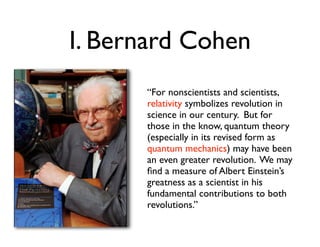
I. Bernard Cohen
“For nonscientists and scientists,
relativity symbolizes revolution in
science in our century. But for
those in the know, quantum theory
(especially in its revised form as
quantum mechanics) may have been
an even greater revolution. We may
find a measure of Albert Einstein’s
greatness as a scientist in his
fundamental contributions to both
revolutions.”
Kelvin 1900
“There is nothing new to be discovered
in physics now.All that remains is more
and more precise measurement.”
Classical Physics
Newtonian mechanics as foundation (and standard)
for over 200 years
Problems
• Radioactivity - where does the energy come from?
• Blackbody radiation - how do you account for the
energy spectrum?
• Aether - where was it?
What about the Atom?
Ernst Mach,Willhelm
Ostwald and others
Atoms were
mathematical rather
than physical entities.
Atoms were a “useful
fiction”
Einstein 1905
Albert Einstein
1879 - 1955
Special Relativity (1905)
General Relativity (1915)
Nobel Prize (1921)
Moved to US (1933)
Letter to F.D. Roosevelt (1939)
The Investigation of the State of
Aether in Magnetic Fields
Wunderjahr 1905
“A New Determination of Molecular Dimensions” (Ph.D thesis,
April)
“On a Heuristic Point ofView about the Creation and Conversion
of Light” (Photoelectric effect, March)
“On the Motion of Small Particles Suspended in a Stationary Liquid,
as Required by the Molecular Kinetic Theory of Heat” (Brownian
Motion, May)
“On the Electrodynamics of Moving Bodies” (Special Relativity, June)
“Does the Inertia of a Body Depend Upon Its Energy
Content?” (Mass-Energy Equivalency, September)
Photoelectric Effect
“Energy, during the propagation of a ray of light, is not
continuously distributed over steadily increasing spaces,
but it consists of a finite number of energy quanta
localised at points in space, moving without dividing and
capable of being absorbed or generated only as entities.”
Explained the photoelectric effect and black-body
radiation
Contradicts the wave theory of light
Black-Body Radiation
Brownian Motion
Brownian Motion
Used kinetic theory of fluids to explain
Brownian Motion
Supported use of statistical mechanics
Provided evidence for atoms and
convinced many (including Ostwald) of
their reality
Special Relativity
A Thought Experiment
Suppose there are two identical rooms. Both rooms
are completely sealed off from the outside world. No
light, radio waves or any other information can get into
the rooms from outside. Room A is sitting in the
parking lot outside. Room B is sitting on the back of a
truck driving down a perfectly smooth, perfectly
straight road at a perfectly constant 100 mph.
Question: You find yourself in one of the two rooms,
but do not know which. What experiment could you
do to tell whether you are in room A or room B?
Inertial Reference Frame
Classical Physics
The laws of physics are
the same in all inertial
reference frames
There is no experiment
you can do to prove
which frame is at rest or
moving with constant
velocity
Relativity Principle
Newton
However, we need an
absolute frame of
reference if we are to
be able to say to which
body a force has been
applied (i.e. which body
is moving and which is
not).
Newton
"Absolute, true and mathematical time, of itself and
from its own nature, flows equably without relation
to anything external”
“Absolute space, in its own nature, without relation
to anything external, remains always similar and
immoveable."
Motion with respect to a privileged frame of
reference (absolute rest)
Newton
Space is a three dimensional
grid with a central reference
point
Time is a constant clockwork
mechanism
Space and time exist
independent of the distribution
of matter in the universe
Maxwell’s synthesis
James Clerk Maxwell
(1865)
Four laws of
electromagnetism
Predicted light to be an
electromagnetic wave
with the observed speed
Speed of Light
Date Author Result (km/
sec)
Error
1676 Olaus Roemer 214,000
1726 James Bradley 301,000
1849 Armand Fizeau 315,000
1862 Leon Foucault 298,000 500
1879 Albert Michelson 299,910 50
1907 Rosa & Dorsay 299,788 30
1926 Michelson 299,796 4
1947 Essen & Smith 299,792 3
1958 K.D. Froome 299,792.5 0.1
1973 Evanson et al. 299,792.4574 0.001
1983 AdoptedValue 299.792.458
Definition of a Meter
The length of a pendulum with a half-period of one second (1790)
The distance between two lines on a standard bar of an alloy of platinum
with ten percent iridium measured at the melting point of ice (1889)
The distance, at 0°C, between the axes of the two central lines marked
on the prototype bar of platinum-iridium, this bar being subject to one
standard atmosphere of pressure and supported on two cylinders of at
least one centimeter diameter, symmetrically placed in the same
horizontal plane at a distance of 571 millimeters from each other. (1927)
The distance travelled by light in a vacuum during a time interval of 1 ⁄
299,792,458 of a second (1983)
Maxwell’s problems
Waves need a medium
(the luminiferous aether)
However, the equations
did not obey the
relativity principle and
were not the same for
all reference frames
Were was the aether?
Attempts to directly detect it failed
Properties: immobile,denser than steel but objects
were still able to pass through it, imperceptible
(“subtle”)
Since the aether was assumed to be immobile, one
could determine the earth’s absolute motion in space.
Michelson & Morley (1887) attempted to determine
how fast the Earth was moving through the aether
Michelson Morley
Experiment
Detect interference
(change in velocity) in
a split light beam
Could not detect as
expected
Einstein
“On the
electrodynamics of
moving bodies” (1905)
A theory to make
physics invariant and
independent of
observer motion, not
to make it “relative”
Two Postulates
The laws of physics have the
same form in all inertial
reference systems (The
Principle of Relativity)
Light propagates through empty
space with a speed independent
of the speed of the emitting
body(The Light Postulate)
“[T]he same laws of electrodynamics and optics will be valid for all
frames of reference for which the equations of mechanics hold good.
We will raise this conjecture (the purport of which will hereafter be
called the ‘Principle of Relativity’) to the status of a postulate, and also
introduce another postulate, which is only apparently irreconcilable
with the former, namely, that light is always propagated in empty space
with a definite velocity c which is independent of the state of motion
of the emitting body.These two postulates suffice for the attainment of
a simple and consistent theory of the electrodynamics of moving
bodies based on Maxwell's theory for stationary bodies.The
introduction of a ‘luminiferous ether’ will prove to be superfluous in as
much as the view here to be developed will not require an ‘absolutely
stationary space’ provided with special properties, nor assign a
velocity-vector to a point of the empty space in which electromagnetic
processes take place.”
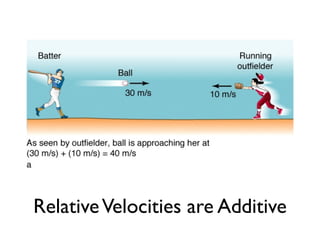
RelativeVelocities are Additive
Most of the Time!
Invariance Theory
The laws of physics (and
the constants) do not
change for different
observers, i.e. are invariant,
but measurements of time
and space are relative to
the observer
Special Relativity
“Every general law of nature must be so
constituted that it is transformed into a law of
exactly the same form when, instead of space-
time variables x, y, z, t of the original coordinate
system K, we introduce new space time
variables x’, y’,z’,t’ of a coordinate system K’…
Or in brief: General laws of nature are co-
variant with respect to Lorentz
transformations.”
Hendrik Lorentz
Relativity
“The unsuccessful attempts to
discover any motion of the
earth relatively to the ‘light
medium,’ suggest that the
phenomena of electrodynamics
as well as of mechanics possess
no properties corresponding
to the idea of absolute rest.”
Relativity
There is no privileged frame
of reference for space &
time
There is no (Newtonian)
absolute space and time
Hermann Minkowski
Geometrical
reformulation of
Einstein’s ideas.
“Space by itself, and time
by itself, are doomed to
fade away into mere
shadows, and only a kind
of union of the two will
preserve an independent
reality.” (1908)
Spacetime
Four dimensional and (originally) Euclidian
All observers agree on the total
spacetime distance between two events
Observers disagree on how to split up
the “space” and “time” components
No Absolute Simultaneity
Other Consequences
Time dilation - time passes more slowly when traveling
fast when compared to a “stationary” observer
Length contraction - objects appear to be compressed
along their direction of motion
A moving light cone becomes focussed and thus brighter
A moving light source seems to “beam” its light forward
Nothing can move faster than the speed of light
Twin paradox
Mass-Energy Equivalency
Based on work of Maxwell and Hertz
and special relativity
“The results of the previous
investigation lead to a very
interesting conclusion, which is here
to be deduced.”
A mass at rest has “rest energy”
distinct from classical kinetic and
potential energies.
Leó Szilárd
Theory & Experiment
It is required that the theory not be refuted by any
undisputed experiment within the theory’s domain of
applicability (i.e. the set of physical situations in which the
theory is valid).
It is expected that the theory be confirmed by a number
of experiments that:
- cover a significant fraction of the theory’s domain of
applicability
- examine a significant fraction of the theory’s predictions
Tests of S.R.
Pre-1905 experiments
Light-speed isotropy (same value in any/every direction)
Measurement of speed of light (and c as limit)
Test of Lorentz Invariance
Time dilation
Atomic clocks in flight
Length contraction (indirect)
Inconsistent Experiments
Outside of domain of applicability of SR
Lacking error analysis, examination of systematic effects or
statistical analysis
“Amateurs look for patterns, professionals look at error bars”
Unrepeatable
Large uncertainties or unknowns
At present there is no reproducible or generally accepted
experiment that is inconsistent with Special Relativity
Einstein laughs at your puny claims !!
Relativity
Outside ordinary human
experience
Deals with the very fast
(special) and the very large
(general)
Newtonian physics still holds
of the “everyday” experience
General Relativity
Tension between Newtonian ideas
of gravitation and the new concept
of spacetime.
Special relativity applies to constant
velocity (“inertial motion”),
however we live in a universe
permeated by gravity which causes
acceleration.What happens if the
observer is accelerating?
General Relativity and
the Geometry of Spacetime
First Solvay Conference, Brussels, 1911
General Relativity
Special relativity applies to constant velocity
(“inertial motion”), however we live in a
universe permeated by gravity which causes
acceleration.What happens if the observer
is accelerating?
How do you unify Newtonian gravitation
with special relativity?
1907
“Then came to me the best idea of
my life ... [T]he gravitational field only
has a relative existence. Because for
an observer freely falling from the roof
of a house, no gravitational field exists
while he is falling. The experimental
fact that the acceleration due to
gravity does not depend on the
material is thus a powerful argument
for extending the relativity postulate
to systems in non-uniform relative
motion.” (1919)
Principal of Equivalence
"On the relativity principle and the conclusions drawn from
it" (1907)
Newtonian inertial (resistance to acceleration) mass and
gravitational (measure of susceptibility to gravitation) mass are the
same thing
“we [...] assume the complete physical equivalence of a gravitational
field and a corresponding acceleration of the reference system.”
There is no experiment observers can perform to distinguish
whether an acceleration arises because of a gravitational force or
because their reference frame is accelerating.
The 1907 Paper
Contains much of the General
Theory
But would require a new
mathematics (tensor calculus) and
a new non-Euclidian geometry
(Riemanian) before it could
provide a quantification of the
gravitational field and thus make
specific numerical predictions.
Euclidian Geometry
Henri Poincaré
What if the universe itself
was non-Euclidian?
The math for non-
Euclidian geometry is not
as simple, hence rejection
would occur.
Gravity is Part of the
Fabric of Spacetime
Thought experiment of two observers
measuring the ratio of a rotating disk’s
radius to circumference (2π)
Realized that Minkowski’s space time was
non-Euclidean
By the Principle of Equivalence this
meant that the geometry of a
gravitational field would also be non-
Euclidean
Carl-Friedrich Gauss
1777 - 1855
Developed a theory of
curved surfaces
Conversion from co-
ordinate distance (map) to
real distance requires a
metric tensor
These will differ by location
so will require a metric field.
Bernhard Riemann
1826 - 1866
Generalized Gauss’
ideas to spaces of higher
dimensions
The required metric
tensor for 4D space (a
“manifold”) had ten
components.
Field Equation (1915)
Ricci Tensor
Energy/
momentum
Tensor
Metric
Tensor
Einstein Tensor
A little simpler
Curvature of
Spacetime
Matter
ThirdVersion (1917)
A Theory of Gravitation
The observed gravitational
attraction between masses
results from the warping of
space and time by those
masses
Spacetime tells matter how
to move, matter tells
spacetime how to curve.
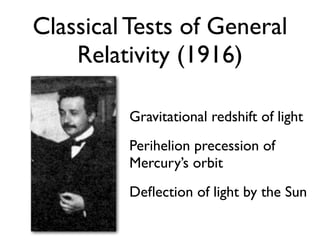
Classical Tests of General
Relativity (1916)
Gravitational redshift of light
Perihelion precession of
Mercury’s orbit
Deflection of light by the Sun
Gravitational Redshift
Measured by Walter Sydney Adams in 1925
while looking at spectrum of Sirius B
Terrestrial experiments by Robert Pound & G.A.
Rebka met predication by within 10% in 1959
Subsequently, Pound and J.L. Snider met
prediction to within 1% in 1964
By 1980 the effect has been measured to
0.0001%
Newton predicts precession of 5555.62 arcsec/
century
Observed precession of 5600.73 arcsec/century
Difference of 43.11 ± 0.45
Bending of Light
Predicted - based on
Newtonian
mechanics - by Henry
Cavendish (1784)
Value of 0.83”
calculated by Johann
Georg von Soldner
(1804)
Einstein (1911)
• Specific prediction - based on GR - for the deflection
of light by a gravitational mass such as the Sun
• Einstein realized he was wrong in 1915 and the value
should be twice that originally calculated
London Times
17 Nov 1919
“Revolution in Science – New Theory of the
Universe – Newtonian Ideas Overthrown.”
Arthur Eddington Frank Dyson
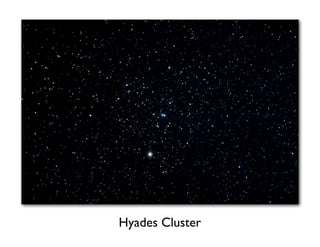
Hyades Cluster
Possible Outcomes
No deflection
Half deflection (Newton)
Full deflection (Einstein)
Not so fast ...
Early accuracy relatively poor
However, experiment repeated
and confirmed in 1922
Most recent hi-precision
confirmation in 1967, 1973 &
2004
There remain false accusations
of data manipulation
5th Solvay 1927
Max Planck Nils Bohr
Travel Time Delay
A time delay should occur
as a photon passes close to
the Sun (“Shapiro delay”)
Agreement at 5% when
testing radar reflections
from Mercury &Venus
(1971)
Agreement at 0.002% using
the Cassini probe (2002)
Gravitational
Lensing
Light travels along “straight” lines in
a curved spacetime
extreme curvature of spacetime
Cygnus X-1
“Golden Age”
of General Relativity
1960 to 1975
Work by the likes of Richard Feynman, Stephen
Hawking & Roger Penrose
Theoretical exploration of Black Holes
Discovery of quasars, pulsars, and candidate black holes
Acceptance of Big Bang and discovery of the cosmic
background radiation
Acceptance of legitimacy of cosmology within physics
Einstein

Einstein

  • 2.
    I. Bernard Cohen “Fornonscientists and scientists, relativity symbolizes revolution in science in our century. But for those in the know, quantum theory (especially in its revised form as quantum mechanics) may have been an even greater revolution. We may find a measure of Albert Einstein’s greatness as a scientist in his fundamental contributions to both revolutions.”
  • 3.
    Kelvin 1900 “There isnothing new to be discovered in physics now.All that remains is more and more precise measurement.”
  • 4.
    Classical Physics Newtonian mechanicsas foundation (and standard) for over 200 years Problems • Radioactivity - where does the energy come from? • Blackbody radiation - how do you account for the energy spectrum? • Aether - where was it?
  • 5.
    What about theAtom? Ernst Mach,Willhelm Ostwald and others Atoms were mathematical rather than physical entities. Atoms were a “useful fiction”
  • 6.
  • 7.
    Albert Einstein 1879 -1955 Special Relativity (1905) General Relativity (1915) Nobel Prize (1921) Moved to US (1933) Letter to F.D. Roosevelt (1939)
  • 14.
    The Investigation ofthe State of Aether in Magnetic Fields
  • 16.
    Wunderjahr 1905 “A NewDetermination of Molecular Dimensions” (Ph.D thesis, April) “On a Heuristic Point ofView about the Creation and Conversion of Light” (Photoelectric effect, March) “On the Motion of Small Particles Suspended in a Stationary Liquid, as Required by the Molecular Kinetic Theory of Heat” (Brownian Motion, May) “On the Electrodynamics of Moving Bodies” (Special Relativity, June) “Does the Inertia of a Body Depend Upon Its Energy Content?” (Mass-Energy Equivalency, September)
  • 17.
  • 18.
    Photoelectric Effect “Energy, duringthe propagation of a ray of light, is not continuously distributed over steadily increasing spaces, but it consists of a finite number of energy quanta localised at points in space, moving without dividing and capable of being absorbed or generated only as entities.” Explained the photoelectric effect and black-body radiation Contradicts the wave theory of light
  • 19.
  • 20.
  • 21.
    Brownian Motion Used kinetictheory of fluids to explain Brownian Motion Supported use of statistical mechanics Provided evidence for atoms and convinced many (including Ostwald) of their reality
  • 22.
  • 23.
    A Thought Experiment Supposethere are two identical rooms. Both rooms are completely sealed off from the outside world. No light, radio waves or any other information can get into the rooms from outside. Room A is sitting in the parking lot outside. Room B is sitting on the back of a truck driving down a perfectly smooth, perfectly straight road at a perfectly constant 100 mph. Question: You find yourself in one of the two rooms, but do not know which. What experiment could you do to tell whether you are in room A or room B?
  • 24.
  • 25.
    Classical Physics The lawsof physics are the same in all inertial reference frames There is no experiment you can do to prove which frame is at rest or moving with constant velocity
  • 26.
  • 27.
    Newton However, we needan absolute frame of reference if we are to be able to say to which body a force has been applied (i.e. which body is moving and which is not).
  • 28.
    Newton "Absolute, true andmathematical time, of itself and from its own nature, flows equably without relation to anything external” “Absolute space, in its own nature, without relation to anything external, remains always similar and immoveable." Motion with respect to a privileged frame of reference (absolute rest)
  • 29.
    Newton Space is athree dimensional grid with a central reference point Time is a constant clockwork mechanism Space and time exist independent of the distribution of matter in the universe
  • 30.
    Maxwell’s synthesis James ClerkMaxwell (1865) Four laws of electromagnetism Predicted light to be an electromagnetic wave with the observed speed
  • 32.
    Speed of Light DateAuthor Result (km/ sec) Error 1676 Olaus Roemer 214,000 1726 James Bradley 301,000 1849 Armand Fizeau 315,000 1862 Leon Foucault 298,000 500 1879 Albert Michelson 299,910 50 1907 Rosa & Dorsay 299,788 30 1926 Michelson 299,796 4 1947 Essen & Smith 299,792 3 1958 K.D. Froome 299,792.5 0.1 1973 Evanson et al. 299,792.4574 0.001 1983 AdoptedValue 299.792.458
  • 33.
    Definition of aMeter The length of a pendulum with a half-period of one second (1790) The distance between two lines on a standard bar of an alloy of platinum with ten percent iridium measured at the melting point of ice (1889) The distance, at 0°C, between the axes of the two central lines marked on the prototype bar of platinum-iridium, this bar being subject to one standard atmosphere of pressure and supported on two cylinders of at least one centimeter diameter, symmetrically placed in the same horizontal plane at a distance of 571 millimeters from each other. (1927) The distance travelled by light in a vacuum during a time interval of 1 ⁄ 299,792,458 of a second (1983)
  • 34.
    Maxwell’s problems Waves needa medium (the luminiferous aether) However, the equations did not obey the relativity principle and were not the same for all reference frames
  • 35.
    Were was theaether? Attempts to directly detect it failed Properties: immobile,denser than steel but objects were still able to pass through it, imperceptible (“subtle”) Since the aether was assumed to be immobile, one could determine the earth’s absolute motion in space. Michelson & Morley (1887) attempted to determine how fast the Earth was moving through the aether
  • 36.
    Michelson Morley Experiment Detect interference (changein velocity) in a split light beam Could not detect as expected
  • 37.
    Einstein “On the electrodynamics of movingbodies” (1905) A theory to make physics invariant and independent of observer motion, not to make it “relative”
  • 38.
    Two Postulates The lawsof physics have the same form in all inertial reference systems (The Principle of Relativity) Light propagates through empty space with a speed independent of the speed of the emitting body(The Light Postulate)
  • 39.
    “[T]he same lawsof electrodynamics and optics will be valid for all frames of reference for which the equations of mechanics hold good. We will raise this conjecture (the purport of which will hereafter be called the ‘Principle of Relativity’) to the status of a postulate, and also introduce another postulate, which is only apparently irreconcilable with the former, namely, that light is always propagated in empty space with a definite velocity c which is independent of the state of motion of the emitting body.These two postulates suffice for the attainment of a simple and consistent theory of the electrodynamics of moving bodies based on Maxwell's theory for stationary bodies.The introduction of a ‘luminiferous ether’ will prove to be superfluous in as much as the view here to be developed will not require an ‘absolutely stationary space’ provided with special properties, nor assign a velocity-vector to a point of the empty space in which electromagnetic processes take place.”
  • 40.
  • 41.
  • 42.
    Invariance Theory The lawsof physics (and the constants) do not change for different observers, i.e. are invariant, but measurements of time and space are relative to the observer
  • 43.
    Special Relativity “Every generallaw of nature must be so constituted that it is transformed into a law of exactly the same form when, instead of space- time variables x, y, z, t of the original coordinate system K, we introduce new space time variables x’, y’,z’,t’ of a coordinate system K’… Or in brief: General laws of nature are co- variant with respect to Lorentz transformations.”
  • 44.
  • 45.
    Relativity “The unsuccessful attemptsto discover any motion of the earth relatively to the ‘light medium,’ suggest that the phenomena of electrodynamics as well as of mechanics possess no properties corresponding to the idea of absolute rest.”
  • 46.
    Relativity There is noprivileged frame of reference for space & time There is no (Newtonian) absolute space and time
  • 47.
    Hermann Minkowski Geometrical reformulation of Einstein’sideas. “Space by itself, and time by itself, are doomed to fade away into mere shadows, and only a kind of union of the two will preserve an independent reality.” (1908)
  • 48.
    Spacetime Four dimensional and(originally) Euclidian All observers agree on the total spacetime distance between two events Observers disagree on how to split up the “space” and “time” components
  • 49.
  • 50.
    Other Consequences Time dilation- time passes more slowly when traveling fast when compared to a “stationary” observer Length contraction - objects appear to be compressed along their direction of motion A moving light cone becomes focussed and thus brighter A moving light source seems to “beam” its light forward Nothing can move faster than the speed of light Twin paradox
  • 52.
    Mass-Energy Equivalency Based onwork of Maxwell and Hertz and special relativity “The results of the previous investigation lead to a very interesting conclusion, which is here to be deduced.” A mass at rest has “rest energy” distinct from classical kinetic and potential energies.
  • 54.
  • 60.
    Theory & Experiment Itis required that the theory not be refuted by any undisputed experiment within the theory’s domain of applicability (i.e. the set of physical situations in which the theory is valid). It is expected that the theory be confirmed by a number of experiments that: - cover a significant fraction of the theory’s domain of applicability - examine a significant fraction of the theory’s predictions
  • 61.
    Tests of S.R. Pre-1905experiments Light-speed isotropy (same value in any/every direction) Measurement of speed of light (and c as limit) Test of Lorentz Invariance Time dilation Atomic clocks in flight Length contraction (indirect)
  • 62.
    Inconsistent Experiments Outside ofdomain of applicability of SR Lacking error analysis, examination of systematic effects or statistical analysis “Amateurs look for patterns, professionals look at error bars” Unrepeatable Large uncertainties or unknowns At present there is no reproducible or generally accepted experiment that is inconsistent with Special Relativity
  • 63.
    Einstein laughs atyour puny claims !!
  • 64.
    Relativity Outside ordinary human experience Dealswith the very fast (special) and the very large (general) Newtonian physics still holds of the “everyday” experience
  • 67.
    General Relativity Tension betweenNewtonian ideas of gravitation and the new concept of spacetime. Special relativity applies to constant velocity (“inertial motion”), however we live in a universe permeated by gravity which causes acceleration.What happens if the observer is accelerating?
  • 68.
    General Relativity and theGeometry of Spacetime
  • 69.
  • 71.
    General Relativity Special relativityapplies to constant velocity (“inertial motion”), however we live in a universe permeated by gravity which causes acceleration.What happens if the observer is accelerating? How do you unify Newtonian gravitation with special relativity?
  • 72.
    1907 “Then came tome the best idea of my life ... [T]he gravitational field only has a relative existence. Because for an observer freely falling from the roof of a house, no gravitational field exists while he is falling. The experimental fact that the acceleration due to gravity does not depend on the material is thus a powerful argument for extending the relativity postulate to systems in non-uniform relative motion.” (1919)
  • 73.
    Principal of Equivalence "Onthe relativity principle and the conclusions drawn from it" (1907) Newtonian inertial (resistance to acceleration) mass and gravitational (measure of susceptibility to gravitation) mass are the same thing “we [...] assume the complete physical equivalence of a gravitational field and a corresponding acceleration of the reference system.” There is no experiment observers can perform to distinguish whether an acceleration arises because of a gravitational force or because their reference frame is accelerating.
  • 75.
    The 1907 Paper Containsmuch of the General Theory But would require a new mathematics (tensor calculus) and a new non-Euclidian geometry (Riemanian) before it could provide a quantification of the gravitational field and thus make specific numerical predictions.
  • 76.
  • 77.
    Henri Poincaré What ifthe universe itself was non-Euclidian? The math for non- Euclidian geometry is not as simple, hence rejection would occur.
  • 78.
    Gravity is Partof the Fabric of Spacetime Thought experiment of two observers measuring the ratio of a rotating disk’s radius to circumference (2π) Realized that Minkowski’s space time was non-Euclidean By the Principle of Equivalence this meant that the geometry of a gravitational field would also be non- Euclidean
  • 79.
    Carl-Friedrich Gauss 1777 -1855 Developed a theory of curved surfaces Conversion from co- ordinate distance (map) to real distance requires a metric tensor These will differ by location so will require a metric field.
  • 80.
    Bernhard Riemann 1826 -1866 Generalized Gauss’ ideas to spaces of higher dimensions The required metric tensor for 4D space (a “manifold”) had ten components.
  • 84.
    Field Equation (1915) RicciTensor Energy/ momentum Tensor Metric Tensor Einstein Tensor
  • 85.
    A little simpler Curvatureof Spacetime Matter
  • 86.
  • 87.
    A Theory ofGravitation The observed gravitational attraction between masses results from the warping of space and time by those masses Spacetime tells matter how to move, matter tells spacetime how to curve.
  • 89.
    Classical Tests ofGeneral Relativity (1916) Gravitational redshift of light Perihelion precession of Mercury’s orbit Deflection of light by the Sun
  • 91.
    Gravitational Redshift Measured byWalter Sydney Adams in 1925 while looking at spectrum of Sirius B Terrestrial experiments by Robert Pound & G.A. Rebka met predication by within 10% in 1959 Subsequently, Pound and J.L. Snider met prediction to within 1% in 1964 By 1980 the effect has been measured to 0.0001%
  • 92.
    Newton predicts precessionof 5555.62 arcsec/ century Observed precession of 5600.73 arcsec/century Difference of 43.11 ± 0.45
  • 94.
    Bending of Light Predicted- based on Newtonian mechanics - by Henry Cavendish (1784) Value of 0.83” calculated by Johann Georg von Soldner (1804)
  • 95.
    Einstein (1911) • Specificprediction - based on GR - for the deflection of light by a gravitational mass such as the Sun • Einstein realized he was wrong in 1915 and the value should be twice that originally calculated
  • 97.
    London Times 17 Nov1919 “Revolution in Science – New Theory of the Universe – Newtonian Ideas Overthrown.”
  • 98.
  • 99.
  • 100.
    Possible Outcomes No deflection Halfdeflection (Newton) Full deflection (Einstein)
  • 105.
    Not so fast... Early accuracy relatively poor However, experiment repeated and confirmed in 1922 Most recent hi-precision confirmation in 1967, 1973 & 2004 There remain false accusations of data manipulation
  • 107.
  • 108.
  • 109.
    Travel Time Delay Atime delay should occur as a photon passes close to the Sun (“Shapiro delay”) Agreement at 5% when testing radar reflections from Mercury &Venus (1971) Agreement at 0.002% using the Cassini probe (2002)
  • 111.
  • 114.
    Light travels along“straight” lines in a curved spacetime
  • 115.
  • 118.
  • 119.
    “Golden Age” of GeneralRelativity 1960 to 1975 Work by the likes of Richard Feynman, Stephen Hawking & Roger Penrose Theoretical exploration of Black Holes Discovery of quasars, pulsars, and candidate black holes Acceptance of Big Bang and discovery of the cosmic background radiation Acceptance of legitimacy of cosmology within physics