More Theories...
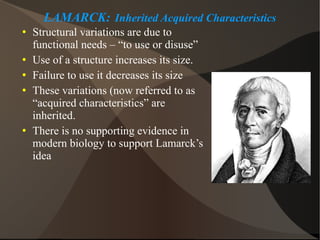
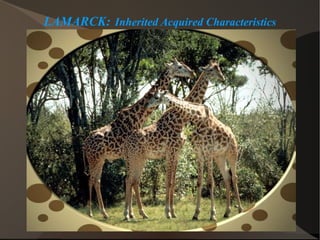
LAMARCK:   Inherited Acquired Characteristics Structural variations are due to functional needs – “to use or disuse” Use of a structure increases its size. Failure to use it decreases its size These variations (now referred to as “acquired characteristics” are inherited.  There is no supporting evidence in modern biology to support Lamarck’s idea
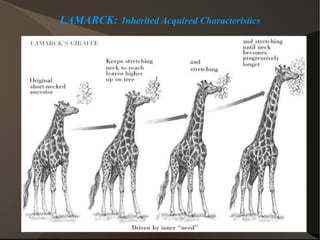
LAMARCK:   Inherited Acquired Characteristics Theory of need = production of new organ or appendage results from a need B) The Theory of Use or Disuse = organs remain active  as long as they are used, but disappear gradually with disuse C) Theory of Inherited Acquired Characteristics = all that has been acquired by the individual is also inherited by his progeny in the next generation
LAMARCK:   Inherited Acquired Characteristics
The Theory of Natural Selection The Theory of Evolution states that the present species have descended, with modifications, from species that existed in the past.  Species are not fixed, unchanging things, but are constantly evolving. Evolution is therefore the constant change that has occurred in our world since its beginning to the present time
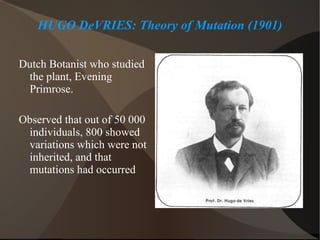
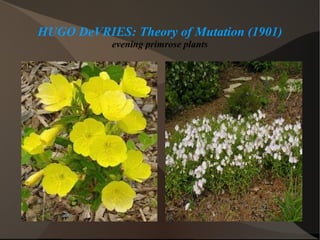
Dutch Botanist who studied the plant, Evening Primrose. Observed that out of 50 000 individuals, 800 showed variations which were not inherited, and that mutations had occurred HUGO DeVRIES: Theory of Mutation (1901)
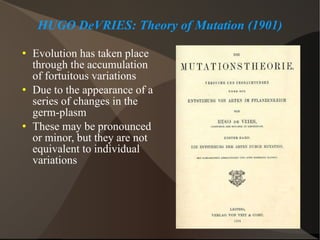
HUGO DeVRIES: Theory of Mutation (1901) Evolution has taken place through the accumulation of fortuitous variations Due to the appearance of a series of changes in the germ-plasm These may be pronounced or minor, but they are not equivalent to individual variations
HUGO DeVRIES: Theory of Mutation (1901) evening primrose plants
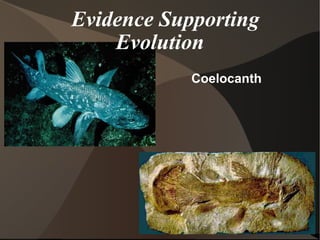
Evidence Supporting Evolution Coelocanth
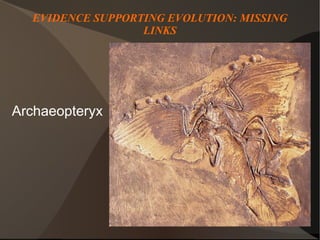
EVIDENCE SUPPORTING EVOLUTION: MISSING LINKS Impossible to completely piece together the evolutionary history of some organisms There are gaps in the fossil record called”  “missing links” For many years there was no connection between birds & reptiles from which they were thought to have evolved  ARCHAEOPTERYX  has characteristics of both birds and reptiles It had feathers and wings like a bird but a reptile skeleton Had teeth & lizard like tail
EVIDENCE SUPPORTING EVOLUTION: MISSING LINKS Archaeopteryx
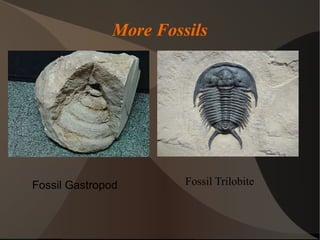
More Fossils Fossil Trilobite Fossil Gastropod
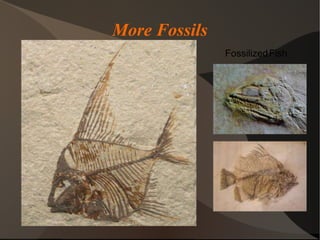
More Fossils Fossilized   Fish
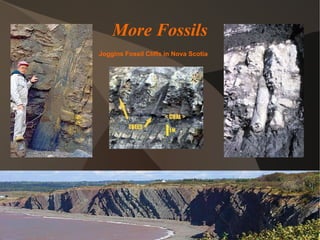
More Fossils Joggins Fossil Cliffs in Nova Scotia
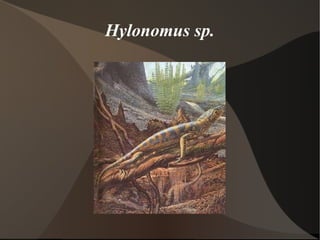
Hylonomus sp.
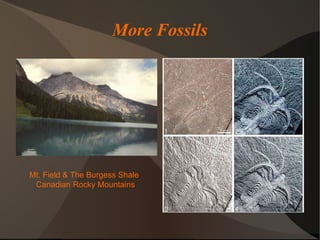
More Fossils Mt. Field & The Burgess Shale Canadian Rocky Mountains
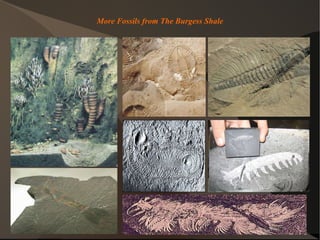
More Fossils from The Burgess Shale
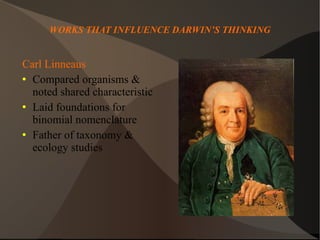
WORKS THAT INFLUENCE DARWIN’S THINKING Carl Linneaus   Compared organisms & noted shared characteristic Laid foundations for binomial nomenclature Father of taxonomy & ecology studies
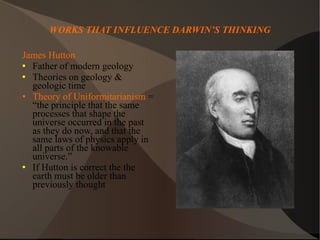
WORKS THAT INFLUENCE DARWIN’S THINKING James Hutton Father of modern geology Theories on geology & geologic time Theory of Uniformitarianism  = “the principle that the same processes that shape the universe occurred in the past as they do now, and that the same laws of physics apply in all parts of the knowable universe.”  If Hutton is correct the the earth must be older than previously thought
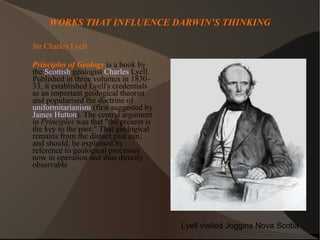
WORKS THAT INFLUENCE DARWIN’S THINKING Sir Charles Lyell Principles of Geology  is a book by the  Scottish  geologist  Charles  Lyell . Published in three volumes in 1830–33, it established Lyell's credentials as an important geological theorist and popularised the doctrine of  uniformitarianism  (first suggested by  James Hutton ). The central argument in  Principles  was that "the present is the key to the past:" That geological remains from the distant past can, and should, be explained by reference to geological processes now in operation and thus directly observable  Lyell visited Joggins Nova Scotia
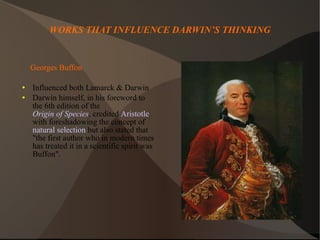
WORKS THAT INFLUENCE DARWIN’S THINKING Georges Buffon Influenced both Lamarck & Darwin Darwin himself, in his foreword to the 6th edition of the  Origin of Species , credited  Aristotle  with foreshadowing the concept of  natural selection  but also stated that "the first author who in modern times has treated it in a scientific spirit was Buffon".

Theories And Evidence

  • 1.
  • 2.
    LAMARCK: Inherited Acquired Characteristics Structural variations are due to functional needs – “to use or disuse” Use of a structure increases its size. Failure to use it decreases its size These variations (now referred to as “acquired characteristics” are inherited. There is no supporting evidence in modern biology to support Lamarck’s idea
  • 3.
    LAMARCK: Inherited Acquired Characteristics Theory of need = production of new organ or appendage results from a need B) The Theory of Use or Disuse = organs remain active as long as they are used, but disappear gradually with disuse C) Theory of Inherited Acquired Characteristics = all that has been acquired by the individual is also inherited by his progeny in the next generation
  • 4.
    LAMARCK: Inherited Acquired Characteristics
  • 5.
    LAMARCK: Inherited Acquired Characteristics
  • 6.
    The Theory ofNatural Selection The Theory of Evolution states that the present species have descended, with modifications, from species that existed in the past. Species are not fixed, unchanging things, but are constantly evolving. Evolution is therefore the constant change that has occurred in our world since its beginning to the present time
  • 7.
    Dutch Botanist whostudied the plant, Evening Primrose. Observed that out of 50 000 individuals, 800 showed variations which were not inherited, and that mutations had occurred HUGO DeVRIES: Theory of Mutation (1901)
  • 8.
    HUGO DeVRIES: Theoryof Mutation (1901) Evolution has taken place through the accumulation of fortuitous variations Due to the appearance of a series of changes in the germ-plasm These may be pronounced or minor, but they are not equivalent to individual variations
  • 9.
    HUGO DeVRIES: Theoryof Mutation (1901) evening primrose plants
  • 10.
  • 11.
    EVIDENCE SUPPORTING EVOLUTION:MISSING LINKS Impossible to completely piece together the evolutionary history of some organisms There are gaps in the fossil record called” “missing links” For many years there was no connection between birds & reptiles from which they were thought to have evolved ARCHAEOPTERYX has characteristics of both birds and reptiles It had feathers and wings like a bird but a reptile skeleton Had teeth & lizard like tail
  • 12.
    EVIDENCE SUPPORTING EVOLUTION:MISSING LINKS Archaeopteryx
  • 13.
    More Fossils FossilTrilobite Fossil Gastropod
  • 14.
  • 15.
    More Fossils JogginsFossil Cliffs in Nova Scotia
  • 16.
  • 17.
    More Fossils Mt.Field & The Burgess Shale Canadian Rocky Mountains
  • 18.
    More Fossils fromThe Burgess Shale
  • 19.
    WORKS THAT INFLUENCEDARWIN’S THINKING Carl Linneaus Compared organisms & noted shared characteristic Laid foundations for binomial nomenclature Father of taxonomy & ecology studies
  • 20.
    WORKS THAT INFLUENCEDARWIN’S THINKING James Hutton Father of modern geology Theories on geology & geologic time Theory of Uniformitarianism = “the principle that the same processes that shape the universe occurred in the past as they do now, and that the same laws of physics apply in all parts of the knowable universe.” If Hutton is correct the the earth must be older than previously thought
  • 21.
    WORKS THAT INFLUENCEDARWIN’S THINKING Sir Charles Lyell Principles of Geology is a book by the Scottish geologist Charles Lyell . Published in three volumes in 1830–33, it established Lyell's credentials as an important geological theorist and popularised the doctrine of uniformitarianism (first suggested by James Hutton ). The central argument in Principles was that "the present is the key to the past:" That geological remains from the distant past can, and should, be explained by reference to geological processes now in operation and thus directly observable Lyell visited Joggins Nova Scotia
  • 22.
    WORKS THAT INFLUENCEDARWIN’S THINKING Georges Buffon Influenced both Lamarck & Darwin Darwin himself, in his foreword to the 6th edition of the Origin of Species , credited Aristotle with foreshadowing the concept of natural selection but also stated that "the first author who in modern times has treated it in a scientific spirit was Buffon".