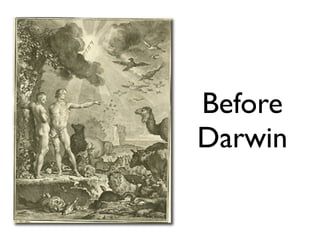
Before
Darwin
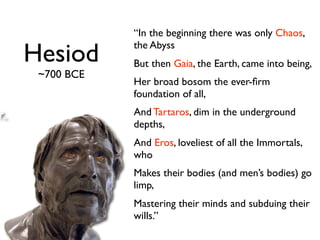
“In the beginning there was only Chaos,

Hesiod      the Abyss
            But then Gaia, the Earth, came into being,
 ~700 BCE
            Her broad bosom the ever-firm
            foundation of all,
            And Tartaros, dim in the underground
            depths,
            And Eros, loveliest of all the Immortals,
            who
            Makes their bodies (and men’s bodies) go
            limp,
            Mastering their minds and subduing their
            wills.”
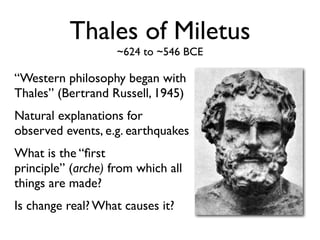
Thales of Miletus
                    ~624 to ~546 BCE

“Western philosophy began with
Thales” (Bertrand Russell, 1945)
Natural explanations for
observed events, e.g. earthquakes
What is the “first
principle” (arche) from which all
things are made?
Is change real? What causes it?
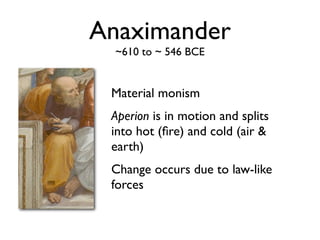
Anaximander
  ~610 to ~ 546 BCE


 Material monism
 Aperion is in motion and splits
 into hot (fire) and cold (air &
 earth)
 Change occurs due to law-like
 forces
Anaximander
  ~610 to ~ 546 BCE

 “[T]he first animals were produced
 in moisture, enclosed in thorny
 barks ... they came out onto the
 drier part”
 “Humans were born from other
 kinds of animals”
 “[T]here arose from heated water
 and earth either fish of animals very
 like fish. In these, humans grew ...”
Shared Values

Commitment to argument and critical inquiry, together
with a view about the nature of justification
Commitment to the idea that the natural world could
be explained in terms that do not refer to anything
beyond nature itself
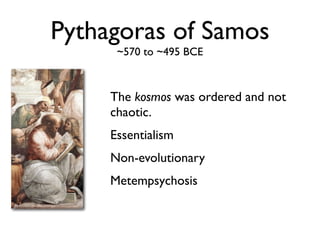
Pythagoras of Samos
      ~570 to ~495 BCE


     The kosmos was ordered and not
     chaotic.
     Essentialism
     Non-evolutionary
     Metempsychosis
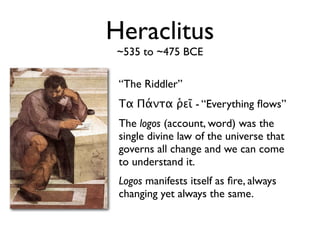
Heraclitus
 ~535 to ~475 BCE

 “The Riddler”
 Τα Πάντα ῥεῖ - “Everything flows”
 The logos (account, word) was the
 single divine law of the universe that
 governs all change and we can come
 to understand it.
 Logos manifests itself as fire, always
 changing yet always the same.
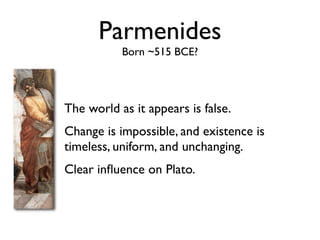
Parmenides
           Born ~515 BCE?


The world as it appears is false.
Change is impossible, and existence is
timeless, uniform, and unchanging.
Clear influence on Plato.
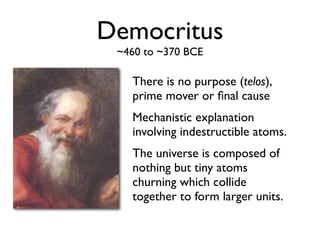
Democritus
 ~460 to ~370 BCE

   There is no purpose (telos),
   prime mover or final cause
   Mechanistic explanation
   involving indestructible atoms.
   The universe is composed of
   nothing but tiny atoms
   churning which collide
   together to form larger units.
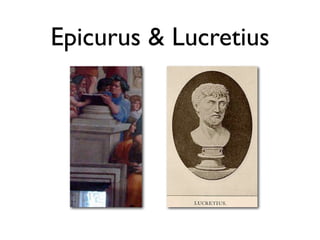
Epicurus & Lucretius
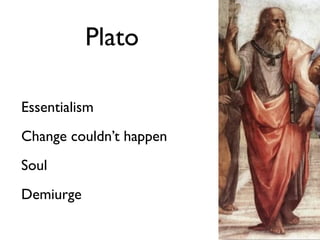
Plato

Essentialism
Change couldn’t happen
Soul
Demiurge
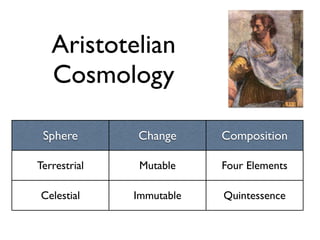
Aristotelian
   Cosmology

 Sphere       Change      Composition

Terrestrial    Mutable    Four Elements

Celestial     Immutable   Quintessence
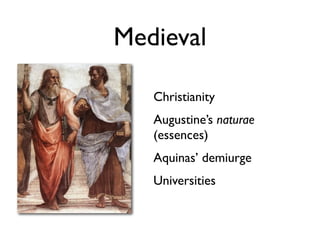
Medieval

   Christianity
   Augustine’s naturae
   (essences)
   Aquinas’ demiurge
   Universities
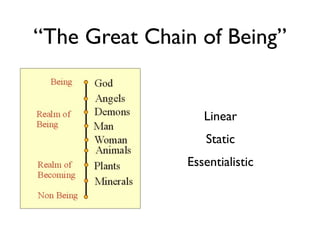
“The Great Chain of Being”


                  Linear
                  Static
               Essentialistic
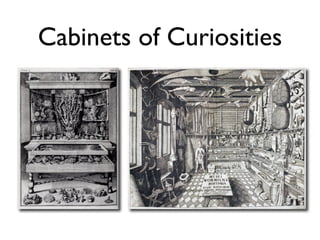
Cabinets of Curiosities
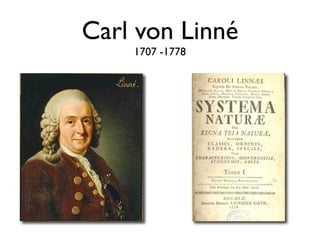
Carl von Linné
    1707 -1778
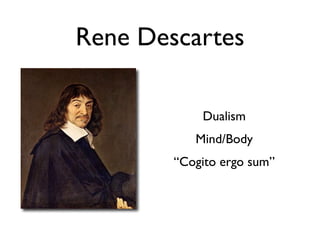
Rene Descartes

            Dualism
           Mind/Body
        “Cogito ergo sum”
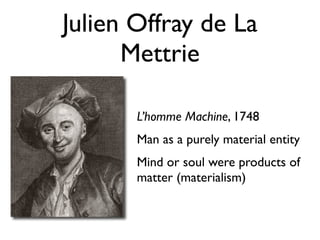
Julien Offray de La
      Mettrie

       L’homme Machine, 1748
       Man as a purely material entity
       Mind or soul were products of
       matter (materialism)
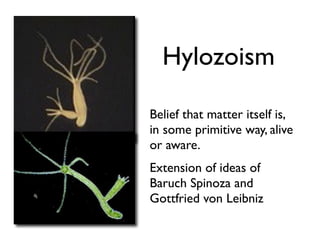
Hylozoism

Belief that matter itself is,
in some primitive way, alive
or aware.
Extension of ideas of
Baruch Spinoza and
Gottfried von Leibniz
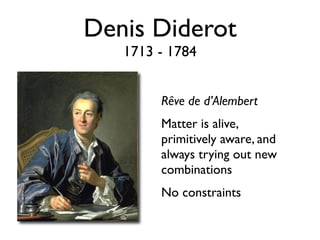
Denis Diderot
   1713 - 1784


        Rêve de d’Alembert
        Matter is alive,
        primitively aware, and
        always trying out new
        combinations
        No constraints
Materialism

Replace Creator with forces of nature
Continual state of flux
No fixed species
No pre-determined path of development
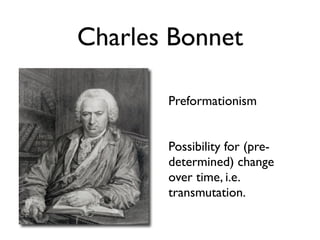
Charles Bonnet

       Preformationism


       Possibility for (pre-
       determined) change
       over time, i.e.
       transmutation.
Philosophical Palingesis
                           1770

Females carry within them all future generations in a
miniature form.
These miniature beings (homunculi) would be able to
survive even great cataclysms such as the biblical Flood;
These catastrophes brought about evolutionary change, and
that after the next disaster, men would become angels,
mammals would gain human-like intelligence, and so on.
Evolution? Pre-determined and dependent on catastrophes
(divine).
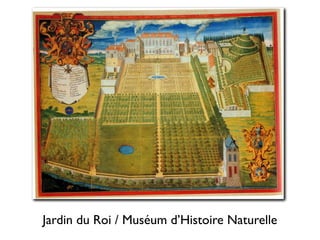
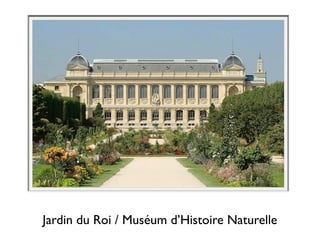
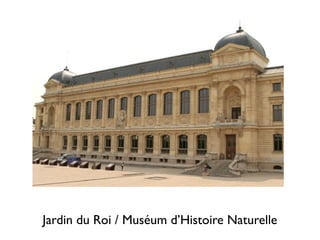
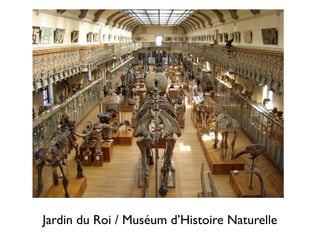
Jardin du Roi / Muséum d’Histoire Naturelle
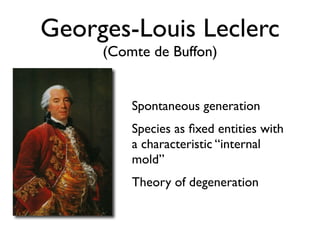
Georges-Louis Leclerc
     (Comte de Buffon)


         Spontaneous generation
         Species as fixed entities with
         a characteristic “internal
         mold”
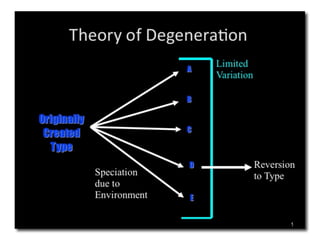
         Theory of degeneration
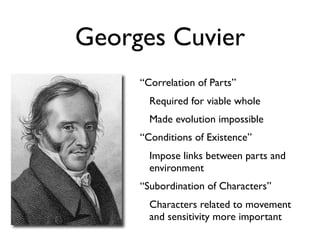
Georges Cuvier
     “Correlation of Parts”
       Required for viable whole
       Made evolution impossible
     “Conditions of Existence”
       Impose links between parts and
       environment
     “Subordination of Characters”
       Characters related to movement
       and sensitivity more important
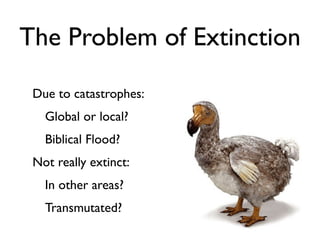
The Problem of Extinction

 Due to catastrophes:
   Global or local?
   Biblical Flood?
 Not really extinct:
   In other areas?
   Transmutated?
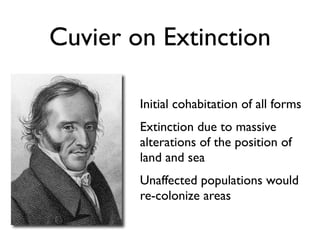
Cuvier on Extinction

        Initial cohabitation of all forms
        Extinction due to massive
        alterations of the position of
        land and sea
        Unaffected populations would
        re-colonize areas
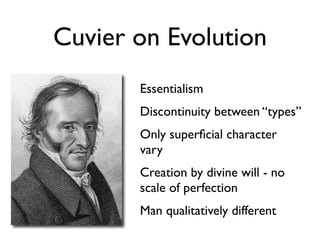
Cuvier on Evolution
       Essentialism
       Discontinuity between “types”
       Only superficial character
       vary
       Creation by divine will - no
       scale of perfection
       Man qualitatively different
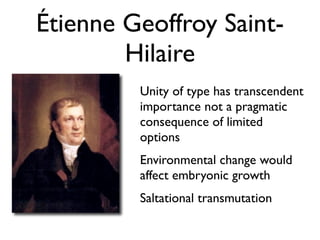
Étienne Geoffroy Saint-
        Hilaire
         Unity of type has transcendent
         importance not a pragmatic
         consequence of limited
         options
         Environmental change would
         affect embryonic growth
         Saltational transmutation
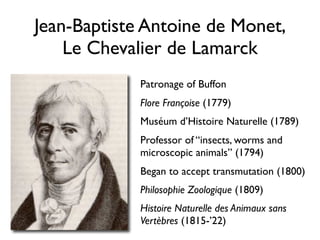
Jean-Baptiste Antoine de Monet,
    Le Chevalier de Lamarck
             Patronage of Buffon
             Flore Françoise (1779)
             Muséum d’Histoire Naturelle (1789)
             Professor of “insects, worms and
             microscopic animals” (1794)
             Began to accept transmutation (1800)
             Philosophie Zoologique (1809)
             Histoire Naturelle des Animaux sans
             Vertèbres (1815-’22)
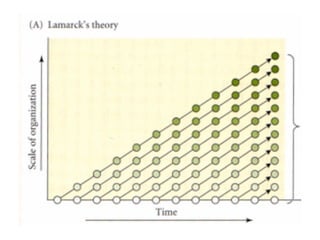
“Lamarckism”
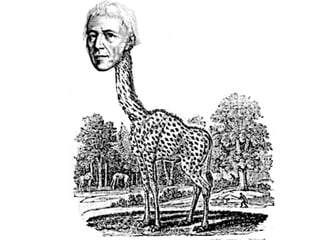
Chance in environment brings
Change in “needs” (besoins), brings
Change in behavior, brings
Change in organ usage and development, brings
Change in form over time - Transmutation!
First Law
               “use and disuse”

“In every animals which has not passed the limit
of its development, a more frequent and
continuous use of any organ gradually
strengthens, develops and enlarges that organ,
and gives it a power proportional to the length
of time it has been so used; while the
permanent disuse of any organ imperceptibly
weakens and deteriorates it, and progressively
diminishes its functional capacity, until it finally
disappears.”
Second Law
 “inheritance of acquired characteristics”

“All the acquisitions or losses wrought by nature on
individuals, through the influence of the
environment in which their race has long been
placed, and hence through the influence of the
predominant use or permanent disuse of any
organ; all these are preserved by reproduction to
the new individuals which arise, provided that the
acquired modifications are common to both sexes,
or at least to the individuals which produce the
young”
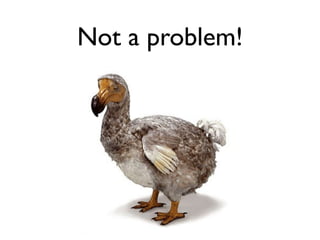
Not a problem!
Lamarck on Man
     "[I]f some of the quadrumanous
     animals...were to lose...the habit
     of climbing trees and grasping the
     branches with its feet...and if the
     individuals of this race were
     forced for a series of generations
     to use their feet only for
     walking... there is no doubt...that
     these quadrumanous animals
     would at length be transformed
     into bimanous”
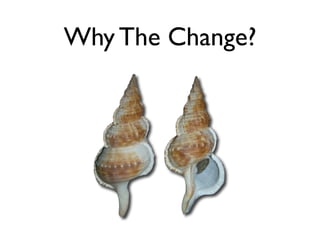
Why The Change?
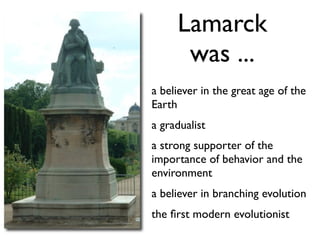
Lamarck
      was ...
a believer in the great age of the
Earth
a gradualist
a strong supporter of the
importance of behavior and the
environment
a believer in branching evolution
the first modern evolutionist
Darwin & Lamarck

Lamarck precedes Darwin regarding fact of
evolution (non-static world)
Shared belief in use and disuse
Lamarck’s theory of adaptation is as legitimate
as Darwin’s provided his premises are valid.
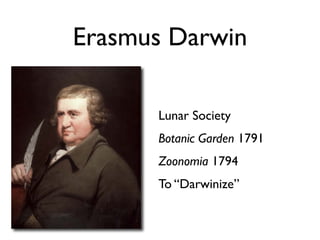
Erasmus Darwin

      Lunar Society
      Botanic Garden 1791
      Zoonomia 1794
      To “Darwinize”
Erasmus Darwin
 ORGANIC LIFE beneath the shoreless waves
Was born and nurs'd in Ocean's pearly caves;
 First forms minute, unseen by spheric glass,
Move on the mud, or pierce the watery mass;
   These, as successive generations bloom,
New powers acquire, and larger limbs assume;
Whence countless groups of vegetation spring,
And breathing realms of fin, and feet, and wing.
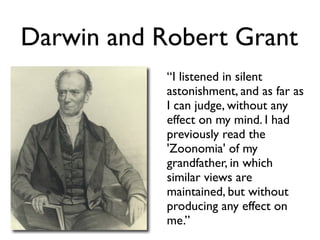
Darwin and Robert Grant
            “I listened in silent
            astonishment, and as far as
            I can judge, without any
            effect on my mind. I had
            previously read the
            'Zoonomia' of my
            grandfather, in which
            similar views are
            maintained, but without
            producing any effect on
            me.”
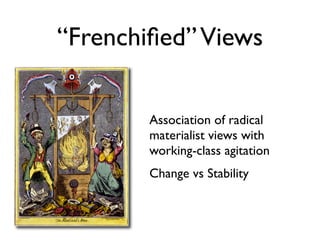
“Frenchified” Views


        Association of radical
        materialist views with
        working-class agitation
        Change vs Stability

03 Before Darwin

  • 1.
  • 2.
    “In the beginningthere was only Chaos, Hesiod the Abyss But then Gaia, the Earth, came into being, ~700 BCE Her broad bosom the ever-firm foundation of all, And Tartaros, dim in the underground depths, And Eros, loveliest of all the Immortals, who Makes their bodies (and men’s bodies) go limp, Mastering their minds and subduing their wills.”
  • 3.
    Thales of Miletus ~624 to ~546 BCE “Western philosophy began with Thales” (Bertrand Russell, 1945) Natural explanations for observed events, e.g. earthquakes What is the “first principle” (arche) from which all things are made? Is change real? What causes it?
  • 4.
    Anaximander ~610to ~ 546 BCE Material monism Aperion is in motion and splits into hot (fire) and cold (air & earth) Change occurs due to law-like forces
  • 5.
    Anaximander ~610to ~ 546 BCE “[T]he first animals were produced in moisture, enclosed in thorny barks ... they came out onto the drier part” “Humans were born from other kinds of animals” “[T]here arose from heated water and earth either fish of animals very like fish. In these, humans grew ...”
  • 6.
    Shared Values Commitment toargument and critical inquiry, together with a view about the nature of justification Commitment to the idea that the natural world could be explained in terms that do not refer to anything beyond nature itself
  • 7.
    Pythagoras of Samos ~570 to ~495 BCE The kosmos was ordered and not chaotic. Essentialism Non-evolutionary Metempsychosis
  • 8.
    Heraclitus ~535 to~475 BCE “The Riddler” Τα Πάντα ῥεῖ - “Everything flows” The logos (account, word) was the single divine law of the universe that governs all change and we can come to understand it. Logos manifests itself as fire, always changing yet always the same.
  • 9.
    Parmenides Born ~515 BCE? The world as it appears is false. Change is impossible, and existence is timeless, uniform, and unchanging. Clear influence on Plato.
  • 10.
    Democritus ~460 to~370 BCE There is no purpose (telos), prime mover or final cause Mechanistic explanation involving indestructible atoms. The universe is composed of nothing but tiny atoms churning which collide together to form larger units.
  • 11.
  • 12.
  • 13.
    Aristotelian Cosmology Sphere Change Composition Terrestrial Mutable Four Elements Celestial Immutable Quintessence
  • 15.
    Medieval Christianity Augustine’s naturae (essences) Aquinas’ demiurge Universities
  • 16.
    “The Great Chainof Being” Linear Static Essentialistic
  • 17.
  • 18.
    Carl von Linné 1707 -1778
  • 19.
    Rene Descartes Dualism Mind/Body “Cogito ergo sum”
  • 20.
    Julien Offray deLa Mettrie L’homme Machine, 1748 Man as a purely material entity Mind or soul were products of matter (materialism)
  • 21.
    Hylozoism Belief that matteritself is, in some primitive way, alive or aware. Extension of ideas of Baruch Spinoza and Gottfried von Leibniz
  • 22.
    Denis Diderot 1713 - 1784 Rêve de d’Alembert Matter is alive, primitively aware, and always trying out new combinations No constraints
  • 23.
    Materialism Replace Creator withforces of nature Continual state of flux No fixed species No pre-determined path of development
  • 24.
    Charles Bonnet Preformationism Possibility for (pre- determined) change over time, i.e. transmutation.
  • 25.
    Philosophical Palingesis 1770 Females carry within them all future generations in a miniature form. These miniature beings (homunculi) would be able to survive even great cataclysms such as the biblical Flood; These catastrophes brought about evolutionary change, and that after the next disaster, men would become angels, mammals would gain human-like intelligence, and so on. Evolution? Pre-determined and dependent on catastrophes (divine).
  • 26.
    Jardin du Roi/ Muséum d’Histoire Naturelle
  • 27.
    Jardin du Roi/ Muséum d’Histoire Naturelle
  • 28.
    Jardin du Roi/ Muséum d’Histoire Naturelle
  • 29.
    Jardin du Roi/ Muséum d’Histoire Naturelle
  • 30.
    Georges-Louis Leclerc (Comte de Buffon) Spontaneous generation Species as fixed entities with a characteristic “internal mold” Theory of degeneration
  • 32.
    Georges Cuvier “Correlation of Parts” Required for viable whole Made evolution impossible “Conditions of Existence” Impose links between parts and environment “Subordination of Characters” Characters related to movement and sensitivity more important
  • 33.
    The Problem ofExtinction Due to catastrophes: Global or local? Biblical Flood? Not really extinct: In other areas? Transmutated?
  • 34.
    Cuvier on Extinction Initial cohabitation of all forms Extinction due to massive alterations of the position of land and sea Unaffected populations would re-colonize areas
  • 35.
    Cuvier on Evolution Essentialism Discontinuity between “types” Only superficial character vary Creation by divine will - no scale of perfection Man qualitatively different
  • 36.
    Étienne Geoffroy Saint- Hilaire Unity of type has transcendent importance not a pragmatic consequence of limited options Environmental change would affect embryonic growth Saltational transmutation
  • 37.
    Jean-Baptiste Antoine deMonet, Le Chevalier de Lamarck Patronage of Buffon Flore Françoise (1779) Muséum d’Histoire Naturelle (1789) Professor of “insects, worms and microscopic animals” (1794) Began to accept transmutation (1800) Philosophie Zoologique (1809) Histoire Naturelle des Animaux sans Vertèbres (1815-’22)
  • 39.
    “Lamarckism” Chance in environmentbrings Change in “needs” (besoins), brings Change in behavior, brings Change in organ usage and development, brings Change in form over time - Transmutation!
  • 41.
    First Law “use and disuse” “In every animals which has not passed the limit of its development, a more frequent and continuous use of any organ gradually strengthens, develops and enlarges that organ, and gives it a power proportional to the length of time it has been so used; while the permanent disuse of any organ imperceptibly weakens and deteriorates it, and progressively diminishes its functional capacity, until it finally disappears.”
  • 42.
    Second Law “inheritanceof acquired characteristics” “All the acquisitions or losses wrought by nature on individuals, through the influence of the environment in which their race has long been placed, and hence through the influence of the predominant use or permanent disuse of any organ; all these are preserved by reproduction to the new individuals which arise, provided that the acquired modifications are common to both sexes, or at least to the individuals which produce the young”
  • 43.
  • 44.
    Lamarck on Man "[I]f some of the quadrumanous animals...were to lose...the habit of climbing trees and grasping the branches with its feet...and if the individuals of this race were forced for a series of generations to use their feet only for walking... there is no doubt...that these quadrumanous animals would at length be transformed into bimanous”
  • 45.
  • 46.
    Lamarck was ... a believer in the great age of the Earth a gradualist a strong supporter of the importance of behavior and the environment a believer in branching evolution the first modern evolutionist
  • 47.
    Darwin & Lamarck Lamarckprecedes Darwin regarding fact of evolution (non-static world) Shared belief in use and disuse Lamarck’s theory of adaptation is as legitimate as Darwin’s provided his premises are valid.
  • 48.
    Erasmus Darwin Lunar Society Botanic Garden 1791 Zoonomia 1794 To “Darwinize”
  • 49.
    Erasmus Darwin ORGANICLIFE beneath the shoreless waves Was born and nurs'd in Ocean's pearly caves; First forms minute, unseen by spheric glass, Move on the mud, or pierce the watery mass; These, as successive generations bloom, New powers acquire, and larger limbs assume; Whence countless groups of vegetation spring, And breathing realms of fin, and feet, and wing.
  • 50.
    Darwin and RobertGrant “I listened in silent astonishment, and as far as I can judge, without any effect on my mind. I had previously read the 'Zoonomia' of my grandfather, in which similar views are maintained, but without producing any effect on me.”
  • 51.
    “Frenchified” Views Association of radical materialist views with working-class agitation Change vs Stability

Editor's Notes

  • #2 \n
  • #3 Theogony - nature and supernatural merge / no natural evidence is required\n
  • #4 apoc pred eclipse in 585. Quakes as earth floating on water (waves). Unity in Difference. Change comes from within.\n
  • #5 student of thales / aperion is vague boundless chaotic material from which all comes \n
  • #6 evolution?\n
  • #7 \n
  • #8 student of anaximander / Community of Pythagoreans / “kosmos” means ordered world (cf chaos) / murderous cult / vegetarians / metempsychosis \n
  • #9 Flow = change / “You cannot step twice into the same river”\n
  • #10 Opinions based on senses (doxa) are untrustworthy\n
  • #11 The Earth is round / Void was necessary / Developed an ethical theory based on this, as did ... \n\n
  • #12 Placement in Vatican!\n
  • #13 \n
  • #14 Fire, water, air, earth\n
  • #15 \n
  • #16 Rise in 12th C / Aristotle: Not infallible indeed some ideas condemned in 1277 / MESSAGE: Speculate but don’t claim access to the truth about the Creation\n\n
  • #17 \n
  • #18 \n
  • #19 \n
  • #20 \n
  • #21 \n
  • #22 \n
  • #23 \n
  • #24 \n
  • #25 \n
  • #26 \n
  • #27 \n
  • #28 \n
  • #29 \n
  • #30 \n
  • #31 \n
  • #32 \n
  • #33 \n
  • #34 \n
  • #35 \n
  • #36 \n
  • #37 \n
  • #38 \n
  • #39 \n
  • #40 \n
  • #41 \n
  • #42 \n
  • #43 \n
  • #44 \n
  • #45 \n
  • #46 \n
  • #47 \n
  • #48 \n
  • #49 \n
  • #50 \n
  • #51 \n