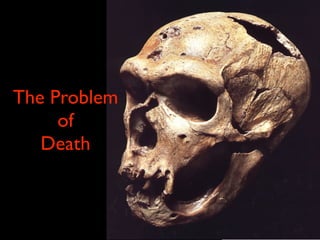
The Problem
     of
   Death
The Problem of Evil
If God is perfectly loving (omnibenevolent), He
must wish to abolish evil
If He is all powerful (omnipotent), He must be
able to abolish evil
But evil exists
Therefore, an all powerful, loving God does not
exist
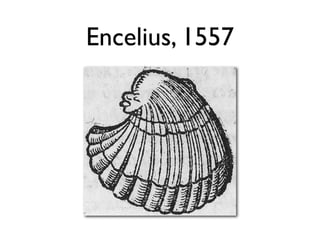
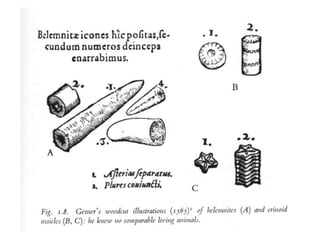
Encelius, 1557
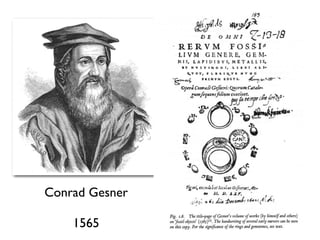
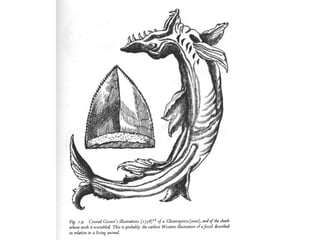
Conrad Gesner

    1565
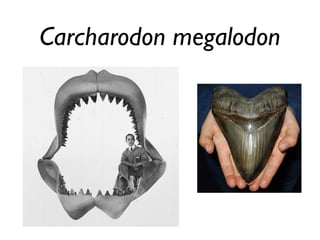
Carcharodon megalodon
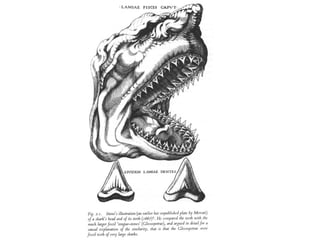
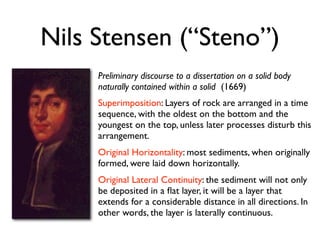
Nils Stensen (“Steno”)
     Preliminary discourse to a dissertation on a solid body
     naturally contained within a solid (1669)
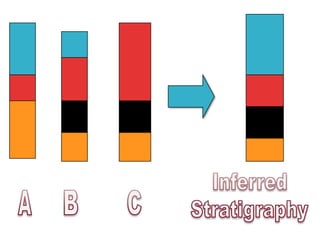
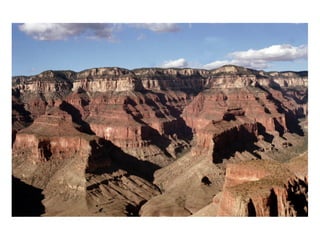
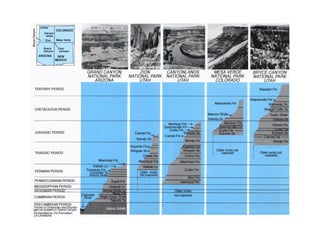
     Superimposition: Layers of rock are arranged in a time
     sequence, with the oldest on the bottom and the
     youngest on the top, unless later processes disturb this
     arrangement.
     Original Horizontality: most sediments, when originally
     formed, were laid down horizontally.
     Original Lateral Continuity: the sediment will not only
     be deposited in a flat layer, it will be a layer that
     extends for a considerable distance in all directions. In
     other words, the layer is laterally continuous.
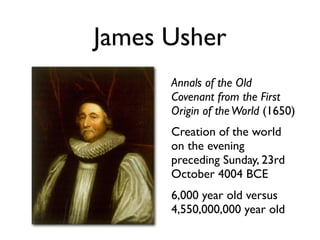
James Usher
      Annals of the Old
      Covenant from the First
      Origin of the World (1650)
      Creation of the world
      on the evening
      preceding Sunday, 23rd
      October 4004 BCE
      6,000 year old versus
      4,550,000,000 year old
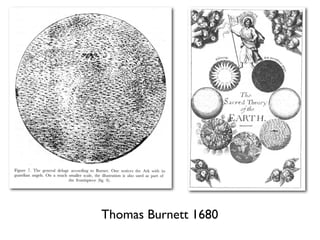
Thomas Burnett 1680
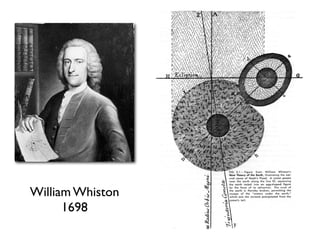
William Whiston
      1698
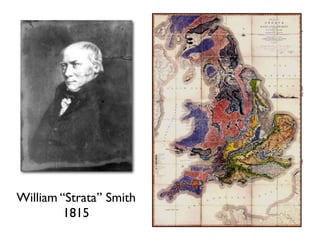
William “Strata” Smith
         1815
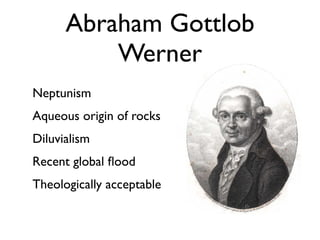
Abraham Gottlob
          Werner
Neptunism
Aqueous origin of rocks
Diluvialism
Recent global flood
Theologically acceptable
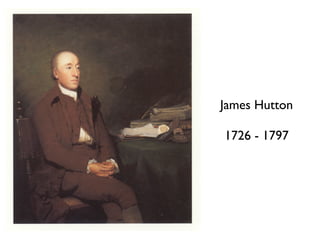
James Hutton

1726 - 1797
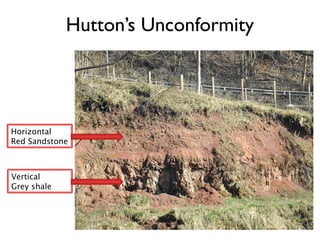
Hutton’s Unconformity


Horizontal
Red Sandstone


Vertical
Grey shale
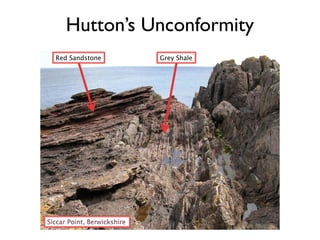
Hutton’s Unconformity
Red Sandstone   Grey Shale
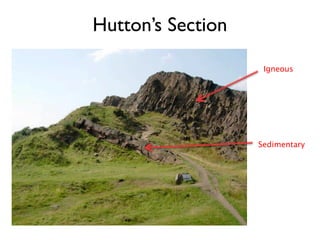
Hutton’s Section

                    Igneous


                   Sedimentary
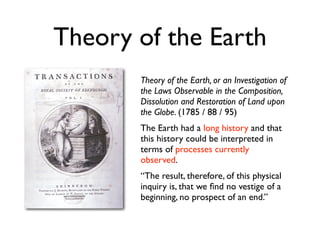
Theory of the Earth
       Theory of the Earth, or an Investigation of
       the Laws Observable in the Composition,
       Dissolution and Restoration of Land upon
       the Globe. (1785 / 88 / 95)
       The Earth had a long history and that
       this history could be interpreted in
       terms of processes currently
       observed.
       “The result, therefore, of this physical
       inquiry is, that we find no vestige of a
       beginning, no prospect of an end.”
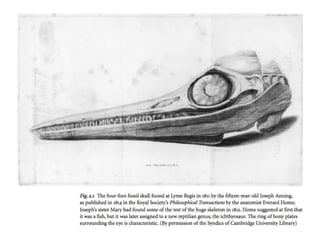
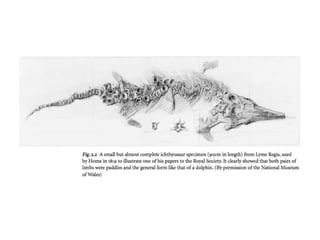
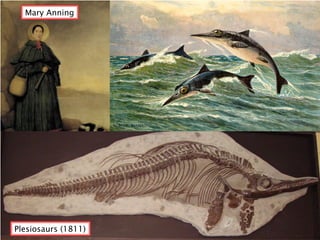
Mary Anning


Plesiosaurs (1811)
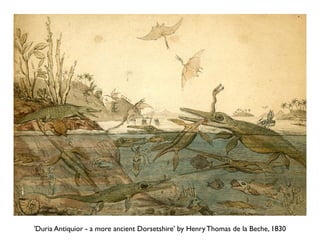
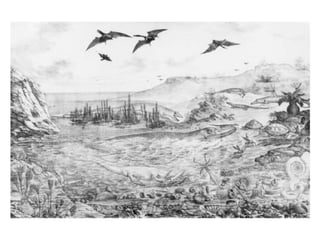
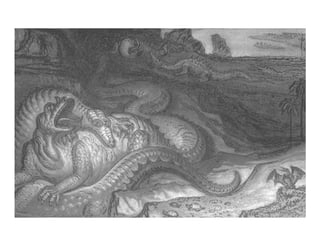
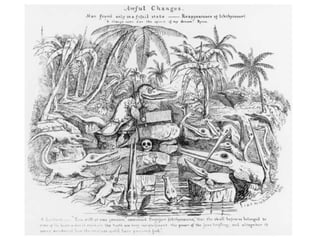
'Duria Antiquior - a more ancient Dorsetshire' by Henry Thomas de la Beche, 1830
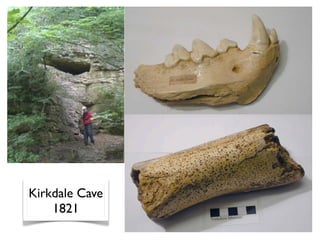
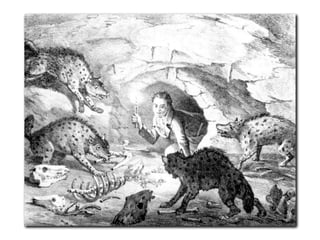
Kirkdale Cave
    1821
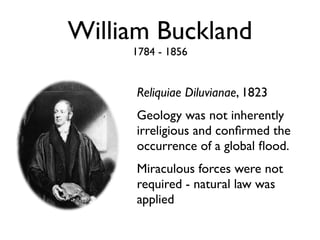
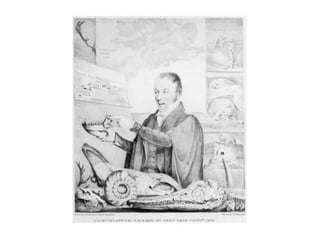
William Buckland
     1784 - 1856


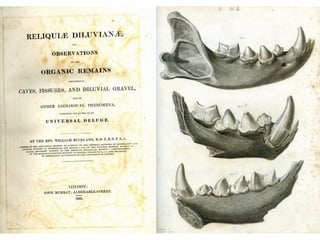
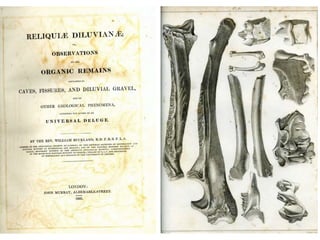
     Reliquiae Diluvianae, 1823
     Geology was not inherently
     irreligious and confirmed the
     occurrence of a global flood.
     Miraculous forces were not
     required - natural law was
     applied
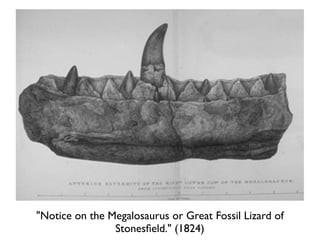
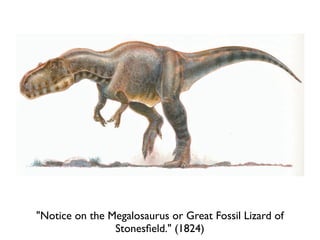
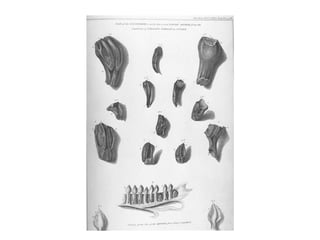
"Notice on the Megalosaurus or Great Fossil Lizard of
                Stonesfield." (1824)
"Notice on the Megalosaurus or Great Fossil Lizard of
                Stonesfield." (1824)
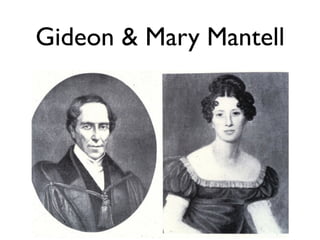
Gideon & Mary Mantell
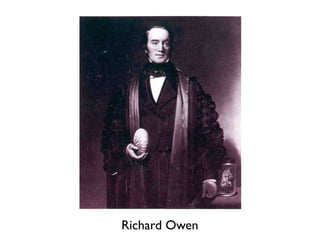
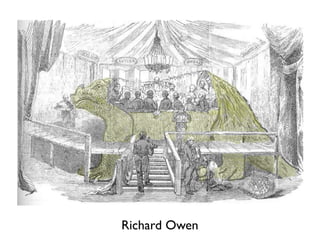
Richard Owen
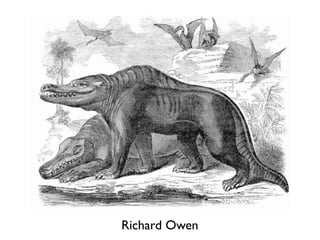
Richard Owen
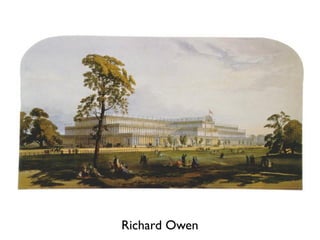
Richard Owen
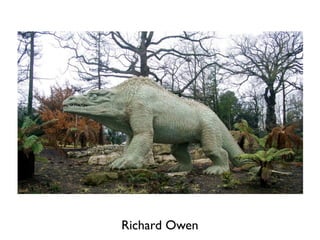
Richard Owen
Richard Owen
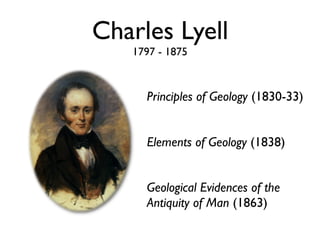
Charles Lyell
   1797 - 1875


     Principles of Geology (1830-33)


     Elements of Geology (1838)


     Geological Evidences of the
     Antiquity of Man (1863)
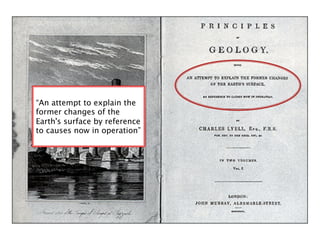
“An attempt to explain the
former changes of the
Earth's surface by reference
to causes now in operation”
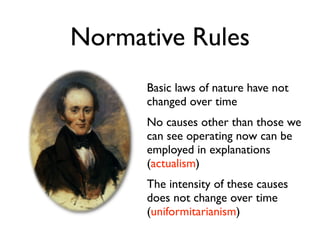
Normative Rules
      Basic laws of nature have not
      changed over time
      No causes other than those we
      can see operating now can be
      employed in explanations
      (actualism)
      The intensity of these causes
      does not change over time
      (uniformitarianism)
Diversity could be explained using a natural
mechanism which was also sufficient to explain
good (and bad) design.

Thus, design was apparent and did not imply a
designer.

Death and extinction are part of the natural
process and “evil” is a meaningless concept
when considering the natural world.

02 The Problem of Death

  • 1.
    The Problem of Death
  • 2.
    The Problem ofEvil If God is perfectly loving (omnibenevolent), He must wish to abolish evil If He is all powerful (omnipotent), He must be able to abolish evil But evil exists Therefore, an all powerful, loving God does not exist
  • 3.
  • 4.
  • 8.
  • 9.
    Nils Stensen (“Steno”) Preliminary discourse to a dissertation on a solid body naturally contained within a solid (1669) Superimposition: Layers of rock are arranged in a time sequence, with the oldest on the bottom and the youngest on the top, unless later processes disturb this arrangement. Original Horizontality: most sediments, when originally formed, were laid down horizontally. Original Lateral Continuity: the sediment will not only be deposited in a flat layer, it will be a layer that extends for a considerable distance in all directions. In other words, the layer is laterally continuous.
  • 14.
    James Usher Annals of the Old Covenant from the First Origin of the World (1650) Creation of the world on the evening preceding Sunday, 23rd October 4004 BCE 6,000 year old versus 4,550,000,000 year old
  • 15.
  • 17.
  • 18.
  • 20.
    Abraham Gottlob Werner Neptunism Aqueous origin of rocks Diluvialism Recent global flood Theologically acceptable
  • 21.
  • 22.
  • 23.
  • 24.
    Hutton’s Section Igneous Sedimentary
  • 25.
    Theory of theEarth Theory of the Earth, or an Investigation of the Laws Observable in the Composition, Dissolution and Restoration of Land upon the Globe. (1785 / 88 / 95) The Earth had a long history and that this history could be interpreted in terms of processes currently observed. “The result, therefore, of this physical inquiry is, that we find no vestige of a beginning, no prospect of an end.”
  • 32.
  • 33.
    'Duria Antiquior -a more ancient Dorsetshire' by Henry Thomas de la Beche, 1830
  • 36.
  • 39.
    William Buckland 1784 - 1856 Reliquiae Diluvianae, 1823 Geology was not inherently irreligious and confirmed the occurrence of a global flood. Miraculous forces were not required - natural law was applied
  • 42.
    "Notice on theMegalosaurus or Great Fossil Lizard of Stonesfield." (1824)
  • 43.
    "Notice on theMegalosaurus or Great Fossil Lizard of Stonesfield." (1824)
  • 44.
  • 49.
  • 50.
  • 51.
  • 52.
  • 53.
  • 61.
    Charles Lyell 1797 - 1875 Principles of Geology (1830-33) Elements of Geology (1838) Geological Evidences of the Antiquity of Man (1863)
  • 62.
    “An attempt toexplain the former changes of the Earth's surface by reference to causes now in operation”
  • 65.
    Normative Rules Basic laws of nature have not changed over time No causes other than those we can see operating now can be employed in explanations (actualism) The intensity of these causes does not change over time (uniformitarianism)
  • 73.
    Diversity could beexplained using a natural mechanism which was also sufficient to explain good (and bad) design. Thus, design was apparent and did not imply a designer. Death and extinction are part of the natural process and “evil” is a meaningless concept when considering the natural world.

Editor's Notes

  • #2  Why did forms apparently die-out? Tied with problem of evil?\n
  • #3 \n
  • #4 \n
  • #5 \n
  • #6 fossil - anything dug up\n
  • #7 \n
  • #8 Resemblance to teeth - 1667 Nils Stensen (Steno) - were teeth\n
  • #9 40 foot long shark\n
  • #10 two years later ... On fossils\n
  • #11 \n
  • #12 Note that this gives *relative* age – not actual – that would come later. No assumption of age. \n\n
  • #13 Note that this gives *relative* age – not actual – that would come later. No assumption of age. \n\n
  • #14 \n
  • #15 \n
  • #16 \n
  • #17 Under the influence of Principia – succeeded Newton as Lucasian prof – also an Arian – expelled in 1710 - Naturalistic - Deistic \n\n
  • #18 \n
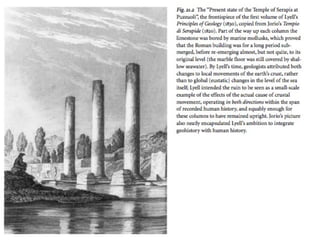
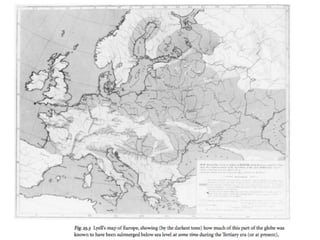
  • #19 By 1830’s map of Europe\n
  • #20 \n
  • #21 Member of Scottish Enlightenment – friend of Hume and Adam Smith. \nHutton’s PLUTONISM vs NEPTUNISM\n\n
  • #22 \n
  • #23 Jedburgh 1787 / Siccar Point (1788) Greywacke: 425 myo deep sea deposit (VERTICAL)\nSandstone: 345 myo flooded coastal plain (HORIZONTAL) /\n
  • #24 Evidence of volcanic rock penetrating through sedimentary as it was being laid down ~350myo\n
  • #25 natural processes - land rising from sea\n
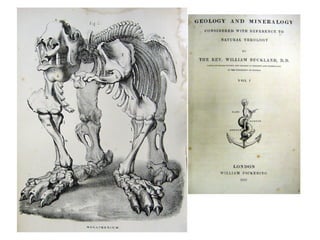
  • #26 Megatherium - South America - 1790’s\n
  • #27 Monsters of the Deep\n
  • #28 Monsters of the Deep\n
  • #29 Monsters of the Deep\n
  • #30 Monsters of the Deep\n
  • #31 Coast of Dorset / collectors / impoverished -> lead to charity printing\n\n
  • #32 \n
  • #33 1831 Scene from the Jura’s. 1836 Dinotherii\n
  • #34 1821 - Kirkdale Cave, Yorkshire\n
  • #35 \n
  • #36 Later shifted to the idea of a local flood.\n
  • #37 Buckland in Oxford - Hyenas - bat urine\n
  • #38 Drawing by local amateur naturalist, Mary Morland, who would become Mrs Buck. \n
  • #39 Obgyn - 1822 -\n
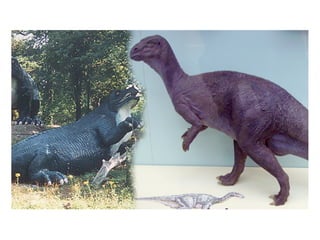
  • #40  quarry in Sussex - some megalsaur - “The Country of the Iguanodon” John Martin (1838)\n
  • #41  quarry in Sussex - some megalsaur - “The Country of the Iguanodon” John Martin (1838)\n
  • #42  quarry in Sussex - some megalsaur - “The Country of the Iguanodon” John Martin (1838)\n
  • #43 Coins dinosaur / ig as mammal-like lumbering / great exhibition 1851\n
  • #44 Coins dinosaur / ig as mammal-like lumbering / great exhibition 1851\n
  • #45 Coins dinosaur / ig as mammal-like lumbering / great exhibition 1851\n
  • #46 Coins dinosaur / ig as mammal-like lumbering / great exhibition 1851\n
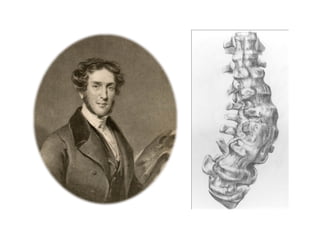
  • #47 M against O that Ig was as we see it today. M carriage accident in 1841, died of opium overdose in 1852. O had spine collected for the Hunterian. Destroyed in 1969. \n\n\n
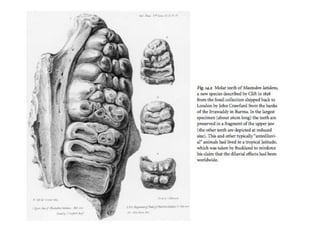
  • #48 Mastodon / Giant Irish / Coprolites\n
  • #49 Mastodon / Giant Irish / Coprolites\n
  • #50 Comparative method\n
  • #51 Buckland compared with modern reptiles\n
  • #52 \n
  • #53 \n
  • #54 \n
  • #55 “The Present is Key to the Past”\n
  • #56 1830 reaction to Lyell - De La Beche - lack of progress, cyclical nature, \n
  • #57 \n
  • #58 \n
  • #59 \n
  • #60 \n
  • #61 \n