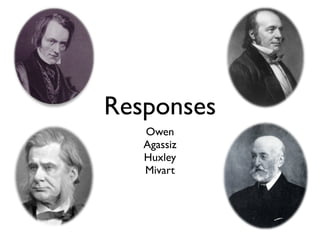
Responses
   Owen
   Agassiz
   Huxley
   Mivart
Charles Bell

   1858 was not “marked by any of
   those striking discoveries which
   at once revolutionize, so to
   speak, the department of
   science on which they bear”


             Presidential Address, Linnaean Society
Initial Positive Reviews


  The Times   Gardeners Chronicle
Adam Sedgwick
     “I cannot conclude without
     expressing my detestation of the
     theory, because of its unflinching
     materialism;—because it has
     deserted the inductive track, the
     only track that leads to physical
     truth;—because it utterly repudiates
     final causes, and thereby indicates a
     demoralized understanding on the
     part of its advocates”


                     Spectator (7 April 1860)
Adam Sedgwick
     The theory was “not inductive
     – not based on a series of
     acknowledged facts pointing
     to a general conclusion, - not
     a proposition evolved out of
     the facts, logically, and of
     course including them.”


               Spectator (7 April 1860)
Adam Sedgwick
     “I have read your book with more pain than
     pleasure. Parts of it I admired greatly, parts I
     laughed at till my sides were almost sore; other
     parts I read with absolute sorrow, because I think
     them utterly false and grievously mischievous.You
     have deserted—after a start in that tram-road of
     all solid physical truth—the true method of
     induction, and started us in machinery as wild, I
     think, as Bishop Wilkins's locomotive that was to
     sail with us to the moon. Many of your wide
     conclusions are based upon assumptions which
     can neither be proved nor disproved, why then
     express them in the language and arrangement of
     philosophical induction?”
                                   Letter to CD, 11/24/59
Adam Sedgwick

     “I shall always protest against
     that degrading hypothesis
     which attributes to man an
     origin derived from the lower
     animals”
                       October 1868
George Douglas Campbell
       Duke of Argyll

        Reign of Law (1867)
        Both history and physical
        phenomena were planned and
        directed by a divine Mind using
        natural law.
        Transmutation could occur, natural
        selection was not the mechanism.
        Beauty for beauty’s sake could not
        be explained.
Henry Charles Fleeming Jenkin
            North British Review, 1867
            Since artificial selection had its
            limits, it actually disproved
            natural selection.
            Advantageous variants would
            be swamped within the
            population as a whole.
            Addressed by Darwin in the
            5th edition of 1869
Shipwrecked Englishman
“Our shipwrecked hero would probably become king; he would kill
a great many blacks in the struggle for existence; he would have a
great many wives and children, while many of his subjects would live
and die as bachelors. In the first generation there will be some
dozens of intelligent young mulattoes, much superior in average
intelligence to the negroes. We might expect the throne for some
generations to be occupied by a more or less yellow king; but can
any one believe that the whole island will gradually acquire a white,
or even a yellow population, or that the islanders would acquire
energy, courage, ingenuity, patience, self-control, endurance, in virtue
of which qualities our hero killed so many of their ancestors, and
begot so many children; those qualities, in fact, which the struggle
for existence would select, if it could select anything?”
Richard Owen
   1804 - 1892
Life
Apprenticed to surgeon apothecary
Educated for six months in Edinburgh, 1824
Prosector at St Bartholomew’s Hospital, 1825
Member, Royal College of Surgeons, 1826
Hunterian Museum: Assistant Curator 1827,
Curator 1842
Fellow, Royal Society, 1834
Hunterian Professor, Royal College of Surgeons,
1836
Introduced to Darwin by Lyell, 1836
British Museum: Superintendent, 1856 - 1883
Founded British Museum (Natural History), 1881
Knight of the Order of the Bath, 1883
Fusing of functionalism (Cuvier) with
  transcendental anatomy (Oken).
Functionalism
     Georges Cuvier
     Adaptation of organism to
     external conditions
     “Correlation of Parts” and
     “Conditions of Existence”
     Could be allied with British
     Natural Theology
Lorenz Oken

     Naturphilosophie


     The skull consisted of
     modified vertebrae
     (1807)
Megatherium 1842
Dinosauria 1842
Dinornis 1843
Royal Medal 1846   Chaning Pearce 1842
Great Exhibition1851
Gideon Mantel 1852
Archaeopteryx 1863
Homology
Homology


   “The same organ in
   different animals under
   every variety of form and
   function”
Vertebral
 Theory
The Vertebrate Archetype


On the Archetype and Homologies of the Vertebrate Skeleton


Archetype as abstract principle or law of nature (1848)
      Archetype as pre-existing pattern (1849)
1839
 “Do the speculations … of Lamarck and
 Geoffroy Saint-Hilaire derive any support, or
 meet with additional disproof, from the facts? …
 We have the opportunity of tracing Ichthyosauri,
 generation after generation through the whole of
 the immense series of strata. The very species
 which made its first abrupt appearance in the
 lowest strata, maintains its characters unchanged
 and recognizable in the highest of the Secondary
 strata. … In the chalk the genus Ichthyosaurus
 quits the stage of existence as suddenly as it
 entered it … and with every appreciable
 character unchanged. There is no evidence
 whatever that one species has
 succeeded or been the result of the
 transmutation of a former species”
Evolutionism?
      1830’s - Matter had “organizing
      energy” (vitalism)
      1838 - Ridicules Lamarckism
      1840’s - “The continuous operation of
      the ordained becoming of all things”
      1849 - Humans evolved from fish by
      natural law
      1854 - Apes could not be transformed
      into men but humans could have
      evolved from other species by a
      process other than transmutation
“Derivative Hypothesis”
     Owen’s Evolutionism
              Fundamental relationship of all
              (vertebrate) organisms
              Spontaneous generation Pattern in
              fossil record from general to specific
              Studies of fossils could actually
              reveal the steps by which
              adaptation took place.
              Species come into existence through
              pre-ordained process of natural
              law
              Transmutation is saltational – there
              are breaks between groups
Reject Darwinism
        Edinburgh Review, 1860
        Origin suffered for the “abuse of
        science ... to which a neighbouring
        nation, some seventy years since,
        owed its temporary degradation”
        Natural Selection can only cause
        extinctions
        Apparent random nature of
        process
        Miss-portrayal of Owen by
        Darwin as a creationist.
On Darwin

    “Darwin stands to biology
    in the relation in which
    Copernicus stood to
    astronomy”
    However, a Newton
    (nomotheization) was still
    to come
Not A Creationist

        “We have no sympathy
        whatever with Biblical
        objectors to creation
        by law, or with the
        sacerdotal revilers of
        those who would explain
        such law”
1858
  “I cannot shut my eyes to
  the significance of that all-
  pervading similitude of
  structure - every tooth,
  every bone, strictly
  homologous - which
  makes the determination
  of the difference [between
  man and ape] the
  anatomist’s difficulty”
Owen on Humans
      Sole members of sub-class
      Archencephala
      Larger relative brain size
      Increase in size of cerebral
      hemispheres
      Well developed cerebellum
      with increased convolutions
      Presence of hippocampus
      minor
Examining a Water Baby
BAAS Meeting of June 1860, Oxford
Bishop Samuel Wilberforce
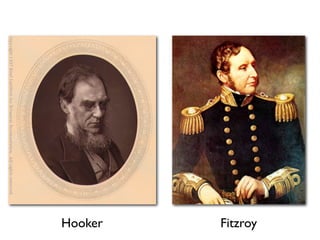
Hooker   Fitzroy
“Cambridge Duet”
      BAAS Meetings
         1860: Oxford
         1861: Manchester
         1862: Cambridge
      Scientific Journals
         Natural History Review (Huxley)
         Annals and Magazine of Natural
         History (Owen)
Man’s Place in Nature
        1863
Problems with
        “Traditional” View
Both sides erred
   Mis-translated Latin (RO)
   Illustrations (RO and THH)
   Lack of fossil evidence (THH)
The continued attack by THH since 1850
Owen’s evolutionism
Long Campaign
     Networking with younger
     scientists
     Continually attacking Owen’s
     work since early 1850’s
     “Slaying a great man as a
     means to achieve greatness”
     Attempt to prevent formation
     of BM(NH) in 1860 -
     museums were for research
Vehement anti-evolutionary member of “old guard”
                           or
Theistic evolutionist and victim of institutional politics
Convicted
    Mantell & Iguanodon
        Denied presidency of
        Geological Society
    Pearce & blemenites
        Voted off councils of
        Zoological and Royal societies.
    Huxley & brains
        Prevented from joining Royal
        Society council
    Hooker & funding for Kew
Darwin on Owen

“The Londoners say he is mad with envy because my
book is so talked about. It is painful to be hated in the
intense degree with which Owen hates me.”
“I used to be ashamed of hating him so much, but
now I will carefully cherish my hatred & contempt to
the last days of my life.”
1885
1866
1867
1868
1869
1881
1881
1881
King of
A Shanty   1882
1882
Swift
McNeil   1893
1867
1876
1880
1882

Richard Owen

  • 1.
    Responses Owen Agassiz Huxley Mivart
  • 2.
    Charles Bell 1858 was not “marked by any of those striking discoveries which at once revolutionize, so to speak, the department of science on which they bear” Presidential Address, Linnaean Society
  • 3.
    Initial Positive Reviews The Times Gardeners Chronicle
  • 4.
    Adam Sedgwick “I cannot conclude without expressing my detestation of the theory, because of its unflinching materialism;—because it has deserted the inductive track, the only track that leads to physical truth;—because it utterly repudiates final causes, and thereby indicates a demoralized understanding on the part of its advocates” Spectator (7 April 1860)
  • 5.
    Adam Sedgwick The theory was “not inductive – not based on a series of acknowledged facts pointing to a general conclusion, - not a proposition evolved out of the facts, logically, and of course including them.” Spectator (7 April 1860)
  • 6.
    Adam Sedgwick “I have read your book with more pain than pleasure. Parts of it I admired greatly, parts I laughed at till my sides were almost sore; other parts I read with absolute sorrow, because I think them utterly false and grievously mischievous.You have deserted—after a start in that tram-road of all solid physical truth—the true method of induction, and started us in machinery as wild, I think, as Bishop Wilkins's locomotive that was to sail with us to the moon. Many of your wide conclusions are based upon assumptions which can neither be proved nor disproved, why then express them in the language and arrangement of philosophical induction?” Letter to CD, 11/24/59
  • 7.
    Adam Sedgwick “I shall always protest against that degrading hypothesis which attributes to man an origin derived from the lower animals” October 1868
  • 8.
    George Douglas Campbell Duke of Argyll Reign of Law (1867) Both history and physical phenomena were planned and directed by a divine Mind using natural law. Transmutation could occur, natural selection was not the mechanism. Beauty for beauty’s sake could not be explained.
  • 9.
    Henry Charles FleemingJenkin North British Review, 1867 Since artificial selection had its limits, it actually disproved natural selection. Advantageous variants would be swamped within the population as a whole. Addressed by Darwin in the 5th edition of 1869
  • 10.
    Shipwrecked Englishman “Our shipwreckedhero would probably become king; he would kill a great many blacks in the struggle for existence; he would have a great many wives and children, while many of his subjects would live and die as bachelors. In the first generation there will be some dozens of intelligent young mulattoes, much superior in average intelligence to the negroes. We might expect the throne for some generations to be occupied by a more or less yellow king; but can any one believe that the whole island will gradually acquire a white, or even a yellow population, or that the islanders would acquire energy, courage, ingenuity, patience, self-control, endurance, in virtue of which qualities our hero killed so many of their ancestors, and begot so many children; those qualities, in fact, which the struggle for existence would select, if it could select anything?”
  • 11.
    Richard Owen 1804 - 1892
  • 12.
    Life Apprenticed to surgeonapothecary Educated for six months in Edinburgh, 1824 Prosector at St Bartholomew’s Hospital, 1825 Member, Royal College of Surgeons, 1826 Hunterian Museum: Assistant Curator 1827, Curator 1842 Fellow, Royal Society, 1834 Hunterian Professor, Royal College of Surgeons, 1836 Introduced to Darwin by Lyell, 1836 British Museum: Superintendent, 1856 - 1883 Founded British Museum (Natural History), 1881 Knight of the Order of the Bath, 1883
  • 15.
    Fusing of functionalism(Cuvier) with transcendental anatomy (Oken).
  • 16.
    Functionalism Georges Cuvier Adaptation of organism to external conditions “Correlation of Parts” and “Conditions of Existence” Could be allied with British Natural Theology
  • 17.
    Lorenz Oken Naturphilosophie The skull consisted of modified vertebrae (1807)
  • 19.
  • 20.
  • 21.
  • 22.
    Royal Medal 1846 Chaning Pearce 1842
  • 23.
  • 24.
  • 25.
  • 26.
  • 27.
    Homology “The same organ in different animals under every variety of form and function”
  • 28.
  • 31.
    The Vertebrate Archetype Onthe Archetype and Homologies of the Vertebrate Skeleton Archetype as abstract principle or law of nature (1848) Archetype as pre-existing pattern (1849)
  • 32.
    1839 “Do thespeculations … of Lamarck and Geoffroy Saint-Hilaire derive any support, or meet with additional disproof, from the facts? … We have the opportunity of tracing Ichthyosauri, generation after generation through the whole of the immense series of strata. The very species which made its first abrupt appearance in the lowest strata, maintains its characters unchanged and recognizable in the highest of the Secondary strata. … In the chalk the genus Ichthyosaurus quits the stage of existence as suddenly as it entered it … and with every appreciable character unchanged. There is no evidence whatever that one species has succeeded or been the result of the transmutation of a former species”
  • 33.
    Evolutionism? 1830’s - Matter had “organizing energy” (vitalism) 1838 - Ridicules Lamarckism 1840’s - “The continuous operation of the ordained becoming of all things” 1849 - Humans evolved from fish by natural law 1854 - Apes could not be transformed into men but humans could have evolved from other species by a process other than transmutation
  • 34.
    “Derivative Hypothesis” Owen’s Evolutionism Fundamental relationship of all (vertebrate) organisms Spontaneous generation Pattern in fossil record from general to specific Studies of fossils could actually reveal the steps by which adaptation took place. Species come into existence through pre-ordained process of natural law Transmutation is saltational – there are breaks between groups
  • 35.
    Reject Darwinism Edinburgh Review, 1860 Origin suffered for the “abuse of science ... to which a neighbouring nation, some seventy years since, owed its temporary degradation” Natural Selection can only cause extinctions Apparent random nature of process Miss-portrayal of Owen by Darwin as a creationist.
  • 36.
    On Darwin “Darwin stands to biology in the relation in which Copernicus stood to astronomy” However, a Newton (nomotheization) was still to come
  • 37.
    Not A Creationist “We have no sympathy whatever with Biblical objectors to creation by law, or with the sacerdotal revilers of those who would explain such law”
  • 38.
    1858 “Icannot shut my eyes to the significance of that all- pervading similitude of structure - every tooth, every bone, strictly homologous - which makes the determination of the difference [between man and ape] the anatomist’s difficulty”
  • 47.
    Owen on Humans Sole members of sub-class Archencephala Larger relative brain size Increase in size of cerebral hemispheres Well developed cerebellum with increased convolutions Presence of hippocampus minor
  • 48.
  • 49.
    BAAS Meeting ofJune 1860, Oxford
  • 50.
  • 51.
    Hooker Fitzroy
  • 52.
    “Cambridge Duet” BAAS Meetings 1860: Oxford 1861: Manchester 1862: Cambridge Scientific Journals Natural History Review (Huxley) Annals and Magazine of Natural History (Owen)
  • 53.
    Man’s Place inNature 1863
  • 54.
    Problems with “Traditional” View Both sides erred Mis-translated Latin (RO) Illustrations (RO and THH) Lack of fossil evidence (THH) The continued attack by THH since 1850 Owen’s evolutionism
  • 55.
    Long Campaign Networking with younger scientists Continually attacking Owen’s work since early 1850’s “Slaying a great man as a means to achieve greatness” Attempt to prevent formation of BM(NH) in 1860 - museums were for research
  • 56.
    Vehement anti-evolutionary memberof “old guard” or Theistic evolutionist and victim of institutional politics
  • 57.
    Convicted Mantell & Iguanodon Denied presidency of Geological Society Pearce & blemenites Voted off councils of Zoological and Royal societies. Huxley & brains Prevented from joining Royal Society council Hooker & funding for Kew
  • 58.
    Darwin on Owen “TheLondoners say he is mad with envy because my book is so talked about. It is painful to be hated in the intense degree with which Owen hates me.” “I used to be ashamed of hating him so much, but now I will carefully cherish my hatred & contempt to the last days of my life.”
  • 60.
  • 62.
  • 63.
  • 64.
  • 65.
  • 66.
  • 67.
  • 68.
  • 69.
  • 70.
  • 71.
  • 72.
  • 73.
  • 74.
  • 75.