PMS (POST MARKETING Surveillance)
Submitted To: Submitted By:
Prof. Dr. Harish Dureja Sandeep
( P’ceutical Department M.Pharma
M.D.U , Rohtak ) (DRA)Ist Sem.
Roll no.:1854
INDEX
 Introduction
 History
 Benefits of PMS
 Sources of PMS
 Types of surveillance
 Method of surveillance
 Manufacturer PMS system
 References
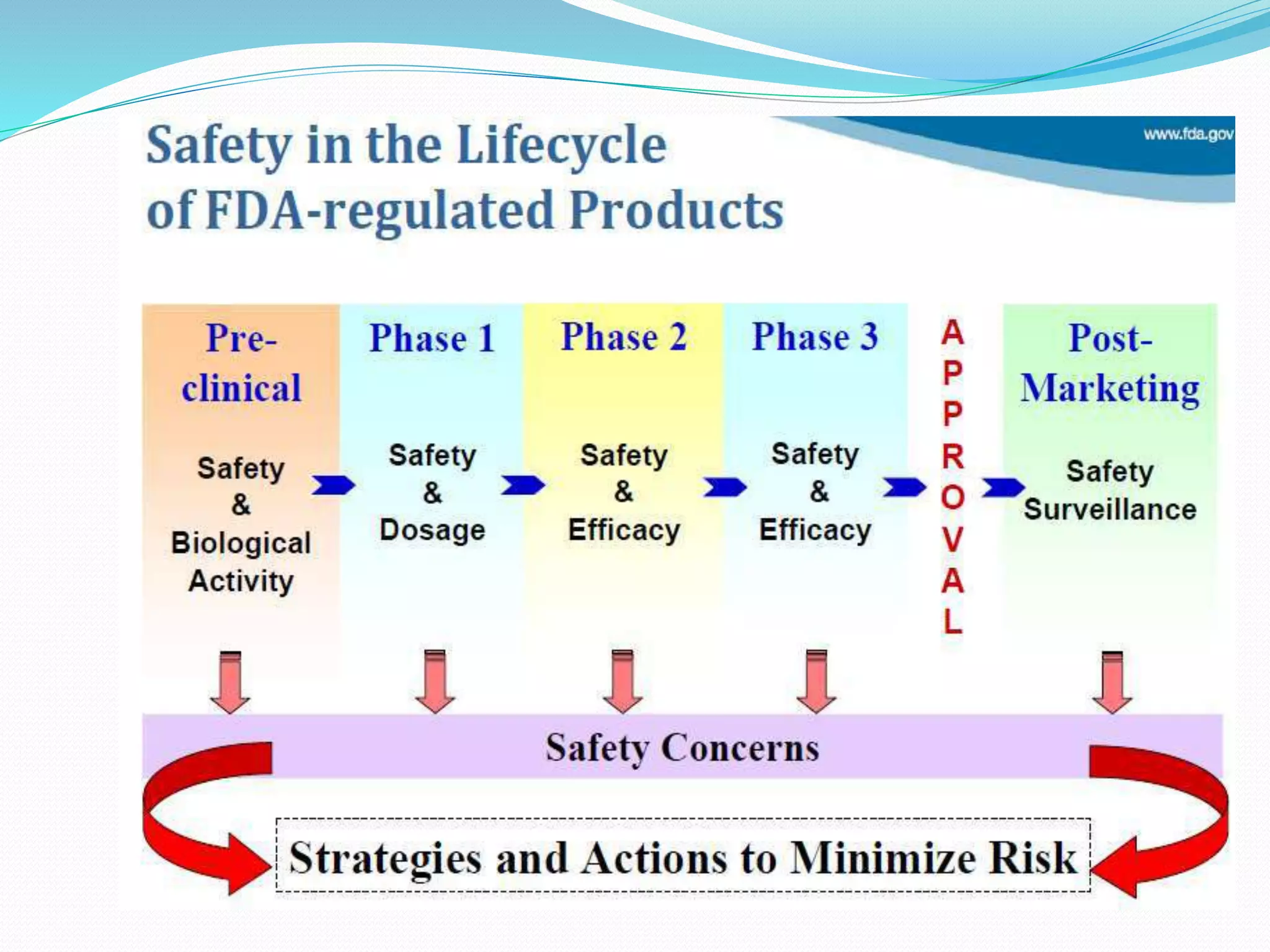
PHASES OF CLINICAL TRIALS
Phase 0 : micro dosing
Phase I : First in man- Safety
Phase II: First in Patient- Dose , dosage forms
Phase III: Efficacy , ADRs
Post-marketing Surveillance or
Phase –IV : Evaluation of in the real
clinical setting.
Introduction
 Post marketing surveillance refers to
any means of obtaining information about a
product after it has been approved for public
use.
 Section 505(0)(3) authorizes FDA to require
certain post marketing studies and clinical
trials for prescription drugs approved under
section 505(b) and biological product approved
under section 351. cont…
 Post-marketing surveillance of drug therefore
play an
important role to discover an undesirable effect
that might present at risk.
 It provide additional information on the
benefit and risk of the drugs.
HISTORY
 In the 1960 at least two serious drugs reactions were
observed in many patient . thalidomide causes limbs
deformities (phocomelia).
 The PMA, senator Edward Kennedy (D-Mass.) suggested
that a better system was need for monitoring the use and
effects of prescription drug after they are marketed.
 As a result, the joint commission on Prescription Drugs Use
was established in 1976,funded largely by the drug industry,
with the mandate to design a post-marketing surveillance
system to detect , quantify and describe the anticipated and
unanticipated effects of marketed drugs.
 The delayed discovery of the adverse effects spurred effects
to improve post-marketing surveillance.
POST-MARKETING SURVEILLANCE
 No fixed duration/Patient population
 Starts immediately after marketing
 Report all ADRs
 Help to detect
 Rare ADRs
 Drug interaction
 Also new uses for drugs[sometimes called
Phase V]
Limitations of Premarketing Clinical Trials
 Size of the patient population studied
 Narrow population - often not providing
sufficient data on special groups
 Narrow indications studied
 Short duration
Benefits of Post-marketing Monitoring :
The ability to study the following:
•Low frequency reactions (not identified in
clinical trials)
•High risk groups
•Long-term effects
•Drug-drug/food interactions
•Increased severity and / or reporting frequency
of known reactions
SOURCES OF PMS INFORMATION:
The following may be considered as sources of
information :
 Expert user groups
 Customer surveys
 Customer complaints and warranty claims
 Post CE-market clinical trials.
 Literature reviews
 The media
Types of Post-marketing Surveillance
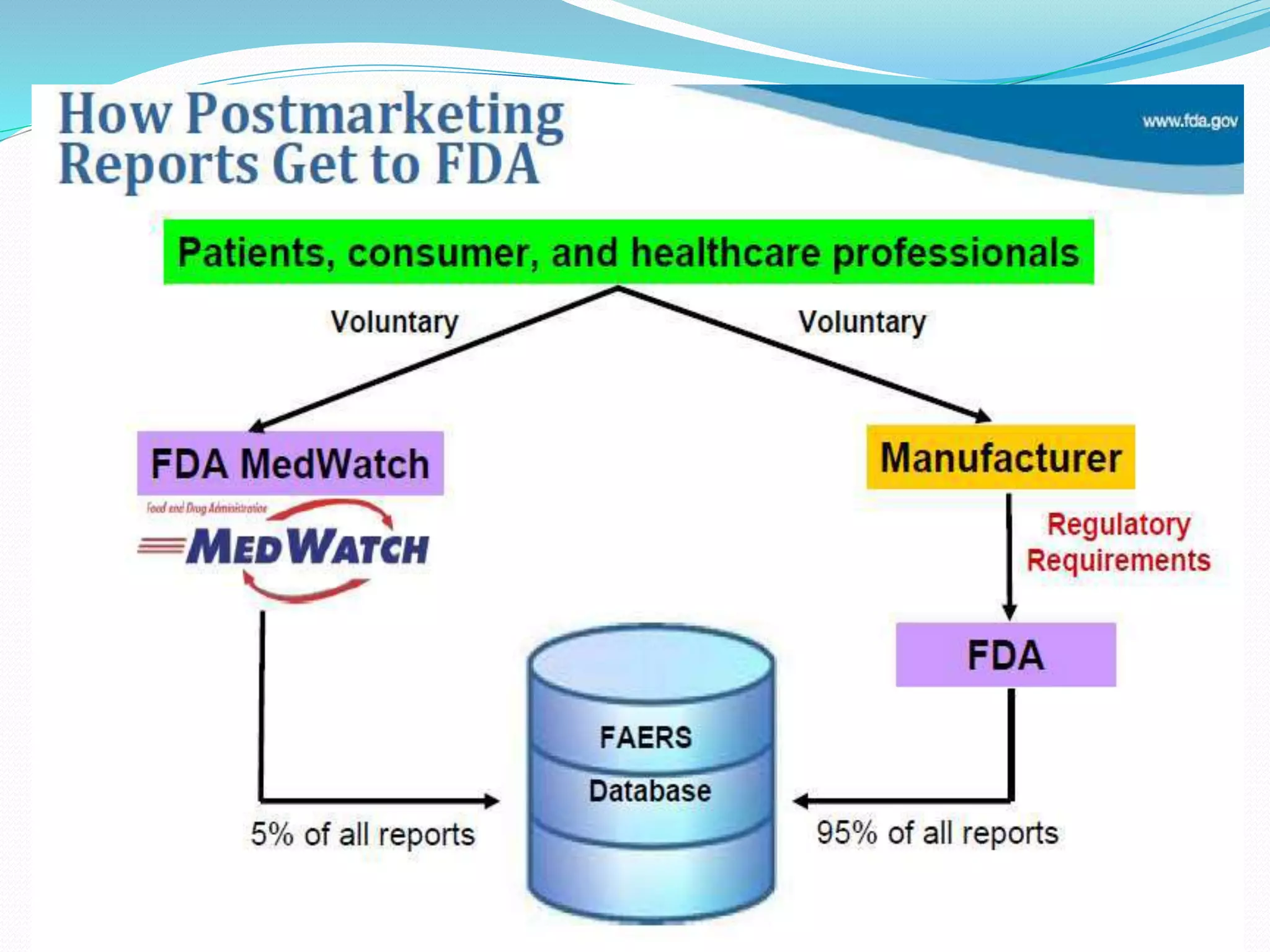
 Spontaneous/voluntary reporting of cases
 National (FDA MedWatch)
 Local or Regional (Joint Commission Requirement)
 Scientific literature publications
 Postmarketing studies (voluntary or required)
 Observational studies (including automated healthcare
databases)
 Randomized clinical trials
 Active surveillance
 Drug-Induced Liver Injury Network (DILIN)
 Sentinel initiative
Spontaneous Reports
 A communication from an individual (e.g.
health care professional, consumer) to a
company or regulatory authority
 Describes a suspected adverse event(s)
 Passive and voluntary reports
Factors Affecting Reporting
 Media attention
 Litigation (class action lawsuits)
 Nature of the adverse event
 Type of drug product and indication
 Length of time on market
 Extent and quality of manufacturer’s surveillance system
 Rx or OTC product status
 Reporting regulations
FDA Adverse Event Reporting System (FAERS)
 Computerized database
 Spontaneous reports
 Contains human drug and therapeutic biologic
reports
 > 7 million reports since 1969
FAERS Strengths
 Includes all U.S. marketed products
 Includes all uses
 Includes broad patient populations: elderly,
children, pregnant women, co-morbidities
 Simple, relatively inexpensive reporting system
 Especially good for events with a rare
background rate
cont….
 Useful for events that occur shortly after
exposure
 Detection of events not seen in clinical trials
(“signal generation”)
 Identification of trends, possible risk factors,
populations, and other clinically significant
emerging safety concerns
Safety Signal
 Reported information on a possible causal
relationship between an adverse event and a drug
 The relationship being previously unknown or
incompletely documented
 Supported by multiple case reports
 New unlabeled adverse events
 An observed increase in a labeled event OR a greater
severity or specificity
 New interactions
 Newly identified at-risk population
Use of Data Mining
 Mathematical tool identifies higher-than-
expected frequency of product-event
combinations
 Tool for hypothesis generation
 Supplements FAERS data review
 Does not replace expert clinical case review
Developing a Case Series
 Identify a well-documented case in FAERS,
published literature, data mining, or other sources
to identify a safety signal.
 Using our knowledge of the clinical course of the
disease, formulate a case definition which may
include both clinical features and laboratory
findings, sometimes even demographic
information if we believe the safety signal is for a
specific population.
 Complete a thorough database search for
additional cases.
Regulatory Actions
 Labeling changes – i.e. Warnings, Precautions,
Adverse Reactions
 Pharmacovigilance activities - enhanced
surveillance (e.g., expedited reporting), registry,
epidemiology studies
 Risk Evaluation and Mitigation Strategy (REMS)
Communication plan, restricted use
 Drug Safety Communication (DSC)
 Market withdrawal
METHODS OF SURVEILLANCE:
Thus, four types of studies are generally
used to identify drugs effects:
1. Controlled clinical trials,
2. Spontaneous or voluntary recording
3. Cohort studies
4. Case control studies
CONTROLLED CLINICAL TRIALS:
 To minimize bias through such method as
 randomization
 Directly monitor patients for the duration of
 studies.
 For evaluating a drug’s efficacy and safety.
 They are often costly.
SPONTANEOUS REPORTING:
A communication from an individual (e.g:
health care professional, consumer) to a company
or regulatory authority .
 This describes a suspected adverse event(S)
 But the actual incidence of adverse drug
reaction can not be determined through
spontaneous reporting.
COHORT STUDIES:
 Studies follow a defined group of patient for a
period of time.
 Patient are not randomly assigned
CASE CONTROL STUDIES:
 Case control studies identify patient with the
adverse effects to be studied, and compare
them with the sample drawn from the same
cohort that gave rise to cases.
MANUFACTURER PMS SYSTEM:
These are some of the type of
knowledge and feed back which can achieved
from a PMS system.
 Detection of some manufacturing problems.
 Product quality improvement.
 Conformation (or otherwise) of risk analysis.
 Knowledge of long term
performance/reliability and /or chronic
complication.
 Knowledge of performance in different user
population.
 Feedback on indication of use.
 Feedback on instruction for use.
 Feedback on use with other devices.
 Feedback on customer satisfaction.
 Feedback on continuing market viability.
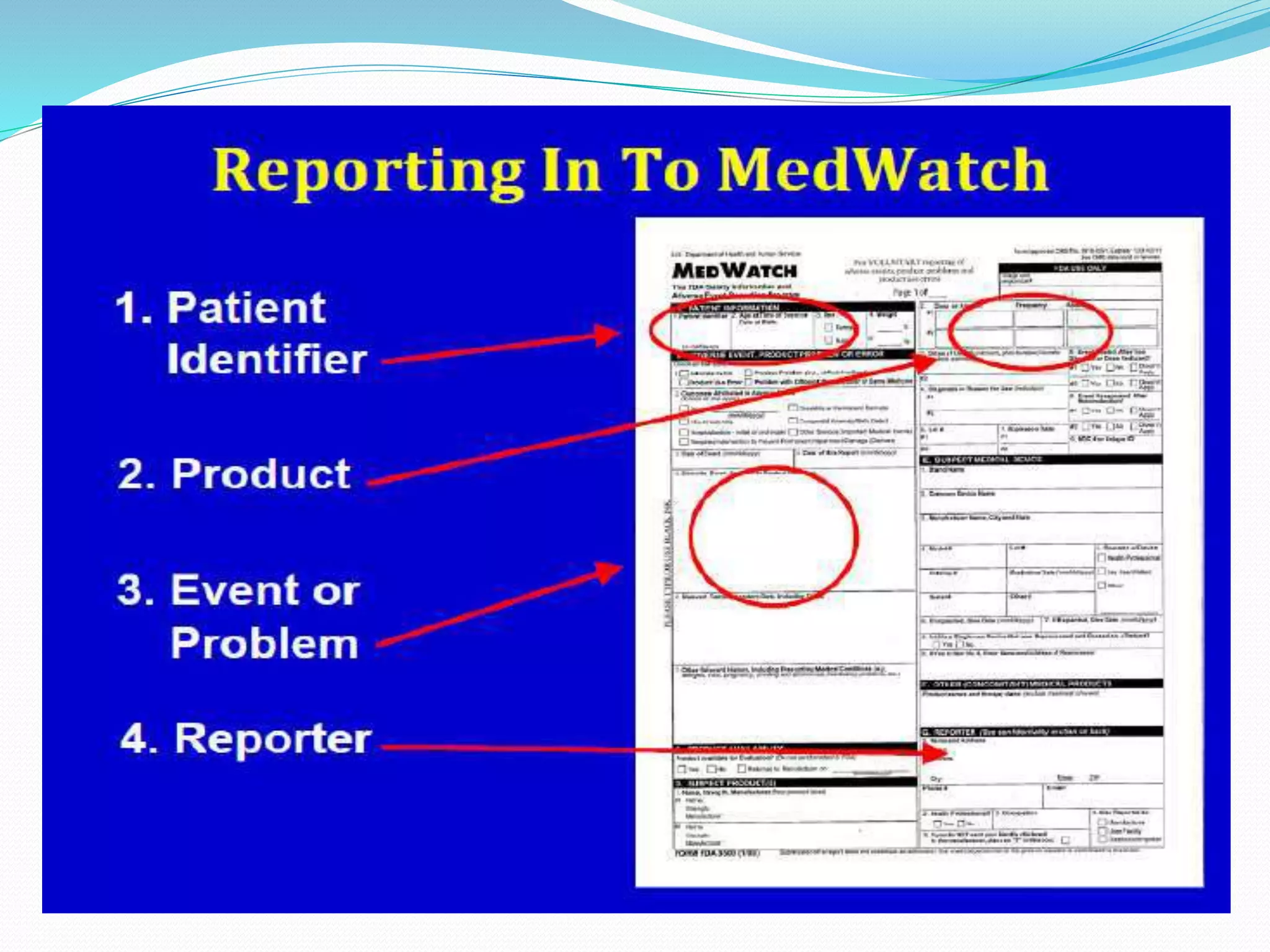
How to report to MedWatch
How to Report:
Online(www.fda.gov/medwatch)
Download the form Mail
Fax 1–800–332–0178
For questions about the form: 1–800–332–1088
References
 http://www.fda.gov/Safety/MedWatch
 MedWatch Safety Alerts:
http://www.fda.gov/Safety/MedWatch/ucm287881.htm
 http://www.fda.gov/Drugs/GuidanceComplianceRegulatoryInf
ormation/Surveillance/AdverseDrugEffects/ucm082196.htm#
QuarterlyReports
 FOOD AND DRUGS ADMINISTRATION, Supplementary
reports to contracts and grants committee on
Medicaid”, from the division of Drugs
Experience, BUREAU OF DRUGS,1982, 10-32.
Thank You

PMS (post marketing surveillance)

  • 1.
    PMS (POST MARKETINGSurveillance) Submitted To: Submitted By: Prof. Dr. Harish Dureja Sandeep ( P’ceutical Department M.Pharma M.D.U , Rohtak ) (DRA)Ist Sem. Roll no.:1854
  • 2.
    INDEX  Introduction  History Benefits of PMS  Sources of PMS  Types of surveillance  Method of surveillance  Manufacturer PMS system  References
  • 3.
    PHASES OF CLINICALTRIALS Phase 0 : micro dosing Phase I : First in man- Safety Phase II: First in Patient- Dose , dosage forms Phase III: Efficacy , ADRs Post-marketing Surveillance or Phase –IV : Evaluation of in the real clinical setting.
  • 5.
    Introduction  Post marketingsurveillance refers to any means of obtaining information about a product after it has been approved for public use.  Section 505(0)(3) authorizes FDA to require certain post marketing studies and clinical trials for prescription drugs approved under section 505(b) and biological product approved under section 351. cont…
  • 6.
     Post-marketing surveillanceof drug therefore play an important role to discover an undesirable effect that might present at risk.  It provide additional information on the benefit and risk of the drugs.
  • 7.
    HISTORY  In the1960 at least two serious drugs reactions were observed in many patient . thalidomide causes limbs deformities (phocomelia).  The PMA, senator Edward Kennedy (D-Mass.) suggested that a better system was need for monitoring the use and effects of prescription drug after they are marketed.  As a result, the joint commission on Prescription Drugs Use was established in 1976,funded largely by the drug industry, with the mandate to design a post-marketing surveillance system to detect , quantify and describe the anticipated and unanticipated effects of marketed drugs.  The delayed discovery of the adverse effects spurred effects to improve post-marketing surveillance.
  • 8.
    POST-MARKETING SURVEILLANCE  Nofixed duration/Patient population  Starts immediately after marketing  Report all ADRs  Help to detect  Rare ADRs  Drug interaction  Also new uses for drugs[sometimes called Phase V]
  • 9.
    Limitations of PremarketingClinical Trials  Size of the patient population studied  Narrow population - often not providing sufficient data on special groups  Narrow indications studied  Short duration
  • 10.
    Benefits of Post-marketingMonitoring : The ability to study the following: •Low frequency reactions (not identified in clinical trials) •High risk groups •Long-term effects •Drug-drug/food interactions •Increased severity and / or reporting frequency of known reactions
  • 11.
    SOURCES OF PMSINFORMATION: The following may be considered as sources of information :  Expert user groups  Customer surveys  Customer complaints and warranty claims  Post CE-market clinical trials.  Literature reviews  The media
  • 12.
    Types of Post-marketingSurveillance  Spontaneous/voluntary reporting of cases  National (FDA MedWatch)  Local or Regional (Joint Commission Requirement)  Scientific literature publications  Postmarketing studies (voluntary or required)  Observational studies (including automated healthcare databases)  Randomized clinical trials  Active surveillance  Drug-Induced Liver Injury Network (DILIN)  Sentinel initiative
  • 13.
    Spontaneous Reports  Acommunication from an individual (e.g. health care professional, consumer) to a company or regulatory authority  Describes a suspected adverse event(s)  Passive and voluntary reports
  • 14.
    Factors Affecting Reporting Media attention  Litigation (class action lawsuits)  Nature of the adverse event  Type of drug product and indication  Length of time on market  Extent and quality of manufacturer’s surveillance system  Rx or OTC product status  Reporting regulations
  • 16.
    FDA Adverse EventReporting System (FAERS)  Computerized database  Spontaneous reports  Contains human drug and therapeutic biologic reports  > 7 million reports since 1969
  • 17.
    FAERS Strengths  Includesall U.S. marketed products  Includes all uses  Includes broad patient populations: elderly, children, pregnant women, co-morbidities  Simple, relatively inexpensive reporting system  Especially good for events with a rare background rate cont….
  • 18.
     Useful forevents that occur shortly after exposure  Detection of events not seen in clinical trials (“signal generation”)  Identification of trends, possible risk factors, populations, and other clinically significant emerging safety concerns
  • 19.
    Safety Signal  Reportedinformation on a possible causal relationship between an adverse event and a drug  The relationship being previously unknown or incompletely documented  Supported by multiple case reports  New unlabeled adverse events  An observed increase in a labeled event OR a greater severity or specificity  New interactions  Newly identified at-risk population
  • 20.
    Use of DataMining  Mathematical tool identifies higher-than- expected frequency of product-event combinations  Tool for hypothesis generation  Supplements FAERS data review  Does not replace expert clinical case review
  • 21.
    Developing a CaseSeries  Identify a well-documented case in FAERS, published literature, data mining, or other sources to identify a safety signal.  Using our knowledge of the clinical course of the disease, formulate a case definition which may include both clinical features and laboratory findings, sometimes even demographic information if we believe the safety signal is for a specific population.  Complete a thorough database search for additional cases.
  • 22.
    Regulatory Actions  Labelingchanges – i.e. Warnings, Precautions, Adverse Reactions  Pharmacovigilance activities - enhanced surveillance (e.g., expedited reporting), registry, epidemiology studies  Risk Evaluation and Mitigation Strategy (REMS) Communication plan, restricted use  Drug Safety Communication (DSC)  Market withdrawal
  • 23.
    METHODS OF SURVEILLANCE: Thus,four types of studies are generally used to identify drugs effects: 1. Controlled clinical trials, 2. Spontaneous or voluntary recording 3. Cohort studies 4. Case control studies
  • 24.
    CONTROLLED CLINICAL TRIALS: To minimize bias through such method as  randomization  Directly monitor patients for the duration of  studies.  For evaluating a drug’s efficacy and safety.  They are often costly.
  • 25.
    SPONTANEOUS REPORTING: A communicationfrom an individual (e.g: health care professional, consumer) to a company or regulatory authority .  This describes a suspected adverse event(S)  But the actual incidence of adverse drug reaction can not be determined through spontaneous reporting.
  • 26.
    COHORT STUDIES:  Studiesfollow a defined group of patient for a period of time.  Patient are not randomly assigned CASE CONTROL STUDIES:  Case control studies identify patient with the adverse effects to be studied, and compare them with the sample drawn from the same cohort that gave rise to cases.
  • 27.
    MANUFACTURER PMS SYSTEM: Theseare some of the type of knowledge and feed back which can achieved from a PMS system.  Detection of some manufacturing problems.  Product quality improvement.  Conformation (or otherwise) of risk analysis.  Knowledge of long term performance/reliability and /or chronic complication.
  • 28.
     Knowledge ofperformance in different user population.  Feedback on indication of use.  Feedback on instruction for use.  Feedback on use with other devices.  Feedback on customer satisfaction.  Feedback on continuing market viability.
  • 29.
    How to reportto MedWatch
  • 31.
    How to Report: Online(www.fda.gov/medwatch) Downloadthe form Mail Fax 1–800–332–0178 For questions about the form: 1–800–332–1088
  • 32.
    References  http://www.fda.gov/Safety/MedWatch  MedWatchSafety Alerts: http://www.fda.gov/Safety/MedWatch/ucm287881.htm  http://www.fda.gov/Drugs/GuidanceComplianceRegulatoryInf ormation/Surveillance/AdverseDrugEffects/ucm082196.htm# QuarterlyReports  FOOD AND DRUGS ADMINISTRATION, Supplementary reports to contracts and grants committee on Medicaid”, from the division of Drugs Experience, BUREAU OF DRUGS,1982, 10-32.
  • 33.