Ice-Cream
Processing
Sushant Gawali
Introduction
• Ice cream is a frozen blend of a sweetened cream mixture and air, with added flavorings.
• It may be made from milk or cream and is flavoured with a sweetener, either sugar or an
alternative, and a spice, such as cocoa or vanilla, or with fruit such as strawberries or
peaches.
• Ice cream is a colloidal emulsion made with water, ice, milk fat, milk protein, sugar and
air.
• Milk proteins such as casein and whey protein present in ice cream are amphiphilic, can
adsorb water and form micelles which will contribute to its consistency.
• Lactose which is sugar present in milk will cause freezing point depression.
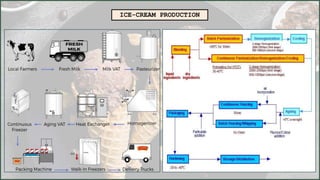
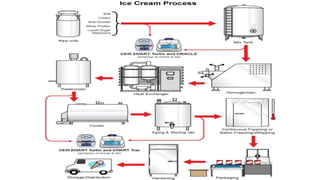
ICE-CREAM PRODUCTION
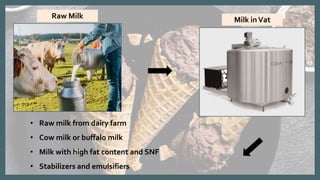
Raw Milk
• Raw milk from dairy farm
• Cow milk or buffalo milk
• Milk with high fat content and SNF
• Stabilizers and emulsifiers
Milk inVat
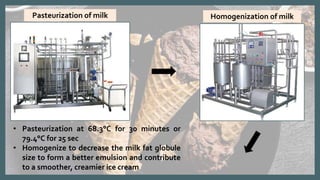
Pasteurization of milk Homogenization of milk
• Pasteurization at 68.3°C for 30 minutes or
79.4°C for 25 sec
• Homogenize to decrease the milk fat globule
size to form a better emulsion and contribute
to a smoother, creamier ice cream
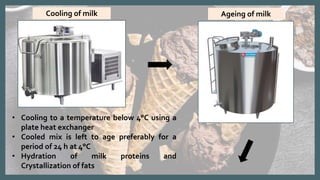
Cooling of milk Ageing of milk
• Cooling to a temperature below 4°C using a
plate heat exchanger
• Cooled mix is left to age preferably for a
period of 24 h at 4°C
• Hydration of milk proteins and
Crystallization of fats
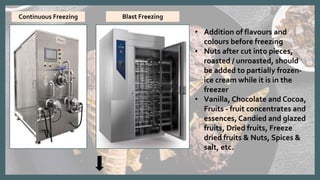
Continuous Freezing Blast Freezing
• Addition of flavours and
colours before freezing
• Nuts after cut into pieces,
roasted / unroasted, should
be added to partially frozen-
ice cream while it is in the
freezer
• Vanilla, Chocolate and Cocoa,
Fruits - fruit concentrates and
essences, Candied and glazed
fruits, Dried fruits, Freeze
dried fruits & Nuts, Spices &
salt, etc.
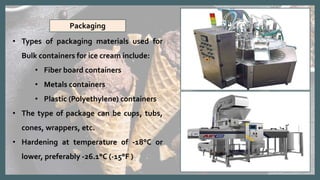
Packaging
• Types of packaging materials used for
Bulk containers for ice cream include:
• Fiber board containers
• Metals containers
• Plastic (Polyethylene) containers
• The type of package can be cups, tubs,
cones, wrappers, etc.
• Hardening at temperature of -18°C or
lower, preferably -26.1°C (-15°F )
• https://dairyprocessinghandbook.tetrapak.com/chapter/ice-cream
• http://www.madehow.com/Volume-3/Ice-Cream.html
• http://milkfacts.info/Milk%20Processing/Ice%20Cream%20Production.html
• http://www.icecreamconemachine.com/blog/ice-cream-production-flow-chart.html
• http://ecoursesonline.iasri.res.in/mod/page/view.php?id=147773
References
Ice Cream Production

Ice Cream Production

  • 1.
  • 2.
    Introduction • Ice creamis a frozen blend of a sweetened cream mixture and air, with added flavorings. • It may be made from milk or cream and is flavoured with a sweetener, either sugar or an alternative, and a spice, such as cocoa or vanilla, or with fruit such as strawberries or peaches. • Ice cream is a colloidal emulsion made with water, ice, milk fat, milk protein, sugar and air. • Milk proteins such as casein and whey protein present in ice cream are amphiphilic, can adsorb water and form micelles which will contribute to its consistency. • Lactose which is sugar present in milk will cause freezing point depression.
  • 3.
  • 5.
    Raw Milk • Rawmilk from dairy farm • Cow milk or buffalo milk • Milk with high fat content and SNF • Stabilizers and emulsifiers Milk inVat
  • 6.
    Pasteurization of milkHomogenization of milk • Pasteurization at 68.3°C for 30 minutes or 79.4°C for 25 sec • Homogenize to decrease the milk fat globule size to form a better emulsion and contribute to a smoother, creamier ice cream
  • 7.
    Cooling of milkAgeing of milk • Cooling to a temperature below 4°C using a plate heat exchanger • Cooled mix is left to age preferably for a period of 24 h at 4°C • Hydration of milk proteins and Crystallization of fats
  • 8.
    Continuous Freezing BlastFreezing • Addition of flavours and colours before freezing • Nuts after cut into pieces, roasted / unroasted, should be added to partially frozen- ice cream while it is in the freezer • Vanilla, Chocolate and Cocoa, Fruits - fruit concentrates and essences, Candied and glazed fruits, Dried fruits, Freeze dried fruits & Nuts, Spices & salt, etc.
  • 9.
    Packaging • Types ofpackaging materials used for Bulk containers for ice cream include: • Fiber board containers • Metals containers • Plastic (Polyethylene) containers • The type of package can be cups, tubs, cones, wrappers, etc. • Hardening at temperature of -18°C or lower, preferably -26.1°C (-15°F )
  • 10.
    • https://dairyprocessinghandbook.tetrapak.com/chapter/ice-cream • http://www.madehow.com/Volume-3/Ice-Cream.html •http://milkfacts.info/Milk%20Processing/Ice%20Cream%20Production.html • http://www.icecreamconemachine.com/blog/ice-cream-production-flow-chart.html • http://ecoursesonline.iasri.res.in/mod/page/view.php?id=147773 References