DESIGN LAB PRESENTATION
PRESENTED BY-
MADHUJA MUKHOPADHYAY
DAYEETA DEY
SANTOSH KUMAR
PRESENTATION TOPIC
ICE CREAM MANUFACTURINGICE CREAM MANUFACTURING
PROCESS DESIGNPROCESS DESIGN
INTRODUCTIONINTRODUCTION
Very little is known about the history of
ice cream. It was first discovered in
EUROPE in the back of 4th
century
.roman emperor Nero ordered to bring
some ice from mountain and to
combine with fruits.
From europe it was introduced in u.s.
countries and in 1776 the first ice
cream parlor was opened in America.
NomenclatureNomenclature
• ". The name came from the
phrase "iced cream" that was
similar to "iced tea". The name
was later abbreviated to "ice
cream" the name we know
today.
What is ice creamWhat is ice cream?
• Homogenised dairy emulsions ice cream
are colloids containing fat droplets as
disperesed phase.
• The mix emulsion is subsequently foamed
.creating dispersed phase of air bubbles
• And finally it is frozen by forming another
dispersed layer of ice crystals.
Design and considerationsDesign and considerations
• Qualities those to be considered :-
 Taste – by adding sweetener it can be sweetened or
not.
 Texture- smooth and creamy texture is influenced by
size,distribution,shape and no. of ice crystals and
fluffiness is obtained by large amount of air.
 Body- by adding proper amount of emulsifier
crumbly,gummy body must be avoided.
 Melt resistance- acid balance,salt balance and
protein composition should be checked to avoid
quick melting.
 Flavour and colour- food flavour and colour are
optional.
IngredientsIngredients
• CREAMCREAM
• LIQUID SKIMMED MILKLIQUID SKIMMED MILK
• POWDERED MILKPOWDERED MILK
• CONDENSED MILKCONDENSED MILK
• RAW MILKRAW MILK
• SUGAR AND SWEETENERSUGAR AND SWEETENER
• GELATINGELATIN
• YEASTYEAST
• FLAVOURFLAVOUR
• COLOURCOLOUR
• EMULSIFIEREMULSIFIER
• VEGETABLE FATSVEGETABLE FATS
• FRUITS AND NUTSFRUITS AND NUTS
• BUTTERBUTTER
PERCENTAGEPERCENTAGE OF COMPONENT
COMPONENT RANGE(%)
MILK FAT 10 -16
MILK SOLIDS NOT FAT 9-12
SUCROSE 9-12
CORN SYRUP SOLIDS 4-6
EMULSIFIERS /STABILIZERS 0-0.5
TOTAL SOLIDS 36-45
WATER 55-64
USEFULNESSUSEFULNESS OF INGREDIENTSOF INGREDIENTS
• MILK FAT- provides creaminess and
richness to ice cream and contributes
to its melting characteristics.
Minimum fat content is 10%.
• The other milk solids consist of the
protein and lactose in milk and
ranges from 9 to 12%.
• The nonfat solids include whey which
plays an important role in body and
texture of ice cream by stabilizing the
air.
• Sweeteners are provided to sweetness of
icecream and also helps to lower the
melting temperature.It helps the ice
cream to scoop and eat.
• Stabilizers (alginates,gums)and
gelatins are proteins and carbohydrates
which add viscosity and control ice
crystallization.
• Emulsifiers are used to keep the milk fat
evenly dispersed in the ice cream during
freezing and storage.it includes egg
yolks and mono and di glycerides.
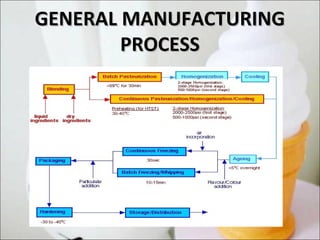
GENERAL MANUFACTURINGGENERAL MANUFACTURING
PROCESSPROCESS
PRODUCTION PROCESSPRODUCTION PROCESS
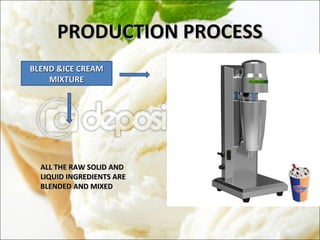
BLEND &ICE CREAMBLEND &ICE CREAM
MIXTUREMIXTURE
ALL THE RAW SOLID ANDALL THE RAW SOLID AND
LIQUID INGREDIENTS ARELIQUID INGREDIENTS ARE
BLENDED AND MIXEDBLENDED AND MIXED
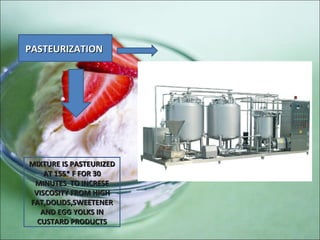
PASTEURIZATIONPASTEURIZATION
MIXTURE IS PASTEURIZEDMIXTURE IS PASTEURIZED
AT 155* F FOR 30AT 155* F FOR 30
MINUTES TO INCRESEMINUTES TO INCRESE
VISCOSITY FROM HIGHVISCOSITY FROM HIGH
FAT,DOLIDS,SWEETENERFAT,DOLIDS,SWEETENER
AND EGG YOLKS INAND EGG YOLKS IN
CUSTARD PRODUCTSCUSTARD PRODUCTS
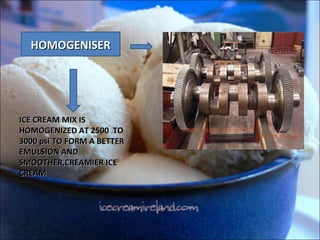
HOMOGENISERHOMOGENISER
ICE CREAM MIX ISICE CREAM MIX IS
HOMOGENIZED AT 2500 TOHOMOGENIZED AT 2500 TO
3000 psi TO FORM A BETTER3000 psi TO FORM A BETTER
EMULSION ANDEMULSION AND
SMOOTHER,CREAMIER ICESMOOTHER,CREAMIER ICE
CREAMCREAM
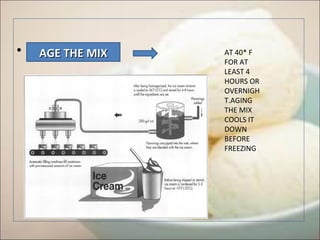
• AGE THE MIXAGE THE MIXAGE THE MIX AT 40* F
FOR AT
LEAST 4
HOURS OR
OVERNIGH
T.AGING
THE MIX
COOLS IT
DOWN
BEFORE
FREEZING
• In The Next Stage flavours are
added in continuous stirred
tank reactor. Vanilla,fruit,nut
flavour,choclate flavour,cake and
cookie flavours are mostly
common.
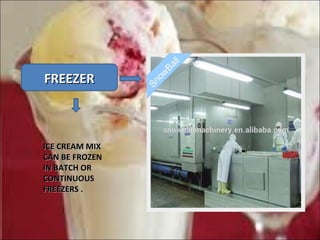
FREEZERFREEZER
ICE CREAM MIXICE CREAM MIX
CAN BE FROZENCAN BE FROZEN
IN BATCH ORIN BATCH OR
CONTINUOUSCONTINUOUS
FREEZERS .FREEZERS .
OVERRUN AND FRUITS MIXINGOVERRUN AND FRUITS MIXING
• IN BATCH FREEZER THERE IS A ROTATING
BARREL WHICH IS ONE THIRD TO ONE HALF
FULLL OF ICE CREAM,AS THE BARREL TURNS
THE AIR IN THE BARREL IS INCORPORATED
INTO THE ICE CREAM MIX.THE ADDITION OF
AIR IS CALLED OVERRUN WHICH
CONTRIBUTES LIGHTNESS OR FLUFFINESS IN
ICE CREAM
• AT THE POINT OF DISCHARGE FROM THE
FREEZER (DRAW TEMPERATURE),ONLY 50%
OF THE WATER IN ICE CREAM IS FROZEN.
FRUITS MIXINGFRUITS MIXING
• Fruits,swirls,and any bulky type
of flavourings (nuts,candy
pieces)are added at this time or
they will stop making the ice
cream smooth enough.
HARDENINGHARDENING
• One method of hardening of ice cream is called a
roller bed process. The ice cream packages are placed
on a roller type conveyor in a very cold room of
temperature 30°F (-34°C), where cold air is circulated
by blowers create wind chill of -60°F (-51°C).
• Second method is Tri-Tray system. It provides moving
trays upon which the ice cream is disposed. The trays
move within the cold room and cold air is blown
around the ice cream. This movement results in
decreased hardening time.
PACKAGINGPACKAGING
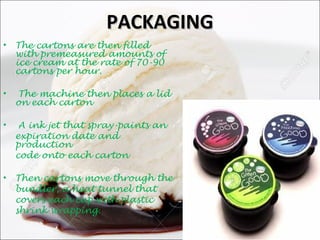
• The cartons are then filled
with premeasured amounts of
ice cream at the rate of 70-90
cartons per hour.
• The machine then places a lid
on each carton
• A ink jet that spray-paints an
expiration date and
production
code onto each carton
• Then cartons move through the
bundler, a heat tunnel that
covers each cup with plastic
shrink wrapping.
STORAGE AND DISTRIBUTIONSTORAGE AND DISTRIBUTION
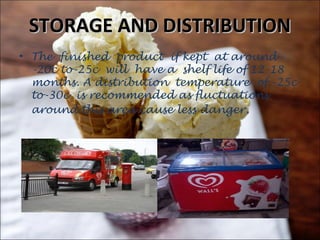
• The finished product if kept at around
-20c to-25c will have a shelf life of 12-18
months. A distribution temperature of -25c
to-30c is recommended as fluctuations
around this area cause less danger.
RISKS OF CONTAMINATIONRISKS OF CONTAMINATION
• Important source of contamination in ice cream as
they are added after mix is
• Fruits – canned, fresh and frozen and should be
of satisfactory in microbiological standards
particularly canned fruits pasteurized
• Fresh & frozen fruits – may contain Yeasts. Nuts
may be infected with moulds.
Coconuts may be contaminated with Salmonellae.
Walnuts-Mould and parasitic infection
SAFETY MEASURESSAFETY MEASURES
• Tests:
visual inspection,
SPC,
Coliform,
ß-haemolytic streptococci,
Yeasts & Moulds.
• Canned / fresh nuts are sterilized in ethylene oxide &
CO2 in1:9 or boiling in sugar solution (50%) followed
by drying at 2500C for few minutes.
• Coconuts should be heat treated when desiccated
SUPPLIERSSUPPLIERS
•BEN AND JERRY
•PERRY’S ICE CREAM
•BREYER’S
•EDDY’S
•HAAGEN-DAZS
CONCLUSIONCONCLUSION
• Something seeming so simple
and yet still so complex can still
be enjoyed as it has been for
centuries in pure sweet bliss ,but
overall it has become more
exciting after knowing the
actual process of making.
Design lab presentation

Design lab presentation

  • 1.
    DESIGN LAB PRESENTATION PRESENTEDBY- MADHUJA MUKHOPADHYAY DAYEETA DEY SANTOSH KUMAR
  • 2.
    PRESENTATION TOPIC ICE CREAMMANUFACTURINGICE CREAM MANUFACTURING PROCESS DESIGNPROCESS DESIGN
  • 3.
    INTRODUCTIONINTRODUCTION Very little isknown about the history of ice cream. It was first discovered in EUROPE in the back of 4th century .roman emperor Nero ordered to bring some ice from mountain and to combine with fruits. From europe it was introduced in u.s. countries and in 1776 the first ice cream parlor was opened in America.
  • 4.
    NomenclatureNomenclature • ". Thename came from the phrase "iced cream" that was similar to "iced tea". The name was later abbreviated to "ice cream" the name we know today.
  • 5.
    What is icecreamWhat is ice cream? • Homogenised dairy emulsions ice cream are colloids containing fat droplets as disperesed phase. • The mix emulsion is subsequently foamed .creating dispersed phase of air bubbles • And finally it is frozen by forming another dispersed layer of ice crystals.
  • 6.
    Design and considerationsDesignand considerations • Qualities those to be considered :-  Taste – by adding sweetener it can be sweetened or not.  Texture- smooth and creamy texture is influenced by size,distribution,shape and no. of ice crystals and fluffiness is obtained by large amount of air.  Body- by adding proper amount of emulsifier crumbly,gummy body must be avoided.  Melt resistance- acid balance,salt balance and protein composition should be checked to avoid quick melting.  Flavour and colour- food flavour and colour are optional.
  • 7.
    IngredientsIngredients • CREAMCREAM • LIQUIDSKIMMED MILKLIQUID SKIMMED MILK • POWDERED MILKPOWDERED MILK • CONDENSED MILKCONDENSED MILK • RAW MILKRAW MILK • SUGAR AND SWEETENERSUGAR AND SWEETENER • GELATINGELATIN • YEASTYEAST • FLAVOURFLAVOUR • COLOURCOLOUR • EMULSIFIEREMULSIFIER • VEGETABLE FATSVEGETABLE FATS • FRUITS AND NUTSFRUITS AND NUTS • BUTTERBUTTER
  • 8.
    PERCENTAGEPERCENTAGE OF COMPONENT COMPONENTRANGE(%) MILK FAT 10 -16 MILK SOLIDS NOT FAT 9-12 SUCROSE 9-12 CORN SYRUP SOLIDS 4-6 EMULSIFIERS /STABILIZERS 0-0.5 TOTAL SOLIDS 36-45 WATER 55-64
  • 9.
    USEFULNESSUSEFULNESS OF INGREDIENTSOFINGREDIENTS • MILK FAT- provides creaminess and richness to ice cream and contributes to its melting characteristics. Minimum fat content is 10%. • The other milk solids consist of the protein and lactose in milk and ranges from 9 to 12%. • The nonfat solids include whey which plays an important role in body and texture of ice cream by stabilizing the air.
  • 10.
    • Sweeteners areprovided to sweetness of icecream and also helps to lower the melting temperature.It helps the ice cream to scoop and eat. • Stabilizers (alginates,gums)and gelatins are proteins and carbohydrates which add viscosity and control ice crystallization. • Emulsifiers are used to keep the milk fat evenly dispersed in the ice cream during freezing and storage.it includes egg yolks and mono and di glycerides.
  • 11.
  • 12.
    PRODUCTION PROCESSPRODUCTION PROCESS BLEND&ICE CREAMBLEND &ICE CREAM MIXTUREMIXTURE ALL THE RAW SOLID ANDALL THE RAW SOLID AND LIQUID INGREDIENTS ARELIQUID INGREDIENTS ARE BLENDED AND MIXEDBLENDED AND MIXED
  • 13.
    PASTEURIZATIONPASTEURIZATION MIXTURE IS PASTEURIZEDMIXTUREIS PASTEURIZED AT 155* F FOR 30AT 155* F FOR 30 MINUTES TO INCRESEMINUTES TO INCRESE VISCOSITY FROM HIGHVISCOSITY FROM HIGH FAT,DOLIDS,SWEETENERFAT,DOLIDS,SWEETENER AND EGG YOLKS INAND EGG YOLKS IN CUSTARD PRODUCTSCUSTARD PRODUCTS
  • 14.
    HOMOGENISERHOMOGENISER ICE CREAM MIXISICE CREAM MIX IS HOMOGENIZED AT 2500 TOHOMOGENIZED AT 2500 TO 3000 psi TO FORM A BETTER3000 psi TO FORM A BETTER EMULSION ANDEMULSION AND SMOOTHER,CREAMIER ICESMOOTHER,CREAMIER ICE CREAMCREAM
  • 15.
    • AGE THEMIXAGE THE MIXAGE THE MIX AT 40* F FOR AT LEAST 4 HOURS OR OVERNIGH T.AGING THE MIX COOLS IT DOWN BEFORE FREEZING
  • 16.
    • In TheNext Stage flavours are added in continuous stirred tank reactor. Vanilla,fruit,nut flavour,choclate flavour,cake and cookie flavours are mostly common.
  • 17.
    FREEZERFREEZER ICE CREAM MIXICECREAM MIX CAN BE FROZENCAN BE FROZEN IN BATCH ORIN BATCH OR CONTINUOUSCONTINUOUS FREEZERS .FREEZERS .
  • 18.
    OVERRUN AND FRUITSMIXINGOVERRUN AND FRUITS MIXING • IN BATCH FREEZER THERE IS A ROTATING BARREL WHICH IS ONE THIRD TO ONE HALF FULLL OF ICE CREAM,AS THE BARREL TURNS THE AIR IN THE BARREL IS INCORPORATED INTO THE ICE CREAM MIX.THE ADDITION OF AIR IS CALLED OVERRUN WHICH CONTRIBUTES LIGHTNESS OR FLUFFINESS IN ICE CREAM • AT THE POINT OF DISCHARGE FROM THE FREEZER (DRAW TEMPERATURE),ONLY 50% OF THE WATER IN ICE CREAM IS FROZEN.
  • 19.
    FRUITS MIXINGFRUITS MIXING •Fruits,swirls,and any bulky type of flavourings (nuts,candy pieces)are added at this time or they will stop making the ice cream smooth enough.
  • 20.
    HARDENINGHARDENING • One methodof hardening of ice cream is called a roller bed process. The ice cream packages are placed on a roller type conveyor in a very cold room of temperature 30°F (-34°C), where cold air is circulated by blowers create wind chill of -60°F (-51°C). • Second method is Tri-Tray system. It provides moving trays upon which the ice cream is disposed. The trays move within the cold room and cold air is blown around the ice cream. This movement results in decreased hardening time.
  • 21.
    PACKAGINGPACKAGING • The cartonsare then filled with premeasured amounts of ice cream at the rate of 70-90 cartons per hour. • The machine then places a lid on each carton • A ink jet that spray-paints an expiration date and production code onto each carton • Then cartons move through the bundler, a heat tunnel that covers each cup with plastic shrink wrapping.
  • 22.
    STORAGE AND DISTRIBUTIONSTORAGEAND DISTRIBUTION • The finished product if kept at around -20c to-25c will have a shelf life of 12-18 months. A distribution temperature of -25c to-30c is recommended as fluctuations around this area cause less danger.
  • 23.
    RISKS OF CONTAMINATIONRISKSOF CONTAMINATION • Important source of contamination in ice cream as they are added after mix is • Fruits – canned, fresh and frozen and should be of satisfactory in microbiological standards particularly canned fruits pasteurized • Fresh & frozen fruits – may contain Yeasts. Nuts may be infected with moulds. Coconuts may be contaminated with Salmonellae. Walnuts-Mould and parasitic infection
  • 24.
    SAFETY MEASURESSAFETY MEASURES •Tests: visual inspection, SPC, Coliform, ß-haemolytic streptococci, Yeasts & Moulds. • Canned / fresh nuts are sterilized in ethylene oxide & CO2 in1:9 or boiling in sugar solution (50%) followed by drying at 2500C for few minutes. • Coconuts should be heat treated when desiccated
  • 25.
    SUPPLIERSSUPPLIERS •BEN AND JERRY •PERRY’SICE CREAM •BREYER’S •EDDY’S •HAAGEN-DAZS
  • 26.
    CONCLUSIONCONCLUSION • Something seemingso simple and yet still so complex can still be enjoyed as it has been for centuries in pure sweet bliss ,but overall it has become more exciting after knowing the actual process of making.