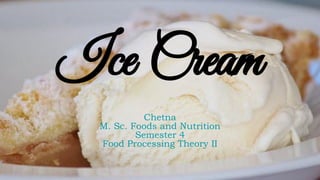
Ice Cream
Chetna
M. Sc. Foods and Nutrition
Semester 4
Food Processing Theory II
Introduction
● Ice cream is frozen dessert made from dairy
products such as milk and cream, combined
with flavourings, and sweeteners, such as
sugar.
● It comes in a wide variety of flavours, often
with additives such as chocolate flakes, nuts,
fruits etc.
● Most popular ice cream flavours are
chocolate, vanilla, strawberry, mango and
many more.
Definition
Ice cream is a frozen dairy product made by suitable blending and processing of cream and other milk products,
together with sugar and flavour, with or without stabilizer or color, and with the incorporation of air during the
freezing process. -Sukumede
According to the Food Safety and Standard Regulations (2011), Ice Cream, Kulfi, Chocolate Ice Cream or Softy Ice
Cream (hereafter referred to as the said product) means the product obtained by freezing a pasteurized mix prepared
from milk and /or other products derived from milk with or without the addition of nutritive sweetening agents, fruit
and fruit products, eggs and egg products, coffee, cocoa, chocolate, condiments, spices, ginger and nuts and it may
also contain bakery products such as cake or cookies as a separate layer and/or coating.
According to PSA Rules (1976), ice cream is the frozen product obtained from cow or buffalo milk or a
combination thereof or from cream, and or other milk products, with or without the addition of cane sugar, eggs,
fruits, fruits juices, preserved fruits, nuts, chocolate, edile flavours and permitted food colours.
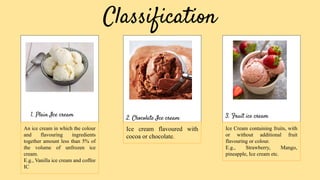
1. Plain Ice cream
Classification
2. Chocolate Ice cream 3. Fruit ice cream
An ice cream in which the colour
and flavouring ingredients
together amount less than 5% of
the volume of unfrozen ice
cream.
E.g., Vanilla ice cream and coffee
IC
Ice Cream containing fruits, with
or without additional fruit
flavouring or colour.
E.g., Strawberry, Mango,
pineapple, Ice cream etc.
Ice cream flavoured with
cocoa or chocolate.
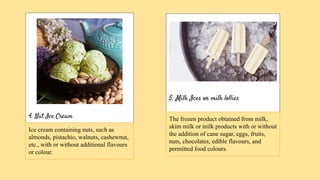
4. Nut Ice Cream
5. Milk Ices or milk lollies
Ice cream containing nuts, such as
almonds, pistachio, walnuts, cashewnut,
etc., with or without additional flavours
or colour.
The frozen product obtained from milk,
skim milk or milk products with or without
the addition of cane sugar, eggs, fruits,
nuts, chocolates, edible flavours, and
permitted food colours.
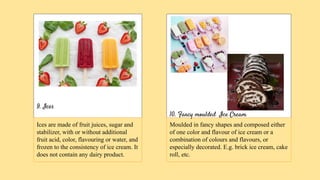
7. Sherbet
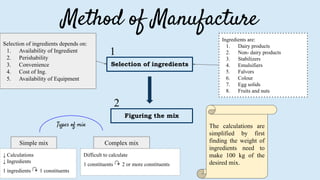
8. Soft ice cream (softy)
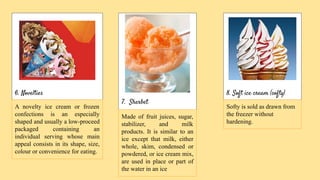
6. Novelties
A novelty ice cream or frozen
confections is an especially
shaped and usually a low-proceed
packaged containing an
individual serving whose main
appeal consists in its shape, size,
colour or convenience for eating.
Made of fruit juices, sugar,
stabilizer, and milk
products. It is similar to an
ice except that milk, either
whole, skim, condensed or
powdered, or ice cream mix,
are used in place or part of
the water in an ice
Softy is sold as drawn from
the freezer without
hardening.
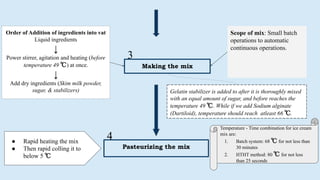
9. Ices
10. Fancy moulded Ice Cream
Ices are made of fruit juices, sugar and
stabilizer, with or without additional
fruit acid, color, flavouring or water, and
frozen to the consistency of ice cream. It
does not contain any dairy product.
Moulded in fancy shapes and composed either
of one color and flavour of ice cream or a
combination of colours and flavours, or
especially decorated. E.g. brick ice cream, cake
roll, etc.
Method of Manufacture
Selection of ingredients
Figuring the mix
Ingredients are:
1. Dairy products
2. Non- dairy products
3. Stabilizers
4. Emulsifiers
5. Falvors
6. Colour
7. Egg solids
8. Fruits and nuts
Selection of ingredients depends on:
1. Availability of Ingredient
2. Perishability
3. Convenience
4. Cost of Ing.
5. Availability of Equipment
Simple mix Complex mix
Types of mix
↓ Calculations
↓ Ingredients
1 ingredients ↷ 1 constituents
Difficult to calculate
1 constituents ↷ 2 or more constituents
The calculations are
simplified by first
finding the weight of
ingredients need to
make 100 kg of the
desired mix.
1
2
Making the mix
Order of Addition of ingredients into vat
Liquid ingredients
↓
Power stirrer, agitation and heating (before
temperature 49 ℃) at once.
↓
Add dry ingredients (Skim milk powder,
sugar, & stabilizers)
Scope of mix: Small batch
operations to automatic
continuous operations.
Gelatin stabilizer is added to after it is thoroughly mixed
with an equal amount of sugar, and before reaches the
temperature 49 ℃. While if we add Sodium alginate
(Dartiloid), temperature should reach atleast 66 ℃.
Pasteurizing the mix
● Rapid heating the mix
● Then rapid colling it to
below 5 ℃
3
4
Temperature - Time combination for ice cream
mix are:
1. Batch system: 68 ℃ for not less than
30 minutes
2. HTHT method: 80 ℃ for not less
than 25 seconds
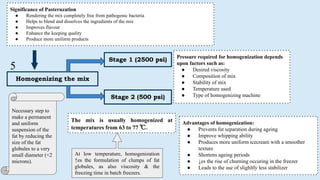
Homogenizing the mix
Stage 1 (2500 psi)
Stage 2 (500 psi)
Advantages of homogenization:
● Prevents fat separation during ageing
● Improve whipping ability
● Produces more uniform icecream with a smoother
texture
● Shortens ageing periods
● ↓es the rise of churning occuring in the freezer
● Leads to the use of slighltly less stabilizer
Significance of Pasteruzation
● Rendering the mix completely free from pathogenic bacteria
● Helps to blend and dissolves the ingredients of the mix
● Improves flavour
● Enhance the keeping quality
● Produce more uniform products
Necessary step to
make a permanent
and uniform
suspension of the
fat by reducing the
size of the fat
globules to a very
small diameter (<2
microns).
The mix is usually homogenized at
temperatures from 63 to 77 ℃.
Pressure required for homogenization depends
upon factors such as:
● Desired viscosity
● Composition of mix
● Stability of mix
● Temperature used
● Type of homogenizing machine
At low temperature, homogenization
↑es the formulation of clumps of fat
globules, as also viscosity & the
freezing time in batch freezers.
5
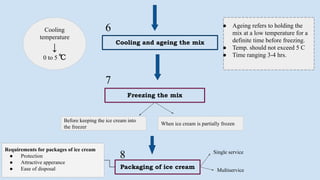
Cooling and ageing the mix
Cooling
temperature
↓
0 to 5 ℃
● Ageing refers to holding the
mix at a low temperature for a
definite time before freezing.
● Temp. should not exceed 5 C
● Time ranging 3-4 hrs.
Freezing the mix
Before keeping the ice cream into
the freezer
When ice cream is partially frozen
Packaging of ice cream
Single service
Multiservice
Requirements for packages of ice cream
● Protection
● Attractive apperance
● Ease of disposal
6
7
8
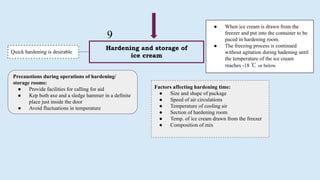
Hardening and storage of
ice cream
Quick hardening is desirable
9
● When ice cream is drawn from the
freezer and put into the container to be
paced in hardening room.
● The freezing process is continued
without agitation during hadening until
the temperature of the ice cream
reaches -18 ℃ or below.
Precaustions during operations of hardening/
storage rooms:
● Provide facilities for calling for aid
● Kep both axe and a sledge hammer in a definite
place just inside the door
● Avoid fluctuations in temperature
Factors affecting hardening time:
● Size and shape of package
● Speed of air circulations
● Temperature of cooling air
● Section of hardening room
● Temp. of ice cream drawn from the freezer
● Composition of mix
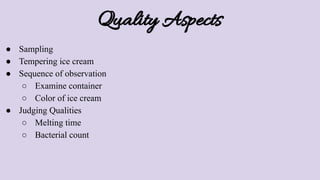
Quality Aspects
● Sampling
● Tempering ice cream
● Sequence of observation
○ Examine container
○ Color of ice cream
● Judging Qualities
○ Melting time
○ Bacterial count
References
● Outlines of Dairy Technology by Sukumar De
● https://youtu.be/CjcTV3c21FY
● https://youtu.be/f0JPX3HK_3M
● https://youtu.be/Z-YZ3Gc4hNM
● https://youtu.be/TjSrcQmjg2Q
● https://youtu.be/5Yqa3vK83G0
Thankyou

Ice cream

  • 1.
    Ice Cream Chetna M. Sc.Foods and Nutrition Semester 4 Food Processing Theory II
  • 2.
    Introduction ● Ice creamis frozen dessert made from dairy products such as milk and cream, combined with flavourings, and sweeteners, such as sugar. ● It comes in a wide variety of flavours, often with additives such as chocolate flakes, nuts, fruits etc. ● Most popular ice cream flavours are chocolate, vanilla, strawberry, mango and many more.
  • 3.
    Definition Ice cream isa frozen dairy product made by suitable blending and processing of cream and other milk products, together with sugar and flavour, with or without stabilizer or color, and with the incorporation of air during the freezing process. -Sukumede According to the Food Safety and Standard Regulations (2011), Ice Cream, Kulfi, Chocolate Ice Cream or Softy Ice Cream (hereafter referred to as the said product) means the product obtained by freezing a pasteurized mix prepared from milk and /or other products derived from milk with or without the addition of nutritive sweetening agents, fruit and fruit products, eggs and egg products, coffee, cocoa, chocolate, condiments, spices, ginger and nuts and it may also contain bakery products such as cake or cookies as a separate layer and/or coating. According to PSA Rules (1976), ice cream is the frozen product obtained from cow or buffalo milk or a combination thereof or from cream, and or other milk products, with or without the addition of cane sugar, eggs, fruits, fruits juices, preserved fruits, nuts, chocolate, edile flavours and permitted food colours.
  • 4.
    1. Plain Icecream Classification 2. Chocolate Ice cream 3. Fruit ice cream An ice cream in which the colour and flavouring ingredients together amount less than 5% of the volume of unfrozen ice cream. E.g., Vanilla ice cream and coffee IC Ice Cream containing fruits, with or without additional fruit flavouring or colour. E.g., Strawberry, Mango, pineapple, Ice cream etc. Ice cream flavoured with cocoa or chocolate.
  • 5.
    4. Nut IceCream 5. Milk Ices or milk lollies Ice cream containing nuts, such as almonds, pistachio, walnuts, cashewnut, etc., with or without additional flavours or colour. The frozen product obtained from milk, skim milk or milk products with or without the addition of cane sugar, eggs, fruits, nuts, chocolates, edible flavours, and permitted food colours.
  • 6.
    7. Sherbet 8. Softice cream (softy) 6. Novelties A novelty ice cream or frozen confections is an especially shaped and usually a low-proceed packaged containing an individual serving whose main appeal consists in its shape, size, colour or convenience for eating. Made of fruit juices, sugar, stabilizer, and milk products. It is similar to an ice except that milk, either whole, skim, condensed or powdered, or ice cream mix, are used in place or part of the water in an ice Softy is sold as drawn from the freezer without hardening.
  • 7.
    9. Ices 10. Fancymoulded Ice Cream Ices are made of fruit juices, sugar and stabilizer, with or without additional fruit acid, color, flavouring or water, and frozen to the consistency of ice cream. It does not contain any dairy product. Moulded in fancy shapes and composed either of one color and flavour of ice cream or a combination of colours and flavours, or especially decorated. E.g. brick ice cream, cake roll, etc.
  • 8.
    Method of Manufacture Selectionof ingredients Figuring the mix Ingredients are: 1. Dairy products 2. Non- dairy products 3. Stabilizers 4. Emulsifiers 5. Falvors 6. Colour 7. Egg solids 8. Fruits and nuts Selection of ingredients depends on: 1. Availability of Ingredient 2. Perishability 3. Convenience 4. Cost of Ing. 5. Availability of Equipment Simple mix Complex mix Types of mix ↓ Calculations ↓ Ingredients 1 ingredients ↷ 1 constituents Difficult to calculate 1 constituents ↷ 2 or more constituents The calculations are simplified by first finding the weight of ingredients need to make 100 kg of the desired mix. 1 2
  • 9.
    Making the mix Orderof Addition of ingredients into vat Liquid ingredients ↓ Power stirrer, agitation and heating (before temperature 49 ℃) at once. ↓ Add dry ingredients (Skim milk powder, sugar, & stabilizers) Scope of mix: Small batch operations to automatic continuous operations. Gelatin stabilizer is added to after it is thoroughly mixed with an equal amount of sugar, and before reaches the temperature 49 ℃. While if we add Sodium alginate (Dartiloid), temperature should reach atleast 66 ℃. Pasteurizing the mix ● Rapid heating the mix ● Then rapid colling it to below 5 ℃ 3 4 Temperature - Time combination for ice cream mix are: 1. Batch system: 68 ℃ for not less than 30 minutes 2. HTHT method: 80 ℃ for not less than 25 seconds
  • 10.
    Homogenizing the mix Stage1 (2500 psi) Stage 2 (500 psi) Advantages of homogenization: ● Prevents fat separation during ageing ● Improve whipping ability ● Produces more uniform icecream with a smoother texture ● Shortens ageing periods ● ↓es the rise of churning occuring in the freezer ● Leads to the use of slighltly less stabilizer Significance of Pasteruzation ● Rendering the mix completely free from pathogenic bacteria ● Helps to blend and dissolves the ingredients of the mix ● Improves flavour ● Enhance the keeping quality ● Produce more uniform products Necessary step to make a permanent and uniform suspension of the fat by reducing the size of the fat globules to a very small diameter (<2 microns). The mix is usually homogenized at temperatures from 63 to 77 ℃. Pressure required for homogenization depends upon factors such as: ● Desired viscosity ● Composition of mix ● Stability of mix ● Temperature used ● Type of homogenizing machine At low temperature, homogenization ↑es the formulation of clumps of fat globules, as also viscosity & the freezing time in batch freezers. 5
  • 11.
    Cooling and ageingthe mix Cooling temperature ↓ 0 to 5 ℃ ● Ageing refers to holding the mix at a low temperature for a definite time before freezing. ● Temp. should not exceed 5 C ● Time ranging 3-4 hrs. Freezing the mix Before keeping the ice cream into the freezer When ice cream is partially frozen Packaging of ice cream Single service Multiservice Requirements for packages of ice cream ● Protection ● Attractive apperance ● Ease of disposal 6 7 8
  • 12.
    Hardening and storageof ice cream Quick hardening is desirable 9 ● When ice cream is drawn from the freezer and put into the container to be paced in hardening room. ● The freezing process is continued without agitation during hadening until the temperature of the ice cream reaches -18 ℃ or below. Precaustions during operations of hardening/ storage rooms: ● Provide facilities for calling for aid ● Kep both axe and a sledge hammer in a definite place just inside the door ● Avoid fluctuations in temperature Factors affecting hardening time: ● Size and shape of package ● Speed of air circulations ● Temperature of cooling air ● Section of hardening room ● Temp. of ice cream drawn from the freezer ● Composition of mix
  • 13.
    Quality Aspects ● Sampling ●Tempering ice cream ● Sequence of observation ○ Examine container ○ Color of ice cream ● Judging Qualities ○ Melting time ○ Bacterial count
  • 14.
    References ● Outlines ofDairy Technology by Sukumar De ● https://youtu.be/CjcTV3c21FY ● https://youtu.be/f0JPX3HK_3M ● https://youtu.be/Z-YZ3Gc4hNM ● https://youtu.be/TjSrcQmjg2Q ● https://youtu.be/5Yqa3vK83G0
  • 15.