ICE CREAM
Sree Nandana S
Food Science & Technology
KUFOS
DEFINITION
■ The frozen product obtained from the cow or buffalo milk or a combination thereof or
from cream and or other milk products, with or without the addition of cane sugar,
eggs, fruits, fruit juices , preserved fruits, nuts, chocolate, edible flavors and permitted
colors.
■ It may contain permitted stabilizers and emulsifiers not exceeding 0.5 per cent by
weight. The mixture must be suitably heated before freezing. The product should
contain not less than 10% milk fat, 3.5% protein, and 36% total solids.
■ However, when any of the aforesaid preparations contains fruits or nuts or both, the
content of milk fat may be proportionately reduced but not less than 8% by weight,
starch may be added to a maximum extent of 5 %, with a declaration to that effect on
the label.
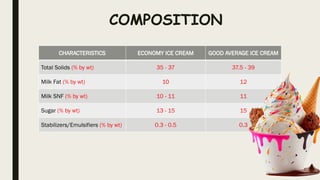
COMPOSITION
CHARACTERISTICS ECONOMY ICE CREAM GOOD AVERAGE ICE CREAM
Total Solids (% by wt) 35 - 37 37.5 - 39
Milk Fat (% by wt) 10 12
Milk SNF (% by wt) 10 - 11 11
Sugar (% by wt) 13 - 15 15
Stabilizers/Emulsifiers (% by wt) 0.3 - 0.5 0.3
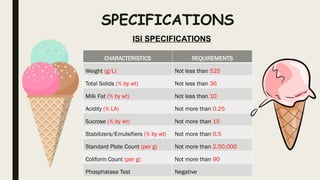
SPECIFICATIONS
CHARACTERISTICS REQUIREMENTS
Weight (g/L) Not less than 525
Total Solids (% by wt) Not less than 36
Milk Fat (% by wt) Not less than 10
Acidity (% LA) Not more than 0.25
Sucrose (% by wt) Not more than 15
Stabilizers/Emulsifiers (% by wt) Not more than 0.5
Standard Plate Count (per g) Not more than 2,50,000
Coliform Count (per g) Not more than 90
Phosphatase Test Negative
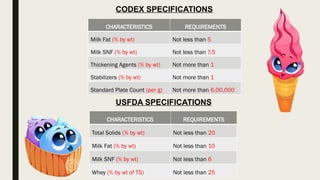
ISI SPECIFICATIONS
CHARACTERISTICS REQUIREMENTS
Milk Fat (% by wt) Not less than 5
Milk SNF (% by wt) Not less than 7.5
Thickening Agents (% by wt) Not more than 1
Stabilizers (% by wt) Not more than 1
Standard Plate Count (per g) Not more than 6,00,000
CODEX SPECIFICATIONS
USFDA SPECIFICATIONS
CHARACTERISTICS REQUIREMENTS
Total Solids (% by wt) Not less than 20
Milk Fat (% by wt) Not less than 10
Milk SNF (% by wt) Not less than 6
Whey (% by wt of TS) Not less than 25
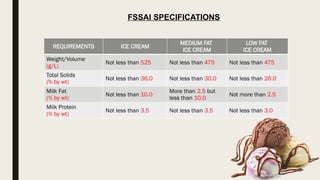
REQUIREMENTS ICE CREAM
MEDIUM FAT
ICE CREAM
LOW FAT
ICE CREAM
Weight/Volume
(g/L)
Not less than 525 Not less than 475 Not less than 475
Total Solids
(% by wt)
Not less than 36.0 Not less than 30.0 Not less than 26.0
Milk Fat
(% by wt)
Not less than 10.0
More than 2.5 but
less than 10.0
Not more than 2.5
Milk Protein
(% by wt)
Not less than 3.5 Not less than 3.5 Not less than 3.0
FSSAI SPECIFICATIONS
TYPES
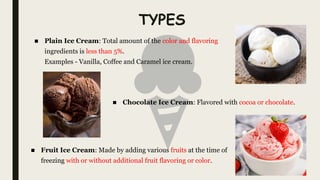
■ Plain Ice Cream: Total amount of the color and flavoring
ingredients is less than 5%.
Examples - Vanilla, Coffee and Caramel ice cream.
■ Chocolate Ice Cream: Flavored with cocoa or chocolate.
■ Fruit Ice Cream: Made by adding various fruits at the time of
freezing with or without additional fruit flavoring or color.
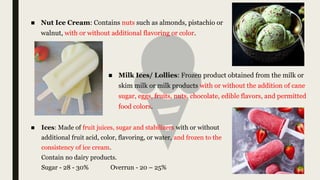
■ Nut Ice Cream: Contains nuts such as almonds, pistachio or
walnut, with or without additional flavoring or color.
■ Milk Ices/ Lollies: Frozen product obtained from the milk or
skim milk or milk products with or without the addition of cane
sugar, eggs, fruits, nuts, chocolate, edible flavors, and permitted
food colors.
■ Ices: Made of fruit juices, sugar and stabilizers with or without
additional fruit acid, color, flavoring, or water, and frozen to the
consistency of ice cream.
Contain no dairy products.
Sugar - 28 - 30% Overrun - 20 – 25%
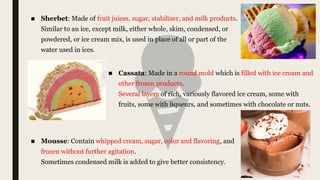
■ Sherbet: Made of fruit juices, sugar, stabilizer, and milk products.
Similar to an ice, except milk, either whole, skim, condensed, or
powdered, or ice cream mix, is used in place of all or part of the
water used in ices.
■ Cassata: Made in a round mold which is filled with ice cream and
other frozen products.
Several layers of rich, variously flavored ice cream, some with
fruits, some with liqueurs, and sometimes with chocolate or nuts.
■ Mousse: Contain whipped cream, sugar, color and flavoring, and
frozen without further agitation.
Sometimes condensed milk is added to give better consistency.
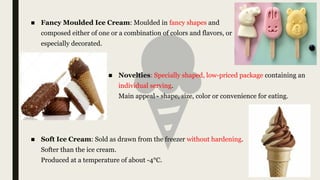
■ Fancy Moulded Ice Cream: Moulded in fancy shapes and
composed either of one or a combination of colors and flavors, or
especially decorated.
■ Novelties: Specially shaped, low-priced package containing an
individual serving.
Main appeal - shape, size, color or convenience for eating.
■ Soft Ice Cream: Sold as drawn from the freezer without hardening.
Softer than the ice cream.
Produced at a temperature of about -4°C.
CHARACTERISTICS
■ The resistance offered by liquids to flow.
■ Essential for proper whipping and the retention of air.
■ Apparent Viscosity – A thickened condition that disappears with agitation.
■ Basic Viscosity – Actual viscosity which remains after apparent viscosity disappears.
■ Influenced by composition, kind and quality of ingredients, processing and
handling of the mix , total solids concentration and temperature.
■ Basic Viscosity = 20-300 centipoise
1. VISCOSITY
2. ACIDITY & pH
■ Depend on serum solid content.
% Acidity of Mix = % Acidity of Milk x
% Serum Solids in Milk
% Serum Solids in Mix
■ Normal Acidity – 0.13% Normal pH – 6.3
■ Higher acidity causes over viscosity, decreased whipping rate, inferior flavor & low stability.
■ If higher than normal, it can be neutralized.
■ Over Neutralization – Flat flavor and dull or grayish mix.
3. MIX STABILITY
Specific Gravity =
(at 16 ͦC)
100
% Fat + % Sugar + % MSNF + % Stabilizer + % Water
4. SPECIFIC GRAVITY (1.05 – 1.12)
■ Resistance to separation by milk proteins in the ice cream mix.
■ Instability – Separation of milk proteins as precipitated/coagulated material in the mix.
■ Caused by – High mix acidity, low citrate – phosphate content, high Ca – Mg content,
high homogenizing pressure, high heat treatment, low ageing time etc.
0.93 1.58
■ A high whipping rate means the ability to whip rapidly to a high over run.
■ Improved by small fat globules, high processing temperature, proper homogenization and
ageing the mix for 2-4hours.
7. WHIPPING RATE
5. SURFACE TENSION (48- 53dynes/sq.cm)
6. FREEZING POINT ( -2.5ºC)
■ Dependent on the soluble constituents and varies with its composition.
■ Directly affected by - sugar, milk sugar, milk salts etc.
■ Indirectly affected by - fat, protein etc.
■ Force acting at the interface between the liquid phase (ice cream mix) and the air.
■ Directly proportional to the attraction between molecules of liquids at the surface.
■ Can be decreased by the addition of emulsifiers.
■ Lower surface tension - excessive whipping rate , fluffy characteristics and susceptibility
to the shrinkage defect.
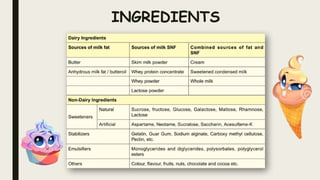
INGREDIENTS
■ Enriches and mellows the ice cream.
■ Gives a full, rich, creamy flavor.
■ Contributes to the body and melting resistance of ice cream.
■ Produces a smooth texture.
■ Gives stability to the ice cream but impairs whipping ability.
■ Even slight off-flavour is noticeable.
1. MILK FAT
2. MILK SOLIDS-NOT-FAT
■ Improves body and texture.
■ Milk sugar adds to sweet taste.
■ Milk proteins make ice cream compact and smooth.
3. SUGAR
■ Enhances the palatability and acceptability of ice cream.
■ Add viscosity to the mix.
■ Reduce the amount of free water by binding it as “water of hydration”
or by immobilizing it within a gel structure.
■ Produces good body, smooth texture, slow melt down and heat shock resistance.
4. STABILIZER
■ Cheapest source of total solids in the mix.
■ Depress the freezing point of the mix.
■ Too much sugar makes the product soft enough to handle and less sugar makes is very hard.
5. EMULSIFIER
■ Reduces the surface tension and hence has a stabilizing effect on the mix.
■ Improve whipping quality of ice cream mix.
■ Increase resistance to shrinkage and rapid meltdown.
■ Increase resistance to development of a coarse or icy texture and provide smooth texture.
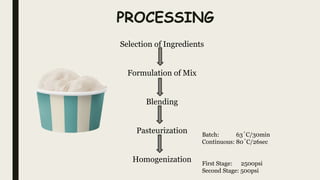
PROCESSING
Selection of Ingredients
Formulation of Mix
Blending
Pasteurization
Homogenization
Batch: 63 C/30min
ͦ
Continuous: 80 C/26sec
ͦ
First Stage: 2500psi
Second Stage: 500psi
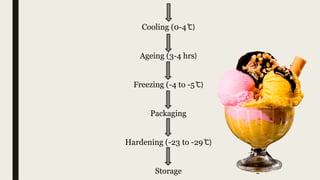
Cooling (0-4 ͦC)
Ageing (3-4 hrs)
Freezing (-4 to -5 ͦC)
Packaging
Hardening (-23 to -29 ͦC)
Storage
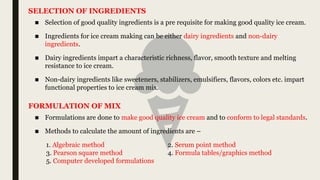
■ Selection of good quality ingredients is a pre requisite for making good quality ice cream.
■ Ingredients for ice cream making can be either dairy ingredients and non-dairy
ingredients.
■ Dairy ingredients impart a characteristic richness, flavor, smooth texture and melting
resistance to ice cream.
■ Non-dairy ingredients like sweeteners, stabilizers, emulsifiers, flavors, colors etc. impart
functional properties to ice cream mix.
SELECTION OF INGREDIENTS
■ Formulations are done to make good quality ice cream and to conform to legal standards.
■ Methods to calculate the amount of ingredients are –
1. Algebraic method 2. Serum point method
3. Pearson square method 4. Formula tables/graphics method
5. Computer developed formulations
FORMULATION OF MIX
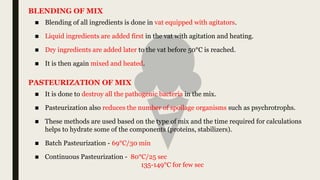
■ Blending of all ingredients is done in vat equipped with agitators.
■ Liquid ingredients are added first in the vat with agitation and heating.
■ Dry ingredients are added later to the vat before 50°C is reached.
■ It is then again mixed and heated.
BLENDING OF MIX
■ It is done to destroy all the pathogenic bacteria in the mix.
■ Pasteurization also reduces the number of spoilage organisms such as psychrotrophs.
■ These methods are used based on the type of mix and the time required for calculations
helps to hydrate some of the components (proteins, stabilizers).
■ Batch Pasteurization - 69°C/30 min
■ Continuous Pasteurization - 80°C/25 sec
135-149°C for few sec
PASTEURIZATION OF MIX
■ Homogenization reduces fat globule size and make permanent emulsion of fat.
■ Two-stage homogenization is usually preferred.
Stage I: 2000 - 2500 psi
Stage II: 500 - 1000 psi
■ It makes a smoother ice cream with better air stability and high melting resistance.
■ Clumping of fat is reduced and a thinner, more rapidly whipped mix is produced.
■ Homogenization is done at pasteurizing temperature for more efficient breaking up of the
fat globules.
HOMOGENIZATION OF MIX
■ Mix is cooled immediately to 0-5°C and held at the same temperature until used.
■ Slow cooling is avoided as it increases viscosity and the ice cream doesn’t melt smoothly.
■ Cooling also retards growth of bacteria.
COOLING THE MIX
■ The mix is aged for at least four hours, or usually overnight.
■ Emulsifiers adsorb to the surface of the fat droplets, replacing some of the milk protein.
■ Fat inside the droplets also begins to crystallize.
■ This helps to incorporate and stabilize air bubbles during freezing.
AGEING THE MIX
■ Ice cream is frozen in batch or continuous scraped-surface freezers jacketed with a
refrigerant such as ammonia or freon.
■ Ice-cream freezer makes ice cream by simultaneously aerating, freezing and beating the
mix to generate ice crystals, air bubbles and matrix.
■ Compressed air is supplied into the freezer for incorporation of air into the ice cream mix
to obtain the required over-run.
■ Fruits, nuts, candy, cookies, etc. are added to the semi-frozen slurry.
■ Soft serve ice cream is drawn into cones at this point without any hardening.
FREEZING THE MIX
■ Hardening is the lowering of temperature of the frozen ice cream after filling into packs.
■ Hardening stabilize the microstructure of the product after freezing and air incorporation.
■ Frozen ice cream is passed through a conveyor belt to an enclosed hardening tunnel.
■ Inside, cold air (typically - 30 °C to – 45 °C) is blown over the ice cream.
■ Hardened ice cream is then stored at temperature -23°C to -18°C so as to keep the
structure stable.
HARDENING
■ Ice cream is stored in a deep freezer at -18 to -23°C.
■ It should not melt as it would allow any bacteria in the ice cream to grow and spoil it.
■ Air in the ice cream escapes and it loses its texture to become solid ice when re-frozen.
■ When ice cream re-freezes, larger ice crystals are formed and it tastes ‘gritty’.
STORAGE
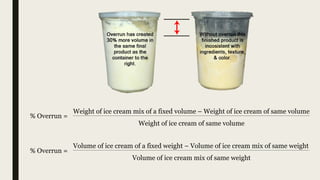
OVERRUN
■ Percentage of air that is incorporated into the ice cream mix during freezing.
■ A key factor in determining the texture and volume of ice cream
■ Freezing with continuous agitation incorporates a significant amount of air.
■ It increases its volume but the weight remains constant.
■ Hence, ice cream always measured in volume not in weight.
■ Too high overrun produces a snowy, fluffy, unpalatable product.
■ Too little overrun produces heavy and soggy ice cream.
% Overrun =
Weight of ice cream mix of a fixed volume – Weight of ice cream of same volume
Weight of ice cream of same volume
% Overrun =
Volume of ice cream of a fixed weight – Volume of ice cream mix of same weight
Volume of ice cream mix of same weight
REFERENCES
■ Sukumar Dey (2018) Outlines of Diary Technology. Oxford University Press
TECHNOLOGY OF ICE CREAM PRODUCTION

TECHNOLOGY OF ICE CREAM PRODUCTION

  • 1.
    ICE CREAM Sree NandanaS Food Science & Technology KUFOS
  • 2.
    DEFINITION ■ The frozenproduct obtained from the cow or buffalo milk or a combination thereof or from cream and or other milk products, with or without the addition of cane sugar, eggs, fruits, fruit juices , preserved fruits, nuts, chocolate, edible flavors and permitted colors. ■ It may contain permitted stabilizers and emulsifiers not exceeding 0.5 per cent by weight. The mixture must be suitably heated before freezing. The product should contain not less than 10% milk fat, 3.5% protein, and 36% total solids. ■ However, when any of the aforesaid preparations contains fruits or nuts or both, the content of milk fat may be proportionately reduced but not less than 8% by weight, starch may be added to a maximum extent of 5 %, with a declaration to that effect on the label.
  • 3.
    COMPOSITION CHARACTERISTICS ECONOMY ICECREAM GOOD AVERAGE ICE CREAM Total Solids (% by wt) 35 - 37 37.5 - 39 Milk Fat (% by wt) 10 12 Milk SNF (% by wt) 10 - 11 11 Sugar (% by wt) 13 - 15 15 Stabilizers/Emulsifiers (% by wt) 0.3 - 0.5 0.3
  • 4.
    SPECIFICATIONS CHARACTERISTICS REQUIREMENTS Weight (g/L)Not less than 525 Total Solids (% by wt) Not less than 36 Milk Fat (% by wt) Not less than 10 Acidity (% LA) Not more than 0.25 Sucrose (% by wt) Not more than 15 Stabilizers/Emulsifiers (% by wt) Not more than 0.5 Standard Plate Count (per g) Not more than 2,50,000 Coliform Count (per g) Not more than 90 Phosphatase Test Negative ISI SPECIFICATIONS
  • 5.
    CHARACTERISTICS REQUIREMENTS Milk Fat(% by wt) Not less than 5 Milk SNF (% by wt) Not less than 7.5 Thickening Agents (% by wt) Not more than 1 Stabilizers (% by wt) Not more than 1 Standard Plate Count (per g) Not more than 6,00,000 CODEX SPECIFICATIONS USFDA SPECIFICATIONS CHARACTERISTICS REQUIREMENTS Total Solids (% by wt) Not less than 20 Milk Fat (% by wt) Not less than 10 Milk SNF (% by wt) Not less than 6 Whey (% by wt of TS) Not less than 25
  • 6.
    REQUIREMENTS ICE CREAM MEDIUMFAT ICE CREAM LOW FAT ICE CREAM Weight/Volume (g/L) Not less than 525 Not less than 475 Not less than 475 Total Solids (% by wt) Not less than 36.0 Not less than 30.0 Not less than 26.0 Milk Fat (% by wt) Not less than 10.0 More than 2.5 but less than 10.0 Not more than 2.5 Milk Protein (% by wt) Not less than 3.5 Not less than 3.5 Not less than 3.0 FSSAI SPECIFICATIONS
  • 7.
    TYPES ■ Plain IceCream: Total amount of the color and flavoring ingredients is less than 5%. Examples - Vanilla, Coffee and Caramel ice cream. ■ Chocolate Ice Cream: Flavored with cocoa or chocolate. ■ Fruit Ice Cream: Made by adding various fruits at the time of freezing with or without additional fruit flavoring or color.
  • 8.
    ■ Nut IceCream: Contains nuts such as almonds, pistachio or walnut, with or without additional flavoring or color. ■ Milk Ices/ Lollies: Frozen product obtained from the milk or skim milk or milk products with or without the addition of cane sugar, eggs, fruits, nuts, chocolate, edible flavors, and permitted food colors. ■ Ices: Made of fruit juices, sugar and stabilizers with or without additional fruit acid, color, flavoring, or water, and frozen to the consistency of ice cream. Contain no dairy products. Sugar - 28 - 30% Overrun - 20 – 25%
  • 9.
    ■ Sherbet: Madeof fruit juices, sugar, stabilizer, and milk products. Similar to an ice, except milk, either whole, skim, condensed, or powdered, or ice cream mix, is used in place of all or part of the water used in ices. ■ Cassata: Made in a round mold which is filled with ice cream and other frozen products. Several layers of rich, variously flavored ice cream, some with fruits, some with liqueurs, and sometimes with chocolate or nuts. ■ Mousse: Contain whipped cream, sugar, color and flavoring, and frozen without further agitation. Sometimes condensed milk is added to give better consistency.
  • 10.
    ■ Fancy MouldedIce Cream: Moulded in fancy shapes and composed either of one or a combination of colors and flavors, or especially decorated. ■ Novelties: Specially shaped, low-priced package containing an individual serving. Main appeal - shape, size, color or convenience for eating. ■ Soft Ice Cream: Sold as drawn from the freezer without hardening. Softer than the ice cream. Produced at a temperature of about -4°C.
  • 11.
    CHARACTERISTICS ■ The resistanceoffered by liquids to flow. ■ Essential for proper whipping and the retention of air. ■ Apparent Viscosity – A thickened condition that disappears with agitation. ■ Basic Viscosity – Actual viscosity which remains after apparent viscosity disappears. ■ Influenced by composition, kind and quality of ingredients, processing and handling of the mix , total solids concentration and temperature. ■ Basic Viscosity = 20-300 centipoise 1. VISCOSITY 2. ACIDITY & pH ■ Depend on serum solid content. % Acidity of Mix = % Acidity of Milk x % Serum Solids in Milk % Serum Solids in Mix
  • 12.
    ■ Normal Acidity– 0.13% Normal pH – 6.3 ■ Higher acidity causes over viscosity, decreased whipping rate, inferior flavor & low stability. ■ If higher than normal, it can be neutralized. ■ Over Neutralization – Flat flavor and dull or grayish mix. 3. MIX STABILITY Specific Gravity = (at 16 ͦC) 100 % Fat + % Sugar + % MSNF + % Stabilizer + % Water 4. SPECIFIC GRAVITY (1.05 – 1.12) ■ Resistance to separation by milk proteins in the ice cream mix. ■ Instability – Separation of milk proteins as precipitated/coagulated material in the mix. ■ Caused by – High mix acidity, low citrate – phosphate content, high Ca – Mg content, high homogenizing pressure, high heat treatment, low ageing time etc. 0.93 1.58
  • 13.
    ■ A highwhipping rate means the ability to whip rapidly to a high over run. ■ Improved by small fat globules, high processing temperature, proper homogenization and ageing the mix for 2-4hours. 7. WHIPPING RATE 5. SURFACE TENSION (48- 53dynes/sq.cm) 6. FREEZING POINT ( -2.5ºC) ■ Dependent on the soluble constituents and varies with its composition. ■ Directly affected by - sugar, milk sugar, milk salts etc. ■ Indirectly affected by - fat, protein etc. ■ Force acting at the interface between the liquid phase (ice cream mix) and the air. ■ Directly proportional to the attraction between molecules of liquids at the surface. ■ Can be decreased by the addition of emulsifiers. ■ Lower surface tension - excessive whipping rate , fluffy characteristics and susceptibility to the shrinkage defect.
  • 14.
  • 15.
    ■ Enriches andmellows the ice cream. ■ Gives a full, rich, creamy flavor. ■ Contributes to the body and melting resistance of ice cream. ■ Produces a smooth texture. ■ Gives stability to the ice cream but impairs whipping ability. ■ Even slight off-flavour is noticeable. 1. MILK FAT 2. MILK SOLIDS-NOT-FAT ■ Improves body and texture. ■ Milk sugar adds to sweet taste. ■ Milk proteins make ice cream compact and smooth. 3. SUGAR ■ Enhances the palatability and acceptability of ice cream.
  • 16.
    ■ Add viscosityto the mix. ■ Reduce the amount of free water by binding it as “water of hydration” or by immobilizing it within a gel structure. ■ Produces good body, smooth texture, slow melt down and heat shock resistance. 4. STABILIZER ■ Cheapest source of total solids in the mix. ■ Depress the freezing point of the mix. ■ Too much sugar makes the product soft enough to handle and less sugar makes is very hard. 5. EMULSIFIER ■ Reduces the surface tension and hence has a stabilizing effect on the mix. ■ Improve whipping quality of ice cream mix. ■ Increase resistance to shrinkage and rapid meltdown. ■ Increase resistance to development of a coarse or icy texture and provide smooth texture.
  • 17.
    PROCESSING Selection of Ingredients Formulationof Mix Blending Pasteurization Homogenization Batch: 63 C/30min ͦ Continuous: 80 C/26sec ͦ First Stage: 2500psi Second Stage: 500psi
  • 18.
    Cooling (0-4 ͦC) Ageing(3-4 hrs) Freezing (-4 to -5 ͦC) Packaging Hardening (-23 to -29 ͦC) Storage
  • 19.
    ■ Selection ofgood quality ingredients is a pre requisite for making good quality ice cream. ■ Ingredients for ice cream making can be either dairy ingredients and non-dairy ingredients. ■ Dairy ingredients impart a characteristic richness, flavor, smooth texture and melting resistance to ice cream. ■ Non-dairy ingredients like sweeteners, stabilizers, emulsifiers, flavors, colors etc. impart functional properties to ice cream mix. SELECTION OF INGREDIENTS ■ Formulations are done to make good quality ice cream and to conform to legal standards. ■ Methods to calculate the amount of ingredients are – 1. Algebraic method 2. Serum point method 3. Pearson square method 4. Formula tables/graphics method 5. Computer developed formulations FORMULATION OF MIX
  • 20.
    ■ Blending ofall ingredients is done in vat equipped with agitators. ■ Liquid ingredients are added first in the vat with agitation and heating. ■ Dry ingredients are added later to the vat before 50°C is reached. ■ It is then again mixed and heated. BLENDING OF MIX ■ It is done to destroy all the pathogenic bacteria in the mix. ■ Pasteurization also reduces the number of spoilage organisms such as psychrotrophs. ■ These methods are used based on the type of mix and the time required for calculations helps to hydrate some of the components (proteins, stabilizers). ■ Batch Pasteurization - 69°C/30 min ■ Continuous Pasteurization - 80°C/25 sec 135-149°C for few sec PASTEURIZATION OF MIX
  • 21.
    ■ Homogenization reducesfat globule size and make permanent emulsion of fat. ■ Two-stage homogenization is usually preferred. Stage I: 2000 - 2500 psi Stage II: 500 - 1000 psi ■ It makes a smoother ice cream with better air stability and high melting resistance. ■ Clumping of fat is reduced and a thinner, more rapidly whipped mix is produced. ■ Homogenization is done at pasteurizing temperature for more efficient breaking up of the fat globules. HOMOGENIZATION OF MIX ■ Mix is cooled immediately to 0-5°C and held at the same temperature until used. ■ Slow cooling is avoided as it increases viscosity and the ice cream doesn’t melt smoothly. ■ Cooling also retards growth of bacteria. COOLING THE MIX
  • 22.
    ■ The mixis aged for at least four hours, or usually overnight. ■ Emulsifiers adsorb to the surface of the fat droplets, replacing some of the milk protein. ■ Fat inside the droplets also begins to crystallize. ■ This helps to incorporate and stabilize air bubbles during freezing. AGEING THE MIX ■ Ice cream is frozen in batch or continuous scraped-surface freezers jacketed with a refrigerant such as ammonia or freon. ■ Ice-cream freezer makes ice cream by simultaneously aerating, freezing and beating the mix to generate ice crystals, air bubbles and matrix. ■ Compressed air is supplied into the freezer for incorporation of air into the ice cream mix to obtain the required over-run. ■ Fruits, nuts, candy, cookies, etc. are added to the semi-frozen slurry. ■ Soft serve ice cream is drawn into cones at this point without any hardening. FREEZING THE MIX
  • 23.
    ■ Hardening isthe lowering of temperature of the frozen ice cream after filling into packs. ■ Hardening stabilize the microstructure of the product after freezing and air incorporation. ■ Frozen ice cream is passed through a conveyor belt to an enclosed hardening tunnel. ■ Inside, cold air (typically - 30 °C to – 45 °C) is blown over the ice cream. ■ Hardened ice cream is then stored at temperature -23°C to -18°C so as to keep the structure stable. HARDENING ■ Ice cream is stored in a deep freezer at -18 to -23°C. ■ It should not melt as it would allow any bacteria in the ice cream to grow and spoil it. ■ Air in the ice cream escapes and it loses its texture to become solid ice when re-frozen. ■ When ice cream re-freezes, larger ice crystals are formed and it tastes ‘gritty’. STORAGE
  • 24.
    OVERRUN ■ Percentage ofair that is incorporated into the ice cream mix during freezing. ■ A key factor in determining the texture and volume of ice cream ■ Freezing with continuous agitation incorporates a significant amount of air. ■ It increases its volume but the weight remains constant. ■ Hence, ice cream always measured in volume not in weight. ■ Too high overrun produces a snowy, fluffy, unpalatable product. ■ Too little overrun produces heavy and soggy ice cream.
  • 25.
    % Overrun = Weightof ice cream mix of a fixed volume – Weight of ice cream of same volume Weight of ice cream of same volume % Overrun = Volume of ice cream of a fixed weight – Volume of ice cream mix of same weight Volume of ice cream mix of same weight
  • 26.
    REFERENCES ■ Sukumar Dey(2018) Outlines of Diary Technology. Oxford University Press