Ice Cream
Technology
short overview
What is Ice Cream?
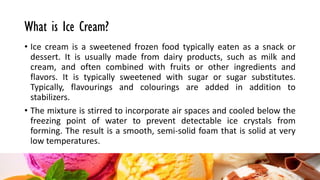
• Ice cream is a sweetened frozen food typically eaten as a snack or
dessert. It is usually made from dairy products, such as milk and
cream, and often combined with fruits or other ingredients and
flavors. It is typically sweetened with sugar or sugar substitutes.
Typically, flavourings and colourings are added in addition to
stabilizers.
• The mixture is stirred to incorporate air spaces and cooled below the
freezing point of water to prevent detectable ice crystals from
forming. The result is a smooth, semi-solid foam that is solid at very
low temperatures.
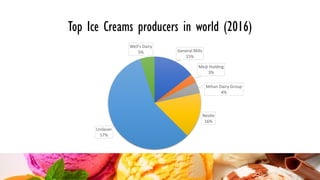
Top Ice Creams producers in world (2016)
General Mills
15%
Meiji Holding
3%
Mihan Dairy Group
4%
Nestle
16%
Unilever
57%
Well's Dairy
5%
Top Ice Creams brands in 2016
Approximate Composition (percentage by weight) of some
types of ice cream
Constituent Dairy Ice Cream Ice Milk Sherbet Ice Lolly
Milk fat 10 4 2 0
Nonfat milk solids 11 12 4 0
Added sugar 14 13 22 22
Additives 0,4 0,6 0,4 0,2
% Overrun 100 85 50 ~0
Edible energy, kJ/100
ml
390 300 340 370
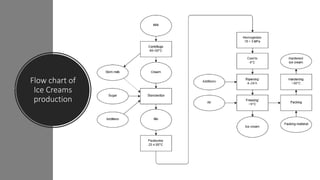
Flow chart of
Ice Creams
production
Ice cream composing
• Composing the mix is relatively simple. The additives are „emulsifier”,
stabilizer (a thickening agent, usually a mixture of polysaccharides),
and flavor and color substances.
• Clearly, ingredients such as fruit pulp and ground nuts should be
added after the homogenization
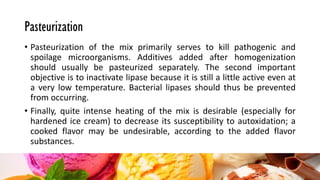
Pasteurization
• Pasteurization of the mix primarily serves to kill pathogenic and
spoilage microorganisms. Additives added after homogenization
should usually be pasteurized separately. The second important
objective is to inactivate lipase because it is still a little active even at
a very low temperature. Bacterial lipases should thus be prevented
from occurring.
• Finally, quite intense heating of the mix is desirable (especially for
hardened ice cream) to decrease its susceptibility to autoxidation; a
cooked flavor may be undesirable, according to the added flavor
substances.
Homogenization
• Homogenization is specifically meant to give the
ice cream a sufficiently fine, smooth texture.
Excessive formation of homogenization clusters
should be avoided as it causes the mix to become
highly viscous and the desirable fine texture not to
be achieved; consequently, the homogenization
pressure should be adapted to the fat content, to
the pasteurization intensity, and, if need be, to the
further composition of the mix.
Cooling and ripening
• Cooling and ripening (keeping cold for some time) are desirable for
two reasons. The fat in most of the fat globules should largely be
crystallized before the ice cream mix enters the freezer; it is important
to note that considerable undercooling may occur because the fat
globules are very small.
• Certain stabilizers such as gelatin and locust bean gum need
considerable time to swell after being dispersed. Some added
emulsifiers need considerable time at low temperature to displace
protein from the fat globules.
Freezing
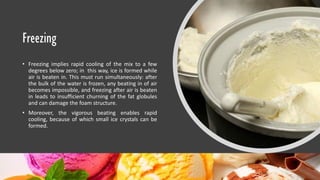
• Freezing implies rapid cooling of the mix to a few
degrees below zero; in this way, ice is formed while
air is beaten in. This must run simultaneously: after
the bulk of the water is frozen, any beating in of air
becomes impossible, and freezing after air is beaten
in leads to insufficient churning of the fat globules
and can damage the foam structure.
• Moreover, the vigorous beating enables rapid
cooling, because of which small ice crystals can be
formed.
Freezing
• Usually, freezing is done in a scraped-surface heat exchanger —
essentially a horizontal cylinder that is cooled externally by means of
direct evaporation (−20 to −30°C) and equipped with a rotating stirrer
(150 to 200 r.p.m.) that scrapes the wall. A layer of ice is formed on
the wall. Pieces of ice are broken from the layer by the scraper and
are distributed throughout the mass.
• The process of manufacture takes a few minutes. The mix leaves the
freezer at −3.5 to −7°C. A second heat exchanger may be applied, in
which the mix is cooled further, while stirred, to about −10°C without
additional beating in of air. Deeper cooling cannot be achieved in a
flow-type exchanger because the product becomes too firm.
Packaging
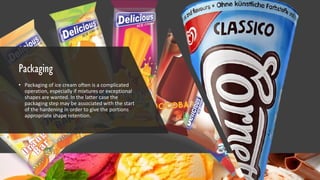
• Packaging of ice cream often is a complicated
operation, especially if mixtures or exceptional
shapes are wanted. In the latter case the
packaging step may be associated with the start
of the hardening in order to give the portions
appropriate shape retention.
Hardening
• The hardening process serves to rapidly adjust the temperature of the
ice cream to such a level as to retain its shape and to give it a
sufficient shelf life with respect to chemical and enzymatic reactions,
as well as to the physical structure.
• The packaged ice cream can be passed through a so-called hardening
tunnel, in which very cold air (say, −40°C) is blown past the small
packages for some 20 min. Likewise, packaged ice cream can be
passed through a brine bath of low temperature.
Role of the various components
Fats
Milk
solids-not-fat
Sugar
Stabilizer Emulsifier
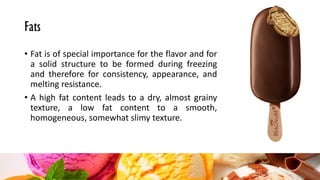
Fats
• Fat is of special importance for the flavor and for
a solid structure to be formed during freezing
and therefore for consistency, appearance, and
melting resistance.
• A high fat content leads to a dry, almost grainy
texture, a low fat content to a smooth,
homogeneous, somewhat slimy texture.
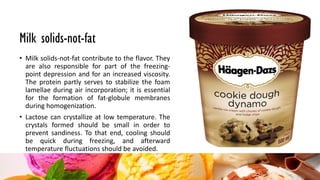
Milk solids-not-fat
• Milk solids-not-fat contribute to the flavor. They
are also responsible for part of the freezing-
point depression and for an increased viscosity.
The protein partly serves to stabilize the foam
lamellae during air incorporation; it is essential
for the formation of fat-globule membranes
during homogenization.
• Lactose can crystallize at low temperature. The
crystals formed should be small in order to
prevent sandiness. To that end, cooling should
be quick during freezing, and afterward
temperature fluctuations should be avoided.
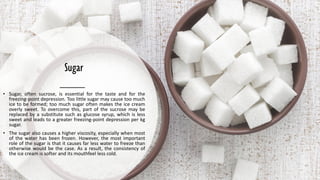
Sugar
• Sugar, often sucrose, is essential for the taste and for the
freezing-point depression. Too little sugar may cause too much
ice to be formed; too much sugar often makes the ice cream
overly sweet. To overcome this, part of the sucrose may be
replaced by a substitute such as glucose syrup, which is less
sweet and leads to a greater freezing-point depression per kg
sugar.
• The sugar also causes a higher viscosity, especially when most
of the water has been frozen. However, the most important
role of the sugar is that it causes far less water to freeze than
otherwise would be the case. As a result, the consistency of
the ice cream is softer and its mouthfeel less cold.
Stabilizer
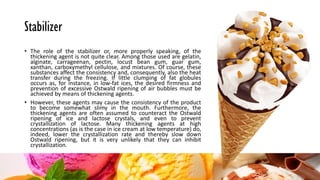
• The role of the stabilizer or, more properly speaking, of the
thickening agent is not quite clear. Among those used are gelatin,
alginate, carrageenan, pectin, locust bean gum, guar gum,
xanthan, carboxymethyl cellulose, and mixtures. Of course, these
substances affect the consistency and, consequently, also the heat
transfer during the freezing. If little clumping of fat globules
occurs as, for instance, in low-fat ices, the desired firmness and
prevention of excessive Ostwald ripening of air bubbles must be
achieved by means of thickening agents.
• However, these agents may cause the consistency of the product
to become somewhat slimy in the mouth. Furthermore, the
thickening agents are often assumed to counteract the Ostwald
ripening of ice and lactose crystals, and even to prevent
crystallization of lactose. Many thickening agents at high
concentrations (as is the case in ice cream at low temperature) do,
indeed, lower the crystallization rate and thereby slow down
Ostwald ripening, but it is very unlikely that they can inhibit
crystallization.
Emulsifier
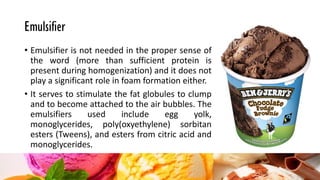
• Emulsifier is not needed in the proper sense of
the word (more than sufficient protein is
present during homogenization) and it does not
play a significant role in foam formation either.
• It serves to stimulate the fat globules to clump
and to become attached to the air bubbles. The
emulsifiers used include egg yolk,
monoglycerides, poly(oxyethylene) sorbitan
esters (Tweens), and esters from citric acid and
monoglycerides.

Ice Cream Technology

  • 1.
  • 2.
    What is IceCream? • Ice cream is a sweetened frozen food typically eaten as a snack or dessert. It is usually made from dairy products, such as milk and cream, and often combined with fruits or other ingredients and flavors. It is typically sweetened with sugar or sugar substitutes. Typically, flavourings and colourings are added in addition to stabilizers. • The mixture is stirred to incorporate air spaces and cooled below the freezing point of water to prevent detectable ice crystals from forming. The result is a smooth, semi-solid foam that is solid at very low temperatures.
  • 3.
    Top Ice Creamsproducers in world (2016) General Mills 15% Meiji Holding 3% Mihan Dairy Group 4% Nestle 16% Unilever 57% Well's Dairy 5%
  • 4.
    Top Ice Creamsbrands in 2016
  • 5.
    Approximate Composition (percentageby weight) of some types of ice cream Constituent Dairy Ice Cream Ice Milk Sherbet Ice Lolly Milk fat 10 4 2 0 Nonfat milk solids 11 12 4 0 Added sugar 14 13 22 22 Additives 0,4 0,6 0,4 0,2 % Overrun 100 85 50 ~0 Edible energy, kJ/100 ml 390 300 340 370
  • 6.
    Flow chart of IceCreams production
  • 7.
    Ice cream composing •Composing the mix is relatively simple. The additives are „emulsifier”, stabilizer (a thickening agent, usually a mixture of polysaccharides), and flavor and color substances. • Clearly, ingredients such as fruit pulp and ground nuts should be added after the homogenization
  • 8.
    Pasteurization • Pasteurization ofthe mix primarily serves to kill pathogenic and spoilage microorganisms. Additives added after homogenization should usually be pasteurized separately. The second important objective is to inactivate lipase because it is still a little active even at a very low temperature. Bacterial lipases should thus be prevented from occurring. • Finally, quite intense heating of the mix is desirable (especially for hardened ice cream) to decrease its susceptibility to autoxidation; a cooked flavor may be undesirable, according to the added flavor substances.
  • 9.
    Homogenization • Homogenization isspecifically meant to give the ice cream a sufficiently fine, smooth texture. Excessive formation of homogenization clusters should be avoided as it causes the mix to become highly viscous and the desirable fine texture not to be achieved; consequently, the homogenization pressure should be adapted to the fat content, to the pasteurization intensity, and, if need be, to the further composition of the mix.
  • 10.
    Cooling and ripening •Cooling and ripening (keeping cold for some time) are desirable for two reasons. The fat in most of the fat globules should largely be crystallized before the ice cream mix enters the freezer; it is important to note that considerable undercooling may occur because the fat globules are very small. • Certain stabilizers such as gelatin and locust bean gum need considerable time to swell after being dispersed. Some added emulsifiers need considerable time at low temperature to displace protein from the fat globules.
  • 11.
    Freezing • Freezing impliesrapid cooling of the mix to a few degrees below zero; in this way, ice is formed while air is beaten in. This must run simultaneously: after the bulk of the water is frozen, any beating in of air becomes impossible, and freezing after air is beaten in leads to insufficient churning of the fat globules and can damage the foam structure. • Moreover, the vigorous beating enables rapid cooling, because of which small ice crystals can be formed.
  • 12.
    Freezing • Usually, freezingis done in a scraped-surface heat exchanger — essentially a horizontal cylinder that is cooled externally by means of direct evaporation (−20 to −30°C) and equipped with a rotating stirrer (150 to 200 r.p.m.) that scrapes the wall. A layer of ice is formed on the wall. Pieces of ice are broken from the layer by the scraper and are distributed throughout the mass. • The process of manufacture takes a few minutes. The mix leaves the freezer at −3.5 to −7°C. A second heat exchanger may be applied, in which the mix is cooled further, while stirred, to about −10°C without additional beating in of air. Deeper cooling cannot be achieved in a flow-type exchanger because the product becomes too firm.
  • 13.
    Packaging • Packaging ofice cream often is a complicated operation, especially if mixtures or exceptional shapes are wanted. In the latter case the packaging step may be associated with the start of the hardening in order to give the portions appropriate shape retention.
  • 14.
    Hardening • The hardeningprocess serves to rapidly adjust the temperature of the ice cream to such a level as to retain its shape and to give it a sufficient shelf life with respect to chemical and enzymatic reactions, as well as to the physical structure. • The packaged ice cream can be passed through a so-called hardening tunnel, in which very cold air (say, −40°C) is blown past the small packages for some 20 min. Likewise, packaged ice cream can be passed through a brine bath of low temperature.
  • 15.
    Role of thevarious components Fats Milk solids-not-fat Sugar Stabilizer Emulsifier
  • 16.
    Fats • Fat isof special importance for the flavor and for a solid structure to be formed during freezing and therefore for consistency, appearance, and melting resistance. • A high fat content leads to a dry, almost grainy texture, a low fat content to a smooth, homogeneous, somewhat slimy texture.
  • 17.
    Milk solids-not-fat • Milksolids-not-fat contribute to the flavor. They are also responsible for part of the freezing- point depression and for an increased viscosity. The protein partly serves to stabilize the foam lamellae during air incorporation; it is essential for the formation of fat-globule membranes during homogenization. • Lactose can crystallize at low temperature. The crystals formed should be small in order to prevent sandiness. To that end, cooling should be quick during freezing, and afterward temperature fluctuations should be avoided.
  • 18.
    Sugar • Sugar, oftensucrose, is essential for the taste and for the freezing-point depression. Too little sugar may cause too much ice to be formed; too much sugar often makes the ice cream overly sweet. To overcome this, part of the sucrose may be replaced by a substitute such as glucose syrup, which is less sweet and leads to a greater freezing-point depression per kg sugar. • The sugar also causes a higher viscosity, especially when most of the water has been frozen. However, the most important role of the sugar is that it causes far less water to freeze than otherwise would be the case. As a result, the consistency of the ice cream is softer and its mouthfeel less cold.
  • 19.
    Stabilizer • The roleof the stabilizer or, more properly speaking, of the thickening agent is not quite clear. Among those used are gelatin, alginate, carrageenan, pectin, locust bean gum, guar gum, xanthan, carboxymethyl cellulose, and mixtures. Of course, these substances affect the consistency and, consequently, also the heat transfer during the freezing. If little clumping of fat globules occurs as, for instance, in low-fat ices, the desired firmness and prevention of excessive Ostwald ripening of air bubbles must be achieved by means of thickening agents. • However, these agents may cause the consistency of the product to become somewhat slimy in the mouth. Furthermore, the thickening agents are often assumed to counteract the Ostwald ripening of ice and lactose crystals, and even to prevent crystallization of lactose. Many thickening agents at high concentrations (as is the case in ice cream at low temperature) do, indeed, lower the crystallization rate and thereby slow down Ostwald ripening, but it is very unlikely that they can inhibit crystallization.
  • 20.
    Emulsifier • Emulsifier isnot needed in the proper sense of the word (more than sufficient protein is present during homogenization) and it does not play a significant role in foam formation either. • It serves to stimulate the fat globules to clump and to become attached to the air bubbles. The emulsifiers used include egg yolk, monoglycerides, poly(oxyethylene) sorbitan esters (Tweens), and esters from citric acid and monoglycerides.