

 Ice cream evolved from the iced beverages and water ices that were popular in the early
medieval period.
 the Italian Marco Polo returned from his famous journey to the Far East with a recipe for
making water ices resembling modern day sherbets.
 Over a thousand years later, Marco Polo returned to Italy from the Far East with a recipe
that closely resembled what is now called sherbet
 Historians estimate that this recipe evolved into ice cream sometime in the 16th century.
 England seems to have discovered ice cream at the same time, or perhaps even earlier than
the Italians.
 The earliest reports of people enjoying flavored ice desserts come from the Romans and
the Chinese.
 Marco Polo returned from his famous expedition with fruit-flavored ices, reporting that
Asians had been making them for thousands of years.
 Cream was introduced as an ingredient(to ice cream making ), and by the 1700s, people were
enjoying a dessert that was very similar to today's ice cream.
 The history of ice cream is closely associated with the development of refrigeration
techniques.
 According to popular accounts, Marco Polo (1254-1324) saw ice creams being made during
his trip to China, and on his return, introduced them to Italy.
 Iced sweetmeats and other frozen dainties had their origin in Egypt or Babylon.
 Ice cream making was revolutionized in 1851, when Jacob Fussel started the first wholesale
ice cream manufacturing operation in Baltimore, Maryland.
 Mix processing in 1941 was carried out by batch pasteurization (Sommer, 1944). While that is
still common today in many dairy operations, most large installations have moved to
continuous (HTST) pasteurization.
 The hand-cranked ice cream freezer was first developed by Nancy Johnson in 1846.
 earliest electrical freezers(based on the principles of a scraped surface freezer.)
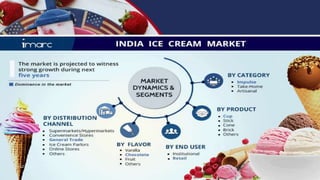
Ice cream market in India
 The liberalization process gave way to organized ice cream sector.
 The total domestic market is estimated at Rs. 1000 crore out of which organized sector
accounts for ~ 65%.
 The major national brands for ice cream are Amul, Quality Walls and Vadilal.
 The regional players are Mother Dairy, Arun, Joy, Nandini, Naturals, Dinshaw, etc.
 The branded market is worth 100 million litre per annum, valued at Rs. 600 crores.
 The branded ice cream market is expected to grow at the rate of 10.0% annually.
 The consumption of ice cream in India is one of the lowest in the world, at 0.1 litre per
person per annum compared to 22.0 litre in US, 5.0 litre in UK, 1.0 litre in Thailand and
0.41litre in Pakistan.
 The global average is 2.0 litre per annum.per individual consumption .
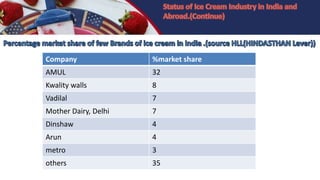
Company %market share
AMUL 32
Kwality walls 8
Vadilal 7
Mother Dairy, Delhi 7
Dinshaw 4
Arun 4
metro 3
others 35
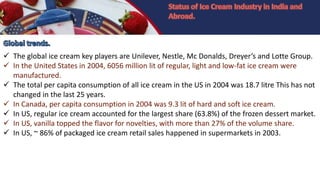
 The global ice cream key players are Unilever, Nestle, Mc Donalds, Dreyer‘s and Lotte Group.
 In the United States in 2004, 6056 million lit of regular, light and low-fat ice cream were
manufactured.
 The total per capita consumption of all ice cream in the US in 2004 was 18.7 litre This has not
changed in the last 25 years.
 In Canada, per capita consumption in 2004 was 9.3 lit of hard and soft ice cream.
 In US, regular ice cream accounted for the largest share (63.8%) of the frozen dessert market.
 In US, vanilla topped the flavor for novelties, with more than 27% of the volume share.
 In US, ~ 86% of packaged ice cream retail sales happened in supermarkets in 2003.
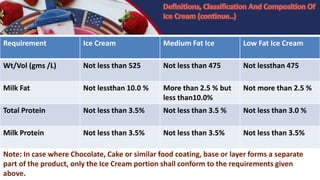
 According to Food Safety and Standard Regulations 2011, Ice Cream, Kulfi, Chocolate Ice
Cream or Softy Ice Cream(hereafter referred to as the said product) means the product
obtained by freezing a pasteurized mix prepared from milk and / or other products derived
from milk with or without the addition of nutritive sweetening agents, fruit and fruit
products, eggs and egg products, coffee, cocoa, chocolate, condiments, spices, ginger and
nuts and it may also contain bakery products such as cake or cookies as a separate layer
and/or coating.
 The said product may be frozen hard or frozen to a soft consistency; the said product shall
have pleasant taste and smell free from off flavour and the said product shall conform to the
following requirements, namely:
Requirement Ice Cream Medium Fat Ice Low Fat Ice Cream
Wt/Vol (gms /L) Not less than 525 Not less than 475 Not lessthan 475
Milk Fat Not lessthan 10.0 % More than 2.5 % but
less than10.0%
Not more than 2.5 %
Total Protein Not less than 3.5% Not less than 3.5 % Not less than 3.0 %
Milk Protein Not less than 3.5% Not less than 3.5% Not less than 3.5%
Note: In case where Chocolate, Cake or similar food coating, base or layer forms a separate
part of the product, only the Ice Cream portion shall conform to the requirements given
above.
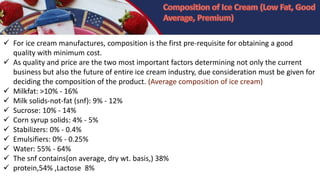
 For ice cream manufactures, composition is the first pre-requisite for obtaining a good
quality with minimum cost.
 As quality and price are the two most important factors determining not only the current
business but also the future of entire ice cream industry, due consideration must be given for
deciding the composition of the product. (Average composition of ice cream)
 Milkfat: >10% - 16%
 Milk solids-not-fat (snf): 9% - 12%
 Sucrose: 10% - 14%
 Corn syrup solids: 4% - 5%
 Stabilizers: 0% - 0.4%
 Emulsifiers: 0% - 0.25%
 Water: 55% - 64%
 The snf contains(on average, dry wt. basis,) 38%
 protein,54% ,Lactose 8%
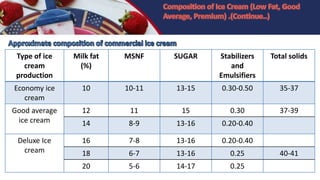
Type of ice
cream
production
Milk fat
(%)
MSNF SUGAR Stabilizers
and
Emulsifiers
Total solids
Economy ice
cream
10 10-11 13-15 0.30-0.50 35-37
Good average
ice cream
12 11 15 0.30 37-39
14 8-9 13-16 0.20-0.40
Deluxe Ice
cream
16 7-8 13-16 0.20-0.40
18 6-7 13-16 0.25 40-41
20 5-6 14-17 0.25
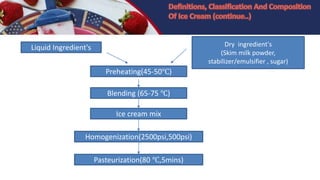
Liquid Ingredient's Dry ingredient's
(Skim milk powder,
stabilizer/emulsifier , sugar)
Preheating(45-50℃)
Blending (65-75 ℃)
Ice cream mix
Homogenization(2500psi,500psi)
Pasteurization(80 ℃,5mins)
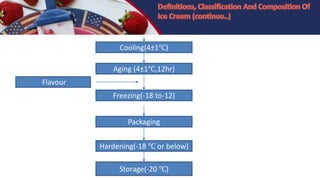
Cooling(4±1℃)
Aging (4±1℃,12hr)
Freezing(-18 to-12)
Packaging
Hardening(-18 ℃ or below)
Storage(-20 ℃)
Flavour
1)Fat
 The word ice cream can now be used for four categories of ice cream - non fat – ice
cream(less than 0.5% fat), low-fat ice cream (2.0% fat), reduced fat ice cream (2.0-10.0%)and
regular, premium, and super premium ice cream (more than 10% fat) as per US regulations.
 The existing national ice cream legislations in the individual member states of the EU vary
considerably with regard to the fat content of ice cream.
2)Milk solids not fat (MSNF)
 MSNF consists of proteins, lactose and minerals, the components of which vary considerably.
 The key components of MSNF are proteins which a part from their contribution to nutritional
requirements also have an effect on the whipping characteristics and other physical and
sensory properties of ice cream.
 Ex SMP, Skimmed milk, whey powder, whey protein concentrate.
In addition MSNF have good functional properties such as
 Interaction with some stabilizers.
 Stabilization of the fat emulsion after homogenization
 Contribution to structure of ice cream
 Water binding ability
3) Sweeteners:
 Sweeteners which include the lactose added via MSNF, make up the major part of the solids
contained in the ice cream.
 The degree of sweetness is determined by the addition of Sweeteners.
 Due to their depressing effect on the freezing point, sweeteners also control the amount of
frozen water in ice cream and thus the softness of the final product.
 EX: sucrose ,l actose, ethanol, glycerol , aspartame ,saccharine
4)Emulsifiers
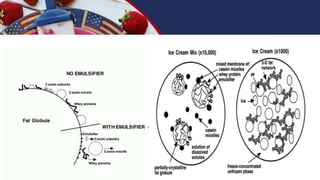
 Emulsifiers are by definition substances which make the formation of an emulsion possible
due to their ability to reduce surface tension.
 In ice cream oil in water in water emulsion and an air – in – partly frozen mix emulsions are
involved.
 Glycerol esters of fatty acids, commercially known as mono and diglycerides, are the
emulsifiers most commonly used in ice cream. Ex mono-diglycerides (E471), lactic acid esters
(E472b), propylene glycol esters (E477)
The benefits of emulsifiers in ice cream manufacture include
 The dryness of ice cream on extrusion from continuous freezer
 Improved whipping properties
 Improved body and texture
 Richer mouth feel and creamy sensation
 Improved air cell distribution , Improved heat shock resistance
5)Stabilizers
 Stabilizers influence the movement of water, partly due to their ability to form H-bonds and
partly due to their ability to form a three dimensional network throughout the liquid which
leads to the immobilization of water.
 The water binding / immobilizing effect improves the storage stability of ice cream.
Furthermore, stabilizers have positive influence on body and texture of ice cream.
 Finally, stabilizers contribute to the melting resistance of ice cream and prevent wheying off
during melting.
 Ex : Locust bean gum(LBG) ,Guargum , Sodiumalginate ,Carrageenan, Sodiumcarboxy methyl
cellulose(Na – CMC) .
 In order to obtain desired properties, combinations of stabilizers are used.
 The dosage of stabilizer combination in ice cream is normally between 0.1 and 0.3%.
Ice cream is a complex product containing milk components like emulsified fat, protein in
colloidal form and a solution of lactose and salts along with or without cane sugar, eggs, fruit
juices, fruits, flavours, colours, stabilizers and emulsifiers.
PREPARATION OF ICE CREAM MIX
1) Selection of ingredients
2) Formulation of ice cream mix
3) Blending of mix
4) Pasteurization of mix
5) Homogenization of mix
6) Cooling of mix
7) Ageing of mix
Selection of ingredients
Good quality materials are essential if the resultant product need to be satisfactory in all
aspects. The raw ingredients necessary to provide the components of ice cream must contain
sufficient fat and milk solids in proportions that can be combined to make a mix of the desired
composition.
Selection of ingredients depends on their
 Availability
 Perishability
 Convenience in handling
 Effect on flavour, body and texture of ice cream
 Cost
 Equipment's available etc.
Ice cream ingredients may be grouped into dairy and non-dairy products.
FORMULATION OF MIX
Consideration of various factors is highly essential to obtain a proper mix. The fundamental
requirement of mix formulation is to obtain a well balanced mix which also satisfies the legal
standards. A well balanced mix should always ensure
 A correct fat to sugar ratio – to prevent fatty mouth feel in case of high fat ice cream the
sugar content has to be raised accordingly. For instances 16% fat ice cream should ideally
have 17% sugar as against 15% sugar for economy (10% fat) ice cream
 A correct total solids to water ratio – if too high, sandiness and rough texture and if too low,
glassy or icy texture with weak body. Usually total solids of 36.0 to 40.0% will result in
organoleptically acceptable ice cream.
 There is inverse relation between fat and SNF in ice cream mix for e.g. super premium ice
cream (high fat) will have lower SNF than good average (moderate fat) ice cream
As a thumb rule, the MSNF should be about 15.6% (slow turn over) to 18.5% (rapid turn over) of
the TS of the mix, depending on the turnover of the ice cream.
methods can be used to calculate the mixes:
 Pearson square method
 Serum point method
 Formula tables / graphics method
 Algebraic method
 Computer developed formulations
STANDARDIZATION OF ICE CREAM MIX
 In order to attain the desired composition of ice cream mix, the calculated quantities of
ingredients (dairy and non dairy) is arrived at through standardization.
 This is accomplished using either (a) Algaebraic method, (b) Serum Point method.
BLENDING OF MIX
The ingredients to be blended are taken in a vat, where it can be heated to facilitate
dissolving, blending and pasteurizing. Mixing process varies from a small batch operation type to
a large scale automatic continuous type depending upon the amount of mix to be processed.
The order in which ingredients are to be added is as follows:-
 Liquid ingredients are mixed together and heated to 49°C prior to the addition of all dry
ingredients.
 Sodium alginate is mixed with a portion of sugar and slowly added to the liquid maintained
at 71.1°C at a moving agitator point.
 When gelatin is used, it should be dissolved in nine times water by weight with equal
volumes of sugar before the liquid temperature reaches 49°C.
 If butter, plastic cream, frozen cream or other frozen products are used, they should be cut
into small pieces and allowed for complete melting before pasteurization.
HOMOGENIZING MIX
Homogenization of ice cream mix is a most essential step to make a permanent
and uniform suspension of the fat by reducing the size of the fat droplets to a very small
diameter, preferably not more than 2 µm.
Advantages of homogenization
Proper homogenization of the mix will never allow the fat to form the cream layer
 More uniform ice cream
 Smoother texture
 Improved whipping ability
 Shorter ageing period
 Less opportunity for churning to occur in freezer
 Less stabilizer is required
 Homogenization of mix is usually done at temperature ranging from 63 to77°C.
 A pressure of 2000 to 2500 psi (135 to 170 kg/cm2) with one valve or 2500 to 3000 psi (170
to 200 kg/cm2) on the first and 500 psi(35 kg/cm2) on the second stage will usually give good
results for an average mix.
PASTEURIZATION OF MIX
Pasteurization is done to destroy all the pathogenic bacteria in the mix so as to render the final
product safe for human consumption
Advantages of pasteurization are:-
 it renders the mix completely free of pathogenic bacteria
 it dissolves and helps to blend the ingredients of the mix
 it improves flavour
 it improves keeping quality
 it produces a more uniform product
Rapid heating and holding of the mix at definite temperature and rapid cooling below 5°C
ensures proper pasteurization.
The temperature time combination for pasteurization of the mix as per BIS is as follows
 For Batch method – 68.5°C for not less than 30 min
 HTST method - 80°C for not less than 25seconds
 Vacreation - 90°C for not less than 1-3 seconds
 UHT pasteurization – 98.8 to 128.3°C for not less than 0-40 seconds
High temperature pasteurization is preferred as there is a greater bacterial kill resulting in low
bacterial count in ice cream
 Better body and texture
 Better flavour
 Protection against oxidation
 Saving of stabilizer
 Saving of time, labour and space ,Increased capacity
FLAVOUR ADDITION
Frozen desserts are valued mainly for pleasing flavour and refreshing effects. Among
the flavouring substances that play an important part in frozen desserts are vanilla, chocolate,
strawberry, pineapple, lemon, banana, mango, orange etc. Type and intensity of flavours are
important characteristics in ice cream where delicate flavours are preferred to harsh flavours.
Examples:-
 Vanilla
 Chocolate and Cocoa
 Fruits – fruit concentrates and essences
 Candied and glazed fruits
 Dried fruits
 Freeze dried fruits & Nuts
 Spices & salt
COOLING OF MIX
 After pasteurization, the mix should be rapidly cooled to a temperature below 4°C using a
plate heat exchanger. Unless the mix is cooled to a temperature of 4°C or lower, it will
become very viscous and the ice cream will not melt down smoothly. Also, temperatures
below 5°C retard the growth of bacteria.
AGEING OF MIX
 The cooled mix is left to age preferably for a period of 24 h at 4°C.
 The changes that occurs during ageing are
 Hydration of milk proteins ,Crystallization of fats
 Absorption of water by any added hydrocolloids
 Viscosity is increased largely due to the previously mentioned changes.
 Ageing is substantially completed within 24 h and longer period should be avoided to
control spoilage by psychrotrophs.
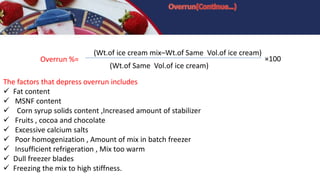
Overrun
 Overrun is usually defined as the volume of ice cream obtained in excess of the volume of
the mix.
 It is usually expressed as percentage of overrun.
 This increased volume is composed mainly of air incorporated during the freezing process.
 The amount of air that should be incorporated depends upon the composition of the mix and
the way it is processed, and is regulated so as to give the percentage of over run or yield that
will give proper body, texture and palatability necessary to good quality ice cream.
Calculating Overrun
 Overrun can be calculated by weighing a container and making a note of it so it can be
subtracted later.
 Note how much the container weighs filled with liquid mix and subtract the container
weight. Fill the same container level with frozen product and note its weight.
Overrun %=
(Wt.of ice cream mix–Wt.of Same Vol.of ice cream)
×100
(Wt.of Same Vol.of ice cream)
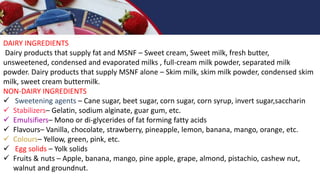
The factors that depress overrun includes
 Fat content
 MSNF content
 Corn syrup solids content ,Increased amount of stabilizer
 Fruits , cocoa and chocolate
 Excessive calcium salts
 Poor homogenization , Amount of mix in batch freezer
 Insufficient refrigeration , Mix too warm
 Dull freezer blades
 Freezing the mix to high stiffness.
DAIRY INGREDIENTS
Dairy products that supply fat and MSNF – Sweet cream, Sweet milk, fresh butter,
unsweetened, condensed and evaporated milks , full-cream milk powder, separated milk
powder. Dairy products that supply MSNF alone – Skim milk, skim milk powder, condensed skim
milk, sweet cream buttermilk.
NON-DAIRY INGREDIENTS
 Sweetening agents – Cane sugar, beet sugar, corn sugar, corn syrup, invert sugar,saccharin
 Stabilizers– Gelatin, sodium alginate, guar gum, etc.
 Emulsifiers– Mono or di-glycerides of fat forming fatty acids
 Flavours– Vanilla, chocolate, strawberry, pineapple, lemon, banana, mango, orange, etc.
 Colours– Yellow, green, pink, etc.
 Egg solids – Yolk solids
 Fruits & nuts – Apple, banana, mango, pine apple, grape, almond, pistachio, cashew nut,
walnut and groundnut.
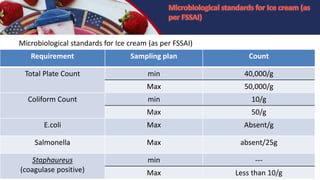
Requirement Sampling plan Count
Total Plate Count min 40,000/g
Max 50,000/g
Coliform Count min 10/g
Max 50/g
E.coli Max Absent/g
Salmonella Max absent/25g
Staphaureus
(coagulase positive)
min ---
Max Less than 10/g
Microbiological standards for Ice cream (as per FSSAI)
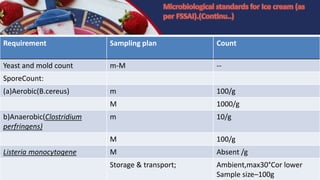
Requirement Sampling plan Count
Yeast and mold count m-M --
SporeCount:
(a)Aerobic(B.cereus) m 100/g
M 1000/g
b)Anaerobic(Clostridium
perfringens)
m 10/g
M 100/g
Listeria monocytogene M Absent /g
Storage & transport; Ambient,max30°Cor lower
Sample size–100g
Depending upon the commercial practices followed, the following
classifications are used for different groups of ice cream and frozen products.
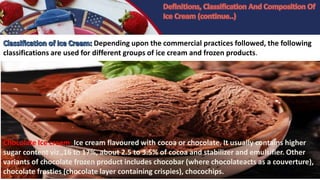
Chocolate Ice cream: Ice cream flavoured with cocoa or chocolate. It usually contains higher
sugar content viz.,16 to 17%, about 2.5 to 3.5% of cocoa and stabilizer and emulsifier. Other
variants of chocolate frozen product includes chocobar (where chocolateacts as a couverture),
chocolate frosties (chocolate layer containing crispies), chocochips.
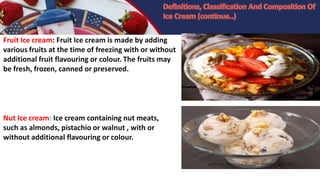
Fruit Ice cream: Fruit Ice cream is made by adding
various fruits at the time of freezing with or without
additional fruit flavouring or colour. The fruits may
be fresh, frozen, canned or preserved.
Nut Ice cream: Ice cream containing nut meats,
such as almonds, pistachio or walnut , with or
without additional flavouring or colour.
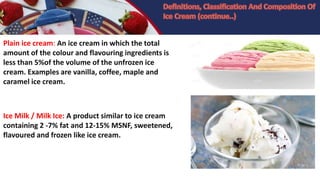
Plain ice cream: An ice cream in which the total
amount of the colour and flavouring ingredients is
less than 5%of the volume of the unfrozen ice
cream. Examples are vanilla, coffee, maple and
caramel ice cream.
Ice Milk / Milk Ice: A product similar to ice cream
containing 2 -7% fat and 12-15% MSNF, sweetened,
flavoured and frozen like ice cream.
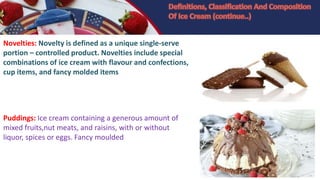
Novelties: Novelty is defined as a unique single-serve
portion – controlled product. Novelties include special
combinations of ice cream with flavour and confections,
cup items, and fancy molded items
Puddings: Ice cream containing a generous amount of
mixed fruits,nut meats, and raisins, with or without
liquor, spices or eggs. Fancy moulded
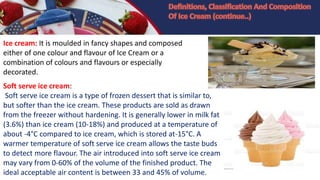
Ice cream: It is moulded in fancy shapes and composed
either of one colour and flavour of Ice Cream or a
combination of colours and flavours or especially
decorated.
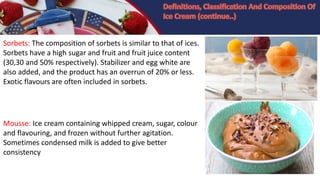
Soft serve ice cream:
Soft serve ice cream is a type of frozen dessert that is similar to,
but softer than the ice cream. These products are sold as drawn
from the freezer without hardening. It is generally lower in milk fat
(3.6%) than ice cream (10-18%) and produced at a temperature of
about -4°C compared to ice cream, which is stored at-15°C. A
warmer temperature of soft serve ice cream allows the taste buds
to detect more flavour. The air introduced into soft serve ice cream
may vary from 0-60% of the volume of the finished product. The
ideal acceptable air content is between 33 and 45% of volume.
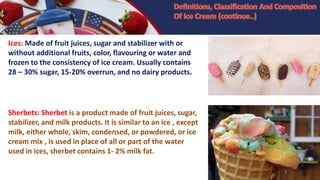
Sorbets: The composition of sorbets is similar to that of ices.
Sorbets have a high sugar and fruit and fruit juice content
(30,30 and 50% respectively). Stabilizer and egg white are
also added, and the product has an overrun of 20% or less.
Exotic flavours are often included in sorbets.
Mousse: Ice cream containing whipped cream, sugar, colour
and flavouring, and frozen without further agitation.
Sometimes condensed milk is added to give better
consistency
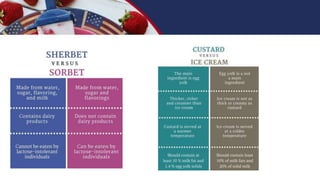
Ices: Made of fruit juices, sugar and stabilizer with or
without additional fruits, color, flavouring or water and
frozen to the consistency of ice cream. Usually contains
28 – 30% sugar, 15-20% overrun, and no dairy products.
Sherbets: Sherbet is a product made of fruit juices, sugar,
stabilizer, and milk products. It is similar to an ice , except
milk, either whole, skim, condensed, or powdered, or ice
cream mix , is used in place of all or part of the water
used in ices, sherbet contains 1- 2% milk fat.
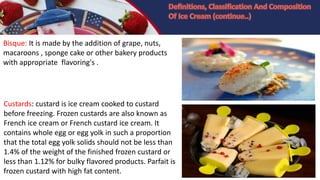
Bisque: It is made by the addition of grape, nuts,
macaroons , sponge cake or other bakery products
with appropriate flavoring's .
Custards: custard is ice cream cooked to custard
before freezing. Frozen custards are also known as
French ice cream or French custard ice cream. It
contains whole egg or egg yolk in such a proportion
that the total egg yolk solids should not be less than
1.4% of the weight of the finished frozen custard or
less than 1.12% for bulky flavored products. Parfait is
frozen custard with high fat content.
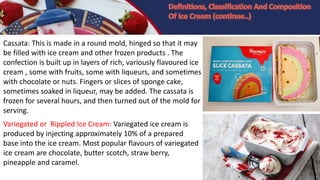
Cassata: This is made in a round mold, hinged so that it may
be filled with ice cream and other frozen products . The
confection is built up in layers of rich, variously flavoured ice
cream , some with fruits, some with liqueurs, and sometimes
with chocolate or nuts. Fingers or slices of sponge cake,
sometimes soaked in liqueur, may be added. The cassata is
frozen for several hours, and then turned out of the mold for
serving.
Variegated or Rippled Ice Cream: Variegated ice cream is
produced by injecting approximately 10% of a prepared
base into the ice cream. Most popular flavours of variegated
ice cream are chocolate, butter scotch, straw berry,
pineapple and caramel.
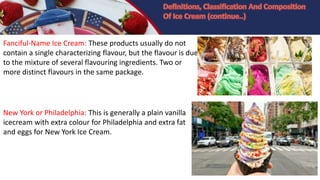
Fanciful-Name Ice Cream: These products usually do not
contain a single characterizing flavour, but the flavour is due
to the mixture of several flavouring ingredients. Two or
more distinct flavours in the same package.
New York or Philadelphia: This is generally a plain vanilla
icecream with extra colour for Philadelphia and extra fat
and eggs for New York Ice Cream.
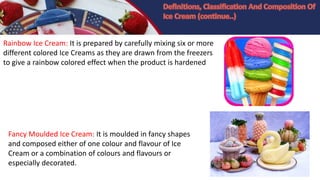
Rainbow Ice Cream: It is prepared by carefully mixing six or more
different colored Ice Creams as they are drawn from the freezers
to give a rainbow colored effect when the product is hardened
Fancy Moulded Ice Cream: It is moulded in fancy shapes
and composed either of one colour and flavour of Ice
Cream or a combination of colours and flavours or
especially decorated.
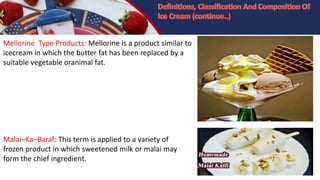
Mellorine Type Products: Mellorine is a product similar to
icecream in which the butter fat has been replaced by a
suitable vegetable oranimal fat.
Malai–Ka–Baraf: This term is applied to a variety of
frozen product in which sweetened milk or malai may
form the chief ingredient.
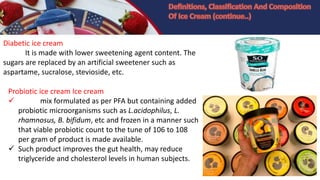
Diabetic ice cream
It is made with lower sweetening agent content. The
sugars are replaced by an artificial sweetener such as
aspartame, sucralose, stevioside, etc.
Probiotic ice cream Ice cream
 mix formulated as per PFA but containing added
probiotic microorganisms such as L.acidophilus, L.
rhamnosus, B. bifidum, etc and frozen in a manner such
that viable probiotic count to the tune of 106 to 108
per gram of product is made available.
 Such product improves the gut health, may reduce
triglyceride and cholesterol levels in human subjects.
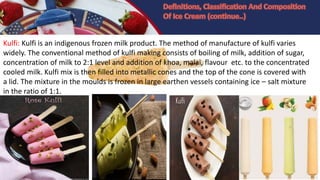
Kulfi: Kulfi is an indigenous frozen milk product. The method of manufacture of kulfi varies
widely. The conventional method of kulfi making consists of boiling of milk, addition of sugar,
concentration of milk to 2:1 level and addition of khoa, malai, flavour etc. to the concentrated
cooled milk. Kulfi mix is then filled into metallic cones and the top of the cone is covered with
a lid. The mixture in the moulds is frozen in large earthen vessels containing ice – salt mixture
in the ratio of 1:1.
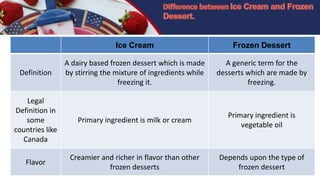
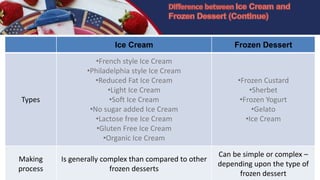
Ice Cream Frozen Dessert
Definition
A dairy based frozen dessert which is made
by stirring the mixture of ingredients while
freezing it.
A generic term for the
desserts which are made by
freezing.
Legal
Definition in
some
countries like
Canada
Primary ingredient is milk or cream
Primary ingredient is
vegetable oil
Flavor
Creamier and richer in flavor than other
frozen desserts
Depends upon the type of
frozen dessert
Ice Cream Frozen Dessert
Types
•French style Ice Cream
•Philadelphia style Ice Cream
•Reduced Fat Ice Cream
•Light Ice Cream
•Soft Ice Cream
•No sugar added Ice Cream
•Lactose free Ice Cream
•Gluten Free Ice Cream
•Organic Ice Cream
•Frozen Custard
•Sherbet
•Frozen Yogurt
•Gelato
•Ice Cream
Making
process
Is generally complex than compared to other
frozen desserts
Can be simple or complex –
depending upon the type of
frozen dessert
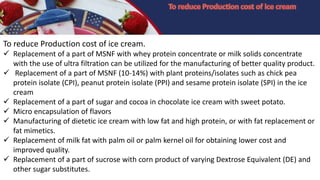
To reduce Production cost of ice cream.
 Replacement of a part of MSNF with whey protein concentrate or milk solids concentrate
with the use of ultra filtration can be utilized for the manufacturing of better quality product.
 Replacement of a part of MSNF (10-14%) with plant proteins/isolates such as chick pea
protein isolate (CPI), peanut protein isolate (PPI) and sesame protein isolate (SPI) in the ice
cream
 Replacement of a part of sugar and cocoa in chocolate ice cream with sweet potato.
 Micro encapsulation of flavors
 Manufacturing of dietetic ice cream with low fat and high protein, or with fat replacement or
fat mimetics.
 Replacement of milk fat with palm oil or palm kernel oil for obtaining lower cost and
improved quality.
 Replacement of a part of sucrose with corn product of varying Dextrose Equivalent (DE) and
other sugar substitutes.
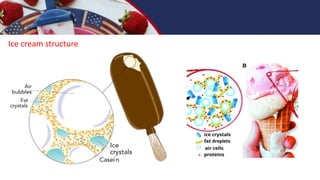
Ice cream structure
Ice cream and its classification

Ice cream and its classification

  • 2.
     Ice creamevolved from the iced beverages and water ices that were popular in the early medieval period.  the Italian Marco Polo returned from his famous journey to the Far East with a recipe for making water ices resembling modern day sherbets.  Over a thousand years later, Marco Polo returned to Italy from the Far East with a recipe that closely resembled what is now called sherbet  Historians estimate that this recipe evolved into ice cream sometime in the 16th century.  England seems to have discovered ice cream at the same time, or perhaps even earlier than the Italians.  The earliest reports of people enjoying flavored ice desserts come from the Romans and the Chinese.  Marco Polo returned from his famous expedition with fruit-flavored ices, reporting that Asians had been making them for thousands of years.
  • 3.
     Cream wasintroduced as an ingredient(to ice cream making ), and by the 1700s, people were enjoying a dessert that was very similar to today's ice cream.  The history of ice cream is closely associated with the development of refrigeration techniques.  According to popular accounts, Marco Polo (1254-1324) saw ice creams being made during his trip to China, and on his return, introduced them to Italy.  Iced sweetmeats and other frozen dainties had their origin in Egypt or Babylon.  Ice cream making was revolutionized in 1851, when Jacob Fussel started the first wholesale ice cream manufacturing operation in Baltimore, Maryland.  Mix processing in 1941 was carried out by batch pasteurization (Sommer, 1944). While that is still common today in many dairy operations, most large installations have moved to continuous (HTST) pasteurization.  The hand-cranked ice cream freezer was first developed by Nancy Johnson in 1846.  earliest electrical freezers(based on the principles of a scraped surface freezer.)
  • 4.
    Ice cream marketin India  The liberalization process gave way to organized ice cream sector.  The total domestic market is estimated at Rs. 1000 crore out of which organized sector accounts for ~ 65%.  The major national brands for ice cream are Amul, Quality Walls and Vadilal.  The regional players are Mother Dairy, Arun, Joy, Nandini, Naturals, Dinshaw, etc.  The branded market is worth 100 million litre per annum, valued at Rs. 600 crores.  The branded ice cream market is expected to grow at the rate of 10.0% annually.  The consumption of ice cream in India is one of the lowest in the world, at 0.1 litre per person per annum compared to 22.0 litre in US, 5.0 litre in UK, 1.0 litre in Thailand and 0.41litre in Pakistan.  The global average is 2.0 litre per annum.per individual consumption .
  • 5.
    Company %market share AMUL32 Kwality walls 8 Vadilal 7 Mother Dairy, Delhi 7 Dinshaw 4 Arun 4 metro 3 others 35
  • 7.
     The globalice cream key players are Unilever, Nestle, Mc Donalds, Dreyer‘s and Lotte Group.  In the United States in 2004, 6056 million lit of regular, light and low-fat ice cream were manufactured.  The total per capita consumption of all ice cream in the US in 2004 was 18.7 litre This has not changed in the last 25 years.  In Canada, per capita consumption in 2004 was 9.3 lit of hard and soft ice cream.  In US, regular ice cream accounted for the largest share (63.8%) of the frozen dessert market.  In US, vanilla topped the flavor for novelties, with more than 27% of the volume share.  In US, ~ 86% of packaged ice cream retail sales happened in supermarkets in 2003.
  • 9.
     According toFood Safety and Standard Regulations 2011, Ice Cream, Kulfi, Chocolate Ice Cream or Softy Ice Cream(hereafter referred to as the said product) means the product obtained by freezing a pasteurized mix prepared from milk and / or other products derived from milk with or without the addition of nutritive sweetening agents, fruit and fruit products, eggs and egg products, coffee, cocoa, chocolate, condiments, spices, ginger and nuts and it may also contain bakery products such as cake or cookies as a separate layer and/or coating.  The said product may be frozen hard or frozen to a soft consistency; the said product shall have pleasant taste and smell free from off flavour and the said product shall conform to the following requirements, namely:
  • 10.
    Requirement Ice CreamMedium Fat Ice Low Fat Ice Cream Wt/Vol (gms /L) Not less than 525 Not less than 475 Not lessthan 475 Milk Fat Not lessthan 10.0 % More than 2.5 % but less than10.0% Not more than 2.5 % Total Protein Not less than 3.5% Not less than 3.5 % Not less than 3.0 % Milk Protein Not less than 3.5% Not less than 3.5% Not less than 3.5% Note: In case where Chocolate, Cake or similar food coating, base or layer forms a separate part of the product, only the Ice Cream portion shall conform to the requirements given above.
  • 11.
     For icecream manufactures, composition is the first pre-requisite for obtaining a good quality with minimum cost.  As quality and price are the two most important factors determining not only the current business but also the future of entire ice cream industry, due consideration must be given for deciding the composition of the product. (Average composition of ice cream)  Milkfat: >10% - 16%  Milk solids-not-fat (snf): 9% - 12%  Sucrose: 10% - 14%  Corn syrup solids: 4% - 5%  Stabilizers: 0% - 0.4%  Emulsifiers: 0% - 0.25%  Water: 55% - 64%  The snf contains(on average, dry wt. basis,) 38%  protein,54% ,Lactose 8%
  • 12.
    Type of ice cream production Milkfat (%) MSNF SUGAR Stabilizers and Emulsifiers Total solids Economy ice cream 10 10-11 13-15 0.30-0.50 35-37 Good average ice cream 12 11 15 0.30 37-39 14 8-9 13-16 0.20-0.40 Deluxe Ice cream 16 7-8 13-16 0.20-0.40 18 6-7 13-16 0.25 40-41 20 5-6 14-17 0.25
  • 13.
    Liquid Ingredient's Dryingredient's (Skim milk powder, stabilizer/emulsifier , sugar) Preheating(45-50℃) Blending (65-75 ℃) Ice cream mix Homogenization(2500psi,500psi) Pasteurization(80 ℃,5mins)
  • 14.
  • 15.
    1)Fat  The wordice cream can now be used for four categories of ice cream - non fat – ice cream(less than 0.5% fat), low-fat ice cream (2.0% fat), reduced fat ice cream (2.0-10.0%)and regular, premium, and super premium ice cream (more than 10% fat) as per US regulations.  The existing national ice cream legislations in the individual member states of the EU vary considerably with regard to the fat content of ice cream. 2)Milk solids not fat (MSNF)  MSNF consists of proteins, lactose and minerals, the components of which vary considerably.  The key components of MSNF are proteins which a part from their contribution to nutritional requirements also have an effect on the whipping characteristics and other physical and sensory properties of ice cream.  Ex SMP, Skimmed milk, whey powder, whey protein concentrate.
  • 16.
    In addition MSNFhave good functional properties such as  Interaction with some stabilizers.  Stabilization of the fat emulsion after homogenization  Contribution to structure of ice cream  Water binding ability 3) Sweeteners:  Sweeteners which include the lactose added via MSNF, make up the major part of the solids contained in the ice cream.  The degree of sweetness is determined by the addition of Sweeteners.  Due to their depressing effect on the freezing point, sweeteners also control the amount of frozen water in ice cream and thus the softness of the final product.  EX: sucrose ,l actose, ethanol, glycerol , aspartame ,saccharine
  • 17.
    4)Emulsifiers  Emulsifiers areby definition substances which make the formation of an emulsion possible due to their ability to reduce surface tension.  In ice cream oil in water in water emulsion and an air – in – partly frozen mix emulsions are involved.  Glycerol esters of fatty acids, commercially known as mono and diglycerides, are the emulsifiers most commonly used in ice cream. Ex mono-diglycerides (E471), lactic acid esters (E472b), propylene glycol esters (E477) The benefits of emulsifiers in ice cream manufacture include  The dryness of ice cream on extrusion from continuous freezer  Improved whipping properties  Improved body and texture  Richer mouth feel and creamy sensation  Improved air cell distribution , Improved heat shock resistance
  • 18.
    5)Stabilizers  Stabilizers influencethe movement of water, partly due to their ability to form H-bonds and partly due to their ability to form a three dimensional network throughout the liquid which leads to the immobilization of water.  The water binding / immobilizing effect improves the storage stability of ice cream. Furthermore, stabilizers have positive influence on body and texture of ice cream.  Finally, stabilizers contribute to the melting resistance of ice cream and prevent wheying off during melting.  Ex : Locust bean gum(LBG) ,Guargum , Sodiumalginate ,Carrageenan, Sodiumcarboxy methyl cellulose(Na – CMC) .  In order to obtain desired properties, combinations of stabilizers are used.  The dosage of stabilizer combination in ice cream is normally between 0.1 and 0.3%.
  • 19.
    Ice cream isa complex product containing milk components like emulsified fat, protein in colloidal form and a solution of lactose and salts along with or without cane sugar, eggs, fruit juices, fruits, flavours, colours, stabilizers and emulsifiers. PREPARATION OF ICE CREAM MIX 1) Selection of ingredients 2) Formulation of ice cream mix 3) Blending of mix 4) Pasteurization of mix 5) Homogenization of mix 6) Cooling of mix 7) Ageing of mix
  • 20.
    Selection of ingredients Goodquality materials are essential if the resultant product need to be satisfactory in all aspects. The raw ingredients necessary to provide the components of ice cream must contain sufficient fat and milk solids in proportions that can be combined to make a mix of the desired composition. Selection of ingredients depends on their  Availability  Perishability  Convenience in handling  Effect on flavour, body and texture of ice cream  Cost  Equipment's available etc. Ice cream ingredients may be grouped into dairy and non-dairy products.
  • 21.
    FORMULATION OF MIX Considerationof various factors is highly essential to obtain a proper mix. The fundamental requirement of mix formulation is to obtain a well balanced mix which also satisfies the legal standards. A well balanced mix should always ensure  A correct fat to sugar ratio – to prevent fatty mouth feel in case of high fat ice cream the sugar content has to be raised accordingly. For instances 16% fat ice cream should ideally have 17% sugar as against 15% sugar for economy (10% fat) ice cream  A correct total solids to water ratio – if too high, sandiness and rough texture and if too low, glassy or icy texture with weak body. Usually total solids of 36.0 to 40.0% will result in organoleptically acceptable ice cream.  There is inverse relation between fat and SNF in ice cream mix for e.g. super premium ice cream (high fat) will have lower SNF than good average (moderate fat) ice cream As a thumb rule, the MSNF should be about 15.6% (slow turn over) to 18.5% (rapid turn over) of the TS of the mix, depending on the turnover of the ice cream.
  • 22.
    methods can beused to calculate the mixes:  Pearson square method  Serum point method  Formula tables / graphics method  Algebraic method  Computer developed formulations STANDARDIZATION OF ICE CREAM MIX  In order to attain the desired composition of ice cream mix, the calculated quantities of ingredients (dairy and non dairy) is arrived at through standardization.  This is accomplished using either (a) Algaebraic method, (b) Serum Point method.
  • 23.
    BLENDING OF MIX Theingredients to be blended are taken in a vat, where it can be heated to facilitate dissolving, blending and pasteurizing. Mixing process varies from a small batch operation type to a large scale automatic continuous type depending upon the amount of mix to be processed. The order in which ingredients are to be added is as follows:-  Liquid ingredients are mixed together and heated to 49°C prior to the addition of all dry ingredients.  Sodium alginate is mixed with a portion of sugar and slowly added to the liquid maintained at 71.1°C at a moving agitator point.  When gelatin is used, it should be dissolved in nine times water by weight with equal volumes of sugar before the liquid temperature reaches 49°C.  If butter, plastic cream, frozen cream or other frozen products are used, they should be cut into small pieces and allowed for complete melting before pasteurization.
  • 24.
    HOMOGENIZING MIX Homogenization ofice cream mix is a most essential step to make a permanent and uniform suspension of the fat by reducing the size of the fat droplets to a very small diameter, preferably not more than 2 µm. Advantages of homogenization Proper homogenization of the mix will never allow the fat to form the cream layer  More uniform ice cream  Smoother texture  Improved whipping ability  Shorter ageing period  Less opportunity for churning to occur in freezer  Less stabilizer is required
  • 25.
     Homogenization ofmix is usually done at temperature ranging from 63 to77°C.  A pressure of 2000 to 2500 psi (135 to 170 kg/cm2) with one valve or 2500 to 3000 psi (170 to 200 kg/cm2) on the first and 500 psi(35 kg/cm2) on the second stage will usually give good results for an average mix. PASTEURIZATION OF MIX Pasteurization is done to destroy all the pathogenic bacteria in the mix so as to render the final product safe for human consumption Advantages of pasteurization are:-  it renders the mix completely free of pathogenic bacteria  it dissolves and helps to blend the ingredients of the mix  it improves flavour  it improves keeping quality  it produces a more uniform product
  • 26.
    Rapid heating andholding of the mix at definite temperature and rapid cooling below 5°C ensures proper pasteurization. The temperature time combination for pasteurization of the mix as per BIS is as follows  For Batch method – 68.5°C for not less than 30 min  HTST method - 80°C for not less than 25seconds  Vacreation - 90°C for not less than 1-3 seconds  UHT pasteurization – 98.8 to 128.3°C for not less than 0-40 seconds High temperature pasteurization is preferred as there is a greater bacterial kill resulting in low bacterial count in ice cream  Better body and texture  Better flavour  Protection against oxidation  Saving of stabilizer  Saving of time, labour and space ,Increased capacity
  • 27.
    FLAVOUR ADDITION Frozen dessertsare valued mainly for pleasing flavour and refreshing effects. Among the flavouring substances that play an important part in frozen desserts are vanilla, chocolate, strawberry, pineapple, lemon, banana, mango, orange etc. Type and intensity of flavours are important characteristics in ice cream where delicate flavours are preferred to harsh flavours. Examples:-  Vanilla  Chocolate and Cocoa  Fruits – fruit concentrates and essences  Candied and glazed fruits  Dried fruits  Freeze dried fruits & Nuts  Spices & salt
  • 28.
    COOLING OF MIX After pasteurization, the mix should be rapidly cooled to a temperature below 4°C using a plate heat exchanger. Unless the mix is cooled to a temperature of 4°C or lower, it will become very viscous and the ice cream will not melt down smoothly. Also, temperatures below 5°C retard the growth of bacteria. AGEING OF MIX  The cooled mix is left to age preferably for a period of 24 h at 4°C.  The changes that occurs during ageing are  Hydration of milk proteins ,Crystallization of fats  Absorption of water by any added hydrocolloids  Viscosity is increased largely due to the previously mentioned changes.  Ageing is substantially completed within 24 h and longer period should be avoided to control spoilage by psychrotrophs.
  • 29.
    Overrun  Overrun isusually defined as the volume of ice cream obtained in excess of the volume of the mix.  It is usually expressed as percentage of overrun.  This increased volume is composed mainly of air incorporated during the freezing process.  The amount of air that should be incorporated depends upon the composition of the mix and the way it is processed, and is regulated so as to give the percentage of over run or yield that will give proper body, texture and palatability necessary to good quality ice cream. Calculating Overrun  Overrun can be calculated by weighing a container and making a note of it so it can be subtracted later.  Note how much the container weighs filled with liquid mix and subtract the container weight. Fill the same container level with frozen product and note its weight.
  • 30.
    Overrun %= (Wt.of icecream mix–Wt.of Same Vol.of ice cream) ×100 (Wt.of Same Vol.of ice cream) The factors that depress overrun includes  Fat content  MSNF content  Corn syrup solids content ,Increased amount of stabilizer  Fruits , cocoa and chocolate  Excessive calcium salts  Poor homogenization , Amount of mix in batch freezer  Insufficient refrigeration , Mix too warm  Dull freezer blades  Freezing the mix to high stiffness.
  • 31.
    DAIRY INGREDIENTS Dairy productsthat supply fat and MSNF – Sweet cream, Sweet milk, fresh butter, unsweetened, condensed and evaporated milks , full-cream milk powder, separated milk powder. Dairy products that supply MSNF alone – Skim milk, skim milk powder, condensed skim milk, sweet cream buttermilk. NON-DAIRY INGREDIENTS  Sweetening agents – Cane sugar, beet sugar, corn sugar, corn syrup, invert sugar,saccharin  Stabilizers– Gelatin, sodium alginate, guar gum, etc.  Emulsifiers– Mono or di-glycerides of fat forming fatty acids  Flavours– Vanilla, chocolate, strawberry, pineapple, lemon, banana, mango, orange, etc.  Colours– Yellow, green, pink, etc.  Egg solids – Yolk solids  Fruits & nuts – Apple, banana, mango, pine apple, grape, almond, pistachio, cashew nut, walnut and groundnut.
  • 32.
    Requirement Sampling planCount Total Plate Count min 40,000/g Max 50,000/g Coliform Count min 10/g Max 50/g E.coli Max Absent/g Salmonella Max absent/25g Staphaureus (coagulase positive) min --- Max Less than 10/g Microbiological standards for Ice cream (as per FSSAI)
  • 33.
    Requirement Sampling planCount Yeast and mold count m-M -- SporeCount: (a)Aerobic(B.cereus) m 100/g M 1000/g b)Anaerobic(Clostridium perfringens) m 10/g M 100/g Listeria monocytogene M Absent /g Storage & transport; Ambient,max30°Cor lower Sample size–100g
  • 34.
    Depending upon thecommercial practices followed, the following classifications are used for different groups of ice cream and frozen products. Chocolate Ice cream: Ice cream flavoured with cocoa or chocolate. It usually contains higher sugar content viz.,16 to 17%, about 2.5 to 3.5% of cocoa and stabilizer and emulsifier. Other variants of chocolate frozen product includes chocobar (where chocolateacts as a couverture), chocolate frosties (chocolate layer containing crispies), chocochips.
  • 35.
    Fruit Ice cream:Fruit Ice cream is made by adding various fruits at the time of freezing with or without additional fruit flavouring or colour. The fruits may be fresh, frozen, canned or preserved. Nut Ice cream: Ice cream containing nut meats, such as almonds, pistachio or walnut , with or without additional flavouring or colour.
  • 36.
    Plain ice cream:An ice cream in which the total amount of the colour and flavouring ingredients is less than 5%of the volume of the unfrozen ice cream. Examples are vanilla, coffee, maple and caramel ice cream. Ice Milk / Milk Ice: A product similar to ice cream containing 2 -7% fat and 12-15% MSNF, sweetened, flavoured and frozen like ice cream.
  • 37.
    Novelties: Novelty isdefined as a unique single-serve portion – controlled product. Novelties include special combinations of ice cream with flavour and confections, cup items, and fancy molded items Puddings: Ice cream containing a generous amount of mixed fruits,nut meats, and raisins, with or without liquor, spices or eggs. Fancy moulded
  • 38.
    Ice cream: Itis moulded in fancy shapes and composed either of one colour and flavour of Ice Cream or a combination of colours and flavours or especially decorated. Soft serve ice cream: Soft serve ice cream is a type of frozen dessert that is similar to, but softer than the ice cream. These products are sold as drawn from the freezer without hardening. It is generally lower in milk fat (3.6%) than ice cream (10-18%) and produced at a temperature of about -4°C compared to ice cream, which is stored at-15°C. A warmer temperature of soft serve ice cream allows the taste buds to detect more flavour. The air introduced into soft serve ice cream may vary from 0-60% of the volume of the finished product. The ideal acceptable air content is between 33 and 45% of volume.
  • 39.
    Sorbets: The compositionof sorbets is similar to that of ices. Sorbets have a high sugar and fruit and fruit juice content (30,30 and 50% respectively). Stabilizer and egg white are also added, and the product has an overrun of 20% or less. Exotic flavours are often included in sorbets. Mousse: Ice cream containing whipped cream, sugar, colour and flavouring, and frozen without further agitation. Sometimes condensed milk is added to give better consistency
  • 40.
    Ices: Made offruit juices, sugar and stabilizer with or without additional fruits, color, flavouring or water and frozen to the consistency of ice cream. Usually contains 28 – 30% sugar, 15-20% overrun, and no dairy products. Sherbets: Sherbet is a product made of fruit juices, sugar, stabilizer, and milk products. It is similar to an ice , except milk, either whole, skim, condensed, or powdered, or ice cream mix , is used in place of all or part of the water used in ices, sherbet contains 1- 2% milk fat.
  • 42.
    Bisque: It ismade by the addition of grape, nuts, macaroons , sponge cake or other bakery products with appropriate flavoring's . Custards: custard is ice cream cooked to custard before freezing. Frozen custards are also known as French ice cream or French custard ice cream. It contains whole egg or egg yolk in such a proportion that the total egg yolk solids should not be less than 1.4% of the weight of the finished frozen custard or less than 1.12% for bulky flavored products. Parfait is frozen custard with high fat content.
  • 43.
    Cassata: This ismade in a round mold, hinged so that it may be filled with ice cream and other frozen products . The confection is built up in layers of rich, variously flavoured ice cream , some with fruits, some with liqueurs, and sometimes with chocolate or nuts. Fingers or slices of sponge cake, sometimes soaked in liqueur, may be added. The cassata is frozen for several hours, and then turned out of the mold for serving. Variegated or Rippled Ice Cream: Variegated ice cream is produced by injecting approximately 10% of a prepared base into the ice cream. Most popular flavours of variegated ice cream are chocolate, butter scotch, straw berry, pineapple and caramel.
  • 44.
    Fanciful-Name Ice Cream:These products usually do not contain a single characterizing flavour, but the flavour is due to the mixture of several flavouring ingredients. Two or more distinct flavours in the same package. New York or Philadelphia: This is generally a plain vanilla icecream with extra colour for Philadelphia and extra fat and eggs for New York Ice Cream.
  • 45.
    Rainbow Ice Cream:It is prepared by carefully mixing six or more different colored Ice Creams as they are drawn from the freezers to give a rainbow colored effect when the product is hardened Fancy Moulded Ice Cream: It is moulded in fancy shapes and composed either of one colour and flavour of Ice Cream or a combination of colours and flavours or especially decorated.
  • 46.
    Mellorine Type Products:Mellorine is a product similar to icecream in which the butter fat has been replaced by a suitable vegetable oranimal fat. Malai–Ka–Baraf: This term is applied to a variety of frozen product in which sweetened milk or malai may form the chief ingredient.
  • 47.
    Diabetic ice cream Itis made with lower sweetening agent content. The sugars are replaced by an artificial sweetener such as aspartame, sucralose, stevioside, etc. Probiotic ice cream Ice cream  mix formulated as per PFA but containing added probiotic microorganisms such as L.acidophilus, L. rhamnosus, B. bifidum, etc and frozen in a manner such that viable probiotic count to the tune of 106 to 108 per gram of product is made available.  Such product improves the gut health, may reduce triglyceride and cholesterol levels in human subjects.
  • 48.
    Kulfi: Kulfi isan indigenous frozen milk product. The method of manufacture of kulfi varies widely. The conventional method of kulfi making consists of boiling of milk, addition of sugar, concentration of milk to 2:1 level and addition of khoa, malai, flavour etc. to the concentrated cooled milk. Kulfi mix is then filled into metallic cones and the top of the cone is covered with a lid. The mixture in the moulds is frozen in large earthen vessels containing ice – salt mixture in the ratio of 1:1.
  • 49.
    Ice Cream FrozenDessert Definition A dairy based frozen dessert which is made by stirring the mixture of ingredients while freezing it. A generic term for the desserts which are made by freezing. Legal Definition in some countries like Canada Primary ingredient is milk or cream Primary ingredient is vegetable oil Flavor Creamier and richer in flavor than other frozen desserts Depends upon the type of frozen dessert
  • 50.
    Ice Cream FrozenDessert Types •French style Ice Cream •Philadelphia style Ice Cream •Reduced Fat Ice Cream •Light Ice Cream •Soft Ice Cream •No sugar added Ice Cream •Lactose free Ice Cream •Gluten Free Ice Cream •Organic Ice Cream •Frozen Custard •Sherbet •Frozen Yogurt •Gelato •Ice Cream Making process Is generally complex than compared to other frozen desserts Can be simple or complex – depending upon the type of frozen dessert
  • 51.
    To reduce Productioncost of ice cream.  Replacement of a part of MSNF with whey protein concentrate or milk solids concentrate with the use of ultra filtration can be utilized for the manufacturing of better quality product.  Replacement of a part of MSNF (10-14%) with plant proteins/isolates such as chick pea protein isolate (CPI), peanut protein isolate (PPI) and sesame protein isolate (SPI) in the ice cream  Replacement of a part of sugar and cocoa in chocolate ice cream with sweet potato.  Micro encapsulation of flavors  Manufacturing of dietetic ice cream with low fat and high protein, or with fat replacement or fat mimetics.  Replacement of milk fat with palm oil or palm kernel oil for obtaining lower cost and improved quality.  Replacement of a part of sucrose with corn product of varying Dextrose Equivalent (DE) and other sugar substitutes.
  • 52.