Geetika K. Gopi
ASTA
• It is the voice of the U.S. spice industry
which works to ensure clean, safe spice.
• Cleanliness specifications for spices of
American Spice Trade Association (ASTA)
are a universally adopted manual for the
assessment of physical quality of spices.
ASTA
• The American Spice Trade Association
(ASTA) was established in New York City in
1907 to provide representation for the
American spice trade.
• ASTA is based in Washington, D.C. and its
members include companies involved in all
aspects of the spice trade — importing,
growing, processing, and marketing at the
wholesale and retail levels.
ASTA
• ASTA’s members include U.S.-based agents,
brokers and importers, and companies based
outside of the U.S. that grow spices and ship
them to the U.S. and other companies
associated with the U.S. spice industry.
• ASTA members manufacture and market the
majority of spices sold in the U.S. for
industrial, food service and consumer use.
• ASTA is a member of The International
Organization of Spice Trade Associations
(IOSTA)
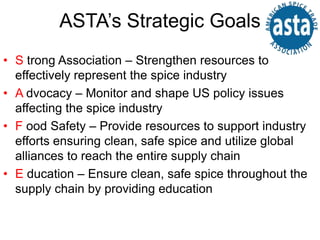
ASTA’s Strategic Goals
• S trong Association – Strengthen resources to
effectively represent the spice industry
• A dvocacy – Monitor and shape US policy issues
affecting the spice industry
• F ood Safety – Provide resources to support industry
efforts ensuring clean, safe spice and utilize global
alliances to reach the entire supply chain
• E ducation – Ensure clean, safe spice throughout the
supply chain by providing education
• Although some spices possess antimicrobial
properties, many spices can harbour
microorganisms, including pathogens.
• Salmonella is the most common bacterial
pathogen associated with product recalls and
outbreaks in spices and is the primary focus.
• Many of the preventive measures that mitigate
risk for introduction of filth in spice products
also reduce risk for contamination with
Salmonella or other pathogens.
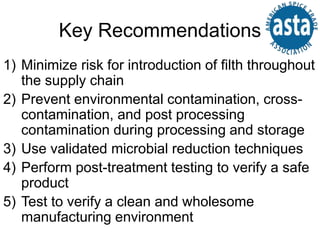
Key Recommendations
1) Minimize risk for introduction of filth throughout
the supply chain
2) Prevent environmental contamination, cross-
contamination, and post processing
contamination during processing and storage
3) Use validated microbial reduction techniques
4) Perform post-treatment testing to verify a safe
product
5) Test to verify a clean and wholesome
manufacturing environment
Establishing Safety in the Growing
and Manufacturing Processes
• Good Agricultural Practices
• Good Manufacturing Practices
• HACCP
• Microbial Reduction Techniques
• Supply Chain Management
Transport and
Processing
Options and
Control Points
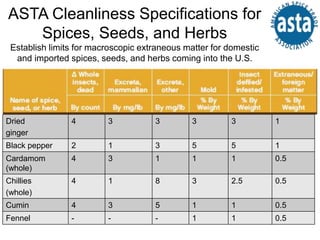
ASTA Cleanliness Specifications for
Spices, Seeds, and Herbs
Establish limits for macroscopic extraneous matter for domestic
and imported spices, seeds, and herbs coming into the U.S.
Dried
ginger
4 3 3 3 3 1
Black pepper 2 1 3 5 5 1
Cardamom
(whole)
4 3 1 1 1 0.5
Chillies
(whole)
4 1 8 3 2.5 0.5
Cumin 4 3 5 1 1 0.5
Fennel - - - 1 1 0.5
CONCLUSION
• ASTA is committed to assisting its
members and others in the industry in
assuring that spices consumed in the U.S.
are clean and safe consistently.
• A complete food safety program minimizes
the risk for contamination by filth or
pathogenic microorganisms at each stage
of the supply chain.
ASTA

ASTA

  • 1.
  • 2.
    ASTA • It isthe voice of the U.S. spice industry which works to ensure clean, safe spice. • Cleanliness specifications for spices of American Spice Trade Association (ASTA) are a universally adopted manual for the assessment of physical quality of spices.
  • 3.
    ASTA • The AmericanSpice Trade Association (ASTA) was established in New York City in 1907 to provide representation for the American spice trade. • ASTA is based in Washington, D.C. and its members include companies involved in all aspects of the spice trade — importing, growing, processing, and marketing at the wholesale and retail levels.
  • 4.
    ASTA • ASTA’s membersinclude U.S.-based agents, brokers and importers, and companies based outside of the U.S. that grow spices and ship them to the U.S. and other companies associated with the U.S. spice industry. • ASTA members manufacture and market the majority of spices sold in the U.S. for industrial, food service and consumer use. • ASTA is a member of The International Organization of Spice Trade Associations (IOSTA)
  • 5.
    ASTA’s Strategic Goals •S trong Association – Strengthen resources to effectively represent the spice industry • A dvocacy – Monitor and shape US policy issues affecting the spice industry • F ood Safety – Provide resources to support industry efforts ensuring clean, safe spice and utilize global alliances to reach the entire supply chain • E ducation – Ensure clean, safe spice throughout the supply chain by providing education
  • 6.
    • Although somespices possess antimicrobial properties, many spices can harbour microorganisms, including pathogens. • Salmonella is the most common bacterial pathogen associated with product recalls and outbreaks in spices and is the primary focus. • Many of the preventive measures that mitigate risk for introduction of filth in spice products also reduce risk for contamination with Salmonella or other pathogens.
  • 7.
    Key Recommendations 1) Minimizerisk for introduction of filth throughout the supply chain 2) Prevent environmental contamination, cross- contamination, and post processing contamination during processing and storage 3) Use validated microbial reduction techniques 4) Perform post-treatment testing to verify a safe product 5) Test to verify a clean and wholesome manufacturing environment
  • 8.
    Establishing Safety inthe Growing and Manufacturing Processes • Good Agricultural Practices • Good Manufacturing Practices • HACCP • Microbial Reduction Techniques • Supply Chain Management
  • 9.
  • 11.
    ASTA Cleanliness Specificationsfor Spices, Seeds, and Herbs Establish limits for macroscopic extraneous matter for domestic and imported spices, seeds, and herbs coming into the U.S. Dried ginger 4 3 3 3 3 1 Black pepper 2 1 3 5 5 1 Cardamom (whole) 4 3 1 1 1 0.5 Chillies (whole) 4 1 8 3 2.5 0.5 Cumin 4 3 5 1 1 0.5 Fennel - - - 1 1 0.5
  • 12.
    CONCLUSION • ASTA iscommitted to assisting its members and others in the industry in assuring that spices consumed in the U.S. are clean and safe consistently. • A complete food safety program minimizes the risk for contamination by filth or pathogenic microorganisms at each stage of the supply chain.

Editor's Notes

  • #2 Many spices are grown in developing countries where sanitation and food handling practices may not be adequate. Agricultural products such as spices are commonly exposed to dust, dirt, insects, and animal waste before they are even harvested. There are many additional opportunities for the introduction of pathogenic microorganisms and filth to spices during primary processing and storage, in transport, and after they have arrived in the U.S.
  • #11 To assist the spice industry in developing programs that minimize risk for contamination during growing, harvesting, drying, transport, processing, and post-processing storage, helping industry firms to provide clean, safe spices to their industrial, food service and consumer customers.