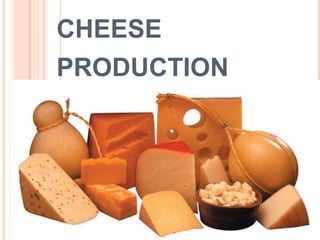
CHEESE
PRODUCTION
INTRODUCTION-ETYMOLOGY
 Word ‘cheese’ – Latin “casues”, meaning to
ferment/become sour
HOW OLD IS THE CHESE YOU ENJOY?
 Gorgonzola 879 AD.
 Roquefort 1070
 Grana 1200
 Cheddar 1500
 Gouda 1697
 Gloucester 1697
 Stilton 1785
 Camembert 1791
INTRODUCTION
 Ultimately a milk product
 Widely used all over the world as food
product
 Purely a product of microbial
fermentation
 Flavor and aroma changes depending
upon the microorganism being used.
 Before long, people learned that curds
can be aged for over weeks and months
and then pressed together to form large
cakes of cheese.
 The art of cheese making have traveled
from Asia to the Europe and then
spread all over the world
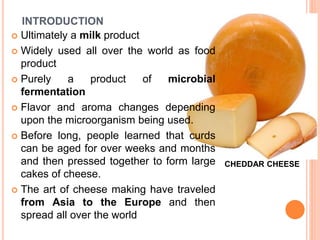
CHEDDAR CHEESE
DISCOVERY
 Though it is not certain that who made the first cheese
but it is certain that it was accidental.
 Nomadic tribes of Central Asia are considered to be
the legends who “discovered” cheese.
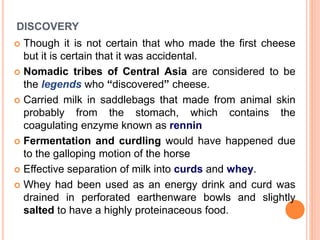
 Carried milk in saddlebags that made from animal skin
probably from the stomach, which contains the
coagulating enzyme known as rennin
 Fermentation and curdling would have happened due
to the galloping motion of the horse
 Effective separation of milk into curds and whey.
 Whey had been used as an energy drink and curd was
drained in perforated earthenware bowls and slightly
salted to have a highly proteinaceous food.
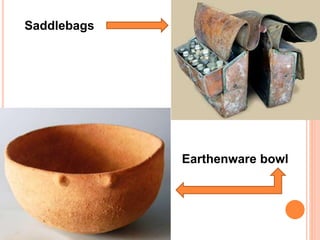
Saddlebags
Earthenware bowl
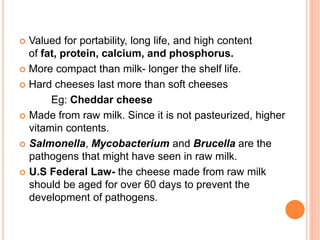
 Valued for portability, long life, and high content
of fat, protein, calcium, and phosphorus.
 More compact than milk- longer the shelf life.
 Hard cheeses last more than soft cheeses
Eg: Cheddar cheese
 Made from raw milk. Since it is not pasteurized, higher
vitamin contents.
 Salmonella, Mycobacterium and Brucella are the
pathogens that might have seen in raw milk.
 U.S Federal Law- the cheese made from raw milk
should be aged for over 60 days to prevent the
development of pathogens.
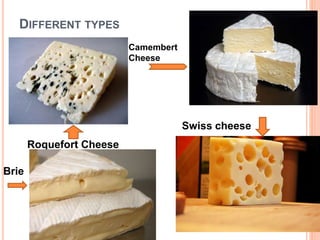
DIFFERENT TYPES
Roquefort Cheese
Camembert
Cheese
Brie
Swiss cheese
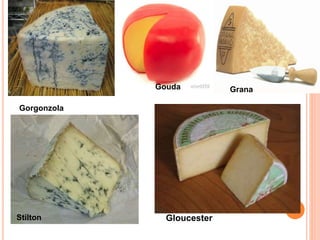
Gorgonzola
Gouda
Stilton
Grana
Gloucester
 Cheese is completely a milk product.
 Whole milk- compressed, processed and stored to
produce cheese.
 Wide range of cheese can be produced in countries
where milk is legally allowed to process without
pasteurization.
 In most of the countries the range of cheeses is smaller
because of this reason
 Whey is a byproduct of cheese production
 Like most of other fermented food products such as
beer, wine, etc. cheese also can be stored for longer
periods, say years.
PRINCIPLES OF CHEESE PRODUCTION
 Cheese – a way of storing milk over years
 Nowhere near as big as the market for cow’s milk
cheese, considerable amount of cheese is made from
other milk such as goat and sheep.
 Cheese – by coagulating milk (separating curd and
whey)
 Both raw milk and pasteurized milk can be used for
cheese making.
 Needs more rennet (up to twice) for homogenized milk
than the raw milk.
 This milk produces a curd that is smoother and less
firm than that of raw milk, so most people add calcium
chloride to the cheese
CHEESE MANUFACTURE
The manufacture of most cheeses involves the following
Pasteurization
Kills nearly all microorganisms including pathogens that cause
diseases and other undesirable organisms such as yeasts and
coliforms (may alter the characteristics by producing CO2z and
undesirable proteolysis)
Regular HTST pasteurization at 72-730C for 15-20 seconds is
commonly applied.
Spore forming bacteria Clostridium tyrobutyricum can survive
pasteurization and produces butyric acid and large volumes of
hydrogen gas by fermenting lactic acid, which will destroy the
structure of cheese.
Chemical inhibitors such as NaNO3 or H2O2 can be used but in
several countries, it has been banned and mechanical modes
have been preferred.
Bactofugation
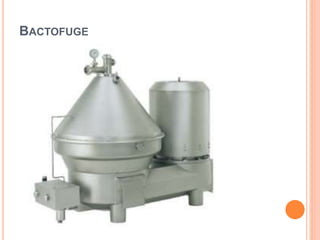
 Process in which a specially designed centrifuge-
bactofuge is been used to separate the bacteria and
spores that present in milk.
 Efficient way of reducing the number of spores in milk
since their specific gravity is lesser than that of milk.
 Normally separate milk into a fraction which is more or
less free from bacteria and a concentrate which
contains both spores and bacteria.
 Example- spore load in cream by Bacillus cereus is
reduced.
 Typically 60-630C is the temperature applied in
Bactofugation
BACTOFUGE
Microfiltration
 A membrane filter with a pore size of approximately 0.2
micron can filter bacteria from a water solution
 Most of the fat globules and some of the proteins are as
large as, or larger than, the bacteria.
 This results in the filter fouling very quickly when
membranes of such a small pore size are chosen.
 In practice, membranes of a pore size of 0.8 to 1.4
micron are chosen to lower the concentration of protein.
 In addition, the protein forms a dynamic membrane that
contributes to the retention of micro-organisms.
 Provides an indirect sterilization
 Due to the high bacteria-reducing efficiency,
microfiltration allows production of hard and semi-hard
cheese without any need for chemicals to inhibit growth
of Clostridia spores.
Additives in cheese milk
 The essential additives in the cheese making process are
the starter culture and the rennet
 Under certain conditions it may also be necessary to
supply other components such as calcium chloride
(CaCl2) and saltpetre (KNO3 or NaNO3)
 An enzyme, lysozyme, has also been introduced as a
substitute for saltpetre as an inhibitor of Clostridia
organisms
Starter
Two principal types of culture are used in cheese making:
 Mesophilic cultures with a temperature optimum between
20 and 40°C
 Thermophilic cultures which develop at up to 45°C.
 The most frequently used cultures are mixed strain
cultures, in which two or more strains of both mesophilic
and thermophilic bacteria exist in symbiosis
 These cultures not only produce lactic acid but also
aroma components and CO2.
 Carbon dioxide is essential for creating the eyes in round-
eyed and granular types of cheese
 Three characteristics of starter cultures are of primary
importance in cheese making
1. ability to produce lactic acid
2. ability to break down the protein
3. ability to produce carbon dioxide (CO2).
Calcium chloride (CaCl2 )
 If the milk is of poor quality for cheese making, the
coagulum will be soft.
 This results in heavy losses of fines (casein) and fat
as well as poor syneresis during cheese making.
 5 – 20 grams of calcium chloride per 100 kg of milk is
normally enough to achieve a constant coagulation
time and result in sufficient firmness of the coagulum.
 For production of low-fat cheese, and if legally
permitted, disodium phosphate (Na2PO4), usually 10
– 20 g/kg, can sometimes be added to the milk before
the calcium chloride is added.
 This increases the elasticity of the coagulum due to
formation of colloidal calcium phosphate, which will
have almost the same effect as the milk fat globules
entrapped in the curd.
Carbon dioxide (CO2 )
 Addition of CO2 is one method of improving the quality
of cheese milk.
 Carbon dioxide occurs naturally in milk, but most of it is
lost in the course of processing
 Adding carbon dioxide by artificial means lowers the pH
of the milk: the original pH is normally reduced by 0.1 to
0.3 units.
 This will then result in shorter coagulation time.
 The effect can be utilized to obtain the same
coagulation time with a smaller amount of rennet
Rennet
 All cheese manufacture depends upon formation of
curd by the action of rennet or similar enzymes except
in cottage cheeses.
 Coagulation of casein is the fundamental process in
cheese making.
 It is generally done with rennet, but other proteolytic
enzymes can also be used.
 The active principle in rennet is an enzyme called
chymosin, and coagulation takes place shortly after
the rennet is added to the milk.
The two major processes occurs after the addition of
rennet are
1. Transformation of casein to paracasein under the
influence of rennet
2. Precipitation of paracasein in the presence of
calcium ions
 The whole process is governed by the temperature,
acidity, and calcium content of the milk as well as
other factors
 The optimum temperature for rennet is in the region of
40°C, but lower temperatures are normally used in the
practice, basically to avoid excessive hardness of the
coagulum
 Rennet is extracted from the stomachs of young calves
and marketed in form of a solution with a strength of
1:10000 to 1:15 000, which means that one part of
rennet can coagulate 10000 – 15000 parts of milk in 40
minutes at 35°C.
 Bovine and porcine rennet are also used, often in
combination with calf rennet (50:50, 30:70, etc.).
 Rennet in powder form is normally 10 times as strong as
liquid rennet.
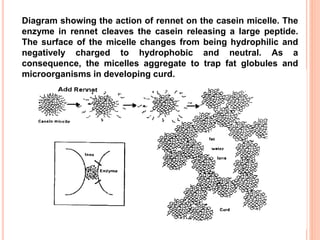
Diagram showing the action of rennet on the casein micelle. The
enzyme in rennet cleaves the casein releasing a large peptide.
The surface of the micelle changes from being hydrophilic and
negatively charged to hydrophobic and neutral. As a
consequence, the micelles aggregate to trap fat globules and
microorganisms in developing curd.
Substitutes for animal rennet
 Found substitutes for animal rennet about 50 years
ago, concerning the vegetarians in India, Israel and
the Middle East who refused to accept the cheese
with animal rennet.
 Use of porcine rennet is out of the question in Muslim
world, also was a reason to find substitute for animal
rennet.
 In recent years the quality of the animal rennet is a
concern which also is a reason.
 There are two main types of substitute coagulants
1. Coagulating enzymes from plants and,
2. Coagulating enzymes from microorganisms
 Coagulation ability is best shown by plant enzymes,
but the cheese will be having a bitter taste during
storage.
 Enzymes from thistle or cynara are used in some
traditional cheese production in the Mediterranean
 Phytic acid, derived from unfermented soybeans, or
Fermentation-Produced Chymosin (FPC) may also
be used
 Today, the most widely used Fermentation-Produced
Chymosin (FPC) is produced either by the
fungus Aspergillus niger or Kluyveromyces
lactis
Acid coagulation
 Any soft cheeses are produced without use of rennet, by
coagulating milk with acid, such as citric acid
or vinegar, or the lactic acid produced by soured milk.
 Cream cheese, paneer, and rubing are traditionally
made this way
 The acidification can also come from bacterial
fermentation such as in cultured milk
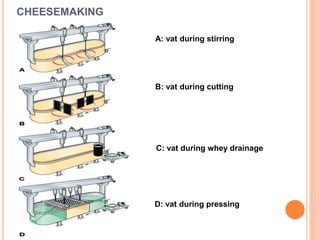
CHEESEMAKING
A: vat during stirring
B: vat during cutting
C: vat during whey drainage
D: vat during pressing
Disturbances in cultures
 Slow rate of production of lactic acid or failure to
produce lactic acid.
 Antibiotics used to cure udder diseases.
 Bacteriophages, thermo-tolerant viruses found in the air
and soil.
 Detergents and sterilising agents used in the dairy.
Acidification
Important for the proper release of curd from whey, and
to control the growth of undesirable bacteria
 Achieved by the addition of lactic acid bacteria that
convert lactose to lactic acid.
 Such, carefully selected culture of lactic acid producing
bacteria is called “starter”, without which cheese cannot
be made.
 New Zealand Diary Research Institute- an agency
which identifies and distributes special starter cultures in
deep frozen form to different cheese plants.
 The starter will be added to the homogenized milk for
culturing in large volumes and the temperature will be
set to 220C, ideal for the growth of starter.
 Fermentation continues for about 6 to 16 hours.
 Amount of starter varies with the variety of cheese to
produce.
 The amount of lactic acid produced and the moisture
in the finished cheese regulate and control the
biochemical activities that takes place during the
maturation/ripening of the cheese.
Coagulation of casein
 The pH is lowered and rennet is added
 Rennet- extracted from the stomach of calves;
chymosin and bovine pepsin are active components.
 Chymosin- responsible for the coagulation of casein
(curdling), gives the curd a smooth texture
 About 30 ml of rennet is enough for a 100 liters of milk, to
yield 10 kg of cheese and 90 L of whey.
 Most of the chymosin is removed with whey
 Chymosin can also be produced by genetically modified
yeasts and bacteria, but such chymosin is not preferred in
Sweden
 Some fungi produced proteases can also be used which
have similar function as that of chymosin.
 Since this enzyme has some other functional
characteristics compared to animal chymosin, used only in
certain circumstances (for “vegetarian” cheeses)
 The milk has to set for about 30 minutes after the
rennet has been added.
 The milk coagulum is cut into cubes with special tools.
 The size of the cubes differs depending on the kind of
cheese being made.
 Rennet- partial proteolysis of casein by cleavage at
the Phe105-Met106 .
 A rennet coagulum consists of a continuous matrix of
strands of casein micelles, which incorporate fat
globules, water, minerals and lactose and in which
microorganisms are entrapped
Syneresis
 Syneresis, or shrinking, of the coagulum is largely the
result of continuing rennet action.
 It causes loss of whey, and is accelerated by cutting,
stirring, cooking, salting or pressing the curd, as well as
the increasing amount of acid produced by the starter,
and gradually increases during cheese making.
 As a result, the cheese curd contracts and moisture is
continuously expelled during the cooking stages.
Salting
 Salt is added to cheese as a preservative and because it
affects the texture and flavour of the final cheese by
controlling microbial growth and enzyme activity.
 The salt can be added either directly to the curd after the
whey is run off and before moulding or pressing into
shape,
 Also can immerse the shaped cheese block in a salt
brine for several days following manufacture.
 Addition of salt to the cut curd draws more whey from the
cheese curd and some of the salt diffuses into the curd.
 The pH of the curd, the contact time and the salt particle
size and structure are all important in determining how
much salt is absorbed by the curd.
Curd Manipulation
Heat treatments
 The application of heat to cheese curd at any of
several different times during the manufacture of
particular cheese varieties, such as Cheddar,
Mozzarella or Emmentaler, is to selectively stop the
growth of certain types of bacteria and consequently
influence the maturation pathway of the cheeses
 It also alters the composition and texture of the cheese
by increasing the syneresis without increasing the
acidity.
Stretching the curd
 Stretching the curd is an important operation for several
kinds of cheese, in particular the pasta filata style,
Mozzarella being the best known.
 Traditionally the curd was immersed in hot (about 800C)
water, and the fluid mass of cheese was pulled into
strands to align the protein fibers and then poured into a
container to cool.
 It was then immersed in brine
 Large scale production means that special machines are
used for stretching.
Pasta filata style Mozarella
Cheddaring
 Cheddaring is a mild form of stretching in which the
cheese curd is piled up and held warm so that water
flows under the force of gravity.
 The pH of the curd falls during this process and whey
continues to exude.
 Again, in large scale manufacture, this is done in large
machines
Washing
 Washing the curd either in the cheese vat or after de-wheying
helps remove more lactose which changes the pH of the
cheese.
 It also reduces syneresis and is important in the manufacture
of cheeses such as Colby, Gouda and Egmont.
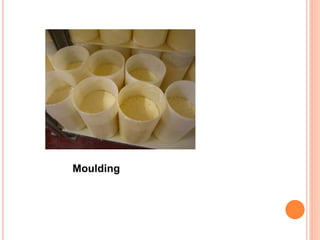
Moulding
 The formation of the final cheese shape into spheres, flattened
spheres, discs, cylinders or rectangular blocks is traditional but
for some varieties, e.g. Camembert, it affects the maturation
pathway.
 Some cheeses are pressed in moulds (nowadays made of
plastic or stainless steel) under the whey for a short time
whereas others are compressed at high pressures for several
hours.
Moulding
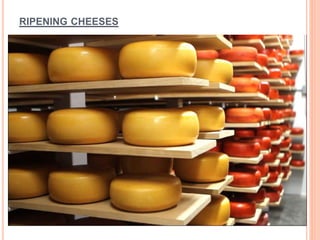
Maturation or ripening
 Cheese ripening is basically about the breakdown of
proteins, lipids and carbohydrates (acids and sugars)
which releases flavour compounds and modifies cheese
texture.
 Ripening varies from nil for fresh cheese to 5 years for
some hard ripened cheese.
 Like a good wine, a good aged cheese should get better
and better with age.
 Ripening processes are broadly classified as interior
and surface ripened.
 Cheese which depend mainly on interior ripening (most
hard ripened cheese such as Cheddar and Italian types)
may be ripened with rind formation or may be film
wrapped before curing.
In the broadest terms there are three sources of
cheese flavor:
 Flavors present in the original cheese milk, such as
natural butter fat flavor and feed flavor.
 Breakdown products of milk proteins, fats and sugars
which are released by microbial enzymes, enzymes
endogenous to milk, and enzyme additives.
 Metabolites of starter bacteria and other
microorganisms. These include products from
catabolism of proteins, fats and sugars.
Flavour and texture development are strongly
dependent on
 pH profile
 Composition
 Salting
 Temperature
 Humidity
 Experience
The ripening of cheese involves three major biochemical
events.
 Glycolysis: Lactose is metabolized to lactic acid, which
may then be catabolised (broken down into smaller
molecules) to form acetic and propionic acids, carbon
dioxide, esters and alcohol by the enzymes of the
microorganisms in the milk, including the added starter.
 Lipolysis: The lipids are broken down to form free fatty
acids, that may then be catabolised to form ketones,
lactones and esters by natural milk enzymes and those
that are added to create the flavour in particular cheese
varieties, e.g. Romano, Blue Vein and Feta cheese.
 Proteolysis: Proteins (caseins) are gradually broken
down to form peptides and amino acids by the
enzymes of the coagulant, the natural milk enzymes
and the enzymes of the starter bacteria and other
added microorganisms,
 e.g. moulds such as Penicillium camemberti used in
the manufacture of Camembert and Penicillium
roqueforti used in the manufacture of blue-veined
cheeses such as Roquefort, Camembert and Stilton.
 The enzymes of these mould species typically result in
a high level of proteolysis in these cheese types
 The rind formation on he cheese depends on the mold
being added during ripening
 The breakdown of the proteins to peptides
(proteolysis) transforms the rubbery and flavourless
cheese curd into a cheese that has a desirable
texture and flavour
 Further proteolysis produces amino acids and the
further biochemical glycolysis and hydrolysis result in
the formation of amines, aldehydes, alcohols and
sulphur compounds that add to the flavour of the
cheese.
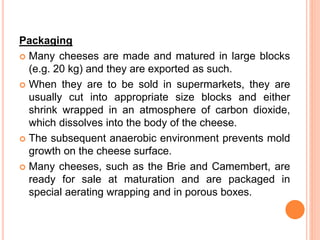
Packaging
 Many cheeses are made and matured in large blocks
(e.g. 20 kg) and they are exported as such.
 When they are to be sold in supermarkets, they are
usually cut into appropriate size blocks and either
shrink wrapped in an atmosphere of carbon dioxide,
which dissolves into the body of the cheese.
 The subsequent anaerobic environment prevents mold
growth on the cheese surface.
 Many cheeses, such as the Brie and Camembert, are
ready for sale at maturation and are packaged in
special aerating wrapping and in porous boxes.
RIPENING CHEESES
HEALTH ASPECTS OF CHEESE
Nutrition - There is a very high concentration of essential
nutrients in cheese including high quality proteins
and calcium .
There are also other elements in cheese such as
phosphorous, zinc, vitamin A, riboflavin, and vitamin
B12.
PREVENTS THE FOLLOWING HEALTH PROBLEMS
 Cavity Prevention
 Cancer Prevention
 Weight Gain
 Bone Strength
 Osteoporosis
REFERENCE
 http://www.cheesemaking.com/shared/pdf/amandatitus.
pdf
 http://nzic.org.nz/ChemProcesses/dairy/3D.pdf
 http://www.ales2.ualberta.ca/afns/courses/nufs403/PDF
s/chapter14.pdf
 https://www.uoguelph.ca/foodscience/cheese-making-
technology/section-e-manufacture-ripening-process-
control-and-yield-efficiency/ripen-0

Cheese production

  • 1.
  • 2.
    INTRODUCTION-ETYMOLOGY  Word ‘cheese’– Latin “casues”, meaning to ferment/become sour HOW OLD IS THE CHESE YOU ENJOY?  Gorgonzola 879 AD.  Roquefort 1070  Grana 1200  Cheddar 1500  Gouda 1697  Gloucester 1697  Stilton 1785  Camembert 1791
  • 3.
    INTRODUCTION  Ultimately amilk product  Widely used all over the world as food product  Purely a product of microbial fermentation  Flavor and aroma changes depending upon the microorganism being used.  Before long, people learned that curds can be aged for over weeks and months and then pressed together to form large cakes of cheese.  The art of cheese making have traveled from Asia to the Europe and then spread all over the world CHEDDAR CHEESE
  • 4.
    DISCOVERY  Though itis not certain that who made the first cheese but it is certain that it was accidental.  Nomadic tribes of Central Asia are considered to be the legends who “discovered” cheese.  Carried milk in saddlebags that made from animal skin probably from the stomach, which contains the coagulating enzyme known as rennin  Fermentation and curdling would have happened due to the galloping motion of the horse  Effective separation of milk into curds and whey.  Whey had been used as an energy drink and curd was drained in perforated earthenware bowls and slightly salted to have a highly proteinaceous food.
  • 5.
  • 6.
     Valued forportability, long life, and high content of fat, protein, calcium, and phosphorus.  More compact than milk- longer the shelf life.  Hard cheeses last more than soft cheeses Eg: Cheddar cheese  Made from raw milk. Since it is not pasteurized, higher vitamin contents.  Salmonella, Mycobacterium and Brucella are the pathogens that might have seen in raw milk.  U.S Federal Law- the cheese made from raw milk should be aged for over 60 days to prevent the development of pathogens.
  • 7.
  • 8.
  • 9.
     Cheese iscompletely a milk product.  Whole milk- compressed, processed and stored to produce cheese.  Wide range of cheese can be produced in countries where milk is legally allowed to process without pasteurization.  In most of the countries the range of cheeses is smaller because of this reason  Whey is a byproduct of cheese production  Like most of other fermented food products such as beer, wine, etc. cheese also can be stored for longer periods, say years.
  • 10.
    PRINCIPLES OF CHEESEPRODUCTION  Cheese – a way of storing milk over years  Nowhere near as big as the market for cow’s milk cheese, considerable amount of cheese is made from other milk such as goat and sheep.  Cheese – by coagulating milk (separating curd and whey)  Both raw milk and pasteurized milk can be used for cheese making.  Needs more rennet (up to twice) for homogenized milk than the raw milk.  This milk produces a curd that is smoother and less firm than that of raw milk, so most people add calcium chloride to the cheese
  • 11.
    CHEESE MANUFACTURE The manufactureof most cheeses involves the following Pasteurization Kills nearly all microorganisms including pathogens that cause diseases and other undesirable organisms such as yeasts and coliforms (may alter the characteristics by producing CO2z and undesirable proteolysis) Regular HTST pasteurization at 72-730C for 15-20 seconds is commonly applied. Spore forming bacteria Clostridium tyrobutyricum can survive pasteurization and produces butyric acid and large volumes of hydrogen gas by fermenting lactic acid, which will destroy the structure of cheese. Chemical inhibitors such as NaNO3 or H2O2 can be used but in several countries, it has been banned and mechanical modes have been preferred.
  • 12.
    Bactofugation  Process inwhich a specially designed centrifuge- bactofuge is been used to separate the bacteria and spores that present in milk.  Efficient way of reducing the number of spores in milk since their specific gravity is lesser than that of milk.  Normally separate milk into a fraction which is more or less free from bacteria and a concentrate which contains both spores and bacteria.  Example- spore load in cream by Bacillus cereus is reduced.  Typically 60-630C is the temperature applied in Bactofugation
  • 13.
  • 14.
    Microfiltration  A membranefilter with a pore size of approximately 0.2 micron can filter bacteria from a water solution  Most of the fat globules and some of the proteins are as large as, or larger than, the bacteria.  This results in the filter fouling very quickly when membranes of such a small pore size are chosen.  In practice, membranes of a pore size of 0.8 to 1.4 micron are chosen to lower the concentration of protein.
  • 15.
     In addition,the protein forms a dynamic membrane that contributes to the retention of micro-organisms.  Provides an indirect sterilization  Due to the high bacteria-reducing efficiency, microfiltration allows production of hard and semi-hard cheese without any need for chemicals to inhibit growth of Clostridia spores.
  • 16.
    Additives in cheesemilk  The essential additives in the cheese making process are the starter culture and the rennet  Under certain conditions it may also be necessary to supply other components such as calcium chloride (CaCl2) and saltpetre (KNO3 or NaNO3)  An enzyme, lysozyme, has also been introduced as a substitute for saltpetre as an inhibitor of Clostridia organisms
  • 17.
    Starter Two principal typesof culture are used in cheese making:  Mesophilic cultures with a temperature optimum between 20 and 40°C  Thermophilic cultures which develop at up to 45°C.  The most frequently used cultures are mixed strain cultures, in which two or more strains of both mesophilic and thermophilic bacteria exist in symbiosis  These cultures not only produce lactic acid but also aroma components and CO2.  Carbon dioxide is essential for creating the eyes in round- eyed and granular types of cheese
  • 18.
     Three characteristicsof starter cultures are of primary importance in cheese making 1. ability to produce lactic acid 2. ability to break down the protein 3. ability to produce carbon dioxide (CO2). Calcium chloride (CaCl2 )  If the milk is of poor quality for cheese making, the coagulum will be soft.  This results in heavy losses of fines (casein) and fat as well as poor syneresis during cheese making.  5 – 20 grams of calcium chloride per 100 kg of milk is normally enough to achieve a constant coagulation time and result in sufficient firmness of the coagulum.
  • 19.
     For productionof low-fat cheese, and if legally permitted, disodium phosphate (Na2PO4), usually 10 – 20 g/kg, can sometimes be added to the milk before the calcium chloride is added.  This increases the elasticity of the coagulum due to formation of colloidal calcium phosphate, which will have almost the same effect as the milk fat globules entrapped in the curd.
  • 20.
    Carbon dioxide (CO2)  Addition of CO2 is one method of improving the quality of cheese milk.  Carbon dioxide occurs naturally in milk, but most of it is lost in the course of processing  Adding carbon dioxide by artificial means lowers the pH of the milk: the original pH is normally reduced by 0.1 to 0.3 units.  This will then result in shorter coagulation time.  The effect can be utilized to obtain the same coagulation time with a smaller amount of rennet
  • 21.
    Rennet  All cheesemanufacture depends upon formation of curd by the action of rennet or similar enzymes except in cottage cheeses.  Coagulation of casein is the fundamental process in cheese making.  It is generally done with rennet, but other proteolytic enzymes can also be used.  The active principle in rennet is an enzyme called chymosin, and coagulation takes place shortly after the rennet is added to the milk.
  • 22.
    The two majorprocesses occurs after the addition of rennet are 1. Transformation of casein to paracasein under the influence of rennet 2. Precipitation of paracasein in the presence of calcium ions  The whole process is governed by the temperature, acidity, and calcium content of the milk as well as other factors  The optimum temperature for rennet is in the region of 40°C, but lower temperatures are normally used in the practice, basically to avoid excessive hardness of the coagulum
  • 23.
     Rennet isextracted from the stomachs of young calves and marketed in form of a solution with a strength of 1:10000 to 1:15 000, which means that one part of rennet can coagulate 10000 – 15000 parts of milk in 40 minutes at 35°C.  Bovine and porcine rennet are also used, often in combination with calf rennet (50:50, 30:70, etc.).  Rennet in powder form is normally 10 times as strong as liquid rennet.
  • 24.
    Diagram showing theaction of rennet on the casein micelle. The enzyme in rennet cleaves the casein releasing a large peptide. The surface of the micelle changes from being hydrophilic and negatively charged to hydrophobic and neutral. As a consequence, the micelles aggregate to trap fat globules and microorganisms in developing curd.
  • 25.
    Substitutes for animalrennet  Found substitutes for animal rennet about 50 years ago, concerning the vegetarians in India, Israel and the Middle East who refused to accept the cheese with animal rennet.  Use of porcine rennet is out of the question in Muslim world, also was a reason to find substitute for animal rennet.  In recent years the quality of the animal rennet is a concern which also is a reason.  There are two main types of substitute coagulants
  • 26.
    1. Coagulating enzymesfrom plants and, 2. Coagulating enzymes from microorganisms  Coagulation ability is best shown by plant enzymes, but the cheese will be having a bitter taste during storage.  Enzymes from thistle or cynara are used in some traditional cheese production in the Mediterranean  Phytic acid, derived from unfermented soybeans, or Fermentation-Produced Chymosin (FPC) may also be used  Today, the most widely used Fermentation-Produced Chymosin (FPC) is produced either by the fungus Aspergillus niger or Kluyveromyces lactis
  • 27.
    Acid coagulation  Anysoft cheeses are produced without use of rennet, by coagulating milk with acid, such as citric acid or vinegar, or the lactic acid produced by soured milk.  Cream cheese, paneer, and rubing are traditionally made this way  The acidification can also come from bacterial fermentation such as in cultured milk
  • 28.
    CHEESEMAKING A: vat duringstirring B: vat during cutting C: vat during whey drainage D: vat during pressing
  • 29.
    Disturbances in cultures Slow rate of production of lactic acid or failure to produce lactic acid.  Antibiotics used to cure udder diseases.  Bacteriophages, thermo-tolerant viruses found in the air and soil.  Detergents and sterilising agents used in the dairy.
  • 30.
    Acidification Important for theproper release of curd from whey, and to control the growth of undesirable bacteria  Achieved by the addition of lactic acid bacteria that convert lactose to lactic acid.  Such, carefully selected culture of lactic acid producing bacteria is called “starter”, without which cheese cannot be made.  New Zealand Diary Research Institute- an agency which identifies and distributes special starter cultures in deep frozen form to different cheese plants.  The starter will be added to the homogenized milk for culturing in large volumes and the temperature will be set to 220C, ideal for the growth of starter.
  • 31.
     Fermentation continuesfor about 6 to 16 hours.  Amount of starter varies with the variety of cheese to produce.  The amount of lactic acid produced and the moisture in the finished cheese regulate and control the biochemical activities that takes place during the maturation/ripening of the cheese. Coagulation of casein  The pH is lowered and rennet is added  Rennet- extracted from the stomach of calves; chymosin and bovine pepsin are active components.  Chymosin- responsible for the coagulation of casein (curdling), gives the curd a smooth texture
  • 32.
     About 30ml of rennet is enough for a 100 liters of milk, to yield 10 kg of cheese and 90 L of whey.  Most of the chymosin is removed with whey  Chymosin can also be produced by genetically modified yeasts and bacteria, but such chymosin is not preferred in Sweden  Some fungi produced proteases can also be used which have similar function as that of chymosin.  Since this enzyme has some other functional characteristics compared to animal chymosin, used only in certain circumstances (for “vegetarian” cheeses)
  • 33.
     The milkhas to set for about 30 minutes after the rennet has been added.  The milk coagulum is cut into cubes with special tools.  The size of the cubes differs depending on the kind of cheese being made.  Rennet- partial proteolysis of casein by cleavage at the Phe105-Met106 .  A rennet coagulum consists of a continuous matrix of strands of casein micelles, which incorporate fat globules, water, minerals and lactose and in which microorganisms are entrapped
  • 34.
    Syneresis  Syneresis, orshrinking, of the coagulum is largely the result of continuing rennet action.  It causes loss of whey, and is accelerated by cutting, stirring, cooking, salting or pressing the curd, as well as the increasing amount of acid produced by the starter, and gradually increases during cheese making.  As a result, the cheese curd contracts and moisture is continuously expelled during the cooking stages.
  • 35.
    Salting  Salt isadded to cheese as a preservative and because it affects the texture and flavour of the final cheese by controlling microbial growth and enzyme activity.  The salt can be added either directly to the curd after the whey is run off and before moulding or pressing into shape,  Also can immerse the shaped cheese block in a salt brine for several days following manufacture.  Addition of salt to the cut curd draws more whey from the cheese curd and some of the salt diffuses into the curd.  The pH of the curd, the contact time and the salt particle size and structure are all important in determining how much salt is absorbed by the curd.
  • 36.
    Curd Manipulation Heat treatments The application of heat to cheese curd at any of several different times during the manufacture of particular cheese varieties, such as Cheddar, Mozzarella or Emmentaler, is to selectively stop the growth of certain types of bacteria and consequently influence the maturation pathway of the cheeses  It also alters the composition and texture of the cheese by increasing the syneresis without increasing the acidity.
  • 37.
    Stretching the curd Stretching the curd is an important operation for several kinds of cheese, in particular the pasta filata style, Mozzarella being the best known.  Traditionally the curd was immersed in hot (about 800C) water, and the fluid mass of cheese was pulled into strands to align the protein fibers and then poured into a container to cool.  It was then immersed in brine  Large scale production means that special machines are used for stretching.
  • 38.
  • 39.
    Cheddaring  Cheddaring isa mild form of stretching in which the cheese curd is piled up and held warm so that water flows under the force of gravity.  The pH of the curd falls during this process and whey continues to exude.  Again, in large scale manufacture, this is done in large machines
  • 40.
    Washing  Washing thecurd either in the cheese vat or after de-wheying helps remove more lactose which changes the pH of the cheese.  It also reduces syneresis and is important in the manufacture of cheeses such as Colby, Gouda and Egmont. Moulding  The formation of the final cheese shape into spheres, flattened spheres, discs, cylinders or rectangular blocks is traditional but for some varieties, e.g. Camembert, it affects the maturation pathway.  Some cheeses are pressed in moulds (nowadays made of plastic or stainless steel) under the whey for a short time whereas others are compressed at high pressures for several hours.
  • 41.
  • 42.
    Maturation or ripening Cheese ripening is basically about the breakdown of proteins, lipids and carbohydrates (acids and sugars) which releases flavour compounds and modifies cheese texture.  Ripening varies from nil for fresh cheese to 5 years for some hard ripened cheese.  Like a good wine, a good aged cheese should get better and better with age.  Ripening processes are broadly classified as interior and surface ripened.
  • 43.
     Cheese whichdepend mainly on interior ripening (most hard ripened cheese such as Cheddar and Italian types) may be ripened with rind formation or may be film wrapped before curing. In the broadest terms there are three sources of cheese flavor:  Flavors present in the original cheese milk, such as natural butter fat flavor and feed flavor.  Breakdown products of milk proteins, fats and sugars which are released by microbial enzymes, enzymes endogenous to milk, and enzyme additives.  Metabolites of starter bacteria and other microorganisms. These include products from catabolism of proteins, fats and sugars.
  • 44.
    Flavour and texturedevelopment are strongly dependent on  pH profile  Composition  Salting  Temperature  Humidity  Experience
  • 45.
    The ripening ofcheese involves three major biochemical events.  Glycolysis: Lactose is metabolized to lactic acid, which may then be catabolised (broken down into smaller molecules) to form acetic and propionic acids, carbon dioxide, esters and alcohol by the enzymes of the microorganisms in the milk, including the added starter.  Lipolysis: The lipids are broken down to form free fatty acids, that may then be catabolised to form ketones, lactones and esters by natural milk enzymes and those that are added to create the flavour in particular cheese varieties, e.g. Romano, Blue Vein and Feta cheese.
  • 46.
     Proteolysis: Proteins(caseins) are gradually broken down to form peptides and amino acids by the enzymes of the coagulant, the natural milk enzymes and the enzymes of the starter bacteria and other added microorganisms,  e.g. moulds such as Penicillium camemberti used in the manufacture of Camembert and Penicillium roqueforti used in the manufacture of blue-veined cheeses such as Roquefort, Camembert and Stilton.  The enzymes of these mould species typically result in a high level of proteolysis in these cheese types  The rind formation on he cheese depends on the mold being added during ripening
  • 47.
     The breakdownof the proteins to peptides (proteolysis) transforms the rubbery and flavourless cheese curd into a cheese that has a desirable texture and flavour  Further proteolysis produces amino acids and the further biochemical glycolysis and hydrolysis result in the formation of amines, aldehydes, alcohols and sulphur compounds that add to the flavour of the cheese.
  • 48.
    Packaging  Many cheesesare made and matured in large blocks (e.g. 20 kg) and they are exported as such.  When they are to be sold in supermarkets, they are usually cut into appropriate size blocks and either shrink wrapped in an atmosphere of carbon dioxide, which dissolves into the body of the cheese.  The subsequent anaerobic environment prevents mold growth on the cheese surface.  Many cheeses, such as the Brie and Camembert, are ready for sale at maturation and are packaged in special aerating wrapping and in porous boxes.
  • 49.
  • 50.
    HEALTH ASPECTS OFCHEESE Nutrition - There is a very high concentration of essential nutrients in cheese including high quality proteins and calcium . There are also other elements in cheese such as phosphorous, zinc, vitamin A, riboflavin, and vitamin B12. PREVENTS THE FOLLOWING HEALTH PROBLEMS  Cavity Prevention  Cancer Prevention  Weight Gain  Bone Strength  Osteoporosis
  • 51.
    REFERENCE  http://www.cheesemaking.com/shared/pdf/amandatitus. pdf  http://nzic.org.nz/ChemProcesses/dairy/3D.pdf http://www.ales2.ualberta.ca/afns/courses/nufs403/PDF s/chapter14.pdf  https://www.uoguelph.ca/foodscience/cheese-making- technology/section-e-manufacture-ripening-process- control-and-yield-efficiency/ripen-0