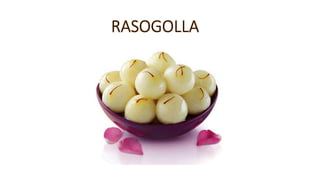
RASOGOLLA
Introduction to Rasogolla
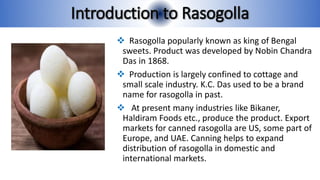
 Rasogolla popularly known as king of Bengal
sweets. Product was developed by Nobin Chandra
Das in 1868.
 Production is largely confined to cottage and
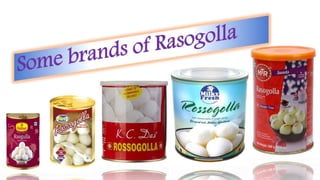
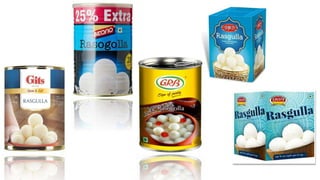
small scale industry. K.C. Das used to be a brand
name for rasogolla in past.
 At present many industries like Bikaner,
Haldiram Foods etc., produce the product. Export
markets for canned rasogolla are US, some part of
Europe, and UAE. Canning helps to expand
distribution of rasogolla in domestic and
international markets.
The latest from the house of K.C Das is the nolen
gur- flovoured Rasogolla, with a faint tint of pink,
popular during winter months when Khajur gur is
available.
Innovations and experimentations have led to the
evolution of forms and flavours-flattened into
patties and blended with rabri floating in a
fragment milk bulk created rasomalai.
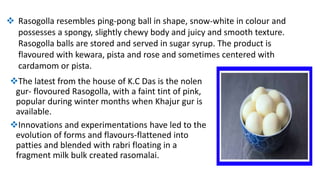
 Rasogolla resembles ping-pong ball in shape, snow-white in colour and
possesses a spongy, slightly chewy body and juicy and smooth texture.
Rasogolla balls are stored and served in sugar syrup. The product is
flavoured with kewara, pista and rose and sometimes centered with
cardamom or pista.
When it comes to Rasgulla, West Bengal and Odisha have fought bitter battles.
Odisha says that Rasagolla was served in Jagannath Temple, which is a 12th
century shrine in Puri. The word Rasgulla also finds mention in works of Balaram
Das, a 15th century poet.
 But West Bengal mentioned that Rasgulla was invented by Nobin Chandra Das
father of K.C.Das, a Bengali confectioner in 1960.
To end this dispute both states started demanding Geographical indication(GI)
tag for Rasgulla which both said originated in their state.
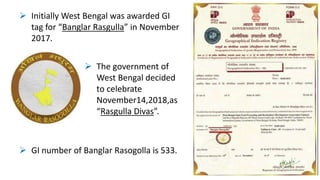
 Initially West Bengal was awarded GI
tag for “Banglar Rasgulla” in November
2017.
 The government of
West Bengal decided
to celebrate
November14,2018,as
“Rasgulla Divas”.
 GI number of Banglar Rasogolla is 533.
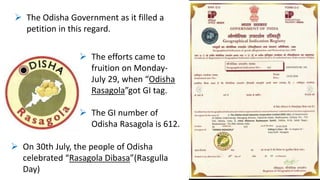
 The Odisha Government as it filled a
petition in this regard.
 The efforts came to
fruition on Monday-
July 29, when “Odisha
Rasagola”got GI tag.
 The GI number of
Odisha Rasagola is 612.
 On 30th July, the people of Odisha
celebrated “Rasagola Dibasa”(Rasgulla
Day)
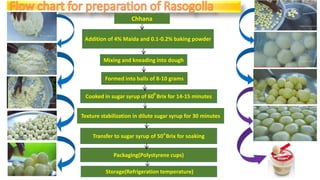
Chhana
Addition of 4% Maida and 0.1-0.2% baking powder
Mixing and kneading into dough
Formed into balls of 8-10 grams
Cooked in sugar syrup of 60 Brix for 14-15 minutes
Texture stabilization in dilute sugar syrup for 30 minutes
Transfer to sugar syrup of 50 Brix for soaking
Packaging(Polystyrene cups)
Storage(Refrigeration temperature)
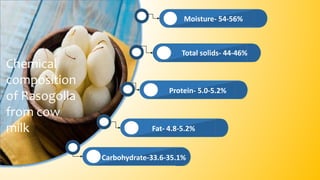
Moisture- 54-56%
Total solids- 44-46%
Protein- 5.0-5.2%
Carbohydrate-33.6-35.1%
Chemical
composition
of Rasogolla
from cow
milk Fat- 4.8-5.2%
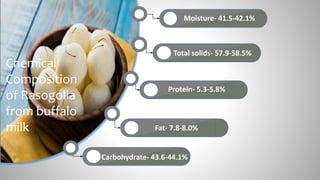
Moisture- 41.5-42.1%
Protein- 5.3-5.8%
Carbohydrate- 43.6-44.1%
Total solids- 57.9-58.5%
Chemical
Composition
of Rasogolla
from buffalo
milk Fat- 7.8-8.0%
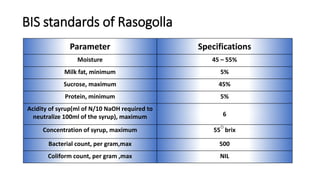
BIS standards of Rasogolla
Parameter Specifications
Moisture 45 – 55%
Milk fat, minimum 5%
Sucrose, maximum 45%
Protein, minimum 5%
Acidity of syrup(ml of N/10 NaOH required to
neutralize 100ml of the syrup), maximum 6
Concentration of syrup, maximum 55 brix
Bacterial count, per gram,max 500
Coliform count, per gram ,max NIL
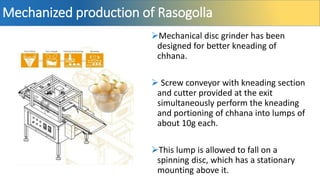
Mechanized production of Rasogolla
Mechanical disc grinder has been
designed for better kneading of
chhana.
 Screw conveyor with kneading section
and cutter provided at the exit
simultaneously perform the kneading
and portioning of chhana into lumps of
about 10g each.
This lump is allowed to fall on a
spinning disc, which has a stationary
mounting above it.
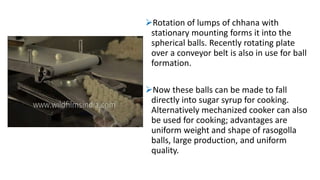
Rotation of lumps of chhana with
stationary mounting forms it into the
spherical balls. Recently rotating plate
over a conveyor belt is also in use for ball
formation.
Now these balls can be made to fall
directly into sugar syrup for cooking.
Alternatively mechanized cooker can also
be used for cooking; advantages are
uniform weight and shape of rasogolla
balls, large production, and uniform
quality.
Yield of Rasogolla
90-100 rasogolla balls of diameter 30mm can be made from one kg of chhana.
The yield is 254g(drained weight) of rasogolla per 100g of cow milk chhana
and 342g of rasogolla per 100g of buffalo milk chhana.
Shelf life of Rasogolla
Rasogolla can be store for 2 – 3days at room temperature without any
packaging and added preservatives.
 Shelf life of rasogolla in tin cans is reported to be 6 months.
Packaging of Rasogolla
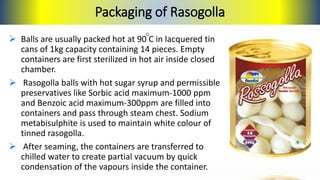
 Balls are usually packed hot at 90 C in lacquered tin
cans of 1kg capacity containing 14 pieces. Empty
containers are first sterilized in hot air inside closed
chamber.
 Rasogolla balls with hot sugar syrup and permissible
preservatives like Sorbic acid maximum-1000 ppm
and Benzoic acid maximum-300ppm are filled into
containers and pass through steam chest. Sodium
metabisulphite is used to maintain white colour of
tinned rasogolla.
 After seaming, the containers are transferred to
chilled water to create partial vacuum by quick
condensation of the vapours inside the container.
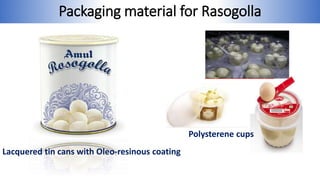
Packaging material for Rasogolla
Lacquered tin cans with Oleo-resinous coating
Polysterene cups
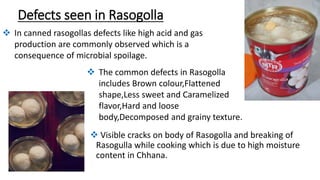
Defects seen in Rasogolla
 Visible cracks on body of Rasogolla and breaking of
Rasogulla while cooking which is due to high moisture
content in Chhana.
 In canned rasogollas defects like high acid and gas
production are commonly observed which is a
consequence of microbial spoilage.
 The common defects in Rasogolla
includes Brown colour,Flattened
shape,Less sweet and Caramelized
flavor,Hard and loose
body,Decomposed and grainy texture.
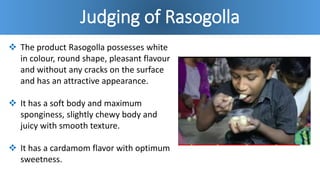
Judging of Rasogolla
 The product Rasogolla possesses white
in colour, round shape, pleasant flavour
and without any cracks on the surface
and has an attractive appearance.
 It has a soft body and maximum
sponginess, slightly chewy body and
juicy with smooth texture.
 It has a cardamom flavor with optimum
sweetness.
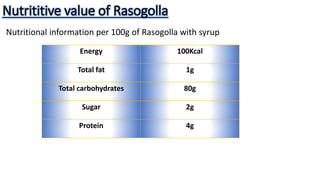
Nutrititive value of Rasogolla
Nutritional information per 100g of Rasogolla with syrup
Energy 100Kcal
Total fat 1g
Total carbohydrates 80g
Sugar 2g
Protein 4g
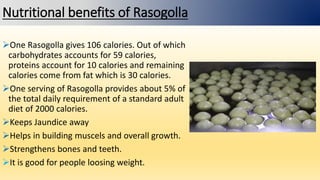
Nutritional benefits of Rasogolla
One Rasogolla gives 106 calories. Out of which
carbohydrates accounts for 59 calories,
proteins account for 10 calories and remaining
calories come from fat which is 30 calories.
One serving of Rasogolla provides about 5% of
the total daily requirement of a standard adult
diet of 2000 calories.
Keeps Jaundice away
Helps in building muscels and overall growth.
Strengthens bones and teeth.
It is good for people loosing weight.
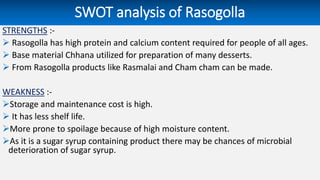
SWOT analysis of Rasogolla
STRENGTHS :-
 Rasogolla has high protein and calcium content required for people of all ages.
 Base material Chhana utilized for preparation of many desserts.
 From Rasogolla products like Rasmalai and Cham cham can be made.
WEAKNESS :-
Storage and maintenance cost is high.
 It has less shelf life.
More prone to spoilage because of high moisture content.
As it is a sugar syrup containing product there may be chances of microbial
deterioration of sugar syrup.
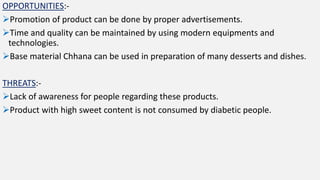
OPPORTUNITIES:-
Promotion of product can be done by proper advertisements.
Time and quality can be maintained by using modern equipments and
technologies.
Base material Chhana can be used in preparation of many desserts and dishes.
THREATS:-
Lack of awareness for people regarding these products.
Product with high sweet content is not consumed by diabetic people.
Rasogolla (milk based sweet product )

Rasogolla (milk based sweet product )

  • 2.
  • 3.
    Introduction to Rasogolla Rasogolla popularly known as king of Bengal sweets. Product was developed by Nobin Chandra Das in 1868.  Production is largely confined to cottage and small scale industry. K.C. Das used to be a brand name for rasogolla in past.  At present many industries like Bikaner, Haldiram Foods etc., produce the product. Export markets for canned rasogolla are US, some part of Europe, and UAE. Canning helps to expand distribution of rasogolla in domestic and international markets.
  • 4.
    The latest fromthe house of K.C Das is the nolen gur- flovoured Rasogolla, with a faint tint of pink, popular during winter months when Khajur gur is available. Innovations and experimentations have led to the evolution of forms and flavours-flattened into patties and blended with rabri floating in a fragment milk bulk created rasomalai.  Rasogolla resembles ping-pong ball in shape, snow-white in colour and possesses a spongy, slightly chewy body and juicy and smooth texture. Rasogolla balls are stored and served in sugar syrup. The product is flavoured with kewara, pista and rose and sometimes centered with cardamom or pista.
  • 5.
    When it comesto Rasgulla, West Bengal and Odisha have fought bitter battles. Odisha says that Rasagolla was served in Jagannath Temple, which is a 12th century shrine in Puri. The word Rasgulla also finds mention in works of Balaram Das, a 15th century poet.  But West Bengal mentioned that Rasgulla was invented by Nobin Chandra Das father of K.C.Das, a Bengali confectioner in 1960. To end this dispute both states started demanding Geographical indication(GI) tag for Rasgulla which both said originated in their state.
  • 6.
     Initially WestBengal was awarded GI tag for “Banglar Rasgulla” in November 2017.  The government of West Bengal decided to celebrate November14,2018,as “Rasgulla Divas”.  GI number of Banglar Rasogolla is 533.
  • 7.
     The OdishaGovernment as it filled a petition in this regard.  The efforts came to fruition on Monday- July 29, when “Odisha Rasagola”got GI tag.  The GI number of Odisha Rasagola is 612.  On 30th July, the people of Odisha celebrated “Rasagola Dibasa”(Rasgulla Day)
  • 8.
    Chhana Addition of 4%Maida and 0.1-0.2% baking powder Mixing and kneading into dough Formed into balls of 8-10 grams Cooked in sugar syrup of 60 Brix for 14-15 minutes Texture stabilization in dilute sugar syrup for 30 minutes Transfer to sugar syrup of 50 Brix for soaking Packaging(Polystyrene cups) Storage(Refrigeration temperature)
  • 9.
    Moisture- 54-56% Total solids-44-46% Protein- 5.0-5.2% Carbohydrate-33.6-35.1% Chemical composition of Rasogolla from cow milk Fat- 4.8-5.2%
  • 10.
    Moisture- 41.5-42.1% Protein- 5.3-5.8% Carbohydrate-43.6-44.1% Total solids- 57.9-58.5% Chemical Composition of Rasogolla from buffalo milk Fat- 7.8-8.0%
  • 11.
    BIS standards ofRasogolla Parameter Specifications Moisture 45 – 55% Milk fat, minimum 5% Sucrose, maximum 45% Protein, minimum 5% Acidity of syrup(ml of N/10 NaOH required to neutralize 100ml of the syrup), maximum 6 Concentration of syrup, maximum 55 brix Bacterial count, per gram,max 500 Coliform count, per gram ,max NIL
  • 12.
    Mechanized production ofRasogolla Mechanical disc grinder has been designed for better kneading of chhana.  Screw conveyor with kneading section and cutter provided at the exit simultaneously perform the kneading and portioning of chhana into lumps of about 10g each. This lump is allowed to fall on a spinning disc, which has a stationary mounting above it.
  • 13.
    Rotation of lumpsof chhana with stationary mounting forms it into the spherical balls. Recently rotating plate over a conveyor belt is also in use for ball formation. Now these balls can be made to fall directly into sugar syrup for cooking. Alternatively mechanized cooker can also be used for cooking; advantages are uniform weight and shape of rasogolla balls, large production, and uniform quality.
  • 14.
    Yield of Rasogolla 90-100rasogolla balls of diameter 30mm can be made from one kg of chhana. The yield is 254g(drained weight) of rasogolla per 100g of cow milk chhana and 342g of rasogolla per 100g of buffalo milk chhana. Shelf life of Rasogolla Rasogolla can be store for 2 – 3days at room temperature without any packaging and added preservatives.  Shelf life of rasogolla in tin cans is reported to be 6 months.
  • 15.
    Packaging of Rasogolla Balls are usually packed hot at 90 C in lacquered tin cans of 1kg capacity containing 14 pieces. Empty containers are first sterilized in hot air inside closed chamber.  Rasogolla balls with hot sugar syrup and permissible preservatives like Sorbic acid maximum-1000 ppm and Benzoic acid maximum-300ppm are filled into containers and pass through steam chest. Sodium metabisulphite is used to maintain white colour of tinned rasogolla.  After seaming, the containers are transferred to chilled water to create partial vacuum by quick condensation of the vapours inside the container.
  • 16.
    Packaging material forRasogolla Lacquered tin cans with Oleo-resinous coating Polysterene cups
  • 19.
    Defects seen inRasogolla  Visible cracks on body of Rasogolla and breaking of Rasogulla while cooking which is due to high moisture content in Chhana.  In canned rasogollas defects like high acid and gas production are commonly observed which is a consequence of microbial spoilage.  The common defects in Rasogolla includes Brown colour,Flattened shape,Less sweet and Caramelized flavor,Hard and loose body,Decomposed and grainy texture.
  • 20.
    Judging of Rasogolla The product Rasogolla possesses white in colour, round shape, pleasant flavour and without any cracks on the surface and has an attractive appearance.  It has a soft body and maximum sponginess, slightly chewy body and juicy with smooth texture.  It has a cardamom flavor with optimum sweetness.
  • 21.
    Nutrititive value ofRasogolla Nutritional information per 100g of Rasogolla with syrup Energy 100Kcal Total fat 1g Total carbohydrates 80g Sugar 2g Protein 4g
  • 22.
    Nutritional benefits ofRasogolla One Rasogolla gives 106 calories. Out of which carbohydrates accounts for 59 calories, proteins account for 10 calories and remaining calories come from fat which is 30 calories. One serving of Rasogolla provides about 5% of the total daily requirement of a standard adult diet of 2000 calories. Keeps Jaundice away Helps in building muscels and overall growth. Strengthens bones and teeth. It is good for people loosing weight.
  • 23.
    SWOT analysis ofRasogolla STRENGTHS :-  Rasogolla has high protein and calcium content required for people of all ages.  Base material Chhana utilized for preparation of many desserts.  From Rasogolla products like Rasmalai and Cham cham can be made. WEAKNESS :- Storage and maintenance cost is high.  It has less shelf life. More prone to spoilage because of high moisture content. As it is a sugar syrup containing product there may be chances of microbial deterioration of sugar syrup.
  • 24.
    OPPORTUNITIES:- Promotion of productcan be done by proper advertisements. Time and quality can be maintained by using modern equipments and technologies. Base material Chhana can be used in preparation of many desserts and dishes. THREATS:- Lack of awareness for people regarding these products. Product with high sweet content is not consumed by diabetic people.