1
Karnataka Veterinary, Animal and Fisheries Sciences
University, Bidar
Dairy Science College, Bengaluru-24
Report on : Membrane technologies used in Waste water treatment
Course Number: DT 422
Course Title: Waste disposal and Pollution abatement
Credit Hours:2(1+1)
Submitted to:
Dr.Thejaswini M L
Assistant professor
Dept. of Dairy Technology
2
Submitted By:
Sl .no. NAME ID NO
1. KRITI B DHK 1914
2. LAYASHREE S DHK 1915
3. PUNEETH M DHK 1916
3
Contents
Sl
no
Particulars Page number
1. Introduction to membranes 4
2. Membrane technologies in waste water
treatment
5-7
3. Membrane Modules 8-11
4. Conclusion 12
4
Introduction to membranes
Membranes are barriers in water treatment that allow water to pass through while
preventing unwanted substances from passing through as well. Technical membranes filter salts,
impurities, viruses, and other particles from water in the same way that cell walls do in our bodies.
A membrane process is any method that filters or removes particles from water by using a
membrane barrier. The pressure difference between one side of the membrane and other causes
fluids to pass through the membrane. Contaminants cling to one side. Although many different
types of filtering media are used for water treatment, such as clay, slit and sand one property that
distinguishes membranes is their ability to separate smaller substances from a liquid, such as
liquid, such as salts and ions.
Membrane processes are physical particle diffusion process in water. They work because
certain types of membranes allow particles with specific characteristics to pass through while
blocking particles with different characteristics to pass through while different characteristics from
passing through.
With the development of High performance synthetic membranes in 1960’s membranes
emerged as a viable method of water purification. Membranes for water treatment have advanced
membranes made from new materials and used in a variety of configurations. The scarcity of
fresh water sources has fueled a push for alternative resources
5
Membrane Technologies used in Waste water treatment
RO has been at the fore front of water reclamation through wastewater treatment and
desalination of seawater for a long time. During reverse osmosis, a hydrostatic pressure is
generated that is strong enough to overcome the intrinsic osmotic pressure of the feed. This is
against the natural osmosis
Forward Osmosis (FO)
FO follows the natural osmosis process where water molecules are drawn from one
solution to the other, through a semipermeable membrane. In this case a draw solution (DS),
which is highly concentrated, is used to provide a concentration gradient to draw water
molecules from the feed solution (FS). This gradient provides the needed osmotic pressure
difference to drive water molecules from the FS to the DS. This movement continues till an
equilibrium of chemical potential is reached
Electro dialysis
Electro-dialysis and electro-dialysis reversal are processes that combine electricity and
ion-permeable membranes to separate dissolved ions from water. These processes make use of
an electric potential to transfer the ions from a dilute solution through an ion permeable
membrane. Two types of ion exchange membranes are used. One is permeable to anions and
rejects cations and the other is permeable to cations and rejects anions. When electric current is
passed through the system, ions from diluate migrate into concentrate through oppositely
charged membranes.
6
Membrane Bioreactors
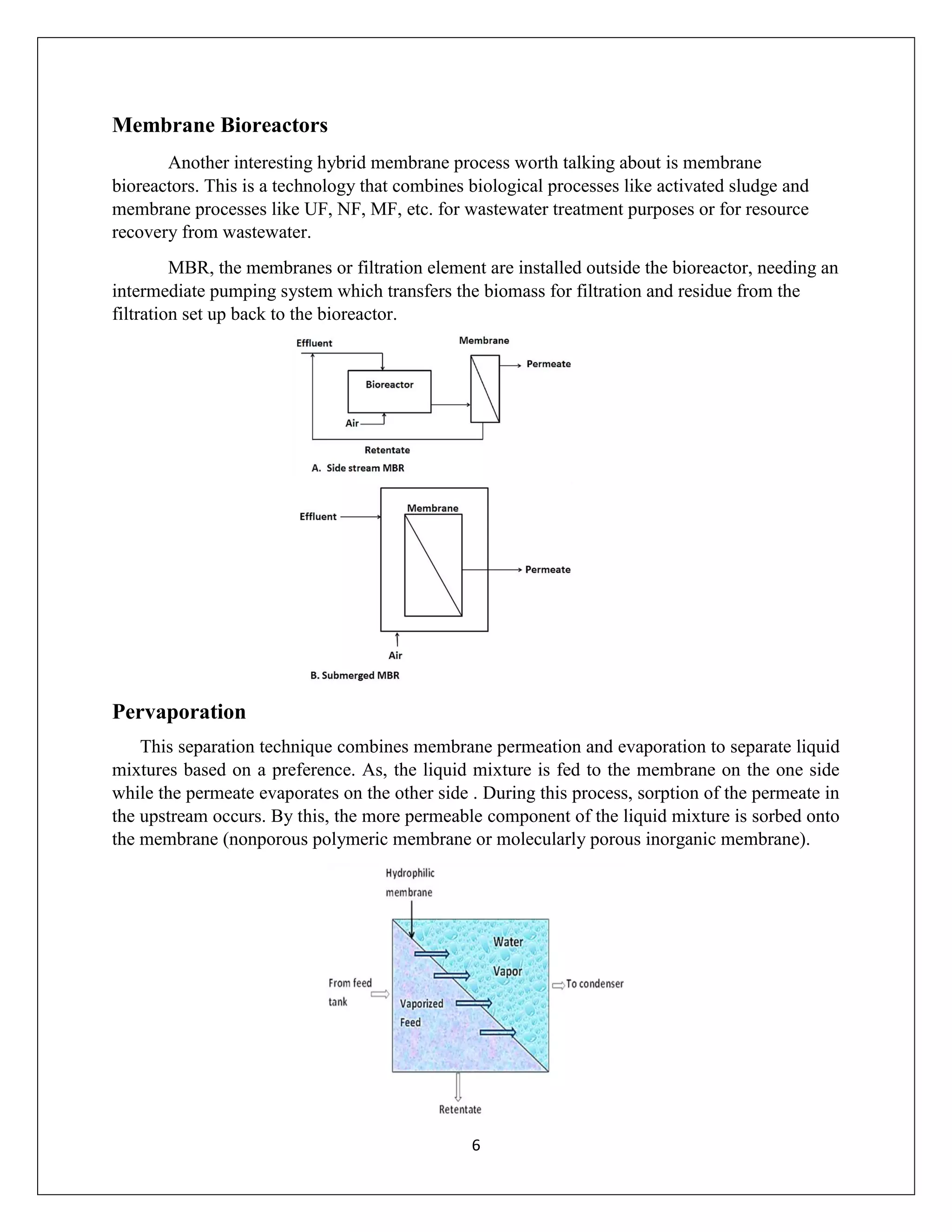
Another interesting hybrid membrane process worth talking about is membrane
bioreactors. This is a technology that combines biological processes like activated sludge and
membrane processes like UF, NF, MF, etc. for wastewater treatment purposes or for resource
recovery from wastewater.
MBR, the membranes or filtration element are installed outside the bioreactor, needing an
intermediate pumping system which transfers the biomass for filtration and residue from the
filtration set up back to the bioreactor.
Pervaporation
This separation technique combines membrane permeation and evaporation to separate liquid
mixtures based on a preference. As, the liquid mixture is fed to the membrane on the one side
while the permeate evaporates on the other side . During this process, sorption of the permeate in
the upstream occurs. By this, the more permeable component of the liquid mixture is sorbed onto
the membrane (nonporous polymeric membrane or molecularly porous inorganic membrane).
7
Hybrid Membrane Processes
Hybrid membrane processes refer to the combination of one or more membrane techniques
with other unit processes like coagulation, ion exchange, adsorption or other membrane processes
to give a better performance than either of the technologies as a standalone process.
Also, due to the high risk of fouling of membranes, other unit processes such as
coagulation, flocculation, sedimentation, or other membrane processes are introduced as
pretreatment steps to reduce fouling of the membranes
Forward Osmosis—Reverse Osmosis Hybrid Systems
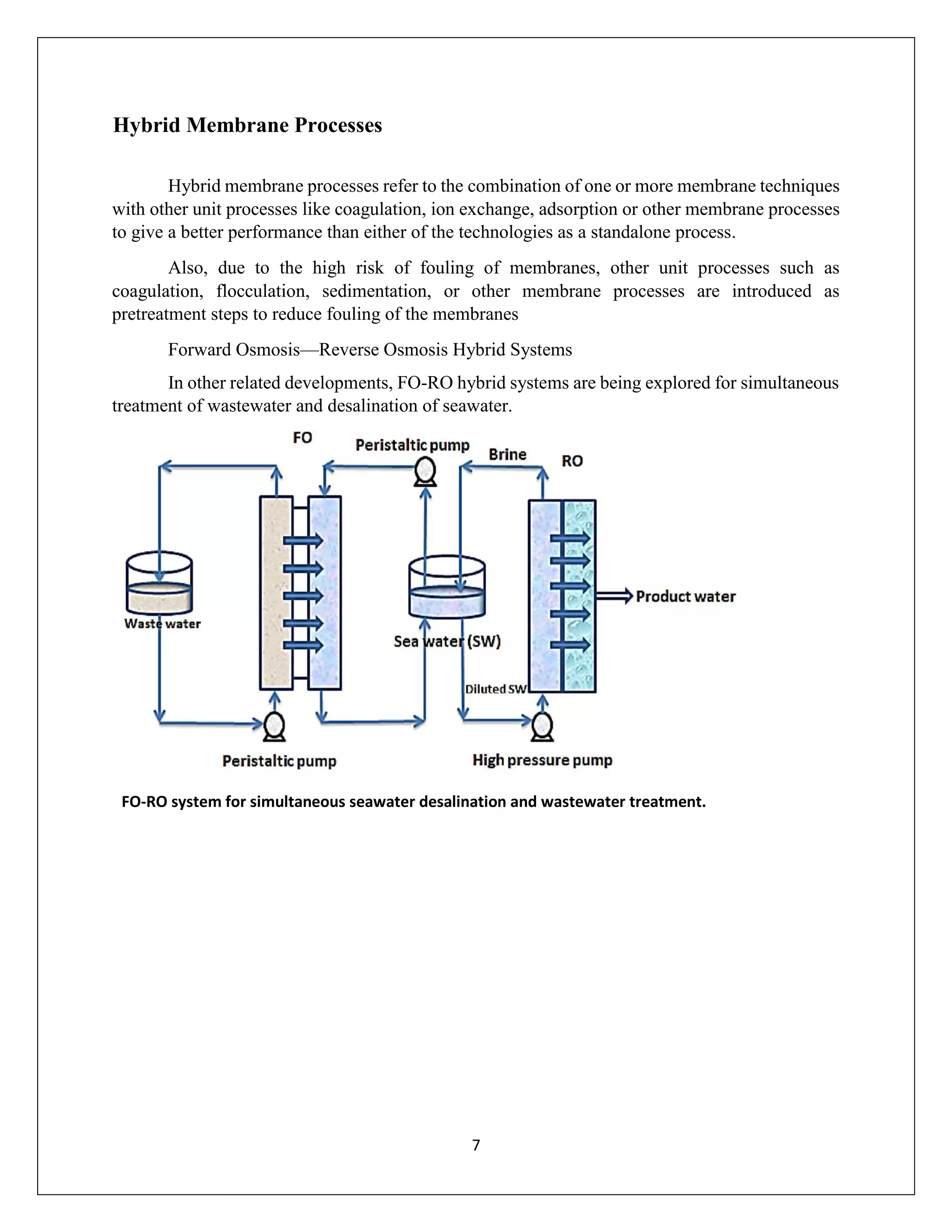
In other related developments, FO-RO hybrid systems are being explored for simultaneous
treatment of wastewater and desalination of seawater.
FO-RO system for simultaneous seawater desalination and wastewater treatment.
8
Membrane Modules and Selection
For large scale membrane processes, like industrial or other commercial uses of
membranes, large membrane areas are required. These large membrane areas are packaged
economically into what is known as modules. There are mainly four types of membrane modules,
namely plate and frame module, tubular module, spiral wound module and hollow fiber modules
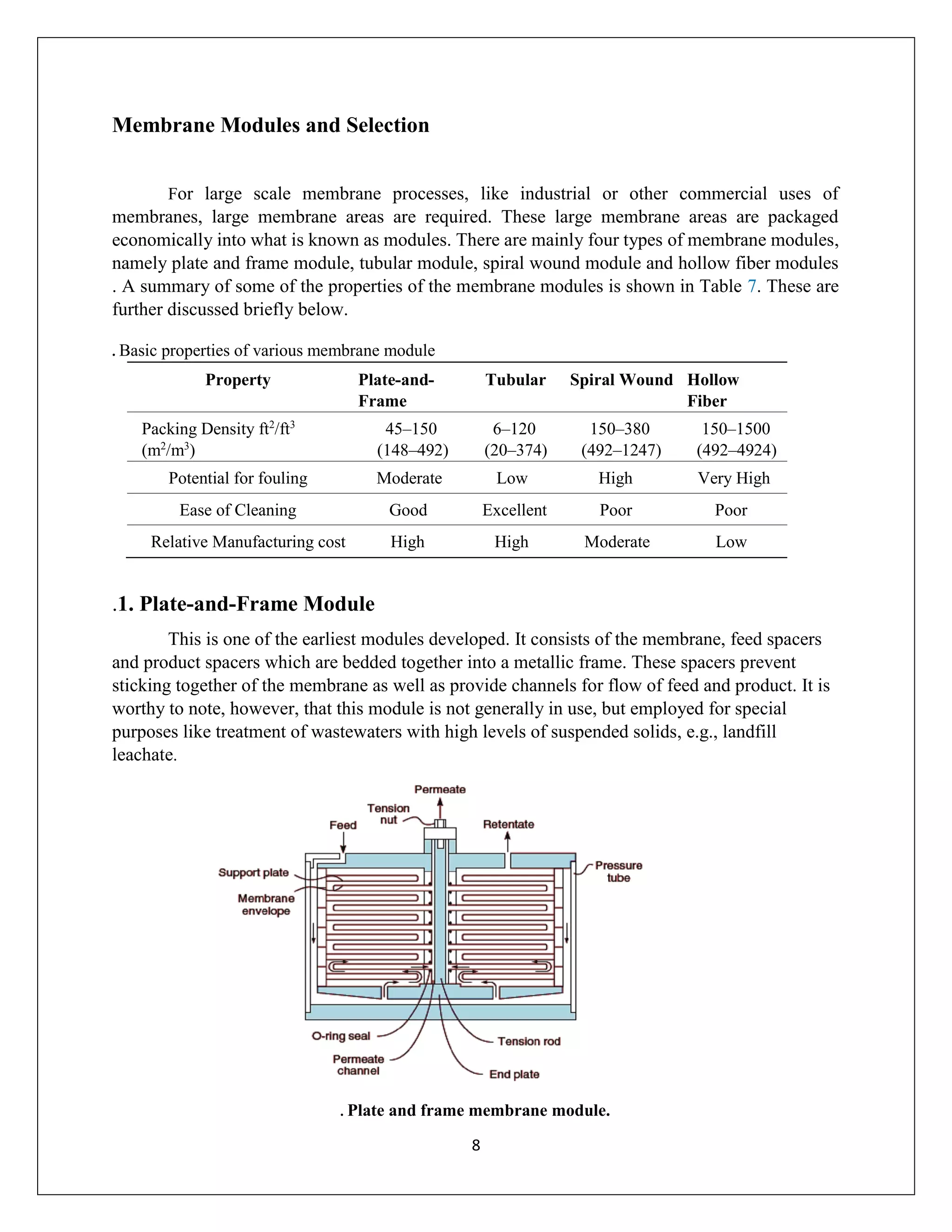
. A summary of some of the properties of the membrane modules is shown in Table 7. These are
further discussed briefly below.
. Basic properties of various membrane module
Property Plate-and-
Frame
Tubular Spiral Wound Hollow
Fiber
Packing Density ft2
/ft3
(m2
/m3
)
45–150
(148–492)
6–120
(20–374)
150–380
(492–1247)
150–1500
(492–4924)
Potential for fouling Moderate Low High Very High
Ease of Cleaning Good Excellent Poor Poor
Relative Manufacturing cost High High Moderate Low
.1. Plate-and-Frame Module
This is one of the earliest modules developed. It consists of the membrane, feed spacers
and product spacers which are bedded together into a metallic frame. These spacers prevent
sticking together of the membrane as well as provide channels for flow of feed and product. It is
worthy to note, however, that this module is not generally in use, but employed for special
purposes like treatment of wastewaters with high levels of suspended solids, e.g., landfill
leachate.
. Plate and frame membrane module.
9
2. Tubular Module
This module consists of an outer housing, referred to as shell. This shell is tubular in nature.
Within this tubular shell, is a perforated or porous stainless steel or fiberglass pipe, within which
a semi-permeable membrane is embedded. The fluid to be treated is fed into the tube under
pressure. The permeate from the membrane passes through the perforated pipe into the inside of
the housing and then collected through the permeate outlet . Tubular membranes are adapted to
treating feed with high solid contents.
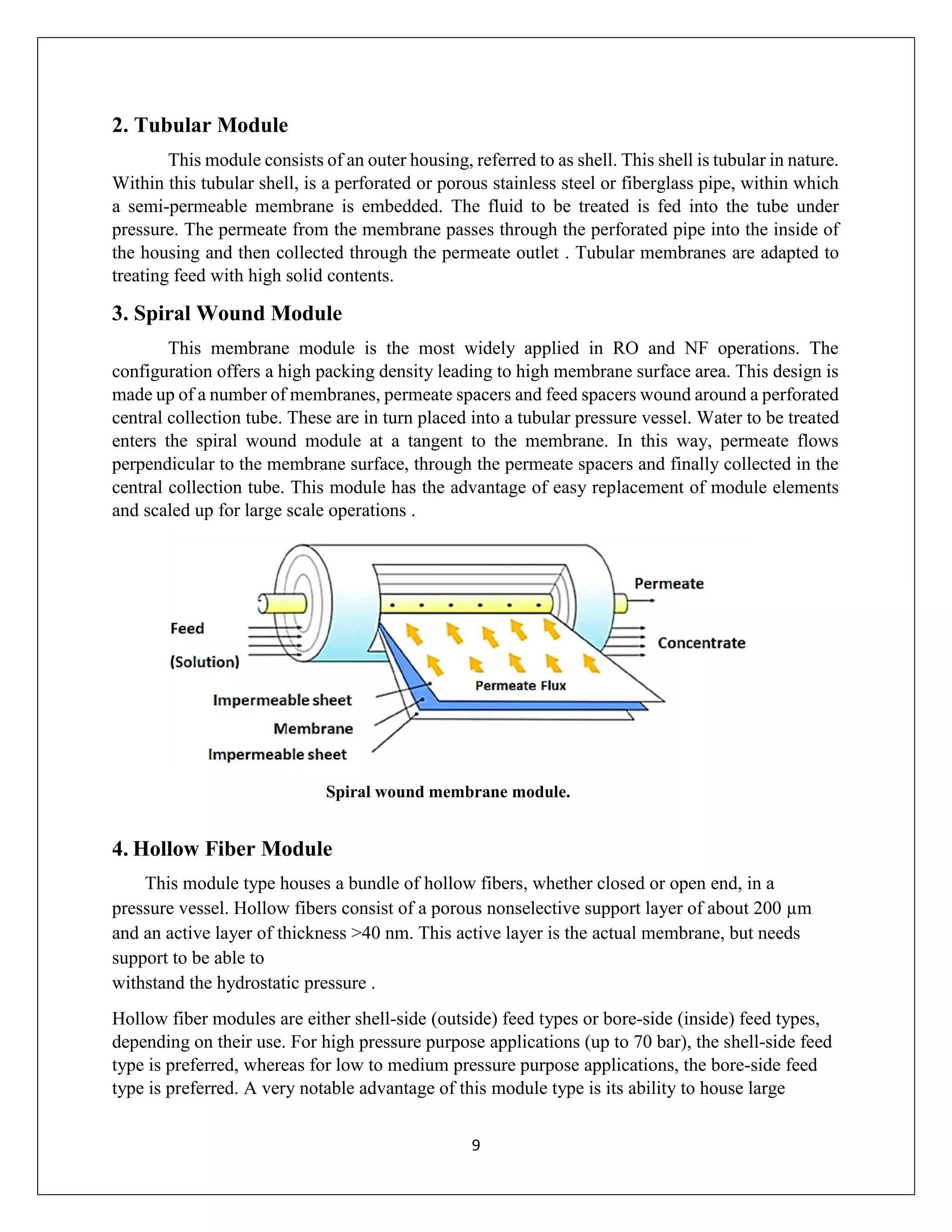
3. Spiral Wound Module
This membrane module is the most widely applied in RO and NF operations. The
configuration offers a high packing density leading to high membrane surface area. This design is
made up of a number of membranes, permeate spacers and feed spacers wound around a perforated
central collection tube. These are in turn placed into a tubular pressure vessel. Water to be treated
enters the spiral wound module at a tangent to the membrane. In this way, permeate flows
perpendicular to the membrane surface, through the permeate spacers and finally collected in the
central collection tube. This module has the advantage of easy replacement of module elements
and scaled up for large scale operations .
Spiral wound membrane module.
4. Hollow Fiber Module
This module type houses a bundle of hollow fibers, whether closed or open end, in a
pressure vessel. Hollow fibers consist of a porous nonselective support layer of about 200 µm
and an active layer of thickness >40 nm. This active layer is the actual membrane, but needs
support to be able to
withstand the hydrostatic pressure .
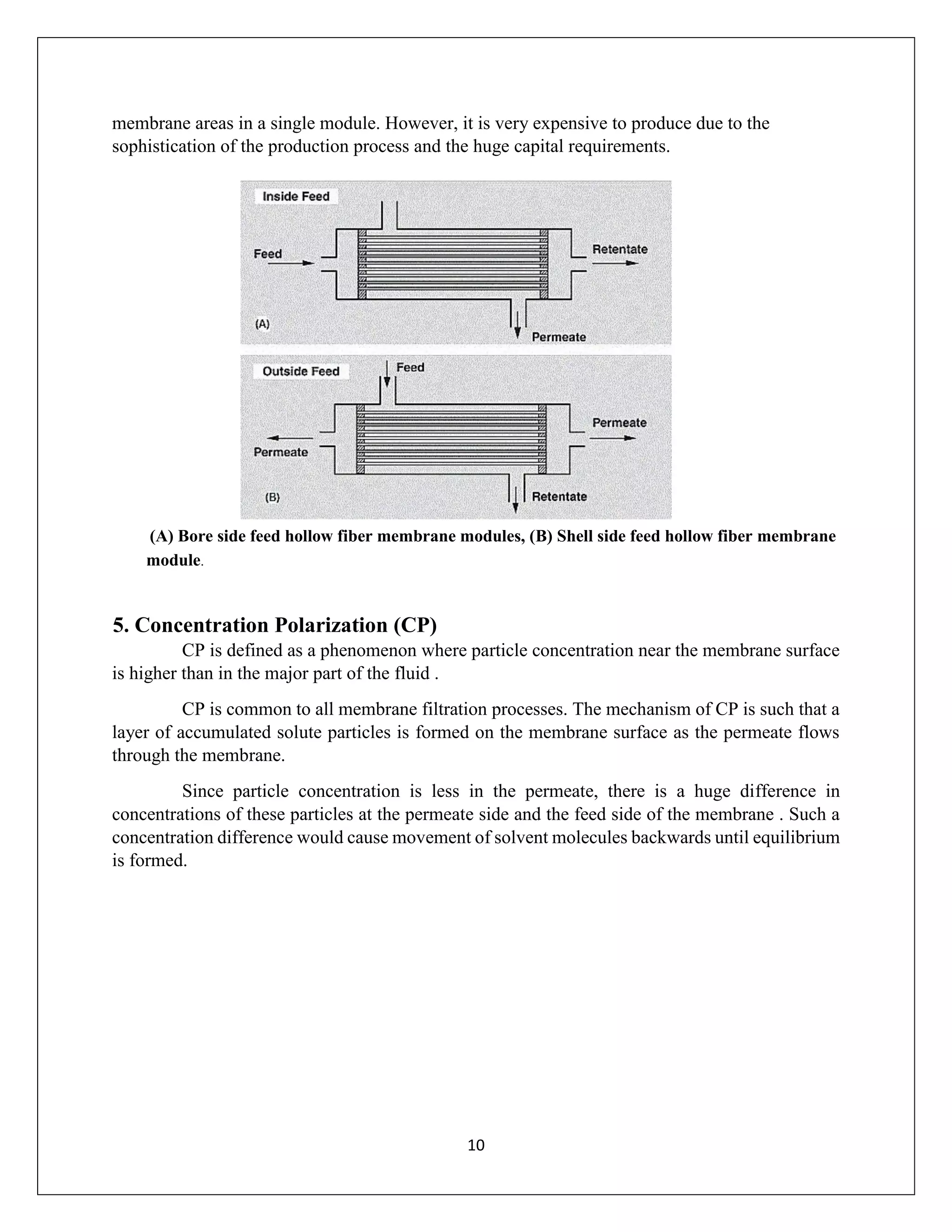
Hollow fiber modules are either shell-side (outside) feed types or bore-side (inside) feed types,
depending on their use. For high pressure purpose applications (up to 70 bar), the shell-side feed
type is preferred, whereas for low to medium pressure purpose applications, the bore-side feed
type is preferred. A very notable advantage of this module type is its ability to house large
10
membrane areas in a single module. However, it is very expensive to produce due to the
sophistication of the production process and the huge capital requirements.
(A) Bore side feed hollow fiber membrane modules, (B) Shell side feed hollow fiber membrane
module.
5. Concentration Polarization (CP)
CP is defined as a phenomenon where particle concentration near the membrane surface
is higher than in the major part of the fluid .
CP is common to all membrane filtration processes. The mechanism of CP is such that a
layer of accumulated solute particles is formed on the membrane surface as the permeate flows
through the membrane.
Since particle concentration is less in the permeate, there is a huge difference in
concentrations of these particles at the permeate side and the feed side of the membrane . Such a
concentration difference would cause movement of solvent molecules backwards until equilibrium
is formed.
11
Membrane Fouling and Pretreatment Strategies
Membrane fouling occurs when suspended solids, microbes, organic materials etc. are deposited
on the membrane surface or within the membrane pores thereby causing decreased permeate flux
. Fouling can be considered irreversible when foulants (materials causing the fouling) are
deposited in the pores of the membrane.
When the foulants are merely deposited on the surface of the membrane, they form a cake layer
which causes resistance to permeate movement. This fouling is considered reversible .
Membrane fouling affects the membrane performance as the movement of permeates is greatly
hindered. Consequently, higher pressure than normal is needed to ensure passage of permeates
through the membrane. The higher the fouling, the more the pressure required .
Membrane fouling has dire consequences on overall membrane performance. These include high
energy consumption, more down time, reduction in membrane filtration area etc.
Methods of Fouling Control: Membrane Cleaning
Membrane separation is largely a size exclusion mechanism. By principle, the particles
rejected, end up fouling the membrane. This makes fouling in membranes inevitable. Some
techniques have been proposed to reduce fouling in membranes. Relevance of these techniques
depends on the properties of the feed solution and the membrane. Some of these techniques
include: boundary layer velocity control, turbulence inducers, membrane material modification,
and the use of external fields . In the same vein, feed pretreatment, flow manipulation, rotating
membranes, and gas sparging were recommended by Williams and Wakeman.
Membrane cleaning comes in to restore the permeation flux of a membrane which is lost as a
result of fouling. This involves the removal of deposited materials on the membrane in order to
pave way for movement of permeate. Membrane cleaning can be classified largely as physical,
chemical, biological/biochemical or physico-chemical. Again, cleaning can be referred to as in-
situ when the membrane module remains within the reactor during cleaning or ex-situ when the
membrane module is removed and cleaned separately.
Methods including: Physical cleaning, Periodic back flushing, Pneumatic cleaning, Ultrasonic
cleaning,Sponge ball cleaning, Chemical cleaning, Biological cleaning.
12
Conclusion
In water treatment, membranes are barriers that allow water to pass through but stop
unwanted substances from passing through with it. Mostly membranes are made from synthetic
organic polymers include Polythylene(PE), Polytetrafluroethylene,
Polytetrafuoroethylene(PTFE), Polypropylene and cellulose acetate. Membrane filters allow the
flow of fluids or gases while preventing the passage of particles and microorganisms.
A membrane process is any method that filters or removes particles from water by using
a membrane barrier. The pressure difference between one side of the membrane and other causes
fluids to pass through the membrane. Contaminants cling to one side. Although many different
types of filtering media are used for water treatment, such as clay, slit and sand one property that
distinguishes membranes is their ability to separate smaller substances from a liquid, such as
liquid, such as salts and ions. For large scale membrane processes, like industrial or other commercial
uses of membranes, large membrane areas are required. These large membrane areas are packaged
economically into what is known as modules. There are mainly four types of membrane modules, namely
plate and frame module, tubular module, spiral wound module and hollow fiber modules .

Membrane technology

  • 1.
    1 Karnataka Veterinary, Animaland Fisheries Sciences University, Bidar Dairy Science College, Bengaluru-24 Report on : Membrane technologies used in Waste water treatment Course Number: DT 422 Course Title: Waste disposal and Pollution abatement Credit Hours:2(1+1) Submitted to: Dr.Thejaswini M L Assistant professor Dept. of Dairy Technology
  • 2.
    2 Submitted By: Sl .no.NAME ID NO 1. KRITI B DHK 1914 2. LAYASHREE S DHK 1915 3. PUNEETH M DHK 1916
  • 3.
    3 Contents Sl no Particulars Page number 1.Introduction to membranes 4 2. Membrane technologies in waste water treatment 5-7 3. Membrane Modules 8-11 4. Conclusion 12
  • 4.
    4 Introduction to membranes Membranesare barriers in water treatment that allow water to pass through while preventing unwanted substances from passing through as well. Technical membranes filter salts, impurities, viruses, and other particles from water in the same way that cell walls do in our bodies. A membrane process is any method that filters or removes particles from water by using a membrane barrier. The pressure difference between one side of the membrane and other causes fluids to pass through the membrane. Contaminants cling to one side. Although many different types of filtering media are used for water treatment, such as clay, slit and sand one property that distinguishes membranes is their ability to separate smaller substances from a liquid, such as liquid, such as salts and ions. Membrane processes are physical particle diffusion process in water. They work because certain types of membranes allow particles with specific characteristics to pass through while blocking particles with different characteristics to pass through while different characteristics from passing through. With the development of High performance synthetic membranes in 1960’s membranes emerged as a viable method of water purification. Membranes for water treatment have advanced membranes made from new materials and used in a variety of configurations. The scarcity of fresh water sources has fueled a push for alternative resources
  • 5.
    5 Membrane Technologies usedin Waste water treatment RO has been at the fore front of water reclamation through wastewater treatment and desalination of seawater for a long time. During reverse osmosis, a hydrostatic pressure is generated that is strong enough to overcome the intrinsic osmotic pressure of the feed. This is against the natural osmosis Forward Osmosis (FO) FO follows the natural osmosis process where water molecules are drawn from one solution to the other, through a semipermeable membrane. In this case a draw solution (DS), which is highly concentrated, is used to provide a concentration gradient to draw water molecules from the feed solution (FS). This gradient provides the needed osmotic pressure difference to drive water molecules from the FS to the DS. This movement continues till an equilibrium of chemical potential is reached Electro dialysis Electro-dialysis and electro-dialysis reversal are processes that combine electricity and ion-permeable membranes to separate dissolved ions from water. These processes make use of an electric potential to transfer the ions from a dilute solution through an ion permeable membrane. Two types of ion exchange membranes are used. One is permeable to anions and rejects cations and the other is permeable to cations and rejects anions. When electric current is passed through the system, ions from diluate migrate into concentrate through oppositely charged membranes.
  • 6.
    6 Membrane Bioreactors Another interestinghybrid membrane process worth talking about is membrane bioreactors. This is a technology that combines biological processes like activated sludge and membrane processes like UF, NF, MF, etc. for wastewater treatment purposes or for resource recovery from wastewater. MBR, the membranes or filtration element are installed outside the bioreactor, needing an intermediate pumping system which transfers the biomass for filtration and residue from the filtration set up back to the bioreactor. Pervaporation This separation technique combines membrane permeation and evaporation to separate liquid mixtures based on a preference. As, the liquid mixture is fed to the membrane on the one side while the permeate evaporates on the other side . During this process, sorption of the permeate in the upstream occurs. By this, the more permeable component of the liquid mixture is sorbed onto the membrane (nonporous polymeric membrane or molecularly porous inorganic membrane).
  • 7.
    7 Hybrid Membrane Processes Hybridmembrane processes refer to the combination of one or more membrane techniques with other unit processes like coagulation, ion exchange, adsorption or other membrane processes to give a better performance than either of the technologies as a standalone process. Also, due to the high risk of fouling of membranes, other unit processes such as coagulation, flocculation, sedimentation, or other membrane processes are introduced as pretreatment steps to reduce fouling of the membranes Forward Osmosis—Reverse Osmosis Hybrid Systems In other related developments, FO-RO hybrid systems are being explored for simultaneous treatment of wastewater and desalination of seawater. FO-RO system for simultaneous seawater desalination and wastewater treatment.
  • 8.
    8 Membrane Modules andSelection For large scale membrane processes, like industrial or other commercial uses of membranes, large membrane areas are required. These large membrane areas are packaged economically into what is known as modules. There are mainly four types of membrane modules, namely plate and frame module, tubular module, spiral wound module and hollow fiber modules . A summary of some of the properties of the membrane modules is shown in Table 7. These are further discussed briefly below. . Basic properties of various membrane module Property Plate-and- Frame Tubular Spiral Wound Hollow Fiber Packing Density ft2 /ft3 (m2 /m3 ) 45–150 (148–492) 6–120 (20–374) 150–380 (492–1247) 150–1500 (492–4924) Potential for fouling Moderate Low High Very High Ease of Cleaning Good Excellent Poor Poor Relative Manufacturing cost High High Moderate Low .1. Plate-and-Frame Module This is one of the earliest modules developed. It consists of the membrane, feed spacers and product spacers which are bedded together into a metallic frame. These spacers prevent sticking together of the membrane as well as provide channels for flow of feed and product. It is worthy to note, however, that this module is not generally in use, but employed for special purposes like treatment of wastewaters with high levels of suspended solids, e.g., landfill leachate. . Plate and frame membrane module.
  • 9.
    9 2. Tubular Module Thismodule consists of an outer housing, referred to as shell. This shell is tubular in nature. Within this tubular shell, is a perforated or porous stainless steel or fiberglass pipe, within which a semi-permeable membrane is embedded. The fluid to be treated is fed into the tube under pressure. The permeate from the membrane passes through the perforated pipe into the inside of the housing and then collected through the permeate outlet . Tubular membranes are adapted to treating feed with high solid contents. 3. Spiral Wound Module This membrane module is the most widely applied in RO and NF operations. The configuration offers a high packing density leading to high membrane surface area. This design is made up of a number of membranes, permeate spacers and feed spacers wound around a perforated central collection tube. These are in turn placed into a tubular pressure vessel. Water to be treated enters the spiral wound module at a tangent to the membrane. In this way, permeate flows perpendicular to the membrane surface, through the permeate spacers and finally collected in the central collection tube. This module has the advantage of easy replacement of module elements and scaled up for large scale operations . Spiral wound membrane module. 4. Hollow Fiber Module This module type houses a bundle of hollow fibers, whether closed or open end, in a pressure vessel. Hollow fibers consist of a porous nonselective support layer of about 200 µm and an active layer of thickness >40 nm. This active layer is the actual membrane, but needs support to be able to withstand the hydrostatic pressure . Hollow fiber modules are either shell-side (outside) feed types or bore-side (inside) feed types, depending on their use. For high pressure purpose applications (up to 70 bar), the shell-side feed type is preferred, whereas for low to medium pressure purpose applications, the bore-side feed type is preferred. A very notable advantage of this module type is its ability to house large
  • 10.
    10 membrane areas ina single module. However, it is very expensive to produce due to the sophistication of the production process and the huge capital requirements. (A) Bore side feed hollow fiber membrane modules, (B) Shell side feed hollow fiber membrane module. 5. Concentration Polarization (CP) CP is defined as a phenomenon where particle concentration near the membrane surface is higher than in the major part of the fluid . CP is common to all membrane filtration processes. The mechanism of CP is such that a layer of accumulated solute particles is formed on the membrane surface as the permeate flows through the membrane. Since particle concentration is less in the permeate, there is a huge difference in concentrations of these particles at the permeate side and the feed side of the membrane . Such a concentration difference would cause movement of solvent molecules backwards until equilibrium is formed.
  • 11.
    11 Membrane Fouling andPretreatment Strategies Membrane fouling occurs when suspended solids, microbes, organic materials etc. are deposited on the membrane surface or within the membrane pores thereby causing decreased permeate flux . Fouling can be considered irreversible when foulants (materials causing the fouling) are deposited in the pores of the membrane. When the foulants are merely deposited on the surface of the membrane, they form a cake layer which causes resistance to permeate movement. This fouling is considered reversible . Membrane fouling affects the membrane performance as the movement of permeates is greatly hindered. Consequently, higher pressure than normal is needed to ensure passage of permeates through the membrane. The higher the fouling, the more the pressure required . Membrane fouling has dire consequences on overall membrane performance. These include high energy consumption, more down time, reduction in membrane filtration area etc. Methods of Fouling Control: Membrane Cleaning Membrane separation is largely a size exclusion mechanism. By principle, the particles rejected, end up fouling the membrane. This makes fouling in membranes inevitable. Some techniques have been proposed to reduce fouling in membranes. Relevance of these techniques depends on the properties of the feed solution and the membrane. Some of these techniques include: boundary layer velocity control, turbulence inducers, membrane material modification, and the use of external fields . In the same vein, feed pretreatment, flow manipulation, rotating membranes, and gas sparging were recommended by Williams and Wakeman. Membrane cleaning comes in to restore the permeation flux of a membrane which is lost as a result of fouling. This involves the removal of deposited materials on the membrane in order to pave way for movement of permeate. Membrane cleaning can be classified largely as physical, chemical, biological/biochemical or physico-chemical. Again, cleaning can be referred to as in- situ when the membrane module remains within the reactor during cleaning or ex-situ when the membrane module is removed and cleaned separately. Methods including: Physical cleaning, Periodic back flushing, Pneumatic cleaning, Ultrasonic cleaning,Sponge ball cleaning, Chemical cleaning, Biological cleaning.
  • 12.
    12 Conclusion In water treatment,membranes are barriers that allow water to pass through but stop unwanted substances from passing through with it. Mostly membranes are made from synthetic organic polymers include Polythylene(PE), Polytetrafluroethylene, Polytetrafuoroethylene(PTFE), Polypropylene and cellulose acetate. Membrane filters allow the flow of fluids or gases while preventing the passage of particles and microorganisms. A membrane process is any method that filters or removes particles from water by using a membrane barrier. The pressure difference between one side of the membrane and other causes fluids to pass through the membrane. Contaminants cling to one side. Although many different types of filtering media are used for water treatment, such as clay, slit and sand one property that distinguishes membranes is their ability to separate smaller substances from a liquid, such as liquid, such as salts and ions. For large scale membrane processes, like industrial or other commercial uses of membranes, large membrane areas are required. These large membrane areas are packaged economically into what is known as modules. There are mainly four types of membrane modules, namely plate and frame module, tubular module, spiral wound module and hollow fiber modules .