
Intelligent Communication Lab 
Wireless Power Transfer Using Metamaterial 
Bonded Microstrip Antenna for 
Smart Grid WSN
Intelligent Communication Lab 
Outline 
• Background 
• Microwave Power Transmission 
• System Model 
• Metamaterials 
• Metamaterials used in Microwave Power Transmission 
• Conclusion 
2
Intelligent Communication Lab 
Background 
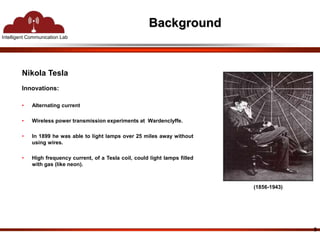
Nikola Tesla 
Innovations: 
• Alternating current 
• Wireless power transmission experiments at Wardenclyffe. 
• In 1899 he was able to light lamps over 25 miles away without 
using wires. 
• High frequency current, of a Tesla coil, could light lamps filled 
with gas (like neon). 
(1856-1943) 
3
Intelligent Communication Lab 
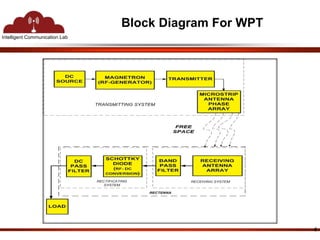
Block Diagram For WPT 
4
Intelligent Communication Lab 
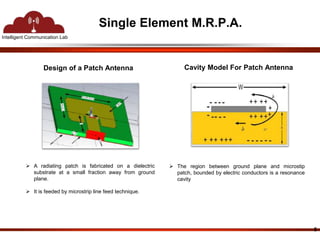
Single Element M.R.P.A. 
Design of a Patch Antenna 
5 
Cavity Model For Patch Antenna 
 A radiating patch is fabricated on a dielectric 
substrate at a small fraction away from ground 
plane. 
 It is feeded by microstrip line feed technique. 
 The region between ground plane and microstip 
patch, bounded by electric conductors is a resonance 
cavity
Intelligent Communication Lab 
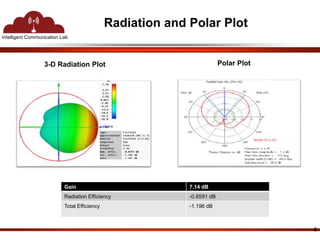
Radiation and Polar Plot 
6 
3-D Radiation Plot Polar Plot 
Gain 7.14 dB 
Radiation Efficiency -0.8591 dB 
Total Efficiency -1.196 dB
Intelligent Communication Lab 
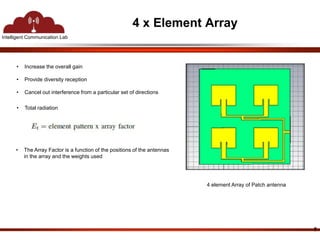
4 x Element Array 
7 
4 element Array of Patch antenna 
• Increase the overall gain 
• Provide diversity reception 
• Cancel out interference from a particular set of directions 
• Total radiation 
• The Array Factor is a function of the positions of the antennas 
in the array and the weights used
Intelligent Communication Lab 
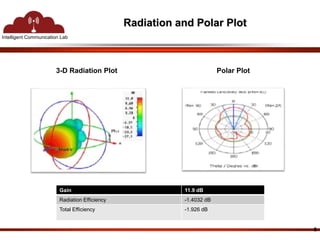
Radiation and Polar Plot 
3-D Radiation Plot Polar Plot 
8 
Gain 11.9 dB 
Radiation Efficiency -1.4032 dB 
Total Efficiency -1.926 dB
Intelligent Communication Lab 
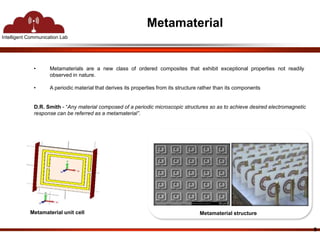
Metamaterial 
• Metamaterials are a new class of ordered composites that exhibit exceptional properties not readily 
observed in nature. 
• A periodic material that derives its properties from its structure rather than its components 
9 
D.R. Smith - “Any material composed of a periodic microscopic structures so as to achieve desired electromagnetic 
response can be referred as a metamaterial”. 
Metamaterial unit cell Metamaterial structure
Intelligent Communication Lab 
History 
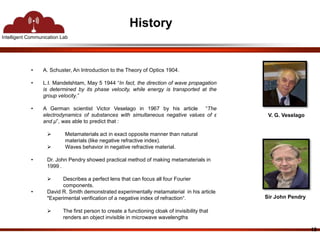
• A. Schuster, An Introduction to the Theory of Optics 1904. 
• L.I. Mandelshtam, May 5 1944 “In fact, the direction of wave propagation 
is determined by its phase velocity, while energy is transported at the 
group velocity.” 
• A German scientist Victor Veselago in 1967 by his article “The 
electrodynamics of substances with simultaneous negative values of ε 
and μ”, was able to predict that : 
 Metamaterials act in exact opposite manner than natural 
materials (like negative refractive index). 
 Waves behavior in negative refractive material. 
• Dr. John Pendry showed practical method of making metamaterials in 
1999 . 
 Describes a perfect lens that can focus all four Fourier 
components. 
• David R. Smith demonstrated experimentally metamaterial in his article 
"Experimental verification of a negative index of refraction“. 
 The first person to create a functioning cloak of invisibility that 
renders an object invisible in microwave wavelengths 
V. G. Veselago 
Sir John Pendry 
10
Intelligent Communication Lab 
Properties of Metamaterials 
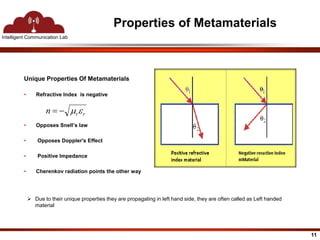
Unique Properties Of Metamaterials 
• Refractive Index is negative 
r r n     
• Opposes Snell’s law 
• Opposes Doppler's Effect 
• Positive Impedance 
• Cherenkov radiation points the other way 
11 
 Due to their unique properties they are propagating in left hand side, they are often called as Left handed 
material
Intelligent Communication Lab 
Classification of Material and 
Achieving N.R.I. 
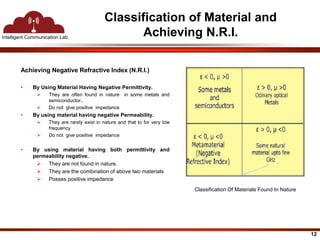
Classification Of Materials Found In Nature 
Achieving Negative Refractive Index (N.R.I.) 
• By Using Material Having Negative Permittivity. 
 They are often found in nature in some metals and 
semiconductor.. 
 Do not give positive impedance 
• By using material having negative Permeability. 
 They are rarely exist in nature and that to for very low 
frequency 
 Do not give positive impedance 
• By using material having both permittivity and 
permeability negative. 
 They are not found in nature. 
 They are the combination of above two materials 
 Posses positive impedance 
12
Intelligent Communication Lab 
Behavior of Waves With 
Metamaterials 
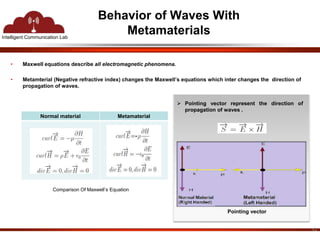
• Maxwell equations describe all electromagnetic phenomena. 
• Metamterial (Negative refractive index) changes the Maxwell’s equations which inter changes the direction of 
propagation of waves. 
13 
Normal material Metamaterial 
 Pointing vector represent the direction of 
propagation of waves . 
Pointing vector 
Comparison Of Maxwell’s Equation
Intelligent Communication Lab 
Metamaterial as Lens 
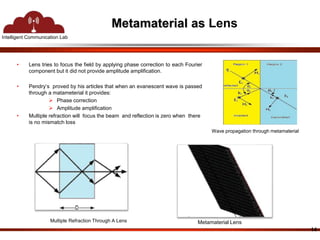
• Lens tries to focus the field by applying phase correction to each Fourier 
component but it did not provide amplitude amplification. 
• Pendry’s proved by his articles that when an evanescent wave is passed 
through a matameterial it provides: 
 Phase correction 
 Amplitude amplification 
• Multiple refraction will focus the beam and reflection is zero when there 
is no mismatch loss 
14 
Wave propagation through metamaterial 
Multiple Refraction Through A Lens Metamaterial Lens
Antenna Incorporated with Metamaterial 
Intelligent Communication Lab 
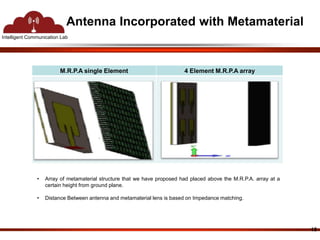
M.R.P.A single Element 4 Element M.R.P.A array 
15 
• Array of metamaterial structure that we have proposed had placed above the M.R.P.A. array at a 
certain height from ground plane. 
• Distance Between antenna and metamaterial lens is based on Impedance matching.
Intelligent Communication Lab 
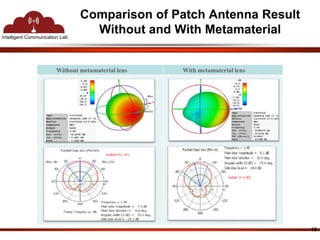
Comparison of Patch Antenna Result 
Without and With Metamaterial 
Without metamaterial lens With metamaterial lens 
16
Intelligent Communication Lab 
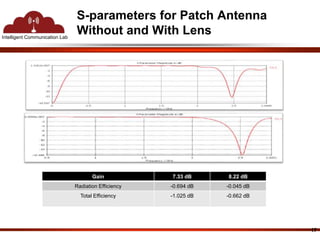
S-parameters for Patch Antenna 
Without and With Lens 
17 
Gain 7.33 dB 8.22 dB 
Radiation Efficiency -0.694 dB -0.045 dB 
Total Efficiency -1.025 dB -0.662 dB
Intelligent Communication Lab 
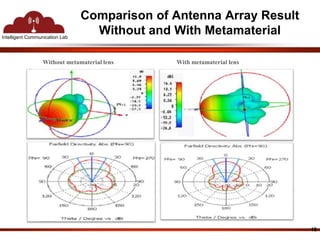
Comparison of Antenna Array Result 
Without and With Metamaterial 
Without metamaterial lens With metamaterial lens 
18
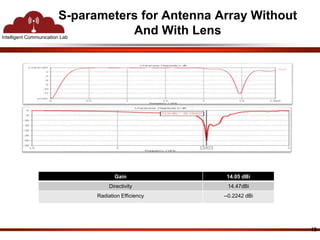
S-parameters for Antenna Array Without 
Intelligent Communication Lab 
And With Lens 
19 
Gain 14.05 dBi 
Directivity 14.47dBi 
Radiation Efficiency --0.2242 dBi
Intelligent Communication Lab 
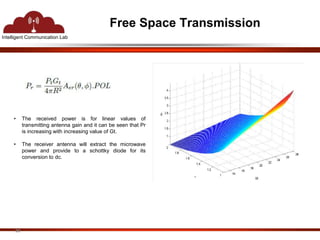
Free Space Transmission 
• The received power is for linear values of 
20 
transmitting antenna gain and it can be seen that Pr 
is increasing with increasing value of Gt. 
• The receiver antenna will extract the microwave 
power and provide to a schottky diode for its 
conversion to dc.
Intelligent Communication Lab 
Conclusion 
21 
• Wireless power can be transmitted to an increased range by using metamaterial with 
antenna 
• Use of metamaterial will improve the antenna performance. 
• No altercation is required in antenna structure for achieving better or desired 
performance. 
• Metamaterial used with antenna can also help in avoiding interference
22 
Vikaram Singh 
Antenna and Microwave Group 
Intelligent Communication Lab (INTELCOM) 
Mumbai, India 
E vikram.singh@intelcomlab.com M +91 9767371987

ICACC Presentation

  • 1.
    Intelligent Communication Lab Wireless Power Transfer Using Metamaterial Bonded Microstrip Antenna for Smart Grid WSN
  • 2.
    Intelligent Communication Lab Outline • Background • Microwave Power Transmission • System Model • Metamaterials • Metamaterials used in Microwave Power Transmission • Conclusion 2
  • 3.
    Intelligent Communication Lab Background Nikola Tesla Innovations: • Alternating current • Wireless power transmission experiments at Wardenclyffe. • In 1899 he was able to light lamps over 25 miles away without using wires. • High frequency current, of a Tesla coil, could light lamps filled with gas (like neon). (1856-1943) 3
  • 4.
    Intelligent Communication Lab Block Diagram For WPT 4
  • 5.
    Intelligent Communication Lab Single Element M.R.P.A. Design of a Patch Antenna 5 Cavity Model For Patch Antenna  A radiating patch is fabricated on a dielectric substrate at a small fraction away from ground plane.  It is feeded by microstrip line feed technique.  The region between ground plane and microstip patch, bounded by electric conductors is a resonance cavity
  • 6.
    Intelligent Communication Lab Radiation and Polar Plot 6 3-D Radiation Plot Polar Plot Gain 7.14 dB Radiation Efficiency -0.8591 dB Total Efficiency -1.196 dB
  • 7.
    Intelligent Communication Lab 4 x Element Array 7 4 element Array of Patch antenna • Increase the overall gain • Provide diversity reception • Cancel out interference from a particular set of directions • Total radiation • The Array Factor is a function of the positions of the antennas in the array and the weights used
  • 8.
    Intelligent Communication Lab Radiation and Polar Plot 3-D Radiation Plot Polar Plot 8 Gain 11.9 dB Radiation Efficiency -1.4032 dB Total Efficiency -1.926 dB
  • 9.
    Intelligent Communication Lab Metamaterial • Metamaterials are a new class of ordered composites that exhibit exceptional properties not readily observed in nature. • A periodic material that derives its properties from its structure rather than its components 9 D.R. Smith - “Any material composed of a periodic microscopic structures so as to achieve desired electromagnetic response can be referred as a metamaterial”. Metamaterial unit cell Metamaterial structure
  • 10.
    Intelligent Communication Lab History • A. Schuster, An Introduction to the Theory of Optics 1904. • L.I. Mandelshtam, May 5 1944 “In fact, the direction of wave propagation is determined by its phase velocity, while energy is transported at the group velocity.” • A German scientist Victor Veselago in 1967 by his article “The electrodynamics of substances with simultaneous negative values of ε and μ”, was able to predict that :  Metamaterials act in exact opposite manner than natural materials (like negative refractive index).  Waves behavior in negative refractive material. • Dr. John Pendry showed practical method of making metamaterials in 1999 .  Describes a perfect lens that can focus all four Fourier components. • David R. Smith demonstrated experimentally metamaterial in his article "Experimental verification of a negative index of refraction“.  The first person to create a functioning cloak of invisibility that renders an object invisible in microwave wavelengths V. G. Veselago Sir John Pendry 10
  • 11.
    Intelligent Communication Lab Properties of Metamaterials Unique Properties Of Metamaterials • Refractive Index is negative r r n     • Opposes Snell’s law • Opposes Doppler's Effect • Positive Impedance • Cherenkov radiation points the other way 11  Due to their unique properties they are propagating in left hand side, they are often called as Left handed material
  • 12.
    Intelligent Communication Lab Classification of Material and Achieving N.R.I. Classification Of Materials Found In Nature Achieving Negative Refractive Index (N.R.I.) • By Using Material Having Negative Permittivity.  They are often found in nature in some metals and semiconductor..  Do not give positive impedance • By using material having negative Permeability.  They are rarely exist in nature and that to for very low frequency  Do not give positive impedance • By using material having both permittivity and permeability negative.  They are not found in nature.  They are the combination of above two materials  Posses positive impedance 12
  • 13.
    Intelligent Communication Lab Behavior of Waves With Metamaterials • Maxwell equations describe all electromagnetic phenomena. • Metamterial (Negative refractive index) changes the Maxwell’s equations which inter changes the direction of propagation of waves. 13 Normal material Metamaterial  Pointing vector represent the direction of propagation of waves . Pointing vector Comparison Of Maxwell’s Equation
  • 14.
    Intelligent Communication Lab Metamaterial as Lens • Lens tries to focus the field by applying phase correction to each Fourier component but it did not provide amplitude amplification. • Pendry’s proved by his articles that when an evanescent wave is passed through a matameterial it provides:  Phase correction  Amplitude amplification • Multiple refraction will focus the beam and reflection is zero when there is no mismatch loss 14 Wave propagation through metamaterial Multiple Refraction Through A Lens Metamaterial Lens
  • 15.
    Antenna Incorporated withMetamaterial Intelligent Communication Lab M.R.P.A single Element 4 Element M.R.P.A array 15 • Array of metamaterial structure that we have proposed had placed above the M.R.P.A. array at a certain height from ground plane. • Distance Between antenna and metamaterial lens is based on Impedance matching.
  • 16.
    Intelligent Communication Lab Comparison of Patch Antenna Result Without and With Metamaterial Without metamaterial lens With metamaterial lens 16
  • 17.
    Intelligent Communication Lab S-parameters for Patch Antenna Without and With Lens 17 Gain 7.33 dB 8.22 dB Radiation Efficiency -0.694 dB -0.045 dB Total Efficiency -1.025 dB -0.662 dB
  • 18.
    Intelligent Communication Lab Comparison of Antenna Array Result Without and With Metamaterial Without metamaterial lens With metamaterial lens 18
  • 19.
    S-parameters for AntennaArray Without Intelligent Communication Lab And With Lens 19 Gain 14.05 dBi Directivity 14.47dBi Radiation Efficiency --0.2242 dBi
  • 20.
    Intelligent Communication Lab Free Space Transmission • The received power is for linear values of 20 transmitting antenna gain and it can be seen that Pr is increasing with increasing value of Gt. • The receiver antenna will extract the microwave power and provide to a schottky diode for its conversion to dc.
  • 21.
    Intelligent Communication Lab Conclusion 21 • Wireless power can be transmitted to an increased range by using metamaterial with antenna • Use of metamaterial will improve the antenna performance. • No altercation is required in antenna structure for achieving better or desired performance. • Metamaterial used with antenna can also help in avoiding interference
  • 22.
    22 Vikaram Singh Antenna and Microwave Group Intelligent Communication Lab (INTELCOM) Mumbai, India E vikram.singh@intelcomlab.com M +91 9767371987