Power harvesting Metamaterial
A.Naga Mounika ,
IV B.Tech, ECE,
Sree Vahini Institute of Science &
Technology ,JNTUK
Working Process2
Introduction1
Applications4
3 How to Generate?
Contents :
1. Introduction
•There are several kinds of sources available to generate an
electricity .
•For example wind energy, hydro power, tidal power, nuclear
power, solar power, coal power, energy from burning fossil fuels
etc.
•There is also a new method by using a Metamaterial.
• It is nothing but capturing background radiation and
converting it to electricity.
•It could be used to capture 'lost' energy from a range of sources
such as satellite transmissions, sound signals or Wi-Fi.
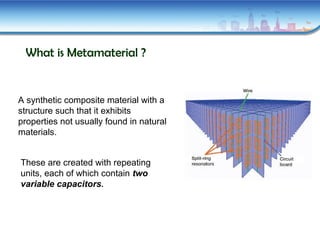
What is Metamaterial ?
A synthetic composite material with a
structure such that it exhibits
properties not usually found in natural
materials.
These are created with repeating
units, each of which contain two
variable capacitors.
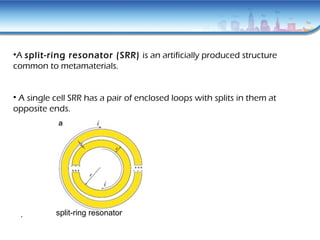
•A split-ring resonator (SRR) is an artificially produced structure
common to metamaterials.
• A single cell SRR has a pair of enclosed loops with splits in them at
opposite ends.
split-ring resonator.
Step 1: Constructing circuit on metamaterial
Step 2: Forming the array of metamaterials
Step 3: Inserting array in a waveguide
.
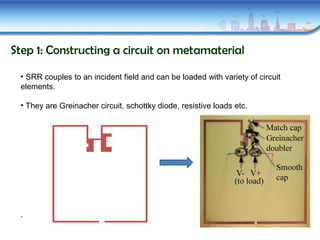
Step 1: Constructing a circuit on metamaterial
• SRR couples to an incident field and can be loaded with variety of circuit
elements.
• They are Greinacher circuit, schottky diode, resistive loads etc.
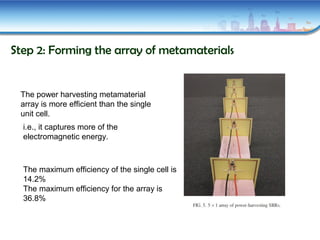
Step 2: Forming the array of metamaterials
i.e., it captures more of the
electromagnetic energy.
The power harvesting metamaterial
array is more efficient than the single
unit cell.
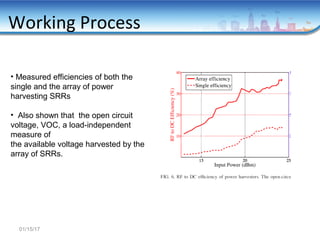
The maximum efficiency of the single cell is
14.2%
The maximum efficiency for the array is
36.8%
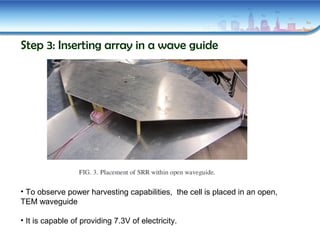
Step 3: Inserting array in a wave guide
• To observe power harvesting capabilities, the cell is placed in an open,
TEM waveguide
• It is capable of providing 7.3V of electricity.
3. Working Process
V-
Signal Generator Amplifier
Oscilloscope
V+ SRR
Waveguide
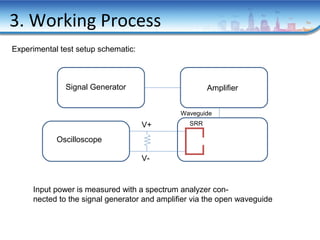
Experimental test setup schematic:
Input power is measured with a spectrum analyzer con-
nected to the signal generator and amplifier via the open waveguide
01/15/17
Working Process
• Measured efficiencies of both the
single and the array of power
harvesting SRRs
• Also shown that the open circuit
voltage, VOC, a load-independent
measure of
the available voltage harvested by the
array of SRRs.
4. Applications :
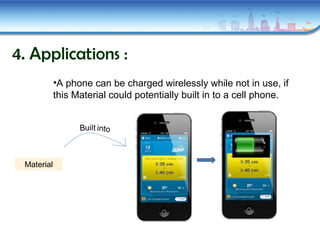
•A phone can be charged wirelessly while not in use, if
this Material could potentially built in to a cell phone.
Material
Thank youThank You

Power harvesting metamaterial

  • 1.
    Power harvesting Metamaterial A.NagaMounika , IV B.Tech, ECE, Sree Vahini Institute of Science & Technology ,JNTUK
  • 2.
  • 3.
    1. Introduction •There areseveral kinds of sources available to generate an electricity . •For example wind energy, hydro power, tidal power, nuclear power, solar power, coal power, energy from burning fossil fuels etc. •There is also a new method by using a Metamaterial. • It is nothing but capturing background radiation and converting it to electricity. •It could be used to capture 'lost' energy from a range of sources such as satellite transmissions, sound signals or Wi-Fi.
  • 4.
    What is Metamaterial? A synthetic composite material with a structure such that it exhibits properties not usually found in natural materials. These are created with repeating units, each of which contain two variable capacitors.
  • 5.
    •A split-ring resonator(SRR) is an artificially produced structure common to metamaterials. • A single cell SRR has a pair of enclosed loops with splits in them at opposite ends. split-ring resonator.
  • 6.
    Step 1: Constructingcircuit on metamaterial Step 2: Forming the array of metamaterials Step 3: Inserting array in a waveguide
  • 7.
    . Step 1: Constructinga circuit on metamaterial • SRR couples to an incident field and can be loaded with variety of circuit elements. • They are Greinacher circuit, schottky diode, resistive loads etc.
  • 8.
    Step 2: Formingthe array of metamaterials i.e., it captures more of the electromagnetic energy. The power harvesting metamaterial array is more efficient than the single unit cell. The maximum efficiency of the single cell is 14.2% The maximum efficiency for the array is 36.8%
  • 9.
    Step 3: Insertingarray in a wave guide • To observe power harvesting capabilities, the cell is placed in an open, TEM waveguide • It is capable of providing 7.3V of electricity.
  • 10.
    3. Working Process V- SignalGenerator Amplifier Oscilloscope V+ SRR Waveguide Experimental test setup schematic: Input power is measured with a spectrum analyzer con- nected to the signal generator and amplifier via the open waveguide
  • 11.
    01/15/17 Working Process • Measuredefficiencies of both the single and the array of power harvesting SRRs • Also shown that the open circuit voltage, VOC, a load-independent measure of the available voltage harvested by the array of SRRs.
  • 12.
    4. Applications : •Aphone can be charged wirelessly while not in use, if this Material could potentially built in to a cell phone. Material
  • 14.