METAMATERIALS
BY
MONALISA PAL
Metamaterials
“Meta-” means “altered, changed” or “higher, beyond”, is a
prefix meaning “to transcend”
Why are they called Metamaterials?
- Existing materials only exhibit a small subset of electromagnetic
properties theoretically available
- Metamaterials can have their electromagnetic properties altered to
something beyond what can be found in nature.
- Can achieve negative index of refraction, magnetism at optical
frequencies, etc.
Metamaterials
The word “Metamaterial” was coined in the late
1990’s

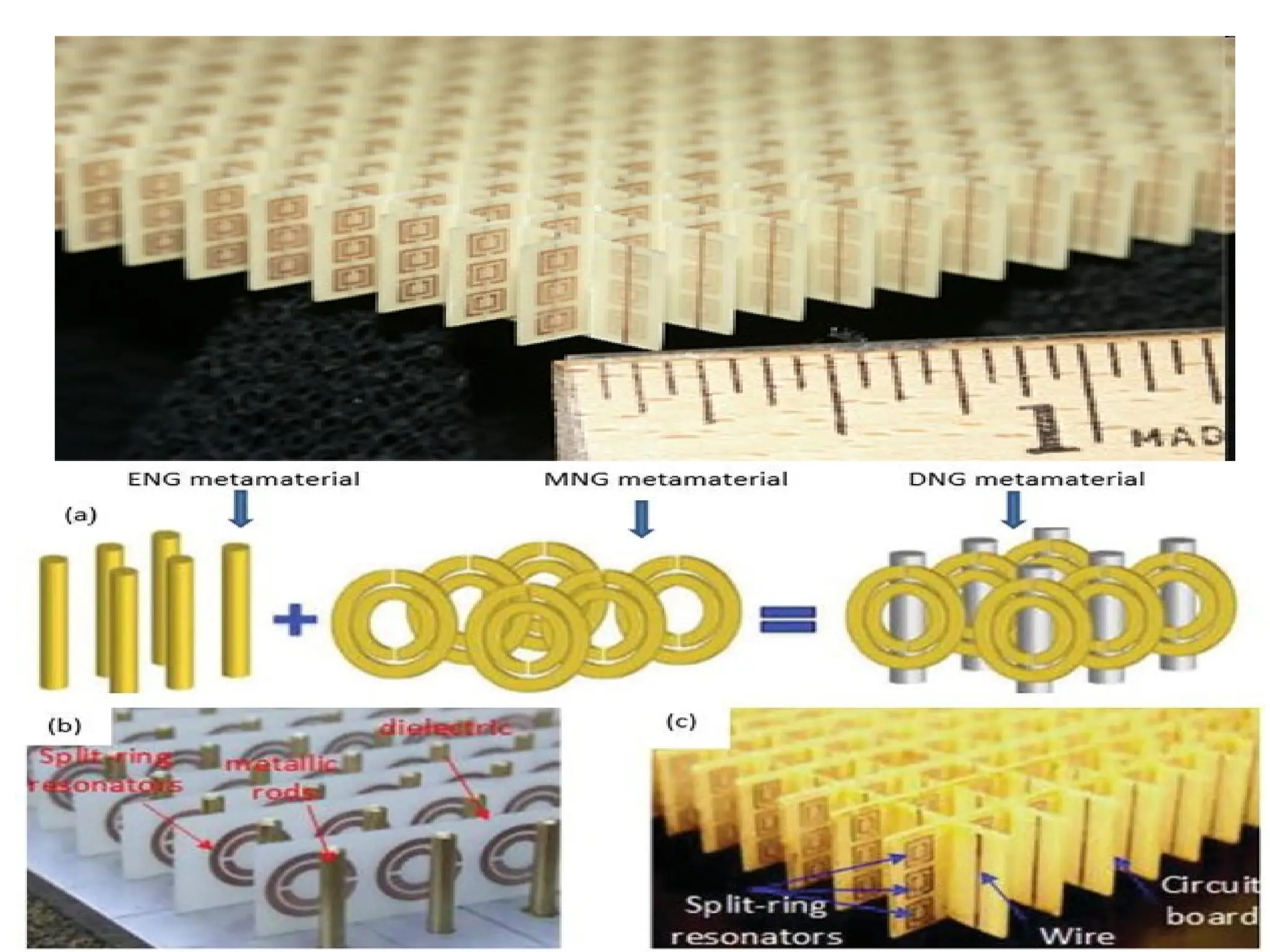
According to David R. Smith, any material
composed of periodic, macroscopic
structures so as to achieve a desired
electromagnetic response can be referred to
as a Metamaterial
What are metamaterials?
• The prefix meta (a Greek word meaning ‘beyond’) indicates that the
characteristics of the material are beyond what we see in nature.
Metamaterials are a novel class of functional materials that are designed
around unique micro- and nanoscale patterns or structures, which cause them
to interact with light and other forms of energy in ways not found in nature.
• Metamaterials are composite materials that are designed and manufactured
artificially. Their unique properties are derived from their internal
microstructures, rather than from their chemical composition, which is found
in natural materials.
• Metamaterials are typically built of multiple identical elements fashioned
from conventional materials, such as metals or nonconductive materials.
Think of a Rubik's cube made of millions of units smaller than the thickness of
a human hair.
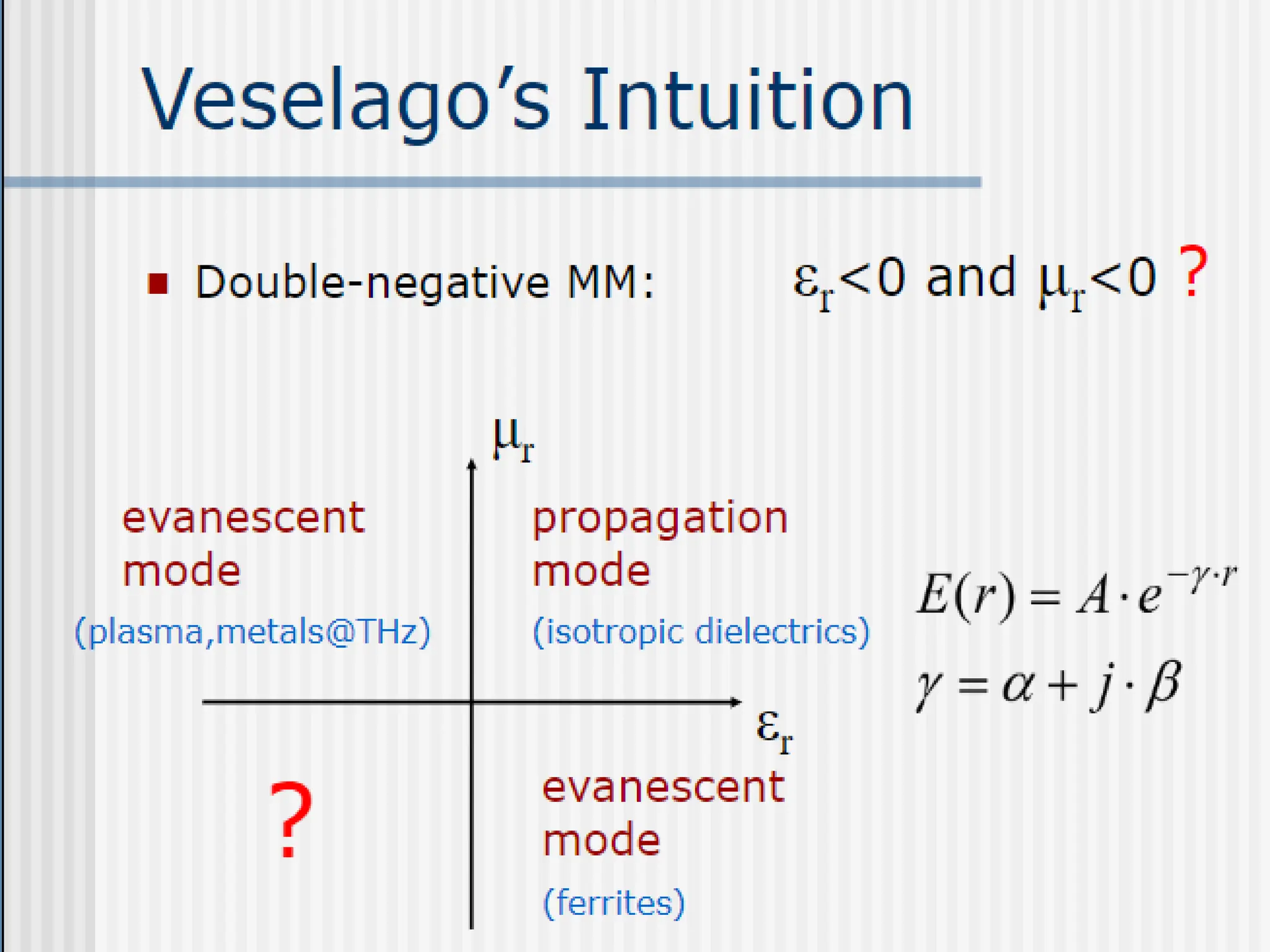
Veselago’s Intuition
The existence of substances with a negative
refractive index was predicted as early as the
middle of the 20th century. In 1976 Soviet
physicist V.G. Veselago published an article that
theoretically describes their properties,
including an unusual refraction of light. The
term metamaterials for such substances was
suggested by Roger Walser in 1999.
How do metamaterials work?
• The essence of metamaterial design lies in creating
materials through artificially crafted structural units with
specific properties and functions. The structural units,
referred to as artificial 'atoms' and 'molecules', can be
customized in terms of shape, size, and lattice constant,
while interactions between them can be engineered.
• Additionally, 'defects' can be strategically placed to further
enhance the desired properties. By arranging the
nanoscale unit cells in a desired geometry, the refractive
index of the metamaterial can be adjusted to positive,
near-zero, or negative values.
Negative refraction
• Among the most sought-after properties of metamaterials is the
negative index of refraction of light and other radiation. Negative
refraction is based on the equations developed in 1861 by Scottish
physicist James Maxwell.
• All known natural materials have a positive refractive index so that
light that crosses from one medium to another gets slightly bent in
the direction of propagation. For example, air at standard conditions
has the lowest index in nature, hovering just above 1. The index of
water is 1.33. That of diamond is about 2.4. The higher a material's
refractive index, the more it distorts light from its original path.
• In some metamaterials, however, negative refraction occurs such
that light and other radiation gets bent backwards as it enters the
structure.
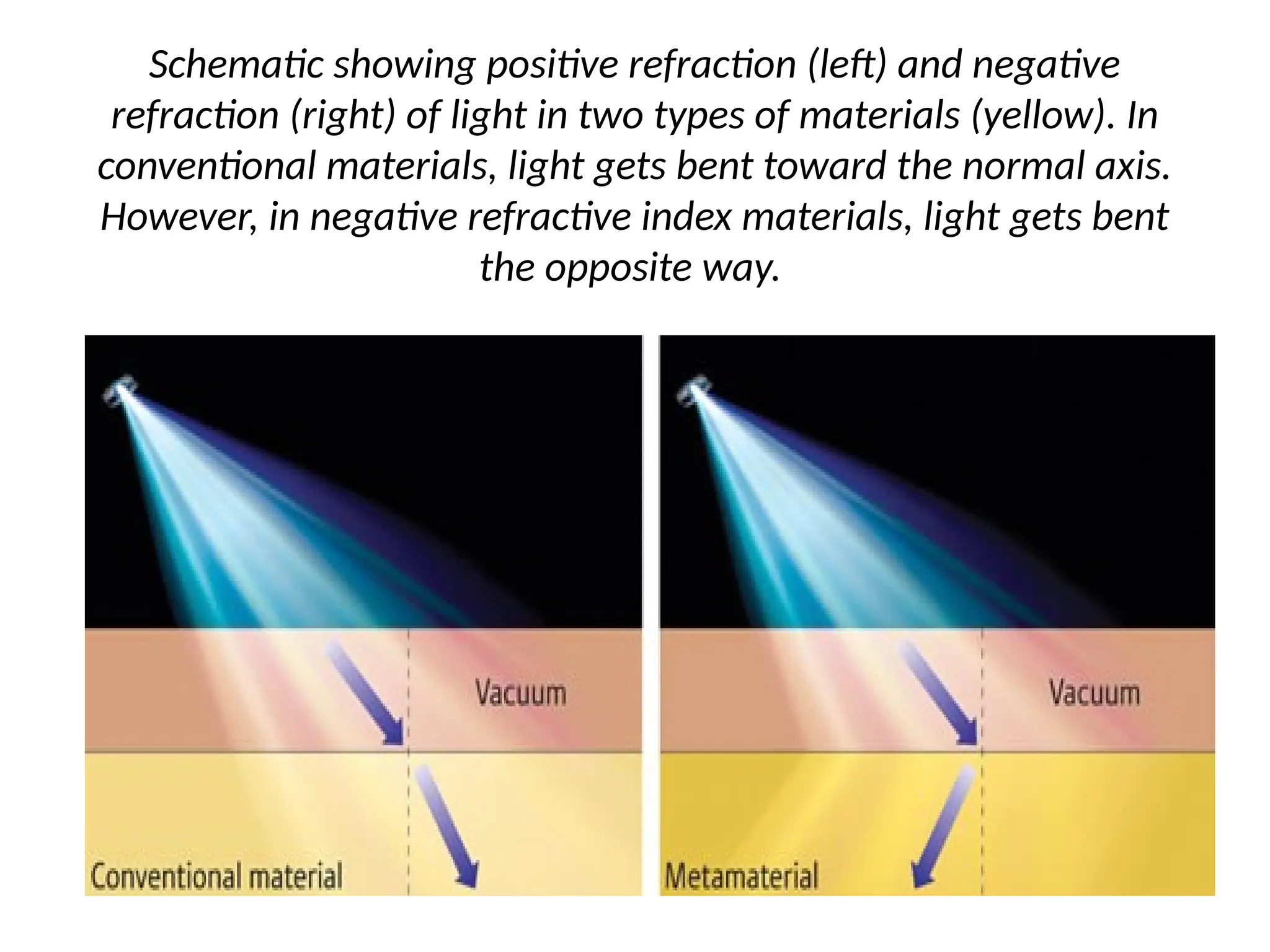
Schematic showing positive refraction (left) and negative
refraction (right) of light in two types of materials (yellow). In
conventional materials, light gets bent toward the normal axis.
However, in negative refractive index materials, light gets bent
the opposite way.
Metasurfaces
• The fascinating functionalities of metamaterials typically
require multiple stacks of material layers, which not only
leads to extensive losses but also brings a lot of
challenges in nanofabrication. Many metamaterials
consist of complex metallic wires and other structures
that require sophisticated fabrication technology and are
difficult to assemble.
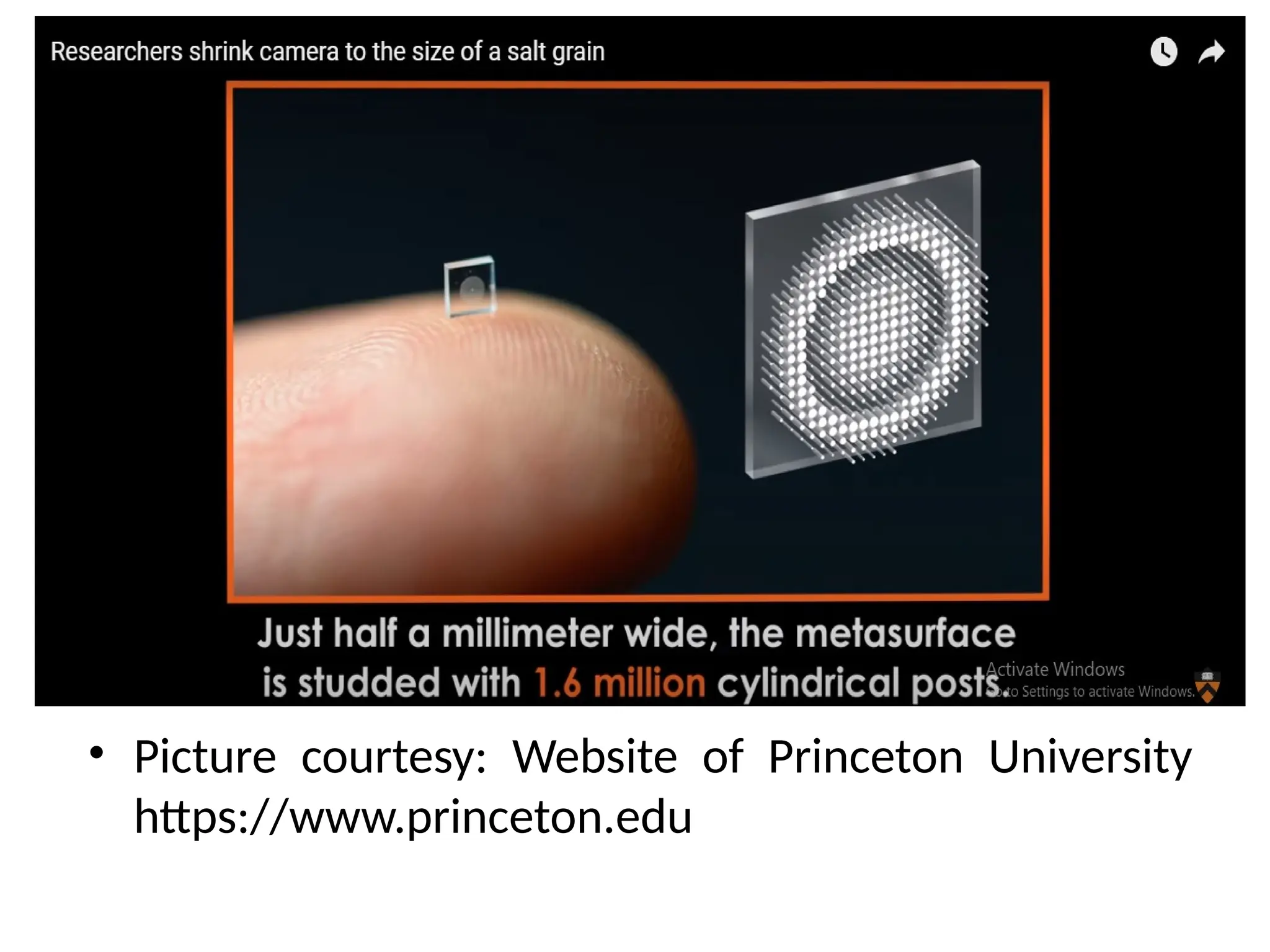
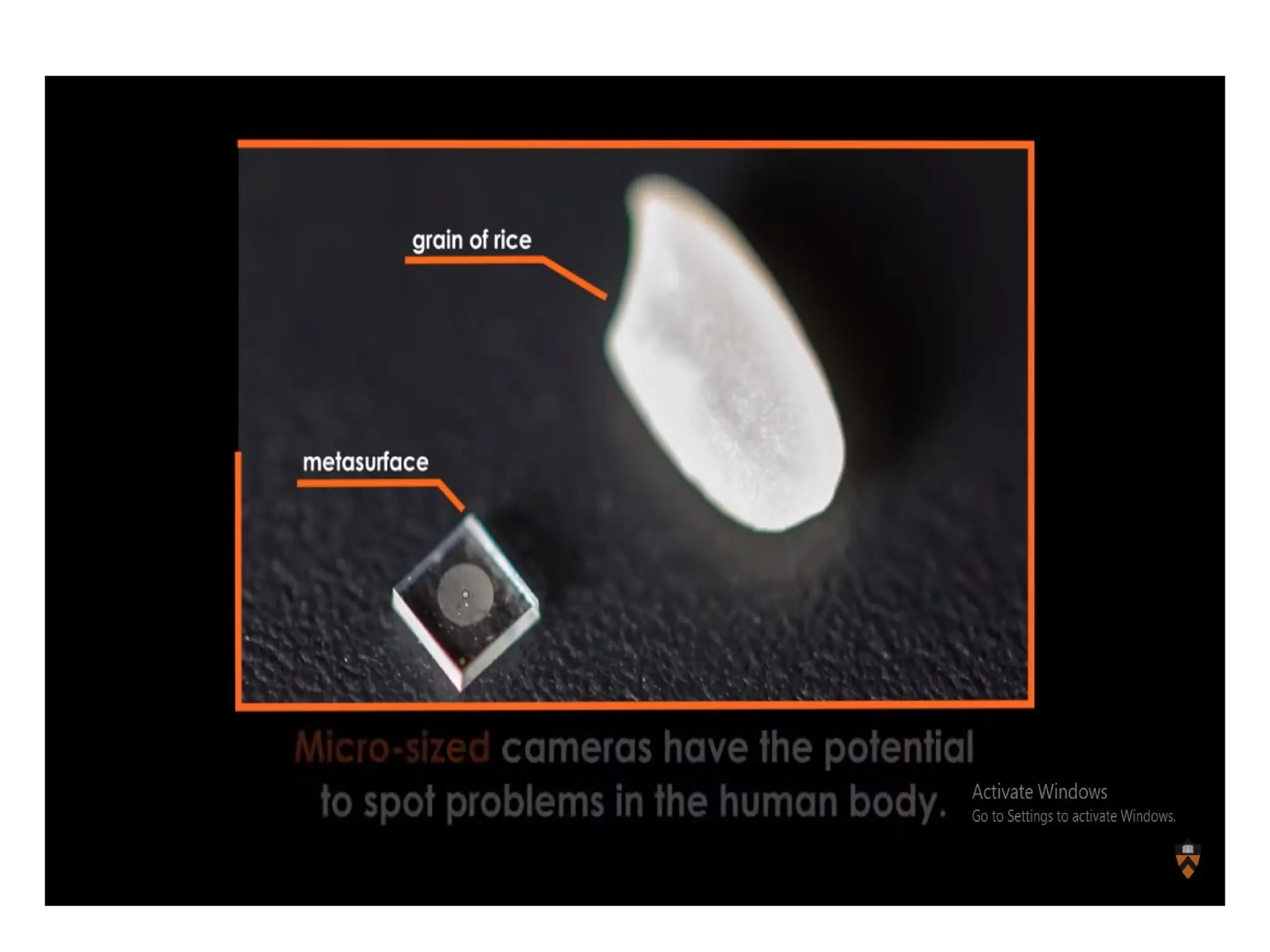
• Metasurfaces are thin-films composed of individual
elements that have initially been developed to overcome
the obstacles that conventional materials are confronted
with.
Operation of Metasurfaces
• The principle of operation of metasurfaces is based on the
phenomenon of diffraction. Any flat periodic array can be viewed as
a diffraction lattice, which splits the incident light into a few rays. The
number and direction of the rays depends on geometrical
parameters: the angle of incidence, wavelength and the period of
the lattice.
• So far, most fabricated metasurfaces are passive, meaning that they
cannot be tuned post fabrication. In contrast, active metasurfaces
allow the dynamic control of its optical properties under external
stimuli. They could be useful in applications ranging from free space
optical communications to holographic displays, and depth sensing.
Advantages over conventional materials
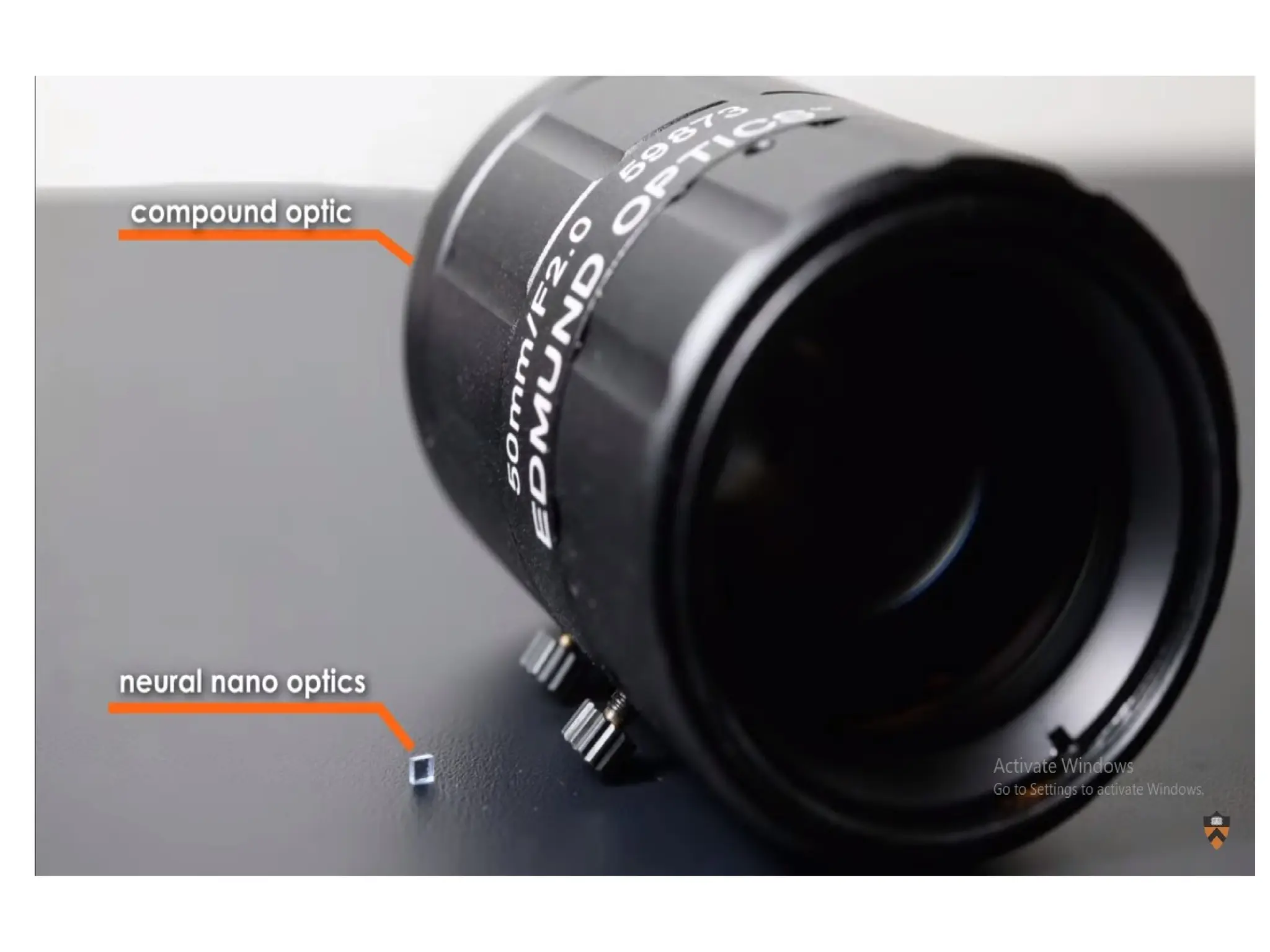
• Metamaterials offer the potential to precisely control the path of light in a material. This
allows the transformation of traditionally bulky optical systems to extremely small form
factors. Metamaterials can also be customized to support novel properties that currently
are not accessible with existing optical hardware, leading to entirely new optical systems.
• Conventional materials interact with electromagnetic radiation like light or radio waves
based on the properties of the material. We are used to how glass bends light or how gold
reflects light. In our everyday encounters with these objects, we know what to expect.
• For instance, we expect gold to be all shiny and yellowish. But when we alter the surface
of the gold with nanoscale structures, that changes how the light behaves when it hits the
gold surface and that changes how we see it. These nano structures take gold from a
conventional material to a metamaterial.
• And although nothing about the gold’s chemical properties have changed, we could now
see it as blue or red.
• Picture courtesy: Website of Princeton University
https://www.princeton.edu
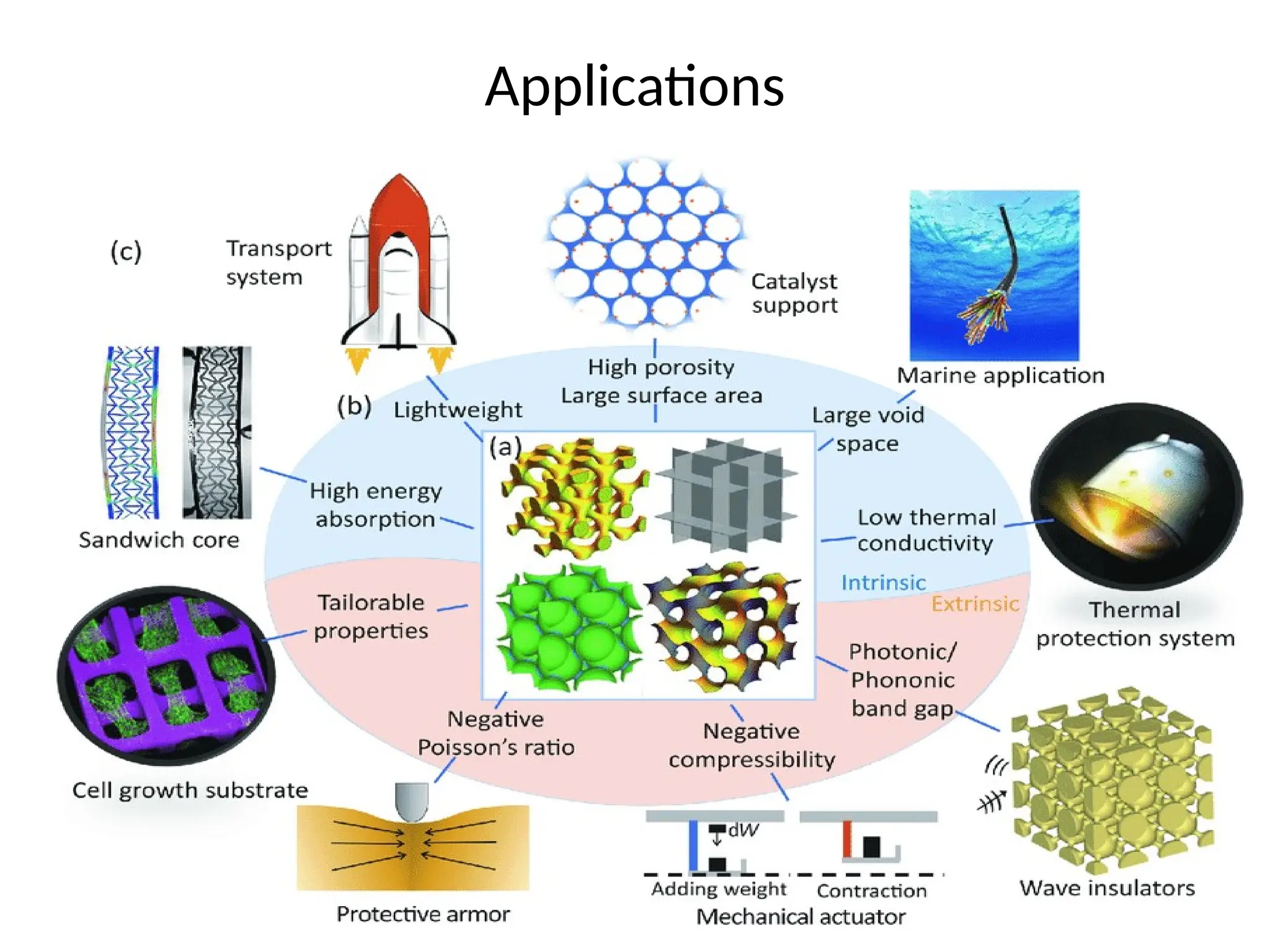
Applications
Applications of metamaterials
Optical camouflage and invisibility cloaks
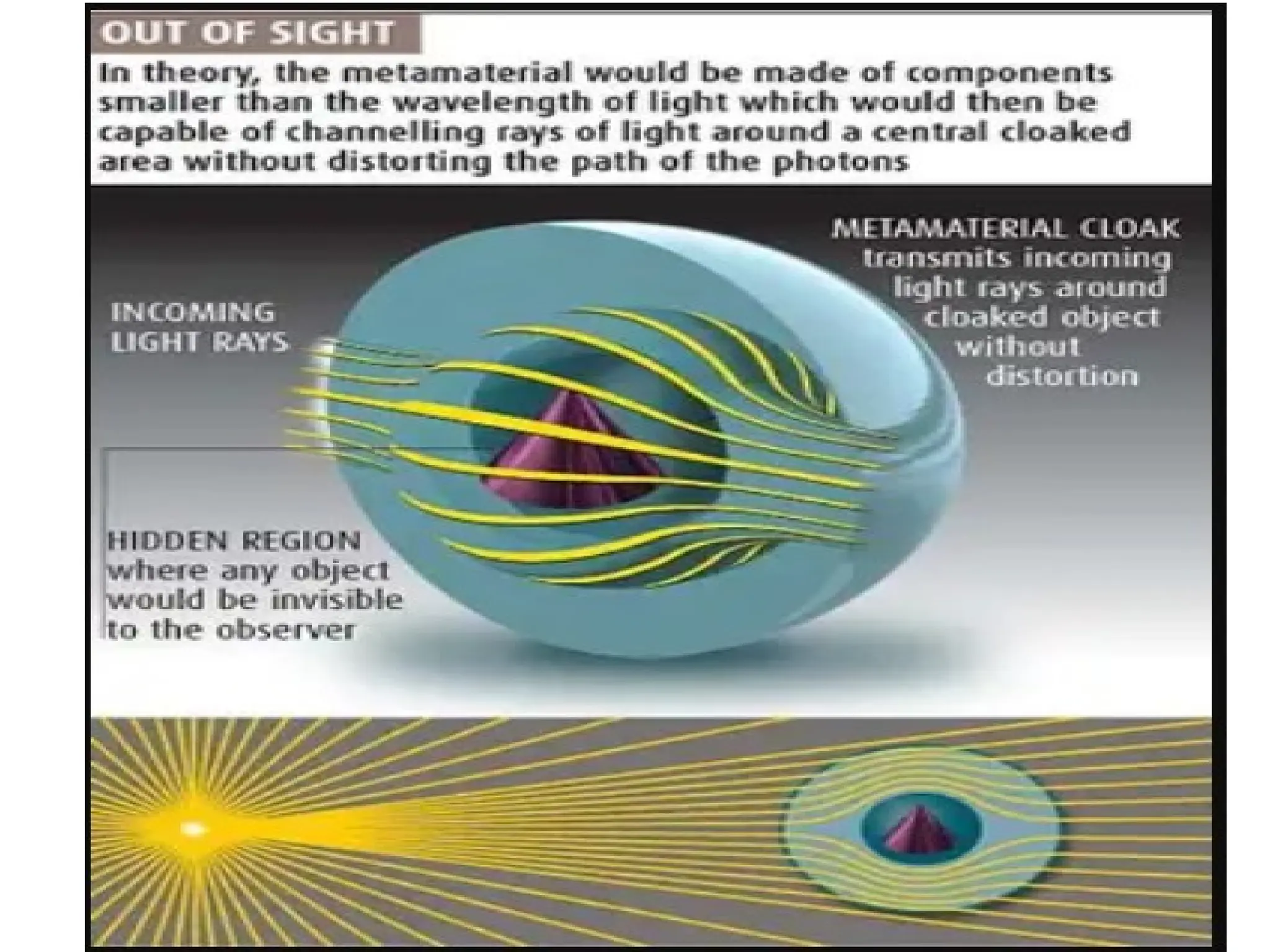
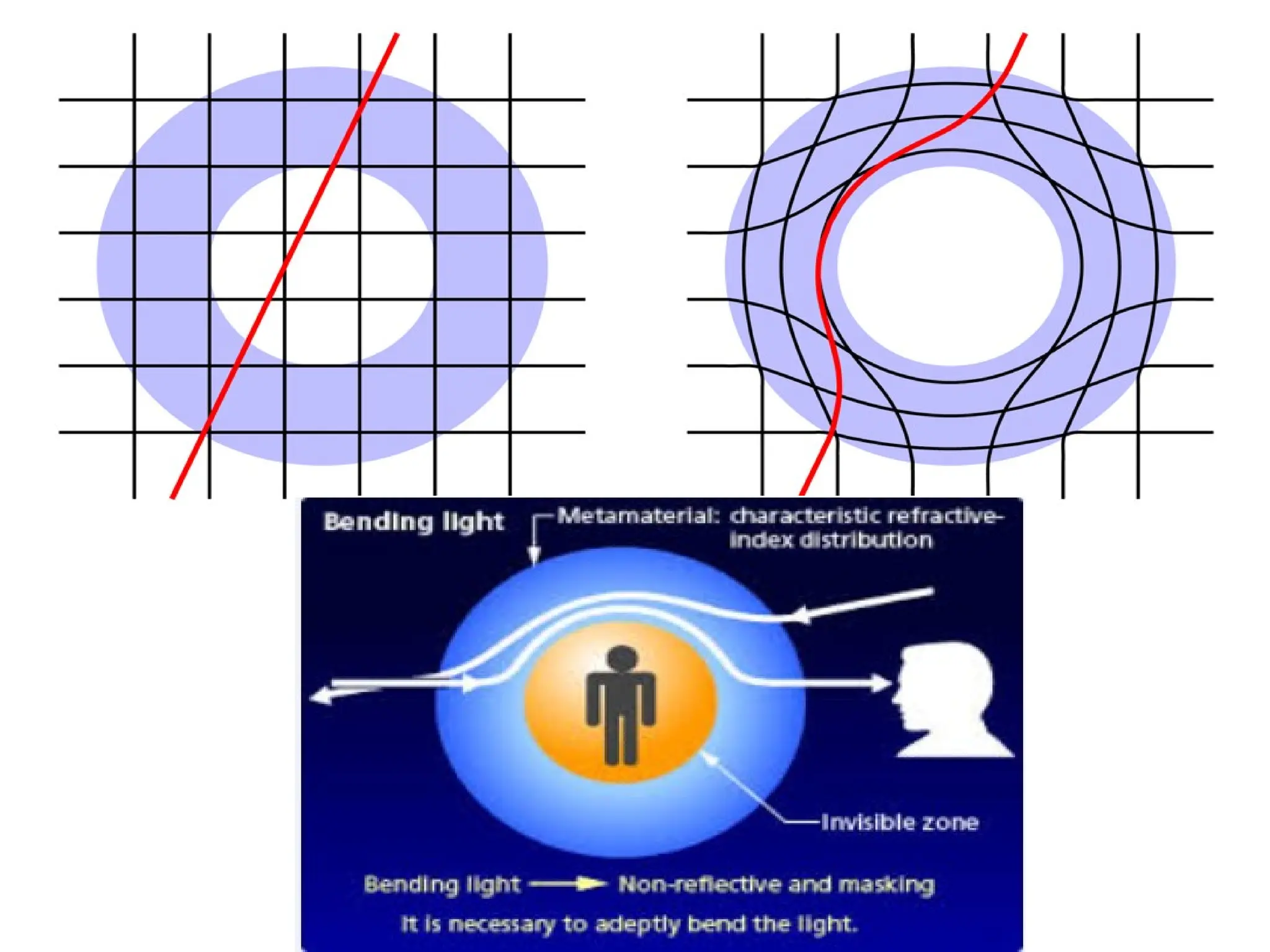
• Metamaterials bend the paths of electromagnetic radiation
(i.e. refraction). For example, a metamaterial invisibility
cloak would bend the paths of light waves around a cloaked
object, accelerating them on their way, and reunite them
on the other side. Thus, an onlooker could see what was
behind the object, while the object itself would be invisible.
• Optical camouflage (such as an invisibility cloaking device)
is a technology to make an object seem invisible by causing
incident light to avoid the object, flow around the object,
and return undisturbed to its original trajectory.
Applications of metamaterials
Improved solar cells
• A metamaterial could be tuned to better match
the solar spectrum, allowing for the development
of broadband wide-angle metamaterials that
could enhance light collection in solar cells. And
metamaterials with a wide-angle response can
accept light from a broad range of angles. In the
case of solar cells, this means more light
collection and less reflected or 'wasted' light.
Applications of metamaterials
Superlens
• One metamaterial application of particular interest is a superlens, a device that might
provide light magnification at levels that dwarf any existing technology.
• The concept of a 'superlens' has attracted significant research interest in the imaging
and photolithography fields since the concept was proposed back in 2000 A superlens
allows to view objects much smaller than the roughly 200 nanometers that a regular
optical lens with visible light would permit. This theoretical resolution limit (diffraction
limit) of conventional optical imaging methodology was the primary factor motivating
the development of higher-resolution scanning probe techniques. Though scanning
electron microscopes can capture objects that are much smaller, down to the single
nanometer range, they are expensive, heavy, and, at the size of a large desk, not very
portable.
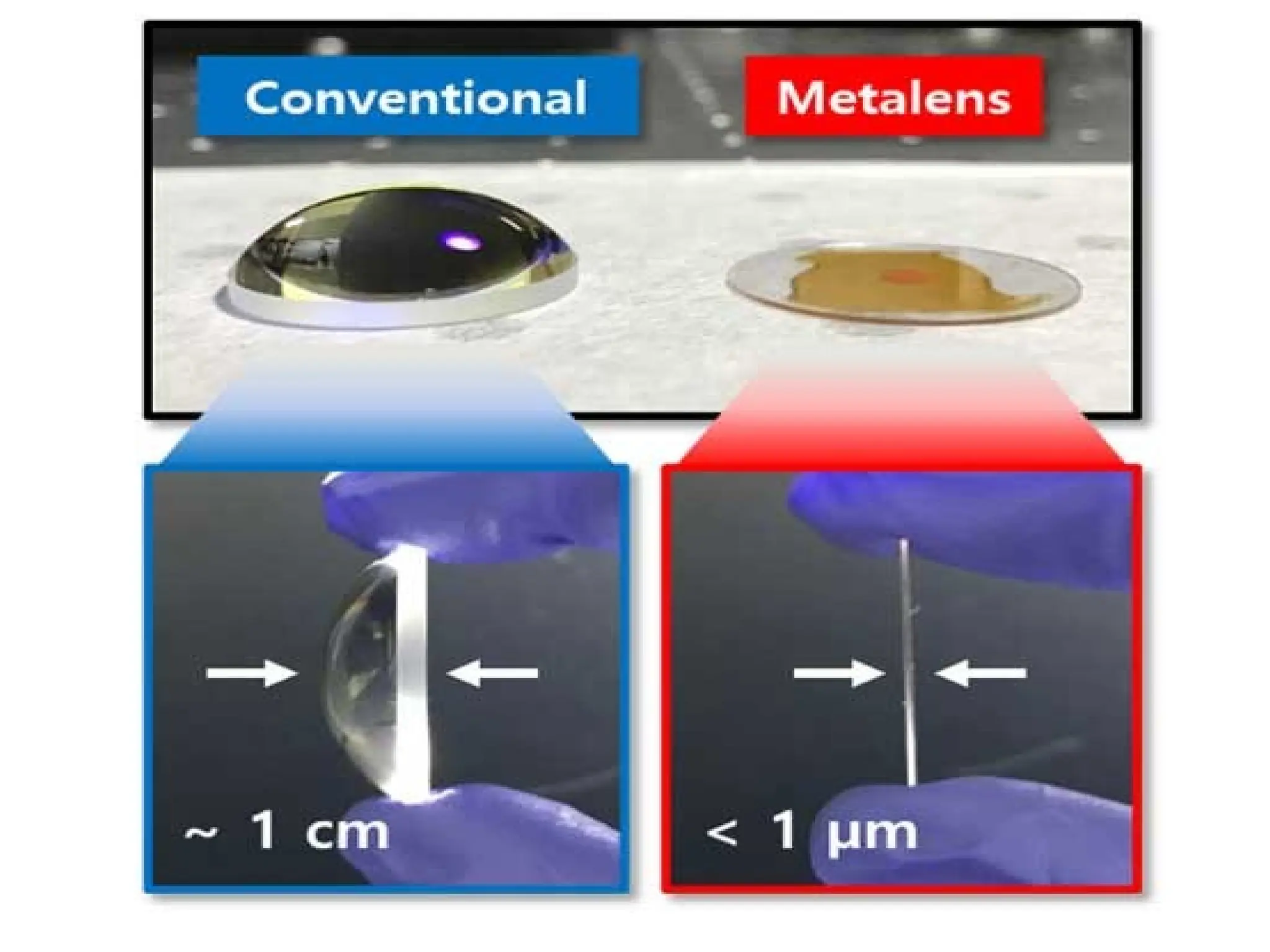
• The metalenses are ultrathin, flat surfaces, they have attracted tremendous attention
because they can overcome limitations of conventional bulky, curved and heavy
optical lenses and they are poised to revolutionize everything from microscopy to
cameras, sensors, and displays
Applications of metamaterials
Acoustic metamaterials
• Acoustic metamaterials could be used in many applications. Large versions
could be used to direct or focus sound to a particular location and form an
audio hotspot. Much smaller versions could be used to focus high intensity
ultrasound to destroy tumors deep within the body. Here, a metamaterial
layer could be tailor-made to fit the body of a patient and tuned to focus the
ultrasound waves where they are needed most.
• Researchers have fabricated a metamaterial lens that focuses radio waves
with extreme precision. The concave lens exhibits a property called negative
refraction, bending electromagnetic waves — in this case, radio waves — in
exactly the opposite sense from which a normal concave lens would work.
• Concave lenses typically radiate radio waves like spokes from a wheel. In this
new metamaterial lens, however, radio waves converge, focusing on a single,
precise point – a property impossible to replicate in natural materials.
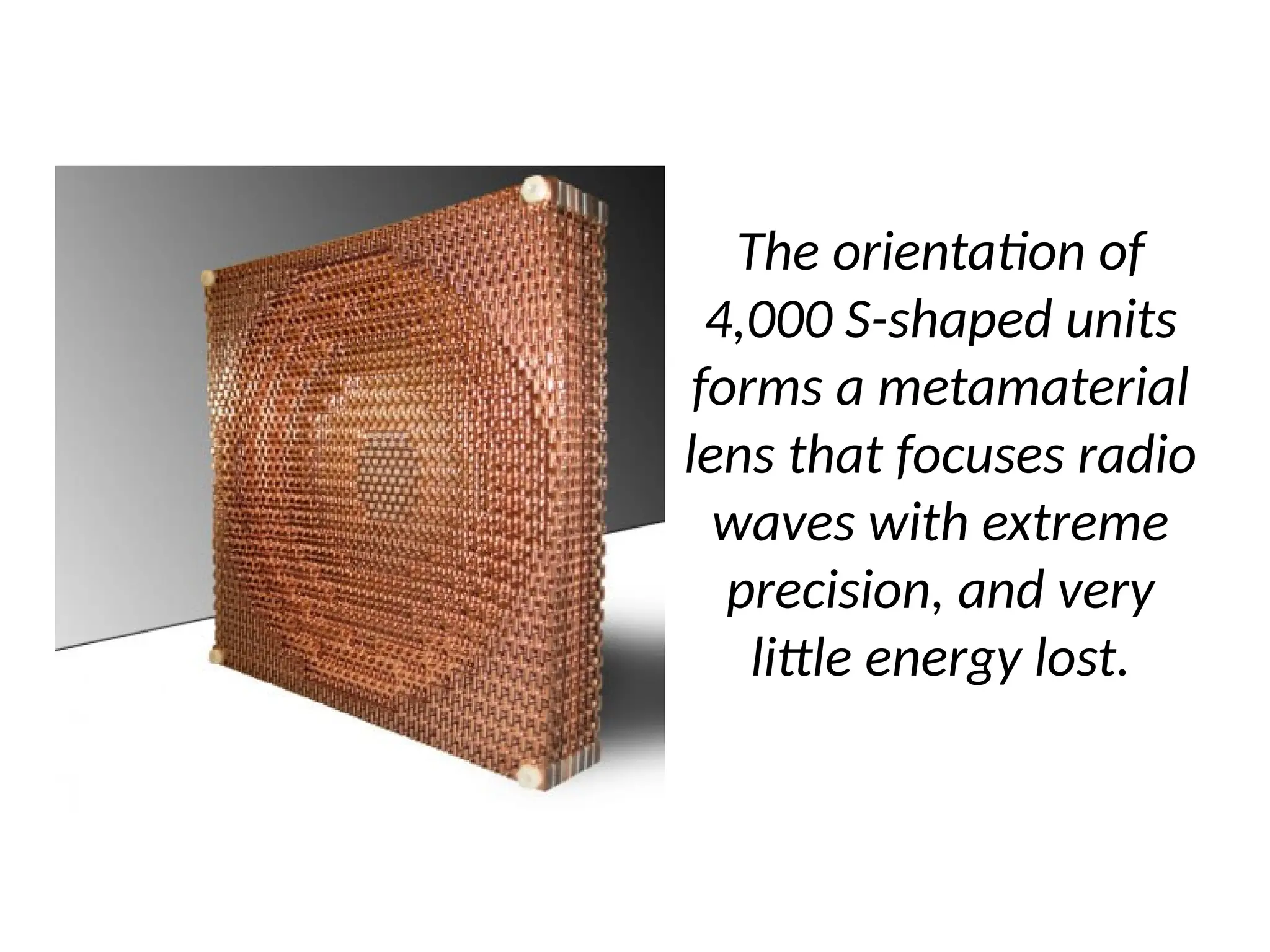
The orientation of
4,000 S-shaped units
forms a metamaterial
lens that focuses radio
waves with extreme
precision, and very
little energy lost.

INTRODUCTION TO METAMATERIAL AND HOW THEY WORKS

  • 1.
  • 2.
    Metamaterials “Meta-” means “altered,changed” or “higher, beyond”, is a prefix meaning “to transcend” Why are they called Metamaterials? - Existing materials only exhibit a small subset of electromagnetic properties theoretically available - Metamaterials can have their electromagnetic properties altered to something beyond what can be found in nature. - Can achieve negative index of refraction, magnetism at optical frequencies, etc.
  • 3.
    Metamaterials The word “Metamaterial”was coined in the late 1990’s  According to David R. Smith, any material composed of periodic, macroscopic structures so as to achieve a desired electromagnetic response can be referred to as a Metamaterial
  • 5.
    What are metamaterials? •The prefix meta (a Greek word meaning ‘beyond’) indicates that the characteristics of the material are beyond what we see in nature. Metamaterials are a novel class of functional materials that are designed around unique micro- and nanoscale patterns or structures, which cause them to interact with light and other forms of energy in ways not found in nature. • Metamaterials are composite materials that are designed and manufactured artificially. Their unique properties are derived from their internal microstructures, rather than from their chemical composition, which is found in natural materials. • Metamaterials are typically built of multiple identical elements fashioned from conventional materials, such as metals or nonconductive materials. Think of a Rubik's cube made of millions of units smaller than the thickness of a human hair.
  • 7.
    Veselago’s Intuition The existenceof substances with a negative refractive index was predicted as early as the middle of the 20th century. In 1976 Soviet physicist V.G. Veselago published an article that theoretically describes their properties, including an unusual refraction of light. The term metamaterials for such substances was suggested by Roger Walser in 1999.
  • 8.
    How do metamaterialswork? • The essence of metamaterial design lies in creating materials through artificially crafted structural units with specific properties and functions. The structural units, referred to as artificial 'atoms' and 'molecules', can be customized in terms of shape, size, and lattice constant, while interactions between them can be engineered. • Additionally, 'defects' can be strategically placed to further enhance the desired properties. By arranging the nanoscale unit cells in a desired geometry, the refractive index of the metamaterial can be adjusted to positive, near-zero, or negative values.
  • 9.
    Negative refraction • Amongthe most sought-after properties of metamaterials is the negative index of refraction of light and other radiation. Negative refraction is based on the equations developed in 1861 by Scottish physicist James Maxwell. • All known natural materials have a positive refractive index so that light that crosses from one medium to another gets slightly bent in the direction of propagation. For example, air at standard conditions has the lowest index in nature, hovering just above 1. The index of water is 1.33. That of diamond is about 2.4. The higher a material's refractive index, the more it distorts light from its original path. • In some metamaterials, however, negative refraction occurs such that light and other radiation gets bent backwards as it enters the structure.
  • 10.
    Schematic showing positiverefraction (left) and negative refraction (right) of light in two types of materials (yellow). In conventional materials, light gets bent toward the normal axis. However, in negative refractive index materials, light gets bent the opposite way.
  • 11.
    Metasurfaces • The fascinatingfunctionalities of metamaterials typically require multiple stacks of material layers, which not only leads to extensive losses but also brings a lot of challenges in nanofabrication. Many metamaterials consist of complex metallic wires and other structures that require sophisticated fabrication technology and are difficult to assemble. • Metasurfaces are thin-films composed of individual elements that have initially been developed to overcome the obstacles that conventional materials are confronted with.
  • 12.
    Operation of Metasurfaces •The principle of operation of metasurfaces is based on the phenomenon of diffraction. Any flat periodic array can be viewed as a diffraction lattice, which splits the incident light into a few rays. The number and direction of the rays depends on geometrical parameters: the angle of incidence, wavelength and the period of the lattice. • So far, most fabricated metasurfaces are passive, meaning that they cannot be tuned post fabrication. In contrast, active metasurfaces allow the dynamic control of its optical properties under external stimuli. They could be useful in applications ranging from free space optical communications to holographic displays, and depth sensing.
  • 13.
    Advantages over conventionalmaterials • Metamaterials offer the potential to precisely control the path of light in a material. This allows the transformation of traditionally bulky optical systems to extremely small form factors. Metamaterials can also be customized to support novel properties that currently are not accessible with existing optical hardware, leading to entirely new optical systems. • Conventional materials interact with electromagnetic radiation like light or radio waves based on the properties of the material. We are used to how glass bends light or how gold reflects light. In our everyday encounters with these objects, we know what to expect. • For instance, we expect gold to be all shiny and yellowish. But when we alter the surface of the gold with nanoscale structures, that changes how the light behaves when it hits the gold surface and that changes how we see it. These nano structures take gold from a conventional material to a metamaterial. • And although nothing about the gold’s chemical properties have changed, we could now see it as blue or red.
  • 14.
    • Picture courtesy:Website of Princeton University https://www.princeton.edu
  • 18.
  • 19.
    Applications of metamaterials Opticalcamouflage and invisibility cloaks • Metamaterials bend the paths of electromagnetic radiation (i.e. refraction). For example, a metamaterial invisibility cloak would bend the paths of light waves around a cloaked object, accelerating them on their way, and reunite them on the other side. Thus, an onlooker could see what was behind the object, while the object itself would be invisible. • Optical camouflage (such as an invisibility cloaking device) is a technology to make an object seem invisible by causing incident light to avoid the object, flow around the object, and return undisturbed to its original trajectory.
  • 22.
    Applications of metamaterials Improvedsolar cells • A metamaterial could be tuned to better match the solar spectrum, allowing for the development of broadband wide-angle metamaterials that could enhance light collection in solar cells. And metamaterials with a wide-angle response can accept light from a broad range of angles. In the case of solar cells, this means more light collection and less reflected or 'wasted' light.
  • 23.
    Applications of metamaterials Superlens •One metamaterial application of particular interest is a superlens, a device that might provide light magnification at levels that dwarf any existing technology. • The concept of a 'superlens' has attracted significant research interest in the imaging and photolithography fields since the concept was proposed back in 2000 A superlens allows to view objects much smaller than the roughly 200 nanometers that a regular optical lens with visible light would permit. This theoretical resolution limit (diffraction limit) of conventional optical imaging methodology was the primary factor motivating the development of higher-resolution scanning probe techniques. Though scanning electron microscopes can capture objects that are much smaller, down to the single nanometer range, they are expensive, heavy, and, at the size of a large desk, not very portable. • The metalenses are ultrathin, flat surfaces, they have attracted tremendous attention because they can overcome limitations of conventional bulky, curved and heavy optical lenses and they are poised to revolutionize everything from microscopy to cameras, sensors, and displays
  • 25.
    Applications of metamaterials Acousticmetamaterials • Acoustic metamaterials could be used in many applications. Large versions could be used to direct or focus sound to a particular location and form an audio hotspot. Much smaller versions could be used to focus high intensity ultrasound to destroy tumors deep within the body. Here, a metamaterial layer could be tailor-made to fit the body of a patient and tuned to focus the ultrasound waves where they are needed most. • Researchers have fabricated a metamaterial lens that focuses radio waves with extreme precision. The concave lens exhibits a property called negative refraction, bending electromagnetic waves — in this case, radio waves — in exactly the opposite sense from which a normal concave lens would work. • Concave lenses typically radiate radio waves like spokes from a wheel. In this new metamaterial lens, however, radio waves converge, focusing on a single, precise point – a property impossible to replicate in natural materials.
  • 26.
    The orientation of 4,000S-shaped units forms a metamaterial lens that focuses radio waves with extreme precision, and very little energy lost.