Seminar
On
Nanomaterials and Metamaterials
By
Deepak Raj (2016JIT2116)
Industrial Tribology, Machine Dynamics and
Maintenance Engineering Centre (ITMMEC)
IIT Delhi
Nanomaterials
• Nanomaterial are characterized by at least one
dimension in the Nanometer range.
• Carbon is the key element in Nanotechnology and
so sometime nanotechnology also called carbon
Nanotechnology.
22/09/2016 IIT Delhi 2
Two principal factors cause the properties of
nanomaterials to differ significantly from Bulk
materials:
1. Increased relative surface area
2. Quantum effects.
These factors can change or enhance
properties such as reactivity, strength and
electrical characteristics.
22/09/2016 IIT Delhi 3
Surface Effects
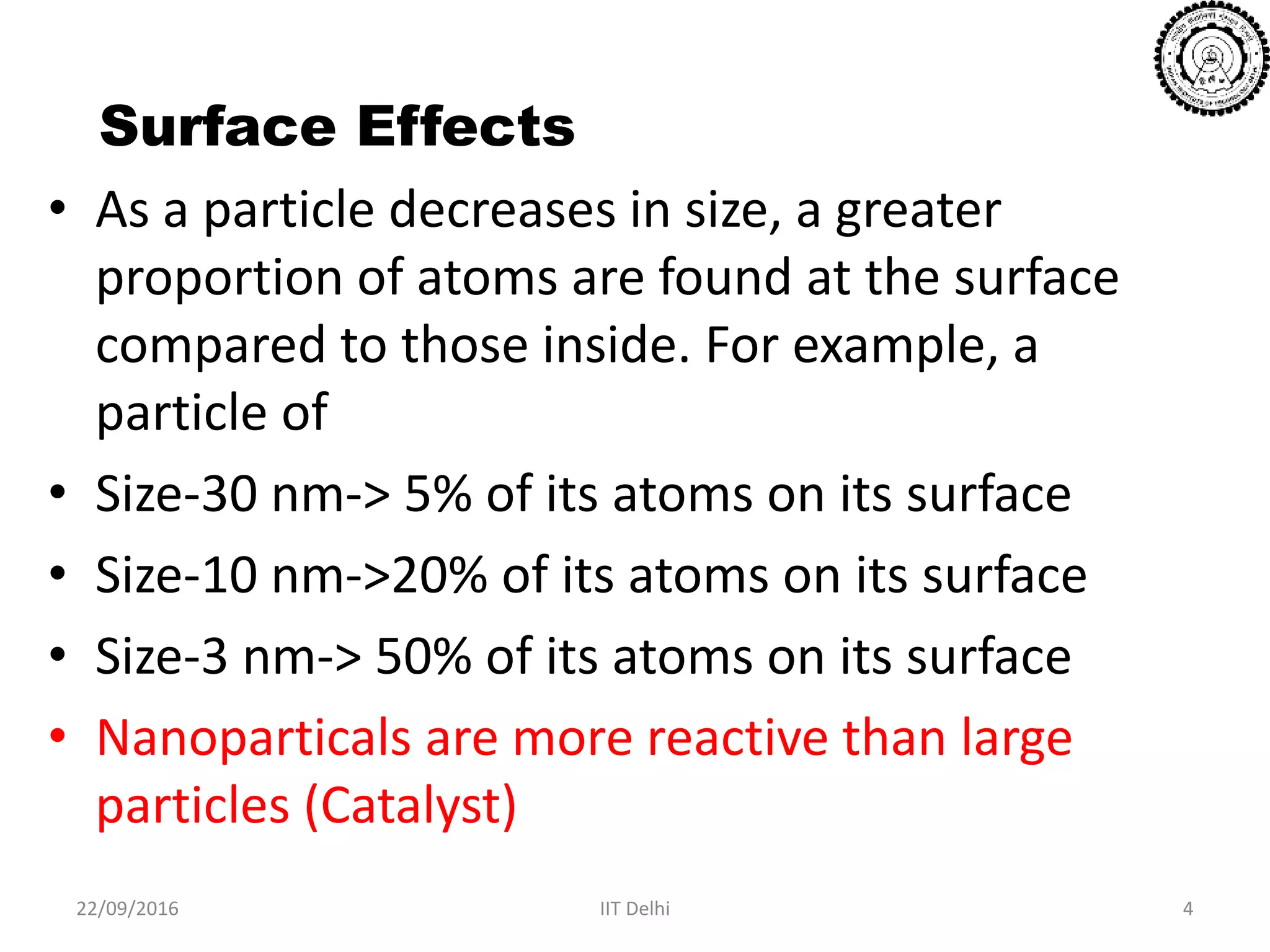
• As a particle decreases in size, a greater
proportion of atoms are found at the surface
compared to those inside. For example, a
particle of
• Size-30 nm-> 5% of its atoms on its surface
• Size-10 nm->20% of its atoms on its surface
• Size-3 nm-> 50% of its atoms on its surface
• Nanoparticals are more reactive than large
particles (Catalyst)
22/09/2016 IIT Delhi 4
Quantum Effects
Quantum confinement
The quantum confinement effect can be observed once the
diameter of the particle is of the same magnitude as the
wavelength of the electron Wave function.
Quantum confinement is responsible for the increase of
energy difference between energy states and band gap. A
phenomenon tightly related with the optical and electronic
properties of the materials.
When materials are this small, their electronic and optical
properties deviate substantially from those of bulk
materials.(GOLD)
22/09/2016 IIT Delhi 5
22/09/2016 IIT Delhi 6
Classification
22/09/2016 IIT Delhi 7
Graphene
• Monolayer of 2-D lattice of SP2 bonded carbon
atoms
• Bond Length approximately 0.14 nm
• Produced by mechanical cleavage of Graphite
• It is a gapless semiconductor
• Very promising to make ballistic field effect
transistor, can be used for development of carbon
transistor
22/09/2016 IIT Delhi 8
Carbon Nanotubes(CNT)
• It is single sheet of graphite rolled into a tube,
both ends of which are capped with fullurene
hemisphere.
• Length is much greater than diameter.
• Extremely strong, stiff and relatively ductile.
• These have relatively low density
• So also termed as Ultimate fibre as extremely
promising as reinforcement.
22/09/2016 IIT Delhi 9
Quantum Dots
• Quantum dots (QD) are very small particles, so
small that their optical and electronic
properties differ from those of larger particles.
• Quantum dots are also sometimes referred to
as artificial atoms.
• These are semiconductor nanocrystals.
• It emits specific wavelength of electro
magnetic radiation depending
on its size.
22/09/2016 IIT Delhi 10
Properties
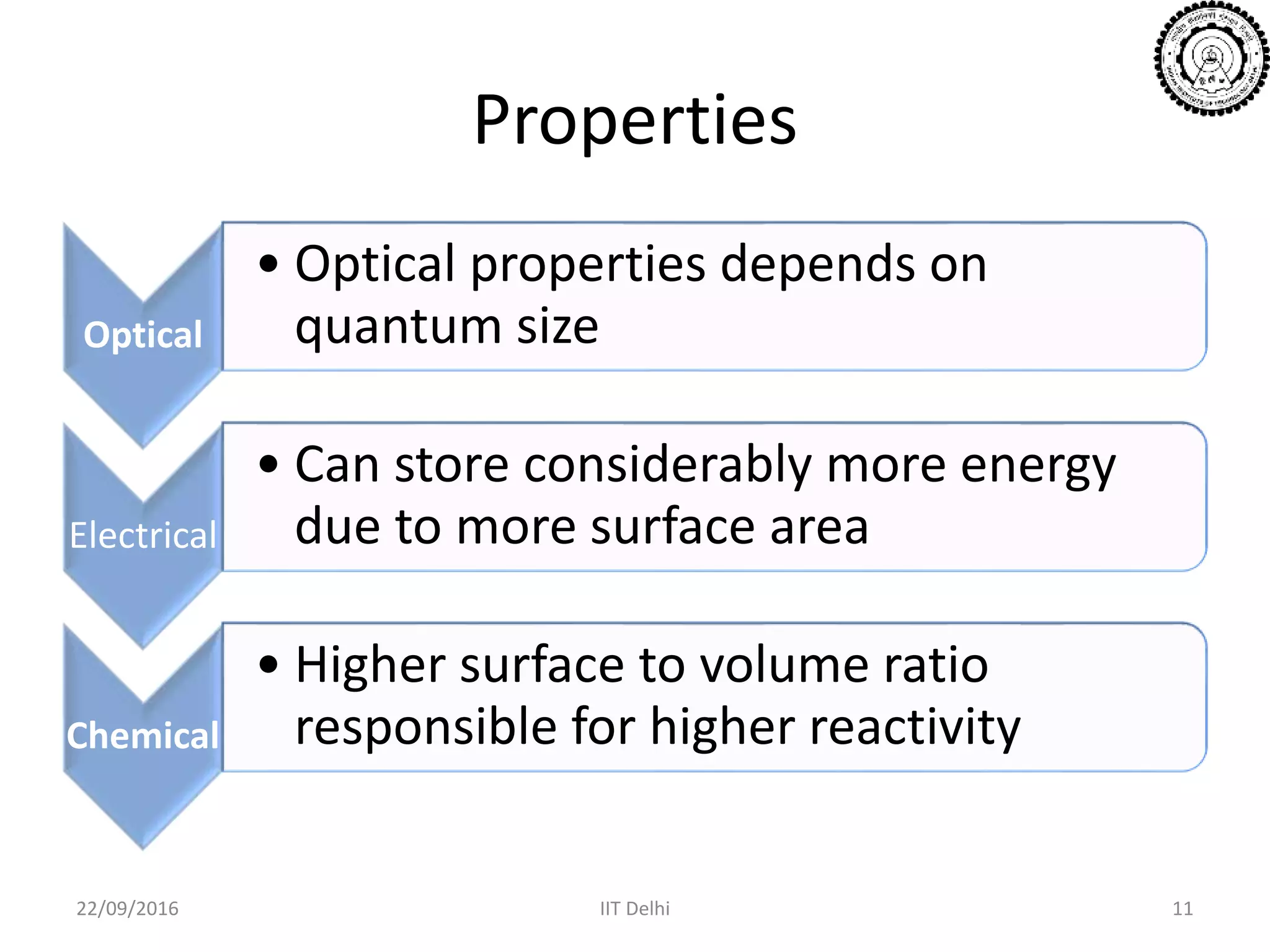
Optical
• Optical properties depends on
quantum size
Electrical
• Can store considerably more energy
due to more surface area
Chemical
• Higher surface to volume ratio
responsible for higher reactivity
22/09/2016 IIT Delhi 11
Metamaterials
22/09/2016 IIT Delhi 12
What is a Metamaterial?
A periodic material that derives its
properties from its structure rather
than its components.
• A metamaterial ( Greek word μετά meta,
meaning "beyond") is a material engineered
to have a property that is not found in nature.
• The materials are usually arranged in
repeating patterns, at scales that are smaller
than the wavelengths of the phenomena they
influence.
• Metamaterials derive their properties not
from the properties of the base materials, but
from their newly designed structures.
22/09/2016 IIT Delhi 14
Their precise shape, geometry, size, orientation and
arrangement gives them their smart properties
capable of manipulating electromagnetic waves: by
blocking, absorbing, enhancing, or bending waves,
to achieve benefits that go beyond what is possible
with conventional materials.
• Can achieve negative index of refraction, zero
index of refraction, magnetism at optical
frequencies, etc.
22/09/2016 IIT Delhi 15
Classification
22/09/2016 IIT Delhi 16
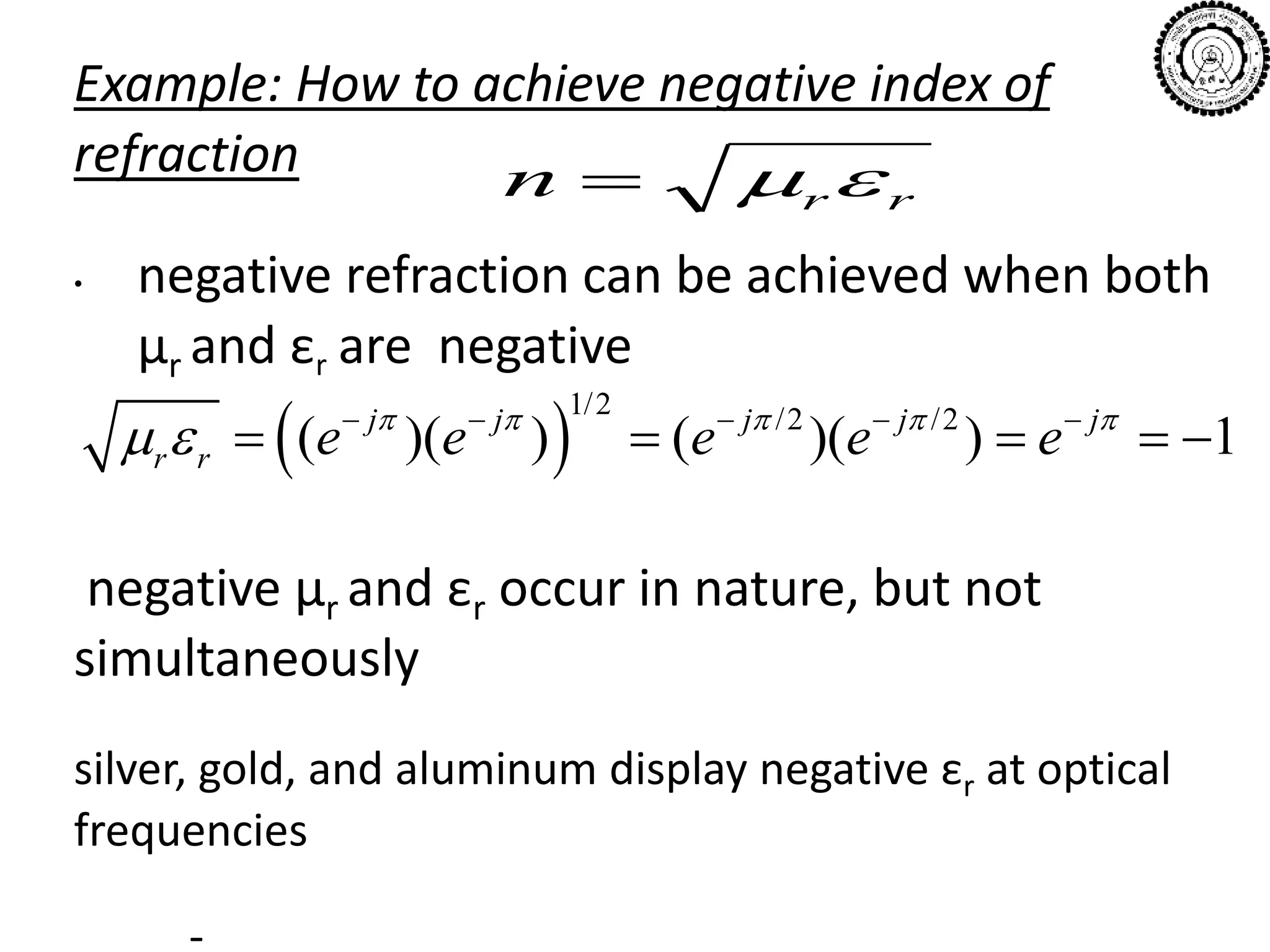
Example: How to achieve negative index of
refraction
• negative refraction can be achieved when both
µr and εr are negative
negative µr and εr occur in nature, but not
simultaneously
silver, gold, and aluminum display negative εr at optical
frequencies
-
rrn 
 
1/2 /2 /2
( )( ) ( )( ) 1j j j j j
r r e e e e e    
      
    
22/09/2016 IIT Delhi 18
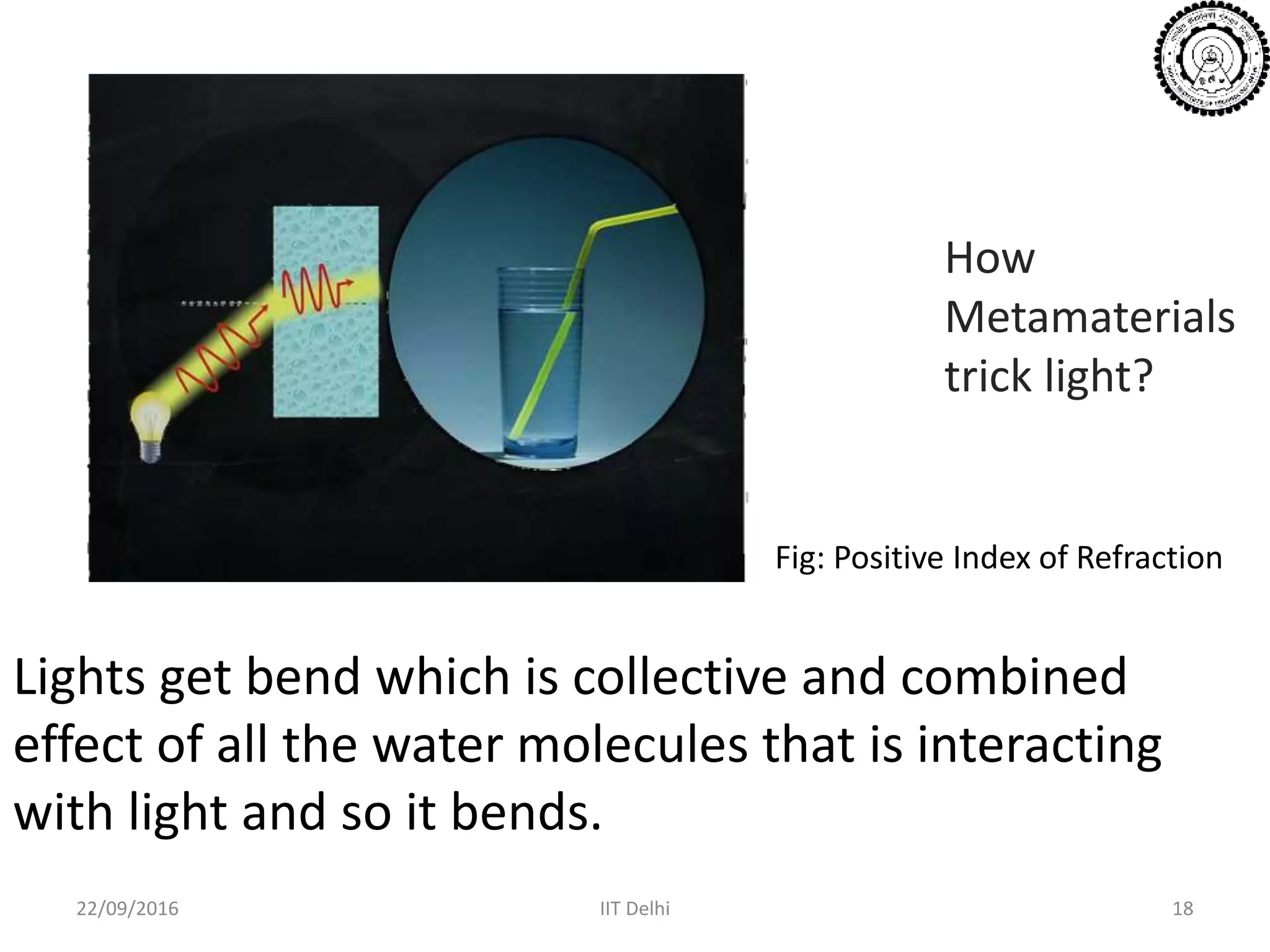
How
Metamaterials
trick light?
Lights get bend which is collective and combined
effect of all the water molecules that is interacting
with light and so it bends.
Fig: Positive Index of Refraction
22/09/2016 IIT Delhi 19
Fig: Negative Index of Refraction
Light gets bend otherway. This is because it is
a negative index metamaterials.
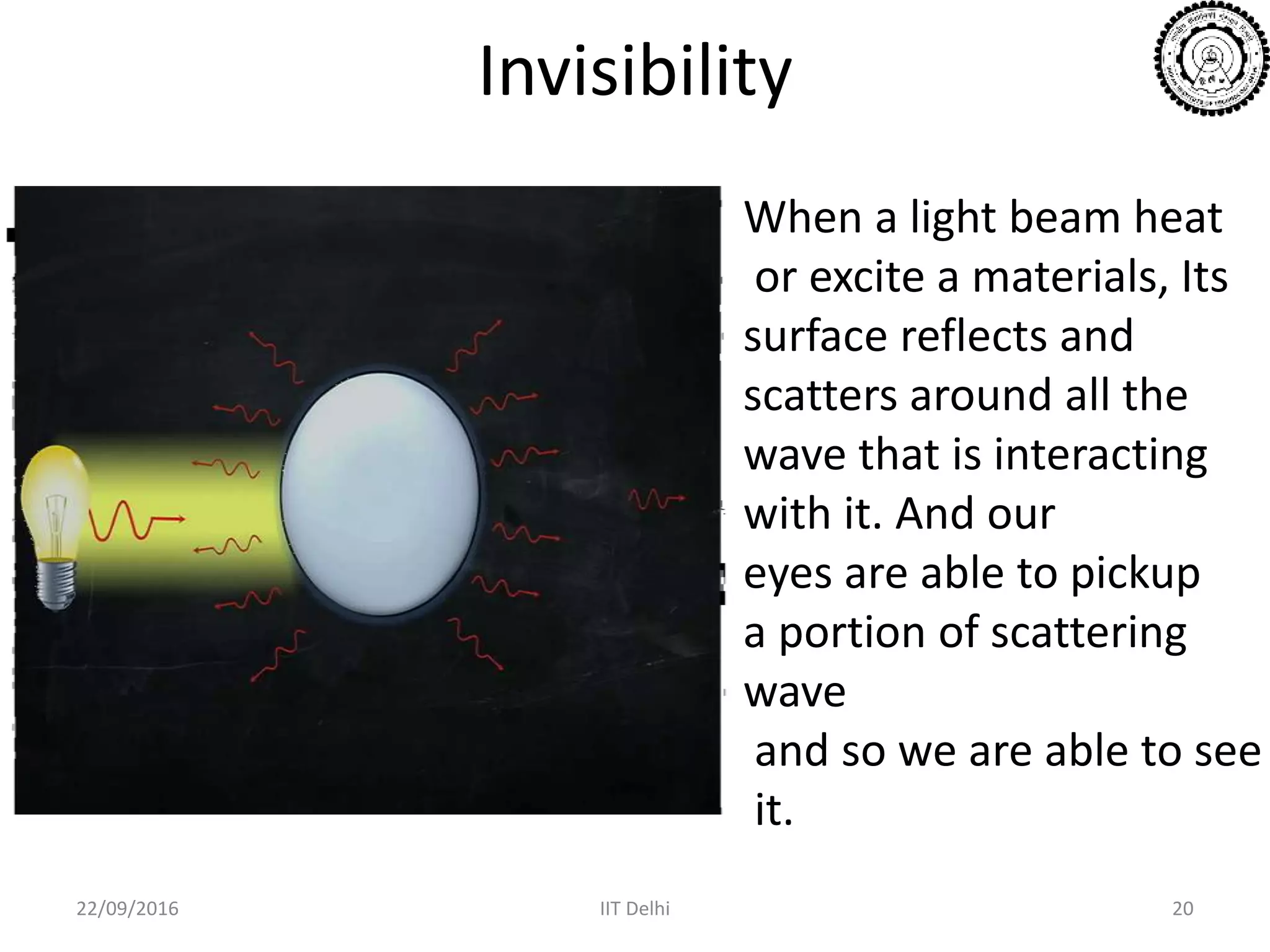
Invisibility
22/09/2016 IIT Delhi 20
When a light beam heat
or excite a materials, Its
surface reflects and
scatters around all the
wave that is interacting
with it. And our
eyes are able to pickup
a portion of scattering
wave
and so we are able to see
it.
• If we can avoid all the interaction between light and
object or cancel all the scattered wave , the object can
become invisible.
• We want to eliminate whole scattered wave around the
object including the shadow on the back of the object
so to make object completely undetectable.
• Possible by designing Metamaterials that would scatter
a form of negative light opposite to that of object then
by balancing the positive light scattered from the
object and negative light scattered from Metamaterials
, It may be able to cancel the whole scattered wave and
the light gets through the object without being
detected.
22/09/2016 IIT Delhi 21
22/09/2016 IIT Delhi 22
22/09/2016 IIT Delhi 23
Application of Metamaterials
Bend light to effectively create an invisibility cloak
Construct satellite trackers that never need to move.
Similar technology could serve as portable, energy-
efficient satellite communication units for soldiers on
the battlefield.
Enable ultra-fast data processing. Metamaterials
could also reduce the size of chips so that they'd be
tiny and speedy.
22/09/2016 IIT Delhi 24
Beam broadband connections to planes, trains, ships
and cars. Imagine having internet access, well,
everywhere.
Create a camera that uses compressed microwave
images without a lens or moving parts. This could
replace the bulky gateways currently in use at airports.
Become the building blocks for a high-speed fiber-
optic telecommunications network
Contribute to making efficient solar cells less bulky
22/09/2016 IIT Delhi 25
Questions
1. What factors enhance the properties of
Nanomaterials?
2. Classify nanomaterial citing example of each.
3. Write Short notes on Graphene, CNT and
Quantum Dots.
4. Mathematically show how negative refractive
index achieved in Metamaterials?
5. Illustrate the concept of Invisibility?
6. What are the application of Metamaterials?
22/09/2016 IIT Delhi 26

Nanomaterial and meta materials

  • 1.
    Seminar On Nanomaterials and Metamaterials By DeepakRaj (2016JIT2116) Industrial Tribology, Machine Dynamics and Maintenance Engineering Centre (ITMMEC) IIT Delhi
  • 2.
    Nanomaterials • Nanomaterial arecharacterized by at least one dimension in the Nanometer range. • Carbon is the key element in Nanotechnology and so sometime nanotechnology also called carbon Nanotechnology. 22/09/2016 IIT Delhi 2
  • 3.
    Two principal factorscause the properties of nanomaterials to differ significantly from Bulk materials: 1. Increased relative surface area 2. Quantum effects. These factors can change or enhance properties such as reactivity, strength and electrical characteristics. 22/09/2016 IIT Delhi 3
  • 4.
    Surface Effects • Asa particle decreases in size, a greater proportion of atoms are found at the surface compared to those inside. For example, a particle of • Size-30 nm-> 5% of its atoms on its surface • Size-10 nm->20% of its atoms on its surface • Size-3 nm-> 50% of its atoms on its surface • Nanoparticals are more reactive than large particles (Catalyst) 22/09/2016 IIT Delhi 4
  • 5.
    Quantum Effects Quantum confinement Thequantum confinement effect can be observed once the diameter of the particle is of the same magnitude as the wavelength of the electron Wave function. Quantum confinement is responsible for the increase of energy difference between energy states and band gap. A phenomenon tightly related with the optical and electronic properties of the materials. When materials are this small, their electronic and optical properties deviate substantially from those of bulk materials.(GOLD) 22/09/2016 IIT Delhi 5
  • 6.
  • 7.
  • 8.
    Graphene • Monolayer of2-D lattice of SP2 bonded carbon atoms • Bond Length approximately 0.14 nm • Produced by mechanical cleavage of Graphite • It is a gapless semiconductor • Very promising to make ballistic field effect transistor, can be used for development of carbon transistor 22/09/2016 IIT Delhi 8
  • 9.
    Carbon Nanotubes(CNT) • Itis single sheet of graphite rolled into a tube, both ends of which are capped with fullurene hemisphere. • Length is much greater than diameter. • Extremely strong, stiff and relatively ductile. • These have relatively low density • So also termed as Ultimate fibre as extremely promising as reinforcement. 22/09/2016 IIT Delhi 9
  • 10.
    Quantum Dots • Quantumdots (QD) are very small particles, so small that their optical and electronic properties differ from those of larger particles. • Quantum dots are also sometimes referred to as artificial atoms. • These are semiconductor nanocrystals. • It emits specific wavelength of electro magnetic radiation depending on its size. 22/09/2016 IIT Delhi 10
  • 11.
    Properties Optical • Optical propertiesdepends on quantum size Electrical • Can store considerably more energy due to more surface area Chemical • Higher surface to volume ratio responsible for higher reactivity 22/09/2016 IIT Delhi 11
  • 12.
  • 13.
    What is aMetamaterial? A periodic material that derives its properties from its structure rather than its components.
  • 14.
    • A metamaterial( Greek word μετά meta, meaning "beyond") is a material engineered to have a property that is not found in nature. • The materials are usually arranged in repeating patterns, at scales that are smaller than the wavelengths of the phenomena they influence. • Metamaterials derive their properties not from the properties of the base materials, but from their newly designed structures. 22/09/2016 IIT Delhi 14
  • 15.
    Their precise shape,geometry, size, orientation and arrangement gives them their smart properties capable of manipulating electromagnetic waves: by blocking, absorbing, enhancing, or bending waves, to achieve benefits that go beyond what is possible with conventional materials. • Can achieve negative index of refraction, zero index of refraction, magnetism at optical frequencies, etc. 22/09/2016 IIT Delhi 15
  • 16.
  • 17.
    Example: How toachieve negative index of refraction • negative refraction can be achieved when both µr and εr are negative negative µr and εr occur in nature, but not simultaneously silver, gold, and aluminum display negative εr at optical frequencies - rrn    1/2 /2 /2 ( )( ) ( )( ) 1j j j j j r r e e e e e                
  • 18.
    22/09/2016 IIT Delhi18 How Metamaterials trick light? Lights get bend which is collective and combined effect of all the water molecules that is interacting with light and so it bends. Fig: Positive Index of Refraction
  • 19.
    22/09/2016 IIT Delhi19 Fig: Negative Index of Refraction Light gets bend otherway. This is because it is a negative index metamaterials.
  • 20.
    Invisibility 22/09/2016 IIT Delhi20 When a light beam heat or excite a materials, Its surface reflects and scatters around all the wave that is interacting with it. And our eyes are able to pickup a portion of scattering wave and so we are able to see it.
  • 21.
    • If wecan avoid all the interaction between light and object or cancel all the scattered wave , the object can become invisible. • We want to eliminate whole scattered wave around the object including the shadow on the back of the object so to make object completely undetectable. • Possible by designing Metamaterials that would scatter a form of negative light opposite to that of object then by balancing the positive light scattered from the object and negative light scattered from Metamaterials , It may be able to cancel the whole scattered wave and the light gets through the object without being detected. 22/09/2016 IIT Delhi 21
  • 22.
  • 23.
  • 24.
    Application of Metamaterials Bendlight to effectively create an invisibility cloak Construct satellite trackers that never need to move. Similar technology could serve as portable, energy- efficient satellite communication units for soldiers on the battlefield. Enable ultra-fast data processing. Metamaterials could also reduce the size of chips so that they'd be tiny and speedy. 22/09/2016 IIT Delhi 24
  • 25.
    Beam broadband connectionsto planes, trains, ships and cars. Imagine having internet access, well, everywhere. Create a camera that uses compressed microwave images without a lens or moving parts. This could replace the bulky gateways currently in use at airports. Become the building blocks for a high-speed fiber- optic telecommunications network Contribute to making efficient solar cells less bulky 22/09/2016 IIT Delhi 25
  • 26.
    Questions 1. What factorsenhance the properties of Nanomaterials? 2. Classify nanomaterial citing example of each. 3. Write Short notes on Graphene, CNT and Quantum Dots. 4. Mathematically show how negative refractive index achieved in Metamaterials? 5. Illustrate the concept of Invisibility? 6. What are the application of Metamaterials? 22/09/2016 IIT Delhi 26

Editor's Notes

  • #9 Ballistic Transistor : They use electromagnetic forces instead of a logic gate
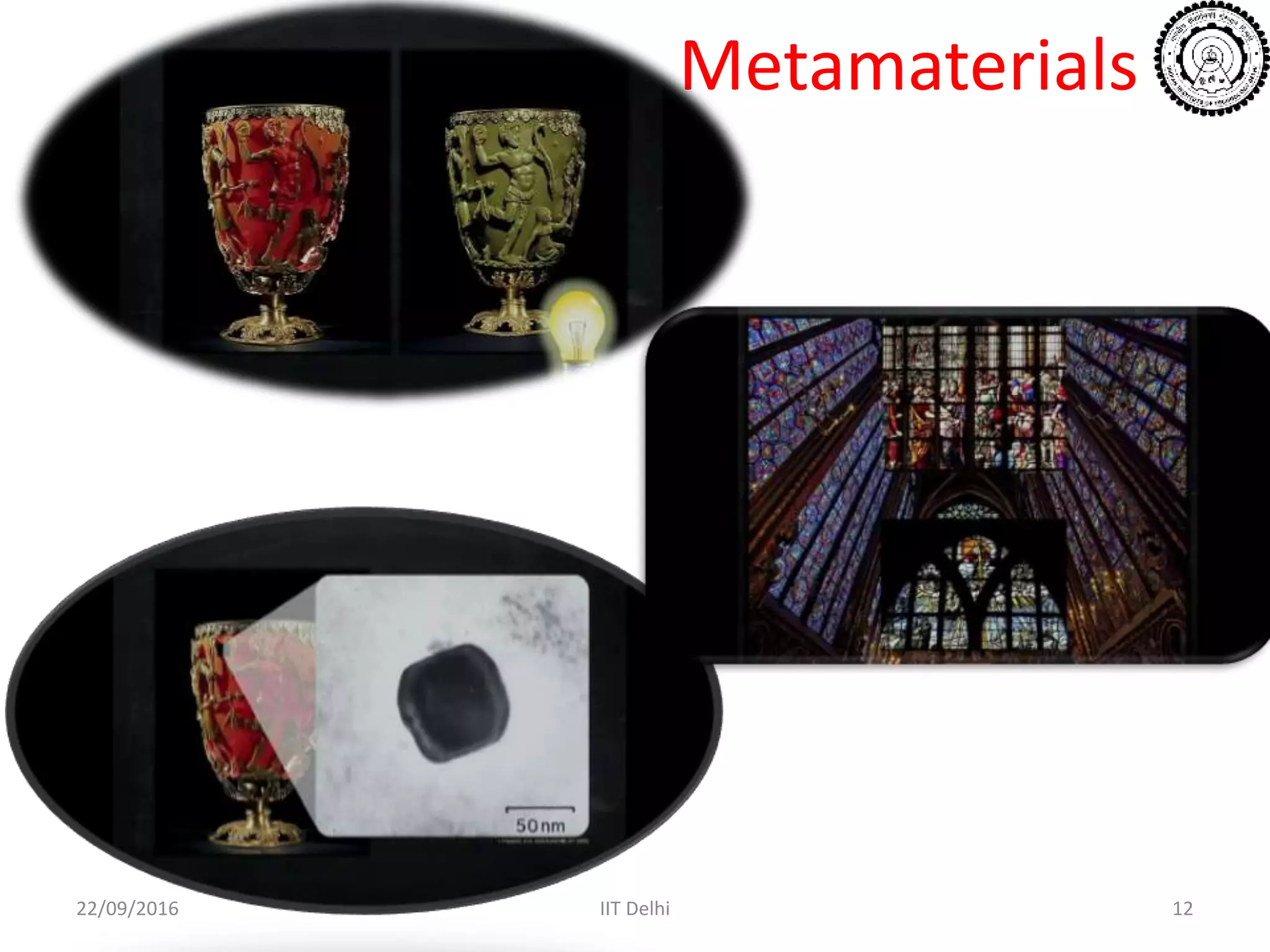
  • #12 Colour depends on quantum dots size, same materials can exhibit different colour. At nanoscale gold can appear red, blue, yellow etc