Overview of Metamaterials
and their
Radar and Optical Applications
Jay B Bargeron
Overview
- Personal Background in Metamaterials
- Introduction to Metamaterials
- Definition of Metamaterial
- How Metamaterials work
- Microwave Metamaterials
- Optical Metamaterials
- Conclusions
Personal Background
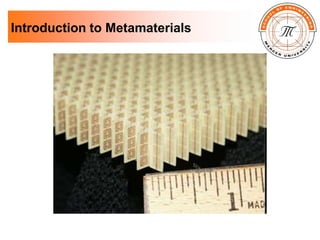
Introduction to Metamaterials
Electromagnetic waves
- Not much difference between 1kHz (λ=300km) and 1THz
(λ=0.3mm)
Why can’t optical light (Terahertz frequency) go through walls like
microwaves?
- Material response varies at different frequencies
- Determined by atomic structure and arrangement (10-10 m).
How can we alter a material’s electromagnetic properties?
- 1 method is to introduce periodic features that are electrically
small over a given frequency range, that appear “atomic” at those
frequencies
Introduction to Metamaterials
What’s in a name?
- “Meta-” means “altered, changed” or “higher, beyond”
Why are they called Metamaterials?
- Existing materials only exhibit a small subset of electromagnetic
properties theoretically available
- Metamaterials can have their electromagnetic properties
altered to something beyond what can be found in nature.
- Can achieve negative index of refraction, zero index of
refraction, magnetism at optical frequencies, etc.
Definition of Metamaterial
- “Metamaterial” coined in the late 1990’s
- According to David R. Smith, any material composed of periodic,
macroscopic structures so as to achieve a desired electromagnetic
response can be referred to as a Metamaterial
-(very broad definition)
-Others prefer to restrict the term Metamatetial to materials with
electromagnetic properties not found in nature
- Still some ambiguity as the exact definition
- Almost all agree the Metamaterials do NOT rely on chemical/atomic
alterations.
How Metamaterials Work
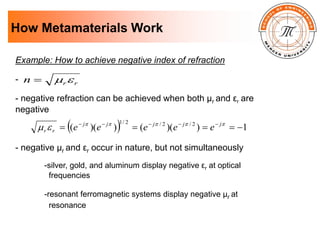
Example: How to achieve negative index of refraction
-
- negative refraction can be achieved when both µr and εr are
negative
- negative µr and εr occur in nature, but not simultaneously
-silver, gold, and aluminum display negative εr at optical
frequencies
-resonant ferromagnetic systems display negative µr at
resonance
r
r
n 


  1
)
)(
(
)
)(
( 2
/
2
/
2
/
1




 



 





 j
j
j
j
j
r
r e
e
e
e
e
How Metamaterials Work
Example: How to achieve negative index of refraction
― What if the structures that cause this frequency variance of µr and εr at
an atomic scale could be replicated on a larger scale?
― To appear homogeneous, the structures would have to be electrically
small and spaced electrically close
― The concept of metamaterials was first proven in the microwave
spectrum.
Microwave Metamaterials
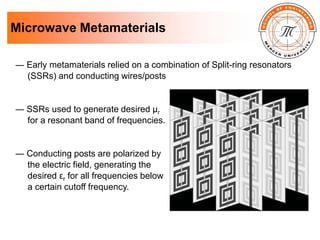
― Early metamaterials relied on a combination of Split-ring resonators
(SSRs) and conducting wires/posts
― SSRs used to generate desired µr
for a resonant band of frequencies.
― Conducting posts are polarized by
the electric field, generating the
desired εr for all frequencies below
a certain cutoff frequency.
Microwave Metamaterials
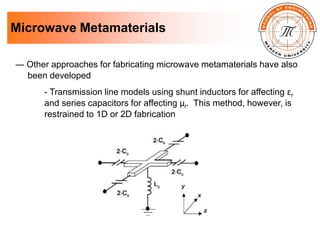
― Other approaches for fabricating microwave metamaterials have also
been developed
- Transmission line models using shunt inductors for affecting εr
and series capacitors for affecting µr. This method, however, is
restrained to 1D or 2D fabrication
Microwave Metamaterials
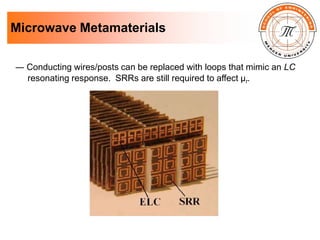
― Conducting wires/posts can be replaced with loops that mimic an LC
resonating response. SRRs are still required to affect µr.
Microwave Metamaterials
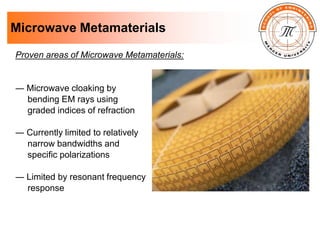
Proven areas of Microwave Metamaterials:
― Microwave cloaking by
bending EM rays using
graded indices of refraction
― Currently limited to relatively
narrow bandwidths and
specific polarizations
― Limited by resonant frequency
response
Microwave Metamaterials
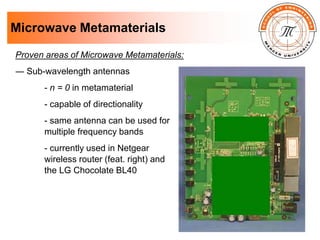
Proven areas of Microwave Metamaterials:
― Sub-wavelength antennas
- n = 0 in metamaterial
- capable of directionality
- same antenna can be used for
multiple frequency bands
- currently used in Netgear
wireless router (feat. right) and
the LG Chocolate BL40
Microwave Metamaterials
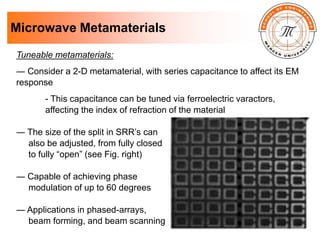
Tuneable metamaterials:
― Consider a 2-D metamaterial, with series capacitance to affect its EM
response
- This capacitance can be tuned via ferroelectric varactors,
affecting the index of refraction of the material
― The size of the split in SRR’s can
also be adjusted, from fully closed
to fully “open” (see Fig. right)
― Capable of achieving phase
modulation of up to 60 degrees
― Applications in phased-arrays,
beam forming, and beam scanning
Microwave Metamaterials
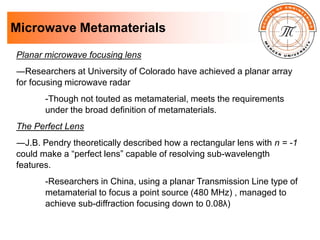
Planar microwave focusing lens
―Researchers at University of Colorado have achieved a planar array
for focusing microwave radar
-Though not touted as metamaterial, meets the requirements
under the broad definition of metamaterials.
The Perfect Lens
―J.B. Pendry theoretically described how a rectangular lens with n = -1
could make a “perfect lens” capable of resolving sub-wavelength
features.
-Researchers in China, using a planar Transmission Line type of
metamaterial to focus a point source (480 MHz) , managed to
achieve sub-diffraction focusing down to 0.08λ)
Faster than light transmission lines?
Could this be possible?
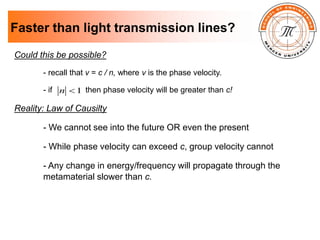
- recall that v = c / n, where v is the phase velocity.
- if then phase velocity will be greater than c!
Reality: Law of Causilty
- We cannot see into the future OR even the present
- While phase velocity can exceed c, group velocity cannot
- Any change in energy/frequency will propagate through the
metamaterial slower than c.
1

n
Optical Metamaterials
Fabrication/Design Challenges for optical metamaterials:
― Smaller wavelength = smaller features
- Coupling between elements becomes more serious
― Metal’s response to electromagnetic waves changes at higher
frequencies.
- Metal no longer behaves as perfect electrical conductors
(dielectric losses need to be taken into account)
- A frequency is eventually reached where the energy of the oscillating,
excited electrons becomes comparable to the electric field. When this
occurs, the metal’s response is known as plasmonic
- Resistive and dielectric losses become much more significant
Optical Metamaterials
― Most research on optical metamaterials has been at the theoretical
stage
- Mathematically characterizing nanoscale plasmonice effects.
- Computer simulations of proposed designs.
― Relatively little work has been done with physically realized optical
metamaterials
Optical Metamaterials
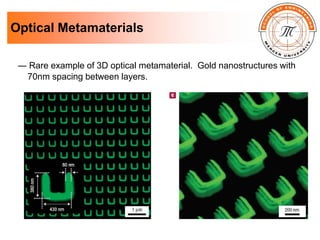
― Rare example of 3D optical metamaterial. Gold nanostructures with
70nm spacing between layers.
Optical Metamaterials
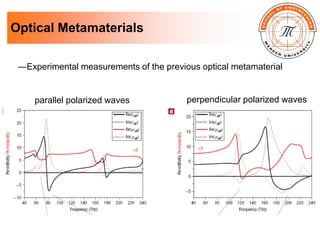
―Experimental measurements of the previous optical metamaterial
parallel polarized waves perpendicular polarized waves
Conclusions
― Introduction of metamaterials in 1990’s opened new possibilities in
electromagnetics.
― Successful implementation of metamaterial technology in the
microwave spectrum.
― Inherent difficulties exist in fabricating optical metamaterials
― Most work to date related to modeling proposed designs
― Little work, so far, on successful application of optical metamaterials
Fin
Questions???

IEEE Metamaterials presentation-2(1).ppt

  • 1.
    Overview of Metamaterials andtheir Radar and Optical Applications Jay B Bargeron
  • 2.
    Overview - Personal Backgroundin Metamaterials - Introduction to Metamaterials - Definition of Metamaterial - How Metamaterials work - Microwave Metamaterials - Optical Metamaterials - Conclusions
  • 3.
  • 4.
  • 5.
    Introduction to Metamaterials Electromagneticwaves - Not much difference between 1kHz (λ=300km) and 1THz (λ=0.3mm) Why can’t optical light (Terahertz frequency) go through walls like microwaves? - Material response varies at different frequencies - Determined by atomic structure and arrangement (10-10 m). How can we alter a material’s electromagnetic properties? - 1 method is to introduce periodic features that are electrically small over a given frequency range, that appear “atomic” at those frequencies
  • 6.
    Introduction to Metamaterials What’sin a name? - “Meta-” means “altered, changed” or “higher, beyond” Why are they called Metamaterials? - Existing materials only exhibit a small subset of electromagnetic properties theoretically available - Metamaterials can have their electromagnetic properties altered to something beyond what can be found in nature. - Can achieve negative index of refraction, zero index of refraction, magnetism at optical frequencies, etc.
  • 7.
    Definition of Metamaterial -“Metamaterial” coined in the late 1990’s - According to David R. Smith, any material composed of periodic, macroscopic structures so as to achieve a desired electromagnetic response can be referred to as a Metamaterial -(very broad definition) -Others prefer to restrict the term Metamatetial to materials with electromagnetic properties not found in nature - Still some ambiguity as the exact definition - Almost all agree the Metamaterials do NOT rely on chemical/atomic alterations.
  • 8.
    How Metamaterials Work Example:How to achieve negative index of refraction - - negative refraction can be achieved when both µr and εr are negative - negative µr and εr occur in nature, but not simultaneously -silver, gold, and aluminum display negative εr at optical frequencies -resonant ferromagnetic systems display negative µr at resonance r r n      1 ) )( ( ) )( ( 2 / 2 / 2 / 1                  j j j j j r r e e e e e
  • 9.
    How Metamaterials Work Example:How to achieve negative index of refraction ― What if the structures that cause this frequency variance of µr and εr at an atomic scale could be replicated on a larger scale? ― To appear homogeneous, the structures would have to be electrically small and spaced electrically close ― The concept of metamaterials was first proven in the microwave spectrum.
  • 10.
    Microwave Metamaterials ― Earlymetamaterials relied on a combination of Split-ring resonators (SSRs) and conducting wires/posts ― SSRs used to generate desired µr for a resonant band of frequencies. ― Conducting posts are polarized by the electric field, generating the desired εr for all frequencies below a certain cutoff frequency.
  • 11.
    Microwave Metamaterials ― Otherapproaches for fabricating microwave metamaterials have also been developed - Transmission line models using shunt inductors for affecting εr and series capacitors for affecting µr. This method, however, is restrained to 1D or 2D fabrication
  • 12.
    Microwave Metamaterials ― Conductingwires/posts can be replaced with loops that mimic an LC resonating response. SRRs are still required to affect µr.
  • 13.
    Microwave Metamaterials Proven areasof Microwave Metamaterials: ― Microwave cloaking by bending EM rays using graded indices of refraction ― Currently limited to relatively narrow bandwidths and specific polarizations ― Limited by resonant frequency response
  • 14.
    Microwave Metamaterials Proven areasof Microwave Metamaterials: ― Sub-wavelength antennas - n = 0 in metamaterial - capable of directionality - same antenna can be used for multiple frequency bands - currently used in Netgear wireless router (feat. right) and the LG Chocolate BL40
  • 15.
    Microwave Metamaterials Tuneable metamaterials: ―Consider a 2-D metamaterial, with series capacitance to affect its EM response - This capacitance can be tuned via ferroelectric varactors, affecting the index of refraction of the material ― The size of the split in SRR’s can also be adjusted, from fully closed to fully “open” (see Fig. right) ― Capable of achieving phase modulation of up to 60 degrees ― Applications in phased-arrays, beam forming, and beam scanning
  • 16.
    Microwave Metamaterials Planar microwavefocusing lens ―Researchers at University of Colorado have achieved a planar array for focusing microwave radar -Though not touted as metamaterial, meets the requirements under the broad definition of metamaterials. The Perfect Lens ―J.B. Pendry theoretically described how a rectangular lens with n = -1 could make a “perfect lens” capable of resolving sub-wavelength features. -Researchers in China, using a planar Transmission Line type of metamaterial to focus a point source (480 MHz) , managed to achieve sub-diffraction focusing down to 0.08λ)
  • 17.
    Faster than lighttransmission lines? Could this be possible? - recall that v = c / n, where v is the phase velocity. - if then phase velocity will be greater than c! Reality: Law of Causilty - We cannot see into the future OR even the present - While phase velocity can exceed c, group velocity cannot - Any change in energy/frequency will propagate through the metamaterial slower than c. 1  n
  • 18.
    Optical Metamaterials Fabrication/Design Challengesfor optical metamaterials: ― Smaller wavelength = smaller features - Coupling between elements becomes more serious ― Metal’s response to electromagnetic waves changes at higher frequencies. - Metal no longer behaves as perfect electrical conductors (dielectric losses need to be taken into account) - A frequency is eventually reached where the energy of the oscillating, excited electrons becomes comparable to the electric field. When this occurs, the metal’s response is known as plasmonic - Resistive and dielectric losses become much more significant
  • 19.
    Optical Metamaterials ― Mostresearch on optical metamaterials has been at the theoretical stage - Mathematically characterizing nanoscale plasmonice effects. - Computer simulations of proposed designs. ― Relatively little work has been done with physically realized optical metamaterials
  • 20.
    Optical Metamaterials ― Rareexample of 3D optical metamaterial. Gold nanostructures with 70nm spacing between layers.
  • 21.
    Optical Metamaterials ―Experimental measurementsof the previous optical metamaterial parallel polarized waves perpendicular polarized waves
  • 22.
    Conclusions ― Introduction ofmetamaterials in 1990’s opened new possibilities in electromagnetics. ― Successful implementation of metamaterial technology in the microwave spectrum. ― Inherent difficulties exist in fabricating optical metamaterials ― Most work to date related to modeling proposed designs ― Little work, so far, on successful application of optical metamaterials
  • 23.