TYPES OF
TIME BASE GENERATORS
1) UJT as RELAXATION OSCILLATOR.
2) MILLER SWEEP GENERATOR.
3) BOOTSTRAP RAMP GENERATOR.
4) CURRENT TIME BASE
GENERATOR.
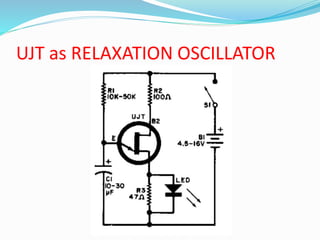
UJT as RELAXATION OSCILLATOR
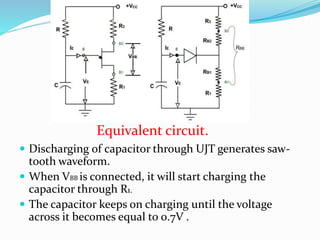
Equivalent circuit.
 Discharging of capacitor through UJT generates saw-
tooth waveform.
 When VBB is connected, it will start charging the
capacitor through R1.
 The capacitor keeps on charging until the voltage
across it becomes equal to 0.7V .
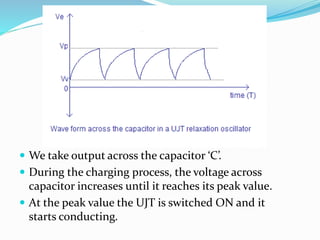
 We take output across the capacitor ‘C’.
 During the charging process, the voltage across
capacitor increases until it reaches its peak value.
 At the peak value the UJT is switched ON and it
starts conducting.
 When the UJT starts conducting , the capacitor
starts discharging between emitter and B1.
 When the capacitor voltage become zero, the
capacitor again starts charging.
 The frequency of the o/p saw-tooth waveform can
be varied by changing the value of R1 resistor, since
this controls the time constant(R1C) of the
capacitor charging circuit.
FORMULA
 t=2.3R1Clog10(1/1-ŋ)
 t=R1Cloge(1/1-ŋ)
 VC=VBB[1-e^(-t/R1C)]
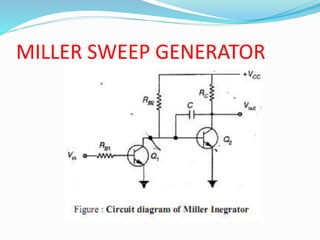
MILLER SWEEP GENERATOR
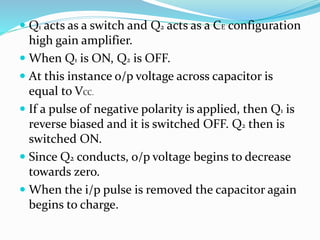
 Q1 acts as a switch and Q2 acts as a CE configuration
high gain amplifier.
 When Q1 is ON, Q2 is OFF.
 At this instance o/p voltage across capacitor is
equal to VCC.
 If a pulse of negative polarity is applied, then Q1 is
reverse biased and it is switched OFF. Q2 then is
switched ON.
 Since Q2 conducts, o/p voltage begins to decrease
towards zero.
 When the i/p pulse is removed the capacitor again
begins to charge.
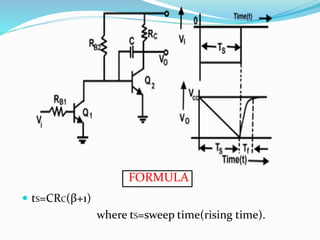
FORMULA
 tS=CRC(β+1)
where tS=sweep time(rising time).
BOOTSTRAP RAMP GENERATOR
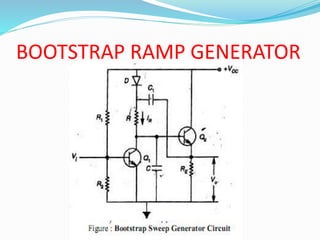
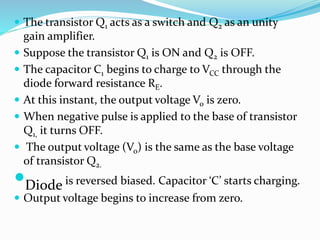
 The transistor Q1 acts as a switch and Q2 as an unity
gain amplifier.
 Suppose the transistor Q1 is ON and Q2 is OFF.
 The capacitor C1 begins to charge to VCC through the
diode forward resistance RE.
 At this instant, the output voltage Vo is zero.
 When negative pulse is applied to the base of transistor
Q1, it turns OFF.
 The output voltage (Vo) is the same as the base voltage
of transistor Q2.
Diode is reversed biased. Capacitor ‘C’ starts charging.
 Output voltage begins to increase from zero.
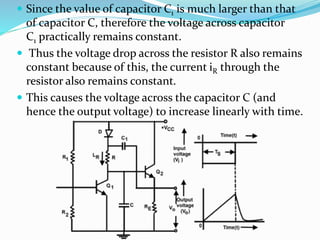
 Since the value of capacitor C1 is much larger than that
of capacitor C, therefore the voltage across capacitor
C1 practically remains constant.
 Thus the voltage drop across the resistor R also remains
constant because of this, the current iR through the
resistor also remains constant.
 This causes the voltage across the capacitor C (and
hence the output voltage) to increase linearly with time.
CURRENT TIME BASE GENERATOR
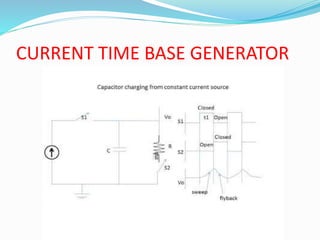
 There are 3 important blocks-constant current source,
capacitor and a switch.
 During the sweep interval, the capacitor ‘C’ is charged by
the constant current.
 When the sweep waveform reaches to its maximum
value VS the switch opens and does not allow the current
to flow further.
 The capacitor ‘C’ starts discharging.
 The o/p voltage waveform is measured across the
capacitor.
Types of time base generators

Types of time base generators

  • 1.
    TYPES OF TIME BASEGENERATORS 1) UJT as RELAXATION OSCILLATOR. 2) MILLER SWEEP GENERATOR. 3) BOOTSTRAP RAMP GENERATOR. 4) CURRENT TIME BASE GENERATOR.
  • 2.
  • 3.
    Equivalent circuit.  Dischargingof capacitor through UJT generates saw- tooth waveform.  When VBB is connected, it will start charging the capacitor through R1.  The capacitor keeps on charging until the voltage across it becomes equal to 0.7V .
  • 4.
     We takeoutput across the capacitor ‘C’.  During the charging process, the voltage across capacitor increases until it reaches its peak value.  At the peak value the UJT is switched ON and it starts conducting.
  • 5.
     When theUJT starts conducting , the capacitor starts discharging between emitter and B1.  When the capacitor voltage become zero, the capacitor again starts charging.  The frequency of the o/p saw-tooth waveform can be varied by changing the value of R1 resistor, since this controls the time constant(R1C) of the capacitor charging circuit. FORMULA  t=2.3R1Clog10(1/1-ŋ)  t=R1Cloge(1/1-ŋ)  VC=VBB[1-e^(-t/R1C)]
  • 6.
  • 7.
     Q1 actsas a switch and Q2 acts as a CE configuration high gain amplifier.  When Q1 is ON, Q2 is OFF.  At this instance o/p voltage across capacitor is equal to VCC.  If a pulse of negative polarity is applied, then Q1 is reverse biased and it is switched OFF. Q2 then is switched ON.  Since Q2 conducts, o/p voltage begins to decrease towards zero.  When the i/p pulse is removed the capacitor again begins to charge.
  • 8.
  • 9.
  • 10.
     The transistorQ1 acts as a switch and Q2 as an unity gain amplifier.  Suppose the transistor Q1 is ON and Q2 is OFF.  The capacitor C1 begins to charge to VCC through the diode forward resistance RE.  At this instant, the output voltage Vo is zero.  When negative pulse is applied to the base of transistor Q1, it turns OFF.  The output voltage (Vo) is the same as the base voltage of transistor Q2. Diode is reversed biased. Capacitor ‘C’ starts charging.  Output voltage begins to increase from zero.
  • 11.
     Since thevalue of capacitor C1 is much larger than that of capacitor C, therefore the voltage across capacitor C1 practically remains constant.  Thus the voltage drop across the resistor R also remains constant because of this, the current iR through the resistor also remains constant.  This causes the voltage across the capacitor C (and hence the output voltage) to increase linearly with time.
  • 12.
  • 13.
     There are3 important blocks-constant current source, capacitor and a switch.  During the sweep interval, the capacitor ‘C’ is charged by the constant current.  When the sweep waveform reaches to its maximum value VS the switch opens and does not allow the current to flow further.  The capacitor ‘C’ starts discharging.  The o/p voltage waveform is measured across the capacitor.