Gandhinagar Institute
of technology
AlA Presentation
Subject:- ice (2161902)
Topic name:- Engine emission
Prepared by:- jani Parth (150120119051)
guided by:- Prof. Maulik Sukhadiya
 Contents
1.Introduction
2.Emission norms
3.Comparison between bharat stages and euro norms
4.Type of emission
5.Emission
6.Hydrocarbon emission
7.Carbon monoxide emission
8.Oxides of nitrogen emission
1. introduction
Internal Combustion Engines Generate Undesirable Emissions During
The Combustion Process.
The Emissions Of Concern Are: Unburnt Hydrocarbons (Hc), Oxides of
Carbon (C𝑂𝑥), Oxides of Nitrogen (N𝑂𝑥) , Oxides of Sulphur (S𝑂𝑥) And
Solid Particulates
As World Population Grew, Power Plants, Factories, And An Ever-
increasing Number of Automobiles Began To Pollute the Air To The
Extent That It Was No Longer Acceptable.
Although Air Pollution Is Global Problem, Some Regions of The World
Still Have No Emission Standard or norms
Ex., Pakistan, China, America Actually Out of the Paris Agreement
2. Emission norms
 Emission norms are statutory requirement that set specific limits to
the amount of pollutants that can be released into environments.
 The also regulate emission from industry, power plants, and diesel
generators.
i. United states :- EPA
ii. California :- VES
iii. European :- EURO NORMS
iv. India :- BHARAT STAGE
3. Comparison between BS and Euro norms
The bharat stage norms have been styled to Indian condition
The main difference is essentially in environmental and geographical
need.
Euro norm is tested as sub zero temperatures and India, where annual
temperature range is between 24 and 28 degree.
Maximum speed:- in euro norms speed is 90km/h and in BS speed is
120 km/h
Mass emission test measurements done in g/km on chassis
dynometer requires loading of 100 kg weight in addition to unloaded a
weight in Europe. But in India 150 kg weight with extra loading
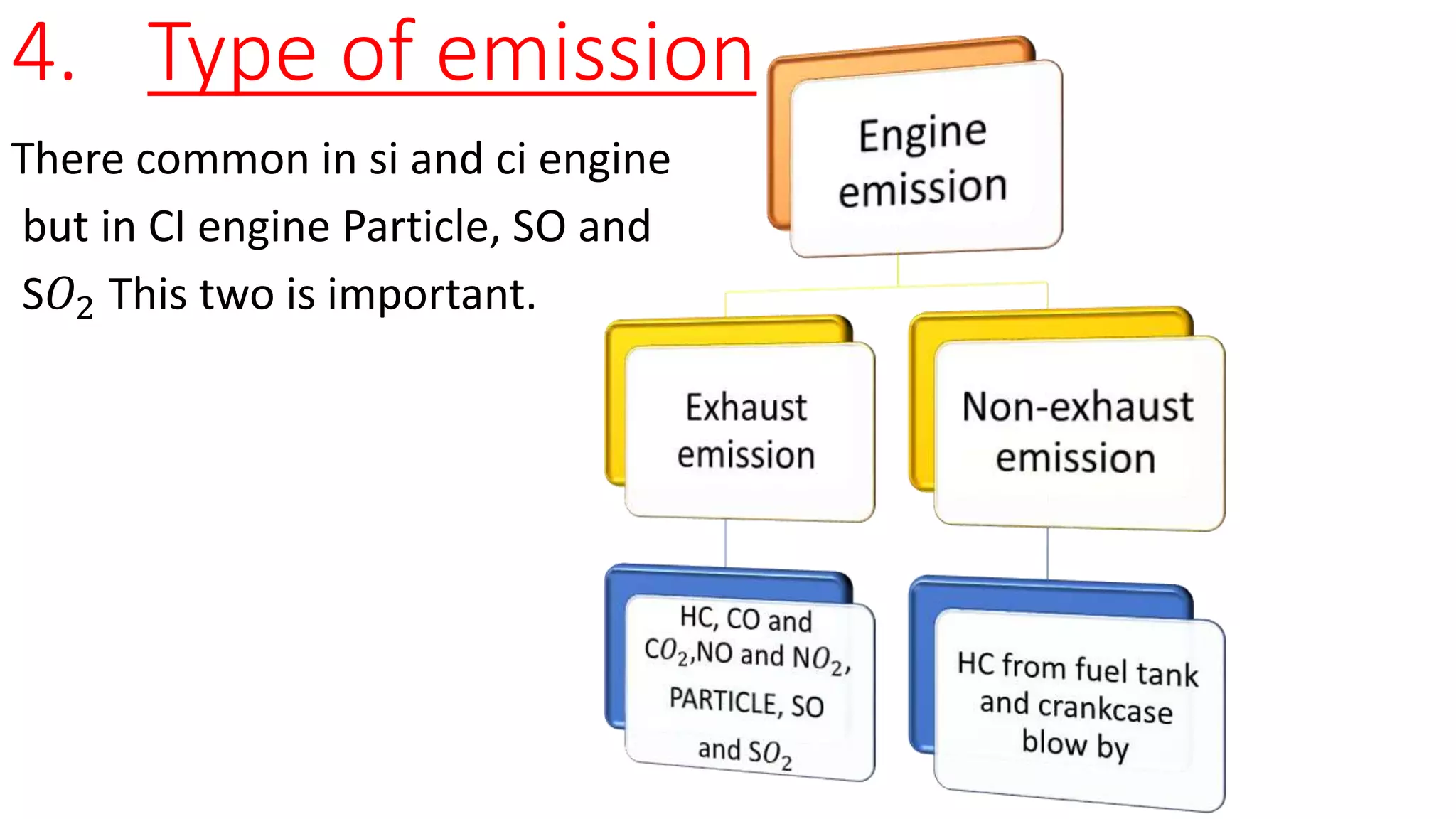
4. Type of emission
There common in si and ci engine
but in CI engine Particle, SO and
S𝑂2 This two is important.
5. Emission
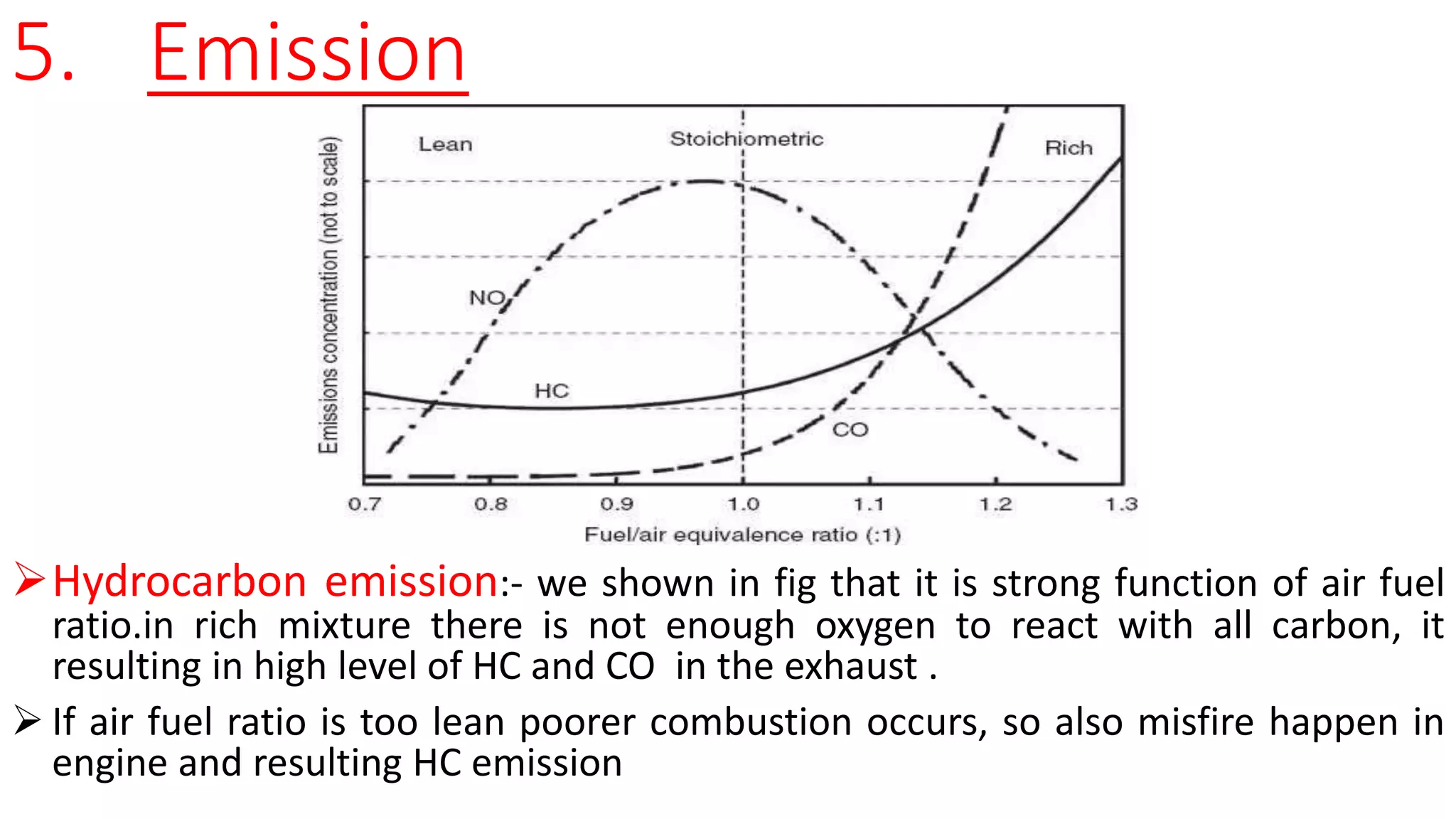
Hydrocarbon emission:- we shown in fig that it is strong function of air fuel
ratio.in rich mixture there is not enough oxygen to react with all carbon, it
resulting in high level of HC and CO in the exhaust .
 If air fuel ratio is too lean poorer combustion occurs, so also misfire happen in
engine and resulting HC emission
…
 The causes hydrocarbon emission from SI engine are:
i. Incomplete combustion
ii. Crevice volumes and flow in crevices
iii. Valve overlap
iv. Leakage past the exhaust valve
v. Deposits on walls
vi. Oil on combustion chamber walls
 Carbon monoxide emission:- carbon monoxide is colourless and odourless
but poisonous gas. It is generated In engine when it is operated with rich ratio.
when there is not enough oxygen to convert all carbon to C𝑂2, some fuel does
not get burned and some carbon end up as co.it is also lost chemical energy
CO+
1
2
𝑂2 → 𝐶𝑂2+ heat
…
Oxides of nitrogen:- Exhaust gases of an engine can have up to 200 rpm
of oxide of nitrogen most of this will be nitrogen oxide (NO).NO is created
mostly from nitrogen in air.it is also found in fuel blends.
 Further, fuel may contain trace amount of NH, NC, and HCN, but this
would contribute only to minor degree. there is number of possible
reaction that from NO.
 It is depends on flame temperature as shown in fig.
 Effect of oxides of nitrogen in environment
1. Photochemical smog
2. Particulates
IC Engine emission
IC Engine emission

IC Engine emission

  • 1.
    Gandhinagar Institute of technology AlAPresentation Subject:- ice (2161902) Topic name:- Engine emission Prepared by:- jani Parth (150120119051) guided by:- Prof. Maulik Sukhadiya
  • 2.
     Contents 1.Introduction 2.Emission norms 3.Comparisonbetween bharat stages and euro norms 4.Type of emission 5.Emission 6.Hydrocarbon emission 7.Carbon monoxide emission 8.Oxides of nitrogen emission
  • 3.
    1. introduction Internal CombustionEngines Generate Undesirable Emissions During The Combustion Process. The Emissions Of Concern Are: Unburnt Hydrocarbons (Hc), Oxides of Carbon (C𝑂𝑥), Oxides of Nitrogen (N𝑂𝑥) , Oxides of Sulphur (S𝑂𝑥) And Solid Particulates As World Population Grew, Power Plants, Factories, And An Ever- increasing Number of Automobiles Began To Pollute the Air To The Extent That It Was No Longer Acceptable. Although Air Pollution Is Global Problem, Some Regions of The World Still Have No Emission Standard or norms Ex., Pakistan, China, America Actually Out of the Paris Agreement
  • 4.
    2. Emission norms Emission norms are statutory requirement that set specific limits to the amount of pollutants that can be released into environments.  The also regulate emission from industry, power plants, and diesel generators. i. United states :- EPA ii. California :- VES iii. European :- EURO NORMS iv. India :- BHARAT STAGE
  • 6.
    3. Comparison betweenBS and Euro norms The bharat stage norms have been styled to Indian condition The main difference is essentially in environmental and geographical need. Euro norm is tested as sub zero temperatures and India, where annual temperature range is between 24 and 28 degree. Maximum speed:- in euro norms speed is 90km/h and in BS speed is 120 km/h Mass emission test measurements done in g/km on chassis dynometer requires loading of 100 kg weight in addition to unloaded a weight in Europe. But in India 150 kg weight with extra loading
  • 8.
    4. Type ofemission There common in si and ci engine but in CI engine Particle, SO and S𝑂2 This two is important.
  • 9.
    5. Emission Hydrocarbon emission:-we shown in fig that it is strong function of air fuel ratio.in rich mixture there is not enough oxygen to react with all carbon, it resulting in high level of HC and CO in the exhaust .  If air fuel ratio is too lean poorer combustion occurs, so also misfire happen in engine and resulting HC emission
  • 10.
    …  The causeshydrocarbon emission from SI engine are: i. Incomplete combustion ii. Crevice volumes and flow in crevices iii. Valve overlap iv. Leakage past the exhaust valve v. Deposits on walls vi. Oil on combustion chamber walls  Carbon monoxide emission:- carbon monoxide is colourless and odourless but poisonous gas. It is generated In engine when it is operated with rich ratio. when there is not enough oxygen to convert all carbon to C𝑂2, some fuel does not get burned and some carbon end up as co.it is also lost chemical energy CO+ 1 2 𝑂2 → 𝐶𝑂2+ heat
  • 12.
    … Oxides of nitrogen:-Exhaust gases of an engine can have up to 200 rpm of oxide of nitrogen most of this will be nitrogen oxide (NO).NO is created mostly from nitrogen in air.it is also found in fuel blends.  Further, fuel may contain trace amount of NH, NC, and HCN, but this would contribute only to minor degree. there is number of possible reaction that from NO.  It is depends on flame temperature as shown in fig.  Effect of oxides of nitrogen in environment 1. Photochemical smog 2. Particulates