control Pollutant formation
Submitted by
WATBAN Al-TEKREETI
ABSTRACT
 The rise in civilization is closely related to the
improvement is transportation. In the
development of transportation, internal
combustion engine play an important role of
petrol and diesel engine. This problem is
increasing day by day with increasing pollution
So our aim is to find out the air pollutant from
petrol as well as diesel engine and control
those. Undesirable emissions in internal
combustion engines are of major concern
because of their negative impact on air quality,
human health, and global warming. Therefore,
there is a concerted effort by most
governments to control them. Undesirable
emissions include unburned hydrocarbons
(HC), carbon monoxide (CO), nitrogen oxides
INTRODUCTION
 The life of a human being is precious.
Certainly, to live a comfortable life you
need to have good surrounding. At least
all the basic needs like air, water, food. -
the emissions are very harmful to
human beings and all these emissions
should be controlled
Definition
 Air pollution: is defined as the addition of any
material which have a dangerous effect of our plant
to our atmosphere
 Emissions”: is a collective term that is used to
describe the undesired gases and particles which
are released into the air or emitted by various
sources
 Criteria Pollutants: The U.S. Environmental
Protection Agency (EPA) is primarily concerned
with emissions that are or can be harmful to the
public at large. EPA considers carbon monoxide
(CO), lead (Pb), nitrogen dioxide (NO2), ozone
(O3), particulate matter (PM), and sulphur dioxide
(SO2) as the pollutants of primary concern,.
Types of pollutions source
 Point sources, which include facilities such
as factories and electric power plants.
 Mobile sources, which include cars and
trucks but also lawn mowers, airplanes,
and anything else that moves and releases
pollutants into the air .
 Biogenic sources, which include trees and
vegetation, gas seeps, and microbial
activity.
 Area sources, which consist of smaller
stationary sources such as dry cleaners
and degreasing operations
Pollution gases :divide in to
 typical emissions contain primary
greenhouse gases Like(carbon
Monoxides(CO2)),(methan (CH4)),(nitrous
oxides(NO2))
 criteria pollutants like (carbon
monoxide(CO)) (total nitrogen
oxides(NOX)) (sulpher dioxide(SO2))(non
methane volatile organic compounds
(NMVOC) (particulate matter(PM))
(lead(Pb)
Pollutants are released
when…..
 Fuel is burned in the internal
combustion engine and the air/gasoline
residuals are emitted through the
tailpipe
 Heat causes fuel to evaporate
throughout the fuel system. Hot, sunny
days and engines warmed by running
provide heat to vaporize fuel into the air
 Refueling at the service station where
gasoline vapors escape into the air
Some kind of air pollution
gases
 carbon monoxide(CO)
 carbon dioxide (CO2)
 nitrogen oxides (NOX)
 hydrocarbons (HC)
 particulate matter (PM)
Effect of pollution
 The pollutants in vehicle emissions are known to damage lung tissue
 Motor vehicle pollution also contributes to the formation of acid rain
and adds to the greenhouse gases that cause climate change
 On warm, sunny days, hydrocarbons react with oxides of nitrogen to
create a secondary pollutant, ozone. In many urban areas, motor
vehicles are the single largest contributor to ground-level ozone which
is a common component of smog. Ozone causes coughing, wheezing
and shortness of breath
 carbon monoxides (CO)reduce the flow of oxygen in the blood stream
and is particularly dangerous to person with heart disease
Solutions
 engine design modification
 cleaner fuel : ( methanol, ethanol, bio-
diesel and CNG (Compressed natural
Gas)
 - post combustion control devise
 -inspection and maintenance devices
 - Zero-emission vehicles include
battery-electric vehicles, plug-in
hybrid-electric vehicles, and hydrogen
fuel-cell-electric vehicles
Solutions
 reduce pollution from our vehicles by
driving less, improving our driving
habits, keeping our vehicles in good
running order
 Make sure tires are properly inflated
 Make sure the gasoline cap fits
properly
 Drive at steady, moderate speeds
 Increase the green land
Measurement techniques used
to measure pollutants
 Non Dispersive Infrared Analysed
(NDIR): detectors are the industry
standard method of measuring the
concentration of carbon oxides (CO &
CO2)
 Absorption bands of common gases: The
flame ionisation detector (FID) is the
industry standard method of measuring
hydrocarbon (HC) concentration
 Chemi-luminescence detector (CLD): It is
the industry standard method of
measuring nitric oxide (NO)
concentration
Control of Emission In Ic Engine
 To reduce atmospheric pollution, two
different approaches are followed:
 1-To reduce the formation of pollutants
in the emission by redesigning the
engine system, fuel system, cooling
system and ignition system
 2-By destroying the pollutants after
these have been formed
Pollutants formation
 HYDROCARBONS(HC): Hydrocarbon
emissions result when fuel molecules in the
engine do not burn or burn only partially(tail
pipe emission)
 NITROGEN OXIDES (NOx): Under the high
pressure and temperature conditions in an
engine, nitrogen and oxygen atoms in the air
react to form various nitrogen oxides,
collectively known as NOx.
 CARBON MONOXIDE(CO): Carbon monoxide
(CO) is a product of incomplete combustion
and occurs when carbon in the fuel is partially
oxidized rather than fully oxidized to carbon
dioxide
Pollutants formation
 CARBON DIOXIDE(CO2): Carbon
dioxide does not directly impair human
health, but it is a “greenhouse gas” that
traps the earth’s heat and contributes to
the potential for global warming
 Evaporative Emissions(HC)(not tail pipe
emissions): Hydrocarbon pollutants also
escape into the air through fuel
evaporation and evaporative losses can
account for a majority of the total
hydrocarbon pollution
Evaporative emissions occur
several ways:
 a- DIURNAL: Gasoline evaporation increases
as the temperature rises during the day,
heating the fuel tank and venting gasoline
vapors
 B- RUNNING LOSSES: The hot engine and
exhaust system can vaporize gasoline when
the car is running
 C-HOT SOAK: The engine remains hot for a
period of time after the car is turned off, and
gasoline evaporation continues when the car
is parked
 D-REFUELING: Gasoline vapours are always
present in fuel tanks. These vapours are
forced out when the tank is filled with liquid
fuel
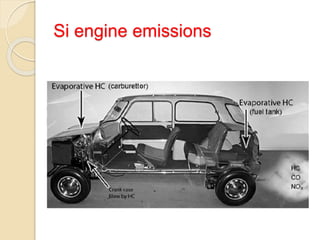
Si engine emissions
 S.I. engine emissions are divided into
three categories:
 1- exhaust emission
 2- evaporative emission .
 3- crank case emission
 The major constituents which
contribute to air pollution are CO,
NOx, and HC
Si engine emissions
Si engine emissions
 The relative amounts depend on engine
design and operating conditions but are of
order:
 1- NOx -> 500-1000 ppm (20 gm/kg of fuel
)
 2- CO -> 122% (200gm/kg of fuel)
 3- HC -> 43000 ppm (25 gm/kg of fuel)
 Fuel evaporation from fuel tank and
carburettor exists even after engine shut
down and these are unburned
hydrocarbons.
 most important variables in determining
CI engine emissions
 Emissions formed as a result of burning the
heterogeneous air/fuel mixture depend on:
 1- the prevailing conditions not only during
combustion, but also during the expansion
and especially prior(befor) to the exhaust
valve opening
 2- Mixture preparation during the ignition
delay
 3- fuel ignition quality
 4- residence time at different combustion
temperatures
 5- expansion duration
 6- general engine design features
CI engine emissions
CI engine emissions
 Incomplete combustion products formed in
the early stages of combustion may be
oxidized later during the expansion stroke
 Mixing of unburned hydrocarbons with
oxidizing gases, high combustion chamber
temperature, and adequate residence time
for the oxidation process permit more
complete combustion
 In most cases, once nitric oxide (NO) is
formed it is not decomposed, but may
increase in concentration during the rest of
the combustion process if the temperature
remains high
Control of emission from SI
engines:
 1-Crankcase Emission Control (PCV
System):
 2-Evaporative Emission Control(HC)
 3-Exhaust Gas Recirculation:
 4- Water Injection
Gaseous Emission Control of
Stationary IC Engines:
 1-Catalyst Control Technologies :The
principle behind a catalyst for control of
the gaseous emissions of a stationary IC
engine is that the catalyst causes
chemical reactions without being changed
or consumed
 a-Non selective Catalytic Reduction
(NSCR) and Three-way Catalysts :
 NSCR has been used to control NOx
emissions from rich-burn engines
Gaseous Emission Control of
Stationary IC Engines:
 b-Selective Catalytic Reduction
(SCR):SCR is a method of controlling
NOx emissions from lean-burn
stationary IC engines.
Gaseous Emission Control of
Stationary IC Engines:
 2-Oxidation Catalysts
 3-Particulate Emission Control of
Stationary IC Engines:
 a-Diesel Oxidation Catalysts:
 b-Diesel Particulate Filters (DPF) or
Trap Oxidizer System
Gaseous Emission Control of
Stationary IC Engines:
 filter material
 1-ceramic monoliths 2-woven
silica fibre coils
 3-ceramic foam 4-mat-like ceramic
fibres
 5-wire mesh 6-sintered metal
substrates
Gaseous Emission Control of
Stationary IC Engines:
 4-Exhaust gas recirculation(EGR) and
retarding injection timing
 5-Closed crankcase ventilation
technology
References
 Fundamentals of air pollution
engineering(richard c. flagan /john h.
seinfeld ) california institute of
technology
 Internal combustion engine
fundamentals (john B.heywood
Thanks For Your Patience And Attention…

Control pollutant formation

  • 1.
  • 2.
    ABSTRACT  The risein civilization is closely related to the improvement is transportation. In the development of transportation, internal combustion engine play an important role of petrol and diesel engine. This problem is increasing day by day with increasing pollution So our aim is to find out the air pollutant from petrol as well as diesel engine and control those. Undesirable emissions in internal combustion engines are of major concern because of their negative impact on air quality, human health, and global warming. Therefore, there is a concerted effort by most governments to control them. Undesirable emissions include unburned hydrocarbons (HC), carbon monoxide (CO), nitrogen oxides
  • 3.
    INTRODUCTION  The lifeof a human being is precious. Certainly, to live a comfortable life you need to have good surrounding. At least all the basic needs like air, water, food. - the emissions are very harmful to human beings and all these emissions should be controlled
  • 4.
    Definition  Air pollution:is defined as the addition of any material which have a dangerous effect of our plant to our atmosphere  Emissions”: is a collective term that is used to describe the undesired gases and particles which are released into the air or emitted by various sources  Criteria Pollutants: The U.S. Environmental Protection Agency (EPA) is primarily concerned with emissions that are or can be harmful to the public at large. EPA considers carbon monoxide (CO), lead (Pb), nitrogen dioxide (NO2), ozone (O3), particulate matter (PM), and sulphur dioxide (SO2) as the pollutants of primary concern,.
  • 5.
    Types of pollutionssource  Point sources, which include facilities such as factories and electric power plants.  Mobile sources, which include cars and trucks but also lawn mowers, airplanes, and anything else that moves and releases pollutants into the air .  Biogenic sources, which include trees and vegetation, gas seeps, and microbial activity.  Area sources, which consist of smaller stationary sources such as dry cleaners and degreasing operations
  • 6.
    Pollution gases :dividein to  typical emissions contain primary greenhouse gases Like(carbon Monoxides(CO2)),(methan (CH4)),(nitrous oxides(NO2))  criteria pollutants like (carbon monoxide(CO)) (total nitrogen oxides(NOX)) (sulpher dioxide(SO2))(non methane volatile organic compounds (NMVOC) (particulate matter(PM)) (lead(Pb)
  • 7.
    Pollutants are released when….. Fuel is burned in the internal combustion engine and the air/gasoline residuals are emitted through the tailpipe  Heat causes fuel to evaporate throughout the fuel system. Hot, sunny days and engines warmed by running provide heat to vaporize fuel into the air  Refueling at the service station where gasoline vapors escape into the air
  • 8.
    Some kind ofair pollution gases  carbon monoxide(CO)  carbon dioxide (CO2)  nitrogen oxides (NOX)  hydrocarbons (HC)  particulate matter (PM)
  • 9.
    Effect of pollution The pollutants in vehicle emissions are known to damage lung tissue  Motor vehicle pollution also contributes to the formation of acid rain and adds to the greenhouse gases that cause climate change  On warm, sunny days, hydrocarbons react with oxides of nitrogen to create a secondary pollutant, ozone. In many urban areas, motor vehicles are the single largest contributor to ground-level ozone which is a common component of smog. Ozone causes coughing, wheezing and shortness of breath  carbon monoxides (CO)reduce the flow of oxygen in the blood stream and is particularly dangerous to person with heart disease
  • 10.
    Solutions  engine designmodification  cleaner fuel : ( methanol, ethanol, bio- diesel and CNG (Compressed natural Gas)  - post combustion control devise  -inspection and maintenance devices  - Zero-emission vehicles include battery-electric vehicles, plug-in hybrid-electric vehicles, and hydrogen fuel-cell-electric vehicles
  • 11.
    Solutions  reduce pollutionfrom our vehicles by driving less, improving our driving habits, keeping our vehicles in good running order  Make sure tires are properly inflated  Make sure the gasoline cap fits properly  Drive at steady, moderate speeds  Increase the green land
  • 12.
    Measurement techniques used tomeasure pollutants  Non Dispersive Infrared Analysed (NDIR): detectors are the industry standard method of measuring the concentration of carbon oxides (CO & CO2)  Absorption bands of common gases: The flame ionisation detector (FID) is the industry standard method of measuring hydrocarbon (HC) concentration  Chemi-luminescence detector (CLD): It is the industry standard method of measuring nitric oxide (NO) concentration
  • 13.
    Control of EmissionIn Ic Engine  To reduce atmospheric pollution, two different approaches are followed:  1-To reduce the formation of pollutants in the emission by redesigning the engine system, fuel system, cooling system and ignition system  2-By destroying the pollutants after these have been formed
  • 14.
    Pollutants formation  HYDROCARBONS(HC):Hydrocarbon emissions result when fuel molecules in the engine do not burn or burn only partially(tail pipe emission)  NITROGEN OXIDES (NOx): Under the high pressure and temperature conditions in an engine, nitrogen and oxygen atoms in the air react to form various nitrogen oxides, collectively known as NOx.  CARBON MONOXIDE(CO): Carbon monoxide (CO) is a product of incomplete combustion and occurs when carbon in the fuel is partially oxidized rather than fully oxidized to carbon dioxide
  • 15.
    Pollutants formation  CARBONDIOXIDE(CO2): Carbon dioxide does not directly impair human health, but it is a “greenhouse gas” that traps the earth’s heat and contributes to the potential for global warming  Evaporative Emissions(HC)(not tail pipe emissions): Hydrocarbon pollutants also escape into the air through fuel evaporation and evaporative losses can account for a majority of the total hydrocarbon pollution
  • 16.
    Evaporative emissions occur severalways:  a- DIURNAL: Gasoline evaporation increases as the temperature rises during the day, heating the fuel tank and venting gasoline vapors  B- RUNNING LOSSES: The hot engine and exhaust system can vaporize gasoline when the car is running  C-HOT SOAK: The engine remains hot for a period of time after the car is turned off, and gasoline evaporation continues when the car is parked  D-REFUELING: Gasoline vapours are always present in fuel tanks. These vapours are forced out when the tank is filled with liquid fuel
  • 17.
    Si engine emissions S.I. engine emissions are divided into three categories:  1- exhaust emission  2- evaporative emission .  3- crank case emission  The major constituents which contribute to air pollution are CO, NOx, and HC
  • 18.
  • 19.
    Si engine emissions The relative amounts depend on engine design and operating conditions but are of order:  1- NOx -> 500-1000 ppm (20 gm/kg of fuel )  2- CO -> 122% (200gm/kg of fuel)  3- HC -> 43000 ppm (25 gm/kg of fuel)  Fuel evaporation from fuel tank and carburettor exists even after engine shut down and these are unburned hydrocarbons.  most important variables in determining
  • 20.
    CI engine emissions Emissions formed as a result of burning the heterogeneous air/fuel mixture depend on:  1- the prevailing conditions not only during combustion, but also during the expansion and especially prior(befor) to the exhaust valve opening  2- Mixture preparation during the ignition delay  3- fuel ignition quality  4- residence time at different combustion temperatures  5- expansion duration  6- general engine design features
  • 21.
  • 22.
    CI engine emissions Incomplete combustion products formed in the early stages of combustion may be oxidized later during the expansion stroke  Mixing of unburned hydrocarbons with oxidizing gases, high combustion chamber temperature, and adequate residence time for the oxidation process permit more complete combustion  In most cases, once nitric oxide (NO) is formed it is not decomposed, but may increase in concentration during the rest of the combustion process if the temperature remains high
  • 23.
    Control of emissionfrom SI engines:  1-Crankcase Emission Control (PCV System):  2-Evaporative Emission Control(HC)  3-Exhaust Gas Recirculation:  4- Water Injection
  • 24.
    Gaseous Emission Controlof Stationary IC Engines:  1-Catalyst Control Technologies :The principle behind a catalyst for control of the gaseous emissions of a stationary IC engine is that the catalyst causes chemical reactions without being changed or consumed  a-Non selective Catalytic Reduction (NSCR) and Three-way Catalysts :  NSCR has been used to control NOx emissions from rich-burn engines
  • 25.
    Gaseous Emission Controlof Stationary IC Engines:  b-Selective Catalytic Reduction (SCR):SCR is a method of controlling NOx emissions from lean-burn stationary IC engines.
  • 26.
    Gaseous Emission Controlof Stationary IC Engines:  2-Oxidation Catalysts  3-Particulate Emission Control of Stationary IC Engines:  a-Diesel Oxidation Catalysts:  b-Diesel Particulate Filters (DPF) or Trap Oxidizer System
  • 27.
    Gaseous Emission Controlof Stationary IC Engines:  filter material  1-ceramic monoliths 2-woven silica fibre coils  3-ceramic foam 4-mat-like ceramic fibres  5-wire mesh 6-sintered metal substrates
  • 28.
    Gaseous Emission Controlof Stationary IC Engines:  4-Exhaust gas recirculation(EGR) and retarding injection timing  5-Closed crankcase ventilation technology
  • 29.
    References  Fundamentals ofair pollution engineering(richard c. flagan /john h. seinfeld ) california institute of technology  Internal combustion engine fundamentals (john B.heywood
  • 30.
    Thanks For YourPatience And Attention…