IBDP Physics
Prescribed Practicals
A. Required Practicals
2.1–Determining the acceleration of free-fall
3.1–Applying the calorimetric techniques of specific heat capacity or specific
latent heat
3.2–Investigating at least one gas law
4.2–Investigating the speed of sound
4.4–Determining refractive index
5.2–Investigating one or more of the factors that affect resistance
5.3–Determining internal resistance
7.1–Investigating half-life
9.3–Investigating Young’s double-slit [HL only]
11.2–Investigating a diode bridge rectification circuit [HL only]
C.2–Investigating the optically compound microscope
C.2–Investigating the performance of a simple optical astronomical refracting
telescope
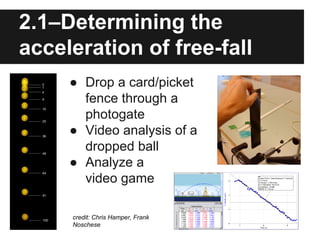
2.1–Determining the
acceleration of free-fall
● Drop a card/picket
fence through a
photogate
● Video analysis of a
dropped ball
● Analyze a
video game
credit: Chris Hamper, Frank
Noschese
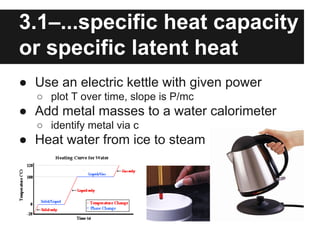
3.1–...specific heat capacity
or specific latent heat
● Use an electric kettle with given power
○ plot T over time, slope is P/mc
● Add metal masses to a water calorimeter
○ identify metal via c
● Heat water from ice to steam
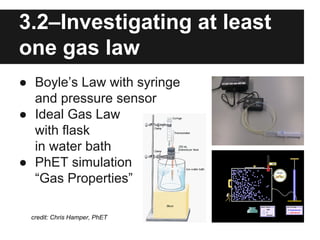
3.2–Investigating at least
one gas law
● Boyle’s Law with syringe
and pressure sensor
● Ideal Gas Law
with flask
in water bath
● PhET simulation
“Gas Properties”
credit: Chris Hamper, PhET
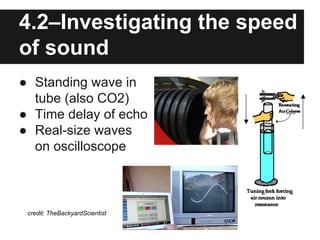
4.2–Investigating the speed
of sound
● Standing wave in
tube (also CO2)
● Time delay of echo
● Real-size waves
on oscilloscope
credit: TheBackyardScientist
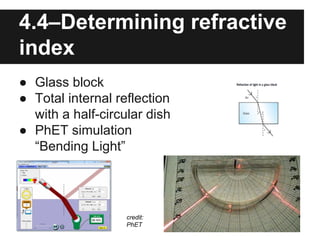
4.4–Determining refractive
index
● Glass block
● Total internal reflection
with a half-circular dish
● PhET simulation
“Bending Light”
credit:
PhET
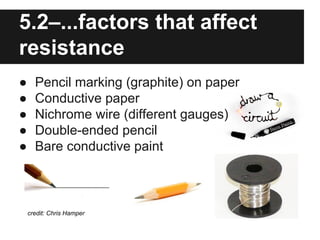
5.2–...factors that affect
resistance
● Pencil marking (graphite) on paper
● Conductive paper
● Nichrome wire (different gauges)
● Double-ended pencil
● Bare conductive paint
credit: Chris Hamper
5.3–Determining internal
resistance
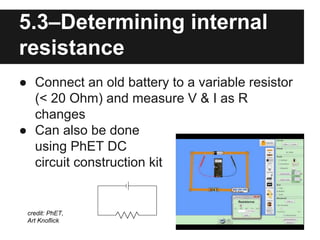
● Connect an old battery to a variable resistor
(< 20 Ohm) and measure V & I as R
changes
● Can also be done
using PhET DC
circuit construction kit
credit: PhET,
Art Knoflick
7.1–Investigating half-life
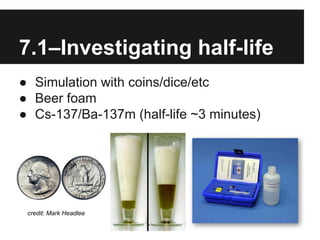
● Simulation with coins/dice/etc
● Beer foam
● Cs-137/Ba-137m (half-life ~3 minutes)
credit: Mark Headlee
9.3–Investigating Young’s
double-slit
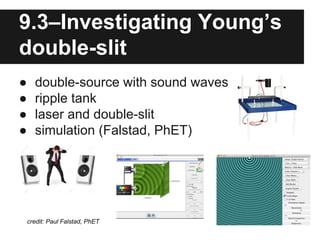
● double-source with sound waves
● ripple tank
● laser and double-slit
● simulation (Falstad, PhET)
credit: Paul Falstad, PhET
11.2–Investigating a diode
bridge rectification circuit
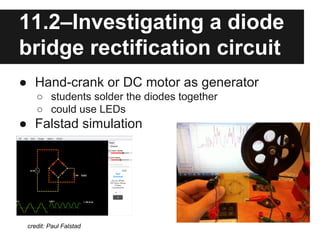
● Hand-crank or DC motor as generator
○ students solder the diodes together
○ could use LEDs
● Falstad simulation
credit: Paul Falstad

IBDP Physics SL/HL Prescribed practicals

  • 1.
  • 2.
    A. Required Practicals 2.1–Determiningthe acceleration of free-fall 3.1–Applying the calorimetric techniques of specific heat capacity or specific latent heat 3.2–Investigating at least one gas law 4.2–Investigating the speed of sound 4.4–Determining refractive index 5.2–Investigating one or more of the factors that affect resistance 5.3–Determining internal resistance 7.1–Investigating half-life 9.3–Investigating Young’s double-slit [HL only] 11.2–Investigating a diode bridge rectification circuit [HL only] C.2–Investigating the optically compound microscope C.2–Investigating the performance of a simple optical astronomical refracting telescope
  • 3.
    2.1–Determining the acceleration offree-fall ● Drop a card/picket fence through a photogate ● Video analysis of a dropped ball ● Analyze a video game credit: Chris Hamper, Frank Noschese
  • 4.
    3.1–...specific heat capacity orspecific latent heat ● Use an electric kettle with given power ○ plot T over time, slope is P/mc ● Add metal masses to a water calorimeter ○ identify metal via c ● Heat water from ice to steam
  • 5.
    3.2–Investigating at least onegas law ● Boyle’s Law with syringe and pressure sensor ● Ideal Gas Law with flask in water bath ● PhET simulation “Gas Properties” credit: Chris Hamper, PhET
  • 6.
    4.2–Investigating the speed ofsound ● Standing wave in tube (also CO2) ● Time delay of echo ● Real-size waves on oscilloscope credit: TheBackyardScientist
  • 7.
    4.4–Determining refractive index ● Glassblock ● Total internal reflection with a half-circular dish ● PhET simulation “Bending Light” credit: PhET
  • 8.
    5.2–...factors that affect resistance ●Pencil marking (graphite) on paper ● Conductive paper ● Nichrome wire (different gauges) ● Double-ended pencil ● Bare conductive paint credit: Chris Hamper
  • 9.
    5.3–Determining internal resistance ● Connectan old battery to a variable resistor (< 20 Ohm) and measure V & I as R changes ● Can also be done using PhET DC circuit construction kit credit: PhET, Art Knoflick
  • 10.
    7.1–Investigating half-life ● Simulationwith coins/dice/etc ● Beer foam ● Cs-137/Ba-137m (half-life ~3 minutes) credit: Mark Headlee
  • 11.
    9.3–Investigating Young’s double-slit ● double-sourcewith sound waves ● ripple tank ● laser and double-slit ● simulation (Falstad, PhET) credit: Paul Falstad, PhET
  • 12.
    11.2–Investigating a diode bridgerectification circuit ● Hand-crank or DC motor as generator ○ students solder the diodes together ○ could use LEDs ● Falstad simulation credit: Paul Falstad