DFT+U practical session
Burak Himmetoglu
●
GGA and GGA+U calculations in FeO
●
Calculation of U for NiO
● Exercise: Case for Cu2
O
FeO-GGA
●
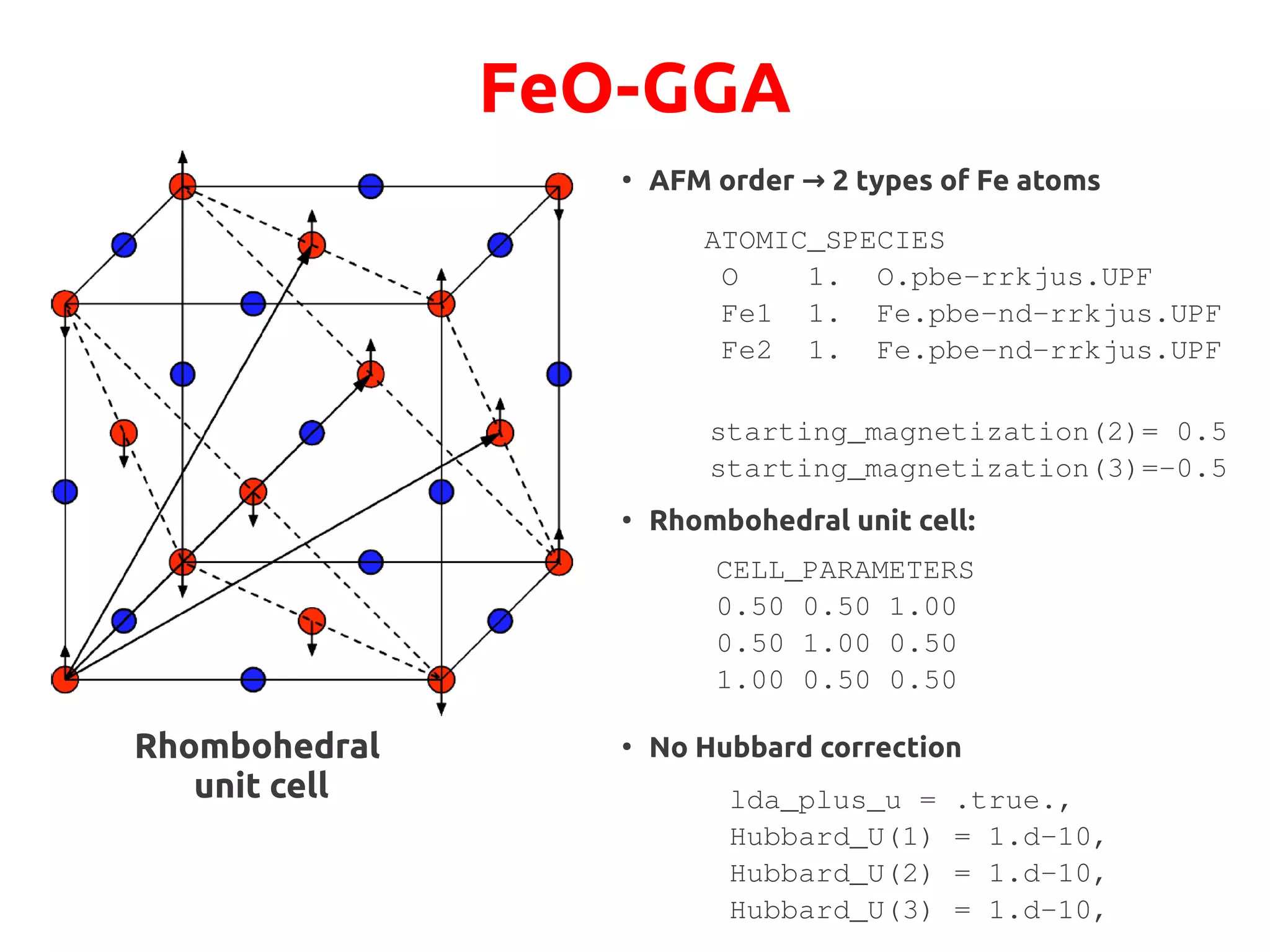
AFM order 2 types of Fe atoms→
ATOMIC_SPECIES
O 1. O.pbe-rrkjus.UPF
Fe1 1. Fe.pbe-nd-rrkjus.UPF
Fe2 1. Fe.pbe-nd-rrkjus.UPF
starting_magnetization(2)= 0.5
starting_magnetization(3)=-0.5
●
Rhombohedral unit cell:
CELL_PARAMETERS
0.50 0.50 1.00
0.50 1.00 0.50
1.00 0.50 0.50
lda_plus_u = .true.,
Hubbard_U(1) = 1.d-10,
Hubbard_U(2) = 1.d-10,
Hubbard_U(3) = 1.d-10,
●
No Hubbard correctionRhombohedral
unit cell
FeO-GGA
● Check the output file: feo.scf.out
LDA+U parameters:
U( 2) = 0.00000000
alpha( 2) = 0.00000000
U( 3) = 0.00000000
Alpha( 3) = 0.00000000
atom 1 Tr[ns(na)] (up, down, total) = 2.78796 2.78796 5.57592
atom 3 Tr[ns(na)] (up, down, total) = 4.97463 1.85925 6.83388
atom 4 Tr[ns(na)] (up, down, total) = 1.85931 4.97463 6.83394
Hubbard correction on atom 2 (Fe1)
Hubbard_alpha perturbation on atom 2 (Fe1)
Total occupations:
●
Oxygen atoms non-magnetic, nup
= ndown
●
Iron atoms ordered anti-ferromagnetically
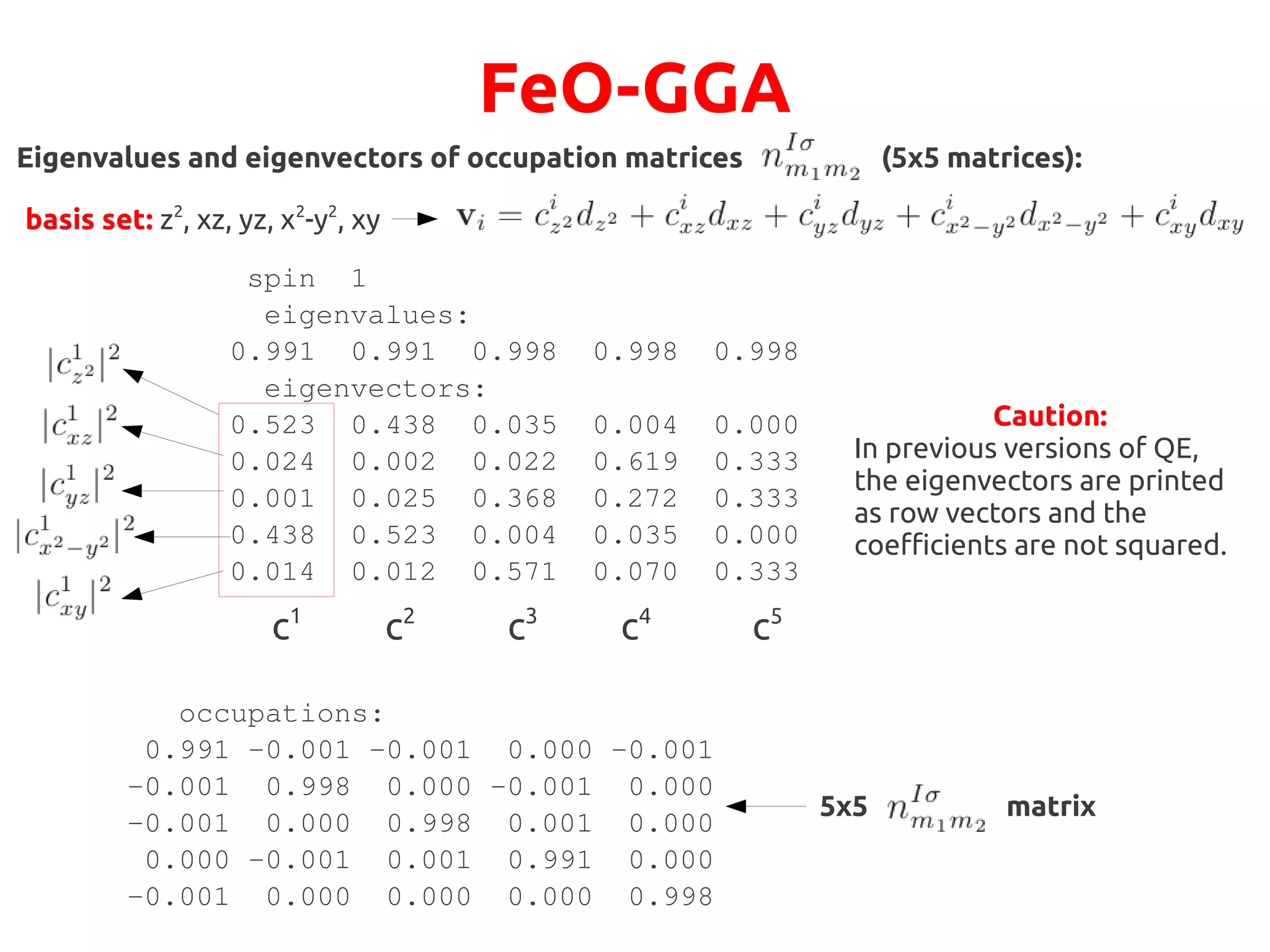
Eigenvalues and eigenvectors of occupation matrices (5x5 matrices):
FeO-GGA
spin 1
eigenvalues:
0.991 0.991 0.998 0.998 0.998
eigenvectors:
0.523 0.438 0.035 0.004 0.000
0.024 0.002 0.022 0.619 0.333
0.001 0.025 0.368 0.272 0.333
0.438 0.523 0.004 0.035 0.000
0.014 0.012 0.571 0.070 0.333
basis set: z2
, xz, yz, x2
-y2
, xy
c1
c2
c3
c4
c5
occupations:
0.991 -0.001 -0.001 0.000 -0.001
-0.001 0.998 0.000 -0.001 0.000
-0.001 0.000 0.998 0.001 0.000
0.000 -0.001 0.001 0.991 0.000
-0.001 0.000 0.000 0.000 0.998
5x5 matrix
Caution:
In previous versions of QE,
the eigenvectors are printed
as row vectors and the
coefficients are not squared.
FeO-GGA
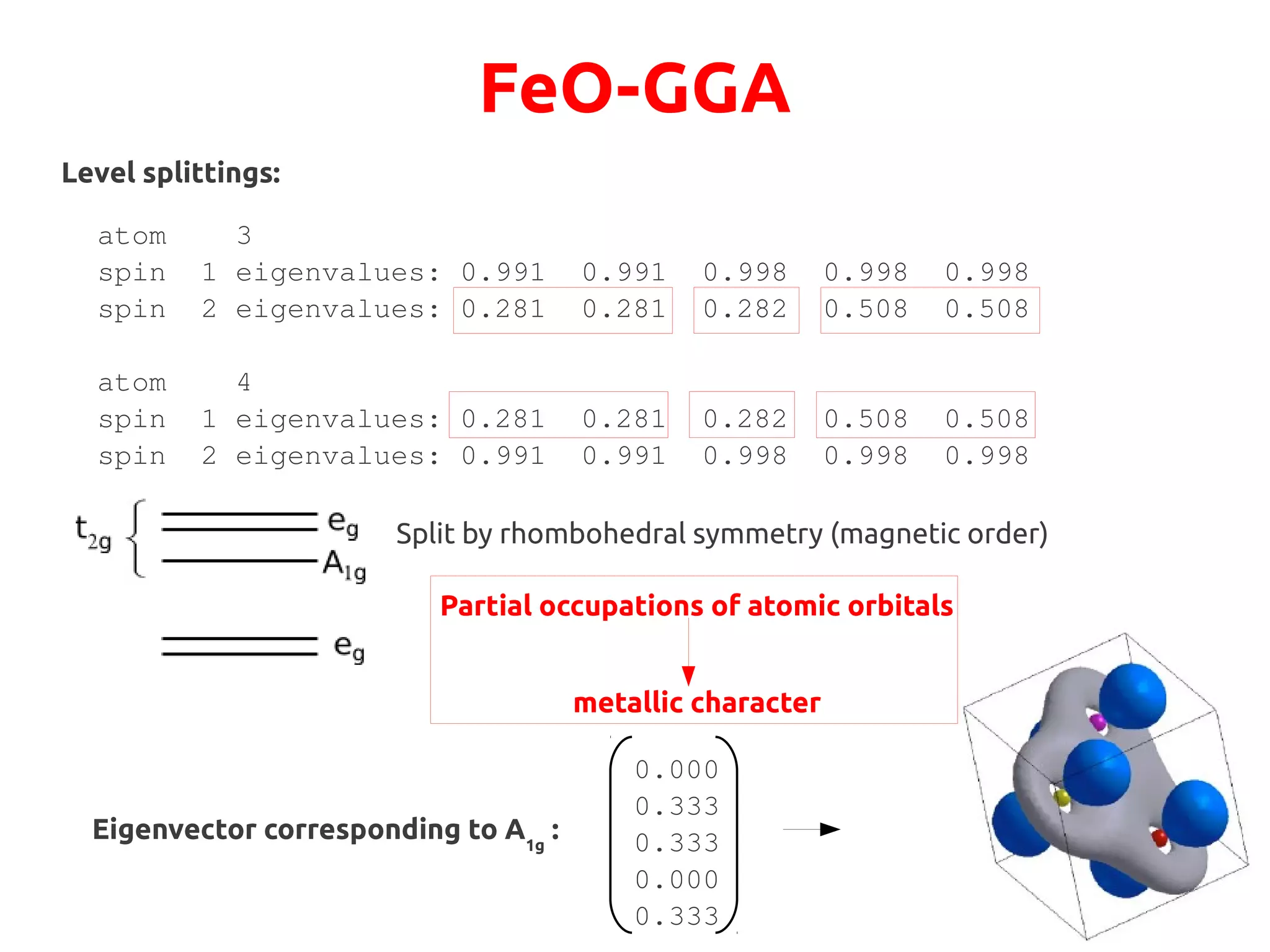
Level splittings:
atom 3
spin 1 eigenvalues: 0.991 0.991 0.998 0.998 0.998
spin 2 eigenvalues: 0.281 0.281 0.282 0.508 0.508
atom 4
spin 1 eigenvalues: 0.281 0.281 0.282 0.508 0.508
spin 2 eigenvalues: 0.991 0.991 0.998 0.998 0.998
Split by rhombohedral symmetry (magnetic order)
Eigenvector corresponding to A1g
:
0.000
0.333
0.333
0.000
0.333
Partial occupations of atomic orbitals
metallic character
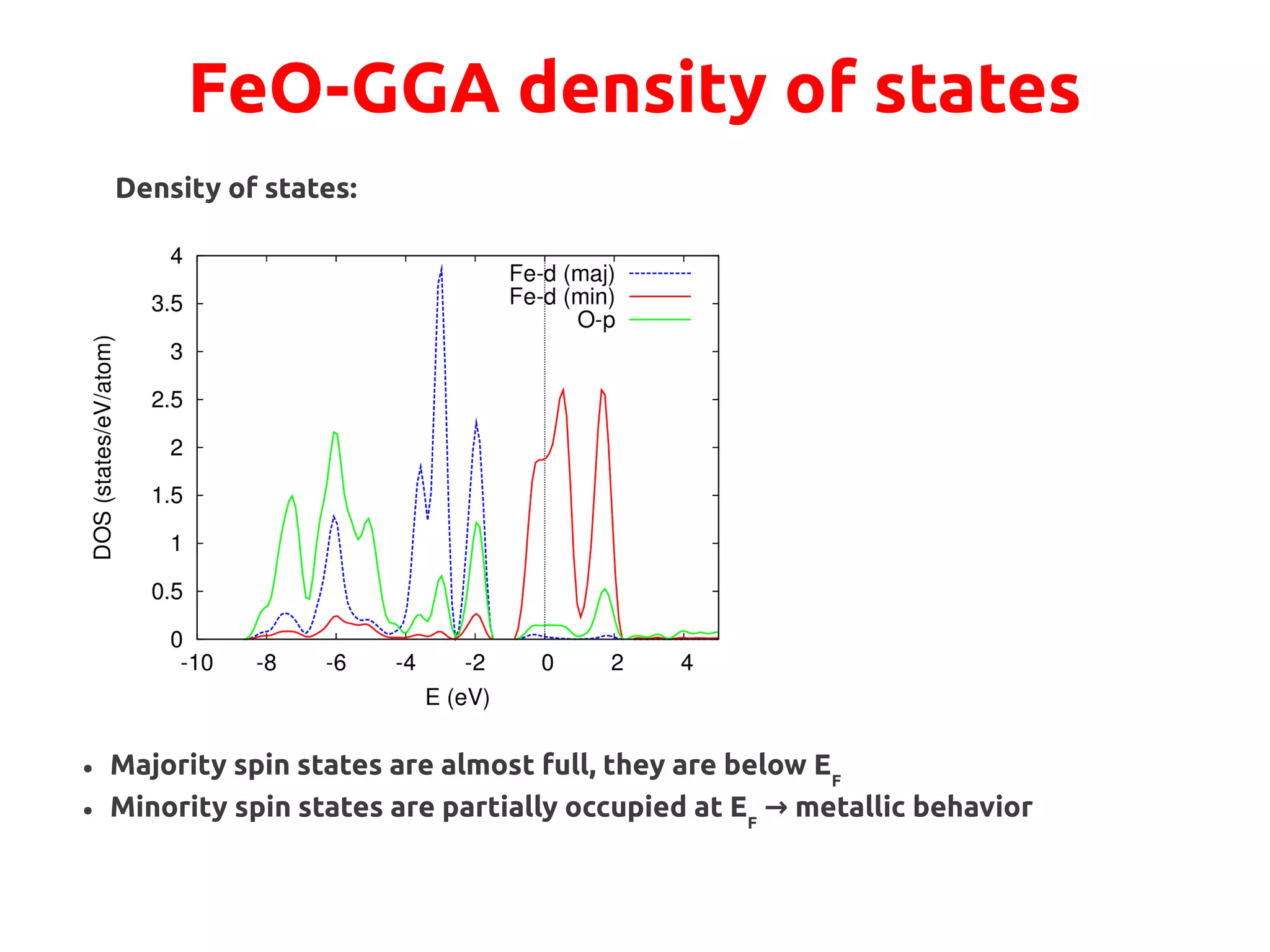
FeO-GGA density of states
Density of states:
● Majority spin states are almost full, they are below EF
● Minority spin states are partially occupied at EF
metallic behavior→
FeO-GGA+U
Hubbard_U(1)=1.d-10,
Hubbard_U(2)=4.3,
Hubbard_U(3)=4.3
Hubbard U correction of Fe d-states:
Total occupations:
atom 1 Tr[ns(na)] (up, down, total) = 2.80479 2.80492 5.60971
atom 3 Tr[ns(na)] (up, down, total) = 4.99045 1.73174 6.72219
atom 4 Tr[ns(na)] (up, down, total) = 1.73173 4.99046 6.72219
Check minority spin occupations of either Fe atom:
atom 4 spin 1
eigenvalues:
0.095 0.216 0.216 0.603 0.603
eigenvectors:
0.000 0.848 0.030 0.085 0.037
0.333 0.034 0.047 0.002 0.584
0.333 0.009 0.072 0.467 0.119
0.000 0.030 0.848 0.037 0.085
0.333 0.078 0.003 0.410 0.176
0.095
0.216
0.603
Still partial occupations!
METALLIC
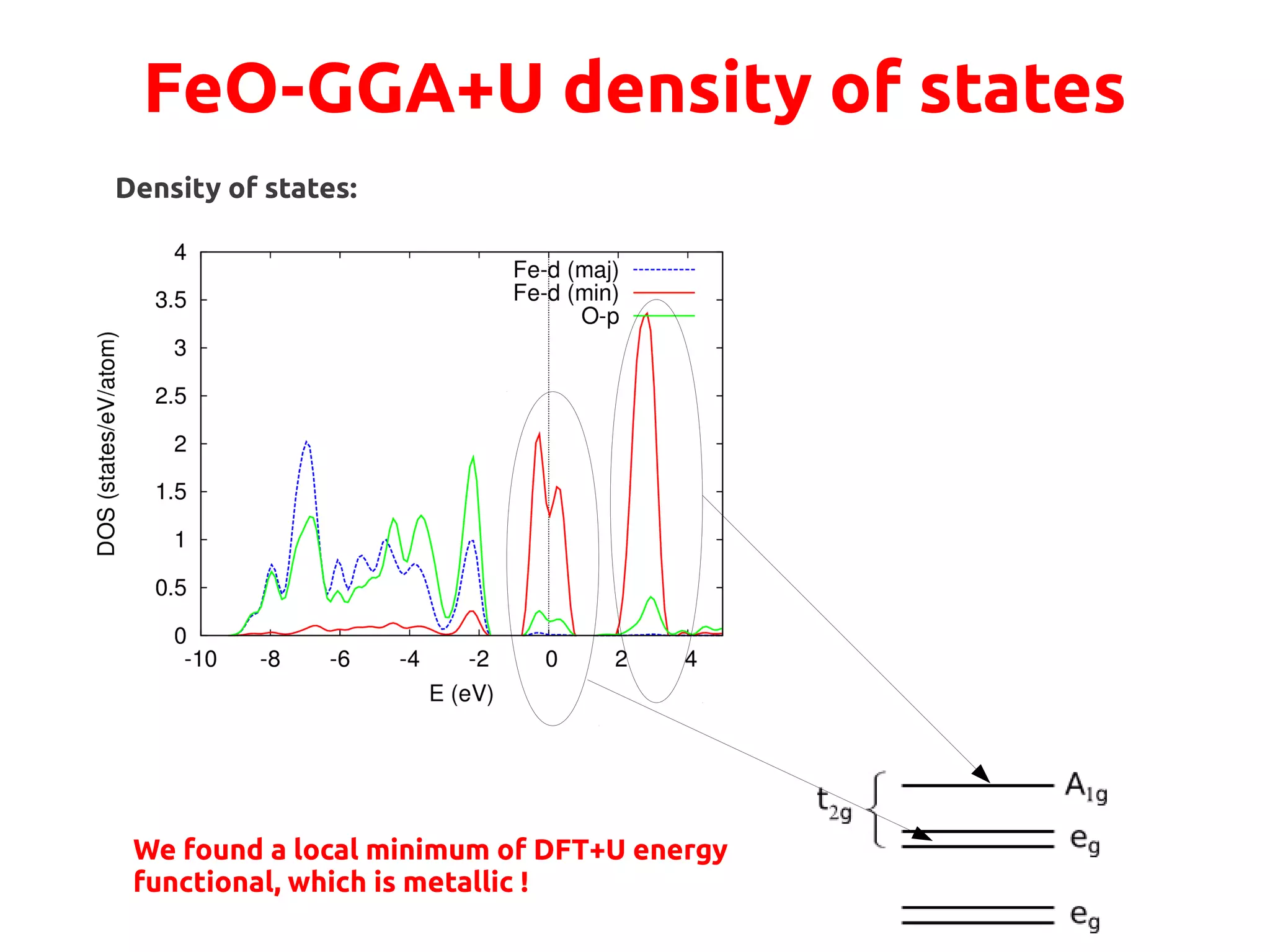
FeO-GGA+U density of states
Density of states:
We found a local minimum of DFT+U energy
functional, which is metallic !
FeO-GGA+U
Let us try to suggest a different possible electronic configuration to the system:
Check minority spin occupations of either Fe atom after the 1st iteration:
atom 4 spin 1
eigenvalues:
0.164 0.164 0.202 0.252 0.252
eigenvectors:
0.043 0.940 0.000 0.013 0.004
0.006 0.005 0.333 0.000 0.655
0.011 0.001 0.333 0.492 0.163
0.940 0.043 0.000 0.004 0.013
0.001 0.011 0.333 0.491 0.164
We want to drive the system to a configuration where the A1g state is fully occupied:
●
This state is singlet filling it→ completely will lead to an insulator
●
Physically, it points along the [111] direction, perpendicular to (111) AFM planes
FeO-GGA+U2
starting_ns_eigenvalue(3,2,2)=1.d0,
starting_ns_eigenvalue(3,1,3)=1.d0
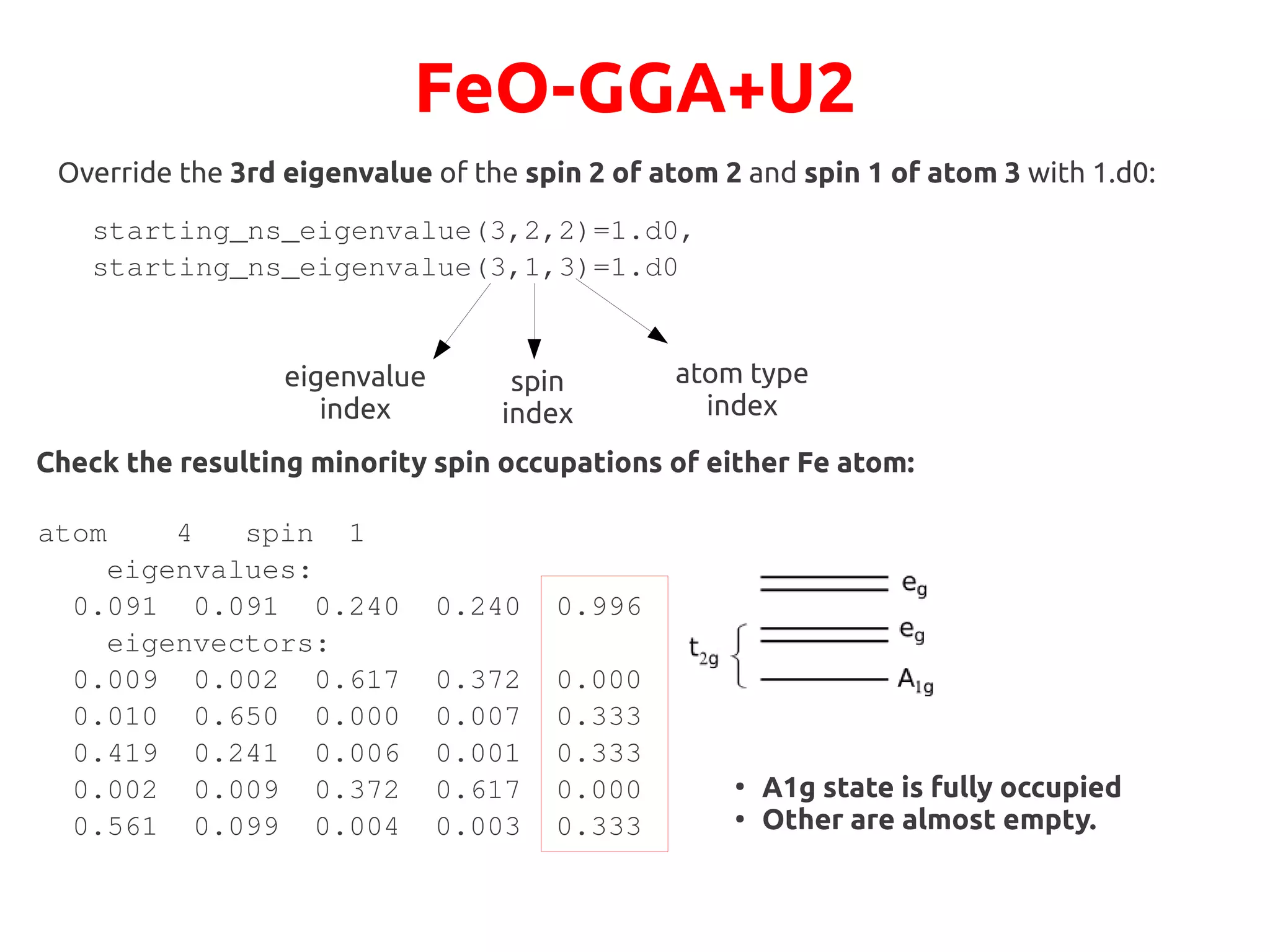
Override the 3rd eigenvalue of the spin 2 of atom 2 and spin 1 of atom 3 with 1.d0:
eigenvalue
index
spin
index
atom type
index
Check the resulting minority spin occupations of either Fe atom:
atom 4 spin 1
eigenvalues:
0.091 0.091 0.240 0.240 0.996
eigenvectors:
0.009 0.002 0.617 0.372 0.000
0.010 0.650 0.000 0.007 0.333
0.419 0.241 0.006 0.001 0.333
0.002 0.009 0.372 0.617 0.000
0.561 0.099 0.004 0.003 0.333
●
A1g state is fully occupied
●
Other are almost empty.
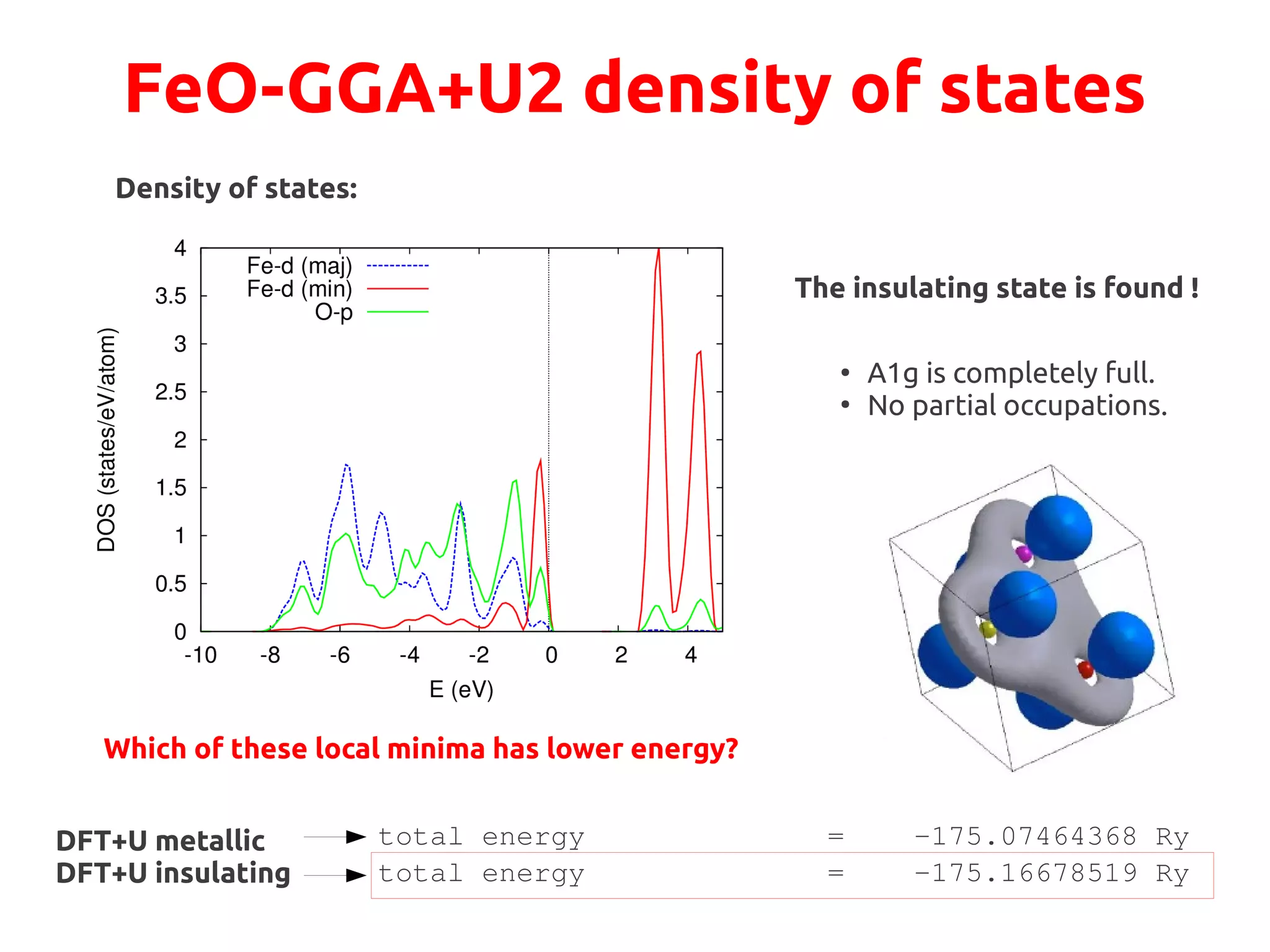
FeO-GGA+U2 density of states
Density of states:
The insulating state is found !
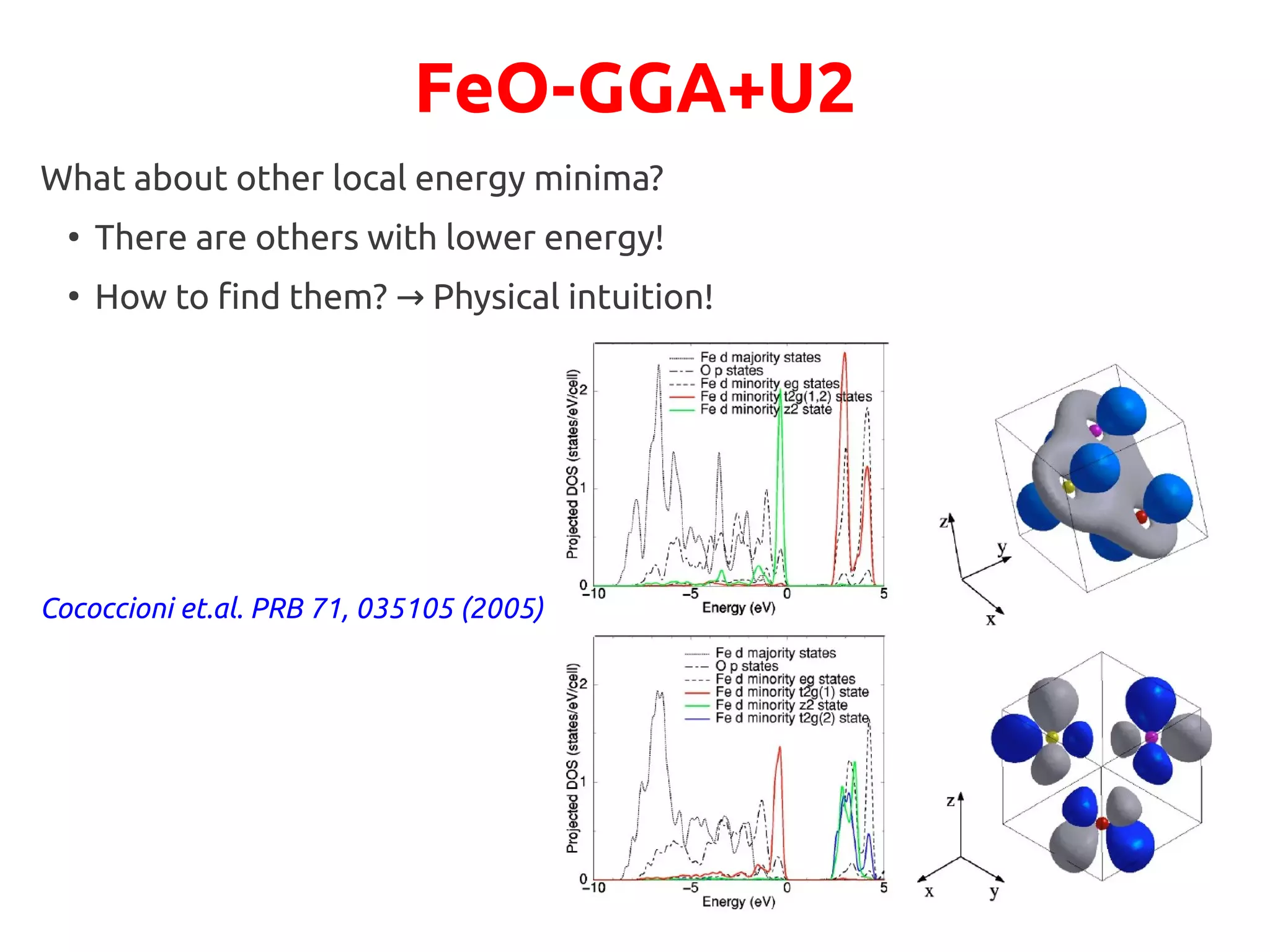
Which of these local minima has lower energy?
total energy = -175.07464368 Ry
total energy = -175.16678519 Ry
DFT+U metallic
DFT+U insulating
●
A1g is completely full.
●
No partial occupations.
FeO-GGA+U2
What about other local energy minima?
●
There are others with lower energy!
●
How to find them? Physical intuition!→
Cococcioni et.al. PRB 71, 035105 (2005)
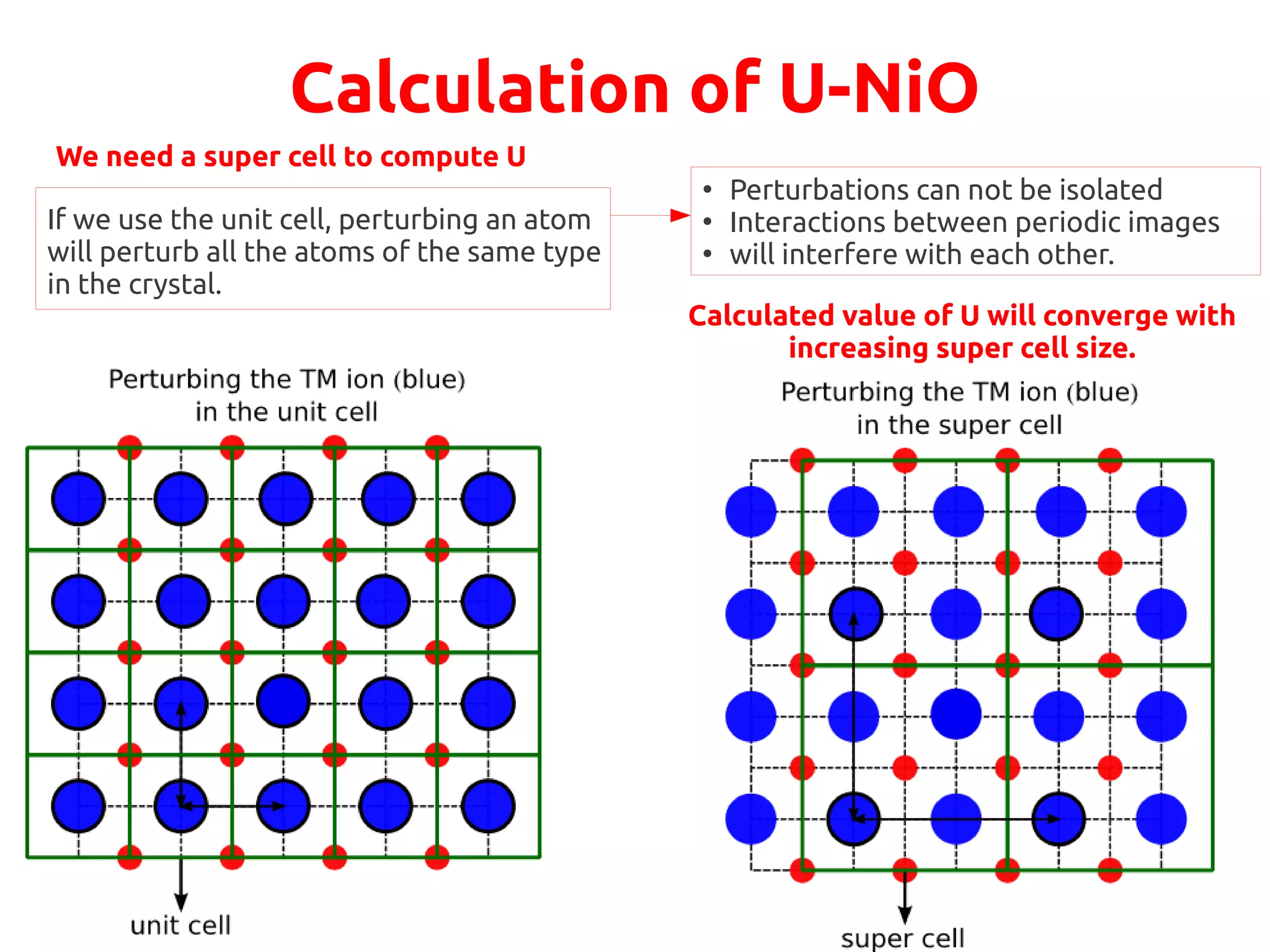
Calculation of U-NiO
If we use the unit cell, perturbing an atom
will perturb all the atoms of the same type
in the crystal.
We need a super cell to compute U
●
Perturbations can not be isolated
●
Interactions between periodic images
●
will interfere with each other.
Calculated value of U will converge with
increasing super cell size.
Calculation of U-NiO
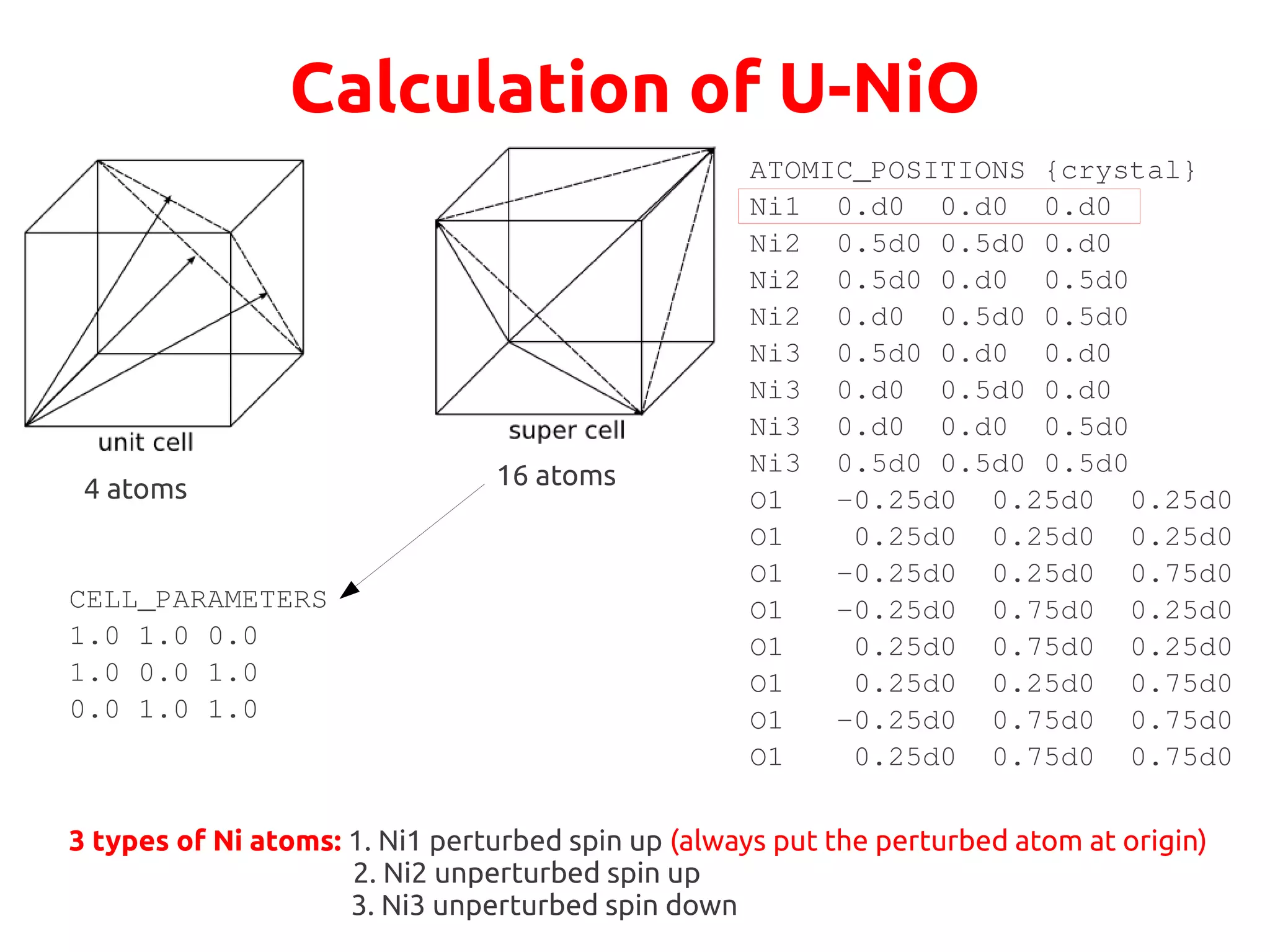
4 atoms 16 atoms
CELL_PARAMETERS
1.0 1.0 0.0
1.0 0.0 1.0
0.0 1.0 1.0
ATOMIC_POSITIONS {crystal}
Ni1 0.d0 0.d0 0.d0
Ni2 0.5d0 0.5d0 0.d0
Ni2 0.5d0 0.d0 0.5d0
Ni2 0.d0 0.5d0 0.5d0
Ni3 0.5d0 0.d0 0.d0
Ni3 0.d0 0.5d0 0.d0
Ni3 0.d0 0.d0 0.5d0
Ni3 0.5d0 0.5d0 0.5d0
O1 -0.25d0 0.25d0 0.25d0
O1 0.25d0 0.25d0 0.25d0
O1 -0.25d0 0.25d0 0.75d0
O1 -0.25d0 0.75d0 0.25d0
O1 0.25d0 0.75d0 0.25d0
O1 0.25d0 0.25d0 0.75d0
O1 -0.25d0 0.75d0 0.75d0
O1 0.25d0 0.75d0 0.75d0
3 types of Ni atoms: 1. Ni1 perturbed spin up (always put the perturbed atom at origin)
2. Ni2 unperturbed spin up
3. Ni3 unperturbed spin down
Calculation of U-NiO
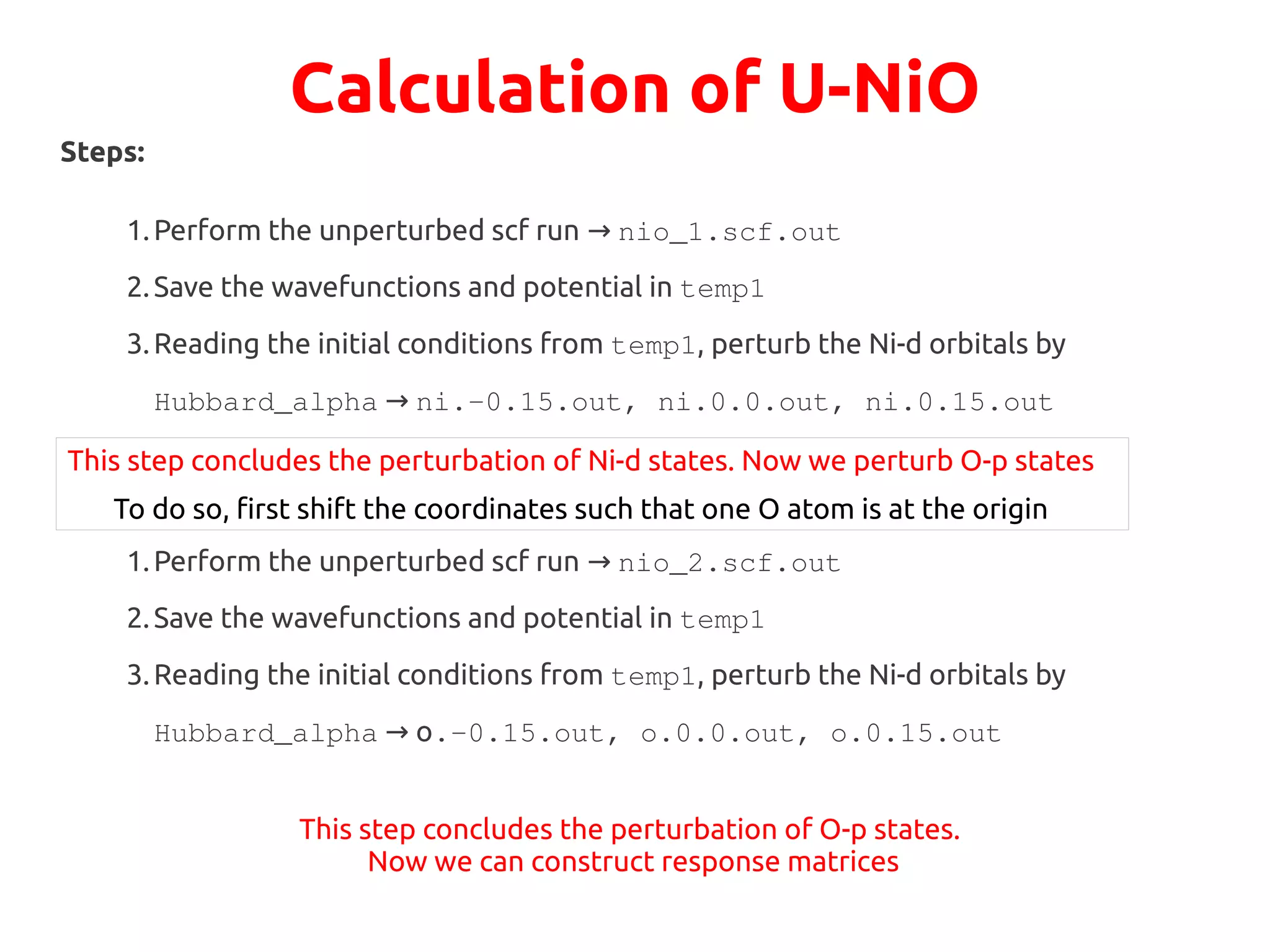
Steps:
1.Perform the unperturbed scf run → nio_1.scf.out
2.Save the wavefunctions and potential in temp1
3.Reading the initial conditions from temp1, perturb the Ni-d orbitals by
Hubbard_alpha → ni.-0.15.out, ni.0.0.out, ni.0.15.out
This step concludes the perturbation of Ni-d states. Now we perturb O-p states
To do so, first shift the coordinates such that one O atom is at the origin
1.Perform the unperturbed scf run → nio_2.scf.out
2.Save the wavefunctions and potential in temp1
3.Reading the initial conditions from temp1, perturb the Ni-d orbitals by
Hubbard_alpha o→ .-0.15.out, o.0.0.out, o.0.15.out
This step concludes the perturbation of O-p states.
Now we can construct response matrices
Calculation of U-NiO
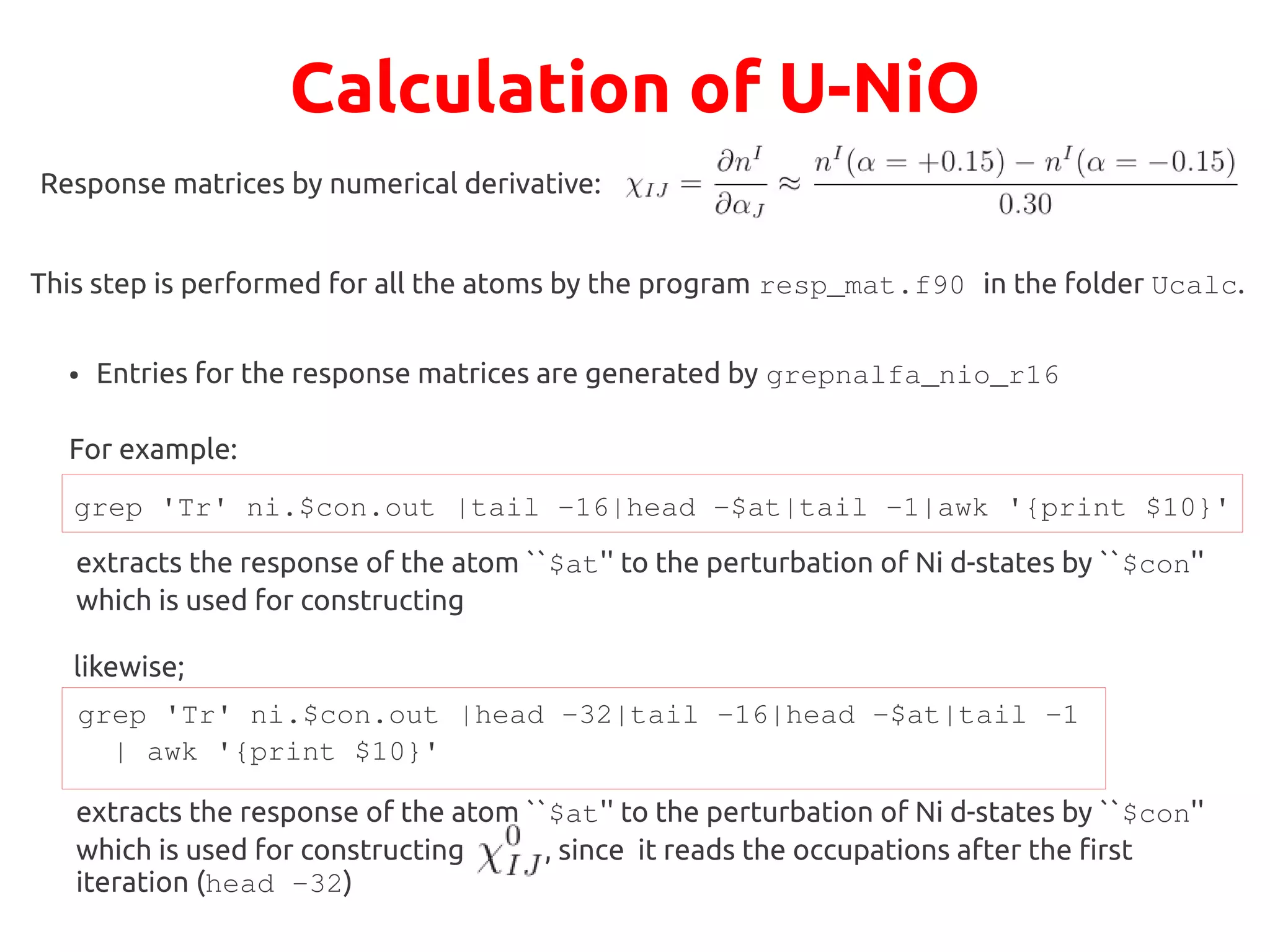
Response matrices by numerical derivative:
This step is performed for all the atoms by the program resp_mat.f90 in the folder Ucalc.
● Entries for the response matrices are generated by grepnalfa_nio_r16
For example:
grep 'Tr' ni.$con.out |tail -16|head -$at|tail -1|awk '{print $10}'
extracts the response of the atom ``$at'' to the perturbation of Ni d-states by ``$con''
which is used for constructing
likewise;
grep 'Tr' ni.$con.out |head -32|tail -16|head -$at|tail -1
| awk '{print $10}'
extracts the response of the atom ``$at'' to the perturbation of Ni d-states by ``$con''
which is used for constructing , since it reads the occupations after the first
iteration (head -32)
Calculation of U-NiO
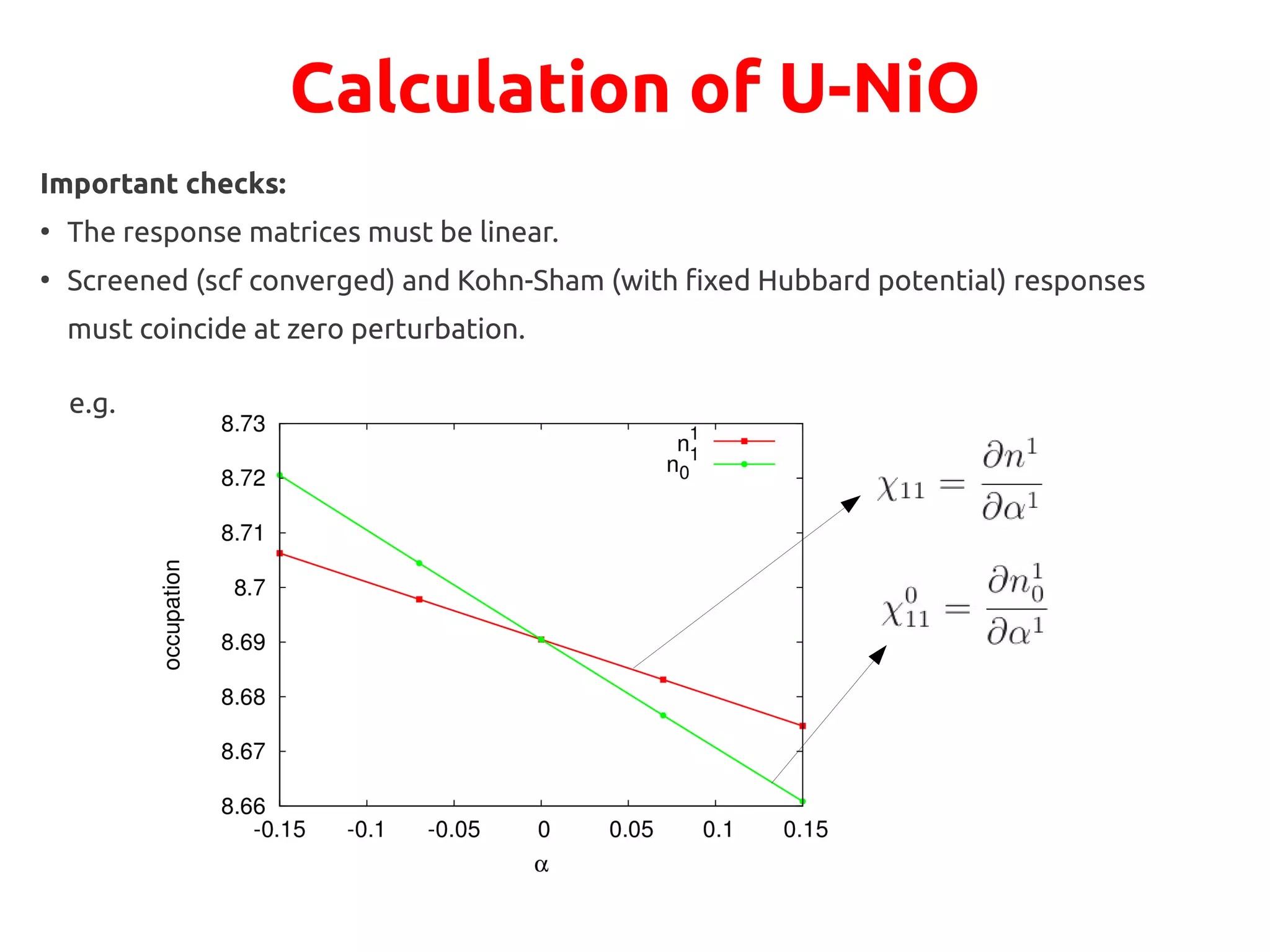
Important checks:
●
The response matrices must be linear.
●
Screened (scf converged) and Kohn-Sham (with fixed Hubbard potential) responses
must coincide at zero perturbation.
e.g.
Calculation of U-NiO
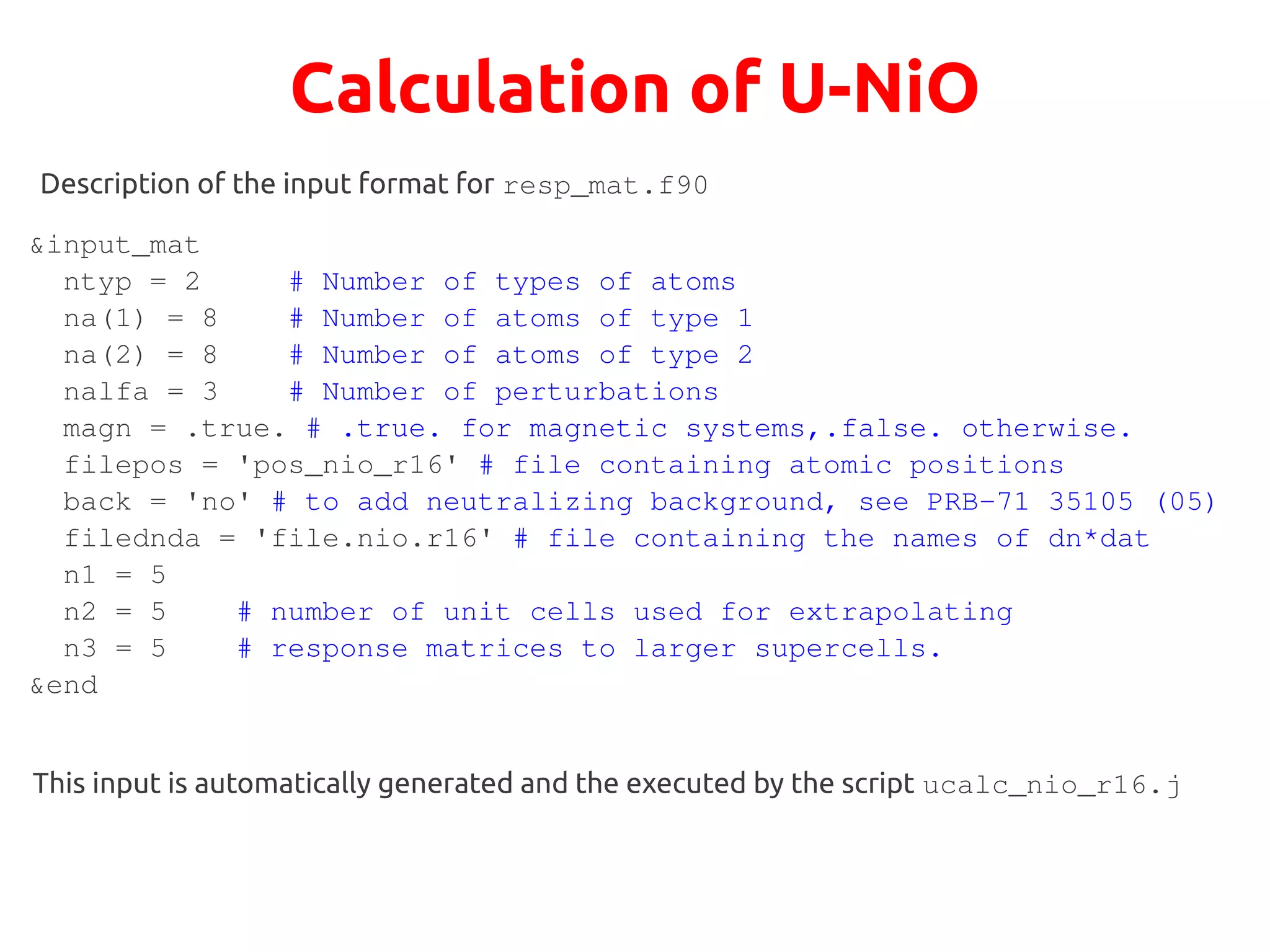
Description of the input format for resp_mat.f90
&input_mat
ntyp = 2 # Number of types of atoms
na(1) = 8 # Number of atoms of type 1
na(2) = 8 # Number of atoms of type 2
nalfa = 3 # Number of perturbations
magn = .true. # .true. for magnetic systems,.false. otherwise.
filepos = 'pos_nio_r16' # file containing atomic positions
back = 'no' # to add neutralizing background, see PRB-71 35105 (05)
filednda = 'file.nio.r16' # file containing the names of dn*dat
n1 = 5
n2 = 5 # number of unit cells used for extrapolating
n3 = 5 # response matrices to larger supercells.
&end
This input is automatically generated and the executed by the script ucalc_nio_r16.j
Calculation of U-NiO
●
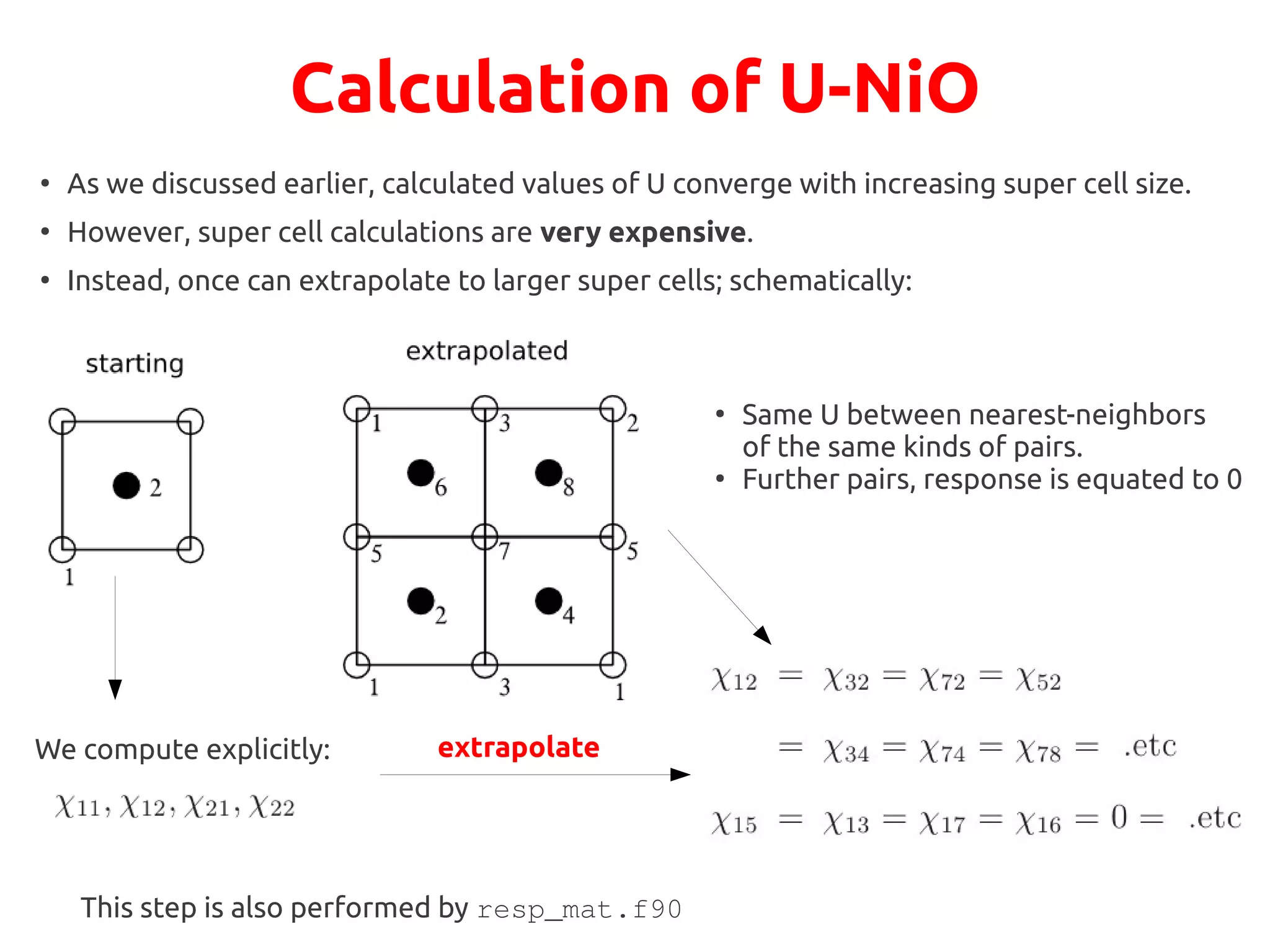
As we discussed earlier, calculated values of U converge with increasing super cell size.
●
However, super cell calculations are very expensive.
●
Instead, once can extrapolate to larger super cells; schematically:
We compute explicitly: extrapolate
●
Same U between nearest-neighbors
of the same kinds of pairs.
●
Further pairs, response is equated to 0
This step is also performed by resp_mat.f90
Calculation of U-NiO
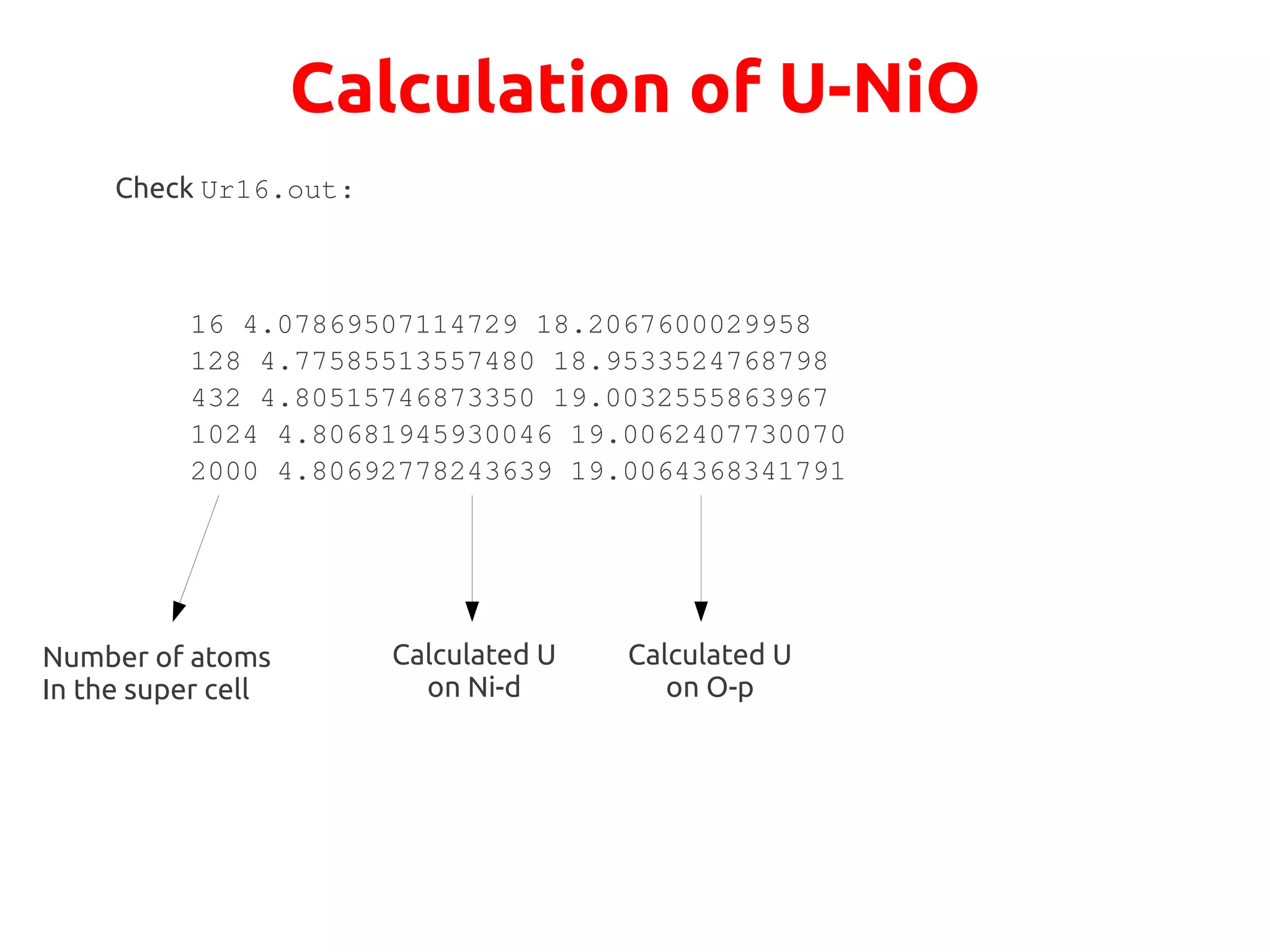
16 4.07869507114729 18.2067600029958
128 4.77585513557480 18.9533524768798
432 4.80515746873350 19.0032555863967
1024 4.80681945930046 19.0062407730070
2000 4.80692778243639 19.0064368341791
Check Ur16.out:
Number of atoms
In the super cell
Calculated U
on Ni-d
Calculated U
on O-p
Exercise Cu2
O
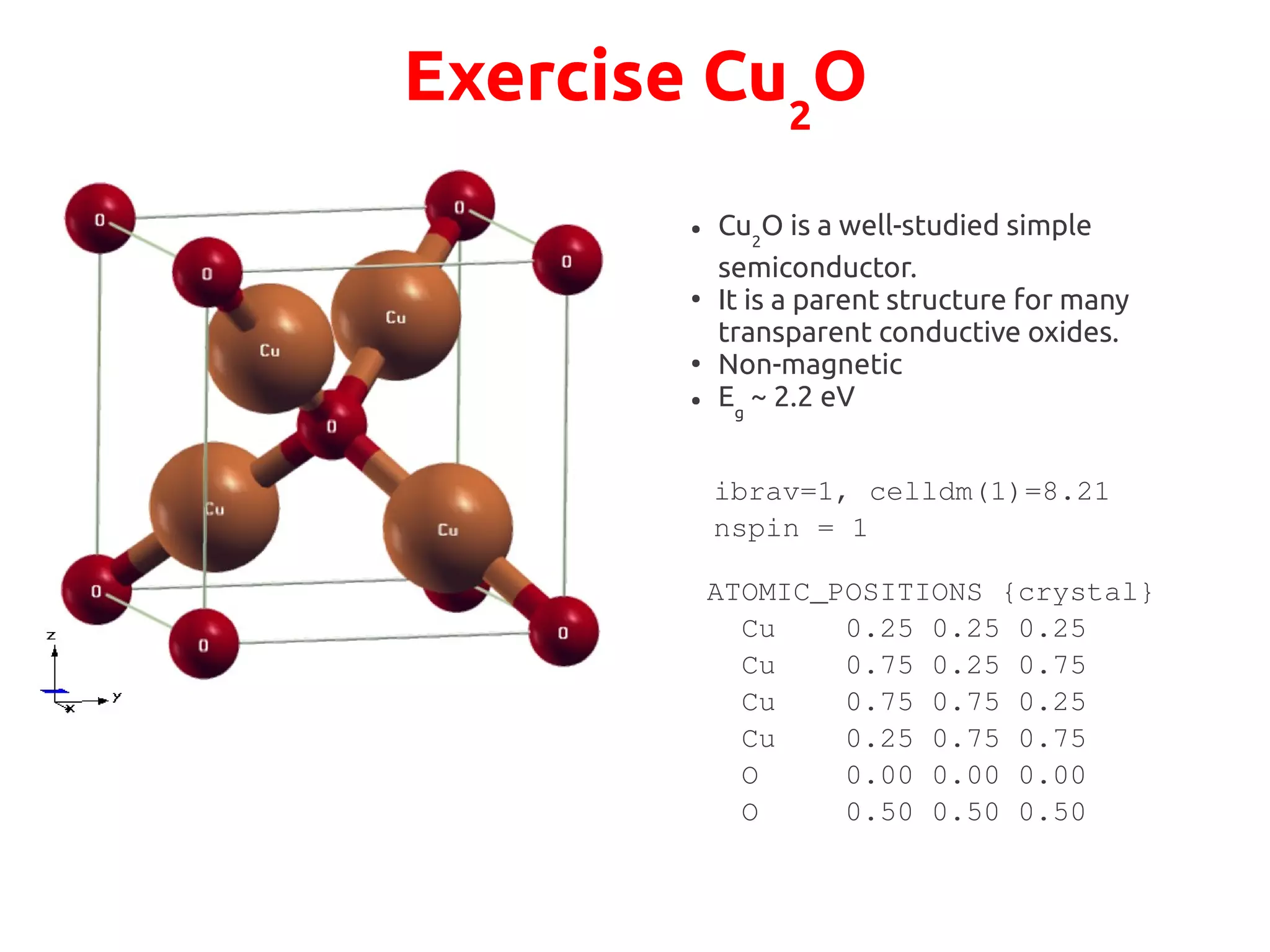
● Cu2
O is a well-studied simple
semiconductor.
●
It is a parent structure for many
transparent conductive oxides.
●
Non-magnetic
● Eg
~ 2.2 eV
ATOMIC_POSITIONS {crystal}
Cu 0.25 0.25 0.25
Cu 0.75 0.25 0.75
Cu 0.75 0.75 0.25
Cu 0.25 0.75 0.75
O 0.00 0.00 0.00
O 0.50 0.50 0.50
ibrav=1, celldm(1)=8.21
nspin = 1
Exercise Cu2
O
●
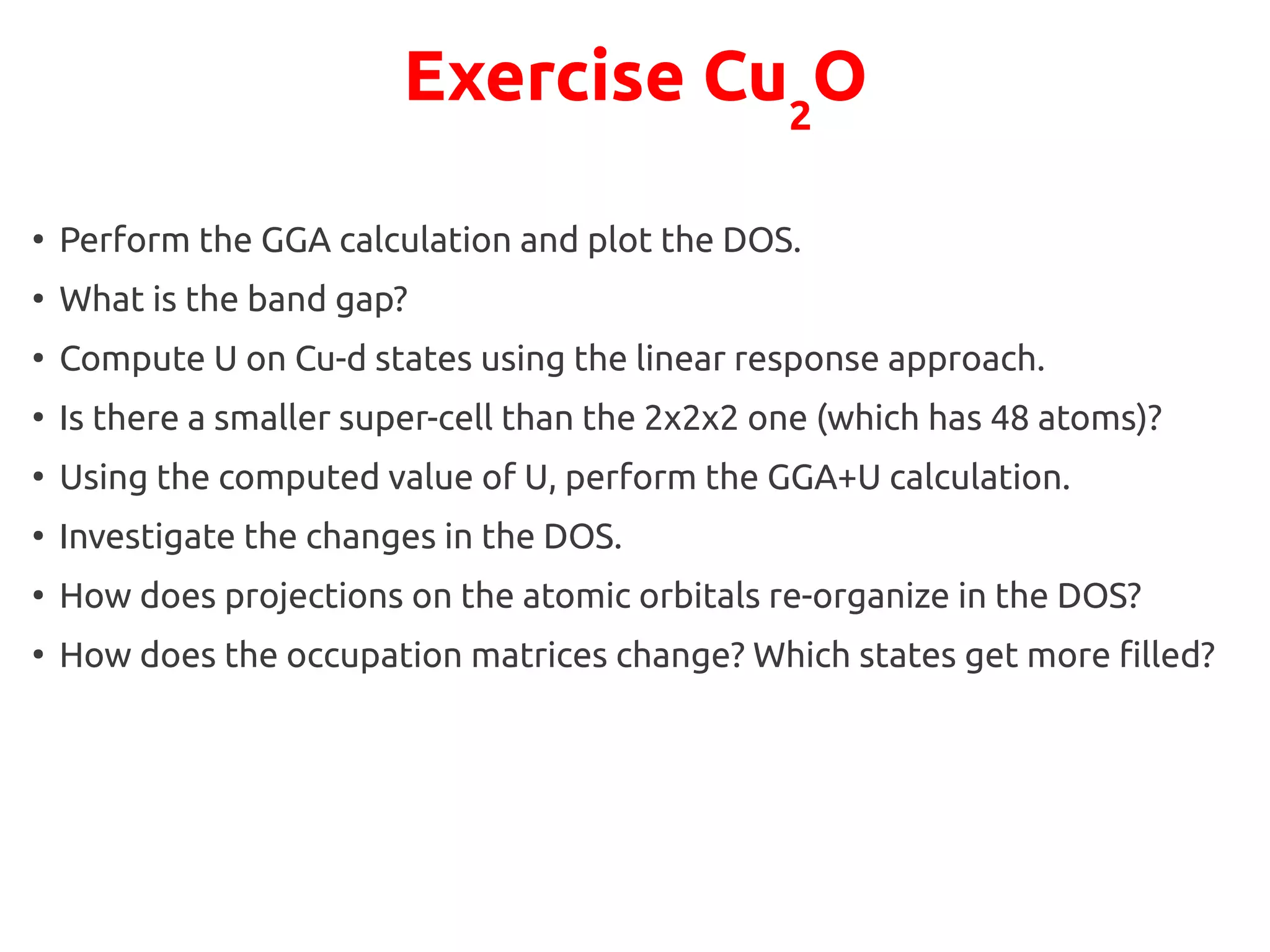
Perform the GGA calculation and plot the DOS.
●
What is the band gap?
●
Compute U on Cu-d states using the linear response approach.
●
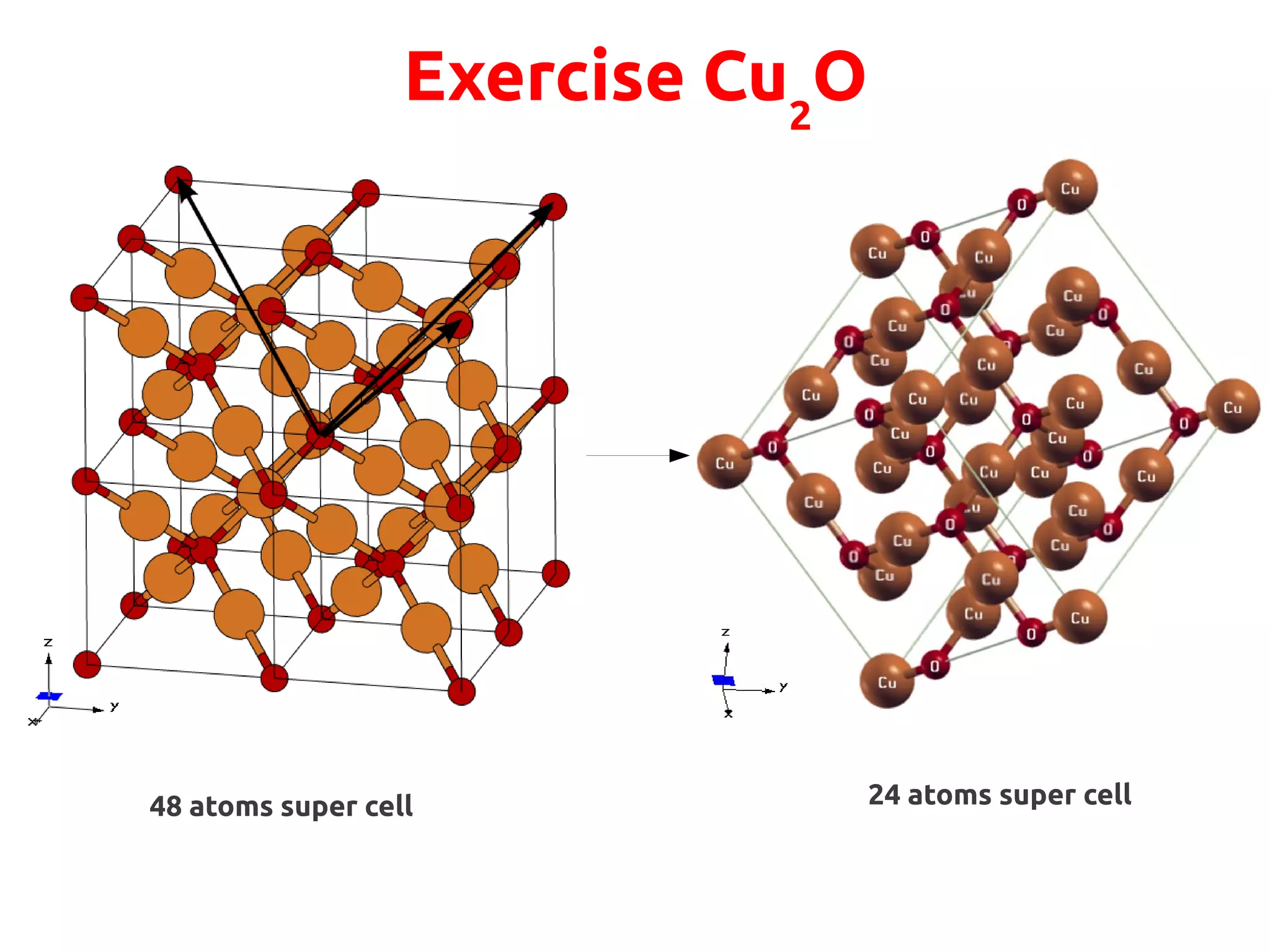
Is there a smaller super-cell than the 2x2x2 one (which has 48 atoms)?
●
Using the computed value of U, perform the GGA+U calculation.
●
Investigate the changes in the DOS.
●
How does projections on the atomic orbitals re-organize in the DOS?
●
How does the occupation matrices change? Which states get more filled?
Exercise Cu2
O
48 atoms super cell 24 atoms super cell
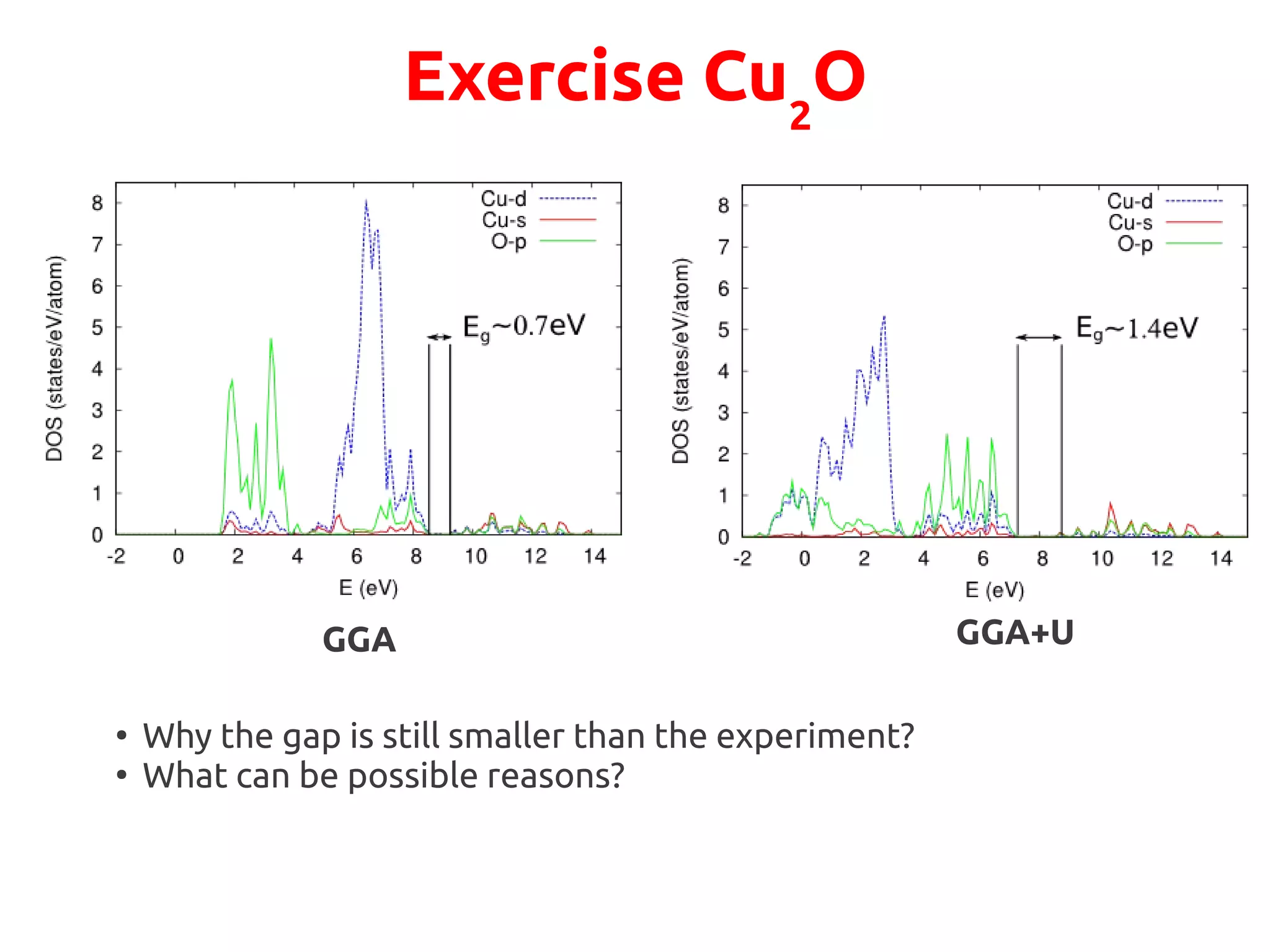
Exercise Cu2
O
GGA GGA+U
●
Why the gap is still smaller than the experiment?
●
What can be possible reasons?

Exercises with DFT+U

  • 1.
    DFT+U practical session BurakHimmetoglu ● GGA and GGA+U calculations in FeO ● Calculation of U for NiO ● Exercise: Case for Cu2 O
  • 2.
    FeO-GGA ● AFM order 2types of Fe atoms→ ATOMIC_SPECIES O 1. O.pbe-rrkjus.UPF Fe1 1. Fe.pbe-nd-rrkjus.UPF Fe2 1. Fe.pbe-nd-rrkjus.UPF starting_magnetization(2)= 0.5 starting_magnetization(3)=-0.5 ● Rhombohedral unit cell: CELL_PARAMETERS 0.50 0.50 1.00 0.50 1.00 0.50 1.00 0.50 0.50 lda_plus_u = .true., Hubbard_U(1) = 1.d-10, Hubbard_U(2) = 1.d-10, Hubbard_U(3) = 1.d-10, ● No Hubbard correctionRhombohedral unit cell
  • 3.
    FeO-GGA ● Check theoutput file: feo.scf.out LDA+U parameters: U( 2) = 0.00000000 alpha( 2) = 0.00000000 U( 3) = 0.00000000 Alpha( 3) = 0.00000000 atom 1 Tr[ns(na)] (up, down, total) = 2.78796 2.78796 5.57592 atom 3 Tr[ns(na)] (up, down, total) = 4.97463 1.85925 6.83388 atom 4 Tr[ns(na)] (up, down, total) = 1.85931 4.97463 6.83394 Hubbard correction on atom 2 (Fe1) Hubbard_alpha perturbation on atom 2 (Fe1) Total occupations: ● Oxygen atoms non-magnetic, nup = ndown ● Iron atoms ordered anti-ferromagnetically
  • 4.
    Eigenvalues and eigenvectorsof occupation matrices (5x5 matrices): FeO-GGA spin 1 eigenvalues: 0.991 0.991 0.998 0.998 0.998 eigenvectors: 0.523 0.438 0.035 0.004 0.000 0.024 0.002 0.022 0.619 0.333 0.001 0.025 0.368 0.272 0.333 0.438 0.523 0.004 0.035 0.000 0.014 0.012 0.571 0.070 0.333 basis set: z2 , xz, yz, x2 -y2 , xy c1 c2 c3 c4 c5 occupations: 0.991 -0.001 -0.001 0.000 -0.001 -0.001 0.998 0.000 -0.001 0.000 -0.001 0.000 0.998 0.001 0.000 0.000 -0.001 0.001 0.991 0.000 -0.001 0.000 0.000 0.000 0.998 5x5 matrix Caution: In previous versions of QE, the eigenvectors are printed as row vectors and the coefficients are not squared.
  • 5.
    FeO-GGA Level splittings: atom 3 spin1 eigenvalues: 0.991 0.991 0.998 0.998 0.998 spin 2 eigenvalues: 0.281 0.281 0.282 0.508 0.508 atom 4 spin 1 eigenvalues: 0.281 0.281 0.282 0.508 0.508 spin 2 eigenvalues: 0.991 0.991 0.998 0.998 0.998 Split by rhombohedral symmetry (magnetic order) Eigenvector corresponding to A1g : 0.000 0.333 0.333 0.000 0.333 Partial occupations of atomic orbitals metallic character
  • 6.
    FeO-GGA density ofstates Density of states: ● Majority spin states are almost full, they are below EF ● Minority spin states are partially occupied at EF metallic behavior→
  • 7.
    FeO-GGA+U Hubbard_U(1)=1.d-10, Hubbard_U(2)=4.3, Hubbard_U(3)=4.3 Hubbard U correctionof Fe d-states: Total occupations: atom 1 Tr[ns(na)] (up, down, total) = 2.80479 2.80492 5.60971 atom 3 Tr[ns(na)] (up, down, total) = 4.99045 1.73174 6.72219 atom 4 Tr[ns(na)] (up, down, total) = 1.73173 4.99046 6.72219 Check minority spin occupations of either Fe atom: atom 4 spin 1 eigenvalues: 0.095 0.216 0.216 0.603 0.603 eigenvectors: 0.000 0.848 0.030 0.085 0.037 0.333 0.034 0.047 0.002 0.584 0.333 0.009 0.072 0.467 0.119 0.000 0.030 0.848 0.037 0.085 0.333 0.078 0.003 0.410 0.176 0.095 0.216 0.603 Still partial occupations! METALLIC
  • 8.
    FeO-GGA+U density ofstates Density of states: We found a local minimum of DFT+U energy functional, which is metallic !
  • 9.
    FeO-GGA+U Let us tryto suggest a different possible electronic configuration to the system: Check minority spin occupations of either Fe atom after the 1st iteration: atom 4 spin 1 eigenvalues: 0.164 0.164 0.202 0.252 0.252 eigenvectors: 0.043 0.940 0.000 0.013 0.004 0.006 0.005 0.333 0.000 0.655 0.011 0.001 0.333 0.492 0.163 0.940 0.043 0.000 0.004 0.013 0.001 0.011 0.333 0.491 0.164 We want to drive the system to a configuration where the A1g state is fully occupied: ● This state is singlet filling it→ completely will lead to an insulator ● Physically, it points along the [111] direction, perpendicular to (111) AFM planes
  • 10.
    FeO-GGA+U2 starting_ns_eigenvalue(3,2,2)=1.d0, starting_ns_eigenvalue(3,1,3)=1.d0 Override the 3rdeigenvalue of the spin 2 of atom 2 and spin 1 of atom 3 with 1.d0: eigenvalue index spin index atom type index Check the resulting minority spin occupations of either Fe atom: atom 4 spin 1 eigenvalues: 0.091 0.091 0.240 0.240 0.996 eigenvectors: 0.009 0.002 0.617 0.372 0.000 0.010 0.650 0.000 0.007 0.333 0.419 0.241 0.006 0.001 0.333 0.002 0.009 0.372 0.617 0.000 0.561 0.099 0.004 0.003 0.333 ● A1g state is fully occupied ● Other are almost empty.
  • 11.
    FeO-GGA+U2 density ofstates Density of states: The insulating state is found ! Which of these local minima has lower energy? total energy = -175.07464368 Ry total energy = -175.16678519 Ry DFT+U metallic DFT+U insulating ● A1g is completely full. ● No partial occupations.
  • 12.
    FeO-GGA+U2 What about otherlocal energy minima? ● There are others with lower energy! ● How to find them? Physical intuition!→ Cococcioni et.al. PRB 71, 035105 (2005)
  • 13.
    Calculation of U-NiO Ifwe use the unit cell, perturbing an atom will perturb all the atoms of the same type in the crystal. We need a super cell to compute U ● Perturbations can not be isolated ● Interactions between periodic images ● will interfere with each other. Calculated value of U will converge with increasing super cell size.
  • 14.
    Calculation of U-NiO 4atoms 16 atoms CELL_PARAMETERS 1.0 1.0 0.0 1.0 0.0 1.0 0.0 1.0 1.0 ATOMIC_POSITIONS {crystal} Ni1 0.d0 0.d0 0.d0 Ni2 0.5d0 0.5d0 0.d0 Ni2 0.5d0 0.d0 0.5d0 Ni2 0.d0 0.5d0 0.5d0 Ni3 0.5d0 0.d0 0.d0 Ni3 0.d0 0.5d0 0.d0 Ni3 0.d0 0.d0 0.5d0 Ni3 0.5d0 0.5d0 0.5d0 O1 -0.25d0 0.25d0 0.25d0 O1 0.25d0 0.25d0 0.25d0 O1 -0.25d0 0.25d0 0.75d0 O1 -0.25d0 0.75d0 0.25d0 O1 0.25d0 0.75d0 0.25d0 O1 0.25d0 0.25d0 0.75d0 O1 -0.25d0 0.75d0 0.75d0 O1 0.25d0 0.75d0 0.75d0 3 types of Ni atoms: 1. Ni1 perturbed spin up (always put the perturbed atom at origin) 2. Ni2 unperturbed spin up 3. Ni3 unperturbed spin down
  • 15.
    Calculation of U-NiO Steps: 1.Performthe unperturbed scf run → nio_1.scf.out 2.Save the wavefunctions and potential in temp1 3.Reading the initial conditions from temp1, perturb the Ni-d orbitals by Hubbard_alpha → ni.-0.15.out, ni.0.0.out, ni.0.15.out This step concludes the perturbation of Ni-d states. Now we perturb O-p states To do so, first shift the coordinates such that one O atom is at the origin 1.Perform the unperturbed scf run → nio_2.scf.out 2.Save the wavefunctions and potential in temp1 3.Reading the initial conditions from temp1, perturb the Ni-d orbitals by Hubbard_alpha o→ .-0.15.out, o.0.0.out, o.0.15.out This step concludes the perturbation of O-p states. Now we can construct response matrices
  • 16.
    Calculation of U-NiO Responsematrices by numerical derivative: This step is performed for all the atoms by the program resp_mat.f90 in the folder Ucalc. ● Entries for the response matrices are generated by grepnalfa_nio_r16 For example: grep 'Tr' ni.$con.out |tail -16|head -$at|tail -1|awk '{print $10}' extracts the response of the atom ``$at'' to the perturbation of Ni d-states by ``$con'' which is used for constructing likewise; grep 'Tr' ni.$con.out |head -32|tail -16|head -$at|tail -1 | awk '{print $10}' extracts the response of the atom ``$at'' to the perturbation of Ni d-states by ``$con'' which is used for constructing , since it reads the occupations after the first iteration (head -32)
  • 17.
    Calculation of U-NiO Importantchecks: ● The response matrices must be linear. ● Screened (scf converged) and Kohn-Sham (with fixed Hubbard potential) responses must coincide at zero perturbation. e.g.
  • 18.
    Calculation of U-NiO Descriptionof the input format for resp_mat.f90 &input_mat ntyp = 2 # Number of types of atoms na(1) = 8 # Number of atoms of type 1 na(2) = 8 # Number of atoms of type 2 nalfa = 3 # Number of perturbations magn = .true. # .true. for magnetic systems,.false. otherwise. filepos = 'pos_nio_r16' # file containing atomic positions back = 'no' # to add neutralizing background, see PRB-71 35105 (05) filednda = 'file.nio.r16' # file containing the names of dn*dat n1 = 5 n2 = 5 # number of unit cells used for extrapolating n3 = 5 # response matrices to larger supercells. &end This input is automatically generated and the executed by the script ucalc_nio_r16.j
  • 19.
    Calculation of U-NiO ● Aswe discussed earlier, calculated values of U converge with increasing super cell size. ● However, super cell calculations are very expensive. ● Instead, once can extrapolate to larger super cells; schematically: We compute explicitly: extrapolate ● Same U between nearest-neighbors of the same kinds of pairs. ● Further pairs, response is equated to 0 This step is also performed by resp_mat.f90
  • 20.
    Calculation of U-NiO 164.07869507114729 18.2067600029958 128 4.77585513557480 18.9533524768798 432 4.80515746873350 19.0032555863967 1024 4.80681945930046 19.0062407730070 2000 4.80692778243639 19.0064368341791 Check Ur16.out: Number of atoms In the super cell Calculated U on Ni-d Calculated U on O-p
  • 21.
    Exercise Cu2 O ● Cu2 Ois a well-studied simple semiconductor. ● It is a parent structure for many transparent conductive oxides. ● Non-magnetic ● Eg ~ 2.2 eV ATOMIC_POSITIONS {crystal} Cu 0.25 0.25 0.25 Cu 0.75 0.25 0.75 Cu 0.75 0.75 0.25 Cu 0.25 0.75 0.75 O 0.00 0.00 0.00 O 0.50 0.50 0.50 ibrav=1, celldm(1)=8.21 nspin = 1
  • 22.
    Exercise Cu2 O ● Perform theGGA calculation and plot the DOS. ● What is the band gap? ● Compute U on Cu-d states using the linear response approach. ● Is there a smaller super-cell than the 2x2x2 one (which has 48 atoms)? ● Using the computed value of U, perform the GGA+U calculation. ● Investigate the changes in the DOS. ● How does projections on the atomic orbitals re-organize in the DOS? ● How does the occupation matrices change? Which states get more filled?
  • 23.
    Exercise Cu2 O 48 atomssuper cell 24 atoms super cell
  • 24.
    Exercise Cu2 O GGA GGA+U ● Whythe gap is still smaller than the experiment? ● What can be possible reasons?