WIRELESS NETWORKS AND SECURITY
Hakan Tolgay
hakan@hakantolgay.com
Who am I
 At Netas since 2008 and has experience on
 Wireline and wireless telephony networks
 VoIP - SIP systems
 VoIP platform security for federal and goverment projets
 Interested in
 Radio Frequesny (RF) stuff
 Physical security
 HAM Radio Operator (TB2THT)
Agenda
 Wireless networks today
 IEEE 802.11 – WiFi
 IEEE 802.11’s technology
 Vulnerabilities
 EM/RF leakİNG and tempest
 Tools
Wireless Networks Today
 In everywhere
 Mostly unecrypted
 Can be in any form, RF, light or sound
IEEE 802.11
 802.11 standart
 Uses unlicensed ISM spectrum which is provided by regulators
 WiFi frequencies: 2.4 & 5Ghz & 60Ghz (on 2016 non-IEEE)
ISM Bands for WiFi
 ISM (industrial, scientific and medical)
 902 - 928 MHz
 2.4 - 2.5 GHz
 5.725 – 5875 GHz
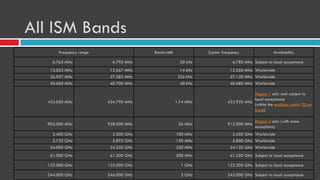
All ISM Bands
Frequency range Bandwidth Center frequency Availability
6.765 MHz 6.795 MHz 30 kHz 6.780 MHz Subject to local acceptance
13.553 MHz 13.567 MHz 14 kHz 13.560 MHz Worldwide
26.957 MHz 27.283 MHz 326 kHz 27.120 MHz Worldwide
40.660 MHz 40.700 MHz 40 kHz 40.680 MHz Worldwide
433.050 MHz 434.790 MHz 1.74 MHz 433.920 MHz
Region 1 only and subject to
local acceptance
(within the amateur radio 70 cm
band)
902.000 MHz 928.000 MHz 26 MHz 915.000 MHz
Region 2 only (with some
exceptions)
2.400 GHz 2.500 GHz 100 MHz 2.450 GHz Worldwide
5.725 GHz 5.875 GHz 150 MHz 5.800 GHz Worldwide
24.000 GHz 24.250 GHz 250 MHz 24.125 GHz Worldwide
61.000 GHz 61.500 GHz 500 MHz 61.250 GHz Subject to local acceptance
122.000 GHz 123.000 GHz 1 GHz 122.500 GHz Subject to local acceptance
244.000 GHz 246.000 GHz 2 GHz 245.000 GHz Subject to local acceptance
WiFi Legacy
 In 1991 AT&T begins working on a wireless technology called WaveLAN
 Now known as WaveLAN Classic
 Operated in 900 MHz Spectrum
 Developed in the Netherlands as a technology for wireless cashier systems
 Supported data rates of 1 and 2 MegaBits Per second
Wifi Since Then
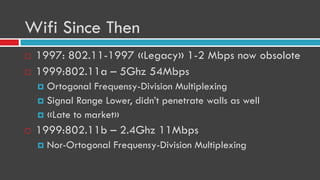
 1997: 802.11-1997 «Legacy» 1-2 Mbps now obsolote
 1999:802.11a – 5Ghz 54Mbps
 Ortogonal Frequensy-Division Multiplexing
 Signal Range Lower, didn’t penetrate walls as well
 «Late to market»
 1999:802.11b – 2.4Ghz 11Mbps
 Nor-Ortogonal Frequensy-Division Multiplexing
Wifi Since Then
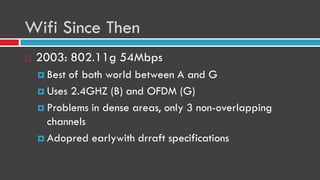
 2003: 802.11g 54Mbps
 Best of both world between A and G
 Uses 2.4GHZ (B) and OFDM (G)
 Problems in dense areas, only 3 non-overlapping
channels
 Adopred earlywith drraft specifications
Wifi «Now»
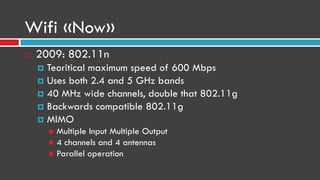
 2009: 802.11n
 Teoritical maximum speed of 600 Mbps
 Uses both 2.4 and 5 GHz bands
 40 MHz wide channels, double that 802.11g
 Backwards compatible 802.11g
 MIMO
 Multiple Input Multiple Output
 4 channels and 4 antennas
 Parallel operation
WiFi «Now»
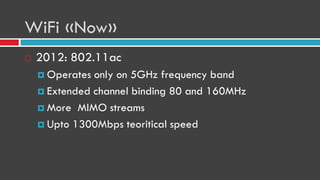
 2012: 802.11ac
 Operates only on 5GHz frequency band
 Extended channel binding 80 and 160MHz
 More MIMO streams
 Upto 1300Mbps teoritical speed
WiFi in the Future
 2016:802.11ad
 Will operate only at 60GHz
 Transfer rate upto 7Gbps
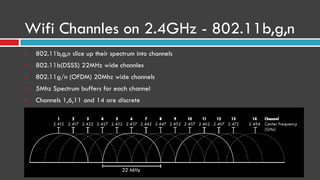
Wifi Channles on 2.4GHz - 802.11b,g,n
 802.11b,g,n slice up their spectrum into channels
 802.11b(DSSS) 22MHz wide channles
 802.11g/n (OFDM) 20Mhz wide channels
 5Mhz Spectrum buffers for each channel
 Channels 1,6,11 and 14 are discrete
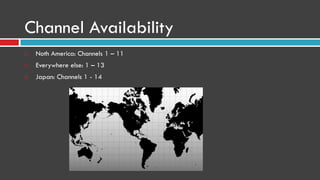
Channel Availability
 Noth America: Channels 1 – 11
 Everywhere else: 1 – 13
 Japan: Channels 1 - 14
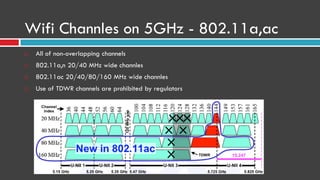
Wifi Channles on 5GHz - 802.11a,ac
 All of non-overlapping channels
 802.11a,n 20/40 MHz wide channles
 802.11ac 20/40/80/160 MHz wide channles
 Use of TDWR channels are prohibited by regulators
Wifi Channles on 60GHz - 802.11ad
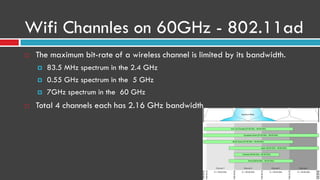
 The maximum bit-rate of a wireless channel is limited by its bandwidth.
 83.5 MHz spectrum in the 2.4 GHz
 0.55 GHz spectrum in the 5 GHz
 7GHz spectrum in the 60 GHz
 Total 4 channels each has 2.16 GHz bandwidth
Modes of WiFi
 Master – Access Point or Base Station
 Managed – Infrastructure Mode (client)
 Ad-hoc – peer-to-peer
 Mesh – Mesh cloud (planned ad-hoc)
 Repeater
 Monitor (promiscuous) - (DEMO)
Modes and capabilities of WiFi NICs
 Not all WiFi NICs are same - DEMO
TX power
 Limited based on counties law/regulations
 In Europe
 17dBm (or 50mW) TX power
 Max Equivalent isotropically radiated power (EIRP) 20dBm (or 100mW)
 Regulatory settings can be changed via kernel modification
 Also you can move your country to another one with better regulations - DEMO
WiFi Frames
 There are 3 main types of 802.11 Frame
 Control Frames
 Management Frames
 Data Frames
Control Frames
 Acknowledgement (ACK)
 Request to Send (RTS) frame
 Clear to Send (CTS) frame
Management Frames
 Beacons
 Probes
 Authentication frames
 Association frames
Beacons
 DEMO
 SSID Flood atack - DEMO
Probes
Authentication Frames
 Authentication
 Deathentication - DEMO
Comon Attacks and Vulnerabilities
 Open Networks
 Weak encryptions
 Weak designs – WPS
Open Networks
 No Encryption, everything is on the air - DEMO
 Easy for Man-in-the-middle atacks (MITM)
 Evil access points - DEMO
Weak encryptions – WEP (Wireless
equivalent Privacy)
 Part of the 802.11 specification
 Aims to make connection at least as secure as wired Connection
 Used to protect MAC Protocol Data Units (MPDU)
 802.11 describes WEP as having two main parts
 The first being the Authentication part
 The second being the Encryption part
 Mostly used until 802.11i
 Use RC4 algorithm for encryption which isn’t so secure
 Easy to break, less than 5 minuets
WPA & WPA2
 Dictionary attacks
 Known passwords
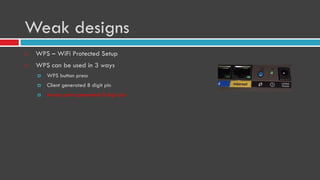
Weak designs
 WPS – WiFi Protected Setup
 WPS can be used in 3 ways
 WPS button press
 Client generated 8 digit pin
 Access point generated 8 digit pin
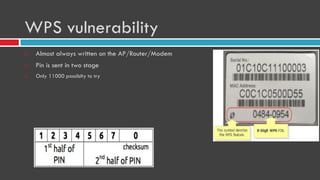
WPS vulnerability
 Almost always written on the AP/Router/Modem
 Pin is sent in two stage
 Only 11000 possiblty to try
EM/RF leaking & Tempest
 Leon Theremin - Video
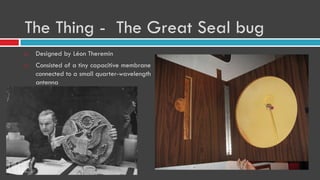
The Thing - The Great Seal bug
 Designed by Léon Theremin
 Consisted of a tiny capacitive membrane
connected to a small quarter-wavelength
antenna
EM/RF leaking
 Every wire is an antenna
 Your screen and typing can be monitored even if you are not online
Tempest
 TEMPEST is a National Security Agency specification and NATO certification[1][2] referring to
spying on information systems through
 Radio or Electrical signals
 Sounds
 Vibrations
Tools
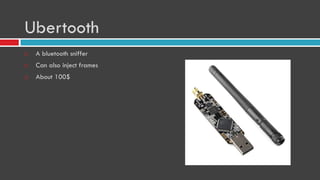
 Ubertooth
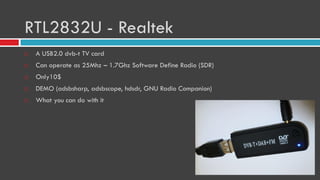
 RTL2832U – Realtek
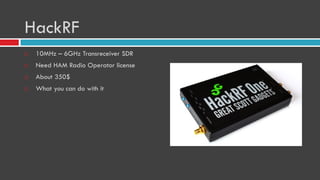
 HackRF
Ubertooth
 A bluetooth sniffer
 Can also inject frames
 About 100$
RTL2832U - Realtek
 A USB2.0 dvb-t TV card
 Can operate as 25Mhz – 1.7Ghz Software Define Radio (SDR)
 Only10$
 DEMO (adsbsharp, adsbscope, hdsdr, GNU Radio Companion)
 What you can do with it
HackRF
 10MHz – 6GHz Transreceiver SDR
 Need HAM Radio Operator license
 About 350$
 What you can do with it
References
 http://www.scholartica.com/
 http://www.hak5.org
 http://wireless.kernel.org/en/users/Documentation/Bluetooth-coexistence
 http://www.tekgear.com/PDF/WHP-050004-1V0%20Bluetooth%20and%20802.11%20Coexistence.pdf
 http://www.freshpatents.com/Enhanced-2-wire-and-3-wire-wlan-bluetooth-coexistence-solution-
dt20070712ptan20070161349.php
 https://greatscottgadgets.com
Thank you

Kablosuz İletişim ve Güvenlik

  • 1.
    WIRELESS NETWORKS ANDSECURITY Hakan Tolgay hakan@hakantolgay.com
  • 2.
    Who am I At Netas since 2008 and has experience on  Wireline and wireless telephony networks  VoIP - SIP systems  VoIP platform security for federal and goverment projets  Interested in  Radio Frequesny (RF) stuff  Physical security  HAM Radio Operator (TB2THT)
  • 3.
    Agenda  Wireless networkstoday  IEEE 802.11 – WiFi  IEEE 802.11’s technology  Vulnerabilities  EM/RF leakİNG and tempest  Tools
  • 4.
    Wireless Networks Today In everywhere  Mostly unecrypted  Can be in any form, RF, light or sound
  • 5.
    IEEE 802.11  802.11standart  Uses unlicensed ISM spectrum which is provided by regulators  WiFi frequencies: 2.4 & 5Ghz & 60Ghz (on 2016 non-IEEE)
  • 6.
    ISM Bands forWiFi  ISM (industrial, scientific and medical)  902 - 928 MHz  2.4 - 2.5 GHz  5.725 – 5875 GHz
  • 7.
    All ISM Bands Frequencyrange Bandwidth Center frequency Availability 6.765 MHz 6.795 MHz 30 kHz 6.780 MHz Subject to local acceptance 13.553 MHz 13.567 MHz 14 kHz 13.560 MHz Worldwide 26.957 MHz 27.283 MHz 326 kHz 27.120 MHz Worldwide 40.660 MHz 40.700 MHz 40 kHz 40.680 MHz Worldwide 433.050 MHz 434.790 MHz 1.74 MHz 433.920 MHz Region 1 only and subject to local acceptance (within the amateur radio 70 cm band) 902.000 MHz 928.000 MHz 26 MHz 915.000 MHz Region 2 only (with some exceptions) 2.400 GHz 2.500 GHz 100 MHz 2.450 GHz Worldwide 5.725 GHz 5.875 GHz 150 MHz 5.800 GHz Worldwide 24.000 GHz 24.250 GHz 250 MHz 24.125 GHz Worldwide 61.000 GHz 61.500 GHz 500 MHz 61.250 GHz Subject to local acceptance 122.000 GHz 123.000 GHz 1 GHz 122.500 GHz Subject to local acceptance 244.000 GHz 246.000 GHz 2 GHz 245.000 GHz Subject to local acceptance
  • 8.
    WiFi Legacy  In1991 AT&T begins working on a wireless technology called WaveLAN  Now known as WaveLAN Classic  Operated in 900 MHz Spectrum  Developed in the Netherlands as a technology for wireless cashier systems  Supported data rates of 1 and 2 MegaBits Per second
  • 9.
    Wifi Since Then 1997: 802.11-1997 «Legacy» 1-2 Mbps now obsolote  1999:802.11a – 5Ghz 54Mbps  Ortogonal Frequensy-Division Multiplexing  Signal Range Lower, didn’t penetrate walls as well  «Late to market»  1999:802.11b – 2.4Ghz 11Mbps  Nor-Ortogonal Frequensy-Division Multiplexing
  • 10.
    Wifi Since Then 2003: 802.11g 54Mbps  Best of both world between A and G  Uses 2.4GHZ (B) and OFDM (G)  Problems in dense areas, only 3 non-overlapping channels  Adopred earlywith drraft specifications
  • 11.
    Wifi «Now»  2009:802.11n  Teoritical maximum speed of 600 Mbps  Uses both 2.4 and 5 GHz bands  40 MHz wide channels, double that 802.11g  Backwards compatible 802.11g  MIMO  Multiple Input Multiple Output  4 channels and 4 antennas  Parallel operation
  • 12.
    WiFi «Now»  2012:802.11ac  Operates only on 5GHz frequency band  Extended channel binding 80 and 160MHz  More MIMO streams  Upto 1300Mbps teoritical speed
  • 13.
    WiFi in theFuture  2016:802.11ad  Will operate only at 60GHz  Transfer rate upto 7Gbps
  • 14.
    Wifi Channles on2.4GHz - 802.11b,g,n  802.11b,g,n slice up their spectrum into channels  802.11b(DSSS) 22MHz wide channles  802.11g/n (OFDM) 20Mhz wide channels  5Mhz Spectrum buffers for each channel  Channels 1,6,11 and 14 are discrete
  • 15.
    Channel Availability  NothAmerica: Channels 1 – 11  Everywhere else: 1 – 13  Japan: Channels 1 - 14
  • 16.
    Wifi Channles on5GHz - 802.11a,ac  All of non-overlapping channels  802.11a,n 20/40 MHz wide channles  802.11ac 20/40/80/160 MHz wide channles  Use of TDWR channels are prohibited by regulators
  • 17.
    Wifi Channles on60GHz - 802.11ad  The maximum bit-rate of a wireless channel is limited by its bandwidth.  83.5 MHz spectrum in the 2.4 GHz  0.55 GHz spectrum in the 5 GHz  7GHz spectrum in the 60 GHz  Total 4 channels each has 2.16 GHz bandwidth
  • 18.
    Modes of WiFi Master – Access Point or Base Station  Managed – Infrastructure Mode (client)  Ad-hoc – peer-to-peer  Mesh – Mesh cloud (planned ad-hoc)  Repeater  Monitor (promiscuous) - (DEMO)
  • 19.
    Modes and capabilitiesof WiFi NICs  Not all WiFi NICs are same - DEMO
  • 20.
    TX power  Limitedbased on counties law/regulations  In Europe  17dBm (or 50mW) TX power  Max Equivalent isotropically radiated power (EIRP) 20dBm (or 100mW)  Regulatory settings can be changed via kernel modification  Also you can move your country to another one with better regulations - DEMO
  • 21.
    WiFi Frames  Thereare 3 main types of 802.11 Frame  Control Frames  Management Frames  Data Frames
  • 22.
    Control Frames  Acknowledgement(ACK)  Request to Send (RTS) frame  Clear to Send (CTS) frame
  • 23.
    Management Frames  Beacons Probes  Authentication frames  Association frames
  • 24.
    Beacons  DEMO  SSIDFlood atack - DEMO
  • 25.
  • 26.
  • 27.
    Comon Attacks andVulnerabilities  Open Networks  Weak encryptions  Weak designs – WPS
  • 28.
    Open Networks  NoEncryption, everything is on the air - DEMO  Easy for Man-in-the-middle atacks (MITM)  Evil access points - DEMO
  • 29.
    Weak encryptions –WEP (Wireless equivalent Privacy)  Part of the 802.11 specification  Aims to make connection at least as secure as wired Connection  Used to protect MAC Protocol Data Units (MPDU)  802.11 describes WEP as having two main parts  The first being the Authentication part  The second being the Encryption part  Mostly used until 802.11i  Use RC4 algorithm for encryption which isn’t so secure  Easy to break, less than 5 minuets
  • 30.
    WPA & WPA2 Dictionary attacks  Known passwords
  • 31.
    Weak designs  WPS– WiFi Protected Setup  WPS can be used in 3 ways  WPS button press  Client generated 8 digit pin  Access point generated 8 digit pin
  • 32.
    WPS vulnerability  Almostalways written on the AP/Router/Modem  Pin is sent in two stage  Only 11000 possiblty to try
  • 33.
    EM/RF leaking &Tempest  Leon Theremin - Video
  • 34.
    The Thing -The Great Seal bug  Designed by Léon Theremin  Consisted of a tiny capacitive membrane connected to a small quarter-wavelength antenna
  • 35.
    EM/RF leaking  Everywire is an antenna  Your screen and typing can be monitored even if you are not online
  • 36.
    Tempest  TEMPEST isa National Security Agency specification and NATO certification[1][2] referring to spying on information systems through  Radio or Electrical signals  Sounds  Vibrations
  • 37.
    Tools  Ubertooth  RTL2832U– Realtek  HackRF
  • 38.
    Ubertooth  A bluetoothsniffer  Can also inject frames  About 100$
  • 39.
    RTL2832U - Realtek A USB2.0 dvb-t TV card  Can operate as 25Mhz – 1.7Ghz Software Define Radio (SDR)  Only10$  DEMO (adsbsharp, adsbscope, hdsdr, GNU Radio Companion)  What you can do with it
  • 40.
    HackRF  10MHz –6GHz Transreceiver SDR  Need HAM Radio Operator license  About 350$  What you can do with it
  • 41.
    References  http://www.scholartica.com/  http://www.hak5.org http://wireless.kernel.org/en/users/Documentation/Bluetooth-coexistence  http://www.tekgear.com/PDF/WHP-050004-1V0%20Bluetooth%20and%20802.11%20Coexistence.pdf  http://www.freshpatents.com/Enhanced-2-wire-and-3-wire-wlan-bluetooth-coexistence-solution- dt20070712ptan20070161349.php  https://greatscottgadgets.com
  • 42.