INTERNATIONAL
BACCALAUREATE
DIPLOMA PROGRAMME
WORKBOOK
MATHEMATICS-HIGHER LEVEL
“If knowledge is light, then education is its intensity.”
(In conjunction with the syllabus of first
examinations, 2014)
VOLUME-I
GOODSHEPHERD INTERNATIONAL SCHOOL
TECHNICAL SUPPORT: ANGELIN MADHUSOODHANAN (M.Sc in Statistics)
AUTHOR: LENIN KUMAR GANDHI (M.Sc, M.Phil in Mathematics)
KEY POINTS
1.) This book is meant for knowledge build-up and prepares the students for IBDP Math-HL
examinations.
2.) The questions in each content of the workbook are tested from the basic introductory level to
the uplifted level which requires highly critical thinking.
3.) Special care is taken to break the uniqueness method of testing the problems. The questions
are tested with various differing command terms and terminology which would surely make
the understanding process challenging and thus making thorough preparations for the
exams.
4.) Making one acquire holistic education is the main goal of this workbook and hence the
questions in each content of the syllabus are proportionately developed, meeting through all
the key requirements of the IBDP pedagogy.
5.) The questions, where so ever developed in whole or part-of are nowhere picked from the
external resources directly or indirectly, thus claiming for full copyright claims of the entire
workbook designed & created.
6.) With feedbacks and opinions taken into account from all across the globe, we hope for
improvisation in the quality of the book and the standard of the questions in forthcoming
editions, meeting through the requirements of the competitive global challenges.
Math4life...
This book is dedicated to all the famous mathematicians
of history who have poured in their knowledge & life
itself, to bring in various fascinating inventions &
discoveries through their esteemed efforts…..
1.) CIRCULAR FUNCTIONS & TRIGONOMETRY
2.) BINOMIAL THEOREM & EXPANSIONS
3.) SEQUENCES & SERIES
TOPICS COVERED IN VOLUME-I OF THE SYLLABUS:
ESSENTIAL KEY FACTORS OF THE PEDAGOGY:
This workbook is designed into preparing the students for future
university courses and is a pre-university knowledge built-up, keeping in
mind the changes as made in the Mathematics-Higher Level syllabus
starting from first examinations, May 2014. This workbook includes the
key essential factors as expected by IB to enhance the students’ skills
in acquiring holistic education and thus making one a life-long learner,
proudly meeting through the school’s vision. The following are the key
factors into which the whole syllabus is sub-divided into:
1.) Enhancing the problem-solving skills (tested on both the
GDC & non-GDC skills)
2.) Testing on the reverse process of understanding the content
approach.
3.) Consistent practice of inducing the critical thinking skills.
4.) Connecting the topics to real-life applications.
5.) Different ways of knowing the contents or the subject itself-
Connecting to Theory of Knowledge.
6.) Historical facts behind the inventions & discoveries in
Mathematics-
Connecting to related contents of the topic.
7.) Enhancing the investigative & research skills- Investigative
topics related to the contents of the topic are included as
‘Mini-Explorations’ at the end of each content.
INTERNATIONAL BACCALAUREATE DIPLOMA PROGRAMME
Mathematics-higher level
ESSENTIAL CONTENTS OF THE WORKBOOK
I.) ENHANCING THE PROBLEM-SOLVING SKILLS:
Each part of the workbook exercise initially includes testing
the students’ level of solving the problems (tested both
through the GDC & non-GDC usage). The use of GDC is
included at the problems thereof (if required while solving).
Problems where critical thinking is required are also part of
the inclusions
PROCESS OF TESTING:
Reverse process of testing the students’ approach has been
identified to be the most effective practice in the learning
process and therefore every content of the workbook is
identified with the reverse process of testing the content.
For example, given the function, graphing its curve would be
a forward process, but given the graph of the function on an
XY Co-ordinate System, identifying its function is equally
an essential practice required in the form of reverse process
II.) REVERSE
.
of learning. Further, it also makes the learning process more
deeper and stronger(a 2-way learning approach).
III.) REAL-LIFE APPLICATIONS:
Proper care is also taken to connect every content of the
syllabus with few situations demanding for real-life
applications of math. Through this, the students are mainly
intended to apply the learned contents in the classroom
sessions into the outer world of real-life situations and thus
learn the concepts more strongly and realistically. It also
gives an opportunity for the learners to appreciate the
applications of mathematics in real-life & thus making a
journey into the life-long learning. At some instances, it
even opens-up the opportunity for demonstrating one’s own
hands-on learning.
IV.) CONNECTING TO TOK:
TOK which stands for ‘Theory of Knowledge’ is defined as the
different ways of knowing the subject and is an essential key
factor in the learning process. In pursuit of holistic education,
it is essential that the subject is learnt not only in terms of
problem-solving skills but also through the different ways of
‘understanding’ & ‘justifying’ the means of evaluating the
learnt subject. For example, learning mathematics in the
present class immediately after an English class would definitely
raise the doubt in the students’ mind with a fair TOK question-
“Is Mathematics a language?” & thus creates an inquiry
platform in researching the question raised in mind and hence is
very essential for ‘knowing’ the various ‘ways of knowing’ the
subject, all in pursuit of holistic education & life-long learning.
Therefore the workbook has also stressed in involving various
contents of the topic connected with different ways of knowing,
which in turn is expected to make the students in better
understanding of TOK connected with mathematics.
V.) HISTORICAL FACTS:
The history behind the inventions & discoveries in
Mathematics have always been hidden treasures since ages &
its time now to react to the opening-up of the actual facts
behind various inventions & discoveries which have impacted
many researches & downfalls and hence in international-
mindedness it is very essential that the students investigate
the facts while learning the contents. The impact of
historical facts has been so tremendous & violent that one
episode of history has taken away the life of a great
Physicist & a Mathematician due to his realistic inventions
& discoveries. Copernicus who contradicted Pluto’s
assumption that the Earth is the center of the solar system
had made new discoveries and more importantly has
courageously stated that Earth is not the center of the solar
system and that the Sun was the center of the solar system
and the statement and the discovery has put him to death-
bed due to the false conflicts of prestige and selfishness of
the kings-times. Many contents in the workbook have opened
up information as investigative questions relating to various
historical facts in mathematics.
VI.) EXPLORATION TASKS:
The “Exploration” which is an Internal Assessment
component, contributes to 20% of the total weightage of
marks and hence this concept is included at the end of each
workbook content, to meet through the essential
requirements of the actual exploration task. It is expected
that the students investigate the Mini-Explorations, meeting
through all the five criteria of the latest Internal
Assessment guidelines. Through this consistent practice of
investigations & inquiries, the students will be able to
collaborate their topics to other subjects, thus expanding
their knowledge to the wider globe. It provides a learning
platform for thoroughly preparing for the actual explorations
and is also a way of selecting the best topic suitable for
‘Exploration’ through choices of the Mini-Explorations as
already done. It also gives a wide opportunity for the
students to present their mathematical communication and
use of correct mathematical notations & terminology, the
decline of which is a major concern in the mathematical
society of the recent times, never to forget the importance
of mathematics in education system and its contribution to
real-life.
VII.) COMMAND TERMS:
The command terms which play a vital role in the questions
asked in final examinations need continuous practice of
understanding the different forms of command terms and
their individual rules of approach while solving the problems
and hence are included in the regular class-sessions. For
example, the key difference between ‘sketch’ & ‘draw’
applies itself with many rules for the former and the latter
accordingly, failing which the students would be penalized in
examinations, as per the strict marking scheme rules of IB.
Most of the students are bound to make mistakes in
understanding of the key difference between ‘Hence’ &
‘Hence or otherwise’ and end up being penalized for not
applying the correct approach. Hence, each content is taken
care with differing command terms to make the practice
thorough through command term-based approach. It is also a
way of enhancing the students’ ability to improvise on their
mathematical communication skills and getting well prepared
for final examinat
Note: All the images & mathematical diagrams have been created using the
mathematical softwares ‘Geogebra’ & ‘Autograph’ and the images wheresoever
copied have been cited with the reference links thereof. The coloring,
designing, outlining and other special effects have been done using the
Microsoft Office-2013. Each content of the following pages have been created
using my qualifications, self-knowledge and the experiences of IB teaching in
conjunction with the IBDP Mathematics-Higher Level syllabus and no
information whatsoever has been picked from external resources.
ions.
Imp: Until and unless otherwise stated, all numerical answers as obtained
from solving the problems must be given exactly or correct to 3 significant
figures.
CONSISTENT PRACTICE IS
THE KEY TO SUCCESS IN
MATHEMATICS….
TOPIC:CIRCULAR FUNCTIONS AND
TRIGONOMETRY
CONTENT: PERIMETER AND AREA OF SECTOR
NON GDC QUESTIONS
1. Make the following conversions
(i) 500
= … … … . 𝑐
.
(ii) 12 𝑐
= … … … … 𝑜
(iii) 1 𝑐
= … … … … . . 𝑜
(iv) 1 𝑜
= … … … … . . 𝑐
(v)
11𝜋
6
= … … … … . 𝑜
2. Find the area and perimeter of the following shaded region
(i)
(ii)
Page 1 of 198.
IBDP Mathematics-Higher LevelWorkbook .
.
3. Find the area of the unshaded region and hence find its respective length of the
arc.
(i)
(ii)
With radius 3 cm
3c
Page 2 of 198.
IBDP Mathematics-Higher LevelWorkbook .
.
4. Find the radius of the circle whose minor sector area is
88
21
𝑐𝑚2
and with central
angle of 120o .Hence find the length of the major arc.
GDC BASED QUESTIONS
5. Find the area of the following shaded region whose length of the minor arc is 2.3
m .
Reverse
Process
Page 3 of 198.
IBDP Mathematics-Higher LevelWorkbook .
.
6. Find the radius of the following circles
(i)
4c
Page 4 of 198.
IBDP Mathematics-Higher LevelWorkbook .
.
(ii)
Page 5 of 198.
IBDP Mathematics-Higher LevelWorkbook .
.
Real life applications :-
The radius of the inner circle is 30 m and that of the outer circle is 50 m with the
common central angle to be 40 o.
Find the area of the estimated region and also the entire boundary estimated by
the engineer.
7. An engineer makes an estimate of a circular cricket ground for painting a 3D-
advertising logo picture on the pitch in the sectional area as represented by
the sector region COD as follows:
Page 6 of 198.
IBDP Mathematics-Higher LevelWorkbook .
.
Connecting to TOK
8. Connect the topic “SECTOR OF A CIRCLE “ to TOK .
Question: “Will the change of central ideas of a person at the core of his heart
affect his/her outer personality?”
Hint:-
Historical facts :-
9. Investigate on the real historical facts behind the central angle of a circle being
fixed at a value of 360 degrees.
Exploration :-
10.To what extent does the length of the Arc differ with its varied central angle?
Does the radius of the circle play a vital role in the process? Use your exploration
to explain the complete process of investigations.
Hint: A real-life activity & the use of effective Math Softwares are helpful for this
exploration.
Central angle of a sector
Length of the arc
l
Page 7 of 198.
IBDP Mathematics-Higher LevelWorkbook .
.
CONTENT: UNIT CIRCLE AND
TRIGONOMETRIC RATIOS CONNECTED
I. NON –GDC QUESTIONS:-
1. Identify the co ordinates of the given points on the following unit circles .
Hence find the gradient of the line joining origin to the point of intersection
without using the actual gradient formula.
(i)
(ii)
X
Y
600
X
Y
600
𝑃
X
Y
450
𝐴
Page 8 of 198.
IBDP Mathematics-Higher LevelWorkbook .
.
(iii)
(iv)
𝑄
X
Y
X
Y
𝐴
𝐵
𝐶
𝐷
Page 9 of 198.
IBDP Mathematics-Higher LevelWorkbook .
.
(v)
(vi)
300
X
Y
𝑅
𝑃
X
Y
1500
Page 10 of 198.
IBDP Mathematics-Higher LevelWorkbook .
.
(vii)
NON GDC QUESTIONS
(viii)
𝑃
X
Y
600
X
Y
3𝜋
4𝑃
Page 11 of 198.
IBDP Mathematics-Higher LevelWorkbook .
.
(ix)
(x)
X
Y
5𝜋
3
𝑆
X
Y
𝜋
3
Page 12 of 198.
IBDP Mathematics-Higher LevelWorkbook .
.
(xi)
2.
Identify the angles for each of the given circles
(i)
𝜃
𝑃
3
2
,
1
2
X
Y
X
Y
𝜋
3
Page 13 of 198.
IBDP Mathematics-Higher LevelWorkbook .
.
(ii)
(iii)
𝑃 −
1
2
,
1
2
X
Y
𝜃
X
Y
𝜃
𝑃 −
1
2
,
3
2
Page 14 of 198.
IBDP Mathematics-Higher LevelWorkbook .
.
(iv)
NON GDC QUESTIONS
(v) Find the coordinates of the following lines which intersect the given unit
circles:
𝑃
3
2
, −
1
2
X
Y
𝜃
X
Y
𝐴
𝐵
𝑦 = 3 𝑥
Page 15 of 198.
IBDP Mathematics-Higher LevelWorkbook .
.
(vi)
(vii)
X
Y
𝑃
𝑄
𝑦 = −𝑥
𝑦 =
1
3
𝑥
X
Y
𝐿
𝑀
Page 16 of 198.
IBDP Mathematics-Higher LevelWorkbook .
.
GDC Based Questions
3. Identify the coordinates of the points of intersection on following unit circles,
Hence find the slope of the line joining origin to the given points without actually
using the gradient formula.
(i)
(ii)
320
X
Y
𝐴
𝐵
X
Y
2840
Page 17 of 198.
IBDP Mathematics-Higher LevelWorkbook .
.
(iii)
(iv)
X
Y
1230
𝐿
X
Y
10
Give 4
s.fanswer
𝑃
Page 18 of 198.
IBDP Mathematics-Higher LevelWorkbook .
.
(v)
(vi)
X
Y
10
Give 4
s.fanswer
𝑃
0.83 𝑐
𝑄
X
Y
Page 19 of 198.
IBDP Mathematics-Higher LevelWorkbook .
.
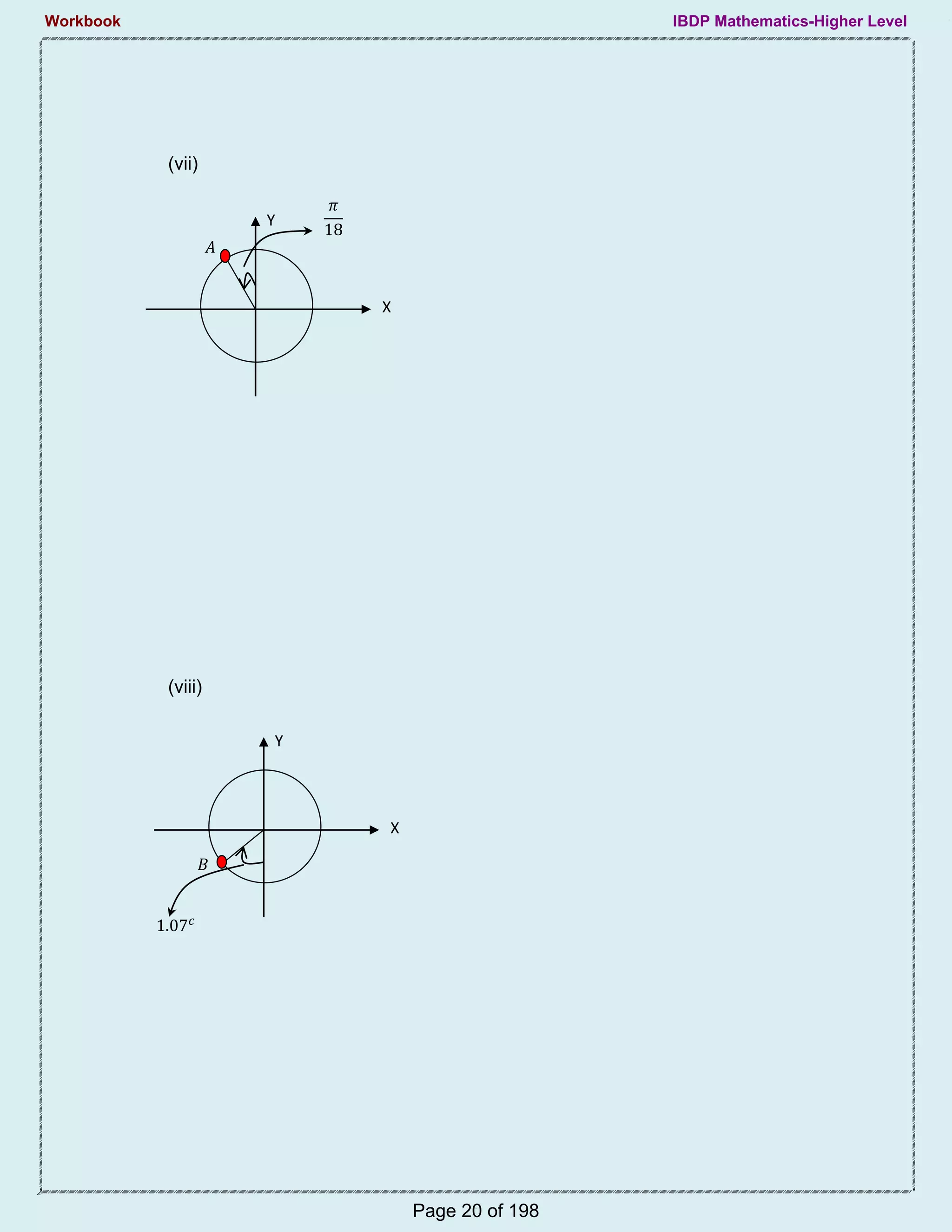
(vii)
(viii)
X
Y
𝐴
𝜋
18
X
Y
1.07 𝑐
𝐵
Page 20 of 198.
IBDP Mathematics-Higher LevelWorkbook .
.
(ix)
X
Y
𝐶
𝜋
31
Page 21 of 198.
IBDP Mathematics-Higher LevelWorkbook .
.
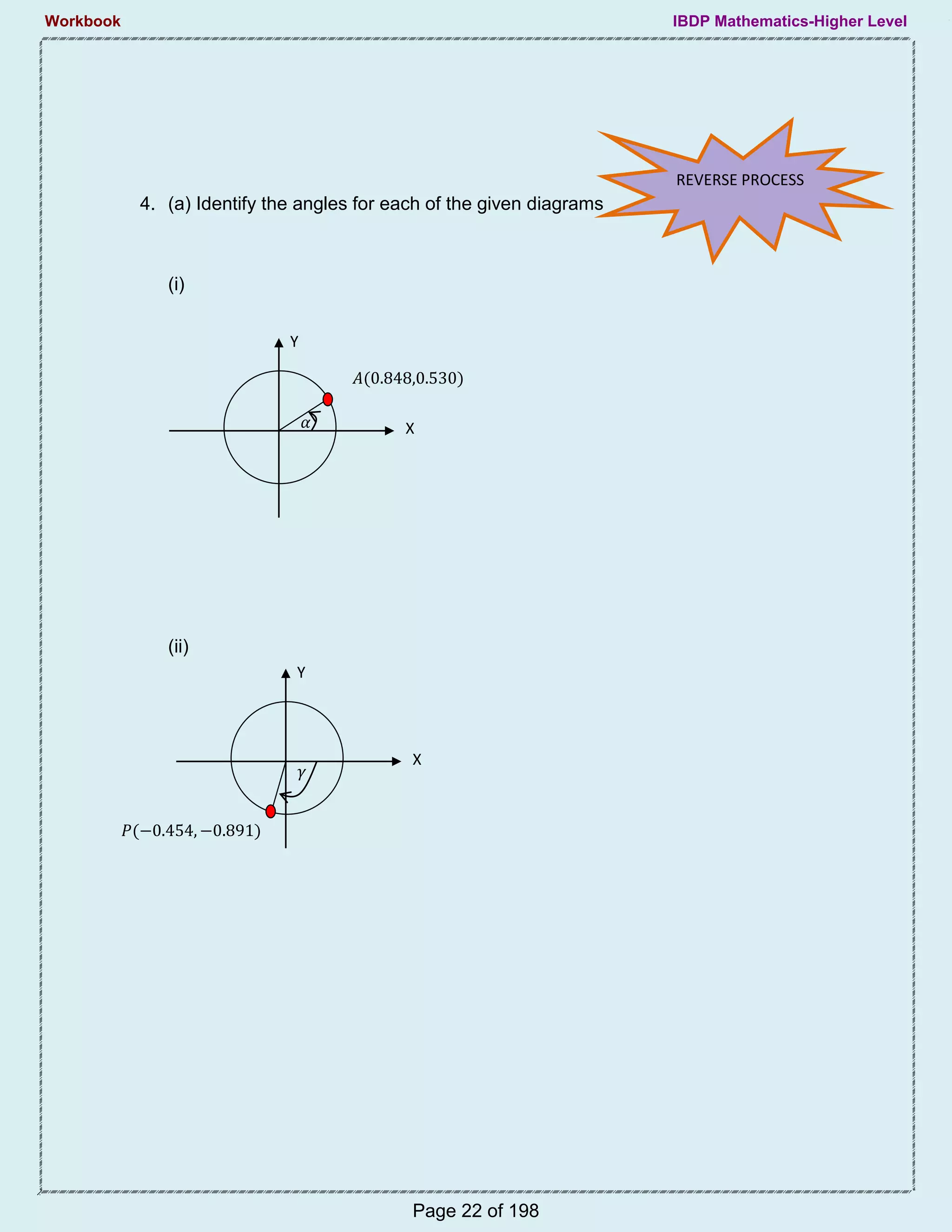
4. (a) Identify the angles for each of the given diagrams
(i)
(ii)
REVERSE PROCESS
X
Y
𝐴(0.848,0.530)
𝛼
X
Y
𝑃(−0.454, −0.891)
𝛾
Page 22 of 198.
IBDP Mathematics-Higher LevelWorkbook .
.
(iii)
(iv)
X
Y
𝑀(0.999, −0.0330)
X
Y
𝛽
X
Y
𝑄(−0.129,0.992)
𝛼
Give your answers in
radians
Page 23 of 198.
IBDP Mathematics-Higher LevelWorkbook .
.
(v)
X
Y
𝛽
𝐴(−0.416,0.909)
Page 24 of 198.
IBDP Mathematics-Higher LevelWorkbook .
.
(vi)
X
Y
𝐿(0.977,0.215)
𝜃
Page 25 of 198.
IBDP Mathematics-Higher LevelWorkbook .
.
(b) Find the coordinates of the following lines which intersect the given unit
circles
(i)
(ii)
X
Y
𝑅
𝑆
𝑦 = 1.235 𝑥
𝑀
𝑀′
X
Y
𝑦 = −0.404 𝑥
Page 26 of 198.
IBDP Mathematics-Higher LevelWorkbook .
.
(iii)
X
Y
𝐿
𝐿′
𝑦 = −4.70 𝑥
Page 27 of 198.
IBDP Mathematics-Higher LevelWorkbook .
.
5. Find the values of the following ratios :
(i) sin 7500
(ii) cos 11400
(iii) tan 9900
(iv) cos 21600
(v) tan
13𝜋
6
(vi) sin
17𝜋
3
(vii) cos
11𝜋
6
− sin
15𝜋
3
(viii) cos(−300)
(ix) sin(−1000)
(x) tan (−
𝜋
2
)
Page 28 of 198.
IBDP Mathematics-Higher LevelWorkbook .
.
REAL-LIFE
APPLICATIONS
6. A farmer plans to build a circular
sheep yard exactly from the centre of his
field. He uses a rope length of 50m exactly
from the centre of his field and hence makes
a circular fence within the plot. He also plans
to build a gateway into the sheep yard as
represented by the points ‘P’ and ‘Q’ as
shown in the diagram .
If point ‘P’ is 1500
counter clockwise and
point ‘Q’Is 1500
clockwise from the x- axis, then find the
Length of the gate PQ as estimated by the farmer.
[Hint: Use 50 m = 1 unit]
CRITICAL
THINKING
I love
it…
Page 29 of 198.
IBDP Mathematics-Higher LevelWorkbook .
.
Page 30 of 198.
IBDP Mathematics-Higher LevelWorkbook .
.
CONNECTING TO TOK
7. Does the different terms as used in mathematics in various parts of the globe
affect the learning process?
Exemplar Terminology used in different parts of the globe :-
Anti clockwise ---- counter clockwise
Right triangle ---- right angled triangle
Measure of angle ---- size of angle
Perpendicular ----- orthogonal
HISTORICAL FACTS :-
8. When did the unit circle first come into existence in the history of mathematics?
Page 31 of 198.
IBDP Mathematics-Higher LevelWorkbook .
.
EXPLORATION
9. Investigate the cause of invention of sin, cos and tan of the angle for a right
angled triangle.
Page 32 of 198.
IBDP Mathematics-Higher LevelWorkbook .
.
CONTENT : -
TRIGONOMETRIC
IDENTITIES
1) Prove the following identities:-
(i)
𝑠𝑖𝑛2 𝜃
𝑐𝑜𝑠2 𝜃
−
1
𝑐𝑜𝑠2 𝜃
+ 1 = 0
Page 33 of 198.
IBDP Mathematics-Higher LevelWorkbook .
.
(ii)
1
𝑠𝑖𝑛 𝛼+𝑐𝑜𝑠 𝛼
+
1
𝑠𝑖𝑛 𝛼−𝑐𝑜𝑠 𝛼
=
2 𝑠𝑖𝑛 𝛼
1−2 𝑐𝑜𝑠2 𝛼
Page 34 of 198.
IBDP Mathematics-Higher LevelWorkbook .
.
(iii) √
1+𝑠𝑖𝑛 𝛾
1−𝑠𝑖𝑛 𝛾
=
1+𝑠𝑖𝑛 𝛾
𝑐𝑜𝑠 𝛾
Page 35 of 198.
IBDP Mathematics-Higher LevelWorkbook .
.
(iv)
1+𝑠𝑖𝑛 𝐴
1−𝑠𝑖𝑛 𝐴
=
(1+𝑠𝑖𝑛 𝐴)2
𝑐𝑜𝑠2 𝐴
Page 36 of 198.
IBDP Mathematics-Higher LevelWorkbook .
.
(v) 𝑠𝑖𝑛4
𝜃 + 𝑐𝑜𝑠4
𝜃 = 1 − 2𝑠𝑖𝑛2
𝜃 𝑐𝑜𝑠2
𝜃
Page 37 of 198.
IBDP Mathematics-Higher LevelWorkbook .
.
(vi) 𝑠𝑖𝑛4
𝜃 − 𝑐𝑜𝑠4
𝜃 = 1 − 2𝑐𝑜𝑠2
𝜃
Page 38 of 198.
IBDP Mathematics-Higher LevelWorkbook .
.
(vii) 𝑠𝑖𝑛6
𝜃 + 𝑐𝑜𝑠6
𝜃 = 1 − 3 𝑠𝑖𝑛2
𝜃 𝑐𝑜𝑠2
𝜃
Page 39 of 198.
IBDP Mathematics-Higher LevelWorkbook .
.
(viii)
𝑠𝑖𝑛 𝐶−𝑠𝑖𝑛 𝐷
𝑐𝑜𝑠 𝐶+𝑐𝑜𝑠 𝐷
+
𝐶𝑜𝑠 𝐶−𝑐𝑜𝑠 𝐷
𝑆𝑖𝑛 𝐶+𝑆𝑖𝑛 𝐷
= 0
Page 40 of 198.
IBDP Mathematics-Higher LevelWorkbook .
.
(2) If 2 sin 𝐴 − 1 = 0 , 𝑡ℎ𝑒𝑛 𝑠ℎ𝑜𝑤 𝑡ℎ𝑎𝑡
(i) 𝑠𝑖𝑛 3𝐴 = 3 𝑠𝑖𝑛 𝐴 − 4 𝑠𝑖𝑛3
𝐴
Page 41 of 198.
IBDP Mathematics-Higher LevelWorkbook .
.
(ii) 𝑐𝑜𝑠 3𝐴 = 4 𝑐𝑜𝑠3
𝐴 − 3 𝑐𝑜𝑠 𝐴
(iii) 𝑡𝑎𝑛 3𝐴 =
3 𝑡𝑎𝑛 𝐴− 𝑡𝑎𝑛3 𝐴
1−3𝑡𝑎𝑛2 𝐴
Page 42 of 198.
IBDP Mathematics-Higher LevelWorkbook .
.
(3) Find the possible values of ‘k’ for
𝑠𝑖𝑛3
𝜃 + 𝑐𝑜𝑠3
𝜃
𝑠𝑖𝑛 𝜃 + 𝑐𝑜𝑠 𝜃
+
𝑠𝑖𝑛3
𝜃 − 𝑐𝑜𝑠3
𝜃
𝑠𝑖𝑛 𝜃 + 𝑐𝑜𝑠 𝜃
= 𝑘
𝑤𝑖𝑡ℎ 𝑘 ≠ 0 ∈ ℝ+
.
Page 43 of 198.
IBDP Mathematics-Higher LevelWorkbook .
.
(4) TOK RELATED:-
Question: Can two quantities be exactly the same in law of nature?
Hint: Connect with the process of proving Trigonometric Identities (LHS = RHS)
Page 44 of 198.
IBDP Mathematics-Higher LevelWorkbook .
.
(5) EXPLORATION :-
Derive for the Pythagorean identity
𝑠𝑖𝑛2
𝜃 + 𝑐𝑜𝑠2
𝜃 = 1
and compare it with the Pythagoras theorem of a right angled triangle
𝐻2
= 𝑂2
+ 𝐴2
.
Hint:- Connect with Pythagorean triplets .
Page 45 of 198.
IBDP Mathematics-Higher LevelWorkbook .
.
TOPIC:- CIRCULAR FUNCTIONS AND
TRIGONOMETRY
CONTENT-:- APPLICATIONS OF
TRIGONOMETRIC RATIOS
(I) Non GDC based Questions
(1)Find the unknown value in the following diagrams :-
(i)
(ii)
4
𝑥
5
𝑥0
400
Page 46 of 198.
IBDP Mathematics-Higher LevelWorkbook .
.
(iii)
(iv)
13 cm,
x
12 cm
5 cm
6 m
10 m
Page 47 of 198.
IBDP Mathematics-Higher LevelWorkbook .
.
(v)
(vi)
x
14 cm
24 cm
α
1 Ɵ
Page 48 of 198.
IBDP Mathematics-Higher LevelWorkbook .
.
(vii) Find the exact value of the unknown variables
12 m
a
50 m
Page 49 of 198.
IBDP Mathematics-Higher LevelWorkbook .
.
(viii)
15 m
a
𝟔𝟎 𝟎
x
Page 50 of 198.
IBDP Mathematics-Higher LevelWorkbook .
.
REAL LIFE APPLICATIONS OF
TRIGONOMETRIC RATIOS
II
(1) A person standing 60𝑚 above the lake observes the cloud at an angle of 30 𝑜
.
He also observes its reflection in the lake at an angle of 60 𝑜
. Find the height of
the cloud above the lake .
Note: It is recommended to draw a neat diagram of the situations before proceeding to solve the
above problem.
Hint: The mirror reflects your image as the water in the lake does……
Page 51 of 198.
IBDP Mathematics-Higher LevelWorkbook .
.
(2) Two people walk away from the tower exactly in opposite direction . Person –A
walks a certain distance and observes the top of the tower with an angle of 30 𝑜
.
Person-B walks a certain distance and observes the top of the tower with an
angle of 60 𝑜
. If the height of the tower is 600 metres then find the distance
between the two persons.
Note: Sketch the approximate diagram for the problem.
Page 52 of 198.
IBDP Mathematics-Higher LevelWorkbook .
.
(III ) TOK
Can the bearings and trigonometric ratios and angles make us reach the destinations
correctly?
Hint:-Investigate on the sailors of the ship using bearings to make the ships reach the
destinations correctly .
(IV) Historical facts
Investigate the historical facts behind the discovery of various places & continents by
famous geographical explorers like Vasco da Gama’s extensive journey through ships.
Hint: Connect to ‘Bearings’.
(V) EXPLORATION
Investigate the change in length of the ALTITUDE with the varying angle of elevation.
Hint: Start your process by taking different data. Start initially with 10 and list out. The
use of Digital Clinometer would be highly useful in the process.
I LOVE THE EXPERIENTIAL LEARNING OF MATHEMATICS……
Let’s recap
history……
Page 53 of 198.
IBDP Mathematics-Higher LevelWorkbook .
.
TOPIC : CIRCULAR
FUNCTIONS AND EQUATIONS
CONTENT:- SINE AND
COSINE RULE
(I) Find the missing dimensions
(i)
(ii)
x
330
7 cm
6 cm
420
6 m
a
0.007 km
29 𝑜
Page 54 of 198.
IBDP Mathematics-Higher LevelWorkbook .
.
(iii)
1200
80 𝑐𝑚
3 𝑚
𝑦
𝑥
Page 55 of 198.
IBDP Mathematics-Higher LevelWorkbook .
.
(iv)
4 m
2 m
29 𝑜
𝜃
5 𝑚
Page 56 of 198.
IBDP Mathematics-Higher LevelWorkbook .
.
(v )
13 m
4 m
𝑥 𝑐
2 𝑐 15 m
Page 57 of 198.
IBDP Mathematics-Higher LevelWorkbook .
.
(i)
6 m
x
40 𝑜
64 𝑜
Page 58 of 198.
IBDP Mathematics-Higher LevelWorkbook .
.
(ii)
16 𝑚
8 𝑚
5 𝑚
𝑥 𝑜
𝑦 𝑜
Page 59 of 198.
IBDP Mathematics-Higher LevelWorkbook .
.
(2) Find the value of the missing dimension correct to two decimal places
(i)
12 𝑐𝑚
𝑥 𝑚
50 𝑜 47 𝑜
Page 60 of 198.
IBDP Mathematics-Higher LevelWorkbook .
.
(ii)
𝑎 𝑐𝑚
16 𝑐𝑚
61 𝑜
53 𝑜
Page 61 of 198.
IBDP Mathematics-Higher LevelWorkbook .
.
(iii)
3.9 𝐾𝑚
𝑥 𝐾𝑚
1.2 𝑐
0.9 𝑐
Page 62 of 198.
IBDP Mathematics-Higher LevelWorkbook .
.
II REAL –LIFE APPLICATIONS :
(1) Calculate the size of the angle LMN for the following cuboidal construction of the
building:
M
L
6 m
N
5 m
3 m
Page 63 of 198.
IBDP Mathematics-Higher LevelWorkbook .
.
(2) Find the length of the longest rod which can fit into the following box :-
Also find the angle made by the rod with the base of the box .
2 m
P
Q
1.4 m
0.3 m
Page 64 of 198.
IBDP Mathematics-Higher LevelWorkbook .
.
(3) Find the estimated angle made by the footballer to kick the ball to the goal post
with his pre-located positions .
Note: Image cited from google images.
MATH IN
GAMES
7 metres
15 metres
110 𝑜
𝑥 𝑜
If I kick the ball at 𝒙 𝒐
turn , the ball
reaches the goal keeper directly .
So, I kick at a more bigger turn of
angle Hmmm………Now, I need 𝒙 ?
Page 65 of 198.
IBDP Mathematics-Higher LevelWorkbook .
.
Page 66 of 198.
IBDP Mathematics-Higher LevelWorkbook .
.
(III) TOK :-
Can sine rule and cosine rule find solutions to problems using the least of the
dimensions of a triangle ?
Hint:-Connect to finding solutions to real life problems through the optimized
sustainability and minimized use of resourceswhich is very essential in case of resolving
few of the global issues.
EXPLORATION:
(IV) Investigate the “ Ambiguous cases“ arising from triangles.
Page 67 of 198.
IBDP Mathematics-Higher LevelWorkbook .
.
TOPIC : CIRCULAR FUNCTIONS AND
TRIGONOMETRY
CONTENT:- AREA OF SCALENE
TRIANGLE
( I ) Find the areas of the following triangles
(i)
𝐵
340
𝐴
6 𝑐𝑚
𝐶
14 𝑐𝑚
Page 68 of 198.
IBDP Mathematics-Higher LevelWorkbook .
.
(ii)
(iii)
600
4 𝑚
2 𝑚
𝑄
𝑅
𝑝
10 m
9 m
12 m
N
M
L
Page 69 of 198.
IBDP Mathematics-Higher LevelWorkbook .
.
(I)
(1)
Find the angle α in radians .
REVERSE
PROCESS
Given the area of triangle
, how do I find the
dimensions of the
triangle?
40 𝑜
𝛼
𝐴𝑟𝑒𝑎 = 45 𝑚2
Page 70 of 198.
IBDP Mathematics-Higher LevelWorkbook .
.
(2)Give 3 s.f answer for the angle SQR given that the 𝑎𝑟𝑒𝑎 𝑜𝑓 𝑡ℎ𝑒 𝑡𝑟𝑖𝑎𝑛𝑔𝑙𝑒 𝑃𝑄𝑅 =
74 𝑐𝑚2
.
(3) Find ‘x’ for the below triangle
𝑃 𝑆
𝑅
𝑄
350
8 𝑐𝑚
12 𝑐𝑚
𝑥 + 2 𝑚
𝐴
𝐵
𝐶
7𝑥 − 3 𝑚
2𝑥 + 5 𝑚
𝐴𝑟𝑒𝑎 = 69 𝑚2
.
Page 71 of 198.
IBDP Mathematics-Higher LevelWorkbook .
.
(II) TOK : -
Question:Can the reverse process of approach be as justified as the forward
process?
(Hint: Good VsBad )
Is changing from bad to good as easy as changing from good to bad?
Critics always say-“ It is easy to change from good to bad but not that easy to
change from bad to good behavior“.
(III)
EXPLORATION : -
Investigate the changing areas with respect to corresponding change of angles and
dimensions --- Use different values of table and triangles with different dimensions.
Page 72 of 198.
IBDP Mathematics-Higher LevelWorkbook .
.
TOPIC : CIRCULAR FUNCTIONS AND
TRIGONOMETRY
CONTENT- TRANSFORMATION OF
NON GDC
(I) (1) Sketch the graphs of the following functions by taking suitable domain &
range:
(i) 𝑦 = sin(𝑥 − 3)
(ii) 𝑦 = 𝑠𝑖𝑛(−4 + 𝑥)
Page 73 of 198.
IBDP Mathematics-Higher LevelWorkbook .
.
GRAPHS-TRIGONOMETRIC
(iii) 𝑦 = 𝑐𝑜𝑠(−1 + 𝑥)
(iv) 𝑦 = − sin( 𝑥 − 1) + 2
Page 74 of 198.
IBDP Mathematics-Higher LevelWorkbook .
.
(v) 𝑦 = sin(−𝑥 − 2) − 3
(vi) 𝑦 = − cos(−𝑥 − 300) + 600
Page 75 of 198.
IBDP Mathematics-Higher LevelWorkbook .
.
(vii) 𝑦 = tan ( 𝑥 +
𝜋
2
) −
𝜋
3
(viii) 𝑦 = −𝑡𝑎𝑛 (
𝜋
6
− 𝑥) − 𝜋
Page 76 of 198.
IBDP Mathematics-Higher LevelWorkbook .
.
(2) Draw the graphs of the following functions by taking suitable domain & range:
Note: Use the graph sheet for the following problems:
(i) 𝑦 =
1
2
sin(𝑥 + 3)
(ii) 𝑦 =
1
2
tan
𝑥
3
Page 77 of 198.
IBDP Mathematics-Higher LevelWorkbook .
.
(i) 𝑦 =
cos 𝑥
3
− 1
Page 78 of 198.
IBDP Mathematics-Higher LevelWorkbook .
.
(ii) 𝑦 = 2𝜋 −
𝜋
3
sin (
𝜋𝑥
6
)
Page 79 of 198.
IBDP Mathematics-Higher LevelWorkbook .
.
(iii) 𝑦 =
1
4
tan (
𝑥+1
3
)
Page 80 of 198.
IBDP Mathematics-Higher LevelWorkbook .
.
(iv) 𝑦 = −
1
2
sin (3 −
𝑥
3
)
Page 81 of 198.
IBDP Mathematics-Higher LevelWorkbook .
.
(3) Draw the graphs of the following combined transformations by taking suitable
domain & range:
Note: Use the graph sheet for the following problems.
(i) 𝑦 = 2 cos (
4
5
(𝑥 − 𝜋)) − 3
Page 82 of 198.
IBDP Mathematics-Higher LevelWorkbook .
.
(ii) 𝑦 = −2.5 sin [0.5 (𝑥 +
3𝜋
4
)] − 2
Page 83 of 198.
IBDP Mathematics-Higher LevelWorkbook .
.
(iii) 𝑦 = −3 cos (
𝑥
4
+
9𝜋
2
) − 0.2
Page 84 of 198.
IBDP Mathematics-Higher LevelWorkbook .
.
(i) 𝑦 = −
1
3
cos (
7𝜋
3
−
𝑥
3
) + 1.25
Page 85 of 198.
IBDP Mathematics-Higher LevelWorkbook .
.
TEST YOUR GRAPHICAL
SKILLS…..
(II) NON GDC - REVERSE PROCESS
(I) Identify the mathematical equation for the following graph:
Page 86 of 198.
IBDP Mathematics-Higher LevelWorkbook .
.
(ii) REAL LIFE
APPLICATIONS
MATHEMATICAL
MODELLING
(1) The tides of a sea wind are modeled by the function 𝐻(𝑡) =
12.8 cos[0.02839 ( 𝑡 − 169)] + 16.8 , where ‘H’ is the height of rise of the tide in
metres ‘t’ is the time taken for the propaganda of the tidal wave in seconds .
(a) What is the initial height of the wave ?
(b) What is the height of the wave after 3 seconds ?
(c) What is the maximum height to which the tidal waves rise from sea level ?
(d) Find the frequency of the tidal wave .
(e) What could be the height of the wave if the propaganda continued for 19 seconds
?
(f) At what time would the height of the wave first reach 10 metres from its origin?
Note: Use of technology would be very essential for solving the above real-life problem.
Page 87 of 198.
IBDP Mathematics-Higher LevelWorkbook .
.
Page 88 of 198.
IBDP Mathematics-Higher LevelWorkbook .
.
(2) FERRIS WHEEL PROBLEM
It takes 1 minute to make a complete rotation around the Ferris wheel and the diameter
of the Ferris wheel is 80 metres .
(a) Find the height at which my Ferris wheel chair stands after 15 seconds .
(b) At what time will my Ferris wheel chair first reach a height of 82 m ?
(c) At what time will my Ferris wheel chair first reach a height of 42 m ?
(d) Find the height at which my Ferris wheel chair stands after 37.5 seconds .
(e) Estimate the height of my Ferris Wheel chair after 3 minutes 20 seconds .
Note: Use of technology would be very essential for solving the above real-life problem.
2𝑚
Page 89 of 198.
IBDP Mathematics-Higher LevelWorkbook .
.
(II) TOK :-
QUESTION:
Can trigonometric functions retain their original shape after transformation?
(OR)
Does transformation of a Trig function affect the actual shape and position of a curve?
Hint : -Can people who transform into leaders or higher authorities retain their originality
of human kind ?
Note: Connect to the following transformation occurring in trigonometric
functions
𝑺𝒊𝒏 𝒙 − − − − − −−→ 𝐬𝐢𝐧 (𝒙 −
𝝅
𝟐
) − − − − − − − −→ 𝐜𝐨𝐬 𝒙
Note: ‘Trig’ stands for the short form of Trigonometric
Page 90 of 198.
IBDP Mathematics-Higher LevelWorkbook .
.
(IV) EXPLORATION
Investigation -1
Investigate the Mathematical modelling as done using mathematical functions.
Explore the different types of data which can be collected for math modelling.
Technological help : - Use of Regression tool of GDC
Suggestions :- Collect data from a real life situation for the investigation of modeling .
Investigation-2 :- Investigate on how the sine and cosine graph
transformations are connected to the simple harmonic motion .
Investigation– 3: -
Invent the formula sin (
𝜋
2
− 𝑥) = cos 𝑥 using transformation of trigonometric graphs.
I love collaborating my math topics
with other subjects …………..
Try exploring as many formulae as you
can …………………..
Page 91 of 198.
IBDP Mathematics-Higher LevelWorkbook .
.
Page 92 of 198.
IBDP Mathematics-Higher LevelWorkbook .
.
TOPIC : CIRCULAR
FUNCTIONS AND
TRIGONOMETRY
CONTENT :- SOLVING OF EQUATIONS
INVOLVING TRIGONOMETRIC
FUNCTIONS AND OTHER FUNCTIONS
COMBINED :-
(I) Solve the following equations :-
(1)
(𝒊) 𝑺𝒊𝒏 𝒙 = 𝟐𝒙 − 𝟏 ; −𝟏𝟎 ≤ 𝒙 ≤ 𝟑
Page 93 of 198.
IBDP Mathematics-Higher LevelWorkbook .
.
(𝒊𝒊) 𝒆 𝒙
= 𝒄𝒐𝒔 𝒙 + 𝟏 ; −𝟐 ≤ 𝒙 < 5
(𝒊𝒊𝒊) 𝒔𝒊𝒏 𝒙 = 𝒄𝒐𝒔 𝒙 ; −𝟒𝝅 < 𝑥 ≤ 7𝝅
Page 94 of 198.
IBDP Mathematics-Higher LevelWorkbook .
.
(𝒊𝒗. ) 𝒔𝒊𝒏(𝒙 − 𝟐) = 𝒍𝒐𝒈 (𝒙 + 𝟏) ; 𝟎 < 𝑥 ≤ 15
(𝒗)
𝟏
𝟑
𝒔𝒊𝒏 (
𝒙
𝟐
− 𝟏) + 𝟑 = 𝒆 𝒙+𝟏
− 𝟑 ; −𝟑 ≤ 𝒙 ≤ 𝟑
Page 95 of 198.
IBDP Mathematics-Higher LevelWorkbook .
.
(2) Find the exact solutions of the equation
1
𝑠𝑖𝑛2 𝑥
+
1
𝑐𝑜𝑠2 𝑥
=
16
3
; −
𝜋
2
< 𝑥 <
𝜋
2
Page 96 of 198.
IBDP Mathematics-Higher LevelWorkbook .
.
(3) Solve the following equations :-
(i) sin 𝑥 = 0.9 ; −𝜋 ≤ 𝑥 ≤ 2𝜋
Page 97 of 198.
IBDP Mathematics-Higher LevelWorkbook .
.
(ii) cos 𝑥 − sin 𝑥 = 0.1 ; −2𝜋 ≤ 𝑥 ≤ 2𝜋
Page 98 of 198.
IBDP Mathematics-Higher LevelWorkbook .
.
(iii)
1
2
tan
𝑥
3
= 𝑥2
− 5𝑥 + 6 ; −10 ≤ 𝑥 ≤ 9
Page 99 of 198.
IBDP Mathematics-Higher LevelWorkbook .
.
(4) Find the co –ordinates of the points of intersection of the line and curve as shown
in the following graph:
Page 100 of 198.
IBDP Mathematics-Higher LevelWorkbook .
.
TOK
Question: Will two different sets of people when living in same region be able to solve
the issues successfully?
Hint: Connect with solving of equations involving two different set of functions.
EXPLORATION:
Can more than two types of equations be
used to find the solutions of the given
mathematical equations?
Hint: Explore using more than two types of functions starting with three
functions, four functions etc. The use of GDC and other mathematical
softwares like ‘Autograph’ would be very useful at this stage.
Page 101 of 198.
IBDP Mathematics-Higher LevelWorkbook .
.
(a) Find the maximum values and the angles at which the following values are
maximum:
(b) Note: Give your angles in degree measure and the values in 3 significant figures.
(I) 1-3 sin x
(II) 4 cos x +1
FINDING THE MAXIMUM & MINIMUM
VALUES OF THE TRIGONOMETRIC
FUNCTIONS (NON-GDC):
MATHEMATICS-HL CONTENT-
Page 102 of 198.
IBDP Mathematics-Higher LevelWorkbook .
.
(III) -3.5 – 2 cos x
(IV) 4+3 cos x
Page 103 of 198.
IBDP Mathematics-Higher LevelWorkbook .
.
(c) Find the minimum values and the angles at which the following values are
minimum:
Note: Give your angles in degree measure and the values in 3 significant figures.
(V) 1-5 sin x
(VI) -3cos x +1
Page 104 of 198.
IBDP Mathematics-Higher LevelWorkbook .
.
(VII) -3.5 +7cos x
(VIII) 4+12cos x
Page 105 of 198.
IBDP Mathematics-Higher LevelWorkbook .
.
(I)
A water wave is made to propagate in a tray of water using the vibrator. A high intensity
laser light is made to pass through to study the Doppler’s effect . Find the essential
points of recognition done by the laser light as marked in the graph below:
REAL LIFE
APPLICATIONS
I love collaborating my
knowledge to Physics…
Page 106 of 198.
IBDP Mathematics-Higher LevelWorkbook .
.
Page 107 of 198.
IBDP Mathematics-Higher LevelWorkbook .
.
(III)
QUESTION:
Can solving of trig equations which involves other functions along with trig functions
solve the real life issues ?
Hint:-(i.) Real life issues surely involve more than one factor.
(ii.) Can different nations come together to resolve the global issues?
TOK…I love different
ways of knowing the subject….
Page 108 of 198.
IBDP Mathematics-Higher LevelWorkbook .
.
(IV)
EXPLORE EACH OF THE FOLLOWING FACTS IN
MATHEMATICS:
(1) Investigate on why trigonometric functions 𝑦 = sin 𝑥 𝑎𝑛𝑑 𝑦 = cos 𝑥 do not have
asymptotic behavior.
(2) Investigate the domain and range limitations of trigonometric functions
( 𝑠𝑖𝑛 𝑥 , 𝑐𝑜𝑠 𝑥 𝑎𝑛𝑑 𝑡𝑎𝑛 𝑥) .
(3) Investigate on why the trigonometric functions 𝑦 = 𝑠𝑖𝑛 𝑥 𝑎𝑛𝑑 𝑦 = 𝑐𝑜𝑠 𝑥 are not the
better models for modeling the population growth of a country unlike the exponential
functions .
(4) Explore the formula sin (
𝜋
2
− 𝑥) = 𝑐𝑜𝑠 𝑥 using transformations of trigonometric
graphs.
EXPLORATION
Page 109 of 198.
IBDP Mathematics-Higher LevelWorkbook .
.
TOPIC :- CIRCULAR
FUNCTIONS AND
TRIGONOMETRY
CONTENT : RECIPROCAL
TRIGONOMETRIC RATIOS :-
(1) Given that sin 𝜃 = −
1
2
; 𝜋 ≤ 𝜃 ≤
3𝜋
2
; find
(i) 𝑐𝑜𝑠𝑒𝑐 𝜃
MATHEMATICS-HL
Page 110 of 198.
IBDP Mathematics-Higher LevelWorkbook .
.
(ii) 𝑠𝑒𝑐 𝜃
(iii) 𝑐𝑜𝑡 𝜃
Page 111 of 198.
IBDP Mathematics-Higher LevelWorkbook .
.
(𝑖𝑣) sec 2𝜃 + 𝑐𝑜𝑠𝑒𝑐 2𝜃
Page 112 of 198.
IBDP Mathematics-Higher LevelWorkbook .
.
(𝑣)
tan 𝜃 + cot 𝜃
1 − sec 𝜃 𝑐𝑜𝑠𝑒𝑐 𝜃
Page 113 of 198.
IBDP Mathematics-Higher LevelWorkbook .
.
(2) It is given that 𝑐𝑜𝑠𝑒𝑐 ( −𝛼 ) = − √2; 𝜋 ≥ 𝛼 ≥
7𝜋
2
find
(𝑖) sin 𝛼
(𝑖𝑖) sec 𝛼
Page 114 of 198.
IBDP Mathematics-Higher LevelWorkbook .
.
(iii) cot 𝛼
(i) tan(−𝛼)
Page 115 of 198.
IBDP Mathematics-Higher LevelWorkbook .
.
(ii) 1 − sec(−𝛼) 𝑐𝑜𝑠𝑒𝑐 𝛼
(iii)
tan 𝛼+cot 𝛼
tan(−𝛼)+cot(−𝛼)
Page 116 of 198.
IBDP Mathematics-Higher LevelWorkbook .
.
(iv) sin 2𝛼
(v) sec 3𝛼
Page 117 of 198.
IBDP Mathematics-Higher LevelWorkbook .
.
(vi) cot(−3𝛼)
(vii) tan 2𝛼
Page 118 of 198.
IBDP Mathematics-Higher LevelWorkbook .
.
(3)
FINDING THE TRIGONOMETRIC RATIO
VALUES OF NON-STANDARD ANGLES
(USING DOUBLE ANGLE PROPERTIES):
Find the exact values of the following trigonometric ratios:
(i.) Sin 150
(ii.) Tan 850
(iii.) Cosec 7.50
(iv.) Cot 82.50
(v.) Tan 200 – Cot 200
(vi.) Cos 22.50 – Sin 22.50
(vii.) Tan 67.50 x Cot 22.50
Page 119 of 198.
IBDP Mathematics-Higher LevelWorkbook .
.
(4)Identify all the possible trigonometric ratios from the triangles below. Hence
find the radian angles of the given representations .
(i)
𝜃
6
3
Page 120 of 198.
IBDP Mathematics-Higher LevelWorkbook .
.
(ii)
𝜃
2
√3
Page 121 of 198.
IBDP Mathematics-Higher LevelWorkbook .
.
(iii)
Semi circle of radius 4 cm
Page 122 of 198.
IBDP Mathematics-Higher LevelWorkbook .
.
(iv)
𝛼
4 cm
5 cm
Page 123 of 198.
IBDP Mathematics-Higher LevelWorkbook .
.
(v)
𝜋
3
AB D
C E
𝛽
𝛼
Page 124 of 198.
IBDP Mathematics-Higher LevelWorkbook .
.
(vi)
3 cm
5 cm
Ɵ
Page 125 of 198.
IBDP Mathematics-Higher LevelWorkbook .
.
(vii)
∆ 𝐴𝐵′
𝐶 ′
𝑖𝑠 𝑡ℎ𝑒 𝑚𝑖𝑟𝑟𝑜𝑟 𝑟𝑒𝑓𝑙𝑒𝑐𝑡𝑖𝑜𝑛 𝑜𝑓 𝑡ℎ𝑒 𝑟𝑖𝑔ℎ𝑡 𝑎𝑛𝑔𝑙𝑒𝑑 𝑖𝑠𝑜𝑠𝑐𝑒𝑙𝑒𝑠 ∆𝐴𝐵𝐶 .
Find
𝑎𝑛𝑔𝑙𝑒 𝐴𝐶′
𝐵′
. 𝐻𝑒𝑛𝑐𝑒 𝑓𝑖𝑛𝑑 𝑎𝑙𝑙 𝑡ℎ𝑒 𝑡𝑟𝑖𝑔𝑜𝑛𝑜𝑚𝑒𝑡𝑟𝑖𝑐 𝑟𝑎𝑡𝑖𝑜𝑠 𝑟𝑒𝑙𝑎𝑡𝑒𝑑 𝑡𝑜 𝑎𝑛𝑔𝑙𝑒 𝐴𝐶′
𝐵′
𝑜𝑓 ∆ 𝐴𝐵′
𝐶 ′
.
A
B
C
B’
C ’
Page 126 of 198.
IBDP Mathematics-Higher LevelWorkbook .
.
(1) Find the possible angles for the following trigonometric ratios
(i) 𝑐𝑜𝑠𝑒𝑐 𝛼 = −
2
3
;
𝜋
2
≤ 𝛼 ≤ 3𝜋.
(ii) sec 2𝜃 = √2 ; 0 ≤ 𝜃 ≤ 2𝜋.
Page 127 of 198.
IBDP Mathematics-Higher LevelWorkbook .
.
(iii) cot 𝜃 = −
1
√3
; −2𝜋 ≤ 𝜃 ≤
4𝜋
3
(iv) 𝑐𝑜𝑠𝑒𝑐 3𝛼 = sec 3𝛼 ; 0 ≤ 𝛼 ≤
7𝜋
2
Page 128 of 198.
IBDP Mathematics-Higher LevelWorkbook .
.
(2) Solving of trig equations
(i) 3(sec 𝑥 − 1) = 𝑡𝑎𝑛2
𝑥 ; −𝜋 ≤ 𝑥 ≤
3𝜋
2
.
NON GDC
Page 129 of 198.
IBDP Mathematics-Higher LevelWorkbook .
.
(ii) 2 sec 𝑥 𝑐𝑜𝑠𝑒𝑐 𝑥 = sec 𝑥 − 2 𝑐𝑜𝑠𝑒𝑐 𝑥 + 1 ; 0 ≤ 𝑥 ≤ 4𝜋.
Page 130 of 198.
IBDP Mathematics-Higher LevelWorkbook .
.
(iii) 2 𝑐𝑜𝑡2
𝜃 = (√3 − 2 )( 1 + 𝑐𝑜𝑠𝑒𝑐 𝜃) ; −
5𝜋
2
≤ 𝜃 ≤ 𝜋.
Page 131 of 198.
IBDP Mathematics-Higher LevelWorkbook .
.
(3) Sketch the following graphs
(𝑖)𝑦 = sec (𝑥 −
𝜋
3
) + 2 ; 0 ≤ 𝑥 ≤ 3𝜋 .
NON GDC
Page 132 of 198.
IBDP Mathematics-Higher LevelWorkbook .
.
(ii) 𝑦 = 2 cot (
𝜋
2
− 𝑥) − 3 ; −𝜋 ≤ 𝑥 ≤ 2𝜋.
Page 133 of 198.
IBDP Mathematics-Higher LevelWorkbook .
.
(iii) 𝑦 = −
1
2
sec(𝜋 + 𝑥) − 0.5 ; 𝜋 ≤ 𝑥 ≤ 5𝜋 .
Page 134 of 198.
IBDP Mathematics-Higher LevelWorkbook .
.
(iv) 𝑦 =
1
3
sec (−
𝑥
4
+
𝜋
6
) −
1
4
; −4𝜋 ≤ 𝑥 ≤
2𝜋
3
.
Page 135 of 198.
IBDP Mathematics-Higher LevelWorkbook .
.
(v) 𝑦 = −
1
4
𝑐𝑜𝑠𝑒𝑐 (−
2𝑥
5
−
𝜋
8
) + 0.25 ; 0 ≤ 𝑥 ≤ 6𝜋.
Page 136 of 198.
IBDP Mathematics-Higher LevelWorkbook .
.
(vi) 𝑦 = 4 cot(
𝜋
3
−
3𝑥
2
) − 1.25 ; −3𝜋 ≤ 𝑥 ≤ 3𝜋 .
Page 137 of 198.
IBDP Mathematics-Higher LevelWorkbook .
.
(4) Obtain the trigonometric graphs
Y = cosec x
Y = sec x
Y = cot x
from the original trigonometric graphs
Y = sin x
Y = cos x
Y = tanx
Page 138 of 198.
IBDP Mathematics-Higher LevelWorkbook .
.
(5)
What was the need for deriving reciprocal trigonometric ratios 𝑐𝑜𝑠𝑒𝑐 𝑥 , 𝑠𝑒𝑐𝑥 , cot 𝑥
when we already have the 3 trigonometric ratios sin 𝑥 , cos 𝑥 , tan 𝑥 derived in the branch
of Mathematics?
(6)
Will reciprocating the situations also play a vital role in resolving the issues?
Hint : -
HISTORICAL
FACTS
TOK
𝒄𝒐𝒔𝒆𝒄 𝒙 =
𝟏
𝐬𝐢𝐧 𝒙
𝐬𝐞𝐜 𝒙 =
𝟏
𝐜𝐨𝐬 𝒙
𝐜𝐨𝐭 𝒙 =
𝟏
𝐭𝐚𝐧 𝒙
Page 139 of 198.
IBDP Mathematics-Higher LevelWorkbook .
.
(7) Hmm…..Now it’s time for
exploration
i.) Explore the domain, range & asymptotic behavior of the reciprocal
trigonometric functions.
ii.) Derive the Trigonometric identities(formulae) relating to reciprocal
trigonometric ratios.
Page 140 of 198.
IBDP Mathematics-Higher LevelWorkbook .
.
TOPIC :- CIRCULAR
FUNCTIONS AND
TRIGONOMETRY
CONTENT: INVERSE TRIGONOMETRIC
FUNCTIONS :-
(1) Find the exact values of the following :-
(i) cos( 𝑎𝑟𝑐 tan(−√3)) + sin(𝑎𝑟𝑐 cos (
3
2√3
)
LEV EL-MATH HL
Page 141 of 198.
IBDP Mathematics-Higher LevelWorkbook .
.
(ii)
tan[𝑎𝑟𝑐 sin(−
1
√2
)−cos 𝑎𝑟𝑐 sin(
1
2
)]
2 sin[𝑎𝑟𝑐 cos(
1
2
)]+3
Page 142 of 198.
IBDP Mathematics-Higher LevelWorkbook .
.
(iii) arccos[tan(
9𝜋
4
)]
Page 143 of 198.
IBDP Mathematics-Higher LevelWorkbook .
.
(iv) arcsin [tan (−
5𝜋
4
)]
Page 144 of 198.
IBDP Mathematics-Higher LevelWorkbook .
.
(v) sin[arctan(tan
7𝜋
3
)]
Page 145 of 198.
IBDP Mathematics-Higher LevelWorkbook .
.
(vi) tan[3 𝑎𝑟𝑐 tan(
1
3
)]
Page 146 of 198.
IBDP Mathematics-Higher LevelWorkbook .
.
(vii) sin[arcsin (
1
√2
) + 𝑎𝑟𝑐 cos(
1
√2
)]
Page 147 of 198.
IBDP Mathematics-Higher LevelWorkbook .
.
(viii) tan[arctan (
1
3
) + 𝑎𝑟𝑐 tan (
3
4
)]
Page 148 of 198.
IBDP Mathematics-Higher LevelWorkbook .
.
(ix) sin[2 𝑎𝑟𝑐 sin (
1
√2
)]
Page 149 of 198.
IBDP Mathematics-Higher LevelWorkbook .
.
2.) GRAPHICAL UNDERSTANDING OF
INVERSE TRIGONOMETRIC
FUNCTIONS:
Explain the process through detailed steps on how the inverse trigonometric graphs are
obtained from the original trigonometric graphs. Also draw the inverse trigonometric
graphs along with their original graphs on the same graph paper, using a suitable scale,
domain and range.
Note:This work assigned is to be done strictly in the graph book.
3.) REAL-LIFE APPLICATIONS:
A person standing at the foot of the first electric pole observes the bird which is struck
on the high tension wire connecting the two poles. The two electric poles are 32 meters
apart and the bird is estimated to have been struck at a distance of 13 meters from the
second pole. If the height of the electric pole is 40 meters from the foot of the ground,
then find the angle at which (i.) the person watches the bird with respect to the ground.
(ii.) the person watches the bird with respect to the electric pole.
(iii.) Also find the possible angle made by the foot of other electric pole with that of the
bird.
Give your answers in degree measure.
Note: Draw a neat labeled diagram and then find the solution for the above problem. It is common
practice that the person’s height is not taken into consideration in the problem solving when the
height isn’t specifically mentioned in the problem.
Page 150 of 198.
IBDP Mathematics-Higher LevelWorkbook .
.
4.) HISTORICAL FACTS:
Investigate the need of invention for the inverse trigonometric functions from the
original trigonometric ratios.
5.) TOK:
Question: Is mathematics a perfect language which communicates to yield perfect
answer to the solution?
Hint: If 5-1 = 1/5 then is sin-1 = 1/sin = cosecant
Page 151 of 198.
IBDP Mathematics-Higher LevelWorkbook .
.
BINOMIAL THEOREM AND
ITS EXPANSIONS
CONTENT: PASCAL’S TRIANGLE AND BINOMIAL
EXPANSIONS
(Non-GDC Questions)
1. Use the binomial theorem to expand each of the following
𝑎)(𝑥 + 𝑦)4
𝑏)(𝑎 − 𝑏)7
Page 152 of 198.
IBDP Mathematics-Higher LevelWorkbook .
.
𝑐)(2 + 𝑝2)6
𝑑)(2ℎ − 𝑘)5
Page 153 of 198.
IBDP Mathematics-Higher LevelWorkbook .
.
𝑒) (𝑥 +
1
𝑥
)
3
𝑓) (𝑧 −
1
2𝑧
)
8
Page 154 of 198.
IBDP Mathematics-Higher LevelWorkbook .
.
2. Find the co efficient of 𝑥3
and 𝑥4
in the expansion of (𝑥 +
1
𝑥
)
5
.
Page 155 of 198.
IBDP Mathematics-Higher LevelWorkbook .
.
(Non-GDC Question)
3. Find the value of ‘𝑛’ if the coefficient of 𝑥3
in the expansion of (2 + 3𝑥) 𝑛
is
twice the coefficient of 𝑥2
.
Page 156 of 198.
IBDP Mathematics-Higher LevelWorkbook .
.
4. Find the term independent of ‘x’ in the expansion of (
2
𝑥
− 𝑥2
)
12
.
Page 157 of 198.
IBDP Mathematics-Higher LevelWorkbook .
.
5. Determine the co efficient of 𝑥 in the expansion (2 + 𝑥)(2 − 𝑥)7
.
Page 158 of 198.
IBDP Mathematics-Higher LevelWorkbook .
.
6. Find the coefficient of 𝑥4
in the expansion (1 − 𝑥 + 𝑥2)(2 + 𝑥)6
.
Page 159 of 198.
IBDP Mathematics-Higher LevelWorkbook .
.
7. The first 3 terms of the expansion of (1 + 𝑎𝑥) 𝑛
in ascending powers of 𝑥 is
1 + 8𝑥 + 28𝑥2
+ ⋯ … … … … … … …
Find 𝑎 and 𝑏 and the next term of the expansion .
Page 160 of 198.
IBDP Mathematics-Higher LevelWorkbook .
.
REAL-LIFE APPLICATIONS OF C(n,r)
Q1) How many 3 digit numbers can be formed using the first nine positive
integers?
Q2) How many 3 digit numbers can be formed using the numbers
0, 1, 2, 3,…….9
“TOK”
Question: “What is the outcome of the good & bad people getting expanded
in society?”
Hint: Can the Binomial Expansion predict the outcome using the Binomial
Theorem formula for:
(Good + Bad)n
EXPLORATION
Investigate the relation between the “Pascal’s Triangle”, “Binomial Co-
efficients” and the “Golden Ratio”.
Page 161 of 198.
IBDP Mathematics-Higher LevelWorkbook .
.
TOPIC : SEQUENCE AND
SERIES
ARITHMETIC SEQUENCE (or ARITHMETIC PROGRESSION)
 𝑎 − 𝑑, 𝑎, 𝑎 + 𝑑 , … … … … … ….
𝑎, 𝑎 + 𝑑 , 𝑎 + 2𝑑 , 𝑎 + 3𝑑 ,………………..
𝑈 𝑛 = 𝑢1 + (𝑛 − 1)𝑑
𝑆 𝑛 =
𝑛
2
(𝑢1 + 𝑢 𝑛) 𝑜𝑟
𝑆 𝑛 =
𝑛
2
[2𝑢1 + (𝑛 − 1)𝑑]
GEOMETRIC SEQUENCE ( GEOMETRIC PROGRESSION)
𝑎, 𝑎𝑟 , 𝑎𝑟2
, …………
𝑎
𝑟
, 𝑎 , 𝑎𝑟 , … … … … … … …
𝑈 𝑛 = 𝑢1 𝑟 𝑛−1
𝑆 𝑛 =
𝑢1(1 − 𝑟 𝑛)
1 − 𝑟
𝑜𝑟
𝑢1(𝑟 𝑛
− 1)
𝑟 − 1
, 𝑟 ≠ 1
𝑆∞ =
𝑢1
1−𝑟
if−1 < 𝑟 < 1.
𝐴 = 𝑃 (1 +
𝑅
100
)
𝑁
R – rate of interest
P- Initial amount
N- Time periods
Page 162 of 198.
IBDP Mathematics-Higher LevelWorkbook .
.
Problems:-
1) Write down the first 5 terms of the following sequences :
a) 5𝑛
b) 3𝑛 − 2
c) 2 −
1
𝑛
2) Find a formula for the nth term of the arithmetic sequence
7.5, 6.6, 5.7 , … … … … … .
Which term of the sequence will have the value −4.2 ?
Page 163 of 198.
IBDP Mathematics-Higher LevelWorkbook .
.
3) The 5th term of an arithmetic sequence is 15 and the 10th term is 45. Find the first
three terms of the sequence. Also find an expression for the nth term.
Page 164 of 198.
IBDP Mathematics-Higher LevelWorkbook .
.
4) Find the number of positive terms of the arithmetic sequence
59.2 , 58.4 , 57.6 , … … …
Hence or otherwise, find the value of the first negative term.
Page 165 of 198.
IBDP Mathematics-Higher LevelWorkbook .
.
5) Given that
24, 5𝑥 + 1, 𝑥2
− 1
are three consecutive terms of an arithmetic progression, find the possible values
of ‘𝑥’ and the numerical value of the fourth term for each value of ‘𝑥’ found.
Page 166 of 198.
IBDP Mathematics-Higher LevelWorkbook .
.
6) Three numbers are in arithmetic progression. Find the numbers if their sum is 30
and the sum of their squares is 332.
Page 167 of 198.
IBDP Mathematics-Higher LevelWorkbook .
.
7) Evaluate ∑ 3𝑟 + 25
𝑟=1
Page 168 of 198.
IBDP Mathematics-Higher LevelWorkbook .
.
8) Find the sum of first nine terms of the arithmetic series
−12 − 5 + 2 + ⋯ … … … … …
Page 169 of 198.
IBDP Mathematics-Higher LevelWorkbook .
.
9) Find the first term and the common difference of the arithmetic sequence in which
𝑢10 = −29 𝑎𝑛𝑑 𝑆10 = −110.
Page 170 of 198.
IBDP Mathematics-Higher LevelWorkbook .
.
10)The sum of first eight terms of an arithmetic series is 100, and the sum of first 15
terms is 555. Find the first term and the common difference.
Page 171 of 198.
IBDP Mathematics-Higher LevelWorkbook .
.
11)Consider the arithmetic series for which
𝑈 𝑛 = 72 − 6𝑛
If the sum of first n terms of the series is 378 then find ‘n’. Give reasons as to why
there are two possible values of ‘n’.
Page 172 of 198.
IBDP Mathematics-Higher LevelWorkbook .
.
12)Find the sum of all the multiples of 11 which are less than 1000.
Page 173 of 198.
IBDP Mathematics-Higher LevelWorkbook .
.
13)Consider the series
29.8 + 29.1 + 28.4 + ⋯ … … … … … …
Find the sum of all positive terms.
Page 174 of 198.
IBDP Mathematics-Higher LevelWorkbook .
.
14)Prove that the series for which 𝑆 𝑛 = 2𝑛2
+ 9𝑛 is arithmetic. Also find the first four
terms of the given series.
Page 175 of 198.
IBDP Mathematics-Higher LevelWorkbook .
.
15)Find the first 3 terms of the geometric sequence in which the common ratio is −
1
3
and the 7th term is −
2
81
.
Page 176 of 198.
IBDP Mathematics-Higher LevelWorkbook .
.
16)Prove that the sequence defined by 𝑈 𝑛 = 3 (−2) 𝑛
is geometric .
Page 177 of 198.
IBDP Mathematics-Higher LevelWorkbook .
.
17)a) If a, b, c are three consecutive terms of a geometric sequence, then show
that 𝑏2
= 𝑎𝑐.
b) If 𝑎 − 4, 𝑎 + 8, 54 are three consecutive terms of a geometric
sequence then find the possible values of ‘a’. Also find the numerical value of the
next term for each of the obtained values of ‘a’.
Page 178 of 198.
IBDP Mathematics-Higher LevelWorkbook .
.
18)The product of three consecutive numbers in a geometric progression is 27. The
sum of the first two numbers and nine times of the third number is −79. Find the
numbers.
Page 179 of 198.
IBDP Mathematics-Higher LevelWorkbook .
.
19)Find the sum of the first 8 terms of the geometric series
32 − 16 + 8 − ⋯ … … … … … ….
Page 180 of 198.
IBDP Mathematics-Higher LevelWorkbook .
.
20) Evaluate
∑ 0.99 𝑛
50
𝑛=1
.
Page 181 of 198.
IBDP Mathematics-Higher LevelWorkbook .
.
21)Find the first term and the common ratio of the geometric series for which
𝑆 𝑛 =
5 𝑛−4 𝑛
4 𝑛−1
Page 182 of 198.
IBDP Mathematics-Higher LevelWorkbook .
.
APPLICATIONS OF GEOMETRIC
SEQUENCE IN “BANKING”
22)A woman makes an annual deposit of $ 1000 into an account for which the bank
pays 5% interest, compounded annually. How much money should have been
accumulated into the account at the end of 10 years ?
Page 183 of 198.
IBDP Mathematics-Higher LevelWorkbook .
.
23)Calculate the amount in an account after 1 year, if $1000 is invested at 6% per
annum compound interest, and interest is paid,
a) Annually
b) Every 6 months
c) Quarterly
d) Monthly
e) Weekly
f) Daily
Page 184 of 198.
IBDP Mathematics-Higher LevelWorkbook .
.
24)Consider the infinite geometric series
∑ 10 ( 1 −
3𝑥
2
) 𝑛∞
𝑛=1
a) For what value of ‘x’ does the above series sum up to infinity?
b) Find the sum of the series for x= 1.3 .
Page 185 of 198.
IBDP Mathematics-Higher LevelWorkbook .
.
25) APPLICATIONS IN THE BOUNCING BALL:
A ball is dropped from a height of 10 meters and after each bounce from the
ground returns to a height which is 84% of the previous height. Calculate the total
distance travelled by the ball before coming to rest.
Page 186 of 198.
IBDP Mathematics-Higher LevelWorkbook .
.
26)a) Find the range of values of ‘x’ for which the geometric series
10 + 10 (2 𝑥) + 10 (2 𝑥)2
+ 10 (2 𝑥)3
+ ⋯ … … … … …
has a sum to infinity .
(b) Find the sum to infinity of the geometric series of part (a) if 𝑥 = −0.1 ,
and the smallest value of ‘n’ for which the sum of first n terms
exceeds 99% of the sum to infinity.
Page 187 of 198.
IBDP Mathematics-Higher LevelWorkbook .
.
Geometrical
patterns:
Find the number of dots in the nth stage of the following patterns. Also find
the number of dots in the 23rd stage of the diagram.
I.) Triangular Numbers:
Page 188 of 198.
IBDP Mathematics-Higher LevelWorkbook .
.
Page 189 of 198.
IBDP Mathematics-Higher LevelWorkbook .
.
II.) Stellar Numbers:
Supportive Link:
https://www.google.co.in/search?q=Stellar+diagrams-
Clear+pictures&espv=2&biw=1152&bih=763&site=webhp&source=lnms&tbm=isch&sa=X&ei=PCor
VdqJIpPkasu-
gJAG&ved=0CAYQ_AUoAQ#tbm=isch&q=stellar+numbers+formula&imgrc=3BIfAmYDnX85bM%25
3A%3BBab12v9kK_Ul7M%3Bhttps%253A%252F%252F1millionmonkeystyping.files.wordpress.co
m%252F2014%252F12%252Fstellar1.jpg%3Bhttp%253A%252F%252Fibmathsresources.com%25
2F2015%252F01%252F20%252Fstellar-numbers-investigation%252F%3B819%3B419
Page 190 of 198.
IBDP Mathematics-Higher LevelWorkbook .
.
REVERSE PROCESS
Given the below graphs, find their corresponding sequences. Hence find an
expression for the nth dot of the graphs:
I.) Also identify the nth dot co-ordinates for the below graph:
Page 191 of 198.
IBDP Mathematics-Higher LevelWorkbook .
.
(II.) Also identify the nth dot co-ordinates for the below graph:
NOTE: The above graphs have been created using ‘Autograph’ software.
Page 192 of 198.
IBDP Mathematics-Higher LevelWorkbook .
.
REAL-LIFE APPLICATIONS
OF SEQUENCES
How to arrange things?
Situation:Imagine I had an oval shaped stadium where I need to arrange the chairs
for the seating, a day in advance for the cricket match, then I had a sense of estimating
the number of chairs required for the perfect arrangement through the patterns I
observed. In row1, I observed that I could perfectly fit 200 chairs (aligned in an oval
shape) of a suitable size to fit the maximum, followed by the row2 with 250 chairs &
continued with 300 chairs in the third row,
Thus observing a pattern with every elliptical outer row requiring additional 50 chairs to
that of the previous row. On the whole, if I had 74 rows covering the entire
stadium, then counting by the rows would make no sense to me as a Mathematical
student. I would seek for a tailored formula to estimate on the number of chairs I
need in order, for the cricket match to be a grand success for the day, & not to
forget the comforts needed for the spectators. At this stage, I think of sequences as
the sequential patterns for the real-life. Now the task is to
(i.) Estimate the number of chairs I need to fit in the last row.
(ii.) Estimate the possible number of chairs I need in the entire stadium
Page 193 of 198.
IBDP Mathematics-Higher LevelWorkbook .
.
ToK
Question: Can sequential life follow
the same pattern of successes or
failures throughout the life span?
i.) 0,0,0,0,0,………………
The above sequence is a continuous pattern with the element zero in each
successive term followed. Will this be an Arithmetic Sequence
as the common difference in each pair is un-un-1=0?
If ‘0’ is the total failure & ‘1’ is the complete success, then will there
be a total failure(since ‘0’ in each term of the above sequence) forever, even
after the nth stage, when the real-life is followed with the above sequence?
(or)
Will the complete success(i.e. ‘1’) as achieved in the initial stage(u1)
be followed forever even after the nth stage, when the real-life is
followed with the sequence:
1, 1, 1, 1, 1,…………..?
The common difference between each pair being ‘0’, will have no
differences at all(since ‘0’)?
ii.) Can the universal sequence,
1/0, 1/0, 1/0, 1/0,……………..
Page 194 of 198.
be accepted as an arithmetic sequence with a well-defined common
difference?
IBDP Mathematics-Higher LevelWorkbook .
.
iii.) 1/0=?
0/0=?
iv.) X0, X1, X2, X3, X4,………….. can be observed for a pattern with the ‘X’
multiplied each time.
Initial term u1= X0
Hence, X=0 => The initial term of the above sequence reduces to
. u1=00=?
HINT:
In real life, it is very difficult to measure failure and success in terms
of a pattern. Failure and success are very dependent on
circumstances and are also relative i.e. for a person, a success may be
an initial failure (Steve Jobb) and a failure could be an overwhelming
success in the beginning.
Added, the critics always say that
“Failure is the stepping stone for
success”
So who knows,
Page 195 of 198.
IBDP Mathematics-Higher LevelWorkbook .
.
The general sequence 0,0,0,…….. may not be a pattern
continued with all zeroes(failures). It may end up with ‘1’(success) at
certain stage. Hence, maths in real-life may not always be a pattern.
NOTE: Explain your reasoning with other examples of life connecting the referred questions.
HISTORICAL FACTS
1.) Explore the historical facts of the ten avataras of the God (dashavataras) in one
kalpa yuga forming Arithmetic Sequence in each of the yuga followed with,
according to Hindu mythology.
2.) Explore the historical facts of the life span of human being depreciating ina multiple
of 10 (Geometric Sequence) in each of the Satya Yuga, Tretha Yuga, Dwapar
Yuga & Kali Yuga, according to Hindu mythology.
EXPLORATION
Investigate the “GOLDEN RATIO” associated with the Fibonacci Sequence.
OTHER INVESTIGATIONS:
1.) Find the number of possible handshakes between ‘n’
people in the conference room.
2.) Find the number of diagonals of a pentagon with ‘n’
sides.
Page 196 of 198.
IBDP Mathematics-Higher LevelWorkbook .
.
3.) Find the maximum number of pieces which can be
made by cutting a cube ‘n’ times.
4.) Find the maximum number of pieces which are
obtained by cutting a pizza for ‘n’ times.
INVESTIGATIVE
QUESTION:
Can sequences help us in winning certain
games for sure?
Hint: Connect with the match stick game- “A sure win
game”
Page 197 of 198.
IBDP Mathematics-Higher LevelWorkbook .
.
EXEMPLAR
INVESTIGATIONS:
I.)Investigate the areas & perimeters of
Vonkoch Snowflake patterns.
II.) Investigate the Recurrence relation
of Fibonacci Sequence.
III.) Explore the Lucas Numbers
IV.)Explore Serpeinski’s Triangle
V.) Explore on how fractals are
connected to the sequences topic.
TRY THIS PUZZLE: A fruit doubles in the
basket every one hour. It takes 10 hours for
the basket to fill completely. After how many
hours will the basket be filled exactly to half?Page 198 of 198.
IBDP Mathematics-Higher LevelWorkbook .
.
BIBLIOGRAPHY
https://www.google.co.in/search?q=Stellar+diagrams-
Clear+pictures&espv=2&biw=1152&bih=763&site=webhp&source=ln
ms&tbm=isch&sa=X&ei=PCorVdqJIpPkasu-
gJAG&ved=0CAYQ_AUoAQ#tbm=isch&q=stellar+numbers+formula&
imgrc=3BIfAmYDnX85bM%253A%3BBab12v9kK_Ul7M%3Bhttps%2
53A%252F%252F1millionmonkeystyping.files.wordpress.com%252F
2014%252F12%252Fstellar1.jpg%3Bhttp%253A%252F%252Fibmath
sresources.com%252F2015%252F01%252F20%252Fstellar-
numbers-investigation%252F%3B819%3B419
2.) Use of softwares:
Autograph 3.8
Geogebra
3.) Google site images
4.) Math equations & symbols- Microsoft Office-2013 (Math Equation
Editor)
5.) Math equations & symbol- ‘Math Type’ software
1.)Supportive Links:
Lenin K Gandhi, M.Sc., M.Phil., Mathematics Facilitator.
32
GSIS-IBDP PROGRAMME
To become active, compassionate and lifelong learners, let us abide by :-
“THE LEARNER PROFILES”
 Inquirers
 Knowledgeable
 Thinkers
 Communicators
 Principled
 Open-minded
 Caring
 Risk-takers
 Balanced
 Reflective
“It is not certain that everything is uncertain” – Blaise Pascal

Math hl workbook ibdp

  • 1.
    INTERNATIONAL BACCALAUREATE DIPLOMA PROGRAMME WORKBOOK MATHEMATICS-HIGHER LEVEL “Ifknowledge is light, then education is its intensity.” (In conjunction with the syllabus of first examinations, 2014) VOLUME-I GOODSHEPHERD INTERNATIONAL SCHOOL TECHNICAL SUPPORT: ANGELIN MADHUSOODHANAN (M.Sc in Statistics) AUTHOR: LENIN KUMAR GANDHI (M.Sc, M.Phil in Mathematics)
  • 4.
    KEY POINTS 1.) Thisbook is meant for knowledge build-up and prepares the students for IBDP Math-HL examinations. 2.) The questions in each content of the workbook are tested from the basic introductory level to the uplifted level which requires highly critical thinking. 3.) Special care is taken to break the uniqueness method of testing the problems. The questions are tested with various differing command terms and terminology which would surely make the understanding process challenging and thus making thorough preparations for the exams. 4.) Making one acquire holistic education is the main goal of this workbook and hence the questions in each content of the syllabus are proportionately developed, meeting through all the key requirements of the IBDP pedagogy. 5.) The questions, where so ever developed in whole or part-of are nowhere picked from the external resources directly or indirectly, thus claiming for full copyright claims of the entire workbook designed & created. 6.) With feedbacks and opinions taken into account from all across the globe, we hope for improvisation in the quality of the book and the standard of the questions in forthcoming editions, meeting through the requirements of the competitive global challenges.
  • 5.
    Math4life... This book isdedicated to all the famous mathematicians of history who have poured in their knowledge & life itself, to bring in various fascinating inventions & discoveries through their esteemed efforts…..
  • 6.
    1.) CIRCULAR FUNCTIONS& TRIGONOMETRY 2.) BINOMIAL THEOREM & EXPANSIONS 3.) SEQUENCES & SERIES TOPICS COVERED IN VOLUME-I OF THE SYLLABUS:
  • 8.
    ESSENTIAL KEY FACTORSOF THE PEDAGOGY: This workbook is designed into preparing the students for future university courses and is a pre-university knowledge built-up, keeping in mind the changes as made in the Mathematics-Higher Level syllabus starting from first examinations, May 2014. This workbook includes the key essential factors as expected by IB to enhance the students’ skills in acquiring holistic education and thus making one a life-long learner, proudly meeting through the school’s vision. The following are the key factors into which the whole syllabus is sub-divided into: 1.) Enhancing the problem-solving skills (tested on both the GDC & non-GDC skills) 2.) Testing on the reverse process of understanding the content approach. 3.) Consistent practice of inducing the critical thinking skills. 4.) Connecting the topics to real-life applications. 5.) Different ways of knowing the contents or the subject itself- Connecting to Theory of Knowledge. 6.) Historical facts behind the inventions & discoveries in Mathematics- Connecting to related contents of the topic. 7.) Enhancing the investigative & research skills- Investigative topics related to the contents of the topic are included as ‘Mini-Explorations’ at the end of each content.
  • 9.
    INTERNATIONAL BACCALAUREATE DIPLOMAPROGRAMME Mathematics-higher level ESSENTIAL CONTENTS OF THE WORKBOOK I.) ENHANCING THE PROBLEM-SOLVING SKILLS: Each part of the workbook exercise initially includes testing the students’ level of solving the problems (tested both through the GDC & non-GDC usage). The use of GDC is included at the problems thereof (if required while solving). Problems where critical thinking is required are also part of the inclusions PROCESS OF TESTING: Reverse process of testing the students’ approach has been identified to be the most effective practice in the learning process and therefore every content of the workbook is identified with the reverse process of testing the content. For example, given the function, graphing its curve would be a forward process, but given the graph of the function on an XY Co-ordinate System, identifying its function is equally an essential practice required in the form of reverse process II.) REVERSE .
  • 10.
    of learning. Further,it also makes the learning process more deeper and stronger(a 2-way learning approach). III.) REAL-LIFE APPLICATIONS: Proper care is also taken to connect every content of the syllabus with few situations demanding for real-life applications of math. Through this, the students are mainly intended to apply the learned contents in the classroom sessions into the outer world of real-life situations and thus learn the concepts more strongly and realistically. It also gives an opportunity for the learners to appreciate the applications of mathematics in real-life & thus making a journey into the life-long learning. At some instances, it even opens-up the opportunity for demonstrating one’s own hands-on learning. IV.) CONNECTING TO TOK: TOK which stands for ‘Theory of Knowledge’ is defined as the different ways of knowing the subject and is an essential key factor in the learning process. In pursuit of holistic education, it is essential that the subject is learnt not only in terms of problem-solving skills but also through the different ways of ‘understanding’ & ‘justifying’ the means of evaluating the learnt subject. For example, learning mathematics in the
  • 11.
    present class immediatelyafter an English class would definitely raise the doubt in the students’ mind with a fair TOK question- “Is Mathematics a language?” & thus creates an inquiry platform in researching the question raised in mind and hence is very essential for ‘knowing’ the various ‘ways of knowing’ the subject, all in pursuit of holistic education & life-long learning. Therefore the workbook has also stressed in involving various contents of the topic connected with different ways of knowing, which in turn is expected to make the students in better understanding of TOK connected with mathematics. V.) HISTORICAL FACTS: The history behind the inventions & discoveries in Mathematics have always been hidden treasures since ages & its time now to react to the opening-up of the actual facts behind various inventions & discoveries which have impacted many researches & downfalls and hence in international- mindedness it is very essential that the students investigate the facts while learning the contents. The impact of historical facts has been so tremendous & violent that one episode of history has taken away the life of a great Physicist & a Mathematician due to his realistic inventions
  • 12.
    & discoveries. Copernicuswho contradicted Pluto’s assumption that the Earth is the center of the solar system had made new discoveries and more importantly has courageously stated that Earth is not the center of the solar system and that the Sun was the center of the solar system and the statement and the discovery has put him to death- bed due to the false conflicts of prestige and selfishness of the kings-times. Many contents in the workbook have opened up information as investigative questions relating to various historical facts in mathematics. VI.) EXPLORATION TASKS: The “Exploration” which is an Internal Assessment component, contributes to 20% of the total weightage of marks and hence this concept is included at the end of each workbook content, to meet through the essential requirements of the actual exploration task. It is expected that the students investigate the Mini-Explorations, meeting through all the five criteria of the latest Internal Assessment guidelines. Through this consistent practice of investigations & inquiries, the students will be able to collaborate their topics to other subjects, thus expanding their knowledge to the wider globe. It provides a learning
  • 13.
    platform for thoroughlypreparing for the actual explorations and is also a way of selecting the best topic suitable for ‘Exploration’ through choices of the Mini-Explorations as already done. It also gives a wide opportunity for the students to present their mathematical communication and use of correct mathematical notations & terminology, the decline of which is a major concern in the mathematical society of the recent times, never to forget the importance of mathematics in education system and its contribution to real-life. VII.) COMMAND TERMS: The command terms which play a vital role in the questions asked in final examinations need continuous practice of understanding the different forms of command terms and their individual rules of approach while solving the problems and hence are included in the regular class-sessions. For example, the key difference between ‘sketch’ & ‘draw’ applies itself with many rules for the former and the latter accordingly, failing which the students would be penalized in examinations, as per the strict marking scheme rules of IB. Most of the students are bound to make mistakes in understanding of the key difference between ‘Hence’ &
  • 14.
    ‘Hence or otherwise’and end up being penalized for not applying the correct approach. Hence, each content is taken care with differing command terms to make the practice thorough through command term-based approach. It is also a way of enhancing the students’ ability to improvise on their mathematical communication skills and getting well prepared for final examinat Note: All the images & mathematical diagrams have been created using the mathematical softwares ‘Geogebra’ & ‘Autograph’ and the images wheresoever copied have been cited with the reference links thereof. The coloring, designing, outlining and other special effects have been done using the Microsoft Office-2013. Each content of the following pages have been created using my qualifications, self-knowledge and the experiences of IB teaching in conjunction with the IBDP Mathematics-Higher Level syllabus and no information whatsoever has been picked from external resources. ions. Imp: Until and unless otherwise stated, all numerical answers as obtained from solving the problems must be given exactly or correct to 3 significant figures.
  • 16.
    CONSISTENT PRACTICE IS THEKEY TO SUCCESS IN MATHEMATICS….
  • 17.
    TOPIC:CIRCULAR FUNCTIONS AND TRIGONOMETRY CONTENT:PERIMETER AND AREA OF SECTOR NON GDC QUESTIONS 1. Make the following conversions (i) 500 = … … … . 𝑐 . (ii) 12 𝑐 = … … … … 𝑜 (iii) 1 𝑐 = … … … … . . 𝑜 (iv) 1 𝑜 = … … … … . . 𝑐 (v) 11𝜋 6 = … … … … . 𝑜 2. Find the area and perimeter of the following shaded region (i) (ii) Page 1 of 198. IBDP Mathematics-Higher LevelWorkbook . .
  • 18.
    3. Find thearea of the unshaded region and hence find its respective length of the arc. (i) (ii) With radius 3 cm 3c Page 2 of 198. IBDP Mathematics-Higher LevelWorkbook . .
  • 19.
    4. Find theradius of the circle whose minor sector area is 88 21 𝑐𝑚2 and with central angle of 120o .Hence find the length of the major arc. GDC BASED QUESTIONS 5. Find the area of the following shaded region whose length of the minor arc is 2.3 m . Reverse Process Page 3 of 198. IBDP Mathematics-Higher LevelWorkbook . .
  • 20.
    6. Find theradius of the following circles (i) 4c Page 4 of 198. IBDP Mathematics-Higher LevelWorkbook . .
  • 21.
    (ii) Page 5 of198. IBDP Mathematics-Higher LevelWorkbook . .
  • 22.
    Real life applications:- The radius of the inner circle is 30 m and that of the outer circle is 50 m with the common central angle to be 40 o. Find the area of the estimated region and also the entire boundary estimated by the engineer. 7. An engineer makes an estimate of a circular cricket ground for painting a 3D- advertising logo picture on the pitch in the sectional area as represented by the sector region COD as follows: Page 6 of 198. IBDP Mathematics-Higher LevelWorkbook . .
  • 23.
    Connecting to TOK 8.Connect the topic “SECTOR OF A CIRCLE “ to TOK . Question: “Will the change of central ideas of a person at the core of his heart affect his/her outer personality?” Hint:- Historical facts :- 9. Investigate on the real historical facts behind the central angle of a circle being fixed at a value of 360 degrees. Exploration :- 10.To what extent does the length of the Arc differ with its varied central angle? Does the radius of the circle play a vital role in the process? Use your exploration to explain the complete process of investigations. Hint: A real-life activity & the use of effective Math Softwares are helpful for this exploration. Central angle of a sector Length of the arc l Page 7 of 198. IBDP Mathematics-Higher LevelWorkbook . .
  • 24.
    CONTENT: UNIT CIRCLEAND TRIGONOMETRIC RATIOS CONNECTED I. NON –GDC QUESTIONS:- 1. Identify the co ordinates of the given points on the following unit circles . Hence find the gradient of the line joining origin to the point of intersection without using the actual gradient formula. (i) (ii) X Y 600 X Y 600 𝑃 X Y 450 𝐴 Page 8 of 198. IBDP Mathematics-Higher LevelWorkbook . .
  • 25.
    (iii) (iv) 𝑄 X Y X Y 𝐴 𝐵 𝐶 𝐷 Page 9 of198. IBDP Mathematics-Higher LevelWorkbook . .
  • 26.
    (v) (vi) 300 X Y 𝑅 𝑃 X Y 1500 Page 10 of198. IBDP Mathematics-Higher LevelWorkbook . .
  • 27.
    (vii) NON GDC QUESTIONS (viii) 𝑃 X Y 600 X Y 3𝜋 4𝑃 Page11 of 198. IBDP Mathematics-Higher LevelWorkbook . .
  • 28.
    (ix) (x) X Y 5𝜋 3 𝑆 X Y 𝜋 3 Page 12 of198. IBDP Mathematics-Higher LevelWorkbook . .
  • 29.
    (xi) 2. Identify the anglesfor each of the given circles (i) 𝜃 𝑃 3 2 , 1 2 X Y X Y 𝜋 3 Page 13 of 198. IBDP Mathematics-Higher LevelWorkbook . .
  • 30.
    (ii) (iii) 𝑃 − 1 2 , 1 2 X Y 𝜃 X Y 𝜃 𝑃 − 1 2 , 3 2 Page14 of 198. IBDP Mathematics-Higher LevelWorkbook . .
  • 31.
    (iv) NON GDC QUESTIONS (v)Find the coordinates of the following lines which intersect the given unit circles: 𝑃 3 2 , − 1 2 X Y 𝜃 X Y 𝐴 𝐵 𝑦 = 3 𝑥 Page 15 of 198. IBDP Mathematics-Higher LevelWorkbook . .
  • 32.
    (vi) (vii) X Y 𝑃 𝑄 𝑦 = −𝑥 𝑦= 1 3 𝑥 X Y 𝐿 𝑀 Page 16 of 198. IBDP Mathematics-Higher LevelWorkbook . .
  • 33.
    GDC Based Questions 3.Identify the coordinates of the points of intersection on following unit circles, Hence find the slope of the line joining origin to the given points without actually using the gradient formula. (i) (ii) 320 X Y 𝐴 𝐵 X Y 2840 Page 17 of 198. IBDP Mathematics-Higher LevelWorkbook . .
  • 34.
    (iii) (iv) X Y 1230 𝐿 X Y 10 Give 4 s.fanswer 𝑃 Page 18of 198. IBDP Mathematics-Higher LevelWorkbook . .
  • 35.
    (v) (vi) X Y 10 Give 4 s.fanswer 𝑃 0.83 𝑐 𝑄 X Y Page19 of 198. IBDP Mathematics-Higher LevelWorkbook . .
  • 36.
    (vii) (viii) X Y 𝐴 𝜋 18 X Y 1.07 𝑐 𝐵 Page 20of 198. IBDP Mathematics-Higher LevelWorkbook . .
  • 37.
    (ix) X Y 𝐶 𝜋 31 Page 21 of198. IBDP Mathematics-Higher LevelWorkbook . .
  • 38.
    4. (a) Identifythe angles for each of the given diagrams (i) (ii) REVERSE PROCESS X Y 𝐴(0.848,0.530) 𝛼 X Y 𝑃(−0.454, −0.891) 𝛾 Page 22 of 198. IBDP Mathematics-Higher LevelWorkbook . .
  • 39.
    (iii) (iv) X Y 𝑀(0.999, −0.0330) X Y 𝛽 X Y 𝑄(−0.129,0.992) 𝛼 Give youranswers in radians Page 23 of 198. IBDP Mathematics-Higher LevelWorkbook . .
  • 40.
    (v) X Y 𝛽 𝐴(−0.416,0.909) Page 24 of198. IBDP Mathematics-Higher LevelWorkbook . .
  • 41.
    (vi) X Y 𝐿(0.977,0.215) 𝜃 Page 25 of198. IBDP Mathematics-Higher LevelWorkbook . .
  • 42.
    (b) Find thecoordinates of the following lines which intersect the given unit circles (i) (ii) X Y 𝑅 𝑆 𝑦 = 1.235 𝑥 𝑀 𝑀′ X Y 𝑦 = −0.404 𝑥 Page 26 of 198. IBDP Mathematics-Higher LevelWorkbook . .
  • 43.
    (iii) X Y 𝐿 𝐿′ 𝑦 = −4.70𝑥 Page 27 of 198. IBDP Mathematics-Higher LevelWorkbook . .
  • 44.
    5. Find thevalues of the following ratios : (i) sin 7500 (ii) cos 11400 (iii) tan 9900 (iv) cos 21600 (v) tan 13𝜋 6 (vi) sin 17𝜋 3 (vii) cos 11𝜋 6 − sin 15𝜋 3 (viii) cos(−300) (ix) sin(−1000) (x) tan (− 𝜋 2 ) Page 28 of 198. IBDP Mathematics-Higher LevelWorkbook . .
  • 45.
    REAL-LIFE APPLICATIONS 6. A farmerplans to build a circular sheep yard exactly from the centre of his field. He uses a rope length of 50m exactly from the centre of his field and hence makes a circular fence within the plot. He also plans to build a gateway into the sheep yard as represented by the points ‘P’ and ‘Q’ as shown in the diagram . If point ‘P’ is 1500 counter clockwise and point ‘Q’Is 1500 clockwise from the x- axis, then find the Length of the gate PQ as estimated by the farmer. [Hint: Use 50 m = 1 unit] CRITICAL THINKING I love it… Page 29 of 198. IBDP Mathematics-Higher LevelWorkbook . .
  • 46.
    Page 30 of198. IBDP Mathematics-Higher LevelWorkbook . .
  • 47.
    CONNECTING TO TOK 7.Does the different terms as used in mathematics in various parts of the globe affect the learning process? Exemplar Terminology used in different parts of the globe :- Anti clockwise ---- counter clockwise Right triangle ---- right angled triangle Measure of angle ---- size of angle Perpendicular ----- orthogonal HISTORICAL FACTS :- 8. When did the unit circle first come into existence in the history of mathematics? Page 31 of 198. IBDP Mathematics-Higher LevelWorkbook . .
  • 48.
    EXPLORATION 9. Investigate thecause of invention of sin, cos and tan of the angle for a right angled triangle. Page 32 of 198. IBDP Mathematics-Higher LevelWorkbook . .
  • 49.
    CONTENT : - TRIGONOMETRIC IDENTITIES 1)Prove the following identities:- (i) 𝑠𝑖𝑛2 𝜃 𝑐𝑜𝑠2 𝜃 − 1 𝑐𝑜𝑠2 𝜃 + 1 = 0 Page 33 of 198. IBDP Mathematics-Higher LevelWorkbook . .
  • 50.
    (ii) 1 𝑠𝑖𝑛 𝛼+𝑐𝑜𝑠 𝛼 + 1 𝑠𝑖𝑛𝛼−𝑐𝑜𝑠 𝛼 = 2 𝑠𝑖𝑛 𝛼 1−2 𝑐𝑜𝑠2 𝛼 Page 34 of 198. IBDP Mathematics-Higher LevelWorkbook . .
  • 51.
    (iii) √ 1+𝑠𝑖𝑛 𝛾 1−𝑠𝑖𝑛𝛾 = 1+𝑠𝑖𝑛 𝛾 𝑐𝑜𝑠 𝛾 Page 35 of 198. IBDP Mathematics-Higher LevelWorkbook . .
  • 52.
    (iv) 1+𝑠𝑖𝑛 𝐴 1−𝑠𝑖𝑛 𝐴 = (1+𝑠𝑖𝑛𝐴)2 𝑐𝑜𝑠2 𝐴 Page 36 of 198. IBDP Mathematics-Higher LevelWorkbook . .
  • 53.
    (v) 𝑠𝑖𝑛4 𝜃 +𝑐𝑜𝑠4 𝜃 = 1 − 2𝑠𝑖𝑛2 𝜃 𝑐𝑜𝑠2 𝜃 Page 37 of 198. IBDP Mathematics-Higher LevelWorkbook . .
  • 54.
    (vi) 𝑠𝑖𝑛4 𝜃 −𝑐𝑜𝑠4 𝜃 = 1 − 2𝑐𝑜𝑠2 𝜃 Page 38 of 198. IBDP Mathematics-Higher LevelWorkbook . .
  • 55.
    (vii) 𝑠𝑖𝑛6 𝜃 +𝑐𝑜𝑠6 𝜃 = 1 − 3 𝑠𝑖𝑛2 𝜃 𝑐𝑜𝑠2 𝜃 Page 39 of 198. IBDP Mathematics-Higher LevelWorkbook . .
  • 56.
    (viii) 𝑠𝑖𝑛 𝐶−𝑠𝑖𝑛 𝐷 𝑐𝑜𝑠𝐶+𝑐𝑜𝑠 𝐷 + 𝐶𝑜𝑠 𝐶−𝑐𝑜𝑠 𝐷 𝑆𝑖𝑛 𝐶+𝑆𝑖𝑛 𝐷 = 0 Page 40 of 198. IBDP Mathematics-Higher LevelWorkbook . .
  • 57.
    (2) If 2sin 𝐴 − 1 = 0 , 𝑡ℎ𝑒𝑛 𝑠ℎ𝑜𝑤 𝑡ℎ𝑎𝑡 (i) 𝑠𝑖𝑛 3𝐴 = 3 𝑠𝑖𝑛 𝐴 − 4 𝑠𝑖𝑛3 𝐴 Page 41 of 198. IBDP Mathematics-Higher LevelWorkbook . .
  • 58.
    (ii) 𝑐𝑜𝑠 3𝐴= 4 𝑐𝑜𝑠3 𝐴 − 3 𝑐𝑜𝑠 𝐴 (iii) 𝑡𝑎𝑛 3𝐴 = 3 𝑡𝑎𝑛 𝐴− 𝑡𝑎𝑛3 𝐴 1−3𝑡𝑎𝑛2 𝐴 Page 42 of 198. IBDP Mathematics-Higher LevelWorkbook . .
  • 59.
    (3) Find thepossible values of ‘k’ for 𝑠𝑖𝑛3 𝜃 + 𝑐𝑜𝑠3 𝜃 𝑠𝑖𝑛 𝜃 + 𝑐𝑜𝑠 𝜃 + 𝑠𝑖𝑛3 𝜃 − 𝑐𝑜𝑠3 𝜃 𝑠𝑖𝑛 𝜃 + 𝑐𝑜𝑠 𝜃 = 𝑘 𝑤𝑖𝑡ℎ 𝑘 ≠ 0 ∈ ℝ+ . Page 43 of 198. IBDP Mathematics-Higher LevelWorkbook . .
  • 60.
    (4) TOK RELATED:- Question:Can two quantities be exactly the same in law of nature? Hint: Connect with the process of proving Trigonometric Identities (LHS = RHS) Page 44 of 198. IBDP Mathematics-Higher LevelWorkbook . .
  • 61.
    (5) EXPLORATION :- Derivefor the Pythagorean identity 𝑠𝑖𝑛2 𝜃 + 𝑐𝑜𝑠2 𝜃 = 1 and compare it with the Pythagoras theorem of a right angled triangle 𝐻2 = 𝑂2 + 𝐴2 . Hint:- Connect with Pythagorean triplets . Page 45 of 198. IBDP Mathematics-Higher LevelWorkbook . .
  • 62.
    TOPIC:- CIRCULAR FUNCTIONSAND TRIGONOMETRY CONTENT-:- APPLICATIONS OF TRIGONOMETRIC RATIOS (I) Non GDC based Questions (1)Find the unknown value in the following diagrams :- (i) (ii) 4 𝑥 5 𝑥0 400 Page 46 of 198. IBDP Mathematics-Higher LevelWorkbook . .
  • 63.
    (iii) (iv) 13 cm, x 12 cm 5cm 6 m 10 m Page 47 of 198. IBDP Mathematics-Higher LevelWorkbook . .
  • 64.
    (v) (vi) x 14 cm 24 cm α 1Ɵ Page 48 of 198. IBDP Mathematics-Higher LevelWorkbook . .
  • 65.
    (vii) Find theexact value of the unknown variables 12 m a 50 m Page 49 of 198. IBDP Mathematics-Higher LevelWorkbook . .
  • 66.
    (viii) 15 m a 𝟔𝟎 𝟎 x Page50 of 198. IBDP Mathematics-Higher LevelWorkbook . .
  • 67.
    REAL LIFE APPLICATIONSOF TRIGONOMETRIC RATIOS II (1) A person standing 60𝑚 above the lake observes the cloud at an angle of 30 𝑜 . He also observes its reflection in the lake at an angle of 60 𝑜 . Find the height of the cloud above the lake . Note: It is recommended to draw a neat diagram of the situations before proceeding to solve the above problem. Hint: The mirror reflects your image as the water in the lake does…… Page 51 of 198. IBDP Mathematics-Higher LevelWorkbook . .
  • 68.
    (2) Two peoplewalk away from the tower exactly in opposite direction . Person –A walks a certain distance and observes the top of the tower with an angle of 30 𝑜 . Person-B walks a certain distance and observes the top of the tower with an angle of 60 𝑜 . If the height of the tower is 600 metres then find the distance between the two persons. Note: Sketch the approximate diagram for the problem. Page 52 of 198. IBDP Mathematics-Higher LevelWorkbook . .
  • 69.
    (III ) TOK Canthe bearings and trigonometric ratios and angles make us reach the destinations correctly? Hint:-Investigate on the sailors of the ship using bearings to make the ships reach the destinations correctly . (IV) Historical facts Investigate the historical facts behind the discovery of various places & continents by famous geographical explorers like Vasco da Gama’s extensive journey through ships. Hint: Connect to ‘Bearings’. (V) EXPLORATION Investigate the change in length of the ALTITUDE with the varying angle of elevation. Hint: Start your process by taking different data. Start initially with 10 and list out. The use of Digital Clinometer would be highly useful in the process. I LOVE THE EXPERIENTIAL LEARNING OF MATHEMATICS…… Let’s recap history…… Page 53 of 198. IBDP Mathematics-Higher LevelWorkbook . .
  • 70.
    TOPIC : CIRCULAR FUNCTIONSAND EQUATIONS CONTENT:- SINE AND COSINE RULE (I) Find the missing dimensions (i) (ii) x 330 7 cm 6 cm 420 6 m a 0.007 km 29 𝑜 Page 54 of 198. IBDP Mathematics-Higher LevelWorkbook . .
  • 71.
    (iii) 1200 80 𝑐𝑚 3 𝑚 𝑦 𝑥 Page55 of 198. IBDP Mathematics-Higher LevelWorkbook . .
  • 72.
    (iv) 4 m 2 m 29𝑜 𝜃 5 𝑚 Page 56 of 198. IBDP Mathematics-Higher LevelWorkbook . .
  • 73.
    (v ) 13 m 4m 𝑥 𝑐 2 𝑐 15 m Page 57 of 198. IBDP Mathematics-Higher LevelWorkbook . .
  • 74.
    (i) 6 m x 40 𝑜 64𝑜 Page 58 of 198. IBDP Mathematics-Higher LevelWorkbook . .
  • 75.
    (ii) 16 𝑚 8 𝑚 5𝑚 𝑥 𝑜 𝑦 𝑜 Page 59 of 198. IBDP Mathematics-Higher LevelWorkbook . .
  • 76.
    (2) Find thevalue of the missing dimension correct to two decimal places (i) 12 𝑐𝑚 𝑥 𝑚 50 𝑜 47 𝑜 Page 60 of 198. IBDP Mathematics-Higher LevelWorkbook . .
  • 77.
    (ii) 𝑎 𝑐𝑚 16 𝑐𝑚 61𝑜 53 𝑜 Page 61 of 198. IBDP Mathematics-Higher LevelWorkbook . .
  • 78.
    (iii) 3.9 𝐾𝑚 𝑥 𝐾𝑚 1.2𝑐 0.9 𝑐 Page 62 of 198. IBDP Mathematics-Higher LevelWorkbook . .
  • 79.
    II REAL –LIFEAPPLICATIONS : (1) Calculate the size of the angle LMN for the following cuboidal construction of the building: M L 6 m N 5 m 3 m Page 63 of 198. IBDP Mathematics-Higher LevelWorkbook . .
  • 80.
    (2) Find thelength of the longest rod which can fit into the following box :- Also find the angle made by the rod with the base of the box . 2 m P Q 1.4 m 0.3 m Page 64 of 198. IBDP Mathematics-Higher LevelWorkbook . .
  • 81.
    (3) Find theestimated angle made by the footballer to kick the ball to the goal post with his pre-located positions . Note: Image cited from google images. MATH IN GAMES 7 metres 15 metres 110 𝑜 𝑥 𝑜 If I kick the ball at 𝒙 𝒐 turn , the ball reaches the goal keeper directly . So, I kick at a more bigger turn of angle Hmmm………Now, I need 𝒙 ? Page 65 of 198. IBDP Mathematics-Higher LevelWorkbook . .
  • 82.
    Page 66 of198. IBDP Mathematics-Higher LevelWorkbook . .
  • 83.
    (III) TOK :- Cansine rule and cosine rule find solutions to problems using the least of the dimensions of a triangle ? Hint:-Connect to finding solutions to real life problems through the optimized sustainability and minimized use of resourceswhich is very essential in case of resolving few of the global issues. EXPLORATION: (IV) Investigate the “ Ambiguous cases“ arising from triangles. Page 67 of 198. IBDP Mathematics-Higher LevelWorkbook . .
  • 84.
    TOPIC : CIRCULARFUNCTIONS AND TRIGONOMETRY CONTENT:- AREA OF SCALENE TRIANGLE ( I ) Find the areas of the following triangles (i) 𝐵 340 𝐴 6 𝑐𝑚 𝐶 14 𝑐𝑚 Page 68 of 198. IBDP Mathematics-Higher LevelWorkbook . .
  • 85.
    (ii) (iii) 600 4 𝑚 2 𝑚 𝑄 𝑅 𝑝 10m 9 m 12 m N M L Page 69 of 198. IBDP Mathematics-Higher LevelWorkbook . .
  • 86.
    (I) (1) Find the angleα in radians . REVERSE PROCESS Given the area of triangle , how do I find the dimensions of the triangle? 40 𝑜 𝛼 𝐴𝑟𝑒𝑎 = 45 𝑚2 Page 70 of 198. IBDP Mathematics-Higher LevelWorkbook . .
  • 87.
    (2)Give 3 s.fanswer for the angle SQR given that the 𝑎𝑟𝑒𝑎 𝑜𝑓 𝑡ℎ𝑒 𝑡𝑟𝑖𝑎𝑛𝑔𝑙𝑒 𝑃𝑄𝑅 = 74 𝑐𝑚2 . (3) Find ‘x’ for the below triangle 𝑃 𝑆 𝑅 𝑄 350 8 𝑐𝑚 12 𝑐𝑚 𝑥 + 2 𝑚 𝐴 𝐵 𝐶 7𝑥 − 3 𝑚 2𝑥 + 5 𝑚 𝐴𝑟𝑒𝑎 = 69 𝑚2 . Page 71 of 198. IBDP Mathematics-Higher LevelWorkbook . .
  • 88.
    (II) TOK :- Question:Can the reverse process of approach be as justified as the forward process? (Hint: Good VsBad ) Is changing from bad to good as easy as changing from good to bad? Critics always say-“ It is easy to change from good to bad but not that easy to change from bad to good behavior“. (III) EXPLORATION : - Investigate the changing areas with respect to corresponding change of angles and dimensions --- Use different values of table and triangles with different dimensions. Page 72 of 198. IBDP Mathematics-Higher LevelWorkbook . .
  • 89.
    TOPIC : CIRCULARFUNCTIONS AND TRIGONOMETRY CONTENT- TRANSFORMATION OF NON GDC (I) (1) Sketch the graphs of the following functions by taking suitable domain & range: (i) 𝑦 = sin(𝑥 − 3) (ii) 𝑦 = 𝑠𝑖𝑛(−4 + 𝑥) Page 73 of 198. IBDP Mathematics-Higher LevelWorkbook . . GRAPHS-TRIGONOMETRIC
  • 90.
    (iii) 𝑦 =𝑐𝑜𝑠(−1 + 𝑥) (iv) 𝑦 = − sin( 𝑥 − 1) + 2 Page 74 of 198. IBDP Mathematics-Higher LevelWorkbook . .
  • 91.
    (v) 𝑦 =sin(−𝑥 − 2) − 3 (vi) 𝑦 = − cos(−𝑥 − 300) + 600 Page 75 of 198. IBDP Mathematics-Higher LevelWorkbook . .
  • 92.
    (vii) 𝑦 =tan ( 𝑥 + 𝜋 2 ) − 𝜋 3 (viii) 𝑦 = −𝑡𝑎𝑛 ( 𝜋 6 − 𝑥) − 𝜋 Page 76 of 198. IBDP Mathematics-Higher LevelWorkbook . .
  • 93.
    (2) Draw thegraphs of the following functions by taking suitable domain & range: Note: Use the graph sheet for the following problems: (i) 𝑦 = 1 2 sin(𝑥 + 3) (ii) 𝑦 = 1 2 tan 𝑥 3 Page 77 of 198. IBDP Mathematics-Higher LevelWorkbook . .
  • 94.
    (i) 𝑦 = cos𝑥 3 − 1 Page 78 of 198. IBDP Mathematics-Higher LevelWorkbook . .
  • 95.
    (ii) 𝑦 =2𝜋 − 𝜋 3 sin ( 𝜋𝑥 6 ) Page 79 of 198. IBDP Mathematics-Higher LevelWorkbook . .
  • 96.
    (iii) 𝑦 = 1 4 tan( 𝑥+1 3 ) Page 80 of 198. IBDP Mathematics-Higher LevelWorkbook . .
  • 97.
    (iv) 𝑦 =− 1 2 sin (3 − 𝑥 3 ) Page 81 of 198. IBDP Mathematics-Higher LevelWorkbook . .
  • 98.
    (3) Draw thegraphs of the following combined transformations by taking suitable domain & range: Note: Use the graph sheet for the following problems. (i) 𝑦 = 2 cos ( 4 5 (𝑥 − 𝜋)) − 3 Page 82 of 198. IBDP Mathematics-Higher LevelWorkbook . .
  • 99.
    (ii) 𝑦 =−2.5 sin [0.5 (𝑥 + 3𝜋 4 )] − 2 Page 83 of 198. IBDP Mathematics-Higher LevelWorkbook . .
  • 100.
    (iii) 𝑦 =−3 cos ( 𝑥 4 + 9𝜋 2 ) − 0.2 Page 84 of 198. IBDP Mathematics-Higher LevelWorkbook . .
  • 101.
    (i) 𝑦 =− 1 3 cos ( 7𝜋 3 − 𝑥 3 ) + 1.25 Page 85 of 198. IBDP Mathematics-Higher LevelWorkbook . .
  • 102.
    TEST YOUR GRAPHICAL SKILLS….. (II)NON GDC - REVERSE PROCESS (I) Identify the mathematical equation for the following graph: Page 86 of 198. IBDP Mathematics-Higher LevelWorkbook . .
  • 103.
    (ii) REAL LIFE APPLICATIONS MATHEMATICAL MODELLING (1)The tides of a sea wind are modeled by the function 𝐻(𝑡) = 12.8 cos[0.02839 ( 𝑡 − 169)] + 16.8 , where ‘H’ is the height of rise of the tide in metres ‘t’ is the time taken for the propaganda of the tidal wave in seconds . (a) What is the initial height of the wave ? (b) What is the height of the wave after 3 seconds ? (c) What is the maximum height to which the tidal waves rise from sea level ? (d) Find the frequency of the tidal wave . (e) What could be the height of the wave if the propaganda continued for 19 seconds ? (f) At what time would the height of the wave first reach 10 metres from its origin? Note: Use of technology would be very essential for solving the above real-life problem. Page 87 of 198. IBDP Mathematics-Higher LevelWorkbook . .
  • 104.
    Page 88 of198. IBDP Mathematics-Higher LevelWorkbook . .
  • 105.
    (2) FERRIS WHEELPROBLEM It takes 1 minute to make a complete rotation around the Ferris wheel and the diameter of the Ferris wheel is 80 metres . (a) Find the height at which my Ferris wheel chair stands after 15 seconds . (b) At what time will my Ferris wheel chair first reach a height of 82 m ? (c) At what time will my Ferris wheel chair first reach a height of 42 m ? (d) Find the height at which my Ferris wheel chair stands after 37.5 seconds . (e) Estimate the height of my Ferris Wheel chair after 3 minutes 20 seconds . Note: Use of technology would be very essential for solving the above real-life problem. 2𝑚 Page 89 of 198. IBDP Mathematics-Higher LevelWorkbook . .
  • 106.
    (II) TOK :- QUESTION: Cantrigonometric functions retain their original shape after transformation? (OR) Does transformation of a Trig function affect the actual shape and position of a curve? Hint : -Can people who transform into leaders or higher authorities retain their originality of human kind ? Note: Connect to the following transformation occurring in trigonometric functions 𝑺𝒊𝒏 𝒙 − − − − − −−→ 𝐬𝐢𝐧 (𝒙 − 𝝅 𝟐 ) − − − − − − − −→ 𝐜𝐨𝐬 𝒙 Note: ‘Trig’ stands for the short form of Trigonometric Page 90 of 198. IBDP Mathematics-Higher LevelWorkbook . .
  • 107.
    (IV) EXPLORATION Investigation -1 Investigatethe Mathematical modelling as done using mathematical functions. Explore the different types of data which can be collected for math modelling. Technological help : - Use of Regression tool of GDC Suggestions :- Collect data from a real life situation for the investigation of modeling . Investigation-2 :- Investigate on how the sine and cosine graph transformations are connected to the simple harmonic motion . Investigation– 3: - Invent the formula sin ( 𝜋 2 − 𝑥) = cos 𝑥 using transformation of trigonometric graphs. I love collaborating my math topics with other subjects ………….. Try exploring as many formulae as you can ………………….. Page 91 of 198. IBDP Mathematics-Higher LevelWorkbook . .
  • 108.
    Page 92 of198. IBDP Mathematics-Higher LevelWorkbook . .
  • 109.
    TOPIC : CIRCULAR FUNCTIONSAND TRIGONOMETRY CONTENT :- SOLVING OF EQUATIONS INVOLVING TRIGONOMETRIC FUNCTIONS AND OTHER FUNCTIONS COMBINED :- (I) Solve the following equations :- (1) (𝒊) 𝑺𝒊𝒏 𝒙 = 𝟐𝒙 − 𝟏 ; −𝟏𝟎 ≤ 𝒙 ≤ 𝟑 Page 93 of 198. IBDP Mathematics-Higher LevelWorkbook . .
  • 110.
    (𝒊𝒊) 𝒆 𝒙 =𝒄𝒐𝒔 𝒙 + 𝟏 ; −𝟐 ≤ 𝒙 < 5 (𝒊𝒊𝒊) 𝒔𝒊𝒏 𝒙 = 𝒄𝒐𝒔 𝒙 ; −𝟒𝝅 < 𝑥 ≤ 7𝝅 Page 94 of 198. IBDP Mathematics-Higher LevelWorkbook . .
  • 111.
    (𝒊𝒗. ) 𝒔𝒊𝒏(𝒙− 𝟐) = 𝒍𝒐𝒈 (𝒙 + 𝟏) ; 𝟎 < 𝑥 ≤ 15 (𝒗) 𝟏 𝟑 𝒔𝒊𝒏 ( 𝒙 𝟐 − 𝟏) + 𝟑 = 𝒆 𝒙+𝟏 − 𝟑 ; −𝟑 ≤ 𝒙 ≤ 𝟑 Page 95 of 198. IBDP Mathematics-Higher LevelWorkbook . .
  • 112.
    (2) Find theexact solutions of the equation 1 𝑠𝑖𝑛2 𝑥 + 1 𝑐𝑜𝑠2 𝑥 = 16 3 ; − 𝜋 2 < 𝑥 < 𝜋 2 Page 96 of 198. IBDP Mathematics-Higher LevelWorkbook . .
  • 113.
    (3) Solve thefollowing equations :- (i) sin 𝑥 = 0.9 ; −𝜋 ≤ 𝑥 ≤ 2𝜋 Page 97 of 198. IBDP Mathematics-Higher LevelWorkbook . .
  • 114.
    (ii) cos 𝑥− sin 𝑥 = 0.1 ; −2𝜋 ≤ 𝑥 ≤ 2𝜋 Page 98 of 198. IBDP Mathematics-Higher LevelWorkbook . .
  • 115.
    (iii) 1 2 tan 𝑥 3 = 𝑥2 − 5𝑥+ 6 ; −10 ≤ 𝑥 ≤ 9 Page 99 of 198. IBDP Mathematics-Higher LevelWorkbook . .
  • 116.
    (4) Find theco –ordinates of the points of intersection of the line and curve as shown in the following graph: Page 100 of 198. IBDP Mathematics-Higher LevelWorkbook . .
  • 117.
    TOK Question: Will twodifferent sets of people when living in same region be able to solve the issues successfully? Hint: Connect with solving of equations involving two different set of functions. EXPLORATION: Can more than two types of equations be used to find the solutions of the given mathematical equations? Hint: Explore using more than two types of functions starting with three functions, four functions etc. The use of GDC and other mathematical softwares like ‘Autograph’ would be very useful at this stage. Page 101 of 198. IBDP Mathematics-Higher LevelWorkbook . .
  • 118.
    (a) Find themaximum values and the angles at which the following values are maximum: (b) Note: Give your angles in degree measure and the values in 3 significant figures. (I) 1-3 sin x (II) 4 cos x +1 FINDING THE MAXIMUM & MINIMUM VALUES OF THE TRIGONOMETRIC FUNCTIONS (NON-GDC): MATHEMATICS-HL CONTENT- Page 102 of 198. IBDP Mathematics-Higher LevelWorkbook . .
  • 119.
    (III) -3.5 –2 cos x (IV) 4+3 cos x Page 103 of 198. IBDP Mathematics-Higher LevelWorkbook . .
  • 120.
    (c) Find theminimum values and the angles at which the following values are minimum: Note: Give your angles in degree measure and the values in 3 significant figures. (V) 1-5 sin x (VI) -3cos x +1 Page 104 of 198. IBDP Mathematics-Higher LevelWorkbook . .
  • 121.
    (VII) -3.5 +7cosx (VIII) 4+12cos x Page 105 of 198. IBDP Mathematics-Higher LevelWorkbook . .
  • 122.
    (I) A water waveis made to propagate in a tray of water using the vibrator. A high intensity laser light is made to pass through to study the Doppler’s effect . Find the essential points of recognition done by the laser light as marked in the graph below: REAL LIFE APPLICATIONS I love collaborating my knowledge to Physics… Page 106 of 198. IBDP Mathematics-Higher LevelWorkbook . .
  • 123.
    Page 107 of198. IBDP Mathematics-Higher LevelWorkbook . .
  • 124.
    (III) QUESTION: Can solving oftrig equations which involves other functions along with trig functions solve the real life issues ? Hint:-(i.) Real life issues surely involve more than one factor. (ii.) Can different nations come together to resolve the global issues? TOK…I love different ways of knowing the subject…. Page 108 of 198. IBDP Mathematics-Higher LevelWorkbook . .
  • 125.
    (IV) EXPLORE EACH OFTHE FOLLOWING FACTS IN MATHEMATICS: (1) Investigate on why trigonometric functions 𝑦 = sin 𝑥 𝑎𝑛𝑑 𝑦 = cos 𝑥 do not have asymptotic behavior. (2) Investigate the domain and range limitations of trigonometric functions ( 𝑠𝑖𝑛 𝑥 , 𝑐𝑜𝑠 𝑥 𝑎𝑛𝑑 𝑡𝑎𝑛 𝑥) . (3) Investigate on why the trigonometric functions 𝑦 = 𝑠𝑖𝑛 𝑥 𝑎𝑛𝑑 𝑦 = 𝑐𝑜𝑠 𝑥 are not the better models for modeling the population growth of a country unlike the exponential functions . (4) Explore the formula sin ( 𝜋 2 − 𝑥) = 𝑐𝑜𝑠 𝑥 using transformations of trigonometric graphs. EXPLORATION Page 109 of 198. IBDP Mathematics-Higher LevelWorkbook . .
  • 126.
    TOPIC :- CIRCULAR FUNCTIONSAND TRIGONOMETRY CONTENT : RECIPROCAL TRIGONOMETRIC RATIOS :- (1) Given that sin 𝜃 = − 1 2 ; 𝜋 ≤ 𝜃 ≤ 3𝜋 2 ; find (i) 𝑐𝑜𝑠𝑒𝑐 𝜃 MATHEMATICS-HL Page 110 of 198. IBDP Mathematics-Higher LevelWorkbook . .
  • 127.
    (ii) 𝑠𝑒𝑐 𝜃 (iii)𝑐𝑜𝑡 𝜃 Page 111 of 198. IBDP Mathematics-Higher LevelWorkbook . .
  • 128.
    (𝑖𝑣) sec 2𝜃+ 𝑐𝑜𝑠𝑒𝑐 2𝜃 Page 112 of 198. IBDP Mathematics-Higher LevelWorkbook . .
  • 129.
    (𝑣) tan 𝜃 +cot 𝜃 1 − sec 𝜃 𝑐𝑜𝑠𝑒𝑐 𝜃 Page 113 of 198. IBDP Mathematics-Higher LevelWorkbook . .
  • 130.
    (2) It isgiven that 𝑐𝑜𝑠𝑒𝑐 ( −𝛼 ) = − √2; 𝜋 ≥ 𝛼 ≥ 7𝜋 2 find (𝑖) sin 𝛼 (𝑖𝑖) sec 𝛼 Page 114 of 198. IBDP Mathematics-Higher LevelWorkbook . .
  • 131.
    (iii) cot 𝛼 (i)tan(−𝛼) Page 115 of 198. IBDP Mathematics-Higher LevelWorkbook . .
  • 132.
    (ii) 1 −sec(−𝛼) 𝑐𝑜𝑠𝑒𝑐 𝛼 (iii) tan 𝛼+cot 𝛼 tan(−𝛼)+cot(−𝛼) Page 116 of 198. IBDP Mathematics-Higher LevelWorkbook . .
  • 133.
    (iv) sin 2𝛼 (v)sec 3𝛼 Page 117 of 198. IBDP Mathematics-Higher LevelWorkbook . .
  • 134.
    (vi) cot(−3𝛼) (vii) tan2𝛼 Page 118 of 198. IBDP Mathematics-Higher LevelWorkbook . .
  • 135.
    (3) FINDING THE TRIGONOMETRICRATIO VALUES OF NON-STANDARD ANGLES (USING DOUBLE ANGLE PROPERTIES): Find the exact values of the following trigonometric ratios: (i.) Sin 150 (ii.) Tan 850 (iii.) Cosec 7.50 (iv.) Cot 82.50 (v.) Tan 200 – Cot 200 (vi.) Cos 22.50 – Sin 22.50 (vii.) Tan 67.50 x Cot 22.50 Page 119 of 198. IBDP Mathematics-Higher LevelWorkbook . .
  • 136.
    (4)Identify all thepossible trigonometric ratios from the triangles below. Hence find the radian angles of the given representations . (i) 𝜃 6 3 Page 120 of 198. IBDP Mathematics-Higher LevelWorkbook . .
  • 137.
    (ii) 𝜃 2 √3 Page 121 of198. IBDP Mathematics-Higher LevelWorkbook . .
  • 138.
    (iii) Semi circle ofradius 4 cm Page 122 of 198. IBDP Mathematics-Higher LevelWorkbook . .
  • 139.
    (iv) 𝛼 4 cm 5 cm Page123 of 198. IBDP Mathematics-Higher LevelWorkbook . .
  • 140.
    (v) 𝜋 3 AB D C E 𝛽 𝛼 Page124 of 198. IBDP Mathematics-Higher LevelWorkbook . .
  • 141.
    (vi) 3 cm 5 cm Ɵ Page125 of 198. IBDP Mathematics-Higher LevelWorkbook . .
  • 142.
    (vii) ∆ 𝐴𝐵′ 𝐶 ′ 𝑖𝑠𝑡ℎ𝑒 𝑚𝑖𝑟𝑟𝑜𝑟 𝑟𝑒𝑓𝑙𝑒𝑐𝑡𝑖𝑜𝑛 𝑜𝑓 𝑡ℎ𝑒 𝑟𝑖𝑔ℎ𝑡 𝑎𝑛𝑔𝑙𝑒𝑑 𝑖𝑠𝑜𝑠𝑐𝑒𝑙𝑒𝑠 ∆𝐴𝐵𝐶 . Find 𝑎𝑛𝑔𝑙𝑒 𝐴𝐶′ 𝐵′ . 𝐻𝑒𝑛𝑐𝑒 𝑓𝑖𝑛𝑑 𝑎𝑙𝑙 𝑡ℎ𝑒 𝑡𝑟𝑖𝑔𝑜𝑛𝑜𝑚𝑒𝑡𝑟𝑖𝑐 𝑟𝑎𝑡𝑖𝑜𝑠 𝑟𝑒𝑙𝑎𝑡𝑒𝑑 𝑡𝑜 𝑎𝑛𝑔𝑙𝑒 𝐴𝐶′ 𝐵′ 𝑜𝑓 ∆ 𝐴𝐵′ 𝐶 ′ . A B C B’ C ’ Page 126 of 198. IBDP Mathematics-Higher LevelWorkbook . .
  • 143.
    (1) Find thepossible angles for the following trigonometric ratios (i) 𝑐𝑜𝑠𝑒𝑐 𝛼 = − 2 3 ; 𝜋 2 ≤ 𝛼 ≤ 3𝜋. (ii) sec 2𝜃 = √2 ; 0 ≤ 𝜃 ≤ 2𝜋. Page 127 of 198. IBDP Mathematics-Higher LevelWorkbook . .
  • 144.
    (iii) cot 𝜃= − 1 √3 ; −2𝜋 ≤ 𝜃 ≤ 4𝜋 3 (iv) 𝑐𝑜𝑠𝑒𝑐 3𝛼 = sec 3𝛼 ; 0 ≤ 𝛼 ≤ 7𝜋 2 Page 128 of 198. IBDP Mathematics-Higher LevelWorkbook . .
  • 145.
    (2) Solving oftrig equations (i) 3(sec 𝑥 − 1) = 𝑡𝑎𝑛2 𝑥 ; −𝜋 ≤ 𝑥 ≤ 3𝜋 2 . NON GDC Page 129 of 198. IBDP Mathematics-Higher LevelWorkbook . .
  • 146.
    (ii) 2 sec𝑥 𝑐𝑜𝑠𝑒𝑐 𝑥 = sec 𝑥 − 2 𝑐𝑜𝑠𝑒𝑐 𝑥 + 1 ; 0 ≤ 𝑥 ≤ 4𝜋. Page 130 of 198. IBDP Mathematics-Higher LevelWorkbook . .
  • 147.
    (iii) 2 𝑐𝑜𝑡2 𝜃= (√3 − 2 )( 1 + 𝑐𝑜𝑠𝑒𝑐 𝜃) ; − 5𝜋 2 ≤ 𝜃 ≤ 𝜋. Page 131 of 198. IBDP Mathematics-Higher LevelWorkbook . .
  • 148.
    (3) Sketch thefollowing graphs (𝑖)𝑦 = sec (𝑥 − 𝜋 3 ) + 2 ; 0 ≤ 𝑥 ≤ 3𝜋 . NON GDC Page 132 of 198. IBDP Mathematics-Higher LevelWorkbook . .
  • 149.
    (ii) 𝑦 =2 cot ( 𝜋 2 − 𝑥) − 3 ; −𝜋 ≤ 𝑥 ≤ 2𝜋. Page 133 of 198. IBDP Mathematics-Higher LevelWorkbook . .
  • 150.
    (iii) 𝑦 =− 1 2 sec(𝜋 + 𝑥) − 0.5 ; 𝜋 ≤ 𝑥 ≤ 5𝜋 . Page 134 of 198. IBDP Mathematics-Higher LevelWorkbook . .
  • 151.
    (iv) 𝑦 = 1 3 sec(− 𝑥 4 + 𝜋 6 ) − 1 4 ; −4𝜋 ≤ 𝑥 ≤ 2𝜋 3 . Page 135 of 198. IBDP Mathematics-Higher LevelWorkbook . .
  • 152.
    (v) 𝑦 =− 1 4 𝑐𝑜𝑠𝑒𝑐 (− 2𝑥 5 − 𝜋 8 ) + 0.25 ; 0 ≤ 𝑥 ≤ 6𝜋. Page 136 of 198. IBDP Mathematics-Higher LevelWorkbook . .
  • 153.
    (vi) 𝑦 =4 cot( 𝜋 3 − 3𝑥 2 ) − 1.25 ; −3𝜋 ≤ 𝑥 ≤ 3𝜋 . Page 137 of 198. IBDP Mathematics-Higher LevelWorkbook . .
  • 154.
    (4) Obtain thetrigonometric graphs Y = cosec x Y = sec x Y = cot x from the original trigonometric graphs Y = sin x Y = cos x Y = tanx Page 138 of 198. IBDP Mathematics-Higher LevelWorkbook . .
  • 155.
    (5) What was theneed for deriving reciprocal trigonometric ratios 𝑐𝑜𝑠𝑒𝑐 𝑥 , 𝑠𝑒𝑐𝑥 , cot 𝑥 when we already have the 3 trigonometric ratios sin 𝑥 , cos 𝑥 , tan 𝑥 derived in the branch of Mathematics? (6) Will reciprocating the situations also play a vital role in resolving the issues? Hint : - HISTORICAL FACTS TOK 𝒄𝒐𝒔𝒆𝒄 𝒙 = 𝟏 𝐬𝐢𝐧 𝒙 𝐬𝐞𝐜 𝒙 = 𝟏 𝐜𝐨𝐬 𝒙 𝐜𝐨𝐭 𝒙 = 𝟏 𝐭𝐚𝐧 𝒙 Page 139 of 198. IBDP Mathematics-Higher LevelWorkbook . .
  • 156.
    (7) Hmm…..Now it’stime for exploration i.) Explore the domain, range & asymptotic behavior of the reciprocal trigonometric functions. ii.) Derive the Trigonometric identities(formulae) relating to reciprocal trigonometric ratios. Page 140 of 198. IBDP Mathematics-Higher LevelWorkbook . .
  • 157.
    TOPIC :- CIRCULAR FUNCTIONSAND TRIGONOMETRY CONTENT: INVERSE TRIGONOMETRIC FUNCTIONS :- (1) Find the exact values of the following :- (i) cos( 𝑎𝑟𝑐 tan(−√3)) + sin(𝑎𝑟𝑐 cos ( 3 2√3 ) LEV EL-MATH HL Page 141 of 198. IBDP Mathematics-Higher LevelWorkbook . .
  • 158.
    (ii) tan[𝑎𝑟𝑐 sin(− 1 √2 )−cos 𝑎𝑟𝑐sin( 1 2 )] 2 sin[𝑎𝑟𝑐 cos( 1 2 )]+3 Page 142 of 198. IBDP Mathematics-Higher LevelWorkbook . .
  • 159.
    (iii) arccos[tan( 9𝜋 4 )] Page 143of 198. IBDP Mathematics-Higher LevelWorkbook . .
  • 160.
    (iv) arcsin [tan(− 5𝜋 4 )] Page 144 of 198. IBDP Mathematics-Higher LevelWorkbook . .
  • 161.
    (v) sin[arctan(tan 7𝜋 3 )] Page 145of 198. IBDP Mathematics-Higher LevelWorkbook . .
  • 162.
    (vi) tan[3 𝑎𝑟𝑐tan( 1 3 )] Page 146 of 198. IBDP Mathematics-Higher LevelWorkbook . .
  • 163.
    (vii) sin[arcsin ( 1 √2 )+ 𝑎𝑟𝑐 cos( 1 √2 )] Page 147 of 198. IBDP Mathematics-Higher LevelWorkbook . .
  • 164.
    (viii) tan[arctan ( 1 3 )+ 𝑎𝑟𝑐 tan ( 3 4 )] Page 148 of 198. IBDP Mathematics-Higher LevelWorkbook . .
  • 165.
    (ix) sin[2 𝑎𝑟𝑐sin ( 1 √2 )] Page 149 of 198. IBDP Mathematics-Higher LevelWorkbook . .
  • 166.
    2.) GRAPHICAL UNDERSTANDINGOF INVERSE TRIGONOMETRIC FUNCTIONS: Explain the process through detailed steps on how the inverse trigonometric graphs are obtained from the original trigonometric graphs. Also draw the inverse trigonometric graphs along with their original graphs on the same graph paper, using a suitable scale, domain and range. Note:This work assigned is to be done strictly in the graph book. 3.) REAL-LIFE APPLICATIONS: A person standing at the foot of the first electric pole observes the bird which is struck on the high tension wire connecting the two poles. The two electric poles are 32 meters apart and the bird is estimated to have been struck at a distance of 13 meters from the second pole. If the height of the electric pole is 40 meters from the foot of the ground, then find the angle at which (i.) the person watches the bird with respect to the ground. (ii.) the person watches the bird with respect to the electric pole. (iii.) Also find the possible angle made by the foot of other electric pole with that of the bird. Give your answers in degree measure. Note: Draw a neat labeled diagram and then find the solution for the above problem. It is common practice that the person’s height is not taken into consideration in the problem solving when the height isn’t specifically mentioned in the problem. Page 150 of 198. IBDP Mathematics-Higher LevelWorkbook . .
  • 167.
    4.) HISTORICAL FACTS: Investigatethe need of invention for the inverse trigonometric functions from the original trigonometric ratios. 5.) TOK: Question: Is mathematics a perfect language which communicates to yield perfect answer to the solution? Hint: If 5-1 = 1/5 then is sin-1 = 1/sin = cosecant Page 151 of 198. IBDP Mathematics-Higher LevelWorkbook . .
  • 168.
    BINOMIAL THEOREM AND ITSEXPANSIONS CONTENT: PASCAL’S TRIANGLE AND BINOMIAL EXPANSIONS (Non-GDC Questions) 1. Use the binomial theorem to expand each of the following 𝑎)(𝑥 + 𝑦)4 𝑏)(𝑎 − 𝑏)7 Page 152 of 198. IBDP Mathematics-Higher LevelWorkbook . .
  • 169.
    𝑐)(2 + 𝑝2)6 𝑑)(2ℎ− 𝑘)5 Page 153 of 198. IBDP Mathematics-Higher LevelWorkbook . .
  • 170.
    𝑒) (𝑥 + 1 𝑥 ) 3 𝑓)(𝑧 − 1 2𝑧 ) 8 Page 154 of 198. IBDP Mathematics-Higher LevelWorkbook . .
  • 171.
    2. Find theco efficient of 𝑥3 and 𝑥4 in the expansion of (𝑥 + 1 𝑥 ) 5 . Page 155 of 198. IBDP Mathematics-Higher LevelWorkbook . .
  • 172.
    (Non-GDC Question) 3. Findthe value of ‘𝑛’ if the coefficient of 𝑥3 in the expansion of (2 + 3𝑥) 𝑛 is twice the coefficient of 𝑥2 . Page 156 of 198. IBDP Mathematics-Higher LevelWorkbook . .
  • 173.
    4. Find theterm independent of ‘x’ in the expansion of ( 2 𝑥 − 𝑥2 ) 12 . Page 157 of 198. IBDP Mathematics-Higher LevelWorkbook . .
  • 174.
    5. Determine theco efficient of 𝑥 in the expansion (2 + 𝑥)(2 − 𝑥)7 . Page 158 of 198. IBDP Mathematics-Higher LevelWorkbook . .
  • 175.
    6. Find thecoefficient of 𝑥4 in the expansion (1 − 𝑥 + 𝑥2)(2 + 𝑥)6 . Page 159 of 198. IBDP Mathematics-Higher LevelWorkbook . .
  • 176.
    7. The first3 terms of the expansion of (1 + 𝑎𝑥) 𝑛 in ascending powers of 𝑥 is 1 + 8𝑥 + 28𝑥2 + ⋯ … … … … … … … Find 𝑎 and 𝑏 and the next term of the expansion . Page 160 of 198. IBDP Mathematics-Higher LevelWorkbook . .
  • 177.
    REAL-LIFE APPLICATIONS OFC(n,r) Q1) How many 3 digit numbers can be formed using the first nine positive integers? Q2) How many 3 digit numbers can be formed using the numbers 0, 1, 2, 3,…….9 “TOK” Question: “What is the outcome of the good & bad people getting expanded in society?” Hint: Can the Binomial Expansion predict the outcome using the Binomial Theorem formula for: (Good + Bad)n EXPLORATION Investigate the relation between the “Pascal’s Triangle”, “Binomial Co- efficients” and the “Golden Ratio”. Page 161 of 198. IBDP Mathematics-Higher LevelWorkbook . .
  • 178.
    TOPIC : SEQUENCEAND SERIES ARITHMETIC SEQUENCE (or ARITHMETIC PROGRESSION)  𝑎 − 𝑑, 𝑎, 𝑎 + 𝑑 , … … … … … …. 𝑎, 𝑎 + 𝑑 , 𝑎 + 2𝑑 , 𝑎 + 3𝑑 ,……………….. 𝑈 𝑛 = 𝑢1 + (𝑛 − 1)𝑑 𝑆 𝑛 = 𝑛 2 (𝑢1 + 𝑢 𝑛) 𝑜𝑟 𝑆 𝑛 = 𝑛 2 [2𝑢1 + (𝑛 − 1)𝑑] GEOMETRIC SEQUENCE ( GEOMETRIC PROGRESSION) 𝑎, 𝑎𝑟 , 𝑎𝑟2 , ………… 𝑎 𝑟 , 𝑎 , 𝑎𝑟 , … … … … … … … 𝑈 𝑛 = 𝑢1 𝑟 𝑛−1 𝑆 𝑛 = 𝑢1(1 − 𝑟 𝑛) 1 − 𝑟 𝑜𝑟 𝑢1(𝑟 𝑛 − 1) 𝑟 − 1 , 𝑟 ≠ 1 𝑆∞ = 𝑢1 1−𝑟 if−1 < 𝑟 < 1. 𝐴 = 𝑃 (1 + 𝑅 100 ) 𝑁 R – rate of interest P- Initial amount N- Time periods Page 162 of 198. IBDP Mathematics-Higher LevelWorkbook . .
  • 179.
    Problems:- 1) Write downthe first 5 terms of the following sequences : a) 5𝑛 b) 3𝑛 − 2 c) 2 − 1 𝑛 2) Find a formula for the nth term of the arithmetic sequence 7.5, 6.6, 5.7 , … … … … … . Which term of the sequence will have the value −4.2 ? Page 163 of 198. IBDP Mathematics-Higher LevelWorkbook . .
  • 180.
    3) The 5thterm of an arithmetic sequence is 15 and the 10th term is 45. Find the first three terms of the sequence. Also find an expression for the nth term. Page 164 of 198. IBDP Mathematics-Higher LevelWorkbook . .
  • 181.
    4) Find thenumber of positive terms of the arithmetic sequence 59.2 , 58.4 , 57.6 , … … … Hence or otherwise, find the value of the first negative term. Page 165 of 198. IBDP Mathematics-Higher LevelWorkbook . .
  • 182.
    5) Given that 24,5𝑥 + 1, 𝑥2 − 1 are three consecutive terms of an arithmetic progression, find the possible values of ‘𝑥’ and the numerical value of the fourth term for each value of ‘𝑥’ found. Page 166 of 198. IBDP Mathematics-Higher LevelWorkbook . .
  • 183.
    6) Three numbersare in arithmetic progression. Find the numbers if their sum is 30 and the sum of their squares is 332. Page 167 of 198. IBDP Mathematics-Higher LevelWorkbook . .
  • 184.
    7) Evaluate ∑3𝑟 + 25 𝑟=1 Page 168 of 198. IBDP Mathematics-Higher LevelWorkbook . .
  • 185.
    8) Find thesum of first nine terms of the arithmetic series −12 − 5 + 2 + ⋯ … … … … … Page 169 of 198. IBDP Mathematics-Higher LevelWorkbook . .
  • 186.
    9) Find thefirst term and the common difference of the arithmetic sequence in which 𝑢10 = −29 𝑎𝑛𝑑 𝑆10 = −110. Page 170 of 198. IBDP Mathematics-Higher LevelWorkbook . .
  • 187.
    10)The sum offirst eight terms of an arithmetic series is 100, and the sum of first 15 terms is 555. Find the first term and the common difference. Page 171 of 198. IBDP Mathematics-Higher LevelWorkbook . .
  • 188.
    11)Consider the arithmeticseries for which 𝑈 𝑛 = 72 − 6𝑛 If the sum of first n terms of the series is 378 then find ‘n’. Give reasons as to why there are two possible values of ‘n’. Page 172 of 198. IBDP Mathematics-Higher LevelWorkbook . .
  • 189.
    12)Find the sumof all the multiples of 11 which are less than 1000. Page 173 of 198. IBDP Mathematics-Higher LevelWorkbook . .
  • 190.
    13)Consider the series 29.8+ 29.1 + 28.4 + ⋯ … … … … … … Find the sum of all positive terms. Page 174 of 198. IBDP Mathematics-Higher LevelWorkbook . .
  • 191.
    14)Prove that theseries for which 𝑆 𝑛 = 2𝑛2 + 9𝑛 is arithmetic. Also find the first four terms of the given series. Page 175 of 198. IBDP Mathematics-Higher LevelWorkbook . .
  • 192.
    15)Find the first3 terms of the geometric sequence in which the common ratio is − 1 3 and the 7th term is − 2 81 . Page 176 of 198. IBDP Mathematics-Higher LevelWorkbook . .
  • 193.
    16)Prove that thesequence defined by 𝑈 𝑛 = 3 (−2) 𝑛 is geometric . Page 177 of 198. IBDP Mathematics-Higher LevelWorkbook . .
  • 194.
    17)a) If a,b, c are three consecutive terms of a geometric sequence, then show that 𝑏2 = 𝑎𝑐. b) If 𝑎 − 4, 𝑎 + 8, 54 are three consecutive terms of a geometric sequence then find the possible values of ‘a’. Also find the numerical value of the next term for each of the obtained values of ‘a’. Page 178 of 198. IBDP Mathematics-Higher LevelWorkbook . .
  • 195.
    18)The product ofthree consecutive numbers in a geometric progression is 27. The sum of the first two numbers and nine times of the third number is −79. Find the numbers. Page 179 of 198. IBDP Mathematics-Higher LevelWorkbook . .
  • 196.
    19)Find the sumof the first 8 terms of the geometric series 32 − 16 + 8 − ⋯ … … … … … …. Page 180 of 198. IBDP Mathematics-Higher LevelWorkbook . .
  • 197.
    20) Evaluate ∑ 0.99𝑛 50 𝑛=1 . Page 181 of 198. IBDP Mathematics-Higher LevelWorkbook . .
  • 198.
    21)Find the firstterm and the common ratio of the geometric series for which 𝑆 𝑛 = 5 𝑛−4 𝑛 4 𝑛−1 Page 182 of 198. IBDP Mathematics-Higher LevelWorkbook . .
  • 199.
    APPLICATIONS OF GEOMETRIC SEQUENCEIN “BANKING” 22)A woman makes an annual deposit of $ 1000 into an account for which the bank pays 5% interest, compounded annually. How much money should have been accumulated into the account at the end of 10 years ? Page 183 of 198. IBDP Mathematics-Higher LevelWorkbook . .
  • 200.
    23)Calculate the amountin an account after 1 year, if $1000 is invested at 6% per annum compound interest, and interest is paid, a) Annually b) Every 6 months c) Quarterly d) Monthly e) Weekly f) Daily Page 184 of 198. IBDP Mathematics-Higher LevelWorkbook . .
  • 201.
    24)Consider the infinitegeometric series ∑ 10 ( 1 − 3𝑥 2 ) 𝑛∞ 𝑛=1 a) For what value of ‘x’ does the above series sum up to infinity? b) Find the sum of the series for x= 1.3 . Page 185 of 198. IBDP Mathematics-Higher LevelWorkbook . .
  • 202.
    25) APPLICATIONS INTHE BOUNCING BALL: A ball is dropped from a height of 10 meters and after each bounce from the ground returns to a height which is 84% of the previous height. Calculate the total distance travelled by the ball before coming to rest. Page 186 of 198. IBDP Mathematics-Higher LevelWorkbook . .
  • 203.
    26)a) Find therange of values of ‘x’ for which the geometric series 10 + 10 (2 𝑥) + 10 (2 𝑥)2 + 10 (2 𝑥)3 + ⋯ … … … … … has a sum to infinity . (b) Find the sum to infinity of the geometric series of part (a) if 𝑥 = −0.1 , and the smallest value of ‘n’ for which the sum of first n terms exceeds 99% of the sum to infinity. Page 187 of 198. IBDP Mathematics-Higher LevelWorkbook . .
  • 204.
    Geometrical patterns: Find the numberof dots in the nth stage of the following patterns. Also find the number of dots in the 23rd stage of the diagram. I.) Triangular Numbers: Page 188 of 198. IBDP Mathematics-Higher LevelWorkbook . .
  • 205.
    Page 189 of198. IBDP Mathematics-Higher LevelWorkbook . .
  • 206.
    II.) Stellar Numbers: SupportiveLink: https://www.google.co.in/search?q=Stellar+diagrams- Clear+pictures&espv=2&biw=1152&bih=763&site=webhp&source=lnms&tbm=isch&sa=X&ei=PCor VdqJIpPkasu- gJAG&ved=0CAYQ_AUoAQ#tbm=isch&q=stellar+numbers+formula&imgrc=3BIfAmYDnX85bM%25 3A%3BBab12v9kK_Ul7M%3Bhttps%253A%252F%252F1millionmonkeystyping.files.wordpress.co m%252F2014%252F12%252Fstellar1.jpg%3Bhttp%253A%252F%252Fibmathsresources.com%25 2F2015%252F01%252F20%252Fstellar-numbers-investigation%252F%3B819%3B419 Page 190 of 198. IBDP Mathematics-Higher LevelWorkbook . .
  • 207.
    REVERSE PROCESS Given thebelow graphs, find their corresponding sequences. Hence find an expression for the nth dot of the graphs: I.) Also identify the nth dot co-ordinates for the below graph: Page 191 of 198. IBDP Mathematics-Higher LevelWorkbook . .
  • 208.
    (II.) Also identifythe nth dot co-ordinates for the below graph: NOTE: The above graphs have been created using ‘Autograph’ software. Page 192 of 198. IBDP Mathematics-Higher LevelWorkbook . .
  • 209.
    REAL-LIFE APPLICATIONS OF SEQUENCES Howto arrange things? Situation:Imagine I had an oval shaped stadium where I need to arrange the chairs for the seating, a day in advance for the cricket match, then I had a sense of estimating the number of chairs required for the perfect arrangement through the patterns I observed. In row1, I observed that I could perfectly fit 200 chairs (aligned in an oval shape) of a suitable size to fit the maximum, followed by the row2 with 250 chairs & continued with 300 chairs in the third row, Thus observing a pattern with every elliptical outer row requiring additional 50 chairs to that of the previous row. On the whole, if I had 74 rows covering the entire stadium, then counting by the rows would make no sense to me as a Mathematical student. I would seek for a tailored formula to estimate on the number of chairs I need in order, for the cricket match to be a grand success for the day, & not to forget the comforts needed for the spectators. At this stage, I think of sequences as the sequential patterns for the real-life. Now the task is to (i.) Estimate the number of chairs I need to fit in the last row. (ii.) Estimate the possible number of chairs I need in the entire stadium Page 193 of 198. IBDP Mathematics-Higher LevelWorkbook . .
  • 210.
    ToK Question: Can sequentiallife follow the same pattern of successes or failures throughout the life span? i.) 0,0,0,0,0,……………… The above sequence is a continuous pattern with the element zero in each successive term followed. Will this be an Arithmetic Sequence as the common difference in each pair is un-un-1=0? If ‘0’ is the total failure & ‘1’ is the complete success, then will there be a total failure(since ‘0’ in each term of the above sequence) forever, even after the nth stage, when the real-life is followed with the above sequence? (or) Will the complete success(i.e. ‘1’) as achieved in the initial stage(u1) be followed forever even after the nth stage, when the real-life is followed with the sequence: 1, 1, 1, 1, 1,…………..? The common difference between each pair being ‘0’, will have no differences at all(since ‘0’)? ii.) Can the universal sequence, 1/0, 1/0, 1/0, 1/0,…………….. Page 194 of 198. be accepted as an arithmetic sequence with a well-defined common difference? IBDP Mathematics-Higher LevelWorkbook . .
  • 211.
    iii.) 1/0=? 0/0=? iv.) X0,X1, X2, X3, X4,………….. can be observed for a pattern with the ‘X’ multiplied each time. Initial term u1= X0 Hence, X=0 => The initial term of the above sequence reduces to . u1=00=? HINT: In real life, it is very difficult to measure failure and success in terms of a pattern. Failure and success are very dependent on circumstances and are also relative i.e. for a person, a success may be an initial failure (Steve Jobb) and a failure could be an overwhelming success in the beginning. Added, the critics always say that “Failure is the stepping stone for success” So who knows, Page 195 of 198. IBDP Mathematics-Higher LevelWorkbook . .
  • 212.
    The general sequence0,0,0,…….. may not be a pattern continued with all zeroes(failures). It may end up with ‘1’(success) at certain stage. Hence, maths in real-life may not always be a pattern. NOTE: Explain your reasoning with other examples of life connecting the referred questions. HISTORICAL FACTS 1.) Explore the historical facts of the ten avataras of the God (dashavataras) in one kalpa yuga forming Arithmetic Sequence in each of the yuga followed with, according to Hindu mythology. 2.) Explore the historical facts of the life span of human being depreciating ina multiple of 10 (Geometric Sequence) in each of the Satya Yuga, Tretha Yuga, Dwapar Yuga & Kali Yuga, according to Hindu mythology. EXPLORATION Investigate the “GOLDEN RATIO” associated with the Fibonacci Sequence. OTHER INVESTIGATIONS: 1.) Find the number of possible handshakes between ‘n’ people in the conference room. 2.) Find the number of diagonals of a pentagon with ‘n’ sides. Page 196 of 198. IBDP Mathematics-Higher LevelWorkbook . .
  • 213.
    3.) Find themaximum number of pieces which can be made by cutting a cube ‘n’ times. 4.) Find the maximum number of pieces which are obtained by cutting a pizza for ‘n’ times. INVESTIGATIVE QUESTION: Can sequences help us in winning certain games for sure? Hint: Connect with the match stick game- “A sure win game” Page 197 of 198. IBDP Mathematics-Higher LevelWorkbook . .
  • 214.
    EXEMPLAR INVESTIGATIONS: I.)Investigate the areas& perimeters of Vonkoch Snowflake patterns. II.) Investigate the Recurrence relation of Fibonacci Sequence. III.) Explore the Lucas Numbers IV.)Explore Serpeinski’s Triangle V.) Explore on how fractals are connected to the sequences topic. TRY THIS PUZZLE: A fruit doubles in the basket every one hour. It takes 10 hours for the basket to fill completely. After how many hours will the basket be filled exactly to half?Page 198 of 198. IBDP Mathematics-Higher LevelWorkbook . .
  • 216.
  • 218.
    Lenin K Gandhi,M.Sc., M.Phil., Mathematics Facilitator. 32 GSIS-IBDP PROGRAMME To become active, compassionate and lifelong learners, let us abide by :- “THE LEARNER PROFILES”  Inquirers  Knowledgeable  Thinkers  Communicators  Principled  Open-minded  Caring  Risk-takers  Balanced  Reflective “It is not certain that everything is uncertain” – Blaise Pascal