YourChild’sTechnologyUse
Positives of tech use
1. Staying connected
2. Fun and creation
3. Independence
4. Sense of belonging
5. Having a voice, being heard
6. Identity
And more!
Research shows that, for example, video games and other screen media improve visual-spatial
capabilities, increase attentional ability, reaction times, and the capacity to identify details among clutter.
1. Ask them to show you their “hangouts” and ask who they talk to
2. Ask them what problems they encounter and really listen without jumping in
3. Discuss advantages and dangers of tech use
4. Regularly ask your children about their day and really listen.
5. Ask them about their interests and help encourage those interests
6. Help create a community within your family- everyone has a role,
has value, and is an active member.
1. Remember to play as a family; either through sports, board games,
storytelling, etc.
How do I help them meet these needs
both on and offline?
Books Vs. Tech
Children’s brains are still developing and malleable, frequent exposure to technology is actually wiring the brain in ways very
different than in previous generations.
Remember when our distractions, learning, leisure,
all came in the form of a book?
Then the Internet was invented and children were thrust into a vastly different environment in which, because distraction is
the norm, consistent attention is impossible, imagination is unnecessary, and memory is inhibited. Technology conditions
the brain to pay attention to information very differently than reading. The metaphor we can use is scuba diving vs. jet
skiing.
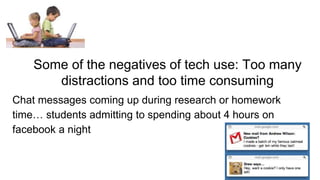
Chat messages coming up during research or homework
time… students admitting to spending about 4 hours on
facebook a night
Some of the negatives of tech use: Too many
distractions and too time consuming
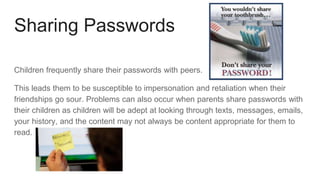
Sharing Passwords
Children frequently share their passwords with peers.
This leads them to be susceptible to impersonation and retaliation when their
friendships go sour. Problems can also occur when parents share passwords with
their children as children will be adept at looking through texts, messages, emails,
your history, and the content may not always be content appropriate for them to
read.
Cyberbullying
Cyberbullying; no place to hide from bullies. Online bullying
can happen at home, school, or anywhere else people go
online.
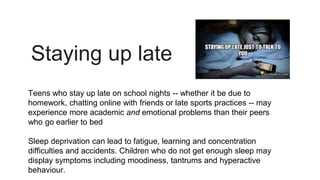
Staying up late
Teens who stay up late on school nights -- whether it be due to
homework, chatting online with friends or late sports practices -- may
experience more academic and emotional problems than their peers
who go earlier to bed
Sleep deprivation can lead to fatigue, learning and concentration
difficulties and accidents. Children who do not get enough sleep may
display symptoms including moodiness, tantrums and hyperactive
behaviour.
Sexual Content
Pop ups; graphic videos, nude pictures,
sexual violence, links to more websites. This is
content children may not be looking for
but they will be exposed to it and this might
trigger them to look for more out of curiosity.
Some websites deliberately mimic the addresses of real websites- so talk
to your children about this potential.
Sexting; sexual content students will either be exposed to from peers or
will produce for other peers.
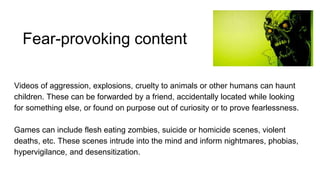
Fear-provoking content
Videos of aggression, explosions, cruelty to animals or other humans can haunt
children. These can be forwarded by a friend, accidentally located while looking
for something else, or found on purpose out of curiosity or to prove fearlessness.
Games can include flesh eating zombies, suicide or homicide scenes, violent
deaths, etc. These scenes intrude into the mind and inform nightmares, phobias,
hypervigilance, and desensitization.
Howtohelpathome
Shared agreements
Family conversations
Modeling good behaviour
Observations /monitoring
Parental controls
Night time rules
Purchasing monitoring software

Your child’s technology use

  • 1.
  • 3.
    Positives of techuse 1. Staying connected 2. Fun and creation 3. Independence 4. Sense of belonging 5. Having a voice, being heard 6. Identity And more! Research shows that, for example, video games and other screen media improve visual-spatial capabilities, increase attentional ability, reaction times, and the capacity to identify details among clutter.
  • 4.
    1. Ask themto show you their “hangouts” and ask who they talk to 2. Ask them what problems they encounter and really listen without jumping in 3. Discuss advantages and dangers of tech use 4. Regularly ask your children about their day and really listen. 5. Ask them about their interests and help encourage those interests 6. Help create a community within your family- everyone has a role, has value, and is an active member. 1. Remember to play as a family; either through sports, board games, storytelling, etc. How do I help them meet these needs both on and offline?
  • 5.
    Books Vs. Tech Children’sbrains are still developing and malleable, frequent exposure to technology is actually wiring the brain in ways very different than in previous generations. Remember when our distractions, learning, leisure, all came in the form of a book? Then the Internet was invented and children were thrust into a vastly different environment in which, because distraction is the norm, consistent attention is impossible, imagination is unnecessary, and memory is inhibited. Technology conditions the brain to pay attention to information very differently than reading. The metaphor we can use is scuba diving vs. jet skiing.
  • 6.
    Chat messages comingup during research or homework time… students admitting to spending about 4 hours on facebook a night Some of the negatives of tech use: Too many distractions and too time consuming
  • 7.
    Sharing Passwords Children frequentlyshare their passwords with peers. This leads them to be susceptible to impersonation and retaliation when their friendships go sour. Problems can also occur when parents share passwords with their children as children will be adept at looking through texts, messages, emails, your history, and the content may not always be content appropriate for them to read.
  • 8.
    Cyberbullying Cyberbullying; no placeto hide from bullies. Online bullying can happen at home, school, or anywhere else people go online.
  • 9.
    Staying up late Teenswho stay up late on school nights -- whether it be due to homework, chatting online with friends or late sports practices -- may experience more academic and emotional problems than their peers who go earlier to bed Sleep deprivation can lead to fatigue, learning and concentration difficulties and accidents. Children who do not get enough sleep may display symptoms including moodiness, tantrums and hyperactive behaviour.
  • 10.
    Sexual Content Pop ups;graphic videos, nude pictures, sexual violence, links to more websites. This is content children may not be looking for but they will be exposed to it and this might trigger them to look for more out of curiosity. Some websites deliberately mimic the addresses of real websites- so talk to your children about this potential. Sexting; sexual content students will either be exposed to from peers or will produce for other peers.
  • 11.
    Fear-provoking content Videos ofaggression, explosions, cruelty to animals or other humans can haunt children. These can be forwarded by a friend, accidentally located while looking for something else, or found on purpose out of curiosity or to prove fearlessness. Games can include flesh eating zombies, suicide or homicide scenes, violent deaths, etc. These scenes intrude into the mind and inform nightmares, phobias, hypervigilance, and desensitization.
  • 12.
    Howtohelpathome Shared agreements Family conversations Modelinggood behaviour Observations /monitoring Parental controls Night time rules Purchasing monitoring software

Editor's Notes

  • #4 1. Staying connected- especially for children who have moved, technology is a wonderful way of helping say connected to past friends and to help make the transition to a new school and new environment a little bit smoother 2. Fun and creation- children can play games (on their own or interactively) 3. Independence- they can research concepts online they have a personal interest in and develop their interests 4. Sense of belonging- they can be a part of a group who meets online, offer advice to friends after school hours, connect with peers and others who share similar interests. 5. Being heard- writing on social media, blogs, chat messages, this supports “having a voice”. And when people respond positively, this supports feeling heard and feeling understood. 6. Identity- individuals find that they can be accepted online when, perhaps, they’re not always accepted elsewhere. Or they can play with their identity, alter and even create an improved version of themselves online. Research shows that, for example, video games and other screen media improve visual-spatial capabilities, increase attentional ability, reaction times, and the capacity to identify details among clutter.