
SLEEP DISORDERS 
THE NORMAL SLEEP & ASSOCIATED DISORDERS
WHY DO WE NEED TO SLEEP? 
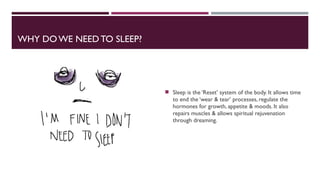
 Sleep is the ‘Reset’ system of the body. It allows time 
to end the ‘wear & tear’ processes, regulate the 
hormones for growth, appetite & moods. It also 
repairs muscles & allows spiritual rejuvenation 
through dreaming.
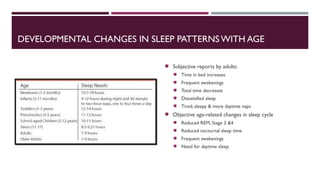
DEVELOPMENTAL CHANGES IN SLEEP PATTERNS WITH AGE 
 Subjective reports by adults: 
 Time in bed increases 
 Frequent awakenings 
 Total time decreases 
 Dissatisfied sleep 
 Tired, sleepy & more daytime naps 
 Objective age-related changes in sleep cycle 
 Reduced REM, Stage 3 &4 
 Reduced nocturnal sleep time 
 Frequent awakenings 
 Need for daytime sleep.
SLEEP STATES 
 There are two physiological states of sleep known as 
REM (Rapid Eye Movement) & NREM (Non-rapid 
eye movement). 
 Stages of sleep are known as the Sleep Architecture. 
 Instruments of measures- electroencephalogram 
(EEG) for brain activity, Eye movement 
(electrooculogram) & muscle tone (EMG).
NREM 
 It is divided into 4 stages on basis of EEG patterns. 
 NREM (75%) alters with REM (25%) sleep throughout the sleep period & is characterized by 
 Slowing of EEG rhythms 
 Higher muscle tone 
 Absence of eye movements 
 NREM is like an idling mind in a movable body
THE SLEEP CYCLE 
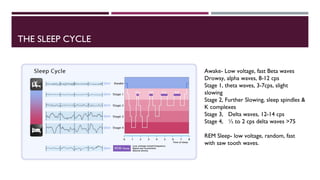
Awake- Low voltage, fast Beta waves 
Drowsy, alpha waves, 8-12 cps 
Stage 1, theta waves, 3-7cps, slight 
slowing 
Stage 2, Further Slowing, sleep spindles & 
K complexes 
Stage 3, Delta waves, 12-14 cps 
Stage 4, ½ to 2 cps delta waves >75 
REM Sleep- low voltage, random, fast 
with saw tooth waves.
REM ( RAPID EYE MOVEMENT) 
Characteristics of REM (also called paradoxical sleep) 
Occurrence: 10-40 mins every 90 mins. 
 Autonomic Instability 
a. Increased HR, BP, RR, 
b. Increased minute to minute variability in HR, RR, BP. 
c. Appears similar to awake state on EEG 
Tonic Inhibition of skeletal muscle tone leading to paralysis 
Rapid Eye Movement 
Dreaming 
Relative poikilothermia (cold-bloodedness) 
Penile or clitoral tumescence 
Reduced sensitivity to sounds 
REM sleep is an awake mind in a paralyzed body.
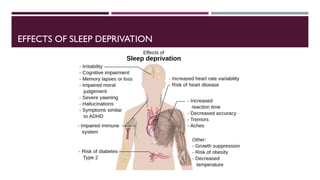
SLEEP DEPRIVATION 
 Greatest effect observed on Cerebral cortex. The physical body gets rest from immobility but is unaffected by 
sleep. 
 A sleep deprived, is a sleep lost 
 Prior loss leads to more stage 4 sleep pattern & REM declines. 
 In sleep-deprived individuals there is significant effect on mind & body’s 
 Immunity-Lymphocyte levels decline 
 Glucose metabolism- Cortisol levels increase 
 Blood pressure rises 
 Increased Amygdala activation 
 Irritable mood.
EFFECTS OF SLEEP DEPRIVATION
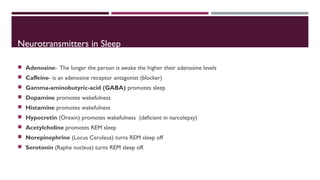
Neurotransmitters in Sleep 
 Adenosine- The longer the person is awake the higher their adenosine levels 
 Caffeine- is an adenosine receptor antagonist (blocker) 
 Gamma-aminobutyric-acid (GABA) promotes sleep 
 Dopamine promotes wakefulness 
 Histamine promotes wakefulness 
 Hypocretin (Orexin) promotes wakefulness (deficient in narcolepsy) 
 Acetylcholine promotes REM sleep 
 Norepinephrine (Locus Ceruleus) turns REM sleep off 
 Serotonin (Raphe nucleus) turns REM sleep off.
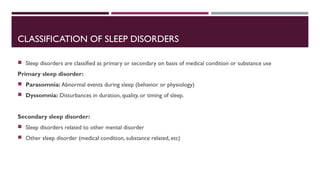
CLASSIFICATION OF SLEEP DISORDERS 
 Sleep disorders are classified as primary or secondary on basis of medical condition or substance use 
Primary sleep disorder: 
 Parasomnia: Abnormal events during sleep (behavior or physiology) 
 Dyssomnia: Disturbances in duration, quality, or timing of sleep. 
Secondary sleep disorder: 
 Sleep disorders related to other mental disorder 
 Other sleep disorder (medical condition, substance related, etc)
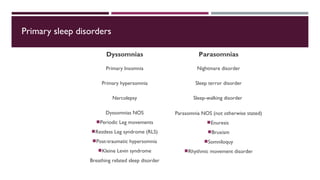
Primary sleep disorders 
Dyssomnias Parasomnias 
Primary Insomnia Nightmare disorder 
Primary hypersomnia Sleep terror disorder 
Narcolepsy Sleep-walking disorder 
Dyssomnias NOS 
Periodic Leg movements 
Restless Leg syndrome (RLS) 
Post-traumatic hypersomnia 
Kleine Levin syndrome 
Parasomnia NOS (not otherwise stated) 
Enuresis 
Bruxism 
Somniloquy 
Rhythmic movement disorder 
Breathing related sleep disorder
Dyssomnias 
 Dyssomnias are sleep disorders related to the quality, duration or timing of sleep, which results in a patient 
complaining about getting too little (insomnia) or too much sleep (hypersomnia) 
 Primary Insomnia: Trouble initiating or maintaining sleep, or not having restorative sleep. It is characterized by 
hyper arousal. 
Not accountable for by medical condition or substance use. 
 Secondary insomnia 
Due to medical, psychiatric or sleep disorder. 
Chronic insomnias is associated with increased depression, reduced quality of life & more usage of health resources.
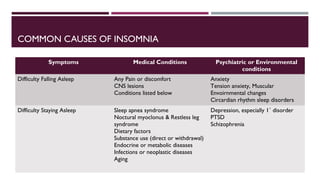
COMMON CAUSES OF INSOMNIA 
Symptoms Medical Conditions Psychiatric or Environmental 
conditions 
Difficulty Falling Asleep Any Pain or discomfort 
CNS lesions 
Conditions listed below 
Anxiety 
Tension anxiety, Muscular 
Envoirnmental changes 
Circardian rhythm sleep disorders 
Difficulty Staying Asleep Sleep apnea syndrome 
Noctural myoclonus & Restless leg 
syndrome 
Dietary factors 
Substance use (direct or withdrawal) 
Endocrine or metabolic diseases 
Infections or neoplastic diseases 
Aging 
Depression, especially 1˚ disorder 
PTSD 
Schizophrenia
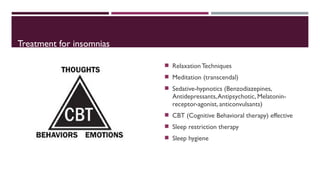
Treatment for insomnias 
 Relaxation Techniques 
 Meditation (transcendal) 
 Sedative-hypnotics (Benzodiazepines, 
Antidepressants, Antipsychotic, Melatonin-receptor- 
agonist, anticonvulsants) 
 CBT (Cognitive Behavioral therapy) effective 
 Sleep restriction therapy 
 Sleep hygiene
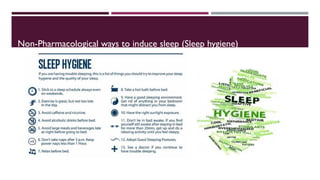
Non-Pharmacological ways to induce sleep (Sleep hygiene)
Primary Hypersomnia 
 Rare & include excessive daytime sleepiness; more than average daily sleep. 
 Not due to medical condition or medication. 
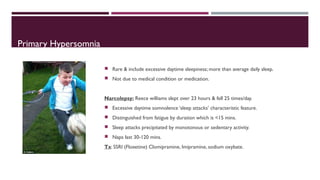
Narcolepsy: Reece williams slept over 23 hours & fell 25 times/day. 
 Excessive daytime somnolence ‘sleep attacks’ characteristic feature. 
 Distinguished from fatigue by duration which is <15 mins. 
 Sleep attacks precipitated by monotonous or sedentary activity. 
 Naps last 30-120 mins. 
Tx: SSRI (Floxetine) Clomipramine, Imipramine, sodium oxybate.
Cataplexy: 
 Reported by 50% of the Narcoleptics 
 Brief (seconds to minutes) episodes of muscle weakness 
(Slurred speech, dropped jaw, buckled knee) or paralysis 
 Patient returns to completely normal after attack. 
 Usually triggered by strong emotions (Laughter, anger, 
excitement, sexual intercourse fear or embarrassment) 
Sleep Paralysis 
 Temporary partial or complete paralysis in sleep-wake 
transitions 
 Conscious but unable to move or open eyes 
 “Scary experience” that lasts <1 min.
Sleep onset REM periods (SOREMPS) 
 Defined as appearance of REM within 15mins (Normal time 
90mins) 
Other associated features with narcolepsy: 
 Periodic leg movements 
 Sleep apnea 
 Frequent night awakenings 
 Memory problems 
 Ocular symptoms (blurring, diplopia) 
Treatments : 
 Regular bedtime 
 Scheduled daytime naps 
 Safety considerations 
 Stimulants (Modanafil, Methyphenidate, amphetamine-dexatroamphetamine 
) 
 Daytime sleepiness Propanolol in high dose. 
 TCAs (Imipramine, Clomipramine, Desipramine) 
 SSRIs (Sertraline, Citalopram)
Breathing related sleep disorders 
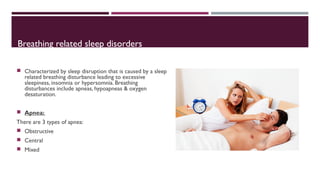
 Characterized by sleep disruption that is caused by a sleep 
related breathing disturbance leading to excessive 
sleepiness, insomnia or hypersomnia. Breathing 
disturbances include apneas, hypoapneas & oxygen 
desaturation. 
 Apnea: 
There are 3 types of apnea: 
 Obstructive 
 Central 
 Mixed
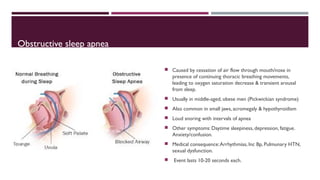
Obstructive sleep apnea 
 Caused by cessation of air flow through mouth/nose in 
presence of continuing thoracic breathing movements, 
leading to oxygen saturation decrease & transient arousal 
from sleep. 
 Usually in middle-aged, obese men (Pickwickian syndrome) 
 Also common in small jaws, acromegaly & hypothyroidism 
 Loud snoring with intervals of apnea 
 Other symptoms: Daytime sleepiness, depression, fatigue. 
Anxiety/confusion. 
 Medical consequence: Arrhythmias, Inc Bp, Pulmunary HTN, 
sexual dysfunction. 
 Event lasts 10-20 seconds each.
Obstructive sleep apnea 
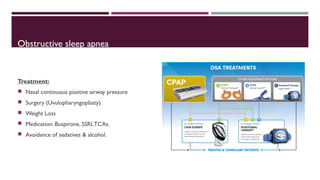
Treatment: 
 Nasal continuous positive airway pressure 
 Surgery (Uvulopharyngoplasty). 
 Weight Loss 
 Medication: Buspirone, SSRI, TCAs. 
 Avoidance of sedatives & alcohol.
Apnea 
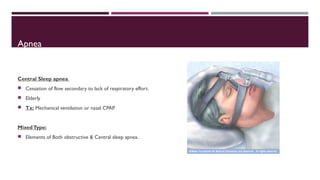
Central Sleep apnea 
 Cessation of flow secondary to lack of respiratory effort. 
 Elderly 
 Tx: Mechanical ventilation or nasal CPAP. 
Mixed Type: 
 Elements of Both obstructive & Central sleep apnea.
Circadian rhythm sleep disorder 
 Includes a wide range of conditions involving a misalignment between desired & actual sleep periods 
 Disturbance types include 
 Delayed sleep phase, Jet lag, shift-work, unspecified 
 Sleep quality is normal. 
 Self-limited. 
 Tx: Regular schedule of bright light therapy. Melatonin, natural hormone (Pineal gland) to induce sleep.
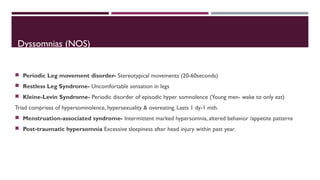
Dyssomnias (NOS) 
 Periodic Leg movement disorder- Stereotypical movements (20-60seconds) 
 Restless Leg Syndrome- Uncomfortable sensation in legs 
 Kleine-Levin Syndrome- Periodic disorder of episodic hyper somnolence (Young men- wake to only eat) 
Triad comprises of hypersomnolence, hypersexuality & overeating. Lasts 1 dy-1 mth. 
 Menstruation-associated syndrome- Intermittent marked hypersomnia, altered behavior /appetite patterns 
 Post-traumatic hypersomnia Excessive sleepiness after head injury within past year.
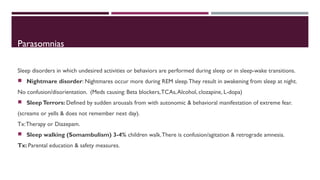
Parasomnias 
Sleep disorders in which undesired activities or behaviors are performed during sleep or in sleep-wake transitions. 
 Nightmare disorder: Nightmares occur more during REM sleep. They result in awakening from sleep at night. 
No confusion/disorientation. (Meds causing: Beta blockers, TCAs, Alcohol, clozapine, L-dopa) 
 Sleep Terrors: Defined by sudden arousals from with autonomic & behavioral manifestation of extreme fear. 
(screams or yells & does not remember next day). 
Tx: Therapy or Diazepam. 
 Sleep walking (Somambulism) 3-4% children walk. There is confusion/agitation & retrograde amnesia. 
Tx: Parental education & safety measures.
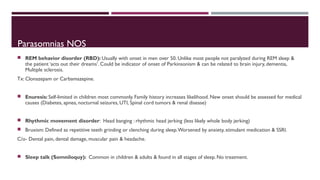
Parasomnias NOS 
 REM behavior disorder (RBD): Usually with onset in men over 50. Unlike most people not paralyzed during REM sleep & 
the patient ‘acts out their dreams’. Could be indicator of onset of Parkinsonism & can be related to brain injury, dementia, 
Multiple sclerosis. 
Tx: Clonazepam or Carbamazepine. 
 Enuresis: Self-limited in children most commonly. Family history increases likelihood. New onset should be assessed for medical 
causes (Diabetes, apnea, nocturnal seizures, UTI, Spinal cord tumors & renal disease) 
 Rhythmic movement disorder: Head banging : rhythmic head jerking (less likely whole body jerking) 
 Bruxism: Defined as repetitive teeth grinding or clenching during sleep. Worsened by anxiety, stimulant medication & SSRI. 
C/o- Dental pain, dental damage, muscular pain & headache. 
 Sleep talk (Somniloquy): Common in children & adults & found in all stages of sleep. No treatment.
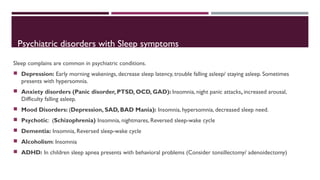
Psychiatric disorders with Sleep symptoms 
Sleep complains are common in psychiatric conditions. 
 Depression: Early morning wakenings, decrease sleep latency, trouble falling asleep/ staying asleep. Sometimes 
presents with hypersomnia. 
 Anxiety disorders (Panic disorder, PTSD, OCD, GAD): Insomnia, night panic attacks, increased arousal, 
Difficulty falling asleep. 
 Mood Disorders: (Depression, SAD, BAD Mania): Insomnia, hypersomnia, decreased sleep need. 
 Psychotic: (Schizophrenia) Insomnia, nightmares, Reversed sleep-wake cycle 
 Dementia: Insomnia, Reversed sleep-wake cycle 
 Alcoholism: Insomnia 
 ADHD: In children sleep apnea presents with behavioral problems (Consider tonsillectomy/ adenoidectomy)
Neurologic disorders with sleep symptoms 
 Stroke: There is increased risk of obstructive & central apnea but apnea may have existed prior to 
stroke. 
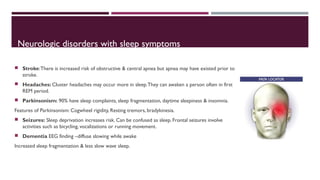
 Headaches: Cluster headaches may occur more in sleep. They can awaken a person often in first 
REM period. 
 Parkinsonism: 90% have sleep complaints, sleep fragmentation, daytime sleepiness & insomnia. 
Features of Parkinsonism: Cogwheel rigidity, Resting tremors, bradykinesia. 
 Seizures: Sleep deprivation increases risk. Can be confused as sleep. Frontal seizures involve 
activities such as bicycling, vocalizations or running movement. 
 Dementia EEG finding –diffuse slowing while awake 
Increased sleep fragmentation & less slow wave sleep.
Substance induced sleep disorders 
 Substances can contribute to a range of sleep symptoms ranging from insomnia, hypersomnia, 
parasomnia or a combination caused by use of medication or by intoxication or withdrawal from a 
drug of abuse. 
 Stimulants: Cocaine, Amphetamine, nicotine, Depressants: Alcohol, Opiates 
 Somnolence: Tolerance/Withdrawal from CNS stimulant or sustained use of CNS depressants. 
 Insomnia: Associated with tolerance to or withdrawal from sedative-hypnotic drugs, CNS stimulants & 
long term alcohol consumption. 
 Sleep problems might be side-effects of drugs (Thyroid preparations, antidepressants, antiepileptics)
 Thank You

S leep disorders

  • 1.
    SLEEP DISORDERS THENORMAL SLEEP & ASSOCIATED DISORDERS
  • 2.
    WHY DO WENEED TO SLEEP?  Sleep is the ‘Reset’ system of the body. It allows time to end the ‘wear & tear’ processes, regulate the hormones for growth, appetite & moods. It also repairs muscles & allows spiritual rejuvenation through dreaming.
  • 3.
    DEVELOPMENTAL CHANGES INSLEEP PATTERNS WITH AGE  Subjective reports by adults:  Time in bed increases  Frequent awakenings  Total time decreases  Dissatisfied sleep  Tired, sleepy & more daytime naps  Objective age-related changes in sleep cycle  Reduced REM, Stage 3 &4  Reduced nocturnal sleep time  Frequent awakenings  Need for daytime sleep.
  • 4.
    SLEEP STATES There are two physiological states of sleep known as REM (Rapid Eye Movement) & NREM (Non-rapid eye movement).  Stages of sleep are known as the Sleep Architecture.  Instruments of measures- electroencephalogram (EEG) for brain activity, Eye movement (electrooculogram) & muscle tone (EMG).
  • 5.
    NREM  Itis divided into 4 stages on basis of EEG patterns.  NREM (75%) alters with REM (25%) sleep throughout the sleep period & is characterized by  Slowing of EEG rhythms  Higher muscle tone  Absence of eye movements  NREM is like an idling mind in a movable body
  • 6.
    THE SLEEP CYCLE Awake- Low voltage, fast Beta waves Drowsy, alpha waves, 8-12 cps Stage 1, theta waves, 3-7cps, slight slowing Stage 2, Further Slowing, sleep spindles & K complexes Stage 3, Delta waves, 12-14 cps Stage 4, ½ to 2 cps delta waves >75 REM Sleep- low voltage, random, fast with saw tooth waves.
  • 7.
    REM ( RAPIDEYE MOVEMENT) Characteristics of REM (also called paradoxical sleep) Occurrence: 10-40 mins every 90 mins.  Autonomic Instability a. Increased HR, BP, RR, b. Increased minute to minute variability in HR, RR, BP. c. Appears similar to awake state on EEG Tonic Inhibition of skeletal muscle tone leading to paralysis Rapid Eye Movement Dreaming Relative poikilothermia (cold-bloodedness) Penile or clitoral tumescence Reduced sensitivity to sounds REM sleep is an awake mind in a paralyzed body.
  • 8.
    SLEEP DEPRIVATION Greatest effect observed on Cerebral cortex. The physical body gets rest from immobility but is unaffected by sleep.  A sleep deprived, is a sleep lost  Prior loss leads to more stage 4 sleep pattern & REM declines.  In sleep-deprived individuals there is significant effect on mind & body’s  Immunity-Lymphocyte levels decline  Glucose metabolism- Cortisol levels increase  Blood pressure rises  Increased Amygdala activation  Irritable mood.
  • 9.
    EFFECTS OF SLEEPDEPRIVATION
  • 10.
    Neurotransmitters in Sleep  Adenosine- The longer the person is awake the higher their adenosine levels  Caffeine- is an adenosine receptor antagonist (blocker)  Gamma-aminobutyric-acid (GABA) promotes sleep  Dopamine promotes wakefulness  Histamine promotes wakefulness  Hypocretin (Orexin) promotes wakefulness (deficient in narcolepsy)  Acetylcholine promotes REM sleep  Norepinephrine (Locus Ceruleus) turns REM sleep off  Serotonin (Raphe nucleus) turns REM sleep off.
  • 11.
    CLASSIFICATION OF SLEEPDISORDERS  Sleep disorders are classified as primary or secondary on basis of medical condition or substance use Primary sleep disorder:  Parasomnia: Abnormal events during sleep (behavior or physiology)  Dyssomnia: Disturbances in duration, quality, or timing of sleep. Secondary sleep disorder:  Sleep disorders related to other mental disorder  Other sleep disorder (medical condition, substance related, etc)
  • 12.
    Primary sleep disorders Dyssomnias Parasomnias Primary Insomnia Nightmare disorder Primary hypersomnia Sleep terror disorder Narcolepsy Sleep-walking disorder Dyssomnias NOS Periodic Leg movements Restless Leg syndrome (RLS) Post-traumatic hypersomnia Kleine Levin syndrome Parasomnia NOS (not otherwise stated) Enuresis Bruxism Somniloquy Rhythmic movement disorder Breathing related sleep disorder
  • 13.
    Dyssomnias  Dyssomniasare sleep disorders related to the quality, duration or timing of sleep, which results in a patient complaining about getting too little (insomnia) or too much sleep (hypersomnia)  Primary Insomnia: Trouble initiating or maintaining sleep, or not having restorative sleep. It is characterized by hyper arousal. Not accountable for by medical condition or substance use.  Secondary insomnia Due to medical, psychiatric or sleep disorder. Chronic insomnias is associated with increased depression, reduced quality of life & more usage of health resources.
  • 14.
    COMMON CAUSES OFINSOMNIA Symptoms Medical Conditions Psychiatric or Environmental conditions Difficulty Falling Asleep Any Pain or discomfort CNS lesions Conditions listed below Anxiety Tension anxiety, Muscular Envoirnmental changes Circardian rhythm sleep disorders Difficulty Staying Asleep Sleep apnea syndrome Noctural myoclonus & Restless leg syndrome Dietary factors Substance use (direct or withdrawal) Endocrine or metabolic diseases Infections or neoplastic diseases Aging Depression, especially 1˚ disorder PTSD Schizophrenia
  • 15.
    Treatment for insomnias  Relaxation Techniques  Meditation (transcendal)  Sedative-hypnotics (Benzodiazepines, Antidepressants, Antipsychotic, Melatonin-receptor- agonist, anticonvulsants)  CBT (Cognitive Behavioral therapy) effective  Sleep restriction therapy  Sleep hygiene
  • 16.
    Non-Pharmacological ways toinduce sleep (Sleep hygiene)
  • 17.
    Primary Hypersomnia Rare & include excessive daytime sleepiness; more than average daily sleep.  Not due to medical condition or medication. Narcolepsy: Reece williams slept over 23 hours & fell 25 times/day.  Excessive daytime somnolence ‘sleep attacks’ characteristic feature.  Distinguished from fatigue by duration which is <15 mins.  Sleep attacks precipitated by monotonous or sedentary activity.  Naps last 30-120 mins. Tx: SSRI (Floxetine) Clomipramine, Imipramine, sodium oxybate.
  • 18.
    Cataplexy:  Reportedby 50% of the Narcoleptics  Brief (seconds to minutes) episodes of muscle weakness (Slurred speech, dropped jaw, buckled knee) or paralysis  Patient returns to completely normal after attack.  Usually triggered by strong emotions (Laughter, anger, excitement, sexual intercourse fear or embarrassment) Sleep Paralysis  Temporary partial or complete paralysis in sleep-wake transitions  Conscious but unable to move or open eyes  “Scary experience” that lasts <1 min.
  • 19.
    Sleep onset REMperiods (SOREMPS)  Defined as appearance of REM within 15mins (Normal time 90mins) Other associated features with narcolepsy:  Periodic leg movements  Sleep apnea  Frequent night awakenings  Memory problems  Ocular symptoms (blurring, diplopia) Treatments :  Regular bedtime  Scheduled daytime naps  Safety considerations  Stimulants (Modanafil, Methyphenidate, amphetamine-dexatroamphetamine )  Daytime sleepiness Propanolol in high dose.  TCAs (Imipramine, Clomipramine, Desipramine)  SSRIs (Sertraline, Citalopram)
  • 20.
    Breathing related sleepdisorders  Characterized by sleep disruption that is caused by a sleep related breathing disturbance leading to excessive sleepiness, insomnia or hypersomnia. Breathing disturbances include apneas, hypoapneas & oxygen desaturation.  Apnea: There are 3 types of apnea:  Obstructive  Central  Mixed
  • 21.
    Obstructive sleep apnea  Caused by cessation of air flow through mouth/nose in presence of continuing thoracic breathing movements, leading to oxygen saturation decrease & transient arousal from sleep.  Usually in middle-aged, obese men (Pickwickian syndrome)  Also common in small jaws, acromegaly & hypothyroidism  Loud snoring with intervals of apnea  Other symptoms: Daytime sleepiness, depression, fatigue. Anxiety/confusion.  Medical consequence: Arrhythmias, Inc Bp, Pulmunary HTN, sexual dysfunction.  Event lasts 10-20 seconds each.
  • 22.
    Obstructive sleep apnea Treatment:  Nasal continuous positive airway pressure  Surgery (Uvulopharyngoplasty).  Weight Loss  Medication: Buspirone, SSRI, TCAs.  Avoidance of sedatives & alcohol.
  • 23.
    Apnea Central Sleepapnea  Cessation of flow secondary to lack of respiratory effort.  Elderly  Tx: Mechanical ventilation or nasal CPAP. Mixed Type:  Elements of Both obstructive & Central sleep apnea.
  • 24.
    Circadian rhythm sleepdisorder  Includes a wide range of conditions involving a misalignment between desired & actual sleep periods  Disturbance types include  Delayed sleep phase, Jet lag, shift-work, unspecified  Sleep quality is normal.  Self-limited.  Tx: Regular schedule of bright light therapy. Melatonin, natural hormone (Pineal gland) to induce sleep.
  • 25.
    Dyssomnias (NOS) Periodic Leg movement disorder- Stereotypical movements (20-60seconds)  Restless Leg Syndrome- Uncomfortable sensation in legs  Kleine-Levin Syndrome- Periodic disorder of episodic hyper somnolence (Young men- wake to only eat) Triad comprises of hypersomnolence, hypersexuality & overeating. Lasts 1 dy-1 mth.  Menstruation-associated syndrome- Intermittent marked hypersomnia, altered behavior /appetite patterns  Post-traumatic hypersomnia Excessive sleepiness after head injury within past year.
  • 26.
    Parasomnias Sleep disordersin which undesired activities or behaviors are performed during sleep or in sleep-wake transitions.  Nightmare disorder: Nightmares occur more during REM sleep. They result in awakening from sleep at night. No confusion/disorientation. (Meds causing: Beta blockers, TCAs, Alcohol, clozapine, L-dopa)  Sleep Terrors: Defined by sudden arousals from with autonomic & behavioral manifestation of extreme fear. (screams or yells & does not remember next day). Tx: Therapy or Diazepam.  Sleep walking (Somambulism) 3-4% children walk. There is confusion/agitation & retrograde amnesia. Tx: Parental education & safety measures.
  • 27.
    Parasomnias NOS REM behavior disorder (RBD): Usually with onset in men over 50. Unlike most people not paralyzed during REM sleep & the patient ‘acts out their dreams’. Could be indicator of onset of Parkinsonism & can be related to brain injury, dementia, Multiple sclerosis. Tx: Clonazepam or Carbamazepine.  Enuresis: Self-limited in children most commonly. Family history increases likelihood. New onset should be assessed for medical causes (Diabetes, apnea, nocturnal seizures, UTI, Spinal cord tumors & renal disease)  Rhythmic movement disorder: Head banging : rhythmic head jerking (less likely whole body jerking)  Bruxism: Defined as repetitive teeth grinding or clenching during sleep. Worsened by anxiety, stimulant medication & SSRI. C/o- Dental pain, dental damage, muscular pain & headache.  Sleep talk (Somniloquy): Common in children & adults & found in all stages of sleep. No treatment.
  • 28.
    Psychiatric disorders withSleep symptoms Sleep complains are common in psychiatric conditions.  Depression: Early morning wakenings, decrease sleep latency, trouble falling asleep/ staying asleep. Sometimes presents with hypersomnia.  Anxiety disorders (Panic disorder, PTSD, OCD, GAD): Insomnia, night panic attacks, increased arousal, Difficulty falling asleep.  Mood Disorders: (Depression, SAD, BAD Mania): Insomnia, hypersomnia, decreased sleep need.  Psychotic: (Schizophrenia) Insomnia, nightmares, Reversed sleep-wake cycle  Dementia: Insomnia, Reversed sleep-wake cycle  Alcoholism: Insomnia  ADHD: In children sleep apnea presents with behavioral problems (Consider tonsillectomy/ adenoidectomy)
  • 29.
    Neurologic disorders withsleep symptoms  Stroke: There is increased risk of obstructive & central apnea but apnea may have existed prior to stroke.  Headaches: Cluster headaches may occur more in sleep. They can awaken a person often in first REM period.  Parkinsonism: 90% have sleep complaints, sleep fragmentation, daytime sleepiness & insomnia. Features of Parkinsonism: Cogwheel rigidity, Resting tremors, bradykinesia.  Seizures: Sleep deprivation increases risk. Can be confused as sleep. Frontal seizures involve activities such as bicycling, vocalizations or running movement.  Dementia EEG finding –diffuse slowing while awake Increased sleep fragmentation & less slow wave sleep.
  • 30.
    Substance induced sleepdisorders  Substances can contribute to a range of sleep symptoms ranging from insomnia, hypersomnia, parasomnia or a combination caused by use of medication or by intoxication or withdrawal from a drug of abuse.  Stimulants: Cocaine, Amphetamine, nicotine, Depressants: Alcohol, Opiates  Somnolence: Tolerance/Withdrawal from CNS stimulant or sustained use of CNS depressants.  Insomnia: Associated with tolerance to or withdrawal from sedative-hypnotic drugs, CNS stimulants & long term alcohol consumption.  Sleep problems might be side-effects of drugs (Thyroid preparations, antidepressants, antiepileptics)
  • 32.