NEONATAL HYPOXIC
ISCHEMIC
ENCEPHALOPATHY
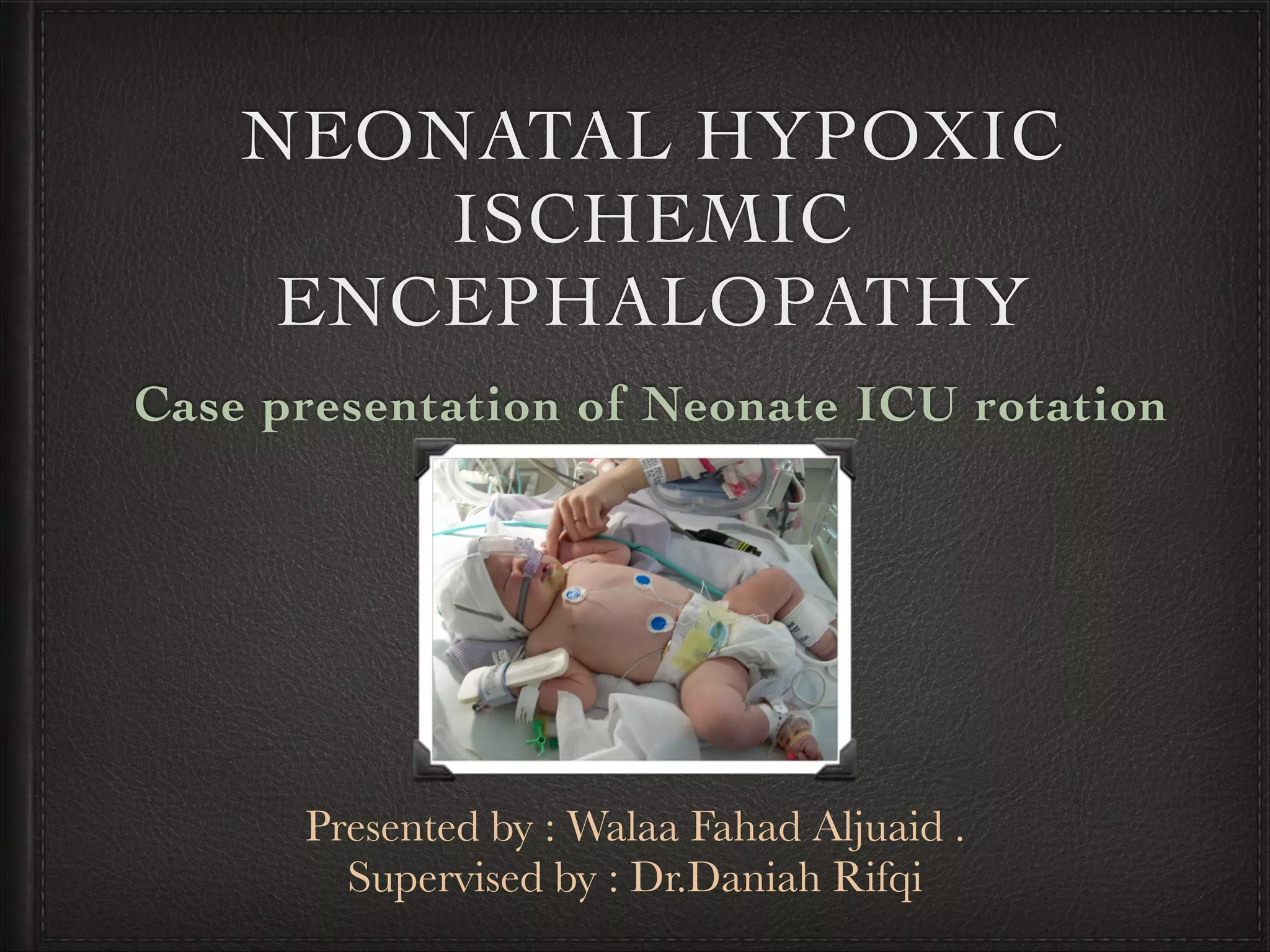
Case presentation of Neonate ICU rotation
Presented by : Walaa Fahad Aljuaid .
Supervised by : Dr.Daniah Rifqi
OUTLINES :
• History of the case
• What is the HIE :
• Definition
• Causes
• Incidence and Prevalence
• Diagnosis

• Complication
• Treatment
• Intervention
The Case :
M.A is 14 days old male came to NICU from another
hospital very sick , severe HIE , Respiratory distress
He was presented there ( another hospital ) with :
failure to thrive , hypotonic , flacid , Apgar score was
1 , he was on the mechanical ventilator as a case of
sever HIE stage 3 , the baby developed convulsion on
the first day controlled on phenobarbitone ,
hypertension controlled with Lasix and Captopril
HISTORY OF PRESENT ILLNESS:
• Medical history :
FTT , SVD , Prolonged Labore , HIE , CHD .
Broncholitis
• Family history :
Mother has one abortion in the past .
• Allergy :
+ve consanguinity
• Medication history :
Captoril ,Phenoparbetone , Lasix
REVIEW OF SYSTEMS :
• Head and nick : normal
• Eyes : restricted pinpoint
• Nose : normal
• CVS : S1 + S2 , HTN
• Chest : RD , low air entry .
• Abdomen : Soft , no organomegally .
• Spine and Genitalia : normal
• Hips : normal
• CNS : AF at level , Tone : hyper Reflexes : Weak .
• Respiration : tachypnea
• Color : normal
• Cry : weak
• Movement : abnormal
• Birth trauma : no
• Apparent Congenital Anomalies : no
WHAT IS THE SEVER HIE ?
References : Kenneth A. stem ,
Stern Law 2017 , cerebralpalsy ,
Hypoxic-Ischemic
Encephalopathy .
Definition:
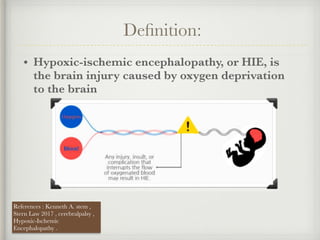
• Hypoxic-ischemic encephalopathy, or HIE, is
the brain injury caused by oxygen deprivation
to the brain
References : Kenneth A. stem ,
Stern Law 2017 , cerebralpalsy ,
Hypoxic-Ischemic
Encephalopathy .
Causes of HIE
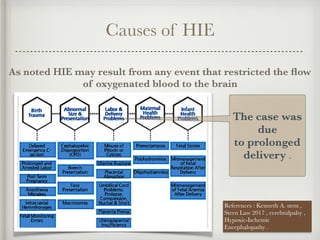
As noted HIE may result from any event that restricted the flow
of oxygenated blood to the brain
The case was
due
to prolonged
delivery .
References : Kenneth A. stem ,
Stern Law 2017 , cerebralpalsy ,
Hypoxic-Ischemic
Encephalopathy .
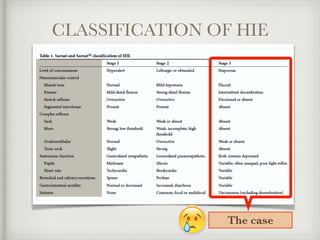
CLASSIFICATION OF HIE
The case
Incidence and Prevalence of HIE in
KSA :
A total of 70 cases of HIE were recorded in the
study period giving an incidence of 5.5 cases
per 1000 term births.
This incidence is lower compared to many
developing countries and comparable to other
centers.
References : Itoo BA1, Al-
Hawsawi ZM, Khan AH,
February 2003,Hypoxic ischemic
encephalopathy. Incidence and
risk factors in North Western
Saudi Arabia.
References : Adnan Amin Alsulaimani , Abdelaziz SA
Abuelsaad and Nader M Mohamed , January 27, 2015 ,
Inflammatory Cytokines in Neonatal Hypoxic Ischemic
Encephalopathy and their Correlation with Brain Marker
S100 Protein: A Case Control Study in Saudi Arabia
2003 2015
mention
Diagnosis :
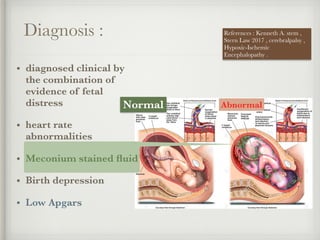
• diagnosed clinical by
the combination of
evidence of fetal
distress
• heart rate
abnormalities
• Meconium stained fluid
• Birth depression
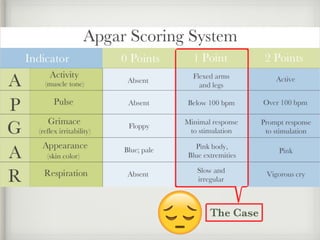
• Low Apgars
Normal Abnormal
References : Kenneth A. stem ,
Stern Law 2017 , cerebralpalsy ,
Hypoxic-Ischemic
Encephalopathy .
The Case
Complications
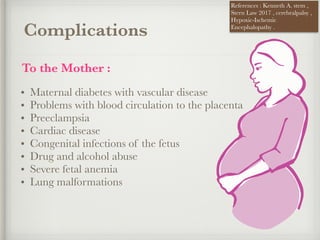
To the Mother :
• Maternal diabetes with vascular disease
• Problems with blood circulation to the placenta
• Preeclampsia
• Cardiac disease
• Congenital infections of the fetus
• Drug and alcohol abuse
• Severe fetal anemia
• Lung malformations
References : Kenneth A. stem ,
Stern Law 2017 , cerebralpalsy ,
Hypoxic-Ischemic
Encephalopathy .
Complications
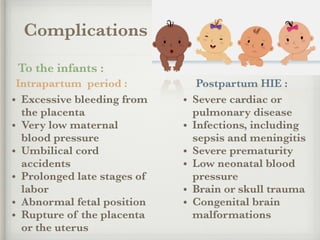
To the infants :
Intrapartum period :
• Excessive bleeding from
the placenta
• Very low maternal
blood pressure
• Umbilical cord
accidents
• Prolonged late stages of
labor
• Abnormal fetal position
• Rupture of the placenta
or the uterus
Postpartum HIE :
• Severe cardiac or
pulmonary disease
• Infections, including
sepsis and meningitis
• Severe prematurity
• Low neonatal blood
pressure
• Brain or skull trauma
• Congenital brain
malformations
Treatment :
The basic goal of HIE treatment is to support the baby’s affected
organs , treatment options include:
• Mechanical ventilation to help a baby who can’t breathe
• Cooling the baby’s brain or body to reverse brain hypoxia
caused by high temperatures
• Hyperbaric oxygen treatment in cases where HIE is caused by
carbon monoxide intoxication
• Treatments to assist the baby’s heart function and control
blood pressure
• Maintain normal blood glucose
• Prevent or control seizures
• Prevent or minimize cerebral edema
References : Kenneth A. stem ,
Stern Law 2017 , cerebralpalsy ,
Hypoxic-Ischemic
Encephalopathy .
BACK TO THE CASE
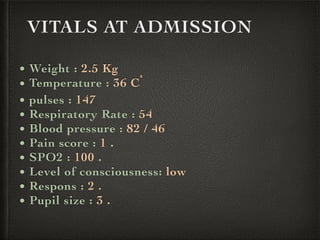
VITALS AT ADMISSION
• Weight : 2.5 Kg
• Temperature : 36 Cْ
• pulses : 147
• Respiratory Rate : 54
• Blood pressure : 82 / 46
• Pain score : 1 .
• SPO2 : 100 .
• Level of consciousness: low
• Respons : 2 .
• Pupil size : 3 .
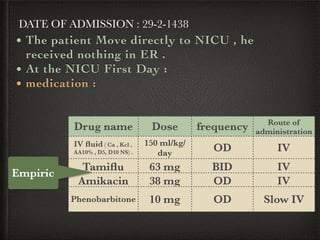
• The patient Move directly to NICU , he
received nothing in ER .
• At the NICU First Day :
• medication :
DATE OF ADMISSION : 29-2-1438
Drug name Dose frequency Route of
administration
IV fluid ( Ca , Kcl ,
AA10% , D5, D10 NS) .
150 ml/kg/
day
OD IV
Tamiflu 63 mg BID IV
Amikacin 38 mg OD IV
Phenobarbitone 10 mg OD Slow IV
Empiric
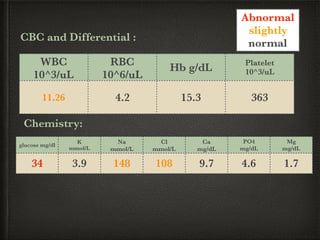
WBC
10^3/uL
RBC
10^6/uL
Hb g/dL
Platelet
10^3/uL
11.26 4.2 15.3 363
CBC and Differential :
glucose mg/dl
K
mmol/L
Na
mmol/L
Cl
mmol/L
Ca
mg/dL
PO4
mg/dL
Mg
mg/dL
34 3.9 148 108 9.7 4.6 1.7
Chemistry:
Abnormal
slightly
normal
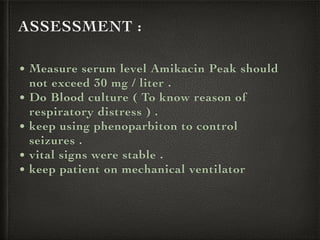
ASSESSMENT :
• Measure serum level Amikacin Peak should
not exceed 30 mg / liter .
• Do Blood culture ( To know reason of
respiratory distress ) .
• keep using phenoparbiton to control
seizures .
• vital signs were stable .
• keep patient on mechanical ventilator
SECOND DAY - SEVENTH DAY
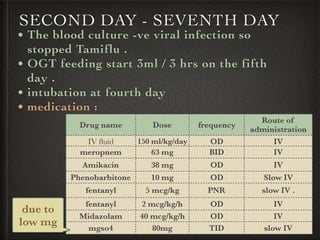
• The blood culture -ve viral infection so
stopped Tamiflu .
• OGT feeding start 3ml / 3 hrs on the fifth
day .
• intubation at fourth day
• medication :
Drug name Dose frequency
Route of
administration
IV fluid 150 ml/kg/day OD IV
meropnem 63 mg BID IV
Amikacin 38 mg OD IV
Phenobarbitone 10 mg OD Slow IV
fentanyl 5 mcg/kg PNR slow IV .
fentanyl 2 mcg/kg/h OD IV
Midazolam 40 mcg/kg/h OD IV
mgso4 80mg TID slow IV
due to
low mg
WBC
10^3/uL
RBC
10^6/uL
Hb g/dL
Platelet
10^3/uL
12.5 3.4 11.7 363
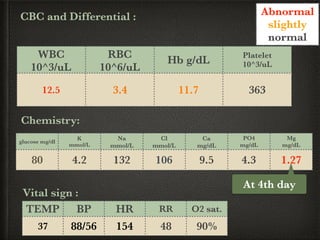
CBC and Differential :
glucose mg/dl
K
mmol/L
Na
mmol/L
Cl
mmol/L
Ca
mg/dL
PO4
mg/dL
Mg
mg/dL
80 4.2 132 106 9.5 4.3 1.27
Chemistry:
Abnormal
slightly
normal
At 4th day
Vital sign :
TEMP BP HR RR O2 sat.
37 88/56 154 48 90%
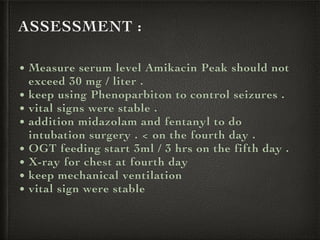
ASSESSMENT :
• Measure serum level Amikacin Peak should not
exceed 30 mg / liter .
• keep using Phenoparbiton to control seizures .
• vital signs were stable .
• addition midazolam and fentanyl to do
intubation surgery . < on the fourth day .
• OGT feeding start 3ml / 3 hrs on the fifth day .
• X-ray for chest at fourth day
• keep mechanical ventilation
• vital sign were stable
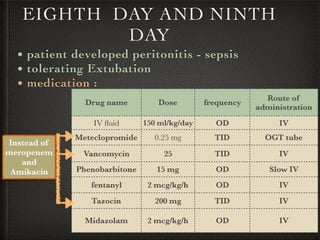
EIGHTH DAY AND NINTH
DAY
• patient developed peritonitis - sepsis
• tolerating Extubation
• medication :
Drug name Dose frequency
Route of
administration
IV fluid 150 ml/kg/day OD IV
Meteclopromide 0.25 mg TID OGT tube
Vancomycin 25 TID IV
Phenobarbitone 15 mg OD Slow IV
fentanyl 2 mcg/kg/h OD IV
Tazocin 200 mg TID IV
Instead of
meropenem
and
Amikacin
Midazolam 2 mcg/kg/h OD IV
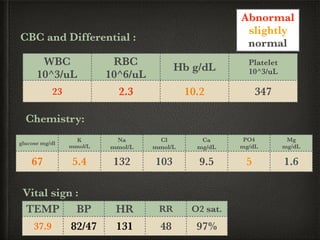
WBC
10^3/uL
RBC
10^6/uL
Hb g/dL
Platelet
10^3/uL
23 2.3 10.2 347
CBC and Differential :
glucose mg/dl
K
mmol/L
Na
mmol/L
Cl
mmol/L
Ca
mg/dL
PO4
mg/dL
Mg
mg/dL
67 5.4 132 103 9.5 5 1.6
Chemistry:
Abnormal
slightly
normal
Vital sign :
TEMP BP HR RR O2 sat.
37.9 82/47 131 48 97%
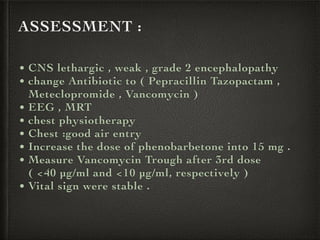
ASSESSMENT :
• CNS lethargic , weak , grade 2 encephalopathy
• change Antibiotic to ( Pepracillin Tazopactam ,
Meteclopromide , Vancomycin )
• EEG , MRT
• chest physiotherapy
• Chest :good air entry
• Increase the dose of phenobarbetone into 15 mg .
• Measure Vancomycin Trough after 3rd dose
( <40 µg/ml and <10 µg/ml, respectively )
• Vital sign were stable .
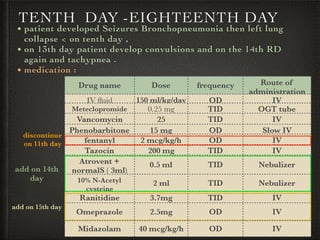
TENTH DAY -EIGHTEENTH DAY
• patient developed Seizures Bronchopneumonia then left lung
collapse < on tenth day ,
• on 13th day patient develop convulsions and on the 14th RD
again and tachypnea .
• medication :
Drug name Dose frequency Route of
administration
IV fluid 150 ml/kg/day OD IV
Meteclopromide 0.25 mg TID OGT tube
Vancomycin 25 TID IV
Phenobarbitone 15 mg OD Slow IV
fentanyl 2 mcg/kg/h OD IV
Tazocin 200 mg TID IV
Atrovent +
normalS ( 3ml)
0.5 ml TID Nebulizer
10% N-Acetyl
cysteine
2 ml TID Nebulizer
Ranitidine 3.7mg TID IV
Omeprazole 2.5mg OD IV
discontinue
on 11th day
add on 14th
day
add on 15th day
Midazolam 40 mcg/kg/h OD IV
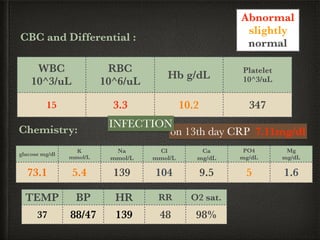
WBC
10^3/uL
RBC
10^6/uL
Hb g/dL
Platelet
10^3/uL
15 3.3 10.2 347
CBC and Differential :
glucose mg/dl
K
mmol/L
Na
mmol/L
Cl
mmol/L
Ca
mg/dL
PO4
mg/dL
Mg
mg/dL
73.1 5.4 139 104 9.5 5 1.6
Chemistry:
Abnormal
slightly
normal
on 13th day CRP 7.11mg/dl
TEMP BP HR RR O2 sat.
37 88/47 139 48 98%
INFECTION
ASSESSMENT :
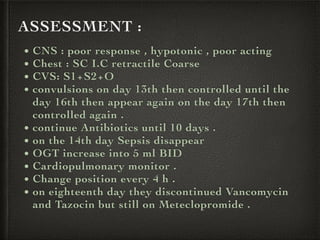
• CNS : poor response , hypotonic , poor acting
• Chest : SC I.C retractile Coarse
• CVS: S1+S2+O
• convulsions on day 13th then controlled until the
day 16th then appear again on the day 17th then
controlled again .
• continue Antibiotics until 10 days .
• on the 14th day Sepsis disappear
• OGT increase into 5 ml BID
• Cardiopulmonary monitor .
• Change position every 4 h .
• on eighteenth day they discontinued Vancomycin
and Tazocin but still on Meteclopromide .
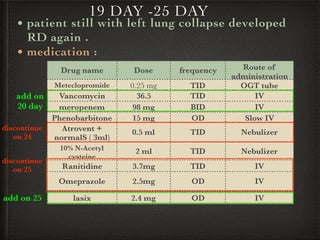
19 DAY -25 DAY
• patient still with left lung collapse developed
RD again .
• medication :
Drug name Dose frequency Route of
administration
Meteclopromide 0.25 mg TID OGT tube
Vancomycin 36.5 TID IV
meropenem 98 mg BID IV
Phenobarbitone 15 mg OD Slow IV
Atrovent +
normalS ( 3ml)
0.5 ml TID Nebulizer
10% N-Acetyl
cysteine
2 ml TID Nebulizer
Ranitidine 3.7mg TID IV
Omeprazole 2.5mg OD IV
lasix 2.4 mg OD IV
add on
20 day
discontinue
on 24
discontinue
on 25
add on 25
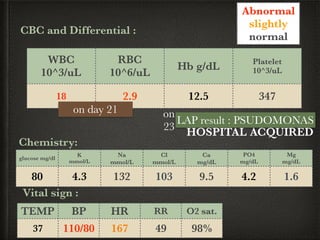
WBC
10^3/uL
RBC
10^6/uL
Hb g/dL
Platelet
10^3/uL
18 2.9 12.5 347
CBC and Differential :
glucose mg/dl
K
mmol/L
Na
mmol/L
Cl
mmol/L
Ca
mg/dL
PO4
mg/dL
Mg
mg/dL
80 4.3 132 103 9.5 4.2 1.6
Chemistry:
Abnormal
slightly
normal
LAP result : PSUDOMONAS
on
23
on day 21
Vital sign :
TEMP BP HR RR O2 sat.
37 110/80 167 49 98%
HOSPITAL ACQUIRED
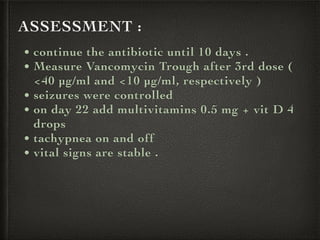
ASSESSMENT :
• continue the antibiotic until 10 days .
• Measure Vancomycin Trough after 3rd dose (
<40 µg/ml and <10 µg/ml, respectively )
• seizures were controlled
• on day 22 add multivitamins 0.5 mg + vit D 4
drops
• tachypnea on and off
• vital signs are stable .
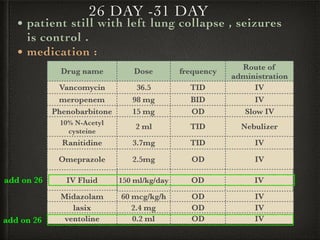
26 DAY -31 DAY
• patient still with left lung collapse , seizures
is control .
• medication :
Drug name Dose frequency
Route of
administration
Vancomycin 36.5 TID IV
meropenem 98 mg BID IV
Phenobarbitone 15 mg OD Slow IV
10% N-Acetyl
cysteine
2 ml TID Nebulizer
Ranitidine 3.7mg TID IV
Omeprazole 2.5mg OD IV
IV Fluid
Midazolam 60 mcg/kg/h OD IV
lasix 2.4 mg OD IV
ventoline 0.2 ml OD IVadd on 26
150 ml/kg/day OD IVadd on 26
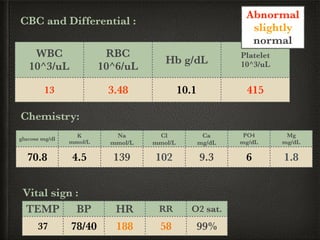
WBC
10^3/uL
RBC
10^6/uL
Hb g/dL
Platelet
10^3/uL
13 3.48 10.1 415
CBC and Differential :
glucose mg/dl
K
mmol/L
Na
mmol/L
Cl
mmol/L
Ca
mg/dL
PO4
mg/dL
Mg
mg/dL
70.8 4.5 139 102 9.3 6 1.8
Chemistry:
Abnormal
slightly
normal
Vital sign :
TEMP BP HR RR O2 sat.
37 78/40 188 58 99%
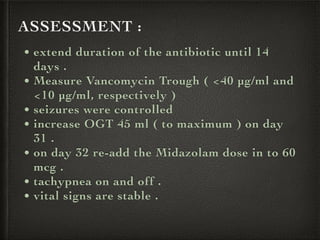
ASSESSMENT :
• extend duration of the antibiotic until 14
days .
• Measure Vancomycin Trough ( <40 µg/ml and
<10 µg/ml, respectively )
• seizures were controlled
• increase OGT 45 ml ( to maximum ) on day
31 .
• on day 32 re-add the Midazolam dose in to 60
mcg .
• tachypnea on and off .
• vital signs are stable .
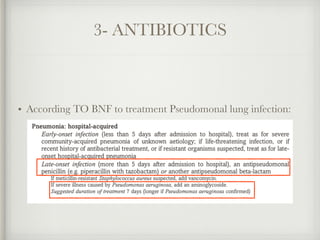
PATIENT
STILL IN THE
HOSPITAL at
NICU .
INTERVENTIONS
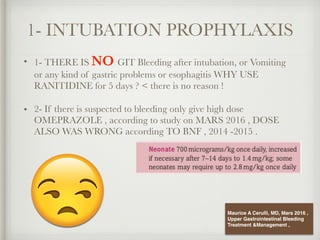
1- INTUBATION PROPHYLAXIS
• 1- THERE IS NO GIT Bleeding after intubation, or Vomiting
or any kind of gastric problems or esophagitis WHY USE
RANITIDINE for 5 days ? < there is no reason !
• 2- If there is suspected to bleeding only give high dose
OMEPRAZOLE , according to study on MARS 2016 , DOSE
ALSO WAS WRONG according TO BNF , 2014 -2015 .
Maurice A Cerulli, MD, Mars 2016 ,
Upper Gastrointestinal Bleeding
Treatment &Management ,
2- MANAGEMENT OF
SEIZURES
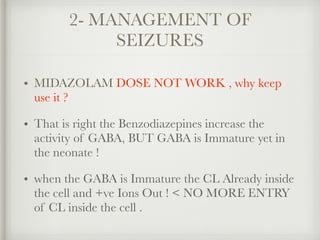
• MIDAZOLAM DOSE NOT WORK , why keep
use it ?
• That is right the Benzodiazepines increase the
activity of GABA, BUT GABA is Immature yet in
the neonate !
• when the GABA is Immature the CL Already inside
the cell and +ve Ions Out ! < NO MORE ENTRY
of CL inside the cell .
SO USE WHAT AS A SOCEND LINE
TREATMENT?
• According to Survey of 55 child neurologists
• Contemporary choice of second, add-on drug if
initial drug fails:
• – Topiramate is “anti-epileptogenic” and
neuroprotective 55% (30/55) among those
recommending TPM, 70% (21/30) perceived
treatment beneficial and 63% (19/30) saw no apparent
ADRs
Levetiracetam: the anti-seizure
medication (no hepatic metabolism, limited
drug-drug interactions, low protein binding,
renal
elimination) and iv formulation .
47% (26/55)
treatment beneficial and 92% (24/25) saw no
apparent ADR
SO USE WHAT AS A SOCEND LINE
TREATMENT?
3- ANTIBIOTICS
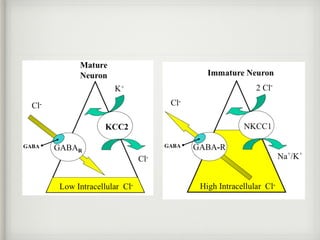
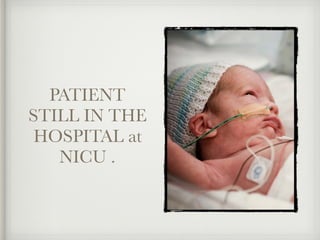
• According TO BNF to treatment Pseudomonal lung infection:
Swami Sivananda
“Put your heart, mind, and soul into even your
smallest acts.
This is the secret of success.
”
THANK YOU .

Hypoxic Ischemic Encephalopathy

  • 1.
    NEONATAL HYPOXIC ISCHEMIC ENCEPHALOPATHY Case presentationof Neonate ICU rotation Presented by : Walaa Fahad Aljuaid . Supervised by : Dr.Daniah Rifqi
  • 2.
    OUTLINES : • Historyof the case • What is the HIE : • Definition • Causes • Incidence and Prevalence • Diagnosis • Complication • Treatment • Intervention
  • 3.
    The Case : M.Ais 14 days old male came to NICU from another hospital very sick , severe HIE , Respiratory distress He was presented there ( another hospital ) with : failure to thrive , hypotonic , flacid , Apgar score was 1 , he was on the mechanical ventilator as a case of sever HIE stage 3 , the baby developed convulsion on the first day controlled on phenobarbitone , hypertension controlled with Lasix and Captopril
  • 4.
    HISTORY OF PRESENTILLNESS: • Medical history : FTT , SVD , Prolonged Labore , HIE , CHD . Broncholitis • Family history : Mother has one abortion in the past . • Allergy : +ve consanguinity • Medication history : Captoril ,Phenoparbetone , Lasix
  • 5.
    REVIEW OF SYSTEMS: • Head and nick : normal • Eyes : restricted pinpoint • Nose : normal • CVS : S1 + S2 , HTN • Chest : RD , low air entry . • Abdomen : Soft , no organomegally . • Spine and Genitalia : normal • Hips : normal • CNS : AF at level , Tone : hyper Reflexes : Weak .
  • 6.
    • Respiration :tachypnea • Color : normal • Cry : weak • Movement : abnormal • Birth trauma : no • Apparent Congenital Anomalies : no
  • 7.
    WHAT IS THESEVER HIE ? References : Kenneth A. stem , Stern Law 2017 , cerebralpalsy , Hypoxic-Ischemic Encephalopathy .
  • 8.
    Definition: • Hypoxic-ischemic encephalopathy,or HIE, is the brain injury caused by oxygen deprivation to the brain References : Kenneth A. stem , Stern Law 2017 , cerebralpalsy , Hypoxic-Ischemic Encephalopathy .
  • 9.
    Causes of HIE Asnoted HIE may result from any event that restricted the flow of oxygenated blood to the brain The case was due to prolonged delivery . References : Kenneth A. stem , Stern Law 2017 , cerebralpalsy , Hypoxic-Ischemic Encephalopathy .
  • 10.
  • 11.
    Incidence and Prevalenceof HIE in KSA : A total of 70 cases of HIE were recorded in the study period giving an incidence of 5.5 cases per 1000 term births. This incidence is lower compared to many developing countries and comparable to other centers. References : Itoo BA1, Al- Hawsawi ZM, Khan AH, February 2003,Hypoxic ischemic encephalopathy. Incidence and risk factors in North Western Saudi Arabia. References : Adnan Amin Alsulaimani , Abdelaziz SA Abuelsaad and Nader M Mohamed , January 27, 2015 , Inflammatory Cytokines in Neonatal Hypoxic Ischemic Encephalopathy and their Correlation with Brain Marker S100 Protein: A Case Control Study in Saudi Arabia 2003 2015 mention
  • 12.
    Diagnosis : • diagnosedclinical by the combination of evidence of fetal distress • heart rate abnormalities • Meconium stained fluid • Birth depression • Low Apgars Normal Abnormal References : Kenneth A. stem , Stern Law 2017 , cerebralpalsy , Hypoxic-Ischemic Encephalopathy .
  • 13.
  • 14.
    Complications To the Mother: • Maternal diabetes with vascular disease • Problems with blood circulation to the placenta • Preeclampsia • Cardiac disease • Congenital infections of the fetus • Drug and alcohol abuse • Severe fetal anemia • Lung malformations References : Kenneth A. stem , Stern Law 2017 , cerebralpalsy , Hypoxic-Ischemic Encephalopathy .
  • 15.
    Complications To the infants: Intrapartum period : • Excessive bleeding from the placenta • Very low maternal blood pressure • Umbilical cord accidents • Prolonged late stages of labor • Abnormal fetal position • Rupture of the placenta or the uterus Postpartum HIE : • Severe cardiac or pulmonary disease • Infections, including sepsis and meningitis • Severe prematurity • Low neonatal blood pressure • Brain or skull trauma • Congenital brain malformations
  • 16.
    Treatment : The basicgoal of HIE treatment is to support the baby’s affected organs , treatment options include: • Mechanical ventilation to help a baby who can’t breathe • Cooling the baby’s brain or body to reverse brain hypoxia caused by high temperatures • Hyperbaric oxygen treatment in cases where HIE is caused by carbon monoxide intoxication • Treatments to assist the baby’s heart function and control blood pressure • Maintain normal blood glucose • Prevent or control seizures • Prevent or minimize cerebral edema References : Kenneth A. stem , Stern Law 2017 , cerebralpalsy , Hypoxic-Ischemic Encephalopathy .
  • 17.
  • 18.
    VITALS AT ADMISSION •Weight : 2.5 Kg • Temperature : 36 Cْ • pulses : 147 • Respiratory Rate : 54 • Blood pressure : 82 / 46 • Pain score : 1 . • SPO2 : 100 . • Level of consciousness: low • Respons : 2 . • Pupil size : 3 .
  • 19.
    • The patientMove directly to NICU , he received nothing in ER . • At the NICU First Day : • medication : DATE OF ADMISSION : 29-2-1438 Drug name Dose frequency Route of administration IV fluid ( Ca , Kcl , AA10% , D5, D10 NS) . 150 ml/kg/ day OD IV Tamiflu 63 mg BID IV Amikacin 38 mg OD IV Phenobarbitone 10 mg OD Slow IV Empiric
  • 20.
    WBC 10^3/uL RBC 10^6/uL Hb g/dL Platelet 10^3/uL 11.26 4.215.3 363 CBC and Differential : glucose mg/dl K mmol/L Na mmol/L Cl mmol/L Ca mg/dL PO4 mg/dL Mg mg/dL 34 3.9 148 108 9.7 4.6 1.7 Chemistry: Abnormal slightly normal
  • 21.
    ASSESSMENT : • Measureserum level Amikacin Peak should not exceed 30 mg / liter . • Do Blood culture ( To know reason of respiratory distress ) . • keep using phenoparbiton to control seizures . • vital signs were stable . • keep patient on mechanical ventilator
  • 22.
    SECOND DAY -SEVENTH DAY • The blood culture -ve viral infection so stopped Tamiflu . • OGT feeding start 3ml / 3 hrs on the fifth day . • intubation at fourth day • medication : Drug name Dose frequency Route of administration IV fluid 150 ml/kg/day OD IV meropnem 63 mg BID IV Amikacin 38 mg OD IV Phenobarbitone 10 mg OD Slow IV fentanyl 5 mcg/kg PNR slow IV . fentanyl 2 mcg/kg/h OD IV Midazolam 40 mcg/kg/h OD IV mgso4 80mg TID slow IV due to low mg
  • 23.
    WBC 10^3/uL RBC 10^6/uL Hb g/dL Platelet 10^3/uL 12.5 3.411.7 363 CBC and Differential : glucose mg/dl K mmol/L Na mmol/L Cl mmol/L Ca mg/dL PO4 mg/dL Mg mg/dL 80 4.2 132 106 9.5 4.3 1.27 Chemistry: Abnormal slightly normal At 4th day Vital sign : TEMP BP HR RR O2 sat. 37 88/56 154 48 90%
  • 24.
    ASSESSMENT : • Measureserum level Amikacin Peak should not exceed 30 mg / liter . • keep using Phenoparbiton to control seizures . • vital signs were stable . • addition midazolam and fentanyl to do intubation surgery . < on the fourth day . • OGT feeding start 3ml / 3 hrs on the fifth day . • X-ray for chest at fourth day • keep mechanical ventilation • vital sign were stable
  • 25.
    EIGHTH DAY ANDNINTH DAY • patient developed peritonitis - sepsis • tolerating Extubation • medication : Drug name Dose frequency Route of administration IV fluid 150 ml/kg/day OD IV Meteclopromide 0.25 mg TID OGT tube Vancomycin 25 TID IV Phenobarbitone 15 mg OD Slow IV fentanyl 2 mcg/kg/h OD IV Tazocin 200 mg TID IV Instead of meropenem and Amikacin Midazolam 2 mcg/kg/h OD IV
  • 26.
    WBC 10^3/uL RBC 10^6/uL Hb g/dL Platelet 10^3/uL 23 2.310.2 347 CBC and Differential : glucose mg/dl K mmol/L Na mmol/L Cl mmol/L Ca mg/dL PO4 mg/dL Mg mg/dL 67 5.4 132 103 9.5 5 1.6 Chemistry: Abnormal slightly normal Vital sign : TEMP BP HR RR O2 sat. 37.9 82/47 131 48 97%
  • 27.
    ASSESSMENT : • CNSlethargic , weak , grade 2 encephalopathy • change Antibiotic to ( Pepracillin Tazopactam , Meteclopromide , Vancomycin ) • EEG , MRT • chest physiotherapy • Chest :good air entry • Increase the dose of phenobarbetone into 15 mg . • Measure Vancomycin Trough after 3rd dose ( <40 µg/ml and <10 µg/ml, respectively ) • Vital sign were stable .
  • 28.
    TENTH DAY -EIGHTEENTHDAY • patient developed Seizures Bronchopneumonia then left lung collapse < on tenth day , • on 13th day patient develop convulsions and on the 14th RD again and tachypnea . • medication : Drug name Dose frequency Route of administration IV fluid 150 ml/kg/day OD IV Meteclopromide 0.25 mg TID OGT tube Vancomycin 25 TID IV Phenobarbitone 15 mg OD Slow IV fentanyl 2 mcg/kg/h OD IV Tazocin 200 mg TID IV Atrovent + normalS ( 3ml) 0.5 ml TID Nebulizer 10% N-Acetyl cysteine 2 ml TID Nebulizer Ranitidine 3.7mg TID IV Omeprazole 2.5mg OD IV discontinue on 11th day add on 14th day add on 15th day Midazolam 40 mcg/kg/h OD IV
  • 29.
    WBC 10^3/uL RBC 10^6/uL Hb g/dL Platelet 10^3/uL 15 3.310.2 347 CBC and Differential : glucose mg/dl K mmol/L Na mmol/L Cl mmol/L Ca mg/dL PO4 mg/dL Mg mg/dL 73.1 5.4 139 104 9.5 5 1.6 Chemistry: Abnormal slightly normal on 13th day CRP 7.11mg/dl TEMP BP HR RR O2 sat. 37 88/47 139 48 98% INFECTION
  • 30.
    ASSESSMENT : • CNS: poor response , hypotonic , poor acting • Chest : SC I.C retractile Coarse • CVS: S1+S2+O • convulsions on day 13th then controlled until the day 16th then appear again on the day 17th then controlled again . • continue Antibiotics until 10 days . • on the 14th day Sepsis disappear • OGT increase into 5 ml BID • Cardiopulmonary monitor . • Change position every 4 h . • on eighteenth day they discontinued Vancomycin and Tazocin but still on Meteclopromide .
  • 31.
    19 DAY -25DAY • patient still with left lung collapse developed RD again . • medication : Drug name Dose frequency Route of administration Meteclopromide 0.25 mg TID OGT tube Vancomycin 36.5 TID IV meropenem 98 mg BID IV Phenobarbitone 15 mg OD Slow IV Atrovent + normalS ( 3ml) 0.5 ml TID Nebulizer 10% N-Acetyl cysteine 2 ml TID Nebulizer Ranitidine 3.7mg TID IV Omeprazole 2.5mg OD IV lasix 2.4 mg OD IV add on 20 day discontinue on 24 discontinue on 25 add on 25
  • 32.
    WBC 10^3/uL RBC 10^6/uL Hb g/dL Platelet 10^3/uL 18 2.912.5 347 CBC and Differential : glucose mg/dl K mmol/L Na mmol/L Cl mmol/L Ca mg/dL PO4 mg/dL Mg mg/dL 80 4.3 132 103 9.5 4.2 1.6 Chemistry: Abnormal slightly normal LAP result : PSUDOMONAS on 23 on day 21 Vital sign : TEMP BP HR RR O2 sat. 37 110/80 167 49 98% HOSPITAL ACQUIRED
  • 33.
    ASSESSMENT : • continuethe antibiotic until 10 days . • Measure Vancomycin Trough after 3rd dose ( <40 µg/ml and <10 µg/ml, respectively ) • seizures were controlled • on day 22 add multivitamins 0.5 mg + vit D 4 drops • tachypnea on and off • vital signs are stable .
  • 34.
    26 DAY -31DAY • patient still with left lung collapse , seizures is control . • medication : Drug name Dose frequency Route of administration Vancomycin 36.5 TID IV meropenem 98 mg BID IV Phenobarbitone 15 mg OD Slow IV 10% N-Acetyl cysteine 2 ml TID Nebulizer Ranitidine 3.7mg TID IV Omeprazole 2.5mg OD IV IV Fluid Midazolam 60 mcg/kg/h OD IV lasix 2.4 mg OD IV ventoline 0.2 ml OD IVadd on 26 150 ml/kg/day OD IVadd on 26
  • 35.
    WBC 10^3/uL RBC 10^6/uL Hb g/dL Platelet 10^3/uL 13 3.4810.1 415 CBC and Differential : glucose mg/dl K mmol/L Na mmol/L Cl mmol/L Ca mg/dL PO4 mg/dL Mg mg/dL 70.8 4.5 139 102 9.3 6 1.8 Chemistry: Abnormal slightly normal Vital sign : TEMP BP HR RR O2 sat. 37 78/40 188 58 99%
  • 36.
    ASSESSMENT : • extendduration of the antibiotic until 14 days . • Measure Vancomycin Trough ( <40 µg/ml and <10 µg/ml, respectively ) • seizures were controlled • increase OGT 45 ml ( to maximum ) on day 31 . • on day 32 re-add the Midazolam dose in to 60 mcg . • tachypnea on and off . • vital signs are stable .
  • 37.
  • 38.
  • 39.
    1- INTUBATION PROPHYLAXIS •1- THERE IS NO GIT Bleeding after intubation, or Vomiting or any kind of gastric problems or esophagitis WHY USE RANITIDINE for 5 days ? < there is no reason ! • 2- If there is suspected to bleeding only give high dose OMEPRAZOLE , according to study on MARS 2016 , DOSE ALSO WAS WRONG according TO BNF , 2014 -2015 . Maurice A Cerulli, MD, Mars 2016 , Upper Gastrointestinal Bleeding Treatment &Management ,
  • 40.
    2- MANAGEMENT OF SEIZURES •MIDAZOLAM DOSE NOT WORK , why keep use it ? • That is right the Benzodiazepines increase the activity of GABA, BUT GABA is Immature yet in the neonate ! • when the GABA is Immature the CL Already inside the cell and +ve Ions Out ! < NO MORE ENTRY of CL inside the cell .
  • 42.
    SO USE WHATAS A SOCEND LINE TREATMENT? • According to Survey of 55 child neurologists • Contemporary choice of second, add-on drug if initial drug fails: • – Topiramate is “anti-epileptogenic” and neuroprotective 55% (30/55) among those recommending TPM, 70% (21/30) perceived treatment beneficial and 63% (19/30) saw no apparent ADRs
  • 43.
    Levetiracetam: the anti-seizure medication(no hepatic metabolism, limited drug-drug interactions, low protein binding, renal elimination) and iv formulation . 47% (26/55) treatment beneficial and 92% (24/25) saw no apparent ADR SO USE WHAT AS A SOCEND LINE TREATMENT?
  • 44.
    3- ANTIBIOTICS • AccordingTO BNF to treatment Pseudomonal lung infection:
  • 45.
    Swami Sivananda “Put yourheart, mind, and soul into even your smallest acts. This is the secret of success. ”
  • 46.