HYPOXIC ISCHEMIC 
ENCEPHALOPATHY 
DR. MANSOOR ELAHI
DEFINITION 
It is the term used to designate the clinical and 
neuropathological findings of an encephalopathy that 
occurs in a full term infant who has experienced a 
significant episode of intrapartum asphyxia.
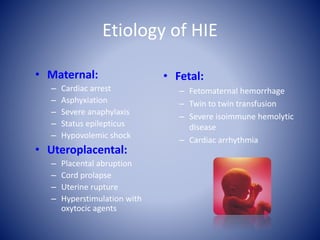
Etiology of HIE 
• Maternal: 
– Cardiac arrest 
– Asphyxiation 
– Severe anaphylaxis 
– Status epilepticus 
– Hypovolemic shock 
• Uteroplacental: 
– Placental abruption 
– Cord prolapse 
– Uterine rupture 
– Hyperstimulation with 
oxytocic agents 
• Fetal: 
– Fetomaternal hemorrhage 
– Twin to twin transfusion 
– Severe isoimmune hemolytic 
disease 
– Cardiac arrhythmia
• Fifteen to 20% of infants with hypoxic-ischemic 
encephalopathy (HIE) die in the neonatal period, and 
25–30% of survivors are left with permanent 
neurodevelopmental abnormalities (cerebral palsy, 
mental retardation)
FETAL HYPOXIA CAUSED BY VARIOUS 
DISORDERS IN MOTHER
(1) inadequate oxygenation of maternal blood from 
hypoventilation during anesthesia, cyanotic heart 
disease, respiratory failure, or carbon monoxide 
poisoning; 
(2) low maternal blood pressure from acute blood loss, 
spinal anesthesia, or compression of the vena cava and 
aorta by the gravid uterus; 
(3) inadequate relaxation of the uterus to permit placental 
filling as a result of uterine tetany caused by the 
administration of excessive oxytocin; 
(4) premature separation of the placenta; 
(5) impedance to the circulation of blood through the 
umbilical cord as a result of compression or knotting of 
the cord; and 
(6) placental insufficiency from toxemia or postmaturity.
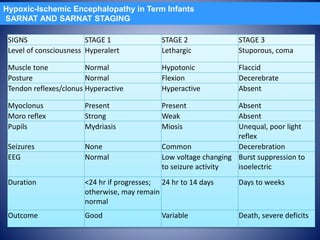
Hypoxic-Ischemic Encephalopathy in Term Infants 
SARNAT AND SARNAT STAGING 
SIGNS STAGE 1 STAGE 2 STAGE 3 
Level of consciousness Hyperalert Lethargic Stuporous, coma 
Muscle tone Normal Hypotonic Flaccid 
Posture Normal Flexion Decerebrate 
Tendon reflexes/clonus Hyperactive Hyperactive Absent 
Myoclonus Present Present Absent 
Moro reflex Strong Weak Absent 
Pupils Mydriasis Miosis Unequal, poor light 
reflex 
Seizures None Common Decerebration 
EEG Normal Low voltage changing 
to seizure activity 
Burst suppression to 
isoelectric 
Duration <24 hr if progresses; 
otherwise, may remain 
normal 
24 hr to 14 days Days to weeks 
Outcome Good Variable Death, severe deficits
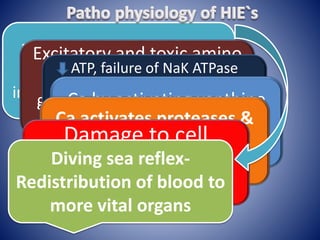
Due to ischemia, anaerobic 
Excitatory and toxic amino 
ATP, failure of NaK ATPase 
pump, depolarization of 
metabolism, lactate & 
acids, particularly 
inorg.phosphates accumulate 
Ca by activating xanthine 
oxidase, N2O,PGs release 
glutamate, accumulate in 
neuronal cells, influx of Ca, Na& 
Ca the osmotic activates damaged influx proteases tissue 
of water 
& 
lipases which generates 
Damage to cell 
membranes & 
free radicals 
Diving sea reflex- 
02 free radicals 
Redistribution of blood to 
infarction 
more vital organs
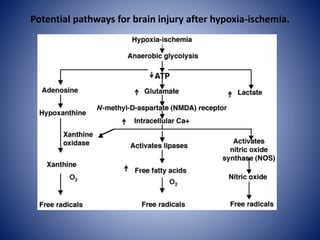
Potential pathways for brain injury after hypoxia-ischemia.
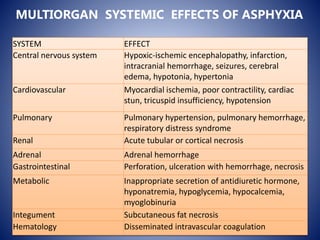
MULTIORGAN SYSTEMIC EFFECTS OF ASPHYXIA 
SYSTEM EFFECT 
Central nervous system Hypoxic-ischemic encephalopathy, infarction, 
intracranial hemorrhage, seizures, cerebral 
edema, hypotonia, hypertonia 
Cardiovascular Myocardial ischemia, poor contractility, cardiac 
stun, tricuspid insufficiency, hypotension 
Pulmonary Pulmonary hypertension, pulmonary hemorrhage, 
respiratory distress syndrome 
Renal Acute tubular or cortical necrosis 
Adrenal Adrenal hemorrhage 
Gastrointestinal Perforation, ulceration with hemorrhage, necrosis 
Metabolic Inappropriate secretion of antidiuretic hormone, 
hyponatremia, hypoglycemia, hypocalcemia, 
myoglobinuria 
Integument Subcutaneous fat necrosis 
Hematology Disseminated intravascular coagulation
What is the 
diagnosis ?
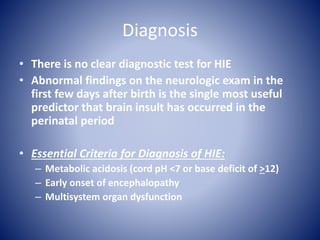
Diagnosis 
• There is no clear diagnostic test for HIE 
• Abnormal findings on the neurologic exam in the 
first few days after birth is the single most useful 
predictor that brain insult has occurred in the 
perinatal period 
• Essential Criteria for Diagnosis of HIE: 
– Metabolic acidosis (cord pH <7 or base deficit of >12) 
– Early onset of encephalopathy 
– Multisystem organ dysfunction
INVESTIGATIONS 
• Exclude other causes of acute resp. distress 
• Chest X ray- to exclude pneumothorax, CDH, 
Congenital pneumonia 
• Sepsis screening and bl. Culture 
• Serum electrolytes 
Hyponatremia – SIADH 
Hyperkalemia – acute renal shutdown/ tissue 
catbolism 
Hyperphosphatemia, hypocalcemia – tissue injury 
BUN & CREATININE, LACTATE, PYRUVATE, BRAIN 
SPECIFIC CREATINE KINASE, HYPOXANTHINE, NON-ESTERIFIED 
FFA
• Amplitude-integrated EEG (aEEG) 
– When performed early, it may reflect dysfunction 
rather than permanent injury 
– Most useful in infants who have moderate to severe 
encephalopathy 
• Marginally abnormal or normal aEEG is very reassuring of 
good outcome 
• Severely abnormal aEEG in infants with moderate HIE raises 
the probability of death or severe disability from 25% to 
75%
• CRANIAL ULTRASOUND 
On 2, 7,21 days & before discharge to ruleout 
IVH. It shows echogenic focus head of caudate 
or caudothalamic notch. 
CT SCAN after 2 wks to prevent radiation 
damage. 
MRI: Most appropriate technique and is able to show 
different patterns of injury. Presence of signal abnormality in 
the internal capsule later in the first week has a very high 
predictive value for neurodevelopmental outcome
MANAGEMENT 
• TABC 
• IV fluids – first 48hrs 10% dextrose to prevent 
hypoglycemia 
• Maintain 2/3 rd of fluid to prevent SIADH 
• Ca gluconate 2ml/kg for 2 days 
• 7.5% NaHCo3, 2-3ml/kg diluted with equal vol. of 
distilled water or 5%D 
• Hypotension by inotropes like dopamine, dobutamine 
• Avoid mannitol- worsen due to endothelial damage in 
HIE. 
• Prophylactic Phenobarbitone to combat seizures.
Criteria for Hypothermia 
• Hypothermia is not effective for every baby 
– Currently only used in infants > 35 weeks 
• Time interval between birth and initiation of 
treatment important 
– Treatment must be started within 6 hours of birth to be 
effective
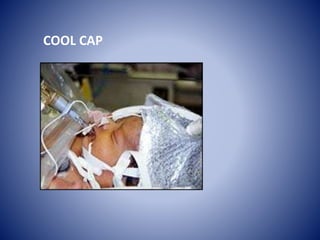
COOL CAP
Hypothermia - Mechanism of Action 
• Reduces cerebral metabolism, prevents edema 
• Decreases energy utilization 
• Reduces/suppresses cytotoxic amino acid accumulation 
and nitric oxide 
• Inhibits platelet-activating factor, inflammatory cascade 
• Suppresses free radical activity 
• Attenuates secondary neuronal damage 
• Inhibits cell death 
• Reduces extent of brain damage 
– DEATH OR SEVERE DISABILITY AT 18 MONTHS OF AGE SIGNIFICANTLY 
REDUCED!! 
– Brain cooling DONE UPTO 72hrs.
CONTRAINDICATIONS TO COOLING 
· Infants likely to require surgery during 
first three days after birth 
· Other abnormalities indicative of poor 
long term outcome are present 
e.g. structural anomalies 
· Appears moribund
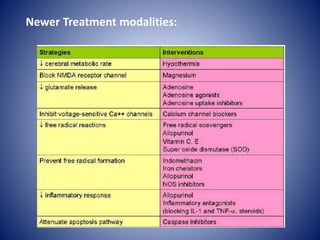
Newer Treatment modalities:
• Brain death after neonatal HIE is diagnosed 
by the clinical findings of coma unresponsive 
to pain, auditory, or visual stimulation; apnea 
with Pco2 rising from 40 to over 60 mm Hg 
without ventilatory support; and absent 
brainstem reflexes (pupil, oculocephalic, 
oculovestibular, corneal, gag, sucking). These 
findings must occur in the absence of 
hypothermia, hypotension, and elevated 
levels of depressant drugs (phenobarbital).
Hypoxic ischemic  encephalopathy

Hypoxic ischemic encephalopathy

  • 1.
  • 2.
    DEFINITION It isthe term used to designate the clinical and neuropathological findings of an encephalopathy that occurs in a full term infant who has experienced a significant episode of intrapartum asphyxia.
  • 3.
    Etiology of HIE • Maternal: – Cardiac arrest – Asphyxiation – Severe anaphylaxis – Status epilepticus – Hypovolemic shock • Uteroplacental: – Placental abruption – Cord prolapse – Uterine rupture – Hyperstimulation with oxytocic agents • Fetal: – Fetomaternal hemorrhage – Twin to twin transfusion – Severe isoimmune hemolytic disease – Cardiac arrhythmia
  • 4.
    • Fifteen to20% of infants with hypoxic-ischemic encephalopathy (HIE) die in the neonatal period, and 25–30% of survivors are left with permanent neurodevelopmental abnormalities (cerebral palsy, mental retardation)
  • 5.
    FETAL HYPOXIA CAUSEDBY VARIOUS DISORDERS IN MOTHER
  • 6.
    (1) inadequate oxygenationof maternal blood from hypoventilation during anesthesia, cyanotic heart disease, respiratory failure, or carbon monoxide poisoning; (2) low maternal blood pressure from acute blood loss, spinal anesthesia, or compression of the vena cava and aorta by the gravid uterus; (3) inadequate relaxation of the uterus to permit placental filling as a result of uterine tetany caused by the administration of excessive oxytocin; (4) premature separation of the placenta; (5) impedance to the circulation of blood through the umbilical cord as a result of compression or knotting of the cord; and (6) placental insufficiency from toxemia or postmaturity.
  • 7.
    Hypoxic-Ischemic Encephalopathy inTerm Infants SARNAT AND SARNAT STAGING SIGNS STAGE 1 STAGE 2 STAGE 3 Level of consciousness Hyperalert Lethargic Stuporous, coma Muscle tone Normal Hypotonic Flaccid Posture Normal Flexion Decerebrate Tendon reflexes/clonus Hyperactive Hyperactive Absent Myoclonus Present Present Absent Moro reflex Strong Weak Absent Pupils Mydriasis Miosis Unequal, poor light reflex Seizures None Common Decerebration EEG Normal Low voltage changing to seizure activity Burst suppression to isoelectric Duration <24 hr if progresses; otherwise, may remain normal 24 hr to 14 days Days to weeks Outcome Good Variable Death, severe deficits
  • 8.
    Due to ischemia,anaerobic Excitatory and toxic amino ATP, failure of NaK ATPase pump, depolarization of metabolism, lactate & acids, particularly inorg.phosphates accumulate Ca by activating xanthine oxidase, N2O,PGs release glutamate, accumulate in neuronal cells, influx of Ca, Na& Ca the osmotic activates damaged influx proteases tissue of water & lipases which generates Damage to cell membranes & free radicals Diving sea reflex- 02 free radicals Redistribution of blood to infarction more vital organs
  • 9.
    Potential pathways forbrain injury after hypoxia-ischemia.
  • 10.
    MULTIORGAN SYSTEMIC EFFECTSOF ASPHYXIA SYSTEM EFFECT Central nervous system Hypoxic-ischemic encephalopathy, infarction, intracranial hemorrhage, seizures, cerebral edema, hypotonia, hypertonia Cardiovascular Myocardial ischemia, poor contractility, cardiac stun, tricuspid insufficiency, hypotension Pulmonary Pulmonary hypertension, pulmonary hemorrhage, respiratory distress syndrome Renal Acute tubular or cortical necrosis Adrenal Adrenal hemorrhage Gastrointestinal Perforation, ulceration with hemorrhage, necrosis Metabolic Inappropriate secretion of antidiuretic hormone, hyponatremia, hypoglycemia, hypocalcemia, myoglobinuria Integument Subcutaneous fat necrosis Hematology Disseminated intravascular coagulation
  • 11.
    What is the diagnosis ?
  • 12.
    Diagnosis • Thereis no clear diagnostic test for HIE • Abnormal findings on the neurologic exam in the first few days after birth is the single most useful predictor that brain insult has occurred in the perinatal period • Essential Criteria for Diagnosis of HIE: – Metabolic acidosis (cord pH <7 or base deficit of >12) – Early onset of encephalopathy – Multisystem organ dysfunction
  • 13.
    INVESTIGATIONS • Excludeother causes of acute resp. distress • Chest X ray- to exclude pneumothorax, CDH, Congenital pneumonia • Sepsis screening and bl. Culture • Serum electrolytes Hyponatremia – SIADH Hyperkalemia – acute renal shutdown/ tissue catbolism Hyperphosphatemia, hypocalcemia – tissue injury BUN & CREATININE, LACTATE, PYRUVATE, BRAIN SPECIFIC CREATINE KINASE, HYPOXANTHINE, NON-ESTERIFIED FFA
  • 14.
    • Amplitude-integrated EEG(aEEG) – When performed early, it may reflect dysfunction rather than permanent injury – Most useful in infants who have moderate to severe encephalopathy • Marginally abnormal or normal aEEG is very reassuring of good outcome • Severely abnormal aEEG in infants with moderate HIE raises the probability of death or severe disability from 25% to 75%
  • 15.
    • CRANIAL ULTRASOUND On 2, 7,21 days & before discharge to ruleout IVH. It shows echogenic focus head of caudate or caudothalamic notch. CT SCAN after 2 wks to prevent radiation damage. MRI: Most appropriate technique and is able to show different patterns of injury. Presence of signal abnormality in the internal capsule later in the first week has a very high predictive value for neurodevelopmental outcome
  • 16.
    MANAGEMENT • TABC • IV fluids – first 48hrs 10% dextrose to prevent hypoglycemia • Maintain 2/3 rd of fluid to prevent SIADH • Ca gluconate 2ml/kg for 2 days • 7.5% NaHCo3, 2-3ml/kg diluted with equal vol. of distilled water or 5%D • Hypotension by inotropes like dopamine, dobutamine • Avoid mannitol- worsen due to endothelial damage in HIE. • Prophylactic Phenobarbitone to combat seizures.
  • 17.
    Criteria for Hypothermia • Hypothermia is not effective for every baby – Currently only used in infants > 35 weeks • Time interval between birth and initiation of treatment important – Treatment must be started within 6 hours of birth to be effective
  • 18.
  • 19.
    Hypothermia - Mechanismof Action • Reduces cerebral metabolism, prevents edema • Decreases energy utilization • Reduces/suppresses cytotoxic amino acid accumulation and nitric oxide • Inhibits platelet-activating factor, inflammatory cascade • Suppresses free radical activity • Attenuates secondary neuronal damage • Inhibits cell death • Reduces extent of brain damage – DEATH OR SEVERE DISABILITY AT 18 MONTHS OF AGE SIGNIFICANTLY REDUCED!! – Brain cooling DONE UPTO 72hrs.
  • 20.
    CONTRAINDICATIONS TO COOLING · Infants likely to require surgery during first three days after birth · Other abnormalities indicative of poor long term outcome are present e.g. structural anomalies · Appears moribund
  • 21.
  • 22.
    • Brain deathafter neonatal HIE is diagnosed by the clinical findings of coma unresponsive to pain, auditory, or visual stimulation; apnea with Pco2 rising from 40 to over 60 mm Hg without ventilatory support; and absent brainstem reflexes (pupil, oculocephalic, oculovestibular, corneal, gag, sucking). These findings must occur in the absence of hypothermia, hypotension, and elevated levels of depressant drugs (phenobarbital).