Nailfold Capillaroscopy in
Rheumatic Diseases
Marwa Abo Elmaaty Besar
Lecturer Of Internal Medicine
(Rheumatology Immunology Unit)
(Pediatric Rheumatology)
Mansoura University
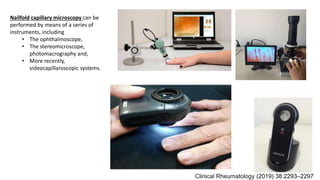
Nailfold capillary microscopy can be
performed by means of a series of
instruments, including
• The ophthalmoscope,
• The stereomicroscope,
photomacrography and,
• More recently,
videocapillaroscopic systems.
Clinical Rheumatology (2019) 38:2293–2297
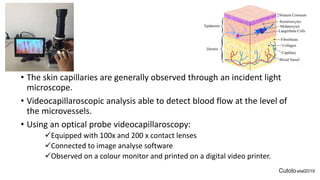
• The skin capillaries are generally observed through an incident light
microscope.
• Videocapillaroscopic analysis able to detect blood flow at the level of
the microvessels.
• Using an optical probe videocapillaroscopy:
Equipped with 100x and 200 x contact lenses
Connected to image analyse software
Observed on a colour monitor and printed on a digital video printer.
Cutoloetal2019
Nailfold capillary microscopy
Characteristics of NFC:-
Impressive cost/effectiveness ratio.
Highly sensitive.
Simple, safe.
Non-invasive and Inexpensive.
Clinical Rheumatology (2019) 38:2293–229
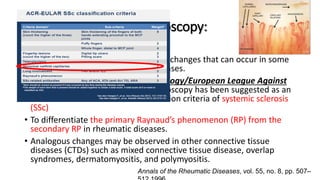
Value of Nailfold capillaroscopy:
• The early detection of microvascular changes that can occur in some
inflammatory connective tissue diseases.
• The American College Of Rheumatology/European League Against
Rheumatism, this feature of capillaroscopy has been suggested as an
additional criterion for the classification criteria of systemic sclerosis
(SSc)
• To differentiate the primary Raynaud’s phenomenon (RP) from the
secondary RP in rheumatic diseases.
• Analogous changes may be observed in other connective tissue
diseases (CTDs) such as mixed connective tissue disease, overlap
syndromes, dermatomyositis, and polymyositis.
Annals of the Rheumatic Diseases, vol. 55, no. 8, pp. 507–
Instruction before exam:
• Patients are acclimatized for 30 min at comfortable temperature.
• Some authors have chosen the fourth and fifth fingers of both hands,
others; all 8 fingers are examined, (thumbs excluded).
• After a drop of immersion oil placed on the nailfold bed to improve
the image resolution.
• Fingers affected by recent local trauma are not analysed.
• Fingers have a higher capillary density than toes.
• Capillaroscopy is possible for skins with light pigmentation and is
difficult to perform on skins with dark pigmentation.
M. Cutolo;etal 2013
O. Sander;etal 2010
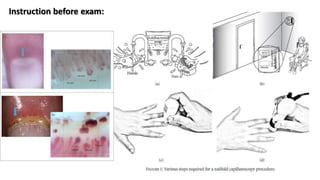
Instruction before exam:
Instruction in capillaroscopic procedure:
• The patients are asked to avoid taking caffeine and smoking for 4–6 hours
before the examination.
• The patients are instructed not to remove their fingernail cuticles for one
month to avoid microtraumas that could put the examination at risk.
• Only vegetable oils (neutral oils) that are skin friendly, Applying common
immersion oils used in microscopy may cause skin and mucous membrane
irritation.
• Physically injured fingers are excluded from the study.
• Vasodilatation can be prevented by a cold light source.
• When using contact optical probes, even the application of minimal
pressure on the nailfolds should be avoided, because this can modify the
vessels
M. Berks,etal2014
Instruction in capillaroscopic procedure2:
• In order to properly observe all the morpho structural characteristics of the
examined field, the capillaroscopy probe must be moved in a slow uniform
motion.
• For a better imaging resolution, adding more oil could be beneficial.
However, both too few or much oil could decrease resolution and should
be avoided.
• It is quite common to have little or no capillary flow when the examination
room is cool or the subject is nervous.
• For each subject, the procedure takes about 15–30 minutes.
• It is suggested that the images acquired during examination should be
analysed by two different experts with no prior knowledge of a patient’s
clinical conditions, because the measuring of capillary dimensions by hand
is tedious and prone to inaccuracy
Journal of Cosmetic Dermatology, vol. 4, no. 3, pp.153–162,
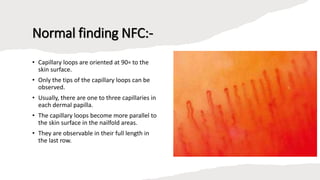
Normal finding NFC:-
• Capillary loops are oriented at 90∘ to the
skin surface.
• Only the tips of the capillary loops can be
observed.
• Usually, there are one to three capillaries in
each dermal papilla.
• The capillary loops become more parallel to
the skin surface in the nailfold areas.
• They are observable in their full length in
the last row.
Comment on NFC:
• The following parameter are examined:
I. Capillary Distribution
II. Capillary Shape
III. Capillary Density
IV. Capillary Dimensions
 Capillary width (CW)
 Capillary Length (CL)
 Arterial and Venous Limbs Diameters.
 Others.
V. Intercapillary distance (ICD)
VI. Avascular Areas
VII. Capillary Orientation
VIII.Subpapillary Venous Plexus Visibility
• In healthy subjects, capillary loops and capillary distribution do not change with
time, and the same pattern is usually maintained.
Clinical Rheumatology (2019) 38:2293–2297
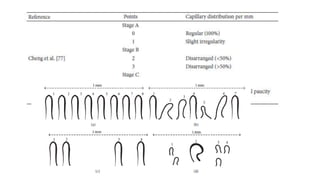
I-Capillary Distribution:-
• In most areas of human body, capillary loops are perpendicular to the
skin surface, whereas, in the nailfold region, they become parallel to the
skin surface.
• A homogeneous and ordered distribution of capillaries arranged in
parallel and at regular narrow distances between ascending and
descending branches.
• The changes in normal capillary distribution:-
(A) Capillaries that are not in one row,
(B) Small Areas (<500 𝜇M) With Missing Capillaries Existing Next To Areas With
Clusters Of Capillaries,
(C) Altered Capillary Distribution,
(D) Heterogeneity of loop shapes, And
(E) Irregular Capillary Orientation
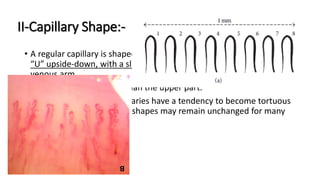
II-Capillary Shape:-
• A regular capillary is shaped like a hair pin or like the English letter
“U” upside-down, with a slimmer arterial arm, an upper part, and a
venous arm.
• The venous arm is larger than the upper part.
• Although individual’s capillaries have a tendency to become tortuous
and dilated with age, their shapes may remain unchanged for many
years.
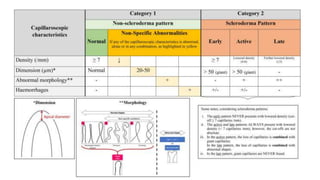
III-Capillary Density
• Capillary density is the number of capillaries in a 1mm length of the distal
row of each finger or toe.
• Also known as the “number of capillaries” and “capillaries number.”
• Counting number of capillaries;
• Hofstee et al.2012, two method for counting:
First; all the capillaries present in the distal row, even if they are not at the same levels.
In the second method, called the 90∘ method.
• A mean capillary density;
German authors; 5–9 capillaries per millimeter
Bulgarian group; 10 ± 0.59 capillaries per millimeter.
• Hoerth et al. 2012 and dolezalova et al 2012. :
Capillary density is directly related to age. Younger children have fewer capillaries than
older children and adults.
Gender differences do not have a large impact on the number of capillaries
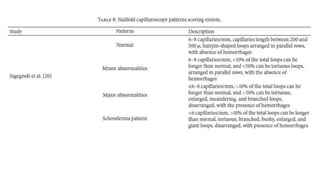
• Scoring System of Capillary Density.
should be obtained by analysing at least two or four fields in the
middle region of the nailfold in each finger.
The average scores from the fields of each of the eight fingers are
summed up and then the total value is divided by eight.
British Journal of Clinical Pharmacology,,20
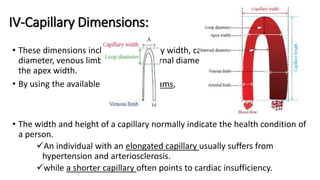
IV-Capillary Dimensions:
• These dimensions include the capillary width, capillary length, arterial limb
diameter, venous limb diameter, external diameter, internal diameter, and
the apex width.
• By using the available software programs,
• The width and height of a capillary normally indicate the health condition of
a person.
An individual with an elongated capillary usually suffers from
hypertension and arteriosclerosis.
while a shorter capillary often points to cardiac insufficiency.
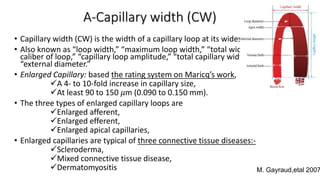
A-Capillary width (CW)
• Capillary width (CW) is the width of a capillary loop at its widest section.
• Also known as “loop width,” “maximum loop width,” “total width,” “total
caliber of loop,” “capillary loop amplitude,” “total capillary width,” and
“external diameter.”
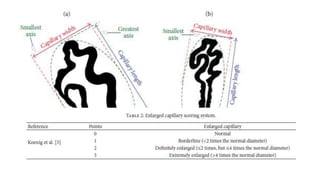
• Enlarged Capillary: based the rating system on Maricq’s work,
A 4- to 10-fold increase in capillary size,
At least 90 to 150 𝜇m (0.090 to 0.150 mm).
• The three types of enlarged capillary loops are
Enlarged afferent,
Enlarged efferent,
Enlarged apical capillaries,
• Enlarged capillaries are typical of three connective tissue diseases:-
Scleroderma,
Mixed connective tissue disease,
Dermatomyositis M. Gayraud,etal 2007
B-Capillary length (CL)
• Capillary length (CL) is the distance between the apex of a capillary loop and the
point where the capillary loop is no longer visible.
• Also known as “loop length” and “capillary height.”
• The normal upper limit for the whole capillary length:-
Is between 92 and 295 𝜇m
Its mean value is 240―38.3 𝜇
• Capillary loops longer than 300 𝜇m (0.300 mm) are elongated(mega capillary)
Physiologically, capillaries in a person’s identical fingers have a similar length, which
varies from person to person and in physically altered fingers.
Diabetes patients often have shorter capillaries, only up to 10 𝜇m long, (“shoal of
fishes or elephant nose”)
• Methods of Measuring Capillary Width and Length.
Can be measured either manually
Or by an automated mechanism.
Capillaroscopic findings,”seminars in arthritis & rheumatism, vol. 30, no. 6, pp. 397–
402,2001.
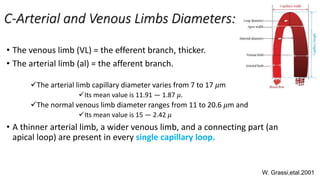
C-Arterial and Venous Limbs Diameters:
• The venous limb (VL) = the efferent branch, thicker.
• The arterial limb (al) = the afferent branch.
The arterial limb capillary diameter varies from 7 to 17 𝜇m
Its mean value is 11.91 ― 1.87 𝜇.
The normal venous limb diameter ranges from 11 to 20.6 𝜇m and
Its mean value is 15 ― 2.42 𝜇
• A thinner arterial limb, a wider venous limb, and a connecting part (an
apical loop) are present in every single capillary loop.
W. Grassi,etal.2001
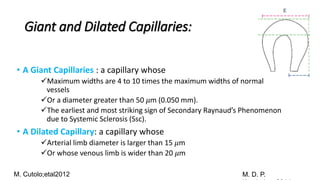
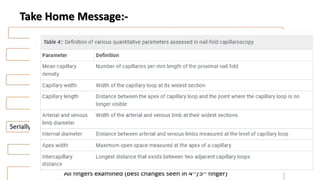
Giant and Dilated Capillaries:
• A Giant Capillaries : a capillary whose
Maximum widths are 4 to 10 times the maximum widths of normal
vessels
Or a diameter greater than 50 𝜇m (0.050 mm).
The earliest and most striking sign of Secondary Raynaud’s Phenomenon
due to Systemic Sclerosis (Ssc).
• A Dilated Capillary: a capillary whose
Arterial limb diameter is larger than 15 𝜇m
Or whose venous limb is wider than 20 𝜇m
M. D. P.
M. Cutolo;etal2012
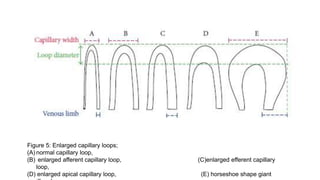
Figure 5: Enlarged capillary loops;
(A) normal capillary loop,
(B) enlarged afferent capillary loop, (C)enlarged efferent capillary
loop,
(D) enlarged apical capillary loop, (E) horseshoe shape giant
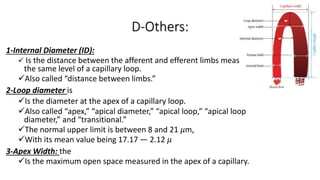
D-Others:
1-Internal Diameter (ID):
 Is the distance between the afferent and efferent limbs measured at
the same level of a capillary loop.
Also called “distance between limbs.”
2-Loop diameter is
Is the diameter at the apex of a capillary loop.
Also called “apex,” “apical diameter,” “apical loop,” “apical loop
diameter,” and “transitional.”
The normal upper limit is between 8 and 21 𝜇m,
With its mean value being 17.17 ― 2.12 𝜇
3-Apex Width: the
Is the maximum open space measured in the apex of a capillary.
Important Notes on Capillary Dimensions
• Capillary width is age related,
Adults and older children have narrower capillaries than younger children.
• “Mean Capillary Width” :
The mean value of the maximum diameters of the 3 widest capillaries in the 1mm
length.
• “Mean Capillary Length” :
Is determined by measuring the three most visible parts of a capillary relative to the
venular plexus.
The capillary lengths of the fourth and fifth fingers are always longer than that of the
other fingers.
• The mean diameter of the arterial limb or the venous limb
Is defined as the mean value of 3 arterial or venous limbs at their widest sections.
• The basin area of a capillary
Is defined by CW × CL, where CW and CL are the capillary width and length,
respectively.
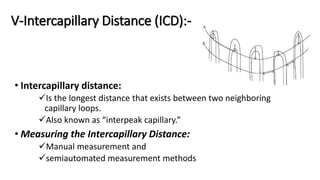
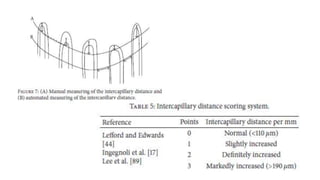
V-Intercapillary Distance (ICD):-
• Intercapillary distance:
Is the longest distance that exists between two neighboring
capillary loops.
Also known as “interpeak capillary.”
• Measuring the Intercapillary Distance:
Manual measurement and
semiautomated measurement methods
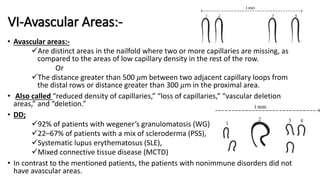
VI-Avascular Areas:-
• Avascular areas:-
Are distinct areas in the nailfold where two or more capillaries are missing, as
compared to the areas of low capillary density in the rest of the row.
Or
The distance greater than 500 𝜇m between two adjacent capillary loops from
the distal rows or distance greater than 300 𝜇m in the proximal area.
• Also called “reduced density of capillaries,” “loss of capillaries,” “vascular deletion
areas,” and “deletion.”
• DD;
92% of patients with wegener’s granulomatosis (WG)
22–67% of patients with a mix of scleroderma (PSS),
Systematic lupus erythematosus (SLE),
Mixed connective tissue disease (MCTD)
• In contrast to the mentioned patients, the patients with nonimmune disorders did not
have avascular areas.
Important Notes on Avascular Areas
• Even when general visibility is low, avascular areas are still well recognized.
• Avascular areas are more frequent in women (10%) than in men (4%). This
difference is statistically significant for both genders and for general visibility
classes.
• Avascular areas have been reported in more progressive diseases, these
areas have a prognostic value.
• Avascular areas may be related to tissue hypoxia.
• Physiologically, not all the considered capillaries can be used in the
evaluation, because some of them are invisible due to being only partially
filled. In these cases, a prolonged observation can be useful, because, often,
after a few seconds, those capillaries will be filled again.
VII-Capillary Orientation
• Capillary distribution
Is affected by the changes in the shape and direction of capillaries.
(i) Capillary direction is expressed as the angle between a vertical line
and the vector associated with the highest proper value.
(ii) Capillary polarity is defined as the standard deviation of all the
capillary directions.
VIII-Subpapillary Venous Plexus Visibility
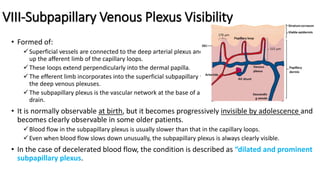
• Formed of:
Superficial vessels are connected to the deep arterial plexus and finally to terminal arterioles which make
up the afferent limb of the capillary loops.
These loops extend perpendicularly into the dermal papilla.
The efferent limb incorporates into the superficial subpapillary venous plexus (PVS) and interfaces with
the deep venous plexuses.
The subpapillary plexus is the vascular network at the base of a finger nailfold into which capillaries
drain.
• It is normally observable at birth, but it becomes progressively invisible by adolescence and
becomes clearly observable in some older patients.
Blood flow in the subpapillary plexus is usually slower than that in the capillary loops.
Even when blood flow slows down unusually, the subpapillary plexus is always clearly visible.
• In the case of decelerated blood flow, the condition is described as “dilated and prominent
subpapillary plexus.
• It is visible in
Approximately 30% of healthy, esp children.
In patients with rheumatoid arthritis
More frequently in patients with systemic lupus erythematosus,
Occasionally in people with systemic scleroderma.
• The PVS for the left hand (1.49) is higher than that for the right hand
(1.07).
• No other differences were discovered between the two hands
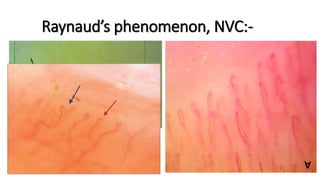
Raynaud’s phenomenon, NVC:-
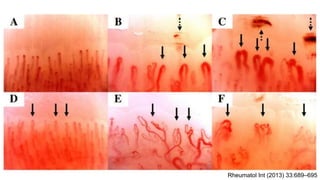
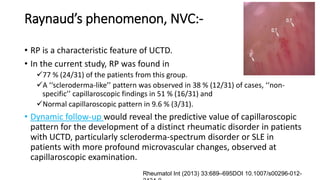
• RP is a characteristic feature of UCTD.
• In the current study, RP was found in
77 % (24/31) of the patients from this group.
A ‘‘scleroderma-like’’ pattern was observed in 38 % (12/31) of cases, ‘‘non-
specific’’ capillaroscopic findings in 51 % (16/31) and
Normal capillaroscopic pattern in 9.6 % (3/31).
• Dynamic follow-up would reveal the predictive value of capillaroscopic
pattern for the development of a distinct rheumatic disorder in patients
with UCTD, particularly scleroderma-spectrum disorder or SLE in
patients with more profound microvascular changes, observed at
capillaroscopic examination.
Rheumatol Int (2013) 33:689–695DOI 10.1007/s00296-012-
Raynaud’s phenomenon, NVC:-
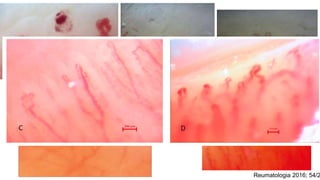
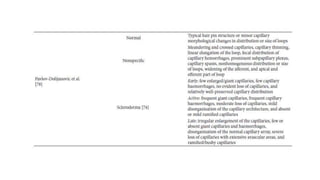
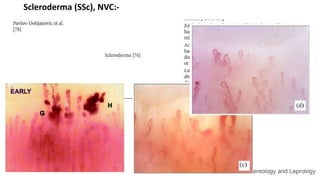
Scleroderma (SSc), NVC:-
2022 Indian Journal of Dermatology, Venereology and Leprology
Rheumatol Int (2013) 33:689–695
Reumatologia 2016; 54/2
Take Home Message:-
Reference:
• O. Sander, C. Sunderk¨otter, I. K¨otte et al., “Kapillarmikroskopie,” Zeitschrift f¨ur Rheumatologie, vol. 69,no.
3, pp. 253–262, 2010.
• M. Cutolo and V. Smith, “State of the art on nailfold capillaroscopy: a reliable diagnostic tool and putative
biomarker in rheumatology?” Rheumatology, vol. 52, no. 11, pp. 1933–1940, 2013.
• K.-M. Lin, T.-T. Cheng, and C.-J. Chen, “Clinical applications of nailfold capillaroscopy in different rheumatic
diseases,” Journal of InternalMedicine of Taiwan, vol. 20, no. 3, pp. 238–247, 2009.
• M. Berks, P. Tresadern, G. Dinsdale et al., “An automated systemfor detecting andmeasuring nailfold
capillaries,” in Medical Image Computing and Computer-Assisted Intervention—MICCAI 2014, P. Golland, N.
Hata,C.Barillot, J. Hornegger, and R. Howe, Eds., vol. 8673 of Lecture Notes in Computer Science,pp. 658–665,
Springer, Berlin, Germany, 2014.
• C. Hoerth, M. Kundi, R. Katzenschlager, and M. Hirschl, “Qualitative and quantitative assessment of nailfold
capillaries by capillaroscopy in healthy volunteers,” Vasa, vol. 41, no. 1, pp. 19–26, 2012.
• H. M. A. Hofstee, E. H. Sern´e, C. Roberts et al., “A multicentre study on the reliability of qualitative and
quantitative nail-fold videocapillaroscopy assessment,” Rheumatology, vol. 51, no. 4, pp. 749–755, 2012.
• M. Gayraud, “Raynaud’s phenomenon,” Joint Bone Spine, vol. 74, no. 1, pp. e1–e8, 2007.
• H. R. Maricq, “Comparison of quantitative and semiquantitative estimates of nailfold capillary abnormalities
in scleroderma spectrum disorders,” Microvascular Research, vol. 32, no. 2, pp. 271–276, 1986.
• M. D. P. Kamboj, A study of nail fold capillaroscopy in psoriasis [Ph.D. thesis], Rajiv Gandhi University of
Health Sciences, Bengaluru, India, 2014.
Capillaroscope.pptx

Capillaroscope.pptx

  • 1.
    Nailfold Capillaroscopy in RheumaticDiseases Marwa Abo Elmaaty Besar Lecturer Of Internal Medicine (Rheumatology Immunology Unit) (Pediatric Rheumatology) Mansoura University
  • 3.
    Nailfold capillary microscopycan be performed by means of a series of instruments, including • The ophthalmoscope, • The stereomicroscope, photomacrography and, • More recently, videocapillaroscopic systems. Clinical Rheumatology (2019) 38:2293–2297
  • 4.
    • The skincapillaries are generally observed through an incident light microscope. • Videocapillaroscopic analysis able to detect blood flow at the level of the microvessels. • Using an optical probe videocapillaroscopy: Equipped with 100x and 200 x contact lenses Connected to image analyse software Observed on a colour monitor and printed on a digital video printer. Cutoloetal2019
  • 5.
    Nailfold capillary microscopy Characteristicsof NFC:- Impressive cost/effectiveness ratio. Highly sensitive. Simple, safe. Non-invasive and Inexpensive. Clinical Rheumatology (2019) 38:2293–229
  • 6.
    Value of Nailfoldcapillaroscopy: • The early detection of microvascular changes that can occur in some inflammatory connective tissue diseases. • The American College Of Rheumatology/European League Against Rheumatism, this feature of capillaroscopy has been suggested as an additional criterion for the classification criteria of systemic sclerosis (SSc) • To differentiate the primary Raynaud’s phenomenon (RP) from the secondary RP in rheumatic diseases. • Analogous changes may be observed in other connective tissue diseases (CTDs) such as mixed connective tissue disease, overlap syndromes, dermatomyositis, and polymyositis. Annals of the Rheumatic Diseases, vol. 55, no. 8, pp. 507–
  • 7.
    Instruction before exam: •Patients are acclimatized for 30 min at comfortable temperature. • Some authors have chosen the fourth and fifth fingers of both hands, others; all 8 fingers are examined, (thumbs excluded). • After a drop of immersion oil placed on the nailfold bed to improve the image resolution. • Fingers affected by recent local trauma are not analysed. • Fingers have a higher capillary density than toes. • Capillaroscopy is possible for skins with light pigmentation and is difficult to perform on skins with dark pigmentation. M. Cutolo;etal 2013 O. Sander;etal 2010
  • 8.
  • 9.
    Instruction in capillaroscopicprocedure: • The patients are asked to avoid taking caffeine and smoking for 4–6 hours before the examination. • The patients are instructed not to remove their fingernail cuticles for one month to avoid microtraumas that could put the examination at risk. • Only vegetable oils (neutral oils) that are skin friendly, Applying common immersion oils used in microscopy may cause skin and mucous membrane irritation. • Physically injured fingers are excluded from the study. • Vasodilatation can be prevented by a cold light source. • When using contact optical probes, even the application of minimal pressure on the nailfolds should be avoided, because this can modify the vessels M. Berks,etal2014
  • 10.
    Instruction in capillaroscopicprocedure2: • In order to properly observe all the morpho structural characteristics of the examined field, the capillaroscopy probe must be moved in a slow uniform motion. • For a better imaging resolution, adding more oil could be beneficial. However, both too few or much oil could decrease resolution and should be avoided. • It is quite common to have little or no capillary flow when the examination room is cool or the subject is nervous. • For each subject, the procedure takes about 15–30 minutes. • It is suggested that the images acquired during examination should be analysed by two different experts with no prior knowledge of a patient’s clinical conditions, because the measuring of capillary dimensions by hand is tedious and prone to inaccuracy Journal of Cosmetic Dermatology, vol. 4, no. 3, pp.153–162,
  • 11.
    Normal finding NFC:- •Capillary loops are oriented at 90∘ to the skin surface. • Only the tips of the capillary loops can be observed. • Usually, there are one to three capillaries in each dermal papilla. • The capillary loops become more parallel to the skin surface in the nailfold areas. • They are observable in their full length in the last row.
  • 12.
    Comment on NFC: •The following parameter are examined: I. Capillary Distribution II. Capillary Shape III. Capillary Density IV. Capillary Dimensions  Capillary width (CW)  Capillary Length (CL)  Arterial and Venous Limbs Diameters.  Others. V. Intercapillary distance (ICD) VI. Avascular Areas VII. Capillary Orientation VIII.Subpapillary Venous Plexus Visibility • In healthy subjects, capillary loops and capillary distribution do not change with time, and the same pattern is usually maintained. Clinical Rheumatology (2019) 38:2293–2297
  • 13.
    I-Capillary Distribution:- • Inmost areas of human body, capillary loops are perpendicular to the skin surface, whereas, in the nailfold region, they become parallel to the skin surface. • A homogeneous and ordered distribution of capillaries arranged in parallel and at regular narrow distances between ascending and descending branches. • The changes in normal capillary distribution:- (A) Capillaries that are not in one row, (B) Small Areas (<500 𝜇M) With Missing Capillaries Existing Next To Areas With Clusters Of Capillaries, (C) Altered Capillary Distribution, (D) Heterogeneity of loop shapes, And (E) Irregular Capillary Orientation
  • 14.
    II-Capillary Shape:- • Aregular capillary is shaped like a hair pin or like the English letter “U” upside-down, with a slimmer arterial arm, an upper part, and a venous arm. • The venous arm is larger than the upper part. • Although individual’s capillaries have a tendency to become tortuous and dilated with age, their shapes may remain unchanged for many years.
  • 16.
    III-Capillary Density • Capillarydensity is the number of capillaries in a 1mm length of the distal row of each finger or toe. • Also known as the “number of capillaries” and “capillaries number.” • Counting number of capillaries; • Hofstee et al.2012, two method for counting: First; all the capillaries present in the distal row, even if they are not at the same levels. In the second method, called the 90∘ method. • A mean capillary density; German authors; 5–9 capillaries per millimeter Bulgarian group; 10 ± 0.59 capillaries per millimeter. • Hoerth et al. 2012 and dolezalova et al 2012. : Capillary density is directly related to age. Younger children have fewer capillaries than older children and adults. Gender differences do not have a large impact on the number of capillaries
  • 17.
    • Scoring Systemof Capillary Density. should be obtained by analysing at least two or four fields in the middle region of the nailfold in each finger. The average scores from the fields of each of the eight fingers are summed up and then the total value is divided by eight. British Journal of Clinical Pharmacology,,20
  • 18.
    IV-Capillary Dimensions: • Thesedimensions include the capillary width, capillary length, arterial limb diameter, venous limb diameter, external diameter, internal diameter, and the apex width. • By using the available software programs, • The width and height of a capillary normally indicate the health condition of a person. An individual with an elongated capillary usually suffers from hypertension and arteriosclerosis. while a shorter capillary often points to cardiac insufficiency.
  • 19.
    A-Capillary width (CW) •Capillary width (CW) is the width of a capillary loop at its widest section. • Also known as “loop width,” “maximum loop width,” “total width,” “total caliber of loop,” “capillary loop amplitude,” “total capillary width,” and “external diameter.” • Enlarged Capillary: based the rating system on Maricq’s work, A 4- to 10-fold increase in capillary size, At least 90 to 150 𝜇m (0.090 to 0.150 mm). • The three types of enlarged capillary loops are Enlarged afferent, Enlarged efferent, Enlarged apical capillaries, • Enlarged capillaries are typical of three connective tissue diseases:- Scleroderma, Mixed connective tissue disease, Dermatomyositis M. Gayraud,etal 2007
  • 20.
    B-Capillary length (CL) •Capillary length (CL) is the distance between the apex of a capillary loop and the point where the capillary loop is no longer visible. • Also known as “loop length” and “capillary height.” • The normal upper limit for the whole capillary length:- Is between 92 and 295 𝜇m Its mean value is 240―38.3 𝜇 • Capillary loops longer than 300 𝜇m (0.300 mm) are elongated(mega capillary) Physiologically, capillaries in a person’s identical fingers have a similar length, which varies from person to person and in physically altered fingers. Diabetes patients often have shorter capillaries, only up to 10 𝜇m long, (“shoal of fishes or elephant nose”) • Methods of Measuring Capillary Width and Length. Can be measured either manually Or by an automated mechanism. Capillaroscopic findings,”seminars in arthritis & rheumatism, vol. 30, no. 6, pp. 397– 402,2001.
  • 21.
    C-Arterial and VenousLimbs Diameters: • The venous limb (VL) = the efferent branch, thicker. • The arterial limb (al) = the afferent branch. The arterial limb capillary diameter varies from 7 to 17 𝜇m Its mean value is 11.91 ― 1.87 𝜇. The normal venous limb diameter ranges from 11 to 20.6 𝜇m and Its mean value is 15 ― 2.42 𝜇 • A thinner arterial limb, a wider venous limb, and a connecting part (an apical loop) are present in every single capillary loop. W. Grassi,etal.2001
  • 22.
    Giant and DilatedCapillaries: • A Giant Capillaries : a capillary whose Maximum widths are 4 to 10 times the maximum widths of normal vessels Or a diameter greater than 50 𝜇m (0.050 mm). The earliest and most striking sign of Secondary Raynaud’s Phenomenon due to Systemic Sclerosis (Ssc). • A Dilated Capillary: a capillary whose Arterial limb diameter is larger than 15 𝜇m Or whose venous limb is wider than 20 𝜇m M. D. P. M. Cutolo;etal2012
  • 23.
    Figure 5: Enlargedcapillary loops; (A) normal capillary loop, (B) enlarged afferent capillary loop, (C)enlarged efferent capillary loop, (D) enlarged apical capillary loop, (E) horseshoe shape giant
  • 24.
    D-Others: 1-Internal Diameter (ID): Is the distance between the afferent and efferent limbs measured at the same level of a capillary loop. Also called “distance between limbs.” 2-Loop diameter is Is the diameter at the apex of a capillary loop. Also called “apex,” “apical diameter,” “apical loop,” “apical loop diameter,” and “transitional.” The normal upper limit is between 8 and 21 𝜇m, With its mean value being 17.17 ― 2.12 𝜇 3-Apex Width: the Is the maximum open space measured in the apex of a capillary.
  • 26.
    Important Notes onCapillary Dimensions • Capillary width is age related, Adults and older children have narrower capillaries than younger children. • “Mean Capillary Width” : The mean value of the maximum diameters of the 3 widest capillaries in the 1mm length. • “Mean Capillary Length” : Is determined by measuring the three most visible parts of a capillary relative to the venular plexus. The capillary lengths of the fourth and fifth fingers are always longer than that of the other fingers. • The mean diameter of the arterial limb or the venous limb Is defined as the mean value of 3 arterial or venous limbs at their widest sections. • The basin area of a capillary Is defined by CW × CL, where CW and CL are the capillary width and length, respectively.
  • 27.
    V-Intercapillary Distance (ICD):- •Intercapillary distance: Is the longest distance that exists between two neighboring capillary loops. Also known as “interpeak capillary.” • Measuring the Intercapillary Distance: Manual measurement and semiautomated measurement methods
  • 29.
    VI-Avascular Areas:- • Avascularareas:- Are distinct areas in the nailfold where two or more capillaries are missing, as compared to the areas of low capillary density in the rest of the row. Or The distance greater than 500 𝜇m between two adjacent capillary loops from the distal rows or distance greater than 300 𝜇m in the proximal area. • Also called “reduced density of capillaries,” “loss of capillaries,” “vascular deletion areas,” and “deletion.” • DD; 92% of patients with wegener’s granulomatosis (WG) 22–67% of patients with a mix of scleroderma (PSS), Systematic lupus erythematosus (SLE), Mixed connective tissue disease (MCTD) • In contrast to the mentioned patients, the patients with nonimmune disorders did not have avascular areas.
  • 30.
    Important Notes onAvascular Areas • Even when general visibility is low, avascular areas are still well recognized. • Avascular areas are more frequent in women (10%) than in men (4%). This difference is statistically significant for both genders and for general visibility classes. • Avascular areas have been reported in more progressive diseases, these areas have a prognostic value. • Avascular areas may be related to tissue hypoxia. • Physiologically, not all the considered capillaries can be used in the evaluation, because some of them are invisible due to being only partially filled. In these cases, a prolonged observation can be useful, because, often, after a few seconds, those capillaries will be filled again.
  • 31.
    VII-Capillary Orientation • Capillarydistribution Is affected by the changes in the shape and direction of capillaries. (i) Capillary direction is expressed as the angle between a vertical line and the vector associated with the highest proper value. (ii) Capillary polarity is defined as the standard deviation of all the capillary directions.
  • 32.
    VIII-Subpapillary Venous PlexusVisibility • Formed of: Superficial vessels are connected to the deep arterial plexus and finally to terminal arterioles which make up the afferent limb of the capillary loops. These loops extend perpendicularly into the dermal papilla. The efferent limb incorporates into the superficial subpapillary venous plexus (PVS) and interfaces with the deep venous plexuses. The subpapillary plexus is the vascular network at the base of a finger nailfold into which capillaries drain. • It is normally observable at birth, but it becomes progressively invisible by adolescence and becomes clearly observable in some older patients. Blood flow in the subpapillary plexus is usually slower than that in the capillary loops. Even when blood flow slows down unusually, the subpapillary plexus is always clearly visible. • In the case of decelerated blood flow, the condition is described as “dilated and prominent subpapillary plexus.
  • 33.
    • It isvisible in Approximately 30% of healthy, esp children. In patients with rheumatoid arthritis More frequently in patients with systemic lupus erythematosus, Occasionally in people with systemic scleroderma. • The PVS for the left hand (1.49) is higher than that for the right hand (1.07). • No other differences were discovered between the two hands
  • 35.
    Raynaud’s phenomenon, NVC:- •RP is a characteristic feature of UCTD. • In the current study, RP was found in 77 % (24/31) of the patients from this group. A ‘‘scleroderma-like’’ pattern was observed in 38 % (12/31) of cases, ‘‘non- specific’’ capillaroscopic findings in 51 % (16/31) and Normal capillaroscopic pattern in 9.6 % (3/31). • Dynamic follow-up would reveal the predictive value of capillaroscopic pattern for the development of a distinct rheumatic disorder in patients with UCTD, particularly scleroderma-spectrum disorder or SLE in patients with more profound microvascular changes, observed at capillaroscopic examination. Rheumatol Int (2013) 33:689–695DOI 10.1007/s00296-012-
  • 36.
  • 38.
    Scleroderma (SSc), NVC:- 2022Indian Journal of Dermatology, Venereology and Leprology
  • 39.
  • 40.
  • 41.
  • 43.
    Reference: • O. Sander,C. Sunderk¨otter, I. K¨otte et al., “Kapillarmikroskopie,” Zeitschrift f¨ur Rheumatologie, vol. 69,no. 3, pp. 253–262, 2010. • M. Cutolo and V. Smith, “State of the art on nailfold capillaroscopy: a reliable diagnostic tool and putative biomarker in rheumatology?” Rheumatology, vol. 52, no. 11, pp. 1933–1940, 2013. • K.-M. Lin, T.-T. Cheng, and C.-J. Chen, “Clinical applications of nailfold capillaroscopy in different rheumatic diseases,” Journal of InternalMedicine of Taiwan, vol. 20, no. 3, pp. 238–247, 2009. • M. Berks, P. Tresadern, G. Dinsdale et al., “An automated systemfor detecting andmeasuring nailfold capillaries,” in Medical Image Computing and Computer-Assisted Intervention—MICCAI 2014, P. Golland, N. Hata,C.Barillot, J. Hornegger, and R. Howe, Eds., vol. 8673 of Lecture Notes in Computer Science,pp. 658–665, Springer, Berlin, Germany, 2014. • C. Hoerth, M. Kundi, R. Katzenschlager, and M. Hirschl, “Qualitative and quantitative assessment of nailfold capillaries by capillaroscopy in healthy volunteers,” Vasa, vol. 41, no. 1, pp. 19–26, 2012. • H. M. A. Hofstee, E. H. Sern´e, C. Roberts et al., “A multicentre study on the reliability of qualitative and quantitative nail-fold videocapillaroscopy assessment,” Rheumatology, vol. 51, no. 4, pp. 749–755, 2012. • M. Gayraud, “Raynaud’s phenomenon,” Joint Bone Spine, vol. 74, no. 1, pp. e1–e8, 2007. • H. R. Maricq, “Comparison of quantitative and semiquantitative estimates of nailfold capillary abnormalities in scleroderma spectrum disorders,” Microvascular Research, vol. 32, no. 2, pp. 271–276, 1986. • M. D. P. Kamboj, A study of nail fold capillaroscopy in psoriasis [Ph.D. thesis], Rajiv Gandhi University of Health Sciences, Bengaluru, India, 2014.