 Systemic lupus erythematosus (SLE) is the
prototypic multisystem autoimmune disease
with broad spectrum of clinical presentation
encompassing all organs and chronic course
which can vary from mild to life threating.
 SLE was first described during middle aged to
describe erosive skin lesion “wolf bite” (1837-
1880) describe it as malar rash.
 Moriz Kaposi (1837-1902) describe it as
systemic disease with visceral manifestation.
NATURAL HISTORY AND DISEASE COURSE:
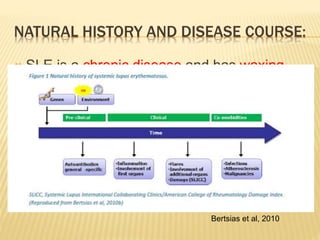
 SLE is a chronic disease and has waxing
and waning course with significant morbidity.
 The disease starts with preclinical phase
characterized by non specific autoimmune
abnormalities that proceeds to a more
disease specific autoimmunity phase.
Bertsias et al, 2010
 The clinical overt disease may start with single
manifestation that are non specific, such as arthritis,
Raynauds phenomenon or autoimmune
thrombocytopenia.
 It may take years for patients to develop enough clinical
and immunological disturbances leading to SLE, although
some patients present from inception with full-blown
disease.
 Time of the disease onset is uncertain and diagnosis is
delayed.
 The clinical presentation may result not only from lupus
flare, but also from damage accrual related to disease,
treatment (steroid and immunosuppressives)and
comorbidities (infection, osteoprosiis, cataract,
atherosclerosis and malignancy). Edworthy SM. etal2005
GREAT IMITATOR:
 SLE is considered the great mimic a myriad
of conditions often result in delayed
diagnosis.
 There may be either clinical or serological
mimicker.
Collins. DA,etal1996
DERMATOLOGICAL MIMICKER OF SLE:
 Acute cutaneous lupus:
1. Rosacea:
 Erythema of face (nose, check, chin and forehead).
 Trigger; hot, cold, sunlight, emotion, spicy, alcohol,
cosmetics.
 Presence papules and pustules or blepharitis favors
rosacea.
 Fine scales, pigment changes, follicular plugging favors
SLE.
 Histologic examination is important.
1. Seborrheic dermatitis:
Of the face may mimic SLE or rosacea, but SLE not affect
nasolabial fold. Lela A Lee,etal1991
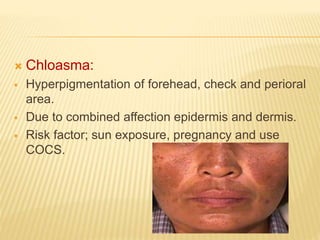
 Chloasma:
 Hyperpigmentation of forehead, check and perioral
area.
 Due to combined affection epidermis and dermis.
 Risk factor; sun exposure, pregnancy and use
COCS.
 Sub acute cutaneous lupus.
The lesion mostly papulo squamous, mimic;
1. Photosensitive eczema.
2. Psoriasis.
3. Granuloma annulare.
4. Erythema annulare centifugum.
 Chronic cutaneous lupus or discoid lupus:
1. Polymorphous light eruption.
2. Lichen planus.
3. Leukemia or lymphoma cutis.
4. Psoriasis.
5. Lupus vulgaris.
6. Sarcodosis.
 The main differentiating point is histologic and DIF
evaluation.
Orteuu CH,etal2001
 Polymorphous light eruption (PMLE):
 Common, sunlight induced eruption affecting individual of all
races.
 PMLE is strongly linked to sun exposure and resolve within days,
unlike DLE that persist for weeks to months.
 ANA usually negative, but histologic and DIF is still main
differentiating point.
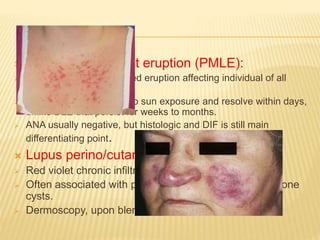
 Lupus perino/cutaneous sarcodosis:
 Red violet chronic infiltrate of the tip of the nose.
 Often associated with pulmonary infiltrate and digital bone
cysts.
 Dermoscopy, upon blenching, have apple jelly.
 Lichen planus (LP):
 Difficult to differentiate especially in absence oral and scalp
lesion, if there is photo-distribution.
 Most incriminated drugs; ACEI, antimalarial, quinine, gold,
thiazide diuretics.
 The diagnosis is only made by biopsy and DIF.
 Tinea faciei:
 Part of dermatophyte infection, characterized by
erythematous, scaly patches, pruritic, worsen with light
exposure.
 Unlike DLE which is slower to develop, more persistent
course with prominent follicle and painful.
RHEUMATOLOGIC AND MUSCULOSKELETAL
MIMICKERS OF SLE:
1. Söjgren’s Syndrome.
2. Rheumatoid Arthritis.
3. Myositis.
4. Sclerroderma.
5. Sarcoidosis.
All can mimic lupus in different ways.
SÖJGREN’S SYNDROME;
 Ss either primary or secondary to other autoimmune,(SLE,
RA).
 SS have many clinical and serological features of SLE.
1. Arthritis.
2. Skin rash.
3. Kidney dse.
4. ANA 80%, RF 75 TO 95%.
 Kidney affection:
1. Tubulo intersititial: most common affected
2. Glomeular: rare, membrano
proliferative,mesangialproliferative,membran
ous.
3. Cryoglobinemia vasculitis and end stage
renal disease were detected.
RHEUMATOID ARTHRITIS:
 Many case presented with joint pain that undifferentiated
from RA, especially early RA.
 Joint swelling (arthritis) and pain is always common in RA,
but SLE associated with arthralgia.
 joint destruction and deformity are more common in RA.
MYOSITIS:
 SLE associated with muscle pain in majority, with muscle
weakness in few of them.
 (PM-DM), the main problem is proximal muscle weakness,
with underlying muscle inflammation and elevation of
creatine kinase(CK), abnormal EMG with characteristics
muscle affection.
 Characteristics pathognomonic dusky red rash in malar
distribution, difficult to differentiate from malar rash of SLE.
 Shawl sign, heliotrope rash and Gottron sign over dorsum
MCP, PIP joints help to differentiate.
 ANA, anti-Jo1 and interstitial lung are specific for DM.
SCLERRODERMA:
 The hallmark of SSc is thickened skin which affect hand,
feet, forearm and face, due excessive production and
inadequate breakdown of collagen.
 Classical salt and pepper pigmentation of SSc may mimic
skin rash, but rash in lupus is due inflammation not fibrosis.
 ILD, difficult of swallowing solid, heart burn and deformity in
hand are rare in lupus.
 Raynaud phenomenon 95% in SSc, 40% in SLE.
 Anticentromere(localized SSc) and anti topisomerase1(
diffuse SSc), less in lupus.
SARCOIDOSIS:
 Fever, arthritis, mouth ulcer, pleuropericaraditis are
common manifestation of both sarcoidosis and
SLE.
 But, ANA +ve 33%, AntidsDNA is negative in
sarcoidosis.
MALIGNANCY :
1. Hematological malignancy(hodgkin lymphoma).
2. Thymoma.
3. Carcinoma of the lung, breast and ovary as paraneoplastic
syndrome that mimic SLE.
 As malignancy cause +ve ANA, anemia, elevated ESR,
vasculitis that mimic SLE.
 A case report of disseminated gastric cell carcinoma
which mimic SLE.
 Lupus may presented with lymphadenopathy and
splenomegaly that missed as lymphoma;
 But size of lymph node rarely exceed >2 cm, while
splenomegaly is mild to moderate.
 Lymphoma have expansion of monoclonal CD19/CD22
B cell.
Al-Hashimi H,etal2010
INFECTION:
 Viral: HCV, HBV, parvovirus B19, HIV, EBV.
 Bacterial: lyme disease, disseminated
gonococcal arthritis, syphillis.
 Parasitic: visceral leishmaniasis.
VIRAL INFECTION:
 HCV mimic lupus (mixed cryoglobinemia):
 Purpura, arthralgia, glomerulonephritis and
polyneuropathy.
 Deposition of immune complex containing
cryoglobulins in different organs.
 Main differentiating point is tissue biopsy either skin
or kidney or nerve.
 Serology, ANA +ve only in 10% in cases of
cryoglobulin.
Parvovirus B19:
Erythema infectiosum(fifth disease);
 It may be asymptomatic or benign self limiting course.
 It may mimic SLE in rash, arthralgia, fever; flu like symptoms and can
involve multi-systemic symptoms.
 Diagnosis by detection serum anti-B19 igm ab.
 Usually misdiagnosed as SLE in early presentation, then lastly
discovered to be parvovirus.
Meyer O. etal2003
Sakkas
LI,2008
Visceral leishmaniasis:
 Fever+ splenomegaly+ pancytopenia+ hypergamma-
globulinemia+ positive ANA; mimic SLE.
 Differentiating point: firm massive splenomegaly with very
high acute phase reactant, high D dimer and activation of
coagulation system.
BACTERIAL INFECTION:
Lyme disease: the great mimicker:
 three stages of the disease:
1. Early localized (3 to 30 days); erythema migrans
with fever, arthralgia, myalgia.
2. Early disseminated (weeks to months): CVS (AV
block) and CNS(cranial neuropathy facial
palsy)manifestation.
3. Late disease (months to years): peripheral
neuropathy with monoarticular migratory
pauciarticular arthritis.
 Serology evidence of exposure to B burgdorferi.
Molin S,etal2010
LEPROSY SIMULATING SLE:
 Chronic granulomatous disease.
 M leprae acid alcohol fast obligate intracellular
bacilli, tropism for peripheral nerves and
reticuloendothelial cells.
 Due to diverse clinical manifestation
(dermatological and neurological manifestation),
leprosy can confused with connective tissue
diseases; RA, DM, SLE.
 Arthritis, fever, erythema nodosum, vasculitis,
skin erythema, GN, pericarditis and pleuritis,
can occur in both leprosy and SLE.
Horta-Baas G, etal2015
 Leprosy presented with anesthetics skin
lesion, nerve enlargement and tenderness.
 Skin and nerve biopsy is recommended to
confirm diagnosis.
KIKUCHI-FUJIMOTO DISEASE
 KD is rare lympho histiocytic disorder.
 Young women, Asian descent.
 Benign, self limited syndrome characterized by
regional lymphadenopathy, fever.
 Extranodal manifestation:
1. Skin; erythematous rash, nodule, crusted
papule, erythema multiform and erythema
maculopapular lesion involve face, upper body.
2. Joint: small and large polyarthritis.
3. Hepatosplenomegaly.
Al-Bishri
J,etal2012
 If extranodal manifestation of KD is
predominate, it is difficult to differentiate from
other disorder like lymphoma, infection and
SLE.
 Lymph node biopsy is essential to make
diagnosis, (histocytic necrotizing lymphadenitis),
unlike SLE that show predominate neutrophil,
eosinophil, plasma cell and vasculitis and HX,E.
 SLE has been seen either coincide, precede or
follow a diagnosis of KD,
Imai K,etal2002
 35 cases of SLE associated with KD;
7 diagnosis SLE, prior to KD.
14 diagnosis both SLE and KD.
14 diagnosis SLE after diagnosis of KD.
Santana A,etal2005
NEUROLOGICAL MIMICKER OF SLE:
Multiple sclerosis(MS):
 5 to 10% of SLE have ANA, antidsDNA AB without sign of
lupus.
 MRI, the lesion of both lupus and MS appear similar.
 Optic nerve and spinal cord may involved, even repeated or
in succession attacks.
Allen IV, etal1979
ENDOCRINAL MIMICKER:
 75% to 90% of Graves disease and small
percentage of Hashimoto thyroiditis have+ve
ANA, antids DNA, but no clinical evidence of
SLE.
Biro E,etal2006
SEROLOGICAL MIMICKER:
 ANA +ve in > 95% of SLE, but several other
connective tissue disease and non rheumatic
diseases that show +ve ANA.
Drug induced lupus:
 Suspected in patients with no diagnosis or history of
lupus who develop +ve ANA and at least one clinical
features of lupus after appropriate duration of exposure
and whose symptoms resolve when the drug is
stopped.
 Fever, myalgia, rash, arthritis and serositis, but
hematological, neurological and kidney manifestation
are rare.
 Anti-histone AB + 95%, hypocomplementaemia and
antiDNA AB are rare.
 Low titer ANA >1/40 seen in 32% of healthy
adult and > 1/60 in 5%.
 +ve ANA is the one of the diagnostics criteria for
drug induced lupus and other connective tissue
diseases.
 False –ve ANA determined by ELISA, should by
repeated by indirect immunofluresence
especially if there is strong clinical suspicion.
 Serial measurement of ANA are not useful for
monitoring disease activity.
Solomon DH,etal2002
CONCLUSION:
 A rational approach:
Good history taking
+
Physical examination
+
Serological examination
+
Targeted organ biopsy
=
Correct diagnosis.
REFERENCE:
1. Biro E, Bako G, et al. Association of systemic and thyroid autoimmune diseases. Clin Rheumatol.
2006; 25:240.
2. Meyer O. Parvovirus B19 and autoimmune diseases. Joint Bone Spine.2003;70:6.
3. Borreliosis mimicking lupus-like syndrome during infliximab treatment. Molin S, Ruzicka T, Prinz JC.
Clin Exp Dermatol. 2010 Aug;35(6):631-3. Epub 2010 Feb 20.
4. Immunological features of visceral leishmaniasis may mimic systemic lupus erythematosus. Sakkas
LI, Boulbou M, Kyriakou D, Makri I, Sinani C, Germenis A, Stathakis N. Clin Biochem. 2008 Jan;41(1-
2):65-8. Epub 2007 Oct 25.
5. Systemic lupus erythematosus: an occasional misdiagnosis. Collins. DA, Bourke .BE. Annals of the
Rheumatic Diseases 1996; 55: 421-422.
6. Allen IV, Miller JHD, Shillington RKA: Systemic lupus erythematosus clinically resembling multiple
sclerosis and with unusual pathological ultrastructural features. J Neurol Neurosurg Psychiatry
42:392, 1979. [PMID: 221619]
7. Lela A Lee. Lupus Erythematosus. Bolognia: Dermatology. (2nd ed.)ISBN: 9781416029991.
8. Orteuu CH, Buchanan JAG, Hutchison I, et al: Systemic lupus erythematosus presenting with oral
mucosal lesions: easily missed. Br J Dermatol 2001; 144:1219-1223
9. . Al-Hashimi H, Bhowmik A. Generalised lymphadenopathy as the first manifestation of lupus
nephritis. BMJ Case Rep. Published online: 22 Apr 2010. doi:10.1136/ bcr.08.2009.2221.
10. Edworthy SM. Clinical manifestations of systemic lupus erythematosus. In: Harris ED, Budd RC,
Firestein GS, et al. eds. Kelley’s textbook of rheumatology. 7th edn. Philadelphia, PA: WB Saunders,
2005:1201–24.
11. Horta-Baas G, Hernández-Cabrera MF, Barile-Fabris LA, Romero- Figueroa Mdel S, Arenas-Guzmán
R. Multibacillary leprosy mimicking systemic lupus erythematosus: case report and literature review.
Lupus. 2015;24(10):1095–102.
Lupus mimicker2.pptx

Lupus mimicker2.pptx

  • 2.
     Systemic lupuserythematosus (SLE) is the prototypic multisystem autoimmune disease with broad spectrum of clinical presentation encompassing all organs and chronic course which can vary from mild to life threating.  SLE was first described during middle aged to describe erosive skin lesion “wolf bite” (1837- 1880) describe it as malar rash.  Moriz Kaposi (1837-1902) describe it as systemic disease with visceral manifestation.
  • 3.
    NATURAL HISTORY ANDDISEASE COURSE:  SLE is a chronic disease and has waxing and waning course with significant morbidity.  The disease starts with preclinical phase characterized by non specific autoimmune abnormalities that proceeds to a more disease specific autoimmunity phase. Bertsias et al, 2010
  • 4.
     The clinicalovert disease may start with single manifestation that are non specific, such as arthritis, Raynauds phenomenon or autoimmune thrombocytopenia.  It may take years for patients to develop enough clinical and immunological disturbances leading to SLE, although some patients present from inception with full-blown disease.  Time of the disease onset is uncertain and diagnosis is delayed.  The clinical presentation may result not only from lupus flare, but also from damage accrual related to disease, treatment (steroid and immunosuppressives)and comorbidities (infection, osteoprosiis, cataract, atherosclerosis and malignancy). Edworthy SM. etal2005
  • 5.
    GREAT IMITATOR:  SLEis considered the great mimic a myriad of conditions often result in delayed diagnosis.  There may be either clinical or serological mimicker. Collins. DA,etal1996
  • 6.
    DERMATOLOGICAL MIMICKER OFSLE:  Acute cutaneous lupus: 1. Rosacea:  Erythema of face (nose, check, chin and forehead).  Trigger; hot, cold, sunlight, emotion, spicy, alcohol, cosmetics.  Presence papules and pustules or blepharitis favors rosacea.  Fine scales, pigment changes, follicular plugging favors SLE.  Histologic examination is important. 1. Seborrheic dermatitis: Of the face may mimic SLE or rosacea, but SLE not affect nasolabial fold. Lela A Lee,etal1991
  • 7.
     Chloasma:  Hyperpigmentationof forehead, check and perioral area.  Due to combined affection epidermis and dermis.  Risk factor; sun exposure, pregnancy and use COCS.
  • 8.
     Sub acutecutaneous lupus. The lesion mostly papulo squamous, mimic; 1. Photosensitive eczema. 2. Psoriasis. 3. Granuloma annulare. 4. Erythema annulare centifugum.
  • 9.
     Chronic cutaneouslupus or discoid lupus: 1. Polymorphous light eruption. 2. Lichen planus. 3. Leukemia or lymphoma cutis. 4. Psoriasis. 5. Lupus vulgaris. 6. Sarcodosis.  The main differentiating point is histologic and DIF evaluation. Orteuu CH,etal2001
  • 10.
     Polymorphous lighteruption (PMLE):  Common, sunlight induced eruption affecting individual of all races.  PMLE is strongly linked to sun exposure and resolve within days, unlike DLE that persist for weeks to months.  ANA usually negative, but histologic and DIF is still main differentiating point.  Lupus perino/cutaneous sarcodosis:  Red violet chronic infiltrate of the tip of the nose.  Often associated with pulmonary infiltrate and digital bone cysts.  Dermoscopy, upon blenching, have apple jelly.
  • 11.
     Lichen planus(LP):  Difficult to differentiate especially in absence oral and scalp lesion, if there is photo-distribution.  Most incriminated drugs; ACEI, antimalarial, quinine, gold, thiazide diuretics.  The diagnosis is only made by biopsy and DIF.  Tinea faciei:  Part of dermatophyte infection, characterized by erythematous, scaly patches, pruritic, worsen with light exposure.  Unlike DLE which is slower to develop, more persistent course with prominent follicle and painful.
  • 12.
    RHEUMATOLOGIC AND MUSCULOSKELETAL MIMICKERSOF SLE: 1. Söjgren’s Syndrome. 2. Rheumatoid Arthritis. 3. Myositis. 4. Sclerroderma. 5. Sarcoidosis. All can mimic lupus in different ways.
  • 13.
    SÖJGREN’S SYNDROME;  Sseither primary or secondary to other autoimmune,(SLE, RA).  SS have many clinical and serological features of SLE. 1. Arthritis. 2. Skin rash. 3. Kidney dse. 4. ANA 80%, RF 75 TO 95%.
  • 14.
     Kidney affection: 1.Tubulo intersititial: most common affected 2. Glomeular: rare, membrano proliferative,mesangialproliferative,membran ous. 3. Cryoglobinemia vasculitis and end stage renal disease were detected.
  • 15.
    RHEUMATOID ARTHRITIS:  Manycase presented with joint pain that undifferentiated from RA, especially early RA.  Joint swelling (arthritis) and pain is always common in RA, but SLE associated with arthralgia.  joint destruction and deformity are more common in RA.
  • 17.
    MYOSITIS:  SLE associatedwith muscle pain in majority, with muscle weakness in few of them.  (PM-DM), the main problem is proximal muscle weakness, with underlying muscle inflammation and elevation of creatine kinase(CK), abnormal EMG with characteristics muscle affection.  Characteristics pathognomonic dusky red rash in malar distribution, difficult to differentiate from malar rash of SLE.  Shawl sign, heliotrope rash and Gottron sign over dorsum MCP, PIP joints help to differentiate.  ANA, anti-Jo1 and interstitial lung are specific for DM.
  • 19.
    SCLERRODERMA:  The hallmarkof SSc is thickened skin which affect hand, feet, forearm and face, due excessive production and inadequate breakdown of collagen.  Classical salt and pepper pigmentation of SSc may mimic skin rash, but rash in lupus is due inflammation not fibrosis.  ILD, difficult of swallowing solid, heart burn and deformity in hand are rare in lupus.  Raynaud phenomenon 95% in SSc, 40% in SLE.  Anticentromere(localized SSc) and anti topisomerase1( diffuse SSc), less in lupus.
  • 20.
    SARCOIDOSIS:  Fever, arthritis,mouth ulcer, pleuropericaraditis are common manifestation of both sarcoidosis and SLE.  But, ANA +ve 33%, AntidsDNA is negative in sarcoidosis.
  • 21.
    MALIGNANCY : 1. Hematologicalmalignancy(hodgkin lymphoma). 2. Thymoma. 3. Carcinoma of the lung, breast and ovary as paraneoplastic syndrome that mimic SLE.  As malignancy cause +ve ANA, anemia, elevated ESR, vasculitis that mimic SLE.  A case report of disseminated gastric cell carcinoma which mimic SLE.  Lupus may presented with lymphadenopathy and splenomegaly that missed as lymphoma;  But size of lymph node rarely exceed >2 cm, while splenomegaly is mild to moderate.  Lymphoma have expansion of monoclonal CD19/CD22 B cell. Al-Hashimi H,etal2010
  • 23.
    INFECTION:  Viral: HCV,HBV, parvovirus B19, HIV, EBV.  Bacterial: lyme disease, disseminated gonococcal arthritis, syphillis.  Parasitic: visceral leishmaniasis.
  • 24.
    VIRAL INFECTION:  HCVmimic lupus (mixed cryoglobinemia):  Purpura, arthralgia, glomerulonephritis and polyneuropathy.  Deposition of immune complex containing cryoglobulins in different organs.  Main differentiating point is tissue biopsy either skin or kidney or nerve.  Serology, ANA +ve only in 10% in cases of cryoglobulin.
  • 25.
    Parvovirus B19: Erythema infectiosum(fifthdisease);  It may be asymptomatic or benign self limiting course.  It may mimic SLE in rash, arthralgia, fever; flu like symptoms and can involve multi-systemic symptoms.  Diagnosis by detection serum anti-B19 igm ab.  Usually misdiagnosed as SLE in early presentation, then lastly discovered to be parvovirus. Meyer O. etal2003 Sakkas LI,2008
  • 26.
    Visceral leishmaniasis:  Fever+splenomegaly+ pancytopenia+ hypergamma- globulinemia+ positive ANA; mimic SLE.  Differentiating point: firm massive splenomegaly with very high acute phase reactant, high D dimer and activation of coagulation system.
  • 27.
    BACTERIAL INFECTION: Lyme disease:the great mimicker:  three stages of the disease: 1. Early localized (3 to 30 days); erythema migrans with fever, arthralgia, myalgia. 2. Early disseminated (weeks to months): CVS (AV block) and CNS(cranial neuropathy facial palsy)manifestation. 3. Late disease (months to years): peripheral neuropathy with monoarticular migratory pauciarticular arthritis.  Serology evidence of exposure to B burgdorferi. Molin S,etal2010
  • 28.
    LEPROSY SIMULATING SLE: Chronic granulomatous disease.  M leprae acid alcohol fast obligate intracellular bacilli, tropism for peripheral nerves and reticuloendothelial cells.  Due to diverse clinical manifestation (dermatological and neurological manifestation), leprosy can confused with connective tissue diseases; RA, DM, SLE.  Arthritis, fever, erythema nodosum, vasculitis, skin erythema, GN, pericarditis and pleuritis, can occur in both leprosy and SLE. Horta-Baas G, etal2015
  • 29.
     Leprosy presentedwith anesthetics skin lesion, nerve enlargement and tenderness.  Skin and nerve biopsy is recommended to confirm diagnosis.
  • 34.
    KIKUCHI-FUJIMOTO DISEASE  KDis rare lympho histiocytic disorder.  Young women, Asian descent.  Benign, self limited syndrome characterized by regional lymphadenopathy, fever.  Extranodal manifestation: 1. Skin; erythematous rash, nodule, crusted papule, erythema multiform and erythema maculopapular lesion involve face, upper body. 2. Joint: small and large polyarthritis. 3. Hepatosplenomegaly. Al-Bishri J,etal2012
  • 35.
     If extranodalmanifestation of KD is predominate, it is difficult to differentiate from other disorder like lymphoma, infection and SLE.  Lymph node biopsy is essential to make diagnosis, (histocytic necrotizing lymphadenitis), unlike SLE that show predominate neutrophil, eosinophil, plasma cell and vasculitis and HX,E.  SLE has been seen either coincide, precede or follow a diagnosis of KD, Imai K,etal2002
  • 36.
     35 casesof SLE associated with KD; 7 diagnosis SLE, prior to KD. 14 diagnosis both SLE and KD. 14 diagnosis SLE after diagnosis of KD. Santana A,etal2005
  • 38.
    NEUROLOGICAL MIMICKER OFSLE: Multiple sclerosis(MS):  5 to 10% of SLE have ANA, antidsDNA AB without sign of lupus.  MRI, the lesion of both lupus and MS appear similar.  Optic nerve and spinal cord may involved, even repeated or in succession attacks. Allen IV, etal1979
  • 42.
    ENDOCRINAL MIMICKER:  75%to 90% of Graves disease and small percentage of Hashimoto thyroiditis have+ve ANA, antids DNA, but no clinical evidence of SLE. Biro E,etal2006
  • 43.
    SEROLOGICAL MIMICKER:  ANA+ve in > 95% of SLE, but several other connective tissue disease and non rheumatic diseases that show +ve ANA.
  • 44.
    Drug induced lupus: Suspected in patients with no diagnosis or history of lupus who develop +ve ANA and at least one clinical features of lupus after appropriate duration of exposure and whose symptoms resolve when the drug is stopped.  Fever, myalgia, rash, arthritis and serositis, but hematological, neurological and kidney manifestation are rare.  Anti-histone AB + 95%, hypocomplementaemia and antiDNA AB are rare.
  • 45.
     Low titerANA >1/40 seen in 32% of healthy adult and > 1/60 in 5%.  +ve ANA is the one of the diagnostics criteria for drug induced lupus and other connective tissue diseases.  False –ve ANA determined by ELISA, should by repeated by indirect immunofluresence especially if there is strong clinical suspicion.  Serial measurement of ANA are not useful for monitoring disease activity. Solomon DH,etal2002
  • 46.
    CONCLUSION:  A rationalapproach: Good history taking + Physical examination + Serological examination + Targeted organ biopsy = Correct diagnosis.
  • 47.
    REFERENCE: 1. Biro E,Bako G, et al. Association of systemic and thyroid autoimmune diseases. Clin Rheumatol. 2006; 25:240. 2. Meyer O. Parvovirus B19 and autoimmune diseases. Joint Bone Spine.2003;70:6. 3. Borreliosis mimicking lupus-like syndrome during infliximab treatment. Molin S, Ruzicka T, Prinz JC. Clin Exp Dermatol. 2010 Aug;35(6):631-3. Epub 2010 Feb 20. 4. Immunological features of visceral leishmaniasis may mimic systemic lupus erythematosus. Sakkas LI, Boulbou M, Kyriakou D, Makri I, Sinani C, Germenis A, Stathakis N. Clin Biochem. 2008 Jan;41(1- 2):65-8. Epub 2007 Oct 25. 5. Systemic lupus erythematosus: an occasional misdiagnosis. Collins. DA, Bourke .BE. Annals of the Rheumatic Diseases 1996; 55: 421-422. 6. Allen IV, Miller JHD, Shillington RKA: Systemic lupus erythematosus clinically resembling multiple sclerosis and with unusual pathological ultrastructural features. J Neurol Neurosurg Psychiatry 42:392, 1979. [PMID: 221619] 7. Lela A Lee. Lupus Erythematosus. Bolognia: Dermatology. (2nd ed.)ISBN: 9781416029991. 8. Orteuu CH, Buchanan JAG, Hutchison I, et al: Systemic lupus erythematosus presenting with oral mucosal lesions: easily missed. Br J Dermatol 2001; 144:1219-1223 9. . Al-Hashimi H, Bhowmik A. Generalised lymphadenopathy as the first manifestation of lupus nephritis. BMJ Case Rep. Published online: 22 Apr 2010. doi:10.1136/ bcr.08.2009.2221. 10. Edworthy SM. Clinical manifestations of systemic lupus erythematosus. In: Harris ED, Budd RC, Firestein GS, et al. eds. Kelley’s textbook of rheumatology. 7th edn. Philadelphia, PA: WB Saunders, 2005:1201–24. 11. Horta-Baas G, Hernández-Cabrera MF, Barile-Fabris LA, Romero- Figueroa Mdel S, Arenas-Guzmán R. Multibacillary leprosy mimicking systemic lupus erythematosus: case report and literature review. Lupus. 2015;24(10):1095–102.

Editor's Notes

  • #16 Arthritis ch by short term, remit spontaneously within days, recurrent, deforming lead to jaccoud arthopathy