Hypothesis
Testing -I
Definition
 A hypothesis test is a statistical test that is used for
determining whether there is enough evidence
from the sample data to draw a conclusion for
the entire population.
 Two types of conclusions:
1. Null Hypothesis (Ho): is the hypothesis that any
observe variation in a sample is simply because of
random chance variation or we can say “the
hypothesis - that there is no significant difference
between the sample and the population, and any
observed difference is due to randomness or
experimental error.”
Rupak Roy
2. Alternative Hypothesis ( Ha ):
is the hypothesis testing that is contrary to the
null hypothesis.
Examples:
If i replace the battery in my car, then my car will give
better mileage?
Null Hypothesis (Ho): no difference of mileage even if we
replace the battery of the car.
Alternative Hypothesis (Ha): difference in mileage if we
replace the battery of the car
Rupak Roy
Significance level i.e. alpha a
If the criteria used for rejecting the null
hypothesis is less than 5% i.e. 0.05(p-value)
then we will conclude that there is difference
between sample and population. In other
words we are rejecting the null hypothesis.
The most standard value for rejecting null
hypothesis is 0.05; however we can change
depending on our need.
Rupak Roy
Example
 If
P (value) > Significance level (a), then we will
accept the null hypothesis
 Else
P (value) < Significance level (a), then we will
reject the null hypothesis
Another term for saying we have rejected the
null hypothesis is Statistically Significant result.
Rupak Roy
Stages of Hypothesis
1. Select
Null hypothesis (Ho): no difference of mileage if we
replace the battery of the car.
Alternative Hypothesis(Ha): difference in mileage if we
replace the battery of the car.
2. Test Distribution: select appropriate distribution like
norm.dist, binom.dist, t-distribution with
significance level: alpha (a) 5% i.e. 0.05
3. P-value ( example, p = 1- norm.dist(………)=0.09
4. Result: failed to reject the null i.e. accepting the null
hypothesis and discarding the alternative hypothesis. We
will conclude that there is no difference in mileage even if
we replace the battery of the car.
Rupak Roy
Example
A food production unit produces a particular product of an average
weight of 10 lbs. with a standard deviation of 0.35 lbs. A random
sample of 30 units found a slightly increase of average weight by 2 lbs.
i.e. 12 lbs. So are there any issues in the product process?
Significance level (a) = 0.05
Null Hypothesis (H0): There are no issues in the production process,
what we found in the sample are due to random chance variation /
randomness.
Alternative Hypothesis (H1): There are some issues in the production
process that is leading to the increase in weight per unit.
Test Distribution: normal distribution
Rupak Roy
Example: continued
In Excel,
normal distribution = norm.dist( X, mean, Standard deviation, Cumulative)
where,
X =12, mean = 10, standard deviation = 0.35 and cumulative =
TRUE/False
Therefore,
= 1- norm.dist
(Because we need to calculate P-value for greater than 10 lbs.)
=1- norm.dist (12,10,0.35,TRUE)
= 5.5089E-09 i.e. less than 0.05
Since P-value is smaller than Significance level (a), we have failed to
reject the H1 i.e. accepting the alternative hypothesis and discarding the
Null hypothesis.
In other words, we will conclude that there are some issues in the
production process that leads to the increase in weight per unit of
production.
Rupak Roy
Terminology
Confidence level: is (1-significance level),
it refers how confident you are about your
conclusion.
So, if null hypothesis is rejected at a 5% level of
significance, then it means you are 95% (1- 0.05)
confident about your conclusion.
Again, if null hypothesis is rejected at a 1% level of
significance, then it means you are 99% (1-0.01)
confident about your conclusion.
Rupak Roy
Central Limit Theorem (CLT)
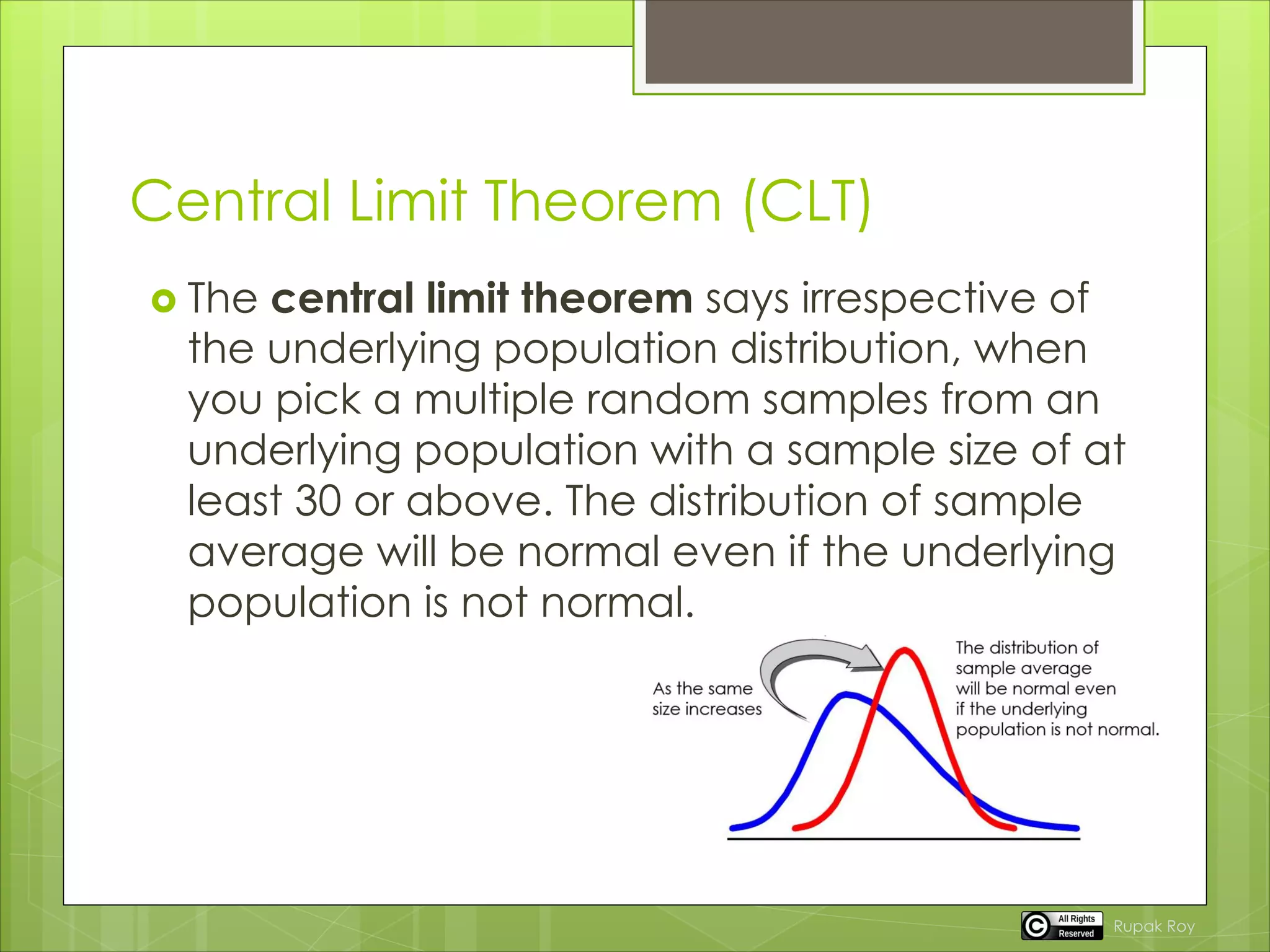
 The central limit theorem says irrespective of
the underlying population distribution, when
you pick a multiple random samples from an
underlying population with a sample size of at
least 30 or above. The distribution of sample
average will be normal even if the underlying
population is not normal.
Rupak Roy
Hypothesis testing when sample size is low
 Remember: Central limit theorem says if the sample size is
sufficiently large, the distribution of sample averages will
be normal irrespective of underlying population distribution
or else it will follow t-distribution.
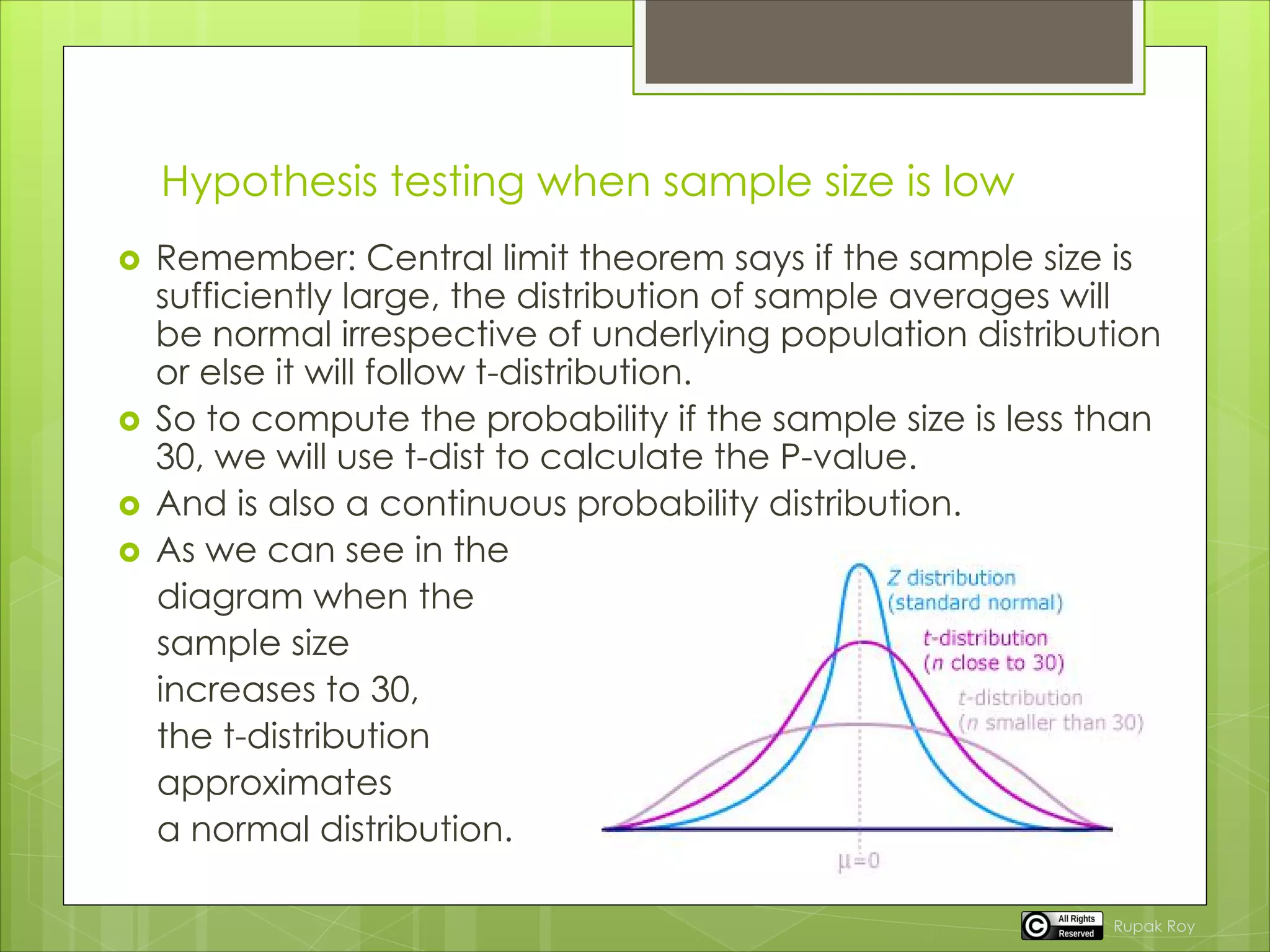
 So to compute the probability if the sample size is less than
30, we will use t-dist to calculate the P-value.
 And is also a continuous probability distribution.
 As we can see in the
diagram when the
sample size
increases to 30,
the t-distribution
approximates
a normal distribution.
Rupak Roy
T-distance
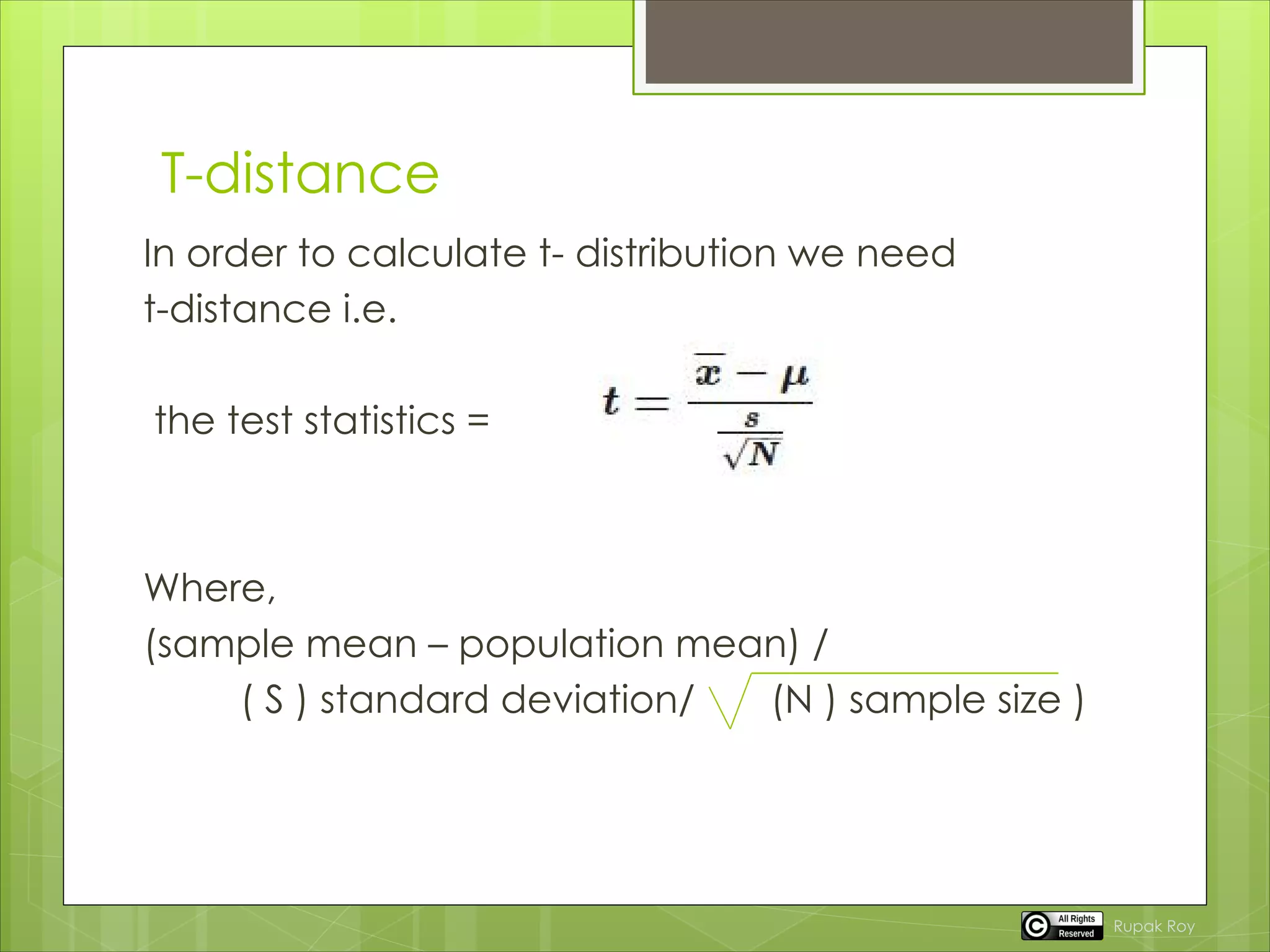
In order to calculate t- distribution we need
t-distance i.e.
the test statistics =
Where,
(sample mean – population mean) /
( S ) standard deviation/ (N ) sample size )
Rupak Roy
Steps for T-distribution
 Select
null hypothesis (ho):
alternative hypothesis (h1):
 Significance level: 5%
 Test distribution: t-distribution(calculate P-value)
 Conclusion: reject the null hypothesis or accept
the null hypothesis.
Rupak Roy
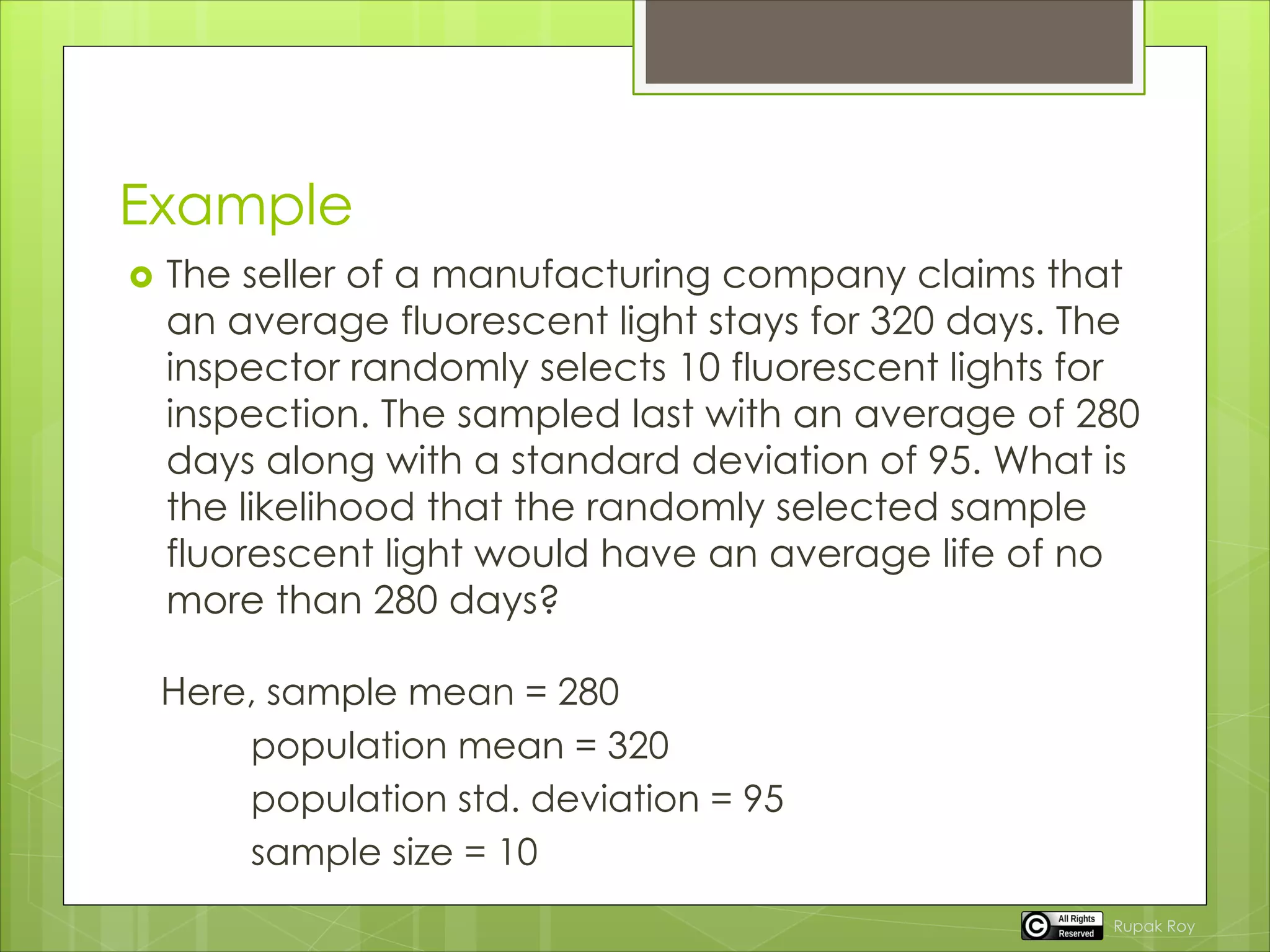
Example
 The seller of a manufacturing company claims that
an average fluorescent light stays for 320 days. The
inspector randomly selects 10 fluorescent lights for
inspection. The sampled last with an average of 280
days along with a standard deviation of 95. What is
the likelihood that the randomly selected sample
fluorescent light would have an average life of no
more than 280 days?
Here, sample mean = 280
population mean = 320
population std. deviation = 95
sample size = 10
Rupak Roy
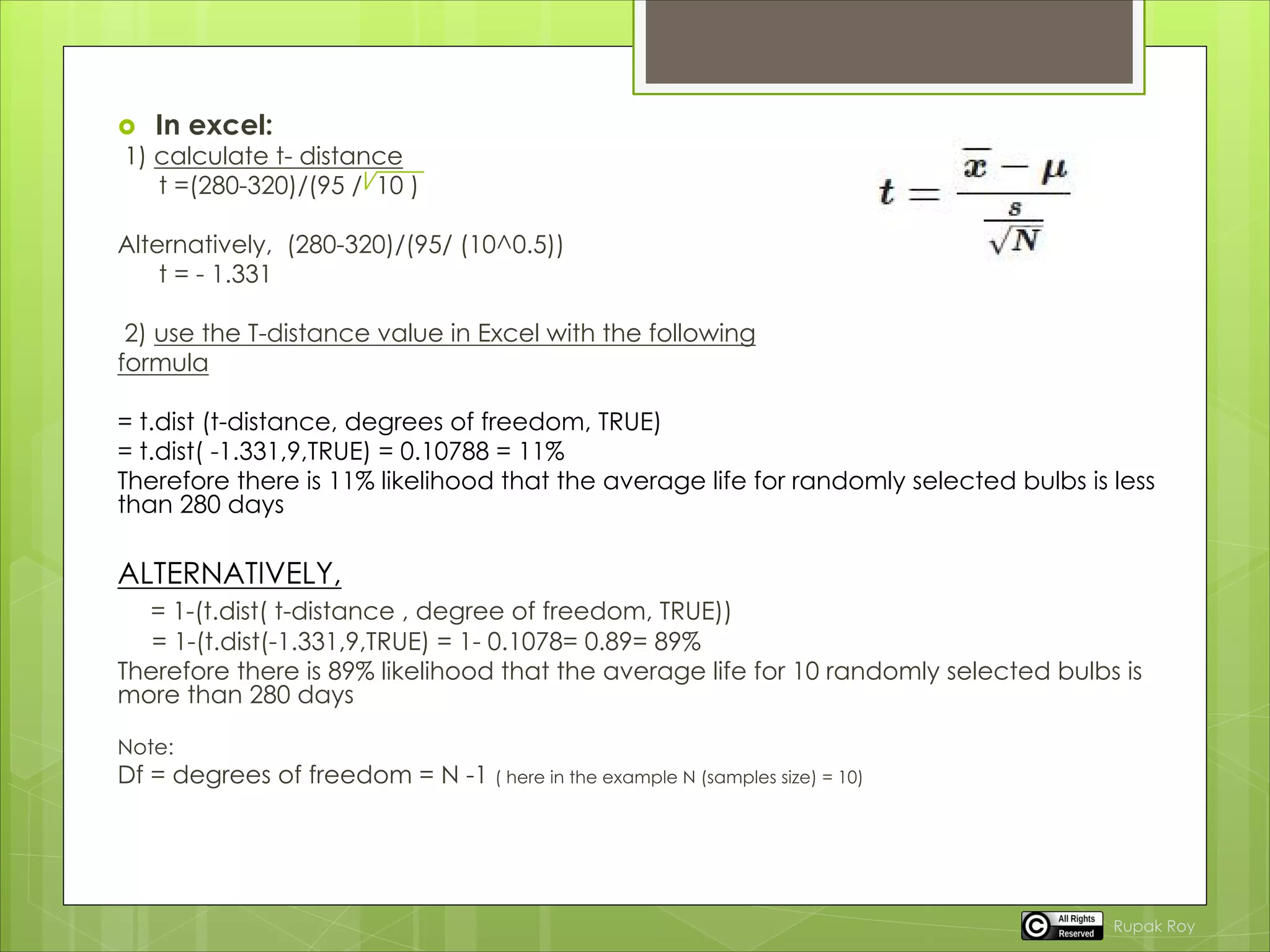
 In excel:
1) calculate t- distance
t =(280-320)/(95 / 10 )
Alternatively, (280-320)/(95/ (10^0.5))
t = - 1.331
2) use the T-distance value in Excel with the following
formula
= t.dist (t-distance, degrees of freedom, TRUE)
= t.dist( -1.331,9,TRUE) = 0.10788 = 11%
Therefore there is 11% likelihood that the average life for randomly selected bulbs is less
than 280 days
ALTERNATIVELY,
= 1-(t.dist( t-distance , degree of freedom, TRUE))
= 1-(t.dist(-1.331,9,TRUE) = 1- 0.1078= 0.89= 89%
Therefore there is 89% likelihood that the average life for 10 randomly selected bulbs is
more than 280 days
Note:
Df = degrees of freedom = N -1 ( here in the example N (samples size) = 10)
Rupak Roy
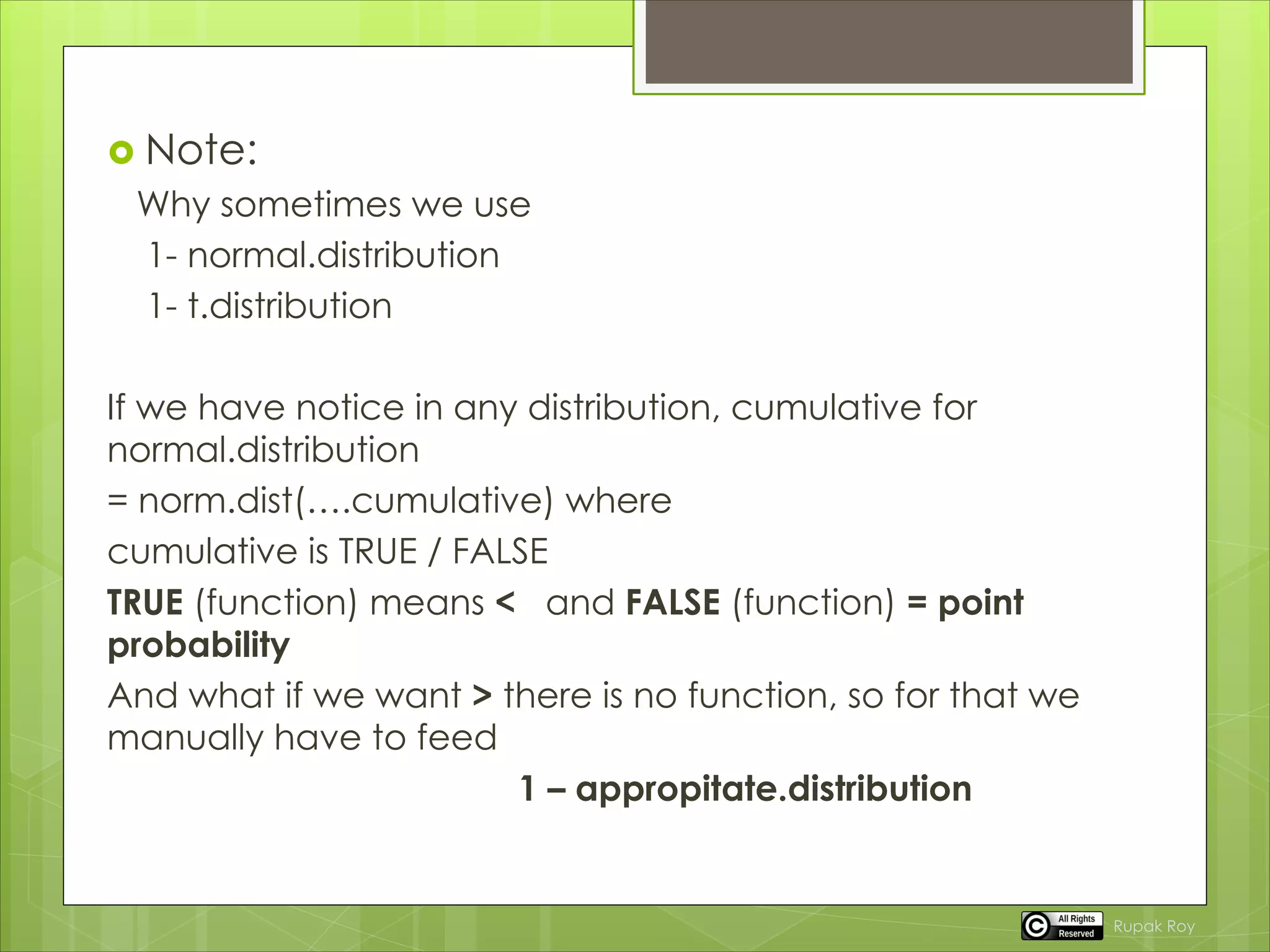
 Note:
Why sometimes we use
1- normal.distribution
1- t.distribution
If we have notice in any distribution, cumulative for
normal.distribution
= norm.dist(….cumulative) where
cumulative is TRUE / FALSE
TRUE (function) means < and FALSE (function) = point
probability
And what if we want > there is no function, so for that we
manually have to feed
1 – appropitate.distribution
Rupak Roy
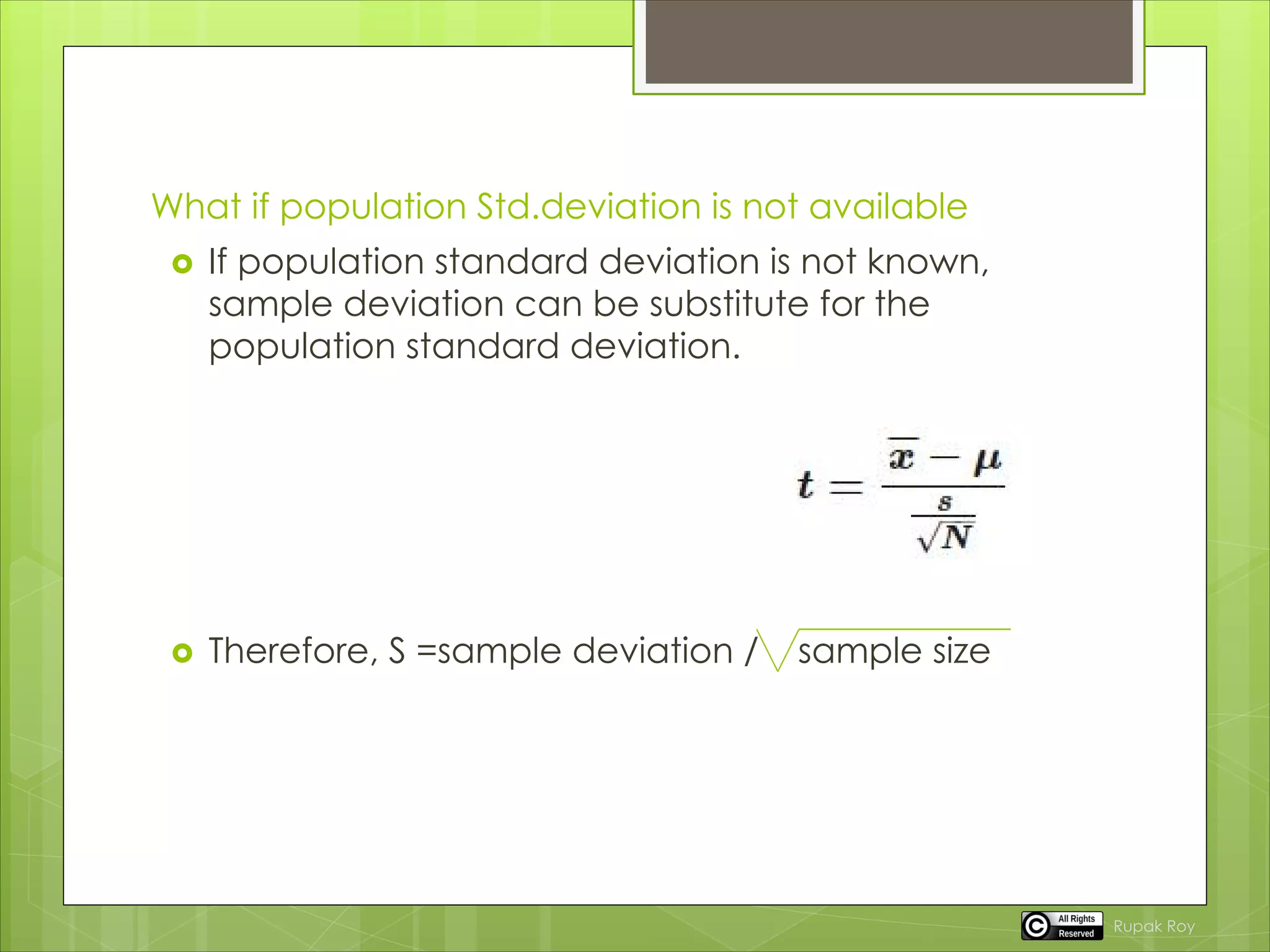
What if population Std.deviation is not available
 If population standard deviation is not known,
sample deviation can be substitute for the
population standard deviation.
 Therefore, S =sample deviation / sample size
Rupak Roy
What if population distribution is not
normal i.e. not normal distribution?
 We are using normal distribution to calculate
p-value for hypothesis testing but it is not
always necessary that every hypothesis test
must use a normal distribution.
 If we already know the type of distribution,
then it’s better to use directly the right
distribution for hypothesis testing.
 Remember the example from our previous
slide “Stage of Hypothesis” where in point
number 2 we have mentioned that we can
choose any appropriate types of distribution.
Rupak Roy
Recap:
“Stages of Hypothesis”
1. Select
Null Hypothesis (Ho): no difference of mileage if we
replace the battery in the car.
Alternative Hypothesis (Ha): difference in mileage if we
replace the battery in the car
2. Test Distribution: select appropriate distribution like
norm.dist, binom.dist with significance level: alpha (a)
5%
3. P-value ( example, p = 1- norm.dist(………) )=0.09
4. Result: failed to reject the null i.e. accepting the null
hypothesis and discarding the alternative hypothesis.
We will conclude that there is no difference in
mileage even if we replace the battery of the car.
Rupak Roy
Next
Directional Hypothesis test
like one tail test i.e. if you have strong reason to
believe in your hypothesis.
And more.
Rupak Roy
 To be continued.
Rupak Roy

Hypothesis Testing with ease

  • 1.
  • 2.
    Definition  A hypothesistest is a statistical test that is used for determining whether there is enough evidence from the sample data to draw a conclusion for the entire population.  Two types of conclusions: 1. Null Hypothesis (Ho): is the hypothesis that any observe variation in a sample is simply because of random chance variation or we can say “the hypothesis - that there is no significant difference between the sample and the population, and any observed difference is due to randomness or experimental error.” Rupak Roy
  • 3.
    2. Alternative Hypothesis( Ha ): is the hypothesis testing that is contrary to the null hypothesis. Examples: If i replace the battery in my car, then my car will give better mileage? Null Hypothesis (Ho): no difference of mileage even if we replace the battery of the car. Alternative Hypothesis (Ha): difference in mileage if we replace the battery of the car Rupak Roy
  • 4.
    Significance level i.e.alpha a If the criteria used for rejecting the null hypothesis is less than 5% i.e. 0.05(p-value) then we will conclude that there is difference between sample and population. In other words we are rejecting the null hypothesis. The most standard value for rejecting null hypothesis is 0.05; however we can change depending on our need. Rupak Roy
  • 5.
    Example  If P (value)> Significance level (a), then we will accept the null hypothesis  Else P (value) < Significance level (a), then we will reject the null hypothesis Another term for saying we have rejected the null hypothesis is Statistically Significant result. Rupak Roy
  • 6.
    Stages of Hypothesis 1.Select Null hypothesis (Ho): no difference of mileage if we replace the battery of the car. Alternative Hypothesis(Ha): difference in mileage if we replace the battery of the car. 2. Test Distribution: select appropriate distribution like norm.dist, binom.dist, t-distribution with significance level: alpha (a) 5% i.e. 0.05 3. P-value ( example, p = 1- norm.dist(………)=0.09 4. Result: failed to reject the null i.e. accepting the null hypothesis and discarding the alternative hypothesis. We will conclude that there is no difference in mileage even if we replace the battery of the car. Rupak Roy
  • 7.
    Example A food productionunit produces a particular product of an average weight of 10 lbs. with a standard deviation of 0.35 lbs. A random sample of 30 units found a slightly increase of average weight by 2 lbs. i.e. 12 lbs. So are there any issues in the product process? Significance level (a) = 0.05 Null Hypothesis (H0): There are no issues in the production process, what we found in the sample are due to random chance variation / randomness. Alternative Hypothesis (H1): There are some issues in the production process that is leading to the increase in weight per unit. Test Distribution: normal distribution Rupak Roy
  • 8.
    Example: continued In Excel, normaldistribution = norm.dist( X, mean, Standard deviation, Cumulative) where, X =12, mean = 10, standard deviation = 0.35 and cumulative = TRUE/False Therefore, = 1- norm.dist (Because we need to calculate P-value for greater than 10 lbs.) =1- norm.dist (12,10,0.35,TRUE) = 5.5089E-09 i.e. less than 0.05 Since P-value is smaller than Significance level (a), we have failed to reject the H1 i.e. accepting the alternative hypothesis and discarding the Null hypothesis. In other words, we will conclude that there are some issues in the production process that leads to the increase in weight per unit of production. Rupak Roy
  • 9.
    Terminology Confidence level: is(1-significance level), it refers how confident you are about your conclusion. So, if null hypothesis is rejected at a 5% level of significance, then it means you are 95% (1- 0.05) confident about your conclusion. Again, if null hypothesis is rejected at a 1% level of significance, then it means you are 99% (1-0.01) confident about your conclusion. Rupak Roy
  • 10.
    Central Limit Theorem(CLT)  The central limit theorem says irrespective of the underlying population distribution, when you pick a multiple random samples from an underlying population with a sample size of at least 30 or above. The distribution of sample average will be normal even if the underlying population is not normal. Rupak Roy
  • 11.
    Hypothesis testing whensample size is low  Remember: Central limit theorem says if the sample size is sufficiently large, the distribution of sample averages will be normal irrespective of underlying population distribution or else it will follow t-distribution.  So to compute the probability if the sample size is less than 30, we will use t-dist to calculate the P-value.  And is also a continuous probability distribution.  As we can see in the diagram when the sample size increases to 30, the t-distribution approximates a normal distribution. Rupak Roy
  • 12.
    T-distance In order tocalculate t- distribution we need t-distance i.e. the test statistics = Where, (sample mean – population mean) / ( S ) standard deviation/ (N ) sample size ) Rupak Roy
  • 13.
    Steps for T-distribution Select null hypothesis (ho): alternative hypothesis (h1):  Significance level: 5%  Test distribution: t-distribution(calculate P-value)  Conclusion: reject the null hypothesis or accept the null hypothesis. Rupak Roy
  • 14.
    Example  The sellerof a manufacturing company claims that an average fluorescent light stays for 320 days. The inspector randomly selects 10 fluorescent lights for inspection. The sampled last with an average of 280 days along with a standard deviation of 95. What is the likelihood that the randomly selected sample fluorescent light would have an average life of no more than 280 days? Here, sample mean = 280 population mean = 320 population std. deviation = 95 sample size = 10 Rupak Roy
  • 15.
     In excel: 1)calculate t- distance t =(280-320)/(95 / 10 ) Alternatively, (280-320)/(95/ (10^0.5)) t = - 1.331 2) use the T-distance value in Excel with the following formula = t.dist (t-distance, degrees of freedom, TRUE) = t.dist( -1.331,9,TRUE) = 0.10788 = 11% Therefore there is 11% likelihood that the average life for randomly selected bulbs is less than 280 days ALTERNATIVELY, = 1-(t.dist( t-distance , degree of freedom, TRUE)) = 1-(t.dist(-1.331,9,TRUE) = 1- 0.1078= 0.89= 89% Therefore there is 89% likelihood that the average life for 10 randomly selected bulbs is more than 280 days Note: Df = degrees of freedom = N -1 ( here in the example N (samples size) = 10) Rupak Roy
  • 16.
     Note: Why sometimeswe use 1- normal.distribution 1- t.distribution If we have notice in any distribution, cumulative for normal.distribution = norm.dist(….cumulative) where cumulative is TRUE / FALSE TRUE (function) means < and FALSE (function) = point probability And what if we want > there is no function, so for that we manually have to feed 1 – appropitate.distribution Rupak Roy
  • 17.
    What if populationStd.deviation is not available  If population standard deviation is not known, sample deviation can be substitute for the population standard deviation.  Therefore, S =sample deviation / sample size Rupak Roy
  • 18.
    What if populationdistribution is not normal i.e. not normal distribution?  We are using normal distribution to calculate p-value for hypothesis testing but it is not always necessary that every hypothesis test must use a normal distribution.  If we already know the type of distribution, then it’s better to use directly the right distribution for hypothesis testing.  Remember the example from our previous slide “Stage of Hypothesis” where in point number 2 we have mentioned that we can choose any appropriate types of distribution. Rupak Roy
  • 19.
    Recap: “Stages of Hypothesis” 1.Select Null Hypothesis (Ho): no difference of mileage if we replace the battery in the car. Alternative Hypothesis (Ha): difference in mileage if we replace the battery in the car 2. Test Distribution: select appropriate distribution like norm.dist, binom.dist with significance level: alpha (a) 5% 3. P-value ( example, p = 1- norm.dist(………) )=0.09 4. Result: failed to reject the null i.e. accepting the null hypothesis and discarding the alternative hypothesis. We will conclude that there is no difference in mileage even if we replace the battery of the car. Rupak Roy
  • 20.
    Next Directional Hypothesis test likeone tail test i.e. if you have strong reason to believe in your hypothesis. And more. Rupak Roy
  • 21.
     To becontinued. Rupak Roy