





HYPOTHESIS TESTING
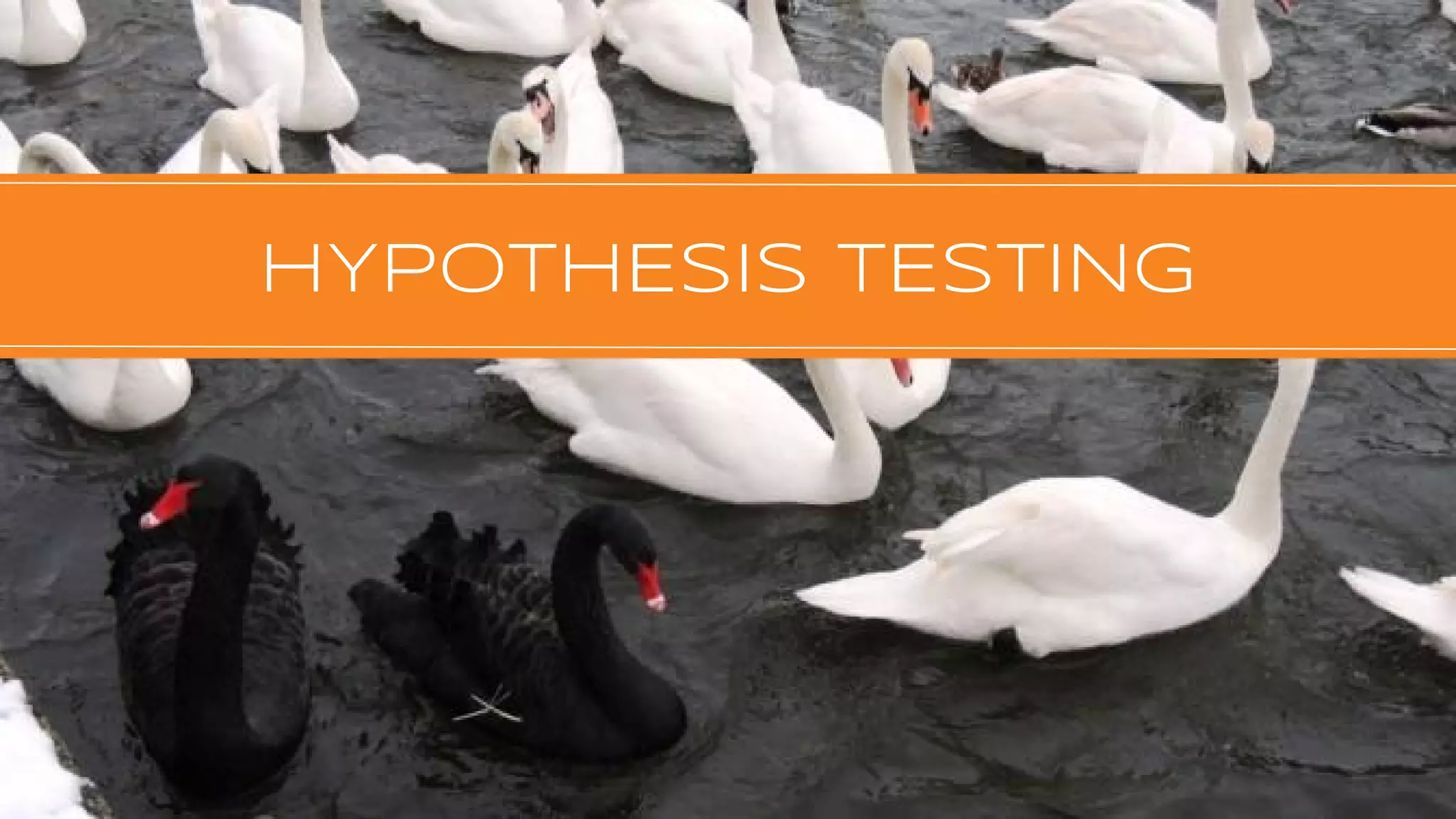
HYPOTHESIS TESTING
1. Science and Falsification
2. Significance Testing
2.1. What is a p-value?
2.2. How to build a Null Hypothesis
3. How about the Alternative Hypothesis?
3.1. False Alarms and Power
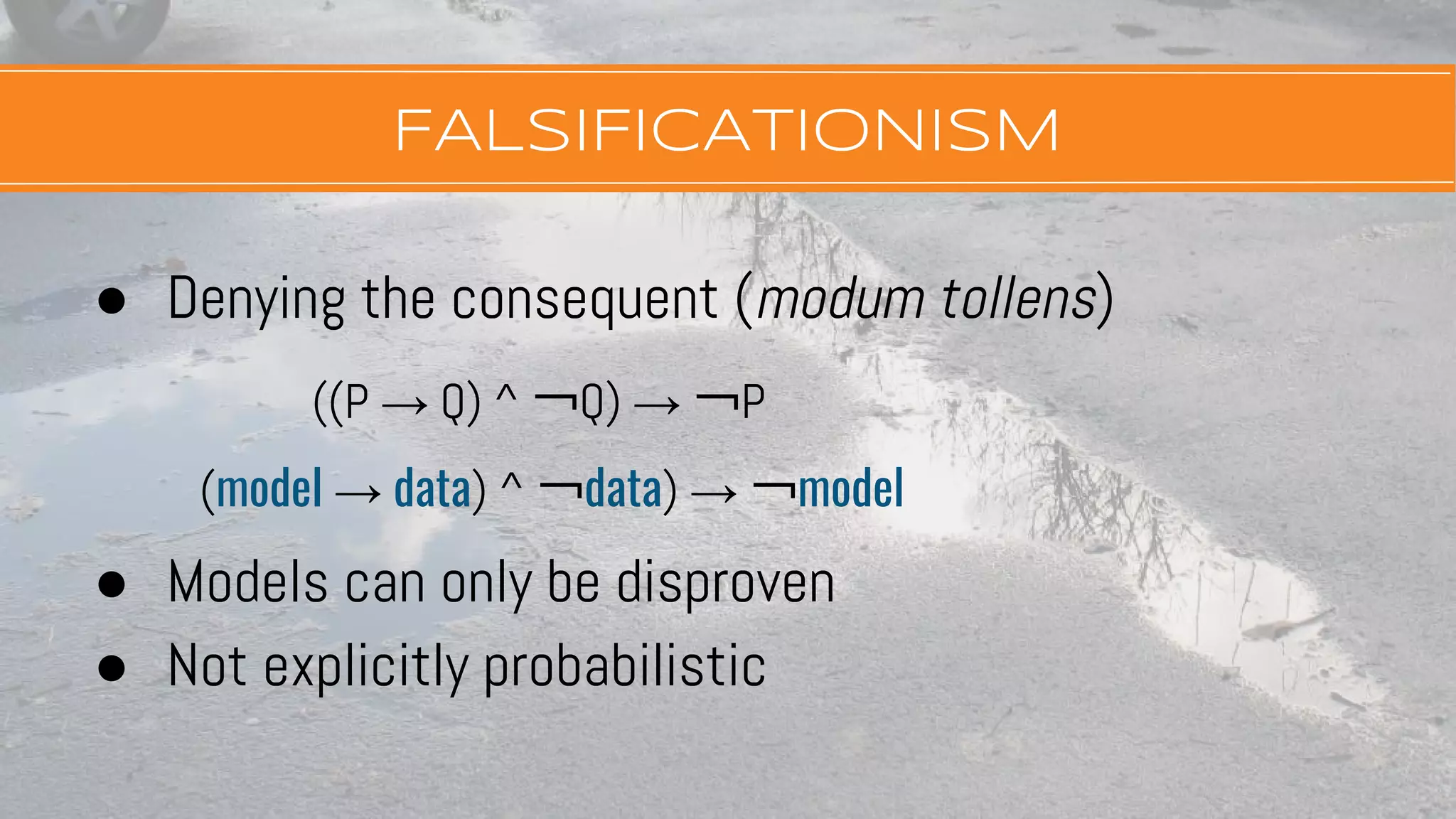
FALSIFICATIONISM
● Denying the consequent (modum tollens)
((P → Q) ^ ¬Q) → ¬P
(model → data) ^ ¬data) → ¬model
● Models can only be disproven
● Not explicitly probabilistic
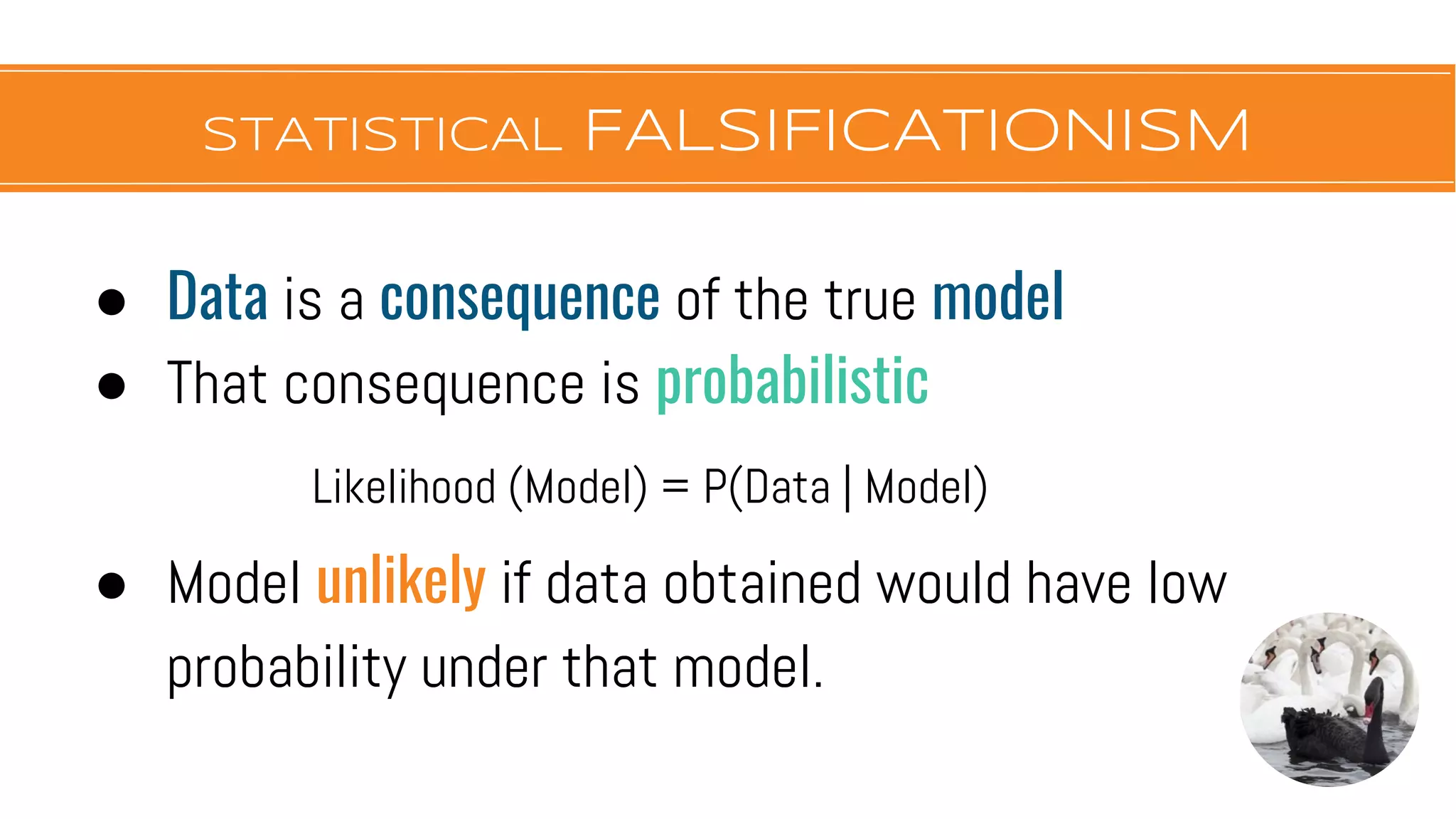
STATISTICAL FALSIFICATIONISM
● Data is a consequence of the true model
● That consequence is probabilistic
Likelihood (Model) = P(Data | Model)
● Model unlikely if data obtained would have low
probability under that model.
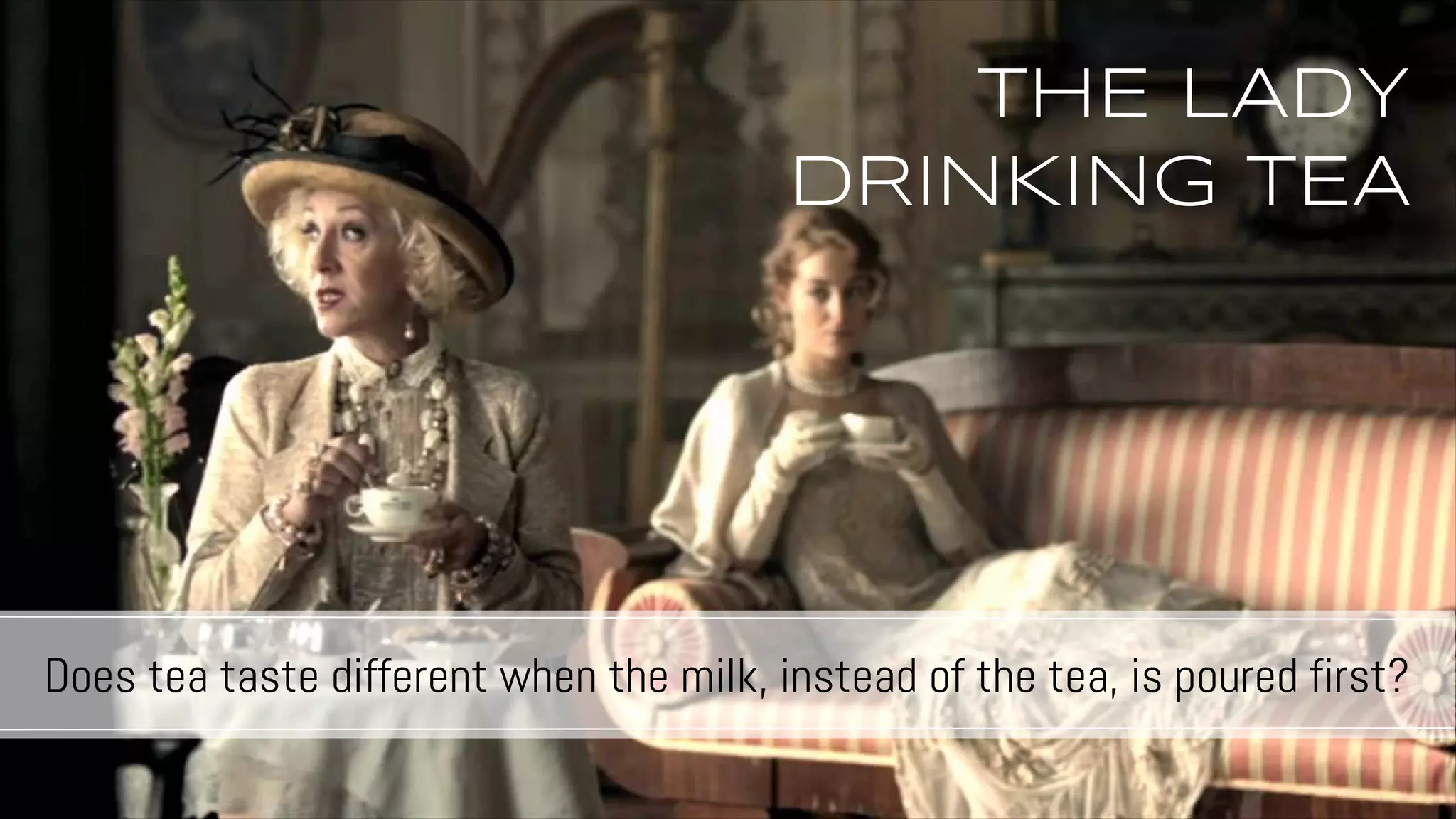
tHE LADY
DRINKING TEA
Does tea taste different when the milk, instead of the tea, is poured first?
TEST INGREDIENTS
● A hypothesis to reject: the null model (H0
)
● Some data
● A summary of the data: a statistic
● A way to calculate the probability
distribution of the statistic given H0
NULL HYPOTHESIS SIGNIFICANCE TESTING
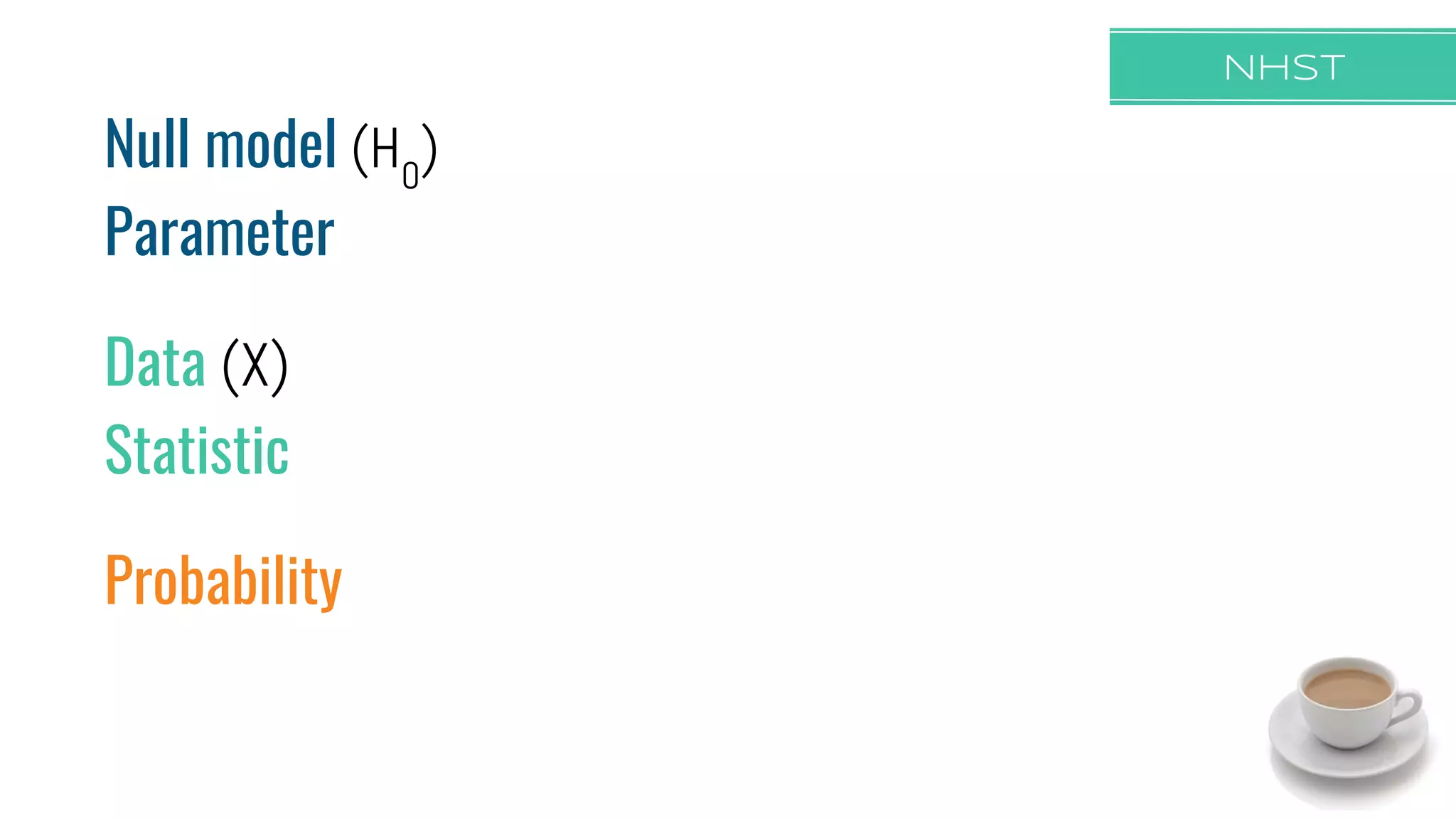
NHST
Null model (H0
)
Parameter
Data (X)
Statistic
Probability
NHST
Null model (H0
)
Parameter
Data (X)
Statistic
Probability
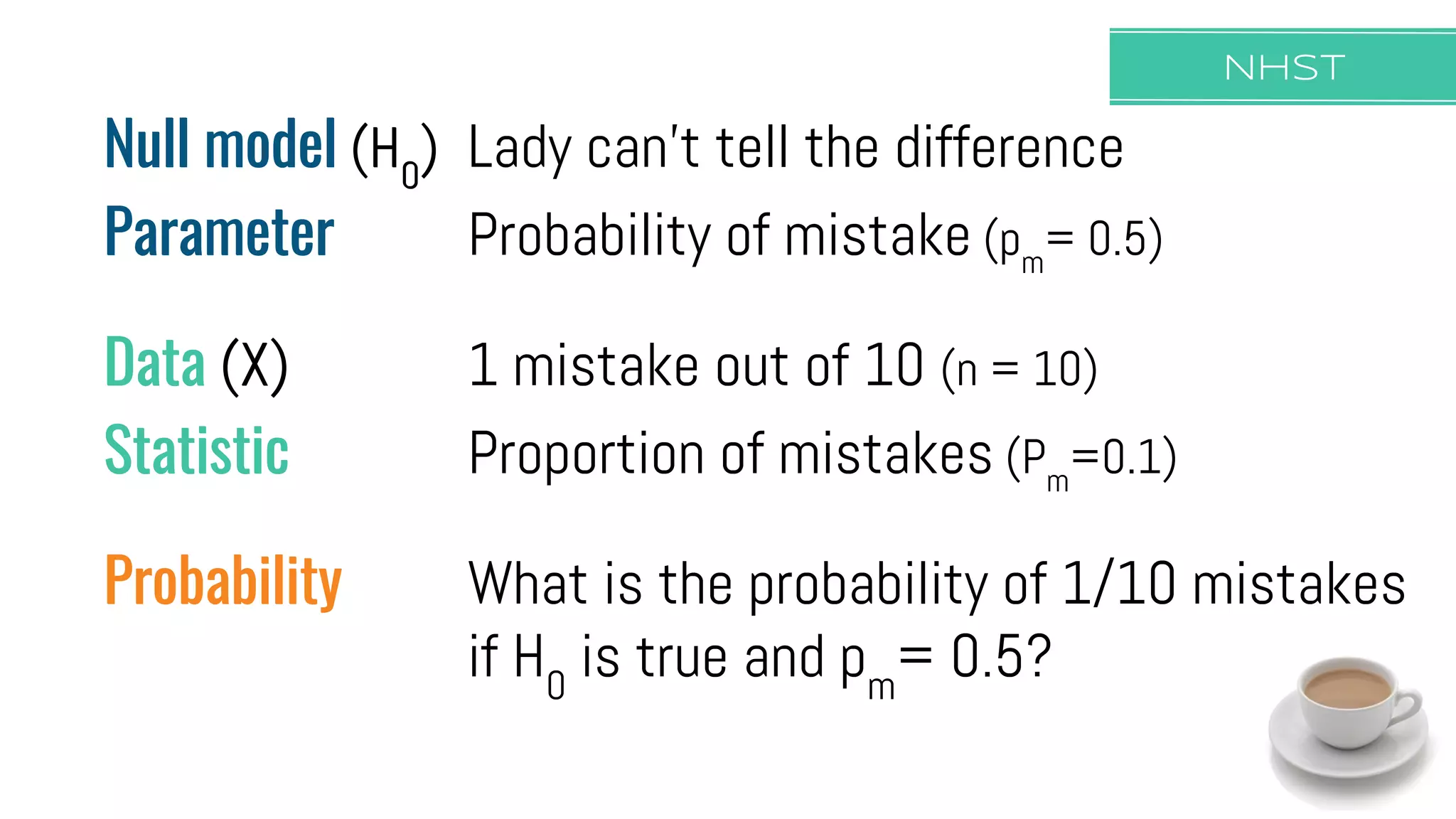
Null model (H0
) Lady can’t tell the difference
Parameter Probability of mistake (pm
= 0.5)
Data (X) 1 mistake out of 10 (n = 10)
Statistic Proportion of mistakes (Pm
=0.1)
Probability What is the probability of 1/10 mistakes
if H0
is true and pm
= 0.5?
The BINOMIAL DISTRIBUTION
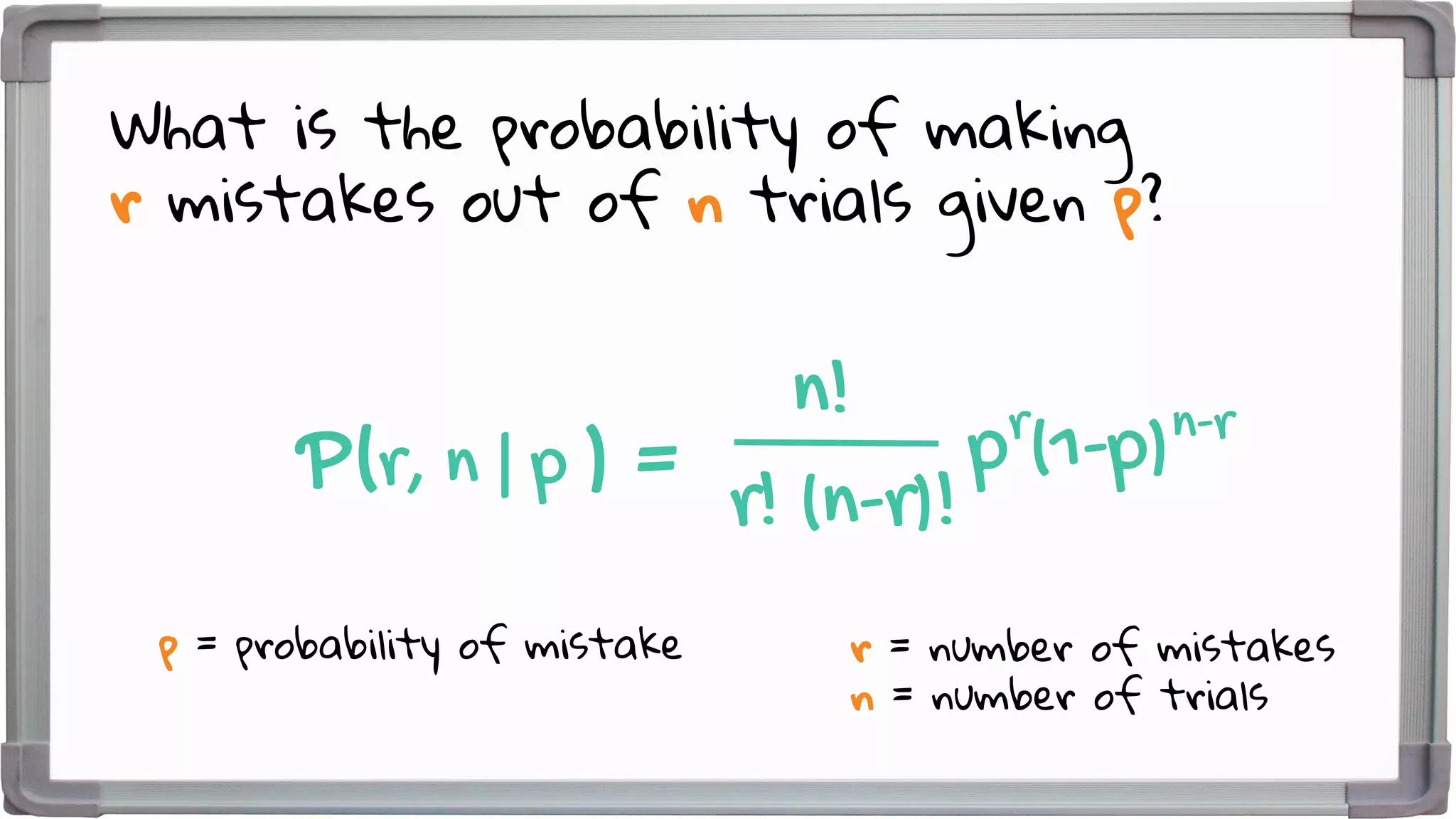
WHITEBOARD TIME!
pr
(1-p)n-rn!
r! (n-r)!P(r, n | p ) =
What is the probability of making
r mistakes out of n trials given p?
p = probability of mistake r = number of mistakes
n = number of trials
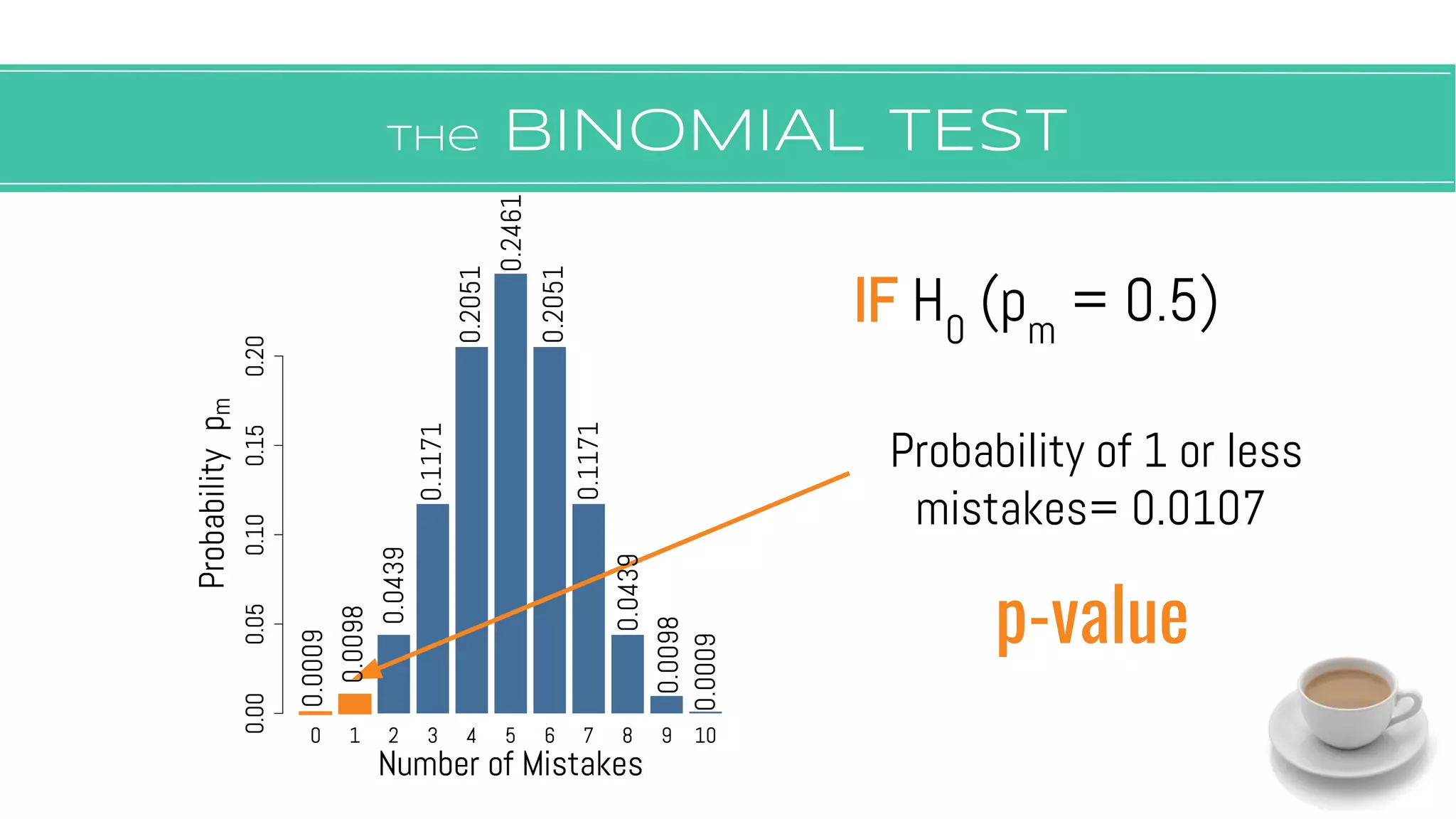
The BINOMIAL TEST
Probability of 1 or less
mistakes= 0.0107
IF H0
(pm
= 0.5)
p-value
0.0009
0.0098
0.0439
0.1171
0.2051
0.2461
0.1171
0.2051
0.0439
0.0098
0.0009
P-vALUES
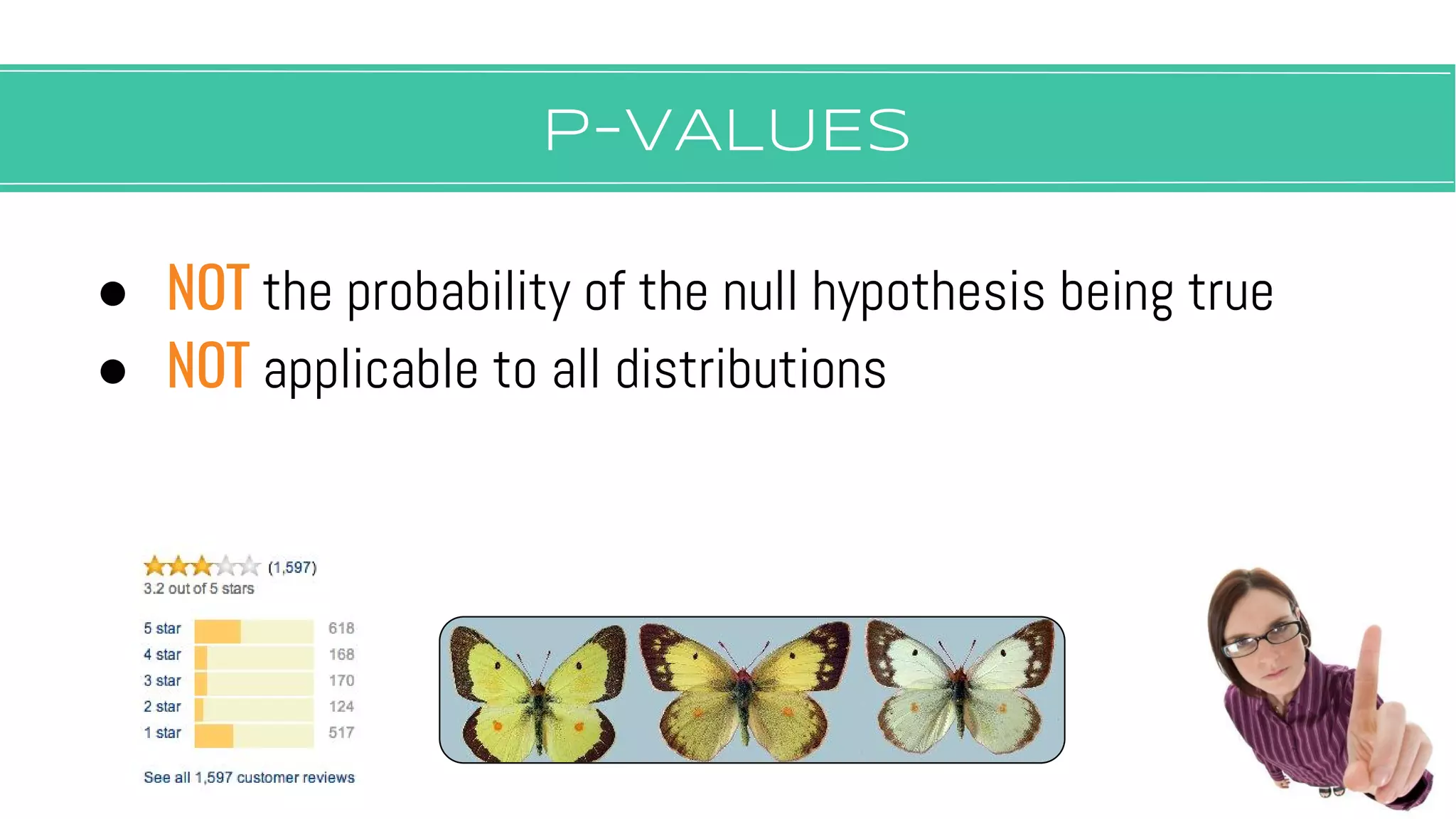
● NOT the probability of the null hypothesis being true
P-vALUES
● NOT the probability of the null hypothesis being true
● NOT applicable to all distributions
P-vALUES
● NOT the probability of the null hypothesis being true
● NOT applicable to all distributions
● NOT a measure of effect size or importance
NHST
Null model (H0
) Lady can’t tell the difference
Parameter Probability of mistake (pm
= 0.5)
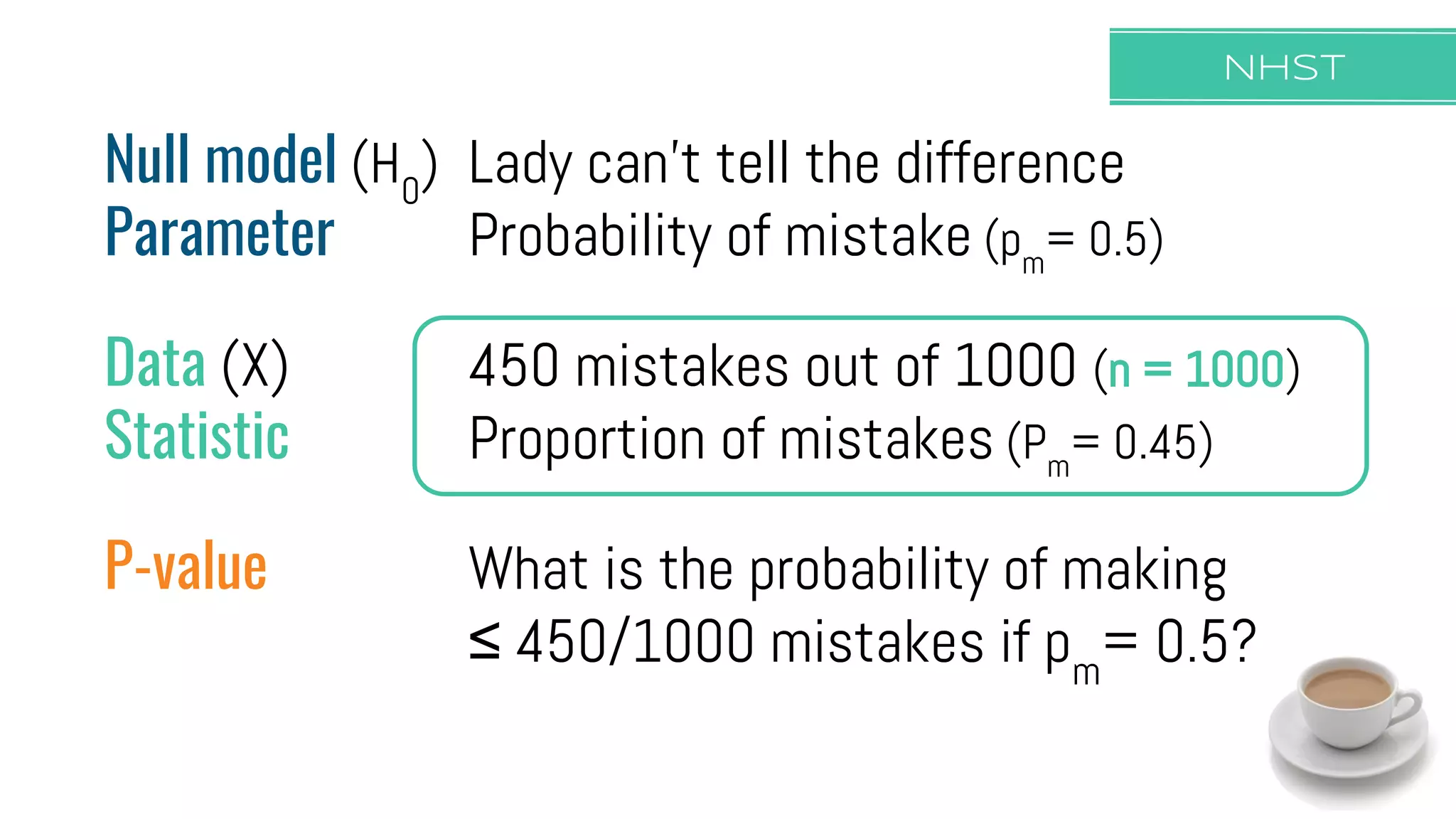
Data (X) 450 mistakes out of 1000 (n = 1000)
Statistic Proportion of mistakes (Pm
= 0.45)
P-value What is the probability of making
≤ 450/1000 mistakes if pm
= 0.5?
The BINOMIAL TEST
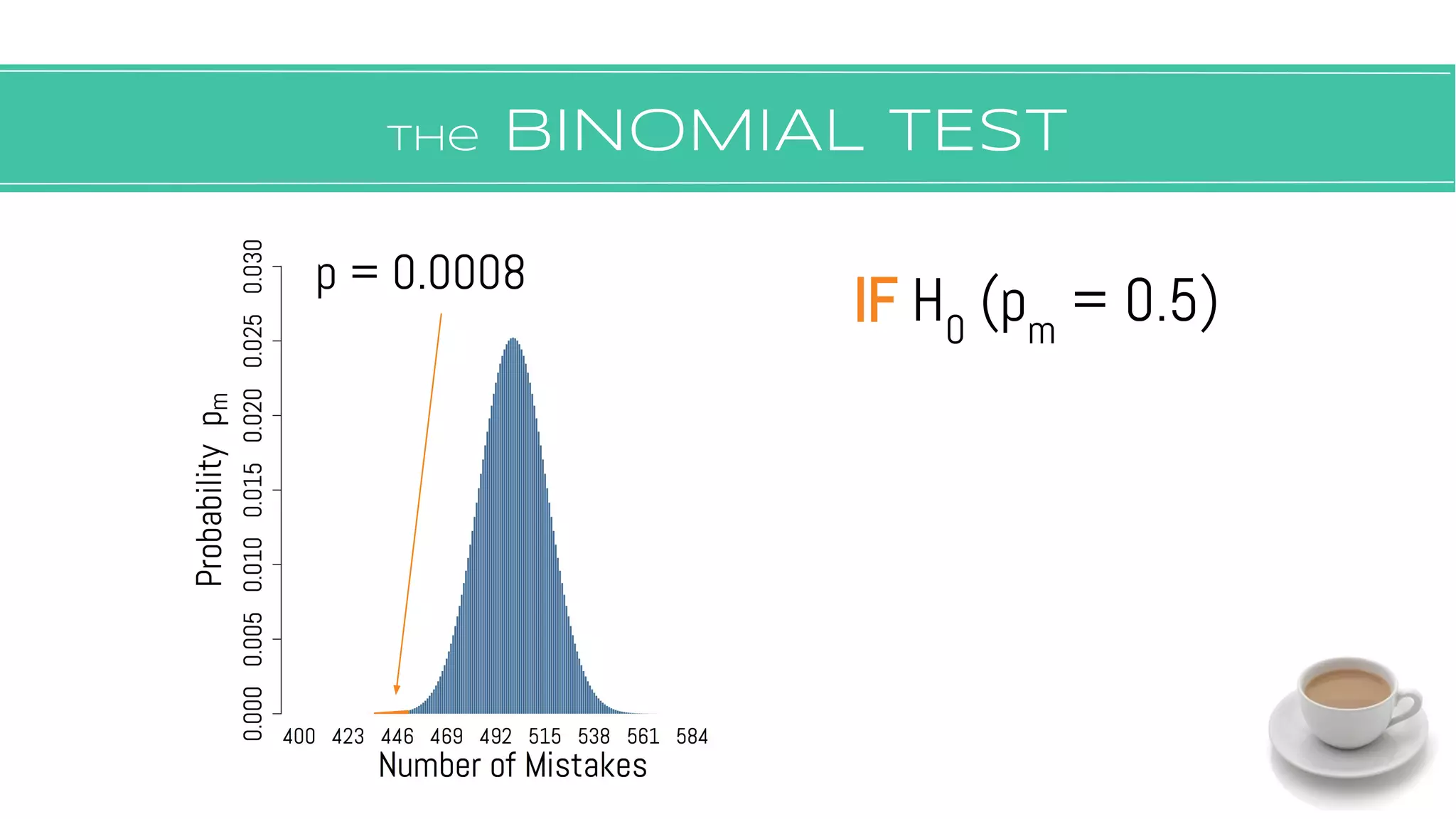
p = 0.0008
IF H0
(pm
= 0.5)
P-vALUES
● NOT the probability of the null hypothesis being true
● NOT applicable to all distributions
● NOT a measure of effect size or importance
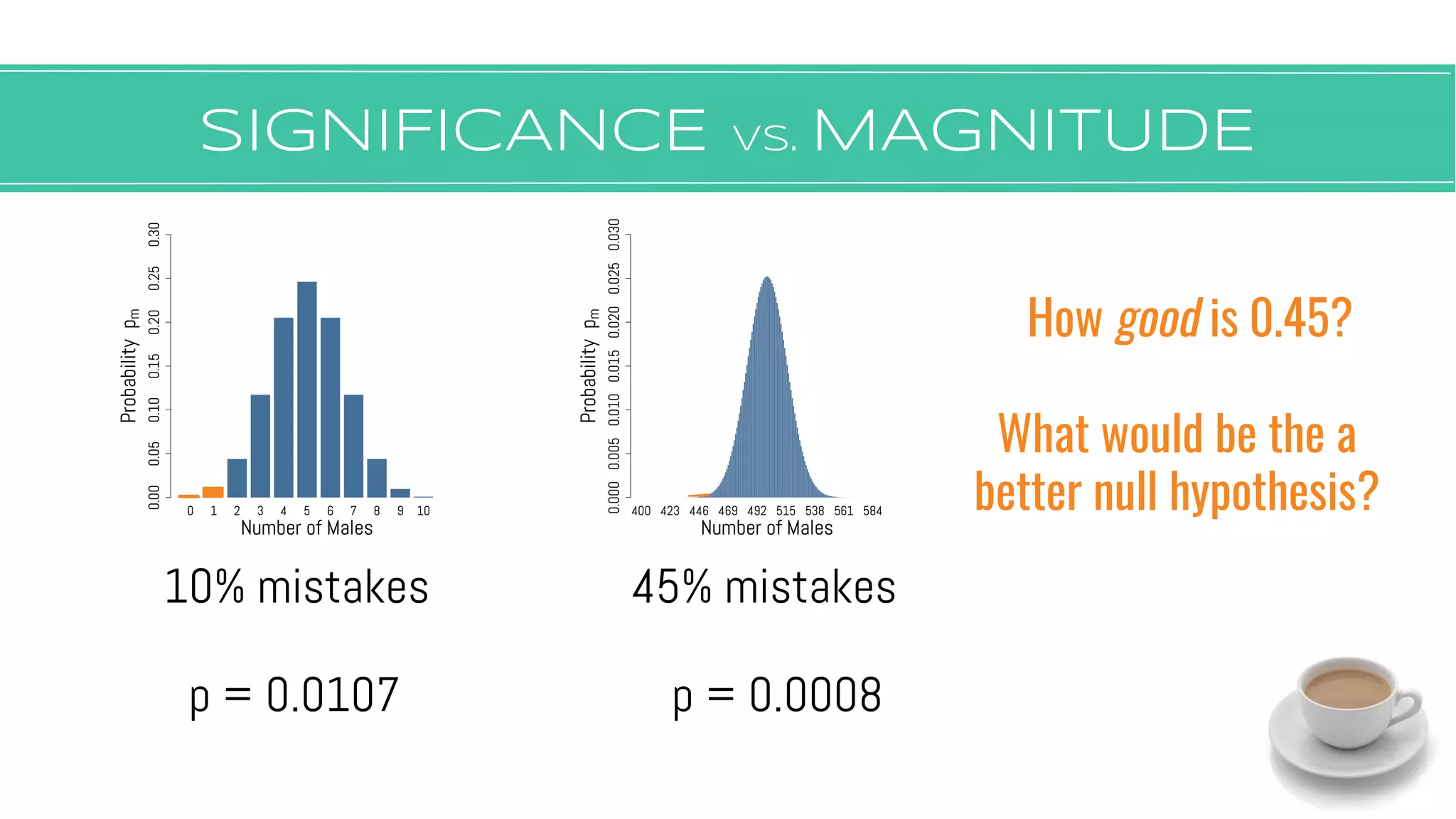
● ANY effect will be significant given enough data
SIGNIFICANCE VS. MAGNITUDE
10% mistakes
p = 0.0008p = 0.0107
45% mistakes
How good is 0.45?
What would be the a
better null hypothesis?
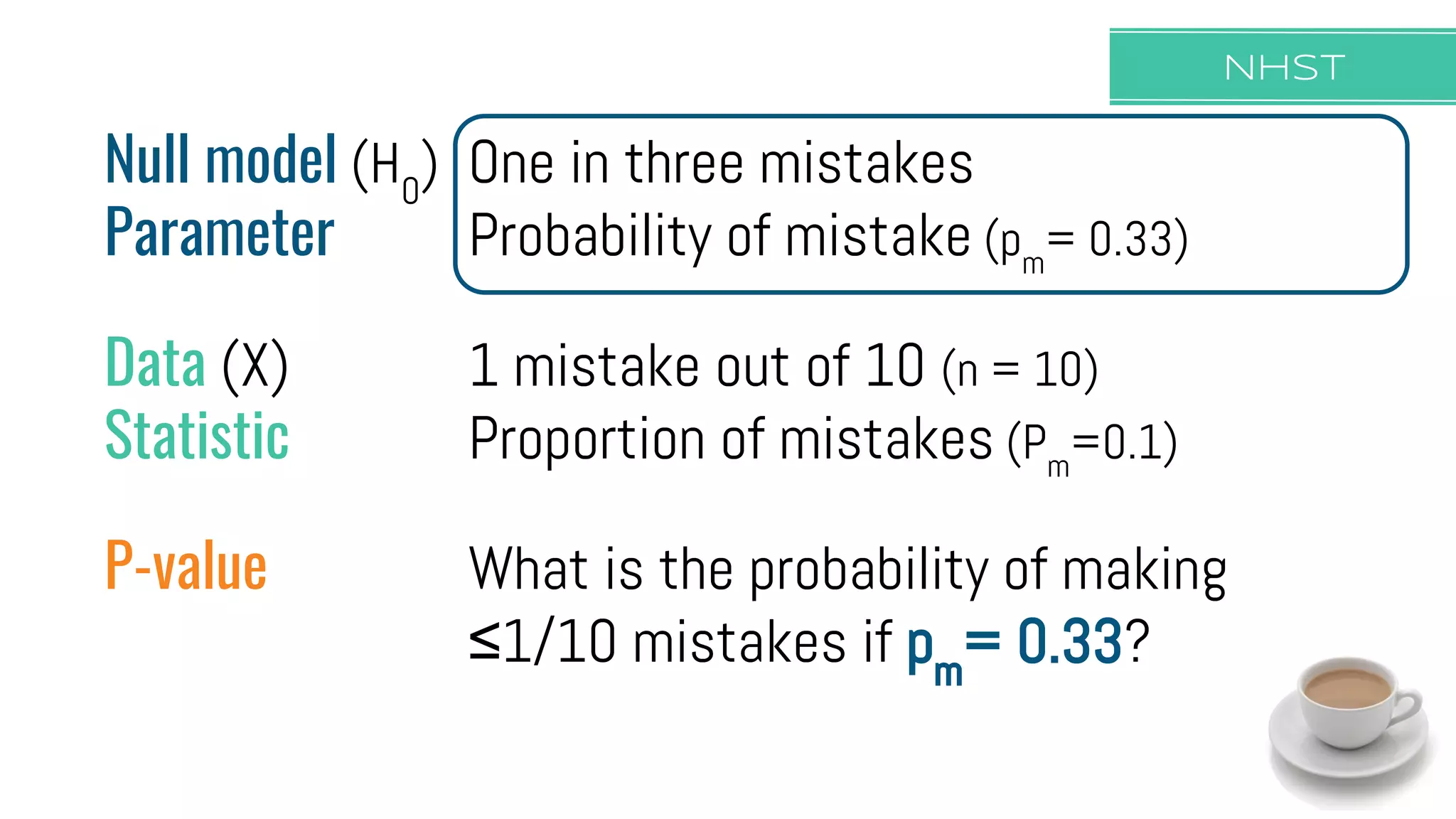
NHST
Null model (H0
) One in three mistakes
Parameter Probability of mistake (pm
= 0.33)
Data (X) 1 mistake out of 10 (n = 10)
Statistic Proportion of mistakes (Pm
=0.1)
P-value What is the probability of making
≤1/10 mistakes if pm
= 0.33?
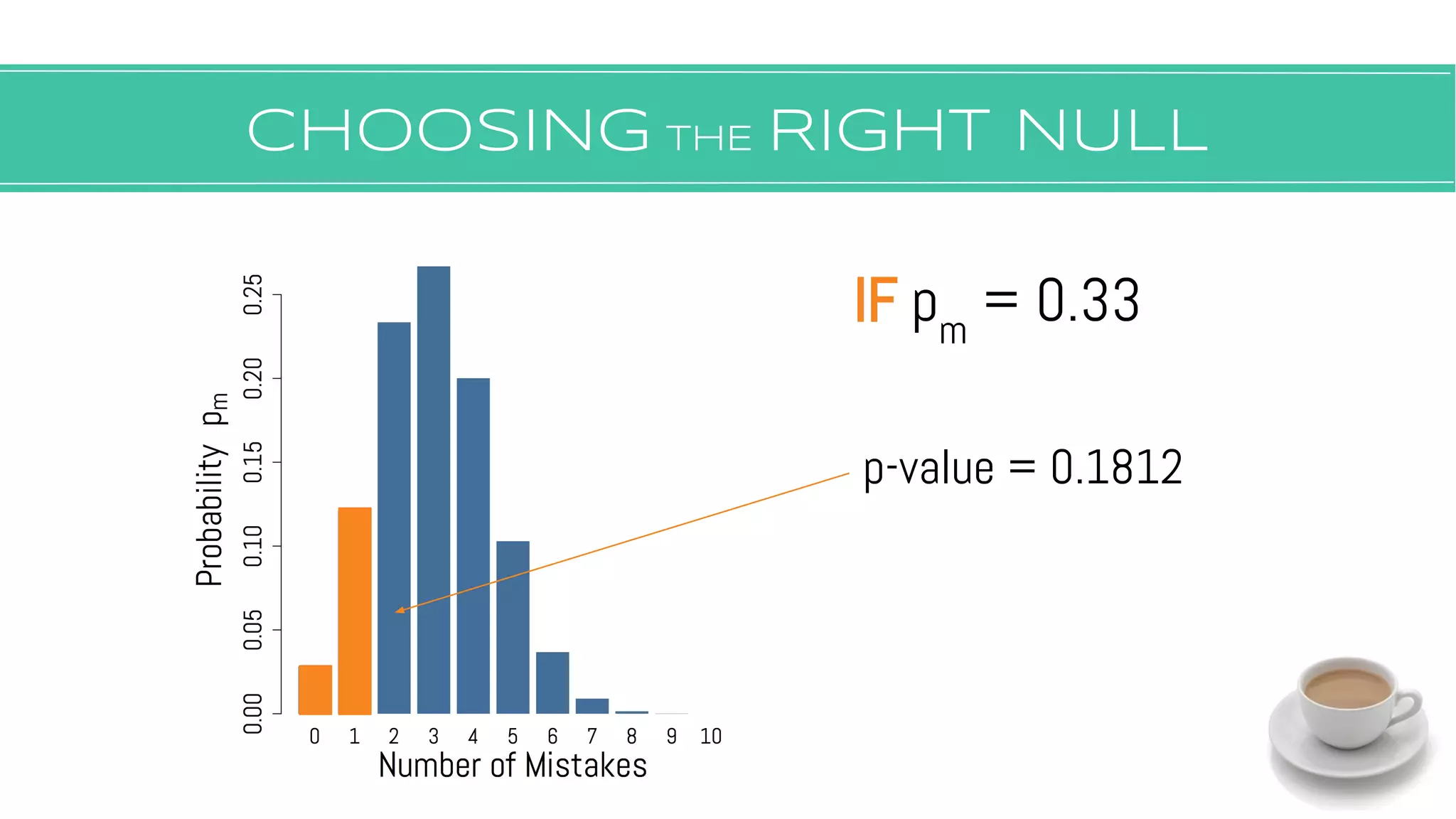
CHOOSING THE RIGHT NULL
p-value = 0.1812
IF pm
= 0.33
SAGUAROS
iN SPACE
Do individuals distribute randomly in space?
PLAY
TIME!
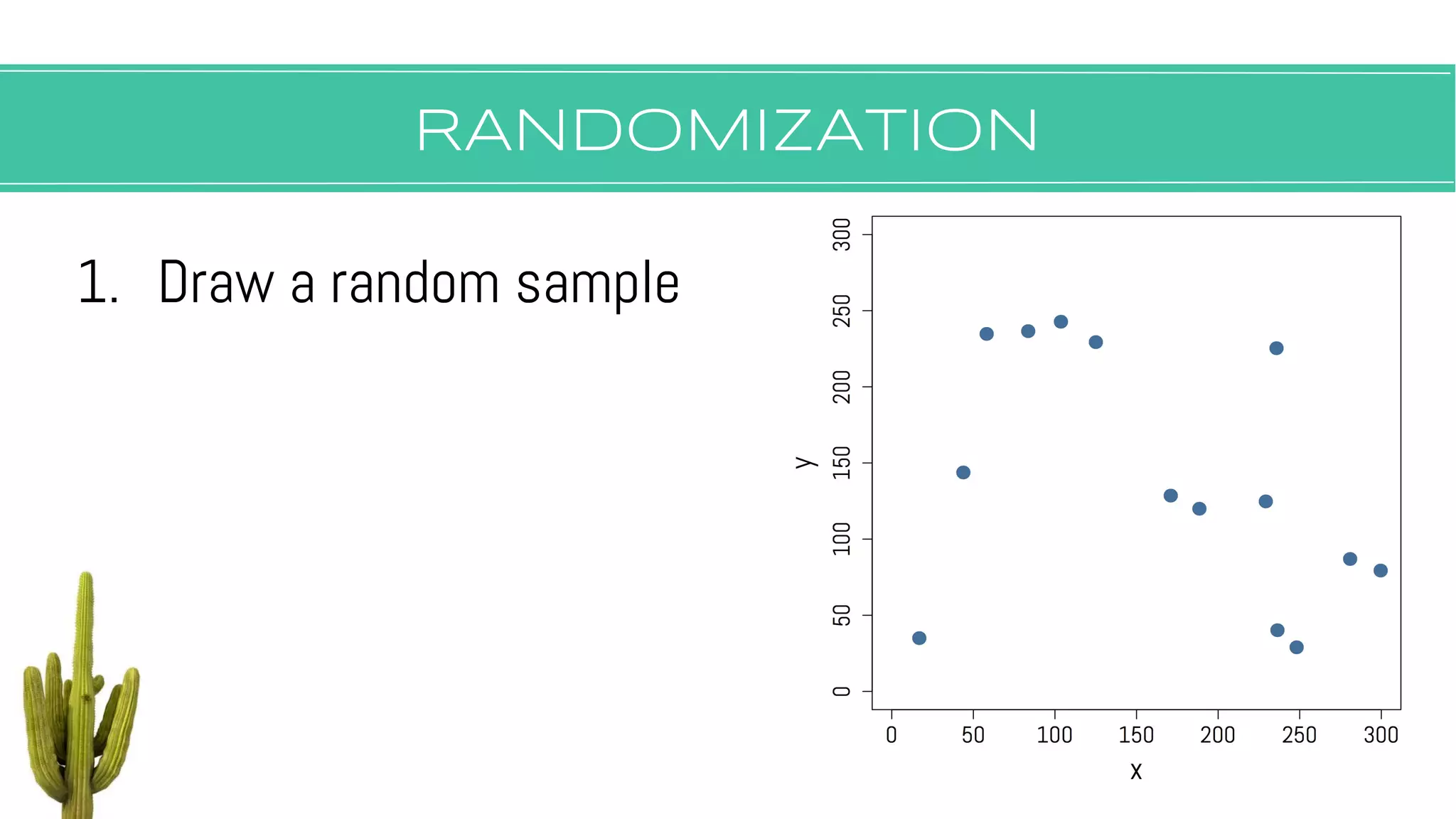
RANDOMIZATION
1. Draw a random sample
RANDOMIZATION
1. Draw a random sample
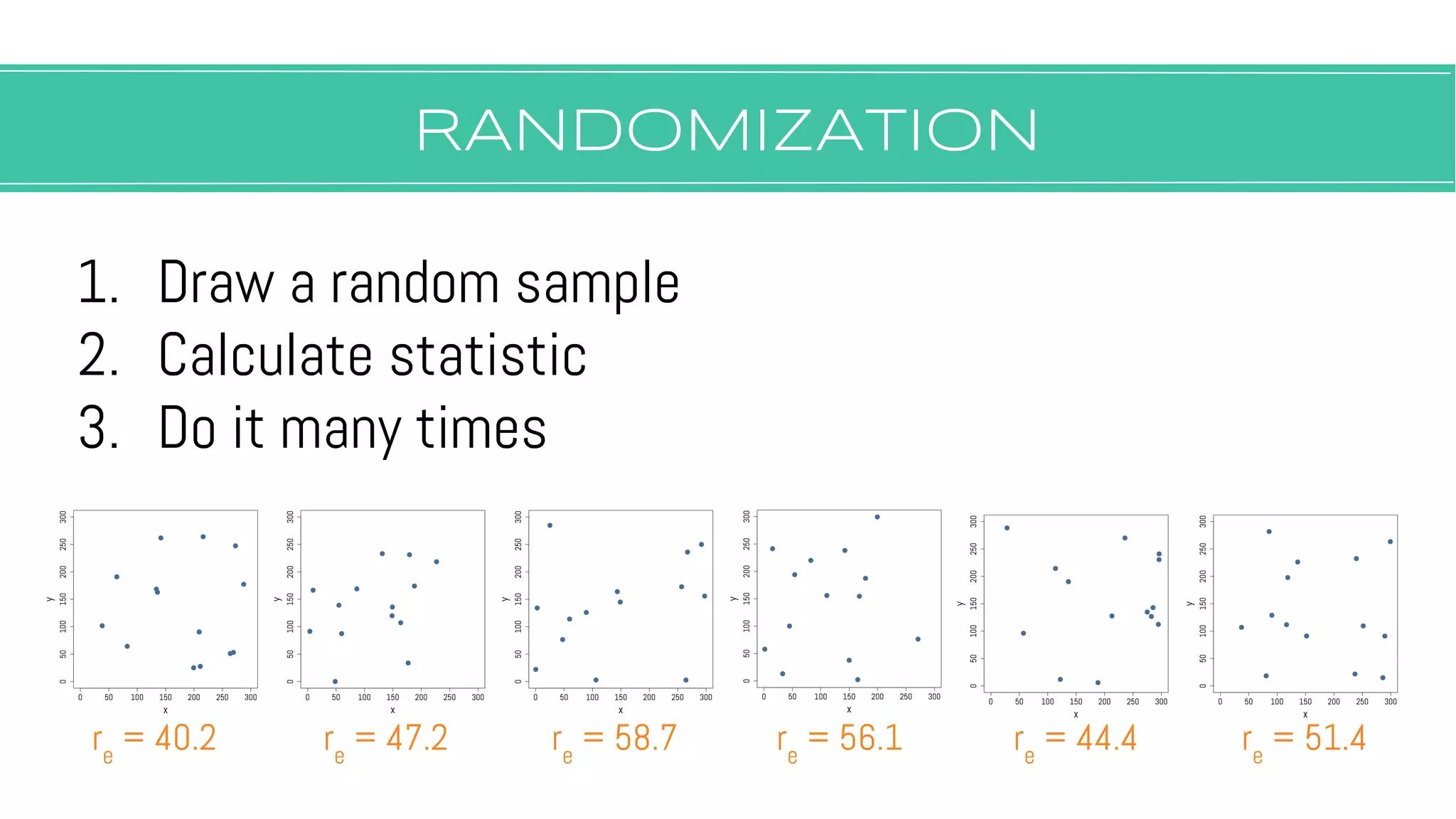
2. Calculate statistic
3. Do it many times
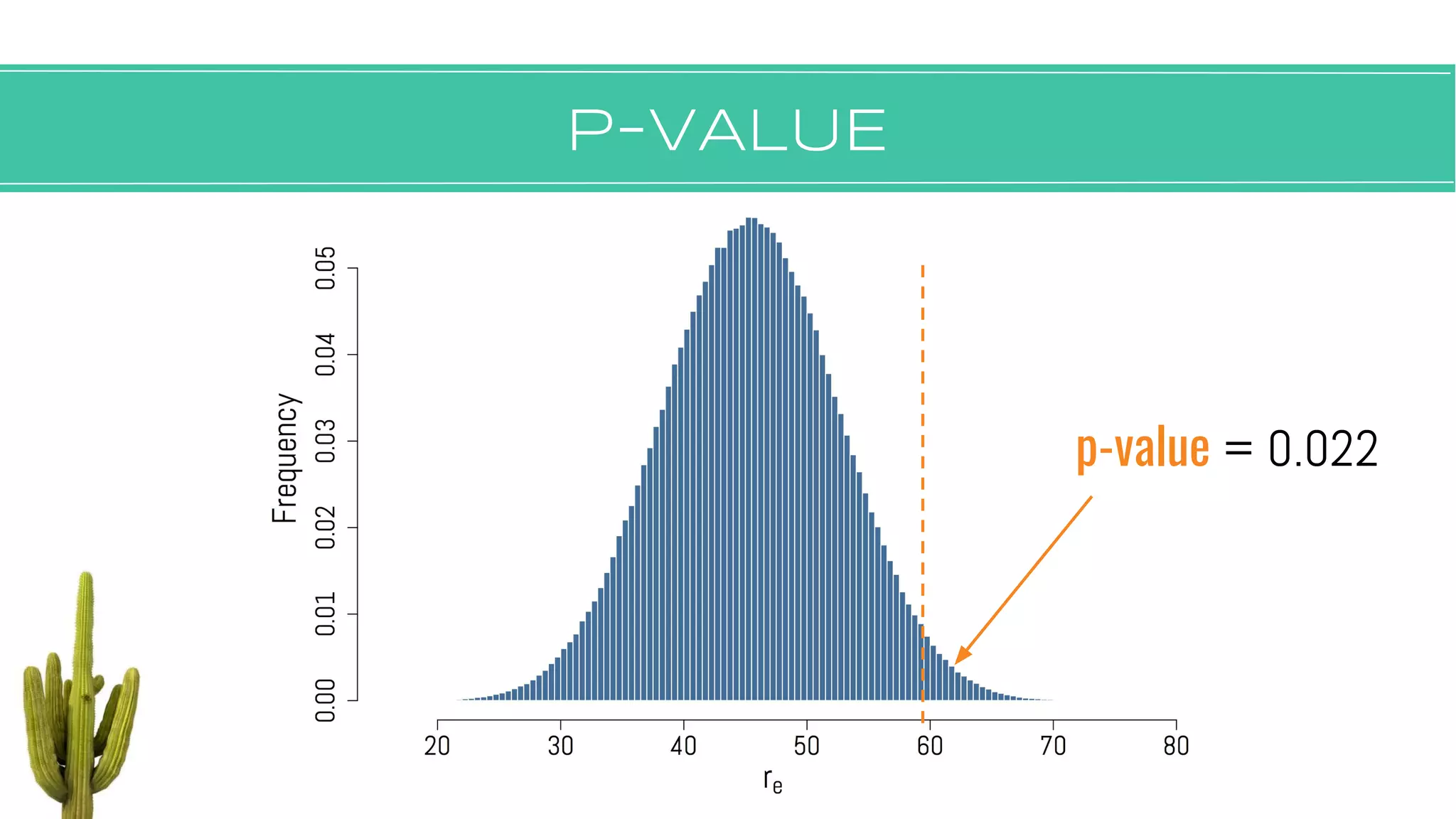
re
= 40.2 re
= 47.2 re
= 58.7 re
= 56.1 re
= 44.4 re
= 51.4
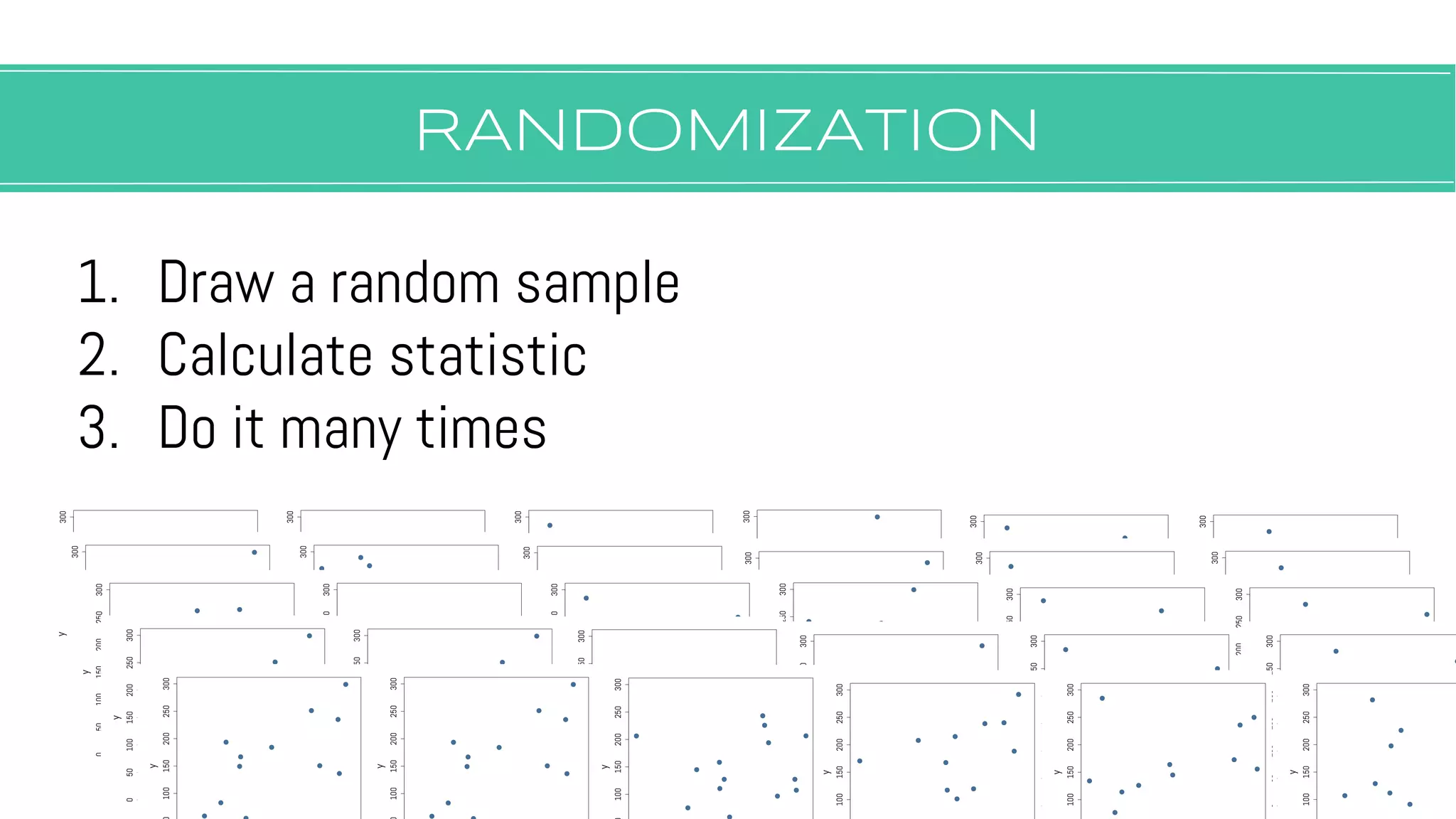
RANDOMIZATION
1. Draw a random sample
2. Calculate statistic
3. Do it many times
re
= 40.2 re
= 47.2 re
= 58.7 re
= 56.1 re
= 44.4 re
= 51.4
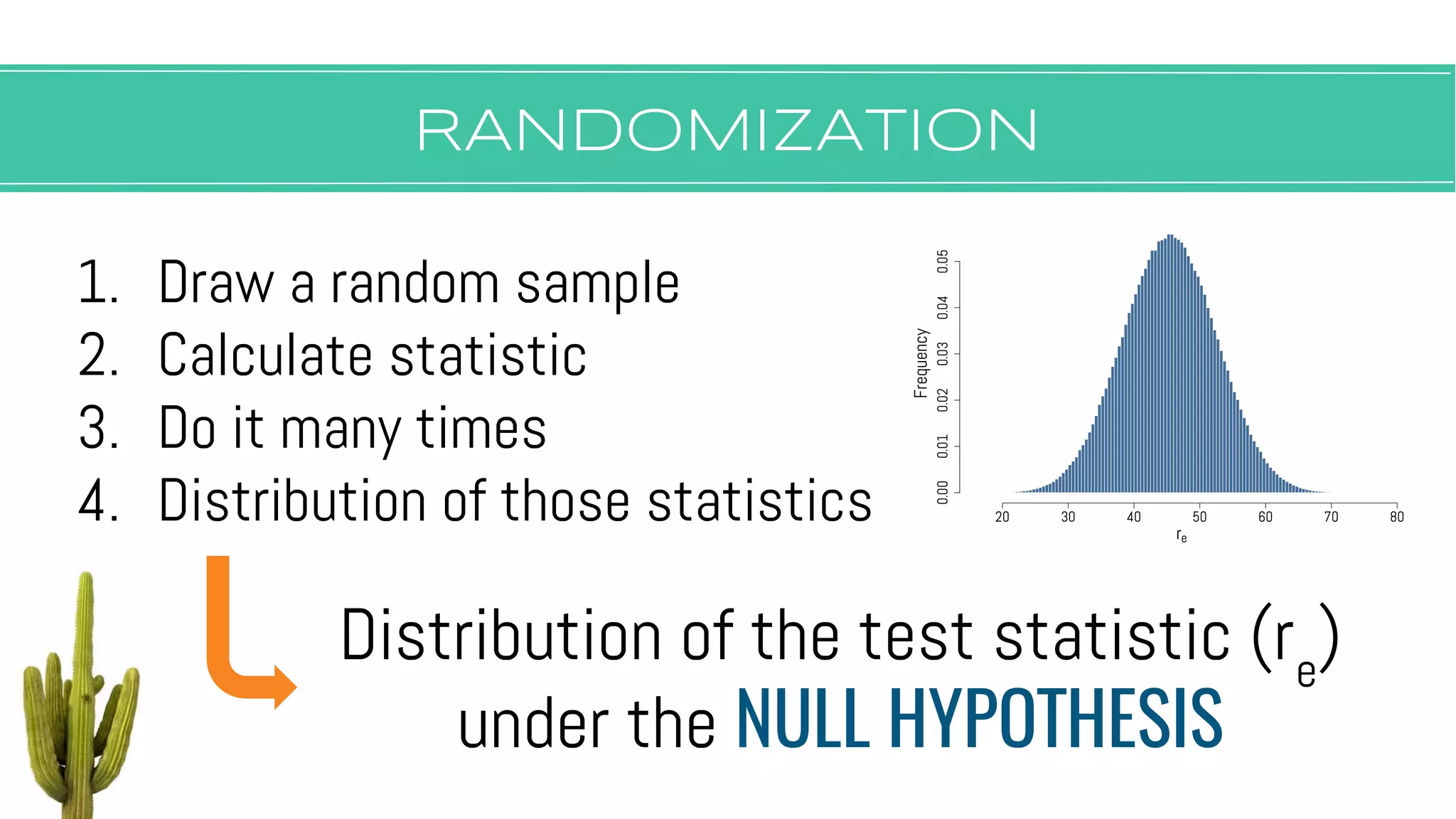
RANDOMIZATION
1. Draw a random sample
2. Calculate statistic
3. Do it many times
4. Distribution of those statistics
Distribution of the test statistic (re
)
under the NULL HYPOTHESIS
P-VALUE
p-value = 0.022
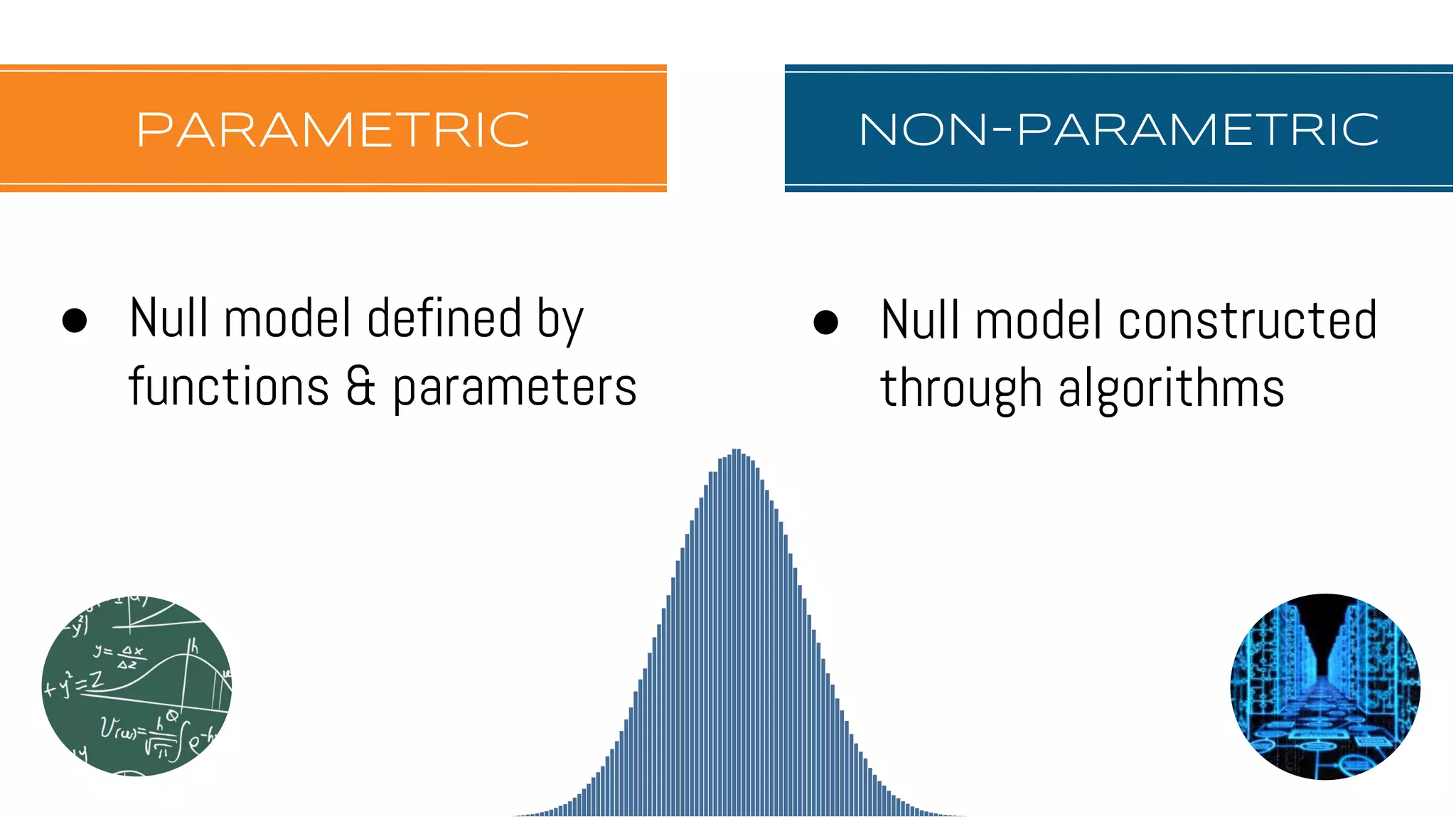
NON-PARAMETRICPARAMETRIC
● Null model defined by
functions & parameters
● Null model constructed
through algorithms
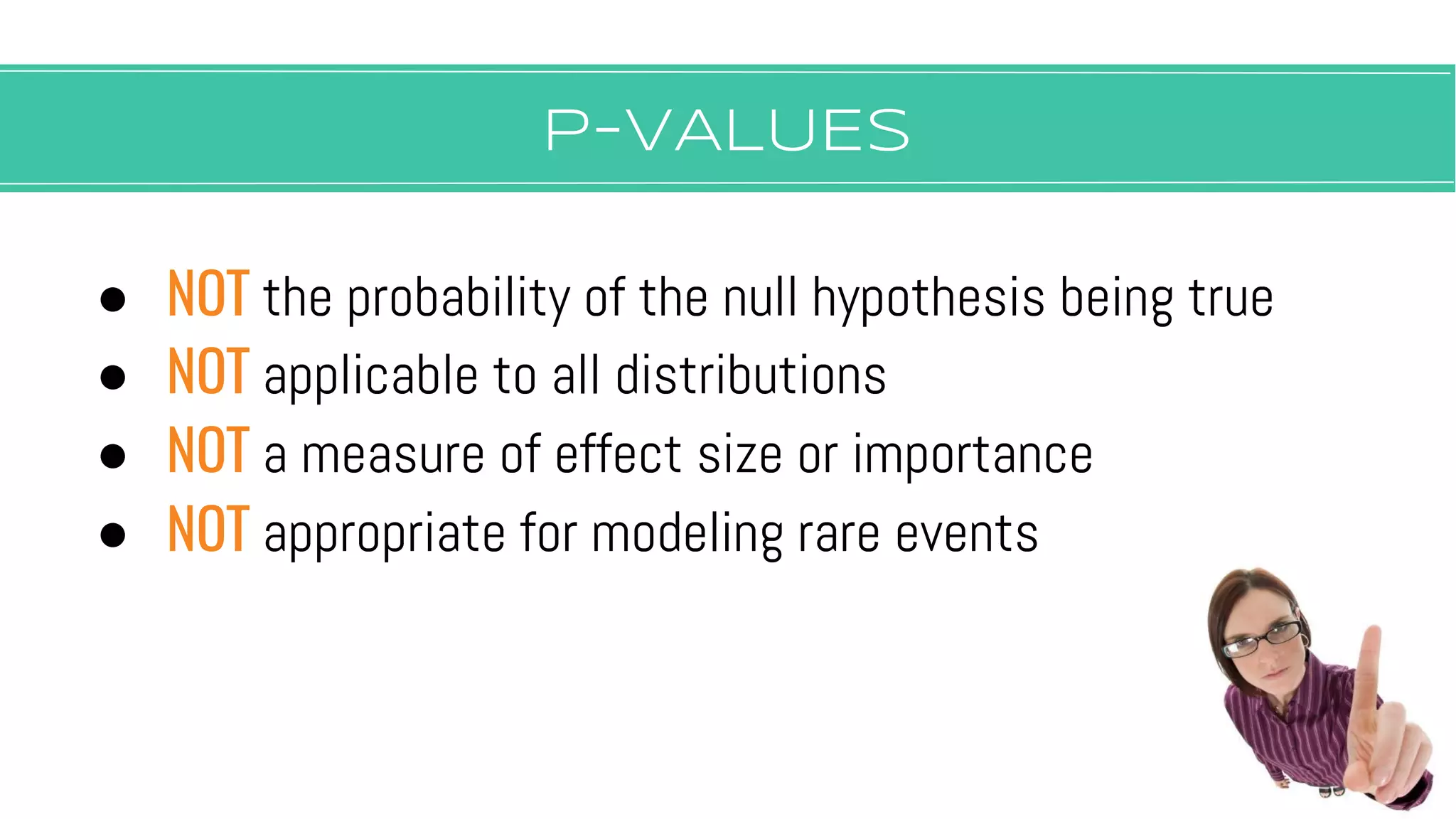
P-vALUES
● NOT the probability of the null hypothesis being true
● NOT applicable to all distributions
● NOT a measure of effect size or importance
● NOT appropriate for modeling rare events
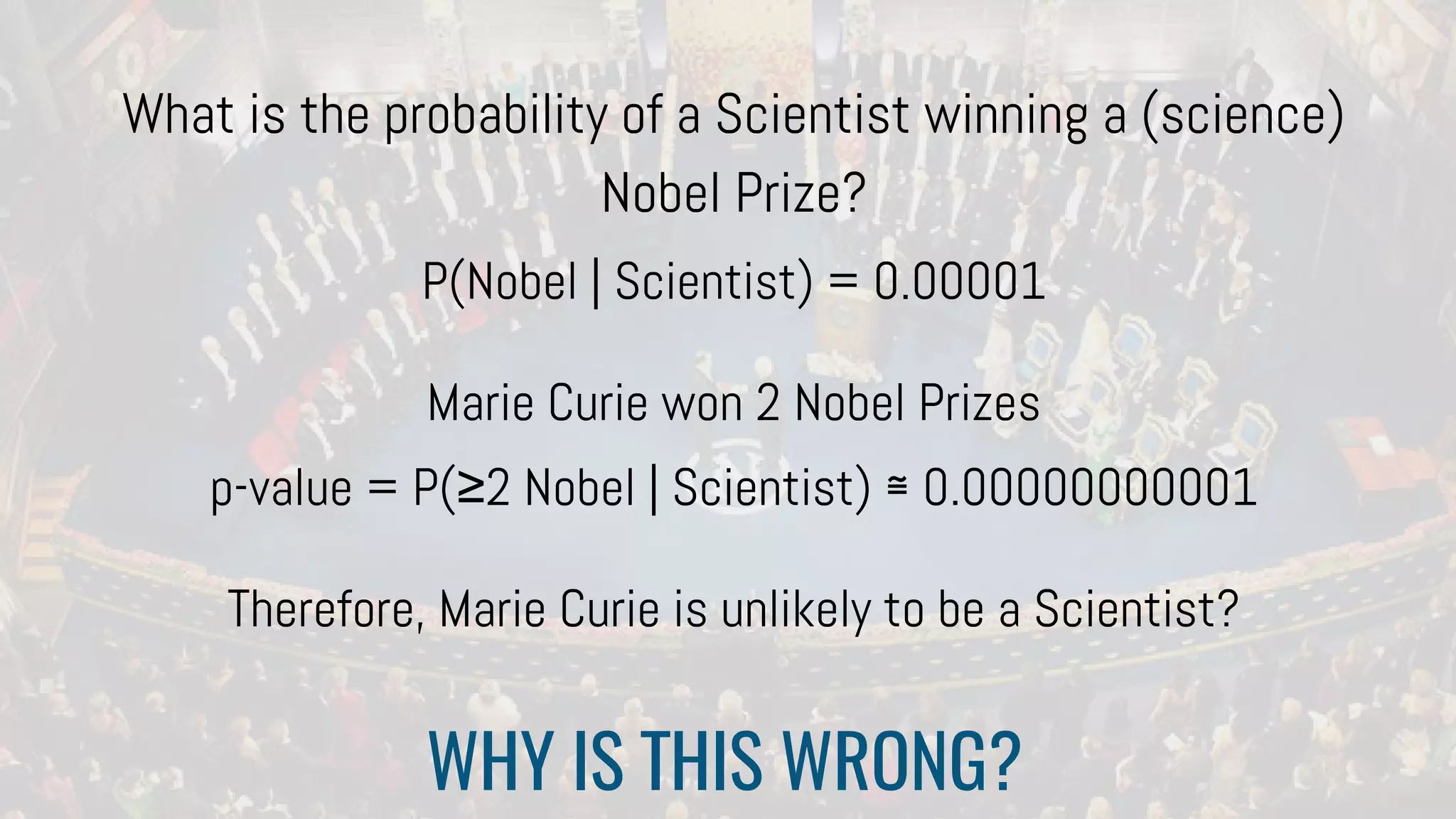
What is the probability of a Scientist winning a (science)
Nobel Prize?
P(Nobel | Scientist) = 0.00001
Marie Curie won 2 Nobel Prizes
p-value = P(≥2 Nobel | Scientist) ≅ 0.00000000001
Therefore, Marie Curie is unlikely to be a Scientist?
WHY IS THIS WRONG?
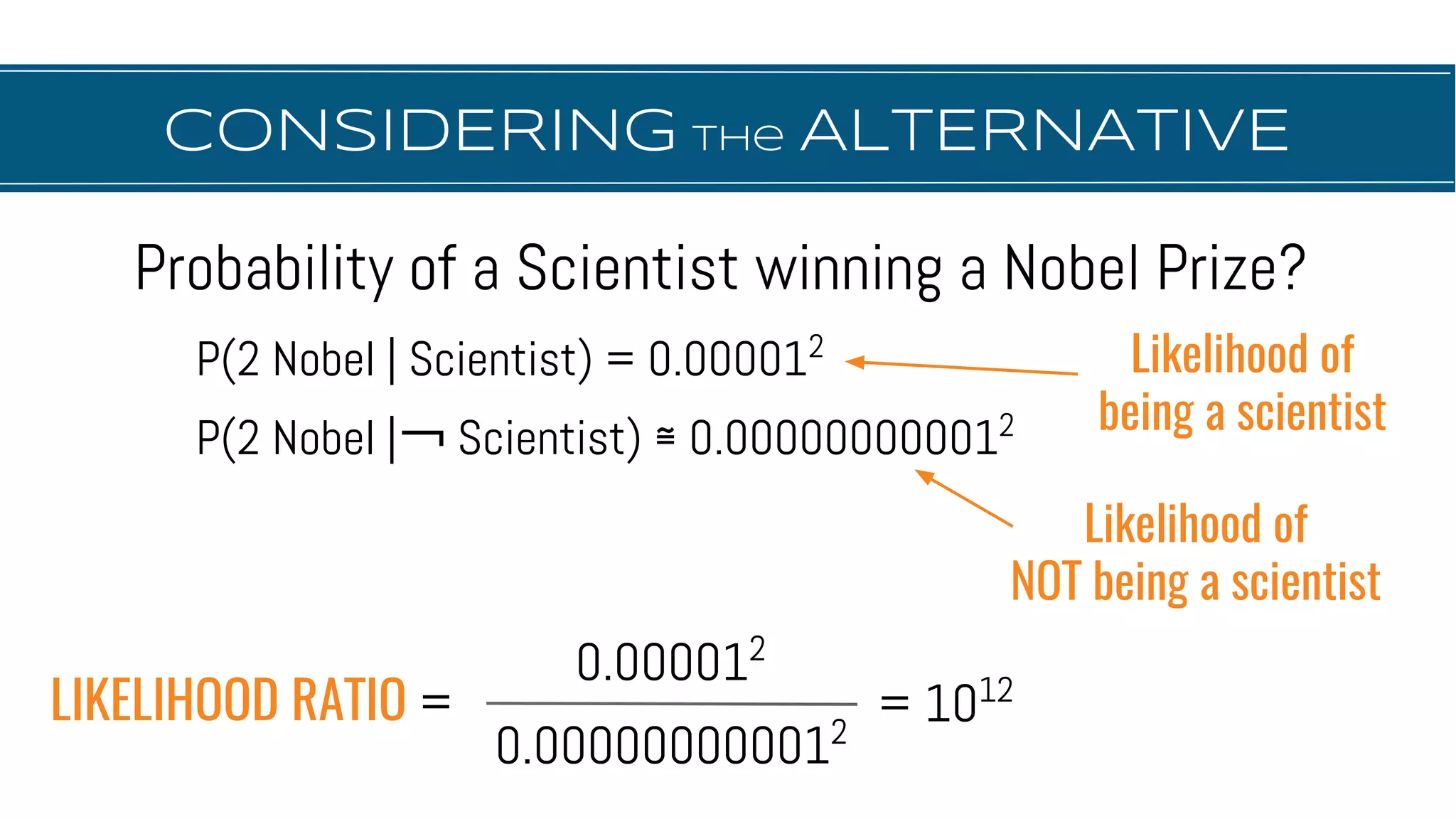
CONSIDERING the ALTERNATIVE
Probability of a Scientist winning a Nobel Prize?
P(2 Nobel | Scientist) = 0.000012
P(2 Nobel |¬ Scientist) ≅ 0.000000000012
Likelihood of
being a scientist
Likelihood of
NOT being a scientist
LIKELIHOOD RATIO = = 1012
0.000000000012
0.000012
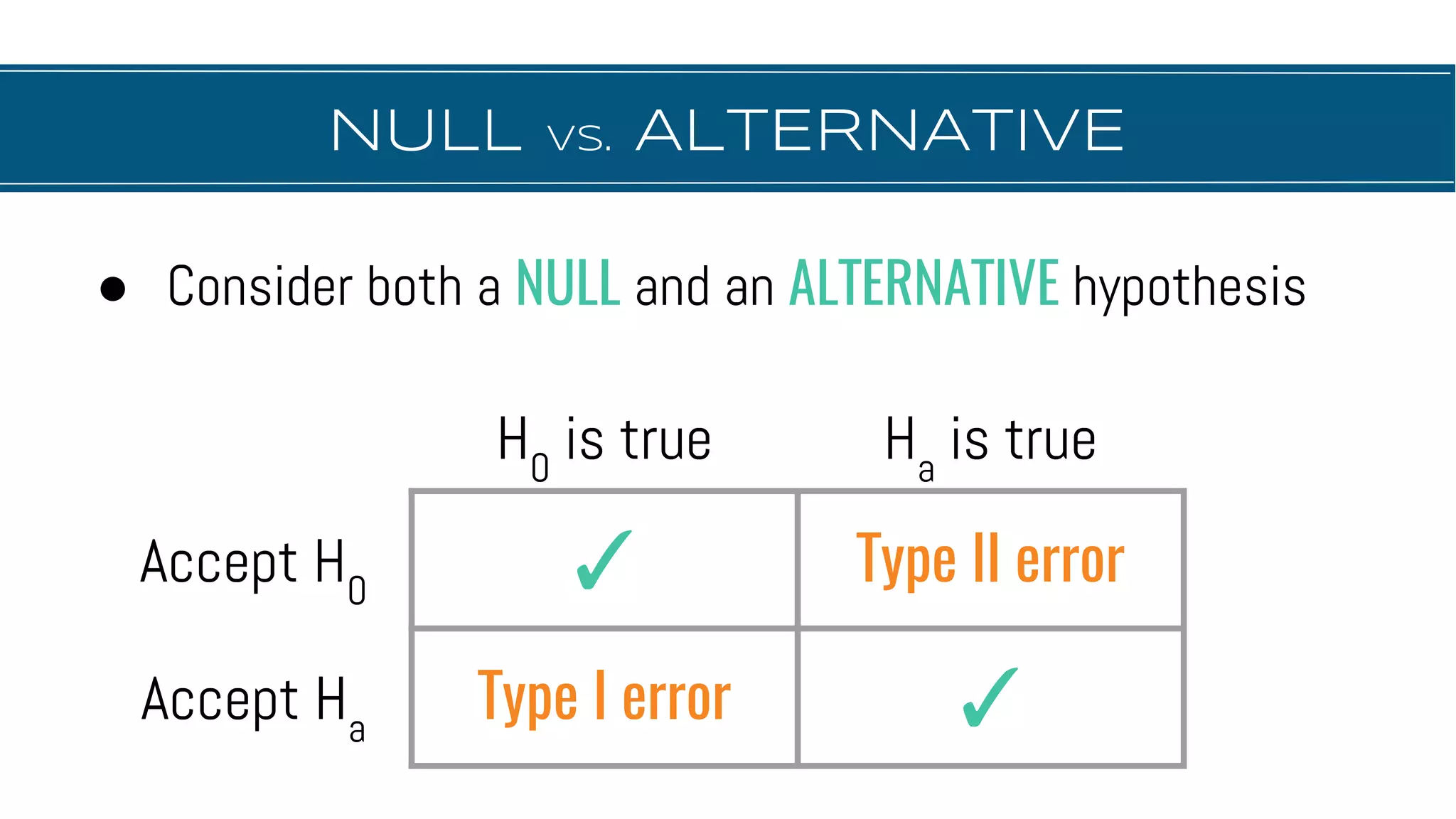
NULL vs. ALTERNATIVE
H0
is true Ha
is true
Accept H0 ✓ Type II error
Accept Ha
Type I error ✓
● Consider both a NULL and an ALTERNATIVE hypothesis
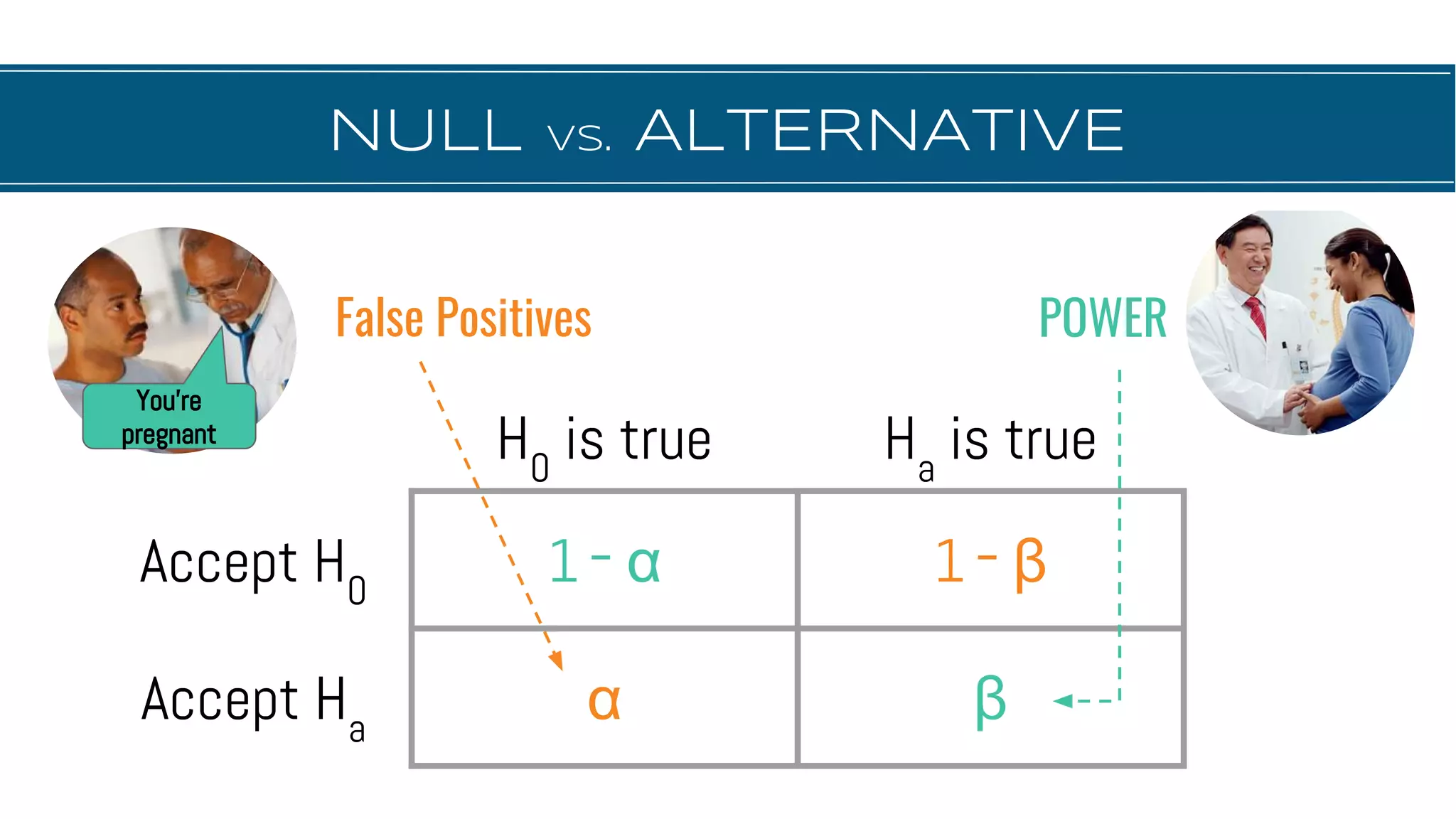
NULL vs. ALTERNATIVE
H0
is true Ha
is true
Accept H0
1 − α 1 − β
Accept Ha
α β
False Positives
You’re
pregnant
POWER
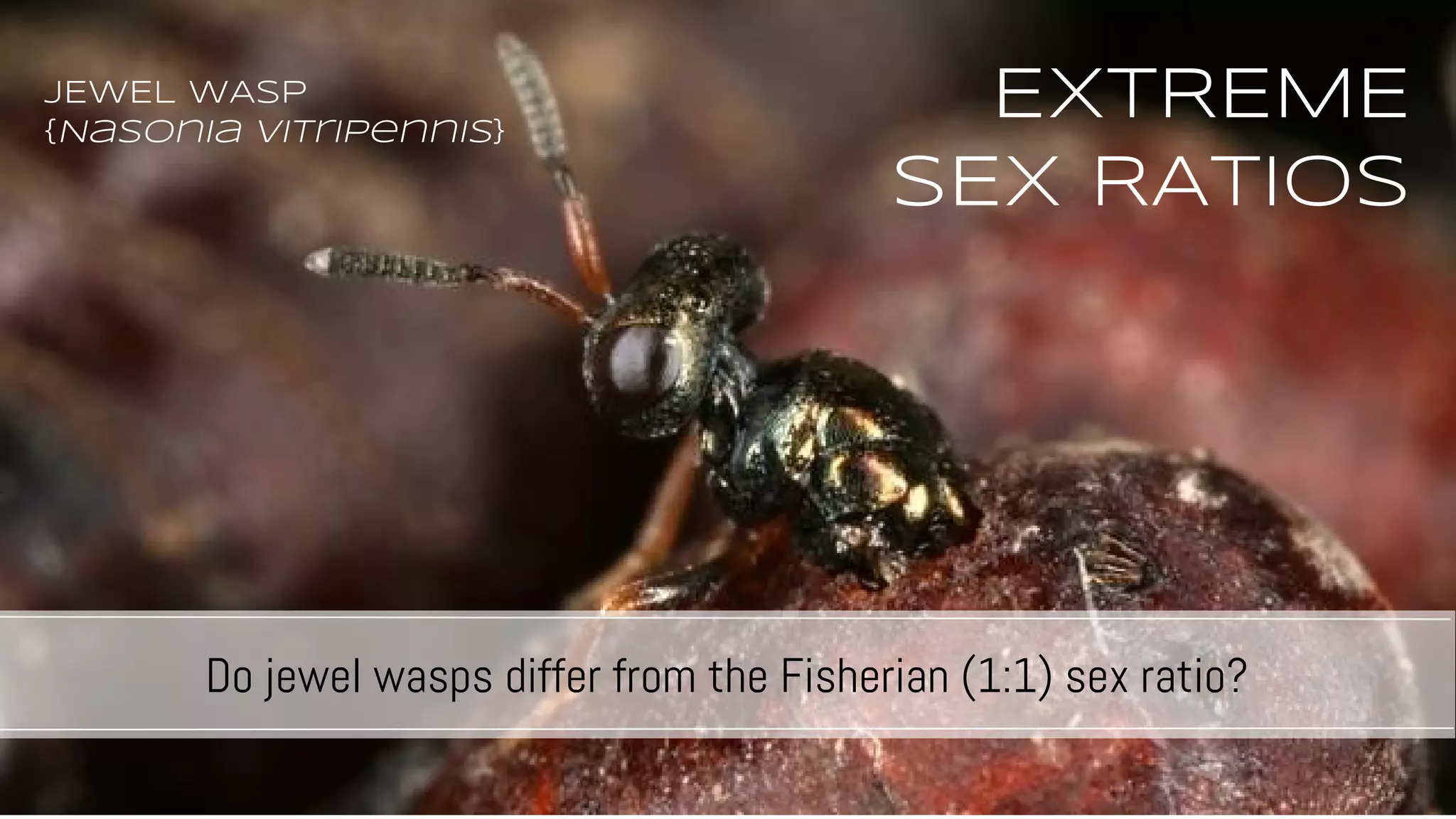
JEWEL WASP
{Nasonia vitripennis}
EXTREME
SEX RATIOS
Do jewel wasps differ from the Fisherian (1:1) sex ratio?
Null model (H0
)
Parameter
Data (X)
Statistic
Probability
inspired by
Hamilton 1967.
Science
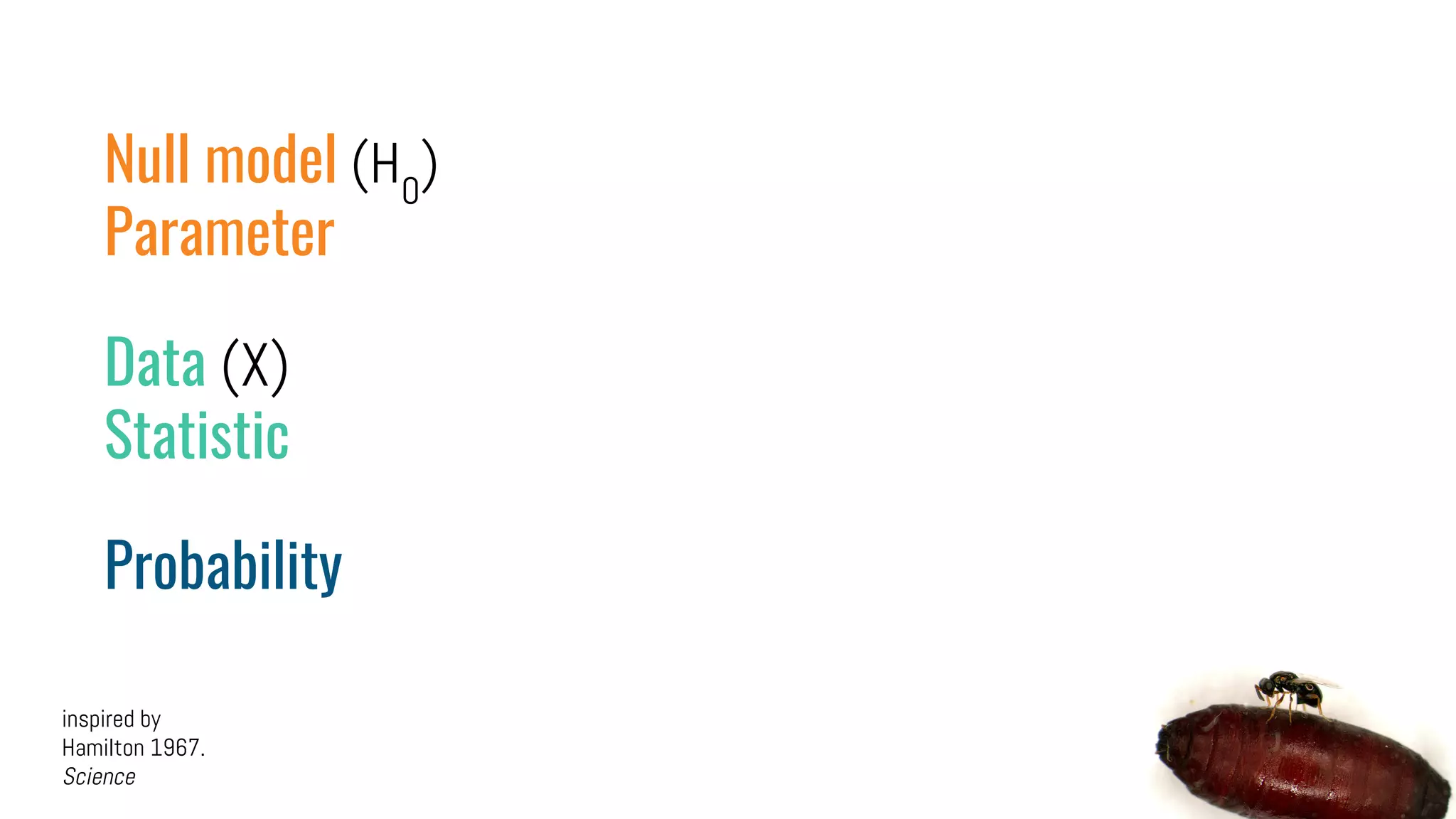
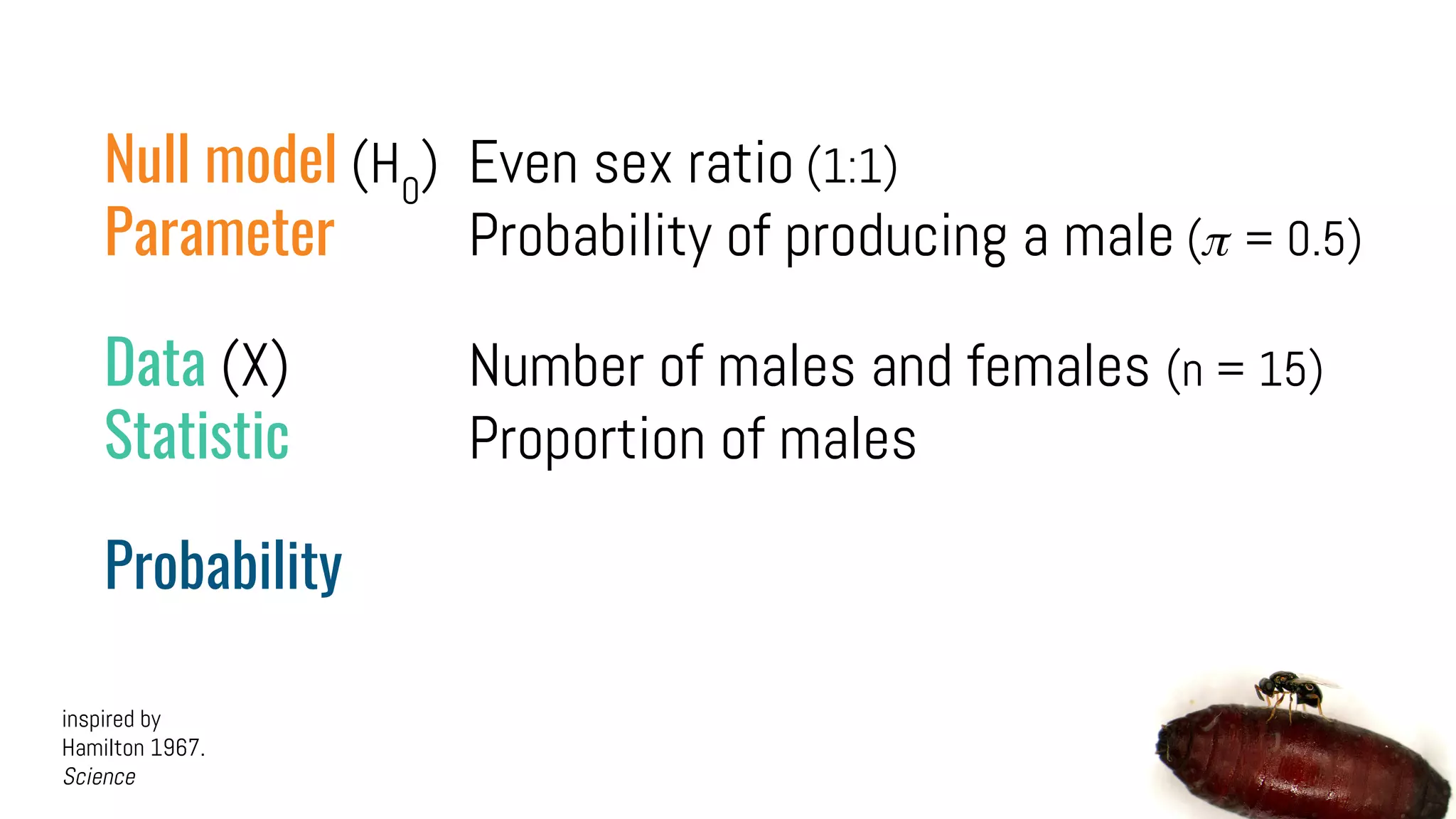
Null model (H0
) Even sex ratio (1:1)
Parameter Probability of producing a male ( = 0.5)
Data (X) Number of males and females (n = 15)
Statistic Proportion of males
Probability
inspired by
Hamilton 1967.
Science
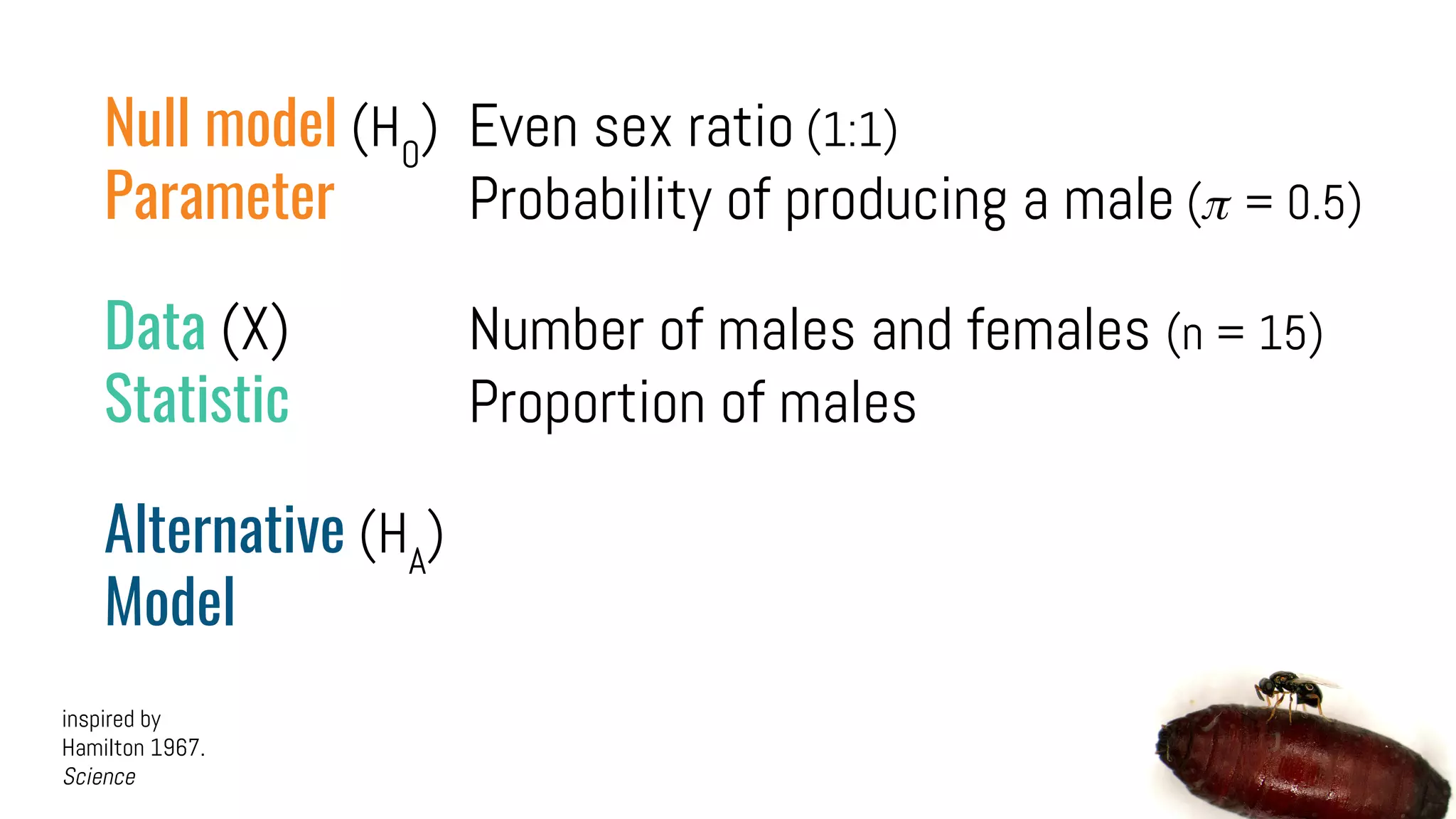
Null model (H0
) Even sex ratio (1:1)
Parameter Probability of producing a male ( = 0.5)
Data (X) Number of males and females (n = 15)
Statistic Proportion of males
Alternative (HA
)
Model
inspired by
Hamilton 1967.
Science
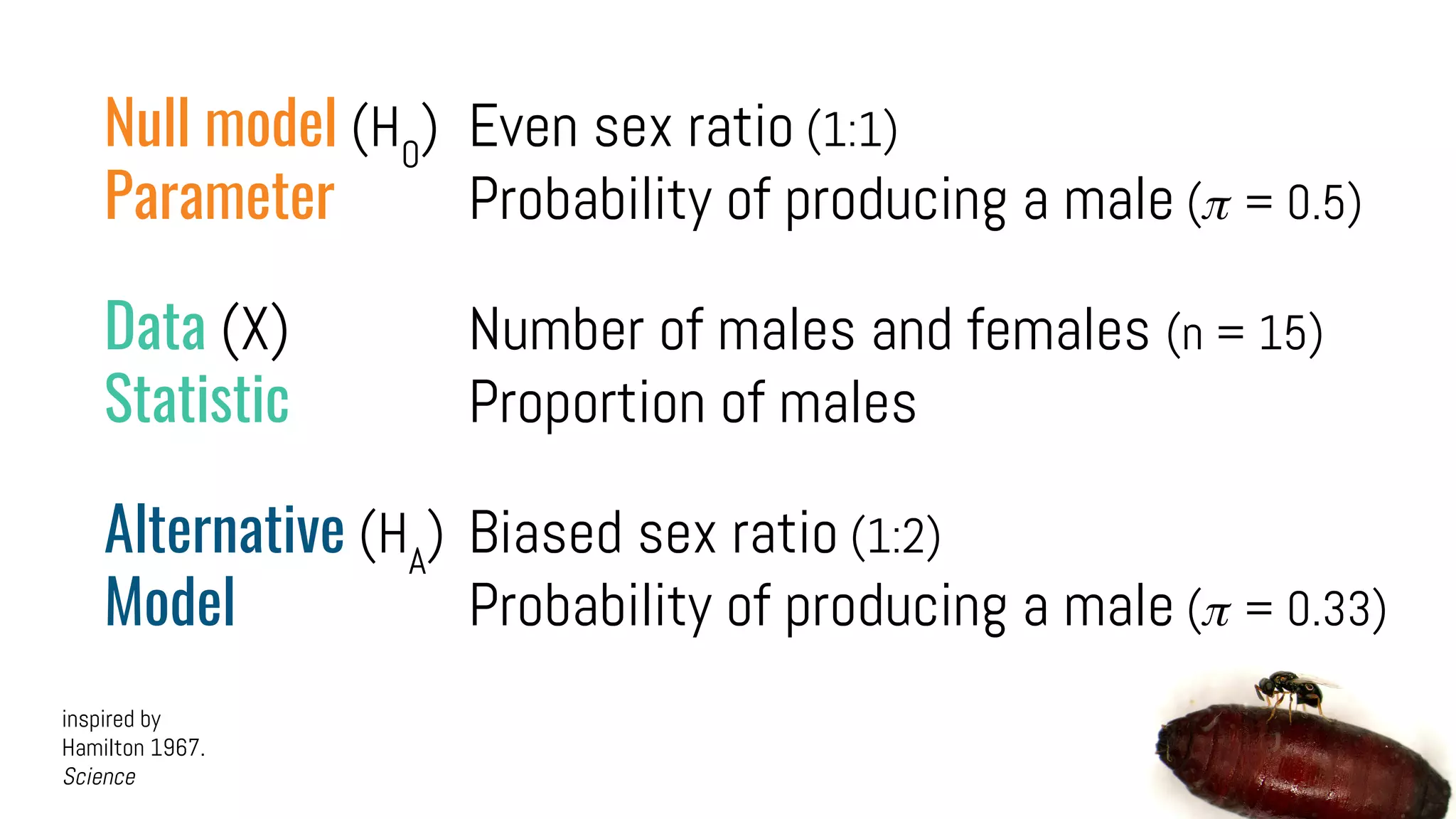
Null model (H0
) Even sex ratio (1:1)
Parameter Probability of producing a male ( = 0.5)
Data (X) Number of males and females (n = 15)
Statistic Proportion of males
Alternative (HA
) Biased sex ratio (1:2)
Model Probability of producing a male ( = 0.33)
inspired by
Hamilton 1967.
Science
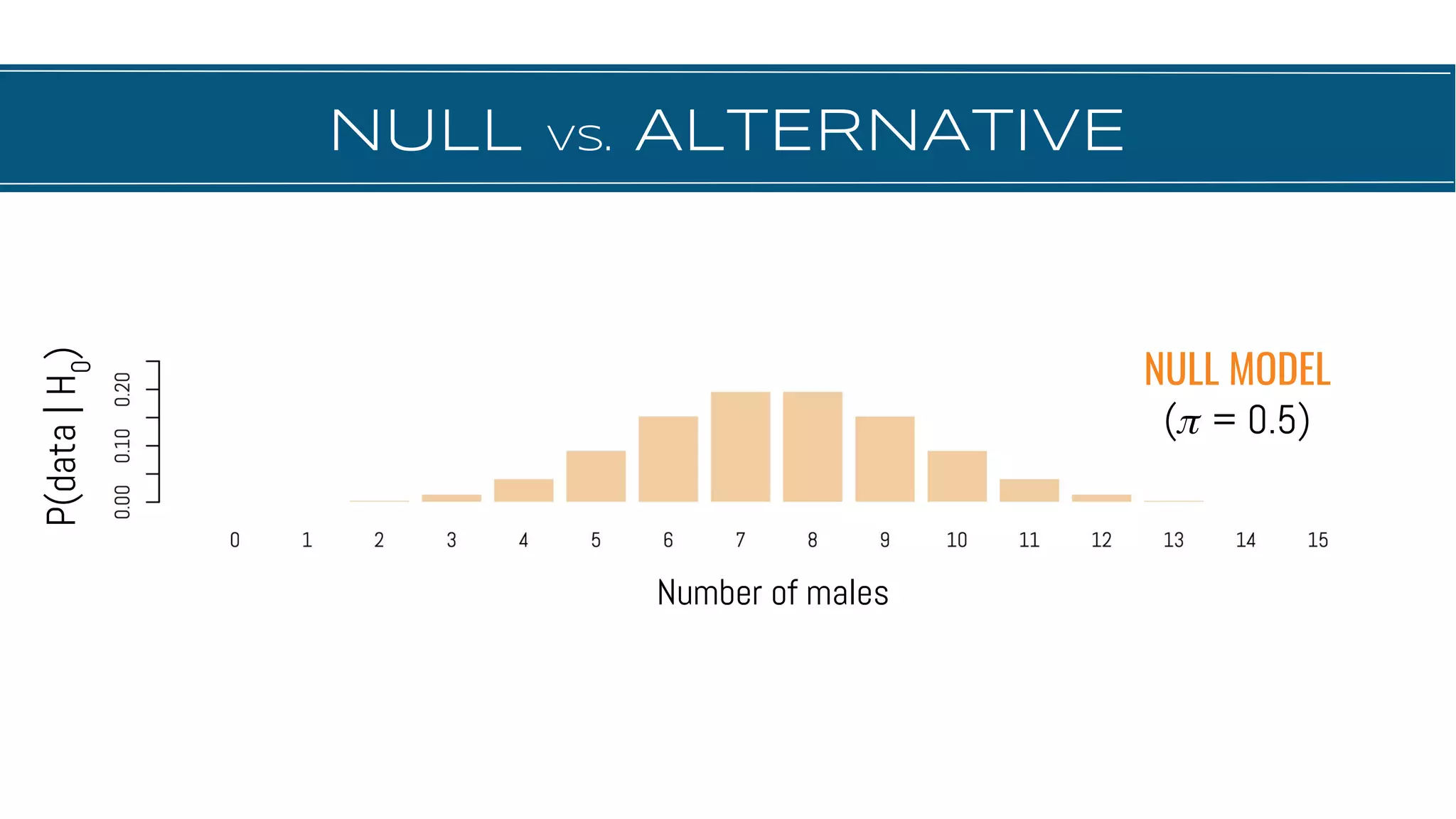
NULL vs. ALTERNATIVE
NULL MODEL
( = 0.5)
Number of males
P(data|H0
)
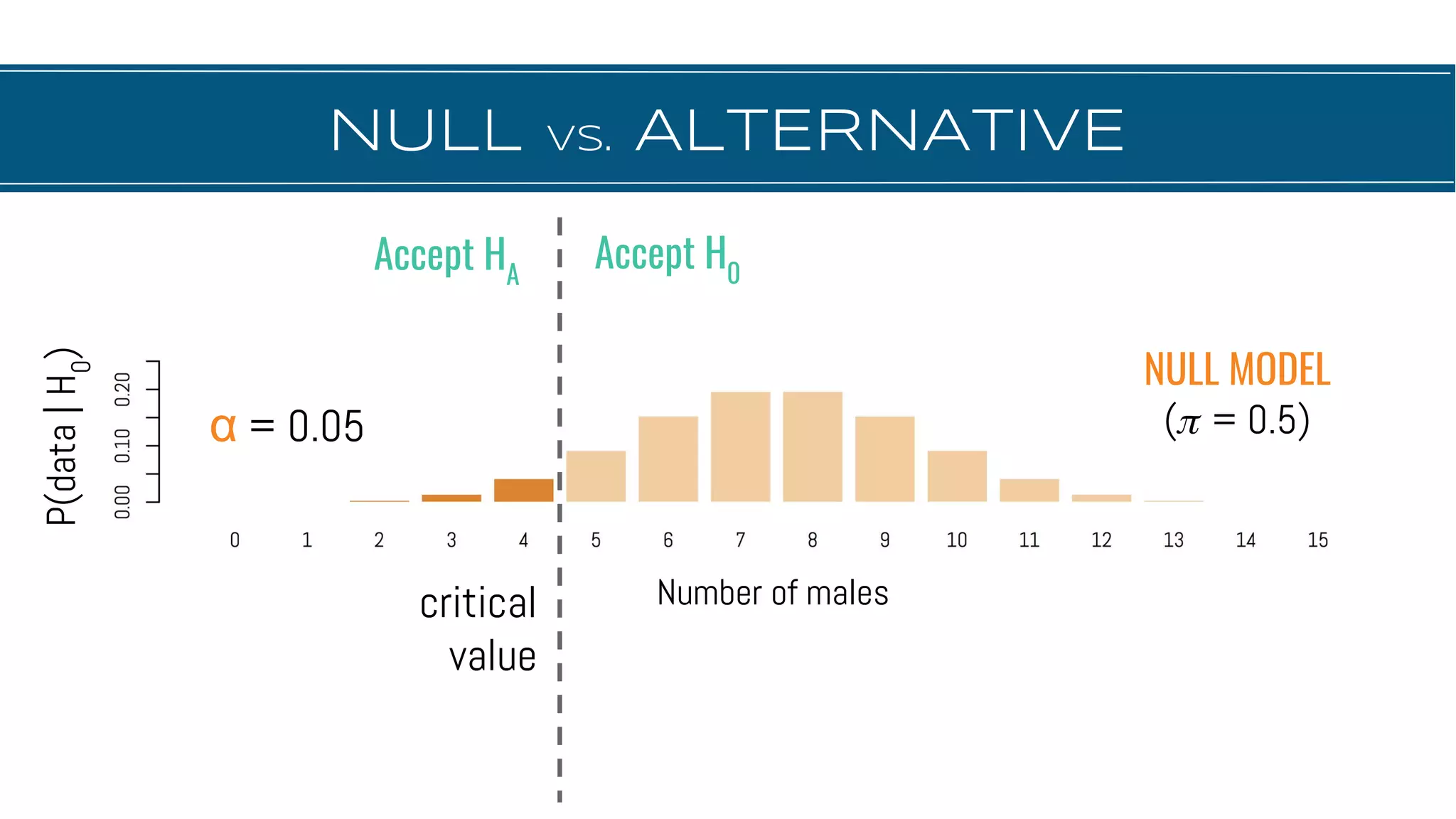
NULL vs. ALTERNATIVE
α = 0.05
P(data|H0
)
critical
value
NULL MODEL
( = 0.5)
Number of males
Accept HA
Accept H0
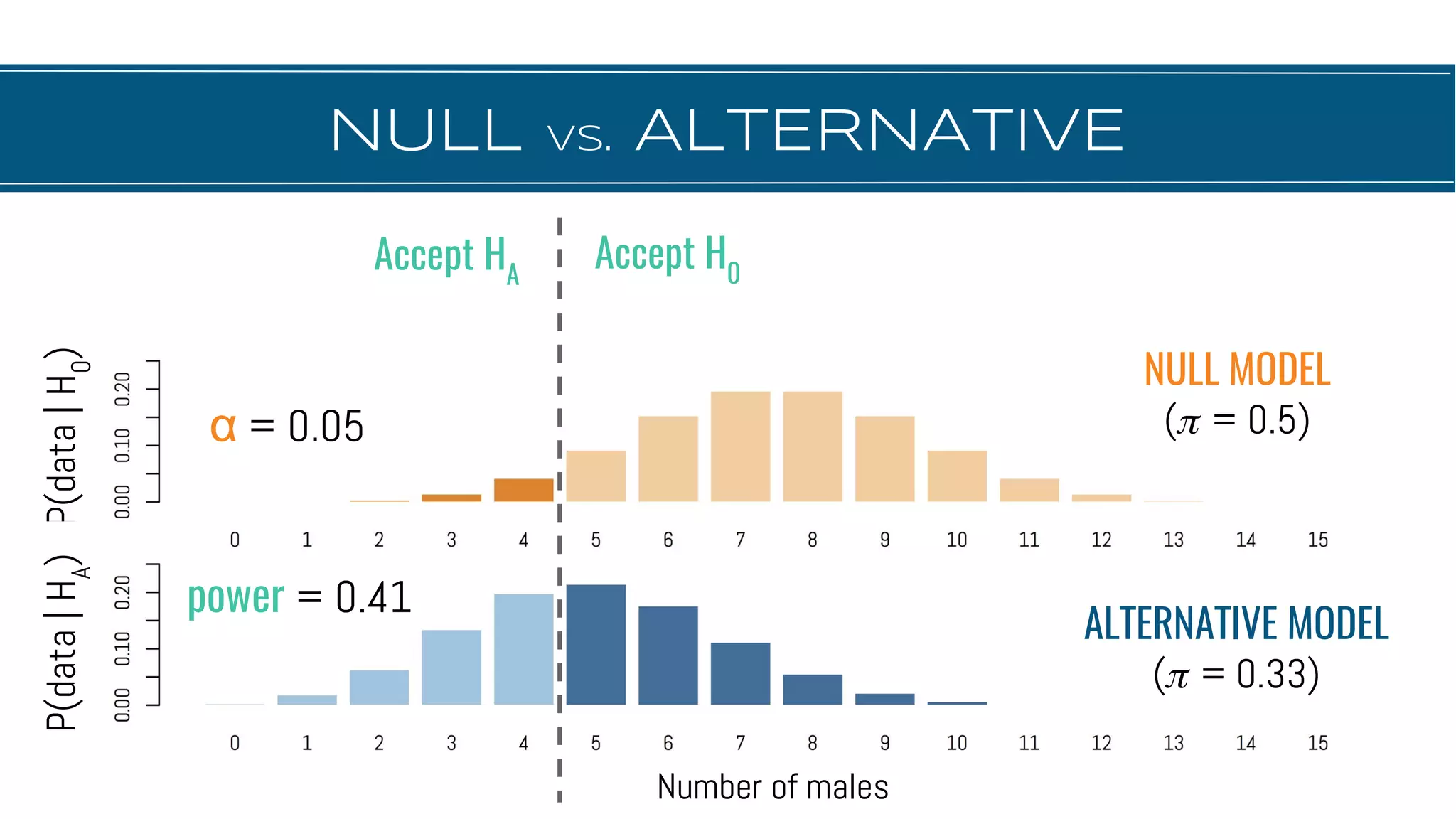
NULL vs. ALTERNATIVE
α = 0.05
P(data|H0
)
NULL MODEL
( = 0.5)
power = 0.41
Number of males
ALTERNATIVE MODEL
( = 0.33)
Accept HA
Accept H0
P(data|HA
)
WHAT GIVES
POWER?
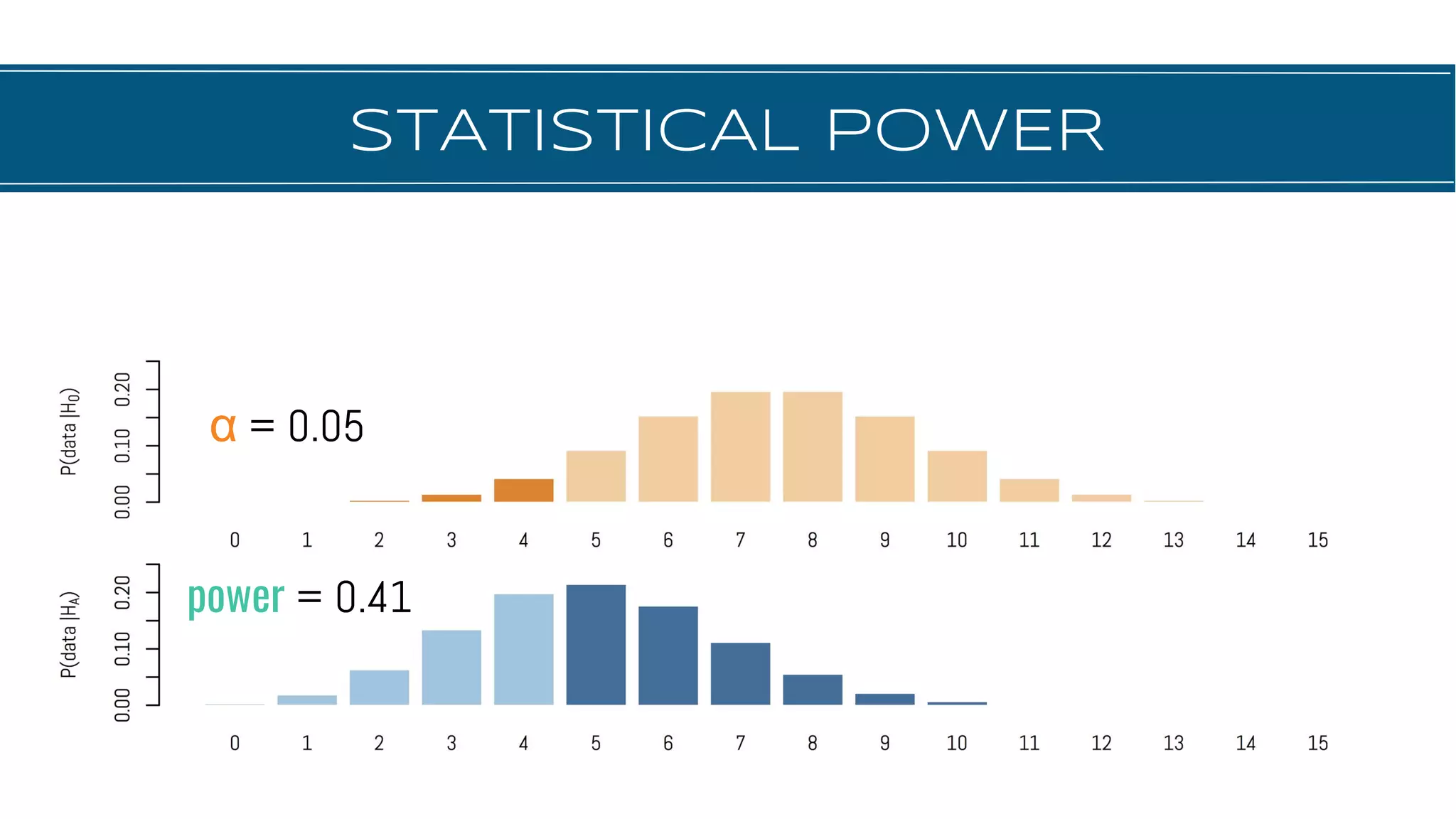
STATISTICAL POWER
power = 0.41
α = 0.05
STATISTICAL POWER
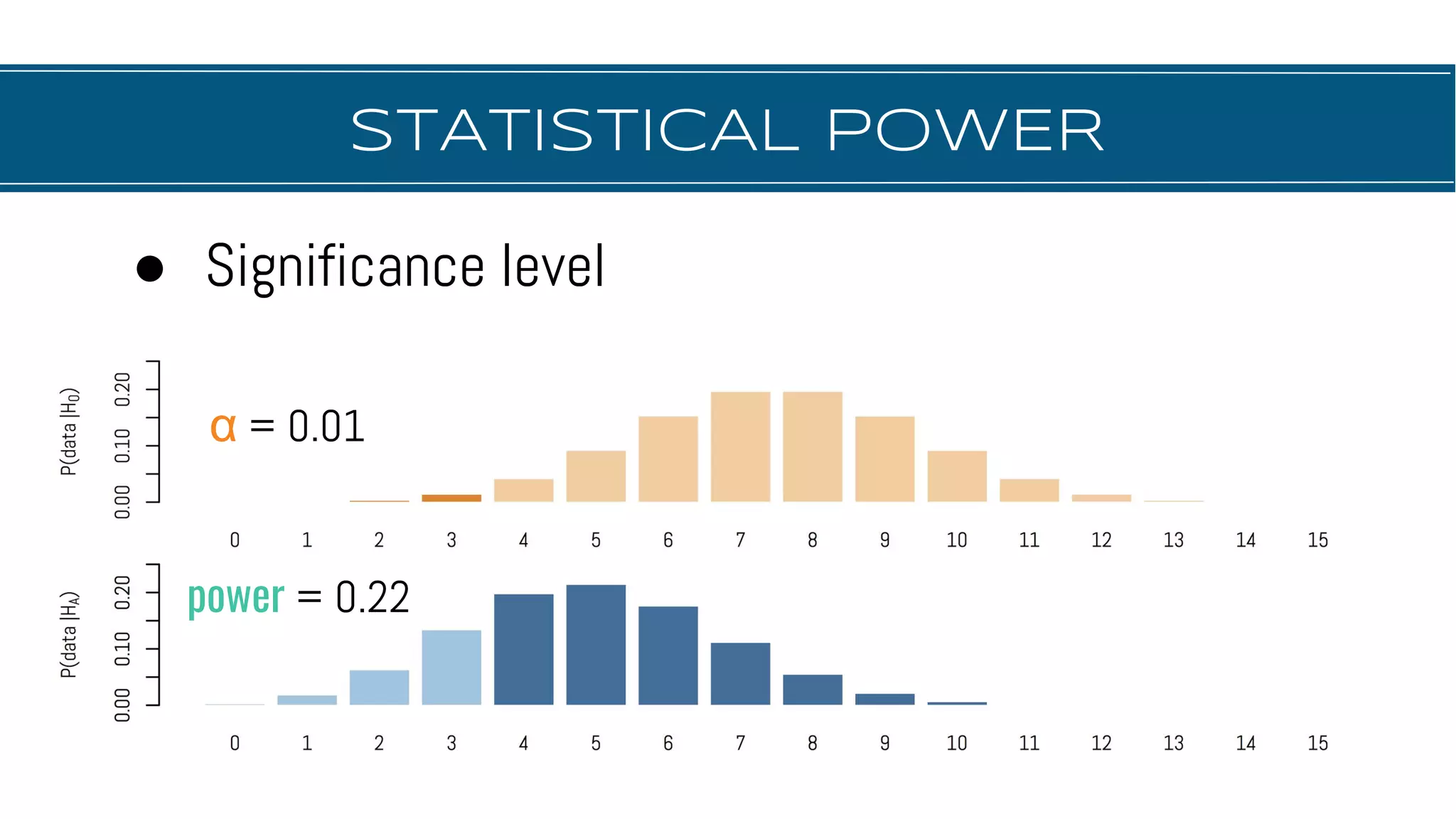
power = 0.22
● Significance level
α = 0.01
STATISTICAL POWER
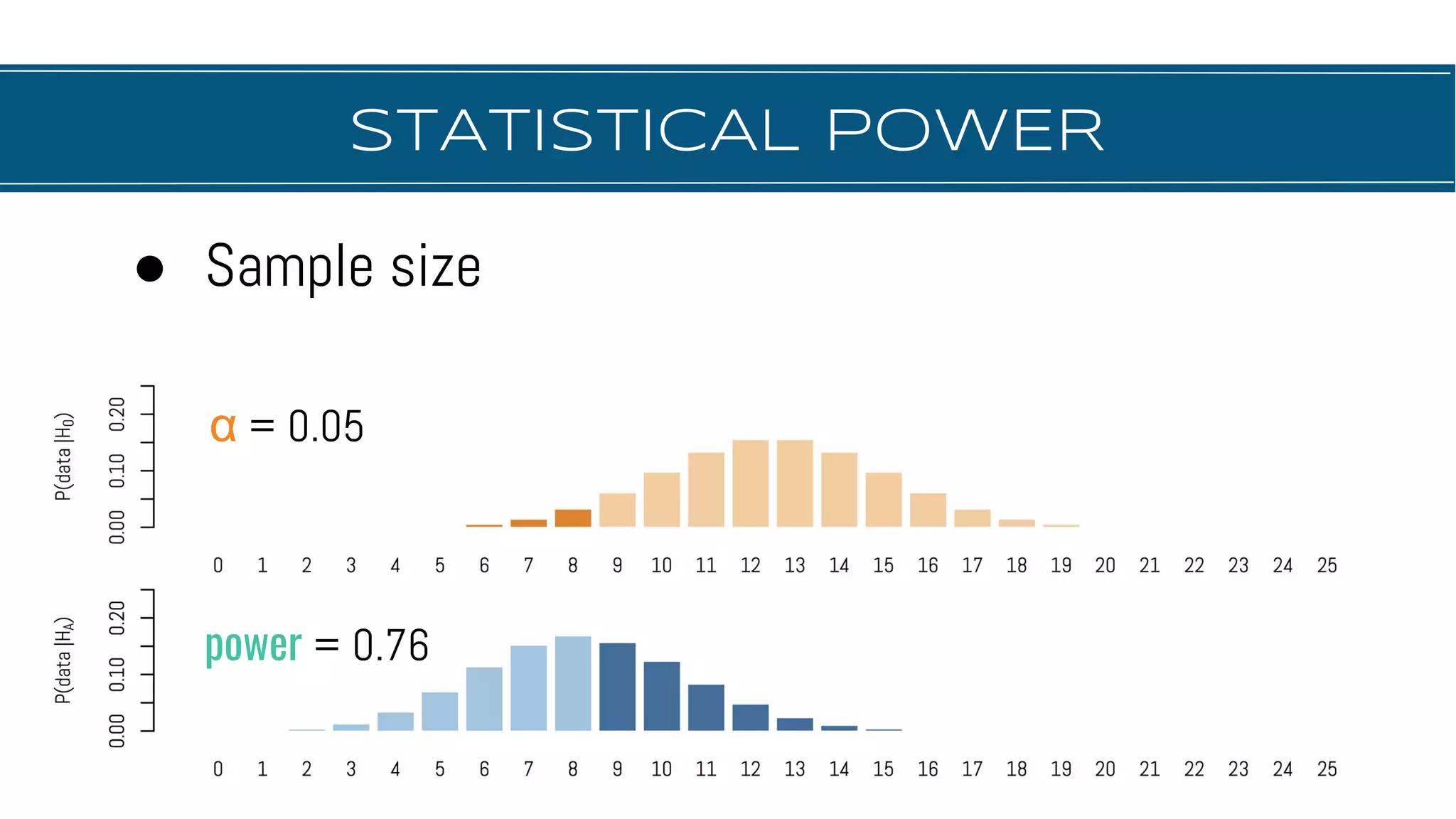
power = 0.76
● Sample size
α = 0.05
STATISTICAL POWER
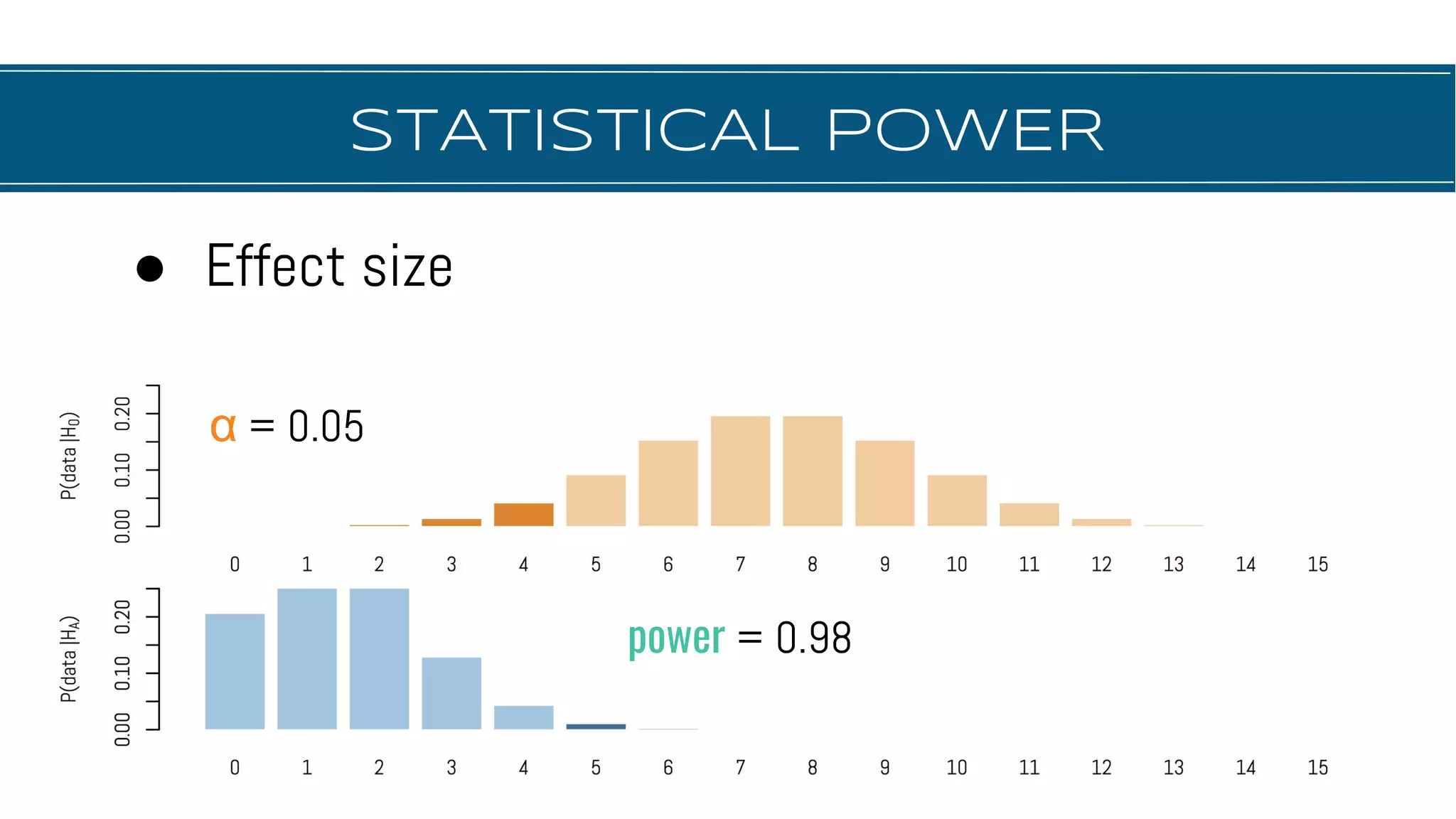
power = 0.98
● Effect size
α = 0.05
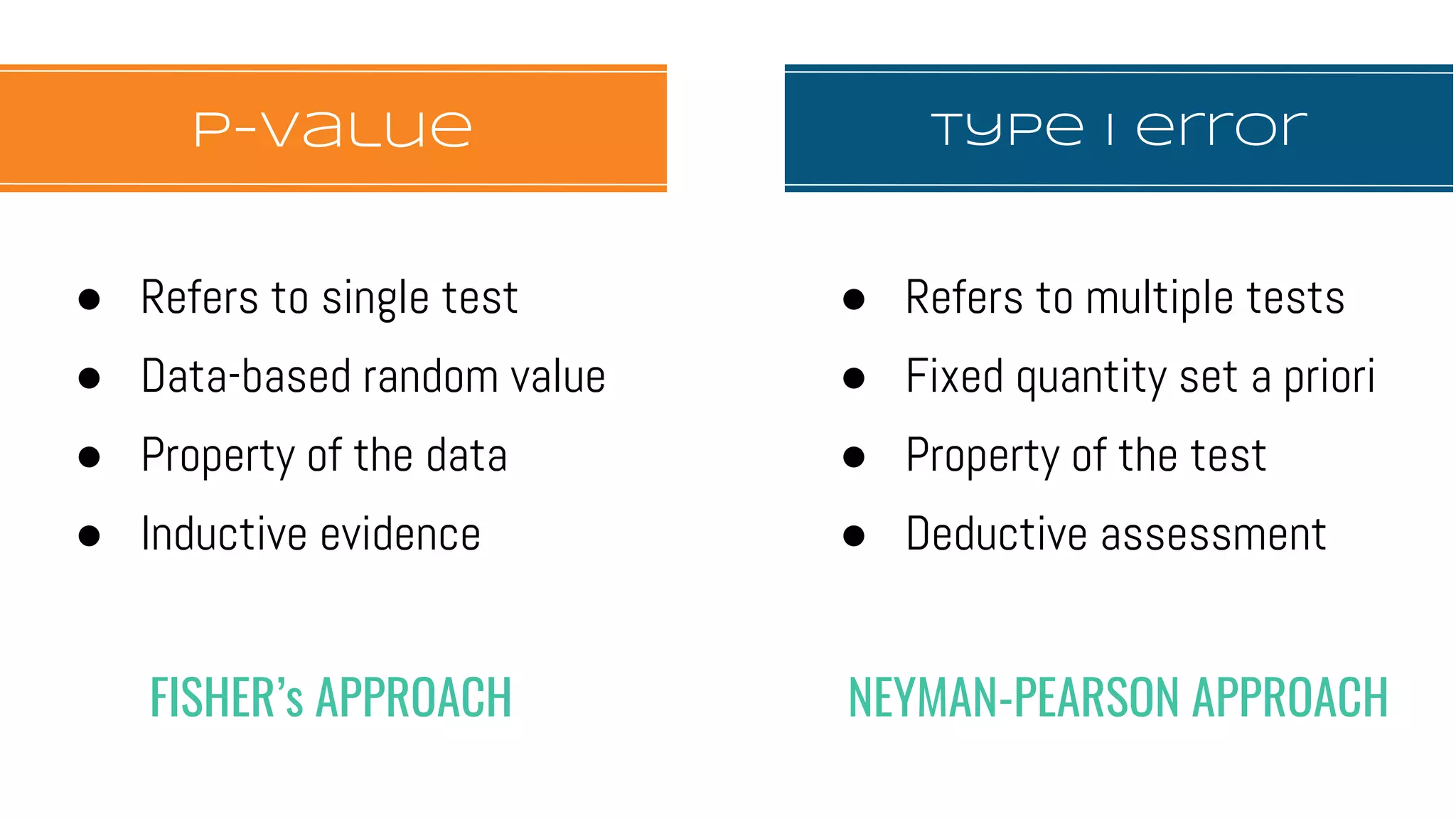
Type I errorp-value
● Refers to single test
● Data-based random value
● Property of the data
● Inductive evidence
● Refers to multiple tests
● Fixed quantity set a priori
● Property of the test
● Deductive assessment
FISHER’s APPROACH NEYMAN-PEARSON APPROACH
UNDERSTANDING TESTS
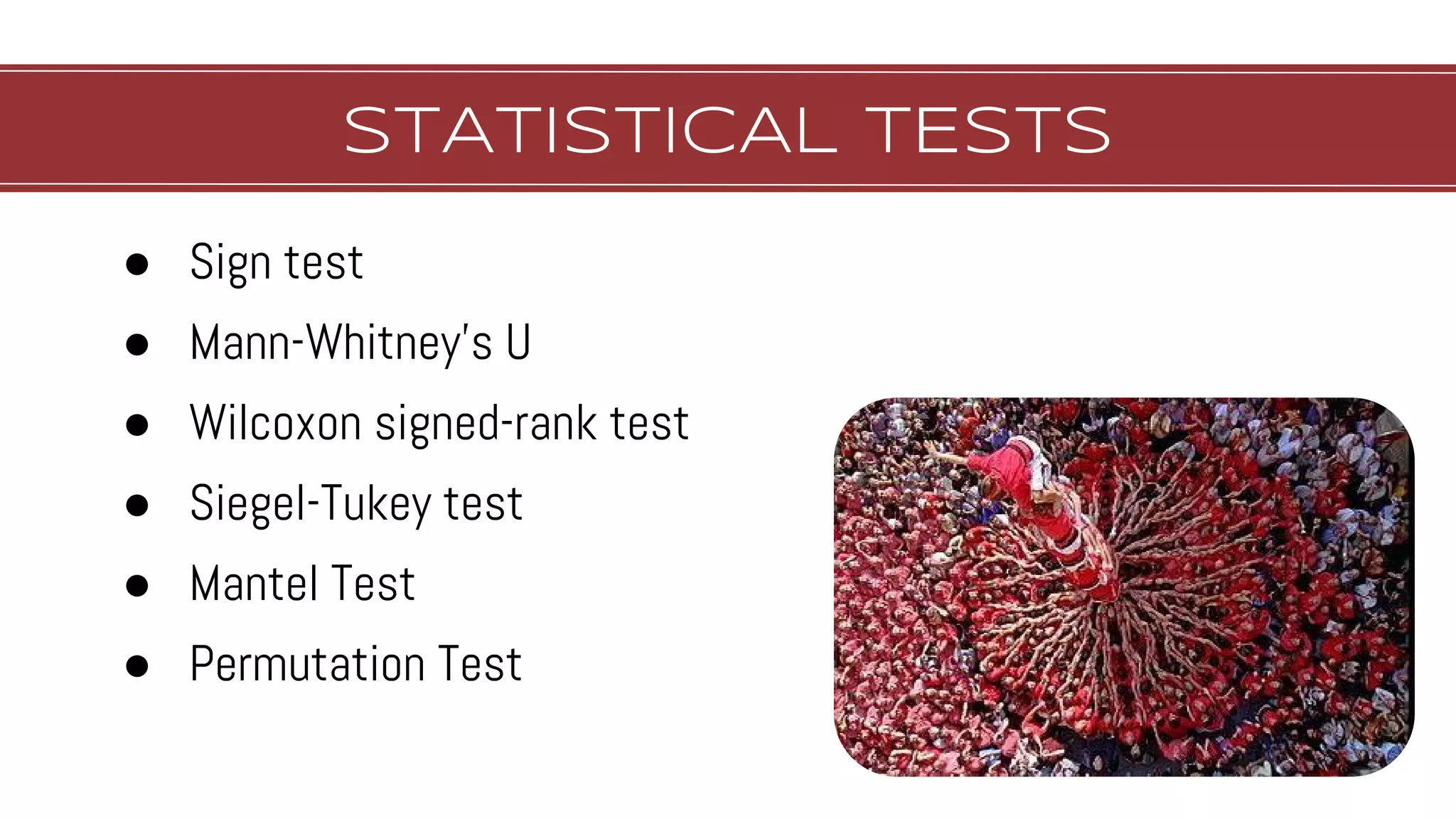
STATISTICAL TESTS
● Sign test
● Mann-Whitney’s U
● Wilcoxon signed-rank test
● Siegel-Tukey test
● Mantel Test
● Permutation Test
HOMEWORK
HOMEWORK
● Work in groups
● Read one of the assigned articles applying a
nonparametric test in biological research
● Try to understand the test in question
● Present your findings to the class
30.01.17
10:00h
QUESTIONS
1. What is the question? What is the purpose of the test?
2. What is the statistic and what does it measure?
3. How is the null hypothesis built and what does it assume?
4. How does the test answer the question?
5. Find out how to implement the test in R
6. What other applications could this test have?
PRESENTATIONS
6 questions = 6 slides = 6 minutes
EvALUATION
● Questions: Relate lecture concepts to the new test
● Delivery: Quality and clarity of the presentation
● Discussion: Both asking and answering questions
● Group-level AND individual-level
Group work ≠ Dividing tasks
(except in presenting)

Foundations of Statistics for Ecology and Evolution. 2. Hypothesis Testing

  • 1.
  • 2.
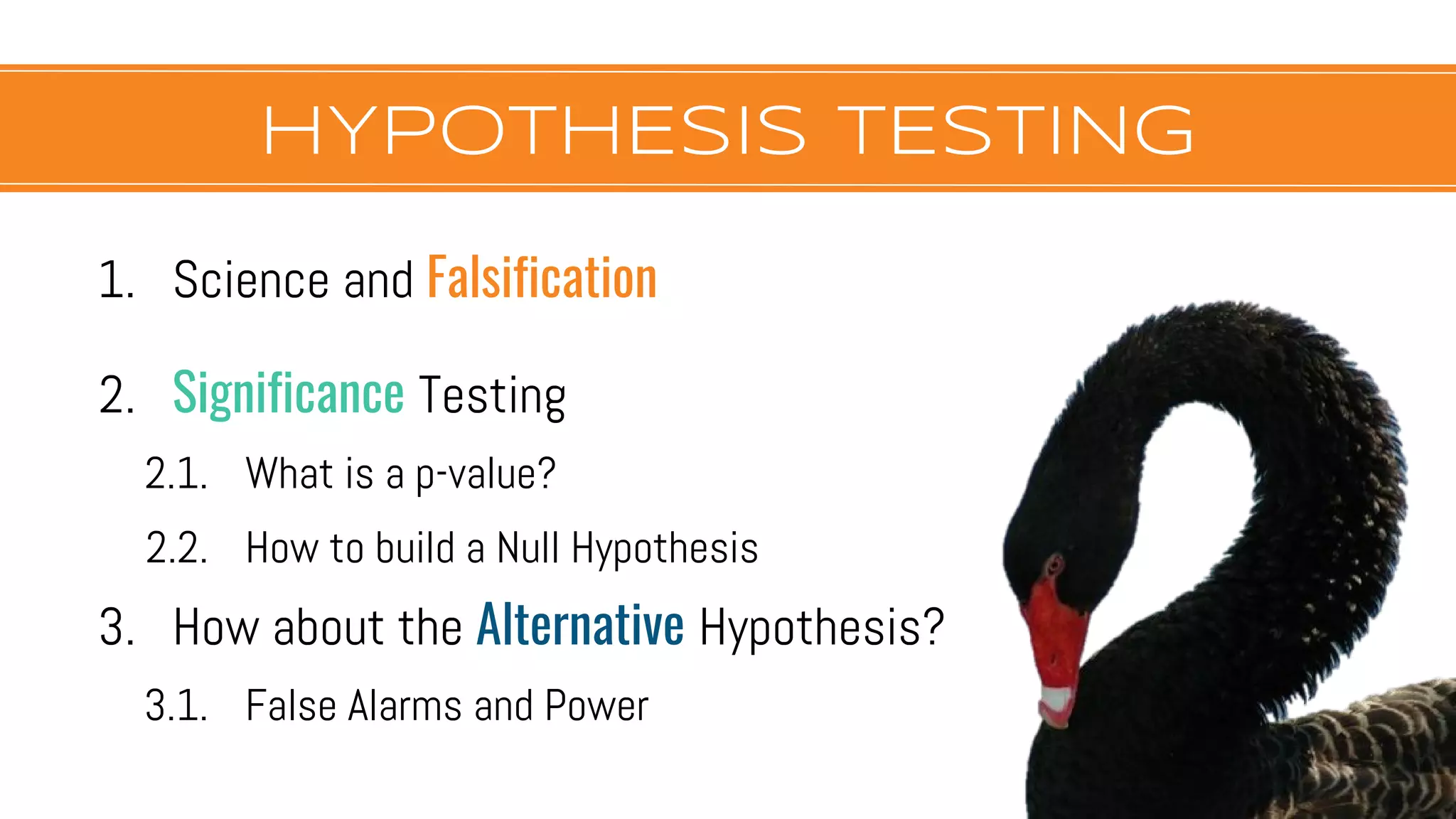
    HYPOTHESIS TESTING 1. Scienceand Falsification 2. Significance Testing 2.1. What is a p-value? 2.2. How to build a Null Hypothesis 3. How about the Alternative Hypothesis? 3.1. False Alarms and Power
  • 3.
    FALSIFICATIONISM ● Denying theconsequent (modum tollens) ((P → Q) ^ ¬Q) → ¬P (model → data) ^ ¬data) → ¬model ● Models can only be disproven ● Not explicitly probabilistic
  • 4.
    STATISTICAL FALSIFICATIONISM ● Datais a consequence of the true model ● That consequence is probabilistic Likelihood (Model) = P(Data | Model) ● Model unlikely if data obtained would have low probability under that model.
  • 5.
    tHE LADY DRINKING TEA Doestea taste different when the milk, instead of the tea, is poured first?
  • 6.
    TEST INGREDIENTS ● Ahypothesis to reject: the null model (H0 ) ● Some data ● A summary of the data: a statistic ● A way to calculate the probability distribution of the statistic given H0 NULL HYPOTHESIS SIGNIFICANCE TESTING
  • 7.
    NHST Null model (H0 ) Parameter Data(X) Statistic Probability
  • 8.
    NHST Null model (H0 ) Parameter Data(X) Statistic Probability Null model (H0 ) Lady can’t tell the difference Parameter Probability of mistake (pm = 0.5) Data (X) 1 mistake out of 10 (n = 10) Statistic Proportion of mistakes (Pm =0.1) Probability What is the probability of 1/10 mistakes if H0 is true and pm = 0.5?
  • 9.
  • 10.
  • 11.
    pr (1-p)n-rn! r! (n-r)!P(r, n| p ) = What is the probability of making r mistakes out of n trials given p? p = probability of mistake r = number of mistakes n = number of trials
  • 12.
    The BINOMIAL TEST Probabilityof 1 or less mistakes= 0.0107 IF H0 (pm = 0.5) p-value 0.0009 0.0098 0.0439 0.1171 0.2051 0.2461 0.1171 0.2051 0.0439 0.0098 0.0009
  • 13.
    P-vALUES ● NOT theprobability of the null hypothesis being true
  • 14.
    P-vALUES ● NOT theprobability of the null hypothesis being true ● NOT applicable to all distributions
  • 15.
    P-vALUES ● NOT theprobability of the null hypothesis being true ● NOT applicable to all distributions ● NOT a measure of effect size or importance
  • 16.
    NHST Null model (H0 )Lady can’t tell the difference Parameter Probability of mistake (pm = 0.5) Data (X) 450 mistakes out of 1000 (n = 1000) Statistic Proportion of mistakes (Pm = 0.45) P-value What is the probability of making ≤ 450/1000 mistakes if pm = 0.5?
  • 17.
    The BINOMIAL TEST p= 0.0008 IF H0 (pm = 0.5)
  • 18.
    P-vALUES ● NOT theprobability of the null hypothesis being true ● NOT applicable to all distributions ● NOT a measure of effect size or importance ● ANY effect will be significant given enough data
  • 19.
    SIGNIFICANCE VS. MAGNITUDE 10%mistakes p = 0.0008p = 0.0107 45% mistakes How good is 0.45? What would be the a better null hypothesis?
  • 20.
    NHST Null model (H0 )One in three mistakes Parameter Probability of mistake (pm = 0.33) Data (X) 1 mistake out of 10 (n = 10) Statistic Proportion of mistakes (Pm =0.1) P-value What is the probability of making ≤1/10 mistakes if pm = 0.33?
  • 21.
    CHOOSING THE RIGHTNULL p-value = 0.1812 IF pm = 0.33
  • 22.
    SAGUAROS iN SPACE Do individualsdistribute randomly in space?
  • 23.
  • 24.
  • 25.
    RANDOMIZATION 1. Draw arandom sample 2. Calculate statistic 3. Do it many times re = 40.2 re = 47.2 re = 58.7 re = 56.1 re = 44.4 re = 51.4
  • 26.
    RANDOMIZATION 1. Draw arandom sample 2. Calculate statistic 3. Do it many times re = 40.2 re = 47.2 re = 58.7 re = 56.1 re = 44.4 re = 51.4
  • 27.
    RANDOMIZATION 1. Draw arandom sample 2. Calculate statistic 3. Do it many times 4. Distribution of those statistics Distribution of the test statistic (re ) under the NULL HYPOTHESIS
  • 28.
  • 29.
    NON-PARAMETRICPARAMETRIC ● Null modeldefined by functions & parameters ● Null model constructed through algorithms
  • 30.
    P-vALUES ● NOT theprobability of the null hypothesis being true ● NOT applicable to all distributions ● NOT a measure of effect size or importance ● NOT appropriate for modeling rare events
  • 31.
    What is theprobability of a Scientist winning a (science) Nobel Prize? P(Nobel | Scientist) = 0.00001 Marie Curie won 2 Nobel Prizes p-value = P(≥2 Nobel | Scientist) ≅ 0.00000000001 Therefore, Marie Curie is unlikely to be a Scientist? WHY IS THIS WRONG?
  • 32.
    CONSIDERING the ALTERNATIVE Probabilityof a Scientist winning a Nobel Prize? P(2 Nobel | Scientist) = 0.000012 P(2 Nobel |¬ Scientist) ≅ 0.000000000012 Likelihood of being a scientist Likelihood of NOT being a scientist LIKELIHOOD RATIO = = 1012 0.000000000012 0.000012
  • 33.
    NULL vs. ALTERNATIVE H0 istrue Ha is true Accept H0 ✓ Type II error Accept Ha Type I error ✓ ● Consider both a NULL and an ALTERNATIVE hypothesis
  • 34.
    NULL vs. ALTERNATIVE H0 istrue Ha is true Accept H0 1 − α 1 − β Accept Ha α β False Positives You’re pregnant POWER
  • 35.
    JEWEL WASP {Nasonia vitripennis} EXTREME SEXRATIOS Do jewel wasps differ from the Fisherian (1:1) sex ratio?
  • 36.
    Null model (H0 ) Parameter Data(X) Statistic Probability inspired by Hamilton 1967. Science
  • 37.
    Null model (H0 )Even sex ratio (1:1) Parameter Probability of producing a male ( = 0.5) Data (X) Number of males and females (n = 15) Statistic Proportion of males Probability inspired by Hamilton 1967. Science
  • 38.
    Null model (H0 )Even sex ratio (1:1) Parameter Probability of producing a male ( = 0.5) Data (X) Number of males and females (n = 15) Statistic Proportion of males Alternative (HA ) Model inspired by Hamilton 1967. Science
  • 39.
    Null model (H0 )Even sex ratio (1:1) Parameter Probability of producing a male ( = 0.5) Data (X) Number of males and females (n = 15) Statistic Proportion of males Alternative (HA ) Biased sex ratio (1:2) Model Probability of producing a male ( = 0.33) inspired by Hamilton 1967. Science
  • 40.
    NULL vs. ALTERNATIVE NULLMODEL ( = 0.5) Number of males P(data|H0 )
  • 41.
    NULL vs. ALTERNATIVE α= 0.05 P(data|H0 ) critical value NULL MODEL ( = 0.5) Number of males Accept HA Accept H0
  • 42.
    NULL vs. ALTERNATIVE α= 0.05 P(data|H0 ) NULL MODEL ( = 0.5) power = 0.41 Number of males ALTERNATIVE MODEL ( = 0.33) Accept HA Accept H0 P(data|HA )
  • 43.
  • 44.
  • 45.
    STATISTICAL POWER power =0.22 ● Significance level α = 0.01
  • 46.
    STATISTICAL POWER power =0.76 ● Sample size α = 0.05
  • 47.
    STATISTICAL POWER power =0.98 ● Effect size α = 0.05
  • 48.
    Type I errorp-value ●Refers to single test ● Data-based random value ● Property of the data ● Inductive evidence ● Refers to multiple tests ● Fixed quantity set a priori ● Property of the test ● Deductive assessment FISHER’s APPROACH NEYMAN-PEARSON APPROACH
  • 49.
  • 50.
    STATISTICAL TESTS ● Signtest ● Mann-Whitney’s U ● Wilcoxon signed-rank test ● Siegel-Tukey test ● Mantel Test ● Permutation Test
  • 51.
  • 52.
    HOMEWORK ● Work ingroups ● Read one of the assigned articles applying a nonparametric test in biological research ● Try to understand the test in question ● Present your findings to the class 30.01.17 10:00h
  • 53.
    QUESTIONS 1. What isthe question? What is the purpose of the test? 2. What is the statistic and what does it measure? 3. How is the null hypothesis built and what does it assume? 4. How does the test answer the question? 5. Find out how to implement the test in R 6. What other applications could this test have?
  • 54.
    PRESENTATIONS 6 questions =6 slides = 6 minutes
  • 55.
    EvALUATION ● Questions: Relatelecture concepts to the new test ● Delivery: Quality and clarity of the presentation ● Discussion: Both asking and answering questions ● Group-level AND individual-level Group work ≠ Dividing tasks (except in presenting)