Basics of Hypothesis TestingBasics of Hypothesis Testing
By Prof Handley Mpoki MafwengaBy Prof Handley Mpoki Mafwenga
Ph.D, MSc, MBA, LLM, PGDTM, ADTM, LLB, FCTA(UK)Ph.D, MSc, MBA, LLM, PGDTM, ADTM, LLB, FCTA(UK)
Macro-fiscal Policy, Advocacy and Tax Expert [Gov-Macro-fiscal Policy, Advocacy and Tax Expert [Gov-
URT]URT]
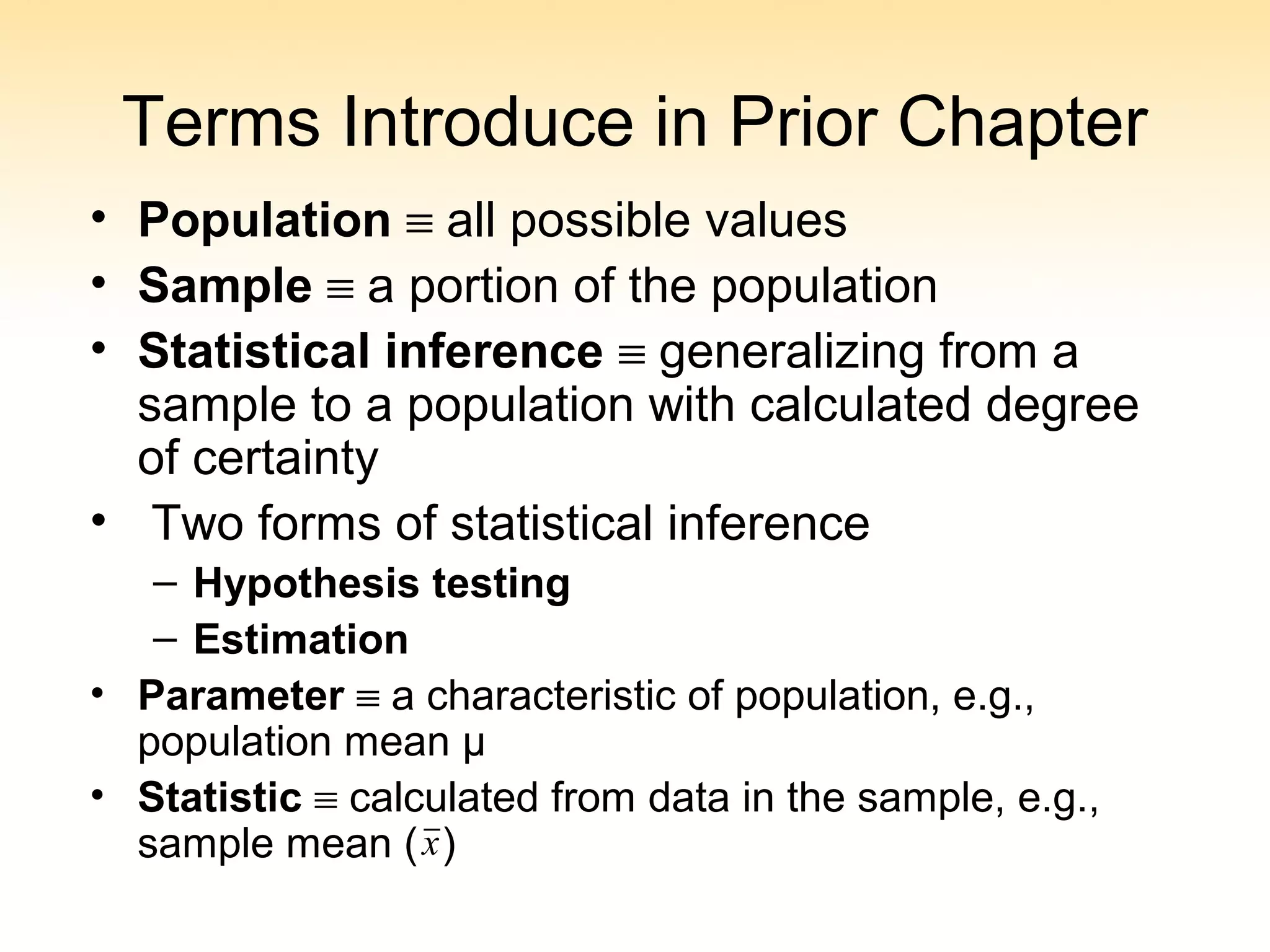
Contents
9.1 Null and Alternative Hypotheses
9.2 Test Statistic
9.3 P-Value
9.4 Significance Level
9.5 One-Sample z Test
9.6 Power and Sample Size
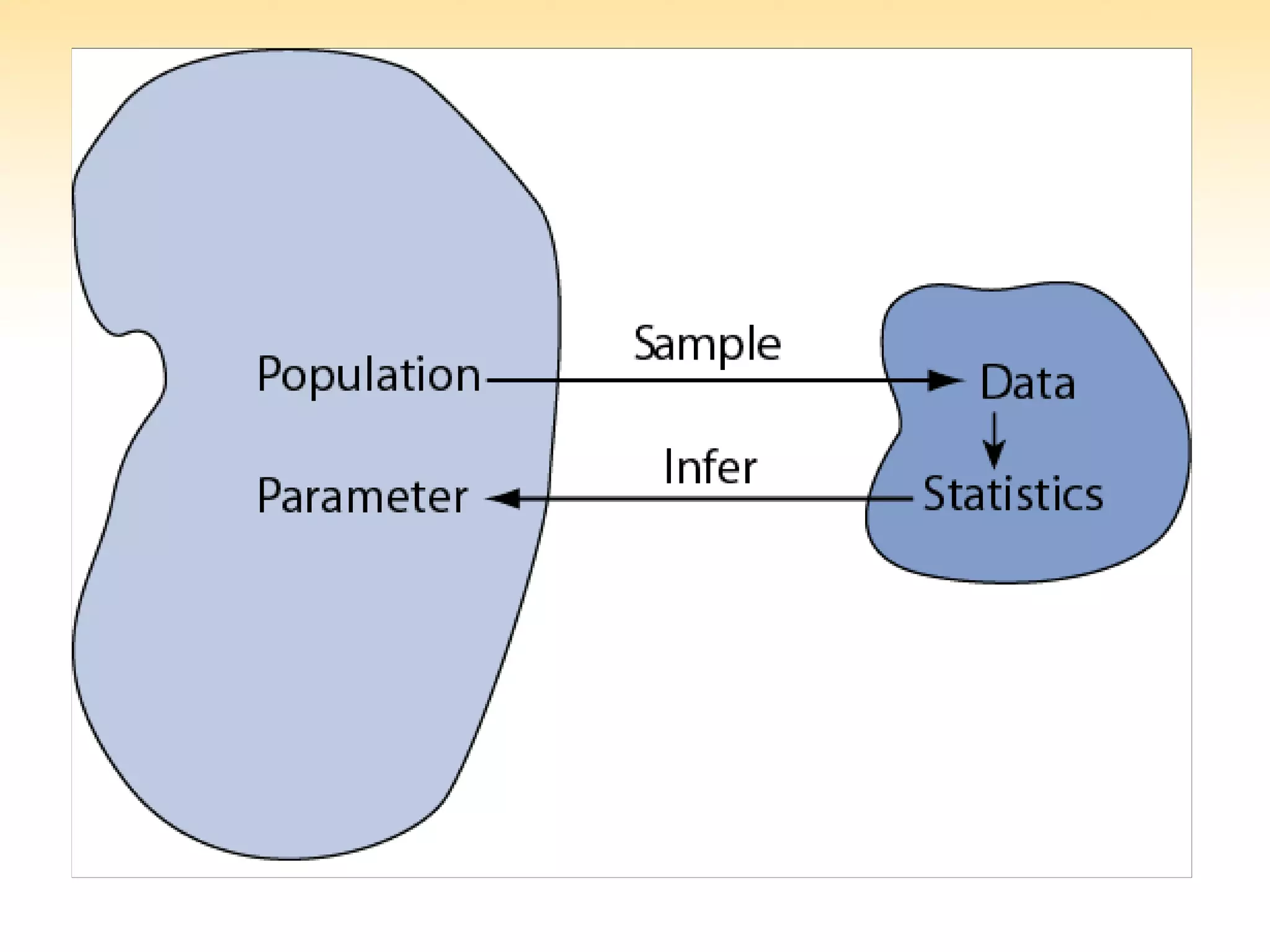
Terms Introduce in Prior Chapter
• Population ≡ all possible values
• Sample ≡ a portion of the population
• Statistical inference ≡ generalizing from a
sample to a population with calculated degree
of certainty
• Two forms of statistical inference
– Hypothesis testing
– Estimation
• Parameter ≡ a characteristic of population, e.g.,
population mean µ
• Statistic ≡ calculated from data in the sample, e.g.,
sample mean ( )x
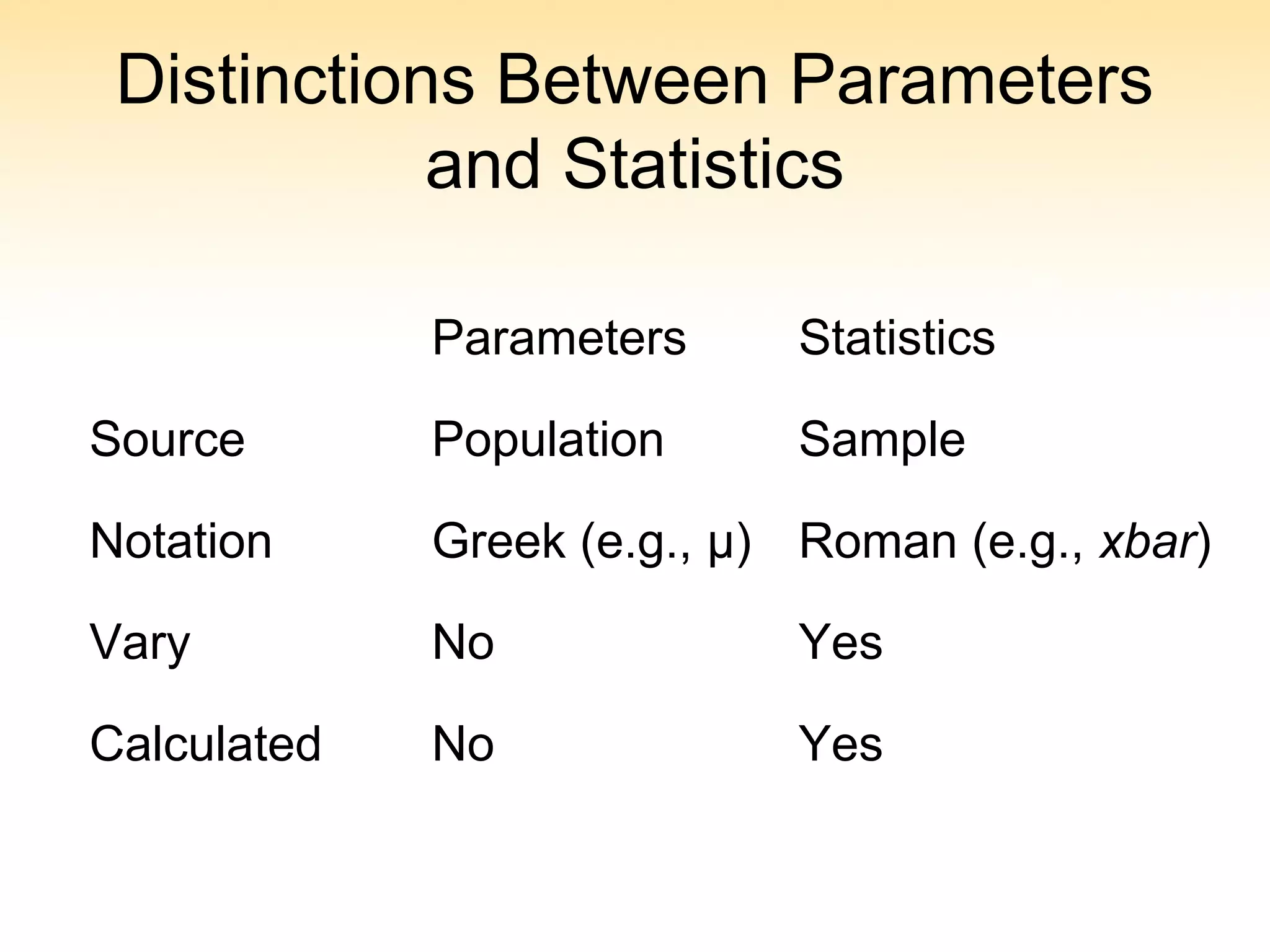
Distinctions Between Parameters
and Statistics
Parameters Statistics
Source Population Sample
Notation Greek (e.g., μ) Roman (e.g., xbar)
Vary No Yes
Calculated No Yes
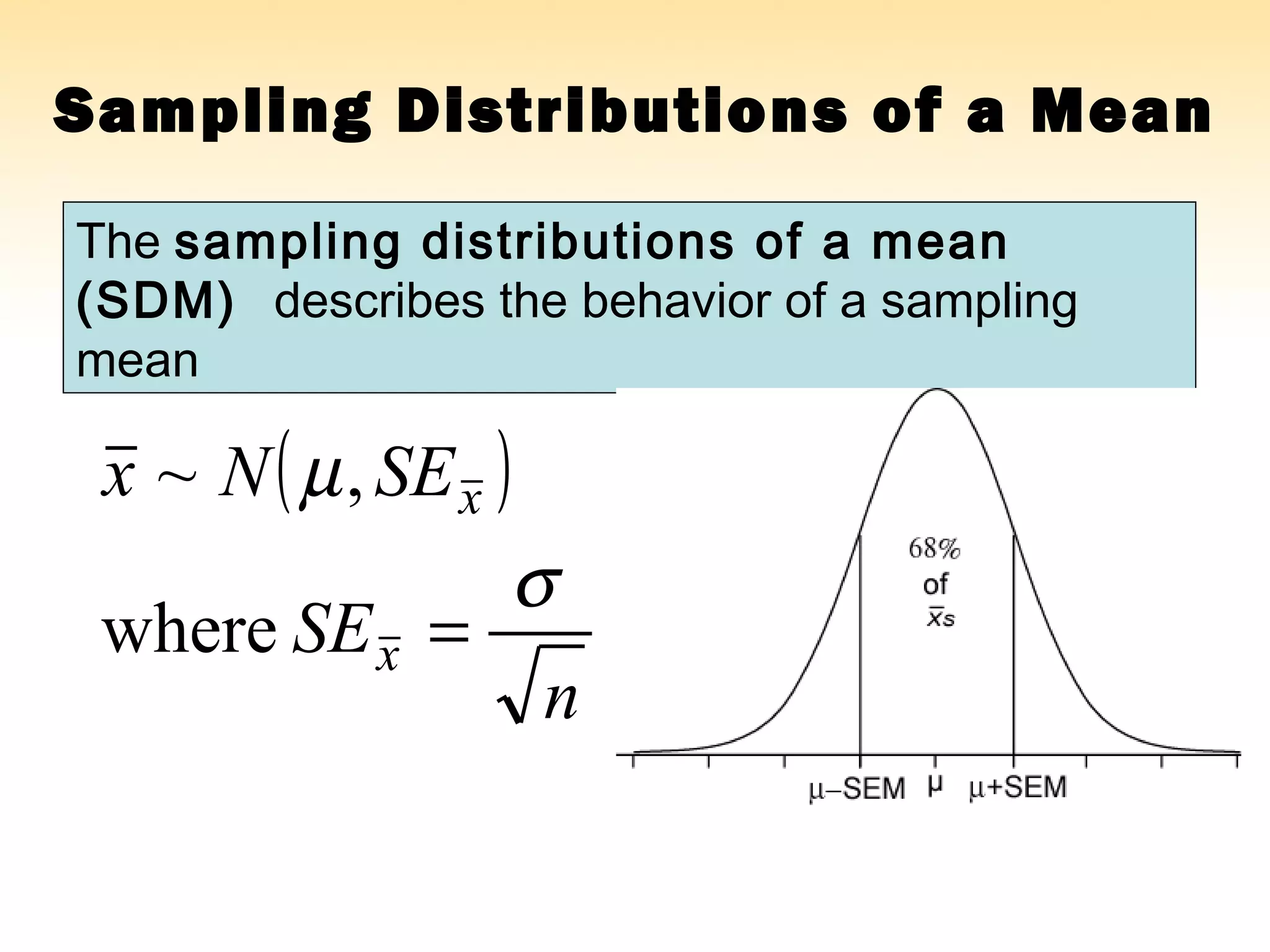
Sampling Distributions of a Mean
The sampling distributions of a mean
(SDM) describes the behavior of a sampling
mean
( )
n
SE
SENx
x
x
σ
µ
=where
,~
Hypothesis Testing
• Is also called significance testing
• Tests a claim about a parameter using
evidence (data in a sample
• The technique is introduced by
considering a one-sample z test
• The procedure is broken into four steps
• Each element of the procedure must be
understood
Hypothesis Testing Steps
A. Null and alternative hypotheses
B. Test statistic
C. P-value and interpretation
D. Significance level (optional)
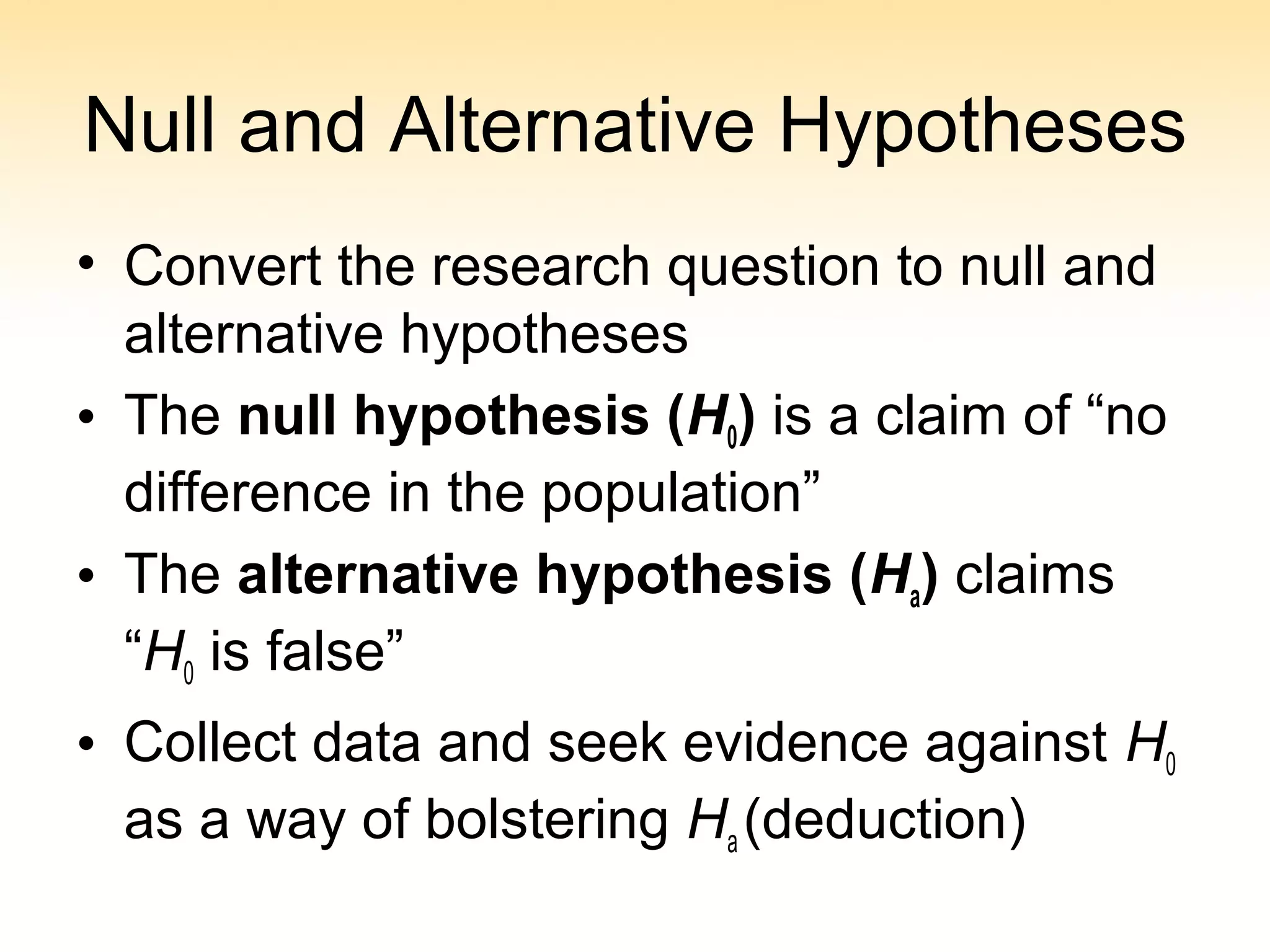
Null and Alternative Hypotheses
• Convert the research question to null and
alternative hypotheses
• The null hypothesis (H0) is a claim of “no
difference in the population”
• The alternative hypothesis (Ha) claims
“H0 is false”
• Collect data and seek evidence against H0
as a way of bolstering Ha (deduction)
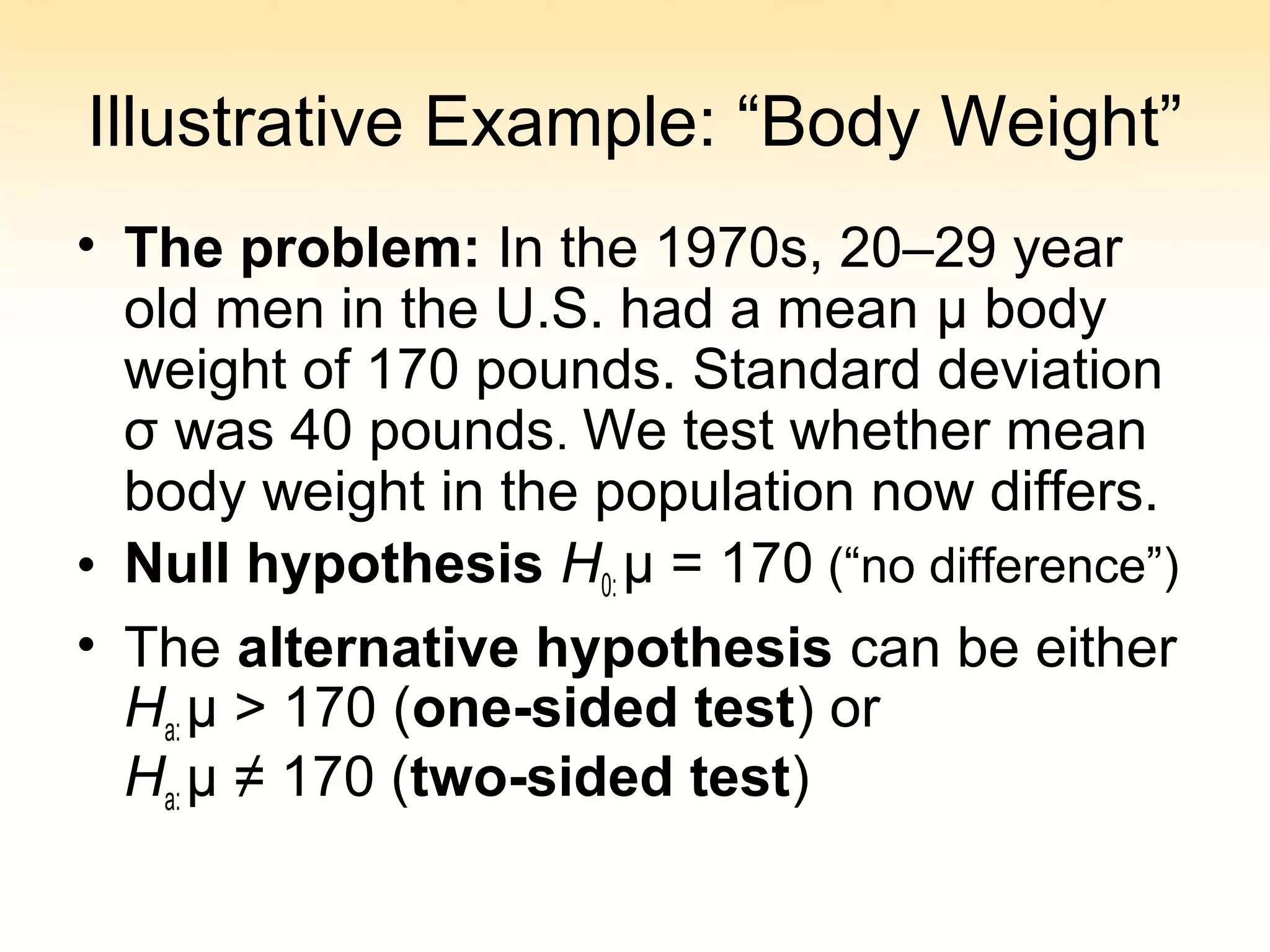
Illustrative Example: “Body Weight”
• The problem: In the 1970s, 20–29 year
old men in the U.S. had a mean μ body
weight of 170 pounds. Standard deviation
σ was 40 pounds. We test whether mean
body weight in the population now differs.
• Null hypothesis H0: μ = 170 (“no difference”)
• The alternative hypothesis can be either
Ha: μ > 170 (one-sided test) or
Ha: μ ≠ 170 (two-sided test)
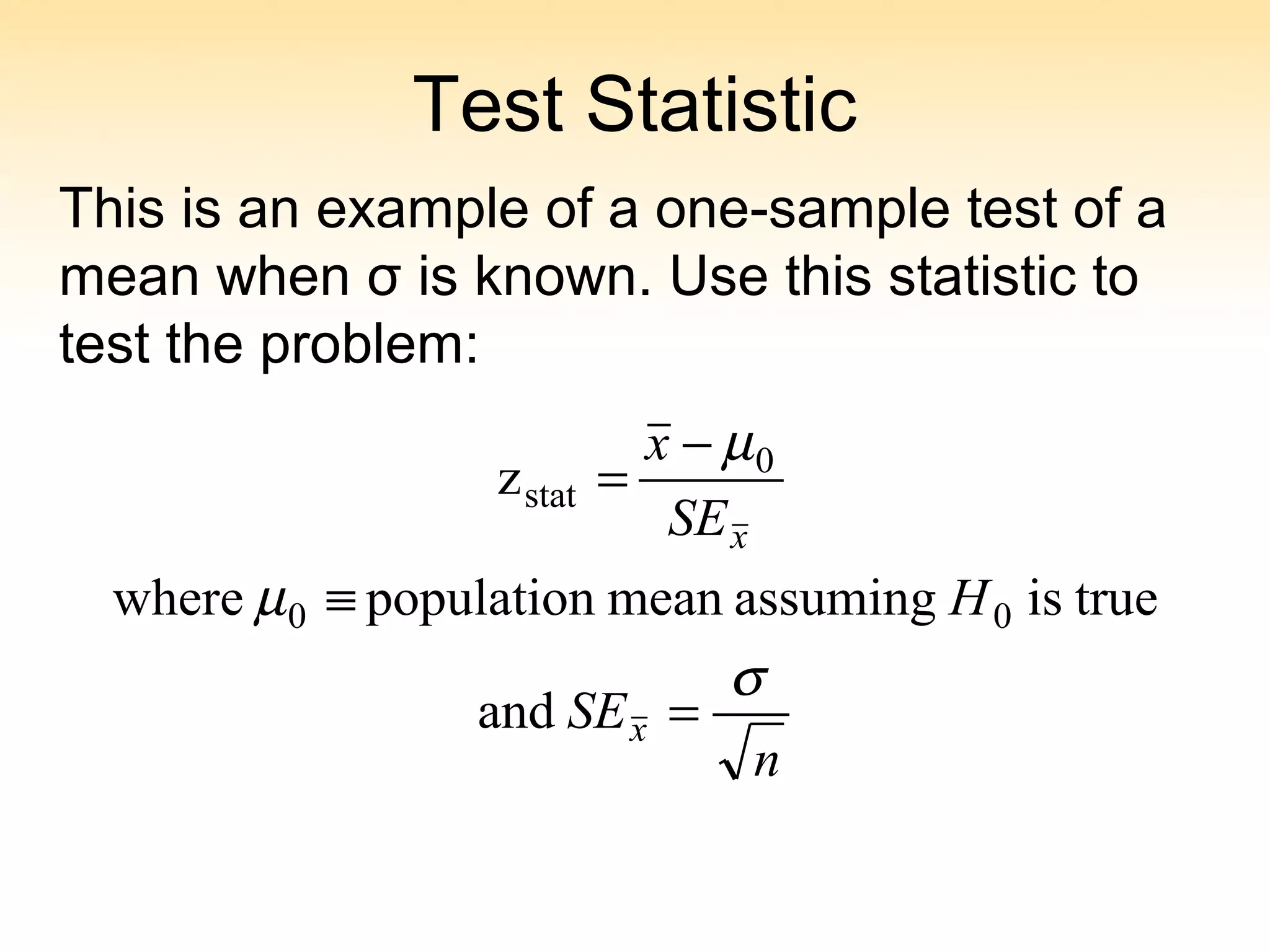
Test Statistic
n
SE
H
SE
x
x
x
σ
µ
µ
=
≡
−
=
and
trueisassumingmeanpopulationwhere
z
00
0
stat
This is an example of a one-sample test of a
mean when σ is known. Use this statistic to
test the problem:
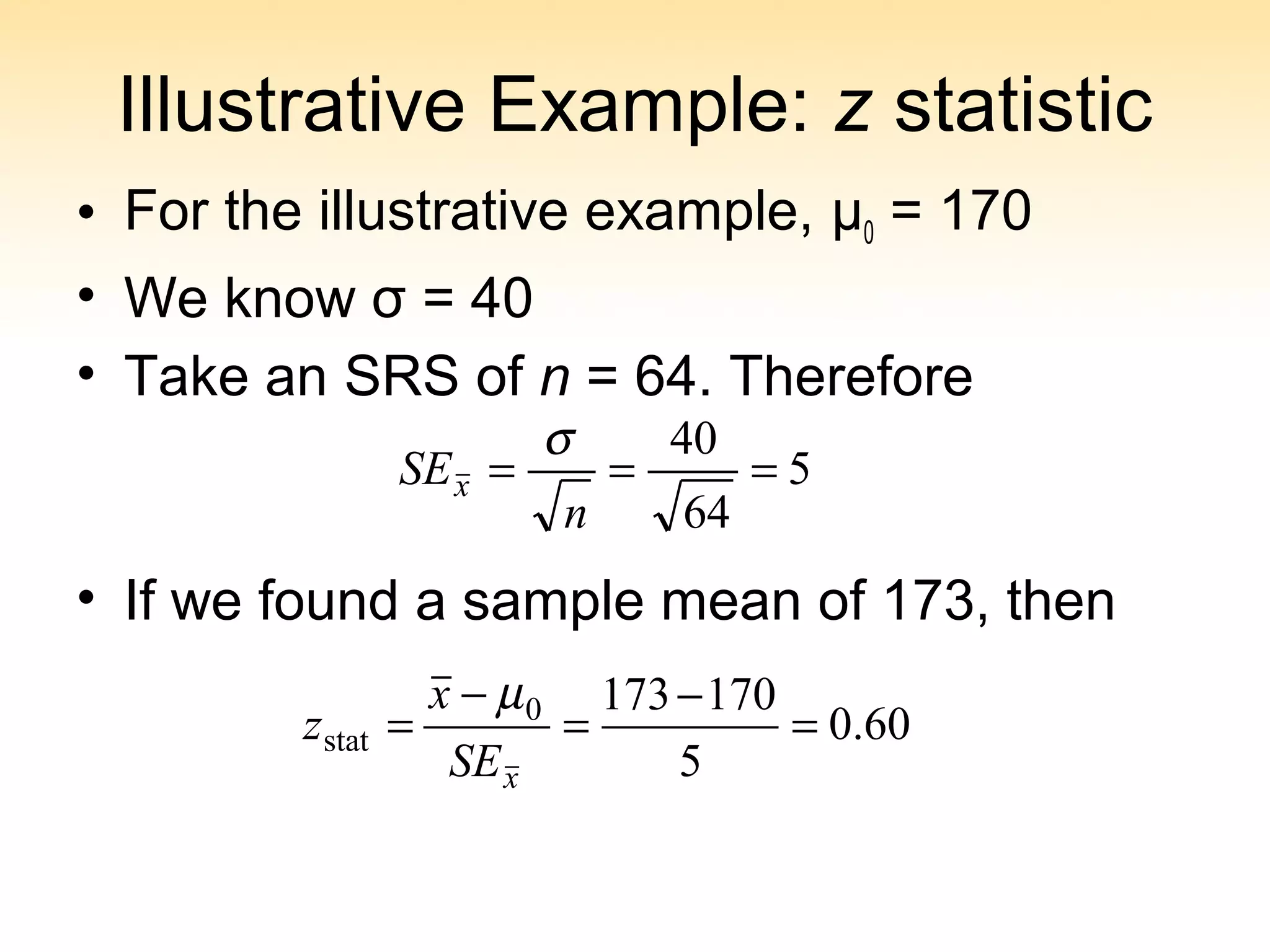
Illustrative Example: z statistic
• For the illustrative example, μ0 = 170
• We know σ = 40
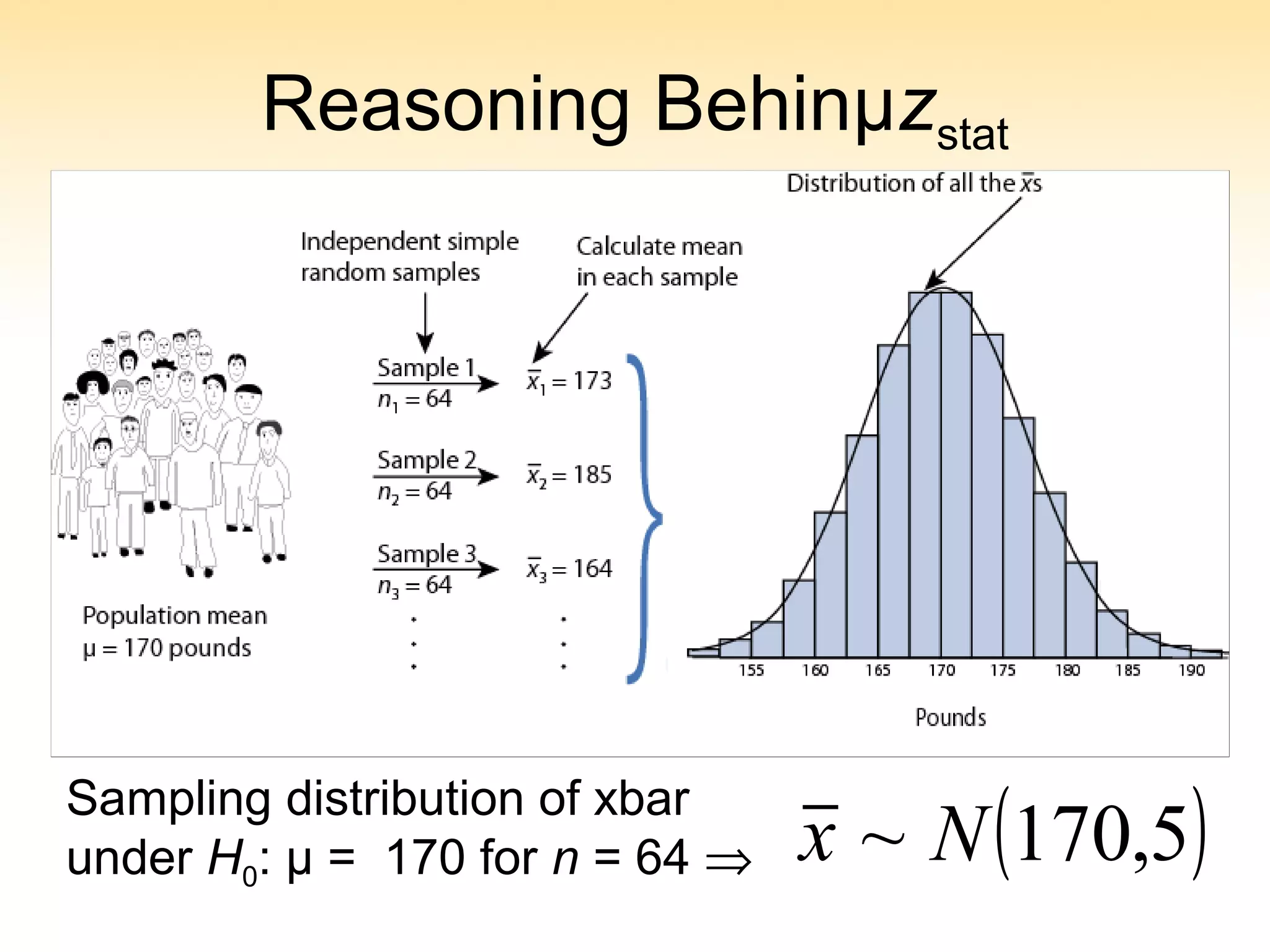
• Take an SRS of n = 64. Therefore
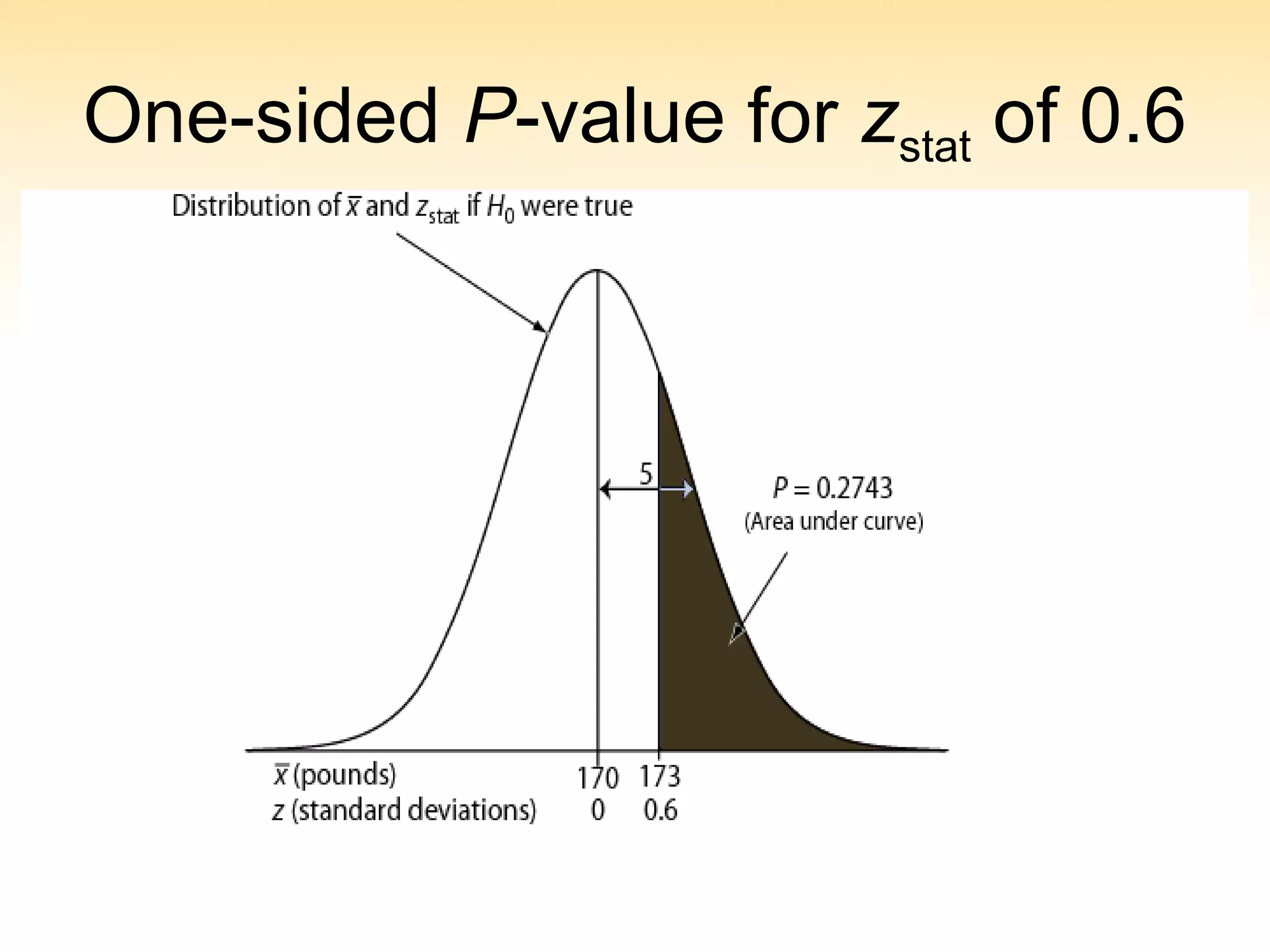
• If we found a sample mean of 173, then
5
64
40
===
n
SEx
σ
60.0
5
1701730
stat =
−
=
−
=
xSE
x
z
µ
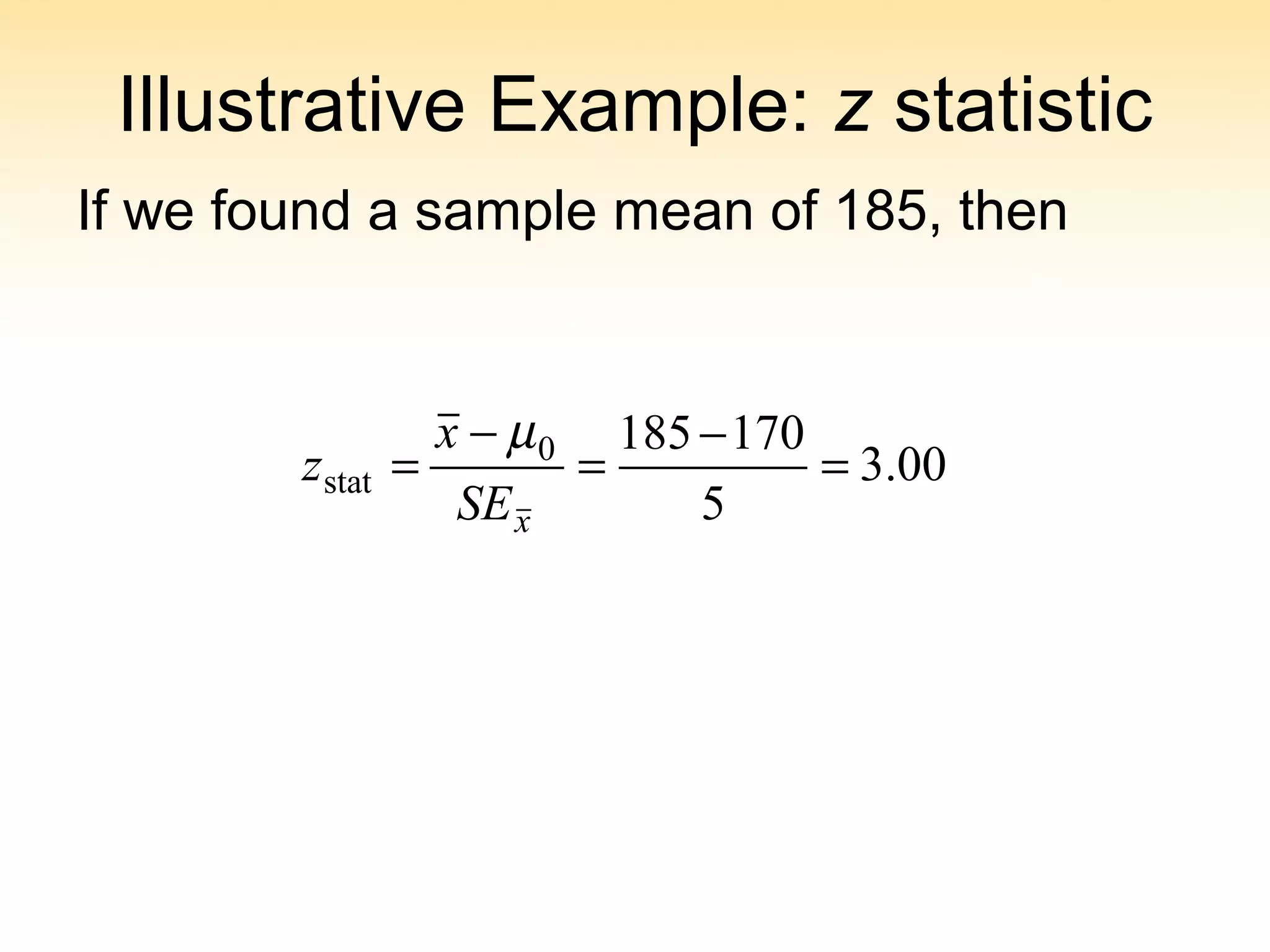
Illustrative Example: z statistic
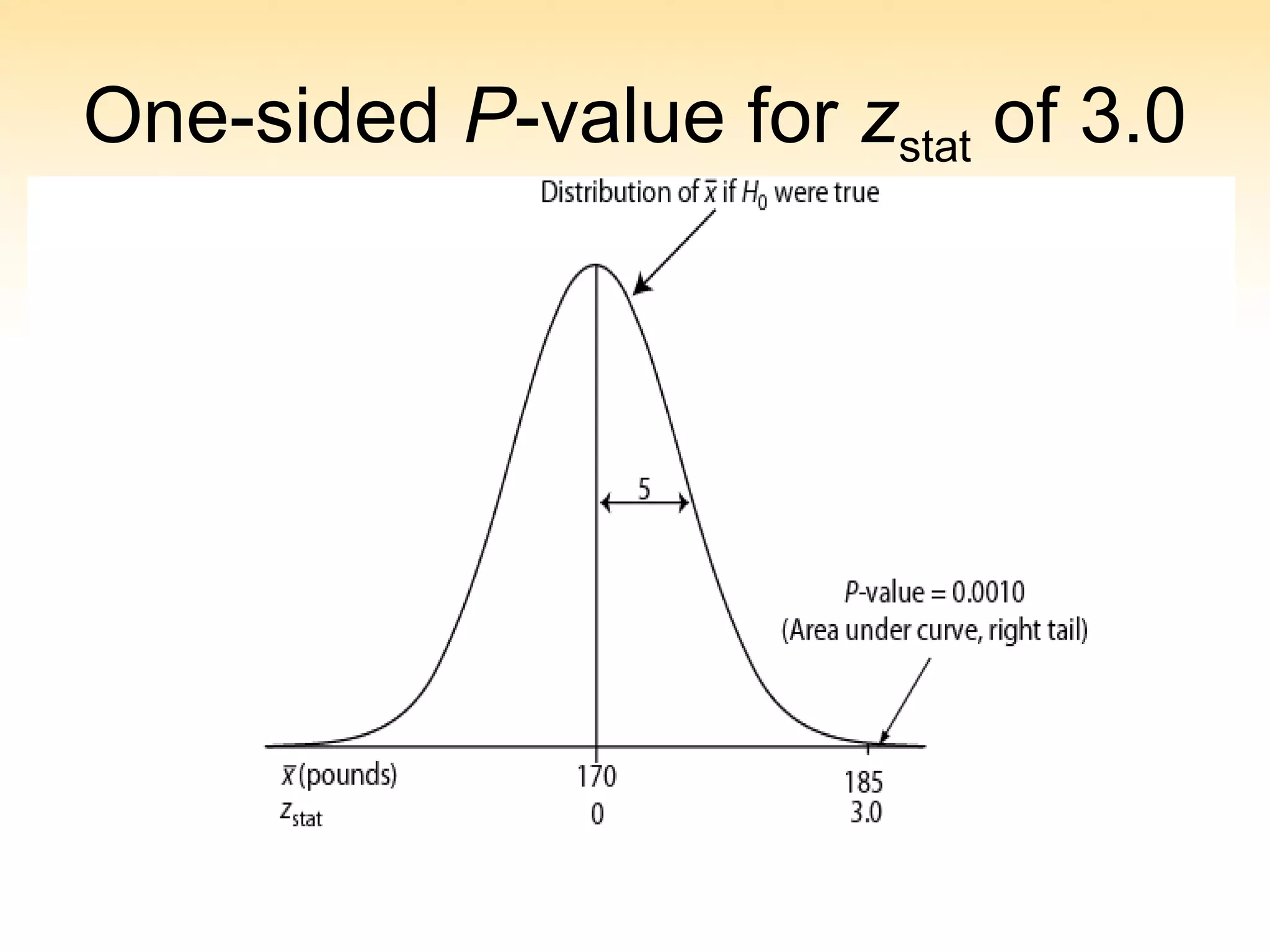
If we found a sample mean of 185, then
00.3
5
1701850
stat =
−
=
−
=
xSE
x
z
µ
Reasoning Behinµzstat
( )5,170~ Nx
Sampling distribution of xbar
under H0: µ = 170 for n = 64 ⇒
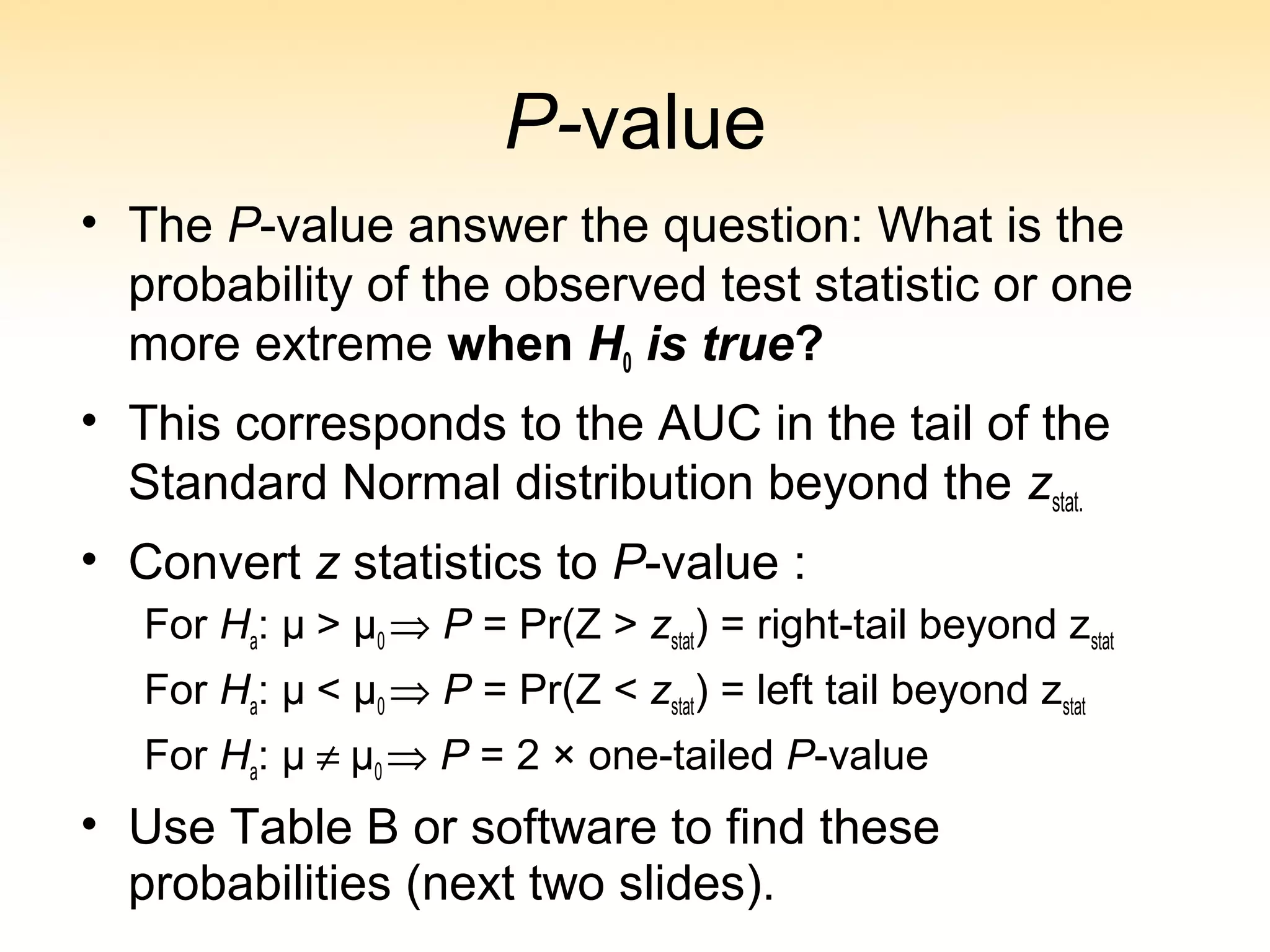
P-value
• The P-value answer the question: What is the
probability of the observed test statistic or one
more extreme when H0 is true?
• This corresponds to the AUC in the tail of the
Standard Normal distribution beyond the zstat.
• Convert z statistics to P-value :
For Ha: μ > μ0 ⇒ P = Pr(Z > zstat) = right-tail beyond zstat
For Ha: μ < μ0 ⇒ P = Pr(Z < zstat) = left tail beyond zstat
For Ha: μ ≠ μ0 ⇒ P = 2 × one-tailed P-value
• Use Table B or software to find these
probabilities (next two slides).
One-sided P-value for zstat of 0.6
One-sided P-value for zstat of 3.0
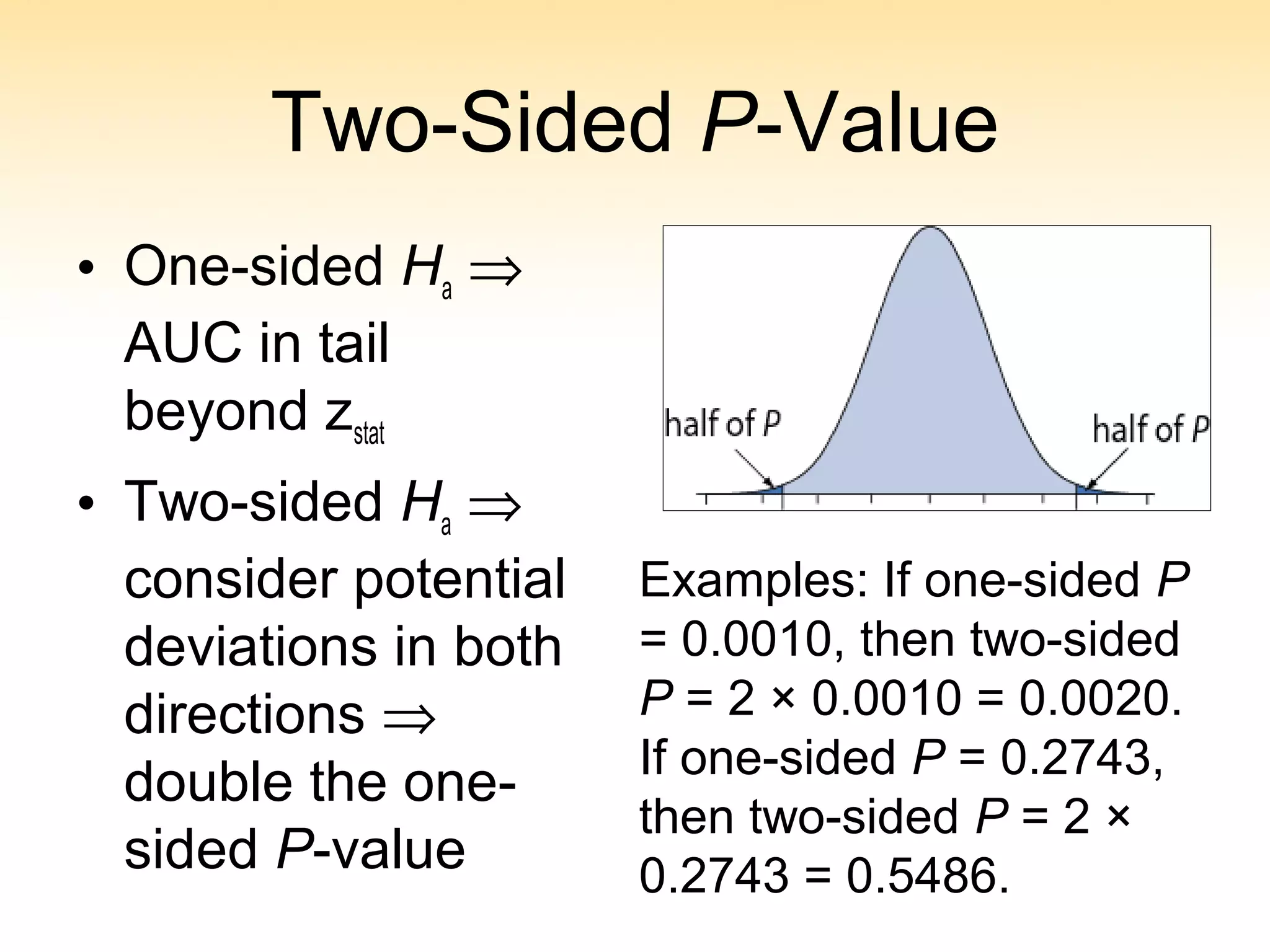
Two-Sided P-Value
• One-sided Ha ⇒
AUC in tail
beyond zstat
• Two-sided Ha ⇒
consider potential
deviations in both
directions ⇒
double the one-
sided P-value
Examples: If one-sided P
= 0.0010, then two-sided
P = 2 × 0.0010 = 0.0020.
If one-sided P = 0.2743,
then two-sided P = 2 ×
0.2743 = 0.5486.
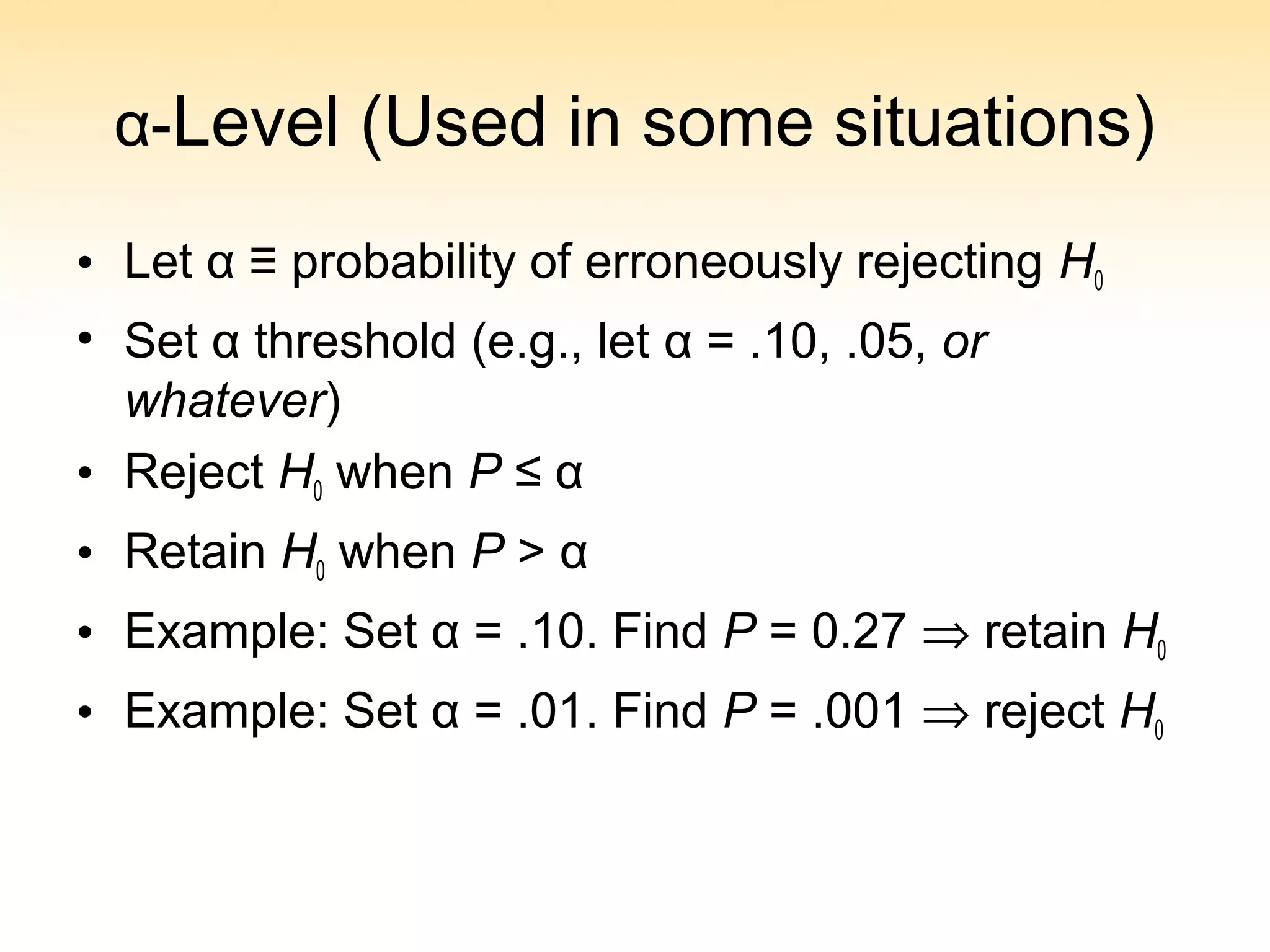
Interpretation
• P-value answer the question: What is the
probability of the observed test statistic …
when H0 is true?
• Thus, smaller and smaller P-values
provide stronger and stronger evidence
against H0
• Small P-value ⇒ strong evidence
Interpretation
Conventions*
P > 0.10 ⇒ non-significant evidence against H0
0.05 < P ≤ 0.10 ⇒ marginally significant evidence
0.01 < P ≤ 0.05 ⇒ significant evidence against H0
P ≤ 0.01 ⇒ highly significant evidence against H0
Examples
P =.27 ⇒ non-significant evidence against H0
P =.01 ⇒ highly significant evidence against H0
* It is unwise to draw firm borders for “significance”
α-Level (Used in some situations)
• Let α ≡ probability of erroneously rejecting H0
• Set α threshold (e.g., let α = .10, .05, or
whatever)
• Reject H0 when P ≤ α
• Retain H0 when P > α
• Example: Set α = .10. Find P = 0.27 ⇒ retain H0
• Example: Set α = .01. Find P = .001 ⇒ reject H0
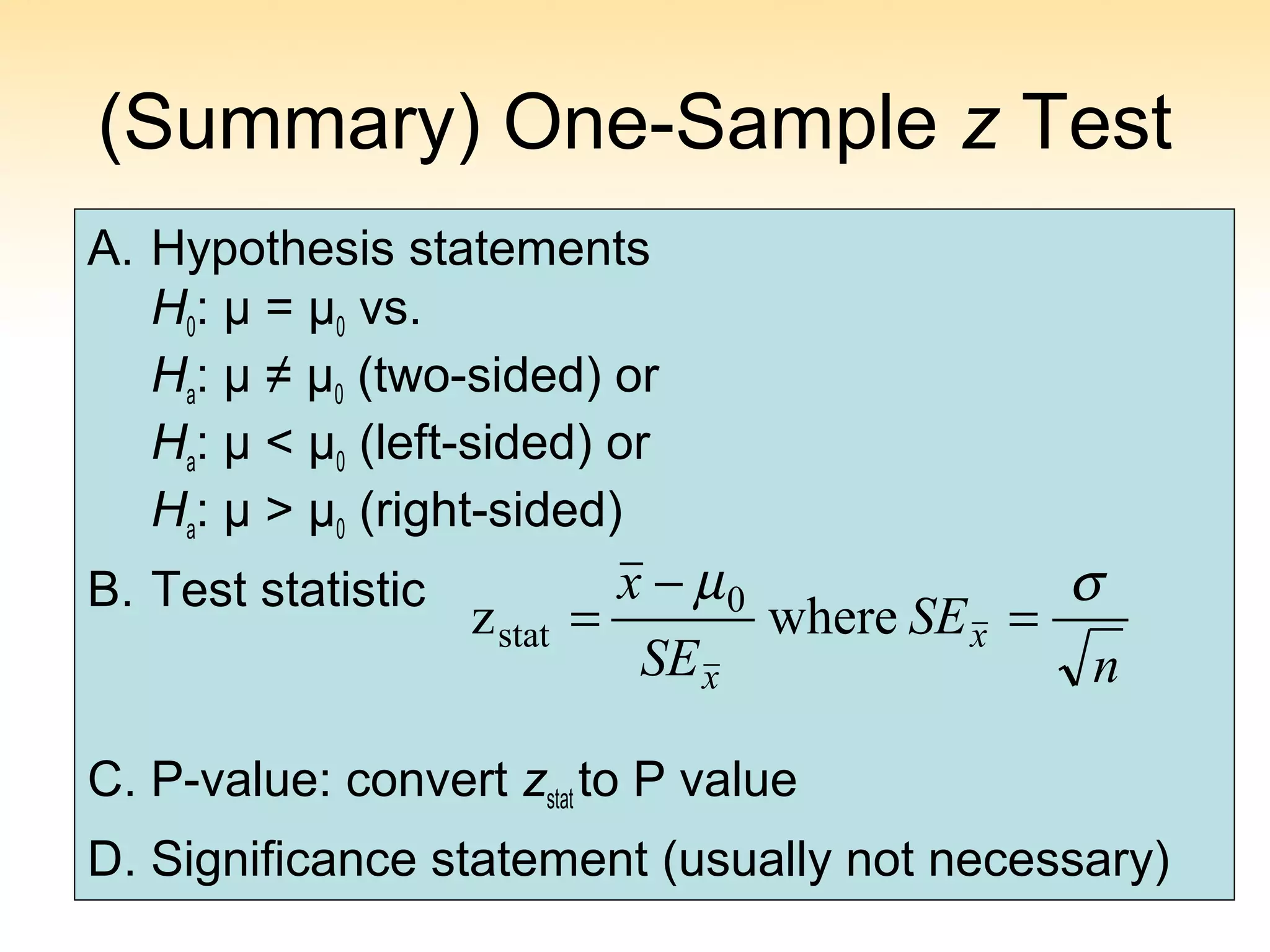
(Summary) One-Sample z Test
A. Hypothesis statements
H0: µ = µ0 vs.
Ha: µ ≠ µ0 (two-sided) or
Ha: µ < µ0 (left-sided) or
Ha: µ > µ0 (right-sided)
B. Test statistic
C. P-value: convert zstat to P value
D. Significance statement (usually not necessary)
n
SE
SE
x
x
x
σµ
=
−
= wherez 0
stat
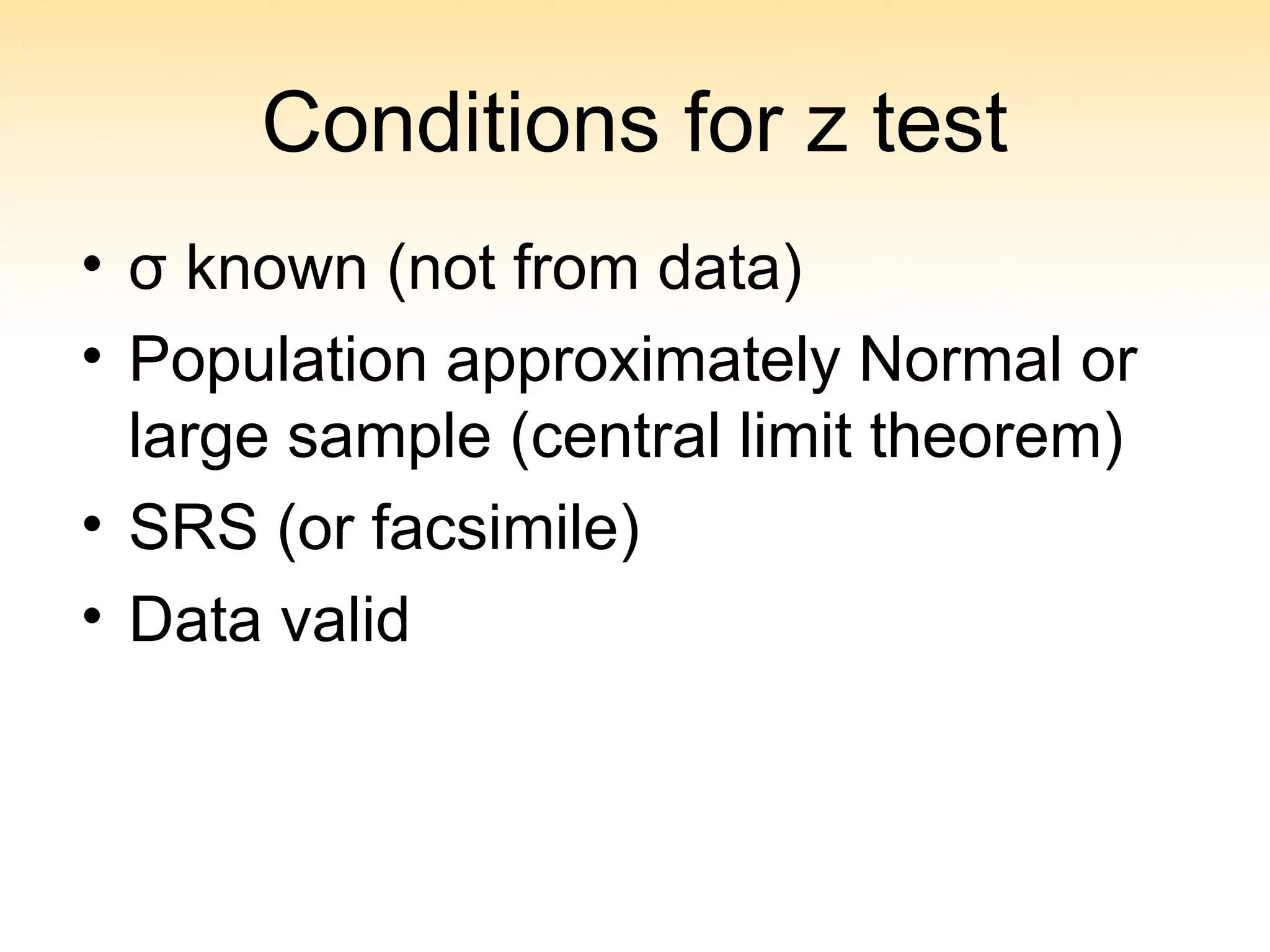
Conditions for z test
• σ known (not from data)
• Population approximately Normal or
large sample (central limit theorem)
• SRS (or facsimile)
• Data valid
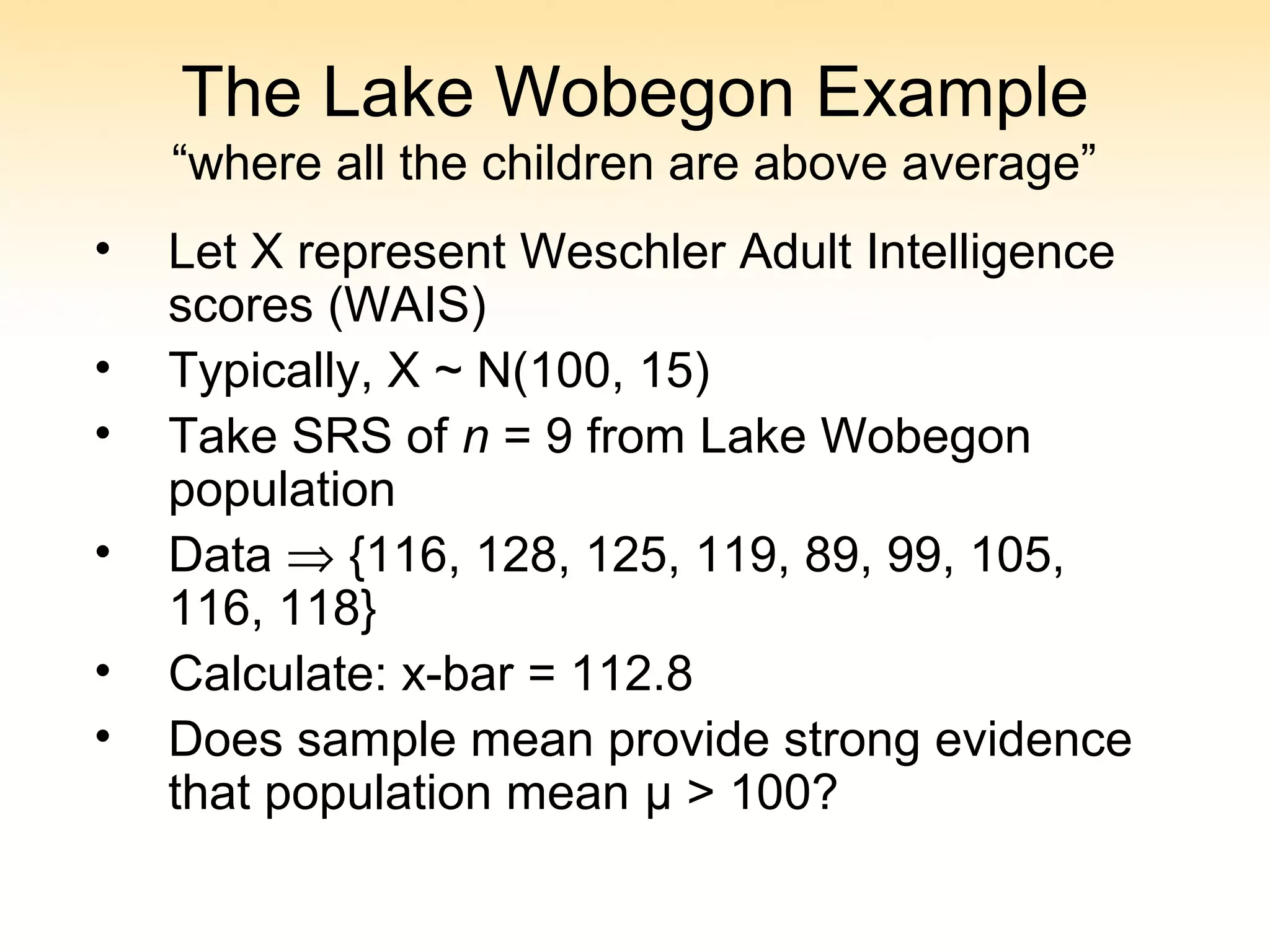
The Lake Wobegon Example
“where all the children are above average”
• Let X represent Weschler Adult Intelligence
scores (WAIS)
• Typically, X ~ N(100, 15)
• Take SRS of n = 9 from Lake Wobegon
population
• Data ⇒ {116, 128, 125, 119, 89, 99, 105,
116, 118}
• Calculate: x-bar = 112.8
• Does sample mean provide strong evidence
that population mean μ > 100?
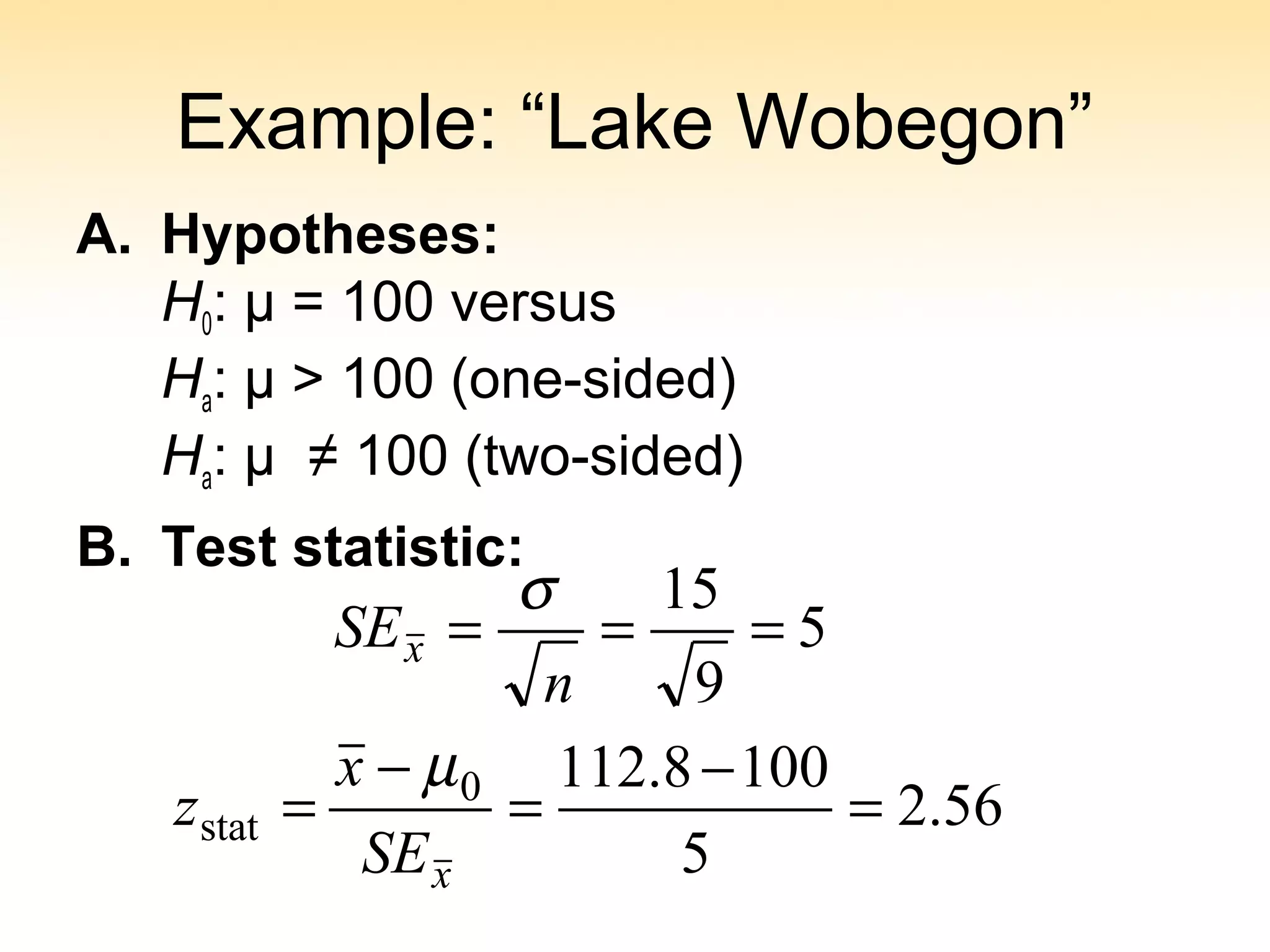
Example: “Lake Wobegon”
A. Hypotheses:
H0: µ = 100 versus
Ha: µ > 100 (one-sided)
Ha: µ ≠ 100 (two-sided)
B. Test statistic:
56.2
5
1008.112
5
9
15
0
stat =
−
=
−
=
===
x
x
SE
x
z
n
SE
µ
σ
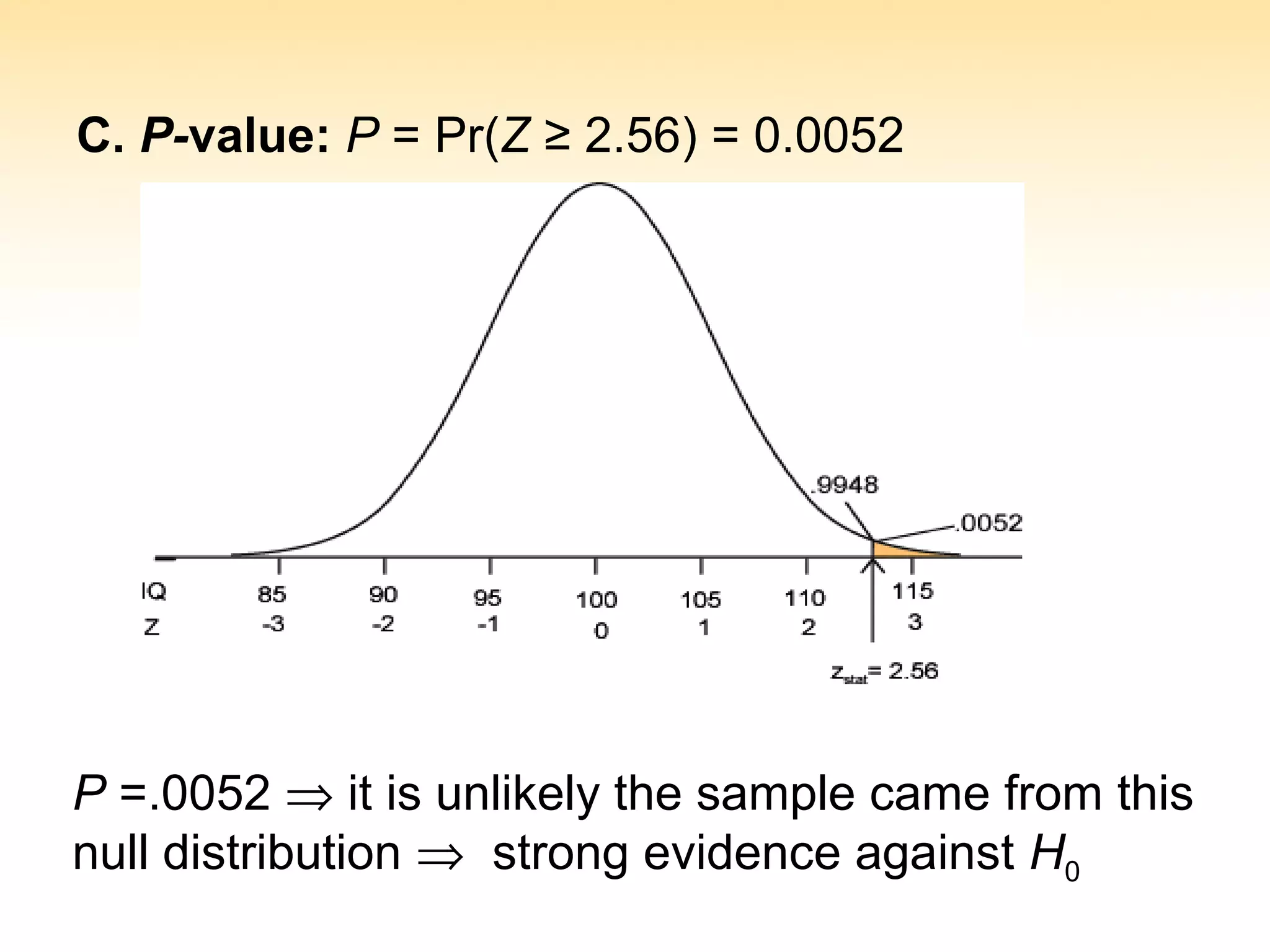
C. P-value: P = Pr(Z ≥ 2.56) = 0.0052
P =.0052 ⇒ it is unlikely the sample came from this
null distribution ⇒ strong evidence against H0
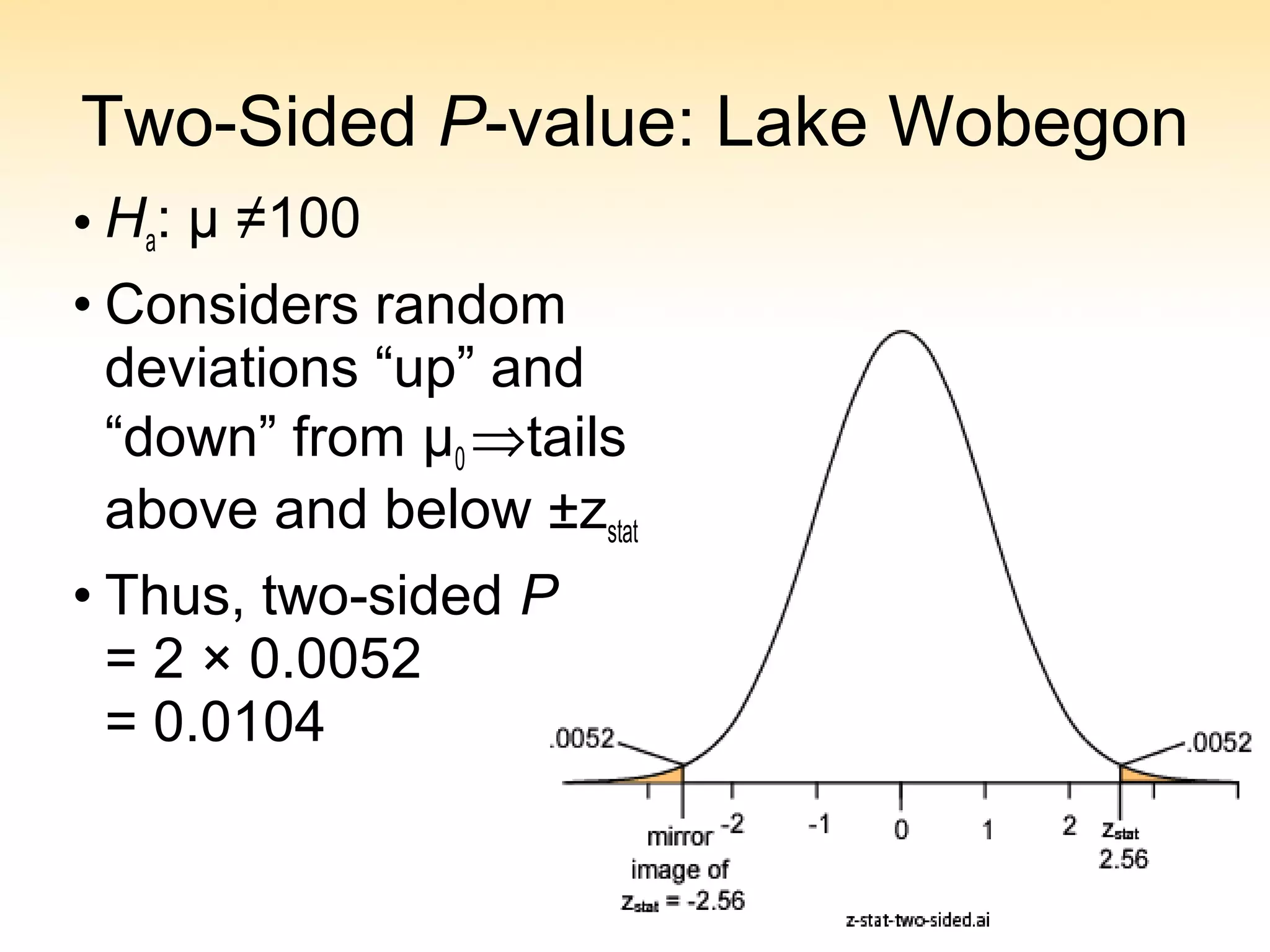
• Ha: µ ≠100
• Considers random
deviations “up” and
“down” from μ0 ⇒tails
above and below ±zstat
• Thus, two-sided P
= 2 × 0.0052
= 0.0104
Two-Sided P-value: Lake Wobegon
Power and Sample Size
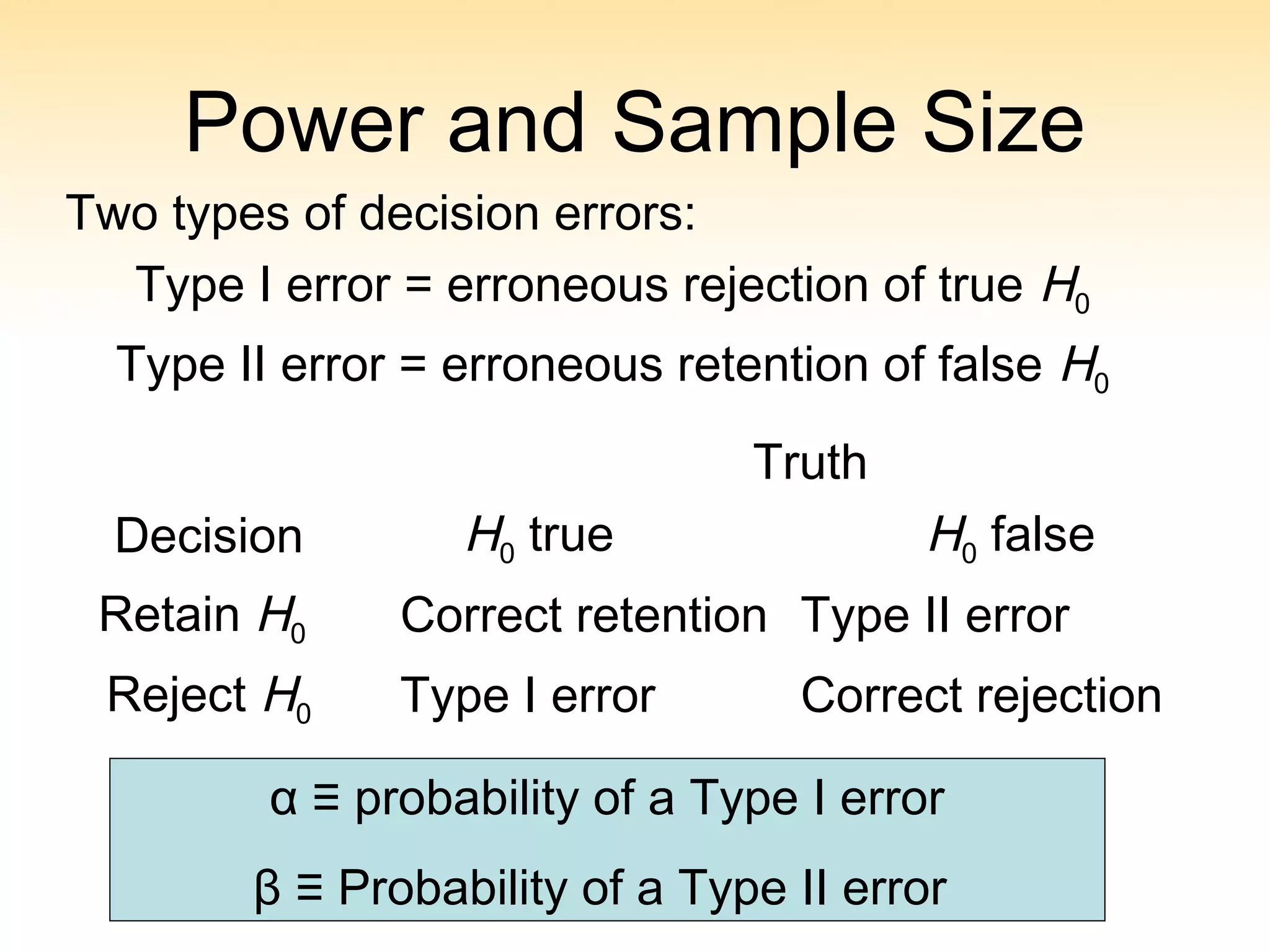
Truth
Decision H0 true H0 false
Retain H0 Correct retention Type II error
Reject H0 Type I error Correct rejection
α ≡ probability of a Type I error
β ≡ Probability of a Type II error
Two types of decision errors:
Type I error = erroneous rejection of true H0
Type II error = erroneous retention of false H0
Power
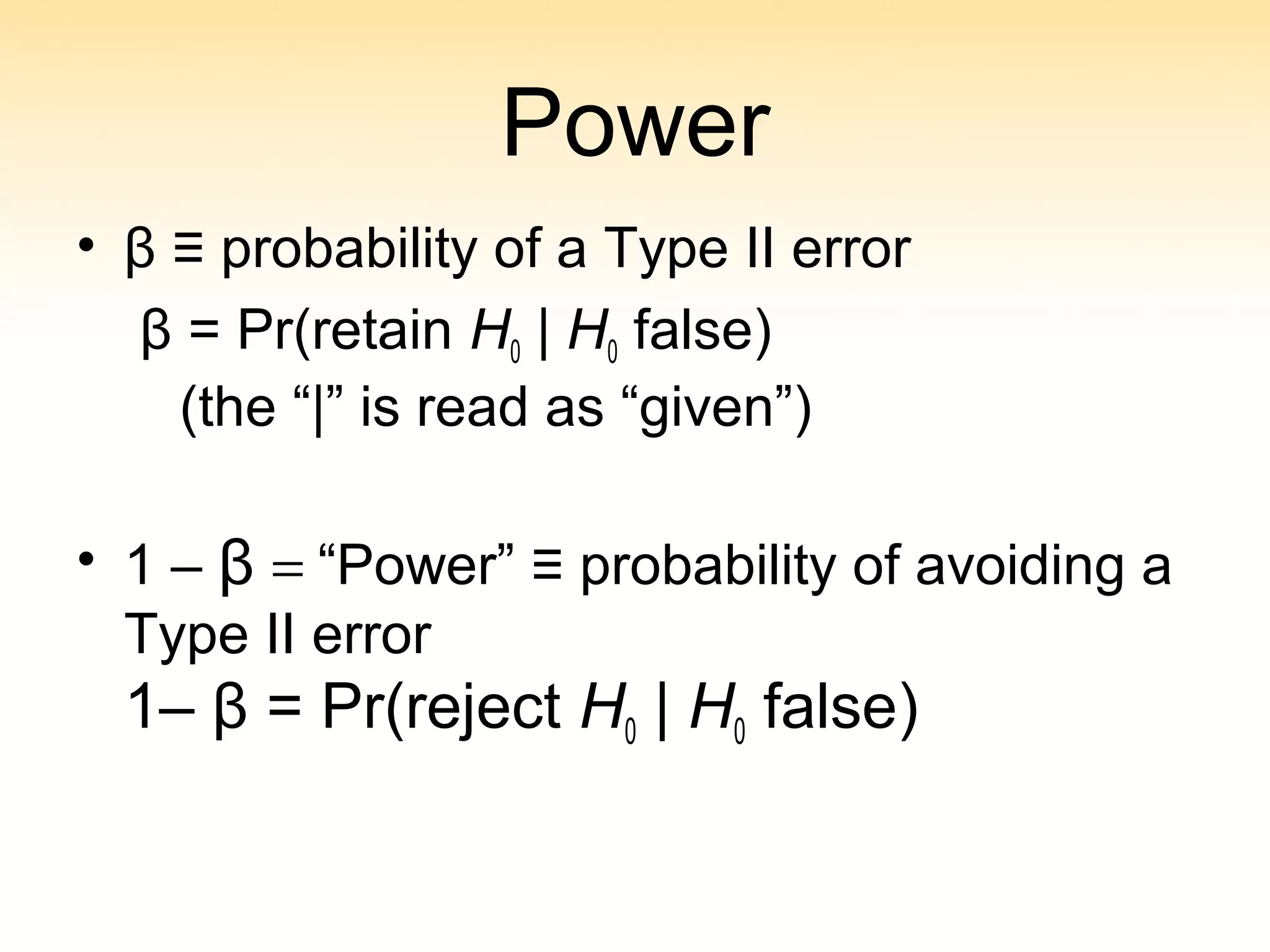
• β ≡ probability of a Type II error
β = Pr(retain H0 | H0 false)
(the “|” is read as “given”)
• 1 – β = “Power” ≡ probability of avoiding a
Type II error
1– β = Pr(reject H0 | H0 false)
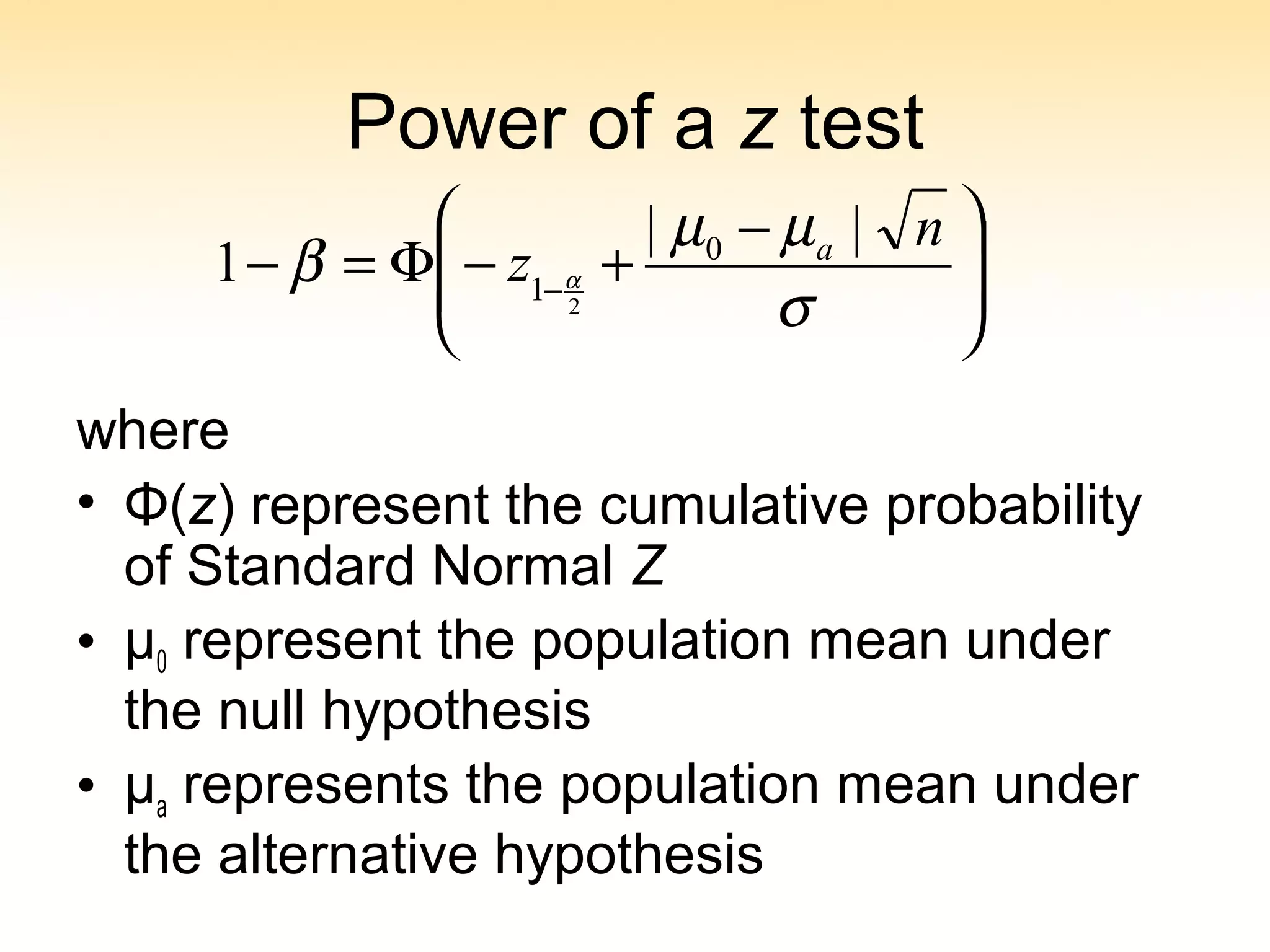
Power of a z test
where
• Φ(z) represent the cumulative probability
of Standard Normal Z
• μ0 represent the population mean under
the null hypothesis
• μa represents the population mean under
the alternative hypothesis







 −
+−Φ=− −
σ
µµ
β α
n
z a ||
1 0
1 2
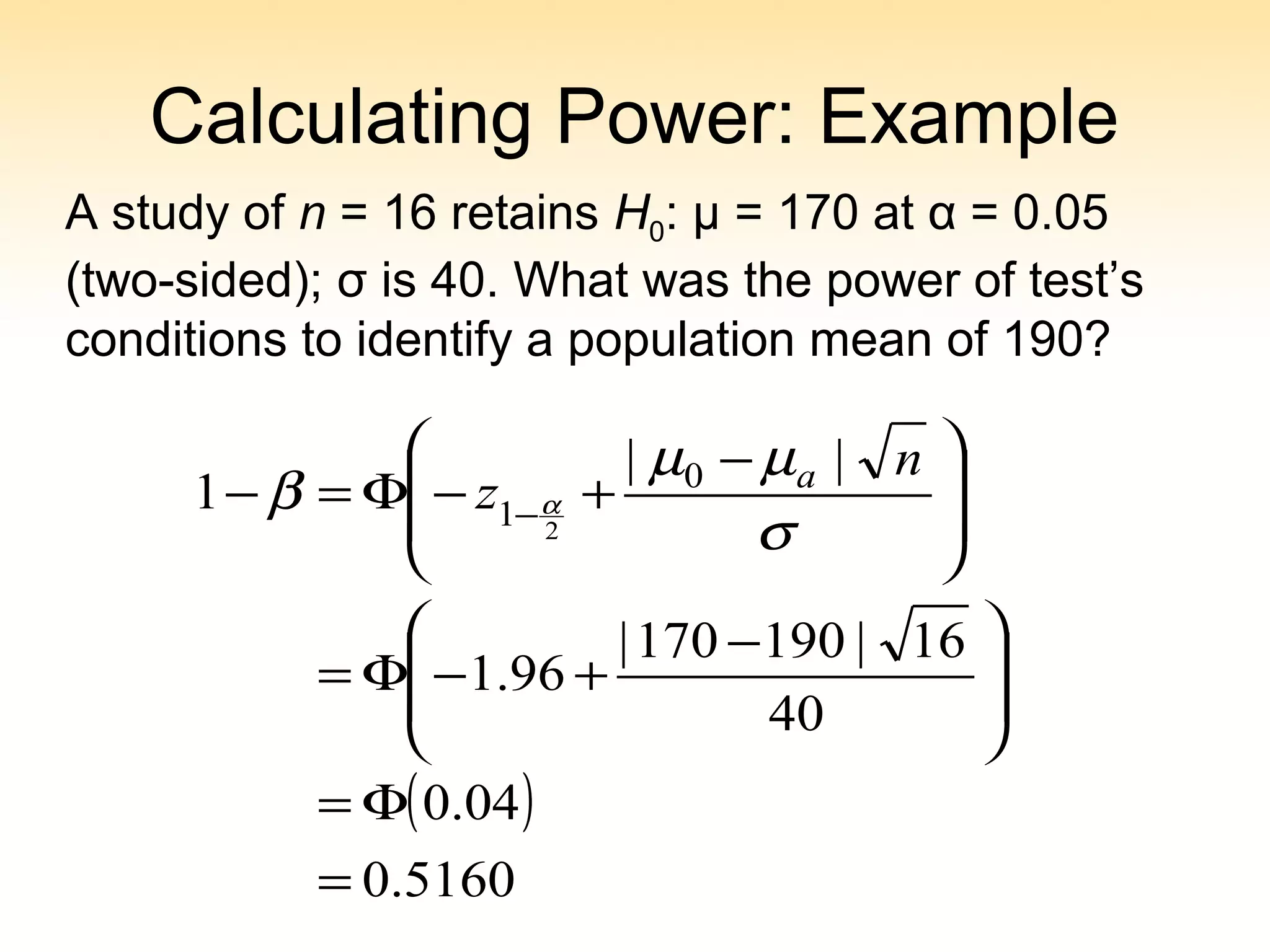
Calculating Power: Example
A study of n = 16 retains H0: μ = 170 at α = 0.05
(two-sided); σ is 40. What was the power of test’s
conditions to identify a population mean of 190?
( )
5160.0
04.0
40
16|190170|
96.1
||
1 0
1 2
=
Φ=







 −
+−Φ=







 −
+−Φ=− −
σ
µµ
β α
n
z a
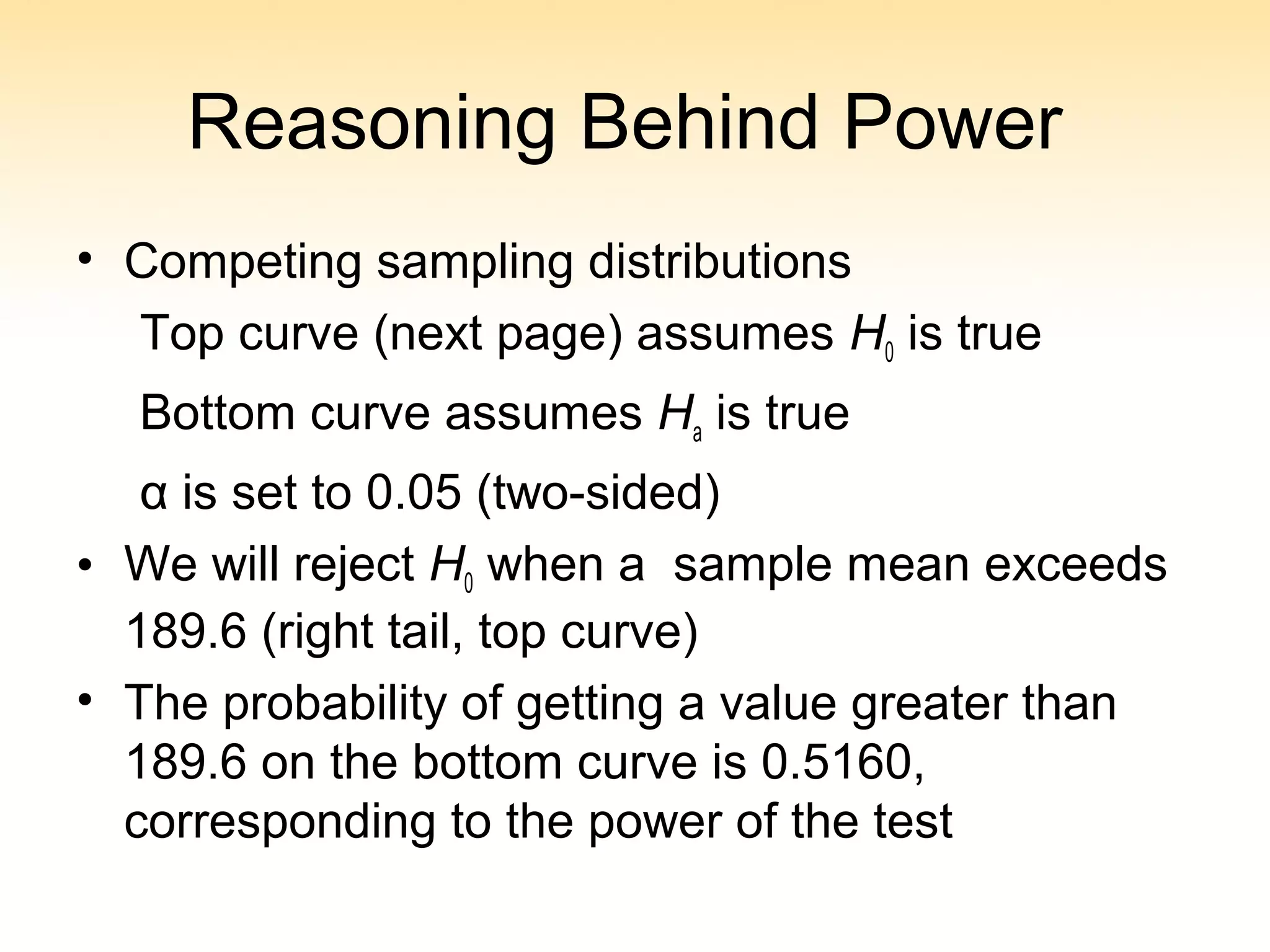
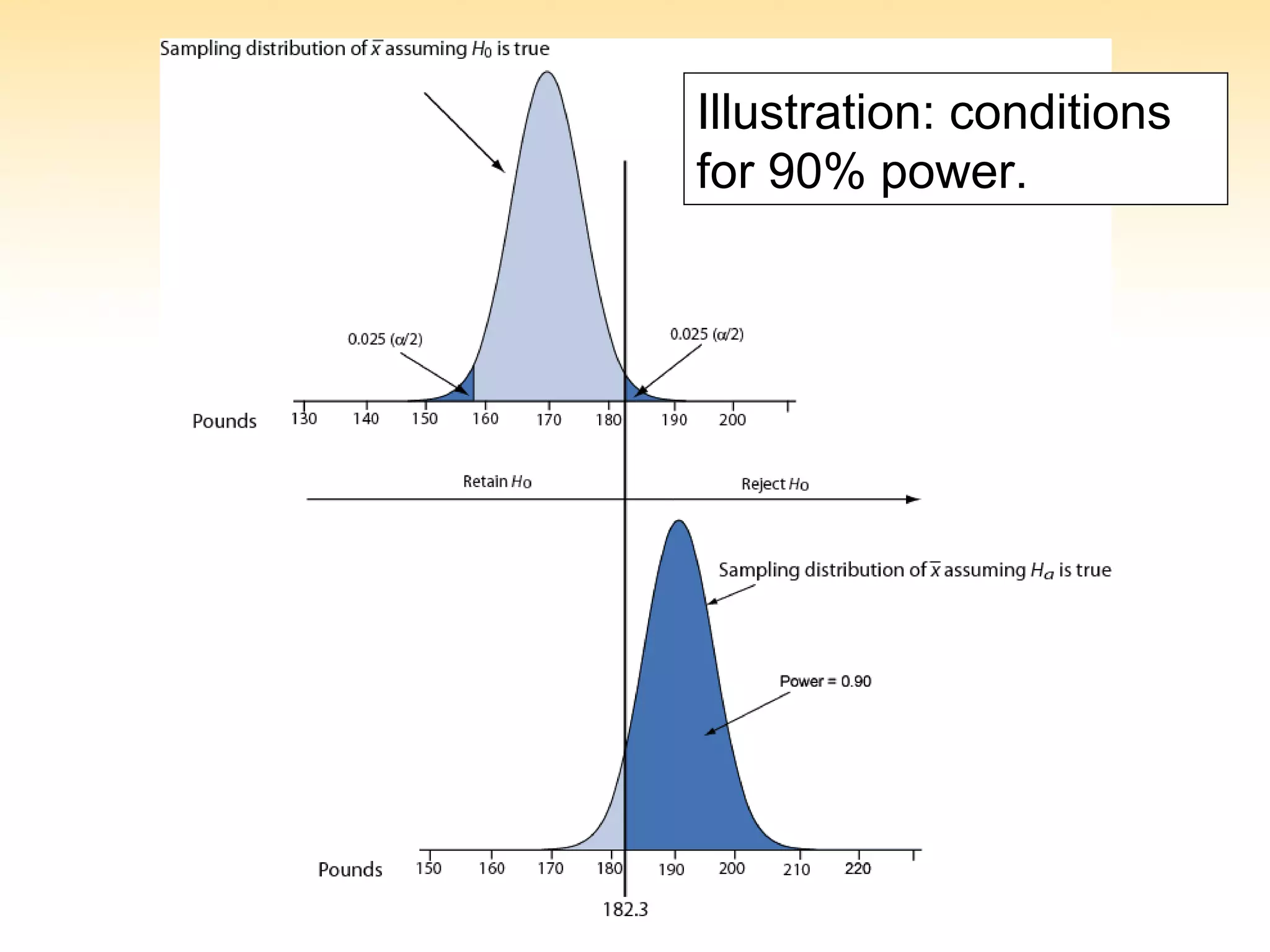
Reasoning Behind Power
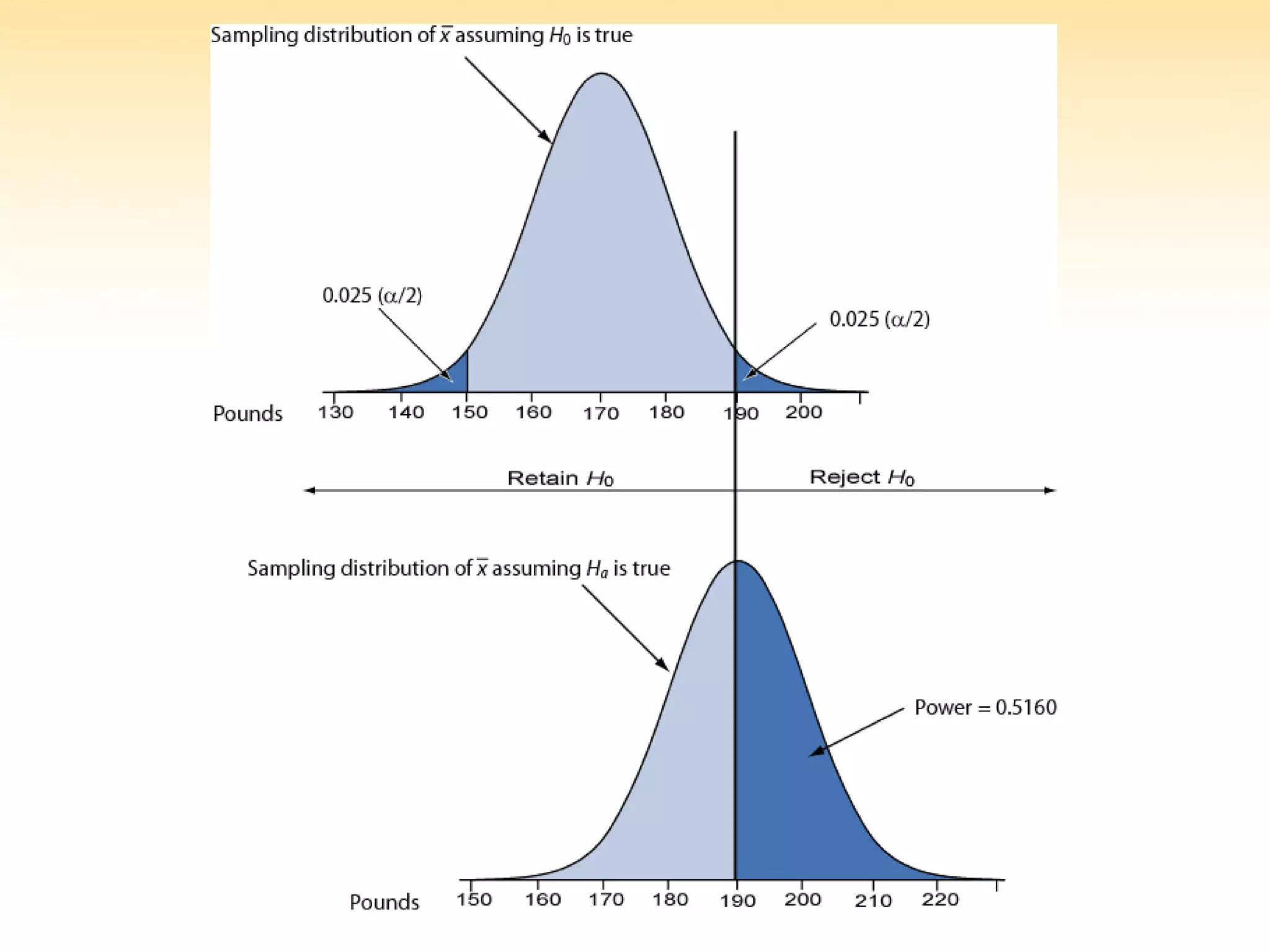
• Competing sampling distributions
Top curve (next page) assumes H0 is true
Bottom curve assumes Ha is true
α is set to 0.05 (two-sided)
• We will reject H0 when a sample mean exceeds
189.6 (right tail, top curve)
• The probability of getting a value greater than
189.6 on the bottom curve is 0.5160,
corresponding to the power of the test
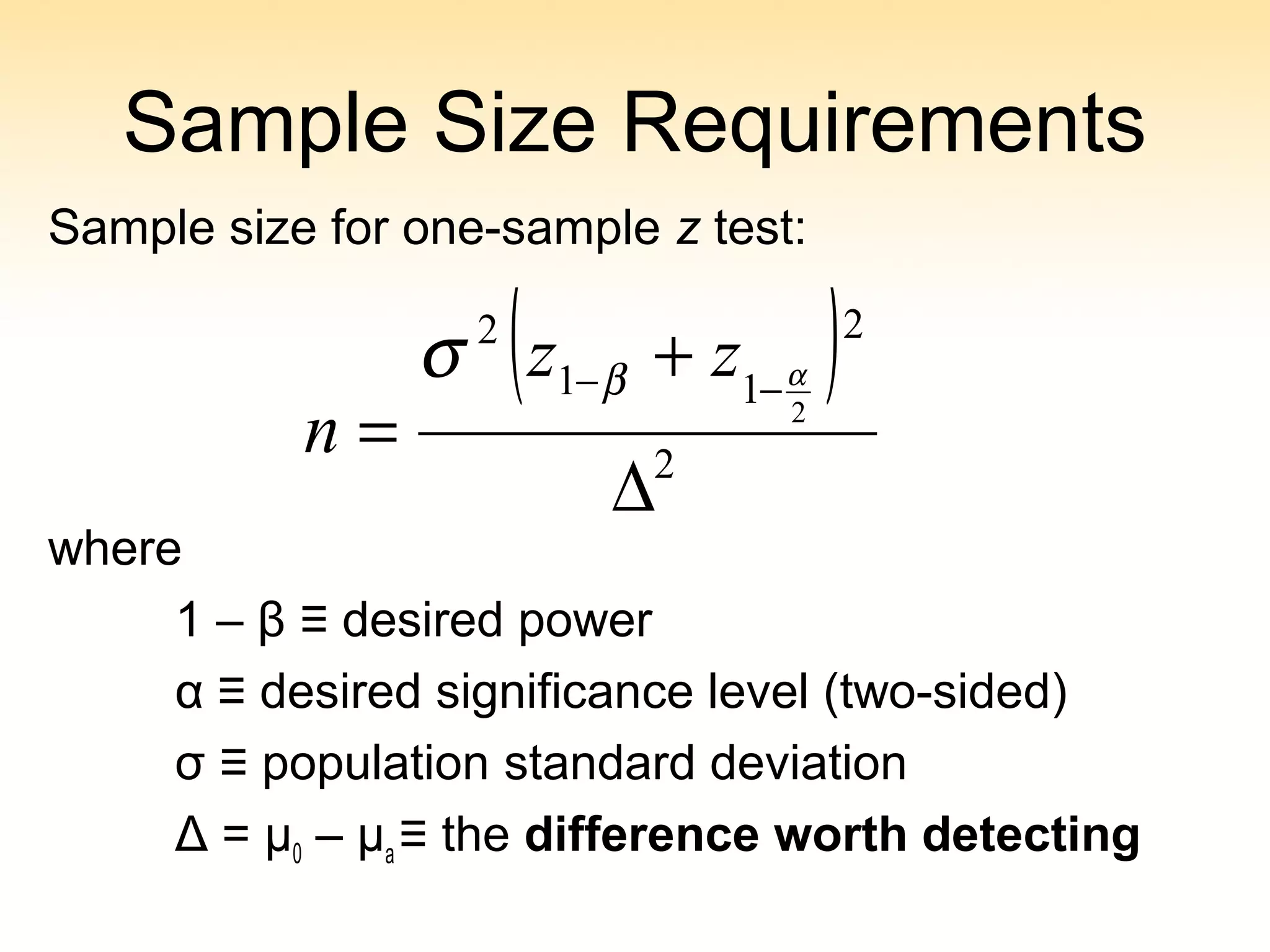
Sample Size Requirements
Sample size for one-sample z test:
where
1 – β ≡ desired power
α ≡ desired significance level (two-sided)
σ ≡ population standard deviation
Δ = μ0 – μa ≡ the difference worth detecting
( )
2
2
11
2
2
∆
+
=
−− αβσ zz
n
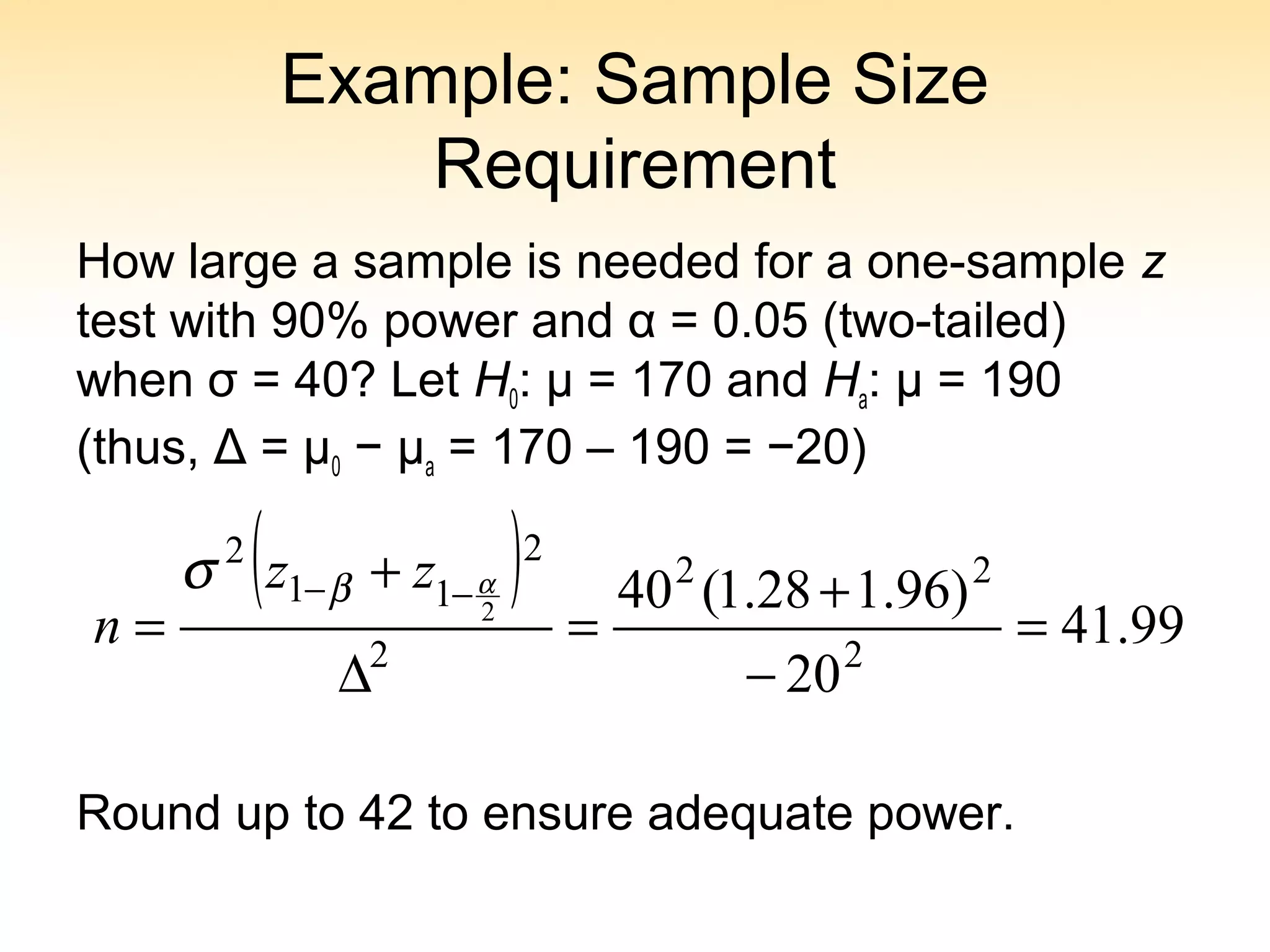
Example: Sample Size
Requirement
How large a sample is needed for a one-sample z
test with 90% power and α = 0.05 (two-tailed)
when σ = 40? Let H0: μ = 170 and Ha: μ = 190
(thus, Δ = μ0 − μa = 170 – 190 = −20)
Round up to 42 to ensure adequate power.
( ) 99.41
20
)96.128.1(40
2
22
2
2
11
2
2
=
−
+
=
∆
+
=
−− αβσ zz
n
Illustration: conditions
for 90% power.
THANK YOU FOR YOUR KIND ATTENTION

Basic of Hypothesis Testing TEKU QM

  • 1.
    Basics of HypothesisTestingBasics of Hypothesis Testing By Prof Handley Mpoki MafwengaBy Prof Handley Mpoki Mafwenga Ph.D, MSc, MBA, LLM, PGDTM, ADTM, LLB, FCTA(UK)Ph.D, MSc, MBA, LLM, PGDTM, ADTM, LLB, FCTA(UK) Macro-fiscal Policy, Advocacy and Tax Expert [Gov-Macro-fiscal Policy, Advocacy and Tax Expert [Gov- URT]URT]
  • 2.
    Contents 9.1 Null andAlternative Hypotheses 9.2 Test Statistic 9.3 P-Value 9.4 Significance Level 9.5 One-Sample z Test 9.6 Power and Sample Size
  • 3.
    Terms Introduce inPrior Chapter • Population ≡ all possible values • Sample ≡ a portion of the population • Statistical inference ≡ generalizing from a sample to a population with calculated degree of certainty • Two forms of statistical inference – Hypothesis testing – Estimation • Parameter ≡ a characteristic of population, e.g., population mean µ • Statistic ≡ calculated from data in the sample, e.g., sample mean ( )x
  • 4.
    Distinctions Between Parameters andStatistics Parameters Statistics Source Population Sample Notation Greek (e.g., μ) Roman (e.g., xbar) Vary No Yes Calculated No Yes
  • 6.
    Sampling Distributions ofa Mean The sampling distributions of a mean (SDM) describes the behavior of a sampling mean ( ) n SE SENx x x σ µ =where ,~
  • 7.
    Hypothesis Testing • Isalso called significance testing • Tests a claim about a parameter using evidence (data in a sample • The technique is introduced by considering a one-sample z test • The procedure is broken into four steps • Each element of the procedure must be understood
  • 8.
    Hypothesis Testing Steps A.Null and alternative hypotheses B. Test statistic C. P-value and interpretation D. Significance level (optional)
  • 9.
    Null and AlternativeHypotheses • Convert the research question to null and alternative hypotheses • The null hypothesis (H0) is a claim of “no difference in the population” • The alternative hypothesis (Ha) claims “H0 is false” • Collect data and seek evidence against H0 as a way of bolstering Ha (deduction)
  • 10.
    Illustrative Example: “BodyWeight” • The problem: In the 1970s, 20–29 year old men in the U.S. had a mean μ body weight of 170 pounds. Standard deviation σ was 40 pounds. We test whether mean body weight in the population now differs. • Null hypothesis H0: μ = 170 (“no difference”) • The alternative hypothesis can be either Ha: μ > 170 (one-sided test) or Ha: μ ≠ 170 (two-sided test)
  • 11.
    Test Statistic n SE H SE x x x σ µ µ = ≡ − = and trueisassumingmeanpopulationwhere z 00 0 stat This isan example of a one-sample test of a mean when σ is known. Use this statistic to test the problem:
  • 12.
    Illustrative Example: zstatistic • For the illustrative example, μ0 = 170 • We know σ = 40 • Take an SRS of n = 64. Therefore • If we found a sample mean of 173, then 5 64 40 === n SEx σ 60.0 5 1701730 stat = − = − = xSE x z µ
  • 13.
    Illustrative Example: zstatistic If we found a sample mean of 185, then 00.3 5 1701850 stat = − = − = xSE x z µ
  • 14.
    Reasoning Behinµzstat ( )5,170~Nx Sampling distribution of xbar under H0: µ = 170 for n = 64 ⇒
  • 15.
    P-value • The P-valueanswer the question: What is the probability of the observed test statistic or one more extreme when H0 is true? • This corresponds to the AUC in the tail of the Standard Normal distribution beyond the zstat. • Convert z statistics to P-value : For Ha: μ > μ0 ⇒ P = Pr(Z > zstat) = right-tail beyond zstat For Ha: μ < μ0 ⇒ P = Pr(Z < zstat) = left tail beyond zstat For Ha: μ ≠ μ0 ⇒ P = 2 × one-tailed P-value • Use Table B or software to find these probabilities (next two slides).
  • 16.
  • 17.
  • 18.
    Two-Sided P-Value • One-sidedHa ⇒ AUC in tail beyond zstat • Two-sided Ha ⇒ consider potential deviations in both directions ⇒ double the one- sided P-value Examples: If one-sided P = 0.0010, then two-sided P = 2 × 0.0010 = 0.0020. If one-sided P = 0.2743, then two-sided P = 2 × 0.2743 = 0.5486.
  • 19.
    Interpretation • P-value answerthe question: What is the probability of the observed test statistic … when H0 is true? • Thus, smaller and smaller P-values provide stronger and stronger evidence against H0 • Small P-value ⇒ strong evidence
  • 20.
    Interpretation Conventions* P > 0.10⇒ non-significant evidence against H0 0.05 < P ≤ 0.10 ⇒ marginally significant evidence 0.01 < P ≤ 0.05 ⇒ significant evidence against H0 P ≤ 0.01 ⇒ highly significant evidence against H0 Examples P =.27 ⇒ non-significant evidence against H0 P =.01 ⇒ highly significant evidence against H0 * It is unwise to draw firm borders for “significance”
  • 21.
    α-Level (Used insome situations) • Let α ≡ probability of erroneously rejecting H0 • Set α threshold (e.g., let α = .10, .05, or whatever) • Reject H0 when P ≤ α • Retain H0 when P > α • Example: Set α = .10. Find P = 0.27 ⇒ retain H0 • Example: Set α = .01. Find P = .001 ⇒ reject H0
  • 22.
    (Summary) One-Sample zTest A. Hypothesis statements H0: µ = µ0 vs. Ha: µ ≠ µ0 (two-sided) or Ha: µ < µ0 (left-sided) or Ha: µ > µ0 (right-sided) B. Test statistic C. P-value: convert zstat to P value D. Significance statement (usually not necessary) n SE SE x x x σµ = − = wherez 0 stat
  • 23.
    Conditions for ztest • σ known (not from data) • Population approximately Normal or large sample (central limit theorem) • SRS (or facsimile) • Data valid
  • 24.
    The Lake WobegonExample “where all the children are above average” • Let X represent Weschler Adult Intelligence scores (WAIS) • Typically, X ~ N(100, 15) • Take SRS of n = 9 from Lake Wobegon population • Data ⇒ {116, 128, 125, 119, 89, 99, 105, 116, 118} • Calculate: x-bar = 112.8 • Does sample mean provide strong evidence that population mean μ > 100?
  • 25.
    Example: “Lake Wobegon” A.Hypotheses: H0: µ = 100 versus Ha: µ > 100 (one-sided) Ha: µ ≠ 100 (two-sided) B. Test statistic: 56.2 5 1008.112 5 9 15 0 stat = − = − = === x x SE x z n SE µ σ
  • 26.
    C. P-value: P= Pr(Z ≥ 2.56) = 0.0052 P =.0052 ⇒ it is unlikely the sample came from this null distribution ⇒ strong evidence against H0
  • 27.
    • Ha: µ≠100 • Considers random deviations “up” and “down” from μ0 ⇒tails above and below ±zstat • Thus, two-sided P = 2 × 0.0052 = 0.0104 Two-Sided P-value: Lake Wobegon
  • 28.
    Power and SampleSize Truth Decision H0 true H0 false Retain H0 Correct retention Type II error Reject H0 Type I error Correct rejection α ≡ probability of a Type I error β ≡ Probability of a Type II error Two types of decision errors: Type I error = erroneous rejection of true H0 Type II error = erroneous retention of false H0
  • 29.
    Power • β ≡probability of a Type II error β = Pr(retain H0 | H0 false) (the “|” is read as “given”) • 1 – β = “Power” ≡ probability of avoiding a Type II error 1– β = Pr(reject H0 | H0 false)
  • 30.
    Power of az test where • Φ(z) represent the cumulative probability of Standard Normal Z • μ0 represent the population mean under the null hypothesis • μa represents the population mean under the alternative hypothesis         − +−Φ=− − σ µµ β α n z a || 1 0 1 2
  • 31.
    Calculating Power: Example Astudy of n = 16 retains H0: μ = 170 at α = 0.05 (two-sided); σ is 40. What was the power of test’s conditions to identify a population mean of 190? ( ) 5160.0 04.0 40 16|190170| 96.1 || 1 0 1 2 = Φ=         − +−Φ=         − +−Φ=− − σ µµ β α n z a
  • 32.
    Reasoning Behind Power •Competing sampling distributions Top curve (next page) assumes H0 is true Bottom curve assumes Ha is true α is set to 0.05 (two-sided) • We will reject H0 when a sample mean exceeds 189.6 (right tail, top curve) • The probability of getting a value greater than 189.6 on the bottom curve is 0.5160, corresponding to the power of the test
  • 34.
    Sample Size Requirements Samplesize for one-sample z test: where 1 – β ≡ desired power α ≡ desired significance level (two-sided) σ ≡ population standard deviation Δ = μ0 – μa ≡ the difference worth detecting ( ) 2 2 11 2 2 ∆ + = −− αβσ zz n
  • 35.
    Example: Sample Size Requirement Howlarge a sample is needed for a one-sample z test with 90% power and α = 0.05 (two-tailed) when σ = 40? Let H0: μ = 170 and Ha: μ = 190 (thus, Δ = μ0 − μa = 170 – 190 = −20) Round up to 42 to ensure adequate power. ( ) 99.41 20 )96.128.1(40 2 22 2 2 11 2 2 = − + = ∆ + = −− αβσ zz n
  • 36.
  • 37.
    THANK YOU FORYOUR KIND ATTENTION

Editor's Notes

  • #4 Hypothesis testing is one of the two common forms of statistical inference. This slide reviews some of the terms that form the basis of statistical inference, as introduced in the prior chapter. Make certain you understand these basics before proceeding.
  • #5 This slide address an other foundation of statistical inference: the difference between parameters and statistics. Parameters and statistics are related, but are not the same thing. Over the years teaching statistics, I have derived a hypothesis that explains why some students have difficulty with statistical inference: they fail to distinguish between statistics and parameter. When a student calculates a statistic such as a sample mean, it seems so tangible and real that they view it as a constant. I think they would be better off if they recognized a statistic as merely one example of what might have been had they done the study or experiment at a different time.
  • #7 This slide summarize what we’ve learned about the sampling distribution of a mean from a large sample. It is based no three important sampling postulates: the central limit theorem, the law of large numbers (unbiased nature of the sample mean), and square root law. Based on these well established statistical theorems we can say that means based on large samples (and means based in Normal populations) will have a Normal sampling distribution with an expectation equal to the population mean with a standard deviation equal to the standard deviation of the population divided by the square root of the sample size n.
  • #8 Hypothesis testing (also called significance testing) uses a quasi-deductive procedure to judge claims about parameters. Before testing a statistical hypothesis it is important to clearly state the nature of the claim to be tested. We are then going to use a four step procedure (as outlined in the last bullet) to test the claim.
  • #10 The first step in the procedure is to state the hypotheses null and alternative forms. The null hypothesis (abbreviate “H naught”) is a statement of no difference. The alternative hypothesis (“H sub a”) is a statement of difference. Seek evidence against the claim of H0 as a way of bolstering Ha. The next slide offers an illustrative example on setting up the hypotheses.
  • #11 In the late 1970s, the weight of U.S. men between 20- and 29-years of age had a log-normal distribution with a mean of 170 pounds and standard deviation of 40 pounds. As you know, the overweight and obese conditions seems to be more prevalent today, constituting a major public health problem. To illustrate the hypothesis testing procedure, we ask if body weight in this group has increased since 1970. Under the null hypothesis there is no difference in the mean body weight between then and now, in which case μ would still equal 170 pounds. Under the alternative hypothesis, the mean weight has increased Therefore, Ha: μ &amp;gt; 170. This statement of the alternative hypothesis is one-sided. That is, it looks only for values larger than stated under the null hypothesis. There is another way to state the alternative hypothesis. We could state it in a “two-sided” manner, looking for values that are either higher- or lower-than expected. For the current illustrative example, the two-sided alternative is Ha: μ ≠ 170. Although for the current illustrative example, this seems unnecessary, two-sided alternative offers several advantages and are much more common in practice.