Machine Learning with
Python
Conditional Probability
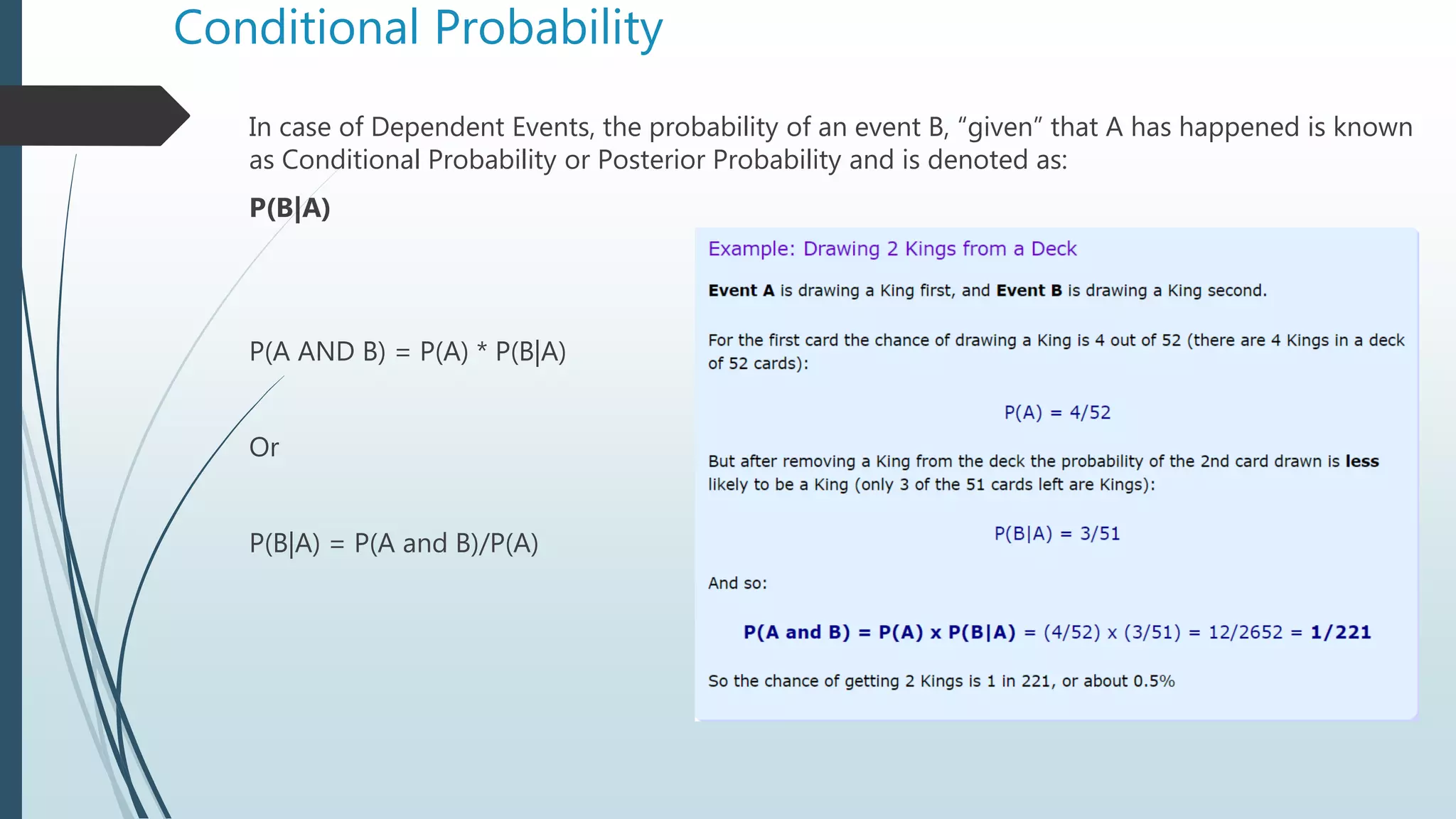
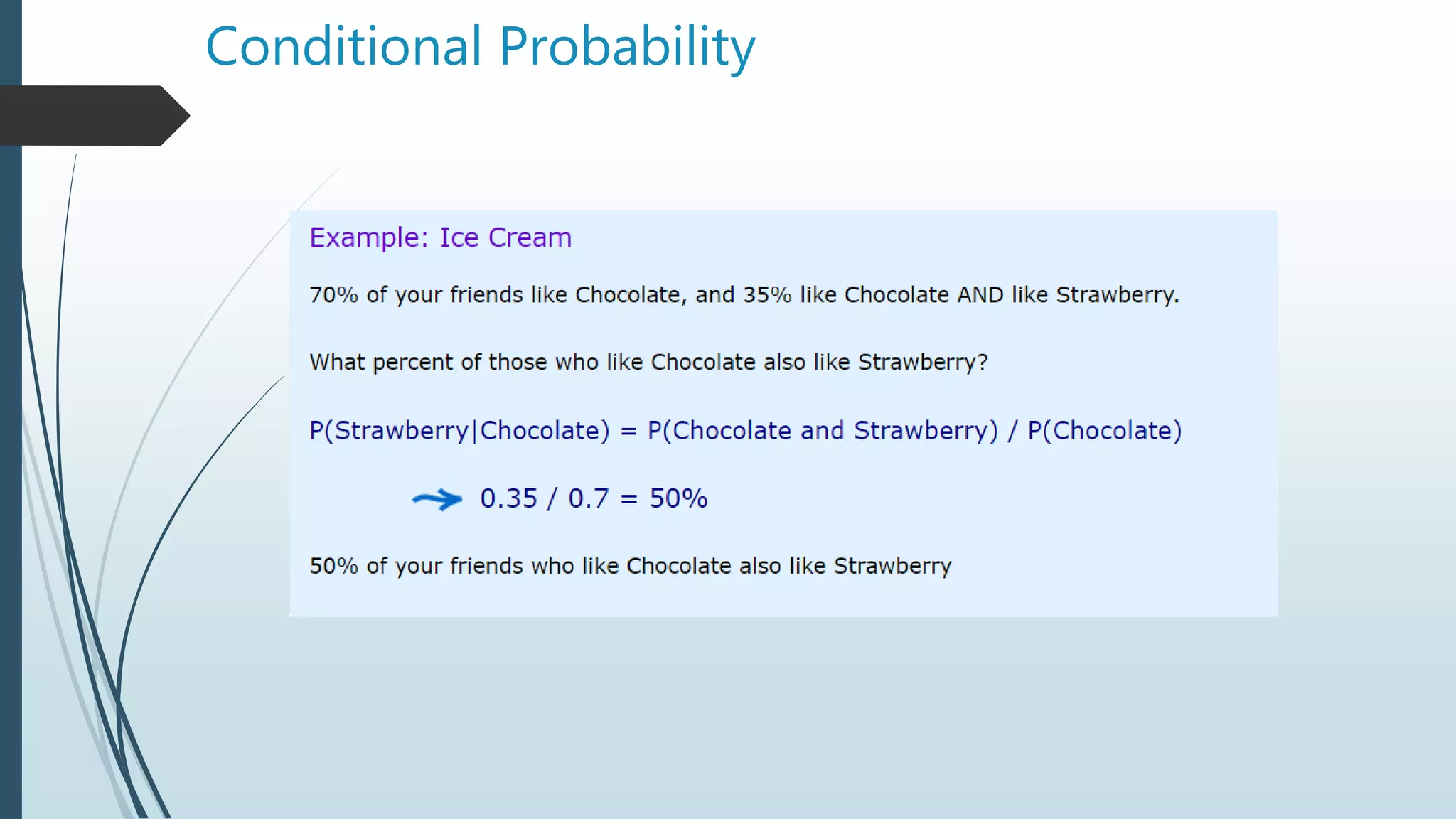
In case of Dependent Events, the probability of an event B, “given” that A has happened is known
as Conditional Probability or Posterior Probability and is denoted as:
P(B|A)
P(A AND B) = P(A) * P(B|A)
Or
P(B|A) = P(A and B)/P(A)
Conditional Probability
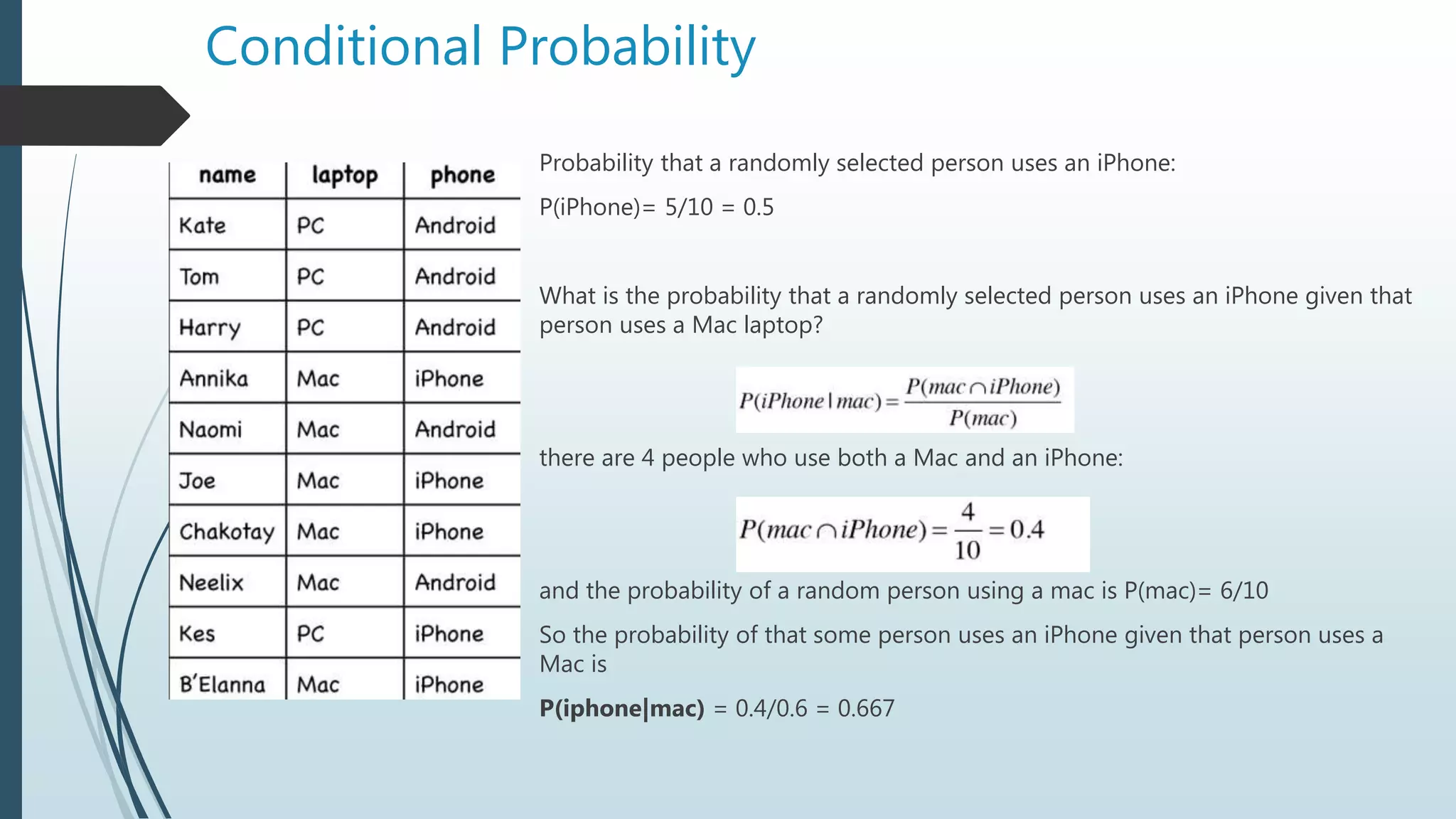
Probability that a randomly selected person uses an iPhone:
P(iPhone)= 5/10 = 0.5
What is the probability that a randomly selected person uses an iPhone given that
person uses a Mac laptop?
there are 4 people who use both a Mac and an iPhone:
and the probability of a random person using a mac is P(mac)= 6/10
So the probability of that some person uses an iPhone given that person uses a
Mac is
P(iphone|mac) = 0.4/0.6 = 0.667
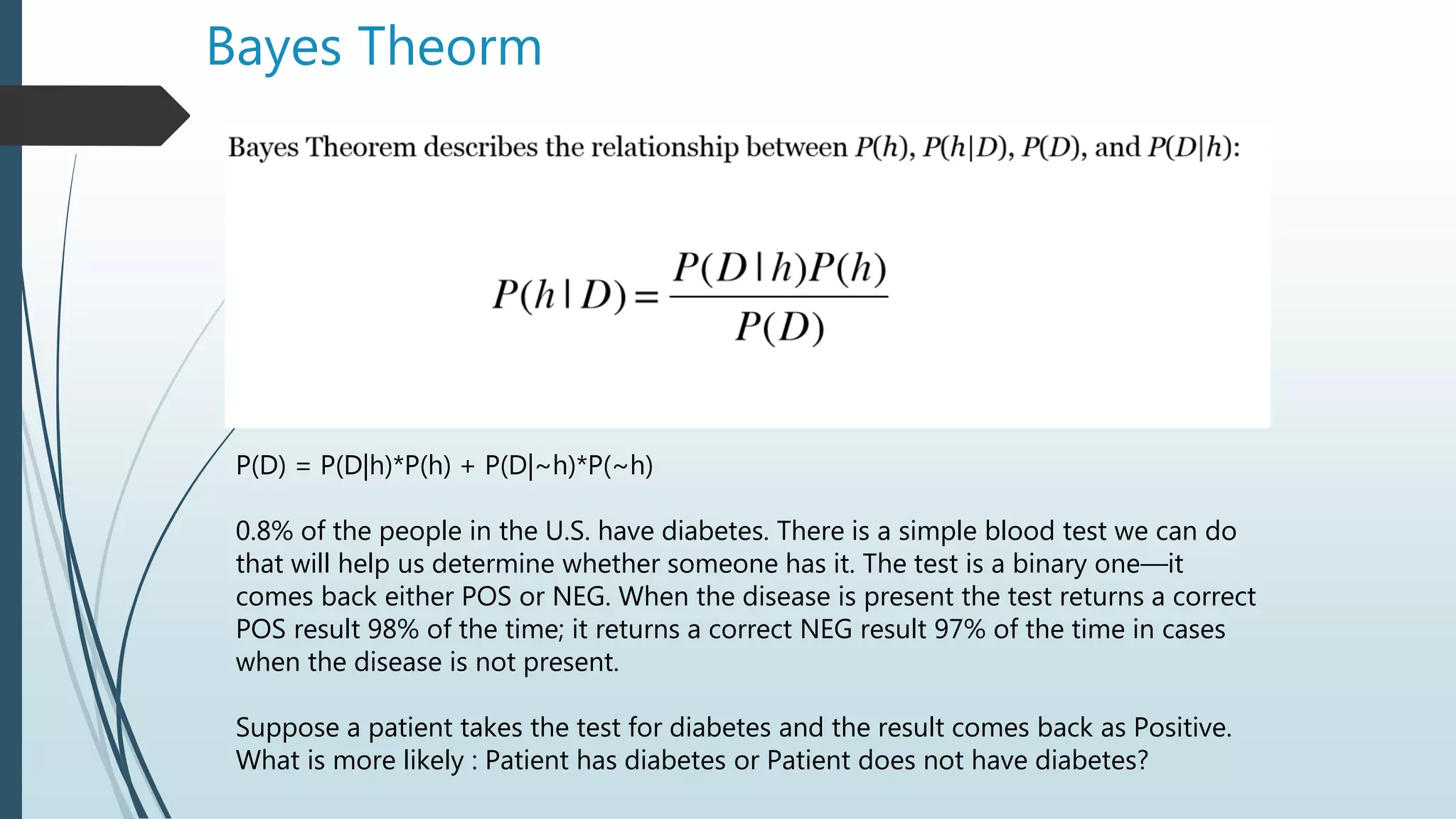
Bayes Theorm
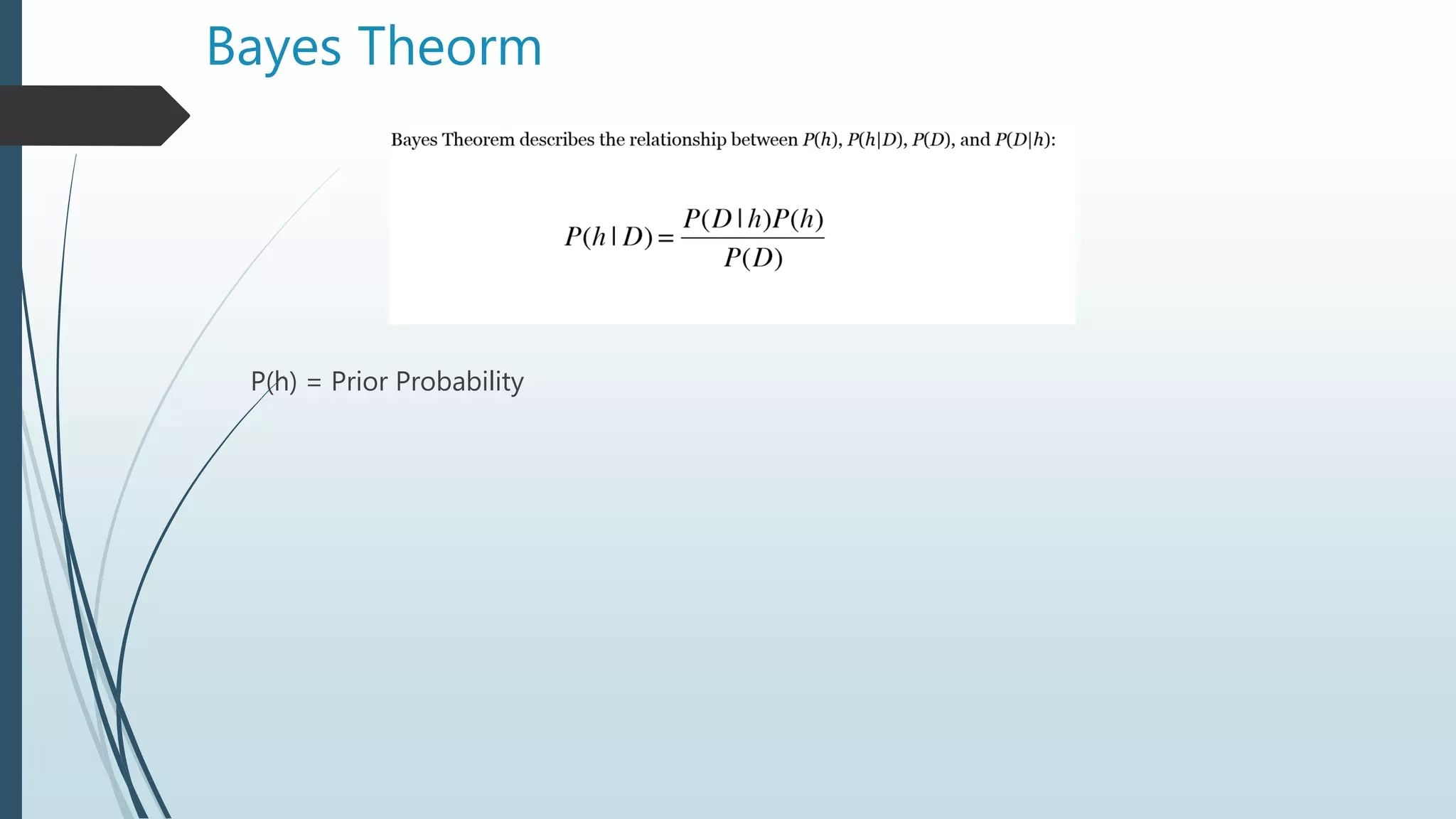
P(h) = Prior Probability
Bayes Theorm
P(D) = P(D|h)*P(h) + P(D|~h)*P(~h)
0.8% of the people in the U.S. have diabetes. There is a simple blood test we can do
that will help us determine whether someone has it. The test is a binary one—it
comes back either POS or NEG. When the disease is present the test returns a correct
POS result 98% of the time; it returns a correct NEG result 97% of the time in cases
when the disease is not present.
Suppose a patient takes the test for diabetes and the result comes back as Positive.
What is more likely : Patient has diabetes or Patient does not have diabetes?
Bayes Theorem
P(disease) = 0.008
P(~disease) = 0.992
P(POS|disease) = 0.98
P(NEG|disease) = 0.02
P(NEG|~disease)=0.97
P(POS|~disease) = 0.03
P(disease|POS) = ??
As per Bayes Theorm:
P(disease|POS) = [P(POS|disease)* P(disease)]/P(POS)
P(POS) = P(POS|disease)* P(disease)] + P(POS|~disease)* P(~disease)]
P(disease|POS) = 0.98*0.008/(0.98*0.008 + 0.03*0.992) = 0.21
P(~disease|POS) = 0.03*0.992/(0.98*0.008 + 0.03*0.992) = 0.79
The person has only 21% chance of getting the disease
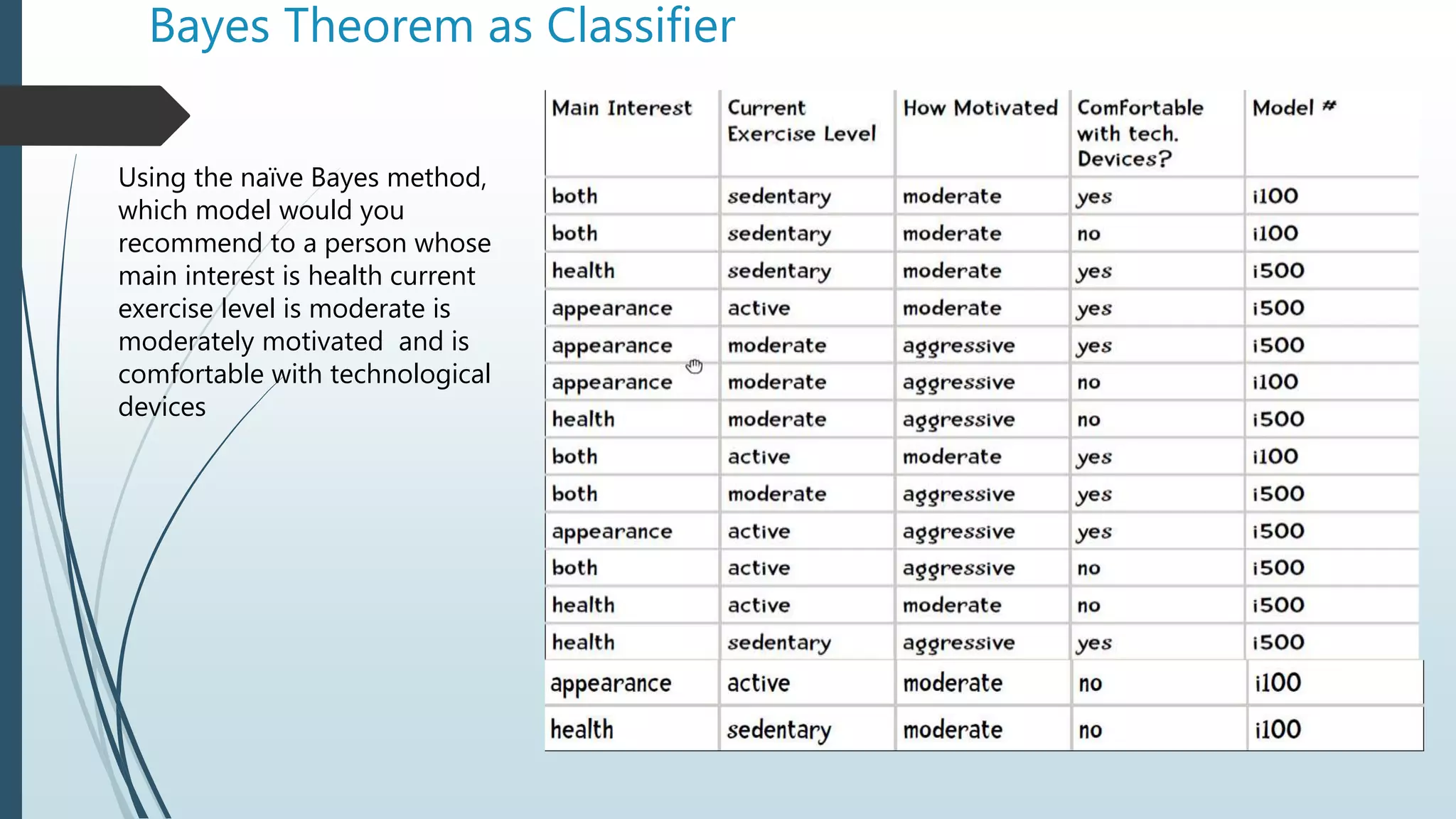
Bayes Theorem as Classifier
Using the naïve Bayes method,
which model would you
recommend to a person whose
main interest is health current
exercise level is moderate is
moderately motivated and is
comfortable with technological
devices
Bayes Theorem as Classifier
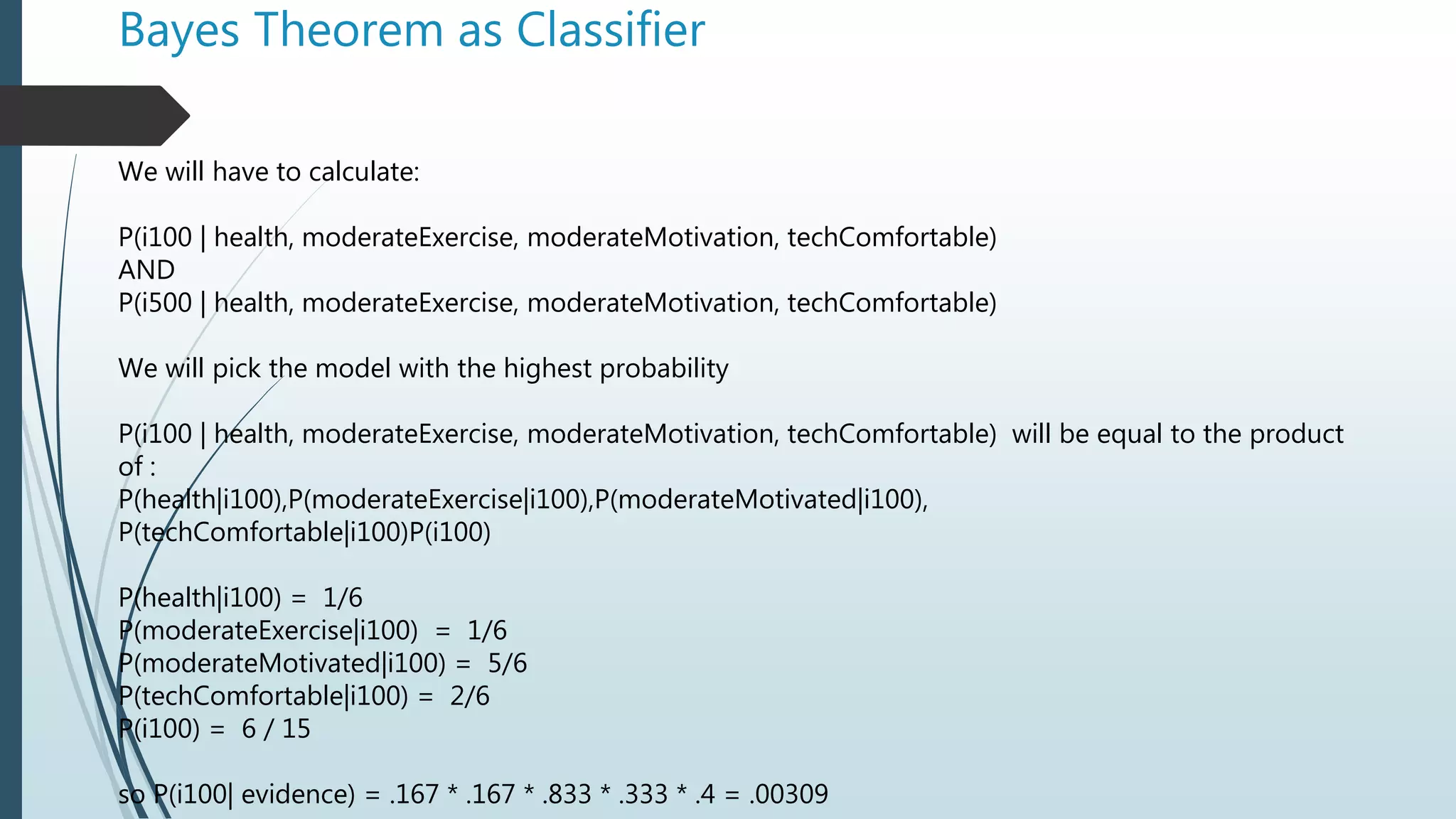
We will have to calculate:
P(i100 | health, moderateExercise, moderateMotivation, techComfortable)
AND
P(i500 | health, moderateExercise, moderateMotivation, techComfortable)
We will pick the model with the highest probability
P(i100 | health, moderateExercise, moderateMotivation, techComfortable) will be equal to the product
of :
P(health|i100),P(moderateExercise|i100),P(moderateMotivated|i100),
P(techComfortable|i100)P(i100)
P(health|i100) = 1/6
P(moderateExercise|i100) = 1/6
P(moderateMotivated|i100) = 5/6
P(techComfortable|i100) = 2/6
P(i100) = 6 / 15
so P(i100| evidence) = .167 * .167 * .833 * .333 * .4 = .00309
Bayes Theorem as Classifier
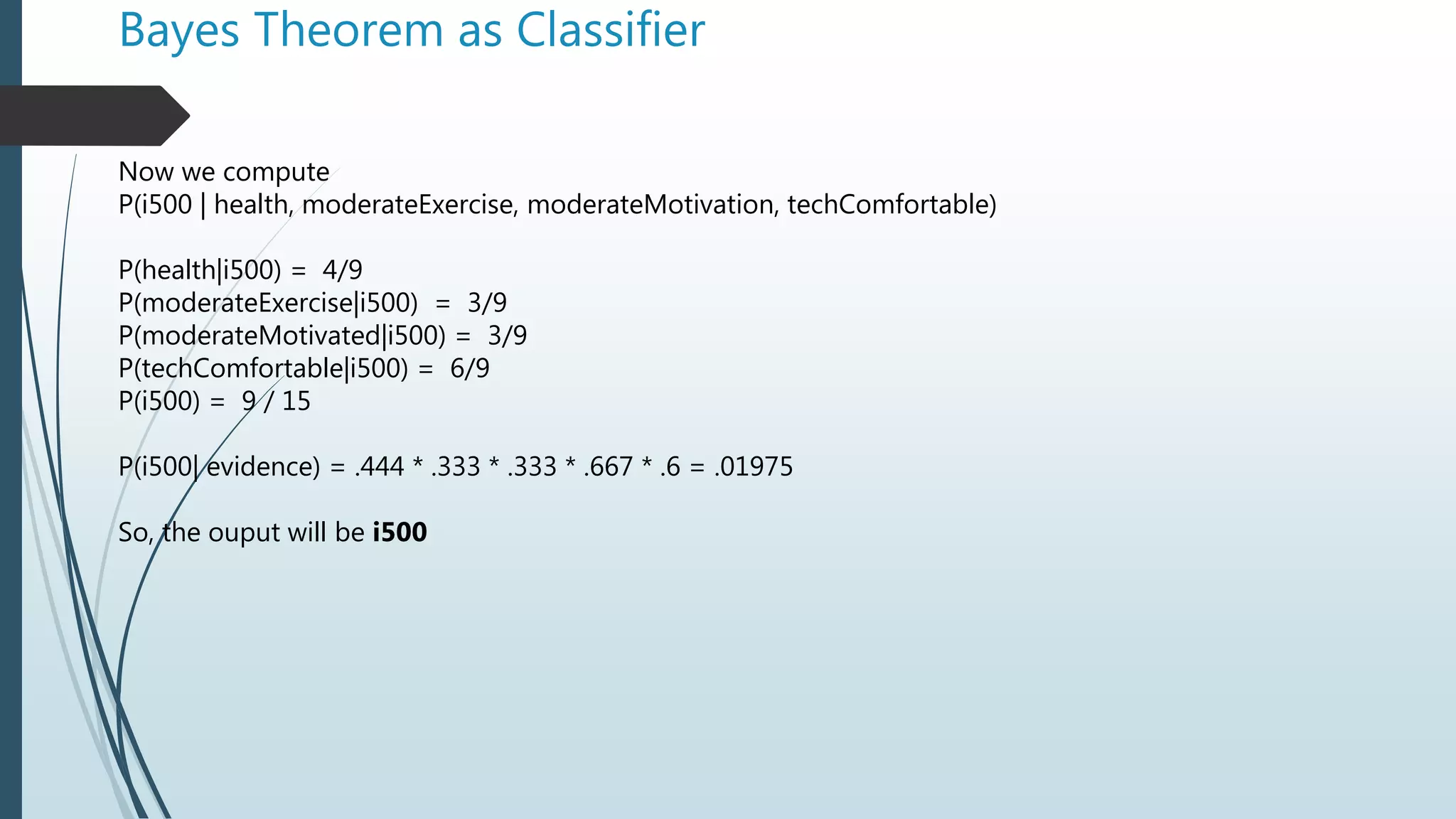
Now we compute
P(i500 | health, moderateExercise, moderateMotivation, techComfortable)
P(health|i500) = 4/9
P(moderateExercise|i500) = 3/9
P(moderateMotivated|i500) = 3/9
P(techComfortable|i500) = 6/9
P(i500) = 9 / 15
P(i500| evidence) = .444 * .333 * .333 * .667 * .6 = .01975
So, the ouput will be i500
NB Algorithm
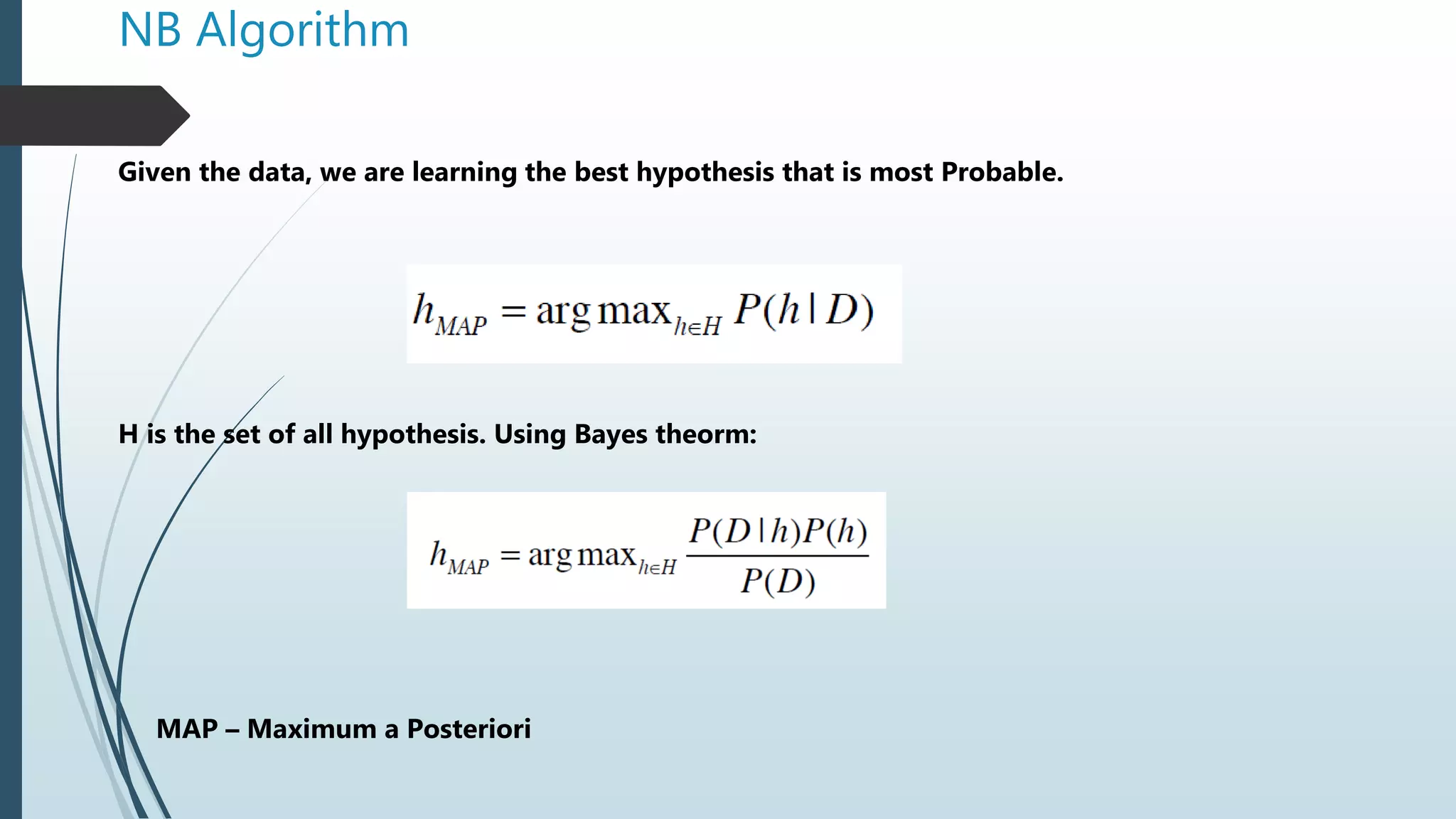
Given the data, we are learning the best hypothesis that is most Probable.
H is the set of all hypothesis. Using Bayes theorm:
MAP – Maximum a Posteriori
Bayes Theorem - Example
There are 2 machines – Mach1 and Mach2
Mach1 produced 30 toys
Mach2 produced 20 toys
Out of all the toys produced, 1% are defective.
50% of defective parts came from Mach1 and 50% came from Mach2.
What is the probability that the toy produced by Mach2 is defective?
Naïve Bayes in case of Numerical Attributes
Naïve Bayes works well for categorical data.
In case of a numerical(continuous) attribute, we can do 2 things:
 Make categories
So Age can be categorized as <18, 18-22, 23-30, 31-40, >40
 Gaussian Distribution
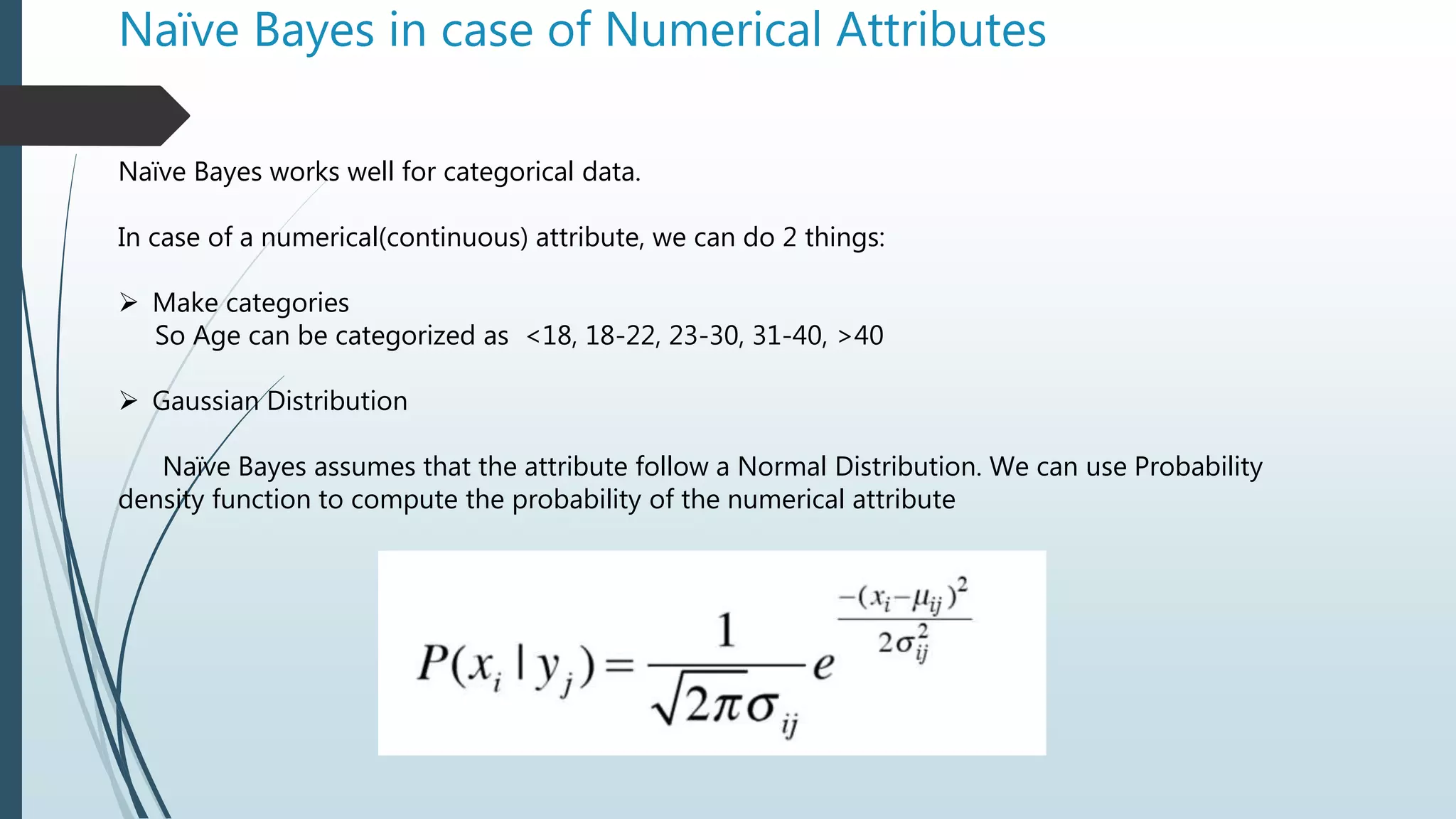
Naïve Bayes assumes that the attribute follow a Normal Distribution. We can use Probability
density function to compute the probability of the numerical attribute
Pros and Cons of NB
Pros
 Fast and Easy to implement. Very good performance for multi-class prediction
 If attributes are truly independent, it performs better compared to other models like Logistic
regression
 Performs better in case of categorical variables
Cons
 If categorical variable has a category (in test data set), which was not observed in training
data set, then model will assign a 0 (zero) probability and will be unable to make a
prediction.
 In real life, it is almost impossible that we get a set of predictors which are completely
independent.
kNN Algorithm
K – Nearest Neighbors:
We have a set of training data with labels. When we are given a new piece of data, we compare it
to every piece of existing data. We then take the most “similar” pieces of data(the nearest
neighbors) and look at their labels. We look at the top “k” most “similar” pieces of data from
training set. Lastly, we take a majority vote from these k pieces and assign the majority class to
our new piece of data.
How to calculate “similarity” between 2 pieces of data?
We can represent each piece of data as a point and calculate the distances between those points.
The pints which are close to each other can be considered as “similar”
Eager Vs Lazy Learning
 Decision Trees, Regression, Neural Networks, SVMs, Bayes nets: all of these can be described
as eager learners. In these models, we fit a function that best fits our training data; when we
have new inputs, the input’s features are fed into the function, which produces an output.
Once a function has been computed, the data could be lost to no detriment of the model’s
performance (until we obtain more data and want to recompute our function). For eager
learners, we take the time to learn from the data first and sacrifice local sensitivity to obtain
quick, global scale estimates on new data points.
 KNN is a lazy learner. Lazy learners do not compute a function to fit the training data before
new data is received. Instead, new instances are compared to the training data itself to make
a classification or regression judgment. Essentially, the data itself is the function to which new
instances are fit. While the memory requirements are much larger than eager learners (storing
all training data versus just a function) and judgments take longer to compute than eager
learners, lazy learners have advantages in localscale estimation and easy integration of
additional training data.
Example
User Bahubali 2 Half-Girlfriend
Avnish 5 5
Pawan 2 5
Nitin 5 1
Aishwarya 5 4
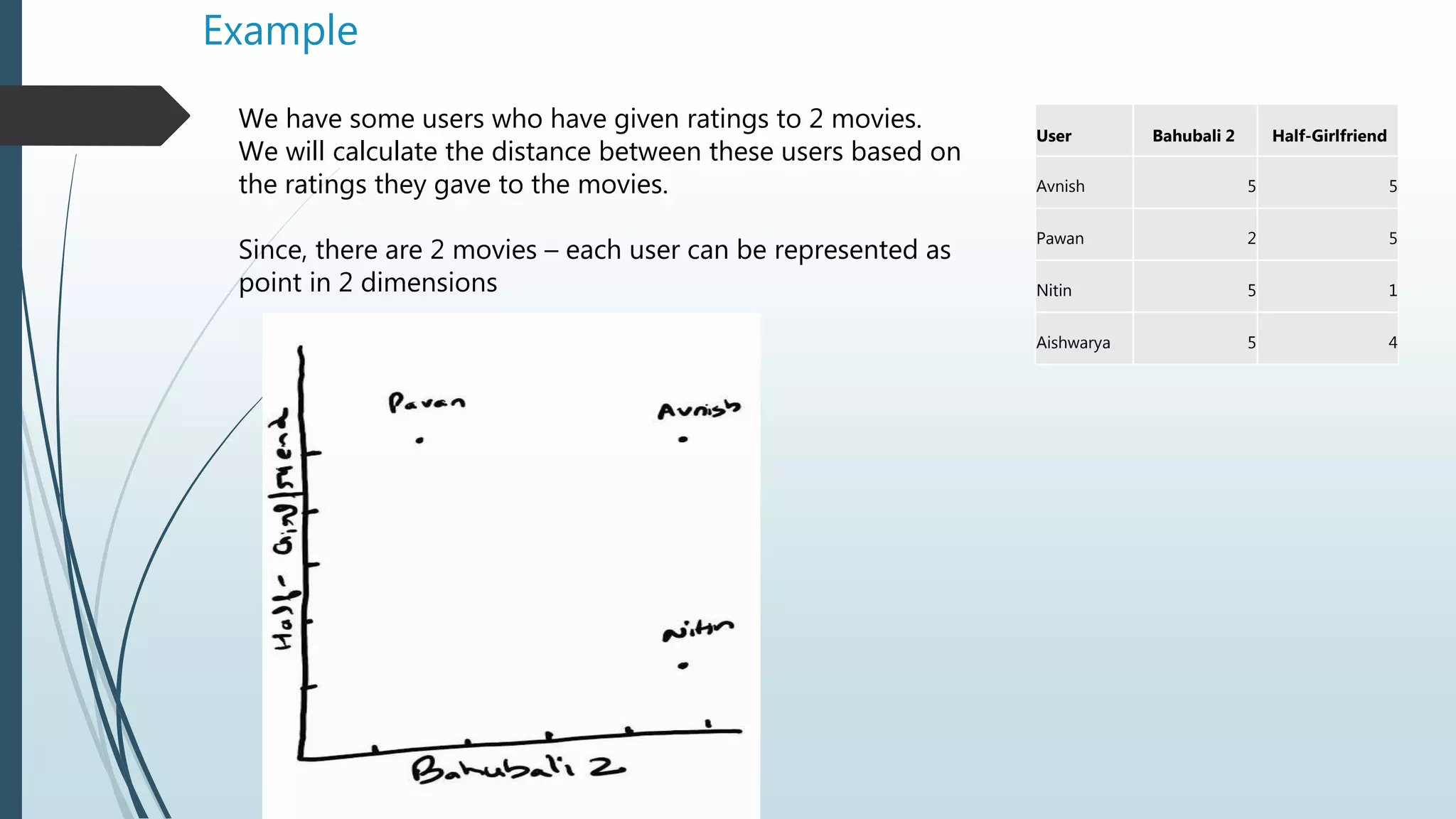
We have some users who have given ratings to 2 movies.
We will calculate the distance between these users based on
the ratings they gave to the movies.
Since, there are 2 movies – each user can be represented as
point in 2 dimensions
Distances
Manhattan Distance:
This is the easiest distance to calculate.
So lets say Aishwary is (x1,y1)
Pawan is (x2,y2)
Manhattan Distance is calculated by : |x1 – x2| + |y1 – y2|
So distance between Aishwary and Pawan is |5 – 2| + |5 – 4| = 4
distance between Aishwary and Avnish is |5 – 5| + |5 – 4| = 1
distance between Aishwary and Nitin is |5 – 5| + |4 -1| = 3
Aishwarya is more similar to Avnish. So if we know the best rated movies of Avnish, we can
recommend it to Aishwarya.
Distances
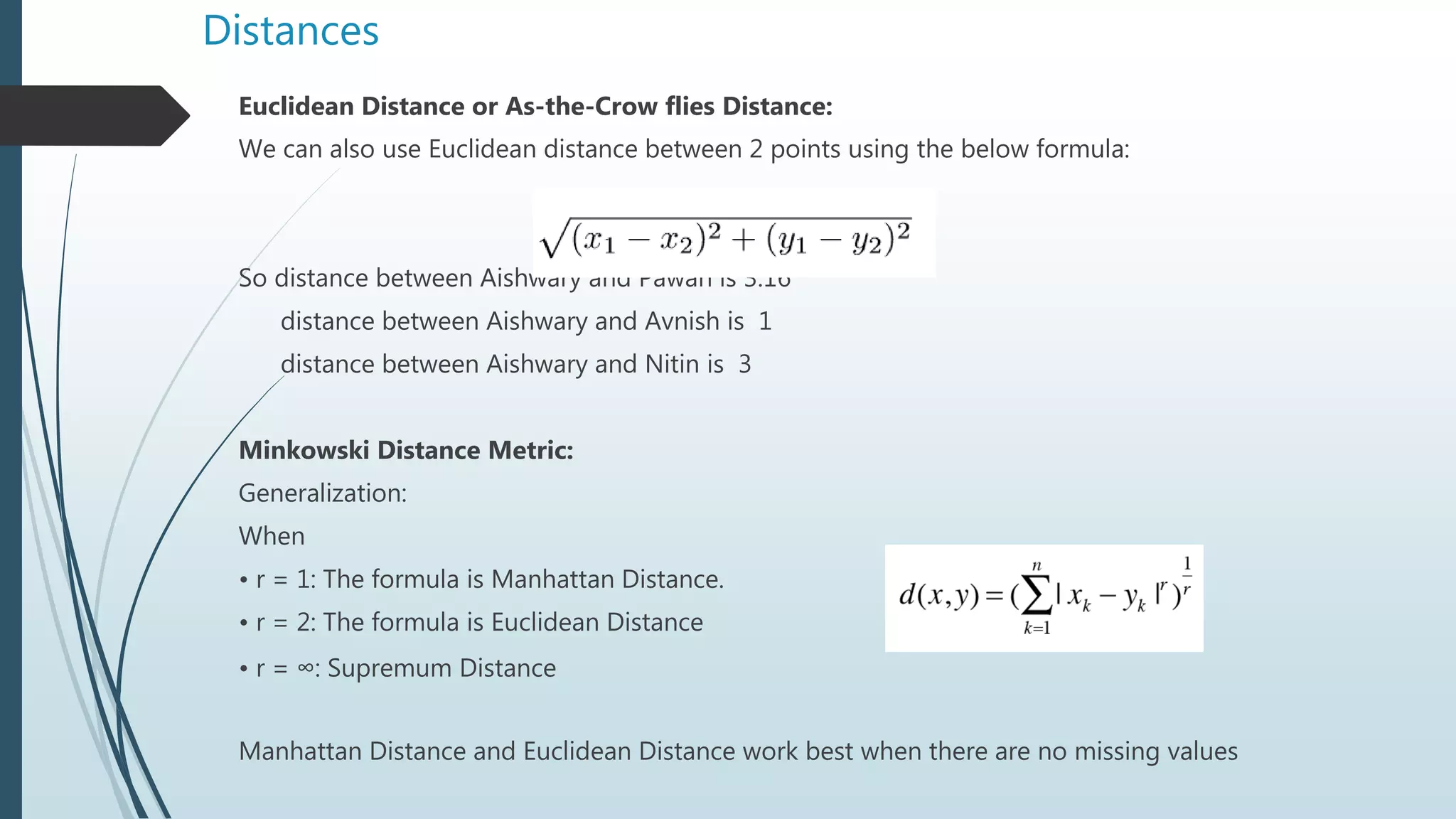
Euclidean Distance or As-the-Crow flies Distance:
We can also use Euclidean distance between 2 points using the below formula:
So distance between Aishwary and Pawan is 3.16
distance between Aishwary and Avnish is 1
distance between Aishwary and Nitin is 3
Minkowski Distance Metric:
Generalization:
When
• r = 1: The formula is Manhattan Distance.
• r = 2: The formula is Euclidean Distance
• r = ∞: Supremum Distance
Manhattan Distance and Euclidean Distance work best when there are no missing values
N - Dimensions
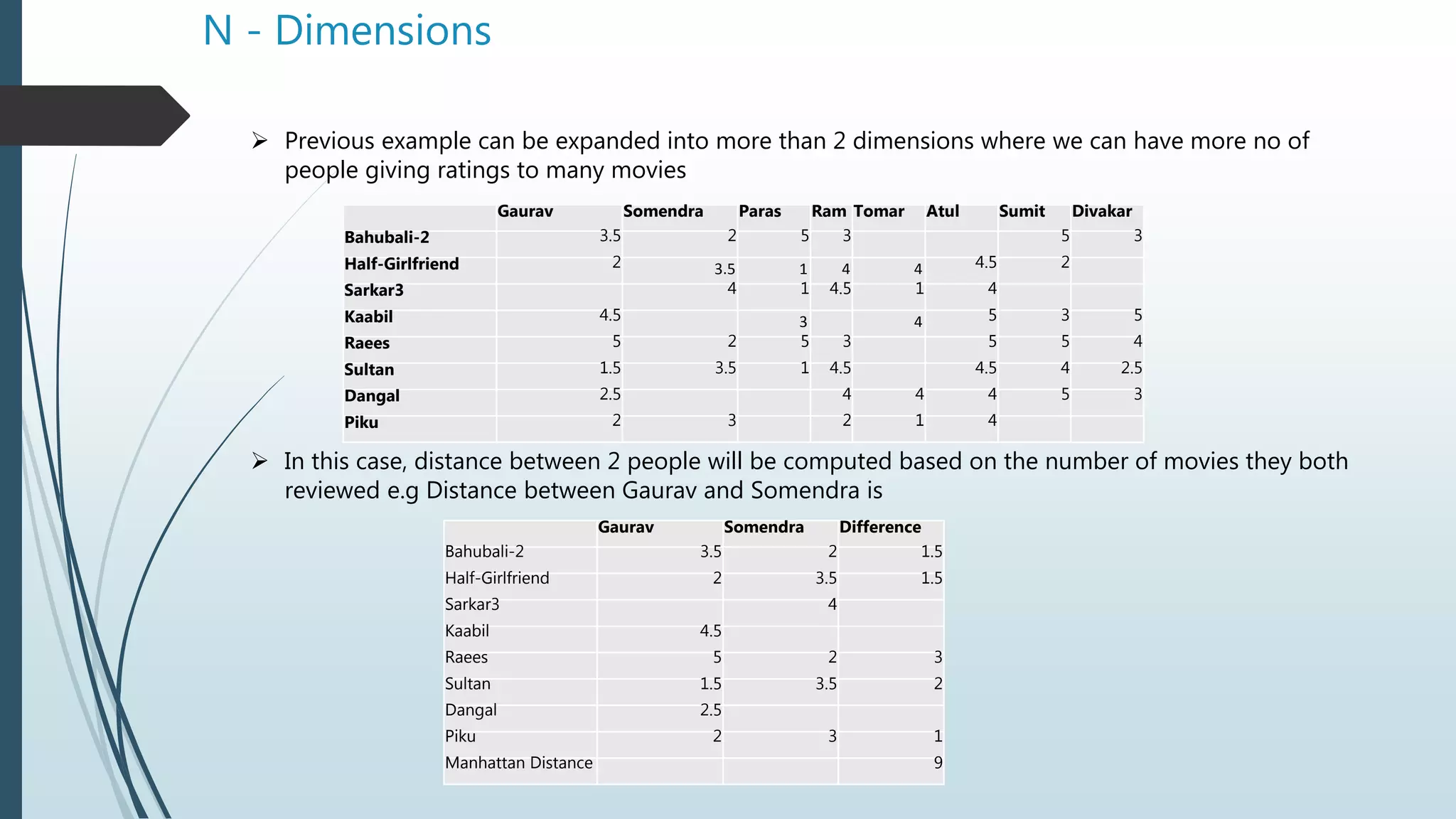
 Previous example can be expanded into more than 2 dimensions where we can have more no of
people giving ratings to many movies
 In this case, distance between 2 people will be computed based on the number of movies they both
reviewed e.g Distance between Gaurav and Somendra is
Gaurav Somendra Paras Ram Tomar Atul Sumit Divakar
Bahubali-2 3.5 2 5 3 5 3
Half-Girlfriend 2 3.5 1 4 4 4.5 2
Sarkar3 4 1 4.5 1 4
Kaabil 4.5 3 4 5 3 5
Raees 5 2 5 3 5 5 4
Sultan 1.5 3.5 1 4.5 4.5 4 2.5
Dangal 2.5 4 4 4 5 3
Piku 2 3 2 1 4
Gaurav Somendra Difference
Bahubali-2 3.5 2 1.5
Half-Girlfriend 2 3.5 1.5
Sarkar3 4
Kaabil 4.5
Raees 5 2 3
Sultan 1.5 3.5 2
Dangal 2.5
Piku 2 3 1
Manhattan Distance 9
Pearson Corelation Coefficient
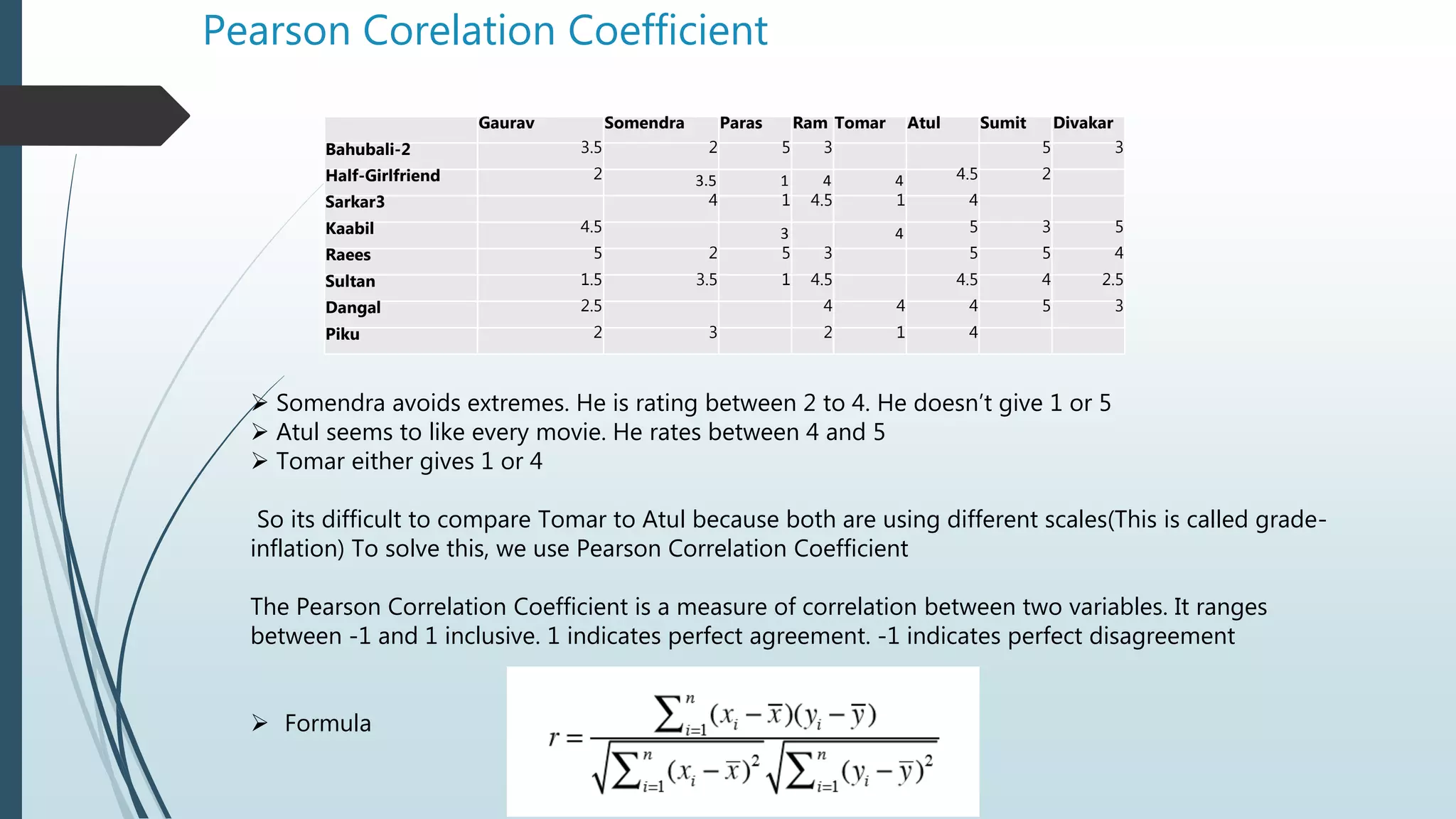
 Somendra avoids extremes. He is rating between 2 to 4. He doesn’t give 1 or 5
 Atul seems to like every movie. He rates between 4 and 5
 Tomar either gives 1 or 4
So its difficult to compare Tomar to Atul because both are using different scales(This is called grade-
inflation) To solve this, we use Pearson Correlation Coefficient
The Pearson Correlation Coefficient is a measure of correlation between two variables. It ranges
between -1 and 1 inclusive. 1 indicates perfect agreement. -1 indicates perfect disagreement
 Formula
Gaurav Somendra Paras Ram Tomar Atul Sumit Divakar
Bahubali-2 3.5 2 5 3 5 3
Half-Girlfriend 2 3.5 1 4 4 4.5 2
Sarkar3 4 1 4.5 1 4
Kaabil 4.5 3 4 5 3 5
Raees 5 2 5 3 5 5 4
Sultan 1.5 3.5 1 4.5 4.5 4 2.5
Dangal 2.5 4 4 4 5 3
Piku 2 3 2 1 4
Cosine Similarity
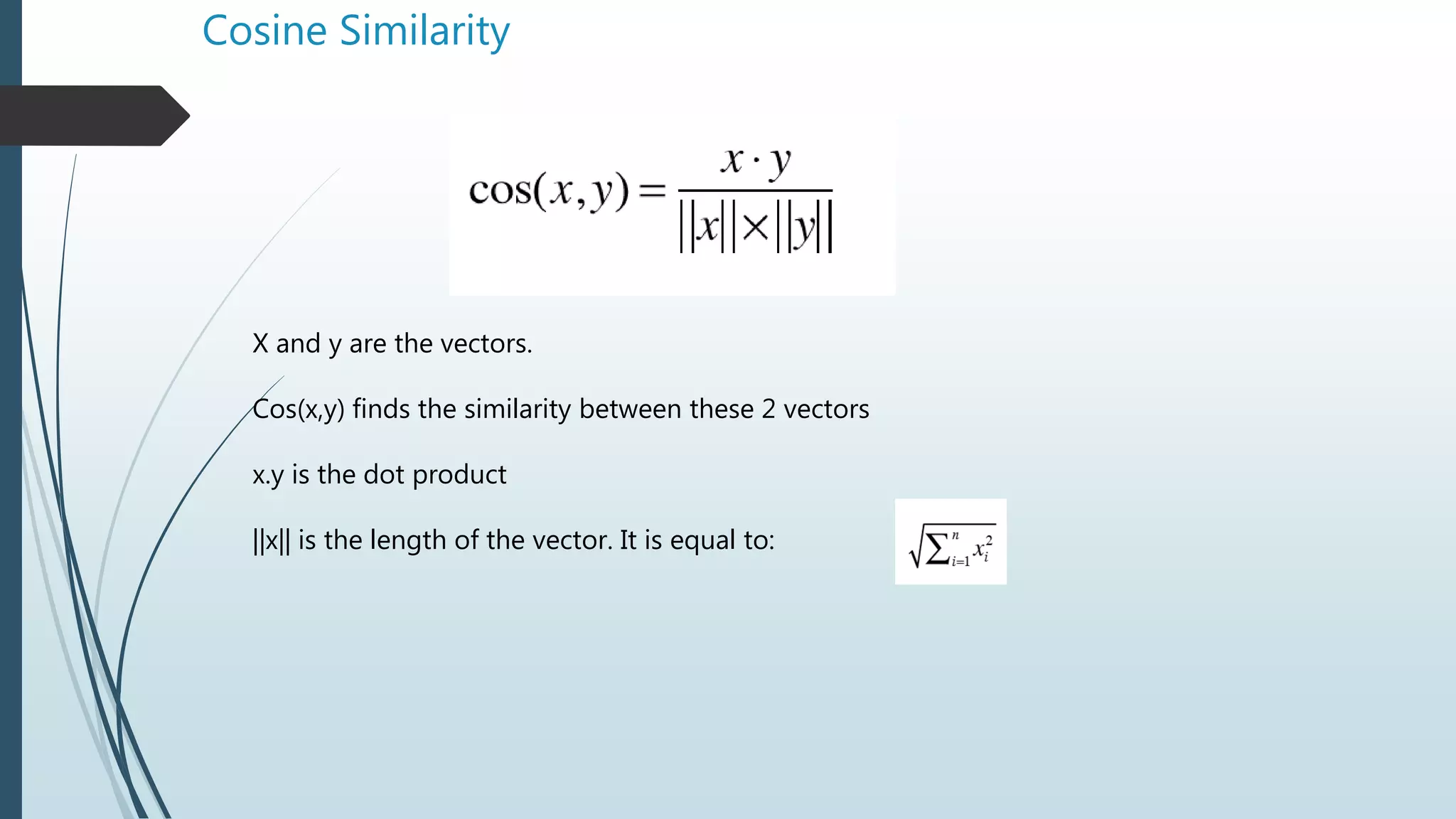
X and y are the vectors.
Cos(x,y) finds the similarity between these 2 vectors
x.y is the dot product
||x|| is the length of the vector. It is equal to:
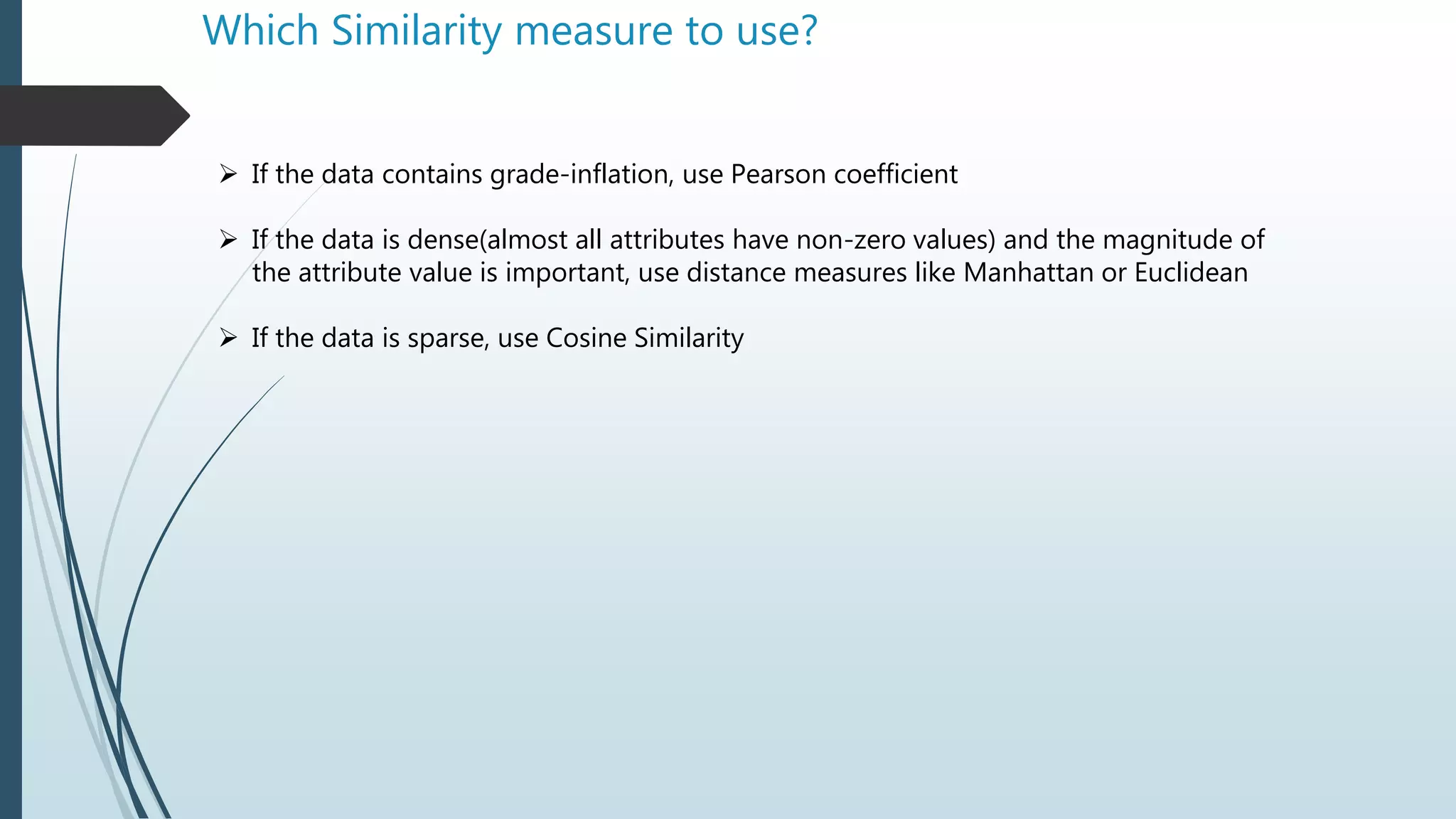
Which Similarity measure to use?
 If the data contains grade-inflation, use Pearson coefficient
 If the data is dense(almost all attributes have non-zero values) and the magnitude of
the attribute value is important, use distance measures like Manhattan or Euclidean
 If the data is sparse, use Cosine Similarity
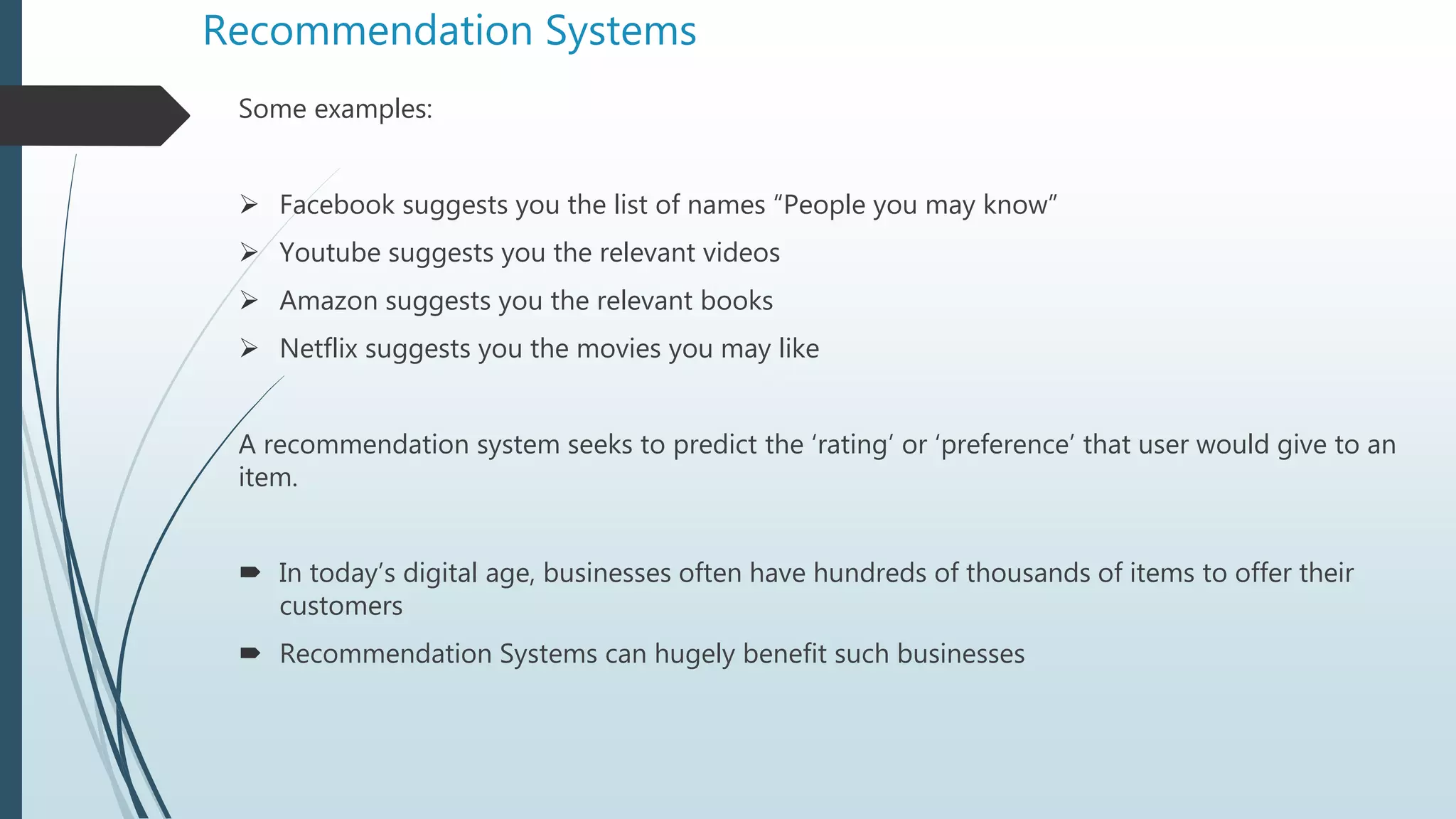
Recommendation Systems
Some examples:
 Facebook suggests you the list of names “People you may know”
 Youtube suggests you the relevant videos
 Amazon suggests you the relevant books
 Netflix suggests you the movies you may like
A recommendation system seeks to predict the ‘rating’ or ‘preference’ that user would give to an
item.
 In today’s digital age, businesses often have hundreds of thousands of items to offer their
customers
 Recommendation Systems can hugely benefit such businesses
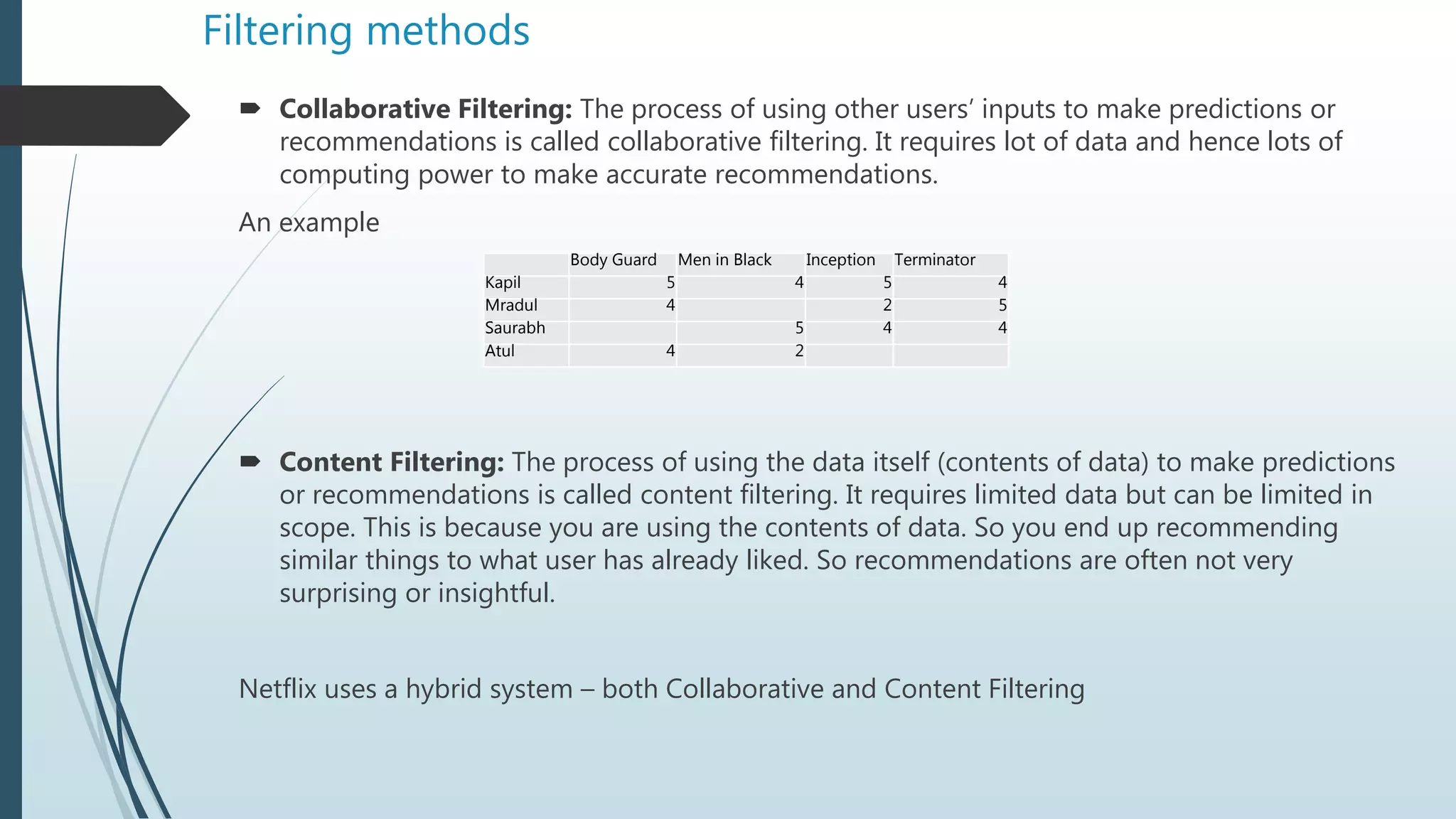
Filtering methods
 Collaborative Filtering: The process of using other users’ inputs to make predictions or
recommendations is called collaborative filtering. It requires lot of data and hence lots of
computing power to make accurate recommendations.
An example
 Content Filtering: The process of using the data itself (contents of data) to make predictions
or recommendations is called content filtering. It requires limited data but can be limited in
scope. This is because you are using the contents of data. So you end up recommending
similar things to what user has already liked. So recommendations are often not very
surprising or insightful.
Netflix uses a hybrid system – both Collaborative and Content Filtering
Body Guard Men in Black Inception Terminator
Kapil 5 4 5 4
Mradul 4 2 5
Saurabh 5 4 4
Atul 4 2
Recommendation Systems
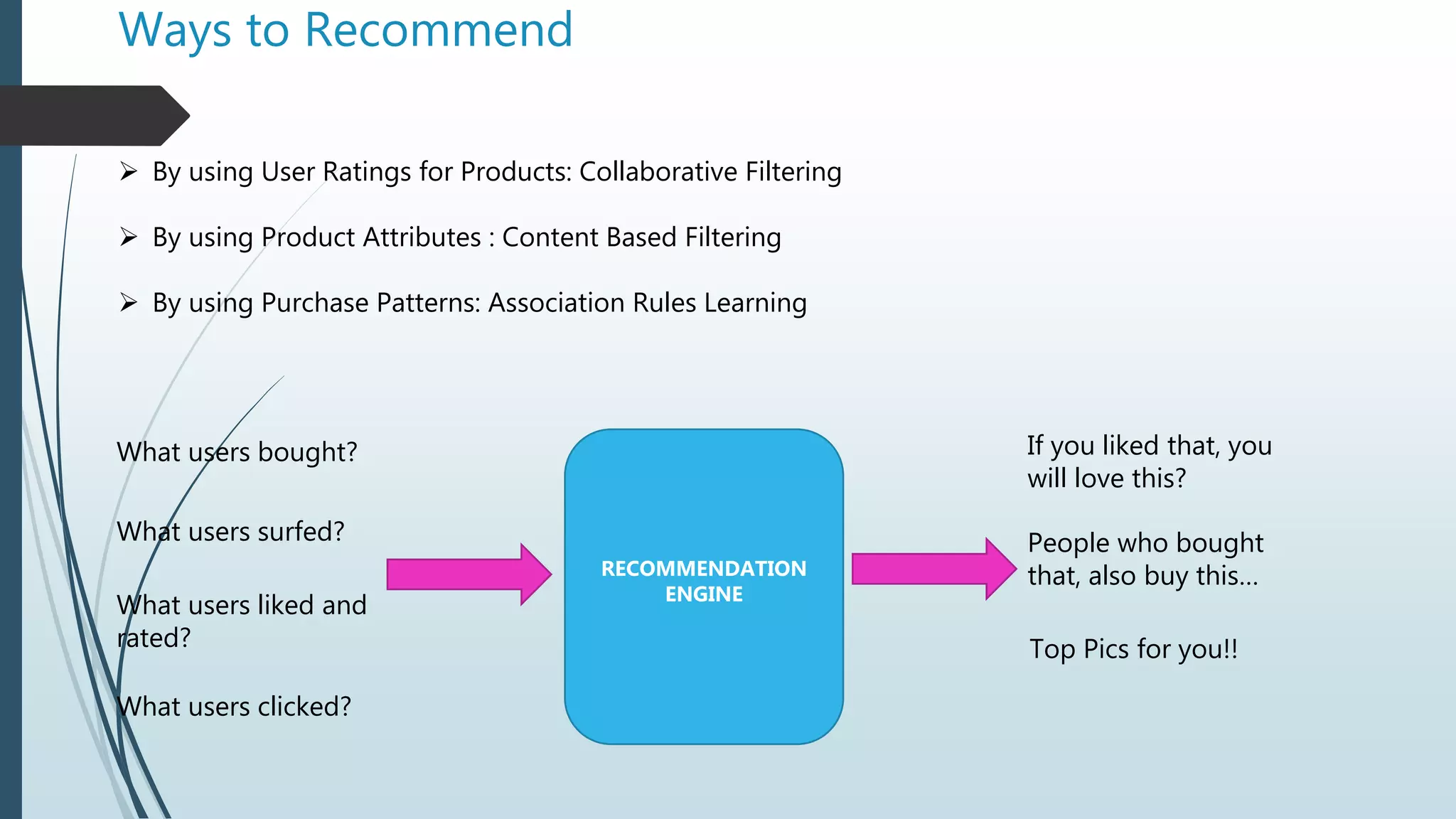
Ways to Recommend
 By using User Ratings for Products: Collaborative Filtering
 By using Product Attributes : Content Based Filtering
 By using Purchase Patterns: Association Rules Learning
RECOMMENDATION
ENGINE
What users bought?
What users surfed?
What users liked and
rated?
What users clicked?
If you liked that, you
will love this?
People who bought
that, also buy this…
Top Pics for you!!
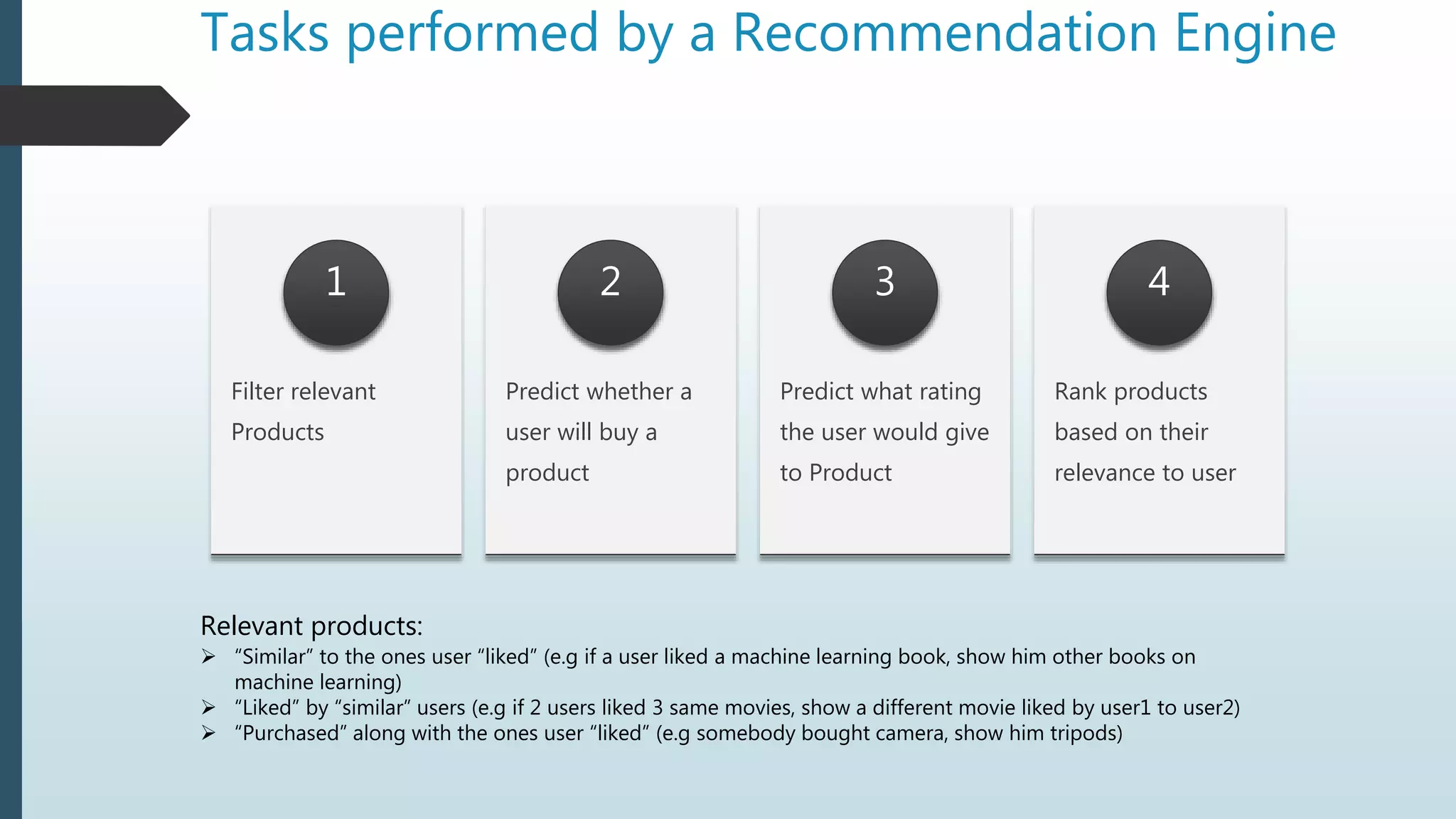
Tasks performed by a Recommendation Engine
Filter relevant
Products
1
Predict whether a
user will buy a
product
2
Predict what rating
the user would give
to Product
3
Rank products
based on their
relevance to user
4
Relevant products:
 “Similar” to the ones user “liked” (e.g if a user liked a machine learning book, show him other books on
machine learning)
 “Liked” by “similar” users (e.g if 2 users liked 3 same movies, show a different movie liked by user1 to user2)
 “Purchased” along with the ones user “liked” (e.g somebody bought camera, show him tripods)
Collaborative Filtering
Cons:
1. Scalability: if the no of users is very high, say 1 million, every time you want to make a
recommendation for someone you need to calculate one million distances (comparing that
person to the 999,999 other people). If we are making multiple recommendations per second,
the number of calculations get extreme.
2. Sparsity: Most recommendation systems have many users and many products but the
average user rates a small fraction of the total products. For example, Amazon carries millions
of books but the average user rates just a handful of books. Because of this, the algorithm
may not find any nearest neighbors.

Machine learning session7(nb classifier k-nn)

  • 1.
  • 2.
    Conditional Probability In caseof Dependent Events, the probability of an event B, “given” that A has happened is known as Conditional Probability or Posterior Probability and is denoted as: P(B|A) P(A AND B) = P(A) * P(B|A) Or P(B|A) = P(A and B)/P(A)
  • 3.
  • 4.
    Conditional Probability Probability thata randomly selected person uses an iPhone: P(iPhone)= 5/10 = 0.5 What is the probability that a randomly selected person uses an iPhone given that person uses a Mac laptop? there are 4 people who use both a Mac and an iPhone: and the probability of a random person using a mac is P(mac)= 6/10 So the probability of that some person uses an iPhone given that person uses a Mac is P(iphone|mac) = 0.4/0.6 = 0.667
  • 5.
    Bayes Theorm P(h) =Prior Probability
  • 6.
    Bayes Theorm P(D) =P(D|h)*P(h) + P(D|~h)*P(~h) 0.8% of the people in the U.S. have diabetes. There is a simple blood test we can do that will help us determine whether someone has it. The test is a binary one—it comes back either POS or NEG. When the disease is present the test returns a correct POS result 98% of the time; it returns a correct NEG result 97% of the time in cases when the disease is not present. Suppose a patient takes the test for diabetes and the result comes back as Positive. What is more likely : Patient has diabetes or Patient does not have diabetes?
  • 7.
    Bayes Theorem P(disease) =0.008 P(~disease) = 0.992 P(POS|disease) = 0.98 P(NEG|disease) = 0.02 P(NEG|~disease)=0.97 P(POS|~disease) = 0.03 P(disease|POS) = ?? As per Bayes Theorm: P(disease|POS) = [P(POS|disease)* P(disease)]/P(POS) P(POS) = P(POS|disease)* P(disease)] + P(POS|~disease)* P(~disease)] P(disease|POS) = 0.98*0.008/(0.98*0.008 + 0.03*0.992) = 0.21 P(~disease|POS) = 0.03*0.992/(0.98*0.008 + 0.03*0.992) = 0.79 The person has only 21% chance of getting the disease
  • 8.
    Bayes Theorem asClassifier Using the naïve Bayes method, which model would you recommend to a person whose main interest is health current exercise level is moderate is moderately motivated and is comfortable with technological devices
  • 9.
    Bayes Theorem asClassifier We will have to calculate: P(i100 | health, moderateExercise, moderateMotivation, techComfortable) AND P(i500 | health, moderateExercise, moderateMotivation, techComfortable) We will pick the model with the highest probability P(i100 | health, moderateExercise, moderateMotivation, techComfortable) will be equal to the product of : P(health|i100),P(moderateExercise|i100),P(moderateMotivated|i100), P(techComfortable|i100)P(i100) P(health|i100) = 1/6 P(moderateExercise|i100) = 1/6 P(moderateMotivated|i100) = 5/6 P(techComfortable|i100) = 2/6 P(i100) = 6 / 15 so P(i100| evidence) = .167 * .167 * .833 * .333 * .4 = .00309
  • 10.
    Bayes Theorem asClassifier Now we compute P(i500 | health, moderateExercise, moderateMotivation, techComfortable) P(health|i500) = 4/9 P(moderateExercise|i500) = 3/9 P(moderateMotivated|i500) = 3/9 P(techComfortable|i500) = 6/9 P(i500) = 9 / 15 P(i500| evidence) = .444 * .333 * .333 * .667 * .6 = .01975 So, the ouput will be i500
  • 11.
    NB Algorithm Given thedata, we are learning the best hypothesis that is most Probable. H is the set of all hypothesis. Using Bayes theorm: MAP – Maximum a Posteriori
  • 12.
    Bayes Theorem -Example There are 2 machines – Mach1 and Mach2 Mach1 produced 30 toys Mach2 produced 20 toys Out of all the toys produced, 1% are defective. 50% of defective parts came from Mach1 and 50% came from Mach2. What is the probability that the toy produced by Mach2 is defective?
  • 13.
    Naïve Bayes incase of Numerical Attributes Naïve Bayes works well for categorical data. In case of a numerical(continuous) attribute, we can do 2 things:  Make categories So Age can be categorized as <18, 18-22, 23-30, 31-40, >40  Gaussian Distribution Naïve Bayes assumes that the attribute follow a Normal Distribution. We can use Probability density function to compute the probability of the numerical attribute
  • 14.
    Pros and Consof NB Pros  Fast and Easy to implement. Very good performance for multi-class prediction  If attributes are truly independent, it performs better compared to other models like Logistic regression  Performs better in case of categorical variables Cons  If categorical variable has a category (in test data set), which was not observed in training data set, then model will assign a 0 (zero) probability and will be unable to make a prediction.  In real life, it is almost impossible that we get a set of predictors which are completely independent.
  • 15.
    kNN Algorithm K –Nearest Neighbors: We have a set of training data with labels. When we are given a new piece of data, we compare it to every piece of existing data. We then take the most “similar” pieces of data(the nearest neighbors) and look at their labels. We look at the top “k” most “similar” pieces of data from training set. Lastly, we take a majority vote from these k pieces and assign the majority class to our new piece of data. How to calculate “similarity” between 2 pieces of data? We can represent each piece of data as a point and calculate the distances between those points. The pints which are close to each other can be considered as “similar”
  • 16.
    Eager Vs LazyLearning  Decision Trees, Regression, Neural Networks, SVMs, Bayes nets: all of these can be described as eager learners. In these models, we fit a function that best fits our training data; when we have new inputs, the input’s features are fed into the function, which produces an output. Once a function has been computed, the data could be lost to no detriment of the model’s performance (until we obtain more data and want to recompute our function). For eager learners, we take the time to learn from the data first and sacrifice local sensitivity to obtain quick, global scale estimates on new data points.  KNN is a lazy learner. Lazy learners do not compute a function to fit the training data before new data is received. Instead, new instances are compared to the training data itself to make a classification or regression judgment. Essentially, the data itself is the function to which new instances are fit. While the memory requirements are much larger than eager learners (storing all training data versus just a function) and judgments take longer to compute than eager learners, lazy learners have advantages in localscale estimation and easy integration of additional training data.
  • 17.
    Example User Bahubali 2Half-Girlfriend Avnish 5 5 Pawan 2 5 Nitin 5 1 Aishwarya 5 4 We have some users who have given ratings to 2 movies. We will calculate the distance between these users based on the ratings they gave to the movies. Since, there are 2 movies – each user can be represented as point in 2 dimensions
  • 18.
    Distances Manhattan Distance: This isthe easiest distance to calculate. So lets say Aishwary is (x1,y1) Pawan is (x2,y2) Manhattan Distance is calculated by : |x1 – x2| + |y1 – y2| So distance between Aishwary and Pawan is |5 – 2| + |5 – 4| = 4 distance between Aishwary and Avnish is |5 – 5| + |5 – 4| = 1 distance between Aishwary and Nitin is |5 – 5| + |4 -1| = 3 Aishwarya is more similar to Avnish. So if we know the best rated movies of Avnish, we can recommend it to Aishwarya.
  • 19.
    Distances Euclidean Distance orAs-the-Crow flies Distance: We can also use Euclidean distance between 2 points using the below formula: So distance between Aishwary and Pawan is 3.16 distance between Aishwary and Avnish is 1 distance between Aishwary and Nitin is 3 Minkowski Distance Metric: Generalization: When • r = 1: The formula is Manhattan Distance. • r = 2: The formula is Euclidean Distance • r = ∞: Supremum Distance Manhattan Distance and Euclidean Distance work best when there are no missing values
  • 20.
    N - Dimensions Previous example can be expanded into more than 2 dimensions where we can have more no of people giving ratings to many movies  In this case, distance between 2 people will be computed based on the number of movies they both reviewed e.g Distance between Gaurav and Somendra is Gaurav Somendra Paras Ram Tomar Atul Sumit Divakar Bahubali-2 3.5 2 5 3 5 3 Half-Girlfriend 2 3.5 1 4 4 4.5 2 Sarkar3 4 1 4.5 1 4 Kaabil 4.5 3 4 5 3 5 Raees 5 2 5 3 5 5 4 Sultan 1.5 3.5 1 4.5 4.5 4 2.5 Dangal 2.5 4 4 4 5 3 Piku 2 3 2 1 4 Gaurav Somendra Difference Bahubali-2 3.5 2 1.5 Half-Girlfriend 2 3.5 1.5 Sarkar3 4 Kaabil 4.5 Raees 5 2 3 Sultan 1.5 3.5 2 Dangal 2.5 Piku 2 3 1 Manhattan Distance 9
  • 21.
    Pearson Corelation Coefficient Somendra avoids extremes. He is rating between 2 to 4. He doesn’t give 1 or 5  Atul seems to like every movie. He rates between 4 and 5  Tomar either gives 1 or 4 So its difficult to compare Tomar to Atul because both are using different scales(This is called grade- inflation) To solve this, we use Pearson Correlation Coefficient The Pearson Correlation Coefficient is a measure of correlation between two variables. It ranges between -1 and 1 inclusive. 1 indicates perfect agreement. -1 indicates perfect disagreement  Formula Gaurav Somendra Paras Ram Tomar Atul Sumit Divakar Bahubali-2 3.5 2 5 3 5 3 Half-Girlfriend 2 3.5 1 4 4 4.5 2 Sarkar3 4 1 4.5 1 4 Kaabil 4.5 3 4 5 3 5 Raees 5 2 5 3 5 5 4 Sultan 1.5 3.5 1 4.5 4.5 4 2.5 Dangal 2.5 4 4 4 5 3 Piku 2 3 2 1 4
  • 22.
    Cosine Similarity X andy are the vectors. Cos(x,y) finds the similarity between these 2 vectors x.y is the dot product ||x|| is the length of the vector. It is equal to:
  • 23.
    Which Similarity measureto use?  If the data contains grade-inflation, use Pearson coefficient  If the data is dense(almost all attributes have non-zero values) and the magnitude of the attribute value is important, use distance measures like Manhattan or Euclidean  If the data is sparse, use Cosine Similarity
  • 24.
    Recommendation Systems Some examples: Facebook suggests you the list of names “People you may know”  Youtube suggests you the relevant videos  Amazon suggests you the relevant books  Netflix suggests you the movies you may like A recommendation system seeks to predict the ‘rating’ or ‘preference’ that user would give to an item.  In today’s digital age, businesses often have hundreds of thousands of items to offer their customers  Recommendation Systems can hugely benefit such businesses
  • 25.
    Filtering methods  CollaborativeFiltering: The process of using other users’ inputs to make predictions or recommendations is called collaborative filtering. It requires lot of data and hence lots of computing power to make accurate recommendations. An example  Content Filtering: The process of using the data itself (contents of data) to make predictions or recommendations is called content filtering. It requires limited data but can be limited in scope. This is because you are using the contents of data. So you end up recommending similar things to what user has already liked. So recommendations are often not very surprising or insightful. Netflix uses a hybrid system – both Collaborative and Content Filtering Body Guard Men in Black Inception Terminator Kapil 5 4 5 4 Mradul 4 2 5 Saurabh 5 4 4 Atul 4 2
  • 26.
  • 27.
    Ways to Recommend By using User Ratings for Products: Collaborative Filtering  By using Product Attributes : Content Based Filtering  By using Purchase Patterns: Association Rules Learning RECOMMENDATION ENGINE What users bought? What users surfed? What users liked and rated? What users clicked? If you liked that, you will love this? People who bought that, also buy this… Top Pics for you!!
  • 28.
    Tasks performed bya Recommendation Engine Filter relevant Products 1 Predict whether a user will buy a product 2 Predict what rating the user would give to Product 3 Rank products based on their relevance to user 4 Relevant products:  “Similar” to the ones user “liked” (e.g if a user liked a machine learning book, show him other books on machine learning)  “Liked” by “similar” users (e.g if 2 users liked 3 same movies, show a different movie liked by user1 to user2)  “Purchased” along with the ones user “liked” (e.g somebody bought camera, show him tripods)
  • 29.
    Collaborative Filtering Cons: 1. Scalability:if the no of users is very high, say 1 million, every time you want to make a recommendation for someone you need to calculate one million distances (comparing that person to the 999,999 other people). If we are making multiple recommendations per second, the number of calculations get extreme. 2. Sparsity: Most recommendation systems have many users and many products but the average user rates a small fraction of the total products. For example, Amazon carries millions of books but the average user rates just a handful of books. Because of this, the algorithm may not find any nearest neighbors.