By
Hazem Samy Hussein
Ass. Lecturer of internal medicine
Defination
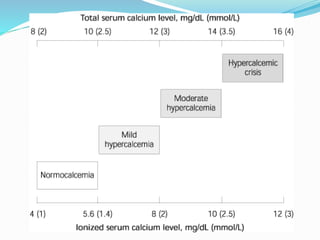
 Hypercalcemia is defined as total serum calcium
> 10.5 mg/dl or ionized serum calcium > 5.6
mg/dl.
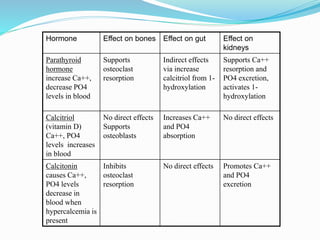
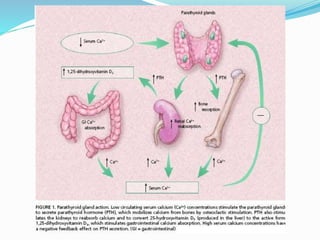
Hormone Effect on bones Effect on gut Effect on
kidneys
Parathyroid
hormone
increase Ca++,
decrease PO4
levels in blood
Supports
osteoclast
resorption
Indirect effects
via increase
calcitriol from 1-
hydroxylation
Supports Ca++
resorption and
PO4 excretion,
activates 1-
hydroxylation
Calcitriol
(vitamin D)
Ca++, PO4
levels increases
in blood
No direct effects
Supports
osteoblasts
Increases Ca++
and PO4
absorption
No direct effects
Calcitonin
causes Ca++,
PO4 levels
decrease in
blood when
hypercalcemia is
present
Inhibits
osteoclast
resorption
No direct effects Promotes Ca++
and PO4
excretion
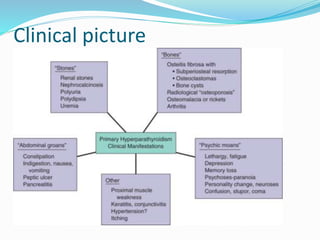
Clinical picture
Causes of Hypercalcemia
A. Parathyroid hormone-dependent
B. Parathyroid hormone-independent
A.Parathyroid hormone-dependent
hypercalcemia
1. Primary hyperparathyroidism
2. Tertiary hyperparathyroidism
3. Familial hypocalciuric hypercalcemia
4. MEN syndromes
5. Lithium therapy
B.Parathyroid hormone-
independent hypercalcemia
Malignancies
Vitamin-D related
Endocrinopathies
Other causes
Evaluation
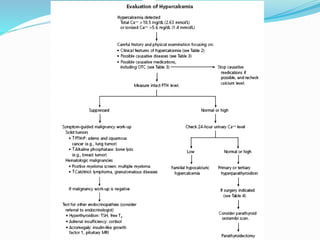
Evaluation of a patient with hypercalcemia should
include a careful history and physical
examination focusing on
 clinical manifestations of hypercalcemia,
 risk factors for malignancy,
 causative medications,
 and a family history of hypercalcemia-
associated conditions
Primary hyperparathyroidism
 Most common cause of PTH-dependent
hypercalcemia.
 Adenoma(80%) ,four glands hyperplasia or carcinoma.
• May be part of MEN syndromes(1 or 2a).
• Typically : ↑PTH , ↓phosphorus ,↑ urine
Ca excretion.
Familial Benign Hypocalciuric
Hypercalcemia
 Far less common cause of PTH-dependent
hypercalcemia.
 Autosomal-dominant ,Caused by a calcium sensor
defect that ↑the set point for serum Ca.
 N. or Mild ↑ PTH,mild ↑Ca (10.5-12 mg/dL) and ↓urine
calcium excretion (<50 mg/24 h).
 asymptomatic and benign, the most important role of
diagnosis is to distinguish it from primary
hyperparathyroidism and avoid an unnecessary
parathyroidectomy.
Malignancy-Associated
Hypercalcemia
 Humoral hypercalcemia of malignancy,Caused by
PTHrP (solid tumors, adult T-cell leukemia syndrome)
 Caused by 1,25(OH)2D (lymphomas)
 Caused by ectopic secretion of PTH (rare,carcinoma of
lung,thymus and ovary)
 Local osteolytic hypercalcemia (multiple myeloma,
leukemia, lymphoma)
Vitamin-D related
hypercalcemia
 Vitamin D intoxication.
 Granulomatous diseases: due to increased conversion
of 25(OH)D to 1,25(OH)2D by macrophages
e.g.sarcoidosis, wagner’s granulomatosis ,T.B.,
lymphomas,etc.
Endocrinopathies
 Thyrotoxicosis : ↑bone turnover.
 Adrenal Insufficiency: volume contraction.
Other causes
 Immobilization due to ↑ bone resorption
 Acute renal failure precipitated by rhabdomyolysis .
 Other drugs: thiazides.
Acute management of
hypercalcemia
1)Serum Ca level <12mg/dl :usually asymptomatic
,monitor and treat underlying cause.
Acute management of
hypercalcemia
2) Serum Ca level ˃12mg/dl :
a)Normal Saline 2-4 L IV daily for 1-3 days
 Enhances filtration and excretion of CA++.
 Indication: Ca > 14 mg/dl, moderate Calcium with
symptoms.
 Caution: may exacerbate heart failure in elderly
patients. Lowers Calcium by 1-3 mg/dl
Acute management of
hypercalcemia
b)Furosemide: as necessary
 Inhibits calcium resorption in distal renal tubule.
 Indication: following aggressive hydration
 Caution: worsens hypercalcemia,hypokalemia,
dehydration if used before intravascular volume is
restored.
Acute management of
hypercalcemia
C)hemodialysis:if oliguric or anuric or severe
symptoms hemodialysis aginist low calcium bath.
d) synthetic salmon CT :
 may be administered at a dose of 4 to 8 IU/kg
subcutaneously every 12 hours.
 In patients with severe hypercalcemia and in those
with renal insufficiency that is refractory to
rehydration
 but most patients become totally refractory to CT
within days to weeks, so it is not suitable for chronic
use.
Long term management of severe
hypercalcemia
1)Primary hyperparathyroidism:
Clinical indications for surgery in patients with
primary hyperparathyroidism
 Significant symptoms of hypercalcemia.
 Nephrolithiasis.
 Low bone mineral density(T-score ≤2.5) at any site.
 Serum Calcium > 12 mg/dl.
 Age< 50 years.
 Infeasibility of longterm follow up.
Long term management of severe
hypercalcemia
2) Malignancy-Associated Hypercalcemia :
a)Intravenous bisphosphonates
 act by inhibiting osteoclastic bone resorption.
 pamidronate is 60 to 90 mg by intravenous
infusion over 1 hour or zoledronic acid is 4 mg
infused over 15 minutes.
 Fever is most common side effect and renal
toxicity is most serious.
Long term management of severe
hypercalcemia
b) Other agents besides bisphosphonates may be
considered (eg, plicamycin or gallium nitrate), but
their toxicity and lack of superior efficacy discourage
their use. Both agents act to inhibit osteoclastic bone
resorption.
c)Glucocorticoids: hematologic malignancies (40-60
mg daily).
Long term management of severe
hypercalcemia
3)Other causes of hypercalcemia:
a)Glucocorticoids:
first-line treatment for hypercalcemia in patients
with multiple myeloma, lymphoma, sarcoidosis, or
intoxication with vitamin D or vitamin A.
b)ketoconazole: useful alternative or adjunctive to
glucocorticoids in granulomatous diseases or
vitamin-D intoxication.
Hypercalcemia

Hypercalcemia

  • 1.
    By Hazem Samy Hussein Ass.Lecturer of internal medicine
  • 2.
    Defination  Hypercalcemia isdefined as total serum calcium > 10.5 mg/dl or ionized serum calcium > 5.6 mg/dl.
  • 4.
    Hormone Effect onbones Effect on gut Effect on kidneys Parathyroid hormone increase Ca++, decrease PO4 levels in blood Supports osteoclast resorption Indirect effects via increase calcitriol from 1- hydroxylation Supports Ca++ resorption and PO4 excretion, activates 1- hydroxylation Calcitriol (vitamin D) Ca++, PO4 levels increases in blood No direct effects Supports osteoblasts Increases Ca++ and PO4 absorption No direct effects Calcitonin causes Ca++, PO4 levels decrease in blood when hypercalcemia is present Inhibits osteoclast resorption No direct effects Promotes Ca++ and PO4 excretion
  • 6.
  • 7.
    Causes of Hypercalcemia A.Parathyroid hormone-dependent B. Parathyroid hormone-independent
  • 8.
    A.Parathyroid hormone-dependent hypercalcemia 1. Primaryhyperparathyroidism 2. Tertiary hyperparathyroidism 3. Familial hypocalciuric hypercalcemia 4. MEN syndromes 5. Lithium therapy
  • 9.
  • 10.
    Evaluation Evaluation of apatient with hypercalcemia should include a careful history and physical examination focusing on  clinical manifestations of hypercalcemia,  risk factors for malignancy,  causative medications,  and a family history of hypercalcemia- associated conditions
  • 11.
    Primary hyperparathyroidism  Mostcommon cause of PTH-dependent hypercalcemia.  Adenoma(80%) ,four glands hyperplasia or carcinoma. • May be part of MEN syndromes(1 or 2a). • Typically : ↑PTH , ↓phosphorus ,↑ urine Ca excretion.
  • 12.
    Familial Benign Hypocalciuric Hypercalcemia Far less common cause of PTH-dependent hypercalcemia.  Autosomal-dominant ,Caused by a calcium sensor defect that ↑the set point for serum Ca.  N. or Mild ↑ PTH,mild ↑Ca (10.5-12 mg/dL) and ↓urine calcium excretion (<50 mg/24 h).  asymptomatic and benign, the most important role of diagnosis is to distinguish it from primary hyperparathyroidism and avoid an unnecessary parathyroidectomy.
  • 13.
    Malignancy-Associated Hypercalcemia  Humoral hypercalcemiaof malignancy,Caused by PTHrP (solid tumors, adult T-cell leukemia syndrome)  Caused by 1,25(OH)2D (lymphomas)  Caused by ectopic secretion of PTH (rare,carcinoma of lung,thymus and ovary)  Local osteolytic hypercalcemia (multiple myeloma, leukemia, lymphoma)
  • 14.
    Vitamin-D related hypercalcemia  VitaminD intoxication.  Granulomatous diseases: due to increased conversion of 25(OH)D to 1,25(OH)2D by macrophages e.g.sarcoidosis, wagner’s granulomatosis ,T.B., lymphomas,etc.
  • 15.
    Endocrinopathies  Thyrotoxicosis :↑bone turnover.  Adrenal Insufficiency: volume contraction.
  • 16.
    Other causes  Immobilizationdue to ↑ bone resorption  Acute renal failure precipitated by rhabdomyolysis .  Other drugs: thiazides.
  • 18.
    Acute management of hypercalcemia 1)SerumCa level <12mg/dl :usually asymptomatic ,monitor and treat underlying cause.
  • 19.
    Acute management of hypercalcemia 2)Serum Ca level ˃12mg/dl : a)Normal Saline 2-4 L IV daily for 1-3 days  Enhances filtration and excretion of CA++.  Indication: Ca > 14 mg/dl, moderate Calcium with symptoms.  Caution: may exacerbate heart failure in elderly patients. Lowers Calcium by 1-3 mg/dl
  • 20.
    Acute management of hypercalcemia b)Furosemide:as necessary  Inhibits calcium resorption in distal renal tubule.  Indication: following aggressive hydration  Caution: worsens hypercalcemia,hypokalemia, dehydration if used before intravascular volume is restored.
  • 21.
    Acute management of hypercalcemia C)hemodialysis:ifoliguric or anuric or severe symptoms hemodialysis aginist low calcium bath. d) synthetic salmon CT :  may be administered at a dose of 4 to 8 IU/kg subcutaneously every 12 hours.  In patients with severe hypercalcemia and in those with renal insufficiency that is refractory to rehydration  but most patients become totally refractory to CT within days to weeks, so it is not suitable for chronic use.
  • 22.
    Long term managementof severe hypercalcemia 1)Primary hyperparathyroidism: Clinical indications for surgery in patients with primary hyperparathyroidism  Significant symptoms of hypercalcemia.  Nephrolithiasis.  Low bone mineral density(T-score ≤2.5) at any site.  Serum Calcium > 12 mg/dl.  Age< 50 years.  Infeasibility of longterm follow up.
  • 23.
    Long term managementof severe hypercalcemia 2) Malignancy-Associated Hypercalcemia : a)Intravenous bisphosphonates  act by inhibiting osteoclastic bone resorption.  pamidronate is 60 to 90 mg by intravenous infusion over 1 hour or zoledronic acid is 4 mg infused over 15 minutes.  Fever is most common side effect and renal toxicity is most serious.
  • 24.
    Long term managementof severe hypercalcemia b) Other agents besides bisphosphonates may be considered (eg, plicamycin or gallium nitrate), but their toxicity and lack of superior efficacy discourage their use. Both agents act to inhibit osteoclastic bone resorption. c)Glucocorticoids: hematologic malignancies (40-60 mg daily).
  • 25.
    Long term managementof severe hypercalcemia 3)Other causes of hypercalcemia: a)Glucocorticoids: first-line treatment for hypercalcemia in patients with multiple myeloma, lymphoma, sarcoidosis, or intoxication with vitamin D or vitamin A. b)ketoconazole: useful alternative or adjunctive to glucocorticoids in granulomatous diseases or vitamin-D intoxication.