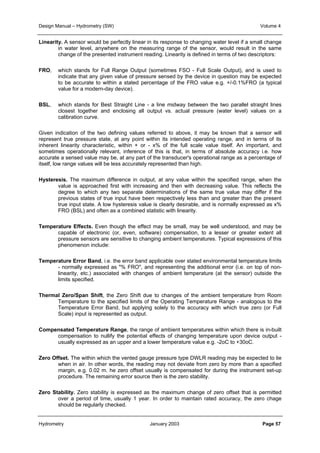
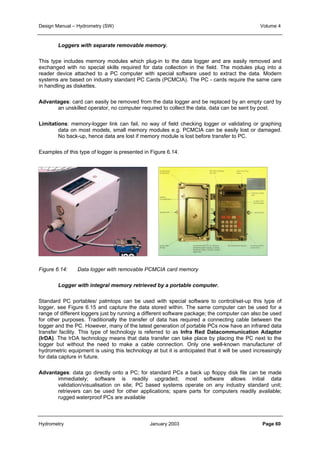
Government of India & Government of The Netherlands 
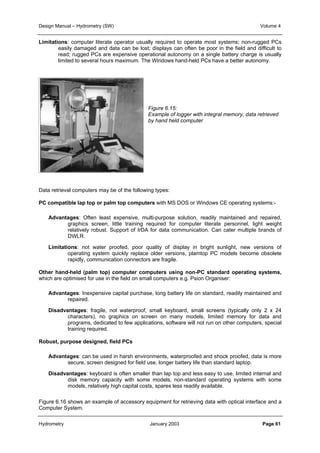
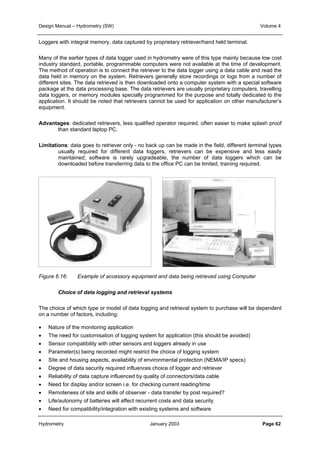
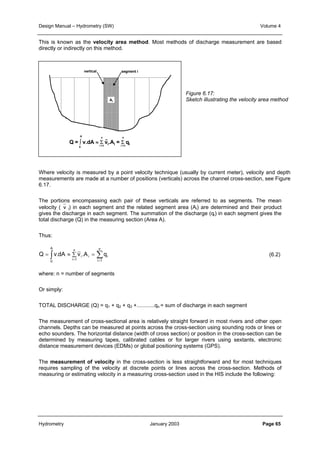
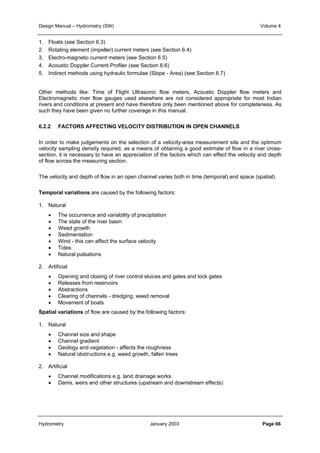
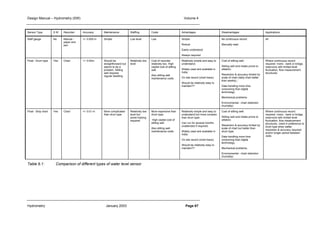
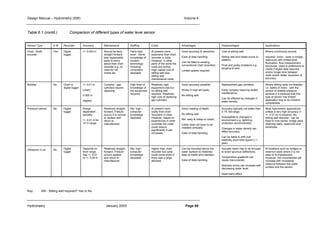
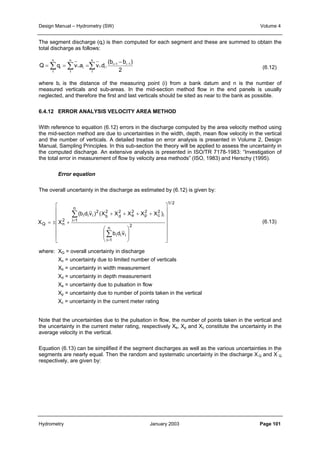
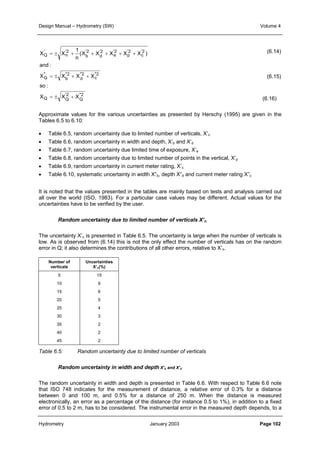
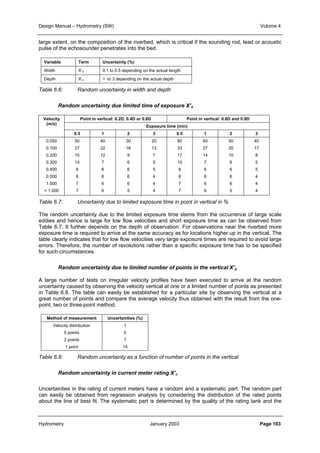
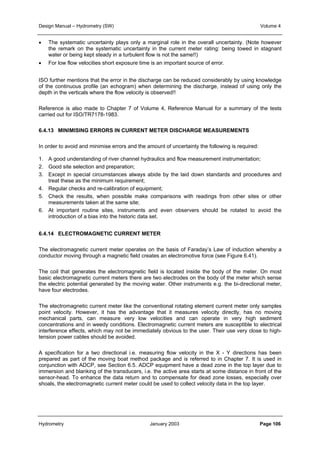
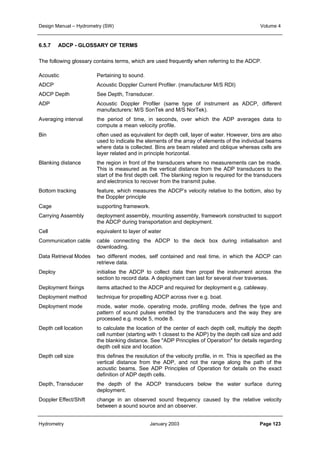
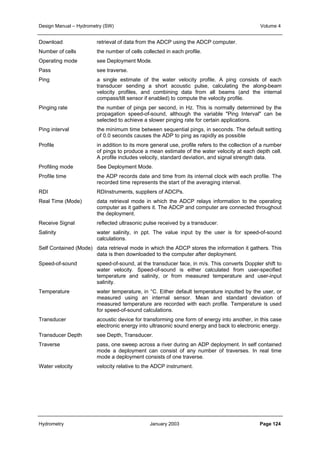
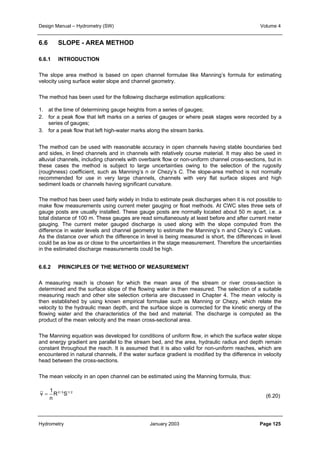
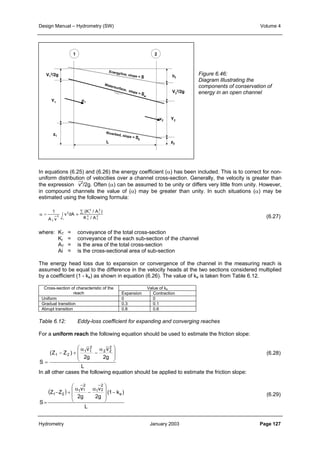
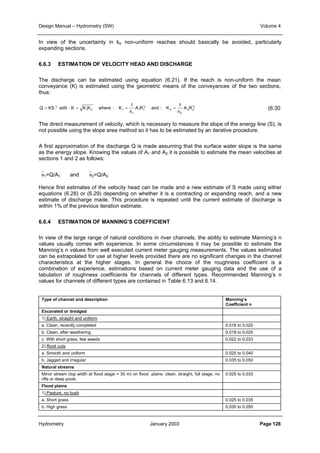
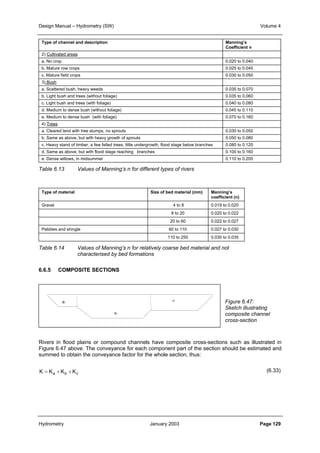
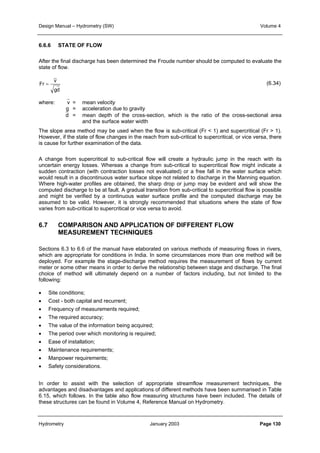
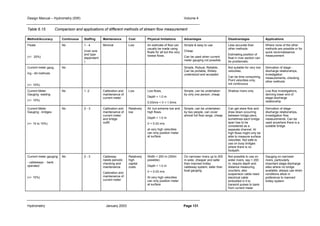
DHV CONSULTANTS & 
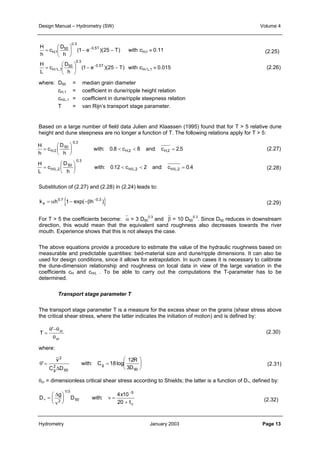
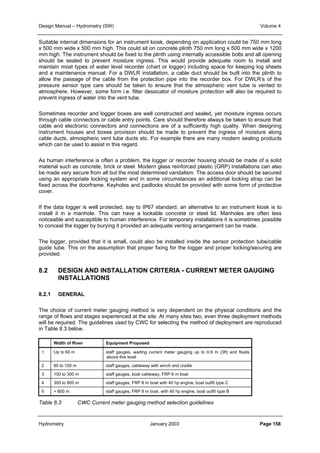
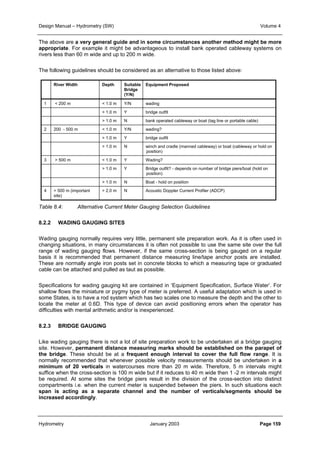
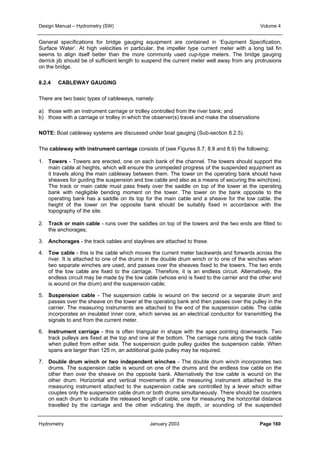
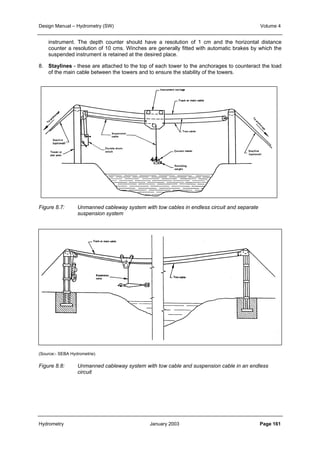
DELFT HYDRAULICS with 
HALCROW, TAHAL, CES, 
ORG & JPS 
VOLUME 4 
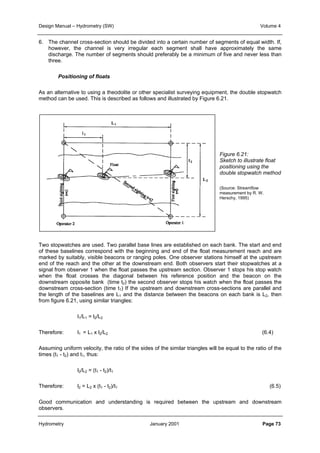
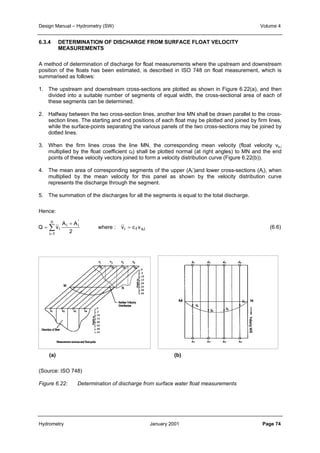
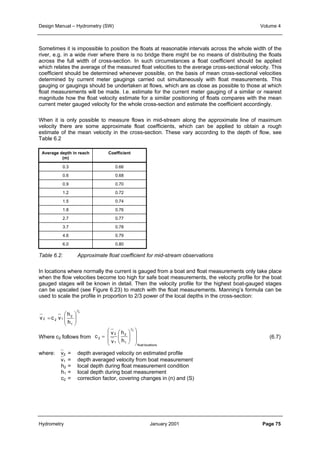
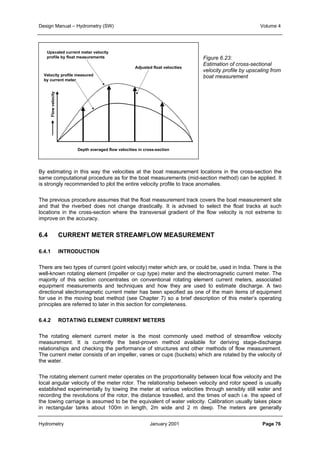
HYDROMETRY 
DESIGN MANUAL
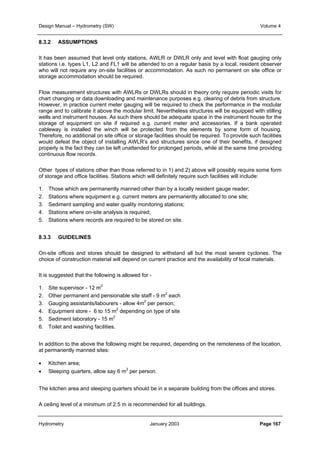
Design Manual – Hydrometry (SW) Volume 4 
Table of Contents 
1 INTRODUCTION 1 
1.1 GENERAL 1 
1.2 DEFINITION OF VARIABLES AND UNITS 2 
2 PHYSICS OF RIVER FLOW 5 
2.1 GENERAL 5 
2.2 CLASSIFICATION OF FLOWS 5 
2.3 VELOCITY PROFILES 8 
2.4 HYDRAULIC RESISTANCE 10 
2.5 UNSTEADY FLOW 14 
2.6 BACKWATER CURVES 17 
3 HYDROMETRIC NETWORK DESIGN 21 
3.1 INTRODUCTION 21 
3.2 NETWORK DESIGN CONSIDERATIONS 22 
3.2.1 CLASSIFICATION 22 
3.2.2 MINIMUM NETWORKS 22 
3.2.3 NETWORKS FOR LARGE RIVER BASINS 23 
3.2.4 NETWORKS FOR SMALL RIVER BASINS 23 
3.2.5 NETWORKS FOR DELTAS AND COASTAL FLOODPLAINS 23 
3.2.6 REPRESENTATIVE BASINS 24 
3.2.7 SUSTAINABILITY 24 
3.2.8 DUPLICATION AVOIDANCE 24 
3.2.9 PERIODIC RE-EVALUATION 24 
3.3 NETWORK DENSITY 24 
3.3.1 WMO RECOMMENDATIONS 24 
3.3.2 PRIORITISATION SYSTEM 25 
3.3.3 STATISTICAL AND MATHEMATICAL OPTIMISATION 26 
3.4 THE NETWORK DESIGN PROCESS 26 
4 SITE SELECTION OF WATER LEVEL AND STREAMFLOW STATIONS 28 
4.1 DEFINITION OF OBJECTIVES 28 
4.2 DEFINITION OF CONTROLS 28 
4.3 SITE SURVEYS 29 
4.4 SELECTION OF WATER LEVEL GAUGING SITES 31 
4.5 SELECTION OF STREAMFLOW MEASUREMENT SITE 31 
5 MEASURING FREQUENCY 34 
5.1 GENERAL 34 
5.2 STAGE MEASUREMENT FREQUENCY 35 
5.3 CURRENT METER MEASUREMENT FREQUENCY 36 
6 MEASURING TECHNIQUES 38 
6.1 STAGE MEASUREMENT 38 
6.1.1 GENERAL 38 
6.1.2 VERTICAL STAFF GAUGES 39 
6.1.3 INCLINED STAFF OR RAMP GAUGES 42 
6.1.4 CREST STAGE GAUGES 43 
6.1.5 ELECTRIC TAPE GAUGES 44 
6.1.6 FLOAT SYSTEM WITH AUTOGRAPHIC RECORDING 45 
6.1.7 FLOAT SYSTEM WITH DIGITAL RECORDING 50 
6.1.8 PRESSURE SENSORS (TRANSDUCERS) 52 
6.1.9 DATA LOGGERS 59 
Hydrometry January 2003 Page i
Design Manual – Hydrometry (SW) Volume 4 
6.1.10 SELECTION OF STAGE AND WATER LEVEL SENSORS AND 
RECORDING EQUIPMENT 63 
6.2 INTRODUCTION TO VELOCITY AREA METHOD OF STREAMFLOW 
MEASUREMENT 64 
6.2.1 BASIC PRINCIPLES 64 
6.2.2 FACTORS AFFECTING VELOCITY DISTRIBUTION IN OPEN 
CHANNELS 66 
6.2.3 DISTRIBUTION OF VELOCITY 69 
6.3 FLOAT MEASUREMENT 70 
6.3.1 BACKGROUND 70 
6.3.2 TYPES OF FLOAT 71 
6.3.3 FLOAT MEASUREMENT TECHNIQUE 72 
6.3.4 DETERMINATION OF DISCHARGE FROM SURFACE FLOAT 
VELOCITY MEASUREMENTS 74 
6.4 CURRENT METER STREAMFLOW MEASUREMENT 76 
6.4.1 INTRODUCTION 76 
6.4.2 ROTATING ELEMENT CURRENT METERS 76 
6.4.3 TYPES OF CURRENT METER 78 
6.4.4 METHODS OF SUSPENSION AND DEPLOYMENT OF CURRENT 
METERS 81 
6.4.5 SPACING OF VERTICALS 86 
6.4.6 MEASUREMENT OF WIDTH, HORIZONTAL DISTANCE OR POSITION 
IN THE HORIZONTAL 88 
6.4.7 MEASUREMENT OF DEPTH 91 
6.4.8 SKEW EFFECTS 97 
6.4.9 METHODS OF ESTIMATING MEAN VELOCITY IN THE VERTICAL 98 
6.4.10 LEGITIMATE SHORT CUTS 100 
6.4.11 COMPUTATION OF DISCHARGE 100 
6.4.12 ERROR ANALYSIS VELOCITY AREA METHOD 101 
6.4.13 MINIMISING ERRORS IN CURRENT METER DISCHARGE 
MEASUREMENTS 106 
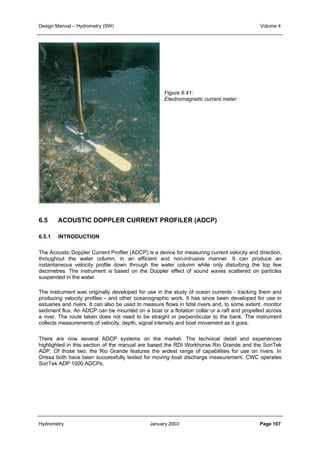
6.4.14 ELECTROMAGNETIC CURRENT METER 106 
6.5 ACOUSTIC DOPPLER CURRENT PROFILER (ADCP) 107 
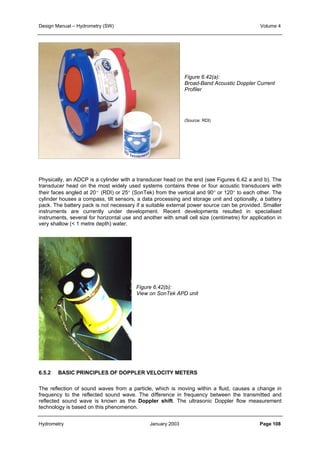
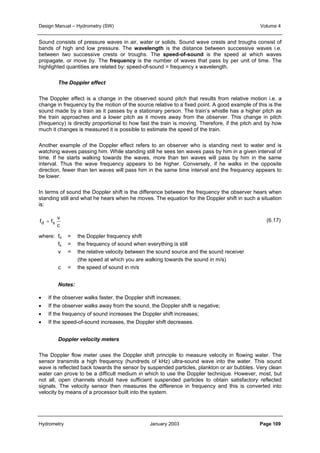
6.5.1 INTRODUCTION 107 
6.5.2 BASIC PRINCIPLES OF DOPPLER VELOCITY METERS 108 
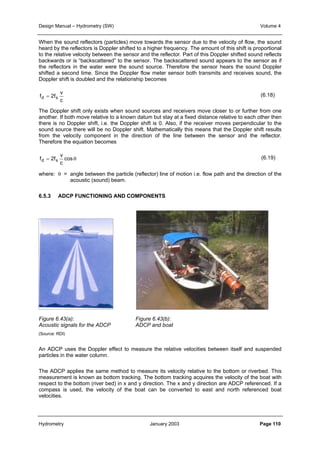
6.5.3 ADCP FUNCTIONING AND COMPONENTS 110 
6.5.4 PRACTICAL USE OF THE ADCP 113 
6.5.5 COLLECTING DISCHARGE DATA WITH A SONTEK ADP 118 
6.5.6 PROCESSING OF SONTEK ADP DATA 120 
6.5.7 ADCP - GLOSSARY OF TERMS 123 
6.6 SLOPE - AREA METHOD 125 
6.6.1 INTRODUCTION 125 
6.6.2 PRINCIPLES OF THE METHOD OF MEASUREMENT 125 
6.6.3 ESTIMATION OF VELOCITY HEAD AND DISCHARGE 128 
6.6.4 ESTIMATION OF MANNING’S COEFFICIENT 128 
6.6.5 COMPOSITE SECTIONS 129 
6.6.6 STATE OF FLOW 130 
6.7 COMPARISON AND APPLICATION OF DIFFERENT FLOW MEASUREMENT 
TECHNIQUES 130 
7 EQUIPMENT SPECIFICATIONS 134 
7.1 INTRODUCTION 134 
7.2 PREPARATION OF STAGE AND STREAM FLOW MEASUREMENT 
INSTRUMENTATION AND EQUIPMENT TENDER SPECIFICATIONS 135 
7.2.1 INTRODUCTION 135 
7.2.2 SITE SURVEYS AND INSTALLATION PLANNING 135 
7.2.3 TENDER PACKAGES 136 
Hydrometry January 2003 Page ii
Design Manual – Hydrometry (SW) Volume 4 
7.2.4 RESOLUTION AND ACCURACY 137 
7.2.5 HYDROMETRIC SENSOR AND EQUIPMENT SELECTION CRITERIA 137 
7.2.6 INSTRUMENT AND EQUIPMENT SPECIFICATIONS 138 
7.2.7 OTHER ITEMS TO BE INCLUDED IN THE SPECIFICATIONS 141 
7.3 INTERPRETATION OF EQUIPMENT SPECIFICATION AND ASSESSMENT OF 
PRODUCTS AND SUPPLIERS 143 
7.3.1 INTERPRETING EQUIPMENT SPECIFICATIONS 143 
7.3.2 EVALUATION OF SPECIFICATIONS 143 
7.4 EQUIPMENT SPECIFICATIONS 145 
8 STATION DESIGN, CONSTRUCTION AND INSTALLATION 147 
8.1 DESIGN AND INSTALLATION CRITERIA - WATER LEVEL MONITORING 147 
8.1.1 STAFF GAUGES 147 
8.1.2 BENCH MARKS 149 
8.1.3 STILLING WELLS 149 
8.1.4 DWLR - PRESSURE SENSOR TYPE 154 
8.1.5 INSTRUMENT PROTECTION AND HOUSINGS 157 
8.2 DESIGN AND INSTALLATION CRITERIA - CURRENT METER GAUGING 
INSTALLATIONS 158 
8.2.1 GENERAL 158 
8.2.2 WADING GAUGING SITES 159 
8.2.3 BRIDGE GAUGING 159 
8.2.4 CABLEWAY GAUGING 160 
8.2.5 BOAT GAUGING 165 
8.3 SITE OFFICES AND STORES 166 
8.3.1 SITE TYPES 166 
8.3.2 ASSUMPTIONS 167 
8.3.3 GUIDELINES 167 
8.3.4 POSSIBLE BUILDING REQUIREMENTS 168 
9 REFERENCES 169 
Hydrometry January 2003 Page iii
Design Manual – Hydrometry (SW) Volume 4 
1 INTRODUCTION 
1.1 GENERAL 
The branch of Geophysics, which deals with the occurrence and movement of water in terms of 
quantities and quality on and below the surface of the earth except the oceans, in vapour, liquid or 
solid state, is termed Hydrology. For hydrological design and water resources assessment purposes 
proper estimates of river flow and river stages are required. Their measurement is the domain of 
hydrometry. 
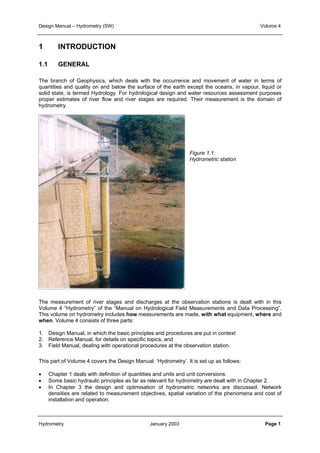
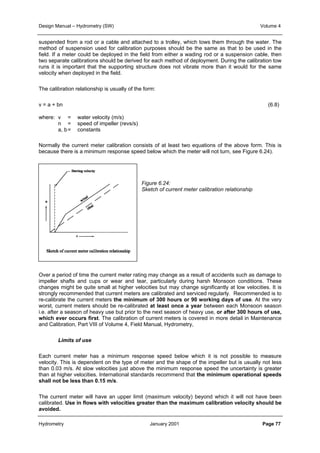
Figure 1.1: 
Hydrometric station 
The measurement of river stages and discharges at the observation stations is dealt with in this 
Volume 4 “Hydrometry” of the “Manual on Hydrological Field Measurements and Data Processing”. 
This volume on hydrometry includes how measurements are made, with what equipment, where and 
when. Volume 4 consists of three parts: 
1. Design Manual, in which the basic principles and procedures are put in context 
2. Reference Manual, for details on specific topics, and 
3. Field Manual, dealing with operational procedures at the observation station. 
This part of Volume 4 covers the Design Manual: ‘Hydrometry’. It is set up as follows: 
• Chapter 1 deals with definition of quantities and units and unit conversions. 
• Some basic hydraulic principles as far as relevant for hydrometry are dealt with in Chapter 2. 
• In Chapter 3 the design and optimisation of hydrometric networks are discussed. Network 
densities are related to measurement objectives, spatial variation of the phenomena and cost of 
installation and operation. 
Hydrometry January 2003 Page 1
Design Manual – Hydrometry (SW) Volume 4 
• Once the network density has been specified the sites for the water levels and discharges have to 
be selected. Criteria for site selection are discussed in Chapter 4. 
• Next, in Chapter 5 the observation frequency to be applied for the various hydrological quantities 
in view of the measurement objectives and temporal variation of the observed processes are 
treated. 
• The measurement techniques for observation of hydrometric variables and related equipment are 
dealt with in Chapter 6. 
• Since the buyers of the hydrometric equipment are often neither sufficiently familiar with the exact 
functioning of (parts of) the equipment nor with the background of the specifications, remarks on 
the equipment specifications have been added in Chapter 7. The equipment specifications proper 
are covered in a separate and regularly updated volume: “Equipment Specification Surface 
Water”. 
• Guidelines on station design and equipment installation are dealt with in Chapter 8. 
In the Field Manual operational practices in running the network stations are given. It also includes 
field inspections, audits and last but not least, the topic of equipment maintenance and calibration. 
Notes 
• The content of this part of the manual deals only with hydrometric measurements in the States of 
Peninsular India. The equipment discussed is used or appropriate for use in the Hydrological 
Information System. Hence, the manual does not provide a complete review of all techniques and 
equipment applied elsewhere. 
• The procedures dealt with in this manual are conformably to BIS and ISO standards. It is 
essential that the procedures described in this manual are closely followed to guarantee a 
standardised approach in the entire operation of the Hydrological Information System. 
1.2 DEFINITION OF VARIABLES AND UNITS 
In this section definitions, symbols and units of relevant quantities and parameters when dealing with 
hydrometry are given. The use of standard methods is an important objective in the operation of the 
Hydrological Information System (HIS). Standard methods require the use of a coherent system of 
units with which variables and parameters are quantified. This section deals with the system of units 
used for the measurement of hydrological quantities. 
Quantity Symbol Unit Quantity Symbol Unit 
Density 
Density of water 
Density of sediment, 
Relative density under water 
Pressure 
Air pressure 
Water pressure 
Temperature 
Water temperature 
Air temperature 
Level, depth, area 
Water depth 
Wetted perimeter 
Wetted area 
Hydraulic radius 
Equilibrium or normal depth 
Critical depth 
ρ 
ρs 
Δ=(ρs-ρ)/ρ 
pa 
p 
Tw ,tw 
Ta ,ta 
y, h 
P 
A 
R 
yn, hn 
yc, hc 
kg.m-3 
kg.m-3 
[-] 
kPa 
kPa 
oC or K 
oC or K 
m 
m 
m2 
m 
m 
m 
Head 
Velocity head 
Pressure head 
Energy head 
Slope 
Slope/gradient (general) 
Bottom/bed slope/gradient 
Water surface slope/gradient 
Energy slope/gradient 
Discharge 
Flow velocity 
Discharge 
Discharge per unit width 
Characteristic numbers 
Reynolds number 
Froude number 
hv 
hp 
He 
S 
S0 
Sw 
Se 
u, v, w 
Q 
q 
Re 
Fr 
m 
m 
m 
[-] 
[-] 
[-] 
[-] 
m.s-1 
m3.s-1 
m2.s-1 
[-] 
[-] 
Table 1.1: Overview of relevant quantities, symbols and units used in hydrometry 
Hydrometry January 2003 Page 2
Design Manual – Hydrometry (SW) Volume 4 
General terms 
Control: The physical properties of a channel, natural or artificial, which determine the relationship 
between stage and discharge at a location in the channel. 
Stable channel: Channel in which the bed and the sides remain sensibly stable over a substantial 
period of time in the control reach and in which scour and deposition during the rising and 
falling floods is inappreciable. 
Unstable channel: Channel in which there is frequently and significantly changing control. 
Reach: A length of open channel between two defined cross-sections 
Invert: The lowest part of the cross-section of a natural or artificial channel. 
Wetted perimeter, P [m]: The wetted boundary of an open channel at a specified section. 
Cross-section of stream, A [m2]: A specified section of the stream normal to the direction of flow 
bounded by the wetted perimeter and the free water surface. 
Hydraulic radius, R [m]: The quotient of the wetted cross-sectional area and the wetted perimeter. 
Level, depth and gradient 
Stage, y, h [m]: Height of water surface of a stream, river, lake or reservoir at the measuring point 
above an established datum plane. 
Gauge height, h [m]: Water surface elevation relative to the gauge datum. 
Water depth D, h [m]: Vertical distance between water surface and river bottom. 
Normal/equilibrium depth, [m]: Flow depth under steady, uniform flow conditions. 
Critical depth, [m]: The depth of flow when the flow is critical (Fr = 1), see Chapter 2. 
Gauge: The device installed at the gauging station for measuring the level of the water surface 
relative to datum. If the gauge is linked to a standard system of levels then the gauge is a 
reference gauge. 
Water level recorder: A device which records automatically, either continuously or at frequent time 
intervals, the water level as sensed by a float, a pressure transducer, a gas bubbler, acoustic 
device, etc. 
Stilling well: A well connected to the main stream in such a way as to permit the measurement of 
the stage in relatively still water. 
Surface slope: The difference in elevation of the surface of the stream per unit horizontal distance 
measured in the direction of flow. 
Bed/bottom slope: The difference in elevation of the bed per unit horizontal distance measured in 
the direction of flow. 
Backwater curve: The profile of the water surface upstream when its surface slope is generally less 
than the bed slope. The backwater curve occurs upstream of an obstruction or confluence. 
Draw-down curve: The profile of the water surface when its surface slope exceeds the bed slope. 
Afflux: The rise in water level immediately upstream of, and due to, an obstruction. 
Elevation/potential head, [m]: The height of any particle of water above a specified datum (potential 
energy per unit of weight relative to a horizontal datum). 
Hydrometry January 2003 Page 3
Design Manual – Hydrometry (SW) Volume 4 
Pressure head, [m]: Height of liquid in a column corresponding to the weight of the liquid per unit 
area. 
Piezometric head, [m]: Sum of elevation head and pressure head, or above a datum, the total head 
at any cross-section minus the velocity head at that cross-section. 
Velocity head, [m]: The head obtained by dividing the square of the velocity by twice the acceleration 
due to gravity. In applying the mean velocity in the cross-section, a correction factor is to be 
applied for non-uniformity of the velocity profile in the cross-section. 
Total energy head, [m]: The sum of the elevation of the free water surface above a horizontal datum 
of a section, and the velocity head. 
Specific energy, [m]: The sum of the elevation of the free water surface above the bed, and the 
velocity head. 
Energy gradient, [-]: The difference in total energy head per unit horizontal distance in the direction 
of flow. 
Stage-discharge relation: A curve, table or function, which expresses the relation between the stage 
and the discharge in an open channel at a given cross-section for a given condition of flow 
(rising, steady or falling) 
Flow and flow types 
Discharge, [m3/s]: Volume of liquid/water flowing through a cross-section per unit of time. 
Velocity, [m/s]: Rate of movement past a point in a specified direction. 
Laminar flow: Type of flow mainly determined by viscosity Re < 500, see Chapter 2 
Turbulent flow: Type of flow which is hardly determined by viscosity: Re > 2000, see Chapter 2. 
Sub-critical flow: The flow in which the Froude number is less than unity and surface disturbances 
can travel upstream, see Chapter 2. 
Super-critical flow: The flow in which the Froude number is greater than unity and surface 
disturbances will not travel in upstream direction, see Chapter 2. 
Critical flow: The flow at which the total energy head is at minimum for a given discharge; under this 
condition the Froude number will be equal to unity and surface disturbances will not travel in 
upstream direction, see Chapter 2. 
Steady flow: Flow in which the depth and velocity remain constant with respect to time, see 
Chapter 2. 
Uniform flow: Flow in which the depth and velocity remain constant with respect to distance, see 
Chapter 2. 
Friction, drag: Boundary shear resistance, which opposes the flow of water. 
Friction coefficient: A coefficient used to calculate the energy gradient caused by friction. 
Rugosity coefficient: A coefficient linked with the boundary roughness and the geometric 
characteristics of the channel used in the open channel flow formulae, like Chezy coefficent, 
Manning’s coefficient, etc. 
Hydraulic jump: Sudden change of flow from super-critical flow to sub-critical flow. 
Hydrometry January 2003 Page 4
Design Manual – Hydrometry (SW) Volume 4 
2 PHYSICS OF RIVER FLOW 
2.1 GENERAL 
In this chapter an overview is given of some relevant subjects of hydraulics, including: 
• classification of flows: laminar versus turbulent flow, sub-critical, critical and supercritical flow and 
steady and unsteady flow, varying gradually or rapidly, 
• flow velocity profiles for laminar and turbulent flow conditions, 
• hydraulic roughness, 
• unsteady flow features, and 
• backwater computations. 
Detailed derivations of the flow equations are provided in Volume 4, Reference Manual, Hydrometry. 
2.2 CLASSIFICATION OF FLOWS 
Flows in rivers are classified according to the forces acting on a mass of fluid. These are: 
gravity Fg = M.g = ρL3g (M = mass; g = gravitational acceleration; ρ = density; L = length) 
pressure Fp = p.A = p L2 (p = pressure; A = area) 
viscosity Fν = τ.A = ρν v L (τ = shear stress; ν = kinematic viscosity; v = velocity) 
surface tension Fσ = σ.L =σL (σ = surface tension) 
elasticity Fe = K.A =KL2 (K = bulk modulus of elasticity) 
inertia Fi =M.a = ρv2L2 (a = acceleration) 
Generally, one of these forces predominates. The inertial force is always present. To characterise the 
physical phenomena, the forces are compared with the inertial force leading to characteristic 
numbers. For river flow or open channel flow the Reynold(s) number and Froude number are of 
importance. 
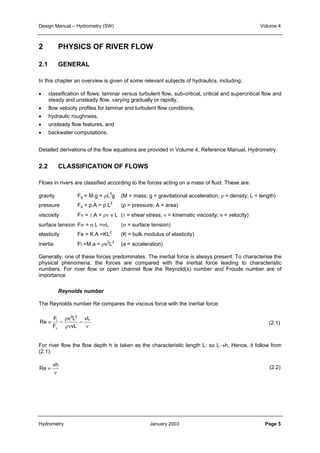
Reynolds number 
The Reynolds number Re compares the viscous force with the inertial force: 
vL 
ν 
= 
ρ 
2 2 
v L 
ρν 
F 
i 
≡ = 
F 
ν 
vL 
Re 
For river flow the flow depth h is taken as the characteristic length L: so L→h. Hence, it follow from 
(2.1): 
≡ vh 
ν 
Re 
(2.1) 
(2.2) 
Hydrometry January 2003 Page 5
Design Manual – Hydrometry (SW) Volume 4 
The Reynolds number distinguishes between laminar and turbulent flow: 
• laminar flow: Re < 600 
• transitional flow: 600 ≤ Re < 2000 
• turbulent flow: Re > 2000 
Laminar flow is best described as thin sheets of water (laminae) moving in straight lines parallel to 
each other, although the velocities of one sheet may not be the same as the one beside it. In this 
situation the viscosity is very strong relative to the inertia forces. Viscosity is the resistance of 
movement of one layer of fluid to another. Very simply it is a measure of a liquid’s “stickiness”. In a 
turbulent flow situation, the path of the fluid particles is no longer straight as the viscous forces are 
weak relative to the inertial forces. Therefore flows are sinuous and intertwining with each other so 
that thorough mixing takes place. In turbulent flow there are continuous variations in velocity (and 
pressure) at every point, so only laminar flow can be considered steady. Turbulent flow is only steady 
if the average velocity and pressure remain constant over a reasonable time period. 
Since the viscosity of water is about 10-6 m2/s at a temperature of 20 oC it is observed from the 
Reynolds number that in nearly all cases river flow is turbulent; only sheet flow with very low velocities 
will behave as laminar flow. The fact that river flow is turbulent has consequences for measurement of 
stage and of flow velocities. A real instantaneous value will give insufficient information about the 
state of flow; time averaged values over periods of 0.5 to several minutes have to be considered 
instead. 
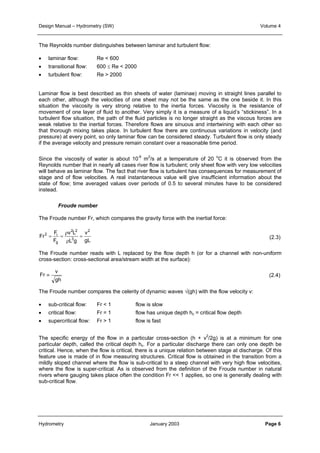
The Froude number Fr, which compares the gravity force with the inertial force: 
F 
Froude number 
ρ 
2 = i = 
= 
F 
g 
The Froude number reads with L replaced by the flow depth h (or for a channel with non-uniform 
cross-section: cross-sectional area/stream width at the surface): 
v 
gh 
Fr 
Fr ≡ 
v 
2 
gL 
2 2 
v L 
3 
ρ 
L g 
(2.3) 
(2.4) 
The Froude number compares the celerity of dynamic waves √(gh) with the flow velocity v: 
• sub-critical flow: Fr < 1 flow is slow 
• critical flow: Fr = 1 flow has unique depth hc = critical flow depth 
• supercritical flow: Fr > 1 flow is fast 
The specific energy of the flow in a particular cross-section (h + v2/2g) is at a minimum for one 
particular depth, called the critical depth hc. For a particular discharge there can only one depth be 
critical. Hence, when the flow is critical, there is a unique relation between stage at discharge. Of this 
feature use is made of in flow measuring structures. Critical flow is obtained in the transition from a 
mildly sloped channel where the flow is sub-critical to a steep channel with very high flow velocities, 
where the flow is super-critical. As is observed from the definition of the Froude number in natural 
rivers where gauging takes place often the condition Fr << 1 applies, so one is generally dealing with 
sub-critical flow. 
Hydrometry January 2003 Page 6
Design Manual – Hydrometry (SW) Volume 4 
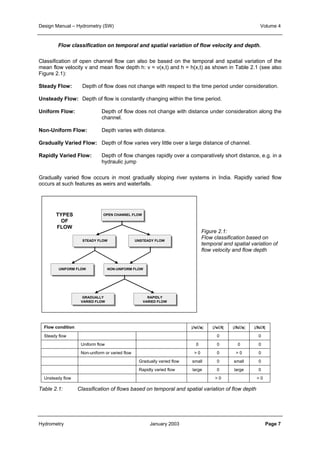
Flow classification on temporal and spatial variation of flow velocity and depth. 
Classification of open channel flow can also be based on the temporal and spatial variation of the 
mean flow velocity v and mean flow depth h: v = v(x,t) and h = h(x,t) as shown in Table 2.1 (see also 
Figure 2.1): 
Steady Flow: Depth of flow does not change with respect to the time period under consideration. 
Unsteady Flow: Depth of flow is constantly changing within the time period. 
Uniform Flow: Depth of flow does not change with distance under consideration along the 
channel. 
Non-Uniform Flow: Depth varies with distance. 
Gradually Varied Flow: Depth of flow varies very little over a large distance of channel. 
Rapidly Varied Flow: Depth of flow changes rapidly over a comparatively short distance, e.g. in a 
hydraulic jump 
Gradually varied flow occurs in most gradually sloping river systems in India. Rapidly varied flow 
occurs at such features as weirs and waterfalls. 
Figure 2.1: 
Flow classification based on 
temporal and spatial variation of 
flow velocity and flow depth 
OPEN CHANNEL FLOW 
STEADY FLOW UNSTEADY FLOW 
TYPES 
OF 
FLOW 
UNIFORM FLOW NON-UNIFORM FLOW 
GRADUALLY 
VARIED FLOW 
RAPIDLY 
VARIED FLOW 
Flow condition |∂v/∂x| |∂v/∂t| |∂h/∂x| |∂h/∂t| 
Steady flow 0 0 
Uniform flow 0 0 0 0 
Non-uniform or varied flow > 0 0 > 0 0 
Gradually varied flow small 0 small 0 
Rapidly varied flow large 0 large 0 
Unsteady flow > 0 > 0 
Table 2.1: Classification of flows based on temporal and spatial variation of flow depth 
Hydrometry January 2003 Page 7
Design Manual – Hydrometry (SW) Volume 4 
2.3 VELOCITY PROFILES 
Consider steady uniform flow. Then, the streamlines are parallel to the riverbed, so bed slope S0 = 
water surface slope Sw = energy slope Se, pressure distribution is hydrostatic and accelerations are 
zero. The velocity profile is then obtained from a balance of forces in flow direction and a relation 
between shear stress and velocity (see Volume 4, Reference Manual). 
Laminar flow 
In case of laminar flow the velocity profile is parabolic and reads: 
1 
v(y) 0 − 2 
y ) 
2 
(hy 
gS 
ν 
= 
where: v(y) = flow velocity at distance y from river bed 
By integration over the depth of flow for the average flow velocityv it follows: 
gS 
h = flow depth 
S0 = river bed slope 
ν = kinematic viscosity 
g = gravitational acceleration 
0 h2 
3 
v 
ν 
= 
Note thatv :: S0, which is characteristic for laminar flow. By comparison of (2.5) with (2.6) it is 
observed that the average flow velocity is equal to the velocity at a depth y = (1-1/3√3)h ≈ 0.42h. 
Turbulent flow 
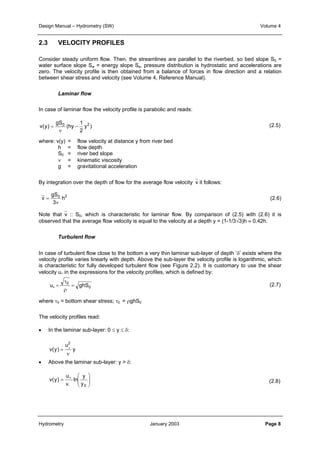
In case of turbulent flow close to the bottom a very thin laminar sub-layer of depth ‘δ’ exists where the 
velocity profile varies linearly with depth. Above the sub-layer the velocity profile is logarithmic, which 
is characteristic for fully developed turbulent flow (see Figure 2.2). It is customary to use the shear 
velocity u∗ in the expressions for the velocity profiles, which is defined by: 
0 
τ 
u 0 = ghS 
ρ 
∗ = 
where τ0 = bottom shear stress; τ0 = ρghS0 
The velocity profiles read: 
• In the laminar sub-layer: 0 ≤ y ≤ δ: 
y 
2 
ν 
u 
v(y) 
= ∗ 
• Above the laminar sub-layer: y > δ: 
 
  
   
u 
= ∗ 
κ 
y 
y0 
ln 
v(y) 
(2.5) 
(2.6) 
(2.7) 
(2.8) 
Hydrometry January 2003 Page 8
Design Manual – Hydrometry (SW) Volume 4 
In equation (2.8) κ = the Von Karman constant, with κ ≈ 0.4, and y0 is the value of y for which the 
velocity becomes zero according to the logarithmic profile: v(y0) = 0. The linear and the logarithmic 
profile intersect at y = δ. The thickness of the laminar sub-layer is given by: 
ν 
u 
∗ 
δ = 
11.6 
(2.9) 
In stead of the abrupt change from a linear to a logarithmic velocity profile there is a transition zone 
extending from 0.5δ < y < 3δ (i.e. 5ν/u∗ < y < 30ν/u∗). 
Figure 2.2: 
Velocity profile near 
bottom 
Transition 
zone 
Fully 
developed 
turbulent flow 
Laminar 
sub-layer 
y 
δ 
v(y) 
y0 
30ν/u∗ 
Logarithmic profile 
Transitional profile 
Linear profile 
11.6ν/u∗ 
5ν/u∗ 
For common values of h and S0 the thickness of the laminar sub-layer δ << 1 mm. Hence, the average 
velocity can safely be derived from equation (2.8) and reads: 
(2.10) 
h 
= ∗ 0 
∗ 
 
<<   
 
  
≈ 
 
  
 
  
 
+ −   
 
  
v 0 
e.y 
In 
u 
y 
h 
1 
h 
y 
In 
u 
o 
0 
κ 
κ 
Following observations can be made: 
because y h 
• v :: u∗, so v :: (S0)1/2 and not proportional with S0 like for laminar flow 
• v(y) = v for y = h/e = 0.368 h 
In equation (2.10) still y0 has to be determined. Its value depends on the roughness of the bottom, 
which is characterised by the equivalent sand roughness ks. According to Nikuradse, a bed with 
roughness ks produces the same resistance as a flat bed covered with fixed, uniform, closely packed 
sand grains with diameter ks. Now the following bed/wall conditions apply: 
if ks < 0.3δ, then the bed is hydraulically smooth, and: y0 ≈ δ/117 (2.11) 
if ks > 6δ, then the bed is hydraulically rough, and: y0 ≈ ks/32 (2.12) 
Hydrometry January 2003 Page 9
Design Manual – Hydrometry (SW) Volume 4 
Combining (2.11) and (2.12) with (2.10) the velocity profiles and average velocities become: 
• for a smooth boundary (ks < 0.3δ): 
117y 
 
 
u 
∗ 
ln 
κ δ 
 
 
= 
v(y) 
u 
∗ 
12h 
ln 
κ δ 
= 
 
 
 
 
/ 3.5 
v 
• for a rough boundary (ks > 6δ): 
32y 
s 
k 
 
  
u 
∗ 
 
  
= 
v(y) 
u 
∗ 
κ 
= 
 
  
 
  
κ 
ln 
12h 
s 
k 
ln 
v 
• for the transition between smooth and rough 0.3δ < ks < 6δ the average velocity follows from: 
12h 
κ + δ 
k / 3.5 
 
  
ln 
g 
12h 
= ∗ 
κ + δ 
k / 3.5 
 
=   
s s 
0 
12h 
+ δ 
k / 3.5 
s 
hS or : 
0 
hS 
 
  
ln 
u 
v 
 
  
= 
v 18 log 
 
  
 
  
• The above formulae are valid for wide channels. For other cross-sections h has to be replaced by 
• In view of the small value of δ in fairly all natural conditions the bed can be considered as 
2.4 HYDRAULIC RESISTANCE 
Generally two flow equations are in use: 
Chezy: v = C(RS)1/2 (2.18) 
Manning: v = 1/n R2/3S1/2 (2.19) 
where: C = Chezy coefficient [m1/2.s-1] 
Using equation (2.17) and replacing flow depth h by the hydraulic radius R and combining the 
expression with (2.18) White-Colebrook’s formula for hydraulic resistance is obtained: 
C 
the hydraulic radius R. 
hydraulically rough. Hence, the equations (2.15) and (2.16) generally apply in practice. 
n = Manning’s n-value for hydraulic roughness [m-1/3.s] 
R 
Note: 
ks 
= 
12 
+ 
 
  
 
  
18 
δ / . 
3 5 
log 
(2.13) 
(2.14) 
(2.15) 
(2.16) 
(2.17) 
(2.20) 
Hydrometry January 2003 Page 10
Design Manual – Hydrometry (SW) Volume 4 
where the denominator in (2.20) takes on the following values: 
• For hydraulically smooth bed ks << δ, hence ks+ δ/3.5 ≈ δ/3.5 
• For hydraulically rough bed ks >> δ, hence ks+ δ/3.5 ≈ ks. 
Strickler proposed the following expression for C: 
C 
R 
k s 
= 
 
  
 
  
25 
1/6 
Equations (2.20) and (2.21) are almost identical in the range 40 < C < 70. Williamson (1951) found for 
concrete tubes the coefficient to be 26.4 instead of 25 for 7.5 < R/ks < 1500. 
Combining (2.21) with (2.18) and comparing the result with (2.19) one obtains: 
C 
1 / 6 1 / 
6 
R 
n 
R 
k s 
= = 
 
  
 
  
25 
Hence the following approximate relation between Manning’s n and Nikuradse’s ks-value exists: 
n 
1 / 
6 
k 
s k 
. / 
1 6 
s = = 
25 
0 04 
The advantage of the use of ks over n is its dimension [m]. The size of bed unevenness can be 
translated into a value for ks (see below). This is at least true for the riverbed. For floodplain 
roughness with bushes etc. the relation between unevenness and ks is less apparent. 
Some practical relations for ks 
According to van Rijn (1984) for an alluvial bed the following values apply for the equivalent sand 
roughness ks: 
• For a flat sandbed and gravelbed it follows respectively: 
k 3D (sandbed) k D (gravelbed) s 90 s 90 ≈ ≈ 
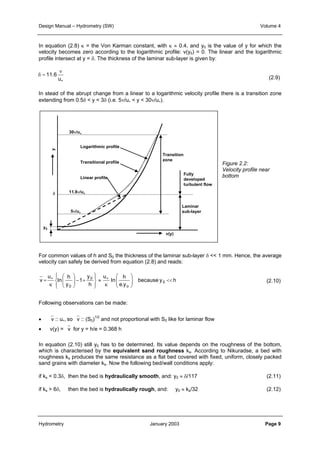
• For a dune/ripple covered bed (see Figure 2.3) 
H 
)) 
L 
k 1.1H(1 exp( 25 s ≈ − − 
(2.21) 
(2.22) 
(2.23) 
(2.24) 
where: D90 = characteristic grain size diameter (90% is finer) 
H = dune/ripple height 
L = dune/ripple length 
H/L = dune/ripple steepness 
Hydrometry January 2003 Page 11
Design Manual – Hydrometry (SW) Volume 4 
Figure 2.3: 
Dune/ripple dimension 
parameters 
Note: 
Definition of dune/ripple dimension parameters 
Water table 
Dune covered river bed 
L 
h 
v 
H 
• For a flat sandbed values for ks in the range of 1 to 10 D90 were found with a median value 3D90 
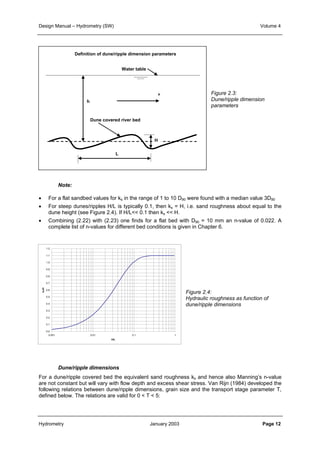
• For steep dunes/ripples H/L is typically 0.1, then ks = H, i.e. sand roughness about equal to the 
dune height (see Figure 2.4). If H/L<< 0.1 then ks << H. 
• Combining (2.22) with (2.23) one finds for a flat bed with D90 = 10 mm an n-value of 0.022. A 
complete list of n-values for different bed conditions is given in Chapter 6. 
Figure 2.4: 
Hydraulic roughness as function of 
dune/ripple dimensions 
0.001 0.01 0.1 1 
H/L 
Dune/ripple dimensions 
1.2 
1.1 
1.0 
0.9 
0.8 
0.7 
0.6 
0.5 
0.4 
0.3 
0.2 
0.1 
0.0 
ks/H 
For a dune/ripple covered bed the equivalent sand roughness ks and hence also Manning’s n-value 
are not constant but will vary with flow depth and excess shear stress. Van Rijn (1984) developed the 
following relations between dune/ripple dimensions, grain size and the transport stage parameter T, 
defined below. The relations are valid for 0 < T < 5: 
Hydrometry January 2003 Page 12
Design Manual – Hydrometry (SW) Volume 4 
H 
h 
H 
L 
where: D50 = median grain diameter 
Based on a large number of field data Julien and Klaassen (1995) found that for T > 5 relative dune 
height and dune steepness are no longer a function of T. The following relations apply for T > 5: 
H 
h 
=  
c 
 
=  
c 
c 
D 
50 
h 
D 
H,1 
 
H/ L,1 
cH,1 = coefficient in dune/ripple height relation 
cH/L,1 = coefficient in dune/ripple steepness relation 
T = van Rijn’s transport stage parameter. 
D 
h 
0.5T 
 
− 
≈ − −  
(1 e )(25 T) with :c 0.11 
0.5T 
H,1 
 
− 
≈ − −  
(1 e )(25 T) with :c 0.015 
H/ L,1 
< < = 
with c and c 
H 
L 
c 
 
  
0.3 
50 
h 
 
  
0.3 
0 3 
. 
: . : . 
50 
0 8 8 25 
2 2 
H H H 
D 
h 
, , 
< < = 
with c and c 
 
  
 
  
, 
0 3 
. 
: . : . 
2 
2 
50 
012 2 0 4 
2 2 
H L H L H L 
= 
= 
/ , 
/ , / , 
Substitution of (2.27) and (2.28) in (2.24) leads to: 
0.3 and β = 10 D50 
k s h { h } = α 0.7 1− exp(−β −0.3 ) 
For T > 5 the coefficients become: α = 3 D50 
direction, this would mean that the equivalent sand roughness also decreases towards the river 
mouth. Experience shows that this is not always the case. 
The above equations provide a procedure to estimate the value of the hydraulic roughness based on 
measurable and predictable quantities: bed-material size and dune/ripple dimensions. It can also be 
used for design conditions, since it allows for extrapolation. In such cases it is necessary to calibrate 
the dune-dimension relationship and roughness on local data in view of the large variation in the 
coefficients cH and cH/L . To be able to carry out the computations the T-parameter has to be 
determined. 
Transport stage parameter T 
The transport stage parameter T is a measure for the excess shear on the grains (shear stress above 
the critical shear stress, where the latter indicates the initiation of motion) and is defined by: 
θ ' 
−θ 
θ 
T cr 
cr 
= 
 
2 
12 
where: 
v 
R 
D g 
θ' = : = log 
  
 
  
2 
Δ 3 
C D 
with C 
g 
18 
50 90 
θcr = dimensionless critical shear stress according to Shields; the latter is a function of D∗, defined by: 
D 
Δ 
ν 
g 
D with 
4 x 
10 5 
20 
− 
t c 
∗ 
=  
  
 
  
= 
+ 
ν 
2 
/ 
1 3 
50 
: 
(2.25) 
(2.26) 
(2.27) 
(2.28) 
(2.29) 
0.3. Since D50 reduces in downstream 
(2.30) 
(2.31) 
(2.32) 
Hydrometry January 2003 Page 13
Design Manual – Hydrometry (SW) Volume 4 
where: tc = temperature in oC. The relation between D∗ and θcr is presented in Table 2.2. Note that the 
Shields curve refers to the situation that a large number of particles are put in motion. 
D∗ -range θcr 
D∗ ≤ 4 0.24 D∗ 
4 < D∗ ≤ 10 0.14 D∗ 
10 < D∗ ≤ 20 0.04 D∗ 
20< D∗ ≤ 150 0.013 D∗ 
D∗ > 150 0.055 
Table 2.2 Shields curve as function of D∗ 
The quantity Δ is the relative density of sediment under water: Δ =(ρs-ρ)/ρ (=1.65) 
Hydraulic roughness for compound channels 
In the above it has been indicated that a clear relationship exists between bed features and the 
hydraulic roughness, whether it is expressed by ks or Manning’s n. In view of this it will be obvious that 
a combined value for ks or n for a compound channel does not make sense. The values have to be 
determined/estimated for each segment separately to be of any value for rating curve extrapolation! 
2.5 UNSTEADY FLOW 
The propagation and attenuation of flood waves in river systems are described by the following partial 
differential equations (see Volume 4, Reference Manual): 
• Continuity equation: 
0 
∂ 
+ 
∂ 
A Q 
= 
∂ 
x 
∂ 
t 
0 
2 
n QQ 
-0.64 
-0.1 
0.29 
− + = 
4 / 3 
R A 
S 
∂ 
+ 
-1 
h 
∂ 
x 
• Momentum equation: 
∂ 
Q 
∂ 
t 
1 
gA 
Q 
A 
1 
∂ 
∂ 
gA x 
2 
s 
0 
2 
 
+   
s s 
s 
 
  
(2.33) 
(2.34) 
where: A = total cross-sectional area (conveying and storage areas) 
B = total width of cross-section 
As = cross-sectional area of conveying section 
Bs = width of conveying cross-section 
h = flow depth 
S0 = bottom slope 
n = Manning’s hydraulic roughness parameter 
R = hydraulic radius of conveying cross-section 
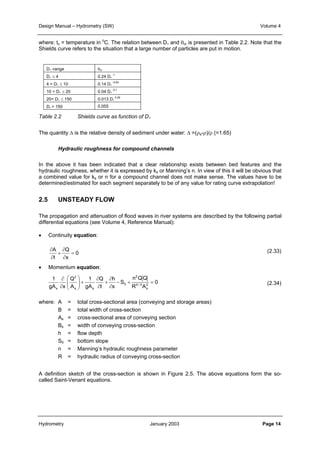
A definition sketch of the cross-section is shown in Figure 2.5. The above equations form the so-called 
Saint-Venant equations. 
Hydrometry January 2003 Page 14
Design Manual – Hydrometry (SW) Volume 4 
B 
Bs 
As 
A 
Storage area h 
Conveying area 
It can be shown, that, if the Froude number is small, the first two terms in (2.34), which represent 
convective and local acceleration effects, are negligible compared to ∂h/∂x. Then, the momentum 
equation reduces to: 
1/ 2 
∂ 
h 
1 
1 
 
 
Q   
  
= − 
A R S 1 
n 
s x 
0 
1/ 2 
0 
2 / 3 
S 
∂ 
From (2.35) it is observed, that the bracketed term approaches 1 if ∂h/∂x << S0, and the momentum 
equation reduces to: 
1/ 2 
0 
5 / 3 
1 
1 
Q = ≈ 
A R S 
n 
B h S 
s s 
1/ 2 
0 
2 / 3 
n 
The latter expression applies for wide rivers, where As ≈ Bsh and R ≈ h. Because of the condition 
∂h/∂x << S0 it follows that for unsteady flow (2.36) is typically only suited for steep rivers. 
The celerity of a flood wave is given by: 
c 
Flood wave celerity 
= ≈ 1 
dQ 
dA B 
dQ 
dh 
Differentiation of (2.36) with respect to h and substitution into (2.37) gives the following expression for 
the celerity of a flood wave or kinematic wave: 
c 
B 
B 
≈ s v 5 
3 
Figure 2.5: 
Definition sketch river 
cross-section 
(2.35) 
(2.36) 
(2.37) 
(2.38) 
From this it is observed that for a river without a flood plain, i.e. Bs = B, the flood wave moves faster 
than the average flow velocity. If, however, B >> Bs, i.e. for a river with a wide flood plain, then the 
flood wave will move slower than the average velocity in the main river. Hence, it is observed that the 
flood wave celerity will change if the river flow changes from inbank to overbank. 
Hydrometry January 2003 Page 15
Design Manual – Hydrometry (SW) Volume 4 
From the continuity equation (2.33) and the momentum equation (2.35) an approximate expression for 
the damping of a flood wave per unit distance can be derived: 
dQ 
dx 
Flood wave damping 
D 
c 
2 
Q 
t 
∂ 
∂ 
≈ where : D 
= 
Q 
BS atQ 
max 
max 
3 
2 
2 0 
For a sinusoidal wave with amplitude a0 and duration/period T the wave damping becomes: 
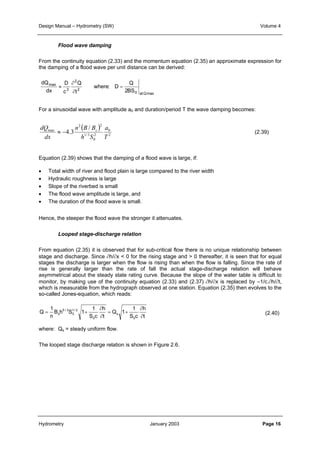
dQ ≈ − s (2.39) 
Equation (2.39) shows that the damping of a flood wave is large, if: 
• Total width of river and flood plain is large compared to the river width 
• Hydraulic roughness is large 
• Slope of the riverbed is small 
• The flood wave amplitude is large, and 
• The duration of the flood wave is small. 
Hence, the steeper the flood wave the stronger it attenuates. 
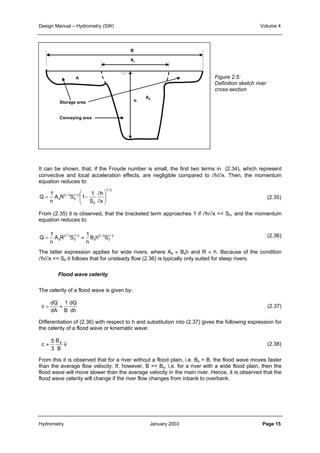
Looped stage-discharge relation 
From equation (2.35) it is observed that for sub-critical flow there is no unique relationship between 
stage and discharge. Since ∂h/∂x < 0 for the rising stage and > 0 thereafter, it is seen that for equal 
stages the discharge is larger when the flow is rising than when the flow is falling. Since the rate of 
rise is generally larger than the rate of fall the actual stage-discharge relation will behave 
asymmetrical about the steady state rating curve. Because the slope of the water table is difficult to 
monitor, by making use of the continuity equation (2.33) and (2.37) ∂h/∂x is replaced by –1/c.∂h/∂t, 
which is measurable from the hydrograph observed at one station. Equation (2.35) then evolves to the 
so-called Jones-equation, which reads: 
∂ 
h 
0 
2 
a 
= + 
( ) 
2 2 
∂ 
n B B 
max / 
1/ 3 
4.3 
h S 
dx 
= + 
2 
0 
T 
s ∂ 
t 
1 
S c 
Q 1 
h 
∂ 
t 
1 
S c 
1 
1/ 2 
0 
5 / 3 
B h S 1 
n 
Q 
0 
s 
0 
(2.40) 
where: Qs = steady uniform flow. 
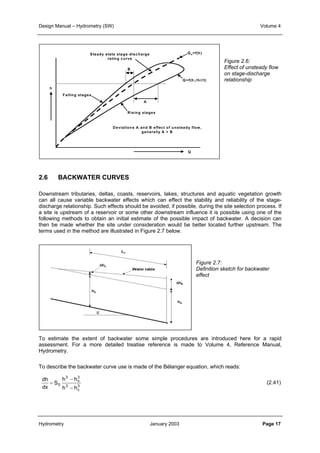
The looped stage discharge relation is shown in Figure 2.6. 
Hydrometry January 2003 Page 16
Design Manual – Hydrometry (SW) Volume 4 
Steady state stage-discharge 
rating curve 
A 
B 
Rising stages 
Falling stages 
h 
Deviations A and B effect of unsteady flow, 
2.6 BACKWATER CURVES 
Qs=f(h) 
Q=f(h,∂h/∂ t) 
Q 
generally A > B 
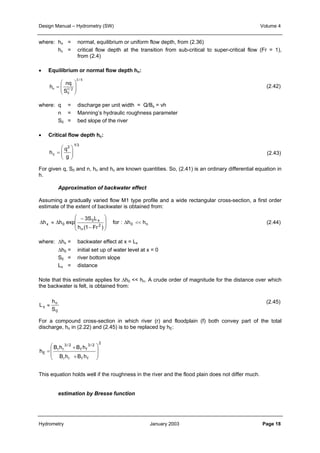
Downstream tributaries, deltas, coasts, reservoirs, lakes, structures and aquatic vegetation growth 
can all cause variable backwater effects which can effect the stability and reliability of the stage-discharge 
a site is upstream of a reservoir or some other downstream influence it is possible using one of the 
following methods to obtain an initial estimate of the possible impact of backwater. A decision can 
then be made whether the site under consideration would be better located further upstream. The 
terms used in the method are illustrated in Figure 2.7 below. 
To estimate the extent of backwater some simple procedures are introduced here for a rapid 
assessment. For a more detailed treatise reference is made to Volume 4, Reference Manual, 
Hydrometry. 
To describe the backwater curve use is made of the Bélanger equation, which reads: 
dh 
dx 
S 
relationship. Such effects should be avoided, if possible, during the site selection process. If 
3 3 
− 
− 0 
h h 
h h 
n 
3 3 
c 
= 
Figure 2.6: 
Effect of unsteady flow 
on stage-discharge 
relationship 
Figure 2.7: 
Definition sketch for backwater 
effect 
(2.41) 
Hydrometry January 2003 Page 17
Design Manual – Hydrometry (SW) Volume 4 
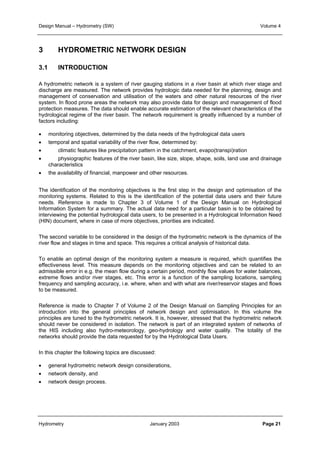
where: hn = normal, equilibrium or uniform flow depth, from (2.36) 
hc = critical flow depth at the transition from sub-critical to super-critical flow (Fr = 1), 
from (2.4) 
• Equilibrium or normal flow depth hn: 
3 / 5 
nq 
 
 
= 
h   
  
n S 
1/ 2 
0 
where: q = discharge per unit width = Q/Bs = vh 
n = Manning’s hydraulic roughness parameter 
S0 = bed slope of the river 
• Critical flow depth hc: 
For given q, S0 and n, hn and hc are known quantities. So, (2.41) is an ordinary differential equation in 
h. 
Approximation of backwater effect 
Assuming a gradually varied flow M1 type profile and a wide rectangular cross-section, a first order 
estimate of the extent of backwater is obtained from: 
3S L 
 
2 1/3 
 
  
− 
h 
 
q 
g c = 
  
 
  
  
h h exp 0 x 
Δ << Δ ≈ Δ 
x 0 for : h h 
2 0 n 
− 
h (1 Fr ) 
n 
 
 
where: Δhx = backwater effect at x = Lx 
Note that this estimate applies for Δh0 << hn. A crude order of magnitude for the distance over which 
the backwater is felt, is obtained from: 
L 
h 
S x 
≈ n 
0 
(2.42) 
(2.43) 
(2.44) 
Δh0 = initial set up of water level at x = 0 
S0 = river bottom slope 
Lx = distance 
(2.45) 
For a compound cross-section in which river (r) and floodplain (f) both convey part of the total 
discharge, hn in (2.22) and (2.45) is to be replaced by hE: 
2 
3 / 2 
+ 
B h B h 
 
 
h f   f 
 
3 / 2 
r r 
+ 
B h B h 
r r f f 
E 
  
 
= 
This equation holds well if the roughness in the river and the flood plain does not differ much. 
estimation by Bresse function 
Hydrometry January 2003 Page 18
Design Manual – Hydrometry (SW) Volume 4 
For more accurate computations one can apply the Bresse function. For a wide river the set of 
equations to solve read (Chow, 1959): 
[ { }] 
γ = − 
( ) ( ) ( ) 
x 0 x 0 
; 1 Fr 
   
   
η + 
h 
n 
= − η − η − γ ψ η − ψ η 
η = 
− 
0 
 
  
L 
x 
where : 
S 
Δ + 
h h 
x n 
n 
 
  
; 
2 
η + η + 
η − 
η = 
x 
and 
ψ η = 
Δ + 
2 1 
3 
h h 
1 
0 n 
h 
n 
arc cot g 
3 
( 1) 
1 
1 
h 
ln 
6 
( ) 
2 
2 
(2.46) 
The function Ψ(η) for 1 ≤ η < 1.25 is presented in Table 2.3. An application is presented in Example 
2.1. 
η Ψ η Ψ η Ψ η Ψ η Ψ 
1.000 ∞ 1.050 0.896 1.100 0.681 1.150 0.561 1.200 0.480 
1.001 2.184 1.051 0.889 1.101 0.678 1.151 0.559 1.201 0.478 
1.002 1.953 1.052 0.883 1.102 0.675 1.152 0.557 1.202 0.477 
1.003 1.818 1.053 0.877 1.103 0.672 1.153 0.555 1.203 0.476 
1.004 1.723 1.054 0.871 1.104 0.669 1.154 0.553 1.204 0.474 
1.005 1.649 1.055 0.866 1.105 0.666 1.155 0.551 1.205 0.473 
1.006 1.588 1.056 0.860 1.106 0.663 1.156 0.550 1.206 0.472 
1.007 1.537 1.057 0.854 1.107 0.660 1.157 0.548 1.207 0.470 
1.008 1.493 1.058 0.849 1.108 0.657 1.158 0.546 1.208 0.469 
1.009 1.454 1.059 0.843 1.109 0.655 1.159 0.544 1.209 0.468 
1.010 1.419 1.060 0.838 1.110 0.652 1.160 0.542 1.210 0.466 
1.011 1.388 1.061 0.833 1.111 0.649 1.161 0.541 1.211 0.465 
1.012 1.359 1.062 0.828 1.112 0.647 1.162 0.539 1.212 0.464 
1.013 1.333 1.063 0.823 1.113 0.644 1.163 0.537 1.213 0.463 
1.014 1.308 1.064 0.818 1.114 0.641 1.164 0.535 1.214 0.461 
1.015 1.286 1.065 0.813 1.115 0.639 1.165 0.534 1.215 0.460 
1.016 1.264 1.066 0.808 1.116 0.636 1.166 0.532 1.216 0.459 
1.017 1.245 1.067 0.804 1.117 0.634 1.167 0.530 1.217 0.458 
1.018 1.226 1.068 0.799 1.118 0.631 1.168 0.528 1.218 0.456 
1.019 1.208 1.069 0.795 1.119 0.628 1.169 0.527 1.219 0.455 
1.020 1.191 1.070 0.790 1.120 0.626 1.170 0.525 1.220 0.454 
1.021 1.175 1.071 0.786 1.121 0.624 1.171 0.523 1.221 0.453 
1.022 1.160 1.072 0.781 1.122 0.621 1.172 0.522 1.222 0.451 
1.023 1.146 1.073 0.777 1.123 0.619 1.173 0.520 1.223 0.450 
1.024 1.132 1.074 0.773 1.124 0.616 1.174 0.519 1.224 0.449 
1.025 1.119 1.075 0.769 1.125 0.614 1.175 0.517 1.225 0.448 
1.026 1.106 1.076 0.765 1.126 0.612 1.176 0.515 1.226 0.447 
1.027 1.094 1.077 0.760 1.127 0.609 1.177 0.514 1.227 0.445 
1.028 1.082 1.078 0.756 1.128 0.607 1.178 0.512 1.228 0.444 
1.029 1.071 1.079 0.753 1.129 0.605 1.179 0.511 1.229 0.443 
1.030 1.060 1.080 0.749 1.130 0.602 1.180 0.509 1.230 0.442 
1.031 1.049 1.081 0.745 1.131 0.600 1.181 0.507 1.231 0.441 
1.032 1.039 1.082 0.741 1.132 0.598 1.182 0.506 1.232 0.440 
1.033 1.029 1.083 0.737 1.133 0.596 1.183 0.504 1.233 0.438 
1.034 1.019 1.084 0.734 1.134 0.594 1.184 0.503 1.234 0.437 
1.035 1.010 1.085 0.730 1.135 0.591 1.185 0.501 1.235 0.436 
1.036 1.001 1.086 0.726 1.136 0.589 1.186 0.500 1.236 0.435 
1.037 0.992 1.087 0.723 1.137 0.587 1.187 0.498 1.237 0.434 
1.038 0.983 1.088 0.719 1.138 0.585 1.188 0.497 1.238 0.433 
1.039 0.975 1.089 0.716 1.139 0.583 1.189 0.495 1.239 0.432 
1.040 0.967 1.090 0.713 1.140 0.581 1.190 0.494 1.240 0.431 
1.041 0.959 1.091 0.709 1.141 0.579 1.191 0.492 1.241 0.429 
1.042 0.951 1.092 0.706 1.142 0.577 1.192 0.491 1.242 0.428 
1.043 0.944 1.093 0.703 1.143 0.575 1.193 0.490 1.243 0.427 
1.044 0.936 1.094 0.699 1.144 0.573 1.194 0.488 1.244 0.426 
1.045 0.929 1.095 0.696 1.145 0.571 1.195 0.487 1.245 0.425 
1.046 0.922 1.096 0.693 1.146 0.569 1.196 0.485 1.246 0.424 
1.047 0.915 1.097 0.690 1.147 0.567 1.197 0.484 1.247 0.423 
1.048 0.909 1.098 0.687 1.148 0.565 1.198 0.483 1.248 0.422 
1.049 0.902 1.099 0.684 1.149 0.563 1.199 0.481 1.249 0.421 
Table 2.3: The function Ψ(η) for 1 ≤ η < 1.25 
Hydrometry January 2003 Page 19
Design Manual – Hydrometry (SW) Volume 4 
Example 2.1 Application of Bresse function 
The distance is to be determined over which the backwater effect at x = 0 of 1 m is reduced to 5% of its 
original value for a river with a bed slope of 5x10⁻⁴, hydraulic roughness n = 0.03, when the normal depth hn 
= 5 m. 
1. Determination of η and Ψ(η) 
For x = 0 the backwater is Δh0 = 1m hence η0 becomes: 
1.20 
+ 
1.0 5.0 
Δ + 
η = 
0 = 
5.0 
h h 
0 n 
h 
n 
= 
If x = x1 is the distance at which the initial backwater effect is reduced to 5% of its value: Δh1 = 0.05 m, 
hence η1 becomes: 
1.01 
+ 
0.05 5.0 
Δ + 
η = 
1 = 
5.0 
h h 
1 n 
h 
n 
= 
It then follows for Ψ(η0) and Ψ(η1) from Table 2.3: Ψ(η0) = 0.480 and Ψ(η1) = 1.419 
2. Froude correction γ: 
− 
1/3 4 
5 x5x10 
γ 2 = − = − = − = 
9.81x0.03 
1 
1/3 
n 
h S 
gn 
1 
v 
2 
gh 
= 1- Fr 1 
2 
2 
0 
The parameter γ in equation (2.46) follows from: 
3. Computation of Lx 
0.903 
The distance Lx = x1 – x0 follows from (2.46) by substitution of the values determined under 1 and 2: 
h 
h 
[ { }] [ ] n 
10,380m 10.4km 
x = − η − η − γ Ψ η − Ψ η = − − − − = = = 
S 
(1.01 1.2) 0.903x(1.419 0.480) 1.038x 
n 
S 
( ) ( ) ( ) 
h 
n 
S 
L 
0 
0 
1 0 1 0 
0 
Note that the distance is only 4% larger than one would have obtained from (2.45). The results (Lx at 5% of 
the original value, expressed as a function of hn/S0) for different river slopes and roughness values for the 
same normal depth (5 m) and initial backwater (1 m) are presented in the following table: 
Froude parameter γ Lx expressed as function of hn/S0 
Roughness n Roughness n 
S0 
0.025 0.03 0.05 0.025 0.03 0.05 
1x10⁻³ 
5x10⁻⁴ 
1x10⁻⁴ 
0.721 
0.861 
0.972 
0.806 
0.903 
0.981 
0.930 
0.965 
0.993 
0.867 
0.998 
1.103 
0.947 
1.038 
1.111 
1.063 
1.096 
1.122 
It is observed, that the multiplier to hn/S0, to arrive at Lx , is close to 1 for different river slopes and 
roughness values. Adding some 10% to the value for Lx obtained from (2.45) will give a reasonable 
approximation of the extent of the backwater reach in practice for field applications. 
Hydrometry January 2003 Page 20
Design Manual – Hydrometry (SW) Volume 4 
3 HYDROMETRIC NETWORK DESIGN 
3.1 INTRODUCTION 
A hydrometric network is a system of river gauging stations in a river basin at which river stage and 
discharge are measured. The network provides hydrologic data needed for the planning, design and 
management of conservation and utilisation of the waters and other natural resources of the river 
system. In flood prone areas the network may also provide data for design and management of flood 
protection measures. The data should enable accurate estimation of the relevant characteristics of the 
hydrological regime of the river basin. The network requirement is greatly influenced by a number of 
factors including: 
• monitoring objectives, determined by the data needs of the hydrological data users 
• temporal and spatial variability of the river flow, determined by: 
• climatic features like precipitation pattern in the catchment, evapo(transpi)ration 
• physiographic features of the river basin, like size, slope, shape, soils, land use and drainage 
characteristics 
• the availability of financial, manpower and other resources. 
The identification of the monitoring objectives is the first step in the design and optimisation of the 
monitoring systems. Related to this is the identification of the potential data users and their future 
needs. Reference is made to Chapter 3 of Volume 1 of the Design Manual on Hydrological 
Information System for a summary. The actual data need for a particular basin is to be obtained by 
interviewing the potential hydrological data users, to be presented in a Hydrological Information Need 
(HIN) document, where in case of more objectives, priorities are indicated. 
The second variable to be considered in the design of the hydrometric network is the dynamics of the 
river flow and stages in time and space. This requires a critical analysis of historical data. 
To enable an optimal design of the monitoring system a measure is required, which quantifies the 
effectiveness level. This measure depends on the monitoring objectives and can be related to an 
admissible error in e.g. the mean flow during a certain period, monthly flow values for water balances, 
extreme flows and/or river stages, etc. This error is a function of the sampling locations, sampling 
frequency and sampling accuracy, i.e. where, when and with what are river/reservoir stages and flows 
to be measured. 
Reference is made to Chapter 7 of Volume 2 of the Design Manual on Sampling Principles for an 
introduction into the general principles of network design and optimisation. In this volume the 
principles are tuned to the hydrometric network. It is, however, stressed that the hydrometric network 
should never be considered in isolation. The network is part of an integrated system of networks of 
the HIS including also hydro-meteorology, geo-hydrology and water quality. The totality of the 
networks should provide the data requested for by the Hydrological Data Users. 
In this chapter the following topics are discussed: 
• general hydrometric network design considerations, 
• network density, and 
• network design process. 
Hydrometry January 2003 Page 21
Design Manual – Hydrometry (SW) Volume 4 
3.2 NETWORK DESIGN CONSIDERATIONS 
In this section a number of aspects are discussed to be considered before actually designing the 
hydrometric network, including: 
• Classification of stations, 
• Minimum networks, 
• Networks for large river basins, 
• Networks for small river basins, 
• Networks for deltas and coastal flood plains, 
• Representative basins, 
• Sustainability, 
• Duplication avoidance, and 
• Periodic re-evaluation. 
3.2.1 CLASSIFICATION 
Based on the network levels presented in Sub-section 7.2 of Volume 2, Design Manual, Sampling 
Principles the following classification of stations is introduced: 
Primary stations, maintained as key stations, principal stations or bench mark stations, where 
measurements are continued for a long period of time to generate representative flow series of the 
river system and provide general coverage of a region. 
Secondary stations, which are essentially short duration stations intended to be operated only for 
such a length of period, which is sufficient to establish the flow characteristics of the river or stream, 
relative to those of a basin gauged by a primary station. 
Special purpose stations, usually required for the planning and design of projects or special 
investigations and are discontinued when their purpose is served. The purpose could vary from 
design, management and operation of the project to monitoring and fulfilment of legal agreements 
between co-basin states. The primary as well as secondary stations may also, in time serve as 
special purpose stations. 
In designing a network all types of stations must be considered simultaneously. 
3.2.2 MINIMUM NETWORKS 
A minimum network should include at least one primary streamflow station in each climatological and 
physiographic area in a State. A river or stream, which flows through more than one State, should be 
gauged at the State boundary. At least one primary gauging station should also be established in 
those basins with potential for future development. 
A minimum network should also include special stations. Where a project is of particular socio-economic 
importance to a State or Region it is essential that a gauging station is established for 
planning, design and possibly operational purposes. Sometimes special stations are required to fulfil a 
legal requirement e.g. the quantification of compensation releases or abstraction controls. Benefit - 
cost ratios for special stations are usually the highest and can help support the remainder of the 
hydrometric network. 
Hydrometry January 2003 Page 22
Design Manual – Hydrometry (SW) Volume 4 
3.2.3 NETWORKS FOR LARGE RIVER BASINS 
A primary station might be planned at a point on the main river where the mean discharge attains its 
maximum value. For rivers flowing across the plains, this site is usually in the downstream part of the 
river, immediately upstream of the point where the river normally divides itself into branches before 
joining the sea or a lake or crosses a State boundary. In the case of mountainous rivers, it is the point 
where water leaves the mountainous reach and enters the plain land. Subsequent stations are 
established at sites where significant changes in the volume of flow are noticed viz., below the 
confluence of a major tributary or at the outflow point of a lake etc. 
If a suitable location is not available below a confluence, the sites can be located above the 
confluence, preferably on the tributary. While establishing sites downstream of a confluence, care 
should be taken to ensure that no other small stream joins the main river so as to avoid erroneous 
assessment of the contribution of the tributary to the main river. In the case of a large river originating 
in mountains, though the major contribution is from upper regions of the basin, several stations may 
have to be located in the downstream stretch of the river. Such stations are intended to provide an 
inventory of water loss from the channel by way of evaporation, infiltration, and by way of utilisation for 
irrigation, power generation, industrial and other domestic needs. 
The distance between two stations on the same river may vary from thirty to several hundred 
kilometres, depending on the volume of flow. The drainage areas computed from origin up to 
consecutive observation sites on a large river should preferably differ by more than 10% so that 
the difference in quantities of flow is significant. The uncertainties in discharge values particularly 
for high flows are unlikely to be less than +/- 10%. However, every reasonable attempt should be 
made to minimise these uncertainties. 
The above uncertainties may affect the location of stations. When tributary inflow is to be known it is 
generally better to gauge it directly, rather than deriving the flow from the difference of a downstream 
and an upstream station along the main stream (see Volume 2, Design Manual, Chapter 4, Example 
4.1). Also, a more accurate discharge record for the main stream is obtained from monitoring the 
feeder rivers than by a main stream station alone, however, at the expense of additional cost. 
3.2.4 NETWORKS FOR SMALL RIVER BASINS 
The criteria mentioned in Sub-section 3.2.3 are applicable to a river basin having a large area and 
well developed stream system. A different approach is to be adopted in dealing with small 
independent rivers, which flow directly into the sea, as in the case of west flowing rivers of Kerala and 
Maharashtra and some east flowing rivers of Tamil Nadu. In such cases, the first hydrological 
observation station might be established on a stream that is typical of the region and then further 
stations could be added to the network so as to widely cover the area. Streams in a particular area 
having meagre or lower yields should not be avoided for inclusion in the network. Absence of a station 
on a low flow stream may lead to wrong conclusions on the water potential of the area as a whole, 
evaluated on the basis of the flow in the high flow streams. Thus, great care is to be exercised in 
designing the network to ensure that all distinct hydrologic areas are adequately covered. It is not 
possible to operate and maintain gauging stations on all the smaller watercourses in the Western 
Ghats, for example. Therefore, representative basins have to be selected and the data from those are 
used to develop techniques for estimating flows for similar ungauged sites. 
3.2.5 NETWORKS FOR DELTAS AND COASTAL FLOODPLAINS 
Deltaic areas such as the Lower Mahanadi in Orissa, where gradients are usually low and channels 
bifurcate, are often important, as water use is productive and thus these areas need monitoring. This 
is particularly important, as deltas are dynamic systems, i.e. they are continually changing. However, 
the type of network required may differ from more conventional river basins. It is often not possible 
due to the low gradients to locate stations with stable stage-discharge relationships, i.e. variable 
backwater effects can occur due to tidal influences and/or changes in aquatic vegetation growth. 
Hydrometry January 2003 Page 23
Design Manual – Hydrometry (SW) Volume 4 
Stage readings should be made at all principal off-takes/bifurcations or nodes in the system. These 
should be supplemented by current meter gaugings when required. At some sites consideration might 
be given to installing a slope-area method station. 
3.2.6 REPRESENTATIVE BASINS 
When gauging stations are included in a network to obtain representative data from a particular 
physiographic zone, it is better if the chosen basins are those with the water resource relatively under 
utilised, i.e. the basins can be considered to be close to their natural state. The selection of 
representative gauging stations in basins, which are heavily utilised by dams and water abstraction 
and/or where significant land use changes have and are continuing to take place should be avoided. 
3.2.7 SUSTAINABILITY 
Of paramount importance is sustainability. It is a relatively straightforward task to design a dense 
network of streamflow stations. However, the implementation and operation of a network is a lot more 
difficult. It has been found from experience, that there is a tendency to adopt an idealistic approach 
and attempt to have as many stations as possible. There are many examples of networks throughout 
the world, which are no longer functioning well due to lack of financial support, skilled manpower and 
logistic support resources such as vehicles. It is far better to operate and maintain 10 gauging stations 
well than to operate and maintain 20 stations badly i.e. higher quality data from fewer stations is 
preferable to a lower quality of data from a greater number of stations. 
3.2.8 DUPLICATION AVOIDANCE 
Since, generally more than one organisation is responsible for the establishment of gauging stations 
e.g. the State Water Departments and CWC, it is essential that the activities are co-ordinated so 
they complement each other and duplication of effort is avoided. 
3.2.9 PERIODIC RE-EVALUATION 
Gauging station networks require periodic re-evaluation. The developments that take place in the 
basin, like construction of new irrigation/hydro-electric projects and industrialisation of the area, may 
warrant addition or closure of stations. For example river reaches are often polluted due to the 
discharge of effluents from industry. Therefore, a need may arise to establish stations to assist with 
water quality monitoring and pollution assessments. 
3.3 NETWORK DENSITY 
The World Meteorological Organisation developed guidelines on minimum hydrological network 
densities. Their guidelines and potential use and limitations are presented in this section. 
Furthermore, a prioritisation system is introduced to rank the importance of stations. Finally, 
comments are given on the use of statistical and mathematical optimisation techniques for 
hydrometric networks. 
3.3.1 WMO RECOMMENDATIONS 
The recommendations of the WMO (World Meteorological Organisation) on the minimum density of a 
streamflow network for regions with different physiographic features are reproduced in Table 3.1 
below. 
Hydrometry January 2003 Page 24
Design Manual – Hydrometry (SW) Volume 4 
Type of region Range of norms for 
minimum network 
Range of provisional norms 
tolerated in1 difficult 
conditions 
I. Flat regions 1,000 - 2,000 3,000 - 10,000 
II. Mountainous regions 300 - 1,0002 1,000 - 5,000 
III. Arid zones3 5,0004 - 20,000 ------------------ 
NOTES: 
1. Last figure in the range should be tolerated only for exceptionally difficult conditions; 
2. Under very difficult conditions this may be extended up to 10000 km2; 
3. Great deserts are not included; 
4. Under very difficult conditions this may be extended up to 10000 km2. 
Table 3.1: Minimum density of hydrological network according to WMO, area in km2 for one 
station 
It is not possible to provide specific, general guidelines on an appropriate network density. The WMO 
recommendations are very general guidelines which if adopted at face value for some of India’s larger 
river basins could result in an excessively dense network. Even though the WMO type guidelines 
might be used as rough rule of thumb as part of an initial network appraisal, their use in the 
final design of the network should be avoided. The network density must ultimately be based on 
the network objectives, the temporal and spatial variability of river stages and flow and on the 
availability of finance, manpower and other resources. 
3.3.2 PRIORITISATION SYSTEM 
It is suggested that in the first instance the “ideal” network size is determined. In determining the 
network all potential users of the data should be consulted. Each station in the “ideal” network should 
be prioritised. In order to do this a simple prioritisation system is useful. This prioritisation system 
could be a simple one such as follows: 
Category Priority Relative Importance 
A High Major, multi-purpose water resources development site, State boundary river, operation of 
major scheme, major ungauged basin, heavily polluted major water supply source 
B Medium Medium scale water resources development project site, secondary basin, industrial 
development area, i.e. potential water quality problems) 
C Low Minor irrigation project site, secondary gauging station on tertiary tributary, major water 
course but already extensively gauged 
The above categories and priorities are merely highlighted by way of example. Each State/Central 
organisation needs to set its own priorities based on its own policies and objectives. In prioritising 
sites, the following questions should be asked: 
What are the socio-economic consequences of not collecting streamflow data at the site? 
What are the alternatives to establishing a streamflow gauging station at the site under consideration? 
An estimate of the number of stations within each State, Division and Sub-division which can be 
realistically well maintained should be made. When deriving this estimate, the following factors should 
be considered: 
• The recurrent budget implications; 
• Short and longer term manpower requirements and availability of suitably skilled personnel; 
• Capacity of instrument repair, spare part provision and calibration facilities; 
• Long term availability of logistic support facilities such as vehicles. 
Hydrometry January 2003 Page 25
Design Manual – Hydrometry (SW) Volume 4 
The ideal and realistic network size estimates should be compared. If necessary the size of the ideal 
network should then be reduced by removing the lower priority stations. 
3.3.3 STATISTICAL AND MATHEMATICAL OPTIMISATION 
The streamflow network should provide information for the location indicated by the hydrological data 
users. At a number of locations no stations will be available. Hence the information is to be obtained 
from the network by e.g. interpolation. If the interpolation error in estimating a flow characteristic is too 
large than additional stations or a re-design should be considered. These techniques are most 
applicable to already well established networks, where the data have been rigorously quality 
controlled and are readily available in computer compatible form. However, they are less readily 
applied to heavily utilised, over-regulated catchments like many of the larger river basins in India. 
These techniques are a tool to assist with network design. They are not straightforward to apply and 
do not totally obviate the need for the pragmatic, common sense approach. 
3.4 THE NETWORK DESIGN PROCESS 
Since everywhere hydrometric networks are existing, the network design process is one of evaluation, 
reviewing and updating of an existing network. The historic evolution of many hydrometric networks 
has tended to be reactively rather than strategically planned. Often gauging stations are being 
operated for which the original objectives are unclear. It is therefore necessary to regularly undertake 
a detailed review of the existing networks to achieve the following: 
• Define and/or re-define the purpose of each gauging station; 
• Identify gaps in the existing network; 
• Identify stations which are no longer required; 
• Establish a framework for the continual evaluation and updating of the network. 
There is a tendency for hydrometrists, hydrologists and water resources planners to be reluctant to 
discontinue gauging stations, even though they might have fulfilled their intended objectives. In the 
design and evaluation of networks it is essential that a ‘hard nosed’ approach is adopted and 
stations which are no longer providing a significant benefit are discontinued. 
In Chapter 7 of Volume 2, Design Manual, Sampling Principles a list of steps is presented to be 
carried out for the review and redesign design of a network. Specific steps for the review of the 
hydrometric network are outlined in Part I of Volume 4, Field Manual, Hydrometry. The main steps in 
the network design process can be summarised as follows: 
1. Review mandates, roles and aims of the organisations involved in the operation of the HIS in a 
particular area and evaluate the communication links. 
2. Collect maps and other background information. 
3. Define the purposes of the network: - who are the data users and what will the data be used for? 
Define the objectives of the network: - what type of data is required where and at what 
frequency? 
4. Evaluate the existing network: - How well does the existing network meet the overall objectives? 
5. Review existing data to identify gaps, ascertain catchment behaviour and variability. 
6. Identify gaps and over-design in the existing network: Propose new stations and delete existing 
stations where necessary, i.e. revise the network. 
7. Prioritise gauging stations: i.e. try to use some simple form of classification system. 
Hydrometry January 2003 Page 26
Design Manual – Hydrometry (SW) Volume 4 
8. Estimate average capital and recurrent costs of installing and maintaining different categories of 
hydrometric stations. Estimate overall cost of operating and maintaining the network. 
9. Review the revised network in relation to overall objectives, ideal network, available budgets and 
the overall benefits of the data. Investigate the sustainability of the proposed network. 
10. Prepare a phased implementation plan. This has to be prioritised, realistic and achievable. 
11. Decide on the approximate location of sites, commence site surveys. If a site is not available 
review the location and see if another strategy can be adopted, e.g. gauge a tributary to estimate 
total flow at the required spot rather than trying to measure the total flow in the main stem river. 
Guidelines on site selection are contained in Chapter 4. 
12. Establish a framework for regular periodic network reviews. 
As hydrometric network design is a dynamic process, networks have to be continually reviewed and 
updated so that they react to new priorities, changes in policies and fiscal changes. Regular 
formalised network reviews should be undertaken, recommended to take place after 3 years or at a 
shorter interval if new data needs do develop. 
Hydrometry January 2003 Page 27
Design Manual – Hydrometry (SW) Volume 4 
4 SITE SELECTION OF WATER LEVEL AND STREAMFLOW 
STATIONS 
4.1 DEFINITION OF OBJECTIVES 
Prior to embarking on the selection of a water level (stage) monitoring or streamflow-gauging site, it is 
imperative that the objectives of the site are fully defined. In this regard the following factors have to 
be established: 
1. What is the purpose of the station? E.g. planning and design of major water supply scheme, 
pollution monitoring, flood forecasting, etc. 
2. Define the required location of the site, i.e. what are the most upstream and downstream limits; 
e.g. the station might have to be located between two major tributaries. 
3. Does the full flow range require monitoring or are low or high flows of greater importance? 
4. What level of accuracy is required? 
5. What period of record is required and what frequency of measurement is desirable? 
6. Who will be the beneficiaries of the data? 
7. Is a particular streamflow measurement methodology or instrument preferred? 
8. Are there any constraints such as access and land acquisition problems and cost limitations? 
The activities involved in selection of a site are dealt with in Section 4.3. The selection of water level 
gauging and discharge measuring sites are discussed in respectively Sections 4.4 and 4.5. The 
selection of a streamflow measuring site requires a proper understanding of the various types of 
controls; an overview is presented in Section 4.2. 
4.2 DEFINITION OF CONTROLS 
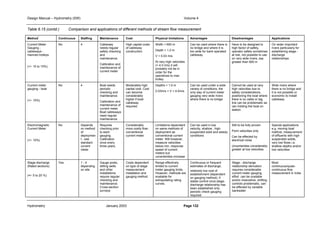
Terminology 
The shape, reliability and stability of the stage-discharge relationship are normally controlled by a 
section or reach of channel at, or downstream of the gauging station, which is known as a control. In 
terms of open channel hydraulics a control is generally termed a section control if critical flow occurs 
a short distance downstream from the gauging station. This can occur where a natural constriction or 
a downward break in channel slope occurs resulting from a rock outcrop or a local constriction in 
width caused by the construction of a bridge. If the stage-discharge relationship depends mainly on 
channel irregularities and friction downstream of the station then this is referred to as a channel 
control. This is the most common type of control in India. A complete control is one which 
determines the stage-discharge relationship throughout the complete range of flow e.g. at a high 
waterfall. However, more commonly no single control is effective for the entire range and we then 
have a compound control. This could be a combination of a section control at low stages and 
channel control for high stages. A control is permanent if the stage-discharge relationship it defines 
does not change with time, otherwise it is referred to as a shifting control. 
Controls can ether be natural or artificial (man made for flow measurement purposes). Artificial 
controls may be purpose built flow measurement structures, which have a theoretical stage - 
discharge relationship unique to the structure. As such it is not necessary to undertake a large 
number of current meter gaugings in order to define the stage - discharge relationship. However, the 
Hydrometry January 2003 Page 28
Design Manual – Hydrometry (SW) Volume 4 
theoretical relationships should be checked over the full range of flows. Reservoir spillways, control 
weirs and anicuts frequently come into the ‘artificial’ category, even though they have not been 
purpose built for flow measurement purposes, since it is often possible to derive theoretical stage-discharge 
relationships. Structures, which have not been constructed for the purpose of flow 
measurement such as bridges, floodway channels and drifts, are not considered as artificial controls 
since they normally require full calibration. 
Stage - discharge gauging stations such as natural controls and non-purpose built structures, which 
require current meter gauging to define the stage-discharge relationship are often referred to as rated 
sections. 
The two most important attributes of a control are stability and sensitivity (the two “S”s). If the 
control is stable the stage-discharge relation will be stable. It is also important that the control is 
sensitive, i.e. small changes in water level should correspond to relatively small changes in discharge. 
Hydrometric sensitivity 
It is a primary requirement for stage-discharge gauging stations that the rating relationship should be 
as sensitive over as wide a range of flows as possible. In other words, any change in the recorded 
water level should correspond to a relatively limited (in percentage rather than absolute terms) change 
in flow. This is illustrated by the rating curves sketched below, see Figure 4.1. From this sketch it can 
be seen, that rating 1 is more sensitive than rating 2. 
Figure 4.1: 
Sketch illustrating the concept of 
hydrometric sensitivity 
h 
Δh 
ΔQ1 ΔQ2 
4.3 SITE SURVEYS 
Rating 1 
Rating 2 
Q 
ΔQ1<< ΔQ2 for same Δh 
Once the purpose and objectives have been defined and the engineer responsible has considered 
what flow measurement and automatic water level recording techniques could be suitable, the site 
selection process can begin. The final choice of site will depend on the type and quality of the data 
required, the method to be deployed and other factors such as logistics and budgetary constraints. In 
particular the final site selection might be mainly determined by the choice of the most appropriate 
equipment or technique. Therefore, some guidance is provided in Chapter 6, on the advantages and 
limitations of different hydrometric methods used in, or which are suitable for Indian conditions. 
In order to select the most appropriate site, considerable effort needs to be expended undertaking site 
selection surveys. The site selection surveys can be divided into four distinct phases, which are 
summarised in the sub-sections below: 
Hydrometry January 2003 Page 29
Design Manual – Hydrometry (SW) Volume 4 
1. Desk study 
2. Reconnaissance surveys 
3. Topographic surveys, and 
4. Other survey work 
To ensure that all the pertinent information is obtained during the site selection process and surveys 
and to assist with the work, a standard form has been prepared. This list has been derived from the 
CWC checklist. A copy of this form is contained in Appendix 2.1 of Chapter 2, Volume 4, Field 
Manual, Hydrometry. 
Desk study 
The target location for the gauging station will have already been identified on a 1:250,000 map or 
similar during the network design process. However, this size of map is too small a scale for site 
selection purposes. The inspection of large-scale topographic maps (1:50,000) and aerial 
photographs, if these are available, should be undertaken to identify possible sites within the target 
river reach. 
Reconnaissance surveys 
These should be undertaken by road, foot and for larger, navigable rivers by boat. It is important that 
the entire target reach of the river is inspected. During the survey, interviews should be held with local 
people to try and build up a picture of the local site conditions such as water level ranges. At sites of 
interest attempts could be made to ascertain who owns the land. 
Topographic surveys 
On completion of the reconnaissance surveys, one or more sites could have been identified which are 
worthy of further consideration. However, it is often not possible to make final decisions on site 
selection without the benefit of bed surveys. Cross-sectional surveys upstream and downstream of 
the gauging site have to be carried out to get a detailed picture of the approach conditions and of the 
layout and extent of the control section. Longitudinal profiles are to be obtained to assess the bed 
slope and to identify potential controls. Possible backwater sources have to be identified. 
Other survey work 
It is useful to carry out flow measurements and stage observations at locations near to the proposed 
site(s) prior to making the final site selection. From such measurements some idea will be obtained 
about the velocity distribution across the measuring cross-section, water level variation and water 
surface slope. If structures are to be installed it is possible that soils and geological surveys will be 
required to establish the stability of the banks and bed for founding the structure and the availability of 
construction material such as rip-rap. 
Summing up 
Once the surveys have been carried the following aspects have to be reviewed: 
• technical aspects: the hydraulic suitability of the site, 
• logistical aspects: site accessibility, communication and staffing, 
• security aspects: security of instruments, away from residential areas and play grounds, 
• legal aspects: land acquisition and right of passage, and 
• financial aspects, including costs of land acquisition, civil works, equipment, data processing, and 
staffing and training. 
Hydrometry January 2003 Page 30
Design Manual – Hydrometry (SW) Volume 4 
4.4 SELECTION OF WATER LEVEL GAUGING SITES 
Stage measurements are most commonly required in surface water hydrometry to determine the flow 
using relationships between stage and discharge or cross-sectional area and velocity. Therefore, in 
many circumstances the selection of a stage or water level measurement site will be to a certain 
extent governed by the suitability of the site for flow measurement purposes. It is very important that 
extreme care is given to the selection of the location of stage monitoring devices since this is the 
basic raw data, which is required to derive discharge. Also, in some situations, flow estimates will not 
be required but it is necessary to measure water level only, e.g. in reservoirs, for flood warning. 
The gauging site should be located outside high turbulence zones, close to the edge of the stream at 
a place where the banks are stable and preferably steep. The downstream control shall be stable and 
sensitive to be able to establish a stable stage-discharge relation, where significant changes in the 
discharge create significant changes in stage. The site shall be outside the backwater zone of 
confluences and structures. The extent of the backwater reach L is approximately (see Chapter 2): 
(4.1) 
h 
L ≈ n 
S 
where: L = approximate reach of the backwater effect 
hn = normal or equilibrium depth (to be replaced by hE for a compound cross-section) 
S = slope of the river bed 
Nearby benchmarks should be available or be established to allow regular levelling of the gauge. 
Detailed selection criteria for water level gauging sites are presented in Chapter 2 of Part I of Volume 
4, Field Manual on Hydrometry. 
4.5 SELECTION OF STREAMFLOW MEASUREMENT SITE 
The majority of streamflow measurement techniques are based on the velocity area method. Even 
though the use of float measurements is sometimes inescapable, current meter gauging is the most 
widely favoured velocity-area method technique. For most situations the same general site selection 
criteria can be applied to each technique. The current Indian Standards on velocity-area method site 
selection (see Reference Manual) and current international practice (e.g. ISO 748) have been 
reviewed along with other considerations and a recommended set of guidelines have been prepared 
for 
• for current meter gauging sites 
• for float measurement 
• for discharge monitoring by Acoustic Doppler Current Profiler (ADCP) 
• for Slope-area Method 
• for selection of Natural Control (rated section) station site, and 
• for selection of Artificial Control Sites. 
For a stage-discharge station, both a stage measurement device and a current meter gauging site are 
required in the same locality. However, it might not always be appropriate to locate the current 
meter gauging site immediately adjacent to the stage measurement device since some of their 
site selection criteria are different. 
Detailed sets of guidelines for the distinguished measurement techniques are presented in Chapter 2 
of Part I of Volume 4, Field Manual on Hydrometry, which should be carefully considered. Some 
important criteria are presented below. 
Hydrometry January 2003 Page 31
Design Manual – Hydrometry (SW) Volume 4 
Current meter gauging site 
The selected site shall have a long, straight, uniform, well-defined approach channel upstream of the 
measuring section to ensure parallel and non-turbulent flow and to minimise irregular velocity 
distribution. In practice, the approach length is related to the channel width. Generally, for rivers less 
than 100 m wide a straight approach of 4 x channel width is considered to be sufficient, whereas for 
rivers greater than 100 m wide the current Indian minimum standard of 400 m straight approach 
should be adopted if possible. When the length of the straight channel is restricted it is recommended 
that the straight length upstream should be at least twice that downstream. The site shall be year 
round accessible and the section be stable, confined to one channel with no overbank flow. Sufficient 
flow depth should be available to provide effective immersion of the current meter and the flow 
velocities shall be within the calibration range of current meters (> 0.15 m/s and < 3.5 m/s). Above 
criteria also apply for other sites, with some additions. 
Float measurement sites 
Float measurements require a measuring track, which is straight and uniform in cross-section over a 
length of five times the average width of cross-sections. The riverbank shall be easily accessible to 
mark the passage of the floats and wind effects shall be minimum. 
Acoustic Doppler Current Profiler (ADCP) sites 
The ADCP is a device for measuring velocity, direction and cross-section. As such it is a velocity area 
device. However, in view of its technology it can cope with irregular velocity distributions and skew 
flow conditions. The choice of measuring cross-section is therefore not so critical as other velocity-area 
methods. The cross-section should, however, be free of rock or other objects to avoid damage to 
the face of the transducers. The equipment requires at least 1.5 m water depth below the transducers, 
which in turn are at least 0.3 m below the water surface. Hence, deep river sections are preferable. 
For safety reasons average velocities should not exceed 4 m/s, since the instrument will be boat 
mounted. 
Slope-area method discharge estimation site 
The site to which the slope-area method is applicable is straight and has uniform, stable cross-sections, 
with uniform hydraulic characteristics. Sufficient fall in the water table shall be available in 
the river reach to allow accurate determination of the water surface slope. 
Natural control (rated section) station site 
In practice there is very rarely an “ideal” location for a natural control (rated section) gauging station. It 
is often required to compromise and to establish stations in far from ideal conditions. The site 
selection is based on hydraulic criteria and on tactical considerations. The natural control should be 
selected where the relationship between stage and discharge is substantially consistent and stable, not 
affected by any significant backwater effect. The control shall be sensitive, such that a significant change 
in discharge, even for the lowest discharges, should be accompanied by a significant change in stage. 
Small errors in stage readings during calibration at a non-sensitive station can result in large errors in the 
discharges indicated by the stage-discharge relationship. Attention is to be given to land acquisition, 
security and staff availability. 
Hydrometry January 2003 Page 32
Design Manual – Hydrometry (SW) Volume 4 
Artificial control sites 
There is a variety of different flow measurement structures. The choice of structure will depend on a 
number of factors including objectives, flow range, afflux, size and nature of the channel, channel 
slope and sediment load, operation and maintenance, passage of fish and not least, cost. The 
applications and limitations of a structure will determine where its use is most appropriate. In this 
regard each type of structure has its own specific site selection criteria. In addition to the above 
mentioned criteria artificial controls also require appropriate sub-soil conditions to provide a solid 
foundation for the structure. Since the structure will create some backwater effect, it may cause extra 
flooding. 
Hydrometry January 2003 Page 33
Design Manual – Hydrometry (SW) Volume 4 
The frequency with which hydrological measurements are taken depends upon a number of factors, 
such as: 
1. The function which the data will serve. More frequent observation is required for the 
assessment of peak flows especially for small catchments, than for some other purposes. Most 
hydrological measurements are made to serve multiple functions. The measurement frequency 
must meet the requirements of the uses planned for the data. 
2. The target accuracy of derived data. It must be recognised that a policy of ‘as good as 
possible’ may lead on occasions to unnecessary expenditure on improving accuracy beyond 
what is needed for the purpose. i.e. there has to be a balance between the value of increased 
accuracy of data and the increased cost of providing that increased accuracy. There must at least 
be a notional upper limit on the size of the uncertainty band (accuracy) outside which the quality 
of the data would generally be unacceptable for its intended uses. Conversely, this uncertainty 
band should not be so small that the cost of providing data to such a high accuracy cannot be 
justified by the end result. 
The accuracy of derived hydrological data will depend on the sampling density, the accuracy of 
measurement of the variable and the frequency of measurement. Sampling density determines 
the representativeness and spatial variability of the derived data and is mainly covered in network 
design (Chapter 3). The frequency of measurement as well as the accuracy of observation at a 
specific location will have an impact on the accuracy of the derived data determination for that 
point, e.g. mean daily flow, derived from a given number of stage values per day each of which is 
converted to flow, (see para. 4 below). 
3. The accuracy of observation. Where observations are subject to random measurement errors, 
a larger number of observations are needed to meet a required target accuracy where the 
measurement error is large. The standard error of the mean relationship (Smr) in a stage 
discharge relationship is dependent both on the standard error (Se) of the observations and on the 
number of observations (N), thus: 
100 
−  
Q Q 
 
5 MEASURING FREQUENCY 
5.1 GENERAL 
= = Σ 
  
g r 
× mr Q 
and : d 
d 
2 
− 
N 2 
where : S 
S 
e 
N 
S 
r 
e 
 
  
= 
(5.1) 
with: d = relative deviation of gauged flow Qg from the fitted stage-discharge relationship Qr 
N = number of gaugings used to define the stage-discharge relation 
4. The time variability of the variable. Fewer measurements are needed to determine the mean of 
a variable over given time, if the variable is uniform or changing very slowly than for a rapidly 
fluctuating variable. This is particularly important for the assessment of mean daily flow, a 
common basis for many hydrological studies. Small steep upland catchments respond rapidly to 
storm rainfall which itself fluctuates in intensity throughout a storm, giving a hydrograph, showing 
rapid rise and fall and sharply defined peaks. On flat lowland basins the hydrograph is smoothed 
by the variable timing of tributary inflows (though they may themselves be flashy) and by channel 
and reservoir storages. Smaller catchments thus need more frequent measurement in order to 
achieve the same accuracy of mean daily flow, than larger flat catchments and also for obtaining 
a sufficient number of points to define the hydrograph of an event. Many hydrological variables 
show a regular diurnal variation. This may either be natural as for climatic variables, arising from 
the periodicity of solar energy input, or, man-made, for example daily cyclic changes due the 
discharge of effluents or abstractions for irrigation. The frequency of measurements must be 
sufficient to define the mean over both the highs and lows of these periodicities. Reference is 
made to Chapter 4 of Volume 2, Design Manual, Sampling Principles, dealing with sampling at 
the Nyquist frequency and beyond. 
Hydrometry January 2003 Page 34
Design Manual – Hydrometry (SW) Volume 4 
5. The seasonality of the variable. Flows in rivers or streams are highly seasonal and during the 
monsoon the changes in stage and discharge can be rapid and large. Thus the frequency of 
measurement of stage has to reflect this. Therefore, during the monsoon season a higher 
measurement frequency is required (hourly or less). It can also be further reduced if an event is 
taking place i.e. more manual readings or event trigger set in data logger. The past manual 
practice in many States has been for daytime hourly observations of river level during the lean 
season and 24-hour readings during the monsoon. The latter requires two additional staff (and the 
associated increased costs) to ensure record continuity. Occasional out-of-season storms are 
missed by daytime reading only. Where variables are observed and recorded autographically 
(chart) and especially digitally, the required data for these out-of-season storms can be captured 
at negligible increased handling and processing cost (see next para.) 
6. The marginal cost/cost-benefit of improved accuracy. If manual observations are undertaken, 
increasing the number of observations to improve the definition (accuracy) may require more 
observer time (man-days). Therefore, costs will increase proportionally and decisions have to be 
made on the benefits of the increased accuracy. However, where automated observations are 
already taking place either by chart or DWLR, the frequency of observation can be increased with 
only a negligible increase in cost. 
7. The benefits of standardisation. It is simpler to process and analyse records which are arriving 
at the Data Processing Centre, all in the same format and with the same frequency of 
observation. This is true, both for manual data and for digital data, where batch processing of 
records by computer is simplified. It may be preferable for digital observations to standardise on a 
time interval close to the minimum requirement, than to adjust the frequency at each station to its 
functions, accuracies and time variability of the parameter being measured, many of which are 
imprecisely known. 
In the subsequent sections the required sampling frequencies for stage and discharge are dealt with. 
5.2 STAGE MEASUREMENT FREQUENCY 
The procedure to determine the sampling frequency is outlined in Chapter 5 of Volume 2, Design 
Manual, Sampling Principles. For full reproduction of the stage variation a sampling interval slightly 
less than the Nyquist interval should be applied. This not only applies when interest is in peak flows, 
but when rates of rise and of fall of the hydrograph have to be reproduced to accurately determine the 
discharge of flashy floods in flat rivers. To estimate the mean flow over a certain period of time a 
larger interval will suffice. Below, the sampling frequencies suggested for various types of rivers and 
measurement techniques are presented. The frequencies given are indicative, based on past 
experience. It is, however, necessary to verify the validity of these frequencies in view of the 
objectives. 
In larger flatter rivers of Peninsular India a general frequency of hourly readings of stage is usually 
acceptable. For a few small upland catchments used for special purposes or research, 15 or 30 
minute observations may be used to define the rainfall-runoff response. For the design of minor 
irrigation schemes and bridge and culvert design on small catchments, 15 minute observations may 
also prove useful. 
Different practice will be adopted depending on whether measurement is by staff gauge only, chart 
recorder or digital water level recorder, as summarised in Table 5.1. 
For digital recorders the standard practice should be for a maximum time interval between readings of 
one hour. On large natural lowland rivers, such an interval may be unnecessarily small, but few such 
rivers in India are natural. Levels may change comparatively quickly as a result of river regulation and 
abstraction a short distance upstream. Information on such changes is often helpful in scheme 
operation and in analysis for example of times of travel. For small catchments, particularly those in 
mountainous, high intensity rainfall areas a frequency of 15 minutes may be required. 
Hydrometry January 2003 Page 35
Design Manual – Hydrometry (SW) Volume 4 
Observation by Frequency Remarks 
DWLR 15 min/hourly Dependent on size of catchment and 
purpose for which data is required. 
AWLR Hourly Depends on scale of chart, more frequent 
readings (15 min.) could be extracted from 
daily and/or strip charts 
Staff gauge only Hourly 
2 or 3 per day 
Monsoon 
Lean season 
Staff gauge with AWLR or DWLR 2 or 3 per day 
Stilling well inside reference level Daily 
Table 5.1: Recommended observation frequency for stage measurements 
For chart recorders, the record is of course continuous and information may be extracted at the 
interval required. The ease of extraction will depend on the scale and size of the chart. However, it is 
recommended that whenever possible a frequency of at least one hour is applied. 
For manned stations with staff gauges only, hourly readings through a full 24 hr day (24/day) will 
apply during the monsoon, with the season defined according to the local climate. During the lean 
season, with the record already intermittent, hourly readings seem unjustified. Two or three readings 
per day will be sufficient, with the provison, that in the event of unseasonal rainfall and river rise, the 
observations are intensified and extended over the full 24 hours. In some circumstances one reading 
a day might suffice. 
For stations where the staff gauge is supplementary to the DWLR or AWLR, the staff gauge will be 
read 3 times daily whilst the recorders are operating correctly but will otherwise revert to the practice 
noted above. 
Where auxiliary/secondary gauges exist they will be read at the same time intervals as the reference 
gauge and the readings should be taken as close in time as possible. 
For all stations level measurement should persist throughout the year, so long as there is flow and the 
no-flow condition will be routinely observed and recorded daily. The latter observations are very 
important; a nil flow is an observation, which must be recorded. Failure to do so results in confusion 
between ‘no flow’ and missing data. 
5.3 CURRENT METER MEASUREMENT FREQUENCY 
The required frequency of current meter measurement at a stage-discharge site depends primarily on 
the stability of the control section, as this will define how frequently gaugings are required to achieve a 
given level of accuracy. The minimum number of gaugings required establishing a good stage-discharge 
relationship for a stable, sensitive control is of the order of 10 -12 over the full flow range. 
The nature of rivers in Peninsular India is such that the controls are often insensitive and the 
uncertainties in current meter gauging are larger than desirable (> +/- 10%). Therefore considerably 
more gaugings might be required in order to define the stage-discharge relationship. A minimum 
number of 20 gaugings should at least be observed. The existing level of calibration is also important. 
A precise interval between gaugings cannot be specified as the need to gauge may depend on the 
occurrence of flow in a particular range. 
Unstable channels and those affected by backwater or hysteresis resulting from unsteady flow will 
require more persistent and frequent measurement than stable controls. 
Recommended frequencies are proposed and these are summarised in Table 5.2. However, these 
are only indicative and merely provided as a guide. 
Hydrometry January 2003 Page 36
Design Manual – Hydrometry (SW) Volume 4 
If more than one condition exists at a station then the condition requiring the most frequent gauging 
should be applied. 
If a change in the control is detected at any station or if current meter gauging suggests that the rating 
has shifted, then gauging should be intensified until the new rating is defined throughout the range. At 
sites with very unstable controls it might be necessary to derive a new stage-discharge relationship for 
each season. 
Mobile teams 
Stage-discharge sites with reliable, stable ratings, which only require periodic current meter gaugings, 
could be serviced by mobile field teams. Groups of sites should be selected within the same 
area/locality, which could be visited by mobile teams to undertake the current meter gaugings. 
Whenever feasible, the use of mobile teams should be encouraged, since it could reduce recurrent 
use and make more efficient use of limited, skilled manpower. In addition, this would minimise the 
amount of equipment required, since the teams could carry the current meters and accessories from 
site to site. 
Before each monsoon season the Executive Engineer will draw up a schedule of stations within his 
jurisdiction outlining his recommendations where priority gauging is required, with ranges, where there 
is currently insufficient gaugings for accurate definition of the stage-discharge relationship. The 
schedule will be circulated to mobile and static teams for their action. 
Station control Frequency Remarks 
All stations (excluding structures) - 
initial calibration 
Daily, more frequent gauging if 
appropriate to capture data for as wide a 
range of events as possible 
> 20 each in low, medium and high 
flow range 
Stable natural channel - well 
calibrated 
Monthly plus at least one high flow event a 
year 
The monthly gaugings can coincide 
with routine chart changing/DWLR 
downloading. 
Backwater affected Daily if backwater source not known 
Otherwise weekly 
If an additional set of gauge posts 
are installed or an additional 
AWLR/DWLR, the changes in 
surface water slope can be 
estimated 
Unstable channels with silt sand or 
gravel 
Daily or more frequent to obtain data for 
high events 
Intermittently unstable channels with 
cobbles or boulders 
Daily during monsoon 
Weekly during lean season 
Unsteady flow with looped rating Weekly Assumes that rate of change from 
stage records of stage can be well 
enough defined 
Structures - Initially 6 gaugings over full modular 
measurement range to confirm calibration 
(performance) of structure, approx. 6 
readings in the non-modular range. 
Including 2 low flows. The modular 
limit should be defined 
Structures - after initial calibration 
(performance) check 
1 - 2 gaugings per year within modular 
range, 3 - 4 gaugings a year in non-modular 
range 
Table 5.2: Recommended observation frequency for current meter gauging 
Hydrometry January 2003 Page 37
Design Manual – Hydrometry (SW) Volume 4 
6 MEASURING TECHNIQUES 
6.1 STAGE MEASUREMENT 
6.1.1 GENERAL 
In Chapter 1 the stage or gauge height has been defined as the elevation of the free water surface of 
a stream relative to a local or national datum, measured by a gauge. Stage or gauge height is usually 
expressed in metres and hundredths (cm) or thousandths (mm) of a metre depending on the 
resolution required. 
Records of stage may be of direct or indirect interest: 
• direct interest: e.g. for flood or low flow levels, reservoir levels, etc., and 
• indirect interest : to derive a second variable, e.g. the discharge of a river using a stage-discharge 
relation (Q = f1(h)) or the surface area and/or volume of a reservoir as determined by a stage-area 
and/or stage-storage relationship (A = f2(h), V = f3(h)). 
The determination of stage is therefore an important measurement in hydrometry. The reliability of 
continuous records of discharge derived from a stage record depends to a large extent on the quality 
of the stage record. Instruments and installations used to measure stage range vary from the very 
simple to highly sophisticated. 
Overview of water level gauges 
Water-level gauges in use in the HIS comprise: 
1. Non-recording gauges, including: 
• Vertical staff gauges (Sub-section 6.1.2) 
• Inclined or ramp gauges (Sub-section 6.1.3) 
• Crest (maximum water level) stage gauges (Sub-section 6.1.4), and 
• Electric tape gauges (Sub-section 6.1.5) 
2. Recording gauges, covering: 
• Float system with autographic recording (Sub-section 6.1.6), 
• Float system with digital recording (Sub-section 6.1.7), and 
• Pressure transducers (Sub-section 6.1.8). 
Note: 
1. The recording gauges are often distinguished according to the recording medium in Autographic 
Water Level Recorder, AWLR, and Digital Water Level Recorder, DWLR, which stores the data in 
an electronic data logger. The float system with autographic recording is then classified as an 
AWLR, whereas the float system with digital recording is called a DWLR as well as the pressure 
transducer. 
2. A number of other non-recording and recording devices are in use in various countries, like wire-weight 
gauge, float tape gauge, chain gauge, hook and pointer gauges, bubbler pressure gauges 
and ultrasonic gauges. The reader is referred to Volume 4, Reference Manual on Hydrometry for 
further details and information on water level sensors used elsewhere. 
Hydrometry January 2003 Page 38
Design Manual – Hydrometry (SW) Volume 4 
In Sub-section 6.1.10 an overview is given of the various types of water-level gauges, preceded by an 
overview of available data loggers in Sub-section 6.1.9. 
6.1.2 VERTICAL STAFF GAUGES 
A staff gauge normally consists of a measuring plate fixed to a post set in concrete. The measuring 
plate is of enamelled steel or stable FRP with graduations of 0.01 m, see Figure 6.1. The staff gauge 
is bolted to a concrete or steel pole. The pole has slots to adjust the level of the plate. The staff gauge 
shall generally comply with IS 4080-1994. Alternatively, the staff gauge may be painted on a well-established 
and stable structure, like a bridge pier or retaining wall. At all hydrometric stations a staff 
gauge is required to measure the water level. The staff gauge is used: 
• either as the sole means of obtaining the level, 
• or as a reference gauge to set and check the water level recorder. 
Where short interval data is required, e.g. small, responsive catchments the use of manually read staff 
gauges will be inadequate unless several observers are rotated (shift system) so that an observer is 
on site at all the time. 
Figure 6.1: 
Close up of typical staff gauge 
The following aspects of staff gauges are subsequently dealt with: 
• Site requirements 
• Station layout 
• Installation aspects 
• Operational aspects 
• Maintenance 
• Accuracy 
• Staff requirements 
• Auxiliary gauges 
• Gauges attached to a stilling well 
• Advantages and disadvantages 
Hydrometry January 2003 Page 39
Design Manual – Hydrometry (SW) Volume 4 
Site requirements 
The staff gauge should be located on stable banks, or attached to bridge piers or reservoir walls. At all 
times one should be able to read the water level from the gauge. Flow conditions should be such that 
little turbulence and wave action is experienced near the gauge posts to reduce measuring errors. 
Reference is made to Chapter 4 for detailed site selection guidelines. 
Station layout 
A single set of gauges is normally employed at a gauging station. If apart from the stage also the fall 
is to be measured auxiliary gauges are required. When a stilling well is available to accommodate a 
recording gauge, staff gauges are placed inside and outside the stilling well. 
To level the gauge, two permanent benchmarks of known level relative to mean sea level (msl) should 
be close to the site. If these are not available two independent sites within 500 m of the river should be 
available where station benchmarks can be installed relative to an arbitrary datum. This arbitrary datum 
should be related to msl as soon as it is practically possible. These sites should be whenever possible 
free from possible natural or human interference. 
Installation aspects 
Vertical gauges are usually installed in sections of 2.0 metres length with a series of gauges stepped 
up the bank to a level exceeding the maximum flood level, see Figure 6.2. For stations where the 
water level is controlled by a weir, the zero of the gauges should coincide with the lowest weir level. 
For stations with a natural control, the zero must be lower than the lowest water level in perennial 
rivers and preferably at, or lower, than the lowest bed level in non-perennial rivers. The zero of all 
gauges should refer to mean sea level datum. The numerals must be distinct and placed so that the 
lower edge of the number is close to the graduation to which it refers. There must also be provision for 
the metre numeral on each metre length of plate. 
Figure 6.2a) & b): Vertical staff gauges stepped in series up a riverbank 
Vertical staff gauges are fixed to reinforced concrete or angle iron supports, with cement concrete 
foundations extending to a level reasonably free from erosion or disturbance (usually about 0.75m). Angle 
iron supports are generally least vulnerable to damage by flood debris but in certain areas may be subject 
to theft. 
Hydrometry January 2003 Page 40
Design Manual – Hydrometry (SW) Volume 4 
Operational aspects 
The staff gauges are manually read at fixed times each day (see Chapter 5). The reading times may 
vary seasonally. Where appropriate the gauges are also read during flow measurements. 
The accurate recording of time is important, particularly during periods of rapidly varying stage. It is 
essential that all observers possess or have access to a reliable watch or clock. 
Consideration must be given to the visibility of the gauges under all flow conditions, for example 
where access to the bank becomes difficult in flood conditions and the gauge becomes more distant. 
The simplest solution may be to provide the observer with a simple pair of binoculars. The averaging 
of stage readings during choppy but steady water conditions could improve the accuracy. However, 
this requires that a good, reliable observer is available. 
Maintenance 
Stability of staff gauges cannot be ensured and they are often exposed to movement or flood damage. 
Gauges must therefore be check surveyed with a minimum frequency of twice per year in the pre- and 
post-monsoon and on the occurrence of any observed disturbance or damage. The zero of the gauge 
plates and each individual gauge plate must be connected to a temporary or permanent benchmark 
and the circuit closed to the starting point with an error not greater than 5 mm. When a gauge is found 
disturbed, it should be reset immediately and survey information be recorded in the Field Record 
Book. 
Accuracy 
When the water level is gauged to estimate the discharge, the level should be accurate relative to a 
local datum. In such cases accuracy relative to national datum is not of importance. When flood levels 
are of concern then the accuracy relative local or national datum may be of concern. 
The uncertainty in the water level reading is composed of: 
• uncertainty in the zero of the gauge, and 
• uncertainty in the gauge reading. 
The uncertainty in the zero of the gauge depends on the accuracy of the levelling to the benchmark. 
The uncertainty in the gauge reading is a function of the accuracy of the graduations on the gauge 
plate, the hydraulic condition and the quality of the observer. 
Under calm conditions, the staff gauge can be read to an accuracy of ± 3 mm. However, the reliability 
of observations is to a far greater extent dependent on the ability and reliability of the observer. This is 
an important consideration in the selection of station equipment and operation. 
Staff requirements 
When staff gauges are used for reference gauging one reading per day will do, so one observer will 
be sufficient. Stations, which operate with staff gauges only, are heavily demanding of manpower as 
three observers are required to ensure readings over the full 24 hours. This is a general requirement 
during monsoon periods when levels change rapidly. The gauge reader(s) shall be of type S-2 
category. 
Hydrometry January 2003 Page 41
Design Manual – Hydrometry (SW) Volume 4 
Auxiliary gauges 
At river sites two more sets of auxiliary gauges, set to the same datum, may be installed to determine 
the fall or water surface slope. The fall is of interest for the computation of discharge to be able: 
• to correct for backwater effects, 
• to estimate the hydraulic roughness for rating curve extrapolation, or 
• to convert stage to discharge using the slope area method (see Section 6.6). 
For the installation of auxiliary gauges there are two conflicting requirements: 
• the distance between gauges should be sufficient to detect differences in water surface slope 
between the cross-sections, 
• the time of measurement at the gauges be precisely synchronised if the stage is changing rapidly. 
Generally, if one assumes that the uncertainty in level measurement at the upstream and downstream 
measurement gauges are the same, then the distance between the gauges should be sufficient for 
the fall to be not less than twenty times the uncertainty in the measurement at one gauge. Hence, if 
the uncertainty in the measurement at one gauge is 0.01 m then the gauges should be distanced such 
that the fall is at least 20 x 0.01 = 0.20 m. Then, the uncertainty in the fall becomes: √2 x 0.01 = 0.014 
m (see Volume 2, Design Manual, Sampling Principles). 
The greater the distance between the gauges, the greater the difficulty in ensuring time 
synchronisation. These difficulties must be considered when setting up and operating such stations; it 
may have consequences for the number of staff required. 
Gauges attached to a stilling well 
When a stilling well is used to accommodate a recording gauge, staff gauges are installed inside and 
outside the well, both having the same zero datum. The standard reference gauge must remain the 
outside gauge as the level on the inside gauge may be affected by blockage of the stilling well inlet 
pipe so that both staff gauge and recorder are registering the same inaccurate reading. In this case, 
comparison of inside and outside gauges provides a check on the functioning of the stilling well. 
Advantages and disadvantages 
Staff gauges are always required at hydrometric stations. To their advantage counts: staff gauges are 
simple, robust and easily understood. Disadvantages are that they do not produce a continuous 
record and that they are manually read. 
6.1.3 INCLINED STAFF OR RAMP GAUGES 
Inclined staff or ramp gauges are staff gauges designed to follow the natural slope of the riverbank, 
see Figure 6.3. Though in the field generally vertical gauges are applied, occasionally inclined gauges 
are applied provided that the riverbank is stable. Aspects dealt with for the vertical gauges are in 
general also applicable to inclined gauges. 
Hydrometry January 2003 Page 42
Design Manual – Hydrometry (SW) Volume 4 
Figure 6.3: 
Inclined staff gauge 
The pro’s and con’s of inclined gauges relative to vertical staff gauges are as follows: 
Advantages: inclined gauges are generally less prone to damage than vertical gauges, where rocky 
and stable banks exist. They also allow more accurate readings of the water level because of 
their better resolution. 
Disadvantages: inclined gauges have to be individually prepared owing to the natural variation in 
slope angle. They should therefore only be used where flood damage to vertical gauges is 
expected. Also, they have found to be prone to movement and damage caused by bank 
collapse and slippage. As they are more complicated and time consuming to install and more 
costly to replace than vertical staff gauges, they are not currently in common usage in India. 
6.1.4 CREST STAGE GAUGES 
Crest stage gauges, sometimes referred to as maximum water level gauges, are devices for obtaining 
the elevation of the peak flood level of a stream where continuous observation is not available. These 
are comparatively simple and inexpensive devices. The four most common methods are: 
1. Colour change gauges: a water sensitive tape, which changes colour when in contact with 
water, is enclosed in a vertical tube. Water enters the tube at the base and washes off the colour 
up to the maximum height reached by the water, see Figure 6.4. 
2. Greasy pole: the gauge typically consists of a vertical tube, containing a floating substance such 
as cork dust or saw-dust, which sticks to an inner greased pole. 
3. Non-returnable float gauges: a float is raised, usually within a transparent tube and is held in 
place by a ratchet at its maximum level. 
4. Non-return valve gauge: water enters the bottom of a clear plastic tube through a non-return 
valve and a column of water to the height of the maximum water reached, is trapped as the 
outside level recedes. 
Examples of each of these are commercially available but can be readily constructed from simple 
materials. 
Hydrometry January 2003 Page 43
Design Manual – Hydrometry (SW) Volume 4 
Figure 6.4: Maximum Flood Level (MFL) Gauge 
The use of crest stage gauges upstream and downstream of the gauging site will provide important 
information on the slope of the water table during peak flow, which in turn is indispensable for proper 
extrapolation of the discharge rating curve. Its use is strongly recommended. 
6.1.5 ELECTRIC TAPE GAUGES 
The portable electric level indicator tape gauge consists of a graduated reel of steel or fibre reinforced 
plastic tape, see Figure 6.5. The tape and sensor are lowered until contact is made with the water 
surface, which completes an electrical circuit and sounds a buzzer. The gauge can be read to the 
nearest millimetre against a datum plate. The latter datum is at a known level above the zero of the 
gauge. The stage is obtained by subtracting the tape reading from the datum plate level. Power 
supply is through a battery. 
Figure 6.5: 
Electric tape gauge 
Hydrometry January 2003 Page 44
Design Manual – Hydrometry (SW) Volume 4 
Electric level indicator tapes are used where staff gauges are not easily installed or read, for example 
on the abutment wall of gauging weirs or inside narrow stilling wells, to provide an accurate level 
measurement alternative at such places. 
Accuracy 
Specifications require that the electrical level indicator tape should have an accuracy equal or better 
than 2.5 mm/10 m at 20 oC. The temperature coefficient of the tape should be less than 0.0125 mm/ 
oC/m. 
6.1.6 FLOAT SYSTEM WITH AUTOGRAPHIC RECORDING 
Measuring principle 
A float sensor consists of a float attached to a beaded wire or perforated metal tape (on sprockets), at 
one end, and, to keep the wire/tape taut, a counterweight at the other end. The wire or tape hangs 
around a pulley wheel. The system is specially engineered to prevent slippage to assure that the 
stage fluctuations sensed by the float are fully transmitted to the pulley. The movement of the pulley 
wheel drives a chart recorder, see Figure 6.6. 
A float sensor requires to be installed in a stilling well to protect the float and to damp out oscillations. 
The stilling well is connected to the river by means of one or more intake pipe(s) or perforations to 
ensure continuity between the river and stilling well levels, see Figure 6.7. 
Figure 6.6: 
Typical float, pulley and 
counterweight water level sensor 
Hence the float sensor system with autographic recording comprises the following components: 
• A stilling well, 
• A float sensor 
• An autographic chart recorder, and 
• Staff gauges inside and outside the stilling well. 
Hydrometry January 2003 Page 45
Design Manual – Hydrometry (SW) Volume 4 
Figure 6.7: 
Float sensor in stilling well 
These components are shortly dealt with below. Furthermore are discussed: 
• operational aspects and problems, 
• accuracy, and 
• advantages and disadvantages 
Full details one can find in Chapter 8 and in Volume 4, Reference Manual on Hydrometry. 
Stilling well 
The stilling well accommodates the float sensor and needs careful design with respect to foundation 
or support, operational range, well diameter in relation to the diameter of the inlet pipes or perforations 
and de-silting arrangements. 
A stilling well is either: 
• a concrete tube or structure founded in the riverbank, with intake pipes, or 
• a metal or plastic pipe attached to a bridge pier, a retaining wall or a ramp, with holes to connect 
the well with the river or reservoir 
The latter solution is generally less costly than a structure on the riverbank. 
The height of the structure is determined by the minimum water level one wants to record and the 
maximum flood level. The platform, carrying the pulley and recorder, should always be well above the 
maximum flood level to keep the equipment dry under all circumstances, whereas the distance 
between platform and the maximum stage is sufficient to allow the float to sense the highest stage. At 
the lower end there is generally more flexibility. The stage variation at the lower end is generally small 
and can well be taken from a staff gauge. By avoiding the lowest stages the intake of sediment is also 
reduced and it provides an easier means to clean the intake pipes when silted up. 
The inlet diameter should be designed to balance the opposing influences of oscillation (small inlet 
required) and lag (larger inlet required). Leupold and Stevens suggest the inlet area to be 1/1000th of 
the area of the stilling well, i.e. an inlet pipe diameter, which is roughly 1/30 x well diameter if one pipe 
Hydrometry January 2003 Page 46
Design Manual – Hydrometry (SW) Volume 4 
is applied. The inlet area should also be designed to balance the ingress of sediment with the 
practical problems of its removal, whereas the diameter of the stilling well should be large enough to 
allow free movement of float and counterweight. The design of stilling wells is dealt with in Chapter 8. 
Static tubes on the stream end of the intake pipes are often applied to reduce drawdown and 
superelevation effects caused by high velocities past the end of the pipe. 
Siltation is the most serious problem in stilling wells. In rivers, which carry a heavy silt load, it is 
advisable to flush or clean wells after each flood. In other instances one or two flushings per year may 
be sufficient. There must be adequate equipment provision for stilling well maintenance. As a guide, 
one portable pump with accessories per 5 stations is usually sufficient for rivers with a heavy silt load. 
On other rivers one pump per 10 stations should be adequate. 
Sensor 
Careful balancing of the float and counterweight is required over the operating range. The operating 
range is linked to the float/weight size and the wire tape weight. The accuracy obtainable depends on 
the float diameter. The larger the float diameter the higher the accuracy. Reputable manufacturers of 
this type of equipment will specify the combinations of sizes of float, counterweight and pulley 
arrangements for various level ranges and accuracies. These are to be used to achieve the desired 
performance. The pulley and recorder have to be installed on a fixed and stable platform or table, well 
above the maximum flood level. 
For proper operation of the sensor in the stilling well it is of importance that: 
• the water level in the well is the same as in the river, 
• the well water level is error free transferred to the pulley. 
For reasons of improper design and/or maintenance of the stilling well the water level in the well may 
deviate from the water level in the river. Similarly, the sensor may work unsatisfactory due to e.g. 
slippage of the wire, mechanical problems, etc. A full list of possible errors is presented below under 
operational problems. 
Autographic chart recorder 
The autographic chart recorder, operating on a float and pulley based system provides a continuous 
trace of stage with respect to time on a chart. The movement of the pulley wheel is translated into a 
movement of a pen mechanism or the movement of the chart relative to a pen. A spring-wound 
mechanical or battery driven clock is part of the recorder. Data is extracted from the chart manually or 
by means of a digitising table or tablet. Two types of chart systems are available: 
a) drum type, where the chart is fitted to a vertical or horizontal drum. The following systems are in 
use: 
• the pulley drives the drum and the clock moves the pen, and 
• the pulley moves the pen and the clock drives the drum (see Figure 6.8) 
b) strip type, where a chart roll is clock driven from one spindle to another; the pen is moved by the 
pulley (see Figure 6.9). 
Major difference between the drum and strip type recorders is that the latter can be left unattended for 
a longer period as the chart allows a longer record on a chart and/or can provide a better resolution. 
Drum type recorders require daily charts for flashy rivers to get sufficient resolution and weekly charts 
when the water level fluctuates slowly. Though the frequent replacement of the chart may look 
disadvantageous for the drum recorder, this is not necessarily so. The experience with the float 
Hydrometry January 2003 Page 47
Design Manual – Hydrometry (SW) Volume 4 
sensor in a well is that the functioning of the system should regularly be checked anyhow, irrespective 
of the type of chart recorder. 
On both recorder types, changes in water level activate a pen or stylus on the stage axis of the chart. 
Recording scales range from 1:1 to 1:50. Most recorders can now record an unlimited range in stage 
by use of a pen-reversing device or by unlimited rotation of the drum. Gearing should be chosen with 
respect to the expected range in level at the station to give adequate definition for extraction without 
crowding the chart with too frequent reversals or drum rotations. 
Errors in the recorded level due to the recorder can arise from malfunction or incorrect setting up of 
the recorder and/or chart, clock and mechanical problems, see below under operational problems. 
Figure 6.8: 
Horizontal drum recorder 
Figure 6.9: 
Float operated strip chart 
recorder 
Staff gauges attached to the stilling well 
Staff gauges are installed inside and outside the stilling well, both having the same zero datum. The 
standard reference gauge must remain the outside gauge as the level on the inside gauge may be 
affected by blockage of the stilling well inlet pipe such that both staff gauge and recorder are 
registering the same inaccurate reading. In this case, comparison of inside and outside gauges 
provides a check on the functioning of the stilling well. 
Hydrometry January 2003 Page 48
Design Manual – Hydrometry (SW) Volume 4 
Operational aspects 
The float type sensor with chart recorder will provide an accurate continuous recording of the water 
level variation in the river if the design is correct and the system is well maintained. In view of a variety 
of operational problems, which may occur with the float sensor and its accommodation, it is required 
that the gauge is inspected daily. The clock of the recorder is to be checked as well as the recorded 
water level with the staff gauge inside and outside the stilling well. The gauge reader(s) shall be of 
type S-2 staff category. 
Operational problems 
Operational problems, that can arise with the float type sensor with chart recorder, are listed below. 
The problems with the sensor and housing and with the recorder are discussed separately. 
The operational problems with the sensor and housing may be of the following kind: 
• Sudden or rapid water level changes can cause wire slippage/tape sprocket jumps. 
• Weight will catch onto the bottom of the instrument bench or floor of instrument house if the wire 
is too short. 
• Weight submergence can cause errors since the tension in the pulley wire/tape will alter. It is not 
always possible to avoid this. However, whenever possible it should be avoided. Bottoming out of 
the counterweight on the base of the stilling well should definitely be avoided. 
• Float lag may occur if the intake pipe or holes is/are too small a diameter or if it becomes blocked. 
• Insufficient dampening of oscillations if the intake pipe diameter or size of intake holes is/are too 
large. Natural level oscillations and surges can result from rapid water level stages. 
• Hysteresis effects may result from float, pulley and gear combinations. 
• Mechanical inertia effects can arise with rapidly changing levels. 
• Gear-train backlash effects can cause error due to gearing wear. 
• Some float systems have additional guides and pulleys to redirect position of float or alter chart-recording 
scales, which can reduce sensitivity. 
• Inadequate float diameter or badly matched float and counterweight. 
• Tangling of float and counterweight wires. 
• Float and counterweight reversed (pen driven in the reverse direction with respect to level). 
• Kinks in float suspension wire or tape. 
• Extension of the wire/tape due to temperature increases. 
• Bridge and wall mounted stilling wells can vibrate at high flows. 
• Build up of silt on the float pulley, affecting the fit of the float tape perforations in the sprockets. 
• The stability of the mounting bracket or base is important. It is strongly recommended that the 
pulley and recorder are installed on a fixed and stable platform or table. 
Operational problems with the chart recorder may be due to: 
• Incorrect choice of gearing: the full range of water levels is not covered. 
• Backlash in the gearing. 
• Friction in the mechanism. 
• Improper setting of the chart on the recorder drum or strip chart in the sprocket holes. 
• Improper joining of the chart edges. 
• Distortion and/or movement of the chart paper (humidity). 
• Distortion or misalignment of the chart drum. 
• Faulty operation of the pen. 
Hydrometry January 2003 Page 49
Design Manual – Hydrometry (SW) Volume 4 
• Clock inaccuracy, over-winding or failure to wind. 
• Insects or other organisms in the mechanism or consuming the chart. 
Accuracy 
A float operated recorder can be expected to sense the level to an accuracy of 3 to 5 mm, which may 
reduce to 10 mm for the accuracy of extraction of data from the chart, depending on the gearing and 
scale of the pen trace for recording ranges of the order of up to about 3 m. However, it must be 
realised that this can only be achieved with a high standard of maintenance and adequate checking, 
based on thorough training. As the recording range increases then the accuracy will further reduce. 
The recorder shall generally comply with IS 9116-1979 
Advantages and disadvantages of float and chart type water level recorders 
Advantages - it is relatively simple to operate and maintain, is widely used, can provide an immediate 
direct reading of stage and provide a historic trace without requiring an external energy 
source. 
Disadvantages - it is a mechanical device and therefore subject to errors from changes in 
temperature, hysteresis and friction. Also, the resolution of the chart scales, depending on the 
arrangement selected are sometimes a limitation on accuracy, the pen wears out and ink 
depletion occurs. Other problems can occur if the pulley wire becomes kinked, the 
counterweight becomes submerged or if the wires become displaced on the pulley wheel(s). 
Its operation therefore requires much attention. The chart has to be analysed or digitised to 
extract the data for entry onto a computer. This requires manpower and is a potential error 
source. Last but not least, the overall costs of the float sensor (initial and maintenance costs) 
are large, primarily due to the stilling well requirement. 
6.1.7 FLOAT SYSTEM WITH DIGITAL RECORDING 
A float sensor consists of a float attached to a beaded wire or perforated metal tape (on sprockets), at 
one end, and, to keep the wire/tape taut, a counterweight at the other end. The wire or tape hangs 
around a pulley wheel. The system is specially engineered to prevent slippage to assure that the 
stage fluctuations sensed by the float are fully transmitted to the pulley. The movement of the pulley 
wheel drives a digital recorder. The float sensor requires to be installed in a stilling well to protect the 
float and to damp out oscillations. The stilling well is connected to the river by means of one or more 
intake pipe(s) or perforations to ensure continuity between the river and stilling well levels. Hence the 
float sensor system comprises the following components: 
1. A stilling well, 
2. The float sensor 
3. A digital stage recorder, and 
4. Staff gauges inside and outside the stilling well. 
The components 1, 2 and 4 are exactly the same as for the float system with autographic recording. 
These components are discussed in the Sub-section 6.1.6. The only piece that differs is the stage 
recorder. Instead of recording the rotation of the pulley wheel on a chart it can directly be captured in 
digital format by a shaft encoder. Essentially a shaft encoder measures the angle of rotation, either 
incremental or absolute, see also Figure 6.10. The output from the shaft encoder is recorded on digital 
data loggers and can be shown on a LCD display. 
Hydrometry January 2003 Page 50
Design Manual – Hydrometry (SW) Volume 4 
The absolute encoder is able to signal exactly where its reference zero is located relative to the 3600 
field of rotation of its shaft, to a required level of resolution. The shaft-mounted disk is of glass (or similar 
light-transmitting material), patterned into "tracks" that, according to a binary pattern that alternatively 
obscures and transmits light from one side of the disk to the other. Absolute encoders of good quality and 
fine resolution are very expensive. 
The incremental encoder signals the fact that shaft rotation is taking place as a train of logic pulses. 
Predominantly the incremental encoder is a revolution counter but which when linked to an appropriate 
counting mechanism can be readily converted into a rotational positioning device. Apart from cost the 
incremental encoder has the advantage over the absolute encoder that by its associated up/down 
counter it can track changing level multiple rotations of its shaft. This is particularly attractive for 
hydrometric applications where a high resolution is often required over a large level range. 
The Optical Incremental Shaft Encoder is the type most widely used in hydrometric practice, though some 
specific proprietary data logging devices prefer to interface with Optical Absolute Encoders, for reasons of 
battery longevity. Examples of free-standing and parasitic shaft encoders are shown in Figure 6.11. 
Figure 6.10: Basic features of the optical shaft encoder 
Advantages and disadvantages of digital float-based water level recorders 
Advantages: - they can provide as good an accuracy as the primary sensor i.e. the float system but 
do not have the errors associated with chart interpretation. For a well constructed float and 
pulley system they should be able to measure to +/- 3 mm. Shaft encoders can be added to 
some normal float and drum type water level recorders and as such, a back up chart can also 
be used in case of logger failure. 
Hydrometry January 2003 Page 51
Design Manual – Hydrometry (SW) Volume 4 
Disadvantages: - because they are operated by means of a float system they require the 
construction of a stilling well. Also, they can be subject to errors similar to those experienced 
with conventional float and chart recorders such as problems caused by submergence of the 
counterweight and line, displacement of the wires on the float or counterweight pulleys and 
kinks in the float suspension cables. Reference level adjustment is required when setting up, 
i.e. the shaft encoder has to be set relative to staff gauge zero, which may be lost during 
operational use. Accidental fast rotations of the pulley wheel cannot be tracked. 
Figure 6.11(a): free standing Figure 6.11(b): parasitic 
6.1.8 PRESSURE SENSORS (TRANSDUCERS) 
The term pressure sensor is applied to devices, which convert changes in water pressure and hence 
water level into electrical signals, which can be recorded remotely from the point of measurement. A 
typical sensor consists of: 
1. a mechanical force-summing device, perhaps a diaphragm or a bellows and resonating quartz 
crystal, which is displaced by the pressure head of water, and 
2. a device which converts the mechanical displacement to an electrical signal. 
The electrical signal is transmitted by a connecting cable to a solid state logger or to an associated 
interface for analogue to digital conversion before storage in the logger memory. 
Gauging the water level by a pressure sensor does not require a stilling well, provided an electronic 
filter is applied to average out the pressure fluctuations due to turbulence. This makes the pressure 
transducer an attractive solution for water level gauging relative to a float sensor if no stilling well is 
yet available. An application is shown in Figure 6.12 
The pressure transducer type DWLR consists of the following components: 
• a pressure sensor 
• a data logger with wave attenuation filter and power supply 
• enclosure for pressure sensor and data logger: 
• either a submerged enclosure, where pressure sensor and data logger are integrated, 
• or an in-well enclosure, i.e. a submerged pressure sensor and a data logger above the water 
table 
• a cable suspending the sensor 
• a data retrieval system (Palmtop computer or Hand Held Terminal), and 
• PC software. 
Hydrometry January 2003 Page 52
Design Manual – Hydrometry (SW) Volume 4 
Figure 6.12: Water level gauging by pressure transducer 
In this subchapter the following topics are discussed: 
• principles of operation 
• accuracy 
• sensor selection criteria, and 
• advantages and limitations 
Principles of operation 
The essence of a pressure transducer is that a sealed diaphragm is deployed at the interface between 
the instrument's interior and "the outside world", see Figure 6.13. This diaphragm is constructed so as 
to be sensitive to differences in pressure on one side relative to the other. Most present-day 
transducer designs make use of semi-conductors. In particular ceramic sensors are preferred which 
provide high stability, are not susceptible to fouling and are touchable. When there is a pressure 
differential, the diaphragm will distort (albeit minutely). The degree of this distortion will relate to the 
degree of pressure difference across the diaphragm, and should be relatively stable with respect to 
time and within achievable manufacturing tolerances. Some other device will be attached to the inner 
face of the diaphragm. This device will have the capability to translate the distorting movement of the 
diaphragm into a changing electrical characteristic. Appropriate electronic devices and circuitry may 
transform this, when suitably energised, into a varying electrical output, which may be processed for 
purposes of display or record. The processed data from the pressure sensor is normally stored on a 
data-logging device. Traditionally in hydrometric applications the logger has been remote from the 
pressure-sensing device, thus the need for the connection cable. However, some modern sensors 
have the logging unit housed in the same housing as the pressure sensor. 
Hydrometry January 2003 Page 53
Design Manual – Hydrometry (SW) Volume 4 
At any given time (usually at manufacture), the device may be precisely calibrated. A mathematical 
relationship may be established between the external pressure being applied to the device's 
diaphragm, relative to the internal pressure within the device's body, and a measurable electrical 
output. 
Figure 6.13: 
Schematic of Absolute, Vented and 
Sealed Gauge Types 
Absolute 
Gauge 
Vented Gauge 
Sealed 
Gauge 
In all transducers, water pressure and hence level is measured with respect to one of three 
references; this reference gives the transducer classification: 
1. vented gauge – reference to atmospheric pressure; 
2. sealed gauge – a fixed known pressure; 
3. absolute gauge – vacuum. 
Since all open channel flows are subject to atmospheric pressure, the vented gauge type is the most 
suitable for application to water level measurement. Ventilation is normally achieved by means of a 
flexible plastic tube that connects the interior of the transducer body with atmosphere, by way of the 
cable that also carries incoming electric power and outgoing signal conductors. The open end of this 
narrow gauge pipe is secured above water level and protected from condensation (e.g. using silica 
gel) and ingress of dust. However, blockage of the vent pipe through inadequate protection has been 
a recurrent problem with some sensors. 
Hydrometry January 2003 Page 54
Design Manual – Hydrometry (SW) Volume 4 
If an absolute pressure sensor is used it is necessary to adjust for atmospheric pressure. This 
normally requires the installation of another device above the maximum flood level in order to monitor 
changes in atmospheric pressure. One advantage of the absolute pressure sensor over the vented or 
gauge pressure type is the fact that if the logging device is installed within the pressure sensor 
housing there is no need to have a connecting cable carrying the vent tube to above the water 
surface. 
The pressure sensor has the advantage of easy installation. Some protection of the cable on the 
bankside is essential and the transducer may be fixed in position in a perforated steel or PVC tube. 
However the installation cost is only a small fraction of the cost of construction of a stilling well and the 
equipment is only marginally more expensive than float based sensors. Additionally they will continue 
to operate when partly covered in sediment provided that the sensor’s diaphragm is no touched by 
sediment. There is a power requirement for the transducer and interface in addition to the logger but 
typical dry cell battery life is at least several months. 
Lightning strikes can be a source of danger to transducers and their associated instrumentation in 
particular long connection cables can ‘pick-up energy’. Therefore, lightning protection is advisable 
taking the manufacturers advice as appropriate. 
Accuracy 
The accuracy of pressure transducers is usually expressed as a percentage of Full Range Output 
(FRO) or Full Scale Output (FSO) and is used to indicate that any given value of pressure (water 
level) sensed by the device may be expected to be accurate to within a stated percentage of the FRO 
value i.e. the calibration range of the device. Most of the better modern pressure transducers will have 
quoted accuracy’s of 0.1% of FRO i.e. +/- 10 mm for a 10 m range transducer. This is acceptable for 
most hydrometric applications in India. Higher accuracy transducers are available but these are 
considerably more costly. 
Sensor selection 
There are a large number of manufacturers, and products vary widely in their accuracy, repeatability 
and robustness for river water level measurements. Also, manufacturer’s specifications can 
sometimes appear complex and can be misleading. Therefore, before deciding on a type of sensor it 
is advantageous to have some basic understanding of the terminology and the technology i.e. how to 
interpret a specification? In this regard a Glossary of Terms and other Information is presented at the 
end of this sub-chapter. Below the main criteria are presented. However, any system procured must 
have a proven record of performance for river level measurement under the environmental conditions 
it will be used in, or should undergo prolonged, thorough and independent field testing before 
acceptance. 
The following are the main criteria necessary in the choice of pressure sensor 
1. Pressure range. A transducer is selected whose permitted maximum over-pressure rating is in 
excess of the greatest head likely to be encountered at the measurement site. 
2. Non-linearity. The deviation of a calibration curve from a straight line. 
3. Hysteresis. The deviation between an ascending and a descending calibration curve 
4. Span error. The deviation from a predetermined output change measured between zero and full 
scale pressure 
5. Repeatability. The difference between the outputs at identical pressures during successive 
pressure cycles 
Hydrometry January 2003 Page 55
Design Manual – Hydrometry (SW) Volume 4 
6. Thermal zero and span shift. The effects of zero shift due to temperature changes within the 
operating range. 
7. Long-term stability. The errors of zero and span as a result of thermal cycling. 
8. Suitability for measurement in water. Care should be taken in transducer selection; its housing 
assembly and cable sheathing should be suitable for immersion in water to pressures at least 
50% greater than the maximum pressures being measured. Suitable anchorage points require to 
be provided for cables liable to flexure. 
Beside the sensor, specifications for the data logger, enclosure for pressure sensor and data logger, 
cable, data retrieval system and software should be met, see Chapter 7. Special attention is to be 
given to ingress protection of the enclosure and cable assembly, and adequacy of the moisture 
blocking system to prevent condensation of water in the vent tube and in the sensor. 
Advantages and limitations of pressure sensors 
Advantages: - they give a direct reading of depth, do not require a stilling well to damp out water level 
oscillations and are thus relatively easy and cheap to install even though some form of 
protection is strongly advised. The cable does not have to be installed vertically and 
transducers are ideally suited for interfacing with data logging systems. 
Limitations: - the levels of accuracy are typically limited to 0.1% of full scale, they are susceptible to 
changes in environment (manufacturer’s stated accuracy is often at a constant reference 
temperature), they can be affected by changes in density of the water column, are some 
times susceptible to flow (velocity head) and electrical noise effects and are liable to drift over 
relatively short time scales (< 1 year). 
Glossary 
Pressure sensors, transducers and transmitters. For the purposes of this manual the term 
pressure sensor has tended to be used to describe a DWLR of the pressure sensor type. This is a 
general collective term, which is used to describe two types of sensors: 
1. Pressure transducers; 
2. Pressure transmitters. 
There is a fundamental difference between the two, even though the term pressure transducer is often 
used to cover both types. The difference between the two types is as follows: 
In a typical pressure sensor design an electrical potential is applied to one part of the circuit and an 
equivalent electrical potential sensed as an output from another part of the circuitry, the output being 
related to the degree of applied pressure at the transducer diaphragm. Conditioning/signal processing 
circuitry is necessary to accurately sense and discriminate the resulting output and convert it into a 
form for storage on a logger in digital format e.g. 4 - 20 mA or 1 - 5 V 
For a pressure transducer the conditioning is undertaken remote from the sensor i.e. at the logger, 
whereas for the pressure transmitter this conditioning takes place at the sensor and the processed 
signal is transmitted back to the logger. 
Flash Powering. Technique to power a sensor for only a few microseconds for a meaningful and 
repeatable measurement, while only draining the battery for a very small fraction to enlarge 
the life time of the latter. 
Hydrometry January 2003 Page 56
Design Manual – Hydrometry (SW) Volume 4 
Linearity. A sensor would be perfectly linear in its response to changing water level if a small change 
in water level, anywhere on the measuring range of the sensor, would result in the same 
change of the presented instrument reading. Linearity is defined in terms of two descriptors: 
FRO, which stands for Full Range Output (sometimes FSO - Full Scale Output), and is used to 
indicate that any given value of pressure sensed by the device in question may be expected 
to be accurate to within a stated percentage of the FRO value e.g. +/-0.1%FRO (a typical 
value for a modern-day device). 
BSL, which stands for Best Straight Line - a line midway between the two parallel straight lines 
closest together and enclosing all output vs. actual pressure (water level) values on a 
calibration curve. 
Given indication of the two defining values referred to above, it may be known that a sensor will 
represent true pressure state, at any point within its intended operating range, and in terms of its 
inherent linearity characteristic, within + or - x% of the full scale value itself. An important, and 
sometimes operationally relevant, inference of this is that, in terms of absolute accuracy i.e. how 
accurate a sensed value may be, at any part of the transducer's operational range as a percentage of 
itself, low range values will be less accurately represented than high. 
Hysteresis. The maximum difference in output, at any value within the specified range, when the 
value is approached first with increasing and then with decreasing value. This reflects the 
degree to which any two separate determinations of the same true value may differ if the 
previous states of true input have been respectively less than and greater than the present 
true input state. A low hysteresis value is clearly desirable, and is normally expressed as x% 
FRO (BSL) and often as a combined statistic with linearity. 
Temperature Effects. Even though the effect may be small, may be well understood, and may be 
capable of electronic (or, even, software) compensation, to a lesser or greater extent all 
pressure sensors are sensitive to changing ambient temperatures. Typical expressions of this 
phenomenon include: 
Temperature Error Band, i.e. the error band applicable over stated environmental temperature limits 
- normally expressed as "% FRO", and representing the additional error (i.e. on top of non-linearity, 
etc.) associated with changes of ambient temperature (at the sensor) outside the 
limits specified. 
Thermal Zero/Span Shift, the Zero Shift due to changes of the ambient temperature from Room 
Temperature to the specified limits of the Operating Temperature Range - analogous to the 
Temperature Error Band, but applying solely to the accuracy with which true zero (or Full 
Scale) input is represented as output. 
Compensated Temperature Range, the range of ambient temperatures within which there is in-built 
compensation to nullify the potential effects of changing temperature upon device output - 
usually expressed as an upper and a lower temperature value e.g. -2oC to +30oC. 
Zero Offset. The within which the vented gauge pressure type DWLR reading may be expected to lie 
when in air. In other words, the reading may not deviate from zero by more than a specified 
margin, e.g. 0.02 m. he zero offset usually is compensated for during the instrument set-up 
procedure. The remaining error source then is the zero stability. 
Zero Stability. Zero stability is expressed as the maximum change of zero offset that is permitted 
over a period of time, usually 1 year. In order to maintain rated accuracy, the zero chage 
should be regularly checked. 
Hydrometry January 2003 Page 57
Design Manual – Hydrometry (SW) Volume 4 
Ageing Effects (or Long Term Drift). Over a sufficiently long period of time, any of the performance 
characteristics of a pressure sensor device may alter, due to the simple ageing process 
altering the physical state of its component parts - quite aside from the effects of general 
operational stress or of chemical processes (oxidation as a result of moisture ingress, for 
example, or corrosion through the ingress of gaseous chemicals). A pressure sensor is, 
inevitably, an assemblage of numerous separate components, made of almost as many 
different materials, each with its own characteristic reactions to thermal cycling. At every 
material interface, a greater or smaller degree of stress will be engendered whenever the 
materials' temperatures change and, accumulating, over many such cycles, physical changes 
take place that can affect the overall device calibration. The existence of the ageing process 
should be recognised through periodic calibration checks of all operational parameters 
detailed in the basic device specification - at intervals of time no longer than (say) three years, 
with less wide-ranging tests applied (in the field if necessary) at no greater than annual 
intervals. 
In any organisation that uses pressure sensors as an everyday hydrometric tool on which reliance is 
to be placed, a high quality, portable Pressure Tester will be likely to be an essential support device. 
This device, in turn, should be subject to rigorous quality assurance procedures that allow its 
performance to be traced back confidently to an accepted Standard. 
Vulnerability to Atmospheric Electro-Magnetic Effects. Pressure sensors are not only delicate in 
their mechanical construction (at least at the pressure sensing diaphragm), they can be 
sensitive also electrically. They are essentially (in the main) low-voltage, low-current devices. 
Also, the essence of their installation places, more often than not, their sensing element at 
some significant distance from other associated electronics, joined by (perhaps) many metres 
of power and signal cable - potentially a very effective antenna. 
Ambient Electric "Noise" is present everywhere and, without appropriate precautions, can easily be 
picked up by instrumentation cabling to a degree that swamps the signal characteristic of 
interest. To protect against this, transducer cabling is invariably of the screened variety, and 
normally works effectively to exclude unwanted electrical noise. However, care is needed at 
installation time to ensure that the total integrity of cable screening is preserved. Joining 
lengths of cable is best avoided and, if unavoidable, requires the utmost care. 
In joining transducer cable lengths, great care is also required to preserve the integrity of the 
ventilation tube. Similarly, in routing cabling between transducer and instrumentation, care is required 
to ensure that the ventilation tube is not blocked by being kinked. 
Lightning can also be a source of danger to transducers and their associated instrumentation (indeed 
it is a hazard to most electronic devices deployed outdoors, or in the near-outdoors). In the 
case of submerged pressure transducers, a very effective path to earth may be provided for 
the high static voltages generated by atmospheric electricity as lightning. Where possible, 
electronic protection against high transient voltages should be incorporated in the installation 
design of all such devices - taking manufacturers' advice as appropriate. Almost inevitably, 
however, there will be instrumentation losses from time to time to lightning activity - relative 
incidence being, often, quite location-specific, with some sites much more vulnerable than 
others. Spares-holding policies should take this into account. 
Overall Device Sensitivity. Sensitivity is the smallest change in the measured value that will result in 
a measurable change in transducer output. This parameter is a joint function of the 
mechanical sensitivity of the pressure diaphragm itself, and of the supporting electronic 
circuitry. It is not always indicated in a product specification, but may reasonably be assumed 
to be no worse than the smallest value of any of the stated parameters that define product 
performance in general. It is unlikely to be better than such a specified value. 
Hydrometry January 2003 Page 58
Design Manual – Hydrometry (SW) Volume 4 
A given degree of sensitivity required in the sensing of the water level is likely to be best achieved 
through careful selection of transducer range. If there is a conflict in the overall operational 
specification between range and sensitivity (or Record Resolution), it may be possible to reconcile 
the difficulty through use of two or more transducers, deployed to cover different parts of the Required 
Range overall. 
If recourse is had to such a multi-transducer operational strategy, care will also need to be taken to 
consider the Over-Ranging Capability of one or more of the deployed transducers i.e. its ability to 
withstand, without damage to its performance, pressures significantly in excess of its nominal range. 
Note that a "Four-Times-Range" over-pressure provision is likely to be readily achievable by many 
commonly available proprietary transducers. 
Note also that, in some applications, undue sensitivity in the transducer to changing input may be an 
operational disadvantage (e.g. response to wave action). Therefore, the sensor needs to be selected 
accordingly. 
Electronic/Software Wave Filter. Conventional float and counterweight water level recorders require 
stilling wells in order to dampen out oscillations caused by wave action. Pressure transducers 
when used in rivers and reservoirs are also subject to wave action and some form of filtering 
or damping is required. This can be undertaken either electronically or in the logger software. 
6.1.9 DATA LOGGERS 
The float operated shaft encoder and pressure transducers referred to in Sections 6.1.7 and 6.1.8 
above are ideally suited for modern data logging systems. Data loggers can be run off batteries and 
can store large quantities of date, time and level data. General specifications for such logging systems 
are contained in the Equipment Specifications, see Chapter 7. Essentially a data logger’s functions 
comprise of: 
• storing site and sensor identification data (configuration) 
• control sensor power 
• receipt of sensor signals 
• conditioning of the signal to compatibility with the analogue to digital converter 
• digitise sensor signal 
• recording of data in solid state memory with associated time information. 
In this subchapter types of logging systems are discussed and guidelines are given for making 
choices among the available data logging and retrieval systems. 
Types of logging systems 
There are 3 main types of data loggers commonly used for hydrometric applications: 
• Loggers with separate removable memory 
• Logger with integral memory retrieved by a portable computer (laptop or palm top PC) 
• Loggers with integral memory, data captured by proprietary retriever/hand held terminal 
Some loggers combine 2 or more of the above types. The loggers are discussed below. 
Hydrometry January 2003 Page 59
Design Manual – Hydrometry (SW) Volume 4 
Loggers with separate removable memory. 
This type includes memory modules which plug-in to the data logger and are easily removed and 
exchanged with no special skills required for data collection in the field. The modules plug into a 
reader device attached to a PC computer with special software used to extract the data. Modern 
systems are based on industry standard PC Cards (PCMCIA). The PC - cards require the same care 
in handling as diskettes. 
Advantages: card can easily be removed from the data logger and be replaced by an empty card by 
an unskilled operator, no computer required to collect the data, data can be sent by post. 
Limitations: memory-logger link can fail, no way of field checking logger or validating or graphing 
data on most models, small memory modules e.g. PCMCIA can be easily lost or damaged. 
No back-up, hence data are lost if memory module is lost before transfer to PC. 
Examples of this type of logger is presented in Figure 6.14. 
Figure 6.14: Data logger with removable PCMCIA card memory 
Logger with integral memory retrieved by a portable computer. 
Standard PC portables/ palmtops can be used with special software to control/set-up this type of 
logger, see Figure 6.15 and capture the data stored within. The same computer can be used for a 
range of different loggers just by running a different software package; the computer can also be used 
for other purposes. Traditionally the transfer of data has required a connecting cable between the 
logger and the PC. However, many of the latest generation of portable PCs now have an infrared data 
transfer facility. This type of technology is referred to as Infra Red Datacommunication Adaptor 
(IrDA). The IrDA technology means that data transfer can take place by placing the PC next to the 
logger but without the need to make a cable connection. Only one well-known manufacturer of 
hydrometric equipment is using this technology at but it is anticipated that it will be used increasingly 
for data capture in future. 
Advantages: data go directly onto a PC; for standard PCs a back up floppy disk file can be made 
immediately; software is readily upgraded; most software allows initial data 
validation/visualisation on site; PC based systems operate on any industry standard unit; 
retrievers can be used for other applications; spare parts for computers readily available; 
rugged waterproof PCs are available 
Hydrometry January 2003 Page 60
Design Manual – Hydrometry (SW) Volume 4 
Limitations: computer literate operator usually required to operate most systems; non-rugged PCs 
easily damaged and data can be lost; displays can often be poor in the field and difficult to 
read; rugged PCs are expensive operational autonomy on a single battery charge is usually 
limited to several hours maximum. The Windows hand-held PCs have a better autonomy. 
Figure 6.15: 
Example of logger with integral memory, data retrieved 
by hand held computer 
Data retrieval computers may be of the following types: 
PC compatible lap top or palm top computers with MS DOS or Windows CE operating systems:- 
Advantages: Often least expensive, multi-purpose solution, readily maintained and repaired, 
graphics screen, little training required for computer literate personnel, light weight 
relatively robust. Support of IrDA for data communication. Can cater multiple brands of 
DWLR. 
Limitations: not water proofed, poor quality of display in bright sunlight, new versions of 
operating system quickly replace older versions, plamtop PC models become obsolete 
rapidly, communication connectors are fragile. 
Other hand-held (palm top) computer computers using non-PC standard operating systems, 
which are optimised for use in the field on small computers e.g. Psion Organiser: 
Advantages: Inexpensive capital purchase, long battery life on standard, readily maintained and 
repaired. 
Disadvantages: fragile, not waterproof, small keyboard, small screens (typically only 2 x 24 
characters), no graphics on screen on many models, limited memory for data and 
programs, dedicated to few applications, software will not run on other computers, special 
training required. 
Robust, purpose designed, field PCs 
Advantages: can be used in harsh environments, waterproofed and shock proofed, data is more 
secure, screen designed for field use, longer battery life than standard laptop. 
Disadvantages: keyboard is often smaller than lap top and less easy to use, limited internal and 
disk memory capacity with some models, non-standard operating systems with some 
models, relatively high capital costs, spares less readily available. 
Figure 6.16 shows an example of accessory equipment for retrieving data with optical interface and a 
Computer System. 
Hydrometry January 2003 Page 61
Design Manual – Hydrometry (SW) Volume 4 
Loggers with integral memory, data captured by proprietary retriever/hand held terminal. 
Many of the earlier types of data logger used in hydrometry were of this type mainly because low cost 
industry standard, portable, programmable computers were not available at the time of development. 
The method of operation is to connect the retriever to the data logger using a data cable and read the 
data held in memory on the system. Retrievers generally store recordings or logs from a number of 
different sites. The data retrieved is then downloaded onto a computer system with a special software 
package at the data processing base. The data retrievers are usually proprietary computers, travelling 
data loggers, or memory modules specially programmed for the purpose and totally dedicated to the 
application. It should be noted that retrievers cannot be used for application on other manufacturer’s 
equipment. 
Advantages: dedicated retrievers, less qualified operator required, often easier to make splash proof 
than standard laptop PC. 
Limitations: data goes to retriever only - no back up can be made in the field, different terminal types 
usually required for different data loggers, retrievers can be expensive and less easily 
maintained; software is rarely upgradeable, the number of data loggers which can be 
downloaded before transferring data to the office PC can be limited, training required. 
Figure 6.16: Example of accessory equipment and data being retrieved using Computer 
Choice of data logging and retrieval systems 
The choice of which type or model of data logging and retrieval system to purchase will be dependent 
on a number of factors, including: 
• Nature of the monitoring application 
• The need for customisation of logging system for application (this should be avoided) 
• Sensor compatibility with other sensors and loggers already in use 
• Parameter(s) being recorded might restrict the choice of logging system 
• Site and housing aspects, availability of environmental protection (NEMA/IP specs) 
• Degree of data security required influences choice of logger and retriever 
• Reliability of data capture influenced by quality of connectors/data cable 
• Need for display and/or screen i.e. for checking current reading/time 
• Remoteness of site and skills of observer - data transfer by post required? 
• Life/autonomy of batteries will affect recurrent costs and data security 
• Need for compatibility/integration with existing systems and software 
Hydrometry January 2003 Page 62
Design Manual – Hydrometry (SW) Volume 4 
• Importance of maintaining/updating investment in hardware 
• Required robustness of field computer may restrict choice of logging system 
• The capital and/or recurrent costs of the logging/retrieval system 
• Sustainability in local setting and environment. 
When choosing a data logging system, the overall cost of ownership over the life of the system 
needs to be carefully considered. The initial capital cost outlay needs to be balanced against the 
expected life of the product, the operating and maintenance costs, the risk of data loss plus any 
benefits such as convenience or time savings (manpower costs) provided during the operating life of 
the system. The capital cost of a system may be the lowest. However, it may be that higher operating, 
maintenance and other costs over a number of years push the overall cost of ownership higher than 
an alternative system, which has a greater capital cost of purchase. 
It is important, that prior to investing in DWLRs and logging systems, that a clear, detailed 
specification of user requirements appropriate for India’s conditions is prepared. Specifications for 
logging systems are included with those for digital water level recorders (see Chapter 7). However, as 
for the sensor itself, any data logging system procured must have a proven record of performance for 
river level measurement or should undergo prolonged, thorough, and independent field, testing before 
acceptance. 
Compared with autographic recorders the advantages and limitations of data loggers are following: 
Advantages: Directly computer compatible; once the data have been recorded it is relatively 
unaffected by environmental influence (charts can be affected by humidity); fast, efficient, less 
labour intensive; data can be recorded at some distance from the prime sensor because it 
can be transmitted without further degradation. No manual digitisation errors, no keyboard 
entry errors. 
Limitations: - The process of converting from continuous signal to digital format invariably introduces 
an error. However, these errors are typically designed to be an order of magnitude less than 
those in the generation of the primary signal. The recording cannot be deciphered without 
specialist equipment. No loss of reliability and accuracy at data entry into the ‘validation’ PC. 
6.1.10 SELECTION OF STAGE AND WATER LEVEL SENSORS AND RECORDING EQUIPMENT 
The choice of the most appropriate water level sensor and retrieval system will depend on a variety of 
factors including but not limited to the following: 
• Site conditions; 
• Environmental capability; 
• Corrosion resistance; 
• Cost - both capital and recurrent; 
• Frequency of measurements required; 
• The required accuracy and resolution of the readings; 
• The value of the information being acquired; 
• The period over which monitoring is required; 
• Ease of installation; 
• Maintenance requirements; 
• Compatibility with existing sensors; 
• Power requirements; 
• Proximity of high tension electric cables or similar - some systems might be effected by electrical 
noise; 
Hydrometry January 2003 Page 63
Design Manual – Hydrometry (SW) Volume 4 
• Calibration requirements; 
• Ease of data handling; 
• Back-up support. 
Ultimately the final choice of any sensor and logging system meeting the technical specifications 
should be based on cost of ownership. Compatibility with the existing or proposed systems is also 
important and the installation of a single type of instrument at only one or two sites should be avoided 
unless special circumstances dictate otherwise. Some general specifications for different types of 
water level sensors are referred to in Chapter 7 of this manual. However, it is essential that prior to 
tendering users clearly define and specify their stage monitoring requirements. Also, they have to be 
in a position to interpret the various suppliers specifications on receipt of tenders. Provided the stage 
monitoring system purchased is a good one and the instrument is properly set-up and maintained 
there should be no significant problems in obtaining a good quality data return using the described 
techniques. As a word of caution some measurement techniques are rejected due to poor data return. 
This apparent poor return is often a fault with the particular instrument or the operator or both rather 
than the specific technique. 
A comparison of the various water level sensing and logging techniques is summarised in Table 6.1 
below. Note that in the table apart from those discussed in this chapter also the bubbler gauge and 
the ultrasonic in air (look down) water level sensor have been considered. The ultrasonic in air (look 
down) water level sensor has not been widely used in river conditions similar to those experienced in 
India but good operating experience has been obtained when it has been used in similar 
environments. All these methods of stage measurement have been widely and successfully used in 
similar conditions to those experienced in India. 
Irrespective of what type of water level/stage measurement device is selected, there will always be a 
need for a staff gauge for reference purposes i.e. all other types of stage measuring devices have to 
be set up and checked against the reference staff gauge. As such the staff gauge is here to stay and 
will not be phased out by the introduction of new techniques. 
6.2 INTRODUCTION TO VELOCITY AREA METHOD OF STREAMFLOW 
MEASUREMENT 
6.2.1 BASIC PRINCIPLES 
The volume of water passing a point in a river or other open channel (e.g. canal) in a unit time is 
referred to as the flow rate or discharge expressed in cubic metres per second (m3/s). Discharge is 
sometimes required as an instantaneous (spot) value but mean flow or an aggregated volume over a 
selected longer period of time (hourly, daily, monthly, annual) is more frequently needed. However, 
except in limited circumstances, discharge cannot be measured both directly and continuously. 
Normal practice is to make periodic measurements of discharge with concurrent measurements of 
stage. A relationship is then obtained between stage and discharge which permits the conversion of a 
continuous stage record into a discharge record. 
Flow rate or discharge (Q) for a river cross-section can be determined from the mean velocity and 
area of flow: 
Q = v x A (6.1) 
where: Q = discharge (m3/s) 
v = mean velocity in cross-section (m/s) 
A = cross-sectional area of flow (m2) 
Hydrometry January 2003 Page 64
Design Manual – Hydrometry (SW) Volume 4 
This is known as the velocity area method. Most methods of discharge measurement are based 
directly or indirectly on this method. 
vertical segment i 


A 
- 
n 
n 
Ai 
Q = ∫ v.dA ≈ Σ vi.Ai = Σ qi 
0 
i =1 
i =1 
Where velocity is measured by a point velocity technique (usually by current meter), velocity and depth 
measurements are made at a number of positions (verticals) across the channel cross-section, see Figure 
6.17. 
The portions encompassing each pair of these verticals are referred to as segments. The mean 
velocity (v i) in each segment and the related segment area (Ai) are determined and their product 
gives the discharge in each segment. The summation of the discharge (qi) in each segment gives the 
total discharge (Q) in the measuring section (Area A). 
Thus: 
A 
n 
n 
∫ Σ= 
= ≈ Σ = 
i i Q v.dA v .A q 
= 
0 
i 1 
i 
i 1 
Figure 6.17: 
Sketch illustrating the velocity area method 
(6.2) 
where: n = number of segments 
Or simply: 
TOTAL DISCHARGE (Q) = q1 + q2 + q3 +............qn = sum of discharge in each segment 
The measurement of cross-sectional area is relatively straight forward in most rivers and other open 
channels. Depths can be measured at points across the cross-section using sounding rods or lines or 
echo sounders. The horizontal distance (width of cross section) or position in the cross-section can be 
determined by measuring tapes, calibrated cables or for larger rivers using sextants, electronic 
distance measurement devices (EDMs) or global positioning systems (GPS). 
The measurement of velocity in the cross-section is less straightforward and for most techniques 
requires sampling of the velocity at discrete points or lines across the cross-section. Methods of 
measuring or estimating velocity in a measuring cross-section used in the HIS include the following: 
Hydrometry January 2003 Page 65
Design Manual – Hydrometry (SW) Volume 4 
1. Floats (see Section 6.3) 
2. Rotating element (impeller) current meters (see Section 6.4) 
3. Electro-magnetic current meters (see Section 6.5) 
4. Acoustic Doppler Current Profiler (see Section 6.6) 
5. Indirect methods using hydraulic formulae (Slope - Area) (see Section 6.7) 
Other methods like: Time of Flight Ultrasonic flow meters, Acoustic Doppler flow meters and 
Electromagnetic river flow gauges used elsewhere are not considered appropriate for most Indian 
rivers and conditions at present and have therefore only been mentioned above for completeness. As 
such they have been given no further coverage in this manual. 
6.2.2 FACTORS AFFECTING VELOCITY DISTRIBUTION IN OPEN CHANNELS 
In order to make judgements on the selection of a velocity-area measurement site and the optimum 
velocity sampling density required, as a means of obtaining a good estimate of flow in a river cross-section, 
it is necessary to have an appreciation of the factors which can effect the velocity and depth 
of flow across the measuring section. 
The velocity and depth of flow in an open channel varies both in time (temporal) and space (spatial). 
Temporal variations are caused by the following factors: 
1. Natural 
• The occurrence and variability of precipitation 
• The state of the river basin 
• Weed growth 
• Sedimentation 
• Wind - this can affect the surface velocity 
• Tides 
• Natural pulsations 
2. Artificial 
• Opening and closing of river control sluices and gates and lock gates 
• Releases from reservoirs 
• Abstractions 
• Clearing of channels - dredging, weed removal 
• Movement of boats 
Spatial variations of flow are caused by the following factors: 
1. Natural 
• Channel size and shape 
• Channel gradient 
• Geology and vegetation - affects the roughness 
• Natural obstructions e.g. weed growth, fallen trees 
2. Artificial 
• Channel modifications e.g. land drainage works 
• Dams, weirs and other structures (upstream and downstream effects) 
Hydrometry January 2003 Page 66
Design Manual – Hydrometry (SW) Volume 4 
Sensor Type S W Recorder Accuracy Maintenance Staffing Costs Advantages Disadvantages Applications 
Staff gauge No Manual - 
paper and 
pen 
+/- 0.005 m Simple Low level Low Simple 
Robust 
Easily understood 
Always required 
Hydrometry January 2003 Page 67 
No continuous record 
Manually read 
All 
Float - Drum type Yes Chart +/- 0.02m Should be 
straightforward but 
seems to be a 
problem. Stilling 
well requires 
regular desilting 
Relatively low 
level 
Cost of recorder 
relatively low. High 
capital cost of stilling 
well 
Also stilling well 
maintenance costs 
Relatively simple and easy to 
understand; 
Widely used and available in 
India; 
On site record (chart trace); 
Should be relatively easy to 
maintain?? 
Cost of stilling well; 
Stilling well and intake prone to 
siltation; 
Resolution  accuracy limited by 
scale of chart (daily chart better 
than weekly) ; 
Data handling more time 
consuming than digital 
technology; 
Mechanical problems; 
Environmental - chart distortion 
(humidity) 
Where continuous record 
required: rivers - bank or bridge, 
reservoirs with limited level 
fluctuation, flow measurement 
structures. 
Float - Strip chart Yes Chart +/- 0.01 m More complicated 
than drum type 
Relatively low 
level but 
some training 
required 
More expensive than 
drum type. 
High capital cost of 
stilling well 
Also stilling well 
maintenance costs 
Relatively simple and easy to 
understand but more complex 
than drum type; 
Can run for several months 
unattended if required; 
Widely used and available in 
India; 
On site record (chart trace); 
Should be relatively easy to 
maintain?? 
Cost of stilling well; 
Stilling well and intake prone to 
siltation; 
Resolution  accuracy limited by 
scale of chart but better than 
drum type; 
Data handling more time 
consuming than digital 
technology; 
Mechanical problems; 
Environmental - chart distortion 
(humidity) 
Where continuous record 
required: rivers - bank or bridge, 
reservoirs with limited level 
fluctuation, flow measurement 
structures. Used in preference to 
drum type when better 
resolution  accuracy required 
and/or longer period between 
visits 
Table 6.1: Comparison of different types of water level sensor
Design Manual – Hydrometry (SW) Volume 4 
Table 6.1 (contd.) Comparison of different types of water level sensor 
Sensor Type S W Recorder Accuracy Maintenance Staffing Costs Advantages Disadvantages Applications 
Float - Shaft 
encoder 
Yes Digital 
logger 
+/- 0.003 m Should be fairly 
straight forward. 
less replaceable 
parts to worry 
about than chart 
recorder e.g. no 
need for ink, 
charts etc. 
Fairly high 
level - Some 
knowledge of 
modern 
technology 
including 
computers 
desirable 
At present more 
expensive than chart 
recorder in India. 
However, in other 
parts of the world the 
costs are similar. 
High capital cost of 
stilling well plus 
stilling well 
maintenance costs. 
Good accuracy  resolution; 
Ease of data handling; 
Can be fitted to existing, 
conventional chart recorders; 
Limited spares required. 
Hydrometry January 2003 Page 68 
Cost of stilling well; 
Stilling well and intake prone to 
siltation; 
Float and pulley problems e.g. 
tangling of wire. 
Where continuous records 
required: rivers - bank or bridge, 
reservoirs with limited level 
fluctuation, flow measurement 
structures. Used in preference to 
charts if digital data required, 
and/or longer time between 
visits and/or better resolution  
accuracy. 
Bubbler No Chart or 
digital logger 
+/- 0.01 m 
(chart) 
0.005 m 
(digital) 
Complex - gas 
cylinders require 
replacing 
High level of 
knowledge of 
the equipment 
required 
Relatively high 
equipment cost but 
no stilling well 
required. Relatively 
high cost of replacing 
gas cylinders. 
Good accuracy possible; 
Works in high silt loads; 
No stilling well. 
Replacement gas cylinders; 
Fairly complex requiring skilled 
maintenance; 
Can be effected by changes in 
water density. 
Where stilling wells not feasible 
i.e. banks of rivers - with the 
advent of reliable pressure 
sensors it is believed that this 
type of sensor has limited 
application due to its inherent 
complexities 
Pressure sensor No Digital 
logger 
Range 
dependent - 
typically 
+/- 0.01 m for 
10 m range 
Relatively straight 
forward, if failure 
occurs it is normal 
to replace and 
return to 
manufacturer 
Rel. high - 
computer 
knowledge 
desirable 
At present more 
costly than chart 
recorders in India. 
However, based on 
experiences in other 
countries the costs 
could reduce 
significantly if use 
increases. 
Direct reading of depth; 
No stilling well; 
Rel. easy  cheap to install; 
Cable does not have to be 
installed vertically; 
Ease of data handling. 
Accuracy typically not better than 
0.1% full range; 
Susceptible to changes in 
environment e.g. lightning 
protection recommended; 
Changes in water density can 
effect accuracy; 
Can be liable to drift over 
relatively short time spans ( 1 
year) 
Most hydrometric applications 
unless a very high accuracy ( 
+/- 0.01 m) is required. No 
stilling well required - can be 
fixed to river banks, bridge piers, 
retaining walls, reservoirs and 
boreholes. 
Ultrasonic in air No Digital 
logger 
Depends on 
level range. 
Say +/- 0.01 
to +/- 0.05 m 
Relatively straight 
forward, if failure 
occurs replace 
and return to 
manufacturer 
Rel. high - 
computer 
knowledge 
desirable 
Higher than chart 
recorder but costs 
could come down if 
there was a large 
demand. 
Can be mounted above the 
water surface so relatively 
easy to install and maintain; 
Ease of data handling. 
Acoustic beam has to be focused 
to avoid spurious deflections; 
Temperature gradients can 
cause inaccuracies; 
Absolute errors can increase with 
decreasing water level; 
Dead band effect. 
At locations such as bridges or 
reservoir walls where it is not 
easy to fix transducers. 
However, the uncertainties will 
increase with increasing 
distance between the water 
surface and the sensor. 
Key: SW - Stilling well required? Yes or No.
Design Manual – Hydrometry (SW) Volume 4 
The mean velocity in a river or other open channel cross-section can be determined by the Manning 
formula v = 1/n R2/3S1/2 (see Chapter 2), which describes the velocity as a function of the Manning 
roughness coefficient n, the hydraulic radius.R and the energy slope S. For natural streams n varies 
from 0.025 in straight smooth channels to about 0.15 to very weedy channels with deep pools and 
thick vegetation on the banks. In relatively uniform channels under steady flow conditions the energy 
slope is often assumed to be equal to the bed slope. 
From the Manning equation it is observed that the velocity is a function of the physical nature of the 
channel and its geometry (shape). 
The velocity at any point in a river, even when the discharge is constant and, when the surface is 
apparently smooth and free from surges and eddies, is continually fluctuating with time. This 
pulsation is caused by secondary currents developed by hydraulic conditions upstream of the 
gauging site e.g. obstructions in the approach channel, surging caused by riffles or rapids being 
continued through pooled reaches, or by acceleration of the water at bends. Generally, the velocity at 
any point changes in cycles, varying in length from a few seconds to more than an hour. The extent of 
such pulsations has a bearing on the time selected for monitoring point velocity at each sampling 
position. 
In natural rivers and other open channels velocity varies not only along its length but also in the 
vertical and horizontally across the channel cross-section. Where point sampling methods of velocity 
measurement are employed it is necessary to have an understanding of the variation of velocity 
across the cross-section in order that the mean velocity in the whole measuring section may be 
determined. 
6.2.3 DISTRIBUTION OF VELOCITY 
In most river situations maximum velocities tend to be found just below the water surface and away 
from the retarding friction properties of the banks. However, the distribution of velocity across the 
cross-section will be dependent on upstream and downstream channel conditions. In long, straight, 
smooth, uniform channels the velocity distribution will be fairly symmetrical about the centre line of the 
channel. However, severely skewed distributions can occur immediately downstream of sharp bends 
or partial obstructions, which can create the higher velocities on one side of the channel. 
The velocity distribution across a river cross-section can be best examined by the plotting of lines of 
equal velocity determined from a large sample of point measurements. These lines which are similar 
to contour lines on maps are known as isovels. Typical isovels for various channel shapes are shown 
in Figure 6.18. 
Figure 6.18: 
Typical curves of equal velocity 
(isovels) in various channel 
sections 
(Source: Open Channel Hydraulics by 
Ven Te Chow, 1959) 
Hydrometry January 2001 Page 69
Design Manual – Hydrometry (SW) Volume 4 
It can be seen from these plots that velocity varies across the measuring section both in the horizontal 
and vertical direction. In most fairly straight rivers and open channels with fairly regular cross-sections 
the distribution of velocity in any vertical across the cross-section has a fairly standard form with a 
shape similar to that shown in Figure 6.19. In Chapter 2 it has been shown that the velocity profile in a 
wide river is well described by a logarithmic or power law profile. 
The mean velocity occurs at approximately 0.4D from the bed or 0.6D from the surface. Hence, one 
way of estimating the average velocity in a vertical is by measuring the point flow velocity at 0.6D 
from the water surface. Various other procedures exist to estimate the average velocity in a vertical 
from point observations, which will be dealt with Section 6.4. 
Figure 6.19: 
Velocity profile in a natural 
stream 
Departures from Normality in the Velocity Profile 
In most free flowing rivers with long straight, unobstructed approaches to the measuring cross-section 
the logarithmic/power form of the velocity distribution should apply i.e. the mean velocity should occur 
at approximately 0.6D. However, in many circumstances the hydrometrist is required to undertake 
measurements at far from ideal sites. At difficult sites irregular velocity profiles can occur. Factors, 
which can cause the velocity profile to deviate from its normal form, include: 
• Aquatic weed growth 
• Natural obstructions in the channel both upstream and downstream of the site, such as boulders, 
dead trees and shoals 
• Artificial obstructions upstream and downstream of the site such as weirs, dams, bridges and 
culverts 
• Unusual flow paths caused by skew flow and back flow 
• Gate opening and closing at control weirs 
6.3 FLOAT MEASUREMENT 
6.3.1 BACKGROUND 
Floats are the simplest and undoubtedly, the earliest form of flow measurement. Many flow 
measurements in India are undertaken using the float method since there is often no other viable 
alternative. However, their use is not recommended unless it is impossible to employ a current meter 
because of excessive velocities and/or depths, because of the presence of excessive amounts of 
material in suspension, in cases of reconnaissance or due to current meter failure. Nevertheless, 
floats still remain, a simple and cheap, albeit less accurate method of estimating the discharge in a 
river section. As such they still have a role to play in Indian hydrometry. 
Hydrometry January 2001 Page 70
Design Manual – Hydrometry (SW) Volume 4 
Velocity as determined by floats is neither a local velocity, nor an instantaneous one, since the mean 
value of the velocity (v) in the time (t) over a measured float path length (s) is determined: 
(6.3) 
s 
t 
v = 
The technique involves the timing of floats over a measured length of as uniform a river reach as 
possible (preferably 3 - 5 times the width of the river). A minimum duration of measurement of 20 
seconds is recommended. If possible the floats should be released at sufficient distance upstream of 
the measuring reach to allow them to attain constant velocity. Also, it is desirable to release the floats 
at different distances from the bank. Float measurement is described in detail in International 
Standard ISO 748, Measurement of liquid flow in open channels - Velocity-area methods. 
The surface velocities obtained by float measurement have to be adjusted to obtain the mean velocity 
in the channel cross-section. The factor to apply is dependent on the depth of submergence and the 
shape of the float. Coefficients have been derived for different types of purpose built float. Normally, 
for surface floats i.e. floats which are not significantly submerged the coefficient used to estimate the 
mean velocity (in vertical over float path length) from the surface water velocity is of the order of 0.8 to 
0.9. 
In simple terms the flow is basically obtained by estimating the mean surface water velocity (vs,i) in 
each segment of the cross-section in the measuring reach, and multiplying this by the float coefficient 
(cf) and the mean cross sectional area (Ai) of the segment in the reach to get the segment discharge 
(qi) and subsequently summing the segment flows. 
In high floods and other difficult conditions it is sometimes possible to undertake float measurements 
but not measure the cross section. In such circumstances the level in the river should be ascertained 
relative to a fixed datum e.g. bridge parapet. The cross-section can then be measured at a later stage 
once it is possible to survey the channel. 
6.3.2 TYPES OF FLOAT 
There are three main types of purpose built floats, see Figure 6.20. 
1. Surface floats: these are the simplest type of float. They are however, most readily influenced by 
wind. These typically have float coefficients of between 0.8 and 0.9 with a value of 0.85 being 
taken as a reasonable average. Many Indian practitioners currently use a coefficient of 0.89. 
Figure 6.20: 
Types of float 
(Source: Streamflow measurement by R. W. 
Herschy, 1995) 
Hydrometry January 2001 Page 71
Design Manual – Hydrometry (SW) Volume 4 
2. Canister (double/sub-surface) floats: these consist of a submerged canister or sub-surface 
float connected by a thin length of adjustable line. The canister dimension and its immersed depth 
are chosen so that the float velocity is equal to the mean velocity in the vertical. Normally 
therefore, the coefficient should be or close to 1.0. 
3. Rod floats: these are cylindrical rods weighted so that they float vertically in still water with only 
there tip protruding above the surface. They are used to measure the mean velocity in the vertical 
and are designed so that they extend through as much of the stream depth as possible without 
the lower end ever touching the bed. The float coefficient will depend on the length of the rod 
relative to the depth of flow in the floats flow path. Typically values might be from 0.9 to 1.0. 
Floats must be easily recognisable. Therefore the use of distinctive colours is recommended. 
It is not necessary for floats to be purpose built. The following are often used to undertake float 
measurements: 
• Floating debris including trees and other flood debris (it is particularly good if the majority of the 
object is submerged); 
• Coconut shells; 
• Weighted cans or lemonade bottles; 
• Wood. 
It should nearly always be possible to find a suitable float at any site. An estimate of flow is usually 
better than no estimate at all. 
6.3.3 FLOAT MEASUREMENT TECHNIQUE 
The selection of a float measurement site is described in Chapter 4 and a proposed observation 
methodology and observation practice considered to be appropriate for Indian conditions is contained 
in Volume 4, Field Manual, Hydrometry. However, the following general practice is generally applied 
but where necessary adapted and changed to suit local conditions. 
Three cross-sections are required along the reach of the channel at the beginning, mid-point and end 
of the measuring reach (length). The cross-sections shall be far enough apart for the time taken for 
the floats to pass from the beginning to the end of the reach to be measured accurately. The midway 
cross-sections are used only for the purposes of checking the velocity measurements between the 
cross-sections at the beginning and at the end of the reach. A minimum duration of float movement of 
20 sec. is recommended. The following are the general steps in a float measurement procedure: 
1. The floats shall be released far enough upstream from the first cross-section in order to obtain a 
constant velocity before reaching the first cross-section. 
2. Whenever possible the floats should be released from a bridge or from a boat so that they can be 
released at set intervals across the channel. 
3. The time at which the float passes each cross-section is noted. This means that observers should 
be stationed at each cross-section so that they can signal to the time keeper(s) when the floats 
are in line with each section. 
4. The distances of the float from the reference bank as it passes each cross-section may be 
determined by a suitable optical means, for example using a theodolite, sextant or range finder 
(low accuracy). 
5. The above procedure should be repeated with floats at different distances from the reference 
bank of the river. 
Hydrometry January 2001 Page 72
Design Manual – Hydrometry (SW) Volume 4 
6. The channel cross-section should be divided into a certain number of segments of equal width. If, 
however, the channel is very irregular each segment shall have approximately the same 
discharge. The number of segments should preferably be a minimum of five and never less than 
three. 
Positioning of floats 
As an alternative to using a theodolite or other specialist surveying equipment, the double stopwatch 
method can be used. This is described as follows and illustrated by Figure 6.21. 
Figure 6.21: 
Sketch to illustrate float 
positioning using the 
double stopwatch method 
(Source: Streamflow 
measurement by R. W. 
Herschy, 1995) 
Two stopwatches are used. Two parallel base lines are established on each bank. The start and end 
of these baselines correspond with the beginning and end of the float measurement reach and are 
marked by suitably, visible beacons or ranging poles. One observer stations himself at the upstream 
end of the reach and the other at the downstream end. Both observers start their stopwatches at a 
signal from observer 1 when the float passes the upstream section. Observer 1 stops his stop watch 
when the float crosses the diagonal between his reference position and the beacon on the 
downstream opposite bank (time t2) the second observer stops his watch when the float passes the 
downstream cross-section (time t1) If the upstream and downstream cross-sections are parallel and 
the length of the baselines are L1 and the distance between the beacons on each bank is L2, then 
from figure 6.21, using similar triangles: 
l1/L1 = l2/L2 
Therefore: l1 = L1 x l2/L2 (6.4) 
Assuming uniform velocity, the ratio of the sides of the similar triangles will be equal to the ratio of the 
times (t1 - t2) and t1, thus: 
l2/L2 = (t1 - t2)/t1 
Therefore: l2 = L2 x (t1 - t2)/t1 (6.5) 
Good communication and understanding is required between the upstream and downstream 
observers. 
Hydrometry January 2001 Page 73
Design Manual – Hydrometry (SW) Volume 4 
6.3.4 DETERMINATION OF DISCHARGE FROM SURFACE FLOAT VELOCITY 
MEASUREMENTS 
A method of determination of discharge for float measurements where the upstream and downstream 
position of the floats has been estimated, is described in ISO 748 on float measurement, which is 
summarised as follows: 
1. The upstream and downstream cross-sections are plotted as shown in Figure 6.22(a), and then 
divided into a suitable number of segments of equal width, the cross-sectional area of each of 
these segments can be determined. 
2. Halfway between the two cross-section lines, another line MN shall be drawn parallel to the cross-section 
lines. The starting and end positions of each float may be plotted and joined by firm lines, 
while the surface-points separating the various panels of the two cross-sections may be joined by 
dotted lines. 
3. When the firm lines cross the line MN, the corresponding mean velocity (float velocity vs,i 
multiplied by the float coefficient cf) shall be plotted normal (at right angles) to MN and the end 
points of these velocity vectors joined to form a velocity distribution curve (Figure 6.22(b)). 
4. The mean area of corresponding segments of the upper (Ai’)and lower cross-sections (Ai), when 
multiplied by the mean velocity for this panel as shown by the velocity distribution curve 
represents the discharge through the segment. 
5. The summation of the discharges for all the segments is equal to the total discharge. 
+ 
A A 
Hence: 
=Σ= 
Q v = 
i where : v c v 
i f s,i 
'i 
i 
n 
i 1 
2 
(6.6) 
(a) (b) 
(Source: ISO 748) 
Figure 6.22: Determination of discharge from surface water float measurements 
Hydrometry January 2001 Page 74
Design Manual – Hydrometry (SW) Volume 4 
Sometimes it is impossible to position the floats at reasonable intervals across the whole width of the 
river, e.g. in a wide river where there is no bridge there might be no means of distributing the floats 
across the full width of cross-section. In such circumstances a float coefficient should be applied 
which relates the average of the measured float velocities to the average cross-sectional velocity. This 
coefficient should be determined whenever possible, on the basis of mean cross-sectional velocities 
determined by current meter gaugings carried out simultaneously with float measurements. This 
gauging or gaugings should be undertaken at flows, which are as close as possible to those at which 
float measurements will be made. I.e. estimate for the current meter gauging of a similar or nearest 
magnitude how the float velocity estimate for a similar positioning of floats compares with the mean 
current meter gauged velocity for the whole cross-section and estimate the coefficient accordingly. 
When it is only possible to measure flows in mid-stream along the approximate line of maximum 
velocity there are some approximate float coefficients, which can be applied to obtain a rough 
estimate of the mean velocity in the cross-section. These vary according to the depth of flow, see 
Table 6.2 
Average depth in reach 
(m) 
Coefficient 
0.3 0.66 
0.6 0.68 
0.9 0.70 
1.2 0.72 
1.5 0.74 
1.8 0.76 
2.7 0.77 
3.7 0.78 
4.6 0.79 
6.0 0.80 
Table 6.2: Approximate float coefficient for mid-stream observations 
In locations where normally the current is gauged from a boat and float measurements only take place 
when the flow velocities become too high for safe boat measurements, the velocity profile for the boat 
gauged stages will be known in detail. Then the velocity profile for the highest boat-gauged stages 
can be upscaled (see Figure 6.23) to match with the float measurements. Manning’s formula can be 
used to scale the profile in proportion to 2/3 power of the local depths in the cross-section: 
3 
2 
 
 
  
 
v = 
c v  2 
2 2 1 
1 
h 
h 
 
 
 
   
c  2 
2 
 
3 
2 
h 
v 
   
  
= 
Where c2 follows from (6.7) 
float locations 
1 
1 
2 
h 
v 
 
where: v2 = depth averaged velocity on estimated profile 
v1 = depth averaged velocity from boat measurement 
h2 = local depth during float measurement condition 
h1 = local depth during boat measurement 
c2 = correction factor, covering changes in (n) and (S) 
Hydrometry January 2001 Page 75
Design Manual – Hydrometry (SW) Volume 4 
Figure 6.23: 
Estimation of cross-sectional 
velocity profile by upscaling from 
boat measurement 
Adjusted float velocities 
Upscaled current meter velocity 
profile by float measurements 
Velocity profile measured 
by current meter 
Flow velocity 
Depth averaged flow velocities in cross-section 
By estimating in this way the velocities at the boat measurement locations in the cross-section the 
same computational procedure as for the boat measurements (mid-section method) can be applied. It 
is strongly recommended to plot the entire velocity profile to trace anomalies. 
The previous procedure assumes that the float measurement track covers the boat measurement site 
and that the riverbed does not change drastically. It is advised to select the float tracks at such 
locations in the cross-section where the transversal gradient of the flow velocity is not extreme to 
improve on the accuracy. 
6.4 CURRENT METER STREAMFLOW MEASUREMENT 
6.4.1 INTRODUCTION 
There are two types of current (point velocity) meter which are, or could be, used in India. There is the 
well-known rotating element (impeller or cup type) meter and the electromagnetic current meter. The 
majority of this section concentrates on conventional rotating element current meters, associated 
equipment measurements and techniques and how they are used to estimate discharge. A two 
directional electromagnetic current meter has been specified as one of the main items of equipment 
for use in the moving boat method (see Chapter 7) so a brief description of this meter’s operating 
principles are referred to later in this section for completeness. 
6.4.2 ROTATING ELEMENT CURRENT METERS 
The rotating element current meter is the most commonly used method of streamflow velocity 
measurement. It is currently the best-proven method available for deriving stage-discharge 
relationships and checking the performance of structures and other methods of flow measurement. 
The current meter consists of an impeller, vanes or cups (buckets) which are rotated by the velocity of 
the water. 
The rotating element current meter operates on the proportionality between local flow velocity and the 
local angular velocity of the meter rotor. The relationship between velocity and rotor speed is usually 
established experimentally by towing the meter at various velocities through sensibly still water and 
recording the revolutions of the rotor, the distance travelled, and the times of each i.e. the speed of 
the towing carriage is assumed to be the equivalent of water velocity. Calibration usually takes place 
in rectangular tanks about 100m in length, 2m wide and 2 m deep. The meters are generally 
Hydrometry January 2001 Page 76
Design Manual – Hydrometry (SW) Volume 4 
suspended from a rod or a cable and attached to a trolley, which tows them through the water. The 
method of suspension used for calibration purposes should be the same as that to be used in the 
field. If a meter could be deployed in the field from either a wading rod or a suspension cable, then 
two separate calibrations should be derived for each method of deployment. During the calibration tow 
runs it is important that the supporting structure does not vibrate more than it would for the same 
velocity when deployed in the field. 
The calibration relationship is usually of the form: 
v = a + bn (6.8) 
where: v = water velocity (m/s) 
n = speed of impeller (revs/s) 
a, b= constants 
Normally the current meter calibration consists of at least two equations of the above form. This is 
because there is a minimum response speed below which the meter will not turn, see Figure 6.24). 
Figure 6.24: 
Sketch of current meter calibration relationship 
Over a period of time the current meter rating may change as a result of accidents such as damage to 
impeller shafts and cups or wear and tear, particularly during harsh Monsoon conditions. These 
changes might be quite small at higher velocities but may change significantly at low velocities. It is 
strongly recommended that current meters are calibrated and serviced regularly. Recommended is to 
re-calibrate the current meters the minimum of 300 hours or 90 working days of use. At the very 
worst, current meters should be re-calibrated at least once a year between each Monsoon season 
i.e. after a season of heavy use but prior to the next season of heavy use, or after 300 hours of use, 
which ever occurs first. The calibration of current meters is covered in more detail in Maintenance 
and Calibration, Part VIII of Volume 4, Field Manual, Hydrometry, 
Limits of use 
Each current meter has a minimum response speed below which it is not possible to measure 
velocity. This is dependent on the type of meter and the shape of the impeller but is usually not less 
than 0.03 m/s. At slow velocities just above the minimum response speed the uncertainty is greater 
than at higher velocities. International standards recommend that the minimum operational speeds 
shall not be less than 0.15 m/s. 
The current meter will have an upper limit (maximum velocity) beyond which it will not have been 
calibrated. Use in flows with velocities greater than the maximum calibration velocity should be 
avoided. 
Hydrometry January 2001 Page 77
Design Manual – Hydrometry (SW) Volume 4 
Some current meters such as the Ott can be supplied with a range of impellers with different helix 
pitches and diameters for use in a variety of conditions. Each impeller should have its own unique 
calibration applicable to the current meter body it was calibrated on. This approach should apply 
to all rotating element sensors. 
Turbulence 
Current meters are usually calibrated in still water but used to measure the velocity of turbulent flow. 
Turbulence imposes a circular motion on the linear motion of water past the meter. Little is known 
about the effects of turbulence on the calibration characteristics of current meters as the effect 
depends on the size of the eddies and the relative importance of circular motion compared with linear 
motion. Whenever possible the less turbulent sections of a river reach should be selected for current 
meter gauging. 
The Ideal Current meter 
An ideal current meter should have the following characteristics: 
1. Instantaneous and consistent response to velocity changes; 
2. Response only to velocity components perpendicular to the measuring section; 
3. Durability; 
4. Simplicity in construction and operation; 
5. Low drag; 
6. Self cleaning; 
7. Rating tolerant of method of suspension. 
6.4.3 TYPES OF CURRENT METER 
Rotating element current meters operated in India can be divided into two main types: 
1. Vertical-axis meter - cup/buckets 
2. Horizontal-axis meters - helical screw (impeller) 
Examples of both these types of meter are shown in Figure 6.25. The vertical axis cup or bucket type 
meter is the most widely used current meter in India. Both types of meter have their advantages and 
disadvantages. However, if they are maintained well and deployed correctly then they should give 
satisfactory performance and results. 
Figure 6.25(a): Cup types current meter Figure 6.25(b): Propeller type current meter 
Hydrometry January 2001 Page 78
Design Manual – Hydrometry (SW) Volume 4 
Cup-type current meters 
Characteristics of the cup-type current meters are summarised below: 
1. This is a fairly robust instrument, which is widely used in India. 
2. It is reported to operate at slightly lower velocities than impeller meters. 
3. The bearings are well protected from silt water. 
4. The buckets and axis are more susceptible to damage by floating debris than impeller meters. 
5. A single rotor serves for the entire range of velocities. 
6. The tail fin is very short, when used on a suspension cable they tend to move about the axis of 
flow more than impeller meters. 
7. When held rigidly on a rod at right angles to the measuring section, the meter will tend to register 
the maximum velocity rather than the component velocity normal to the cross-section. 
8. When supported by a cable the meter will measure the actual maximum oblique velocity provided 
it is free to align itself with the stream and it is properly balanced. 
9. Some makes of cup meters have a protection bar in front of the cups. This could result in a 
different result depending on which direction the meter is positioned relative to the flow. 
10. The cups will move due to vertical components of velocity. Therefore the up and down movement 
of a boat and/or suspension cable can cause inaccuracies. 
Impeller meters 
The impeller meters have following characteristics: 
1. The impeller meter disturbs flow less than a cup type meter; 
2. The impeller is less likely to be come entangled with debris than a cup type meter. 
3. Bearing friction is less than for vertical shaft meters since the bending moment on the rotor is 
eliminated. 
4. Some makes of meter come with a set of impellers to cover different velocity ranges (note: each 
impeller and corresponding meter body should have its own unique current meter calibration). 
5. Most modern impeller meters have component (cosine response) impellers. This means that if 
they are held rigidly at right angles to the flow they should measure the component velocity 
normal to the measuring cross-section. 
6. When supported by a cable the meter will measure the actual maximum oblique velocity provided 
it is free to align itself with the stream and it is properly balanced. 
7. When used from a suspension cable, impeller meters appear to be more stable and rotate less 
about the direction of flow than cup meters. 
8. Impeller meters are not so susceptible to vertical components of velocity as cup meters and 
therefore tend to give better results when used from moving boats. 
Care and checking of current meters 
Current meters are scientific instruments. They should be handled with care and operated and 
maintained in accordance with the manufacturer’s instructions. 
Care should be taken to ensure that the impeller and impeller shaft are not damaged. If this occurs 
the meter shaft and impeller should be replaced and the meter re-calibrated. Those meters with 
bearings in oil should have the oil changed at least after every day of gauging. Also, the meters 
should be housed in oil even when they are not in use. 
Hydrometry January 2001 Page 79
Design Manual – Hydrometry (SW) Volume 4 
Spin tests should be undertaken before each day of use. These should be undertaken in a draught 
proof environment. The meter should be spun three times by blowing along its axis. The time taken 
from top speed to standstill shall be observed and the average of the three readings taken. This 
should be compared with a spin test undertaken on receipt of the meter from the manufacturer when 
new or after each service and re-calibration. If a significant difference is noted (10%) the meter 
should be investigated i.e. repeatability is very important. It is preferable that the same person is 
responsible for the spin tests on the same meter for consistency purposes. Some Indian 
Organisations have developed electro-mechanical spin test devices in order that the velocity of air 
moving the current meters rotating element remains relatively constant for each test. 
Notes: 
1. It is not a good idea to spin meters (particularly miniature ones) with the finger as this could 
damage the spindle. 
2. Some meters e.g. Valeport, have water lubricated base bearings. Therefore, a standard spin test 
in the dry should not be applied to these meters. 
When not in operation meters should be kept securely in their carrying box or case. Meters should not 
be carried or left somewhere when unprotected. Further discussion on the care and maintenance of 
current meters is contained in Volume 4, Field Manual on Hydrometry. 
Revolution Counting and Timing 
Revolution counters can either be electro-mechanical or electronic counting devices. The simplest 
counter, which is still widely used in India, makes a bleeping noise at every revolution. The operator 
counts the number of bleeps by listening by means of headphones. The time is measured 
simultaneously by means of a stopwatch. It is recommended that the use of this type of counter is 
phased out since operator miscounting is a potential source of error. 
Other devices measure revolutions only, by means of a simple electro-mechanical or digital (LCD 
display) and a separate timing device (stopwatch) is required. If a simple counter is used it is essential 
to synchronise the counting and timing. The actual time over which the revolutions were monitored 
should be recorded and not the target time. e.g. if the target time was 60 sec. but the counter was 
stopped at 59.5 sec. then the latter should be recorded on the field record sheet. 
More sophisticated counters have in built timing devices and these are to be preferred. These in built 
timers allow the pre-setting of an appropriate exposure time e.g. 60 seconds. Some devices also have 
an additional facility where the number of pulses can be pre-set and the time recorded. 
Revolution counters and timers should be checked on a regular basis. The counter is normally 
checked against 50 revolutions of the impeller. If it does not record the correct number of revolutions it 
should be taken out of operation until such time as the problem has been resolved. Timers should be 
checked against a suitable calibrated timing device over say a 200 second period. Differences of 
greater than 2.5% shall be investigated. 
Exposure time 
Exposure time is the time over which the current meter revolutions are counted. The exposure time to 
be selected will be dependent on the physical characteristics of the river channel being monitored. 
However, it is important that the time selected is sufficient to minimise errors due to pulsations. 
Conversely if the discharge is changing rapidly the time selected should not be too long. 
Hydrometry January 2001 Page 80
Design Manual – Hydrometry (SW) Volume 4 
Generally for most Indian applications it is recommended that a minimum exposure time of 60 
seconds be adopted. It should be noted that on some very large rivers under certain flow conditions, 
a longer exposure time might be appropriate. 
If the velocities are very low and there are less than 20 counts in 60 seconds the exposure time 
should be increased to 100 seconds. Alternatively the time it takes to record 20 revolutions should be 
measured. 
In situations where the stage is varying rapidly it is possible that the exposure time could be reduced 
to 30 seconds. This is discussed further in Volume 4, Field Manual on Hydrometry. 
6.4.4 METHODS OF SUSPENSION AND DEPLOYMENT OF CURRENT METERS 
Current meters can be fixed to rods or suspended from cables or handlines. If a suspension cable or 
handline is used a sinker weight and tail fin is required to be attached to the current meter.. The 
weight and shape of the sinker weight will be determined by the type of current meter, the method of 
deployment and the velocity of flow. Where high velocities occur it will only be possible to immerse the 
current to meter to just below the water surface (say 1.0 m) using a handline and at extremely, high 
velocities the same could apply, depending on sinker weight size to mechanically/electro-mechanically 
operated suspension cables. 
Current meters should be calibrated while fixed or suspended in the same manner which they 
will be used in the field. 
There are a number of methods of deploying current meters, which are summarised as follows: 
1. Wading (see Figure 6.26) 
2. From a bridge using rods (low bridge), handline or suspension derrick (bridge outfit) and winch 
(see Figure 6.27) 
3. Cableway gauging - bank operated winch method, manned trolley (winch and cradle) method 
(see Figures 6.28, 6.29 and 6.30) 
4. Boat gauging - stationary (including boat cableway) or moving boat methods. 
Note 
Cableway gauging normally refers to the construction of a cableway to transport a trolley across a 
river. The trolley can be designed to carry a man who operates the current meter while on the trolley. 
Alternatively, the trolley and the current meter can be operated by means of the winch system from 
the bank. These will be referred to as manned and unmanned cableways respectively. One of the 
most common ways of gauging large rivers in India is by means of a boat, which is positioned and 
secured by means of a cable, or rope attached to a cableway system. As the current meter is 
operated and controlled from the boat it is considered to be a boat gauging method and for the sake 
of clarity will be referred to as the boat cableway method. 
Hydrometry January 2001 Page 81
Design Manual – Hydrometry (SW) Volume 4 
Figure 6.26: 
Wading gauging 
Figure 6.27: Gauging from a Bridge with a Bridge Outfit 
Hydrometry January 2001 Page 82
Design Manual – Hydrometry (SW) Volume 4 
Figure 6.28: Unmanned Cableway System 
Figure 6.29(a) Figure 6.29(b) 
Hydrometry January 2001 Page 83
Design Manual – Hydrometry (SW) Volume 4 
Figure 6.29(c): 
Unmanned cableway winch (manually operated and 
electrically operated) 
Figure 6.30: 
Cableway with manned trolley 
Figure 6.31: 
Boat gauging using a standard 
tag line method 
Hydrometry January 2001 Page 84
Design Manual – Hydrometry (SW) Volume 4 
Figure 6.32: 
Boat gauging - boat cableway 
system 
The selection of the gauging method depends on the following factors: 
1. Physical characteristics of the site 
2. Frequency of gauging 
3. Required accuracy 
4. Speed of operation/time availability 
5. Staffing levels required 
6. Cost 
7. Importance of the site i.e. value 
8. Safety considerations 
Wading gauging is the simplest, usually the least costly and the quickest method of gauging. In 
shallow rivers and streams it can usually be undertaken by one person. Also, in many instances it can 
produce the most reliable results. The position of the operator is important - they must ensure that 
his/her body does not interfere with the flow pattern (see Volume 4, Field Manual, Hydrometry). 
Precautions must be taken, that the wading person is not carried/washed away at sites where flow is 
fast or changes rapidly. 
Bridge gauging where wading gauging is not possible, bridge gauging is sometimes the next best 
alternative even though conditions are not always ideal e.g. skew flow conditions being created by the 
bridge piers. Single or limited span rectangular cross-section bridges, which do not cause a 
constriction to flow, are the best type of section. The current meter is suspended from the bridge by 
means of a handline or suspension derrick and winch (bridge outfit). 
Hydrometry January 2001 Page 85
Design Manual – Hydrometry (SW) Volume 4 
Cableways are usually installed as permanent fixtures at gauging stations for establishing stage-discharge 
relationships. There are two basic types of cableway: 
1. Those with an unmanned instrument carriage or trolley controlled by river bank operation; and 
2. Those with a manned carriage or trolley from which the observer controls the positioning and 
utilisation of the current meter. 
Portable and semi-portable cableway systems do exist but these would only be appropriate for use at 
temporary or short term sites on smaller water courses such as those found in the Western Ghats. 
Note: Boat cableway systems are considered and discussed in the relevant sections on boat gauging. 
Boat gauging is usually used where it is not possible to gauge using one of the other three methods 
such as wide, deep channels. Boat gauging is usually undertaken by stretching a rope or cable across 
the measuring section to which boat can be attached either or not using an anchor to keep the boat in 
position. For very wide rivers the boat is kept in position using its engine and/or anchor. If a cable is 
used it can be marked off in distance measuring units (m) in order to ascertain the boats position 
across the cross-section. Alternatively, a survey technique or GPS can be used. Suspension of the 
current meter is normal by means of a small suspension derrick and winch. However, in shallower 
water rods can sometimes be used if the velocities are not too large. 
An alternative to keeping the boat stationary at each vertical (conventional method) is to employ the 
moving boat method. This is more complicated than conventional boat gauging, but particularly with 
the advent of modern measuring instrumentation, it is a useful method of gauging larger, important 
rivers. However, it is possible that the technique will be superseded by the use of Acoustic Doppler 
Current Profilers (ADCPs), particularly if these reduce in price. 
Boat gauging in particular has a number of risks associated with it, particularly at high flows. 
Therefore, it is essential that safety procedures are in place and adhered to. 
General equipment specifications for the different current meter gauging methods are described in 
Chapter 7. 
6.4.5 SPACING OF VERTICALS 
To be able to describe the bed shape, to determine the cross sectional area and to define the velocity 
distribution, the cross section is divided by verticals into segments. The spacing and number of 
verticals is crucial for the accurate measurement of discharge. The number of verticals is determined 
by the size, shape and regularity of the velocity profile across the measuring section. If too few 
verticals are used this can cause the largest source of error in the estimation of discharge by current 
meter gauging. The CWC specifies a minimum of 15 verticals except for channels with a width greater 
than 180 metres when a maximum of 25 is specified. ISO 748 and other standards specify criteria 
similar to these, see Table 6.3: 
Channel width (m) Number of verticals 
0W0.5 3 to 4 
0.5≤W1 4 to 5 
1≤W5 5 to 8 
3≤W5 8 to 10 
5≤W10 10 to 20 
W ≥ 10 20 
Table 6.3: Recommended number of verticals as a 
function of channel width (ISO 748) 
Hydrometry January 2001 Page 86
Design Manual – Hydrometry (SW) Volume 4 
Notes 
1. Two additional verticals not included in the table are required close to each of the two waters 
edges. 
2. In all instances depths and velocities made at the waters edge are additional to above. 
3. The difference in depth between two adjacent verticals should not exceed 50% of the smaller. 
4. The difference in velocity between non-zero samples taken at the same proportion of depth in 
adjacent verticals shall not exceed 50% of the smaller. 
Generally such standards should be considered as a minimum requirement, rather than an upper 
limit. 
For rivers in India greater than 10 m wide it is recommended, in line with ISO 748 and other practice, 
that at least 20 verticals be used and that the discharge in any one segment does not exceed 10% of 
the total. Between 20 and 30 verticals will normally be used. Uncertainties in streamflow 
measurement are expressed as percentages. The percentage uncertainty of using say 25 verticals is 
of the same order for all widths of river, irrespective of the width of segments. Verticals may be 
spaced on the basis of the following criteria: 
1. Equidistant 
2. Segments of equal flow 
3. Bed profile i.e. where significant changes in depth occur 
Experiments indicate that in terms of the overall uncertainty in discharge determination, there is no 
advantage in using segments of equal flow rather than equidistant segments. Because of the 
additional work in preparing the gauging section and in computation, it is recommended that the 
selection of verticals based on equal flow segments be not attempted. 
For practical reasons, equidistant verticals will normally be used but with a larger number per section 
when the bed profile and velocity distribution is irregular. In the case of sudden changes in depth and 
velocity (changes  50% of the smaller), one or more intermediate verticals may be added. 
Special care has to be taken when selecting the number or verticals used for bridge gauging. For 
some types of bridges under certain flow conditions the current meter will be by necessity deployed 
between the bridge piers i.e. the position of the bridge piers relative to the current meter can be such 
that each bridge span or arch acts effectively as a separate channel. Some bridges have a large 
number of spans and in many cases this could result in only one velocity measurement being taken 
between each span. To treat each bridge span as a separate channel requiring upwards of 10 
verticals per span would at most sites be too time consuming. Therefore, as a compromise it is 
recommended that 5 verticals should be taken between each bridge span including one at each 
edge*. If this is not possible then an absolute minimum of 3 should be taken i.e. one at each edge and 
one in the middle. If the location of the current meter is such that it is located sufficiently far upstream 
or downstream of the bridge piers e.g. where the bridge deck is cantilevered, then the number of 
verticals can be selected as normal. 
After a sufficiently long period of time covering the full range of flow conditions it could be 
demonstrated that it might be possible to reduce the number of verticals used at a gauging site 
without significantly reducing the accuracy. This should only be done on the basis of an analysis of 
the available gauging data. This might be particularly useful in situations where the stage is changing 
rapidly and time availability in which to complete the gauging is short. 
Hydrometry January 2001 Page 87
Design Manual – Hydrometry (SW) Volume 4 
Note 
While it is important to be as close to the side of the bridge pier as possible one also has to consider 
the instrument safety. Therefore, care should be taken to ensure that there is a low risk of the 
instrument hitting the side of bridge piers. 
6.4.6 MEASUREMENT OF WIDTH, HORIZONTAL DISTANCE OR POSITION IN THE 
HORIZONTAL 
The measurement of the width of the channel and of individual segments or finding the position 
across the river relative to a fixed reference, are obtained by measuring the distance from or to a fixed 
reference point on the river bank. The technique selected depends on the width of the channel and 
the method of deployment used for gauging. In this sub-section techniques are discussed for: 
1. Wading gauging 
2. Bridges 
3. Fixed cableways with bankside winch (unmanned instrument carriage) 
4. Fixed cableways with cable car (winch and cradle/manned trolley) 
5. Boat, including the following techniques: 
• Pivot point method 
• Linear measurement methods 
• Angular method 
• Stadia method, and 
• Geographic positioning system 
Wading Gauging 
When channel widths are small (say  50 metres) these distances can be measured directly. For 
example by means of a tape or suitably marked wire (tag line) fixed across the measuring section. 
This method is recommended for gauging in narrow rivers and provides easy opportunity for selection 
of vertical spacing appropriate to channel width. The tape or tag line should be maintained as taut as 
possible. For wider wading gauging sections one of the positioning techniques for boat gauging 
described below could be used. Wading gauging is often deployed in India during the low flow 
season, when one of the other methods of deployment is not possible due to low depths. In many 
rivers the low flow does not flow across the whole bank full width of the river and in mobile (sandy) 
bed situations might flow in two or more distinct channels. In such circumstances each individual 
channel should be gauged separately and summed to give the total flow. 
Bridges 
Bridges used for gauging should be marked in advance on the bridge deck or parapet, showing also 
the position of bridge piers and abutments. As bridges are not generally designed for gauging 
purposes, gauging conditions may not be ideal, due to the influence of piers and other obstructions on 
the distribution of velocities (see Sub-section 6.4.5 regarding the number of verticals required). The 
marks should be sufficiently frequent to allow sufficient verticals to be taken when the width of flow is 
at a minimum. 
Hydrometry January 2001 Page 88
Design Manual – Hydrometry (SW) Volume 4 
Fixed Cableways with bankside winch (unmanned instrument carriage) 
For fixed cableways where the current meter is traversed across the river using a bankside winch, it is 
recommended that all such winches be fitted with a counter based on the diameter of the cable drum 
to determine the distance traversed from the bankside reference point where the counter is zeroed. 
Such winch counters again allow adjustment of vertical spacing to changing channel width. If this is 
not possible then there should be a reliable and accurate method of measuring out the length of cable 
i.e. distances traversed by the trolley. 
Fixed cableways with cable car (winch and cradle/manned trolley) 
For fixed cableways used either with man-riding cable car or for positioning a boat in the channel, the 
cable is marked with tags, pendants or painted marks. Practice in some state networks has been to 
mark only 20 verticals at equal intervals across the channel width. This practice results in a 
decreasing number of segments with flow, as the channel width declines and consequently increasing 
uncertainty in discharge determination in low flows. It is recommended that the line be tagged at more 
frequent intervals, say 60, across the full channel width. In addition to ensuring adequate verticals in 
low flow, this practice allows alternate verticals to be used in successive gaugings, thus reducing the 
possible systematic bias in discharge deriving from the sampled verticals. 
Boat 
The fixing of verticals for gaugings by boat in rivers of moderate width can be done by using a 
moveable winch-mounted tag line. The tag line is wound on a reel which is operated from the stern of 
the boat, whilst on the bank the slack of the cable is taken up by means of a block and tackle with an 
anchored support. The line serves the dual purpose of holding the boat in position and of locating the 
measurement vertical. Alternatively portable fencing winches and marked cables can be used. 
Where a boat cableway system is used the cable should be clearly marked with distance markers. 
The frequency of these marks should be sufficient to obtain at least 20 verticals at the lowest flow 
width. As the cable is often a significant distance above the boat, the marks should be clearly visible. 
At larger intervals (say every 10m or 50 m, depending on the width of river, it is advisable to have a 
different coloured or type of marker to avoid mis-positioning. 
Where the river is too wide for the use of a tag line or boat cableway system or it cannot be used 
because of river traffic a variety of position fixing methods using bankside flags and targets may be 
used. These are briefly described below: 
Pivot Point Method. A popular and effective method, which is widely used in India is the pivot point 
method, illustrated on Fig 6.33 and can be used so long as the river is wide and there is sufficient flat 
land available adjacent to the river. The cross section line is defined by points A and A’. The point A 
should be approximately half the river width from the water’s edge. The line AP is laid at right angles 
and also a distance of approximately half the river width to the pivot point P. The line PD is about one 
fifth of AP and the line DD’ is drawn parallel to the section line. On DD’ points are marked at fixed and 
equal intervals depending on the width between the selected verticals. The boat moving on the line 
AA’ can be fixed in the selected vertical by lining up points E1, E2 etc. with P. If a river is wider than 
600 metres pivot point layout may be used on both banks to enable two gauging parties to work 
simultaneously and independently. The points E1, E2, etc. may be defined by masonry blocks with a 
central pipe to hold the marker flag or ranging rod. There should be facilities for intermediate flag 
points to provide adequate verticals in the low flow channel. 
Hydrometry January 2001 Page 89
Design Manual – Hydrometry (SW) Volume 4 
Figure 6.33: 
Diagram illustrating the 
pivot point method 
(Source ISO 748) 
Linear Measurement Methods. Two methods are referred to in ISO 748, these are as follows: 
1. Four flags or markers A, B, C and D are fixed, two on each bank along the cross-section line (see 
Figure 6.34). One more flag, E, is fixed on one of the banks along at right angles to the cross-section 
line and passing through flag point B, nearer to the water’s edge at a known distance from 
it. An observer with flag in his hand, then moves along the bank from C, towards a position N, 
along a line perpendicular to the cross-sectional line, until the corresponding flag E on the 
opposite bank, the flag on the boat M, and the flag in his hand N are all in one line. The 
perpendicular distance from the flag in his hand to the cross-section line is determined and the 
distance of the boat is computed as follows: 
(6.9) 
× 
CN CD 
+ 
BE CN 
MC 
= 
2. If the channel is very wide so that objects on the opposite bank are not clearly visible, the position 
of the boat is fixed from measurements made on one bank only (see Figure 6.35). Two flags on 
lines perpendicular to the cross-sectional line, and on the same side, are marked on one bank of 
the river such that the distance of the boat is computed as follows: 
(6.10) 
× 
DE CD 
− 
DE CN 
MD 
= 
(Source ISO 748) (Source ISO 748) 
Figure 6.34: Measurement of position in Figure 6.35: Measurement of position in 
cross-section - projection from cross-section – projection 
opposite bank from one bank. 
Hydrometry January 2001 Page 90
Design Manual – Hydrometry (SW) Volume 4 
Angular method. A theodolite is set up on one of the banks and angular measurements taken to the 
boat used for taking soundings and its position fixed (See Figure 6.36). Alternatively, a 
sextant may be used from the boat to note the readings to two flags, one fixed on the cross-section 
and the other at right angles to it. 
Stadia method. Where insufficient land is available or where ground very uneven for pivot point 
layout a stadia method may be used (see Figure 6.37). A theodolite or electronic distance 
measurer (EDM) is placed on the section line AD while the stadia rod or target is held in the 
boat and the distance is determined from the stadia readings or EDM readout. 
(Source ISO 748) 
Figure 6.36: Measurement of position Figure 6.37: Measurement of position 
in cross-section - in cross-section 
Angular method - Stadia method 
Global Positioning Systems (GPS). Modern global positioning systems can fix positions of boats to 
within 2 m. The technique is particularly suitable for use with the moving boat method but can also be 
used for the conventional boat gauging method. A specification for a GPS system is referred to in 
Chapter 7 with particular reference to its use for the moving boat method. 
Communication 
For some of the above methods it is possible to have the inherent position visible to the boat driver. 
However, for others such as the shore based theodolite method this is not possible. Therefore, while 
moving the boat between positions the boat driver needs to receive information on the boat’s 
position/movement relative to the required position. This information can be relayed by means of pre-determined 
and clear signals, megaphone, hand-held radio or portable phone. 
6.4.7 MEASUREMENT OF DEPTH 
Pre-surveyed section 
Depth and velocity are normally measured as successive operations during current meter gauging. 
However, it may be more convenient to survey the cross section accurately during low flow and, for 
every vertical used for velocity measurement to determine the difference between gauge zero and 
bed level (d1 ...dn). Approximately 60 points across the section should be used. During subsequent 
gauging, the depth hi at the ith vertical becomes the sum of the staff gauge reading and di. A 
reference chart may be prepared for use during gauging. Although pre-survey is generally more 
accurate than levels sounded during flood gauging, this method should only be used where there is 
evidence that there is no significant change in the bed level due to erosion or deposition between 
survey and gauging or where sounded depths cannot satisfactorily be obtained during floods. The 
cross section must be confirmed by post-flood or post monsoon survey. It is important using this 
method to be able to accurately determine the position in the horizontal relative to the original cross-sectional 
survey, other wise there is a danger that the current meter will be positioned wrongly in the 
vertical and the horizontal. 
Hydrometry January 2001 Page 91
Design Manual – Hydrometry (SW) Volume 4 
The method of depth measurement during gauging depends on depth and velocity and whether done 
by wading, cableway, bridge or boat. Depth and position in the vertical are measured by rigid rod or 
by a sounding weight suspended from a cable provided that velocities are not too high. By whatever 
method at least two observations of depth should be taken at each vertical and the mean of the two 
values used for area and discharge computation. 
Following techniques are discussed below: 
• Wading rods 
• Sounding rods 
• Sounding reels and cables (including wet- and airline correction) 
• Echosounder 
Wading Rods 
Whilst wading, the depth may be measured by rods up to a depth of about 1 metre. Rods with screw-in 
extensions may be used from boat or low bridge. They are usually circular in cross section and 
colour marked in metres, decimetres and centimetres. The rod is placed on the channel bottom at the 
selected vertical and the depth is read directly. Rods are provided with a detachable base plate to 
prevent sinking into the bed. However, if the bed is very soft or of mobile sand, thus not allowing firm 
placing of the base, it may be held in suspension by hand and the depth read when the base plate just 
touches the bed. 
The top-setting wading rod has a main rod for measuring depth and a second rod for setting the 
position of the current meter. The advantage of this rod is that the current meter can be set at the 
selected depth in the water without getting the hands wet. The rod is placed so that the base plate 
rests on the bed and the depth of water is read on the graduated main rod. When the setting rod is 
adjusted to read the depth of water, the meter is positioned automatically at 0.6 depth. Top setting of 
0.2 and 0.8 depth is also possible. 
Sounding rods 
For depths up to 6 metres sounding rods made from seasoned timber or bamboo may be cheaply 
made and used from river crossing or boat. Rods have painted graduations or enamelled graduation 
plates and a circular foot plate 15 cm in diameter to prevent sinking in the bed. A plumb bob is 
provided to ensure that the rod is placed vertically. Graduations on painted rods should be regularly 
checked for length accuracy by steel tape and paint markings renewed. 
Sounding reels and cables 
When the river is too deep or fast flowing to wade, the current meter is suspended in the water by cable 
from a boat, bridge or cableway. The cable is used with reels, winches and counters to measure the 
water depth and to position the current meter. The normal arrangement is for a weight hanger bar to be 
attached to the end of the sounding line by a connector. A sounding weight (sinker weight or bomb) is 
attached to the lower end of the hanger by means of a hanger pin and the current meter is attached 
beneath the connector. 
When using the sounding reel and counter, the weight and current meter are lowered until the bottom of 
the weight touches the water surface and the counter is set to zero. The current meter assembly is then 
lowered to the streambed and the length of cable paid out is read from the counter and recorded. Where 
the reel is not equipped with a counter, alternative arrangements are made to measure the length of line 
paid out at the reel from water surface to bed. For example, graduations on the cable or if a suspension 
derrick is used on the derrick’s jib. The observer can tell when the current meter touches the bed of the 
Hydrometry January 2001 Page 92
Design Manual – Hydrometry (SW) Volume 4 
river at lower velocities since the tension goes out of the suspension cable. However, as velocities 
increase this becomes more difficult to detect. Some more sophisticated current meter gauging systems 
have a sensor on the bottom of the sinker weight which transmits a signal back to the observer when the 
weight touches the bottom. 
Once the depth measurement has been made the current meter has to be positioned at the correct 
depth(s) to take the velocity reading(s) e.g. 0.6D. Three ways of doing this are possible which are outlined 
below. In order to illustrate each of the three methods assume it is required to position the meter at 0.6D 
at a vertical where the depth is 2 m deep. The distance between the bottom of the sinker weight and the 
centre of the current meter is 0.25 m (h) i.e. effective length of hanger bar. 
1. Measure the depth by zeroing bottom of sinker weight at surface and lowering it to the bottom. 
Then raise the meter back to the surface and position the meter axis at the water surface (not the 
sinker weight) and zero the depth counter or other depth measurement device. Then lower the 
meter to the required position i.e. 0.6D from the water surface. 
Zero depth measurement device with bottom of weight touching water surface, then lower to bed 
and read measurement 
Depth reading = 2.0 m. 
Raise centre line of meter to water surface and zero depth counter or measuring device at this 
position, then lower until the reading is: 
0.6D = 0.6 x 2 m = 1.2 m. 
2. Zero the axis of the meter at the surface, lower the meter until the sinker weight touches the 
bottom and measure the distance the meter has been lowered from the surface. Add the distance 
between the bottom of the weight to the centre line of the current meter to obtain the total depth. 
Then position the meter at the required depth. 
Reading when weight touches bottom = 1.75 m 
Depth = reading on counter + h = 1.75 + 0.25 = 2.0 m. 
Position meter at 0.6D = 1.2 m 
3. Zero the bottom of the weight at the surface of the water and lower it to the bottom to measure the 
depth. To position the current meter at the required position work out the required position and 
then add the distance between the bottom of the weight to the centre line of the current meter. 
Then position the current meter at 0.6 of this depth from the surface. If the meter is raised to this 
level on the counter or other distance measuring device it will be at the correct level 
Reading on counter = 2.0 m 
0.6D = 1.2 m 
Position of weight for meter to be at 0.6D = 1.2 + 0.25 m = 1.45 m 
Therefore raise meter until reading on counter = 1.45 m i.e. this is the position of the 
weight. 
The sinker weight, hanger bar, suspension cable (and in particular its diameter) and where not 
permanently attached, the tail fin should be in accordance with the manufacturers recommended 
specification i.e. the sinker weight etc. should be one which is supplied for the specific make of current 
meter. 
Hydrometry January 2001 Page 93
Design Manual – Hydrometry (SW) Volume 4 
Wet line / Dry line corrections 
The weight of the sounding weight needs to be sufficient to maintain the cable in an approximately 
vertical position. It is usually decided on by experience, and common weights in use vary from 7 kg to 
150 kg depending on the velocity and depth. 
Figure 6.38: 
Sketch demonstrating the air line and wet line correction 
Where velocities are high and the sounding weight is insufficient to maintain the suspension cable 
vertical, the length of cable paid out is always more than the true depth of water as shown in Figure 
6.38. In order to obtain the corrected depth, dry line and wet line corrections, which are functions of 
the vertical angle θ, are applied to the observed depth, where the angle θ is measured by a fixed 
protractor. 
Observed depth = af - ab = df 
= true depth + (ae - ab) + (ef - bc) 
Air line correction = ae - ab = ab (sec θ - 1) 
Wet line correction = ef - bc 
Air line correction: allows for the difference between the slant length and the vertical line above the 
surface and the vertical; length of the line above the surface. 
Wet line: allows for the correction of the wetted length of the wire when the wire is not normal to the 
surface. 
Hydrometry January 2001 Page 94
Design Manual – Hydrometry (SW) Volume 4 
The air line correction is the difference between the slant length of line and the vertical distance from 
the suspension point to the water surface. Correction factors are shown in Table 6.4 as a percentage 
of the vertical air line cable length. The wet line correction is applied to that part of the length of the 
sounding line below the water surface as also shown in Table 6.4. These values assume that the 
velocity distribution in the vertical is normal and that the drag forces near the bed can be neglected, 
but can be significantly in error where the vertical angle exceeds 30o. 
The same conditions that cause errors in sounding the depth of the river also cause errors in placing 
the current meter at the selected depth in the vertical. The correction tables are not strictly applicable 
to the problem of placing the current meter because of the increased drag force as the current meter 
is raised from the stream bed. the use of the correction tables will tend to reduce this error, and 
although not strictly applicable, their use has become general for this purpose. 
Vertical Angle θ 
(degrees) 
% Correction 
Dry line 
% Correction 
Wet line 
4 0.24 0.06 
6 0.55 0.16 
8 0.98 0.32 
10 1.54 0.50 
12 2.23 0.72 
14 3.06 0.98 
16 4.03 1.28 
18 5.15 1.64 
20 6.42 2.04 
22 7.85 2.48 
24 9.46 2.96 
26 11.26 3.50 
28 13.26 4.08 
30 15.47 4.72 
Table 6.4: Air line and wet line corrections 
The routine procedure for applying depth corrections with reference to Fig 6.38 is as follows: 
1. Measure the vertical distance ab from the guide pulley on the gauging reel to the water surface. 
This will give the vertical distance to be used with the air-line correction table. 
2. Place the bottom of the weight at the water surface and set the depth counter on the gauging reel 
to read zero. 
3. Lower the sounding weight to the bed of the stream. Read and record the sounded depth df and 
the vertical angle θ of the cable when the weight is at the bed of the stream, but entirely supported 
by the cable. 
4. With the aid of the correction tables compute and record: 
• the air correction (de) as a percentage of (ab) (Table 6.4); 
• the wet line depth (ef) = df - de; 
• the wet line correction as a percentage of (ef) (Table 6.4); 
• add both corrections together and subtract them from the sounded depth (df) - this will give 
the revised depth (bc); 
• if the 0.2 and 0.8 depth method is in use to locate the current meter for velocity measurement, 
raise the current meter from the sounding position at the stream bed a distance equal to 0.2 
of the wet line depth (ef) minus the distance from the current meter to the bottom of the 
weight - this places the current meter approximately at the 0.8 depth position; 
Hydrometry January 2001 Page 95
Design Manual – Hydrometry (SW) Volume 4 
• Raise the current meter to the surface of the water and set the depth counter to read (ae), 
then lower the current meter until it is at a distance equal to (ae) plus 0.2 of the wet line depth 
(ef) - this places the current meter approximately at the 0.2 depth position. 
An alternative method can be used where there is a pre-surveyed cross-section: 
1. Estimate the true depth in the vertical from the current water level and the position across the 
measuring section using the pre-determined cross-section; 
2. Position the meter at the required sampling depth assuming that the measured depth is correct. 
At extremely high velocities, the meter can be positioned just below the surface, say 1 m and the 
surface velocity adjusted to give the mean velocity in the vertical by means of an appropriate 
coefficient i.e. like a surface float coefficient. 
When the drag is severe and the potential errors high, serious consideration should be given to the 
use of the pre-surveyed section method. It should also be noted that errors are particularly severe 
where the air line is long in comparison with the wet line and the angle θ is high. 
EXAMPLE 6.1 AIR LINE AND WET LINE CORRECTIONS 
The total length of a sounding line when the sinker weight is touching the bed of a river = 7.55 m. The 
depth from guide pulley to surface = 3.0 m. The angle between the vertical and the sounding line at the 
point of suspension i.e. θ = 20o. The distance from the centre line of the current meter to the bottom of the 
weight = 0.3 m. What is the true depth of the vertical? Find the positions of the current meter for the two 
point method i.e. 0.2D and 0.8D. 
Solution: 
df = af - ab = 7.55 - 3.0 = 4.55 
Air line % correction = 6.42% from Table 6.4 
Air line correction, de = 6.42% x ab = 0.642 x 3.0 = 0.19 m. 
Wet line depth, ef = df - de = 4.55 - 0.19 = 4.36 m. 
Wet line % correction = 2.04% from Table 6.4 
Wet line correction = 2.04% x 4.36 = 0.0204 x 4.36 = 0.09 
True depth = df - air line corr. - wet line corr. = 4.55 - 0.19 - 0.09 = 4.27 m 
To place current meter at 0.8D: 
0.2 wet line depth = 0.2 x 4.36 = 0.87 m 
Current meter should be raised a distance of 0.87 - 0.3 m from position when sinker weight is just resting 
on the river bed. 
To place current meter at 0.2D: 
ae + 0.2 wet line (ef) i.e. 3.19 = 0.2 x 4.36 = 4.062 m from suspension cable pivot. 
Echo sounder 
Echo sounders are sometimes used for the determination of depth in deep water from a gauging boat 
or at high velocities when it is not possible to use a sounding line and sinker weight. The sounding 
transducer, mounted underwater, releases bursts of ultrasonic energy at fixed intervals and the 
instrument measures the time required for these pulses of energy to travel to the stream bed and to 
be reflected and return to the transducer. With the known propagation velocity of sound in water, the 
sounder computes and records the depth on a strip chart, dial, data logger or portable PC. 
Use of an echo sounder removes the errors arising from drag on cables and accuracies of 1% are 
attainable in deeper water from both portable and fixed models. Accuracy reduces in shallower depths 
and the minimum depth for use is of the order of 0.3 metres. Errors can arise from the entrainment of 
bubbles under the transducer and from variations in the speed of ultrasound with changing 
temperature and salinity. If a survey vessel is used then allowance has to be made for the 
draft/difference between the water surface and the face of the transducer heads i.e. offset. In practice 
checks should be made during the working day using a check bar suspended at known depth below 
the sounder or by making simultaneous soundings by sounding line on a firm bottom. The operating 
frequency should be 200 kHz or higher to avoid penetration of the acoustic signal into the streambed. 
Hydrometry January 2001 Page 96
Design Manual – Hydrometry (SW) Volume 4 
The use of an echo sounder coupled with a GPS system is an excellent way of recording position and 
depth simultaneously and these two together form an essential part of the equipment required to 
undertake flow measurements using the moving boat method. Specifications for echo sounders are 
referred to in more detail in Chapter 7. 
6.4.8 SKEW EFFECTS 
Current meter gauging requires the measurement of the horizontal component of velocity 
perpendicular to the cross-section at each point being sampled. As such river sections where 
horizontal (e.g. downstream of a bend) and/or vertical (e.g. at constriction) skew flow occur should be 
avoided. This is not always possible. For skew flows up to 10o from the perpendicular to the cross-section 
the error is relatively small provided the meter is held perpendicular to the measuring section. 
Modern impeller meters are designed to try and compensate for flow which is not normal to the 
measuring section. This is due to the cosine response. 
However, cup meters tend to measure the maximum velocity as will impeller meters if they are 
pointing into the direction of flow when suspended from a suspension cable/line. Therefore for bucket 
meters or impeller meters pointing in the direction of flow and not the perpendicular, the following 
correction should be applied: 
vcorrected = vmeasured x cos θ (6.11) 
where: θ = the angle between the direction of flow and the perpendicular to the cross-section. 
The angle θ is not easily measured and as such the effect of skew flow is usually ignored. However, 
there are occasions when it is necessary to gauge from bridges which are not at right angles to the 
direction of flow i.e. they cross the river at an angle. In such circumstances the measured velocities 
should be multiplied by the cosine of the angle between the angle made by the perpendicular to the 
direction of flow (line of banks) and the line of the axis of the bridge. This is illustrated in the sketch 
below (Figure 6.39). 
Figure 6.39: 
Sketch illustrating the effect of bridges skew to 
the direction of flow 
Angle θ 
River 
Bridge 
Flow 
direction 
When rod gauging is undertaken care should always be taken to ensure that the meter is held 
horizontal to the bed at right angles to the cross-section. 
Hydrometry January 2001 Page 97
Design Manual – Hydrometry (SW) Volume 4 
6.4.9 METHODS OF ESTIMATING MEAN VELOCITY IN THE VERTICAL 
The measurement of discharge in open channels using current meter point velocity sensing devices, 
requires the determination of mean velocity for each sampling vertical across the measuring section. 
The mean velocity in each vertical can be determined by one of the following methods: 
• Reduced-point methods 
• Velocity-distribution method 
• Other methods 
• Integration Method 
The reduced point and other methods are undertaken by taking velocity measurements at fixed 
proportions of the depth below the surface. 
For the velocity-distribution method, velocity measurements are made in a number of points in 
each vertical between the surface and the bed of the channel. The spacing should be such that the 
velocity between two adjacent points is not more than 20% with respect to the higher of the two. The 
top and bottom points should be located near the top and bottom of the channel. 
The integration method involves raising and lowering the meter through the entire depth at each 
vertical at a uniform rate. This method is not recommended. 
The choice of method is dependent on the time available, the physical characteristics of the river, 
changing stage and the purpose for which the data are required. A summary of the application of 
these different methods is contained in Table 6.5. 
The one (0.6D) (i.e. 0.6D from the surface or 0.4D from the riverbed!!) and two point (0.2D  0.8D) 
methods are adequate for most routine fieldwork. The former being used for depths 1.0 m and the 
latter for depths ≥ 1.0 m. Generally, the 0.6D has been used in India for all depths. In some cases it is 
only possible to use the surface velocity method in which case the surface velocity is multiplied to a 
coefficient similar to that for a surface water float, say 0.85. Such coefficients should be confirmed by 
estimating the mean velocity by another method. An alternative to 0.6D is to position the current meter 
at 0.5D and multiplying the resulting velocity by 0.95 to obtain the mean in the vertical, which gives 
results which a slightly reduced error. 
At important and/or difficult sites it is recommended that in the first instance the two point or even one 
of the other methods involving more points is used. If it can be demonstrated that the velocity 
distributions follow the logarithmic form then it would be possible to revert to the 0.6D, or possible 
even the 0.5D method. 
NOTE: In terms of reducing the overall uncertainty in the discharge measurement it is 
generally better to use more verticals than trying to measure more points in the vertical. 
EXAMPLE 6.2 
Question: If the depth in a vertical is 2.0 metres at what level would you position the current meter using 
the one point and two point methods? 
Answer: One point method: 2 x 0.6 = 1.2 m 
i.e. 1.2 metres from water surface. 
Two point method: 2 x 0.2 = 0.4 m 
2 x 0.8 = 1.6 m 
i.e. 0.4 and 1.6 metres from the surface. 
Hydrometry January 2001 Page 98
Design Manual – Hydrometry (SW) Volume 4 
Method Estimation Advantages, disadvantages  limitations 
1) Reduced Point Methods 
a) One point method 
b) Two point method 
a) vm = v0.6 
b) vm = 0.5 (v0.2 + v0.8) 
D  1.0m 
D  1.0m 
Provide reliable estimates of mean velocity provided the 
velocity distribution is regular and follows classical form. 
2) Velocity Distribution Method The velocity measurements in each vertical are plotted 
against decimal fraction of depth from the surface. The area 
under the curve which is equal to the mean velocity can be 
determined by digitiser, planimeter, or counting squares. 
- Accurate but time consuming. 
- Not appropriate for rapidly changing flow conditions. 
- Most appropriate for research activities in rivers and open 
channels with irregular velocity distributions. 
3) Other Methods 
a) Six point method a) vm = 0.1(vs + 2v0.2 + 2v0.4 + 2v0.6 + 2v0.8 + Vb) 
b) Five point method b) vm = 0.1(vs + 3v0.2 + 3v0.6 + 2v0.8 + vb) 
c) Three point method c) vm = 0.25(v0.2 + 2v0.6 + v0.8) 
a), b)  c) used in difficult conditions such as sites with 
aquatic weed growth or for special research investigations or 
calibration work in irregular channels. 
Used where more information on vertical profile required or 
where there is some doubt about the regularity of the profile. 
d) Alternative one point method d) vm = 0.95 x v0.5 Sometimes used at shallow depths where it is not possible to 
fix the current meter at 0.6D or to avoid arithmetic errors. 
e) Surface one point method e) vs = c x vs 
c = coefficient, varying usually from 0.84 to 0.90. 
The value of the coefficient should be checked when 
possible by one of the other methods. 
Used in flood, or other conditions where the other methods 
are not feasible. The depth of submergence should be the 
same across the cross-section e.g. 1 m. 
4) Integration Method The average number of revolutions per second over the 
integration period is determined and this is incorporated into 
the formula for the current meter calibration coefficient. 
- Water depths  1m. 
- Problem - maintaining steady lowering and raising speed. 
- Vertical components of velocity could cause errors. 
- Suspension methods only. 
Key: v - velocity 
D - depth at vertical 
Subscripts: 
m - mean velocity 
s - velocity just below the surface 
0.2, 0.4, 0.5, 0.6, 0.8 - proportion of depth from surface e.g. v0.6 = velocity at 0.6D 
b - velocity just above bed 
Table 6.5: Methods of estimating mean velocity in a vertical 
Hydrometry January 2001 Page 99
Design Manual – Hydrometry (SW) Volume 4 
6.4.10 LEGITIMATE SHORT CUTS 
Under certain field conditions and circumstances it is permissible to take short cuts in the procedures 
when time is of the essence. In particular during rapidly varying discharge and stage conditions e.g. 
flood gauging. Under such circumstances it might be necessary to do one or more of the following: 
1. Only measure velocities at, or close to the surface; 
2. Reduce the number of verticals; 
3. Do not measure depth, if a reference water level mark is taken, the cross-section can be surveyed 
at a later date; 
4. If the site has been gauged previously it is possible that the knowledge obtained earlier can be 
used to reduce the amount of measurement time e.g. pre-determined cross-sections; 
5. Reduce the exposure time. 
This is discussed further in Volume 4, Field Manual, Hydrometry, dealing with the measurement 
procedures. 
6.4.11 COMPUTATION OF DISCHARGE 
There are several methods of computing flow from current meter gauging data. These are 
summarised as follows: 
Arithmetical Graphical 
Mid-section Velocity contour 
Mean-section Graphical integration method 
The arithmetical methods are the most commonly used and one or other of them is usually the basis 
of most current meter gauging computational software. Of these the mid-section method is most 
widely used in India and is described below. Graphical methods are rarely utilised these days except 
for special investigations where multi-point methods are used and where there is a specific interest in 
the velocity distribution. For information on the other techniques the reader is referred to ISO 748 and 
other hydrometric standards and textbooks. 
The computation of discharge using the mid-section method is illustrated by Figure 6.40. 
In the mid-section method of computation, it is assumed that the velocity sampled at each vertical (vi) 
represents the mean velocity in a segment. Similarly it is assumed that the depth of the vertical (di) is 
the mean depth in the segment. The segment area extends laterally from half the distance from the 
preceding vertical to half the distance to the next as shown as the hatched area in Figure 6.40. 
Figure 6.40: 
Sketch illustrating the computation of 
discharge using the mid-section 
method 
Hydrometry January 2003 Page 100
Design Manual – Hydrometry (SW) Volume 4 
The segment discharge (qi) is then computed for each segment and these are summed to obtain the 
total discharge as follows: 
(6.12) 
+ − − 
(b b ) 
n 
n 
n 
=Σ =Σ =Σ 
Q q v .a v .d . i 1 i 1 
2 
1 
i i 
1 
i i i 
1 
where bi is the distance of the measuring point (i) from a bank datum and n is the number of 
measured verticals and sub-areas. In the mid-section method flow in the end panels is usually 
neglected, and therefore the first and last verticals should be sited as near to the bank as possible. 
6.4.12 ERROR ANALYSIS VELOCITY AREA METHOD 
With reference to equation (6.12) errors in the discharge computed by the area velocity method using 
the mid-section method are due to uncertainties in the width, depth, mean flow velocity in the vertical 
and the number of verticals. A detailed treatise on error analysis is presented in Volume 2, Design 
Manual, Sampling Principles. In this sub-section the theory will be applied to assess the uncertainty in 
the computed discharge. An extensive analysis is presented in ISO/TR 7178-1983: “Investigation of 
the total error in measurement of flow by velocity area methods” (ISO, 1983) and Herschy (1995). 
Error equation 
The overall uncertainty in the discharge as estimated by (6.12) is given by: 
(6.13) 
2e 
2d 
2 
b 
+ + + + 
(b d v ) (X X X X X ) 
n 2 
Σ 
= 
i 1 
b d v 
i i i 
n 
Σ 
= 
i 1 
2 
p 
2 
i i i 
2 
 
      
= ± + 
X X 
Q n 
 
 
  
 
 
  
 
where: XQ = overall uncertainty in discharge 
1/ 2 
i 
2 
c 
 
      
 
Xn = uncertainty due to limited number of verticals 
Xb = uncertainty in width measurement 
Xd = uncertainty in depth measurement 
Xe = uncertainty due to pulsation in flow 
Xp = uncertainty due to number of points taken in the vertical 
Xc = uncertainty in the current meter rating 
Note that the uncertainties due to the pulsation in flow, the number of points taken in the vertical and 
the uncertainty in the current meter rating, respectively Xe, Xp and Xc constitute the uncertainty in the 
average velocity in the vertical. 
Equation (6.13) can be simplified if the segment discharges as well as the various uncertainties in the 
segments are nearly equal. Then the random and systematic uncertainty in the discharge X’ 
Q and X’’ 
Q 
respectively, are given by: 
Hydrometry January 2003 Page 101
Design Manual – Hydrometry (SW) Volume 4 
(6.14) 
(6.15) 
(6.16) 
1 
= ± + + + + + 
(X X X X X ) 
n 
2 
d 
X X 
and : 
= ± + + 
X X X X 
2 
Q 
2'n 
2 b 
'2 
' 
Q 
 
Q 
so : 
= ± + 
X X X 
Q Q 
2 
c 
'2 
c 
2'p 
'2 
e 
'2 
d 
2'b 
Approximate values for the various uncertainties as presented by Herschy (1995) are given in the 
Tables 6.5 to 6.10: 
• Table 6.5, random uncertainty due to limited number of verticals, X’n 
• Table 6.6, random uncertainty in width and depth, X’b and X’d 
• Table 6.7, random uncertainty due limited time of exposure, X’e 
• Table 6.8, random uncertainty due to limited number of points in the vertical, X’p 
• Table 6.9, random uncertainty in current meter rating, X’c 
• Table 6.10, systematic uncertainty in width X”b, depth X”d and current meter rating X”c 
It is noted that the values presented in the tables are mainly based on tests and analysis carried out 
all over the world (ISO, 1983). For a particular case values may be different. Actual values for the 
uncertainties have to be verified by the user. 
Random uncertainty due to limited number of verticals X’n 
The uncertainty X’n is presented in Table 6.5. The uncertainty is large when the number of verticals is 
low. As is observed from (6.14) this is not the only effect the number of verticals has on the random 
error in Q; it also determines the contributions of all other errors, relative to X’n. 
Number of 
verticals 
Uncertainties 
X’n(%) 
5 
10 
15 
20 
25 
30 
35 
40 
45 
15 
9 
6 
5 
4 
3 
2 
2 
2 
Table 6.5: Random uncertainty due to limited number of verticals 
Random uncertainty in width and depth X’b and X’d 
The random uncertainty in width and depth is presented in Table 6.6. With respect to Table 6.6 note 
that ISO 748 indicates for the measurement of distance, a relative error of 0.3% for a distance 
between 0 and 100 m, and 0.5% for a distance of 250 m. When the distance is measured 
electronically, an error as a percentage of the distance (for instance 0.5 to 1%), in addition to a fixed 
error of 0.5 to 2 m, has to be considered. The instrumental error in the measured depth depends, to a 
Hydrometry January 2003 Page 102
Design Manual – Hydrometry (SW) Volume 4 
large extent, on the composition of the riverbed, which is critical if the sounding rod, lead or acoustic 
pulse of the echosounder penetrates into the bed. 
Variable Term Uncertainty (%) 
Width X’b 0.1 to 0.5 depending on the actual length 
Depth X’d 1 to 3 depending on the actual depth 
Table 6.6: Random uncertainty in width and depth 
Random uncertainty due limited time of exposure X’e 
Point in vertical: 0.2D, 0.4D or 0.6D Point in vertical: 0.8D and 0.9D 
Exposure time (min) 
Velocity 
(m/s) 
0.5 1 2 3 0.5 1 2 3 
0.050 
0.100 
0.200 
0.300 
0.400 
0.500 
1.000 
 1.000 
50 
27 
15 
10 
8 
8 
7 
7 
40 
22 
12 
7 
6 
6 
6 
6 
30 
16 
9 
6 
6 
6 
6 
5 
20 
13 
7 
5 
5 
4 
4 
4 
80 
33 
17 
10 
8 
8 
7 
7 
60 
27 
14 
7 
6 
6 
6 
6 
50 
20 
10 
6 
6 
6 
6 
5 
40 
17 
8 
5 
5 
4 
4 
4 
Table 6.7: Uncertainty due to limited exposure time in point in vertical in % 
The random uncertainty due to the limited exposure time stems from the occurrence of large scale 
eddies and hence is large for low flow velocities and short exposure time as can be observed from 
Table 6.7. It further depends on the depth of observation. For observations near the riverbed more 
exposure time is required to arrive at the same accuracy as for locations higher up in the vertical. The 
table clearly indicates that for low flow velocities very large exposure times are required to avoid large 
errors. Therefore, the number of revolutions rather than a specific exposure time has to be specified 
for such circumstances. 
Random uncertainty due to limited number of points in the vertical X’p 
A large number of tests on irregular velocity profiles have been executed to arrive at the random 
uncertainty caused by observing the velocity vertical at one or a limited number of points as presented 
in Table 6.8. The table can easily be established for a particular site by observing the vertical at a 
great number of points and compare the average velocity thus obtained with the result from the one-point, 
two or three-point method. 
Method of measurement Uncertainties (%) 
Velocity distribution 
5 points 
2 points 
1 point 
1 
5 
7 
15 
Table 6.8: Random uncertainty as a function of number of points in the vertical 
Random uncertainty in current meter rating X’c 
Uncertainties in the rating of current meters have a random and a systematic part. The random part 
can easily be obtained from regression analysis by considering the distribution of the rated points 
about the line of best fit. The systematic part is determined by the quality of the rating tank and the 
Hydrometry January 2003 Page 103
Design Manual – Hydrometry (SW) Volume 4 
manner in which the rating tank conditions resemble reality (being towed in stagnant water or being 
kept steady in a turbulent flow is not the same!!) 
The random error part in the current meter rating is presented in Table 6.9. The data is based on 
experiments performed in several rating tanks. A distinction is made between individual rating and 
group rating. 
Velocity (m/s) Uncertainties (%) 
Individual rating Group or standard 
rating 
0.03 
0.10 
0.15 
0.25 
0.50 
 0.50 
20 
5 
2.5 
2 
1 
1 
20 
10 
5 
4 
3 
2 
Table 6.9: 
Random uncertainty in current meter 
rating, X’c 
Systematic uncertainty in width X”b, depth X”d and current meter rating X”c 
Variable Term Uncertainty (%) 
Width 
Depth 
Current meter rating 
X”b 
X”d 
X”c 
0.5 
0.5 
1.0 
Table 6.10: Systematic uncertainty in width X”b, depth X”d and current meter rating X”c 
Typical order of magnitude values for systematic uncertainties in the measurement of the width and 
depth and in current meter rating caused by the rating tank characteristics and the method of 
calibration are presented in Table 6.10. 
Application 
To illustrate the use of the error analysis a few examples are worked out in the following. 
Example 6.3 
Conditions: River discharge Q = 120 m3/s 
Number of verticals = 20 
Average velocity = 0.60 m/s 
Method used = 1-point method (0.6D), 60 seconds exposure 
Computation of error: 
X’n = 5% (Table 6.5) 
X’b = 0.3% (Table 6.6) 
X’d = 2% (Table 6.6) 
X’e = 6% (Table 6.7) 
X’p = 15% (Table 6.8) 
X’c = 1% (Table 6.9, individual rating) 
X”b = 0.5% (Table 6.10) 
X”d = 0.5% (Table 6.10) 
X”c = 1% (Table 6.10) 
With (6.14) the random error becomes: 
X’Q = [52 + 1/20(0.32 +22 + 62 + 152 + 12)]1/2 =[25 + 266/20]1/2 = 6.2% 
From (6.15) the systematic error amounts: 
X”Q = [0.52 + 0.52 + 12]1/2 = 1.2% 
Hydrometry January 2003 Page 104
Design Manual – Hydrometry (SW) Volume 4 
Finally, using (6.16) the overall uncertainty in the discharge becomes: 
XQ = [6.2 2 + 1.2 2]1/2 = 6.3% 
Hence the discharge is Q = 120 m3/s ± 6.3% 
In official documents according to ISO standards random and systematic uncertainties have to be specified 
separately; so the statement becomes: 
Discharge = 120 m3/s ± 6.3%, random uncertainty = ± 6.2%, systematic uncertainty =± 1.2% 
Note that the true discharge is likely to lie between 112.4 and 127.6 m3/s, Hence there are 3 significant 
digits. So it makes no sense to present the discharge in this case with 1 or more decimals, see also 
Volume 2, Design Manual, Sampling Principles. 
Example 6.4 
Conditions: similar to EXAMPLE 6.3 but instead of using a 1-point method, the 0.2D0.8D, i.e the 
2-point method is used in the verticals. 
It is easily observed that the use of the 2-point method only changes the uncertainty due to the number of 
points in the vertical X’p. For the 2-point method one gets from Table 6.8: X’p = 7%. The random 
uncertainty then becomes 
X’Q = [52 + 1/20(0.32 +22 + 62 + 72 + 12)]1/2 =[25 + 90/20]1/2 = 5.4%, instead of 6.2% for the 1-point method. 
The overall uncertainty now reads: XQ = [5.42 + 1.22]1/2 = 5.5%, which is only a marginal improvement 
compared to the 6.3% before. 
Example 6.5 
Conditions: similar to EXAMPLE 6.3, but the velocity is now observed at 10 verticals only. 
The change in the number of verticals affects only the random part of the uncertainty. From (6.14) and 
Table 6.5 one obtains for X’n = 9%. The other effect of this change is that the denominator (n) in (6.14) also 
changes. The random uncertainty then becomes 
X’Q = [92 + 1/10(0.32 +22 + 62 + 152 + 12)]1/2 =[81 + 266/10]1/2 = 10.4%, instead of 6.2% for sampling at 20 
verticals. 
The overall uncertainty now reads: XQ = [10.42 + 1.22]1/2 = 10.5%, which is considerably worse than in the 
two examples before. 
The results from the examples are summarised and extended in Table 6.11. 
Random uncertainty in discharge 
X’Q 
Overall uncertainty in discharge 
XQ 
Number of verticals 
1-point 2-points 1-point 2-points 
10 10.4 9.5 10.5 9.6 
20 6.2 5.4 6.3 5.6 
30 4.2 3.5 4.4 3.7 
40 2.6 2.5 2.9 2.8 
Table 6.11: Effect of number of verticals and number of points in the vertical on uncertainty in Q 
From the theory and the examples it follows that: 
• The most important factor to keep the uncertainty in Q low is to measure the velocity in a 
sufficient number of verticals (≥ 20) 
• The reduction in the uncertainty in Q from measuring at two points rather than in one point is 
marginal. 
Hydrometry January 2003 Page 105
Design Manual – Hydrometry (SW) Volume 4 
• The systematic uncertainty plays only a marginal role in the overall uncertainty. (Note however 
the remark on the systematic uncertainty in the current meter rating: being towed in stagnant 
water or being kept steady in a turbulent flow is not the same!!) 
• For low flow velocities short exposure time is an important source of error. 
ISO further mentions that the error in the discharge can be reduced considerably by using knowledge 
of the continuous profile (an echogram) when determining the discharge, instead of using only the 
depth in the verticals where the flow velocity is observed!! 
Reference is also made to Chapter 7 of Volume 4, Reference Manual for a summary of the tests 
carried out for ISO/TR7178-1983. 
6.4.13 MINIMISING ERRORS IN CURRENT METER DISCHARGE MEASUREMENTS 
In order to avoid and minimise errors and the amount of uncertainty the following is required: 
1. A good understanding of river channel hydraulics and flow measurement instrumentation; 
2. Good site selection and preparation; 
3. Except in special circumstances always abide by the laid down standards and procedures and 
treat these as the minimum requirement; 
4. Regular checks and re-calibration of equipment; 
5. Check the results, when possible make comparisons with readings from other sites or other 
measurements taken at the same site; 
6. At important routine sites, instruments and even observers should be rotated to avoid the 
introduction of a bias into the historic data set. 
6.4.14 ELECTROMAGNETIC CURRENT METER 
The electromagnetic current meter operates on the basis of Faraday’s Law of induction whereby a 
conductor moving through a magnetic field creates an electromotive force (see Figure 6.41). 
The coil that generates the electromagnetic field is located inside the body of the meter. On most 
basic electromagnetic current meters there are two electrodes on the body of the meter which sense 
the electric potential generated by the moving water. Other instruments e.g. the bi-directional meter, 
have four electrodes. 
The electromagnetic current meter like the conventional rotating element current meter only samples 
point velocity. However, it has the advantage that it measures velocity directly, has no moving 
mechanical parts, can measure very low velocities and can operate in very high sediment 
concentrations and in weedy conditions. Electromagnetic current meters are susceptible to electrical 
interference effects, which may not be immediately obvious to the user. Their use very close to high-tension 
power cables should be avoided. 
A specification for a two directional i.e. measuring flow velocity in the X - Y directions has been 
prepared as part of the moving boat method package and is referred to in Chapter 7. It is used in 
conjunction with ADCP, see Section 6.5. ADCP equipment have a dead zone in the top layer due to 
immersion and blanking of the transducers, i.e. the active area starts at some distance in front of the 
sensor-head. To enhance the data return and to compensate for dead zone losses, especially over 
shoals, the electromagnetic current meter could be used to collect velocity data in the top layer. 
Hydrometry January 2003 Page 106
Design Manual – Hydrometry (SW) Volume 4 
Figure 6.41: 
Electromagnetic current meter 
6.5 ACOUSTIC DOPPLER CURRENT PROFILER (ADCP) 
6.5.1 INTRODUCTION 
The Acoustic Doppler Current Profiler (ADCP) is a device for measuring current velocity and direction, 
throughout the water column, in an efficient and non-intrusive manner. It can produce an 
instantaneous velocity profile down through the water column while only disturbing the top few 
decimetres. The instrument is based on the Doppler effect of sound waves scattered on particles 
suspended in the water. 
The instrument was originally developed for use in the study of ocean currents - tracking them and 
producing velocity profiles - and other oceanographic work. It has since been developed for use in 
estuaries and rivers. It can also be used to measure flows in tidal rivers and, to some extent, monitor 
sediment flux. An ADCP can be mounted on a boat or a flotation collar or a raft and propelled across 
a river. The route taken does not need to be straight or perpendicular to the bank. The instrument 
collects measurements of velocity, depth, signal intensity and boat movement as it goes. 
There are now several ADCP systems on the market. The technical detail and experiences 
highlighted in this section of the manual are based the RDI Workhorse Rio Grande and the SonTek 
ADP. Of those two, the Rio Grande features the widest range of capabilities for use on rivers. In 
Orissa both have been successfully tested for moving boat discharge measurement. CWC operates 
SonTek ADP 1000 ADCPs. 
Hydrometry January 2003 Page 107
Design Manual – Hydrometry (SW) Volume 4 
Figure 6.42(a): 
Broad-Band Acoustic Doppler Current 
Profiler 
(Source: RDI) 
Physically, an ADCP is a cylinder with a transducer head on the end (see Figures 6.42 a and b). The 
transducer head on the most widely used systems contains three or four acoustic transducers with 
their faces angled at 20º (RDI) or 25° (SonTek) from the vertical and 90° or 120° to each other. The 
cylinder houses a compass, tilt sensors, a data processing and storage unit and optionally, a battery 
pack. The battery pack is not necessary if a suitable external power source can be provided. Smaller 
instruments are currently under development. Recent developments resulted in specialised 
instruments, several for horizontal use and another with small cell size (centimetre) for application in 
very shallow ( 1 metre depth) water. 
Figure 6.42(b): 
View on SonTek APD unit 
6.5.2 BASIC PRINCIPLES OF DOPPLER VELOCITY METERS 
The reflection of sound waves from a particle, which is moving within a fluid, causes a change in 
frequency to the reflected sound wave. The difference in frequency between the transmitted and 
reflected sound wave is known as the Doppler shift. The ultrasonic Doppler flow measurement 
technology is based on this phenomenon. 
Hydrometry January 2003 Page 108
Design Manual – Hydrometry (SW) Volume 4 
Sound consists of pressure waves in air, water or solids. Sound wave crests and troughs consist of 
bands of high and low pressure. The wavelength is the distance between successive waves i.e. 
between two successive crests or troughs. The speed-of-sound is the speed at which waves 
propagate, or move by. The frequency is the number of waves that pass by per unit of time. The 
highlighted quantities are related by: speed-of-sound = frequency x wavelength. 
The Doppler effect 
The Doppler effect is a change in the observed sound pitch that results from relative motion i.e. a 
change in frequency by the motion of the source relative to a fixed point. A good example of this is the 
sound made by a train as it passes by a stationary person. The train’s whistle has a higher pitch as 
the train approaches and a lower pitch as it moves away from the observer. This change in pitch 
(frequency) is directly proportional to how fast the train is moving. Therefore, if the pitch and by how 
much it changes is measured it is possible to estimate the speed of the train. 
Another example of the Doppler effect refers to an observer who is standing next to water and is 
watching waves passing him. While standing still he sees ten waves pass by him in a given interval of 
time. If he starts walking towards the waves, more than ten waves will pass by him in the same 
interval. Thus the wave frequency appears to be higher. Conversely, if he walks in the opposite 
direction, fewer than ten waves will pass him in the same time interval and the frequency appears to 
be lower. 
In terms of sound the Doppler shift is the difference between the frequency the observer hears when 
standing still and what he hears when he moves. The equation for the Doppler shift in such a situation 
is: 
(6.17) 
v 
c 
fd = fs 
where: fd = the Doppler frequency shift 
fs = the frequency of sound when everything is still 
v = the relative velocity between the sound source and the sound receiver 
(the speed at which you are walking towards the sound in m/s) 
c = the speed of sound in m/s 
Notes: 
• If the observer walks faster, the Doppler shift increases; 
• If the observer walks away from the sound, the Doppler shift is negative; 
• If the frequency of sound increases the Doppler shift increases; 
• If the speed-of-sound increases, the Doppler shift decreases. 
Doppler velocity meters 
The Doppler flow meter uses the Doppler shift principle to measure velocity in flowing water. The 
sensor transmits a high frequency (hundreds of kHz) ultra-sound wave into the water. This sound 
wave is reflected back towards the sensor by suspended particles, plankton or air bubbles. Very clean 
water can prove to be a difficult medium in which to use the Doppler technique. However, most, but 
not all, open channels should have sufficient suspended particles to obtain satisfactory reflected 
signals. The velocity sensor then measures the difference in frequency and this is converted into 
velocity by means of a processor built into the system. 
Hydrometry January 2003 Page 109
Design Manual – Hydrometry (SW) Volume 4 
When the sound reflectors (particles) move towards the sensor due to the velocity of flow, the sound 
heard by the reflectors is Doppler shifted to a higher frequency. The amount of this shift is proportional 
to the relative velocity between the sensor and the reflector. Part of this Doppler shifted sound reflects 
backwards or is “backscattered” to the sensor. The backscattered sound appears to the sensor as if 
the reflectors in the water were the sound source. Therefore the sensor hears the sound Doppler 
shifted a second time. Since the Doppler flow meter sensor both transmits and receives sound, the 
Doppler shift is doubled and the relationship becomes 
v 
c 
fd = 2fs 
The Doppler shift only exists when sound sources and receivers move closer to or further from one 
another. If both move relative to a known datum but stay at a fixed distance relative to each other then 
there is no Doppler shift, i.e. the Doppler shift is 0. Also, if the receiver moves perpendicular to the 
sound source there will be no Doppler shift. Mathematically this means that the Doppler shift results 
from the velocity component in the direction of the line between the sensor and the reflector. 
Therefore the equation becomes 
v 
= cos θ 
c 
fd 2fs 
(6.18) 
(6.19) 
where: θ = angle between the particle (reflector) line of motion i.e. flow path and the direction of the 
acoustic (sound) beam. 
6.5.3 ADCP FUNCTIONING AND COMPONENTS 
Figure 6.43(a): Figure 6.43(b): 
Acoustic signals for the ADCP ADCP and boat 
(Source: RDI) 
An ADCP uses the Doppler effect to measure the relative velocities between itself and suspended 
particles in the water column. 
The ADCP applies the same method to measure its velocity relative to the bottom or riverbed. This 
measurement is known as bottom tracking. The bottom tracking acquires the velocity of the boat with 
respect to the bottom (river bed) in x and y direction. The x and y direction are ADCP referenced. If a 
compass is used, the velocity of the boat can be converted to east and north referenced boat 
velocities. 
Hydrometry January 2003 Page 110
Design Manual – Hydrometry (SW) Volume 4 
Each of the ADCP transducers emits a pulse of sound (a ping) into the water column. Suspended 
particles in the column reflect some of the sound back. The ADCP measures the Doppler shift of the 
reflected sound and uses this to calculate the relative velocity of the particles to itself. The velocity of 
the particles is assumed to be equal to the velocity of the water current. 
The ADCP divides the water column into horizontal layers (cells). The thickness of the layers is 
adjustable, the maximum and minimum thickness are brand and model dependent. Typical ranges are 
0.1 and 8 m (600 kHz RDI Workhorse) and 0.25 to 5 m (1000 kHz SonTek ADP). It is possible for the 
ADCP to estimate the x, y and z direction velocity components from the data obtained from 3 beams. 
The fourth beam, which is implemented on some models, is redundant. In case one of the four beams 
fails, still the velocities in x, y and z direction can be calculated. If all four beams deliver good data, the 
data of the fourth beam can be used to calculate an error velocity. The error velocity is a useful quality 
indicator for the delivered x, y, and z velocities. When ADCP measurements are executed close to a 
feature like a steep bank, vertical rock, sluice wall or similar, the data of the fourth beam - the one that 
radiates the feature - could be discarded. The remaining three undisturbed beams could be used to 
calculate the water velocity in each cell and the boat velocity with respect to bottom. Under such 
conditions, the three-beam ADCP is likely to produce distorted data. 
The average velocity of each cell is calculated to produce a velocity profile (of the stack of cells or 
layers) of the water column. Velocity profiles, which were collected while traversing the channel, are 
subsequently processed by supporting software to estimate the total discharge of that channel. 
The operator can adjust a multitude of parameters when setting up the ADCP for a deployment. 
Details of these parameters can be found in the manuals pertaining to the specific model of 
instrument. These manuals should be thoroughly understood by the ADCP operators and the data 
processing staff. Below some of the set-up parameters (cell size, ping rate, averaging interval) are 
discussed in general terms. The smaller the cell size, the finer the spatial detail in the profile, i.e. the 
more layers can be sampled. Further, when the cells are small, the ADCP can sample in shallower 
water. This can be easily understood when one imagines what would happen if the cell size were set 
to 5 m in 4 meters of water depth. In case of 0.25 m cells still many cells could be sampled in the very 
same water depth. However, the smaller a cell is the larger the single ping standard deviation will be. 
The manufacturers specify the systematic velocity error, as introduced by the sensor, as less than 1 
cm/s. However, the single ping velocity error can be in the order of 1 m/s. In normal operation the 
ADCP is programmed to execute a number of pings and report the averaged results thereof. In this 
context a ping is a measurement with a single sound burst from which a set of velocity data (Vx, Vy, 
Vup) can be derived. In rivers, the execution and processing of a single ping is a matter of 
milliseconds, in deep ocean water a single ping may take a few seconds. 
The standard deviation of the single ping velocity results is a fundamental instrument property, which 
is, roughly speaking, primarily dependent upon the noise threshold of the acoustic transducers with 
associated electronics and the number of sound waves that is available for the measurement. The 
higher the transmitted frequency and the larger the cell the smaller the single ping standard deviation 
becomes. The single ping velocity errors have a Gaussian distribution and as a result, the averaged 
velocity values will have a reduced standard deviation. 
The table below shows the single ping standard deviation as reported by the M/s SonTek and M/s 
RDI. The RDI Workhorse Rio Grande can be operated in several modes. Mode 1 is very robust and 
can be used in most of the applications; it has the largest operational depth range. Modes 5 and 8 are 
intended for shallow water. M/s RDI reports that the maximum range should be less than 7 m. For that 
depth the maximum velocity should be less than 1 m/s. For operation in 4 m depth, the maximum 
velocity should be less than 2 m/s. In mode 5 the velocity shear and turbulence should be very low, in 
mode 8 there is no limitation in this respect. 
Hydrometry January 2003 Page 111
Design Manual – Hydrometry (SW) Volume 4 
manufacturer frequency mode single ping 
st dev in cm/s 
SonTek 3D ADP 1000 kHz n/a 94 
RDI Rio Grande 600 kHz 1 27 
RDI Rio Grande 600 kHz 5 0.3 
RDI Rio Grande 600 kHz 8 3.3 
Table 6.1: Single ping velocity standard deviation for cell size of 0.25 m. 
vsp =235 / (f z) (6.19) 
where: vsp = the single ping velocity standard deviation in m/s 
f = the acoustic frequency in kHz and 
z = the size of the depth cell in m. 
The value of vsp halves when the cell size is doubled, however, when the readings of two adjacent 
cells are combined to a new value (also doubling the cell size) the standard deviation of the result 
decreases with the square root of 2 (1.4) only. From this it can be concluded that measuring with 
double cell size results in a smaller velocity standard deviation than is obtained by combining the data 
of two adjacent cells to get the same effective cell size. It should be noted that for other ADCP models 
the velocity standard deviation could show a different function of the cell size. 
The standard deviation pertaining to averaged velocity values is estimated by: 
vasd = vsp / N (6.20) 
where N is the number of pings available to calculate the average velocity. 
The ping rate should be set at the highest value to acquire as many pings as possible for the 
averaging. The maximum ping rate for the SonTek ADP is 12 pings per second. 
Components of the ADCP 
A typical ADCP set-up comprises 3 main units: 
1. the ADCP 
2. a laptop PC with the ADCP data processing software installed for control of the ADCP 
3. a car battery and power adapter for the laptop PC 
The ADCP can be used in two ways: 
1. The ADCP can be set to record in stand-alone (Self Contained) mode, sent off to record the data 
and the collected data is downloaded to the PC later. 
2. The second way is in real-time. The ADCP stays connected throughout the gauging process and 
the data is processed and displayed on the computer screen as it is recorded. This is the normal 
way for river discharge profiling from a moving boat. 
The 2nd way is preferred since the 1st way does not provide any immediate feedback while the 
measurements are being taken. An external power supply is required on the boat in the 2nd case. 
Hydrometry January 2003 Page 112
Design Manual – Hydrometry (SW) Volume 4 
A typical ADCP flow measurement output showing the velocity distribution across the measuring 
section and the estimated discharge is shown in Figure 6.44. 
Figure 6.44: Example of River Surveyor Screen 
6.5.4 PRACTICAL USE OF THE ADCP 
In this sub-section following practicalities about the ADCP will be discussed: 
• Deployment methods 
• Practical considerations for use of the ADCP 
• Overall performance of the ADCP 
Deployment Methods 
To produce a discharge estimate the ADCP has to be taken across (traversing) a river once with its 
transducers submerged to a known constant depth. Usually it is more convenient to cross the river 
from the one bank to the other and back again to end on the same bank as it started effectively 
executing two traverses. This should be executed at least trice. An average of the (3 x 2) results can 
then be taken. The discharge figures of these individual traverses should be compared with each 
other. Traverses showing large deviations should be neglected (not deleted). The measurements 
should continue till at least four discharge figures deviate by less than 5% from the average value. It is 
recommended that a number of traverses is made to see if, in steady flow conditions, repeatability 
occurs. In unsteady flow conditions executing multiple traverses provides an opportunity to monitor 
changes in discharge. 
Hydrometry January 2003 Page 113
Design Manual – Hydrometry (SW) Volume 4 
The most common way of using the ADCP is to fix it to a boat so that it can be vertically adjusted, 
(see Figure 6.45(b)). The boat fixings should be such as to allow the transducers to be fixed at 
different depths relative to the water surface. Also, they should allow the easy installation and fixing of 
the ADCP to the boat i.e. the ADCP should not be permanently fixed in the boat. Another way is to 
mount it in a flotation collar, which ensures that the transducers remain submerged to a constant 
depth. The flotation collar containing the instrument can then be towed across the river on a cableway 
or the end of a rope, pushed by a boat or even driven by a remote control motor. For the larger rivers 
the boat mounting method is recommended. 
Some models of ADCP support autonomous (self-recording) operation. A useful advantage of the 
autonomous operation is that no communication with a controlling PC is required during traversing 
which implies, that after proper set-up the instrument can be towed from one bank to the other without 
the need for a communication cable. Also during heavy rain, when the use of a PC is risky, the 
autonomous mode is very practical. After execution of one or more traverses, the data can be 
retrieved for processing. The start and stop times should be duly annotated to allow connection of the 
discharge figures to actual events. The annotated times should be derived from the same clock as 
used for setting the clock of the ADCP. To support the autonomous mode, the ADCP has to be fitted 
with a PC-card for storage of the data. 
Figure 6.45(a): 
ADP in operation 
Figure 6.45(b): 
ADCP deployed from a boat 
Hydrometry January 2003 Page 114
Design Manual – Hydrometry (SW) Volume 4 
Practical Considerations 
1. The ADCP unit makes large demands on power while operational. A car battery and adapter for 
the laptop PC are necessary to run the laptop and the ADCP in real-time. Some ADCP models 
allow the use of internal battery packs. Although this avoids the need for external power, it 
increases operational cost and the risk of water ingress due to sloppy closing of the ADCP 
housing after installation of the battery pack. 
2. The boat velocity is measured by the bottom tracking function, which makes use of the bottom 
(Doppler) reflection of the sound beams to obtain the boat velocity relative to the bottom. This is 
an accurate measurement provided that the bottom is stationary. However, at high flow velocities, 
thick blankets of bottom sediment may be mobilised resulting in bias on the bottom track 
measurement. Under such condition a (D)GPS system is required to obtain the velocity of the 
boat. This adds to the cost and increases complexity considerably. The DGPS provides the boat 
track relative to a north referenced coordinate system. The ADCP obtains water velocity with 
respect to the boat and referenced to magnetic north using the compass. The water velocity with 
respect to the ground is calculated subtracting the boat velocity form the measured water velocity 
(relative to the boat). This subtraction of two large values can only result in accurate flow data 
when the ADCP’s compass is accurately calibrated and precisely lined up with true north. The 
importance of this can be appreciated when one considers the measurement of velocity in 
stagnant water e.g. of a reservoir. If the compass is not precisely lined up, the displayed water 
velocity will be proportional to the sine of the direction error multiplied by the boat’s speed. At a 
boat speed of 1 m/s and a direction error of 5°, the velocity error would 9 cm/s. 
When using DGPS to obtain boat velocity and position data, it is essential that the ADCP 
compass is calibrated thoroughly prior to its use. Further a non-magnetic boat should be used. If 
magnetic anomalies exist, e.g. due to metal structures or ship nearby, the magnetic compass 
method will fail. An accurate gyrocompass should be used then. This again increases cost and 
power demand. For normal ADCP measurements when bottom tracking is performing well a 
normal compass calibration would suffice. 
3. The minimum depth of deployment is recommended not to be less than 1.0m for more than 5% of 
the cross-section. The depth of operation is not the actual depth but the distance from the ADCP 
transducers which should be mounted whenever conditions allow, at least 0.3 m below the surface or 
below the hull of the boat (whichever is the greater). However, if a moon pool / well is used it should 
be possible to mount the faces of the transducers just below the hull of the boat provided aeration 
does not occur underneath the hull. (Aeration blocks the passage of sound waves.) Mechanical 
vibrations may adversely affect the performance of the ADCP. A special case is the coupling of 
sound waves into the hull and back to the ADCP again. In that case the transmitted sound penetrates 
the boat’s hull, rings around in the boat and is transmitted into the water again. The ADCP in 
receiving mode captures the sound which effectively corrupts the proper measurement of the upper 
cell(s). If this occurs, the not-measurable layer just below the ADCP increases beyond the standard 
blanking distance. 
4. From a safety perspective, the average velocity in the measuring cross-section should not exceed 4 
m/s. However, this will be governed to a certain extent by the boat engine size and the skill of the 
boat operator. 
5. The diagram Figure 6.45(c) shows a typical outboard installation of an ADCP. The instrument is 
supported by a rod. While taking measurements, the rod is in vertical position to submerse the 
transducers whereas the rod is brought to horizontal position to enable sailing at high velocity, 
e.g. from one measuring station to the other. The vertical position of the rod is maintained by a 
guy wire. Care should be taken that the rod can swivel away in case the instrument hits an 
obstruction, the guy wire may be allowed to slip free then. 
The ADCP can only function properly when it is in the water; therefore the instrument should be 
kept submersed. To cover as much of the water column as feasible, the ADCP should be fixed at 
a minimum submersion depth close to the water surface while avoiding trapping of bubbles or an 
air gap below the transducers. 
Hydrometry January 2003 Page 115
Design Manual – Hydrometry (SW) Volume 4 
6. The acoustic transducers were designed to have narrow beams; however, unavoidably the 
transducers also have side lobes, which transmit energy in unwanted directions. Most of the side 
lobes are entirely harmless; however, the side lobes that are directed at the bottom have a major 
impact on the capabilities of the ADCP. This can be understood as follows. Although the side 
lobes have much less acoustic efficiency as the main lobe, they receive a strong signal from the 
bottom; after all, the bottom is a very good reflector in comparison to the tiny suspended 
scatterers. As a result, the bottom reflection overwhelms the signals reflected of normal scatterers 
effectively corrupting the velocity measurement. The distance along the slanted beams to which 
the ADCP can measure velocity equals the water depth below the sensor. The depth to which the 
ADCP can measure water velocity depends upon the beam angle of the main lobe. For the 
SonTek ADP this angle is 25°, the related maximum measurement depth is at COS(25°) x depth 
below the transducer, which is about 90% of the distance from the ADCP to the bottom. The blind 
zone is about 10% of the depth below the transducer. RDI ADCPs have an angle of 30° or 20°, 
which results in blind zones of 14% and 6% respectively. 
The valid range is calculated from 0.9 x (depth below sensor - depth below surface) - blanking 
distance. Only entire cells should be used, bottom cells that are (partly) contaminated by side lobe 
- bottom reflection should be discarded. 
ADCP 
90% 
10% 
support rod 
ADCP draft 
Beam angle 25° 
side lobe 
main lobe 
Figure 6.45(c): Relationship between transducer beam angle and thickness of the contaminated 
layer 
7. It is not possible for the ADCP to sample the full vertical velocity profile. There is also an 
unmeasured band close to the surface see, Figure 6.45(d). This unmeasured portion at the 
surface consists of the distance between the surface and the faces of the acoustic transducers 
(the draft of the ADCP) and a dead band which is the blanking distance of the acoustic 
transducer, e.g. 0.5m. The blanking distance is related to the length of the transmitted acoustic 
pulse and the switch-over from transmission mode to receive mode of the transducers. Therefore, 
if the transducers are fixed at e.g. 0.3 m below the surface no measurement of velocity will be 
obtained in the upper 0.8m of the water column, i.e. in this example the top of the first cell is at 0.8 
m below the surface. The unmeasured upper and lower portions of the verticals are defined 
automatically by extrapolation by the ADCP’s software. This extrapolation is undertaken using 
assumptions based on the classical form of the velocity profile, either using a power law or a 
Hydrometry January 2003 Page 116
Design Manual – Hydrometry (SW) Volume 4 
straight-line method. Alternatively, an electromagnetic current meter can measure the velocity in 
the upper portion. The values in the example above depend upon the type of ADCP. 
The diagram below gives an impression of the measured and unmeasured sections of the cross 
section. For rivers where shoals have to be crossed in measuring mode, it is recommended to set 
the minimum cell size such that over the shoals of at least two cells valid data is obtained. 
Very close to the banks the velocity data may also be corrupted, depending upon the type of 
ADCP, the beam configuration and the slope of the banks. 
8. The instrument does not perform well in aerated water. Therefore, the transducers have to be 
immersed at sufficient depth to avoid air entrapment caused by turbulence on the water surface 
and/or the movement of the boat. Conversely, particularly in shallower rivers the transducers 
should not be immersed at too great a depth otherwise a significant portion of the vertical profile 
may not be sampled. Care should be taken to ensure that the transducers are at some distance 
from the boat’s hull to avoid interference by sound reflected from the hull. 
0.0 
1.0 
2.0 
3.0 
4.0 
5.0 
6.0 
0 1 
0 
ADCP draft 
blanking distance 
1 
s 
t 
cell 
2nd cell 
water surface 
usable range bottom 
20 30 40 50 60 70 
Figure 6.45(d): Effects of depth, draft and blanking on profile 
9. It is recommended that a special lightweight (alloy) frame be built for the ADCP. This frame 
should serve three purposes: 
• make carrying easier 
• protect the ADCP 
• provide a means of fixing the ADCP to any/most boats 
The frame should be supported by a guy wire (as shown in the sketch above showing the ADCP 
mounted on a small boat) to prevent the ADCP leaning back while sailing at some speed. For 
high speed sailing it is recommended to swivel the frame so as to bring the ADCP above the 
water surface. 
It is recommended that a cover is fabricated to fix over the bottom of the frame to protect the 
transducer faces when the ADCP is not being deployed. 
Hydrometry January 2003 Page 117
Design Manual – Hydrometry (SW) Volume 4 
During traversing while collecting data the movements of the boat should be smooth to avoid 
errors in the bottom tracking function. Preferably the boat should maintain a constant speed 
during the entire traverse. Sudden changes of course and accelerations / decelerations should be 
avoided. The reason for this is the performance of the ADP bottom tracking, which is also affected 
by the faulty readings of the tilt sensors when the boat changes speed or heading. The tilt sensors 
are referenced to the direction of the local vector of acceleration, which is the acceleration of 
gravity under stationary conditions. However, the reference vector tilts in case of horizontal 
acceleration e.g. when the boat changes speed and / or coarse. 
10. The ADP bottom tracking is having difficulty with sloping bottom. If in a cross section such failure 
is observed, a slightly more up stream or down stream cross section may be tried for better data. 
A specification for the ADCP is contained in ‘Equipment Specification Surface Water’, see also 
Chapter 7. 
Overall Performance of the ADCP 
Acoustic Doppler Current Profilers are relatively new hydrometric instruments. However, they have 
already been used successfully in small and large rivers such as the Great Lake system (on the 
Canada US border). River depths here vary between 4m and 20m and the average discharge is 5,000 
m3/s. Extensive use of the ADCP has been made on Ganges and Brahmaputra rivers in Bangladesh, 
measuring discharges up to 100,000 m3/s (Delft Hydraulics et.al. 1996). Successful projects have also 
been completed on rivers such as the Mississippi and the Danube. The equipment has been found to 
be very good at spotting areas of recirculation and other anomalies in the flow regimes. 
ADCPs are established instruments for hydrometry. The equipment is costly and requires a relatively 
high level of technical ability. Therefore, it is only recommended for use at larger, more important sites 
e.g. inter-State borders where more conventional methods are not viable, for research and for 
verification measurements at gauging sites. 
6.5.5 COLLECTING DISCHARGE DATA WITH A SONTEK ADP 
The first step is to identify a proper cross section, which should be in a straight river section. The 
cross section should have uniform flow; heavy turbulence and boils are to be avoided. Actually the 
same selection criteria as applied for traditional discharge measurements should be applied. Some 
aspects need special attention to make best use of the ADCP’s capabilities. 
The cross section should have as smooth a bottom profile as possible without steep slopes and 
shoals. Steep slopes hamper the performance of the bottom tracking because at the slope each of the 
beams obtains entirely different depth readings, further the averaged depth value may not be 
representative. The water depth should be sufficient to cover at least a few depth layers (cells) but 
should stay well within the depth capabilities of the ADCP. The unmeasurable section on each of the 
banks should be as small as possible. The flow rate at the banks and in particular in the 
unmeasurable sections should be as low as possible. 
The survey boat should traverse along the cross section in a smooth manner i.e. the speed and 
coarse should be kept steady during the data collection. Significant changes in speed (acceleration or 
deceleration), or sudden coarse changes jeopardise the bottom tracking, which renders velocity 
readings of the affected profiles virtually useless. 
The ADP, being an acoustic instrument, needs information about the actual speed of sound. To 
estimate the speed of sound, the instrument is fitted with a temperature sensor. The salinity is to be 
entered manually, however, for use in non-tidal river sections and reservoirs the salinity would be 0. 
The use of the in-built temperature sensor should be enabled. 
Hydrometry January 2003 Page 118
Design Manual – Hydrometry (SW) Volume 4 
After transport and at the beginning and end of each measuring day, the compass should be 
calibrated using the software supported calibration procedure. The results should be annotated in the 
instrument’s logbook. If deviations with previous calibrations are substantial, i.e. exceeding several 
degrees, whereas the boat, installation and other significant aspects were not changed, the cause 
should be investigated. 
The choice of cell size (thickness of the measured layers) affects the measured section in the profile 
and the standard deviation of the velocity data. The smaller the cells, the larger the part of the vertical 
profile that can be measured and the shallower the water may be. However, the smaller the cells the 
larger the standard deviation becomes. For each cross section depth profile the optimum cell size 
should be assessed. The cell size should be chosen small enough to cover at least two valid cells 
over shoals (if they exist). Preferably, although difficult, a cross section with uniform depth is selected 
for discharge measurements. 
Especially during periods of high discharge, the performance of the bottom tracking should be verified 
in particular to check if the bottom tracking performance is affected by moving bed. This is done by 
monitoring the apparent position of the boat as obtained from the bottom tracking while the boat 
remains anchored at some spots on the cross section where moving bed conditions are likely. The 
anchoring should be safe (high flow velocity) and stable, i.e. the anchor should hold properly. The 
anchor line should be at least 1.5 times the water depth preferably with some ends of chain between 
the anchor and the anchor line. The dragging of the anchor can be monitored visually with respect to 
points on the bank. An apparent upstream movement of the boat on the bottom tracking display is an 
indication of a moving bed condition. Moving bed can be very local, moving to another cross section 
may avoid the problem. The ADCP data file as collected during the bottom tracking test(s) should be 
retained and its name, time and other particulars duly annotated in the station logbook. 
At the start of each transect the distance to the bank is to be estimated to define the unmeasured 
section of the stream. Further, some qualitative information about the observed flow pattern at the 
surface would further enhance the flow estimate in the unmeasured sections. It would be interesting to 
know if the section between boat and bank is covered by plants, rock; if reverse flow is observed or 
large eddies and similar. The same observations are to be made and annotated at the end of the 
transect. 
The boat velocity with respect to the bottom should be slow in order to take as munch data as 
possible. Averaging a large number of pings would reduce the standard deviation of the velocity 
results and further it would reduce the effect of turbulence. As a rule of thumb, traversing the cross 
section should take at least a few minutes. On very small streams this may be difficult to achieve. On 
large rivers the velocity, relative to the bottom, should be chosen equal to the average water velocity 
or smaller, given the width of such rivers, traversing would take much longer than a few minutes. 
All the observations and actions should be duly annotated in the cross section logbook. The same 
applies to the observations while traversing the cross section. These may have to do with the 
measurements (bottom tracking failure due to steep slopes (too deep, jerks) large signal intensities 
(sediment?), the boat (jerk, deviation of track to avoid collision with floating debris) but also with the 
river proper. 
Provided that the traverses are started and ended at a conspicuous point on each of the banks, an 
upstream drift in displayed end position could be an indication of a moving bed condition. However, 
many other reasons can result in similar drift. In any case, if consistent upstream drift is detected, in 
both left-to-right and reverse traverses, the data should be carefully assessed for possible moving bed 
conditions. Another indicator of possible moving bed is the measurement of high signal intensities 
(due to high sediment concentrations), in particular close to the bottom. 
Hydrometry January 2003 Page 119
Design Manual – Hydrometry (SW) Volume 4 
6.5.6 PROCESSING OF SONTEK ADP DATA 
The top and bottom layers were extrapolated by the River Surveyor default method (power fit 
distribution with an exponent of 0.167 using the entire profile data). The distances-to-bank at begin 
and end of the cross section as entered during the measurements were used to extrapolate to the 
banks. Cell size was 0.25 m, transducer depth 0.15 m and blanking distance 0.5 m. The applied 
averaging interval was 5 seconds. 
It is of great importance to observe good validation practices. One of the key aspects is that the entire 
processing is traceable, i.e. starting with the raw data and using the annotations / remarks pertaining 
to a previous processing run on the same data, it should be possible to redo the processing and arrive 
at the same results. 
Both RDI and SonTek include a software tool for processing of the ADCP data, viz. WinRiver and 
RiverSurveyor respectively. Although these tools save some of the settings during processing, they do 
not keep track of the entire processing session. One of the causes is that part of the processing may 
be done with other tools like Excel or MatLab. Below the use of RiverSurveyor is addressed. The 
details about RiverSurveyor have to be learned from the accompanying manual. 
As discussed above, the ADCP cannot measure the entire complete cross section; mainly the edges 
(top, bottom, banks) are beyond reach. Hence, the contribution of the edges has to be estimated as 
good as possible. Next the RiverSurveyor settings to estimate the discharge of the unmeasured 
sections are discussed. 
Bottom layer 
RiverSurveyor supports two methods to estimate the velocity in the lower 10% (cannot be measured 
due to side lobe interference) of the profile. One method attributes the velocity of the lowest valid 
cell(s) to the unmeasured bottom layer. The second method applies a power-fit through the collected 
profile data and extrapolates this fit to the bottom. For calculation of river discharge, the power-fit 
method is to be preferred. The default exponent for the fit is 0.1667; the exponent may be changed 
but always with great care and only after checking the performance. Normally the entire profile should 
be used. 
Top layer 
The average velocity of the top layer may be estimated with the same methods as described under 
Bottom layer. Also in this case the power-fit method is to be preferred as it uses data of multiple cells 
which would reduce random error. However, under certain conditions, like stratified flow, the power-fit 
method might perform badly. 
Banks 
The discharges at the start-bank and the end-bank can be individually estimated. Two methods are 
available, viz.: 
1. entry of a user estimated discharge, e.g. measured by current meter 
The quality of the estimate is determined by the measurement and the extent to which the manual 
and ADCP measured areas are complimentary without overlap or gap. 
2. calculated estimate based on distance to bank and velocity profile(s) measured next to the bank. 
Several fields have to be entered for a proper calculation. 
• In a canal the bank shape may be chosen as Vertical, in a river it is normally Slope. 
Hydrometry January 2003 Page 120
Design Manual – Hydrometry (SW) Volume 4 
• The distance to the bank should be entered according to the distance where proper data 
collection started should be entered. 
• The profile to start / end the calculation should be chosen with some care; it should not be 
contaminated by bad bottom tracking or similar and it should have one or more valid depth 
cells. 
• If needed, the results of several profiles in a row can be used to calculate average values for 
depth and velocities which are to be used to calculate the estimate of the unmeasured 
discharge of the start / end section. 
It should be noted that the described estimation methodologies rely on the assumption that the flow 
velocity distribution over the profile (vertical) is not stratified. In river bends (it is not recommended to 
collect discharge data there), and over shoals this may not be the case, special attention is required 
then. 
The speed-of-sound at the transducer faces should be known for the data processing. It is 
recommended to let the ADCP measure the water temperature at its sensor and use that value for 
automatic estimation of the speed-of-sound. The actually applied value should be checked. 
EXAMPLE 
Summary data as reported by RiverSurveyor pertaining to a particular traverse is presented in the 
table below. 
Summary report 
Measured Middle Portion Discharge 190.7 m3/s 
Estimated Top Layer Discharge 58.3 m3/s 
Estimated Bottom Layer Discharge 13.3 m3/s 
Estimated Start Edge Discharge 0.9 m3/s 
Estimated End Edge Discharge 1.8 m3/s 
Total Discharge 264.9 m3/s 
Measured Discharge as a % of Total 72.0 % 
Measured Distance 176.9 m 
Maximum Water Depth 6.74 m 
Maximum Measured Depth-Averaged Velocity 1.40 m/s 
Maximum Vessel Velocity 0.94 m/s 
As reported, 72% of the discharge was measured and 28% was estimated by extrapolation to banks, 
bottom and surface. In the example, the top layer is by far the largest discharge contribution that could 
not be directly measured. The thickness of the top layer depends upon the depth of the instrument 
and the blanking range: both should be as small as feasible. The minimum cell size and blanking 
range are instrument specific, though. 
Although discussed before, the discharge value as presented by RiverSurveyor might be 
contaminated due to bottom tracking failure. In case flow velocities during the traverse were high and 
substantial sediment transport was likely the results should be interpreted with caution and checked 
for the effects of moving bed conditions. 
The collected data should be subjected to a validation procedure before being accepted for use. The 
validation procedure should assess the velocity measurements, the bottom tracking and the depth 
measurements. Related to the bottom tracking, the boat’s velocity over the ground should be 
determined and checked for smooth speed and coarse. The acoustic intensity (back scatter signal) 
and its distribution over the vertical should be assessed for possible high sediment concentrations 
Hydrometry January 2003 Page 121
Design Manual – Hydrometry (SW) Volume 4 
near the bottom. In particular outliers in the bottom tracking data may occur, the effects thereof can be 
reduced by interpolation. The validation methodology should be traceable and properly recorded. 
The RiverSurveyor results can be exported to discharge files; the latter have default extension DIS. 
The DIS files contain time series data of aggregated data like bottom tracking derived position relative 
to the starting point; depth averaged velocity; discharge values and similar data, all at a fixed time 
interval (the averaging interval) e.g. 5 seconds. 
Based upon the sailed distance, as derived from the bottom tracking data, the boat speed over the 
ground can be calculated for each time interval. Knowing that the boat was sailing with a fairly 
constant speed (although relative to the water) certain outliers in the data can be identified by 
comparing the calculated speed of the boat against a maximum acceptable threshold value (e.g. 1.25 
m/s, slightly larger than the estimated sailing speed). The actual threshold can be derived from the 
measured speed over the ground by analysing the timeseries discarding the apparent outliers. First all 
values that deviate by more than 95% of the average value should be removed and marked 
accordingly. Of the remaining boat velocity values the average and standard deviation should be 
calculated. Values that deviate by more than two times the standard deviation of the speed over the 
ground should be marked. The associated discharge values for the marked intervals should be 
replaced by interpolation from the last good value before the marked interval(s) up to the first good 
value after the marked interval(s). For both velocity and depth interpolated values should be inserted. 
The DIS data file can be imported in Excel spread sheet for processing. It is recommended to retain 
the original raw data file, the DIS file and the excel file. A record of the validation method, steps and 
manipulations should be prepared separately. The accuracy of the validation results can be further 
augmented by careful estimation of the flow in unmeasured bank sections and extrapolation method 
towards the bottom and surface. 
This simple method mainly replaces data that are corrupted due to the before mentioned bottom 
tracking errors. The validation results for some test traverses are presented in the table below under 
the header marked “corrected”. The percentage column expresses the deviation of individual 
(corrected) discharge figures with respect to the overall average of that same column. The discharge 
was not measured by classic current meter. Hence, no comparison could be made. Obviously the 
applied validation and correction method improves the consistency of the individual results. A 
prerequisite for this validation and correction method is a smooth sailing along the cross section, 
stable in speed and coarse: such method of sailing improves data quality anyway because the bottom 
tracking performs better. 
The raw data file and the Overview of all cross sections. 
raw corrected 
file m3/s % m3/s % 
UKT0209211150 302.8 7.6 270.8 1.4 
UKT0209211209 271.8 -3.4 267.4 0.1 
UKT0209211218 361.2 28.4 265.7 -0.6 
UKT0209211227 266.4 -5.3 262.5 -1.8 
UKT0209211327 271.8 -3.4 265.9 -0.5 
UKT0209211336 261.4 -7.1 276.2 3.4 
UKT0209211343 246.7 -12.3 265.3 -0.7 
UKT0209211535 285.4 1.4 263.5 -1.4 
UKT0209211544 264.9 -5.9 267.3 0.0 
mean 281.4 267.2 
Hydrometry January 2003 Page 122
Design Manual – Hydrometry (SW) Volume 4 
6.5.7 ADCP - GLOSSARY OF TERMS 
The following glossary contains terms, which are used frequently when referring to the ADCP. 
Acoustic Pertaining to sound. 
ADCP Acoustic Doppler Current Profiler. (manufacturer M/S RDI) 
ADCP Depth See Depth, Transducer. 
ADP Acoustic Doppler Profiler (same type of instrument as ADCP, different 
manufacturers: M/S SonTek and M/S NorTek). 
Averaging interval the period of time, in seconds, over which the ADP averages data to 
compute a mean velocity profile. 
Bin often used as equivalent for depth cell, layer of water. However, bins are also 
used to indicate the elements of the array of elements of the individual beams 
where data is collected. Bins are beam related and oblique whereas cells are 
layer related and in principle horizontal. 
Blanking distance the region in front of the transducers where no measurements can be made. 
This is measured as the vertical distance from the ADP transducers to the 
start of the first depth cell. The blanking region is required for the transducers 
and electronics to recover from the transmit pulse. 
Bottom tracking feature, which measures the ADCP’s velocity relative to the bottom, also by 
the Doppler principle 
Cage supporting framework. 
Carrying Assembly deployment assembly, mounting assembly, framework constructed to support 
the ADCP during transportation and deployment. 
Cell equivalent to layer of water 
Communication cable cable connecting the ADCP to the deck box during initialisation and 
downloading. 
Data Retrieval Modes two different modes, self contained and real time, in which the ADCP can 
retrieve data. 
Deploy initialise the ADCP to collect data then propel the instrument across the 
section to record data. A deployment can last for several river traverses. 
Deployment fixings items attached to the ADCP and required for deployment e.g. cableway. 
Deployment method technique for propelling ADCP across river e.g. boat. 
Deployment mode mode, water mode, operating mode, profiling mode, defines the type and 
pattern of sound pulses emitted by the transducers and the way they are 
processed e.g. mode 5, mode 8. 
Depth cell location to calculate the location of the center of each depth cell, multiply the depth 
cell number (starting with 1 closest to the ADP) by the depth cell size and add 
the blanking distance. See ADP Principles of Operation for details regarding 
depth cell size and location. 
Depth cell size this defines the resolution of the velocity profile, in m. This is specified as the 
vertical distance from the ADP, and not the range along the path of the 
acoustic beams. See ADP Principles of Operation for details on the exact 
definition of ADP depth cells. 
Depth, Transducer the depth of the ADCP transducers below the water surface during 
deployment. 
Doppler Effect/Shift change in an observed sound frequency caused by the relative velocity 
between a sound source and an observer. 
Hydrometry January 2003 Page 123
Design Manual – Hydrometry (SW) Volume 4 
Download retrieval of data from the ADCP using the ADCP computer. 
Number of cells the number of cells collected in each profile. 
Operating mode see Deployment Mode. 
Pass see traverse. 
Ping a single estimate of the water velocity profile. A ping consists of each 
transducer sending a short acoustic pulse, calculating the along-beam 
velocity profiles, and combining data from all beams (and the internal 
compass/tilt sensor if enabled) to compute the velocity profile. 
Pinging rate the number of pings per second, in Hz. This is normally determined by the 
propagation speed-of-sound, although the variable Ping Interval can be 
selected to achieve a slower pinging rate for certain applications. 
Ping interval the minimum time between sequential pings, in seconds. The default setting 
of 0.0 seconds causes the ADP to ping as rapidly as possible 
Profile in addition to its more general use, profile refers to the collection of a number 
of pings to produce a mean estimate of the water velocity at each depth cell. 
A profile includes velocity, standard deviation, and signal strength data. 
Profiling mode See Deployment Mode. 
Profile time the ADP records date and time from its internal clock with each profile. The 
recorded time represents the start of the averaging interval. 
RDI RDInstruments, suppliers of ADCPs. 
Real Time (Mode) data retrieval mode in which the ADCP relays information to the operating 
computer as it gathers it. The ADCP and computer are connected throughout 
the deployment. 
Receive Signal reflected ultrasonic pulse received by a transducer. 
Salinity water salinity, in ppt. The value input by the user is for speed-of-sound 
calculations. 
Self Contained (Mode) data retrieval mode in which the ADCP stores the information it gathers. This 
data is then downloaded to the computer after deployment. 
Speed-of-sound speed-of-sound, at the transducer face, in m/s. This converts Doppler shift to 
water velocity. Speed-of-sound is either calculated from user-specified 
temperature and salinity, or from measured temperature and user-input 
salinity. 
Temperature water temperature, in °C. Either default temperature inputted by the user, or 
measured using an internal sensor. Mean and standard deviation of 
measured temperature are recorded with each profile. Temperature is used 
for speed-of-sound calculations. 
Transducer acoustic device for transforming one form of energy into another, in this case 
electronic energy into ultrasonic sound energy and back to electronic energy. 
Transducer Depth see Depth, Transducer. 
Traverse pass, one sweep across a river during an ADP deployment. In self contained 
mode a deployment can consist of any number of traverses. In real time 
mode a deployment consists of one traverse. 
Water velocity velocity relative to the ADCP instrument. 
Hydrometry January 2003 Page 124
Design Manual – Hydrometry (SW) Volume 4 
6.6 SLOPE - AREA METHOD 
6.6.1 INTRODUCTION 
The slope area method is based on open channel formulae like Manning’s formula for estimating 
velocity using surface water slope and channel geometry. 
The method has been used for the following discharge estimation applications: 
1. at the time of determining gauge heights from a series of gauges; 
2. for a peak flow that left marks on a series of gauges or where peak stages were recorded by a 
series of gauges; 
3. for a peak flow that left high-water marks along the stream banks. 
The method can be used with reasonable accuracy in open channels having stable boundaries bed 
and sides, in lined channels and in channels with relatively course material. It may also be used in 
alluvial channels, including channels with overbank flow or non-uniform channel cross-sections, but in 
these cases the method is subject to large uncertainties owing to the selection of the rugosity 
(roughness) coefficient, such as Manning’s n or Chezy’s C. The slope-area method is not normally 
recommended for use in very large channels, channels with very flat surface slopes and high 
sediment loads or channels having significant curvature. 
The method has been used fairly widely in India to estimate peak discharges when it is not possible to 
make flow measurements using current meter gauging or float methods. At CWC sites three sets of 
gauge posts are usually installed. These gauge posts are normally located about 50 m apart, i.e. a 
total distance of 100 m. These gauges are read simultaneously at least before and after current meter 
gauging. The current meter gauged discharge is used along with the slope computed from the 
difference in water levels and channel geometry to estimate the Manning’s n and Chezy’s C values. 
As the distance over which the difference in level is being measured is short, the differences in level 
could be as low as or close to the uncertainties in the stage measurement. Therefore the uncertainties 
in the estimated discharge measurements could be high. 
6.6.2 PRINCIPLES OF THE METHOD OF MEASUREMENT 
A measuring reach is chosen for which the mean area of the stream or river cross-section is 
determined and the surface slope of the flowing water is then measured. The selection of a suitable 
measuring reach and other site selection criteria are discussed in Chapter 4. The mean velocity is 
then established by using known empirical formulae such as Manning or Chezy, which relate the 
velocity to the hydraulic mean depth, and the surface slope is corrected for the kinetic energy of the 
flowing water and the characteristics of the bed and material. The discharge is computed as the 
product of the mean velocity and the mean cross-sectional area. 
The Manning equation was developed for conditions of uniform flow, in which the surface water slope 
and energy gradient are parallel to the stream bed, and the area, hydraulic radius and depth remain 
constant throughout the reach. It is assumed that it is also valid for non-uniform reaches, which are 
encountered in natural channels, if the water surface gradient is modified by the difference in velocity 
head between the cross-sections. 
The mean velocity in an open channel can be estimated using the Manning formula, thus: 
(6.20) 
1 
R2 / 3S1/ 2 
n 
v = 
Hydrometry January 2003 Page 125
Design Manual – Hydrometry (SW) Volume 4 
where: v = average velocity (m/s) 
R = hydraulic radius (m) = A/P 
A = cross-sectional area 
P = wetted perimeter 
S = Slope of the energy line (see below) 
n = Manning’s n (roughness coefficient) 
Therefore, discharge can be derived from (6.20) and (6.1) 
1 
2 
2 
1 
AR 3 
S 
n 
Q = A × v = 
2 
3 
1 
AR 
n 
This can be expressed as: 
1 
2 
Q = KS 
where: K = the conveyance = 
The total energy of flowing water per unit weight is the total head H in metres, which is the sum of the 
elevation above a datum, the pressure head and the velocity head. 
α v 
2 
2g 
= + + 
H z Y 
α v 
2 
= + 
H Z 
or: where Z = z + Y (6.24) 
2g 
where: z = height of bed above datum (m) 
Z = height of water surface above datum 
Y = depth of water (m) 
α = energy coefficient 
v = mean velocity of flow (m/s) 
g = acceleration due to gravity (m2/s) 
H = total head (m) 
From the principle of the conservation of energy the total head at the upstream section should be the 
same as at the downstream section. The difference between them, or head loss hf, is a result of 
friction from the channel. With this under consideration the expression termed the Bernoulli energy 
equation can be written as: 
f 
2 
v 
2 2 
v 
α 
α 
+ 
Z = + 
+ 
1 2 
h 
2 
1 1 
2g 
Z 
2g 
The friction slope, or the slope of the energy line, of the reach between sections 1 and 2 may be 
defined as: 
 v 
2 
α 
1 1 
α 
2g 
L 
 
−   
(1 k ) 
v 
2 2 
2g 
− + 
(Z Z ) 
h 
= f 
= 
L 
S 
e 
2 
1 2 
  
− 
(6.21) 
(6.22) 
(6.23) 
(6.25) 
(6.26) 
Where: hf = friction head loss 
(Z1-Z2) = the measured surface water fall between sections 1  2; 
α1, α2 = the velocity head coefficients; 
ke = the energy head loss coefficient; 
v1, v2 = the mean velocities at section 1 and section 2 respectively and are given by the 
ratio Q/A at the two sections; 
L = the length of the channel reach. 
Hydrometry January 2003 Page 126
Design Manual – Hydrometry (SW) Volume 4 
1 2 
V1 
2/2g 
hf 
V2 
2/2g 
Y1 
z1 
Y2 
z2 
v1 
Energyline, slope = S 
Watersurface, slope = Sw 
Riverbed, slope = S0 
v2 
L 
In equations (6.25) and (6.26) the energy coefficient (α) has been included. This is to correct for non-uniform 
distribution of velocities over a channel cross-section. Generally, the velocity is greater than 
the expression v2/2g. Often (α) can be assumed to be unity or differs very little from unity. However, 
in compound channels the value of (α) may be greater than unity. In such situations (α) may be 
estimated using the following formula: 
(K / A ) 
2 
T 
3 
T 
2 
i 
3 
i 
α = ∫ ≈ 
A 
3 
3 
1 
A v 
T 
K / A 
v dA 
T 
Σ 
Figure 6.46: 
Diagram Illustrating the 
components of conservation of 
energy in an open channel 
(6.27) 
where: KT = conveyance of the total cross-section 
KI = conveyance of the each sub-section of the channel 
AT = is the area of the total cross-section 
Ai = is the cross-sectional area of sub-section 
The energy head loss due to expansion or convergence of the channel in the measuring reach is 
assumed to be equal to the difference in the velocity heads at the two sections considered multiplied 
by a coefficient (1 - ke) as shown in equation (6.26). The value of ke is taken from Table 6.12. 
Cross-section of characteristic of the Value of ke 
reach Expansion Contraction 
Uniform 0 0 
Gradual transition 0.3 0.1 
Abrupt transition 0.8 0.6 
Table 6.12: Eddy-loss coefficient for expanding and converging reaches 
For a uniform reach the following equation should be used to estimate the friction slope: 
(6.28) 
 v 
α 
 
  
α 
  
1 1 
1 2 2g 
L 
v 
2 2 
2g 
− + 
(Z Z ) 
S 
2 
2 
 
 
− 
= 
In all other cases the following equation should be applied to estimate the friction slope: 
(6.29) 
 
 α 
α 
1 2 −   
( ) 
2 
1 1 
L 
(1 k ) 
v 
2 
1 2 
2g 
v 
2g 
− + 
Z Z 
S 
e 
 
  
 
− 
= 
Hydrometry January 2003 Page 127
Design Manual – Hydrometry (SW) Volume 4 
In view of the uncertainty in ke non-uniform reaches should basically be avoided, particularly 
expanding sections. 
The discharge can be estimated using equation (6.21). If the reach is non-uniform the mean 
conveyance (K) is estimated using the geometric means of the conveyances of the two sections, 
thus: 
3 
2 
6.6.3 ESTIMATION OF VELOCITY HEAD AND DISCHARGE 
1 
1 
Q = KS with : K = K K where : K = = 
A R 3 
and : K 
A R 
1 2 1 2 
2 
1 
2 2 
2 
1 1 2 
1 
n 
n 
(6.30 
The direct measurement of velocity, which is necessary to measure the slope of the energy line (S), is 
not possible using the slope area method so it has to be estimated by an iterative procedure. 
A first approximation of the discharge Q is made assuming that the surface water slope is the same 
as the energy slope. Knowing the values of A1 and A2 it is possible to estimate the mean velocities at 
sections 1 and 2 as follows: 
v1=Q/A1 and v2=Q/A2 
Hence first estimates of the velocity head can be made and a new estimate of S made using either 
equations (6.28) or (6.29) depending on whether it is a contracting or expanding reach, and a new 
estimate of discharge made. This procedure is repeated until the current estimate of discharge is 
within 1% of the previous iteration estimate. 
6.6.4 ESTIMATION OF MANNING’S COEFFICIENT 
In view of the large range of natural conditions in river channels, the ability to estimate Manning’s n 
values usually comes with experience. In some circumstances it may be possible to estimate the 
Manning’s n values from well executed current meter gauging measurements. The values estimated 
can be extrapolated for use at higher levels provided there are no significant changes in the channel 
characteristics at the higher stages. In general the choice of the roughness coefficient is a 
combination of experience, estimations based on current meter gauging data and the use of a 
tabulation of roughness coefficients for channels of different types. Recommended Manning’s n 
values for channels of different types are contained in Table 6.13 and 6.14. 
Type of channel and description Manning’s 
Coefficient n 
Excavated or dredged 
1) Earth, straight and uniform 
a. Clean, recently completed 0.016 to 0.020 
b. Clean, after weathering 0.018 to 0.025 
c. With short grass, few weeds 0.022 to 0.033 
2) Rock cuts 
a. Smooth and uniform 0.025 to 0.040 
b. Jagged and irregular 0.035 to 0.050 
Natural streams 
Minor stream (top width at flood stage  30 m) on flood plains: clean, straight, full stage, no 
0.025 to 0.033 
rifts or deep pools 
Flood plains 
1) Pasture, no bush 
a. Short grass 0.025 to 0.035 
b. High grass 0.030 to 0.050 
Hydrometry January 2003 Page 128
Design Manual – Hydrometry (SW) Volume 4 
Type of channel and description Manning’s 
Coefficient n 
2) Cultivated areas 
a. No crop 0.020 to 0.040 
b. Mature row crops 0.025 to 0.045 
c. Mature field crops 0.030 to 0.050 
3) Bush 
a. Scattered bush, heavy weeds 0.035 to 0.070 
b. Light bush and trees (without foliage) 0.035 to 0.060 
c. Light bush and trees (with foliage) 0.040 to 0.080 
d. Medium to dense bush (without foliage) 0.045 to 0.110 
e. Medium to dense bush (with foliage) 0.070 to 0.160 
4) Trees 
a. Cleared land with tree stumps, no sprouts 0.030 to 0.050 
b. Same as above, but with heavy growth of sprouts 0.050 to 0.080 
c. Heavy stand of timber, a few felled trees, little undergrowth, flood stage below branches 0.080 to 0.120 
d. Same as above, but with flood stage reaching branches 0.100 to 0.160 
e. Dense willows, in midsummer 0.110 to 0.200 
Table 6.13 Values of Manning’s n for different types of rivers 
Type of material Size of bed material (mm) Manning’s 
coefficient (n) 
Gravel 4 to 8 0.019 to 0.020 
8 to 20 0.020 to 0.022 
20 to 60 0.022 to 0.027 
Pebbles and shingle 60 to 110 0.027 to 0.030 
110 to 250 0.030 to 0.035 
Table 6.14 Values of Manning’s n for relatively coarse bed material and not 
characterised by bed formations 
6.6.5 COMPOSITE SECTIONS 
Figure 6.47: 
Sketch illustrating 
composite channel 
cross-section 
a c 
b 
Rivers in flood plains or compound channels have composite cross-sections such as illustrated in 
Figure 6.47 above. The conveyance for each component part of the section should be estimated and 
summed to obtain the conveyance factor for the whole section, thus: 
(6.33) 
K = Ka +Kb +Kc 
Hydrometry January 2003 Page 129
Design Manual – Hydrometry (SW) Volume 4 
6.6.6 STATE OF FLOW 
After the final discharge has been determined the Froude number should be computed to evaluate the 
state of flow. 
v 
gd 
Fr = 
(6.34) 
where: v = mean velocity 
g = acceleration due to gravity 
d = mean depth of the cross-section, which is the ratio of the cross-sectional area 
and the surface water width 
The slope area method may be used when the flow is sub-critical (Fr  1) and supercritical (Fr  1). 
However, if the state of flow changes in the reach from sub-critical to supercritical, or vice versa, there 
is cause for further examination of the data. 
A change from supercritical to sub-critical flow will create a hydraulic jump in the reach with its 
uncertain energy losses. Whereas a change from sub-critical to supercritical flow might indicate a 
sudden contraction (with contraction losses not evaluated) or a free fall in the water surface which 
would result in a discontinuous water surface slope not related to discharge in the Manning equation. 
Where high-water profiles are obtained, the sharp drop or jump may be evident and will show the 
computed discharge to be at fault. A gradual transition from sub-critical to supercritical flow is possible 
and might be verified by a continuous water surface profile and the computed discharge may be 
assumed to be valid. However, it is strongly recommended that situations where the state of flow 
varies from sub-critical to supercritical or vice versa to avoid. 
6.7 COMPARISON AND APPLICATION OF DIFFERENT FLOW 
MEASUREMENT TECHNIQUES 
Sections 6.3 to 6.6 of the manual have elaborated on various methods of measuring flows in rivers, 
which are appropriate for conditions in India. In some circumstances more than one method will be 
deployed. For example the stage-discharge method requires the measurement of flows by current 
meter or some other means in order to derive the relationship between stage and discharge. The final 
choice of method will ultimately depend on a number of factors including, but not limited to the 
following: 
• Site conditions; 
• Cost - both capital and recurrent; 
• Frequency of measurements required; 
• The required accuracy; 
• The value of the information being acquired; 
• The period over which monitoring is required; 
• Ease of installation; 
• Maintenance requirements; 
• Manpower requirements; 
• Safety considerations. 
In order to assist with the selection of appropriate streamflow measurement techniques, the 
advantages and disadvantages and applications of different methods have been summarised in Table 
6.15, which follows. In the table also flow measuring structures have been included. The details of 
these structures can be found in Volume 4, Reference Manual on Hydrometry. 
Hydrometry January 2003 Page 130
Design Manual – Hydrometry (SW) Volume 4 
Table 6.15 Comparison and applications of different methods of stream flow measurement 
Method/Accuracy Continuous Staffing Maintenance Cost Physical limitations Advantages Disadvantages Applications 
Floats 
(+/- 20%) 
No 1 - 4 
(river size 
and type 
dependent 
) 
Minimal Low An estimate of flow can 
usually be made using 
floats for all but the very 
lowest flows. 
Simple  easy to use 
Cheap 
Can be used when current 
meter gauging not possible 
Hydrometry January 2003 Page 131 
Less accurate than 
other methods 
Estimating position of 
float in river section can 
be problematic 
Where none of the other 
methods are possible or for 
quick reconnaissance 
measurement 
Current meter gaug 
ing - All methods 
(+/- 10%) 
No Simple, Robust, Reliable, 
Can be portable, Widely 
understood and accepted 
Not suitable for very low 
velocities, 
Can be time consuming, 
Point velocities only, 
not continuous 
Derivation of stage - 
discharge relationships, 
investigation 
measurements, checking 
other methods 
Current Meter 
Gauging -wading 
(+/- 10%) 
No 1 -2 Calibration and 
maintenance of 
current meter 
Low Low flows, 
Depth  1.0 m 
0.03m/s  V  1.0m/s 
Simple, can be undertaken 
by only one person, cheap 
Shallow rivers only Low flow investigations, 
deriving lower end of 
stage-discharge 
relationship 
Current Meter 
Gauging - bridges 
(+/- 10 to 15%) 
No 2 - 3 Calibration and 
maintenance of 
current meter 
and bridge 
outfit 
Relatively 
low 
All but extreme low and 
high flows. 
Depth  1.0 m 
V  0.03 m/s 
at very high velocities 
can only position meter 
at surface 
Simple, can be undertaken 
by two people, can cover 
almost full flow range, cheap 
Can get skew flow and 
draw down occurring 
between bridge piers, 
sometimes each bridge 
span has to be 
considered as a 
separate channel. At 
high flows might only be 
able to measure surface 
velocities. Not safe to 
use on busy bridges 
where there is no 
footpath. 
Derivation of stage - 
discharge relationships, 
investigation flow 
measurements. Can be 
used anywhere there is a 
suitable bridge 
Current meter gauging 
- cableways - bank 
operated 
(+/- 10%) 
No 2 - 3 Cableway 
needs periodic 
checking and 
maintenance. 
Calibration and 
maintenance of 
current meter 
Relatively 
high 
capital 
costs 
Width  200 m (300m 
possible) 
Depth  1.0 m 
V  0.03 m/s 
At very high velocities 
can only position meter 
at surface 
On narrower rivers up to 200 
m wide, cheaper and safer 
than manned trolley 
cableway system, safer than 
boat gauging 
Not possible to use on 
wider rivers, say  200 
m, require depth and 
distance measuring 
counters, also 
suspension cable need 
electrical cable 
embodied in it to 
transmit pulses to bank 
from current meter 
Gauging on narrower 
rivers, particularly 
important stage-discharge 
sites where no bridge 
available, always use when 
conditions allow in 
preference to manned 
trolley system
Design Manual – Hydrometry (SW) Volume 4 
Table 6.15 (contd.) Comparison and applications of different methods of stream flow measurement 
Method* Continuous Staffing Maintenance Cost Physical limitations Advantages Disadvantages Applications 
Current Meter 
Gauging - 
cableways - 
manned trolleys 
(+/- 10 to 15%) 
No 4 Cableway 
needs regular 
safety checking 
and 
maintenance. 
Calibration and 
maintenance of 
current meter 
High capital costs 
of cableway 
construction 
Width  600 m 
Depth  1.0 m 
V  0.03 m/s 
At very high velocities 
( 4.0 m/s) it will 
probably not be in 
order for the 
operatives to man 
trolley 
Can be used where there is 
no bridge and where it is 
too wide for bank operated 
cableway 
Hydrometry January 2003 Page 132 
Have to be designed to 
high factor of safety, 
operator safety sometimes 
at risk, not possible to use 
on very wide rivers, say 
greater than 600 m 
On wider important 
rivers particularly for 
establishing stage - 
discharge 
relationships 
Current meter 
gauging - boat 
(+/- 15%) 
No 4 Boat needs 
periodic 
checking and 
maintenance. 
Calibration and 
maintenance of 
current meter. 
Boat cableways 
need regular 
maintenance 
Moderately high 
capital cost. Cost 
can become 
considerably 
higher if boat 
cableway 
required. 
Depths  1.0 m 
0.03m/s  V  4.0m/s 
Can be used under a wide 
variety of conditions, the 
only way of current meter 
gauging very wide rivers 
where there is no bridge 
Cannot be used at very 
high velocities due to 
safety considerations, 
positioning the boat where 
there is no cable or tag 
line can be problematic as 
can holding the boat on 
station. 
Wide rivers where 
there is no bridge and 
it is not possible or 
economic to install 
cableway 
Electromagnetic 
Current Meter 
(+/- 10%) 
No Depends 
on method 
of 
deploymen 
t - see 
standard 
current 
meter 
Requires 
checking prior 
to each 
gauging. 
Calibration 
once every 
three years. 
Considerably 
more costly than 
conventional 
current meter 
Limitations dependent 
on same methods of 
deployment as 
conventional current 
meter. Will however, 
measure velocities 
below min. response 
speed of current 
meters but 
uncertainties increase 
Can be used in low 
velocity, shallow , high 
suspended solid and weedy 
conditions 
Still to be fully proven 
Point velocities only 
Can be effected by 
electrical noise 
Uncertainties considerably 
greater at low velocities 
Special applications 
e.g. moving boat 
method, measurement 
of effluents with high 
suspended solids, 
very low flows i.e. 
shallow depths and/or 
low velocities 
Stage-discharge 
(Rated sections) 
(=/- 5 to 20 %) 
Yes 1 - 4 
depending 
on site 
Gauge posts, 
stilling wells 
and other 
installations 
require regular 
checking and 
maintenance. 
Cross-section 
surveys 
Costs dependent 
on type of stage 
measurement 
installation and 
gauging method. 
Range effectively 
limited to current 
meter gauging limits. 
However, methods are 
available for 
extrapolating rating 
curves. 
Continuous or frequent 
estimates of discharge, 
relatively low cost of 
establishment (dependent 
on gauging method), if 
stable control once stage-discharge 
relationship has 
been established only 
periodic check gauging 
required 
Stage - discharge 
relationship derivation 
requires considerable 
current meter gauging 
effort can be unstable 
and/or insensitive, shifting 
controls problematic, can 
be effected by variable 
backwater 
Most 
continuous/quasi-continuous 
flow 
measurement in India
Design Manual – Hydrometry (SW) Volume 4 
Table 6.15 (contd.) Comparison and applications of different methods of stream flow measurement 
Method* Continuous Staffing Maintenance Cost Physical limitations Advantages Disadvantages Applications 
Structures 
(+/- 5%) 
Yes 1 - 2 Structures 
require to be 
kept free from 
debris and 
vegetation 
growth. 
Downstream 
and approach 
channels need 
to be kept clear 
of weed growth 
and other 
obstructions. 
Regular 
maintenance to 
repair crest and 
other structural 
damage, 
High capital cost. Narrow rivers only, 
say  50 m and 100 m 
maximum. 
Flow range is 
dependent on the 
modular limit unless a 
method of estimating 
non-modular flows is 
installed. 
Highly accurate 
require very little checking 
by current meter if working 
within their limits of 
application, can provide 
sensitive and stable 
controls 
Hydrometry January 2003 Page 133 
High capital cost 
Limited stage and thus 
flow range 
Require to undertake 
current meter gauging 
or some other method 
to estimate flows in 
non-modular range, 
only suitable for 
smaller rivers e.g. 
Western Ghats, can 
create upstream afflux 
problems 
Special investigations on 
smaller water courses 
where a high accuracy is 
required, e.g. irrigation 
canals 
Acoustic Doppler 
Current Profiler 
(+/- 10%) 
No 4 Normally 
requires return 
to supplier 
every 3 years 
for minor 
repairs and 
maintenance. 
Diagnostic 
checks can be 
undertaken 
using the 
ADCP 
software. 
High capital cost. Depths  1.8 m 
V  4.0 m/s 
Ideally suited for use 
on larger rivers. 
Upper velocity limit is 
based on safety 
considerations and 
not due to limitations 
of the technique. 
Quick even on a very wide 
river can be assumed to be 
instantaneous 
measurement 
Does not affect navigation 
Boat does not have to 
move in straight line 
Portable 
A detailed picture of the 
bed and velocity profiles 
can be obtained 
Not yet widely used 
Equipment costly 
High tech. - requires a 
relatively, highly 
skilled operator 
Not possible to use 
from boat above 4.0 
m/s for safety reasons 
Can make large 
demands on internal 
battery power 
On very large, important 
rivers e.g. at inter-state 
boundaries where other 
methods are not 
possible. 
Slope-area method 
(+/- 25%) 
Usually no 
but could be 
continuous 
1 - 2 Minimal Low Rivers flowing across 
full bed width. 
Expanding and very 
wide reaches should 
be avoided. 
Easy to set-up 
Post-flood peak estimation 
Simple 
Low cost 
Not as accurate as 
other methods 
Accuracy dependent 
on selection of 
roughness coefficient 
and other factors 
Extreme flood peak 
estimation, where other 
methods not viable, 
where variable 
backwater is a problem 
* Typical discharge measurement uncertainties are contained in brackets under method.
Design Manual – Hydrometry (SW) Volume 4 
7 EQUIPMENT SPECIFICATIONS 
7.1 INTRODUCTION 
For the development of comprehensive and user friendly data bases it is important to pay special 
attention to the standardisation of procedures and equipment for collecting this data. In this context, a 
set of specifications for hydro-meteorological, hydrometric and water quality equipment has been 
compiled by the R.D. Directorate of the Central Water Commission, in collaboration with HP 
Consultant, DHV/Delft Hydraulics. This set is meant to be a guideline for procurement and is not 
thought to be complete, nor is it thought to be applicable for each and every application. The 
general specifications for stage and streamflow measurement instruments and equipment are 
contained in a special Volume: ‘Equipment Specification Surface Water’, which is regularly updated, 
to keep track with the latest developments in the field of hydrometry and electronic devices. 
It is important, prior to investing in hydrometric equipment, particularly DWLRs and logging systems, 
that a clear, detailed definition of user requirements appropriate for India’s conditions is prepared. 
Also, the specifications (What the producer should comply with) shall be, where necessary, site 
specific. Therefore, some brief guidelines concerning the preparation of technical specifications are 
contained in Section 7.2. 
There is a large number of suppliers of hydrometric equipment. Many of these are highly reputable, 
honest companies who produce good quality equipment. However, there are other companies whose 
sales personnel will make claims about their equipment, which cannot be substantiated by their own 
specifications and/or performance in the field. Sometimes a type of instrument or technique gets a 
bad reputation for one or more of the following reasons: 
• The supplier makes claims about the instruments performance beyond its capability; 
• The selected instrument is poorly made; 
• The user tries to use it for applications outside the instrument's specification; 
• The users field staff are not properly trained and/or have a poor work attitude; 
• The operation and maintenance requirements are misunderstood by the user. 
The advantages and limitations of the instruments, equipment and techniques described in this 
manual have been highlighted in the relevant chapters. In this regard it is important that the 
appropriate instrument is selected for the application required. When choosing appropriate 
hydrological equipment, and in particular DWLRs, the overall cost of ownership over the life of the 
system needs to be carefully considered. The initial capital cost outlay needs to be balanced 
against the expected life of the product, the operating and maintenance costs, the risk of data loss 
plus any benefits such as convenience or time savings (manpower costs) provided during the 
operating life of the system. The capital cost of a system may be the lowest. However, higher 
operating, maintenance and other costs over a number of years may push the overall cost of 
ownership higher than an alternative system, which has a greater capital cost of purchase. 
It is very important that manufacturer’s specifications and jargon are fully understood prior to 
evaluating tenders or bids for the supply of hydrometric equipment. Those suppliers who do not meet 
the specification should not be considered. It is also very important that the instruments and 
equipment under consideration should have a well-proven ‘track record’ under similar conditions to 
those in which they are to be used. In addition manufacturers should be able to demonstrate that they 
have good manufacturing, quality assurance and calibration facilities and they have a high level of 
quality assurance procedures in place. Section 7.3 provides some guidelines on the interpretation of 
manufacturers specifications and the quality of their product and their quality assurance procedures. 
Hydrometry January 2003 Page 134
Design Manual – Hydrometry (SW) Volume 4 
All the instrument types and techniques described in this manual have been widely and successfully 
used in a variety of harsh climatic and hydrological conditions similar to those experienced in 
Peninsular India. Therefore, provided the instruments used are of a good quality and soundly 
maintained and the staff are well trained and motivated, it should be possible to obtain the best 
possible data quality. 
7.2 PREPARATION OF STAGE AND STREAM FLOW MEASUREMENT 
INSTRUMENTATION AND EQUIPMENT TENDER SPECIFICATIONS 
7.2.1 INTRODUCTION 
In Chapter 3 on Network Design and Chapter 4 on Site Selection, very much emphasis is put on the 
definition of monitoring objectives. These have to be clearly defined before siting, designing and 
specifying equipment for a stage or flow measurement station. These objectives will determine factors 
such as location and thus site conditions, required accuracy, frequency of measurement, 
measurement range, budget and operation and maintenance capability. Therefore, the objectives 
have to be clearly defined prior to preparing specifications for hydrometric instruments and 
measurement equipment. Some of the objectives which are of particular relevance to instrument and 
equipment selection are reproduced from Chapter 4 for ease of reference, as follows: 
1. What is the purpose of the station? e.g. planning and design of major water supply scheme, 
pollution monitoring, flood forecasting etc. 
2. Define the required location of the site i.e. what are the most upstream and downstream limits e.g. 
the station might have to be located between two major tributaries; 
3. Does the full flow range require monitoring or are low or high flows of greater importance? 
4. What level of accuracy is required? 
5. What period of record is required and what frequency of measurement is desirable? 
6. Who will be the beneficiaries of the data? 
7. Are there any constraints such as access and land acquisition problems and cost limitations? 
8. Is a particular streamflow measurement methodology or instrument preferred? 
7.2.2 SITE SURVEYS AND INSTALLATION PLANNING 
Even the simpler and more widely used and understood hydrometric equipment requires an 
understanding of probable site conditions. For example even the simple, basic stage post requires a 
knowledge of the cross-section so that the number and lengths of gauge plates can be determined. 
Level range and depths to bed level is also important in selecting current meter suspension cable and 
the length of connecting cable between the current meter and the revolution counter. 
The first step in the specification process is therefore to undertake the site surveys (Section 4.2). 
This should result in some or all of the following: 
• Cross-section(s) of proposed stage and current meter gauging sites; 
• Level range; 
• Distance from proposed position of sensor to instrument house (DWLR’s); 
• Definition of measurements and equipment required; 
• Definition of operating conditions e.g. temperature ranges, susceptibility to moisture ingress or 
flooding, type of instrument housing required, is stilling well possible and necessary; 
• A basic understanding of nature of flow - turbulent, flow circulation, very high and/or very low 
velocities; 
• Indication of composition of water - high suspended solids, saline, air bubbles, corrosive. 
Hydrometry January 2003 Page 135
Design Manual – Hydrometry (SW) Volume 4 
• Specific information relating to DWLR installations - e.g. is attachment to a bridge pier or a wall 
possible, in the river bank situation what type of instrument and cable protection will be required. 
• Series of clear site plans and photographs, types of banks, topology, erosion/sedimentation 
plants, animals/ rodents insects. 
On completion of the site surveys it is then possible to plan the installation. During this planning 
phase the following will be determined: 
• Details of the proposed installation(s). 
• The type and numbers of the measurement equipment required. 
• Materials required e.g. cable protection tubes, instrument house, padlocks and other security 
fixings, cable fixtures. 
• The measuring ranges. 
• Accuracy and resolution required. 
• Ancillary equipment requirements e.g. suspension cables. 
7.2.3 TENDER PACKAGES 
Once the installation planning is complete, a decision can be made on how to divide the work into 
suitable tenders. In this regard the following divisions might be appropriate: 
Tender 1: Civil works e.g. stilling wells, structures, buildings and cableway towers 
Tender 2: Standard hydrometric equipment e.g. current meters, AWLR’s etc., winches, 
cableways 
Tender 3: Electronic stage monitoring equipment i.e. DWLR’s, 
Tender 4: Special equipment to be tendered separately e.g. echo sounders, ADCP, reservoir 
survey equipment 
Even though it is preferable to keep the number of packages to an acceptable minimum, it has to be 
recognised that hydrometric equipment is extremely specialised. There are very few single 
manufacturers who make all the necessary equipment, for a stage-discharge station and these are 
mainly from Europe and the USA. For example you could have a very good manufacturer of DWLR’s 
who does not make current meters. Therefore care has to be taken in designing the package to 
ensure good companies are not excluded because the package is too wide. Also if the package is too 
wide there is the danger that companies will include in their bids another company’s equipment with 
which they are not familiar. 
It is essential that the supplier has extensive and traceable experience with the offered 
equipment. 
When large numbers of a particular type of instrument are required it is sometimes a good idea, 
particularly if the instrument is relatively new technology, to split the main package into several 
smaller phased packages. For example, instead of buying 60 instruments of the same type 
immediately, possibly only buy 20 in the first instance. This means if the successful supplier for the 
first package provides a poor service or equipment, there is an opportunity to exclude him from future 
bidding for the remaining equipment. It could be highly beneficial (in terms of resulting data) if the 
procuring agency obtained in-house instrumentation expertise. 
Once the tender packages have been agreed the necessary tender/bid documents can be prepared. 
In preparing the technical specifications it is important to pay due attention to the points raised in 
Sections 7.2.4 to 7.2.7 below 
Hydrometry January 2003 Page 136
Design Manual – Hydrometry (SW) Volume 4 
7.2.4 RESOLUTION AND ACCURACY 
It is very important to state in the specification document the measuring resolution and accuracy 
(measurement uncertainty) required. There is a subtle, but important difference between the definition 
of the terms ‘resolution and ‘accuracy’ for water level measurement. Also, sometimes people 
erroneously use one term when they really mean the other. 
‘Resolution’ means the degree of precision of measurement units that can be obtained with any one 
method of measurement e.g. the minimum resolution on a graduated metric ruler or tape is normally 1 
mm i.e. it is divided into 1 mm intervals. The ‘accuracy’ of that measurement, however, is entirely 
dependent on how good the calibration of the ruler was during production and also on how accurately 
the human eye/brain combination can read the scale. This is often a function of both the viewing 
distance and eyesight. 
For DWLR’s accuracy is usually expressed as a percentage of Full Scale Output (FSO) or Full Range 
Output (FRO) which mean the same thing. For example most modern pressure sensors have an 
accuracy of +/- 0.1% of FSO. This means if the measuring range is 10 m it will measure to +/- 10 mm 
i.e. the absolute accuracy is +/- 10 mm. However, if the same sensor was only measuring over a 
scale of 0.5 m, it would still have an absolute accuracy of 10 mm, so the percentage accuracy would 
increase to 10/500 x100 = +/- 2% of that scale. It is very important to specify the measuring accuracy 
required both in absolute and % of FSO terms. Normally for most stage-discharge river applications 
an accuracy of +/- 10 mm is required or desirable. 
7.2.5 HYDROMETRIC SENSOR AND EQUIPMENT SELECTION CRITERIA 
When preparing specifications and selecting an instrument or measurement method it is essential that 
due cognisance is given to the following selection criteria: 
• Water level or flow measurement sensor design factors 
• Installation and site requirements 
• Operation and maintenance 
Water level or flow measurement sensor design factors 
1. Sensor size i.e. dimension requirements. Are there any size constraints e.g. narrow piezometer 
tube. 
2. Power requirements and autonomy. At some dam sites power supply might be available. How 
long should the instrument and its associated equipment be able to run before changing the 
batteries? 
3. Mode of operation - continuous or pulsed 
4. Processing method 
5. Discrimination methods - identification and rejection of spurious signals 
6. Assumptions e.g. velocity of sound for Doppler’s and ultrasonic water level sensors 
7. Output e.g. 4 - 20 ma 
Installation and site requirements 
1. Site selection requirements - what special features does a particular instrument require in terms of 
physical conditions? 
2. Ease of installation - generally the simpler the better. 
3. Environmental/aesthetic considerations - is the instrument going to create environmental 
problems? 
4. Power requirements - does the instrument require a main power supply. If so this may exclude its 
use in many hydrometric installation 
Hydrometry January 2003 Page 137
Design Manual – Hydrometry (SW) Volume 4 
5. Diagnostic features 
6. On site calibration requirements 
7. Weatherproofing, environmental protection- does it require a special instrument house or does it 
come with its own protection 
Operation and maintenance 
1. Power - how often do batteries need changing or charging depends on Power consumption during 
operation/stand by and while communicating. 
2. Logging facilities - ease of data handling, compatibility with other systems; 
3. Maintenance requirements - frequency of visits, river channel maintenance requirements e.g. 
removal of silt, equipment maintenance; 
4. Back up support - what maintenance and support services can the supplier offer? Where is the 
supplier located relative to the sites concerned? 
7.2.6 INSTRUMENT AND EQUIPMENT SPECIFICATIONS 
The Specifications are covered in the ‘Equipment Specification Surface Water’ as a separate Volume. 
It includes minimum requirements for all types of hydrometric equipment used in the HIS. As already 
indicated it is necessary in many cases to be site specific. This section provides some guidance on 
the type of information to provide in the specification for the following types of equipment: 
• Staff gauges 
• Digital water level recorder (Pressure sensor/Shaft encoder type) 
• Current meters and accessories. 
The type of information to be provided is elaborated below. 
Staff gauges 
The specifications should include the following: 
• Measuring range; 
• Number; 
• Graduation pattern; 
• Material; 
• Colour; 
• Dimensions including length; 
• Resolution and accuracy of manufacture; 
• Any fixing arrangements e.g. bolt holes/slots. 
Autographic water level recorders 
• Measuring range; 
• Drum or strip chart; 
• Drum/chart speeds; 
• Scales; 
• Drive - spring or battery; 
• Battery lifetime/autonomy; 
• Instrument housing to be provided? what IP standard? 
Hydrometry January 2003 Page 138
Design Manual – Hydrometry (SW) Volume 4 
Digital water level recorder (Pressure sensor type) 
Sensor 
• Measuring range; 
• Accuracy; 
• Size/weight; 
• Long term stability; 
• Level of protection - IP level of protection; 
• Moisture ingress protection 
• Corrosion protection 
Recorder (or Data Logger) 
• ADC and Storage resolution; 
• Measuring intervals; 
• Memory; 
• Back-up; 
• Storage capacity; 
• Parameters to be recorded and stored e.g. date, level, time; 
• Clock; 
• Power supply and battery life; 
• Operating temperature range; 
• Interface for data communication. 
Electronics enclosure 
Material, level of environmental/ingress protection, dimensions, connectors, corrosion resistance. 
Cable specifications 
Data retrieval system 
Type, capability, LCD display required?, capacity to offload data, power supply, back-up battery, 
operating temperature and humidity ranges. Suitability, compatibility and user friendliness of software. 
Current meters and Accessories 
Sensor 
• Type - cup or impeller; 
• Velocity and depth measuring range ; 
• Accuracy; 
• Contact e.g. 1 rev per pulse; 
• Calibration and certificate requirements. 
Counter/Timer 
• Type of display e.g. LCD; 
• In built timing facility yes or no? 
Hydrometry January 2003 Page 139
Design Manual – Hydrometry (SW) Volume 4 
• Fixed pulse counter option? 
• Counting range; 
• Time resolution; 
• Temperature range; 
• Power supply; 
• Protection levels, IP standard. 
• Sturdiness; 
Wading rods 
• Number; 
• Measuring range; 
• Length of each section of rod e.g. 1 m; 
• Graduations e.g. 10 mm; 
• Material; 
• Current meter positioning rod/device e.g. positioning meter at 0.6 D. 
Bridge outfit 
• Measuring range - height of bridge (top of parapet) to lowest point; 
• Material; 
• Weight of current meter and fish-weight; 
• Suspension cable incorporating electrical connection wire between meter and pulse counter; 
• Depth counter or other means of measuring depth; 
• Angle of suspension indicator/protractor; 
• Current meter positioning indicator e.g. 0.6 D; 
• Type of jib - length, other dimensions. 
• Breaking strength of cable; 
• Torsion flame underload; 
Bank operated cableway 
It is recommended that a detailed cross-sectional drawing of each site is supplied with the tender 
documents, clearly indicating the proposed position of the cable stanchions, the ground conditions, 
the maximum flood level and other pertinent information. The onus can then be on the supplier to 
determine cable lengths, stanchion sizing etc. Most reputable suppliers of this type of equipment will 
provide such a service. Other information to be provided in the specification could include: 
• Measuring range - depth and maximum width/span; 
• Weight of current meter and fish-weight; 
• Suspension cable incorporating electrical connection wire between meter and pulse counter; 
• Depth and distance counter resolution, normally 0.01 and 0.1m respectively; 
• Angle of suspension indicator/protractor; 
• Hand winch or motor (diesel or electric). 
• Safety factors? 
Hydrometry January 2003 Page 140
Design Manual – Hydrometry (SW) Volume 4 
7.2.7 OTHER ITEMS TO BE INCLUDED IN THE SPECIFICATIONS 
Other items to be included in the Specifications include: 
• Company reputation, facilities, authentication and accreditation; 
• Installation, commissioning and training; 
• Acceptance; 
• Warranty, service, maintenance and spare parts; 
• Tender evaluation criteria; 
These items are elaborated below. 
Company Reputation, Facilities, Authentication and Accreditation 
It is very important, particularly for large orders that the company concerned has a good, proven track 
record with the equipment they are selling. Therefore, in the tender specification the following 
information should be requested: 
Company background - history, size, how long has it been manufacturing and/or supplying the very 
instrument concerned, back up support facilities in India. Official published company accounts for the 
last three years is sometimes a useful indicator of company credibility; 
Project profiles of the same equipment supplied over the last five years for similar applications in 
same environmental conditions; 
A list of references i.e. names and addresses, telephone and fax numbers of previous customers, e-mail 
addresses where applicable. Experience has indicated that it is essential that some of these 
references are followed up (see Section 7.3); 
Details of instrument calibration facilities; 
Details of quality assurance procedures - have these been accredited i.e. have these been approved 
by a recognised accreditation bureau/organisation? 
Installation, Commissioning  Training 
It is very important that the tender document/specification is clear about what is expected from the 
supplier on delivery. Is the contractor or supplier expected to undertake installation, commissioning 
and training? The more effort the supplier has to expend after delivery will generally have an 
increased knock-on effect on the overall cost. Conversely, particularly with modern, less familiar 
equipment there is a danger if the equipment is to be installed by the purchasing organisation that 
problems can occur. The amount of effort expended by the supplier at the installation stage is a 
function of the complexities of the equipment and the capabilities of the organisation concerned. 
The following suggestions are offered as a guide: 
Hydrometry January 2003 Page 141
Design Manual – Hydrometry (SW) Volume 4 
Typical equipment Effort by Supplier 
1. 
Staff gauges, basic current meter sets, floats, basic 
levelling instrument, boat  OBE 
No on site installation, commissioning or training required 
2. 
AWLR’s, bridge outfits, boat outfit, echo sounders, 
electromagnetic current meter, 
Installation/demonstration/commissioning/training at one 
site 
3. 
Electronic levelling instruments, positioning 
equipment (DGPS) 
May require more training 
4. DWLR’s, shaft encoder 
Installation, commissioning and training at 8 - 10 sites in 
each region/division 
5. 
Cableways, ADCP, reservoir capacity survey 
equipment 
Complete installation, commissioning and training at each 
site or for each unit 
Acceptance 
Irrespective of whether the equipment is to be installed by the supplier or not, it is important that some 
form of acceptance procedure is put in place. Even simple equipment like gauge plates should be 
inspected and approved on delivery. The acceptance routines will be instrument/equipment specific 
but should be more than just a number count against an inventory. For example every fifth gauge 
plate could be checked for quality by comparing the distance measuring graduations with a standard, 
accurate steel tape. Other instruments such as DWLRs will require more complex acceptance 
procedures. As a general policy all instruments, equipment, software deliverables should be submitted 
to a acceptance protocol. Where appropriate instruments will only be accepted with the necessary 
calibration certificates and other supporting documentation. The quality of the finished product will be 
up to the standard stated in both the tender and supplier’s specifications. It should be made clear in 
the tender specification that the supplier will not receive full or final payment, depending on the agreed 
payment schedule until such time as a formal acceptance procedure has been successfully 
completed. 
Warranty, Service, Maintenance and Spare Parts 
Some hydrometric equipment of the quality required is not readily available, on local markets. 
Therefore, equipment might have to be purchased from elsewhere in the country or internationally. It 
should be clearly spelt out in the tender document what the successful supplier will be expected to 
provide in the way of back-up services. 
Generally it should be expected that the supplier will have an office or fully trained Agent within each 
State where his equipment is installed. This office should be able to provide adequate support 
facilities including replacement instruments, spare parts, servicing, maintenance contracts and further 
training. Most reputable manufacturers will offer a 12 months full warranty period or more and 
sometimes a further two years of reduced warranty, but this should be confirmed. 
Tender Evaluation Criteria 
It should be made clear in the tender documents that only equipment meeting the specifications in 
their entirety will be considered. Also, it should be clearly emphasised that purchase cost will not 
necessarily be the overriding factor in the evaluation of tenders. Moreover any bid missing parts of 
specifications or not responding to all the specification details requested, whether deliberately or not, 
should be treated as non-compliant with the tender requirements. A manufacturer/vendor having a 
poor performing record or offering a product that is poorly performing under Indian conditions may be 
thoroughly scrutinised. 
Hydrometry January 2003 Page 142
Design Manual – Hydrometry (SW) Volume 4 
7.3 INTERPRETATION OF EQUIPMENT SPECIFICATION AND ASSESSMENT 
OF PRODUCTS AND SUPPLIERS 
7.3.1 INTERPRETING EQUIPMENT SPECIFICATIONS 
The interpretation of manufacturer’s specifications for conventional hydrometric equipment such as 
current meters, suspension cables and cableways is relatively straight forward. However, the advent 
of modern electronic instruments and in particular DWLR’s has resulted in new terminology and 
jargon. 
Contemplating the use of electronics-based technology takes many hydrologists and hydrometrists 
into unfamiliar territory. There is likely to be rather more to do than simply make a decision regarding 
most appropriate technology for the application. Even if that choice is straightforward, there will be 
competing products to be considered, each hailed by its salesman as (a) totally appropriate to your 
application and (b) the best and most cost-effective in its class. Some unfamiliar terms may be 
encountered in product literature that, though they may be intended to be informative regarding the 
performance that the manufacturer is claiming for his device, may sometimes be selectively so. 
Specmanship is a highly developed art that seeks predominantly to highlight the virtues that the 
supplier sees in his product, while drawing as little attention as is decently possible to its limitations. 
All trades and professions use jargon as a convenient shorthand that is totally meaningful to the 
initiated. To outsiders, it may be at best confusing, at worst incomprehensible. A typical Product 
Specification or Calibration Certificate for a DWLR of the pressure sensor type might contain such 
terms as: 
• FSO (Full Scale Output) or FRO (Full Range Output) 
• BSL (Best Straight Line) 
• Hysteresis 
• Linearity 
• Temperature Error Band 
• Thermal Zero Shift 
• Thermal Span Shift 
• Compensated Temperature Range 
• Zero Offset 
• IP standards 
There may also be unfamiliar measurement concepts such as the Bar to be grasped, as a unit of 
measure for pressure, coupled with a need to be able to interpret this as Depth of Water. There will 
also be Gauge Pressure to be distinguished from Absolute Pressure, if Specifications are to be 
fully understood. For this reason the terms listed above have been defined and briefly explained in the 
section on DWLR’s of the pressure sensor type, in Sub-section 6.1 of this manual. Whenever possible 
the specifications for instruments, which have not been used before, should be interpreted by an 
experienced hydrometric instruments specialist with an electronics and/or physics background. 
7.3.2 EVALUATION OF SPECIFICATIONS 
The evaluation of the specifications comprise the following items: 
• Technical specifications 
• Company background and reputation, qualification criteria 
• Quality assurance, certification and accreditation 
• Installation, commissioning, training and back-up support. 
Hydrometry January 2003 Page 143
Design Manual – Hydrometry (SW) Volume 4 
These items are dealt with below. 
Technical Specifications 
In order to assist with the evaluation of the technical specifications it is recommended that a standard 
evaluation form is prepared which can be completed for each tenderer. This form should list the 
various attributes specified in the tender document, the required specification and the specification of 
the suppliers equipment. This is particularly important for evaluating specifications for equipment of an 
electronic nature such as DWLRs. The form should be used to assist with the evaluation process. 
Where equipment fails to meet the tender specification this should be clearly indicated on the form. 
The form is divided into 11 main sections, namely: 
1. General information; 
2. Pressure Measurement; 
3. Data logger; 
4. Electronics enclosure; 
5. Cable; 
6. Data Retrieval System (DRS); 
7. PC utility software; 
8. DWLR spares 
9. DRS spares; 
10. Maintenance; 
11. Training; 
12. Any special features. 
Only instruments or equipment which fully meet the requirements of the tender specifications 
should be considered for purchase. 
Company Background and Reputation 
The organisation tendering for the supply of equipment will be asked to provide background 
information such as quality assurance procedures, calibration facilities, financial standing, details of 
recent sales and installation of equipment particularly in similar hydro-meteorological conditions to 
those experienced in Peninsular India. Every attempt should be made to authenticate this information, 
particularly if the company concerned is unknown or not well known to the organisation letting the 
tender. Some of the Company’s quoted references should be contacted at random to obtain an 
independent opinion on the performance of the equipment based on the experiences of other users. 
The financial stability of the company and its potential longevity are also important considerations. No 
organisation wishes to commit themselves to a large order of hydrometric equipment, only to find that 
the company concerned is dissolved shortly after delivery, resulting in a cessation of back-up support. 
Quality Assurance, Certification and Accreditation 
Prior to placing a large order for DWLRs or similar electronic based hydrometric equipment, the 
organisation letting the tender should satisfy themselves that the company concerned has adequate 
quality assurance procedures already in place. In some countries, suppliers will have manufacturing 
and calibration facilities, which will have been certified by an appropriate independent bureau or 
organisation to comply with a traceable national or international standard. In such circumstances the 
buyer should be reasonably confident that the quality required will be achieved. However, in India to 
date, despite the presence of a well-established standards bureau, such procedures are not widely 
established. 
Hydrometry January 2003 Page 144
Design Manual – Hydrometry (SW) Volume 4 
Until such procedures are in place, particularly where large orders of equipment are involved, some 
form of inspection procedure should be established. In the first instance suppliers will be asked at the 
tender stage to indicate their quality assurance and calibration procedures. In particular with regard to 
the latter it is important that they specify how the instrument calibration is undertaken and who 
undertakes this work if it is not done in-house. 
If a company is one of the favourites to be awarded an equipment tender then consideration should 
be given to inspecting their manufacturing and calibration facilities. This inspection should be 
undertaken by an experienced instrument specialist with electronics’ background. 
If some key instrument components are bought in from an external source (third party), attempts 
should be made to also ascertain the standing of that company and their quality assurance 
procedures. 
Installation, Commissioning, Training and Back-up Support 
Care should be taken to ensure that the supplier has committed himself to the necessary installation, 
commissioning and training requirements. The suppliers concerned should clearly demonstrate that 
they have the necessary staff to complete the work in the time-scales available. The locality of key 
staff should be established and supported with CVs and technical certificates where appropriate. The 
supplier should provide documentary evidence that he has an established office/agent within a 
reasonable distance/travel time from where the equipment is to be installed. 
7.4 EQUIPMENT SPECIFICATIONS 
In the Volume: ‘Equipment Specification, Surface Water’ specifications are provided for the following 
hydrological equipment: 
1. Staff gauge (IS 4080-1994) 
2. Level indicator tape 
3. Electrical level indicator tape 
4. AWLR, Float type (IS 9116-1979) 
5. DWLR, Pressure type 
6. DWLR, Float with shaft encoder 
7. Current meter, cup-type (IS 3910-1992, IS 4073-1967 and ISO 3454-1975) 
8. Current meter, pygmy-type (IS 3910-1992) 
9. Current meter, propeller-type (IS 3910-1992, IS 4073-1967 and ISO 3454-1975) 
10. Pulse counter 
11. Electronic stopwatch 
12. Portable echo-sounder 
13. Bathymetric system 
14. Hydrographic echo-sounder 
15. Sound velocity calibrator 
16. Differential GPS 
17. Laptop computer 
18. Bathymetric software 
19. Portable generator 
20. Discharge measuring system 
21. Acoustic Doppler Current Profiler 
22. Electromagnetic current meter 
23. Compass 
Hydrometry January 2003 Page 145
Design Manual – Hydrometry (SW) Volume 4 
24. Moving boat software 
25. Survey equipment 
26. Theodolite (IS 2976-1964 and IS 8330-1997) 
27. Levelling staff (IS 11961-1986, A6 of IS 617-1975, IS 292-1983 and A6 of IS 627-1975) 
28. Auto level (IS 8330-1997 and IS 4590-1980) 
29. Laser distance meter 
30. Bridge outfit (IS 6064-1971) 
31. Boat outfit (IS 6064-1971) 
32. FRP boat 
33. FRP catamaran 
34. Aluminium boat 
35. Outboard engine 
36. Boat engine 
37. Tent (IS 989-1990) 
38. Total Station (tripod: IS 8330-1997) 
39. GPS L1 Receiver 
40. Digital level (tripod: IS 8330-1997) 
41. Data retrieval system 
42. DWLR, Bubbler type 
43. FRP boat (5.5 m) 
44. Steel boat (5.5 m) 
45. Steel boat (8 m) 
46. Electronic current meter (for wading use) 
47. Motor launch 
It is noted that in the cause of time new specifications may be drafted. Hence, always consult the 
latest update of ‘Equipment Specification Surface Water’. 
Hydrometry January 2003 Page 146
Design Manual – Hydrometry (SW) Volume 4 
8 STATION DESIGN, CONSTRUCTION AND INSTALLATION 
8.1 DESIGN AND INSTALLATION CRITERIA - WATER LEVEL MONITORING 
8.1.1 STAFF GAUGES 
Staff gauges are the basic water level monitoring tool. They are required at all measurement sites 
since they are used as the reference check with which to set up an AWLR or DWLR i.e. in most 
circumstances the AWLR or DWLR should be set up to read the same as the staff gauge. General 
guidelines and suggestions are presented to assist in the design. 
Definitions 
Gauge plates can either be fixed on the riverbank by means of mounting poles or to structures such 
as bridge piers or weir wing walls. The terms staff gauge, stage gauge, gauge plate, gauge board and 
gauge post are often used when making reference to stage measurement. Sometimes they are used 
to mean the same thing, at other times to mean slightly different parts of a staff gauge installation. 
This can sometimes lead to confusion. Therefore, the following definitions are given to avoid 
confusion in this chapter of the manual. 
Stage or staff gauge: the complete installation, which is installed so that manual measurements of 
stage and/or water level can be made. The complete installation consists of a gauge plate and gauge 
post and/or gauge board. 
Gauge plate: this is the graduated measuring plate, which can be made from enamelled steel or 
glass reinforced plastic (fibreglass). This what is fixed to the gauge post or wall (by means of gauge 
board). 
Gauge post: metal, concrete or timber post, which is usually set in a concrete foundation block, to 
which the gauge plate can be fixed. 
Gauge board: when installing gauge plates on walls and bridge piers it is advisable to fix a wooden 
backing board to the wall or bridge pier to which the gauge plate can be fixed i.e. it is usually not 
advisable to fix the plate directly to the concrete, brick or stonework. 
Installation criteria 
The exact method of installation will depend on current practice, site conditions and most suitable 
material available. However, the following installation criteria are offered as a guide. 
1. The staff gauge(s) should be placed near the bank of the river so that they can be read directly. 
Whenever possible they should be positioned so that the observer can make readings at eye 
level. This is not always possible when using bridge piers. 
2. Where very turbulent, high velocity conditions occur, it is sometimes advantageous to construct a 
stilling bay in the bank, which dampens the effects of turbulence, and oscillations in the main 
channel. Also, this can reduce the bow wave effect round the gauge at high velocities. The 
gauges should be as streamlined as possible to reduce this effect. 
3. When installed on river banks the gauge plates should be fixed to steel (either angle iron or piles) 
or concrete supports/fixing posts. These should be fixed in concrete foundation blocks to try and 
prevent sinking, tilting and/or being washed away. The depth of the foundations will depend on 
specific site conditions. However, it is recommended that these should never be less than 0.5 m 
deep. 
Hydrometry January 2003 Page 147
Design Manual – Hydrometry (SW) Volume 4 
4. It is essential that the site selected for the installation of staff gauges has stable banks i.e. 
whenever possible erosion prone banks are avoided. Bank stabilisation should be undertaken to 
stabilise the banks if necessary. One solution, which is used effectively in some states, is to install 
the gauge posts in a series of steps on built-up terraces, which are protected from erosion by 
flood protection works e.g. revetment stone. 
5. Slotted, fixing boltholes should be provided in steel gauge posts so that fine adjustment of the 
gauge plates can take place to set them at the correct level and to reset them when required. 
Also, this can facilitate the removal of the gauge plates for maintenance purposes as well as 
adjustment. If concrete posts are used it is not usually practical to install adjustment slots. 
Therefore, for such installations the adjustment slots should be provided in the gauge plate. 
6. When fixing to bridge piers or wing walls a suitable backing plate or board (gauge board) should 
be provided. The gauge board should be attached to the surface so as to provide a truly vertical 
face on which to mount the gauge plate. The backing board should be fixed securely to the wall. If 
possible, particularly with new constructions and purpose built gauging stations, the gauge 
boards should be recessed into the walls so that the plates are flush with the wall faces. 
7. Where the range of water levels exceeds the capacity of a single vertical gauge section, 
additional sections are installed on the line of the cross-section normal to the direction of flow. 
8. It is important that the graduations of a vertical staff gauge are clearly marked on the gauge plate. 
The numerals shall be distinct and placed so that that the lower edge of the numeral is close to 
the graduation to which it refers. 
9. The gauge plates should be manufactured in suitable lengths (usually 1.0, 1.5 or 2.0 m) with the 
face of the scale not less than 100 mm wide. 
10. The smallest marking should be normally 10 mm but reading to the nearest +/- 2 mm should be 
possible by interpolation if the gauge can be approached to within 1 m. 
11. The markings of the sub-divisions shall be accurate to +/- 0.5 mm and the cumulative error in 
length shall not exceed 0.1% 0r 0.5 mm, whichever is greater. 
12. On receipt from the manufacturer/supplier each delivery of gauge plates should be quality 
checked. It is recommended that the dimensions of at least one in every five gauges are checked 
using a high, quality steel tape. 
13. A specification for a standard gauge plate (staff gauge) is contained in ‘Equipment Specification 
Surface Water’. This specifies enamelled plate as the appropriate material. However, fibreglass 
(GRP) has been found to be a successful material in other countries with a similar climate and 
conditions to India and could be used as an alternative material if desired. 
14. Some typical staff gauge installation arrangements are shown in Figure 8.1. 
Figure 8.1: 
Typical Staff Gauge Installation Arrangements 
Hydrometry January 2003 Page 148
Design Manual – Hydrometry (SW) Volume 4 
8.1.2 BENCH MARKS 
Every water level/stage monitoring station irrespective of type should be equipped with at least one 
permanent site benchmark. 
It is recommended that if there is a national grid benchmark (GTS) of a good quality within 5 km of the 
site then one permanent site benchmark should be established. Whenever possible this should be 
located within 500 m of the main set of reference staff gauges but above the maximum flood level and 
away from other potential sources of damage e.g. vehicular access tracks. This benchmark should be 
linked to the GTS network by double levelling from the nearest reliable national grid benchmark. 
If the distance to the nearest reliable GTS bench mark is greater than 5 km, then two independent 
bench marks should be established in the close to the main set of staff gauges but at separate 
locations. In the first instance these bench marks should be double levelled relative to each other by 
means an arbitrary datum e.g. assume one bench mark is at 100 m, until such time as it is possible to 
link them both to the GTS system. The benchmarks should be linked to the GTS system by double 
levelling as soon as possible after their construction. 
Bench marks should be of a strong permanent construction of the same or a similar standard to the 
Indian, CWC Musto type or ‘D’ type bench marks. One drawback of these benchmarks is the fact that 
they are flat. It is better to have pointed or a clearly defined apex on a bench mark e.g. a bolt set 
securely in concrete makes a good bench mark. Therefore consideration should be given to revising 
the Musto design to install a bolt or similar in the top of the bench stone to be the reference point. 
Benchmarks should not be attached to stilling wells or their instrument housings since these are 
subject to bank subsidence. In this regard the benchmarks should not be constructed directly adjacent 
to a riverbank or other feature which is liable to movement. 
8.1.3 STILLING WELLS 
The function of the stilling well is to: 
1. accommodate the instrument and protect the float system; 
2. to provide within the well an accurate representation of the water level in the channel; 
3. to damp out oscillations of the water surface. 
The stilling well is usually constructed for the installation of the float type sensor, which can record by 
means of a chart or a shaft encoder. 
Stilling wells can either be located in the bank or fixed to a bridge pier or an abutment. When placed in 
the bank the well is connected to the channel by intake pipe(s). When placed directly in the channel, 
the intakes are usually in the form of holes or slots cut in the sides. 
Design criteria 
The following general guidelines which are based on current International and other accepted practice 
should be followed whenever possible: 
a) Whenever possible the well should not interfere with the flow pattern in the approach channel. 
b) If the stilling well is monitoring water levels upstream of a section or artificial control it should be 
located far enough upstream to be outside the influence of drawdown at the control. 
Hydrometry January 2003 Page 149
Design Manual – Hydrometry (SW) Volume 4 
c) The well shall be watertight such that water can only enter or leave by means of the intake 
hole(s). 
d) The well shall be installed vertically and should be designed to allow the free movement of the 
float for the anticipated range of levels. Many sites in India require monitoring of a wide range of 
levels. In such circumstances the counterweight could become submerged. The design of the 
float and counterweight system should allow for this. Advice should be obtained from the 
manufacturer of the sensor on the impact such submergence could have on accuracy. 
e) The dimensions of the well shall be large enough to accommodate all the instrumentation to be 
installed. Normally the clearance between the walls and the float should be at least 75 mm. In 
situations where more than one recorder is to be installed in the same well, the clearance 
between the two floats should be at least 150 mm. It is advisable for permanent, bank stilling 
wells to make the dimensions of the well large enough for safe entry for de-silting and other 
maintenance purposes. In this regard an internal diameter of 1.5 m is recommended. In addition it 
is recommended that the provision of step irons is allowed for in the design for access purposes. 
For bridge and wing wall installations, not prone to siltation, a diameter of 0.5 m will normally 
suffice. It is normal to install such stilling wells on the downstream faces of bridges. This type of 
bridge installation is already in use in a number of States so type designs are already available. It 
is essential to ensure that sufficient fixing brackets of the correct strength are used to attach the 
stilling well to the bridge pier. Whenever possible bridge stilling wells should be fixed to the 
support piers and not the bridge deck to avoid problems caused by traffic vibration. 
f) Wells may be made from reinforced concrete, metal (steel pipe), PVC or Galvanised iron culvert 
pipe with the seams soldered. Concrete stilling wells are usually recommended for bank type 
installations in India and steel pipe wells for fixing from bridges. The well should have a sealed 
bottom and must be effectively watertight apart from the inlet. 
g) The dimensions of the intakes shall be large enough to allow the water level in the well to follow 
the rise and fall of the river. Conversely, the dimensions of the intake shall be small enough to 
damp out oscillations caused by wave action or surges. The computational procedure to 
dimension the pipes is presented at the end of the Sub-section. Leupold and Stevens, the well-known, 
long established manufacturers of hydrometric equipment, recommend that the area of 
the water inlet should be about 1/1000th of the area of the stilling well. Where a pipe is used 
connecting the well with open water it may be somewhat larger than where the connection is 
made by a mere hole in the wall of the well. Also, where the inlet is placed at considerable depth, 
say in a reservoir application, the intake diameter may be considerably larger than if near the 
surface. Leupold and Stevens have suggested the following guidelines: 
Diameter of float well (mm) Diameter of inlet hole (mm) Diameter of inlet pipe 5 - 10 m 
long (mm) 
300 12 12 
400 12 19 
500 16 19 
600 19 25 
760 25 37 
1000 32 50 
1000 mm square 32 50 
1000 x 1300 rect. 37 75 
1300 x 1600 rect. 50 100 
Table 8.1: Recommended intake sizes for different stilling well diameters 
Hydrometry January 2003 Page 150
Design Manual – Hydrometry (SW) Volume 4 
h) For a stilling well diameter of 1.5 m, an intake pipe diameter of 100 mm is recommended. A 
minimum of two possibly three intake pipes of this diameter should be installed at vertical intervals 
of about 0.3 m. Therefore if the bottom intake becomes blocked during high water the higher 
one(s) should continue to operate. A depth of 1.0 m should be allowed from the invert level of the 
lowest intake pipe to the base of the well. The invert level of the intake pipe should be installed at 
least 0.15 m below the lowest, estimated water level. 
i) Provision should be made for the cleaning of the stilling well and intake pipes. The following 
methods can be considered: 
• Provision of a flushing tank whereby water under considerable head can be applied to the 
well end of the intake pipes. The tank is filled with water then a valve(s) is (are) opened 
which allows the water into the intakes. 
• An alternative to i) above is to close the intakes by means of valves or a plug and then 
pump water into the well, then open the well or remove plug to flush out the intakes. This 
method is to be preferred since it saves constructing a flushing tank. Also, one portable 
pump can service a group of sites. 
• Hand cleaning of well sump and rodding out of intake pipes. 
• It is desirable that intake pipes greater than 20 m in length are provided with an 
intermediate manhole fitted with internal baffles to act as a silt trap and to provide access 
for cleaning. 
j) The intake pipe shall be laid at 90o to the direction of flow preferably at a slight constant slope to 
prevent air pockets forming in the pipe. It is recommended that whenever possible the intake pipe 
is flush with the bank of the river. This is not always possible in natural channels and it is 
sometimes necessary to extend the pipe out into the river channel e.g. where the minimum water 
level occurs in the centre of a wide, flat river bed. Whenever possible it is recommended that bank 
works are undertaken in concrete or stonework to create a stable position flush with the bank for 
the entry to the inlet pipe. 
k) The base of the instrument house above the well should be at least 1.0 m above the maximum, 
historic flood level. The instrument house should be weatherproof and adequately ventilated. If 
the stilling well is constructed of concrete, the instrument house could also be of a concrete 
construction. For bank stilling wells an instrument bench of solid timber or metal construction on 
which to place the float pulley and recording equipment should be installed. Slots should be 
provided in the bench prior to commissioning for the installation of the pulley wire, float and 
counterweight. For wall and bridge mounted stilling wells an access ladder and instrument 
platform shall be provided. A weatherproof instrument box of at least IP65 standard (See Sub-section 
8.1.5) should be provided securely fixed to the platform. All instrument houses shall be 
weatherproof and secure from malicious interference. 
l) For bridge or wall mounted stilling wells where an intake pipe is not required, the bottom of the 
stilling well pipe shall be sealed and intake hole(s) shall be drilled at the lower end of the pipe. An 
indication of the hole diameter required is provided in Table 8.1. From this table it can be seen 
that for a stilling well of 500 mm diameter an intake hole of 16 mm is recommended. In some 
circumstances where the bottom of the pipe could be prone to siltation it might be better to have 
several holes at different elevations above the bed of the river. 
m) A fixed reference mark should be established at the top of stilling wells so that the position of the 
water surface inside the well can be established relative to a known datum (mean sea level) so 
that this can be compared with the water level in the river. The position of the water level in the 
well relative to the reference point can be established using a tape gauge (See Chapter 6). The 
position of the water level in the well relative to GTS can thus be determined. This should be 
compared with the external stage reading relative to GTS. If a significant difference occurs ( 1 
cm) this could be due to stilling well and/or intake siltation or another problem e.g. gauge post 
slip. An alternative to establishing a reference point for larger stilling wells is to install a staff 
gauge on the inside of the well with the same zero as the external gauges. However, such an 
installation can be difficult to read without the aid of step irons and a torch. 
n) The entire structural design and construction specifications e.g. concrete mixes etc. shall be in 
accordance with the current Indian Standards. 
Hydrometry January 2003 Page 151
Design Manual – Hydrometry (SW) Volume 4 
A sketch of an outline design for a typical bank stilling well is shown in Figure 8.2 and a typical 
arrangement for a bridge-mounted installation is shown in Figure 8.3. 
Figure 8.2: 
Sketch of typical bank stilling 
well arrangement 
Figure 8.3: 
Sketch of typical stilling 
well arrangement for a 
bridge pier 


Data House 
Logger 
Valve Controls Instrument 
1 m 
0.3 m 
0.3 m 
Max historic 
flood level 
1.0 m 
 
 
Min. of 
75 mm 
Bench 
Mark 
Counter-weight 
Float 
Valves 
 
1.5 m 


Instrument 
Bench 
Concrete Lined 
Stilling Well 
Intake 
Pipes 
0.1m 
RIVER BED 
Instrument 
Box 
Steel Pipe 
Stilling Well 
(0.5m dia.) 
Direction of 
Flow 
Water Intake 
(10mm dia. 
holes) 
BRIDGE PIER 


RIVER BED 
 
 
Hydrometry January 2003 Page 152
Design Manual – Hydrometry (SW) Volume 4 
Adjustment 
If the velocity past the end of the intake is high, draw-down (rising stage) or superelevation (falling 
stage) of the water level in the stilling well, depending on the angle of the intake opening(s) relative to 
the flow, may occur due to dynamic effects and disturbance caused by the protruding end of the pipe. 
These differences in height may be as much as 0.3 m, and they vary not only for different stages but 
also for the same stage of the river (Herschy, 1992). Stilling wells attached to bridges or walls usually 
have holes in drilled in the stilling well casing to allow the passage of water rather than intake pipes. In 
such circumstances the dynamic effects can be even more significant than with intake pipes. 
In order to reduce this drawdown or superelevation, static tubes are often placed on the stream end of 
the intake pipe. The static tube consists of a short length of pipe, 0.5 m long, attached to a 90o elbow 
on the end of the intake pipe and extending downstream in the same horizontal plane as the intake. 
The end of the tube is capped and water enters or leaves through holes drilled in its sidewalls. 
Determination of stilling well lag 
The stilling well lag is a measure of the head loss in the intake system. The following relationship 
may be used to determine the lag for an intake pipe for a given rate of change in stage: 
(8.1) 
2 
2 2 
w 
1 
dh 
A 
W 
 
h   
 
  
 
 
 
 
 
  
= 
l n 
p 
dt 
A 
2g 
 
 
 
  
 
where: hl = the amount of lag (m) 
W = the coefficient of head loss in the connecting pipe and fittings 
Aw = horizontal cross-sectional area of the stilling well (m2) 
Ap = cross-sectional area of the intake pipe (m2) 
dh/dt = rate of change of stage in the river (m/s) 
n = number of intake pipes 
For a straight connecting intake pipe with no control fittings: 
Entry loss = 
Exit loss = 
Friction loss = 
(8.2) 
v 
2 
2g 
0.5 
v 
2 
2g 
1.0 
λL v 
2 
2g 
D 
L 
λ 
D 
∴ W = 1.5 
+ 
Where: λ = Darcy-Weisbach pipe flow formulae coefficient of total drag 
L = length of intake pipe (m) 
D = diameter of intake pipe (m) 
v = velocity in the intake pipe (m/s) 
If there is a valve fitted the head loss = 
v 
2 
2g 
2.0 
L 
λ 
∴ = + 
and (8.3) 
D 
W 3.5 
Hydrometry January 2003 Page 153
Design Manual – Hydrometry (SW) Volume 4 
8.1.4 DWLR - PRESSURE SENSOR TYPE 
DWLRs of the pressure sensor type are described in Chapter 6. Pressure sensors do not require the 
installation of a stilling well. They are much cheaper to install than conventional float and chart 
recorders or shaft encoders but slightly less accurate than the latter. Also, the recording equipment 
can be remote from the riverbank since the data is recorded digitally. The pressure sensor type 
DWLR consists of three main parts: 
1. The sensor, which has to be installed below the surface of the water at or below the minimum 
level to be measured. For river applications the sensor should be vented to atmosphere. 
2. The connecting cable, which is the means of communicating with the sensor and also carries the 
atmospheric vent tube. 
3. The logger, depending on make, this can either be integrated with the sensor or on the riverbank. 
Installation guidelines 
Some general installation guidelines are as follows: 
a) Pressure sensors do not require stilling wells. The damping out of wave oscillations can be 
undertaken using an electronic filter or an algorithm incorporated into the data logger software. 
However, in order to protect the DWLR from flood damage or human interference when used in 
the river environment it is recommended that some form of cable protection is provided e.g. a 
cable duct or small diameter pipe. When they are used in observation boreholes it is often 
sufficient to merely hang them from a permanent fixing at the top of the well. The deeper the 
sensor is installed (or actually the deeper the opening of sensor guide tube) below the water 
surface, the less the measurement is affected by waves. 
b) Pressure sensors and the connecting cable do not require to be installed vertically. The 
sensor can be laid on its side or pointing downwards. 
c) The diameter of a typical pressure sensor very rarely exceeds 50 mm. Therefore, to install the 
sensor and cable in a duct or pipe greater than 100 mm is usually unnecessary and adds to the 
costs and complexities of construction. 
d) Even though it is permissible to suspend a sensor by hanging it from its own connecting cable 
care must be taken to ensure that the position of the sensor relative to datum does not move. If a 
transducer is hanging vertically in a well or pipe then some form of cable clamping device at the 
top of the pipe or wellhead is desirable. Also, the cable might require time to fully stretch i.e. 
cables usually arrive from the manufacturers coiled up. Where possible, particularly on the bank 
installations described below. In vertical or slightly slanted installations, the sensor may be 
lowered to a stop at a convenient depth. If the sensor rests on the stopper, then the reproducibility 
and stability of the installation is taken care of. 
e) Bank installations: if pressure transducers are to be installed at the side of the river it is 
recommended that they be inserted in small diameter pipe of say 75 - 100 mm diameter. This 
pipe could be of PVC or Galvanised Iron. This pipe could be run down the side of the bank buried 
about 0.3 - 0.5 m below the surface. The pipe should be anchored to concrete foundation blocks. 
It is suggested that the gauge post anchor blocks are used for this purpose since the pressure 
transducer should be installed at the same location as the gauge posts. The bottom end of the 
pipe should be open to allow the free passage of water. Several installation/fixing arrangements 
are possible. An example is given in Figure 8.4. In slanted installations the sensor may be 
attached to a plastic rod, e.g. electricity pipe and pushed towards the stopper. The steeper the 
installation is the better, to avoid accumulation of sediment on the sensor. 
f) For bridge and wing wall type installations e.g. on dam walls, the pressure transducer should 
be installed in a Galvanised or PVC pipe similar to the that proposed for a bank installation. This 
should be fixed to the walls securely using standard pipe clamps and appropriate 
concrete/masonry fixing bolt. A possible bridge fixing arrangement is illustrated in Figure 8.5. 
g) For some very, wide Indian rivers with a relatively large range of water level but which can drop 
to very low flows or dry up, the positioning of a water level monitoring site can present difficulties. 
Hydrometry January 2003 Page 154
Design Manual – Hydrometry (SW) Volume 4 
Sometimes where these rivers have mobile beds the flow takes place in several channels at low 
flows and takes place a long way from the well-defined banks. One solution in some 
circumstances might be to install a triangular latticework tower close to the centre of the river 
channel, at or close to the minimum bed level. A pressure sensor could be installed in a protective 
conduit fixed to the tower and a recorder platform and instrument box secured to the top. A sketch 
of this type of arrangement is shown in Figure 8.6. This type of arrangement is possible, since a 
DWLR can, if necessary be left unattended for several weeks. The mode of installation is similar 
to that on a bridge pier. 
h) For all the above possible, installation arrangements it is recommended that two draw strings are 
installed in the pipe. This would facilitate the removal and re-installation of the sensor for 
maintenance purposes and could avoid the necessity of removing/unfitting the protection 
conduit/pipe. In slanting installations, the push rod could be used to pull the sensor back provided 
properly designed. The metal of the sensor should not be in permanent contact with any metal, 
e.g. galvanised steel piple. 
i) It is not necessary to install a full instrument house for this type of sensor. This can further reduce 
the cost of the installation. For both the bank and bridge or wall type installation the sensor can be 
installed in a weatherproof, secure instrument kiosk or box or in the protection tube. For bridge 
installations the logger can be housed in a box on an instrument platform fixed to one of the 
bridge piers. Alternatively, the signal cable can be run in a duct to an instrument kiosk on one of 
the banks. Suitable dimensions for an instrument kiosk would be 750 mm long x 500 mm wide x 
500 mm high. This could sit on concrete plinth 750 mm long x 500 mm wide x 1200 mm high. The 
instrument should be fixed to the plinth using internally accessible bolts and all opening should be 
sealed to prevent moisture ingress. A cable duct should be built into the plinth to allow the 
passage of the cable from the protection pipe into the recorder box. The kiosk should be 
weatherproofed to at least IP65 standard (see Sub-section 8.1.5). Provision should be made to 
ensure that the atmospheric vent tube is vented to atmosphere. However, some form i.e. 
hydrographic filter and desiccator of moisture protection will also be required to prevent ingress of 
water into the vent tube. The manufacturer/supplier should be required to provide this. 
j) General specification for a pressure sensor and data logging system is contained in ‘Equipment 
Specification, Surface Water’. However, it should be noted that individual specifications should be 
site specific. 
Figure 8.4: 
Sketch of bank mounted DWLR of pressure 
sensor type arrangement 
• Stopper should freely pass sediment avoiding accumulation of the same. 
• The stopper should prevent the sensor to pass. 
Hydrometry January 2003 Page 155
Design Manual – Hydrometry (SW) Volume 4 
• For easy construction the stopper could be bolt passing through the middle of the tube. In wide 
tubes a grid of bolts or similar would be needed. 
• The bolts should be secured against loosening or the sensor, which is resting on it may fall. 
• If there is a high risk of sedimentation, the sensor may be kept at a higher level or the openings of 
the sensor may be covered by filter cloth preventing the sediment to reach the sensitive sensor 
membrane. If this is done, the sensor will continue measuring even when covered by sand. 
Figure 8.5: Sketch of possible arrangement for bridge fixing of DWLR of pressure sensor type 
Figure 8.6: 
Sketch of tower mounted DWLR of 
pressure sensor type arrangement 
Hydrometry January 2003 Page 156
Design Manual – Hydrometry (SW) Volume 4 
8.1.5 INSTRUMENT PROTECTION AND HOUSINGS 
Awl’s and DWLR’s require protection from moisture, dust, human interference and other factors. An 
international system of rating the amount of protection provided by instrument housings and 
enclosures is the IP system. This is summarised in Table 8.2 below. 
First number 
(protection against solid objects) 
Second Number 
(protection against liquids) 
0 No protection No protection 
1 Protected against solid objects over 50 mm in 
size 
Protection against condensation 
2 Protected against solid objects over 12 mm in 
size 
Protected against direct sprays of water up to 15o 
from vertical 
3 Protected against solid objects over 2.5 mm in 
size 
Protected against direct sprays of water up to 60o 
from vertical 
4 Protected against solid objects over 1.0 mm in 
size 
Protected against water from all directions - limited 
ingress permitted 
5 Protected against limited dust ingress Protected against low pressure jets of water from all 
directions - limited ingress permitted 
6 Totally protected against dust Protected against pressure jets of water from all 
directions - limited ingress permitted 
7 Protected against the effect of immersion between 15 
cm and 1 m. 
8 Protects against long periods of immersion under 
pressure 
Table 8.2: Summary of IP Rating System 
EXAMPLE 8.1 
An instrument installed in a housing with an IP rating of IP67 should be totally protected against dust and 
the effect of immersion between 15 cm and 1 m. 
Therefore three points to note about IP ratings: 
• they are self certified 
• equipment only has to meet the classification on the first exposure, and 
• equipment has no time span for applicability, i.e. it may only meet the specification when new. 
If an instrument is located above a bank side stilling well of concrete construction it is normally housed 
in a building of substantial construction, also of concrete or brick. However, steps should still be taken 
to ensure that the building is adequately ventilated (airbricks) and watertight. In dry, windy weather 
dust is often a problem and in times of high humidity condensation can also be a problem. Therefore 
even when installed in such an instrument house, AWRLs and DWLR loggers should be provided with 
adequate environmental protection. 
Many makes of AWLRs and DWLRs are supplied in protective housings, e.g. Ott chart recorders and 
some loggers. The majority of these do not offer protection from determined human interference. 
However, in most instances, apart from that of security it is not necessary to provide a complete 
building to house a chart recorder or logger. Modern loggers come in a variety of shapes and sizes 
from small rectangular boxes only slightly larger than a cigarette packet to enclosures as large as 
small suitcases. Therefore in many circumstances a large secure instrument box or kiosk secured to a 
concrete plinth or bridge pier or platform will suffice for most applications 
Hydrometry January 2003 Page 157
Design Manual – Hydrometry (SW) Volume 4 
Suitable internal dimensions for an instrument kiosk, depending on application could be 750 mm long 
x 500 mm wide x 500 mm high. This could sit on concrete plinth 750 mm long x 500 mm wide x 1200 
mm high. The instrument should be fixed to the plinth using internally accessible bolts and all opening 
should be sealed to prevent moisture ingress. This would provide adequate room to install and 
maintain most types of water level recorder (chart or logger) including space for keeping log sheets 
and a maintenance manual. For a DWLR installation, a cable duct should be built into the plinth to 
allow the passage of the cable from the protection pipe into the recorder box. For DWLR’s of the 
pressure sensor type care should be taken to ensure that the atmospheric vent tube is vented to 
atmosphere. However, some form i.e. filter dessicator of moisture protection will also be required to 
prevent ingress of water into the vent tube. 
Sometimes recorder and logger boxes are well constructed and sealed, yet moisture ingress occurs 
through cable connectors or cable entry points. Care should therefore always be taken to ensure that 
cable and electronic connectors and connections are of a sufficiently high quality. When designing 
instrument houses and boxes provision should be made to prevent the ingress of moisture along 
cable ducts, atmospheric vent tube ducts etc. For example there are many modern sealing products 
which can be used to assist in this regard. 
As human interference is often a problem, the logger or recorder housing should be made of a solid 
material such as concrete, brick or steel. Modern glass reinforced plastic (GRP) installations can also 
be made very secure from all but the most determined vandalism. The access door should be secured 
using an appropriate locking system and in some circumstances an additional locking strap can be 
fixed across the doorframe. Keyholes and padlocks should be provided with some form of protective 
cover. 
If the data logger is well protected, say to IP67 standard, an alternative to an instrument kiosk is to 
install it in a manhole. This can have a lockable concrete or steel lid. Manholes are often less 
noticeable and susceptible to human interference. For temporary installations it is sometimes possible 
to conceal the logger by burying it provided an adequate venting arrangement can be made. 
The logger, provided that it is small, could also be installed inside the sensor protection tube/cable 
guide tube. This on the assumption that proper fixing for the logger and proper locking/securing are 
provided. 
8.2 DESIGN AND INSTALLATION CRITERIA - CURRENT METER GAUGING 
INSTALLATIONS 
8.2.1 GENERAL 
The choice of current meter gauging method is very dependent on the physical conditions and the 
range of flows and stages experienced at the site. At many sites two, even three deployment methods 
will be required. The guidelines used by CWC for selecting the method of deployment are reproduced 
in Table 8.3 below. 
Width of River Equipment Proposed 
1 Up to 60 m staff gauges, wading current meter gauging up to 0.9 m (3ft) and floats 
above this level 
2 60 to 100 m staff gauges, cableway with winch and cradle 
3 100 to 300 m staff gauges, boat cableway, FRP 6 m boat 
4 300 to 800 m staff gauges, FRP 8 m boat with 40 hp engine, boat outfit type C 
5 + 800 m staff gauges, FRP 8 m boat, with 40 hp engine, boat outfit type B 
Table 8.3 CWC Current meter gauging method selection guidelines 
Hydrometry January 2003 Page 158
Design Manual – Hydrometry (SW) Volume 4 
The above are a very general guide and in some circumstances another method might be more 
appropriate. For example it might be advantageous to install bank operated cableway systems on 
rivers less than 60 m wide and up to 200 m wide. 
The following guidelines should be considered as an alternative to those listed above: 
River Width Depth Suitable 
Bridge 
(Y/N) 
Equipment Proposed 
1  200 m  1.0 m Y/N wading 
 1.0 m Y bridge outfit 
 1.0 m N bank operated cableway or boat (tag line or portable cable) 
2 200 - 500 m  1.0 m Y/N wading? 
 1.0 m Y bridge outfit 
 1.0 m N winch and cradle (manned cableway) or boat (cableway or hold on 
position) 
3  500 m  1.0 m Y Wading? 
 1.0 m Y Bridge outfit? - depends on number of bridge piers/boat (hold on 
position) 
 1.0 m N Boat - hold on position 
4  500 m (important 
site) 
 2.0 m N Acoustic Doppler Current Profiler (ADCP) 
Table 8.4: Alternative Current Meter Gauging Selection Guidelines 
8.2.2 WADING GAUGING SITES 
Wading gauging normally requires very little, permanent site preparation work. As it is often used in 
changing situations, in many circumstances it is often not possible to use the same site over the full 
range of wading gauging flows. However, if the same cross-section is being gauged on a regular 
basis it is recommended that permanent distance measuring line/tape anchor posts are installed. 
These are normally angle iron posts set in concrete blocks to which a measuring tape or graduated 
cable can be attached and pulled as taut as possible. 
Specifications for wading gauging kit are contained in ‘Equipment Specification, Surface Water’. For 
shallow flows the miniature or pygmy type of meter is preferred. A useful adaptation which is used in 
some States, is to have a rod system which has two scales one to measure the depth and the other to 
locate the meter at 0.6D. This type of device can avoid positioning errors when the operator has 
difficulties with mental arithmetic and/or is inexperienced. 
8.2.3 BRIDGE GAUGING 
Like wading gauging there is not a lot of site preparation work to be undertaken at a bridge gauging 
site. However, permanent distance measuring marks should be established on the parapet of 
the bridge. These should be at a frequent enough interval to cover the full flow range. It is 
normally recommended that whenever possible velocity measurements should be undertaken in a 
minimum of 20 verticals in watercourses more than 20 m wide. Therefore, 5 m intervals might 
suffice when the cross-section is 100 m wide but if it reduces to 40 m wide then 1 -2 m intervals might 
be required. At some sites the bridge piers result in the division of the cross-section into distinct 
compartments i.e. when the current meter is suspended between the piers. In such situations each 
span is acting as a separate channel and the number of verticals/segments should be 
increased accordingly. 
Hydrometry January 2003 Page 159
Design Manual – Hydrometry (SW) Volume 4 
General specifications for bridge gauging equipment are contained in ‘Equipment Specification, 
Surface Water’. At high velocities in particular, the impeller type current meter with a long tail fin 
seems to align itself better than the more commonly used cup-type meters. The bridge gauging 
derrick jib should be of sufficient length to suspend the current meter well away from any protrusions 
on the bridge. 
8.2.4 CABLEWAY GAUGING 
There are two basic types of cableways, namely: 
a) those with an instrument carriage or trolley controlled from the river bank; and 
b) those with a carriage or trolley in which the observer(s) travel and make the observations 
NOTE: Boat cableway systems are discussed under boat gauging (Sub-section 8.2.5). 
The cableway with instrument carriage consists of (see Figures 8.7, 8.8 and 8.9) the following: 
1. Towers - Towers are erected, one on each bank of the channel. The towers should support the 
main cable at heights, which will ensure the unimpeded progress of the suspended equipment as 
it travels along the main cableway between them. The tower on the operating bank should have 
sheaves for guiding the suspension and tow cable and also as a means of securing the winch(es). 
The track or main cable must pass freely over the saddle on top of the tower at the operating 
bank with negligible bending moment on the tower. The tower on the bank opposite to the 
operating bank has a saddle on its top for the main cable and a sheave for the tow cable. the 
height of the tower on the opposite bank should be suitably fixed in accordance with the 
topography of the site. 
2. Track or main cable - runs over the saddles on top of the towers and the two ends are fitted to 
the anchorages; 
3. Anchorages - the track cables and staylines are attached to these. 
4. Tow cable - this is the cable which moves the current meter backwards and forwards across the 
river. It is attached to one of the drums in the double drum winch or to one of the winches when 
two separate winches are used, and passes over the sheaves fixed to the towers. The two ends 
of the tow cable are fixed to the carriage. Therefore, it is an endless circuit. Alternatively, the 
endless circuit may be made by the tow cable (whose end is fixed to the carrier and the other end 
is wound on the drum) and the suspension cable; 
5. Suspension cable - The suspension cable is wound on the second or a separate drum and 
passes over the sheave on the tower at the operating bank and then passes over the pulley in the 
carrier. The measuring instruments are attached to the end of the suspension cable. The cable 
incorporates an insulated inner core, which serves as an electrical conductor for transmitting the 
signals to and from the current meter. 
6. Instrument carriage - this is often triangular in shape with the apex pointing downwards. Two 
track pulleys are fixed at the top and one at the bottom. The carriage runs along the track cable 
when pulled from either side. The suspension guide pulley guides the suspension cable. When 
spans are larger than 125 m, an additional guide pulley may be required. 
7. Double drum winch or two independent winches - The double drum winch incorporates two 
drums. The suspension cable is wound on one of the drums and the endless tow cable on the 
other then over the sheave on the opposite bank. Alternatively the tow cable is wound on the 
other drum. Horizontal and vertical movements of the measuring instrument attached to the 
measuring instrument attached to the suspension cable are controlled by a lever which either 
couples only the suspension cable drum or both drums simultaneously. There should be counters 
on each drum to indicate the released length of cable, one for measuring the horizontal distance 
travelled by the carriage and the other indicating the depth, or sounding of the suspended 
Hydrometry January 2003 Page 160
Design Manual – Hydrometry (SW) Volume 4 
instrument. The depth counter should have a resolution of 1 cm and the horizontal distance 
counter a resolution of 10 cms. Winches are generally fitted with automatic brakes by which the 
suspended instrument is retained at the desired place. 
8. Staylines - these are attached to the top of each tower to the anchorages to counteract the load 
of the main cable between the towers and to ensure the stability of the towers. 
Figure 8.7: Unmanned cableway system with tow cables in endless circuit and separate 
suspension system 
(Source:- SEBA Hydrometrie) 
Figure 8.8: Unmanned cableway system with tow cable and suspension cable in an endless 
circuit 
Hydrometry January 2003 Page 161
Design Manual – Hydrometry (SW) Volume 4 
Figure 8.9: Seba cableway system with stanchion/column 
The cableway with manned carriage consists of (see Figure 8.10): 
1. Towers; 
2. Track or main cable; 
3. Anchorages; 
4. Staylines; 
5. Carriage. 
Components 1, 2, 3  4 are similar to those described above for an unmanned carriage. 
The manned carriage from which the observer makes the gauging, travels along the main cable by 
means of the two track pulleys. The carriage may be driven manually or by a power unit. The power 
driven units are usually used on wider spans. Some systems in use in India are driven by diesel 
powered motorised winches. The carriage should be designed so that observations can be made from 
both the sitting and standing position. A suspension winch, which is in accordance with the general 
bridge gauging specification, should be installed in the carriage. A pair of adequate wire cutters 
should be permanently kept in the carriage (cradle) in the event that debris catches round the 
suspension cable this can be cut to avoid risk of the life of the operator(s). 
Figure 8.10: Manned cableway system 
Hydrometry January 2003 Page 162
Design Manual – Hydrometry (SW) Volume 4 
Design guidelines for cableway systems 
These guidelines are based mainly on ISO 4375 - 1979 and current accepted Indian and International 
practice. Type designs for manned carriage cableway systems are available in several States e.g. 
Maharashtra. For the design of unmanned bank-operated cableways the ‘Guidance on the design of 
cableways’, Hydrology Project, October 1998 should be consulted. The document is included in the 
Volume 4, Reference Manual on Hydrometry. Design criteria for the cableway components are listed 
below. 
Safety factor 
All the components of the system shall be designed to provide a minimum safety factor of 2 for 
unmanned carriages and 5 for manned carriages at maximum load. 
Towers 
1. They should be accessible at all times of year. The towers shall be designed to take all loads 
which are to be supported, including their own weight and wind loads. The height of the towers 
shall be such that the bottom of the equipment, suspended from the centre of the main cable 
span, should not be less than 1 m above the maximum flood level. Also, the cable should 
be high enough so as not to prevent any hazard to navigation. 
2. Towers should be constructed of suitable steel material with the required strength to meet the 
design criteria. The type of constructions should take account of local availability of material, 
strength and cost. Many of the towers installed in India are of the 4 legged lattice work type. 
However, it is also possible to construct the unmanned cableway towers from steel columns. 
(Figure 8.9). 
Track or main cable 
The sag shall not be more than 2%. 
The tension in the cable suspended between supports of equal height and neglecting additional 
tension due to wind load on the cable is given by the formula: 
(8.4) 
PS 
4D 
wS 
2 
= + 
8D 
T 
Where: T = the horizontal tension in the cable, in Newton’s 
w = is the weight per metre run of wire rope or cable, in Newton’s 
S = horizontal span, in metres 
D = the ultimate sag in metres 
P = the concentrated moving load, in Newton’s 
The actual tension in the cable is given by: 
(8.5) 
16D 
2 
2 
S 
F = T 1 + 
The main cables in the cableway shall be corrosion resistant. For short spans, wire rope may be used 
but for larger spans special high tensile cable will be required. 
Hydrometry January 2003 Page 163
Design Manual – Hydrometry (SW) Volume 4 
For manned systems distance markers should be fixed or painted on the main cable in order to fix the 
position of the carriage. These marks should be sufficiently frequent to allow sufficient segments to be 
taken at the lowest gauged flows. 
Anchorages 
1. These shall be adequate to sustain the maximum load for which the cableway is designed. 
2. The anchorage should be set in a direct line with the track cable. 
3. The anchorage should be placed so it can be easily inspected. 
Staylines 
1. These should be constructed of corrosion resistant material and be of sufficient strength to 
sustain the tower in a vertical position. 
2. It is necessary to provide a means of adjusting the tension in the staylines. 
Tow cable 
Should be light, flexible and corrosion resistant but have sufficient strength to move the carriage. 
There should be a means of adjusting the tension in the cable if it makes an endless circuit. 
Suspension cable 
1. Should be light, flexible and corrosion resistant but have sufficient strength to move the current 
meter and the maximum size of sounding weight. 
2. The cable should preferably be preformed and reverse laid to prevent spinning. 
3. The cable should be fitted with a suitable attachment for the fixing of the current meter gauging 
equipment. 
4. An insulated conducting cable should be incorporated into the cable for transmission of the signal 
from the current meter. The cable connections between the cable and the current meter should be 
robust and suitable for use in a harsh, water environment. 
5. The cable shall be smooth and flexible so it can take turns without any permanent bends or twists 
which could effect its design life and its length. 
6. For unmanned systems some form of angle siting device should be fitted on the observation 
(winch) bank in order to estimate the angle of suspension from the vertical for making air-line and 
wet-line corrections. 
Unmanned carriages 
Should: 
1. Have sufficient strength to support the measuring equipment; 
2. Simple in design and protected against corrosion; 
3. Permit the operation of the equipment without hindrance. 
Manned carriages 
Should: 
1. Be of adequate strength to carry the observers (maximum of three), the measuring equipment. 
2. There should be reasonable comfort for the operator and the observer who should be able to 
make reasonable movements safely; 
Hydrometry January 2003 Page 164
Design Manual – Hydrometry (SW) Volume 4 
3. An adequate, permanent support for the gauging winch should be provided; 
4. There should be a braking system to fix it at the required position; 
5. It should be equipped with an angle-measuring device in order make measurements for the 
computation of air-line and wet-line corrections. 
Winches 
1. The winch should be able to carry the required loads of the meter suspension cable and tow 
cable; 
2. The winch shall be provided with a locking device by which the suspended instrument can be 
fixed at any depth in steps not greater than 1 cm. a friction brake should also be fitted. 
3. The winch should be fitted with guide pulleys in order to lay the cable evenly on the drums as it is 
wound in and out. the diameters of the drums on double drum winches shall be matched to 
ensure that that the towing cable and suspension cable are payed out at the same rate; 
4. The diameter of the drum should be greater than the minimum winding diameter recommended 
for the cable 
5. There shall be an arrangement which enables the suspension drum to be disengaged from the 
traversing drum and to be operated independently or both drums; 
6. If an electrical cored suspension cable is used the suspension drum shall have a suitable slip ring 
housing and connection for picking up signals transmitted by the current meters i.e., there should 
be the facility to connect the current meter revolution counter to the winch. 
Suspension weights 
In order to maintain the sounding and suspension cables as near vertical as possible the appropriate 
size of sounding weight is required. An estimate of the mass required is given by the following 
formulae: 
(8.6) 
m = 5vD 
where: m = the mass of the weight in kg 
v = the mean velocity of flow in m/s 
D = the depth in m 
8.2.5 BOAT GAUGING 
Permanent installations for boat gauging could consist of one or more of the following: 
• Boat cableway; 
• Temporary cable or tag line anchor posts; 
• Positioning system i.e. survey markers. 
Design considerations 
1. Boat cableway systems should be designed to the same criteria as the cableways referred to in 
Section 8.2.4. The loadings will be slightly different, as the main load will be that of the boat being 
acted upon by the current. However, if a maintenance trolley is to be provided then it should be 
designed to the normal manned carriage standards. 
2. At some boat gauging sites particularly in lower flows and narrower channels temporary cables or 
tag lines can be stretched across the river which are removed after each gauging or when the 
river starts to move out of the measurable flow range. At permanent sites it is sometimes 
worthwhile installing a series of anchor posts on each bank similar to gauge posts to which to 
attach and tension the measuring cable or line. These can be set at appropriate levels down the 
Hydrometry January 2003 Page 165
Design Manual – Hydrometry (SW) Volume 4 
bank of the river and set in concrete foundations similar to those for a gauge post. The bow of the 
boat can then be readily fixed to the cable which will be close to the water level. 
3. The positioning system most commonly used in India is the pivot method whereby the boat is 
lined up with known reference points on the banks and a master reference beacon. The reference 
points have distance points marked on them so that when the boat is in line with a particular 
reference point and the beacon its position across the measuring section is known. This method 
is practised at many CWC sites and standard designs and procedures are available. The method 
is described in Chapter 6. 
4. When its not possible to fix the boat to a cable it can be held in position by an anchor and/or the 
engine. A skilled boat operator is usually required for the latter. 
5. With the advent of modern depth, velocity and position measuring systems the moving boat 
method has become a very important gauging technique in some river systems. This is described 
elsewhere since it requires very specialist equipment, is costly and is to be evaluated as part of a 
pilot project. Therefore, it has not been included in these general guidelines. 
8.3 SITE OFFICES AND STORES 
8.3.1 SITE TYPES 
The need for and the design of site offices will be dependent on a number of factors including the type 
of gauging station, the nature of the site, the manning levels and equipment required and the logistical 
support facilities within the overall area or region. In order to provide some guidelines on site office 
and store requirements an indication of manpower level requirements for different categories of site is 
required. An estimate of manpower requirements has been prepared for this purpose and these are 
summarised in Table 8.5 below. However, it has to be emphasised that this table refers to a network 
of stations of uniform characteristics whereas in practice within each geographical and administration 
area there will be a range of stations with various levels of importance with respect to function and 
varying levels of difficulty in measurement. Also, manpower requirements will by necessity vary 
between States and even within States. In addition, other combinations of measurements may be 
made other than those listed in the table. 
Type 
code 
Station type Perm. 
staff 
Seasonal 
staff 
Gauging 
stations/team 
No. per team 
L1 Level only with staff gauge (SG) 1 +2 8 1 
L2 Level only with AWLR 1 - 8 1 
FL1 SG and float gauging 1 +2 6 1 
QL1 Flow gauging structure with AWLR 1 - 6 2 
QL2 Flow with AWLR and stable control 
defined by gauging 
1 - 5 2 
QL3 Flow with SG and stable control 
defined by gauging 
1 +2 5 2 
QL4 Flow with AWLR and defined by 
cableway or bridge gauging 
1 - 3 3 
QL5 Flow with SG with variable control 
defined by cableway or bridge gauging 
1 +2 3 3 
QL6 Flow with AWLR and variable control 
defined by boat gauging 
1 - 2 3 
C1 Flow with AWLR with variable control 
(broad channel) defined by boat 
gauging, sediment and WQ sampling 
and analysis 
6 - 1 (4) 
Table 8.5: Estimated manpower requirements for different types of gauging station 
Hydrometry January 2003 Page 166
Design Manual – Hydrometry (SW) Volume 4 
8.3.2 ASSUMPTIONS 
It has been assumed that level only stations, AWLR or DWLR only and level with float gauging only 
stations i.e. types L1, L2 and FL1 will be attended to on a regular basis by a local, resident observer 
who will not require any on-site facilities or accommodation. As such no permanent on site office or 
storage accommodation should be required. 
Flow measurement structures with AWLRs or DWLRs should in theory only require periodic visits for 
chart changing or data downloading and maintenance purposes e.g. clearing of debris from structure. 
However, in practice current meter gauging will be required to check the performance in the modular 
range and to calibrate it above the modular limit. Nevertheless structures will be equipped with stilling 
wells and instrument houses. As such there should be adequate space in the instrument house for the 
storage of equipment on site if required e.g. current meter and accessories. If a bank operated 
cableway is installed the winch will be protected from the elements by some form of housing. 
Therefore, no additional on site office or storage facilities should be required. To provide such facilities 
would defeat the object of installing AWLR’s and structures since one of their benefits, if designed 
properly is the fact they can be left unattended for prolonged periods, while at the same time providing 
continuous flow records. 
Other types of stations other than those referred to in 1) and 2) above will possibly require some form 
of storage and office facilities. Stations which will definitely require such facilities will include: 
1. Those which are permanently manned other than by a locally resident gauge reader; 
2. Stations where equipment e.g. current meters are permanently allocated to one site; 
3. Sediment sampling and water quality monitoring stations; 
4. Stations where on-site analysis is required; 
5. Stations where records are required to be stored on site. 
8.3.3 GUIDELINES 
On-site offices and stores should be designed to withstand all but the most severe cyclones. The 
choice of construction material will depend on current practice and the availability of local materials. 
It is suggested that the following is allowed for - 
1. Site supervisor - 12 m2 
2. Other permanent and pensionable site staff - 9 m2 each 
3. Gauging assistants/labourers - allow 4m2 per person; 
4. Equipment store - 6 to 15 m2 depending on type of site 
5. Sediment laboratory - 15 m2 
6. Toilet and washing facilities. 
In addition to the above the following might be required, depending on the remoteness of the location, 
at permanently manned sites: 
• Kitchen area; 
• Sleeping quarters, allow say 6 m2 per person. 
The kitchen area and sleeping quarters should be in a separate building from the offices and stores. 
A ceiling level of a minimum of 2.5 m is recommended for all buildings. 
Hydrometry January 2003 Page 167
Design Manual – Hydrometry (SW) Volume 4 
Other considerations: 
1. At sites where records such as charts will be stored for more than a month before transferring to a 
secure sub-divisional or divisional office, a secure dustproof, waterproof and fireproof record 
storage cabinet or safe should be provided. 
2. Sediment sampling laboratories should be equipped with a drying oven, water supply and sink. A 
laboratory bench at least 3 m long and 1 m wide should be provided. This bench should be of a 
solid timber construction and should be rigid. 
3. The instrument stores should be equipped with heavy duty shelving on which to place instruments 
such as current meters, sampling equipment, sample bottles and other accessories. Current 
meters should always be placed in their own specially designed box when not in use, either for 
transportation or storage purposes. 
4. The provision of desks, tables, filing cabinets and cupboards will be site specific. However, it is 
recommended that care is taken to ensure that adequate work space and paper storage facilities 
are provided. 
5. Water quality laboratory space and other requirements, have been covered separately in Volume 
7. 
8.3.4 POSSIBLE BUILDING REQUIREMENTS 
The following Table 8.6 provides guidelines on possible office/storage requirements for different 
categories of flow measurement site: 
Category Type of site Office 
space (m2) 
Storage 
space (m2) 
Sediment 
laboratory 
(m2) 
Sleeping 
quarters 
etc. (m2) 
Remarks 
QL2 Flow with AWLR and stable 
control defined by gauging 
station 
N/A 6 N/A N/A As control is 
stable it is 
assumed that 
there would be no 
need for gauging 
on a daily basis 
QL3 Flow with SG and stable 
control defined by gauging 
N/A 6 N/A N/A As control is 
stable it is 
assumed that 
there would be no 
need for gauging 
on a daily basis 
QL4 Flow with AWLR and defined 
by cableway or bridge 
gauging 
12 10 N/A N/A Even though the 
station might not 
be continuously 
manned it could 
be useful to have 
some office facility 
on site 
QL5 Flow with SG with variable 
control defined by cableway 
or bridge gauging 
12 10 N/A N/A Even though the 
station might not 
be continuously 
manned it could 
be useful to have 
some office facility 
on site 
QL6 Flow with AWLR and variable 
control defined by boat 
gauging 
21 15 N/A N/A 
C1 Flow with AWLR with variable 
control (broad channel) 
defined by boat gauging, 
sediment and WQ sampling 
and analysis 
37 15 15 40 The sleeping 
accommodation 
includes for a 
kitchen 
Table 8.6: Possible building requirements for different types of gauging sites 
Hydrometry January 2003 Page 168
Design Manual – Hydrometry (SW) Volume 4 
9 REFERENCES 
• Chow, V.T. (1959) 
Open-channel hydraulics. 
McGraw-Hill, New York, ISBN 07-010776-9 
• Cobb (1993) 
Broad-Band Acoustic Doppler Current Profiler. 
US Geological Survey Office of Surface Water. 
• DRL (1996) 
Acoustic Measurements of Sediment Flux through the Mersey Narrows. 
Environment Agency North West Region 
• Gordon (1989) 
Acoustic Measurement of River Discharge. 
Journal of Hydraulic Engineering, Vol. 115, No. 7 
• Hershy, R.W. (1995) 
Streamflow Measurement. 
2nd Edition, E  FN Spon, London. 
• Jansen, P.Ph.et.al. (1979) 
Principles of River Engineering 
Pitman (London) 
• Jarvis, Waters  Adams (1995) 
Preliminary Investigations to Determine the Potential of the Acoustic Doppler Current Profiler for 
River Flow Measurement. 
BHS 5th National Hydrology Symposium, Edinburgh. 
RD I (1989) 
Acoustic Doppler Current Profilers Principles of Operation: a Practical Primer. 
• Julien, P.Y. and G.J. Klaassen (1995) 
Sand-dune geometry of large rivers during floods. 
Journal of Hydraulic Engineering, ASCE, Vol: 21, No. 9. 
• RDI (1995) 
RD Instruments; ADCP River Discharge Manual. RD Instruments quick reference instruction 
manual. 
• Rijn, L.C. van (1984) 
Sediment transport, Part III: Alluvial Roughness. 
Journal of Hydraulic Engineering, ASCE, Vol: 110, No. 12. 
• Rijn, L.C. van (1980) 
Principles of Fluid Flow and Surface Waves in Rivers, Estuaries, Seas and Oceans. 
AQUA Publications, Amsterdam. 
• Delft Hydraulics  Danish Hydraulics Institute (1996) 
River Survey Project FAP24, Special Report 11 - Optimisation of Hydraulic Measurements. 
WARPO, Bangladesh/EU. 
Hydrometry January 2003 Page 169

Hydrometry: Design Manual Volume-4 2003

  • 1.
    Government of India& Government of The Netherlands DHV CONSULTANTS & DELFT HYDRAULICS with HALCROW, TAHAL, CES, ORG & JPS VOLUME 4 HYDROMETRY DESIGN MANUAL
  • 2.
    Design Manual –Hydrometry (SW) Volume 4 Table of Contents 1 INTRODUCTION 1 1.1 GENERAL 1 1.2 DEFINITION OF VARIABLES AND UNITS 2 2 PHYSICS OF RIVER FLOW 5 2.1 GENERAL 5 2.2 CLASSIFICATION OF FLOWS 5 2.3 VELOCITY PROFILES 8 2.4 HYDRAULIC RESISTANCE 10 2.5 UNSTEADY FLOW 14 2.6 BACKWATER CURVES 17 3 HYDROMETRIC NETWORK DESIGN 21 3.1 INTRODUCTION 21 3.2 NETWORK DESIGN CONSIDERATIONS 22 3.2.1 CLASSIFICATION 22 3.2.2 MINIMUM NETWORKS 22 3.2.3 NETWORKS FOR LARGE RIVER BASINS 23 3.2.4 NETWORKS FOR SMALL RIVER BASINS 23 3.2.5 NETWORKS FOR DELTAS AND COASTAL FLOODPLAINS 23 3.2.6 REPRESENTATIVE BASINS 24 3.2.7 SUSTAINABILITY 24 3.2.8 DUPLICATION AVOIDANCE 24 3.2.9 PERIODIC RE-EVALUATION 24 3.3 NETWORK DENSITY 24 3.3.1 WMO RECOMMENDATIONS 24 3.3.2 PRIORITISATION SYSTEM 25 3.3.3 STATISTICAL AND MATHEMATICAL OPTIMISATION 26 3.4 THE NETWORK DESIGN PROCESS 26 4 SITE SELECTION OF WATER LEVEL AND STREAMFLOW STATIONS 28 4.1 DEFINITION OF OBJECTIVES 28 4.2 DEFINITION OF CONTROLS 28 4.3 SITE SURVEYS 29 4.4 SELECTION OF WATER LEVEL GAUGING SITES 31 4.5 SELECTION OF STREAMFLOW MEASUREMENT SITE 31 5 MEASURING FREQUENCY 34 5.1 GENERAL 34 5.2 STAGE MEASUREMENT FREQUENCY 35 5.3 CURRENT METER MEASUREMENT FREQUENCY 36 6 MEASURING TECHNIQUES 38 6.1 STAGE MEASUREMENT 38 6.1.1 GENERAL 38 6.1.2 VERTICAL STAFF GAUGES 39 6.1.3 INCLINED STAFF OR RAMP GAUGES 42 6.1.4 CREST STAGE GAUGES 43 6.1.5 ELECTRIC TAPE GAUGES 44 6.1.6 FLOAT SYSTEM WITH AUTOGRAPHIC RECORDING 45 6.1.7 FLOAT SYSTEM WITH DIGITAL RECORDING 50 6.1.8 PRESSURE SENSORS (TRANSDUCERS) 52 6.1.9 DATA LOGGERS 59 Hydrometry January 2003 Page i
  • 3.
    Design Manual –Hydrometry (SW) Volume 4 6.1.10 SELECTION OF STAGE AND WATER LEVEL SENSORS AND RECORDING EQUIPMENT 63 6.2 INTRODUCTION TO VELOCITY AREA METHOD OF STREAMFLOW MEASUREMENT 64 6.2.1 BASIC PRINCIPLES 64 6.2.2 FACTORS AFFECTING VELOCITY DISTRIBUTION IN OPEN CHANNELS 66 6.2.3 DISTRIBUTION OF VELOCITY 69 6.3 FLOAT MEASUREMENT 70 6.3.1 BACKGROUND 70 6.3.2 TYPES OF FLOAT 71 6.3.3 FLOAT MEASUREMENT TECHNIQUE 72 6.3.4 DETERMINATION OF DISCHARGE FROM SURFACE FLOAT VELOCITY MEASUREMENTS 74 6.4 CURRENT METER STREAMFLOW MEASUREMENT 76 6.4.1 INTRODUCTION 76 6.4.2 ROTATING ELEMENT CURRENT METERS 76 6.4.3 TYPES OF CURRENT METER 78 6.4.4 METHODS OF SUSPENSION AND DEPLOYMENT OF CURRENT METERS 81 6.4.5 SPACING OF VERTICALS 86 6.4.6 MEASUREMENT OF WIDTH, HORIZONTAL DISTANCE OR POSITION IN THE HORIZONTAL 88 6.4.7 MEASUREMENT OF DEPTH 91 6.4.8 SKEW EFFECTS 97 6.4.9 METHODS OF ESTIMATING MEAN VELOCITY IN THE VERTICAL 98 6.4.10 LEGITIMATE SHORT CUTS 100 6.4.11 COMPUTATION OF DISCHARGE 100 6.4.12 ERROR ANALYSIS VELOCITY AREA METHOD 101 6.4.13 MINIMISING ERRORS IN CURRENT METER DISCHARGE MEASUREMENTS 106 6.4.14 ELECTROMAGNETIC CURRENT METER 106 6.5 ACOUSTIC DOPPLER CURRENT PROFILER (ADCP) 107 6.5.1 INTRODUCTION 107 6.5.2 BASIC PRINCIPLES OF DOPPLER VELOCITY METERS 108 6.5.3 ADCP FUNCTIONING AND COMPONENTS 110 6.5.4 PRACTICAL USE OF THE ADCP 113 6.5.5 COLLECTING DISCHARGE DATA WITH A SONTEK ADP 118 6.5.6 PROCESSING OF SONTEK ADP DATA 120 6.5.7 ADCP - GLOSSARY OF TERMS 123 6.6 SLOPE - AREA METHOD 125 6.6.1 INTRODUCTION 125 6.6.2 PRINCIPLES OF THE METHOD OF MEASUREMENT 125 6.6.3 ESTIMATION OF VELOCITY HEAD AND DISCHARGE 128 6.6.4 ESTIMATION OF MANNING’S COEFFICIENT 128 6.6.5 COMPOSITE SECTIONS 129 6.6.6 STATE OF FLOW 130 6.7 COMPARISON AND APPLICATION OF DIFFERENT FLOW MEASUREMENT TECHNIQUES 130 7 EQUIPMENT SPECIFICATIONS 134 7.1 INTRODUCTION 134 7.2 PREPARATION OF STAGE AND STREAM FLOW MEASUREMENT INSTRUMENTATION AND EQUIPMENT TENDER SPECIFICATIONS 135 7.2.1 INTRODUCTION 135 7.2.2 SITE SURVEYS AND INSTALLATION PLANNING 135 7.2.3 TENDER PACKAGES 136 Hydrometry January 2003 Page ii
  • 4.
    Design Manual –Hydrometry (SW) Volume 4 7.2.4 RESOLUTION AND ACCURACY 137 7.2.5 HYDROMETRIC SENSOR AND EQUIPMENT SELECTION CRITERIA 137 7.2.6 INSTRUMENT AND EQUIPMENT SPECIFICATIONS 138 7.2.7 OTHER ITEMS TO BE INCLUDED IN THE SPECIFICATIONS 141 7.3 INTERPRETATION OF EQUIPMENT SPECIFICATION AND ASSESSMENT OF PRODUCTS AND SUPPLIERS 143 7.3.1 INTERPRETING EQUIPMENT SPECIFICATIONS 143 7.3.2 EVALUATION OF SPECIFICATIONS 143 7.4 EQUIPMENT SPECIFICATIONS 145 8 STATION DESIGN, CONSTRUCTION AND INSTALLATION 147 8.1 DESIGN AND INSTALLATION CRITERIA - WATER LEVEL MONITORING 147 8.1.1 STAFF GAUGES 147 8.1.2 BENCH MARKS 149 8.1.3 STILLING WELLS 149 8.1.4 DWLR - PRESSURE SENSOR TYPE 154 8.1.5 INSTRUMENT PROTECTION AND HOUSINGS 157 8.2 DESIGN AND INSTALLATION CRITERIA - CURRENT METER GAUGING INSTALLATIONS 158 8.2.1 GENERAL 158 8.2.2 WADING GAUGING SITES 159 8.2.3 BRIDGE GAUGING 159 8.2.4 CABLEWAY GAUGING 160 8.2.5 BOAT GAUGING 165 8.3 SITE OFFICES AND STORES 166 8.3.1 SITE TYPES 166 8.3.2 ASSUMPTIONS 167 8.3.3 GUIDELINES 167 8.3.4 POSSIBLE BUILDING REQUIREMENTS 168 9 REFERENCES 169 Hydrometry January 2003 Page iii
  • 5.
    Design Manual –Hydrometry (SW) Volume 4 1 INTRODUCTION 1.1 GENERAL The branch of Geophysics, which deals with the occurrence and movement of water in terms of quantities and quality on and below the surface of the earth except the oceans, in vapour, liquid or solid state, is termed Hydrology. For hydrological design and water resources assessment purposes proper estimates of river flow and river stages are required. Their measurement is the domain of hydrometry. Figure 1.1: Hydrometric station The measurement of river stages and discharges at the observation stations is dealt with in this Volume 4 “Hydrometry” of the “Manual on Hydrological Field Measurements and Data Processing”. This volume on hydrometry includes how measurements are made, with what equipment, where and when. Volume 4 consists of three parts: 1. Design Manual, in which the basic principles and procedures are put in context 2. Reference Manual, for details on specific topics, and 3. Field Manual, dealing with operational procedures at the observation station. This part of Volume 4 covers the Design Manual: ‘Hydrometry’. It is set up as follows: • Chapter 1 deals with definition of quantities and units and unit conversions. • Some basic hydraulic principles as far as relevant for hydrometry are dealt with in Chapter 2. • In Chapter 3 the design and optimisation of hydrometric networks are discussed. Network densities are related to measurement objectives, spatial variation of the phenomena and cost of installation and operation. Hydrometry January 2003 Page 1
  • 6.
    Design Manual –Hydrometry (SW) Volume 4 • Once the network density has been specified the sites for the water levels and discharges have to be selected. Criteria for site selection are discussed in Chapter 4. • Next, in Chapter 5 the observation frequency to be applied for the various hydrological quantities in view of the measurement objectives and temporal variation of the observed processes are treated. • The measurement techniques for observation of hydrometric variables and related equipment are dealt with in Chapter 6. • Since the buyers of the hydrometric equipment are often neither sufficiently familiar with the exact functioning of (parts of) the equipment nor with the background of the specifications, remarks on the equipment specifications have been added in Chapter 7. The equipment specifications proper are covered in a separate and regularly updated volume: “Equipment Specification Surface Water”. • Guidelines on station design and equipment installation are dealt with in Chapter 8. In the Field Manual operational practices in running the network stations are given. It also includes field inspections, audits and last but not least, the topic of equipment maintenance and calibration. Notes • The content of this part of the manual deals only with hydrometric measurements in the States of Peninsular India. The equipment discussed is used or appropriate for use in the Hydrological Information System. Hence, the manual does not provide a complete review of all techniques and equipment applied elsewhere. • The procedures dealt with in this manual are conformably to BIS and ISO standards. It is essential that the procedures described in this manual are closely followed to guarantee a standardised approach in the entire operation of the Hydrological Information System. 1.2 DEFINITION OF VARIABLES AND UNITS In this section definitions, symbols and units of relevant quantities and parameters when dealing with hydrometry are given. The use of standard methods is an important objective in the operation of the Hydrological Information System (HIS). Standard methods require the use of a coherent system of units with which variables and parameters are quantified. This section deals with the system of units used for the measurement of hydrological quantities. Quantity Symbol Unit Quantity Symbol Unit Density Density of water Density of sediment, Relative density under water Pressure Air pressure Water pressure Temperature Water temperature Air temperature Level, depth, area Water depth Wetted perimeter Wetted area Hydraulic radius Equilibrium or normal depth Critical depth ρ ρs Δ=(ρs-ρ)/ρ pa p Tw ,tw Ta ,ta y, h P A R yn, hn yc, hc kg.m-3 kg.m-3 [-] kPa kPa oC or K oC or K m m m2 m m m Head Velocity head Pressure head Energy head Slope Slope/gradient (general) Bottom/bed slope/gradient Water surface slope/gradient Energy slope/gradient Discharge Flow velocity Discharge Discharge per unit width Characteristic numbers Reynolds number Froude number hv hp He S S0 Sw Se u, v, w Q q Re Fr m m m [-] [-] [-] [-] m.s-1 m3.s-1 m2.s-1 [-] [-] Table 1.1: Overview of relevant quantities, symbols and units used in hydrometry Hydrometry January 2003 Page 2
  • 7.
    Design Manual –Hydrometry (SW) Volume 4 General terms Control: The physical properties of a channel, natural or artificial, which determine the relationship between stage and discharge at a location in the channel. Stable channel: Channel in which the bed and the sides remain sensibly stable over a substantial period of time in the control reach and in which scour and deposition during the rising and falling floods is inappreciable. Unstable channel: Channel in which there is frequently and significantly changing control. Reach: A length of open channel between two defined cross-sections Invert: The lowest part of the cross-section of a natural or artificial channel. Wetted perimeter, P [m]: The wetted boundary of an open channel at a specified section. Cross-section of stream, A [m2]: A specified section of the stream normal to the direction of flow bounded by the wetted perimeter and the free water surface. Hydraulic radius, R [m]: The quotient of the wetted cross-sectional area and the wetted perimeter. Level, depth and gradient Stage, y, h [m]: Height of water surface of a stream, river, lake or reservoir at the measuring point above an established datum plane. Gauge height, h [m]: Water surface elevation relative to the gauge datum. Water depth D, h [m]: Vertical distance between water surface and river bottom. Normal/equilibrium depth, [m]: Flow depth under steady, uniform flow conditions. Critical depth, [m]: The depth of flow when the flow is critical (Fr = 1), see Chapter 2. Gauge: The device installed at the gauging station for measuring the level of the water surface relative to datum. If the gauge is linked to a standard system of levels then the gauge is a reference gauge. Water level recorder: A device which records automatically, either continuously or at frequent time intervals, the water level as sensed by a float, a pressure transducer, a gas bubbler, acoustic device, etc. Stilling well: A well connected to the main stream in such a way as to permit the measurement of the stage in relatively still water. Surface slope: The difference in elevation of the surface of the stream per unit horizontal distance measured in the direction of flow. Bed/bottom slope: The difference in elevation of the bed per unit horizontal distance measured in the direction of flow. Backwater curve: The profile of the water surface upstream when its surface slope is generally less than the bed slope. The backwater curve occurs upstream of an obstruction or confluence. Draw-down curve: The profile of the water surface when its surface slope exceeds the bed slope. Afflux: The rise in water level immediately upstream of, and due to, an obstruction. Elevation/potential head, [m]: The height of any particle of water above a specified datum (potential energy per unit of weight relative to a horizontal datum). Hydrometry January 2003 Page 3
  • 8.
    Design Manual –Hydrometry (SW) Volume 4 Pressure head, [m]: Height of liquid in a column corresponding to the weight of the liquid per unit area. Piezometric head, [m]: Sum of elevation head and pressure head, or above a datum, the total head at any cross-section minus the velocity head at that cross-section. Velocity head, [m]: The head obtained by dividing the square of the velocity by twice the acceleration due to gravity. In applying the mean velocity in the cross-section, a correction factor is to be applied for non-uniformity of the velocity profile in the cross-section. Total energy head, [m]: The sum of the elevation of the free water surface above a horizontal datum of a section, and the velocity head. Specific energy, [m]: The sum of the elevation of the free water surface above the bed, and the velocity head. Energy gradient, [-]: The difference in total energy head per unit horizontal distance in the direction of flow. Stage-discharge relation: A curve, table or function, which expresses the relation between the stage and the discharge in an open channel at a given cross-section for a given condition of flow (rising, steady or falling) Flow and flow types Discharge, [m3/s]: Volume of liquid/water flowing through a cross-section per unit of time. Velocity, [m/s]: Rate of movement past a point in a specified direction. Laminar flow: Type of flow mainly determined by viscosity Re < 500, see Chapter 2 Turbulent flow: Type of flow which is hardly determined by viscosity: Re > 2000, see Chapter 2. Sub-critical flow: The flow in which the Froude number is less than unity and surface disturbances can travel upstream, see Chapter 2. Super-critical flow: The flow in which the Froude number is greater than unity and surface disturbances will not travel in upstream direction, see Chapter 2. Critical flow: The flow at which the total energy head is at minimum for a given discharge; under this condition the Froude number will be equal to unity and surface disturbances will not travel in upstream direction, see Chapter 2. Steady flow: Flow in which the depth and velocity remain constant with respect to time, see Chapter 2. Uniform flow: Flow in which the depth and velocity remain constant with respect to distance, see Chapter 2. Friction, drag: Boundary shear resistance, which opposes the flow of water. Friction coefficient: A coefficient used to calculate the energy gradient caused by friction. Rugosity coefficient: A coefficient linked with the boundary roughness and the geometric characteristics of the channel used in the open channel flow formulae, like Chezy coefficent, Manning’s coefficient, etc. Hydraulic jump: Sudden change of flow from super-critical flow to sub-critical flow. Hydrometry January 2003 Page 4
  • 9.
    Design Manual –Hydrometry (SW) Volume 4 2 PHYSICS OF RIVER FLOW 2.1 GENERAL In this chapter an overview is given of some relevant subjects of hydraulics, including: • classification of flows: laminar versus turbulent flow, sub-critical, critical and supercritical flow and steady and unsteady flow, varying gradually or rapidly, • flow velocity profiles for laminar and turbulent flow conditions, • hydraulic roughness, • unsteady flow features, and • backwater computations. Detailed derivations of the flow equations are provided in Volume 4, Reference Manual, Hydrometry. 2.2 CLASSIFICATION OF FLOWS Flows in rivers are classified according to the forces acting on a mass of fluid. These are: gravity Fg = M.g = ρL3g (M = mass; g = gravitational acceleration; ρ = density; L = length) pressure Fp = p.A = p L2 (p = pressure; A = area) viscosity Fν = τ.A = ρν v L (τ = shear stress; ν = kinematic viscosity; v = velocity) surface tension Fσ = σ.L =σL (σ = surface tension) elasticity Fe = K.A =KL2 (K = bulk modulus of elasticity) inertia Fi =M.a = ρv2L2 (a = acceleration) Generally, one of these forces predominates. The inertial force is always present. To characterise the physical phenomena, the forces are compared with the inertial force leading to characteristic numbers. For river flow or open channel flow the Reynold(s) number and Froude number are of importance. Reynolds number The Reynolds number Re compares the viscous force with the inertial force: vL ν = ρ 2 2 v L ρν F i ≡ = F ν vL Re For river flow the flow depth h is taken as the characteristic length L: so L→h. Hence, it follow from (2.1): ≡ vh ν Re (2.1) (2.2) Hydrometry January 2003 Page 5
  • 10.
    Design Manual –Hydrometry (SW) Volume 4 The Reynolds number distinguishes between laminar and turbulent flow: • laminar flow: Re < 600 • transitional flow: 600 ≤ Re < 2000 • turbulent flow: Re > 2000 Laminar flow is best described as thin sheets of water (laminae) moving in straight lines parallel to each other, although the velocities of one sheet may not be the same as the one beside it. In this situation the viscosity is very strong relative to the inertia forces. Viscosity is the resistance of movement of one layer of fluid to another. Very simply it is a measure of a liquid’s “stickiness”. In a turbulent flow situation, the path of the fluid particles is no longer straight as the viscous forces are weak relative to the inertial forces. Therefore flows are sinuous and intertwining with each other so that thorough mixing takes place. In turbulent flow there are continuous variations in velocity (and pressure) at every point, so only laminar flow can be considered steady. Turbulent flow is only steady if the average velocity and pressure remain constant over a reasonable time period. Since the viscosity of water is about 10-6 m2/s at a temperature of 20 oC it is observed from the Reynolds number that in nearly all cases river flow is turbulent; only sheet flow with very low velocities will behave as laminar flow. The fact that river flow is turbulent has consequences for measurement of stage and of flow velocities. A real instantaneous value will give insufficient information about the state of flow; time averaged values over periods of 0.5 to several minutes have to be considered instead. The Froude number Fr, which compares the gravity force with the inertial force: F Froude number ρ 2 = i = = F g The Froude number reads with L replaced by the flow depth h (or for a channel with non-uniform cross-section: cross-sectional area/stream width at the surface): v gh Fr Fr ≡ v 2 gL 2 2 v L 3 ρ L g (2.3) (2.4) The Froude number compares the celerity of dynamic waves √(gh) with the flow velocity v: • sub-critical flow: Fr < 1 flow is slow • critical flow: Fr = 1 flow has unique depth hc = critical flow depth • supercritical flow: Fr > 1 flow is fast The specific energy of the flow in a particular cross-section (h + v2/2g) is at a minimum for one particular depth, called the critical depth hc. For a particular discharge there can only one depth be critical. Hence, when the flow is critical, there is a unique relation between stage at discharge. Of this feature use is made of in flow measuring structures. Critical flow is obtained in the transition from a mildly sloped channel where the flow is sub-critical to a steep channel with very high flow velocities, where the flow is super-critical. As is observed from the definition of the Froude number in natural rivers where gauging takes place often the condition Fr << 1 applies, so one is generally dealing with sub-critical flow. Hydrometry January 2003 Page 6
  • 11.
    Design Manual –Hydrometry (SW) Volume 4 Flow classification on temporal and spatial variation of flow velocity and depth. Classification of open channel flow can also be based on the temporal and spatial variation of the mean flow velocity v and mean flow depth h: v = v(x,t) and h = h(x,t) as shown in Table 2.1 (see also Figure 2.1): Steady Flow: Depth of flow does not change with respect to the time period under consideration. Unsteady Flow: Depth of flow is constantly changing within the time period. Uniform Flow: Depth of flow does not change with distance under consideration along the channel. Non-Uniform Flow: Depth varies with distance. Gradually Varied Flow: Depth of flow varies very little over a large distance of channel. Rapidly Varied Flow: Depth of flow changes rapidly over a comparatively short distance, e.g. in a hydraulic jump Gradually varied flow occurs in most gradually sloping river systems in India. Rapidly varied flow occurs at such features as weirs and waterfalls. Figure 2.1: Flow classification based on temporal and spatial variation of flow velocity and flow depth OPEN CHANNEL FLOW STEADY FLOW UNSTEADY FLOW TYPES OF FLOW UNIFORM FLOW NON-UNIFORM FLOW GRADUALLY VARIED FLOW RAPIDLY VARIED FLOW Flow condition |∂v/∂x| |∂v/∂t| |∂h/∂x| |∂h/∂t| Steady flow 0 0 Uniform flow 0 0 0 0 Non-uniform or varied flow > 0 0 > 0 0 Gradually varied flow small 0 small 0 Rapidly varied flow large 0 large 0 Unsteady flow > 0 > 0 Table 2.1: Classification of flows based on temporal and spatial variation of flow depth Hydrometry January 2003 Page 7
  • 12.
    Design Manual –Hydrometry (SW) Volume 4 2.3 VELOCITY PROFILES Consider steady uniform flow. Then, the streamlines are parallel to the riverbed, so bed slope S0 = water surface slope Sw = energy slope Se, pressure distribution is hydrostatic and accelerations are zero. The velocity profile is then obtained from a balance of forces in flow direction and a relation between shear stress and velocity (see Volume 4, Reference Manual). Laminar flow In case of laminar flow the velocity profile is parabolic and reads: 1 v(y) 0 − 2 y ) 2 (hy gS ν = where: v(y) = flow velocity at distance y from river bed By integration over the depth of flow for the average flow velocityv it follows: gS h = flow depth S0 = river bed slope ν = kinematic viscosity g = gravitational acceleration 0 h2 3 v ν = Note thatv :: S0, which is characteristic for laminar flow. By comparison of (2.5) with (2.6) it is observed that the average flow velocity is equal to the velocity at a depth y = (1-1/3√3)h ≈ 0.42h. Turbulent flow In case of turbulent flow close to the bottom a very thin laminar sub-layer of depth ‘δ’ exists where the velocity profile varies linearly with depth. Above the sub-layer the velocity profile is logarithmic, which is characteristic for fully developed turbulent flow (see Figure 2.2). It is customary to use the shear velocity u∗ in the expressions for the velocity profiles, which is defined by: 0 τ u 0 = ghS ρ ∗ = where τ0 = bottom shear stress; τ0 = ρghS0 The velocity profiles read: • In the laminar sub-layer: 0 ≤ y ≤ δ: y 2 ν u v(y) = ∗ • Above the laminar sub-layer: y > δ:       u = ∗ κ y y0 ln v(y) (2.5) (2.6) (2.7) (2.8) Hydrometry January 2003 Page 8
  • 13.
    Design Manual –Hydrometry (SW) Volume 4 In equation (2.8) κ = the Von Karman constant, with κ ≈ 0.4, and y0 is the value of y for which the velocity becomes zero according to the logarithmic profile: v(y0) = 0. The linear and the logarithmic profile intersect at y = δ. The thickness of the laminar sub-layer is given by: ν u ∗ δ = 11.6 (2.9) In stead of the abrupt change from a linear to a logarithmic velocity profile there is a transition zone extending from 0.5δ < y < 3δ (i.e. 5ν/u∗ < y < 30ν/u∗). Figure 2.2: Velocity profile near bottom Transition zone Fully developed turbulent flow Laminar sub-layer y δ v(y) y0 30ν/u∗ Logarithmic profile Transitional profile Linear profile 11.6ν/u∗ 5ν/u∗ For common values of h and S0 the thickness of the laminar sub-layer δ << 1 mm. Hence, the average velocity can safely be derived from equation (2.8) and reads: (2.10) h = ∗ 0 ∗  <<      ≈        + −      v 0 e.y In u y h 1 h y In u o 0 κ κ Following observations can be made: because y h • v :: u∗, so v :: (S0)1/2 and not proportional with S0 like for laminar flow • v(y) = v for y = h/e = 0.368 h In equation (2.10) still y0 has to be determined. Its value depends on the roughness of the bottom, which is characterised by the equivalent sand roughness ks. According to Nikuradse, a bed with roughness ks produces the same resistance as a flat bed covered with fixed, uniform, closely packed sand grains with diameter ks. Now the following bed/wall conditions apply: if ks < 0.3δ, then the bed is hydraulically smooth, and: y0 ≈ δ/117 (2.11) if ks > 6δ, then the bed is hydraulically rough, and: y0 ≈ ks/32 (2.12) Hydrometry January 2003 Page 9
  • 14.
    Design Manual –Hydrometry (SW) Volume 4 Combining (2.11) and (2.12) with (2.10) the velocity profiles and average velocities become: • for a smooth boundary (ks < 0.3δ): 117y   u ∗ ln κ δ   = v(y) u ∗ 12h ln κ δ =     / 3.5 v • for a rough boundary (ks > 6δ): 32y s k    u ∗    = v(y) u ∗ κ =       κ ln 12h s k ln v • for the transition between smooth and rough 0.3δ < ks < 6δ the average velocity follows from: 12h κ + δ k / 3.5    ln g 12h = ∗ κ + δ k / 3.5  =   s s 0 12h + δ k / 3.5 s hS or : 0 hS    ln u v    = v 18 log       • The above formulae are valid for wide channels. For other cross-sections h has to be replaced by • In view of the small value of δ in fairly all natural conditions the bed can be considered as 2.4 HYDRAULIC RESISTANCE Generally two flow equations are in use: Chezy: v = C(RS)1/2 (2.18) Manning: v = 1/n R2/3S1/2 (2.19) where: C = Chezy coefficient [m1/2.s-1] Using equation (2.17) and replacing flow depth h by the hydraulic radius R and combining the expression with (2.18) White-Colebrook’s formula for hydraulic resistance is obtained: C the hydraulic radius R. hydraulically rough. Hence, the equations (2.15) and (2.16) generally apply in practice. n = Manning’s n-value for hydraulic roughness [m-1/3.s] R Note: ks = 12 +       18 δ / . 3 5 log (2.13) (2.14) (2.15) (2.16) (2.17) (2.20) Hydrometry January 2003 Page 10
  • 15.
    Design Manual –Hydrometry (SW) Volume 4 where the denominator in (2.20) takes on the following values: • For hydraulically smooth bed ks << δ, hence ks+ δ/3.5 ≈ δ/3.5 • For hydraulically rough bed ks >> δ, hence ks+ δ/3.5 ≈ ks. Strickler proposed the following expression for C: C R k s =       25 1/6 Equations (2.20) and (2.21) are almost identical in the range 40 < C < 70. Williamson (1951) found for concrete tubes the coefficient to be 26.4 instead of 25 for 7.5 < R/ks < 1500. Combining (2.21) with (2.18) and comparing the result with (2.19) one obtains: C 1 / 6 1 / 6 R n R k s = =       25 Hence the following approximate relation between Manning’s n and Nikuradse’s ks-value exists: n 1 / 6 k s k . / 1 6 s = = 25 0 04 The advantage of the use of ks over n is its dimension [m]. The size of bed unevenness can be translated into a value for ks (see below). This is at least true for the riverbed. For floodplain roughness with bushes etc. the relation between unevenness and ks is less apparent. Some practical relations for ks According to van Rijn (1984) for an alluvial bed the following values apply for the equivalent sand roughness ks: • For a flat sandbed and gravelbed it follows respectively: k 3D (sandbed) k D (gravelbed) s 90 s 90 ≈ ≈ • For a dune/ripple covered bed (see Figure 2.3) H )) L k 1.1H(1 exp( 25 s ≈ − − (2.21) (2.22) (2.23) (2.24) where: D90 = characteristic grain size diameter (90% is finer) H = dune/ripple height L = dune/ripple length H/L = dune/ripple steepness Hydrometry January 2003 Page 11
  • 16.
    Design Manual –Hydrometry (SW) Volume 4 Figure 2.3: Dune/ripple dimension parameters Note: Definition of dune/ripple dimension parameters Water table Dune covered river bed L h v H • For a flat sandbed values for ks in the range of 1 to 10 D90 were found with a median value 3D90 • For steep dunes/ripples H/L is typically 0.1, then ks = H, i.e. sand roughness about equal to the dune height (see Figure 2.4). If H/L<< 0.1 then ks << H. • Combining (2.22) with (2.23) one finds for a flat bed with D90 = 10 mm an n-value of 0.022. A complete list of n-values for different bed conditions is given in Chapter 6. Figure 2.4: Hydraulic roughness as function of dune/ripple dimensions 0.001 0.01 0.1 1 H/L Dune/ripple dimensions 1.2 1.1 1.0 0.9 0.8 0.7 0.6 0.5 0.4 0.3 0.2 0.1 0.0 ks/H For a dune/ripple covered bed the equivalent sand roughness ks and hence also Manning’s n-value are not constant but will vary with flow depth and excess shear stress. Van Rijn (1984) developed the following relations between dune/ripple dimensions, grain size and the transport stage parameter T, defined below. The relations are valid for 0 < T < 5: Hydrometry January 2003 Page 12
  • 17.
    Design Manual –Hydrometry (SW) Volume 4 H h H L where: D50 = median grain diameter Based on a large number of field data Julien and Klaassen (1995) found that for T > 5 relative dune height and dune steepness are no longer a function of T. The following relations apply for T > 5: H h =  c  =  c c D 50 h D H,1  H/ L,1 cH,1 = coefficient in dune/ripple height relation cH/L,1 = coefficient in dune/ripple steepness relation T = van Rijn’s transport stage parameter. D h 0.5T  − ≈ − −  (1 e )(25 T) with :c 0.11 0.5T H,1  − ≈ − −  (1 e )(25 T) with :c 0.015 H/ L,1 < < = with c and c H L c    0.3 50 h    0.3 0 3 . : . : . 50 0 8 8 25 2 2 H H H D h , , < < = with c and c       , 0 3 . : . : . 2 2 50 012 2 0 4 2 2 H L H L H L = = / , / , / , Substitution of (2.27) and (2.28) in (2.24) leads to: 0.3 and β = 10 D50 k s h { h } = α 0.7 1− exp(−β −0.3 ) For T > 5 the coefficients become: α = 3 D50 direction, this would mean that the equivalent sand roughness also decreases towards the river mouth. Experience shows that this is not always the case. The above equations provide a procedure to estimate the value of the hydraulic roughness based on measurable and predictable quantities: bed-material size and dune/ripple dimensions. It can also be used for design conditions, since it allows for extrapolation. In such cases it is necessary to calibrate the dune-dimension relationship and roughness on local data in view of the large variation in the coefficients cH and cH/L . To be able to carry out the computations the T-parameter has to be determined. Transport stage parameter T The transport stage parameter T is a measure for the excess shear on the grains (shear stress above the critical shear stress, where the latter indicates the initiation of motion) and is defined by: θ ' −θ θ T cr cr =  2 12 where: v R D g θ' = : = log      2 Δ 3 C D with C g 18 50 90 θcr = dimensionless critical shear stress according to Shields; the latter is a function of D∗, defined by: D Δ ν g D with 4 x 10 5 20 − t c ∗ =       = + ν 2 / 1 3 50 : (2.25) (2.26) (2.27) (2.28) (2.29) 0.3. Since D50 reduces in downstream (2.30) (2.31) (2.32) Hydrometry January 2003 Page 13
  • 18.
    Design Manual –Hydrometry (SW) Volume 4 where: tc = temperature in oC. The relation between D∗ and θcr is presented in Table 2.2. Note that the Shields curve refers to the situation that a large number of particles are put in motion. D∗ -range θcr D∗ ≤ 4 0.24 D∗ 4 < D∗ ≤ 10 0.14 D∗ 10 < D∗ ≤ 20 0.04 D∗ 20< D∗ ≤ 150 0.013 D∗ D∗ > 150 0.055 Table 2.2 Shields curve as function of D∗ The quantity Δ is the relative density of sediment under water: Δ =(ρs-ρ)/ρ (=1.65) Hydraulic roughness for compound channels In the above it has been indicated that a clear relationship exists between bed features and the hydraulic roughness, whether it is expressed by ks or Manning’s n. In view of this it will be obvious that a combined value for ks or n for a compound channel does not make sense. The values have to be determined/estimated for each segment separately to be of any value for rating curve extrapolation! 2.5 UNSTEADY FLOW The propagation and attenuation of flood waves in river systems are described by the following partial differential equations (see Volume 4, Reference Manual): • Continuity equation: 0 ∂ + ∂ A Q = ∂ x ∂ t 0 2 n QQ -0.64 -0.1 0.29 − + = 4 / 3 R A S ∂ + -1 h ∂ x • Momentum equation: ∂ Q ∂ t 1 gA Q A 1 ∂ ∂ gA x 2 s 0 2  +   s s s    (2.33) (2.34) where: A = total cross-sectional area (conveying and storage areas) B = total width of cross-section As = cross-sectional area of conveying section Bs = width of conveying cross-section h = flow depth S0 = bottom slope n = Manning’s hydraulic roughness parameter R = hydraulic radius of conveying cross-section A definition sketch of the cross-section is shown in Figure 2.5. The above equations form the so-called Saint-Venant equations. Hydrometry January 2003 Page 14
  • 19.
    Design Manual –Hydrometry (SW) Volume 4 B Bs As A Storage area h Conveying area It can be shown, that, if the Froude number is small, the first two terms in (2.34), which represent convective and local acceleration effects, are negligible compared to ∂h/∂x. Then, the momentum equation reduces to: 1/ 2 ∂ h 1 1   Q     = − A R S 1 n s x 0 1/ 2 0 2 / 3 S ∂ From (2.35) it is observed, that the bracketed term approaches 1 if ∂h/∂x << S0, and the momentum equation reduces to: 1/ 2 0 5 / 3 1 1 Q = ≈ A R S n B h S s s 1/ 2 0 2 / 3 n The latter expression applies for wide rivers, where As ≈ Bsh and R ≈ h. Because of the condition ∂h/∂x << S0 it follows that for unsteady flow (2.36) is typically only suited for steep rivers. The celerity of a flood wave is given by: c Flood wave celerity = ≈ 1 dQ dA B dQ dh Differentiation of (2.36) with respect to h and substitution into (2.37) gives the following expression for the celerity of a flood wave or kinematic wave: c B B ≈ s v 5 3 Figure 2.5: Definition sketch river cross-section (2.35) (2.36) (2.37) (2.38) From this it is observed that for a river without a flood plain, i.e. Bs = B, the flood wave moves faster than the average flow velocity. If, however, B >> Bs, i.e. for a river with a wide flood plain, then the flood wave will move slower than the average velocity in the main river. Hence, it is observed that the flood wave celerity will change if the river flow changes from inbank to overbank. Hydrometry January 2003 Page 15
  • 20.
    Design Manual –Hydrometry (SW) Volume 4 From the continuity equation (2.33) and the momentum equation (2.35) an approximate expression for the damping of a flood wave per unit distance can be derived: dQ dx Flood wave damping D c 2 Q t ∂ ∂ ≈ where : D = Q BS atQ max max 3 2 2 0 For a sinusoidal wave with amplitude a0 and duration/period T the wave damping becomes: dQ ≈ − s (2.39) Equation (2.39) shows that the damping of a flood wave is large, if: • Total width of river and flood plain is large compared to the river width • Hydraulic roughness is large • Slope of the riverbed is small • The flood wave amplitude is large, and • The duration of the flood wave is small. Hence, the steeper the flood wave the stronger it attenuates. Looped stage-discharge relation From equation (2.35) it is observed that for sub-critical flow there is no unique relationship between stage and discharge. Since ∂h/∂x < 0 for the rising stage and > 0 thereafter, it is seen that for equal stages the discharge is larger when the flow is rising than when the flow is falling. Since the rate of rise is generally larger than the rate of fall the actual stage-discharge relation will behave asymmetrical about the steady state rating curve. Because the slope of the water table is difficult to monitor, by making use of the continuity equation (2.33) and (2.37) ∂h/∂x is replaced by –1/c.∂h/∂t, which is measurable from the hydrograph observed at one station. Equation (2.35) then evolves to the so-called Jones-equation, which reads: ∂ h 0 2 a = + ( ) 2 2 ∂ n B B max / 1/ 3 4.3 h S dx = + 2 0 T s ∂ t 1 S c Q 1 h ∂ t 1 S c 1 1/ 2 0 5 / 3 B h S 1 n Q 0 s 0 (2.40) where: Qs = steady uniform flow. The looped stage discharge relation is shown in Figure 2.6. Hydrometry January 2003 Page 16
  • 21.
    Design Manual –Hydrometry (SW) Volume 4 Steady state stage-discharge rating curve A B Rising stages Falling stages h Deviations A and B effect of unsteady flow, 2.6 BACKWATER CURVES Qs=f(h) Q=f(h,∂h/∂ t) Q generally A > B Downstream tributaries, deltas, coasts, reservoirs, lakes, structures and aquatic vegetation growth can all cause variable backwater effects which can effect the stability and reliability of the stage-discharge a site is upstream of a reservoir or some other downstream influence it is possible using one of the following methods to obtain an initial estimate of the possible impact of backwater. A decision can then be made whether the site under consideration would be better located further upstream. The terms used in the method are illustrated in Figure 2.7 below. To estimate the extent of backwater some simple procedures are introduced here for a rapid assessment. For a more detailed treatise reference is made to Volume 4, Reference Manual, Hydrometry. To describe the backwater curve use is made of the Bélanger equation, which reads: dh dx S relationship. Such effects should be avoided, if possible, during the site selection process. If 3 3 − − 0 h h h h n 3 3 c = Figure 2.6: Effect of unsteady flow on stage-discharge relationship Figure 2.7: Definition sketch for backwater effect (2.41) Hydrometry January 2003 Page 17
  • 22.
    Design Manual –Hydrometry (SW) Volume 4 where: hn = normal, equilibrium or uniform flow depth, from (2.36) hc = critical flow depth at the transition from sub-critical to super-critical flow (Fr = 1), from (2.4) • Equilibrium or normal flow depth hn: 3 / 5 nq   = h     n S 1/ 2 0 where: q = discharge per unit width = Q/Bs = vh n = Manning’s hydraulic roughness parameter S0 = bed slope of the river • Critical flow depth hc: For given q, S0 and n, hn and hc are known quantities. So, (2.41) is an ordinary differential equation in h. Approximation of backwater effect Assuming a gradually varied flow M1 type profile and a wide rectangular cross-section, a first order estimate of the extent of backwater is obtained from: 3S L  2 1/3    − h  q g c =        h h exp 0 x Δ << Δ ≈ Δ x 0 for : h h 2 0 n − h (1 Fr ) n   where: Δhx = backwater effect at x = Lx Note that this estimate applies for Δh0 << hn. A crude order of magnitude for the distance over which the backwater is felt, is obtained from: L h S x ≈ n 0 (2.42) (2.43) (2.44) Δh0 = initial set up of water level at x = 0 S0 = river bottom slope Lx = distance (2.45) For a compound cross-section in which river (r) and floodplain (f) both convey part of the total discharge, hn in (2.22) and (2.45) is to be replaced by hE: 2 3 / 2 + B h B h   h f   f  3 / 2 r r + B h B h r r f f E    = This equation holds well if the roughness in the river and the flood plain does not differ much. estimation by Bresse function Hydrometry January 2003 Page 18
  • 23.
    Design Manual –Hydrometry (SW) Volume 4 For more accurate computations one can apply the Bresse function. For a wide river the set of equations to solve read (Chow, 1959): [ { }] γ = − ( ) ( ) ( ) x 0 x 0 ; 1 Fr       η + h n = − η − η − γ ψ η − ψ η η = − 0    L x where : S Δ + h h x n n    ; 2 η + η + η − η = x and ψ η = Δ + 2 1 3 h h 1 0 n h n arc cot g 3 ( 1) 1 1 h ln 6 ( ) 2 2 (2.46) The function Ψ(η) for 1 ≤ η < 1.25 is presented in Table 2.3. An application is presented in Example 2.1. η Ψ η Ψ η Ψ η Ψ η Ψ 1.000 ∞ 1.050 0.896 1.100 0.681 1.150 0.561 1.200 0.480 1.001 2.184 1.051 0.889 1.101 0.678 1.151 0.559 1.201 0.478 1.002 1.953 1.052 0.883 1.102 0.675 1.152 0.557 1.202 0.477 1.003 1.818 1.053 0.877 1.103 0.672 1.153 0.555 1.203 0.476 1.004 1.723 1.054 0.871 1.104 0.669 1.154 0.553 1.204 0.474 1.005 1.649 1.055 0.866 1.105 0.666 1.155 0.551 1.205 0.473 1.006 1.588 1.056 0.860 1.106 0.663 1.156 0.550 1.206 0.472 1.007 1.537 1.057 0.854 1.107 0.660 1.157 0.548 1.207 0.470 1.008 1.493 1.058 0.849 1.108 0.657 1.158 0.546 1.208 0.469 1.009 1.454 1.059 0.843 1.109 0.655 1.159 0.544 1.209 0.468 1.010 1.419 1.060 0.838 1.110 0.652 1.160 0.542 1.210 0.466 1.011 1.388 1.061 0.833 1.111 0.649 1.161 0.541 1.211 0.465 1.012 1.359 1.062 0.828 1.112 0.647 1.162 0.539 1.212 0.464 1.013 1.333 1.063 0.823 1.113 0.644 1.163 0.537 1.213 0.463 1.014 1.308 1.064 0.818 1.114 0.641 1.164 0.535 1.214 0.461 1.015 1.286 1.065 0.813 1.115 0.639 1.165 0.534 1.215 0.460 1.016 1.264 1.066 0.808 1.116 0.636 1.166 0.532 1.216 0.459 1.017 1.245 1.067 0.804 1.117 0.634 1.167 0.530 1.217 0.458 1.018 1.226 1.068 0.799 1.118 0.631 1.168 0.528 1.218 0.456 1.019 1.208 1.069 0.795 1.119 0.628 1.169 0.527 1.219 0.455 1.020 1.191 1.070 0.790 1.120 0.626 1.170 0.525 1.220 0.454 1.021 1.175 1.071 0.786 1.121 0.624 1.171 0.523 1.221 0.453 1.022 1.160 1.072 0.781 1.122 0.621 1.172 0.522 1.222 0.451 1.023 1.146 1.073 0.777 1.123 0.619 1.173 0.520 1.223 0.450 1.024 1.132 1.074 0.773 1.124 0.616 1.174 0.519 1.224 0.449 1.025 1.119 1.075 0.769 1.125 0.614 1.175 0.517 1.225 0.448 1.026 1.106 1.076 0.765 1.126 0.612 1.176 0.515 1.226 0.447 1.027 1.094 1.077 0.760 1.127 0.609 1.177 0.514 1.227 0.445 1.028 1.082 1.078 0.756 1.128 0.607 1.178 0.512 1.228 0.444 1.029 1.071 1.079 0.753 1.129 0.605 1.179 0.511 1.229 0.443 1.030 1.060 1.080 0.749 1.130 0.602 1.180 0.509 1.230 0.442 1.031 1.049 1.081 0.745 1.131 0.600 1.181 0.507 1.231 0.441 1.032 1.039 1.082 0.741 1.132 0.598 1.182 0.506 1.232 0.440 1.033 1.029 1.083 0.737 1.133 0.596 1.183 0.504 1.233 0.438 1.034 1.019 1.084 0.734 1.134 0.594 1.184 0.503 1.234 0.437 1.035 1.010 1.085 0.730 1.135 0.591 1.185 0.501 1.235 0.436 1.036 1.001 1.086 0.726 1.136 0.589 1.186 0.500 1.236 0.435 1.037 0.992 1.087 0.723 1.137 0.587 1.187 0.498 1.237 0.434 1.038 0.983 1.088 0.719 1.138 0.585 1.188 0.497 1.238 0.433 1.039 0.975 1.089 0.716 1.139 0.583 1.189 0.495 1.239 0.432 1.040 0.967 1.090 0.713 1.140 0.581 1.190 0.494 1.240 0.431 1.041 0.959 1.091 0.709 1.141 0.579 1.191 0.492 1.241 0.429 1.042 0.951 1.092 0.706 1.142 0.577 1.192 0.491 1.242 0.428 1.043 0.944 1.093 0.703 1.143 0.575 1.193 0.490 1.243 0.427 1.044 0.936 1.094 0.699 1.144 0.573 1.194 0.488 1.244 0.426 1.045 0.929 1.095 0.696 1.145 0.571 1.195 0.487 1.245 0.425 1.046 0.922 1.096 0.693 1.146 0.569 1.196 0.485 1.246 0.424 1.047 0.915 1.097 0.690 1.147 0.567 1.197 0.484 1.247 0.423 1.048 0.909 1.098 0.687 1.148 0.565 1.198 0.483 1.248 0.422 1.049 0.902 1.099 0.684 1.149 0.563 1.199 0.481 1.249 0.421 Table 2.3: The function Ψ(η) for 1 ≤ η < 1.25 Hydrometry January 2003 Page 19
  • 24.
    Design Manual –Hydrometry (SW) Volume 4 Example 2.1 Application of Bresse function The distance is to be determined over which the backwater effect at x = 0 of 1 m is reduced to 5% of its original value for a river with a bed slope of 5x10⁻⁴, hydraulic roughness n = 0.03, when the normal depth hn = 5 m. 1. Determination of η and Ψ(η) For x = 0 the backwater is Δh0 = 1m hence η0 becomes: 1.20 + 1.0 5.0 Δ + η = 0 = 5.0 h h 0 n h n = If x = x1 is the distance at which the initial backwater effect is reduced to 5% of its value: Δh1 = 0.05 m, hence η1 becomes: 1.01 + 0.05 5.0 Δ + η = 1 = 5.0 h h 1 n h n = It then follows for Ψ(η0) and Ψ(η1) from Table 2.3: Ψ(η0) = 0.480 and Ψ(η1) = 1.419 2. Froude correction γ: − 1/3 4 5 x5x10 γ 2 = − = − = − = 9.81x0.03 1 1/3 n h S gn 1 v 2 gh = 1- Fr 1 2 2 0 The parameter γ in equation (2.46) follows from: 3. Computation of Lx 0.903 The distance Lx = x1 – x0 follows from (2.46) by substitution of the values determined under 1 and 2: h h [ { }] [ ] n 10,380m 10.4km x = − η − η − γ Ψ η − Ψ η = − − − − = = = S (1.01 1.2) 0.903x(1.419 0.480) 1.038x n S ( ) ( ) ( ) h n S L 0 0 1 0 1 0 0 Note that the distance is only 4% larger than one would have obtained from (2.45). The results (Lx at 5% of the original value, expressed as a function of hn/S0) for different river slopes and roughness values for the same normal depth (5 m) and initial backwater (1 m) are presented in the following table: Froude parameter γ Lx expressed as function of hn/S0 Roughness n Roughness n S0 0.025 0.03 0.05 0.025 0.03 0.05 1x10⁻³ 5x10⁻⁴ 1x10⁻⁴ 0.721 0.861 0.972 0.806 0.903 0.981 0.930 0.965 0.993 0.867 0.998 1.103 0.947 1.038 1.111 1.063 1.096 1.122 It is observed, that the multiplier to hn/S0, to arrive at Lx , is close to 1 for different river slopes and roughness values. Adding some 10% to the value for Lx obtained from (2.45) will give a reasonable approximation of the extent of the backwater reach in practice for field applications. Hydrometry January 2003 Page 20
  • 25.
    Design Manual –Hydrometry (SW) Volume 4 3 HYDROMETRIC NETWORK DESIGN 3.1 INTRODUCTION A hydrometric network is a system of river gauging stations in a river basin at which river stage and discharge are measured. The network provides hydrologic data needed for the planning, design and management of conservation and utilisation of the waters and other natural resources of the river system. In flood prone areas the network may also provide data for design and management of flood protection measures. The data should enable accurate estimation of the relevant characteristics of the hydrological regime of the river basin. The network requirement is greatly influenced by a number of factors including: • monitoring objectives, determined by the data needs of the hydrological data users • temporal and spatial variability of the river flow, determined by: • climatic features like precipitation pattern in the catchment, evapo(transpi)ration • physiographic features of the river basin, like size, slope, shape, soils, land use and drainage characteristics • the availability of financial, manpower and other resources. The identification of the monitoring objectives is the first step in the design and optimisation of the monitoring systems. Related to this is the identification of the potential data users and their future needs. Reference is made to Chapter 3 of Volume 1 of the Design Manual on Hydrological Information System for a summary. The actual data need for a particular basin is to be obtained by interviewing the potential hydrological data users, to be presented in a Hydrological Information Need (HIN) document, where in case of more objectives, priorities are indicated. The second variable to be considered in the design of the hydrometric network is the dynamics of the river flow and stages in time and space. This requires a critical analysis of historical data. To enable an optimal design of the monitoring system a measure is required, which quantifies the effectiveness level. This measure depends on the monitoring objectives and can be related to an admissible error in e.g. the mean flow during a certain period, monthly flow values for water balances, extreme flows and/or river stages, etc. This error is a function of the sampling locations, sampling frequency and sampling accuracy, i.e. where, when and with what are river/reservoir stages and flows to be measured. Reference is made to Chapter 7 of Volume 2 of the Design Manual on Sampling Principles for an introduction into the general principles of network design and optimisation. In this volume the principles are tuned to the hydrometric network. It is, however, stressed that the hydrometric network should never be considered in isolation. The network is part of an integrated system of networks of the HIS including also hydro-meteorology, geo-hydrology and water quality. The totality of the networks should provide the data requested for by the Hydrological Data Users. In this chapter the following topics are discussed: • general hydrometric network design considerations, • network density, and • network design process. Hydrometry January 2003 Page 21
  • 26.
    Design Manual –Hydrometry (SW) Volume 4 3.2 NETWORK DESIGN CONSIDERATIONS In this section a number of aspects are discussed to be considered before actually designing the hydrometric network, including: • Classification of stations, • Minimum networks, • Networks for large river basins, • Networks for small river basins, • Networks for deltas and coastal flood plains, • Representative basins, • Sustainability, • Duplication avoidance, and • Periodic re-evaluation. 3.2.1 CLASSIFICATION Based on the network levels presented in Sub-section 7.2 of Volume 2, Design Manual, Sampling Principles the following classification of stations is introduced: Primary stations, maintained as key stations, principal stations or bench mark stations, where measurements are continued for a long period of time to generate representative flow series of the river system and provide general coverage of a region. Secondary stations, which are essentially short duration stations intended to be operated only for such a length of period, which is sufficient to establish the flow characteristics of the river or stream, relative to those of a basin gauged by a primary station. Special purpose stations, usually required for the planning and design of projects or special investigations and are discontinued when their purpose is served. The purpose could vary from design, management and operation of the project to monitoring and fulfilment of legal agreements between co-basin states. The primary as well as secondary stations may also, in time serve as special purpose stations. In designing a network all types of stations must be considered simultaneously. 3.2.2 MINIMUM NETWORKS A minimum network should include at least one primary streamflow station in each climatological and physiographic area in a State. A river or stream, which flows through more than one State, should be gauged at the State boundary. At least one primary gauging station should also be established in those basins with potential for future development. A minimum network should also include special stations. Where a project is of particular socio-economic importance to a State or Region it is essential that a gauging station is established for planning, design and possibly operational purposes. Sometimes special stations are required to fulfil a legal requirement e.g. the quantification of compensation releases or abstraction controls. Benefit - cost ratios for special stations are usually the highest and can help support the remainder of the hydrometric network. Hydrometry January 2003 Page 22
  • 27.
    Design Manual –Hydrometry (SW) Volume 4 3.2.3 NETWORKS FOR LARGE RIVER BASINS A primary station might be planned at a point on the main river where the mean discharge attains its maximum value. For rivers flowing across the plains, this site is usually in the downstream part of the river, immediately upstream of the point where the river normally divides itself into branches before joining the sea or a lake or crosses a State boundary. In the case of mountainous rivers, it is the point where water leaves the mountainous reach and enters the plain land. Subsequent stations are established at sites where significant changes in the volume of flow are noticed viz., below the confluence of a major tributary or at the outflow point of a lake etc. If a suitable location is not available below a confluence, the sites can be located above the confluence, preferably on the tributary. While establishing sites downstream of a confluence, care should be taken to ensure that no other small stream joins the main river so as to avoid erroneous assessment of the contribution of the tributary to the main river. In the case of a large river originating in mountains, though the major contribution is from upper regions of the basin, several stations may have to be located in the downstream stretch of the river. Such stations are intended to provide an inventory of water loss from the channel by way of evaporation, infiltration, and by way of utilisation for irrigation, power generation, industrial and other domestic needs. The distance between two stations on the same river may vary from thirty to several hundred kilometres, depending on the volume of flow. The drainage areas computed from origin up to consecutive observation sites on a large river should preferably differ by more than 10% so that the difference in quantities of flow is significant. The uncertainties in discharge values particularly for high flows are unlikely to be less than +/- 10%. However, every reasonable attempt should be made to minimise these uncertainties. The above uncertainties may affect the location of stations. When tributary inflow is to be known it is generally better to gauge it directly, rather than deriving the flow from the difference of a downstream and an upstream station along the main stream (see Volume 2, Design Manual, Chapter 4, Example 4.1). Also, a more accurate discharge record for the main stream is obtained from monitoring the feeder rivers than by a main stream station alone, however, at the expense of additional cost. 3.2.4 NETWORKS FOR SMALL RIVER BASINS The criteria mentioned in Sub-section 3.2.3 are applicable to a river basin having a large area and well developed stream system. A different approach is to be adopted in dealing with small independent rivers, which flow directly into the sea, as in the case of west flowing rivers of Kerala and Maharashtra and some east flowing rivers of Tamil Nadu. In such cases, the first hydrological observation station might be established on a stream that is typical of the region and then further stations could be added to the network so as to widely cover the area. Streams in a particular area having meagre or lower yields should not be avoided for inclusion in the network. Absence of a station on a low flow stream may lead to wrong conclusions on the water potential of the area as a whole, evaluated on the basis of the flow in the high flow streams. Thus, great care is to be exercised in designing the network to ensure that all distinct hydrologic areas are adequately covered. It is not possible to operate and maintain gauging stations on all the smaller watercourses in the Western Ghats, for example. Therefore, representative basins have to be selected and the data from those are used to develop techniques for estimating flows for similar ungauged sites. 3.2.5 NETWORKS FOR DELTAS AND COASTAL FLOODPLAINS Deltaic areas such as the Lower Mahanadi in Orissa, where gradients are usually low and channels bifurcate, are often important, as water use is productive and thus these areas need monitoring. This is particularly important, as deltas are dynamic systems, i.e. they are continually changing. However, the type of network required may differ from more conventional river basins. It is often not possible due to the low gradients to locate stations with stable stage-discharge relationships, i.e. variable backwater effects can occur due to tidal influences and/or changes in aquatic vegetation growth. Hydrometry January 2003 Page 23
  • 28.
    Design Manual –Hydrometry (SW) Volume 4 Stage readings should be made at all principal off-takes/bifurcations or nodes in the system. These should be supplemented by current meter gaugings when required. At some sites consideration might be given to installing a slope-area method station. 3.2.6 REPRESENTATIVE BASINS When gauging stations are included in a network to obtain representative data from a particular physiographic zone, it is better if the chosen basins are those with the water resource relatively under utilised, i.e. the basins can be considered to be close to their natural state. The selection of representative gauging stations in basins, which are heavily utilised by dams and water abstraction and/or where significant land use changes have and are continuing to take place should be avoided. 3.2.7 SUSTAINABILITY Of paramount importance is sustainability. It is a relatively straightforward task to design a dense network of streamflow stations. However, the implementation and operation of a network is a lot more difficult. It has been found from experience, that there is a tendency to adopt an idealistic approach and attempt to have as many stations as possible. There are many examples of networks throughout the world, which are no longer functioning well due to lack of financial support, skilled manpower and logistic support resources such as vehicles. It is far better to operate and maintain 10 gauging stations well than to operate and maintain 20 stations badly i.e. higher quality data from fewer stations is preferable to a lower quality of data from a greater number of stations. 3.2.8 DUPLICATION AVOIDANCE Since, generally more than one organisation is responsible for the establishment of gauging stations e.g. the State Water Departments and CWC, it is essential that the activities are co-ordinated so they complement each other and duplication of effort is avoided. 3.2.9 PERIODIC RE-EVALUATION Gauging station networks require periodic re-evaluation. The developments that take place in the basin, like construction of new irrigation/hydro-electric projects and industrialisation of the area, may warrant addition or closure of stations. For example river reaches are often polluted due to the discharge of effluents from industry. Therefore, a need may arise to establish stations to assist with water quality monitoring and pollution assessments. 3.3 NETWORK DENSITY The World Meteorological Organisation developed guidelines on minimum hydrological network densities. Their guidelines and potential use and limitations are presented in this section. Furthermore, a prioritisation system is introduced to rank the importance of stations. Finally, comments are given on the use of statistical and mathematical optimisation techniques for hydrometric networks. 3.3.1 WMO RECOMMENDATIONS The recommendations of the WMO (World Meteorological Organisation) on the minimum density of a streamflow network for regions with different physiographic features are reproduced in Table 3.1 below. Hydrometry January 2003 Page 24
  • 29.
    Design Manual –Hydrometry (SW) Volume 4 Type of region Range of norms for minimum network Range of provisional norms tolerated in1 difficult conditions I. Flat regions 1,000 - 2,000 3,000 - 10,000 II. Mountainous regions 300 - 1,0002 1,000 - 5,000 III. Arid zones3 5,0004 - 20,000 ------------------ NOTES: 1. Last figure in the range should be tolerated only for exceptionally difficult conditions; 2. Under very difficult conditions this may be extended up to 10000 km2; 3. Great deserts are not included; 4. Under very difficult conditions this may be extended up to 10000 km2. Table 3.1: Minimum density of hydrological network according to WMO, area in km2 for one station It is not possible to provide specific, general guidelines on an appropriate network density. The WMO recommendations are very general guidelines which if adopted at face value for some of India’s larger river basins could result in an excessively dense network. Even though the WMO type guidelines might be used as rough rule of thumb as part of an initial network appraisal, their use in the final design of the network should be avoided. The network density must ultimately be based on the network objectives, the temporal and spatial variability of river stages and flow and on the availability of finance, manpower and other resources. 3.3.2 PRIORITISATION SYSTEM It is suggested that in the first instance the “ideal” network size is determined. In determining the network all potential users of the data should be consulted. Each station in the “ideal” network should be prioritised. In order to do this a simple prioritisation system is useful. This prioritisation system could be a simple one such as follows: Category Priority Relative Importance A High Major, multi-purpose water resources development site, State boundary river, operation of major scheme, major ungauged basin, heavily polluted major water supply source B Medium Medium scale water resources development project site, secondary basin, industrial development area, i.e. potential water quality problems) C Low Minor irrigation project site, secondary gauging station on tertiary tributary, major water course but already extensively gauged The above categories and priorities are merely highlighted by way of example. Each State/Central organisation needs to set its own priorities based on its own policies and objectives. In prioritising sites, the following questions should be asked: What are the socio-economic consequences of not collecting streamflow data at the site? What are the alternatives to establishing a streamflow gauging station at the site under consideration? An estimate of the number of stations within each State, Division and Sub-division which can be realistically well maintained should be made. When deriving this estimate, the following factors should be considered: • The recurrent budget implications; • Short and longer term manpower requirements and availability of suitably skilled personnel; • Capacity of instrument repair, spare part provision and calibration facilities; • Long term availability of logistic support facilities such as vehicles. Hydrometry January 2003 Page 25
  • 30.
    Design Manual –Hydrometry (SW) Volume 4 The ideal and realistic network size estimates should be compared. If necessary the size of the ideal network should then be reduced by removing the lower priority stations. 3.3.3 STATISTICAL AND MATHEMATICAL OPTIMISATION The streamflow network should provide information for the location indicated by the hydrological data users. At a number of locations no stations will be available. Hence the information is to be obtained from the network by e.g. interpolation. If the interpolation error in estimating a flow characteristic is too large than additional stations or a re-design should be considered. These techniques are most applicable to already well established networks, where the data have been rigorously quality controlled and are readily available in computer compatible form. However, they are less readily applied to heavily utilised, over-regulated catchments like many of the larger river basins in India. These techniques are a tool to assist with network design. They are not straightforward to apply and do not totally obviate the need for the pragmatic, common sense approach. 3.4 THE NETWORK DESIGN PROCESS Since everywhere hydrometric networks are existing, the network design process is one of evaluation, reviewing and updating of an existing network. The historic evolution of many hydrometric networks has tended to be reactively rather than strategically planned. Often gauging stations are being operated for which the original objectives are unclear. It is therefore necessary to regularly undertake a detailed review of the existing networks to achieve the following: • Define and/or re-define the purpose of each gauging station; • Identify gaps in the existing network; • Identify stations which are no longer required; • Establish a framework for the continual evaluation and updating of the network. There is a tendency for hydrometrists, hydrologists and water resources planners to be reluctant to discontinue gauging stations, even though they might have fulfilled their intended objectives. In the design and evaluation of networks it is essential that a ‘hard nosed’ approach is adopted and stations which are no longer providing a significant benefit are discontinued. In Chapter 7 of Volume 2, Design Manual, Sampling Principles a list of steps is presented to be carried out for the review and redesign design of a network. Specific steps for the review of the hydrometric network are outlined in Part I of Volume 4, Field Manual, Hydrometry. The main steps in the network design process can be summarised as follows: 1. Review mandates, roles and aims of the organisations involved in the operation of the HIS in a particular area and evaluate the communication links. 2. Collect maps and other background information. 3. Define the purposes of the network: - who are the data users and what will the data be used for? Define the objectives of the network: - what type of data is required where and at what frequency? 4. Evaluate the existing network: - How well does the existing network meet the overall objectives? 5. Review existing data to identify gaps, ascertain catchment behaviour and variability. 6. Identify gaps and over-design in the existing network: Propose new stations and delete existing stations where necessary, i.e. revise the network. 7. Prioritise gauging stations: i.e. try to use some simple form of classification system. Hydrometry January 2003 Page 26
  • 31.
    Design Manual –Hydrometry (SW) Volume 4 8. Estimate average capital and recurrent costs of installing and maintaining different categories of hydrometric stations. Estimate overall cost of operating and maintaining the network. 9. Review the revised network in relation to overall objectives, ideal network, available budgets and the overall benefits of the data. Investigate the sustainability of the proposed network. 10. Prepare a phased implementation plan. This has to be prioritised, realistic and achievable. 11. Decide on the approximate location of sites, commence site surveys. If a site is not available review the location and see if another strategy can be adopted, e.g. gauge a tributary to estimate total flow at the required spot rather than trying to measure the total flow in the main stem river. Guidelines on site selection are contained in Chapter 4. 12. Establish a framework for regular periodic network reviews. As hydrometric network design is a dynamic process, networks have to be continually reviewed and updated so that they react to new priorities, changes in policies and fiscal changes. Regular formalised network reviews should be undertaken, recommended to take place after 3 years or at a shorter interval if new data needs do develop. Hydrometry January 2003 Page 27
  • 32.
    Design Manual –Hydrometry (SW) Volume 4 4 SITE SELECTION OF WATER LEVEL AND STREAMFLOW STATIONS 4.1 DEFINITION OF OBJECTIVES Prior to embarking on the selection of a water level (stage) monitoring or streamflow-gauging site, it is imperative that the objectives of the site are fully defined. In this regard the following factors have to be established: 1. What is the purpose of the station? E.g. planning and design of major water supply scheme, pollution monitoring, flood forecasting, etc. 2. Define the required location of the site, i.e. what are the most upstream and downstream limits; e.g. the station might have to be located between two major tributaries. 3. Does the full flow range require monitoring or are low or high flows of greater importance? 4. What level of accuracy is required? 5. What period of record is required and what frequency of measurement is desirable? 6. Who will be the beneficiaries of the data? 7. Is a particular streamflow measurement methodology or instrument preferred? 8. Are there any constraints such as access and land acquisition problems and cost limitations? The activities involved in selection of a site are dealt with in Section 4.3. The selection of water level gauging and discharge measuring sites are discussed in respectively Sections 4.4 and 4.5. The selection of a streamflow measuring site requires a proper understanding of the various types of controls; an overview is presented in Section 4.2. 4.2 DEFINITION OF CONTROLS Terminology The shape, reliability and stability of the stage-discharge relationship are normally controlled by a section or reach of channel at, or downstream of the gauging station, which is known as a control. In terms of open channel hydraulics a control is generally termed a section control if critical flow occurs a short distance downstream from the gauging station. This can occur where a natural constriction or a downward break in channel slope occurs resulting from a rock outcrop or a local constriction in width caused by the construction of a bridge. If the stage-discharge relationship depends mainly on channel irregularities and friction downstream of the station then this is referred to as a channel control. This is the most common type of control in India. A complete control is one which determines the stage-discharge relationship throughout the complete range of flow e.g. at a high waterfall. However, more commonly no single control is effective for the entire range and we then have a compound control. This could be a combination of a section control at low stages and channel control for high stages. A control is permanent if the stage-discharge relationship it defines does not change with time, otherwise it is referred to as a shifting control. Controls can ether be natural or artificial (man made for flow measurement purposes). Artificial controls may be purpose built flow measurement structures, which have a theoretical stage - discharge relationship unique to the structure. As such it is not necessary to undertake a large number of current meter gaugings in order to define the stage - discharge relationship. However, the Hydrometry January 2003 Page 28
  • 33.
    Design Manual –Hydrometry (SW) Volume 4 theoretical relationships should be checked over the full range of flows. Reservoir spillways, control weirs and anicuts frequently come into the ‘artificial’ category, even though they have not been purpose built for flow measurement purposes, since it is often possible to derive theoretical stage-discharge relationships. Structures, which have not been constructed for the purpose of flow measurement such as bridges, floodway channels and drifts, are not considered as artificial controls since they normally require full calibration. Stage - discharge gauging stations such as natural controls and non-purpose built structures, which require current meter gauging to define the stage-discharge relationship are often referred to as rated sections. The two most important attributes of a control are stability and sensitivity (the two “S”s). If the control is stable the stage-discharge relation will be stable. It is also important that the control is sensitive, i.e. small changes in water level should correspond to relatively small changes in discharge. Hydrometric sensitivity It is a primary requirement for stage-discharge gauging stations that the rating relationship should be as sensitive over as wide a range of flows as possible. In other words, any change in the recorded water level should correspond to a relatively limited (in percentage rather than absolute terms) change in flow. This is illustrated by the rating curves sketched below, see Figure 4.1. From this sketch it can be seen, that rating 1 is more sensitive than rating 2. Figure 4.1: Sketch illustrating the concept of hydrometric sensitivity h Δh ΔQ1 ΔQ2 4.3 SITE SURVEYS Rating 1 Rating 2 Q ΔQ1<< ΔQ2 for same Δh Once the purpose and objectives have been defined and the engineer responsible has considered what flow measurement and automatic water level recording techniques could be suitable, the site selection process can begin. The final choice of site will depend on the type and quality of the data required, the method to be deployed and other factors such as logistics and budgetary constraints. In particular the final site selection might be mainly determined by the choice of the most appropriate equipment or technique. Therefore, some guidance is provided in Chapter 6, on the advantages and limitations of different hydrometric methods used in, or which are suitable for Indian conditions. In order to select the most appropriate site, considerable effort needs to be expended undertaking site selection surveys. The site selection surveys can be divided into four distinct phases, which are summarised in the sub-sections below: Hydrometry January 2003 Page 29
  • 34.
    Design Manual –Hydrometry (SW) Volume 4 1. Desk study 2. Reconnaissance surveys 3. Topographic surveys, and 4. Other survey work To ensure that all the pertinent information is obtained during the site selection process and surveys and to assist with the work, a standard form has been prepared. This list has been derived from the CWC checklist. A copy of this form is contained in Appendix 2.1 of Chapter 2, Volume 4, Field Manual, Hydrometry. Desk study The target location for the gauging station will have already been identified on a 1:250,000 map or similar during the network design process. However, this size of map is too small a scale for site selection purposes. The inspection of large-scale topographic maps (1:50,000) and aerial photographs, if these are available, should be undertaken to identify possible sites within the target river reach. Reconnaissance surveys These should be undertaken by road, foot and for larger, navigable rivers by boat. It is important that the entire target reach of the river is inspected. During the survey, interviews should be held with local people to try and build up a picture of the local site conditions such as water level ranges. At sites of interest attempts could be made to ascertain who owns the land. Topographic surveys On completion of the reconnaissance surveys, one or more sites could have been identified which are worthy of further consideration. However, it is often not possible to make final decisions on site selection without the benefit of bed surveys. Cross-sectional surveys upstream and downstream of the gauging site have to be carried out to get a detailed picture of the approach conditions and of the layout and extent of the control section. Longitudinal profiles are to be obtained to assess the bed slope and to identify potential controls. Possible backwater sources have to be identified. Other survey work It is useful to carry out flow measurements and stage observations at locations near to the proposed site(s) prior to making the final site selection. From such measurements some idea will be obtained about the velocity distribution across the measuring cross-section, water level variation and water surface slope. If structures are to be installed it is possible that soils and geological surveys will be required to establish the stability of the banks and bed for founding the structure and the availability of construction material such as rip-rap. Summing up Once the surveys have been carried the following aspects have to be reviewed: • technical aspects: the hydraulic suitability of the site, • logistical aspects: site accessibility, communication and staffing, • security aspects: security of instruments, away from residential areas and play grounds, • legal aspects: land acquisition and right of passage, and • financial aspects, including costs of land acquisition, civil works, equipment, data processing, and staffing and training. Hydrometry January 2003 Page 30
  • 35.
    Design Manual –Hydrometry (SW) Volume 4 4.4 SELECTION OF WATER LEVEL GAUGING SITES Stage measurements are most commonly required in surface water hydrometry to determine the flow using relationships between stage and discharge or cross-sectional area and velocity. Therefore, in many circumstances the selection of a stage or water level measurement site will be to a certain extent governed by the suitability of the site for flow measurement purposes. It is very important that extreme care is given to the selection of the location of stage monitoring devices since this is the basic raw data, which is required to derive discharge. Also, in some situations, flow estimates will not be required but it is necessary to measure water level only, e.g. in reservoirs, for flood warning. The gauging site should be located outside high turbulence zones, close to the edge of the stream at a place where the banks are stable and preferably steep. The downstream control shall be stable and sensitive to be able to establish a stable stage-discharge relation, where significant changes in the discharge create significant changes in stage. The site shall be outside the backwater zone of confluences and structures. The extent of the backwater reach L is approximately (see Chapter 2): (4.1) h L ≈ n S where: L = approximate reach of the backwater effect hn = normal or equilibrium depth (to be replaced by hE for a compound cross-section) S = slope of the river bed Nearby benchmarks should be available or be established to allow regular levelling of the gauge. Detailed selection criteria for water level gauging sites are presented in Chapter 2 of Part I of Volume 4, Field Manual on Hydrometry. 4.5 SELECTION OF STREAMFLOW MEASUREMENT SITE The majority of streamflow measurement techniques are based on the velocity area method. Even though the use of float measurements is sometimes inescapable, current meter gauging is the most widely favoured velocity-area method technique. For most situations the same general site selection criteria can be applied to each technique. The current Indian Standards on velocity-area method site selection (see Reference Manual) and current international practice (e.g. ISO 748) have been reviewed along with other considerations and a recommended set of guidelines have been prepared for • for current meter gauging sites • for float measurement • for discharge monitoring by Acoustic Doppler Current Profiler (ADCP) • for Slope-area Method • for selection of Natural Control (rated section) station site, and • for selection of Artificial Control Sites. For a stage-discharge station, both a stage measurement device and a current meter gauging site are required in the same locality. However, it might not always be appropriate to locate the current meter gauging site immediately adjacent to the stage measurement device since some of their site selection criteria are different. Detailed sets of guidelines for the distinguished measurement techniques are presented in Chapter 2 of Part I of Volume 4, Field Manual on Hydrometry, which should be carefully considered. Some important criteria are presented below. Hydrometry January 2003 Page 31
  • 36.
    Design Manual –Hydrometry (SW) Volume 4 Current meter gauging site The selected site shall have a long, straight, uniform, well-defined approach channel upstream of the measuring section to ensure parallel and non-turbulent flow and to minimise irregular velocity distribution. In practice, the approach length is related to the channel width. Generally, for rivers less than 100 m wide a straight approach of 4 x channel width is considered to be sufficient, whereas for rivers greater than 100 m wide the current Indian minimum standard of 400 m straight approach should be adopted if possible. When the length of the straight channel is restricted it is recommended that the straight length upstream should be at least twice that downstream. The site shall be year round accessible and the section be stable, confined to one channel with no overbank flow. Sufficient flow depth should be available to provide effective immersion of the current meter and the flow velocities shall be within the calibration range of current meters (> 0.15 m/s and < 3.5 m/s). Above criteria also apply for other sites, with some additions. Float measurement sites Float measurements require a measuring track, which is straight and uniform in cross-section over a length of five times the average width of cross-sections. The riverbank shall be easily accessible to mark the passage of the floats and wind effects shall be minimum. Acoustic Doppler Current Profiler (ADCP) sites The ADCP is a device for measuring velocity, direction and cross-section. As such it is a velocity area device. However, in view of its technology it can cope with irregular velocity distributions and skew flow conditions. The choice of measuring cross-section is therefore not so critical as other velocity-area methods. The cross-section should, however, be free of rock or other objects to avoid damage to the face of the transducers. The equipment requires at least 1.5 m water depth below the transducers, which in turn are at least 0.3 m below the water surface. Hence, deep river sections are preferable. For safety reasons average velocities should not exceed 4 m/s, since the instrument will be boat mounted. Slope-area method discharge estimation site The site to which the slope-area method is applicable is straight and has uniform, stable cross-sections, with uniform hydraulic characteristics. Sufficient fall in the water table shall be available in the river reach to allow accurate determination of the water surface slope. Natural control (rated section) station site In practice there is very rarely an “ideal” location for a natural control (rated section) gauging station. It is often required to compromise and to establish stations in far from ideal conditions. The site selection is based on hydraulic criteria and on tactical considerations. The natural control should be selected where the relationship between stage and discharge is substantially consistent and stable, not affected by any significant backwater effect. The control shall be sensitive, such that a significant change in discharge, even for the lowest discharges, should be accompanied by a significant change in stage. Small errors in stage readings during calibration at a non-sensitive station can result in large errors in the discharges indicated by the stage-discharge relationship. Attention is to be given to land acquisition, security and staff availability. Hydrometry January 2003 Page 32
  • 37.
    Design Manual –Hydrometry (SW) Volume 4 Artificial control sites There is a variety of different flow measurement structures. The choice of structure will depend on a number of factors including objectives, flow range, afflux, size and nature of the channel, channel slope and sediment load, operation and maintenance, passage of fish and not least, cost. The applications and limitations of a structure will determine where its use is most appropriate. In this regard each type of structure has its own specific site selection criteria. In addition to the above mentioned criteria artificial controls also require appropriate sub-soil conditions to provide a solid foundation for the structure. Since the structure will create some backwater effect, it may cause extra flooding. Hydrometry January 2003 Page 33
  • 38.
    Design Manual –Hydrometry (SW) Volume 4 The frequency with which hydrological measurements are taken depends upon a number of factors, such as: 1. The function which the data will serve. More frequent observation is required for the assessment of peak flows especially for small catchments, than for some other purposes. Most hydrological measurements are made to serve multiple functions. The measurement frequency must meet the requirements of the uses planned for the data. 2. The target accuracy of derived data. It must be recognised that a policy of ‘as good as possible’ may lead on occasions to unnecessary expenditure on improving accuracy beyond what is needed for the purpose. i.e. there has to be a balance between the value of increased accuracy of data and the increased cost of providing that increased accuracy. There must at least be a notional upper limit on the size of the uncertainty band (accuracy) outside which the quality of the data would generally be unacceptable for its intended uses. Conversely, this uncertainty band should not be so small that the cost of providing data to such a high accuracy cannot be justified by the end result. The accuracy of derived hydrological data will depend on the sampling density, the accuracy of measurement of the variable and the frequency of measurement. Sampling density determines the representativeness and spatial variability of the derived data and is mainly covered in network design (Chapter 3). The frequency of measurement as well as the accuracy of observation at a specific location will have an impact on the accuracy of the derived data determination for that point, e.g. mean daily flow, derived from a given number of stage values per day each of which is converted to flow, (see para. 4 below). 3. The accuracy of observation. Where observations are subject to random measurement errors, a larger number of observations are needed to meet a required target accuracy where the measurement error is large. The standard error of the mean relationship (Smr) in a stage discharge relationship is dependent both on the standard error (Se) of the observations and on the number of observations (N), thus: 100 −  Q Q  5 MEASURING FREQUENCY 5.1 GENERAL = = Σ   g r × mr Q and : d d 2 − N 2 where : S S e N S r e    = (5.1) with: d = relative deviation of gauged flow Qg from the fitted stage-discharge relationship Qr N = number of gaugings used to define the stage-discharge relation 4. The time variability of the variable. Fewer measurements are needed to determine the mean of a variable over given time, if the variable is uniform or changing very slowly than for a rapidly fluctuating variable. This is particularly important for the assessment of mean daily flow, a common basis for many hydrological studies. Small steep upland catchments respond rapidly to storm rainfall which itself fluctuates in intensity throughout a storm, giving a hydrograph, showing rapid rise and fall and sharply defined peaks. On flat lowland basins the hydrograph is smoothed by the variable timing of tributary inflows (though they may themselves be flashy) and by channel and reservoir storages. Smaller catchments thus need more frequent measurement in order to achieve the same accuracy of mean daily flow, than larger flat catchments and also for obtaining a sufficient number of points to define the hydrograph of an event. Many hydrological variables show a regular diurnal variation. This may either be natural as for climatic variables, arising from the periodicity of solar energy input, or, man-made, for example daily cyclic changes due the discharge of effluents or abstractions for irrigation. The frequency of measurements must be sufficient to define the mean over both the highs and lows of these periodicities. Reference is made to Chapter 4 of Volume 2, Design Manual, Sampling Principles, dealing with sampling at the Nyquist frequency and beyond. Hydrometry January 2003 Page 34
  • 39.
    Design Manual –Hydrometry (SW) Volume 4 5. The seasonality of the variable. Flows in rivers or streams are highly seasonal and during the monsoon the changes in stage and discharge can be rapid and large. Thus the frequency of measurement of stage has to reflect this. Therefore, during the monsoon season a higher measurement frequency is required (hourly or less). It can also be further reduced if an event is taking place i.e. more manual readings or event trigger set in data logger. The past manual practice in many States has been for daytime hourly observations of river level during the lean season and 24-hour readings during the monsoon. The latter requires two additional staff (and the associated increased costs) to ensure record continuity. Occasional out-of-season storms are missed by daytime reading only. Where variables are observed and recorded autographically (chart) and especially digitally, the required data for these out-of-season storms can be captured at negligible increased handling and processing cost (see next para.) 6. The marginal cost/cost-benefit of improved accuracy. If manual observations are undertaken, increasing the number of observations to improve the definition (accuracy) may require more observer time (man-days). Therefore, costs will increase proportionally and decisions have to be made on the benefits of the increased accuracy. However, where automated observations are already taking place either by chart or DWLR, the frequency of observation can be increased with only a negligible increase in cost. 7. The benefits of standardisation. It is simpler to process and analyse records which are arriving at the Data Processing Centre, all in the same format and with the same frequency of observation. This is true, both for manual data and for digital data, where batch processing of records by computer is simplified. It may be preferable for digital observations to standardise on a time interval close to the minimum requirement, than to adjust the frequency at each station to its functions, accuracies and time variability of the parameter being measured, many of which are imprecisely known. In the subsequent sections the required sampling frequencies for stage and discharge are dealt with. 5.2 STAGE MEASUREMENT FREQUENCY The procedure to determine the sampling frequency is outlined in Chapter 5 of Volume 2, Design Manual, Sampling Principles. For full reproduction of the stage variation a sampling interval slightly less than the Nyquist interval should be applied. This not only applies when interest is in peak flows, but when rates of rise and of fall of the hydrograph have to be reproduced to accurately determine the discharge of flashy floods in flat rivers. To estimate the mean flow over a certain period of time a larger interval will suffice. Below, the sampling frequencies suggested for various types of rivers and measurement techniques are presented. The frequencies given are indicative, based on past experience. It is, however, necessary to verify the validity of these frequencies in view of the objectives. In larger flatter rivers of Peninsular India a general frequency of hourly readings of stage is usually acceptable. For a few small upland catchments used for special purposes or research, 15 or 30 minute observations may be used to define the rainfall-runoff response. For the design of minor irrigation schemes and bridge and culvert design on small catchments, 15 minute observations may also prove useful. Different practice will be adopted depending on whether measurement is by staff gauge only, chart recorder or digital water level recorder, as summarised in Table 5.1. For digital recorders the standard practice should be for a maximum time interval between readings of one hour. On large natural lowland rivers, such an interval may be unnecessarily small, but few such rivers in India are natural. Levels may change comparatively quickly as a result of river regulation and abstraction a short distance upstream. Information on such changes is often helpful in scheme operation and in analysis for example of times of travel. For small catchments, particularly those in mountainous, high intensity rainfall areas a frequency of 15 minutes may be required. Hydrometry January 2003 Page 35
  • 40.
    Design Manual –Hydrometry (SW) Volume 4 Observation by Frequency Remarks DWLR 15 min/hourly Dependent on size of catchment and purpose for which data is required. AWLR Hourly Depends on scale of chart, more frequent readings (15 min.) could be extracted from daily and/or strip charts Staff gauge only Hourly 2 or 3 per day Monsoon Lean season Staff gauge with AWLR or DWLR 2 or 3 per day Stilling well inside reference level Daily Table 5.1: Recommended observation frequency for stage measurements For chart recorders, the record is of course continuous and information may be extracted at the interval required. The ease of extraction will depend on the scale and size of the chart. However, it is recommended that whenever possible a frequency of at least one hour is applied. For manned stations with staff gauges only, hourly readings through a full 24 hr day (24/day) will apply during the monsoon, with the season defined according to the local climate. During the lean season, with the record already intermittent, hourly readings seem unjustified. Two or three readings per day will be sufficient, with the provison, that in the event of unseasonal rainfall and river rise, the observations are intensified and extended over the full 24 hours. In some circumstances one reading a day might suffice. For stations where the staff gauge is supplementary to the DWLR or AWLR, the staff gauge will be read 3 times daily whilst the recorders are operating correctly but will otherwise revert to the practice noted above. Where auxiliary/secondary gauges exist they will be read at the same time intervals as the reference gauge and the readings should be taken as close in time as possible. For all stations level measurement should persist throughout the year, so long as there is flow and the no-flow condition will be routinely observed and recorded daily. The latter observations are very important; a nil flow is an observation, which must be recorded. Failure to do so results in confusion between ‘no flow’ and missing data. 5.3 CURRENT METER MEASUREMENT FREQUENCY The required frequency of current meter measurement at a stage-discharge site depends primarily on the stability of the control section, as this will define how frequently gaugings are required to achieve a given level of accuracy. The minimum number of gaugings required establishing a good stage-discharge relationship for a stable, sensitive control is of the order of 10 -12 over the full flow range. The nature of rivers in Peninsular India is such that the controls are often insensitive and the uncertainties in current meter gauging are larger than desirable (> +/- 10%). Therefore considerably more gaugings might be required in order to define the stage-discharge relationship. A minimum number of 20 gaugings should at least be observed. The existing level of calibration is also important. A precise interval between gaugings cannot be specified as the need to gauge may depend on the occurrence of flow in a particular range. Unstable channels and those affected by backwater or hysteresis resulting from unsteady flow will require more persistent and frequent measurement than stable controls. Recommended frequencies are proposed and these are summarised in Table 5.2. However, these are only indicative and merely provided as a guide. Hydrometry January 2003 Page 36
  • 41.
    Design Manual –Hydrometry (SW) Volume 4 If more than one condition exists at a station then the condition requiring the most frequent gauging should be applied. If a change in the control is detected at any station or if current meter gauging suggests that the rating has shifted, then gauging should be intensified until the new rating is defined throughout the range. At sites with very unstable controls it might be necessary to derive a new stage-discharge relationship for each season. Mobile teams Stage-discharge sites with reliable, stable ratings, which only require periodic current meter gaugings, could be serviced by mobile field teams. Groups of sites should be selected within the same area/locality, which could be visited by mobile teams to undertake the current meter gaugings. Whenever feasible, the use of mobile teams should be encouraged, since it could reduce recurrent use and make more efficient use of limited, skilled manpower. In addition, this would minimise the amount of equipment required, since the teams could carry the current meters and accessories from site to site. Before each monsoon season the Executive Engineer will draw up a schedule of stations within his jurisdiction outlining his recommendations where priority gauging is required, with ranges, where there is currently insufficient gaugings for accurate definition of the stage-discharge relationship. The schedule will be circulated to mobile and static teams for their action. Station control Frequency Remarks All stations (excluding structures) - initial calibration Daily, more frequent gauging if appropriate to capture data for as wide a range of events as possible > 20 each in low, medium and high flow range Stable natural channel - well calibrated Monthly plus at least one high flow event a year The monthly gaugings can coincide with routine chart changing/DWLR downloading. Backwater affected Daily if backwater source not known Otherwise weekly If an additional set of gauge posts are installed or an additional AWLR/DWLR, the changes in surface water slope can be estimated Unstable channels with silt sand or gravel Daily or more frequent to obtain data for high events Intermittently unstable channels with cobbles or boulders Daily during monsoon Weekly during lean season Unsteady flow with looped rating Weekly Assumes that rate of change from stage records of stage can be well enough defined Structures - Initially 6 gaugings over full modular measurement range to confirm calibration (performance) of structure, approx. 6 readings in the non-modular range. Including 2 low flows. The modular limit should be defined Structures - after initial calibration (performance) check 1 - 2 gaugings per year within modular range, 3 - 4 gaugings a year in non-modular range Table 5.2: Recommended observation frequency for current meter gauging Hydrometry January 2003 Page 37
  • 42.
    Design Manual –Hydrometry (SW) Volume 4 6 MEASURING TECHNIQUES 6.1 STAGE MEASUREMENT 6.1.1 GENERAL In Chapter 1 the stage or gauge height has been defined as the elevation of the free water surface of a stream relative to a local or national datum, measured by a gauge. Stage or gauge height is usually expressed in metres and hundredths (cm) or thousandths (mm) of a metre depending on the resolution required. Records of stage may be of direct or indirect interest: • direct interest: e.g. for flood or low flow levels, reservoir levels, etc., and • indirect interest : to derive a second variable, e.g. the discharge of a river using a stage-discharge relation (Q = f1(h)) or the surface area and/or volume of a reservoir as determined by a stage-area and/or stage-storage relationship (A = f2(h), V = f3(h)). The determination of stage is therefore an important measurement in hydrometry. The reliability of continuous records of discharge derived from a stage record depends to a large extent on the quality of the stage record. Instruments and installations used to measure stage range vary from the very simple to highly sophisticated. Overview of water level gauges Water-level gauges in use in the HIS comprise: 1. Non-recording gauges, including: • Vertical staff gauges (Sub-section 6.1.2) • Inclined or ramp gauges (Sub-section 6.1.3) • Crest (maximum water level) stage gauges (Sub-section 6.1.4), and • Electric tape gauges (Sub-section 6.1.5) 2. Recording gauges, covering: • Float system with autographic recording (Sub-section 6.1.6), • Float system with digital recording (Sub-section 6.1.7), and • Pressure transducers (Sub-section 6.1.8). Note: 1. The recording gauges are often distinguished according to the recording medium in Autographic Water Level Recorder, AWLR, and Digital Water Level Recorder, DWLR, which stores the data in an electronic data logger. The float system with autographic recording is then classified as an AWLR, whereas the float system with digital recording is called a DWLR as well as the pressure transducer. 2. A number of other non-recording and recording devices are in use in various countries, like wire-weight gauge, float tape gauge, chain gauge, hook and pointer gauges, bubbler pressure gauges and ultrasonic gauges. The reader is referred to Volume 4, Reference Manual on Hydrometry for further details and information on water level sensors used elsewhere. Hydrometry January 2003 Page 38
  • 43.
    Design Manual –Hydrometry (SW) Volume 4 In Sub-section 6.1.10 an overview is given of the various types of water-level gauges, preceded by an overview of available data loggers in Sub-section 6.1.9. 6.1.2 VERTICAL STAFF GAUGES A staff gauge normally consists of a measuring plate fixed to a post set in concrete. The measuring plate is of enamelled steel or stable FRP with graduations of 0.01 m, see Figure 6.1. The staff gauge is bolted to a concrete or steel pole. The pole has slots to adjust the level of the plate. The staff gauge shall generally comply with IS 4080-1994. Alternatively, the staff gauge may be painted on a well-established and stable structure, like a bridge pier or retaining wall. At all hydrometric stations a staff gauge is required to measure the water level. The staff gauge is used: • either as the sole means of obtaining the level, • or as a reference gauge to set and check the water level recorder. Where short interval data is required, e.g. small, responsive catchments the use of manually read staff gauges will be inadequate unless several observers are rotated (shift system) so that an observer is on site at all the time. Figure 6.1: Close up of typical staff gauge The following aspects of staff gauges are subsequently dealt with: • Site requirements • Station layout • Installation aspects • Operational aspects • Maintenance • Accuracy • Staff requirements • Auxiliary gauges • Gauges attached to a stilling well • Advantages and disadvantages Hydrometry January 2003 Page 39
  • 44.
    Design Manual –Hydrometry (SW) Volume 4 Site requirements The staff gauge should be located on stable banks, or attached to bridge piers or reservoir walls. At all times one should be able to read the water level from the gauge. Flow conditions should be such that little turbulence and wave action is experienced near the gauge posts to reduce measuring errors. Reference is made to Chapter 4 for detailed site selection guidelines. Station layout A single set of gauges is normally employed at a gauging station. If apart from the stage also the fall is to be measured auxiliary gauges are required. When a stilling well is available to accommodate a recording gauge, staff gauges are placed inside and outside the stilling well. To level the gauge, two permanent benchmarks of known level relative to mean sea level (msl) should be close to the site. If these are not available two independent sites within 500 m of the river should be available where station benchmarks can be installed relative to an arbitrary datum. This arbitrary datum should be related to msl as soon as it is practically possible. These sites should be whenever possible free from possible natural or human interference. Installation aspects Vertical gauges are usually installed in sections of 2.0 metres length with a series of gauges stepped up the bank to a level exceeding the maximum flood level, see Figure 6.2. For stations where the water level is controlled by a weir, the zero of the gauges should coincide with the lowest weir level. For stations with a natural control, the zero must be lower than the lowest water level in perennial rivers and preferably at, or lower, than the lowest bed level in non-perennial rivers. The zero of all gauges should refer to mean sea level datum. The numerals must be distinct and placed so that the lower edge of the number is close to the graduation to which it refers. There must also be provision for the metre numeral on each metre length of plate. Figure 6.2a) & b): Vertical staff gauges stepped in series up a riverbank Vertical staff gauges are fixed to reinforced concrete or angle iron supports, with cement concrete foundations extending to a level reasonably free from erosion or disturbance (usually about 0.75m). Angle iron supports are generally least vulnerable to damage by flood debris but in certain areas may be subject to theft. Hydrometry January 2003 Page 40
  • 45.
    Design Manual –Hydrometry (SW) Volume 4 Operational aspects The staff gauges are manually read at fixed times each day (see Chapter 5). The reading times may vary seasonally. Where appropriate the gauges are also read during flow measurements. The accurate recording of time is important, particularly during periods of rapidly varying stage. It is essential that all observers possess or have access to a reliable watch or clock. Consideration must be given to the visibility of the gauges under all flow conditions, for example where access to the bank becomes difficult in flood conditions and the gauge becomes more distant. The simplest solution may be to provide the observer with a simple pair of binoculars. The averaging of stage readings during choppy but steady water conditions could improve the accuracy. However, this requires that a good, reliable observer is available. Maintenance Stability of staff gauges cannot be ensured and they are often exposed to movement or flood damage. Gauges must therefore be check surveyed with a minimum frequency of twice per year in the pre- and post-monsoon and on the occurrence of any observed disturbance or damage. The zero of the gauge plates and each individual gauge plate must be connected to a temporary or permanent benchmark and the circuit closed to the starting point with an error not greater than 5 mm. When a gauge is found disturbed, it should be reset immediately and survey information be recorded in the Field Record Book. Accuracy When the water level is gauged to estimate the discharge, the level should be accurate relative to a local datum. In such cases accuracy relative to national datum is not of importance. When flood levels are of concern then the accuracy relative local or national datum may be of concern. The uncertainty in the water level reading is composed of: • uncertainty in the zero of the gauge, and • uncertainty in the gauge reading. The uncertainty in the zero of the gauge depends on the accuracy of the levelling to the benchmark. The uncertainty in the gauge reading is a function of the accuracy of the graduations on the gauge plate, the hydraulic condition and the quality of the observer. Under calm conditions, the staff gauge can be read to an accuracy of ± 3 mm. However, the reliability of observations is to a far greater extent dependent on the ability and reliability of the observer. This is an important consideration in the selection of station equipment and operation. Staff requirements When staff gauges are used for reference gauging one reading per day will do, so one observer will be sufficient. Stations, which operate with staff gauges only, are heavily demanding of manpower as three observers are required to ensure readings over the full 24 hours. This is a general requirement during monsoon periods when levels change rapidly. The gauge reader(s) shall be of type S-2 category. Hydrometry January 2003 Page 41
  • 46.
    Design Manual –Hydrometry (SW) Volume 4 Auxiliary gauges At river sites two more sets of auxiliary gauges, set to the same datum, may be installed to determine the fall or water surface slope. The fall is of interest for the computation of discharge to be able: • to correct for backwater effects, • to estimate the hydraulic roughness for rating curve extrapolation, or • to convert stage to discharge using the slope area method (see Section 6.6). For the installation of auxiliary gauges there are two conflicting requirements: • the distance between gauges should be sufficient to detect differences in water surface slope between the cross-sections, • the time of measurement at the gauges be precisely synchronised if the stage is changing rapidly. Generally, if one assumes that the uncertainty in level measurement at the upstream and downstream measurement gauges are the same, then the distance between the gauges should be sufficient for the fall to be not less than twenty times the uncertainty in the measurement at one gauge. Hence, if the uncertainty in the measurement at one gauge is 0.01 m then the gauges should be distanced such that the fall is at least 20 x 0.01 = 0.20 m. Then, the uncertainty in the fall becomes: √2 x 0.01 = 0.014 m (see Volume 2, Design Manual, Sampling Principles). The greater the distance between the gauges, the greater the difficulty in ensuring time synchronisation. These difficulties must be considered when setting up and operating such stations; it may have consequences for the number of staff required. Gauges attached to a stilling well When a stilling well is used to accommodate a recording gauge, staff gauges are installed inside and outside the well, both having the same zero datum. The standard reference gauge must remain the outside gauge as the level on the inside gauge may be affected by blockage of the stilling well inlet pipe so that both staff gauge and recorder are registering the same inaccurate reading. In this case, comparison of inside and outside gauges provides a check on the functioning of the stilling well. Advantages and disadvantages Staff gauges are always required at hydrometric stations. To their advantage counts: staff gauges are simple, robust and easily understood. Disadvantages are that they do not produce a continuous record and that they are manually read. 6.1.3 INCLINED STAFF OR RAMP GAUGES Inclined staff or ramp gauges are staff gauges designed to follow the natural slope of the riverbank, see Figure 6.3. Though in the field generally vertical gauges are applied, occasionally inclined gauges are applied provided that the riverbank is stable. Aspects dealt with for the vertical gauges are in general also applicable to inclined gauges. Hydrometry January 2003 Page 42
  • 47.
    Design Manual –Hydrometry (SW) Volume 4 Figure 6.3: Inclined staff gauge The pro’s and con’s of inclined gauges relative to vertical staff gauges are as follows: Advantages: inclined gauges are generally less prone to damage than vertical gauges, where rocky and stable banks exist. They also allow more accurate readings of the water level because of their better resolution. Disadvantages: inclined gauges have to be individually prepared owing to the natural variation in slope angle. They should therefore only be used where flood damage to vertical gauges is expected. Also, they have found to be prone to movement and damage caused by bank collapse and slippage. As they are more complicated and time consuming to install and more costly to replace than vertical staff gauges, they are not currently in common usage in India. 6.1.4 CREST STAGE GAUGES Crest stage gauges, sometimes referred to as maximum water level gauges, are devices for obtaining the elevation of the peak flood level of a stream where continuous observation is not available. These are comparatively simple and inexpensive devices. The four most common methods are: 1. Colour change gauges: a water sensitive tape, which changes colour when in contact with water, is enclosed in a vertical tube. Water enters the tube at the base and washes off the colour up to the maximum height reached by the water, see Figure 6.4. 2. Greasy pole: the gauge typically consists of a vertical tube, containing a floating substance such as cork dust or saw-dust, which sticks to an inner greased pole. 3. Non-returnable float gauges: a float is raised, usually within a transparent tube and is held in place by a ratchet at its maximum level. 4. Non-return valve gauge: water enters the bottom of a clear plastic tube through a non-return valve and a column of water to the height of the maximum water reached, is trapped as the outside level recedes. Examples of each of these are commercially available but can be readily constructed from simple materials. Hydrometry January 2003 Page 43
  • 48.
    Design Manual –Hydrometry (SW) Volume 4 Figure 6.4: Maximum Flood Level (MFL) Gauge The use of crest stage gauges upstream and downstream of the gauging site will provide important information on the slope of the water table during peak flow, which in turn is indispensable for proper extrapolation of the discharge rating curve. Its use is strongly recommended. 6.1.5 ELECTRIC TAPE GAUGES The portable electric level indicator tape gauge consists of a graduated reel of steel or fibre reinforced plastic tape, see Figure 6.5. The tape and sensor are lowered until contact is made with the water surface, which completes an electrical circuit and sounds a buzzer. The gauge can be read to the nearest millimetre against a datum plate. The latter datum is at a known level above the zero of the gauge. The stage is obtained by subtracting the tape reading from the datum plate level. Power supply is through a battery. Figure 6.5: Electric tape gauge Hydrometry January 2003 Page 44
  • 49.
    Design Manual –Hydrometry (SW) Volume 4 Electric level indicator tapes are used where staff gauges are not easily installed or read, for example on the abutment wall of gauging weirs or inside narrow stilling wells, to provide an accurate level measurement alternative at such places. Accuracy Specifications require that the electrical level indicator tape should have an accuracy equal or better than 2.5 mm/10 m at 20 oC. The temperature coefficient of the tape should be less than 0.0125 mm/ oC/m. 6.1.6 FLOAT SYSTEM WITH AUTOGRAPHIC RECORDING Measuring principle A float sensor consists of a float attached to a beaded wire or perforated metal tape (on sprockets), at one end, and, to keep the wire/tape taut, a counterweight at the other end. The wire or tape hangs around a pulley wheel. The system is specially engineered to prevent slippage to assure that the stage fluctuations sensed by the float are fully transmitted to the pulley. The movement of the pulley wheel drives a chart recorder, see Figure 6.6. A float sensor requires to be installed in a stilling well to protect the float and to damp out oscillations. The stilling well is connected to the river by means of one or more intake pipe(s) or perforations to ensure continuity between the river and stilling well levels, see Figure 6.7. Figure 6.6: Typical float, pulley and counterweight water level sensor Hence the float sensor system with autographic recording comprises the following components: • A stilling well, • A float sensor • An autographic chart recorder, and • Staff gauges inside and outside the stilling well. Hydrometry January 2003 Page 45
  • 50.
    Design Manual –Hydrometry (SW) Volume 4 Figure 6.7: Float sensor in stilling well These components are shortly dealt with below. Furthermore are discussed: • operational aspects and problems, • accuracy, and • advantages and disadvantages Full details one can find in Chapter 8 and in Volume 4, Reference Manual on Hydrometry. Stilling well The stilling well accommodates the float sensor and needs careful design with respect to foundation or support, operational range, well diameter in relation to the diameter of the inlet pipes or perforations and de-silting arrangements. A stilling well is either: • a concrete tube or structure founded in the riverbank, with intake pipes, or • a metal or plastic pipe attached to a bridge pier, a retaining wall or a ramp, with holes to connect the well with the river or reservoir The latter solution is generally less costly than a structure on the riverbank. The height of the structure is determined by the minimum water level one wants to record and the maximum flood level. The platform, carrying the pulley and recorder, should always be well above the maximum flood level to keep the equipment dry under all circumstances, whereas the distance between platform and the maximum stage is sufficient to allow the float to sense the highest stage. At the lower end there is generally more flexibility. The stage variation at the lower end is generally small and can well be taken from a staff gauge. By avoiding the lowest stages the intake of sediment is also reduced and it provides an easier means to clean the intake pipes when silted up. The inlet diameter should be designed to balance the opposing influences of oscillation (small inlet required) and lag (larger inlet required). Leupold and Stevens suggest the inlet area to be 1/1000th of the area of the stilling well, i.e. an inlet pipe diameter, which is roughly 1/30 x well diameter if one pipe Hydrometry January 2003 Page 46
  • 51.
    Design Manual –Hydrometry (SW) Volume 4 is applied. The inlet area should also be designed to balance the ingress of sediment with the practical problems of its removal, whereas the diameter of the stilling well should be large enough to allow free movement of float and counterweight. The design of stilling wells is dealt with in Chapter 8. Static tubes on the stream end of the intake pipes are often applied to reduce drawdown and superelevation effects caused by high velocities past the end of the pipe. Siltation is the most serious problem in stilling wells. In rivers, which carry a heavy silt load, it is advisable to flush or clean wells after each flood. In other instances one or two flushings per year may be sufficient. There must be adequate equipment provision for stilling well maintenance. As a guide, one portable pump with accessories per 5 stations is usually sufficient for rivers with a heavy silt load. On other rivers one pump per 10 stations should be adequate. Sensor Careful balancing of the float and counterweight is required over the operating range. The operating range is linked to the float/weight size and the wire tape weight. The accuracy obtainable depends on the float diameter. The larger the float diameter the higher the accuracy. Reputable manufacturers of this type of equipment will specify the combinations of sizes of float, counterweight and pulley arrangements for various level ranges and accuracies. These are to be used to achieve the desired performance. The pulley and recorder have to be installed on a fixed and stable platform or table, well above the maximum flood level. For proper operation of the sensor in the stilling well it is of importance that: • the water level in the well is the same as in the river, • the well water level is error free transferred to the pulley. For reasons of improper design and/or maintenance of the stilling well the water level in the well may deviate from the water level in the river. Similarly, the sensor may work unsatisfactory due to e.g. slippage of the wire, mechanical problems, etc. A full list of possible errors is presented below under operational problems. Autographic chart recorder The autographic chart recorder, operating on a float and pulley based system provides a continuous trace of stage with respect to time on a chart. The movement of the pulley wheel is translated into a movement of a pen mechanism or the movement of the chart relative to a pen. A spring-wound mechanical or battery driven clock is part of the recorder. Data is extracted from the chart manually or by means of a digitising table or tablet. Two types of chart systems are available: a) drum type, where the chart is fitted to a vertical or horizontal drum. The following systems are in use: • the pulley drives the drum and the clock moves the pen, and • the pulley moves the pen and the clock drives the drum (see Figure 6.8) b) strip type, where a chart roll is clock driven from one spindle to another; the pen is moved by the pulley (see Figure 6.9). Major difference between the drum and strip type recorders is that the latter can be left unattended for a longer period as the chart allows a longer record on a chart and/or can provide a better resolution. Drum type recorders require daily charts for flashy rivers to get sufficient resolution and weekly charts when the water level fluctuates slowly. Though the frequent replacement of the chart may look disadvantageous for the drum recorder, this is not necessarily so. The experience with the float Hydrometry January 2003 Page 47
  • 52.
    Design Manual –Hydrometry (SW) Volume 4 sensor in a well is that the functioning of the system should regularly be checked anyhow, irrespective of the type of chart recorder. On both recorder types, changes in water level activate a pen or stylus on the stage axis of the chart. Recording scales range from 1:1 to 1:50. Most recorders can now record an unlimited range in stage by use of a pen-reversing device or by unlimited rotation of the drum. Gearing should be chosen with respect to the expected range in level at the station to give adequate definition for extraction without crowding the chart with too frequent reversals or drum rotations. Errors in the recorded level due to the recorder can arise from malfunction or incorrect setting up of the recorder and/or chart, clock and mechanical problems, see below under operational problems. Figure 6.8: Horizontal drum recorder Figure 6.9: Float operated strip chart recorder Staff gauges attached to the stilling well Staff gauges are installed inside and outside the stilling well, both having the same zero datum. The standard reference gauge must remain the outside gauge as the level on the inside gauge may be affected by blockage of the stilling well inlet pipe such that both staff gauge and recorder are registering the same inaccurate reading. In this case, comparison of inside and outside gauges provides a check on the functioning of the stilling well. Hydrometry January 2003 Page 48
  • 53.
    Design Manual –Hydrometry (SW) Volume 4 Operational aspects The float type sensor with chart recorder will provide an accurate continuous recording of the water level variation in the river if the design is correct and the system is well maintained. In view of a variety of operational problems, which may occur with the float sensor and its accommodation, it is required that the gauge is inspected daily. The clock of the recorder is to be checked as well as the recorded water level with the staff gauge inside and outside the stilling well. The gauge reader(s) shall be of type S-2 staff category. Operational problems Operational problems, that can arise with the float type sensor with chart recorder, are listed below. The problems with the sensor and housing and with the recorder are discussed separately. The operational problems with the sensor and housing may be of the following kind: • Sudden or rapid water level changes can cause wire slippage/tape sprocket jumps. • Weight will catch onto the bottom of the instrument bench or floor of instrument house if the wire is too short. • Weight submergence can cause errors since the tension in the pulley wire/tape will alter. It is not always possible to avoid this. However, whenever possible it should be avoided. Bottoming out of the counterweight on the base of the stilling well should definitely be avoided. • Float lag may occur if the intake pipe or holes is/are too small a diameter or if it becomes blocked. • Insufficient dampening of oscillations if the intake pipe diameter or size of intake holes is/are too large. Natural level oscillations and surges can result from rapid water level stages. • Hysteresis effects may result from float, pulley and gear combinations. • Mechanical inertia effects can arise with rapidly changing levels. • Gear-train backlash effects can cause error due to gearing wear. • Some float systems have additional guides and pulleys to redirect position of float or alter chart-recording scales, which can reduce sensitivity. • Inadequate float diameter or badly matched float and counterweight. • Tangling of float and counterweight wires. • Float and counterweight reversed (pen driven in the reverse direction with respect to level). • Kinks in float suspension wire or tape. • Extension of the wire/tape due to temperature increases. • Bridge and wall mounted stilling wells can vibrate at high flows. • Build up of silt on the float pulley, affecting the fit of the float tape perforations in the sprockets. • The stability of the mounting bracket or base is important. It is strongly recommended that the pulley and recorder are installed on a fixed and stable platform or table. Operational problems with the chart recorder may be due to: • Incorrect choice of gearing: the full range of water levels is not covered. • Backlash in the gearing. • Friction in the mechanism. • Improper setting of the chart on the recorder drum or strip chart in the sprocket holes. • Improper joining of the chart edges. • Distortion and/or movement of the chart paper (humidity). • Distortion or misalignment of the chart drum. • Faulty operation of the pen. Hydrometry January 2003 Page 49
  • 54.
    Design Manual –Hydrometry (SW) Volume 4 • Clock inaccuracy, over-winding or failure to wind. • Insects or other organisms in the mechanism or consuming the chart. Accuracy A float operated recorder can be expected to sense the level to an accuracy of 3 to 5 mm, which may reduce to 10 mm for the accuracy of extraction of data from the chart, depending on the gearing and scale of the pen trace for recording ranges of the order of up to about 3 m. However, it must be realised that this can only be achieved with a high standard of maintenance and adequate checking, based on thorough training. As the recording range increases then the accuracy will further reduce. The recorder shall generally comply with IS 9116-1979 Advantages and disadvantages of float and chart type water level recorders Advantages - it is relatively simple to operate and maintain, is widely used, can provide an immediate direct reading of stage and provide a historic trace without requiring an external energy source. Disadvantages - it is a mechanical device and therefore subject to errors from changes in temperature, hysteresis and friction. Also, the resolution of the chart scales, depending on the arrangement selected are sometimes a limitation on accuracy, the pen wears out and ink depletion occurs. Other problems can occur if the pulley wire becomes kinked, the counterweight becomes submerged or if the wires become displaced on the pulley wheel(s). Its operation therefore requires much attention. The chart has to be analysed or digitised to extract the data for entry onto a computer. This requires manpower and is a potential error source. Last but not least, the overall costs of the float sensor (initial and maintenance costs) are large, primarily due to the stilling well requirement. 6.1.7 FLOAT SYSTEM WITH DIGITAL RECORDING A float sensor consists of a float attached to a beaded wire or perforated metal tape (on sprockets), at one end, and, to keep the wire/tape taut, a counterweight at the other end. The wire or tape hangs around a pulley wheel. The system is specially engineered to prevent slippage to assure that the stage fluctuations sensed by the float are fully transmitted to the pulley. The movement of the pulley wheel drives a digital recorder. The float sensor requires to be installed in a stilling well to protect the float and to damp out oscillations. The stilling well is connected to the river by means of one or more intake pipe(s) or perforations to ensure continuity between the river and stilling well levels. Hence the float sensor system comprises the following components: 1. A stilling well, 2. The float sensor 3. A digital stage recorder, and 4. Staff gauges inside and outside the stilling well. The components 1, 2 and 4 are exactly the same as for the float system with autographic recording. These components are discussed in the Sub-section 6.1.6. The only piece that differs is the stage recorder. Instead of recording the rotation of the pulley wheel on a chart it can directly be captured in digital format by a shaft encoder. Essentially a shaft encoder measures the angle of rotation, either incremental or absolute, see also Figure 6.10. The output from the shaft encoder is recorded on digital data loggers and can be shown on a LCD display. Hydrometry January 2003 Page 50
  • 55.
    Design Manual –Hydrometry (SW) Volume 4 The absolute encoder is able to signal exactly where its reference zero is located relative to the 3600 field of rotation of its shaft, to a required level of resolution. The shaft-mounted disk is of glass (or similar light-transmitting material), patterned into "tracks" that, according to a binary pattern that alternatively obscures and transmits light from one side of the disk to the other. Absolute encoders of good quality and fine resolution are very expensive. The incremental encoder signals the fact that shaft rotation is taking place as a train of logic pulses. Predominantly the incremental encoder is a revolution counter but which when linked to an appropriate counting mechanism can be readily converted into a rotational positioning device. Apart from cost the incremental encoder has the advantage over the absolute encoder that by its associated up/down counter it can track changing level multiple rotations of its shaft. This is particularly attractive for hydrometric applications where a high resolution is often required over a large level range. The Optical Incremental Shaft Encoder is the type most widely used in hydrometric practice, though some specific proprietary data logging devices prefer to interface with Optical Absolute Encoders, for reasons of battery longevity. Examples of free-standing and parasitic shaft encoders are shown in Figure 6.11. Figure 6.10: Basic features of the optical shaft encoder Advantages and disadvantages of digital float-based water level recorders Advantages: - they can provide as good an accuracy as the primary sensor i.e. the float system but do not have the errors associated with chart interpretation. For a well constructed float and pulley system they should be able to measure to +/- 3 mm. Shaft encoders can be added to some normal float and drum type water level recorders and as such, a back up chart can also be used in case of logger failure. Hydrometry January 2003 Page 51
  • 56.
    Design Manual –Hydrometry (SW) Volume 4 Disadvantages: - because they are operated by means of a float system they require the construction of a stilling well. Also, they can be subject to errors similar to those experienced with conventional float and chart recorders such as problems caused by submergence of the counterweight and line, displacement of the wires on the float or counterweight pulleys and kinks in the float suspension cables. Reference level adjustment is required when setting up, i.e. the shaft encoder has to be set relative to staff gauge zero, which may be lost during operational use. Accidental fast rotations of the pulley wheel cannot be tracked. Figure 6.11(a): free standing Figure 6.11(b): parasitic 6.1.8 PRESSURE SENSORS (TRANSDUCERS) The term pressure sensor is applied to devices, which convert changes in water pressure and hence water level into electrical signals, which can be recorded remotely from the point of measurement. A typical sensor consists of: 1. a mechanical force-summing device, perhaps a diaphragm or a bellows and resonating quartz crystal, which is displaced by the pressure head of water, and 2. a device which converts the mechanical displacement to an electrical signal. The electrical signal is transmitted by a connecting cable to a solid state logger or to an associated interface for analogue to digital conversion before storage in the logger memory. Gauging the water level by a pressure sensor does not require a stilling well, provided an electronic filter is applied to average out the pressure fluctuations due to turbulence. This makes the pressure transducer an attractive solution for water level gauging relative to a float sensor if no stilling well is yet available. An application is shown in Figure 6.12 The pressure transducer type DWLR consists of the following components: • a pressure sensor • a data logger with wave attenuation filter and power supply • enclosure for pressure sensor and data logger: • either a submerged enclosure, where pressure sensor and data logger are integrated, • or an in-well enclosure, i.e. a submerged pressure sensor and a data logger above the water table • a cable suspending the sensor • a data retrieval system (Palmtop computer or Hand Held Terminal), and • PC software. Hydrometry January 2003 Page 52
  • 57.
    Design Manual –Hydrometry (SW) Volume 4 Figure 6.12: Water level gauging by pressure transducer In this subchapter the following topics are discussed: • principles of operation • accuracy • sensor selection criteria, and • advantages and limitations Principles of operation The essence of a pressure transducer is that a sealed diaphragm is deployed at the interface between the instrument's interior and "the outside world", see Figure 6.13. This diaphragm is constructed so as to be sensitive to differences in pressure on one side relative to the other. Most present-day transducer designs make use of semi-conductors. In particular ceramic sensors are preferred which provide high stability, are not susceptible to fouling and are touchable. When there is a pressure differential, the diaphragm will distort (albeit minutely). The degree of this distortion will relate to the degree of pressure difference across the diaphragm, and should be relatively stable with respect to time and within achievable manufacturing tolerances. Some other device will be attached to the inner face of the diaphragm. This device will have the capability to translate the distorting movement of the diaphragm into a changing electrical characteristic. Appropriate electronic devices and circuitry may transform this, when suitably energised, into a varying electrical output, which may be processed for purposes of display or record. The processed data from the pressure sensor is normally stored on a data-logging device. Traditionally in hydrometric applications the logger has been remote from the pressure-sensing device, thus the need for the connection cable. However, some modern sensors have the logging unit housed in the same housing as the pressure sensor. Hydrometry January 2003 Page 53
  • 58.
    Design Manual –Hydrometry (SW) Volume 4 At any given time (usually at manufacture), the device may be precisely calibrated. A mathematical relationship may be established between the external pressure being applied to the device's diaphragm, relative to the internal pressure within the device's body, and a measurable electrical output. Figure 6.13: Schematic of Absolute, Vented and Sealed Gauge Types Absolute Gauge Vented Gauge Sealed Gauge In all transducers, water pressure and hence level is measured with respect to one of three references; this reference gives the transducer classification: 1. vented gauge – reference to atmospheric pressure; 2. sealed gauge – a fixed known pressure; 3. absolute gauge – vacuum. Since all open channel flows are subject to atmospheric pressure, the vented gauge type is the most suitable for application to water level measurement. Ventilation is normally achieved by means of a flexible plastic tube that connects the interior of the transducer body with atmosphere, by way of the cable that also carries incoming electric power and outgoing signal conductors. The open end of this narrow gauge pipe is secured above water level and protected from condensation (e.g. using silica gel) and ingress of dust. However, blockage of the vent pipe through inadequate protection has been a recurrent problem with some sensors. Hydrometry January 2003 Page 54
  • 59.
    Design Manual –Hydrometry (SW) Volume 4 If an absolute pressure sensor is used it is necessary to adjust for atmospheric pressure. This normally requires the installation of another device above the maximum flood level in order to monitor changes in atmospheric pressure. One advantage of the absolute pressure sensor over the vented or gauge pressure type is the fact that if the logging device is installed within the pressure sensor housing there is no need to have a connecting cable carrying the vent tube to above the water surface. The pressure sensor has the advantage of easy installation. Some protection of the cable on the bankside is essential and the transducer may be fixed in position in a perforated steel or PVC tube. However the installation cost is only a small fraction of the cost of construction of a stilling well and the equipment is only marginally more expensive than float based sensors. Additionally they will continue to operate when partly covered in sediment provided that the sensor’s diaphragm is no touched by sediment. There is a power requirement for the transducer and interface in addition to the logger but typical dry cell battery life is at least several months. Lightning strikes can be a source of danger to transducers and their associated instrumentation in particular long connection cables can ‘pick-up energy’. Therefore, lightning protection is advisable taking the manufacturers advice as appropriate. Accuracy The accuracy of pressure transducers is usually expressed as a percentage of Full Range Output (FRO) or Full Scale Output (FSO) and is used to indicate that any given value of pressure (water level) sensed by the device may be expected to be accurate to within a stated percentage of the FRO value i.e. the calibration range of the device. Most of the better modern pressure transducers will have quoted accuracy’s of 0.1% of FRO i.e. +/- 10 mm for a 10 m range transducer. This is acceptable for most hydrometric applications in India. Higher accuracy transducers are available but these are considerably more costly. Sensor selection There are a large number of manufacturers, and products vary widely in their accuracy, repeatability and robustness for river water level measurements. Also, manufacturer’s specifications can sometimes appear complex and can be misleading. Therefore, before deciding on a type of sensor it is advantageous to have some basic understanding of the terminology and the technology i.e. how to interpret a specification? In this regard a Glossary of Terms and other Information is presented at the end of this sub-chapter. Below the main criteria are presented. However, any system procured must have a proven record of performance for river level measurement under the environmental conditions it will be used in, or should undergo prolonged, thorough and independent field testing before acceptance. The following are the main criteria necessary in the choice of pressure sensor 1. Pressure range. A transducer is selected whose permitted maximum over-pressure rating is in excess of the greatest head likely to be encountered at the measurement site. 2. Non-linearity. The deviation of a calibration curve from a straight line. 3. Hysteresis. The deviation between an ascending and a descending calibration curve 4. Span error. The deviation from a predetermined output change measured between zero and full scale pressure 5. Repeatability. The difference between the outputs at identical pressures during successive pressure cycles Hydrometry January 2003 Page 55
  • 60.
    Design Manual –Hydrometry (SW) Volume 4 6. Thermal zero and span shift. The effects of zero shift due to temperature changes within the operating range. 7. Long-term stability. The errors of zero and span as a result of thermal cycling. 8. Suitability for measurement in water. Care should be taken in transducer selection; its housing assembly and cable sheathing should be suitable for immersion in water to pressures at least 50% greater than the maximum pressures being measured. Suitable anchorage points require to be provided for cables liable to flexure. Beside the sensor, specifications for the data logger, enclosure for pressure sensor and data logger, cable, data retrieval system and software should be met, see Chapter 7. Special attention is to be given to ingress protection of the enclosure and cable assembly, and adequacy of the moisture blocking system to prevent condensation of water in the vent tube and in the sensor. Advantages and limitations of pressure sensors Advantages: - they give a direct reading of depth, do not require a stilling well to damp out water level oscillations and are thus relatively easy and cheap to install even though some form of protection is strongly advised. The cable does not have to be installed vertically and transducers are ideally suited for interfacing with data logging systems. Limitations: - the levels of accuracy are typically limited to 0.1% of full scale, they are susceptible to changes in environment (manufacturer’s stated accuracy is often at a constant reference temperature), they can be affected by changes in density of the water column, are some times susceptible to flow (velocity head) and electrical noise effects and are liable to drift over relatively short time scales (< 1 year). Glossary Pressure sensors, transducers and transmitters. For the purposes of this manual the term pressure sensor has tended to be used to describe a DWLR of the pressure sensor type. This is a general collective term, which is used to describe two types of sensors: 1. Pressure transducers; 2. Pressure transmitters. There is a fundamental difference between the two, even though the term pressure transducer is often used to cover both types. The difference between the two types is as follows: In a typical pressure sensor design an electrical potential is applied to one part of the circuit and an equivalent electrical potential sensed as an output from another part of the circuitry, the output being related to the degree of applied pressure at the transducer diaphragm. Conditioning/signal processing circuitry is necessary to accurately sense and discriminate the resulting output and convert it into a form for storage on a logger in digital format e.g. 4 - 20 mA or 1 - 5 V For a pressure transducer the conditioning is undertaken remote from the sensor i.e. at the logger, whereas for the pressure transmitter this conditioning takes place at the sensor and the processed signal is transmitted back to the logger. Flash Powering. Technique to power a sensor for only a few microseconds for a meaningful and repeatable measurement, while only draining the battery for a very small fraction to enlarge the life time of the latter. Hydrometry January 2003 Page 56
  • 61.
    Design Manual –Hydrometry (SW) Volume 4 Linearity. A sensor would be perfectly linear in its response to changing water level if a small change in water level, anywhere on the measuring range of the sensor, would result in the same change of the presented instrument reading. Linearity is defined in terms of two descriptors: FRO, which stands for Full Range Output (sometimes FSO - Full Scale Output), and is used to indicate that any given value of pressure sensed by the device in question may be expected to be accurate to within a stated percentage of the FRO value e.g. +/-0.1%FRO (a typical value for a modern-day device). BSL, which stands for Best Straight Line - a line midway between the two parallel straight lines closest together and enclosing all output vs. actual pressure (water level) values on a calibration curve. Given indication of the two defining values referred to above, it may be known that a sensor will represent true pressure state, at any point within its intended operating range, and in terms of its inherent linearity characteristic, within + or - x% of the full scale value itself. An important, and sometimes operationally relevant, inference of this is that, in terms of absolute accuracy i.e. how accurate a sensed value may be, at any part of the transducer's operational range as a percentage of itself, low range values will be less accurately represented than high. Hysteresis. The maximum difference in output, at any value within the specified range, when the value is approached first with increasing and then with decreasing value. This reflects the degree to which any two separate determinations of the same true value may differ if the previous states of true input have been respectively less than and greater than the present true input state. A low hysteresis value is clearly desirable, and is normally expressed as x% FRO (BSL) and often as a combined statistic with linearity. Temperature Effects. Even though the effect may be small, may be well understood, and may be capable of electronic (or, even, software) compensation, to a lesser or greater extent all pressure sensors are sensitive to changing ambient temperatures. Typical expressions of this phenomenon include: Temperature Error Band, i.e. the error band applicable over stated environmental temperature limits - normally expressed as "% FRO", and representing the additional error (i.e. on top of non-linearity, etc.) associated with changes of ambient temperature (at the sensor) outside the limits specified. Thermal Zero/Span Shift, the Zero Shift due to changes of the ambient temperature from Room Temperature to the specified limits of the Operating Temperature Range - analogous to the Temperature Error Band, but applying solely to the accuracy with which true zero (or Full Scale) input is represented as output. Compensated Temperature Range, the range of ambient temperatures within which there is in-built compensation to nullify the potential effects of changing temperature upon device output - usually expressed as an upper and a lower temperature value e.g. -2oC to +30oC. Zero Offset. The within which the vented gauge pressure type DWLR reading may be expected to lie when in air. In other words, the reading may not deviate from zero by more than a specified margin, e.g. 0.02 m. he zero offset usually is compensated for during the instrument set-up procedure. The remaining error source then is the zero stability. Zero Stability. Zero stability is expressed as the maximum change of zero offset that is permitted over a period of time, usually 1 year. In order to maintain rated accuracy, the zero chage should be regularly checked. Hydrometry January 2003 Page 57
  • 62.
    Design Manual –Hydrometry (SW) Volume 4 Ageing Effects (or Long Term Drift). Over a sufficiently long period of time, any of the performance characteristics of a pressure sensor device may alter, due to the simple ageing process altering the physical state of its component parts - quite aside from the effects of general operational stress or of chemical processes (oxidation as a result of moisture ingress, for example, or corrosion through the ingress of gaseous chemicals). A pressure sensor is, inevitably, an assemblage of numerous separate components, made of almost as many different materials, each with its own characteristic reactions to thermal cycling. At every material interface, a greater or smaller degree of stress will be engendered whenever the materials' temperatures change and, accumulating, over many such cycles, physical changes take place that can affect the overall device calibration. The existence of the ageing process should be recognised through periodic calibration checks of all operational parameters detailed in the basic device specification - at intervals of time no longer than (say) three years, with less wide-ranging tests applied (in the field if necessary) at no greater than annual intervals. In any organisation that uses pressure sensors as an everyday hydrometric tool on which reliance is to be placed, a high quality, portable Pressure Tester will be likely to be an essential support device. This device, in turn, should be subject to rigorous quality assurance procedures that allow its performance to be traced back confidently to an accepted Standard. Vulnerability to Atmospheric Electro-Magnetic Effects. Pressure sensors are not only delicate in their mechanical construction (at least at the pressure sensing diaphragm), they can be sensitive also electrically. They are essentially (in the main) low-voltage, low-current devices. Also, the essence of their installation places, more often than not, their sensing element at some significant distance from other associated electronics, joined by (perhaps) many metres of power and signal cable - potentially a very effective antenna. Ambient Electric "Noise" is present everywhere and, without appropriate precautions, can easily be picked up by instrumentation cabling to a degree that swamps the signal characteristic of interest. To protect against this, transducer cabling is invariably of the screened variety, and normally works effectively to exclude unwanted electrical noise. However, care is needed at installation time to ensure that the total integrity of cable screening is preserved. Joining lengths of cable is best avoided and, if unavoidable, requires the utmost care. In joining transducer cable lengths, great care is also required to preserve the integrity of the ventilation tube. Similarly, in routing cabling between transducer and instrumentation, care is required to ensure that the ventilation tube is not blocked by being kinked. Lightning can also be a source of danger to transducers and their associated instrumentation (indeed it is a hazard to most electronic devices deployed outdoors, or in the near-outdoors). In the case of submerged pressure transducers, a very effective path to earth may be provided for the high static voltages generated by atmospheric electricity as lightning. Where possible, electronic protection against high transient voltages should be incorporated in the installation design of all such devices - taking manufacturers' advice as appropriate. Almost inevitably, however, there will be instrumentation losses from time to time to lightning activity - relative incidence being, often, quite location-specific, with some sites much more vulnerable than others. Spares-holding policies should take this into account. Overall Device Sensitivity. Sensitivity is the smallest change in the measured value that will result in a measurable change in transducer output. This parameter is a joint function of the mechanical sensitivity of the pressure diaphragm itself, and of the supporting electronic circuitry. It is not always indicated in a product specification, but may reasonably be assumed to be no worse than the smallest value of any of the stated parameters that define product performance in general. It is unlikely to be better than such a specified value. Hydrometry January 2003 Page 58
  • 63.
    Design Manual –Hydrometry (SW) Volume 4 A given degree of sensitivity required in the sensing of the water level is likely to be best achieved through careful selection of transducer range. If there is a conflict in the overall operational specification between range and sensitivity (or Record Resolution), it may be possible to reconcile the difficulty through use of two or more transducers, deployed to cover different parts of the Required Range overall. If recourse is had to such a multi-transducer operational strategy, care will also need to be taken to consider the Over-Ranging Capability of one or more of the deployed transducers i.e. its ability to withstand, without damage to its performance, pressures significantly in excess of its nominal range. Note that a "Four-Times-Range" over-pressure provision is likely to be readily achievable by many commonly available proprietary transducers. Note also that, in some applications, undue sensitivity in the transducer to changing input may be an operational disadvantage (e.g. response to wave action). Therefore, the sensor needs to be selected accordingly. Electronic/Software Wave Filter. Conventional float and counterweight water level recorders require stilling wells in order to dampen out oscillations caused by wave action. Pressure transducers when used in rivers and reservoirs are also subject to wave action and some form of filtering or damping is required. This can be undertaken either electronically or in the logger software. 6.1.9 DATA LOGGERS The float operated shaft encoder and pressure transducers referred to in Sections 6.1.7 and 6.1.8 above are ideally suited for modern data logging systems. Data loggers can be run off batteries and can store large quantities of date, time and level data. General specifications for such logging systems are contained in the Equipment Specifications, see Chapter 7. Essentially a data logger’s functions comprise of: • storing site and sensor identification data (configuration) • control sensor power • receipt of sensor signals • conditioning of the signal to compatibility with the analogue to digital converter • digitise sensor signal • recording of data in solid state memory with associated time information. In this subchapter types of logging systems are discussed and guidelines are given for making choices among the available data logging and retrieval systems. Types of logging systems There are 3 main types of data loggers commonly used for hydrometric applications: • Loggers with separate removable memory • Logger with integral memory retrieved by a portable computer (laptop or palm top PC) • Loggers with integral memory, data captured by proprietary retriever/hand held terminal Some loggers combine 2 or more of the above types. The loggers are discussed below. Hydrometry January 2003 Page 59
  • 64.
    Design Manual –Hydrometry (SW) Volume 4 Loggers with separate removable memory. This type includes memory modules which plug-in to the data logger and are easily removed and exchanged with no special skills required for data collection in the field. The modules plug into a reader device attached to a PC computer with special software used to extract the data. Modern systems are based on industry standard PC Cards (PCMCIA). The PC - cards require the same care in handling as diskettes. Advantages: card can easily be removed from the data logger and be replaced by an empty card by an unskilled operator, no computer required to collect the data, data can be sent by post. Limitations: memory-logger link can fail, no way of field checking logger or validating or graphing data on most models, small memory modules e.g. PCMCIA can be easily lost or damaged. No back-up, hence data are lost if memory module is lost before transfer to PC. Examples of this type of logger is presented in Figure 6.14. Figure 6.14: Data logger with removable PCMCIA card memory Logger with integral memory retrieved by a portable computer. Standard PC portables/ palmtops can be used with special software to control/set-up this type of logger, see Figure 6.15 and capture the data stored within. The same computer can be used for a range of different loggers just by running a different software package; the computer can also be used for other purposes. Traditionally the transfer of data has required a connecting cable between the logger and the PC. However, many of the latest generation of portable PCs now have an infrared data transfer facility. This type of technology is referred to as Infra Red Datacommunication Adaptor (IrDA). The IrDA technology means that data transfer can take place by placing the PC next to the logger but without the need to make a cable connection. Only one well-known manufacturer of hydrometric equipment is using this technology at but it is anticipated that it will be used increasingly for data capture in future. Advantages: data go directly onto a PC; for standard PCs a back up floppy disk file can be made immediately; software is readily upgraded; most software allows initial data validation/visualisation on site; PC based systems operate on any industry standard unit; retrievers can be used for other applications; spare parts for computers readily available; rugged waterproof PCs are available Hydrometry January 2003 Page 60
  • 65.
    Design Manual –Hydrometry (SW) Volume 4 Limitations: computer literate operator usually required to operate most systems; non-rugged PCs easily damaged and data can be lost; displays can often be poor in the field and difficult to read; rugged PCs are expensive operational autonomy on a single battery charge is usually limited to several hours maximum. The Windows hand-held PCs have a better autonomy. Figure 6.15: Example of logger with integral memory, data retrieved by hand held computer Data retrieval computers may be of the following types: PC compatible lap top or palm top computers with MS DOS or Windows CE operating systems:- Advantages: Often least expensive, multi-purpose solution, readily maintained and repaired, graphics screen, little training required for computer literate personnel, light weight relatively robust. Support of IrDA for data communication. Can cater multiple brands of DWLR. Limitations: not water proofed, poor quality of display in bright sunlight, new versions of operating system quickly replace older versions, plamtop PC models become obsolete rapidly, communication connectors are fragile. Other hand-held (palm top) computer computers using non-PC standard operating systems, which are optimised for use in the field on small computers e.g. Psion Organiser: Advantages: Inexpensive capital purchase, long battery life on standard, readily maintained and repaired. Disadvantages: fragile, not waterproof, small keyboard, small screens (typically only 2 x 24 characters), no graphics on screen on many models, limited memory for data and programs, dedicated to few applications, software will not run on other computers, special training required. Robust, purpose designed, field PCs Advantages: can be used in harsh environments, waterproofed and shock proofed, data is more secure, screen designed for field use, longer battery life than standard laptop. Disadvantages: keyboard is often smaller than lap top and less easy to use, limited internal and disk memory capacity with some models, non-standard operating systems with some models, relatively high capital costs, spares less readily available. Figure 6.16 shows an example of accessory equipment for retrieving data with optical interface and a Computer System. Hydrometry January 2003 Page 61
  • 66.
    Design Manual –Hydrometry (SW) Volume 4 Loggers with integral memory, data captured by proprietary retriever/hand held terminal. Many of the earlier types of data logger used in hydrometry were of this type mainly because low cost industry standard, portable, programmable computers were not available at the time of development. The method of operation is to connect the retriever to the data logger using a data cable and read the data held in memory on the system. Retrievers generally store recordings or logs from a number of different sites. The data retrieved is then downloaded onto a computer system with a special software package at the data processing base. The data retrievers are usually proprietary computers, travelling data loggers, or memory modules specially programmed for the purpose and totally dedicated to the application. It should be noted that retrievers cannot be used for application on other manufacturer’s equipment. Advantages: dedicated retrievers, less qualified operator required, often easier to make splash proof than standard laptop PC. Limitations: data goes to retriever only - no back up can be made in the field, different terminal types usually required for different data loggers, retrievers can be expensive and less easily maintained; software is rarely upgradeable, the number of data loggers which can be downloaded before transferring data to the office PC can be limited, training required. Figure 6.16: Example of accessory equipment and data being retrieved using Computer Choice of data logging and retrieval systems The choice of which type or model of data logging and retrieval system to purchase will be dependent on a number of factors, including: • Nature of the monitoring application • The need for customisation of logging system for application (this should be avoided) • Sensor compatibility with other sensors and loggers already in use • Parameter(s) being recorded might restrict the choice of logging system • Site and housing aspects, availability of environmental protection (NEMA/IP specs) • Degree of data security required influences choice of logger and retriever • Reliability of data capture influenced by quality of connectors/data cable • Need for display and/or screen i.e. for checking current reading/time • Remoteness of site and skills of observer - data transfer by post required? • Life/autonomy of batteries will affect recurrent costs and data security • Need for compatibility/integration with existing systems and software Hydrometry January 2003 Page 62
  • 67.
    Design Manual –Hydrometry (SW) Volume 4 • Importance of maintaining/updating investment in hardware • Required robustness of field computer may restrict choice of logging system • The capital and/or recurrent costs of the logging/retrieval system • Sustainability in local setting and environment. When choosing a data logging system, the overall cost of ownership over the life of the system needs to be carefully considered. The initial capital cost outlay needs to be balanced against the expected life of the product, the operating and maintenance costs, the risk of data loss plus any benefits such as convenience or time savings (manpower costs) provided during the operating life of the system. The capital cost of a system may be the lowest. However, it may be that higher operating, maintenance and other costs over a number of years push the overall cost of ownership higher than an alternative system, which has a greater capital cost of purchase. It is important, that prior to investing in DWLRs and logging systems, that a clear, detailed specification of user requirements appropriate for India’s conditions is prepared. Specifications for logging systems are included with those for digital water level recorders (see Chapter 7). However, as for the sensor itself, any data logging system procured must have a proven record of performance for river level measurement or should undergo prolonged, thorough, and independent field, testing before acceptance. Compared with autographic recorders the advantages and limitations of data loggers are following: Advantages: Directly computer compatible; once the data have been recorded it is relatively unaffected by environmental influence (charts can be affected by humidity); fast, efficient, less labour intensive; data can be recorded at some distance from the prime sensor because it can be transmitted without further degradation. No manual digitisation errors, no keyboard entry errors. Limitations: - The process of converting from continuous signal to digital format invariably introduces an error. However, these errors are typically designed to be an order of magnitude less than those in the generation of the primary signal. The recording cannot be deciphered without specialist equipment. No loss of reliability and accuracy at data entry into the ‘validation’ PC. 6.1.10 SELECTION OF STAGE AND WATER LEVEL SENSORS AND RECORDING EQUIPMENT The choice of the most appropriate water level sensor and retrieval system will depend on a variety of factors including but not limited to the following: • Site conditions; • Environmental capability; • Corrosion resistance; • Cost - both capital and recurrent; • Frequency of measurements required; • The required accuracy and resolution of the readings; • The value of the information being acquired; • The period over which monitoring is required; • Ease of installation; • Maintenance requirements; • Compatibility with existing sensors; • Power requirements; • Proximity of high tension electric cables or similar - some systems might be effected by electrical noise; Hydrometry January 2003 Page 63
  • 68.
    Design Manual –Hydrometry (SW) Volume 4 • Calibration requirements; • Ease of data handling; • Back-up support. Ultimately the final choice of any sensor and logging system meeting the technical specifications should be based on cost of ownership. Compatibility with the existing or proposed systems is also important and the installation of a single type of instrument at only one or two sites should be avoided unless special circumstances dictate otherwise. Some general specifications for different types of water level sensors are referred to in Chapter 7 of this manual. However, it is essential that prior to tendering users clearly define and specify their stage monitoring requirements. Also, they have to be in a position to interpret the various suppliers specifications on receipt of tenders. Provided the stage monitoring system purchased is a good one and the instrument is properly set-up and maintained there should be no significant problems in obtaining a good quality data return using the described techniques. As a word of caution some measurement techniques are rejected due to poor data return. This apparent poor return is often a fault with the particular instrument or the operator or both rather than the specific technique. A comparison of the various water level sensing and logging techniques is summarised in Table 6.1 below. Note that in the table apart from those discussed in this chapter also the bubbler gauge and the ultrasonic in air (look down) water level sensor have been considered. The ultrasonic in air (look down) water level sensor has not been widely used in river conditions similar to those experienced in India but good operating experience has been obtained when it has been used in similar environments. All these methods of stage measurement have been widely and successfully used in similar conditions to those experienced in India. Irrespective of what type of water level/stage measurement device is selected, there will always be a need for a staff gauge for reference purposes i.e. all other types of stage measuring devices have to be set up and checked against the reference staff gauge. As such the staff gauge is here to stay and will not be phased out by the introduction of new techniques. 6.2 INTRODUCTION TO VELOCITY AREA METHOD OF STREAMFLOW MEASUREMENT 6.2.1 BASIC PRINCIPLES The volume of water passing a point in a river or other open channel (e.g. canal) in a unit time is referred to as the flow rate or discharge expressed in cubic metres per second (m3/s). Discharge is sometimes required as an instantaneous (spot) value but mean flow or an aggregated volume over a selected longer period of time (hourly, daily, monthly, annual) is more frequently needed. However, except in limited circumstances, discharge cannot be measured both directly and continuously. Normal practice is to make periodic measurements of discharge with concurrent measurements of stage. A relationship is then obtained between stage and discharge which permits the conversion of a continuous stage record into a discharge record. Flow rate or discharge (Q) for a river cross-section can be determined from the mean velocity and area of flow: Q = v x A (6.1) where: Q = discharge (m3/s) v = mean velocity in cross-section (m/s) A = cross-sectional area of flow (m2) Hydrometry January 2003 Page 64
  • 69.
    Design Manual –Hydrometry (SW) Volume 4 This is known as the velocity area method. Most methods of discharge measurement are based directly or indirectly on this method. vertical segment i A - n n Ai Q = ∫ v.dA ≈ Σ vi.Ai = Σ qi 0 i =1 i =1 Where velocity is measured by a point velocity technique (usually by current meter), velocity and depth measurements are made at a number of positions (verticals) across the channel cross-section, see Figure 6.17. The portions encompassing each pair of these verticals are referred to as segments. The mean velocity (v i) in each segment and the related segment area (Ai) are determined and their product gives the discharge in each segment. The summation of the discharge (qi) in each segment gives the total discharge (Q) in the measuring section (Area A). Thus: A n n ∫ Σ= = ≈ Σ = i i Q v.dA v .A q = 0 i 1 i i 1 Figure 6.17: Sketch illustrating the velocity area method (6.2) where: n = number of segments Or simply: TOTAL DISCHARGE (Q) = q1 + q2 + q3 +............qn = sum of discharge in each segment The measurement of cross-sectional area is relatively straight forward in most rivers and other open channels. Depths can be measured at points across the cross-section using sounding rods or lines or echo sounders. The horizontal distance (width of cross section) or position in the cross-section can be determined by measuring tapes, calibrated cables or for larger rivers using sextants, electronic distance measurement devices (EDMs) or global positioning systems (GPS). The measurement of velocity in the cross-section is less straightforward and for most techniques requires sampling of the velocity at discrete points or lines across the cross-section. Methods of measuring or estimating velocity in a measuring cross-section used in the HIS include the following: Hydrometry January 2003 Page 65
  • 70.
    Design Manual –Hydrometry (SW) Volume 4 1. Floats (see Section 6.3) 2. Rotating element (impeller) current meters (see Section 6.4) 3. Electro-magnetic current meters (see Section 6.5) 4. Acoustic Doppler Current Profiler (see Section 6.6) 5. Indirect methods using hydraulic formulae (Slope - Area) (see Section 6.7) Other methods like: Time of Flight Ultrasonic flow meters, Acoustic Doppler flow meters and Electromagnetic river flow gauges used elsewhere are not considered appropriate for most Indian rivers and conditions at present and have therefore only been mentioned above for completeness. As such they have been given no further coverage in this manual. 6.2.2 FACTORS AFFECTING VELOCITY DISTRIBUTION IN OPEN CHANNELS In order to make judgements on the selection of a velocity-area measurement site and the optimum velocity sampling density required, as a means of obtaining a good estimate of flow in a river cross-section, it is necessary to have an appreciation of the factors which can effect the velocity and depth of flow across the measuring section. The velocity and depth of flow in an open channel varies both in time (temporal) and space (spatial). Temporal variations are caused by the following factors: 1. Natural • The occurrence and variability of precipitation • The state of the river basin • Weed growth • Sedimentation • Wind - this can affect the surface velocity • Tides • Natural pulsations 2. Artificial • Opening and closing of river control sluices and gates and lock gates • Releases from reservoirs • Abstractions • Clearing of channels - dredging, weed removal • Movement of boats Spatial variations of flow are caused by the following factors: 1. Natural • Channel size and shape • Channel gradient • Geology and vegetation - affects the roughness • Natural obstructions e.g. weed growth, fallen trees 2. Artificial • Channel modifications e.g. land drainage works • Dams, weirs and other structures (upstream and downstream effects) Hydrometry January 2003 Page 66
  • 71.
    Design Manual –Hydrometry (SW) Volume 4 Sensor Type S W Recorder Accuracy Maintenance Staffing Costs Advantages Disadvantages Applications Staff gauge No Manual - paper and pen +/- 0.005 m Simple Low level Low Simple Robust Easily understood Always required Hydrometry January 2003 Page 67 No continuous record Manually read All Float - Drum type Yes Chart +/- 0.02m Should be straightforward but seems to be a problem. Stilling well requires regular desilting Relatively low level Cost of recorder relatively low. High capital cost of stilling well Also stilling well maintenance costs Relatively simple and easy to understand; Widely used and available in India; On site record (chart trace); Should be relatively easy to maintain?? Cost of stilling well; Stilling well and intake prone to siltation; Resolution accuracy limited by scale of chart (daily chart better than weekly) ; Data handling more time consuming than digital technology; Mechanical problems; Environmental - chart distortion (humidity) Where continuous record required: rivers - bank or bridge, reservoirs with limited level fluctuation, flow measurement structures. Float - Strip chart Yes Chart +/- 0.01 m More complicated than drum type Relatively low level but some training required More expensive than drum type. High capital cost of stilling well Also stilling well maintenance costs Relatively simple and easy to understand but more complex than drum type; Can run for several months unattended if required; Widely used and available in India; On site record (chart trace); Should be relatively easy to maintain?? Cost of stilling well; Stilling well and intake prone to siltation; Resolution accuracy limited by scale of chart but better than drum type; Data handling more time consuming than digital technology; Mechanical problems; Environmental - chart distortion (humidity) Where continuous record required: rivers - bank or bridge, reservoirs with limited level fluctuation, flow measurement structures. Used in preference to drum type when better resolution accuracy required and/or longer period between visits Table 6.1: Comparison of different types of water level sensor
  • 72.
    Design Manual –Hydrometry (SW) Volume 4 Table 6.1 (contd.) Comparison of different types of water level sensor Sensor Type S W Recorder Accuracy Maintenance Staffing Costs Advantages Disadvantages Applications Float - Shaft encoder Yes Digital logger +/- 0.003 m Should be fairly straight forward. less replaceable parts to worry about than chart recorder e.g. no need for ink, charts etc. Fairly high level - Some knowledge of modern technology including computers desirable At present more expensive than chart recorder in India. However, in other parts of the world the costs are similar. High capital cost of stilling well plus stilling well maintenance costs. Good accuracy resolution; Ease of data handling; Can be fitted to existing, conventional chart recorders; Limited spares required. Hydrometry January 2003 Page 68 Cost of stilling well; Stilling well and intake prone to siltation; Float and pulley problems e.g. tangling of wire. Where continuous records required: rivers - bank or bridge, reservoirs with limited level fluctuation, flow measurement structures. Used in preference to charts if digital data required, and/or longer time between visits and/or better resolution accuracy. Bubbler No Chart or digital logger +/- 0.01 m (chart) 0.005 m (digital) Complex - gas cylinders require replacing High level of knowledge of the equipment required Relatively high equipment cost but no stilling well required. Relatively high cost of replacing gas cylinders. Good accuracy possible; Works in high silt loads; No stilling well. Replacement gas cylinders; Fairly complex requiring skilled maintenance; Can be effected by changes in water density. Where stilling wells not feasible i.e. banks of rivers - with the advent of reliable pressure sensors it is believed that this type of sensor has limited application due to its inherent complexities Pressure sensor No Digital logger Range dependent - typically +/- 0.01 m for 10 m range Relatively straight forward, if failure occurs it is normal to replace and return to manufacturer Rel. high - computer knowledge desirable At present more costly than chart recorders in India. However, based on experiences in other countries the costs could reduce significantly if use increases. Direct reading of depth; No stilling well; Rel. easy cheap to install; Cable does not have to be installed vertically; Ease of data handling. Accuracy typically not better than 0.1% full range; Susceptible to changes in environment e.g. lightning protection recommended; Changes in water density can effect accuracy; Can be liable to drift over relatively short time spans ( 1 year) Most hydrometric applications unless a very high accuracy ( +/- 0.01 m) is required. No stilling well required - can be fixed to river banks, bridge piers, retaining walls, reservoirs and boreholes. Ultrasonic in air No Digital logger Depends on level range. Say +/- 0.01 to +/- 0.05 m Relatively straight forward, if failure occurs replace and return to manufacturer Rel. high - computer knowledge desirable Higher than chart recorder but costs could come down if there was a large demand. Can be mounted above the water surface so relatively easy to install and maintain; Ease of data handling. Acoustic beam has to be focused to avoid spurious deflections; Temperature gradients can cause inaccuracies; Absolute errors can increase with decreasing water level; Dead band effect. At locations such as bridges or reservoir walls where it is not easy to fix transducers. However, the uncertainties will increase with increasing distance between the water surface and the sensor. Key: SW - Stilling well required? Yes or No.
  • 73.
    Design Manual –Hydrometry (SW) Volume 4 The mean velocity in a river or other open channel cross-section can be determined by the Manning formula v = 1/n R2/3S1/2 (see Chapter 2), which describes the velocity as a function of the Manning roughness coefficient n, the hydraulic radius.R and the energy slope S. For natural streams n varies from 0.025 in straight smooth channels to about 0.15 to very weedy channels with deep pools and thick vegetation on the banks. In relatively uniform channels under steady flow conditions the energy slope is often assumed to be equal to the bed slope. From the Manning equation it is observed that the velocity is a function of the physical nature of the channel and its geometry (shape). The velocity at any point in a river, even when the discharge is constant and, when the surface is apparently smooth and free from surges and eddies, is continually fluctuating with time. This pulsation is caused by secondary currents developed by hydraulic conditions upstream of the gauging site e.g. obstructions in the approach channel, surging caused by riffles or rapids being continued through pooled reaches, or by acceleration of the water at bends. Generally, the velocity at any point changes in cycles, varying in length from a few seconds to more than an hour. The extent of such pulsations has a bearing on the time selected for monitoring point velocity at each sampling position. In natural rivers and other open channels velocity varies not only along its length but also in the vertical and horizontally across the channel cross-section. Where point sampling methods of velocity measurement are employed it is necessary to have an understanding of the variation of velocity across the cross-section in order that the mean velocity in the whole measuring section may be determined. 6.2.3 DISTRIBUTION OF VELOCITY In most river situations maximum velocities tend to be found just below the water surface and away from the retarding friction properties of the banks. However, the distribution of velocity across the cross-section will be dependent on upstream and downstream channel conditions. In long, straight, smooth, uniform channels the velocity distribution will be fairly symmetrical about the centre line of the channel. However, severely skewed distributions can occur immediately downstream of sharp bends or partial obstructions, which can create the higher velocities on one side of the channel. The velocity distribution across a river cross-section can be best examined by the plotting of lines of equal velocity determined from a large sample of point measurements. These lines which are similar to contour lines on maps are known as isovels. Typical isovels for various channel shapes are shown in Figure 6.18. Figure 6.18: Typical curves of equal velocity (isovels) in various channel sections (Source: Open Channel Hydraulics by Ven Te Chow, 1959) Hydrometry January 2001 Page 69
  • 74.
    Design Manual –Hydrometry (SW) Volume 4 It can be seen from these plots that velocity varies across the measuring section both in the horizontal and vertical direction. In most fairly straight rivers and open channels with fairly regular cross-sections the distribution of velocity in any vertical across the cross-section has a fairly standard form with a shape similar to that shown in Figure 6.19. In Chapter 2 it has been shown that the velocity profile in a wide river is well described by a logarithmic or power law profile. The mean velocity occurs at approximately 0.4D from the bed or 0.6D from the surface. Hence, one way of estimating the average velocity in a vertical is by measuring the point flow velocity at 0.6D from the water surface. Various other procedures exist to estimate the average velocity in a vertical from point observations, which will be dealt with Section 6.4. Figure 6.19: Velocity profile in a natural stream Departures from Normality in the Velocity Profile In most free flowing rivers with long straight, unobstructed approaches to the measuring cross-section the logarithmic/power form of the velocity distribution should apply i.e. the mean velocity should occur at approximately 0.6D. However, in many circumstances the hydrometrist is required to undertake measurements at far from ideal sites. At difficult sites irregular velocity profiles can occur. Factors, which can cause the velocity profile to deviate from its normal form, include: • Aquatic weed growth • Natural obstructions in the channel both upstream and downstream of the site, such as boulders, dead trees and shoals • Artificial obstructions upstream and downstream of the site such as weirs, dams, bridges and culverts • Unusual flow paths caused by skew flow and back flow • Gate opening and closing at control weirs 6.3 FLOAT MEASUREMENT 6.3.1 BACKGROUND Floats are the simplest and undoubtedly, the earliest form of flow measurement. Many flow measurements in India are undertaken using the float method since there is often no other viable alternative. However, their use is not recommended unless it is impossible to employ a current meter because of excessive velocities and/or depths, because of the presence of excessive amounts of material in suspension, in cases of reconnaissance or due to current meter failure. Nevertheless, floats still remain, a simple and cheap, albeit less accurate method of estimating the discharge in a river section. As such they still have a role to play in Indian hydrometry. Hydrometry January 2001 Page 70
  • 75.
    Design Manual –Hydrometry (SW) Volume 4 Velocity as determined by floats is neither a local velocity, nor an instantaneous one, since the mean value of the velocity (v) in the time (t) over a measured float path length (s) is determined: (6.3) s t v = The technique involves the timing of floats over a measured length of as uniform a river reach as possible (preferably 3 - 5 times the width of the river). A minimum duration of measurement of 20 seconds is recommended. If possible the floats should be released at sufficient distance upstream of the measuring reach to allow them to attain constant velocity. Also, it is desirable to release the floats at different distances from the bank. Float measurement is described in detail in International Standard ISO 748, Measurement of liquid flow in open channels - Velocity-area methods. The surface velocities obtained by float measurement have to be adjusted to obtain the mean velocity in the channel cross-section. The factor to apply is dependent on the depth of submergence and the shape of the float. Coefficients have been derived for different types of purpose built float. Normally, for surface floats i.e. floats which are not significantly submerged the coefficient used to estimate the mean velocity (in vertical over float path length) from the surface water velocity is of the order of 0.8 to 0.9. In simple terms the flow is basically obtained by estimating the mean surface water velocity (vs,i) in each segment of the cross-section in the measuring reach, and multiplying this by the float coefficient (cf) and the mean cross sectional area (Ai) of the segment in the reach to get the segment discharge (qi) and subsequently summing the segment flows. In high floods and other difficult conditions it is sometimes possible to undertake float measurements but not measure the cross section. In such circumstances the level in the river should be ascertained relative to a fixed datum e.g. bridge parapet. The cross-section can then be measured at a later stage once it is possible to survey the channel. 6.3.2 TYPES OF FLOAT There are three main types of purpose built floats, see Figure 6.20. 1. Surface floats: these are the simplest type of float. They are however, most readily influenced by wind. These typically have float coefficients of between 0.8 and 0.9 with a value of 0.85 being taken as a reasonable average. Many Indian practitioners currently use a coefficient of 0.89. Figure 6.20: Types of float (Source: Streamflow measurement by R. W. Herschy, 1995) Hydrometry January 2001 Page 71
  • 76.
    Design Manual –Hydrometry (SW) Volume 4 2. Canister (double/sub-surface) floats: these consist of a submerged canister or sub-surface float connected by a thin length of adjustable line. The canister dimension and its immersed depth are chosen so that the float velocity is equal to the mean velocity in the vertical. Normally therefore, the coefficient should be or close to 1.0. 3. Rod floats: these are cylindrical rods weighted so that they float vertically in still water with only there tip protruding above the surface. They are used to measure the mean velocity in the vertical and are designed so that they extend through as much of the stream depth as possible without the lower end ever touching the bed. The float coefficient will depend on the length of the rod relative to the depth of flow in the floats flow path. Typically values might be from 0.9 to 1.0. Floats must be easily recognisable. Therefore the use of distinctive colours is recommended. It is not necessary for floats to be purpose built. The following are often used to undertake float measurements: • Floating debris including trees and other flood debris (it is particularly good if the majority of the object is submerged); • Coconut shells; • Weighted cans or lemonade bottles; • Wood. It should nearly always be possible to find a suitable float at any site. An estimate of flow is usually better than no estimate at all. 6.3.3 FLOAT MEASUREMENT TECHNIQUE The selection of a float measurement site is described in Chapter 4 and a proposed observation methodology and observation practice considered to be appropriate for Indian conditions is contained in Volume 4, Field Manual, Hydrometry. However, the following general practice is generally applied but where necessary adapted and changed to suit local conditions. Three cross-sections are required along the reach of the channel at the beginning, mid-point and end of the measuring reach (length). The cross-sections shall be far enough apart for the time taken for the floats to pass from the beginning to the end of the reach to be measured accurately. The midway cross-sections are used only for the purposes of checking the velocity measurements between the cross-sections at the beginning and at the end of the reach. A minimum duration of float movement of 20 sec. is recommended. The following are the general steps in a float measurement procedure: 1. The floats shall be released far enough upstream from the first cross-section in order to obtain a constant velocity before reaching the first cross-section. 2. Whenever possible the floats should be released from a bridge or from a boat so that they can be released at set intervals across the channel. 3. The time at which the float passes each cross-section is noted. This means that observers should be stationed at each cross-section so that they can signal to the time keeper(s) when the floats are in line with each section. 4. The distances of the float from the reference bank as it passes each cross-section may be determined by a suitable optical means, for example using a theodolite, sextant or range finder (low accuracy). 5. The above procedure should be repeated with floats at different distances from the reference bank of the river. Hydrometry January 2001 Page 72
  • 77.
    Design Manual –Hydrometry (SW) Volume 4 6. The channel cross-section should be divided into a certain number of segments of equal width. If, however, the channel is very irregular each segment shall have approximately the same discharge. The number of segments should preferably be a minimum of five and never less than three. Positioning of floats As an alternative to using a theodolite or other specialist surveying equipment, the double stopwatch method can be used. This is described as follows and illustrated by Figure 6.21. Figure 6.21: Sketch to illustrate float positioning using the double stopwatch method (Source: Streamflow measurement by R. W. Herschy, 1995) Two stopwatches are used. Two parallel base lines are established on each bank. The start and end of these baselines correspond with the beginning and end of the float measurement reach and are marked by suitably, visible beacons or ranging poles. One observer stations himself at the upstream end of the reach and the other at the downstream end. Both observers start their stopwatches at a signal from observer 1 when the float passes the upstream section. Observer 1 stops his stop watch when the float crosses the diagonal between his reference position and the beacon on the downstream opposite bank (time t2) the second observer stops his watch when the float passes the downstream cross-section (time t1) If the upstream and downstream cross-sections are parallel and the length of the baselines are L1 and the distance between the beacons on each bank is L2, then from figure 6.21, using similar triangles: l1/L1 = l2/L2 Therefore: l1 = L1 x l2/L2 (6.4) Assuming uniform velocity, the ratio of the sides of the similar triangles will be equal to the ratio of the times (t1 - t2) and t1, thus: l2/L2 = (t1 - t2)/t1 Therefore: l2 = L2 x (t1 - t2)/t1 (6.5) Good communication and understanding is required between the upstream and downstream observers. Hydrometry January 2001 Page 73
  • 78.
    Design Manual –Hydrometry (SW) Volume 4 6.3.4 DETERMINATION OF DISCHARGE FROM SURFACE FLOAT VELOCITY MEASUREMENTS A method of determination of discharge for float measurements where the upstream and downstream position of the floats has been estimated, is described in ISO 748 on float measurement, which is summarised as follows: 1. The upstream and downstream cross-sections are plotted as shown in Figure 6.22(a), and then divided into a suitable number of segments of equal width, the cross-sectional area of each of these segments can be determined. 2. Halfway between the two cross-section lines, another line MN shall be drawn parallel to the cross-section lines. The starting and end positions of each float may be plotted and joined by firm lines, while the surface-points separating the various panels of the two cross-sections may be joined by dotted lines. 3. When the firm lines cross the line MN, the corresponding mean velocity (float velocity vs,i multiplied by the float coefficient cf) shall be plotted normal (at right angles) to MN and the end points of these velocity vectors joined to form a velocity distribution curve (Figure 6.22(b)). 4. The mean area of corresponding segments of the upper (Ai’)and lower cross-sections (Ai), when multiplied by the mean velocity for this panel as shown by the velocity distribution curve represents the discharge through the segment. 5. The summation of the discharges for all the segments is equal to the total discharge. + A A Hence: =Σ= Q v = i where : v c v i f s,i 'i i n i 1 2 (6.6) (a) (b) (Source: ISO 748) Figure 6.22: Determination of discharge from surface water float measurements Hydrometry January 2001 Page 74
  • 79.
    Design Manual –Hydrometry (SW) Volume 4 Sometimes it is impossible to position the floats at reasonable intervals across the whole width of the river, e.g. in a wide river where there is no bridge there might be no means of distributing the floats across the full width of cross-section. In such circumstances a float coefficient should be applied which relates the average of the measured float velocities to the average cross-sectional velocity. This coefficient should be determined whenever possible, on the basis of mean cross-sectional velocities determined by current meter gaugings carried out simultaneously with float measurements. This gauging or gaugings should be undertaken at flows, which are as close as possible to those at which float measurements will be made. I.e. estimate for the current meter gauging of a similar or nearest magnitude how the float velocity estimate for a similar positioning of floats compares with the mean current meter gauged velocity for the whole cross-section and estimate the coefficient accordingly. When it is only possible to measure flows in mid-stream along the approximate line of maximum velocity there are some approximate float coefficients, which can be applied to obtain a rough estimate of the mean velocity in the cross-section. These vary according to the depth of flow, see Table 6.2 Average depth in reach (m) Coefficient 0.3 0.66 0.6 0.68 0.9 0.70 1.2 0.72 1.5 0.74 1.8 0.76 2.7 0.77 3.7 0.78 4.6 0.79 6.0 0.80 Table 6.2: Approximate float coefficient for mid-stream observations In locations where normally the current is gauged from a boat and float measurements only take place when the flow velocities become too high for safe boat measurements, the velocity profile for the boat gauged stages will be known in detail. Then the velocity profile for the highest boat-gauged stages can be upscaled (see Figure 6.23) to match with the float measurements. Manning’s formula can be used to scale the profile in proportion to 2/3 power of the local depths in the cross-section: 3 2      v = c v  2 2 2 1 1 h h       c  2 2  3 2 h v      = Where c2 follows from (6.7) float locations 1 1 2 h v  where: v2 = depth averaged velocity on estimated profile v1 = depth averaged velocity from boat measurement h2 = local depth during float measurement condition h1 = local depth during boat measurement c2 = correction factor, covering changes in (n) and (S) Hydrometry January 2001 Page 75
  • 80.
    Design Manual –Hydrometry (SW) Volume 4 Figure 6.23: Estimation of cross-sectional velocity profile by upscaling from boat measurement Adjusted float velocities Upscaled current meter velocity profile by float measurements Velocity profile measured by current meter Flow velocity Depth averaged flow velocities in cross-section By estimating in this way the velocities at the boat measurement locations in the cross-section the same computational procedure as for the boat measurements (mid-section method) can be applied. It is strongly recommended to plot the entire velocity profile to trace anomalies. The previous procedure assumes that the float measurement track covers the boat measurement site and that the riverbed does not change drastically. It is advised to select the float tracks at such locations in the cross-section where the transversal gradient of the flow velocity is not extreme to improve on the accuracy. 6.4 CURRENT METER STREAMFLOW MEASUREMENT 6.4.1 INTRODUCTION There are two types of current (point velocity) meter which are, or could be, used in India. There is the well-known rotating element (impeller or cup type) meter and the electromagnetic current meter. The majority of this section concentrates on conventional rotating element current meters, associated equipment measurements and techniques and how they are used to estimate discharge. A two directional electromagnetic current meter has been specified as one of the main items of equipment for use in the moving boat method (see Chapter 7) so a brief description of this meter’s operating principles are referred to later in this section for completeness. 6.4.2 ROTATING ELEMENT CURRENT METERS The rotating element current meter is the most commonly used method of streamflow velocity measurement. It is currently the best-proven method available for deriving stage-discharge relationships and checking the performance of structures and other methods of flow measurement. The current meter consists of an impeller, vanes or cups (buckets) which are rotated by the velocity of the water. The rotating element current meter operates on the proportionality between local flow velocity and the local angular velocity of the meter rotor. The relationship between velocity and rotor speed is usually established experimentally by towing the meter at various velocities through sensibly still water and recording the revolutions of the rotor, the distance travelled, and the times of each i.e. the speed of the towing carriage is assumed to be the equivalent of water velocity. Calibration usually takes place in rectangular tanks about 100m in length, 2m wide and 2 m deep. The meters are generally Hydrometry January 2001 Page 76
  • 81.
    Design Manual –Hydrometry (SW) Volume 4 suspended from a rod or a cable and attached to a trolley, which tows them through the water. The method of suspension used for calibration purposes should be the same as that to be used in the field. If a meter could be deployed in the field from either a wading rod or a suspension cable, then two separate calibrations should be derived for each method of deployment. During the calibration tow runs it is important that the supporting structure does not vibrate more than it would for the same velocity when deployed in the field. The calibration relationship is usually of the form: v = a + bn (6.8) where: v = water velocity (m/s) n = speed of impeller (revs/s) a, b= constants Normally the current meter calibration consists of at least two equations of the above form. This is because there is a minimum response speed below which the meter will not turn, see Figure 6.24). Figure 6.24: Sketch of current meter calibration relationship Over a period of time the current meter rating may change as a result of accidents such as damage to impeller shafts and cups or wear and tear, particularly during harsh Monsoon conditions. These changes might be quite small at higher velocities but may change significantly at low velocities. It is strongly recommended that current meters are calibrated and serviced regularly. Recommended is to re-calibrate the current meters the minimum of 300 hours or 90 working days of use. At the very worst, current meters should be re-calibrated at least once a year between each Monsoon season i.e. after a season of heavy use but prior to the next season of heavy use, or after 300 hours of use, which ever occurs first. The calibration of current meters is covered in more detail in Maintenance and Calibration, Part VIII of Volume 4, Field Manual, Hydrometry, Limits of use Each current meter has a minimum response speed below which it is not possible to measure velocity. This is dependent on the type of meter and the shape of the impeller but is usually not less than 0.03 m/s. At slow velocities just above the minimum response speed the uncertainty is greater than at higher velocities. International standards recommend that the minimum operational speeds shall not be less than 0.15 m/s. The current meter will have an upper limit (maximum velocity) beyond which it will not have been calibrated. Use in flows with velocities greater than the maximum calibration velocity should be avoided. Hydrometry January 2001 Page 77
  • 82.
    Design Manual –Hydrometry (SW) Volume 4 Some current meters such as the Ott can be supplied with a range of impellers with different helix pitches and diameters for use in a variety of conditions. Each impeller should have its own unique calibration applicable to the current meter body it was calibrated on. This approach should apply to all rotating element sensors. Turbulence Current meters are usually calibrated in still water but used to measure the velocity of turbulent flow. Turbulence imposes a circular motion on the linear motion of water past the meter. Little is known about the effects of turbulence on the calibration characteristics of current meters as the effect depends on the size of the eddies and the relative importance of circular motion compared with linear motion. Whenever possible the less turbulent sections of a river reach should be selected for current meter gauging. The Ideal Current meter An ideal current meter should have the following characteristics: 1. Instantaneous and consistent response to velocity changes; 2. Response only to velocity components perpendicular to the measuring section; 3. Durability; 4. Simplicity in construction and operation; 5. Low drag; 6. Self cleaning; 7. Rating tolerant of method of suspension. 6.4.3 TYPES OF CURRENT METER Rotating element current meters operated in India can be divided into two main types: 1. Vertical-axis meter - cup/buckets 2. Horizontal-axis meters - helical screw (impeller) Examples of both these types of meter are shown in Figure 6.25. The vertical axis cup or bucket type meter is the most widely used current meter in India. Both types of meter have their advantages and disadvantages. However, if they are maintained well and deployed correctly then they should give satisfactory performance and results. Figure 6.25(a): Cup types current meter Figure 6.25(b): Propeller type current meter Hydrometry January 2001 Page 78
  • 83.
    Design Manual –Hydrometry (SW) Volume 4 Cup-type current meters Characteristics of the cup-type current meters are summarised below: 1. This is a fairly robust instrument, which is widely used in India. 2. It is reported to operate at slightly lower velocities than impeller meters. 3. The bearings are well protected from silt water. 4. The buckets and axis are more susceptible to damage by floating debris than impeller meters. 5. A single rotor serves for the entire range of velocities. 6. The tail fin is very short, when used on a suspension cable they tend to move about the axis of flow more than impeller meters. 7. When held rigidly on a rod at right angles to the measuring section, the meter will tend to register the maximum velocity rather than the component velocity normal to the cross-section. 8. When supported by a cable the meter will measure the actual maximum oblique velocity provided it is free to align itself with the stream and it is properly balanced. 9. Some makes of cup meters have a protection bar in front of the cups. This could result in a different result depending on which direction the meter is positioned relative to the flow. 10. The cups will move due to vertical components of velocity. Therefore the up and down movement of a boat and/or suspension cable can cause inaccuracies. Impeller meters The impeller meters have following characteristics: 1. The impeller meter disturbs flow less than a cup type meter; 2. The impeller is less likely to be come entangled with debris than a cup type meter. 3. Bearing friction is less than for vertical shaft meters since the bending moment on the rotor is eliminated. 4. Some makes of meter come with a set of impellers to cover different velocity ranges (note: each impeller and corresponding meter body should have its own unique current meter calibration). 5. Most modern impeller meters have component (cosine response) impellers. This means that if they are held rigidly at right angles to the flow they should measure the component velocity normal to the measuring cross-section. 6. When supported by a cable the meter will measure the actual maximum oblique velocity provided it is free to align itself with the stream and it is properly balanced. 7. When used from a suspension cable, impeller meters appear to be more stable and rotate less about the direction of flow than cup meters. 8. Impeller meters are not so susceptible to vertical components of velocity as cup meters and therefore tend to give better results when used from moving boats. Care and checking of current meters Current meters are scientific instruments. They should be handled with care and operated and maintained in accordance with the manufacturer’s instructions. Care should be taken to ensure that the impeller and impeller shaft are not damaged. If this occurs the meter shaft and impeller should be replaced and the meter re-calibrated. Those meters with bearings in oil should have the oil changed at least after every day of gauging. Also, the meters should be housed in oil even when they are not in use. Hydrometry January 2001 Page 79
  • 84.
    Design Manual –Hydrometry (SW) Volume 4 Spin tests should be undertaken before each day of use. These should be undertaken in a draught proof environment. The meter should be spun three times by blowing along its axis. The time taken from top speed to standstill shall be observed and the average of the three readings taken. This should be compared with a spin test undertaken on receipt of the meter from the manufacturer when new or after each service and re-calibration. If a significant difference is noted (10%) the meter should be investigated i.e. repeatability is very important. It is preferable that the same person is responsible for the spin tests on the same meter for consistency purposes. Some Indian Organisations have developed electro-mechanical spin test devices in order that the velocity of air moving the current meters rotating element remains relatively constant for each test. Notes: 1. It is not a good idea to spin meters (particularly miniature ones) with the finger as this could damage the spindle. 2. Some meters e.g. Valeport, have water lubricated base bearings. Therefore, a standard spin test in the dry should not be applied to these meters. When not in operation meters should be kept securely in their carrying box or case. Meters should not be carried or left somewhere when unprotected. Further discussion on the care and maintenance of current meters is contained in Volume 4, Field Manual on Hydrometry. Revolution Counting and Timing Revolution counters can either be electro-mechanical or electronic counting devices. The simplest counter, which is still widely used in India, makes a bleeping noise at every revolution. The operator counts the number of bleeps by listening by means of headphones. The time is measured simultaneously by means of a stopwatch. It is recommended that the use of this type of counter is phased out since operator miscounting is a potential source of error. Other devices measure revolutions only, by means of a simple electro-mechanical or digital (LCD display) and a separate timing device (stopwatch) is required. If a simple counter is used it is essential to synchronise the counting and timing. The actual time over which the revolutions were monitored should be recorded and not the target time. e.g. if the target time was 60 sec. but the counter was stopped at 59.5 sec. then the latter should be recorded on the field record sheet. More sophisticated counters have in built timing devices and these are to be preferred. These in built timers allow the pre-setting of an appropriate exposure time e.g. 60 seconds. Some devices also have an additional facility where the number of pulses can be pre-set and the time recorded. Revolution counters and timers should be checked on a regular basis. The counter is normally checked against 50 revolutions of the impeller. If it does not record the correct number of revolutions it should be taken out of operation until such time as the problem has been resolved. Timers should be checked against a suitable calibrated timing device over say a 200 second period. Differences of greater than 2.5% shall be investigated. Exposure time Exposure time is the time over which the current meter revolutions are counted. The exposure time to be selected will be dependent on the physical characteristics of the river channel being monitored. However, it is important that the time selected is sufficient to minimise errors due to pulsations. Conversely if the discharge is changing rapidly the time selected should not be too long. Hydrometry January 2001 Page 80
  • 85.
    Design Manual –Hydrometry (SW) Volume 4 Generally for most Indian applications it is recommended that a minimum exposure time of 60 seconds be adopted. It should be noted that on some very large rivers under certain flow conditions, a longer exposure time might be appropriate. If the velocities are very low and there are less than 20 counts in 60 seconds the exposure time should be increased to 100 seconds. Alternatively the time it takes to record 20 revolutions should be measured. In situations where the stage is varying rapidly it is possible that the exposure time could be reduced to 30 seconds. This is discussed further in Volume 4, Field Manual on Hydrometry. 6.4.4 METHODS OF SUSPENSION AND DEPLOYMENT OF CURRENT METERS Current meters can be fixed to rods or suspended from cables or handlines. If a suspension cable or handline is used a sinker weight and tail fin is required to be attached to the current meter.. The weight and shape of the sinker weight will be determined by the type of current meter, the method of deployment and the velocity of flow. Where high velocities occur it will only be possible to immerse the current to meter to just below the water surface (say 1.0 m) using a handline and at extremely, high velocities the same could apply, depending on sinker weight size to mechanically/electro-mechanically operated suspension cables. Current meters should be calibrated while fixed or suspended in the same manner which they will be used in the field. There are a number of methods of deploying current meters, which are summarised as follows: 1. Wading (see Figure 6.26) 2. From a bridge using rods (low bridge), handline or suspension derrick (bridge outfit) and winch (see Figure 6.27) 3. Cableway gauging - bank operated winch method, manned trolley (winch and cradle) method (see Figures 6.28, 6.29 and 6.30) 4. Boat gauging - stationary (including boat cableway) or moving boat methods. Note Cableway gauging normally refers to the construction of a cableway to transport a trolley across a river. The trolley can be designed to carry a man who operates the current meter while on the trolley. Alternatively, the trolley and the current meter can be operated by means of the winch system from the bank. These will be referred to as manned and unmanned cableways respectively. One of the most common ways of gauging large rivers in India is by means of a boat, which is positioned and secured by means of a cable, or rope attached to a cableway system. As the current meter is operated and controlled from the boat it is considered to be a boat gauging method and for the sake of clarity will be referred to as the boat cableway method. Hydrometry January 2001 Page 81
  • 86.
    Design Manual –Hydrometry (SW) Volume 4 Figure 6.26: Wading gauging Figure 6.27: Gauging from a Bridge with a Bridge Outfit Hydrometry January 2001 Page 82
  • 87.
    Design Manual –Hydrometry (SW) Volume 4 Figure 6.28: Unmanned Cableway System Figure 6.29(a) Figure 6.29(b) Hydrometry January 2001 Page 83
  • 88.
    Design Manual –Hydrometry (SW) Volume 4 Figure 6.29(c): Unmanned cableway winch (manually operated and electrically operated) Figure 6.30: Cableway with manned trolley Figure 6.31: Boat gauging using a standard tag line method Hydrometry January 2001 Page 84
  • 89.
    Design Manual –Hydrometry (SW) Volume 4 Figure 6.32: Boat gauging - boat cableway system The selection of the gauging method depends on the following factors: 1. Physical characteristics of the site 2. Frequency of gauging 3. Required accuracy 4. Speed of operation/time availability 5. Staffing levels required 6. Cost 7. Importance of the site i.e. value 8. Safety considerations Wading gauging is the simplest, usually the least costly and the quickest method of gauging. In shallow rivers and streams it can usually be undertaken by one person. Also, in many instances it can produce the most reliable results. The position of the operator is important - they must ensure that his/her body does not interfere with the flow pattern (see Volume 4, Field Manual, Hydrometry). Precautions must be taken, that the wading person is not carried/washed away at sites where flow is fast or changes rapidly. Bridge gauging where wading gauging is not possible, bridge gauging is sometimes the next best alternative even though conditions are not always ideal e.g. skew flow conditions being created by the bridge piers. Single or limited span rectangular cross-section bridges, which do not cause a constriction to flow, are the best type of section. The current meter is suspended from the bridge by means of a handline or suspension derrick and winch (bridge outfit). Hydrometry January 2001 Page 85
  • 90.
    Design Manual –Hydrometry (SW) Volume 4 Cableways are usually installed as permanent fixtures at gauging stations for establishing stage-discharge relationships. There are two basic types of cableway: 1. Those with an unmanned instrument carriage or trolley controlled by river bank operation; and 2. Those with a manned carriage or trolley from which the observer controls the positioning and utilisation of the current meter. Portable and semi-portable cableway systems do exist but these would only be appropriate for use at temporary or short term sites on smaller water courses such as those found in the Western Ghats. Note: Boat cableway systems are considered and discussed in the relevant sections on boat gauging. Boat gauging is usually used where it is not possible to gauge using one of the other three methods such as wide, deep channels. Boat gauging is usually undertaken by stretching a rope or cable across the measuring section to which boat can be attached either or not using an anchor to keep the boat in position. For very wide rivers the boat is kept in position using its engine and/or anchor. If a cable is used it can be marked off in distance measuring units (m) in order to ascertain the boats position across the cross-section. Alternatively, a survey technique or GPS can be used. Suspension of the current meter is normal by means of a small suspension derrick and winch. However, in shallower water rods can sometimes be used if the velocities are not too large. An alternative to keeping the boat stationary at each vertical (conventional method) is to employ the moving boat method. This is more complicated than conventional boat gauging, but particularly with the advent of modern measuring instrumentation, it is a useful method of gauging larger, important rivers. However, it is possible that the technique will be superseded by the use of Acoustic Doppler Current Profilers (ADCPs), particularly if these reduce in price. Boat gauging in particular has a number of risks associated with it, particularly at high flows. Therefore, it is essential that safety procedures are in place and adhered to. General equipment specifications for the different current meter gauging methods are described in Chapter 7. 6.4.5 SPACING OF VERTICALS To be able to describe the bed shape, to determine the cross sectional area and to define the velocity distribution, the cross section is divided by verticals into segments. The spacing and number of verticals is crucial for the accurate measurement of discharge. The number of verticals is determined by the size, shape and regularity of the velocity profile across the measuring section. If too few verticals are used this can cause the largest source of error in the estimation of discharge by current meter gauging. The CWC specifies a minimum of 15 verticals except for channels with a width greater than 180 metres when a maximum of 25 is specified. ISO 748 and other standards specify criteria similar to these, see Table 6.3: Channel width (m) Number of verticals 0W0.5 3 to 4 0.5≤W1 4 to 5 1≤W5 5 to 8 3≤W5 8 to 10 5≤W10 10 to 20 W ≥ 10 20 Table 6.3: Recommended number of verticals as a function of channel width (ISO 748) Hydrometry January 2001 Page 86
  • 91.
    Design Manual –Hydrometry (SW) Volume 4 Notes 1. Two additional verticals not included in the table are required close to each of the two waters edges. 2. In all instances depths and velocities made at the waters edge are additional to above. 3. The difference in depth between two adjacent verticals should not exceed 50% of the smaller. 4. The difference in velocity between non-zero samples taken at the same proportion of depth in adjacent verticals shall not exceed 50% of the smaller. Generally such standards should be considered as a minimum requirement, rather than an upper limit. For rivers in India greater than 10 m wide it is recommended, in line with ISO 748 and other practice, that at least 20 verticals be used and that the discharge in any one segment does not exceed 10% of the total. Between 20 and 30 verticals will normally be used. Uncertainties in streamflow measurement are expressed as percentages. The percentage uncertainty of using say 25 verticals is of the same order for all widths of river, irrespective of the width of segments. Verticals may be spaced on the basis of the following criteria: 1. Equidistant 2. Segments of equal flow 3. Bed profile i.e. where significant changes in depth occur Experiments indicate that in terms of the overall uncertainty in discharge determination, there is no advantage in using segments of equal flow rather than equidistant segments. Because of the additional work in preparing the gauging section and in computation, it is recommended that the selection of verticals based on equal flow segments be not attempted. For practical reasons, equidistant verticals will normally be used but with a larger number per section when the bed profile and velocity distribution is irregular. In the case of sudden changes in depth and velocity (changes 50% of the smaller), one or more intermediate verticals may be added. Special care has to be taken when selecting the number or verticals used for bridge gauging. For some types of bridges under certain flow conditions the current meter will be by necessity deployed between the bridge piers i.e. the position of the bridge piers relative to the current meter can be such that each bridge span or arch acts effectively as a separate channel. Some bridges have a large number of spans and in many cases this could result in only one velocity measurement being taken between each span. To treat each bridge span as a separate channel requiring upwards of 10 verticals per span would at most sites be too time consuming. Therefore, as a compromise it is recommended that 5 verticals should be taken between each bridge span including one at each edge*. If this is not possible then an absolute minimum of 3 should be taken i.e. one at each edge and one in the middle. If the location of the current meter is such that it is located sufficiently far upstream or downstream of the bridge piers e.g. where the bridge deck is cantilevered, then the number of verticals can be selected as normal. After a sufficiently long period of time covering the full range of flow conditions it could be demonstrated that it might be possible to reduce the number of verticals used at a gauging site without significantly reducing the accuracy. This should only be done on the basis of an analysis of the available gauging data. This might be particularly useful in situations where the stage is changing rapidly and time availability in which to complete the gauging is short. Hydrometry January 2001 Page 87
  • 92.
    Design Manual –Hydrometry (SW) Volume 4 Note While it is important to be as close to the side of the bridge pier as possible one also has to consider the instrument safety. Therefore, care should be taken to ensure that there is a low risk of the instrument hitting the side of bridge piers. 6.4.6 MEASUREMENT OF WIDTH, HORIZONTAL DISTANCE OR POSITION IN THE HORIZONTAL The measurement of the width of the channel and of individual segments or finding the position across the river relative to a fixed reference, are obtained by measuring the distance from or to a fixed reference point on the river bank. The technique selected depends on the width of the channel and the method of deployment used for gauging. In this sub-section techniques are discussed for: 1. Wading gauging 2. Bridges 3. Fixed cableways with bankside winch (unmanned instrument carriage) 4. Fixed cableways with cable car (winch and cradle/manned trolley) 5. Boat, including the following techniques: • Pivot point method • Linear measurement methods • Angular method • Stadia method, and • Geographic positioning system Wading Gauging When channel widths are small (say 50 metres) these distances can be measured directly. For example by means of a tape or suitably marked wire (tag line) fixed across the measuring section. This method is recommended for gauging in narrow rivers and provides easy opportunity for selection of vertical spacing appropriate to channel width. The tape or tag line should be maintained as taut as possible. For wider wading gauging sections one of the positioning techniques for boat gauging described below could be used. Wading gauging is often deployed in India during the low flow season, when one of the other methods of deployment is not possible due to low depths. In many rivers the low flow does not flow across the whole bank full width of the river and in mobile (sandy) bed situations might flow in two or more distinct channels. In such circumstances each individual channel should be gauged separately and summed to give the total flow. Bridges Bridges used for gauging should be marked in advance on the bridge deck or parapet, showing also the position of bridge piers and abutments. As bridges are not generally designed for gauging purposes, gauging conditions may not be ideal, due to the influence of piers and other obstructions on the distribution of velocities (see Sub-section 6.4.5 regarding the number of verticals required). The marks should be sufficiently frequent to allow sufficient verticals to be taken when the width of flow is at a minimum. Hydrometry January 2001 Page 88
  • 93.
    Design Manual –Hydrometry (SW) Volume 4 Fixed Cableways with bankside winch (unmanned instrument carriage) For fixed cableways where the current meter is traversed across the river using a bankside winch, it is recommended that all such winches be fitted with a counter based on the diameter of the cable drum to determine the distance traversed from the bankside reference point where the counter is zeroed. Such winch counters again allow adjustment of vertical spacing to changing channel width. If this is not possible then there should be a reliable and accurate method of measuring out the length of cable i.e. distances traversed by the trolley. Fixed cableways with cable car (winch and cradle/manned trolley) For fixed cableways used either with man-riding cable car or for positioning a boat in the channel, the cable is marked with tags, pendants or painted marks. Practice in some state networks has been to mark only 20 verticals at equal intervals across the channel width. This practice results in a decreasing number of segments with flow, as the channel width declines and consequently increasing uncertainty in discharge determination in low flows. It is recommended that the line be tagged at more frequent intervals, say 60, across the full channel width. In addition to ensuring adequate verticals in low flow, this practice allows alternate verticals to be used in successive gaugings, thus reducing the possible systematic bias in discharge deriving from the sampled verticals. Boat The fixing of verticals for gaugings by boat in rivers of moderate width can be done by using a moveable winch-mounted tag line. The tag line is wound on a reel which is operated from the stern of the boat, whilst on the bank the slack of the cable is taken up by means of a block and tackle with an anchored support. The line serves the dual purpose of holding the boat in position and of locating the measurement vertical. Alternatively portable fencing winches and marked cables can be used. Where a boat cableway system is used the cable should be clearly marked with distance markers. The frequency of these marks should be sufficient to obtain at least 20 verticals at the lowest flow width. As the cable is often a significant distance above the boat, the marks should be clearly visible. At larger intervals (say every 10m or 50 m, depending on the width of river, it is advisable to have a different coloured or type of marker to avoid mis-positioning. Where the river is too wide for the use of a tag line or boat cableway system or it cannot be used because of river traffic a variety of position fixing methods using bankside flags and targets may be used. These are briefly described below: Pivot Point Method. A popular and effective method, which is widely used in India is the pivot point method, illustrated on Fig 6.33 and can be used so long as the river is wide and there is sufficient flat land available adjacent to the river. The cross section line is defined by points A and A’. The point A should be approximately half the river width from the water’s edge. The line AP is laid at right angles and also a distance of approximately half the river width to the pivot point P. The line PD is about one fifth of AP and the line DD’ is drawn parallel to the section line. On DD’ points are marked at fixed and equal intervals depending on the width between the selected verticals. The boat moving on the line AA’ can be fixed in the selected vertical by lining up points E1, E2 etc. with P. If a river is wider than 600 metres pivot point layout may be used on both banks to enable two gauging parties to work simultaneously and independently. The points E1, E2, etc. may be defined by masonry blocks with a central pipe to hold the marker flag or ranging rod. There should be facilities for intermediate flag points to provide adequate verticals in the low flow channel. Hydrometry January 2001 Page 89
  • 94.
    Design Manual –Hydrometry (SW) Volume 4 Figure 6.33: Diagram illustrating the pivot point method (Source ISO 748) Linear Measurement Methods. Two methods are referred to in ISO 748, these are as follows: 1. Four flags or markers A, B, C and D are fixed, two on each bank along the cross-section line (see Figure 6.34). One more flag, E, is fixed on one of the banks along at right angles to the cross-section line and passing through flag point B, nearer to the water’s edge at a known distance from it. An observer with flag in his hand, then moves along the bank from C, towards a position N, along a line perpendicular to the cross-sectional line, until the corresponding flag E on the opposite bank, the flag on the boat M, and the flag in his hand N are all in one line. The perpendicular distance from the flag in his hand to the cross-section line is determined and the distance of the boat is computed as follows: (6.9) × CN CD + BE CN MC = 2. If the channel is very wide so that objects on the opposite bank are not clearly visible, the position of the boat is fixed from measurements made on one bank only (see Figure 6.35). Two flags on lines perpendicular to the cross-sectional line, and on the same side, are marked on one bank of the river such that the distance of the boat is computed as follows: (6.10) × DE CD − DE CN MD = (Source ISO 748) (Source ISO 748) Figure 6.34: Measurement of position in Figure 6.35: Measurement of position in cross-section - projection from cross-section – projection opposite bank from one bank. Hydrometry January 2001 Page 90
  • 95.
    Design Manual –Hydrometry (SW) Volume 4 Angular method. A theodolite is set up on one of the banks and angular measurements taken to the boat used for taking soundings and its position fixed (See Figure 6.36). Alternatively, a sextant may be used from the boat to note the readings to two flags, one fixed on the cross-section and the other at right angles to it. Stadia method. Where insufficient land is available or where ground very uneven for pivot point layout a stadia method may be used (see Figure 6.37). A theodolite or electronic distance measurer (EDM) is placed on the section line AD while the stadia rod or target is held in the boat and the distance is determined from the stadia readings or EDM readout. (Source ISO 748) Figure 6.36: Measurement of position Figure 6.37: Measurement of position in cross-section - in cross-section Angular method - Stadia method Global Positioning Systems (GPS). Modern global positioning systems can fix positions of boats to within 2 m. The technique is particularly suitable for use with the moving boat method but can also be used for the conventional boat gauging method. A specification for a GPS system is referred to in Chapter 7 with particular reference to its use for the moving boat method. Communication For some of the above methods it is possible to have the inherent position visible to the boat driver. However, for others such as the shore based theodolite method this is not possible. Therefore, while moving the boat between positions the boat driver needs to receive information on the boat’s position/movement relative to the required position. This information can be relayed by means of pre-determined and clear signals, megaphone, hand-held radio or portable phone. 6.4.7 MEASUREMENT OF DEPTH Pre-surveyed section Depth and velocity are normally measured as successive operations during current meter gauging. However, it may be more convenient to survey the cross section accurately during low flow and, for every vertical used for velocity measurement to determine the difference between gauge zero and bed level (d1 ...dn). Approximately 60 points across the section should be used. During subsequent gauging, the depth hi at the ith vertical becomes the sum of the staff gauge reading and di. A reference chart may be prepared for use during gauging. Although pre-survey is generally more accurate than levels sounded during flood gauging, this method should only be used where there is evidence that there is no significant change in the bed level due to erosion or deposition between survey and gauging or where sounded depths cannot satisfactorily be obtained during floods. The cross section must be confirmed by post-flood or post monsoon survey. It is important using this method to be able to accurately determine the position in the horizontal relative to the original cross-sectional survey, other wise there is a danger that the current meter will be positioned wrongly in the vertical and the horizontal. Hydrometry January 2001 Page 91
  • 96.
    Design Manual –Hydrometry (SW) Volume 4 The method of depth measurement during gauging depends on depth and velocity and whether done by wading, cableway, bridge or boat. Depth and position in the vertical are measured by rigid rod or by a sounding weight suspended from a cable provided that velocities are not too high. By whatever method at least two observations of depth should be taken at each vertical and the mean of the two values used for area and discharge computation. Following techniques are discussed below: • Wading rods • Sounding rods • Sounding reels and cables (including wet- and airline correction) • Echosounder Wading Rods Whilst wading, the depth may be measured by rods up to a depth of about 1 metre. Rods with screw-in extensions may be used from boat or low bridge. They are usually circular in cross section and colour marked in metres, decimetres and centimetres. The rod is placed on the channel bottom at the selected vertical and the depth is read directly. Rods are provided with a detachable base plate to prevent sinking into the bed. However, if the bed is very soft or of mobile sand, thus not allowing firm placing of the base, it may be held in suspension by hand and the depth read when the base plate just touches the bed. The top-setting wading rod has a main rod for measuring depth and a second rod for setting the position of the current meter. The advantage of this rod is that the current meter can be set at the selected depth in the water without getting the hands wet. The rod is placed so that the base plate rests on the bed and the depth of water is read on the graduated main rod. When the setting rod is adjusted to read the depth of water, the meter is positioned automatically at 0.6 depth. Top setting of 0.2 and 0.8 depth is also possible. Sounding rods For depths up to 6 metres sounding rods made from seasoned timber or bamboo may be cheaply made and used from river crossing or boat. Rods have painted graduations or enamelled graduation plates and a circular foot plate 15 cm in diameter to prevent sinking in the bed. A plumb bob is provided to ensure that the rod is placed vertically. Graduations on painted rods should be regularly checked for length accuracy by steel tape and paint markings renewed. Sounding reels and cables When the river is too deep or fast flowing to wade, the current meter is suspended in the water by cable from a boat, bridge or cableway. The cable is used with reels, winches and counters to measure the water depth and to position the current meter. The normal arrangement is for a weight hanger bar to be attached to the end of the sounding line by a connector. A sounding weight (sinker weight or bomb) is attached to the lower end of the hanger by means of a hanger pin and the current meter is attached beneath the connector. When using the sounding reel and counter, the weight and current meter are lowered until the bottom of the weight touches the water surface and the counter is set to zero. The current meter assembly is then lowered to the streambed and the length of cable paid out is read from the counter and recorded. Where the reel is not equipped with a counter, alternative arrangements are made to measure the length of line paid out at the reel from water surface to bed. For example, graduations on the cable or if a suspension derrick is used on the derrick’s jib. The observer can tell when the current meter touches the bed of the Hydrometry January 2001 Page 92
  • 97.
    Design Manual –Hydrometry (SW) Volume 4 river at lower velocities since the tension goes out of the suspension cable. However, as velocities increase this becomes more difficult to detect. Some more sophisticated current meter gauging systems have a sensor on the bottom of the sinker weight which transmits a signal back to the observer when the weight touches the bottom. Once the depth measurement has been made the current meter has to be positioned at the correct depth(s) to take the velocity reading(s) e.g. 0.6D. Three ways of doing this are possible which are outlined below. In order to illustrate each of the three methods assume it is required to position the meter at 0.6D at a vertical where the depth is 2 m deep. The distance between the bottom of the sinker weight and the centre of the current meter is 0.25 m (h) i.e. effective length of hanger bar. 1. Measure the depth by zeroing bottom of sinker weight at surface and lowering it to the bottom. Then raise the meter back to the surface and position the meter axis at the water surface (not the sinker weight) and zero the depth counter or other depth measurement device. Then lower the meter to the required position i.e. 0.6D from the water surface. Zero depth measurement device with bottom of weight touching water surface, then lower to bed and read measurement Depth reading = 2.0 m. Raise centre line of meter to water surface and zero depth counter or measuring device at this position, then lower until the reading is: 0.6D = 0.6 x 2 m = 1.2 m. 2. Zero the axis of the meter at the surface, lower the meter until the sinker weight touches the bottom and measure the distance the meter has been lowered from the surface. Add the distance between the bottom of the weight to the centre line of the current meter to obtain the total depth. Then position the meter at the required depth. Reading when weight touches bottom = 1.75 m Depth = reading on counter + h = 1.75 + 0.25 = 2.0 m. Position meter at 0.6D = 1.2 m 3. Zero the bottom of the weight at the surface of the water and lower it to the bottom to measure the depth. To position the current meter at the required position work out the required position and then add the distance between the bottom of the weight to the centre line of the current meter. Then position the current meter at 0.6 of this depth from the surface. If the meter is raised to this level on the counter or other distance measuring device it will be at the correct level Reading on counter = 2.0 m 0.6D = 1.2 m Position of weight for meter to be at 0.6D = 1.2 + 0.25 m = 1.45 m Therefore raise meter until reading on counter = 1.45 m i.e. this is the position of the weight. The sinker weight, hanger bar, suspension cable (and in particular its diameter) and where not permanently attached, the tail fin should be in accordance with the manufacturers recommended specification i.e. the sinker weight etc. should be one which is supplied for the specific make of current meter. Hydrometry January 2001 Page 93
  • 98.
    Design Manual –Hydrometry (SW) Volume 4 Wet line / Dry line corrections The weight of the sounding weight needs to be sufficient to maintain the cable in an approximately vertical position. It is usually decided on by experience, and common weights in use vary from 7 kg to 150 kg depending on the velocity and depth. Figure 6.38: Sketch demonstrating the air line and wet line correction Where velocities are high and the sounding weight is insufficient to maintain the suspension cable vertical, the length of cable paid out is always more than the true depth of water as shown in Figure 6.38. In order to obtain the corrected depth, dry line and wet line corrections, which are functions of the vertical angle θ, are applied to the observed depth, where the angle θ is measured by a fixed protractor. Observed depth = af - ab = df = true depth + (ae - ab) + (ef - bc) Air line correction = ae - ab = ab (sec θ - 1) Wet line correction = ef - bc Air line correction: allows for the difference between the slant length and the vertical line above the surface and the vertical; length of the line above the surface. Wet line: allows for the correction of the wetted length of the wire when the wire is not normal to the surface. Hydrometry January 2001 Page 94
  • 99.
    Design Manual –Hydrometry (SW) Volume 4 The air line correction is the difference between the slant length of line and the vertical distance from the suspension point to the water surface. Correction factors are shown in Table 6.4 as a percentage of the vertical air line cable length. The wet line correction is applied to that part of the length of the sounding line below the water surface as also shown in Table 6.4. These values assume that the velocity distribution in the vertical is normal and that the drag forces near the bed can be neglected, but can be significantly in error where the vertical angle exceeds 30o. The same conditions that cause errors in sounding the depth of the river also cause errors in placing the current meter at the selected depth in the vertical. The correction tables are not strictly applicable to the problem of placing the current meter because of the increased drag force as the current meter is raised from the stream bed. the use of the correction tables will tend to reduce this error, and although not strictly applicable, their use has become general for this purpose. Vertical Angle θ (degrees) % Correction Dry line % Correction Wet line 4 0.24 0.06 6 0.55 0.16 8 0.98 0.32 10 1.54 0.50 12 2.23 0.72 14 3.06 0.98 16 4.03 1.28 18 5.15 1.64 20 6.42 2.04 22 7.85 2.48 24 9.46 2.96 26 11.26 3.50 28 13.26 4.08 30 15.47 4.72 Table 6.4: Air line and wet line corrections The routine procedure for applying depth corrections with reference to Fig 6.38 is as follows: 1. Measure the vertical distance ab from the guide pulley on the gauging reel to the water surface. This will give the vertical distance to be used with the air-line correction table. 2. Place the bottom of the weight at the water surface and set the depth counter on the gauging reel to read zero. 3. Lower the sounding weight to the bed of the stream. Read and record the sounded depth df and the vertical angle θ of the cable when the weight is at the bed of the stream, but entirely supported by the cable. 4. With the aid of the correction tables compute and record: • the air correction (de) as a percentage of (ab) (Table 6.4); • the wet line depth (ef) = df - de; • the wet line correction as a percentage of (ef) (Table 6.4); • add both corrections together and subtract them from the sounded depth (df) - this will give the revised depth (bc); • if the 0.2 and 0.8 depth method is in use to locate the current meter for velocity measurement, raise the current meter from the sounding position at the stream bed a distance equal to 0.2 of the wet line depth (ef) minus the distance from the current meter to the bottom of the weight - this places the current meter approximately at the 0.8 depth position; Hydrometry January 2001 Page 95
  • 100.
    Design Manual –Hydrometry (SW) Volume 4 • Raise the current meter to the surface of the water and set the depth counter to read (ae), then lower the current meter until it is at a distance equal to (ae) plus 0.2 of the wet line depth (ef) - this places the current meter approximately at the 0.2 depth position. An alternative method can be used where there is a pre-surveyed cross-section: 1. Estimate the true depth in the vertical from the current water level and the position across the measuring section using the pre-determined cross-section; 2. Position the meter at the required sampling depth assuming that the measured depth is correct. At extremely high velocities, the meter can be positioned just below the surface, say 1 m and the surface velocity adjusted to give the mean velocity in the vertical by means of an appropriate coefficient i.e. like a surface float coefficient. When the drag is severe and the potential errors high, serious consideration should be given to the use of the pre-surveyed section method. It should also be noted that errors are particularly severe where the air line is long in comparison with the wet line and the angle θ is high. EXAMPLE 6.1 AIR LINE AND WET LINE CORRECTIONS The total length of a sounding line when the sinker weight is touching the bed of a river = 7.55 m. The depth from guide pulley to surface = 3.0 m. The angle between the vertical and the sounding line at the point of suspension i.e. θ = 20o. The distance from the centre line of the current meter to the bottom of the weight = 0.3 m. What is the true depth of the vertical? Find the positions of the current meter for the two point method i.e. 0.2D and 0.8D. Solution: df = af - ab = 7.55 - 3.0 = 4.55 Air line % correction = 6.42% from Table 6.4 Air line correction, de = 6.42% x ab = 0.642 x 3.0 = 0.19 m. Wet line depth, ef = df - de = 4.55 - 0.19 = 4.36 m. Wet line % correction = 2.04% from Table 6.4 Wet line correction = 2.04% x 4.36 = 0.0204 x 4.36 = 0.09 True depth = df - air line corr. - wet line corr. = 4.55 - 0.19 - 0.09 = 4.27 m To place current meter at 0.8D: 0.2 wet line depth = 0.2 x 4.36 = 0.87 m Current meter should be raised a distance of 0.87 - 0.3 m from position when sinker weight is just resting on the river bed. To place current meter at 0.2D: ae + 0.2 wet line (ef) i.e. 3.19 = 0.2 x 4.36 = 4.062 m from suspension cable pivot. Echo sounder Echo sounders are sometimes used for the determination of depth in deep water from a gauging boat or at high velocities when it is not possible to use a sounding line and sinker weight. The sounding transducer, mounted underwater, releases bursts of ultrasonic energy at fixed intervals and the instrument measures the time required for these pulses of energy to travel to the stream bed and to be reflected and return to the transducer. With the known propagation velocity of sound in water, the sounder computes and records the depth on a strip chart, dial, data logger or portable PC. Use of an echo sounder removes the errors arising from drag on cables and accuracies of 1% are attainable in deeper water from both portable and fixed models. Accuracy reduces in shallower depths and the minimum depth for use is of the order of 0.3 metres. Errors can arise from the entrainment of bubbles under the transducer and from variations in the speed of ultrasound with changing temperature and salinity. If a survey vessel is used then allowance has to be made for the draft/difference between the water surface and the face of the transducer heads i.e. offset. In practice checks should be made during the working day using a check bar suspended at known depth below the sounder or by making simultaneous soundings by sounding line on a firm bottom. The operating frequency should be 200 kHz or higher to avoid penetration of the acoustic signal into the streambed. Hydrometry January 2001 Page 96
  • 101.
    Design Manual –Hydrometry (SW) Volume 4 The use of an echo sounder coupled with a GPS system is an excellent way of recording position and depth simultaneously and these two together form an essential part of the equipment required to undertake flow measurements using the moving boat method. Specifications for echo sounders are referred to in more detail in Chapter 7. 6.4.8 SKEW EFFECTS Current meter gauging requires the measurement of the horizontal component of velocity perpendicular to the cross-section at each point being sampled. As such river sections where horizontal (e.g. downstream of a bend) and/or vertical (e.g. at constriction) skew flow occur should be avoided. This is not always possible. For skew flows up to 10o from the perpendicular to the cross-section the error is relatively small provided the meter is held perpendicular to the measuring section. Modern impeller meters are designed to try and compensate for flow which is not normal to the measuring section. This is due to the cosine response. However, cup meters tend to measure the maximum velocity as will impeller meters if they are pointing into the direction of flow when suspended from a suspension cable/line. Therefore for bucket meters or impeller meters pointing in the direction of flow and not the perpendicular, the following correction should be applied: vcorrected = vmeasured x cos θ (6.11) where: θ = the angle between the direction of flow and the perpendicular to the cross-section. The angle θ is not easily measured and as such the effect of skew flow is usually ignored. However, there are occasions when it is necessary to gauge from bridges which are not at right angles to the direction of flow i.e. they cross the river at an angle. In such circumstances the measured velocities should be multiplied by the cosine of the angle between the angle made by the perpendicular to the direction of flow (line of banks) and the line of the axis of the bridge. This is illustrated in the sketch below (Figure 6.39). Figure 6.39: Sketch illustrating the effect of bridges skew to the direction of flow Angle θ River Bridge Flow direction When rod gauging is undertaken care should always be taken to ensure that the meter is held horizontal to the bed at right angles to the cross-section. Hydrometry January 2001 Page 97
  • 102.
    Design Manual –Hydrometry (SW) Volume 4 6.4.9 METHODS OF ESTIMATING MEAN VELOCITY IN THE VERTICAL The measurement of discharge in open channels using current meter point velocity sensing devices, requires the determination of mean velocity for each sampling vertical across the measuring section. The mean velocity in each vertical can be determined by one of the following methods: • Reduced-point methods • Velocity-distribution method • Other methods • Integration Method The reduced point and other methods are undertaken by taking velocity measurements at fixed proportions of the depth below the surface. For the velocity-distribution method, velocity measurements are made in a number of points in each vertical between the surface and the bed of the channel. The spacing should be such that the velocity between two adjacent points is not more than 20% with respect to the higher of the two. The top and bottom points should be located near the top and bottom of the channel. The integration method involves raising and lowering the meter through the entire depth at each vertical at a uniform rate. This method is not recommended. The choice of method is dependent on the time available, the physical characteristics of the river, changing stage and the purpose for which the data are required. A summary of the application of these different methods is contained in Table 6.5. The one (0.6D) (i.e. 0.6D from the surface or 0.4D from the riverbed!!) and two point (0.2D 0.8D) methods are adequate for most routine fieldwork. The former being used for depths 1.0 m and the latter for depths ≥ 1.0 m. Generally, the 0.6D has been used in India for all depths. In some cases it is only possible to use the surface velocity method in which case the surface velocity is multiplied to a coefficient similar to that for a surface water float, say 0.85. Such coefficients should be confirmed by estimating the mean velocity by another method. An alternative to 0.6D is to position the current meter at 0.5D and multiplying the resulting velocity by 0.95 to obtain the mean in the vertical, which gives results which a slightly reduced error. At important and/or difficult sites it is recommended that in the first instance the two point or even one of the other methods involving more points is used. If it can be demonstrated that the velocity distributions follow the logarithmic form then it would be possible to revert to the 0.6D, or possible even the 0.5D method. NOTE: In terms of reducing the overall uncertainty in the discharge measurement it is generally better to use more verticals than trying to measure more points in the vertical. EXAMPLE 6.2 Question: If the depth in a vertical is 2.0 metres at what level would you position the current meter using the one point and two point methods? Answer: One point method: 2 x 0.6 = 1.2 m i.e. 1.2 metres from water surface. Two point method: 2 x 0.2 = 0.4 m 2 x 0.8 = 1.6 m i.e. 0.4 and 1.6 metres from the surface. Hydrometry January 2001 Page 98
  • 103.
    Design Manual –Hydrometry (SW) Volume 4 Method Estimation Advantages, disadvantages limitations 1) Reduced Point Methods a) One point method b) Two point method a) vm = v0.6 b) vm = 0.5 (v0.2 + v0.8) D 1.0m D 1.0m Provide reliable estimates of mean velocity provided the velocity distribution is regular and follows classical form. 2) Velocity Distribution Method The velocity measurements in each vertical are plotted against decimal fraction of depth from the surface. The area under the curve which is equal to the mean velocity can be determined by digitiser, planimeter, or counting squares. - Accurate but time consuming. - Not appropriate for rapidly changing flow conditions. - Most appropriate for research activities in rivers and open channels with irregular velocity distributions. 3) Other Methods a) Six point method a) vm = 0.1(vs + 2v0.2 + 2v0.4 + 2v0.6 + 2v0.8 + Vb) b) Five point method b) vm = 0.1(vs + 3v0.2 + 3v0.6 + 2v0.8 + vb) c) Three point method c) vm = 0.25(v0.2 + 2v0.6 + v0.8) a), b) c) used in difficult conditions such as sites with aquatic weed growth or for special research investigations or calibration work in irregular channels. Used where more information on vertical profile required or where there is some doubt about the regularity of the profile. d) Alternative one point method d) vm = 0.95 x v0.5 Sometimes used at shallow depths where it is not possible to fix the current meter at 0.6D or to avoid arithmetic errors. e) Surface one point method e) vs = c x vs c = coefficient, varying usually from 0.84 to 0.90. The value of the coefficient should be checked when possible by one of the other methods. Used in flood, or other conditions where the other methods are not feasible. The depth of submergence should be the same across the cross-section e.g. 1 m. 4) Integration Method The average number of revolutions per second over the integration period is determined and this is incorporated into the formula for the current meter calibration coefficient. - Water depths 1m. - Problem - maintaining steady lowering and raising speed. - Vertical components of velocity could cause errors. - Suspension methods only. Key: v - velocity D - depth at vertical Subscripts: m - mean velocity s - velocity just below the surface 0.2, 0.4, 0.5, 0.6, 0.8 - proportion of depth from surface e.g. v0.6 = velocity at 0.6D b - velocity just above bed Table 6.5: Methods of estimating mean velocity in a vertical Hydrometry January 2001 Page 99
  • 104.
    Design Manual –Hydrometry (SW) Volume 4 6.4.10 LEGITIMATE SHORT CUTS Under certain field conditions and circumstances it is permissible to take short cuts in the procedures when time is of the essence. In particular during rapidly varying discharge and stage conditions e.g. flood gauging. Under such circumstances it might be necessary to do one or more of the following: 1. Only measure velocities at, or close to the surface; 2. Reduce the number of verticals; 3. Do not measure depth, if a reference water level mark is taken, the cross-section can be surveyed at a later date; 4. If the site has been gauged previously it is possible that the knowledge obtained earlier can be used to reduce the amount of measurement time e.g. pre-determined cross-sections; 5. Reduce the exposure time. This is discussed further in Volume 4, Field Manual, Hydrometry, dealing with the measurement procedures. 6.4.11 COMPUTATION OF DISCHARGE There are several methods of computing flow from current meter gauging data. These are summarised as follows: Arithmetical Graphical Mid-section Velocity contour Mean-section Graphical integration method The arithmetical methods are the most commonly used and one or other of them is usually the basis of most current meter gauging computational software. Of these the mid-section method is most widely used in India and is described below. Graphical methods are rarely utilised these days except for special investigations where multi-point methods are used and where there is a specific interest in the velocity distribution. For information on the other techniques the reader is referred to ISO 748 and other hydrometric standards and textbooks. The computation of discharge using the mid-section method is illustrated by Figure 6.40. In the mid-section method of computation, it is assumed that the velocity sampled at each vertical (vi) represents the mean velocity in a segment. Similarly it is assumed that the depth of the vertical (di) is the mean depth in the segment. The segment area extends laterally from half the distance from the preceding vertical to half the distance to the next as shown as the hatched area in Figure 6.40. Figure 6.40: Sketch illustrating the computation of discharge using the mid-section method Hydrometry January 2003 Page 100
  • 105.
    Design Manual –Hydrometry (SW) Volume 4 The segment discharge (qi) is then computed for each segment and these are summed to obtain the total discharge as follows: (6.12) + − − (b b ) n n n =Σ =Σ =Σ Q q v .a v .d . i 1 i 1 2 1 i i 1 i i i 1 where bi is the distance of the measuring point (i) from a bank datum and n is the number of measured verticals and sub-areas. In the mid-section method flow in the end panels is usually neglected, and therefore the first and last verticals should be sited as near to the bank as possible. 6.4.12 ERROR ANALYSIS VELOCITY AREA METHOD With reference to equation (6.12) errors in the discharge computed by the area velocity method using the mid-section method are due to uncertainties in the width, depth, mean flow velocity in the vertical and the number of verticals. A detailed treatise on error analysis is presented in Volume 2, Design Manual, Sampling Principles. In this sub-section the theory will be applied to assess the uncertainty in the computed discharge. An extensive analysis is presented in ISO/TR 7178-1983: “Investigation of the total error in measurement of flow by velocity area methods” (ISO, 1983) and Herschy (1995). Error equation The overall uncertainty in the discharge as estimated by (6.12) is given by: (6.13) 2e 2d 2 b + + + + (b d v ) (X X X X X ) n 2 Σ = i 1 b d v i i i n Σ = i 1 2 p 2 i i i 2        = ± + X X Q n          where: XQ = overall uncertainty in discharge 1/ 2 i 2 c         Xn = uncertainty due to limited number of verticals Xb = uncertainty in width measurement Xd = uncertainty in depth measurement Xe = uncertainty due to pulsation in flow Xp = uncertainty due to number of points taken in the vertical Xc = uncertainty in the current meter rating Note that the uncertainties due to the pulsation in flow, the number of points taken in the vertical and the uncertainty in the current meter rating, respectively Xe, Xp and Xc constitute the uncertainty in the average velocity in the vertical. Equation (6.13) can be simplified if the segment discharges as well as the various uncertainties in the segments are nearly equal. Then the random and systematic uncertainty in the discharge X’ Q and X’’ Q respectively, are given by: Hydrometry January 2003 Page 101
  • 106.
    Design Manual –Hydrometry (SW) Volume 4 (6.14) (6.15) (6.16) 1 = ± + + + + + (X X X X X ) n 2 d X X and : = ± + + X X X X 2 Q 2'n 2 b '2 ' Q Q so : = ± + X X X Q Q 2 c '2 c 2'p '2 e '2 d 2'b Approximate values for the various uncertainties as presented by Herschy (1995) are given in the Tables 6.5 to 6.10: • Table 6.5, random uncertainty due to limited number of verticals, X’n • Table 6.6, random uncertainty in width and depth, X’b and X’d • Table 6.7, random uncertainty due limited time of exposure, X’e • Table 6.8, random uncertainty due to limited number of points in the vertical, X’p • Table 6.9, random uncertainty in current meter rating, X’c • Table 6.10, systematic uncertainty in width X”b, depth X”d and current meter rating X”c It is noted that the values presented in the tables are mainly based on tests and analysis carried out all over the world (ISO, 1983). For a particular case values may be different. Actual values for the uncertainties have to be verified by the user. Random uncertainty due to limited number of verticals X’n The uncertainty X’n is presented in Table 6.5. The uncertainty is large when the number of verticals is low. As is observed from (6.14) this is not the only effect the number of verticals has on the random error in Q; it also determines the contributions of all other errors, relative to X’n. Number of verticals Uncertainties X’n(%) 5 10 15 20 25 30 35 40 45 15 9 6 5 4 3 2 2 2 Table 6.5: Random uncertainty due to limited number of verticals Random uncertainty in width and depth X’b and X’d The random uncertainty in width and depth is presented in Table 6.6. With respect to Table 6.6 note that ISO 748 indicates for the measurement of distance, a relative error of 0.3% for a distance between 0 and 100 m, and 0.5% for a distance of 250 m. When the distance is measured electronically, an error as a percentage of the distance (for instance 0.5 to 1%), in addition to a fixed error of 0.5 to 2 m, has to be considered. The instrumental error in the measured depth depends, to a Hydrometry January 2003 Page 102
  • 107.
    Design Manual –Hydrometry (SW) Volume 4 large extent, on the composition of the riverbed, which is critical if the sounding rod, lead or acoustic pulse of the echosounder penetrates into the bed. Variable Term Uncertainty (%) Width X’b 0.1 to 0.5 depending on the actual length Depth X’d 1 to 3 depending on the actual depth Table 6.6: Random uncertainty in width and depth Random uncertainty due limited time of exposure X’e Point in vertical: 0.2D, 0.4D or 0.6D Point in vertical: 0.8D and 0.9D Exposure time (min) Velocity (m/s) 0.5 1 2 3 0.5 1 2 3 0.050 0.100 0.200 0.300 0.400 0.500 1.000 1.000 50 27 15 10 8 8 7 7 40 22 12 7 6 6 6 6 30 16 9 6 6 6 6 5 20 13 7 5 5 4 4 4 80 33 17 10 8 8 7 7 60 27 14 7 6 6 6 6 50 20 10 6 6 6 6 5 40 17 8 5 5 4 4 4 Table 6.7: Uncertainty due to limited exposure time in point in vertical in % The random uncertainty due to the limited exposure time stems from the occurrence of large scale eddies and hence is large for low flow velocities and short exposure time as can be observed from Table 6.7. It further depends on the depth of observation. For observations near the riverbed more exposure time is required to arrive at the same accuracy as for locations higher up in the vertical. The table clearly indicates that for low flow velocities very large exposure times are required to avoid large errors. Therefore, the number of revolutions rather than a specific exposure time has to be specified for such circumstances. Random uncertainty due to limited number of points in the vertical X’p A large number of tests on irregular velocity profiles have been executed to arrive at the random uncertainty caused by observing the velocity vertical at one or a limited number of points as presented in Table 6.8. The table can easily be established for a particular site by observing the vertical at a great number of points and compare the average velocity thus obtained with the result from the one-point, two or three-point method. Method of measurement Uncertainties (%) Velocity distribution 5 points 2 points 1 point 1 5 7 15 Table 6.8: Random uncertainty as a function of number of points in the vertical Random uncertainty in current meter rating X’c Uncertainties in the rating of current meters have a random and a systematic part. The random part can easily be obtained from regression analysis by considering the distribution of the rated points about the line of best fit. The systematic part is determined by the quality of the rating tank and the Hydrometry January 2003 Page 103
  • 108.
    Design Manual –Hydrometry (SW) Volume 4 manner in which the rating tank conditions resemble reality (being towed in stagnant water or being kept steady in a turbulent flow is not the same!!) The random error part in the current meter rating is presented in Table 6.9. The data is based on experiments performed in several rating tanks. A distinction is made between individual rating and group rating. Velocity (m/s) Uncertainties (%) Individual rating Group or standard rating 0.03 0.10 0.15 0.25 0.50 0.50 20 5 2.5 2 1 1 20 10 5 4 3 2 Table 6.9: Random uncertainty in current meter rating, X’c Systematic uncertainty in width X”b, depth X”d and current meter rating X”c Variable Term Uncertainty (%) Width Depth Current meter rating X”b X”d X”c 0.5 0.5 1.0 Table 6.10: Systematic uncertainty in width X”b, depth X”d and current meter rating X”c Typical order of magnitude values for systematic uncertainties in the measurement of the width and depth and in current meter rating caused by the rating tank characteristics and the method of calibration are presented in Table 6.10. Application To illustrate the use of the error analysis a few examples are worked out in the following. Example 6.3 Conditions: River discharge Q = 120 m3/s Number of verticals = 20 Average velocity = 0.60 m/s Method used = 1-point method (0.6D), 60 seconds exposure Computation of error: X’n = 5% (Table 6.5) X’b = 0.3% (Table 6.6) X’d = 2% (Table 6.6) X’e = 6% (Table 6.7) X’p = 15% (Table 6.8) X’c = 1% (Table 6.9, individual rating) X”b = 0.5% (Table 6.10) X”d = 0.5% (Table 6.10) X”c = 1% (Table 6.10) With (6.14) the random error becomes: X’Q = [52 + 1/20(0.32 +22 + 62 + 152 + 12)]1/2 =[25 + 266/20]1/2 = 6.2% From (6.15) the systematic error amounts: X”Q = [0.52 + 0.52 + 12]1/2 = 1.2% Hydrometry January 2003 Page 104
  • 109.
    Design Manual –Hydrometry (SW) Volume 4 Finally, using (6.16) the overall uncertainty in the discharge becomes: XQ = [6.2 2 + 1.2 2]1/2 = 6.3% Hence the discharge is Q = 120 m3/s ± 6.3% In official documents according to ISO standards random and systematic uncertainties have to be specified separately; so the statement becomes: Discharge = 120 m3/s ± 6.3%, random uncertainty = ± 6.2%, systematic uncertainty =± 1.2% Note that the true discharge is likely to lie between 112.4 and 127.6 m3/s, Hence there are 3 significant digits. So it makes no sense to present the discharge in this case with 1 or more decimals, see also Volume 2, Design Manual, Sampling Principles. Example 6.4 Conditions: similar to EXAMPLE 6.3 but instead of using a 1-point method, the 0.2D0.8D, i.e the 2-point method is used in the verticals. It is easily observed that the use of the 2-point method only changes the uncertainty due to the number of points in the vertical X’p. For the 2-point method one gets from Table 6.8: X’p = 7%. The random uncertainty then becomes X’Q = [52 + 1/20(0.32 +22 + 62 + 72 + 12)]1/2 =[25 + 90/20]1/2 = 5.4%, instead of 6.2% for the 1-point method. The overall uncertainty now reads: XQ = [5.42 + 1.22]1/2 = 5.5%, which is only a marginal improvement compared to the 6.3% before. Example 6.5 Conditions: similar to EXAMPLE 6.3, but the velocity is now observed at 10 verticals only. The change in the number of verticals affects only the random part of the uncertainty. From (6.14) and Table 6.5 one obtains for X’n = 9%. The other effect of this change is that the denominator (n) in (6.14) also changes. The random uncertainty then becomes X’Q = [92 + 1/10(0.32 +22 + 62 + 152 + 12)]1/2 =[81 + 266/10]1/2 = 10.4%, instead of 6.2% for sampling at 20 verticals. The overall uncertainty now reads: XQ = [10.42 + 1.22]1/2 = 10.5%, which is considerably worse than in the two examples before. The results from the examples are summarised and extended in Table 6.11. Random uncertainty in discharge X’Q Overall uncertainty in discharge XQ Number of verticals 1-point 2-points 1-point 2-points 10 10.4 9.5 10.5 9.6 20 6.2 5.4 6.3 5.6 30 4.2 3.5 4.4 3.7 40 2.6 2.5 2.9 2.8 Table 6.11: Effect of number of verticals and number of points in the vertical on uncertainty in Q From the theory and the examples it follows that: • The most important factor to keep the uncertainty in Q low is to measure the velocity in a sufficient number of verticals (≥ 20) • The reduction in the uncertainty in Q from measuring at two points rather than in one point is marginal. Hydrometry January 2003 Page 105
  • 110.
    Design Manual –Hydrometry (SW) Volume 4 • The systematic uncertainty plays only a marginal role in the overall uncertainty. (Note however the remark on the systematic uncertainty in the current meter rating: being towed in stagnant water or being kept steady in a turbulent flow is not the same!!) • For low flow velocities short exposure time is an important source of error. ISO further mentions that the error in the discharge can be reduced considerably by using knowledge of the continuous profile (an echogram) when determining the discharge, instead of using only the depth in the verticals where the flow velocity is observed!! Reference is also made to Chapter 7 of Volume 4, Reference Manual for a summary of the tests carried out for ISO/TR7178-1983. 6.4.13 MINIMISING ERRORS IN CURRENT METER DISCHARGE MEASUREMENTS In order to avoid and minimise errors and the amount of uncertainty the following is required: 1. A good understanding of river channel hydraulics and flow measurement instrumentation; 2. Good site selection and preparation; 3. Except in special circumstances always abide by the laid down standards and procedures and treat these as the minimum requirement; 4. Regular checks and re-calibration of equipment; 5. Check the results, when possible make comparisons with readings from other sites or other measurements taken at the same site; 6. At important routine sites, instruments and even observers should be rotated to avoid the introduction of a bias into the historic data set. 6.4.14 ELECTROMAGNETIC CURRENT METER The electromagnetic current meter operates on the basis of Faraday’s Law of induction whereby a conductor moving through a magnetic field creates an electromotive force (see Figure 6.41). The coil that generates the electromagnetic field is located inside the body of the meter. On most basic electromagnetic current meters there are two electrodes on the body of the meter which sense the electric potential generated by the moving water. Other instruments e.g. the bi-directional meter, have four electrodes. The electromagnetic current meter like the conventional rotating element current meter only samples point velocity. However, it has the advantage that it measures velocity directly, has no moving mechanical parts, can measure very low velocities and can operate in very high sediment concentrations and in weedy conditions. Electromagnetic current meters are susceptible to electrical interference effects, which may not be immediately obvious to the user. Their use very close to high-tension power cables should be avoided. A specification for a two directional i.e. measuring flow velocity in the X - Y directions has been prepared as part of the moving boat method package and is referred to in Chapter 7. It is used in conjunction with ADCP, see Section 6.5. ADCP equipment have a dead zone in the top layer due to immersion and blanking of the transducers, i.e. the active area starts at some distance in front of the sensor-head. To enhance the data return and to compensate for dead zone losses, especially over shoals, the electromagnetic current meter could be used to collect velocity data in the top layer. Hydrometry January 2003 Page 106
  • 111.
    Design Manual –Hydrometry (SW) Volume 4 Figure 6.41: Electromagnetic current meter 6.5 ACOUSTIC DOPPLER CURRENT PROFILER (ADCP) 6.5.1 INTRODUCTION The Acoustic Doppler Current Profiler (ADCP) is a device for measuring current velocity and direction, throughout the water column, in an efficient and non-intrusive manner. It can produce an instantaneous velocity profile down through the water column while only disturbing the top few decimetres. The instrument is based on the Doppler effect of sound waves scattered on particles suspended in the water. The instrument was originally developed for use in the study of ocean currents - tracking them and producing velocity profiles - and other oceanographic work. It has since been developed for use in estuaries and rivers. It can also be used to measure flows in tidal rivers and, to some extent, monitor sediment flux. An ADCP can be mounted on a boat or a flotation collar or a raft and propelled across a river. The route taken does not need to be straight or perpendicular to the bank. The instrument collects measurements of velocity, depth, signal intensity and boat movement as it goes. There are now several ADCP systems on the market. The technical detail and experiences highlighted in this section of the manual are based the RDI Workhorse Rio Grande and the SonTek ADP. Of those two, the Rio Grande features the widest range of capabilities for use on rivers. In Orissa both have been successfully tested for moving boat discharge measurement. CWC operates SonTek ADP 1000 ADCPs. Hydrometry January 2003 Page 107
  • 112.
    Design Manual –Hydrometry (SW) Volume 4 Figure 6.42(a): Broad-Band Acoustic Doppler Current Profiler (Source: RDI) Physically, an ADCP is a cylinder with a transducer head on the end (see Figures 6.42 a and b). The transducer head on the most widely used systems contains three or four acoustic transducers with their faces angled at 20º (RDI) or 25° (SonTek) from the vertical and 90° or 120° to each other. The cylinder houses a compass, tilt sensors, a data processing and storage unit and optionally, a battery pack. The battery pack is not necessary if a suitable external power source can be provided. Smaller instruments are currently under development. Recent developments resulted in specialised instruments, several for horizontal use and another with small cell size (centimetre) for application in very shallow ( 1 metre depth) water. Figure 6.42(b): View on SonTek APD unit 6.5.2 BASIC PRINCIPLES OF DOPPLER VELOCITY METERS The reflection of sound waves from a particle, which is moving within a fluid, causes a change in frequency to the reflected sound wave. The difference in frequency between the transmitted and reflected sound wave is known as the Doppler shift. The ultrasonic Doppler flow measurement technology is based on this phenomenon. Hydrometry January 2003 Page 108
  • 113.
    Design Manual –Hydrometry (SW) Volume 4 Sound consists of pressure waves in air, water or solids. Sound wave crests and troughs consist of bands of high and low pressure. The wavelength is the distance between successive waves i.e. between two successive crests or troughs. The speed-of-sound is the speed at which waves propagate, or move by. The frequency is the number of waves that pass by per unit of time. The highlighted quantities are related by: speed-of-sound = frequency x wavelength. The Doppler effect The Doppler effect is a change in the observed sound pitch that results from relative motion i.e. a change in frequency by the motion of the source relative to a fixed point. A good example of this is the sound made by a train as it passes by a stationary person. The train’s whistle has a higher pitch as the train approaches and a lower pitch as it moves away from the observer. This change in pitch (frequency) is directly proportional to how fast the train is moving. Therefore, if the pitch and by how much it changes is measured it is possible to estimate the speed of the train. Another example of the Doppler effect refers to an observer who is standing next to water and is watching waves passing him. While standing still he sees ten waves pass by him in a given interval of time. If he starts walking towards the waves, more than ten waves will pass by him in the same interval. Thus the wave frequency appears to be higher. Conversely, if he walks in the opposite direction, fewer than ten waves will pass him in the same time interval and the frequency appears to be lower. In terms of sound the Doppler shift is the difference between the frequency the observer hears when standing still and what he hears when he moves. The equation for the Doppler shift in such a situation is: (6.17) v c fd = fs where: fd = the Doppler frequency shift fs = the frequency of sound when everything is still v = the relative velocity between the sound source and the sound receiver (the speed at which you are walking towards the sound in m/s) c = the speed of sound in m/s Notes: • If the observer walks faster, the Doppler shift increases; • If the observer walks away from the sound, the Doppler shift is negative; • If the frequency of sound increases the Doppler shift increases; • If the speed-of-sound increases, the Doppler shift decreases. Doppler velocity meters The Doppler flow meter uses the Doppler shift principle to measure velocity in flowing water. The sensor transmits a high frequency (hundreds of kHz) ultra-sound wave into the water. This sound wave is reflected back towards the sensor by suspended particles, plankton or air bubbles. Very clean water can prove to be a difficult medium in which to use the Doppler technique. However, most, but not all, open channels should have sufficient suspended particles to obtain satisfactory reflected signals. The velocity sensor then measures the difference in frequency and this is converted into velocity by means of a processor built into the system. Hydrometry January 2003 Page 109
  • 114.
    Design Manual –Hydrometry (SW) Volume 4 When the sound reflectors (particles) move towards the sensor due to the velocity of flow, the sound heard by the reflectors is Doppler shifted to a higher frequency. The amount of this shift is proportional to the relative velocity between the sensor and the reflector. Part of this Doppler shifted sound reflects backwards or is “backscattered” to the sensor. The backscattered sound appears to the sensor as if the reflectors in the water were the sound source. Therefore the sensor hears the sound Doppler shifted a second time. Since the Doppler flow meter sensor both transmits and receives sound, the Doppler shift is doubled and the relationship becomes v c fd = 2fs The Doppler shift only exists when sound sources and receivers move closer to or further from one another. If both move relative to a known datum but stay at a fixed distance relative to each other then there is no Doppler shift, i.e. the Doppler shift is 0. Also, if the receiver moves perpendicular to the sound source there will be no Doppler shift. Mathematically this means that the Doppler shift results from the velocity component in the direction of the line between the sensor and the reflector. Therefore the equation becomes v = cos θ c fd 2fs (6.18) (6.19) where: θ = angle between the particle (reflector) line of motion i.e. flow path and the direction of the acoustic (sound) beam. 6.5.3 ADCP FUNCTIONING AND COMPONENTS Figure 6.43(a): Figure 6.43(b): Acoustic signals for the ADCP ADCP and boat (Source: RDI) An ADCP uses the Doppler effect to measure the relative velocities between itself and suspended particles in the water column. The ADCP applies the same method to measure its velocity relative to the bottom or riverbed. This measurement is known as bottom tracking. The bottom tracking acquires the velocity of the boat with respect to the bottom (river bed) in x and y direction. The x and y direction are ADCP referenced. If a compass is used, the velocity of the boat can be converted to east and north referenced boat velocities. Hydrometry January 2003 Page 110
  • 115.
    Design Manual –Hydrometry (SW) Volume 4 Each of the ADCP transducers emits a pulse of sound (a ping) into the water column. Suspended particles in the column reflect some of the sound back. The ADCP measures the Doppler shift of the reflected sound and uses this to calculate the relative velocity of the particles to itself. The velocity of the particles is assumed to be equal to the velocity of the water current. The ADCP divides the water column into horizontal layers (cells). The thickness of the layers is adjustable, the maximum and minimum thickness are brand and model dependent. Typical ranges are 0.1 and 8 m (600 kHz RDI Workhorse) and 0.25 to 5 m (1000 kHz SonTek ADP). It is possible for the ADCP to estimate the x, y and z direction velocity components from the data obtained from 3 beams. The fourth beam, which is implemented on some models, is redundant. In case one of the four beams fails, still the velocities in x, y and z direction can be calculated. If all four beams deliver good data, the data of the fourth beam can be used to calculate an error velocity. The error velocity is a useful quality indicator for the delivered x, y, and z velocities. When ADCP measurements are executed close to a feature like a steep bank, vertical rock, sluice wall or similar, the data of the fourth beam - the one that radiates the feature - could be discarded. The remaining three undisturbed beams could be used to calculate the water velocity in each cell and the boat velocity with respect to bottom. Under such conditions, the three-beam ADCP is likely to produce distorted data. The average velocity of each cell is calculated to produce a velocity profile (of the stack of cells or layers) of the water column. Velocity profiles, which were collected while traversing the channel, are subsequently processed by supporting software to estimate the total discharge of that channel. The operator can adjust a multitude of parameters when setting up the ADCP for a deployment. Details of these parameters can be found in the manuals pertaining to the specific model of instrument. These manuals should be thoroughly understood by the ADCP operators and the data processing staff. Below some of the set-up parameters (cell size, ping rate, averaging interval) are discussed in general terms. The smaller the cell size, the finer the spatial detail in the profile, i.e. the more layers can be sampled. Further, when the cells are small, the ADCP can sample in shallower water. This can be easily understood when one imagines what would happen if the cell size were set to 5 m in 4 meters of water depth. In case of 0.25 m cells still many cells could be sampled in the very same water depth. However, the smaller a cell is the larger the single ping standard deviation will be. The manufacturers specify the systematic velocity error, as introduced by the sensor, as less than 1 cm/s. However, the single ping velocity error can be in the order of 1 m/s. In normal operation the ADCP is programmed to execute a number of pings and report the averaged results thereof. In this context a ping is a measurement with a single sound burst from which a set of velocity data (Vx, Vy, Vup) can be derived. In rivers, the execution and processing of a single ping is a matter of milliseconds, in deep ocean water a single ping may take a few seconds. The standard deviation of the single ping velocity results is a fundamental instrument property, which is, roughly speaking, primarily dependent upon the noise threshold of the acoustic transducers with associated electronics and the number of sound waves that is available for the measurement. The higher the transmitted frequency and the larger the cell the smaller the single ping standard deviation becomes. The single ping velocity errors have a Gaussian distribution and as a result, the averaged velocity values will have a reduced standard deviation. The table below shows the single ping standard deviation as reported by the M/s SonTek and M/s RDI. The RDI Workhorse Rio Grande can be operated in several modes. Mode 1 is very robust and can be used in most of the applications; it has the largest operational depth range. Modes 5 and 8 are intended for shallow water. M/s RDI reports that the maximum range should be less than 7 m. For that depth the maximum velocity should be less than 1 m/s. For operation in 4 m depth, the maximum velocity should be less than 2 m/s. In mode 5 the velocity shear and turbulence should be very low, in mode 8 there is no limitation in this respect. Hydrometry January 2003 Page 111
  • 116.
    Design Manual –Hydrometry (SW) Volume 4 manufacturer frequency mode single ping st dev in cm/s SonTek 3D ADP 1000 kHz n/a 94 RDI Rio Grande 600 kHz 1 27 RDI Rio Grande 600 kHz 5 0.3 RDI Rio Grande 600 kHz 8 3.3 Table 6.1: Single ping velocity standard deviation for cell size of 0.25 m. vsp =235 / (f z) (6.19) where: vsp = the single ping velocity standard deviation in m/s f = the acoustic frequency in kHz and z = the size of the depth cell in m. The value of vsp halves when the cell size is doubled, however, when the readings of two adjacent cells are combined to a new value (also doubling the cell size) the standard deviation of the result decreases with the square root of 2 (1.4) only. From this it can be concluded that measuring with double cell size results in a smaller velocity standard deviation than is obtained by combining the data of two adjacent cells to get the same effective cell size. It should be noted that for other ADCP models the velocity standard deviation could show a different function of the cell size. The standard deviation pertaining to averaged velocity values is estimated by: vasd = vsp / N (6.20) where N is the number of pings available to calculate the average velocity. The ping rate should be set at the highest value to acquire as many pings as possible for the averaging. The maximum ping rate for the SonTek ADP is 12 pings per second. Components of the ADCP A typical ADCP set-up comprises 3 main units: 1. the ADCP 2. a laptop PC with the ADCP data processing software installed for control of the ADCP 3. a car battery and power adapter for the laptop PC The ADCP can be used in two ways: 1. The ADCP can be set to record in stand-alone (Self Contained) mode, sent off to record the data and the collected data is downloaded to the PC later. 2. The second way is in real-time. The ADCP stays connected throughout the gauging process and the data is processed and displayed on the computer screen as it is recorded. This is the normal way for river discharge profiling from a moving boat. The 2nd way is preferred since the 1st way does not provide any immediate feedback while the measurements are being taken. An external power supply is required on the boat in the 2nd case. Hydrometry January 2003 Page 112
  • 117.
    Design Manual –Hydrometry (SW) Volume 4 A typical ADCP flow measurement output showing the velocity distribution across the measuring section and the estimated discharge is shown in Figure 6.44. Figure 6.44: Example of River Surveyor Screen 6.5.4 PRACTICAL USE OF THE ADCP In this sub-section following practicalities about the ADCP will be discussed: • Deployment methods • Practical considerations for use of the ADCP • Overall performance of the ADCP Deployment Methods To produce a discharge estimate the ADCP has to be taken across (traversing) a river once with its transducers submerged to a known constant depth. Usually it is more convenient to cross the river from the one bank to the other and back again to end on the same bank as it started effectively executing two traverses. This should be executed at least trice. An average of the (3 x 2) results can then be taken. The discharge figures of these individual traverses should be compared with each other. Traverses showing large deviations should be neglected (not deleted). The measurements should continue till at least four discharge figures deviate by less than 5% from the average value. It is recommended that a number of traverses is made to see if, in steady flow conditions, repeatability occurs. In unsteady flow conditions executing multiple traverses provides an opportunity to monitor changes in discharge. Hydrometry January 2003 Page 113
  • 118.
    Design Manual –Hydrometry (SW) Volume 4 The most common way of using the ADCP is to fix it to a boat so that it can be vertically adjusted, (see Figure 6.45(b)). The boat fixings should be such as to allow the transducers to be fixed at different depths relative to the water surface. Also, they should allow the easy installation and fixing of the ADCP to the boat i.e. the ADCP should not be permanently fixed in the boat. Another way is to mount it in a flotation collar, which ensures that the transducers remain submerged to a constant depth. The flotation collar containing the instrument can then be towed across the river on a cableway or the end of a rope, pushed by a boat or even driven by a remote control motor. For the larger rivers the boat mounting method is recommended. Some models of ADCP support autonomous (self-recording) operation. A useful advantage of the autonomous operation is that no communication with a controlling PC is required during traversing which implies, that after proper set-up the instrument can be towed from one bank to the other without the need for a communication cable. Also during heavy rain, when the use of a PC is risky, the autonomous mode is very practical. After execution of one or more traverses, the data can be retrieved for processing. The start and stop times should be duly annotated to allow connection of the discharge figures to actual events. The annotated times should be derived from the same clock as used for setting the clock of the ADCP. To support the autonomous mode, the ADCP has to be fitted with a PC-card for storage of the data. Figure 6.45(a): ADP in operation Figure 6.45(b): ADCP deployed from a boat Hydrometry January 2003 Page 114
  • 119.
    Design Manual –Hydrometry (SW) Volume 4 Practical Considerations 1. The ADCP unit makes large demands on power while operational. A car battery and adapter for the laptop PC are necessary to run the laptop and the ADCP in real-time. Some ADCP models allow the use of internal battery packs. Although this avoids the need for external power, it increases operational cost and the risk of water ingress due to sloppy closing of the ADCP housing after installation of the battery pack. 2. The boat velocity is measured by the bottom tracking function, which makes use of the bottom (Doppler) reflection of the sound beams to obtain the boat velocity relative to the bottom. This is an accurate measurement provided that the bottom is stationary. However, at high flow velocities, thick blankets of bottom sediment may be mobilised resulting in bias on the bottom track measurement. Under such condition a (D)GPS system is required to obtain the velocity of the boat. This adds to the cost and increases complexity considerably. The DGPS provides the boat track relative to a north referenced coordinate system. The ADCP obtains water velocity with respect to the boat and referenced to magnetic north using the compass. The water velocity with respect to the ground is calculated subtracting the boat velocity form the measured water velocity (relative to the boat). This subtraction of two large values can only result in accurate flow data when the ADCP’s compass is accurately calibrated and precisely lined up with true north. The importance of this can be appreciated when one considers the measurement of velocity in stagnant water e.g. of a reservoir. If the compass is not precisely lined up, the displayed water velocity will be proportional to the sine of the direction error multiplied by the boat’s speed. At a boat speed of 1 m/s and a direction error of 5°, the velocity error would 9 cm/s. When using DGPS to obtain boat velocity and position data, it is essential that the ADCP compass is calibrated thoroughly prior to its use. Further a non-magnetic boat should be used. If magnetic anomalies exist, e.g. due to metal structures or ship nearby, the magnetic compass method will fail. An accurate gyrocompass should be used then. This again increases cost and power demand. For normal ADCP measurements when bottom tracking is performing well a normal compass calibration would suffice. 3. The minimum depth of deployment is recommended not to be less than 1.0m for more than 5% of the cross-section. The depth of operation is not the actual depth but the distance from the ADCP transducers which should be mounted whenever conditions allow, at least 0.3 m below the surface or below the hull of the boat (whichever is the greater). However, if a moon pool / well is used it should be possible to mount the faces of the transducers just below the hull of the boat provided aeration does not occur underneath the hull. (Aeration blocks the passage of sound waves.) Mechanical vibrations may adversely affect the performance of the ADCP. A special case is the coupling of sound waves into the hull and back to the ADCP again. In that case the transmitted sound penetrates the boat’s hull, rings around in the boat and is transmitted into the water again. The ADCP in receiving mode captures the sound which effectively corrupts the proper measurement of the upper cell(s). If this occurs, the not-measurable layer just below the ADCP increases beyond the standard blanking distance. 4. From a safety perspective, the average velocity in the measuring cross-section should not exceed 4 m/s. However, this will be governed to a certain extent by the boat engine size and the skill of the boat operator. 5. The diagram Figure 6.45(c) shows a typical outboard installation of an ADCP. The instrument is supported by a rod. While taking measurements, the rod is in vertical position to submerse the transducers whereas the rod is brought to horizontal position to enable sailing at high velocity, e.g. from one measuring station to the other. The vertical position of the rod is maintained by a guy wire. Care should be taken that the rod can swivel away in case the instrument hits an obstruction, the guy wire may be allowed to slip free then. The ADCP can only function properly when it is in the water; therefore the instrument should be kept submersed. To cover as much of the water column as feasible, the ADCP should be fixed at a minimum submersion depth close to the water surface while avoiding trapping of bubbles or an air gap below the transducers. Hydrometry January 2003 Page 115
  • 120.
    Design Manual –Hydrometry (SW) Volume 4 6. The acoustic transducers were designed to have narrow beams; however, unavoidably the transducers also have side lobes, which transmit energy in unwanted directions. Most of the side lobes are entirely harmless; however, the side lobes that are directed at the bottom have a major impact on the capabilities of the ADCP. This can be understood as follows. Although the side lobes have much less acoustic efficiency as the main lobe, they receive a strong signal from the bottom; after all, the bottom is a very good reflector in comparison to the tiny suspended scatterers. As a result, the bottom reflection overwhelms the signals reflected of normal scatterers effectively corrupting the velocity measurement. The distance along the slanted beams to which the ADCP can measure velocity equals the water depth below the sensor. The depth to which the ADCP can measure water velocity depends upon the beam angle of the main lobe. For the SonTek ADP this angle is 25°, the related maximum measurement depth is at COS(25°) x depth below the transducer, which is about 90% of the distance from the ADCP to the bottom. The blind zone is about 10% of the depth below the transducer. RDI ADCPs have an angle of 30° or 20°, which results in blind zones of 14% and 6% respectively. The valid range is calculated from 0.9 x (depth below sensor - depth below surface) - blanking distance. Only entire cells should be used, bottom cells that are (partly) contaminated by side lobe - bottom reflection should be discarded. ADCP 90% 10% support rod ADCP draft Beam angle 25° side lobe main lobe Figure 6.45(c): Relationship between transducer beam angle and thickness of the contaminated layer 7. It is not possible for the ADCP to sample the full vertical velocity profile. There is also an unmeasured band close to the surface see, Figure 6.45(d). This unmeasured portion at the surface consists of the distance between the surface and the faces of the acoustic transducers (the draft of the ADCP) and a dead band which is the blanking distance of the acoustic transducer, e.g. 0.5m. The blanking distance is related to the length of the transmitted acoustic pulse and the switch-over from transmission mode to receive mode of the transducers. Therefore, if the transducers are fixed at e.g. 0.3 m below the surface no measurement of velocity will be obtained in the upper 0.8m of the water column, i.e. in this example the top of the first cell is at 0.8 m below the surface. The unmeasured upper and lower portions of the verticals are defined automatically by extrapolation by the ADCP’s software. This extrapolation is undertaken using assumptions based on the classical form of the velocity profile, either using a power law or a Hydrometry January 2003 Page 116
  • 121.
    Design Manual –Hydrometry (SW) Volume 4 straight-line method. Alternatively, an electromagnetic current meter can measure the velocity in the upper portion. The values in the example above depend upon the type of ADCP. The diagram below gives an impression of the measured and unmeasured sections of the cross section. For rivers where shoals have to be crossed in measuring mode, it is recommended to set the minimum cell size such that over the shoals of at least two cells valid data is obtained. Very close to the banks the velocity data may also be corrupted, depending upon the type of ADCP, the beam configuration and the slope of the banks. 8. The instrument does not perform well in aerated water. Therefore, the transducers have to be immersed at sufficient depth to avoid air entrapment caused by turbulence on the water surface and/or the movement of the boat. Conversely, particularly in shallower rivers the transducers should not be immersed at too great a depth otherwise a significant portion of the vertical profile may not be sampled. Care should be taken to ensure that the transducers are at some distance from the boat’s hull to avoid interference by sound reflected from the hull. 0.0 1.0 2.0 3.0 4.0 5.0 6.0 0 1 0 ADCP draft blanking distance 1 s t cell 2nd cell water surface usable range bottom 20 30 40 50 60 70 Figure 6.45(d): Effects of depth, draft and blanking on profile 9. It is recommended that a special lightweight (alloy) frame be built for the ADCP. This frame should serve three purposes: • make carrying easier • protect the ADCP • provide a means of fixing the ADCP to any/most boats The frame should be supported by a guy wire (as shown in the sketch above showing the ADCP mounted on a small boat) to prevent the ADCP leaning back while sailing at some speed. For high speed sailing it is recommended to swivel the frame so as to bring the ADCP above the water surface. It is recommended that a cover is fabricated to fix over the bottom of the frame to protect the transducer faces when the ADCP is not being deployed. Hydrometry January 2003 Page 117
  • 122.
    Design Manual –Hydrometry (SW) Volume 4 During traversing while collecting data the movements of the boat should be smooth to avoid errors in the bottom tracking function. Preferably the boat should maintain a constant speed during the entire traverse. Sudden changes of course and accelerations / decelerations should be avoided. The reason for this is the performance of the ADP bottom tracking, which is also affected by the faulty readings of the tilt sensors when the boat changes speed or heading. The tilt sensors are referenced to the direction of the local vector of acceleration, which is the acceleration of gravity under stationary conditions. However, the reference vector tilts in case of horizontal acceleration e.g. when the boat changes speed and / or coarse. 10. The ADP bottom tracking is having difficulty with sloping bottom. If in a cross section such failure is observed, a slightly more up stream or down stream cross section may be tried for better data. A specification for the ADCP is contained in ‘Equipment Specification Surface Water’, see also Chapter 7. Overall Performance of the ADCP Acoustic Doppler Current Profilers are relatively new hydrometric instruments. However, they have already been used successfully in small and large rivers such as the Great Lake system (on the Canada US border). River depths here vary between 4m and 20m and the average discharge is 5,000 m3/s. Extensive use of the ADCP has been made on Ganges and Brahmaputra rivers in Bangladesh, measuring discharges up to 100,000 m3/s (Delft Hydraulics et.al. 1996). Successful projects have also been completed on rivers such as the Mississippi and the Danube. The equipment has been found to be very good at spotting areas of recirculation and other anomalies in the flow regimes. ADCPs are established instruments for hydrometry. The equipment is costly and requires a relatively high level of technical ability. Therefore, it is only recommended for use at larger, more important sites e.g. inter-State borders where more conventional methods are not viable, for research and for verification measurements at gauging sites. 6.5.5 COLLECTING DISCHARGE DATA WITH A SONTEK ADP The first step is to identify a proper cross section, which should be in a straight river section. The cross section should have uniform flow; heavy turbulence and boils are to be avoided. Actually the same selection criteria as applied for traditional discharge measurements should be applied. Some aspects need special attention to make best use of the ADCP’s capabilities. The cross section should have as smooth a bottom profile as possible without steep slopes and shoals. Steep slopes hamper the performance of the bottom tracking because at the slope each of the beams obtains entirely different depth readings, further the averaged depth value may not be representative. The water depth should be sufficient to cover at least a few depth layers (cells) but should stay well within the depth capabilities of the ADCP. The unmeasurable section on each of the banks should be as small as possible. The flow rate at the banks and in particular in the unmeasurable sections should be as low as possible. The survey boat should traverse along the cross section in a smooth manner i.e. the speed and coarse should be kept steady during the data collection. Significant changes in speed (acceleration or deceleration), or sudden coarse changes jeopardise the bottom tracking, which renders velocity readings of the affected profiles virtually useless. The ADP, being an acoustic instrument, needs information about the actual speed of sound. To estimate the speed of sound, the instrument is fitted with a temperature sensor. The salinity is to be entered manually, however, for use in non-tidal river sections and reservoirs the salinity would be 0. The use of the in-built temperature sensor should be enabled. Hydrometry January 2003 Page 118
  • 123.
    Design Manual –Hydrometry (SW) Volume 4 After transport and at the beginning and end of each measuring day, the compass should be calibrated using the software supported calibration procedure. The results should be annotated in the instrument’s logbook. If deviations with previous calibrations are substantial, i.e. exceeding several degrees, whereas the boat, installation and other significant aspects were not changed, the cause should be investigated. The choice of cell size (thickness of the measured layers) affects the measured section in the profile and the standard deviation of the velocity data. The smaller the cells, the larger the part of the vertical profile that can be measured and the shallower the water may be. However, the smaller the cells the larger the standard deviation becomes. For each cross section depth profile the optimum cell size should be assessed. The cell size should be chosen small enough to cover at least two valid cells over shoals (if they exist). Preferably, although difficult, a cross section with uniform depth is selected for discharge measurements. Especially during periods of high discharge, the performance of the bottom tracking should be verified in particular to check if the bottom tracking performance is affected by moving bed. This is done by monitoring the apparent position of the boat as obtained from the bottom tracking while the boat remains anchored at some spots on the cross section where moving bed conditions are likely. The anchoring should be safe (high flow velocity) and stable, i.e. the anchor should hold properly. The anchor line should be at least 1.5 times the water depth preferably with some ends of chain between the anchor and the anchor line. The dragging of the anchor can be monitored visually with respect to points on the bank. An apparent upstream movement of the boat on the bottom tracking display is an indication of a moving bed condition. Moving bed can be very local, moving to another cross section may avoid the problem. The ADCP data file as collected during the bottom tracking test(s) should be retained and its name, time and other particulars duly annotated in the station logbook. At the start of each transect the distance to the bank is to be estimated to define the unmeasured section of the stream. Further, some qualitative information about the observed flow pattern at the surface would further enhance the flow estimate in the unmeasured sections. It would be interesting to know if the section between boat and bank is covered by plants, rock; if reverse flow is observed or large eddies and similar. The same observations are to be made and annotated at the end of the transect. The boat velocity with respect to the bottom should be slow in order to take as munch data as possible. Averaging a large number of pings would reduce the standard deviation of the velocity results and further it would reduce the effect of turbulence. As a rule of thumb, traversing the cross section should take at least a few minutes. On very small streams this may be difficult to achieve. On large rivers the velocity, relative to the bottom, should be chosen equal to the average water velocity or smaller, given the width of such rivers, traversing would take much longer than a few minutes. All the observations and actions should be duly annotated in the cross section logbook. The same applies to the observations while traversing the cross section. These may have to do with the measurements (bottom tracking failure due to steep slopes (too deep, jerks) large signal intensities (sediment?), the boat (jerk, deviation of track to avoid collision with floating debris) but also with the river proper. Provided that the traverses are started and ended at a conspicuous point on each of the banks, an upstream drift in displayed end position could be an indication of a moving bed condition. However, many other reasons can result in similar drift. In any case, if consistent upstream drift is detected, in both left-to-right and reverse traverses, the data should be carefully assessed for possible moving bed conditions. Another indicator of possible moving bed is the measurement of high signal intensities (due to high sediment concentrations), in particular close to the bottom. Hydrometry January 2003 Page 119
  • 124.
    Design Manual –Hydrometry (SW) Volume 4 6.5.6 PROCESSING OF SONTEK ADP DATA The top and bottom layers were extrapolated by the River Surveyor default method (power fit distribution with an exponent of 0.167 using the entire profile data). The distances-to-bank at begin and end of the cross section as entered during the measurements were used to extrapolate to the banks. Cell size was 0.25 m, transducer depth 0.15 m and blanking distance 0.5 m. The applied averaging interval was 5 seconds. It is of great importance to observe good validation practices. One of the key aspects is that the entire processing is traceable, i.e. starting with the raw data and using the annotations / remarks pertaining to a previous processing run on the same data, it should be possible to redo the processing and arrive at the same results. Both RDI and SonTek include a software tool for processing of the ADCP data, viz. WinRiver and RiverSurveyor respectively. Although these tools save some of the settings during processing, they do not keep track of the entire processing session. One of the causes is that part of the processing may be done with other tools like Excel or MatLab. Below the use of RiverSurveyor is addressed. The details about RiverSurveyor have to be learned from the accompanying manual. As discussed above, the ADCP cannot measure the entire complete cross section; mainly the edges (top, bottom, banks) are beyond reach. Hence, the contribution of the edges has to be estimated as good as possible. Next the RiverSurveyor settings to estimate the discharge of the unmeasured sections are discussed. Bottom layer RiverSurveyor supports two methods to estimate the velocity in the lower 10% (cannot be measured due to side lobe interference) of the profile. One method attributes the velocity of the lowest valid cell(s) to the unmeasured bottom layer. The second method applies a power-fit through the collected profile data and extrapolates this fit to the bottom. For calculation of river discharge, the power-fit method is to be preferred. The default exponent for the fit is 0.1667; the exponent may be changed but always with great care and only after checking the performance. Normally the entire profile should be used. Top layer The average velocity of the top layer may be estimated with the same methods as described under Bottom layer. Also in this case the power-fit method is to be preferred as it uses data of multiple cells which would reduce random error. However, under certain conditions, like stratified flow, the power-fit method might perform badly. Banks The discharges at the start-bank and the end-bank can be individually estimated. Two methods are available, viz.: 1. entry of a user estimated discharge, e.g. measured by current meter The quality of the estimate is determined by the measurement and the extent to which the manual and ADCP measured areas are complimentary without overlap or gap. 2. calculated estimate based on distance to bank and velocity profile(s) measured next to the bank. Several fields have to be entered for a proper calculation. • In a canal the bank shape may be chosen as Vertical, in a river it is normally Slope. Hydrometry January 2003 Page 120
  • 125.
    Design Manual –Hydrometry (SW) Volume 4 • The distance to the bank should be entered according to the distance where proper data collection started should be entered. • The profile to start / end the calculation should be chosen with some care; it should not be contaminated by bad bottom tracking or similar and it should have one or more valid depth cells. • If needed, the results of several profiles in a row can be used to calculate average values for depth and velocities which are to be used to calculate the estimate of the unmeasured discharge of the start / end section. It should be noted that the described estimation methodologies rely on the assumption that the flow velocity distribution over the profile (vertical) is not stratified. In river bends (it is not recommended to collect discharge data there), and over shoals this may not be the case, special attention is required then. The speed-of-sound at the transducer faces should be known for the data processing. It is recommended to let the ADCP measure the water temperature at its sensor and use that value for automatic estimation of the speed-of-sound. The actually applied value should be checked. EXAMPLE Summary data as reported by RiverSurveyor pertaining to a particular traverse is presented in the table below. Summary report Measured Middle Portion Discharge 190.7 m3/s Estimated Top Layer Discharge 58.3 m3/s Estimated Bottom Layer Discharge 13.3 m3/s Estimated Start Edge Discharge 0.9 m3/s Estimated End Edge Discharge 1.8 m3/s Total Discharge 264.9 m3/s Measured Discharge as a % of Total 72.0 % Measured Distance 176.9 m Maximum Water Depth 6.74 m Maximum Measured Depth-Averaged Velocity 1.40 m/s Maximum Vessel Velocity 0.94 m/s As reported, 72% of the discharge was measured and 28% was estimated by extrapolation to banks, bottom and surface. In the example, the top layer is by far the largest discharge contribution that could not be directly measured. The thickness of the top layer depends upon the depth of the instrument and the blanking range: both should be as small as feasible. The minimum cell size and blanking range are instrument specific, though. Although discussed before, the discharge value as presented by RiverSurveyor might be contaminated due to bottom tracking failure. In case flow velocities during the traverse were high and substantial sediment transport was likely the results should be interpreted with caution and checked for the effects of moving bed conditions. The collected data should be subjected to a validation procedure before being accepted for use. The validation procedure should assess the velocity measurements, the bottom tracking and the depth measurements. Related to the bottom tracking, the boat’s velocity over the ground should be determined and checked for smooth speed and coarse. The acoustic intensity (back scatter signal) and its distribution over the vertical should be assessed for possible high sediment concentrations Hydrometry January 2003 Page 121
  • 126.
    Design Manual –Hydrometry (SW) Volume 4 near the bottom. In particular outliers in the bottom tracking data may occur, the effects thereof can be reduced by interpolation. The validation methodology should be traceable and properly recorded. The RiverSurveyor results can be exported to discharge files; the latter have default extension DIS. The DIS files contain time series data of aggregated data like bottom tracking derived position relative to the starting point; depth averaged velocity; discharge values and similar data, all at a fixed time interval (the averaging interval) e.g. 5 seconds. Based upon the sailed distance, as derived from the bottom tracking data, the boat speed over the ground can be calculated for each time interval. Knowing that the boat was sailing with a fairly constant speed (although relative to the water) certain outliers in the data can be identified by comparing the calculated speed of the boat against a maximum acceptable threshold value (e.g. 1.25 m/s, slightly larger than the estimated sailing speed). The actual threshold can be derived from the measured speed over the ground by analysing the timeseries discarding the apparent outliers. First all values that deviate by more than 95% of the average value should be removed and marked accordingly. Of the remaining boat velocity values the average and standard deviation should be calculated. Values that deviate by more than two times the standard deviation of the speed over the ground should be marked. The associated discharge values for the marked intervals should be replaced by interpolation from the last good value before the marked interval(s) up to the first good value after the marked interval(s). For both velocity and depth interpolated values should be inserted. The DIS data file can be imported in Excel spread sheet for processing. It is recommended to retain the original raw data file, the DIS file and the excel file. A record of the validation method, steps and manipulations should be prepared separately. The accuracy of the validation results can be further augmented by careful estimation of the flow in unmeasured bank sections and extrapolation method towards the bottom and surface. This simple method mainly replaces data that are corrupted due to the before mentioned bottom tracking errors. The validation results for some test traverses are presented in the table below under the header marked “corrected”. The percentage column expresses the deviation of individual (corrected) discharge figures with respect to the overall average of that same column. The discharge was not measured by classic current meter. Hence, no comparison could be made. Obviously the applied validation and correction method improves the consistency of the individual results. A prerequisite for this validation and correction method is a smooth sailing along the cross section, stable in speed and coarse: such method of sailing improves data quality anyway because the bottom tracking performs better. The raw data file and the Overview of all cross sections. raw corrected file m3/s % m3/s % UKT0209211150 302.8 7.6 270.8 1.4 UKT0209211209 271.8 -3.4 267.4 0.1 UKT0209211218 361.2 28.4 265.7 -0.6 UKT0209211227 266.4 -5.3 262.5 -1.8 UKT0209211327 271.8 -3.4 265.9 -0.5 UKT0209211336 261.4 -7.1 276.2 3.4 UKT0209211343 246.7 -12.3 265.3 -0.7 UKT0209211535 285.4 1.4 263.5 -1.4 UKT0209211544 264.9 -5.9 267.3 0.0 mean 281.4 267.2 Hydrometry January 2003 Page 122
  • 127.
    Design Manual –Hydrometry (SW) Volume 4 6.5.7 ADCP - GLOSSARY OF TERMS The following glossary contains terms, which are used frequently when referring to the ADCP. Acoustic Pertaining to sound. ADCP Acoustic Doppler Current Profiler. (manufacturer M/S RDI) ADCP Depth See Depth, Transducer. ADP Acoustic Doppler Profiler (same type of instrument as ADCP, different manufacturers: M/S SonTek and M/S NorTek). Averaging interval the period of time, in seconds, over which the ADP averages data to compute a mean velocity profile. Bin often used as equivalent for depth cell, layer of water. However, bins are also used to indicate the elements of the array of elements of the individual beams where data is collected. Bins are beam related and oblique whereas cells are layer related and in principle horizontal. Blanking distance the region in front of the transducers where no measurements can be made. This is measured as the vertical distance from the ADP transducers to the start of the first depth cell. The blanking region is required for the transducers and electronics to recover from the transmit pulse. Bottom tracking feature, which measures the ADCP’s velocity relative to the bottom, also by the Doppler principle Cage supporting framework. Carrying Assembly deployment assembly, mounting assembly, framework constructed to support the ADCP during transportation and deployment. Cell equivalent to layer of water Communication cable cable connecting the ADCP to the deck box during initialisation and downloading. Data Retrieval Modes two different modes, self contained and real time, in which the ADCP can retrieve data. Deploy initialise the ADCP to collect data then propel the instrument across the section to record data. A deployment can last for several river traverses. Deployment fixings items attached to the ADCP and required for deployment e.g. cableway. Deployment method technique for propelling ADCP across river e.g. boat. Deployment mode mode, water mode, operating mode, profiling mode, defines the type and pattern of sound pulses emitted by the transducers and the way they are processed e.g. mode 5, mode 8. Depth cell location to calculate the location of the center of each depth cell, multiply the depth cell number (starting with 1 closest to the ADP) by the depth cell size and add the blanking distance. See ADP Principles of Operation for details regarding depth cell size and location. Depth cell size this defines the resolution of the velocity profile, in m. This is specified as the vertical distance from the ADP, and not the range along the path of the acoustic beams. See ADP Principles of Operation for details on the exact definition of ADP depth cells. Depth, Transducer the depth of the ADCP transducers below the water surface during deployment. Doppler Effect/Shift change in an observed sound frequency caused by the relative velocity between a sound source and an observer. Hydrometry January 2003 Page 123
  • 128.
    Design Manual –Hydrometry (SW) Volume 4 Download retrieval of data from the ADCP using the ADCP computer. Number of cells the number of cells collected in each profile. Operating mode see Deployment Mode. Pass see traverse. Ping a single estimate of the water velocity profile. A ping consists of each transducer sending a short acoustic pulse, calculating the along-beam velocity profiles, and combining data from all beams (and the internal compass/tilt sensor if enabled) to compute the velocity profile. Pinging rate the number of pings per second, in Hz. This is normally determined by the propagation speed-of-sound, although the variable Ping Interval can be selected to achieve a slower pinging rate for certain applications. Ping interval the minimum time between sequential pings, in seconds. The default setting of 0.0 seconds causes the ADP to ping as rapidly as possible Profile in addition to its more general use, profile refers to the collection of a number of pings to produce a mean estimate of the water velocity at each depth cell. A profile includes velocity, standard deviation, and signal strength data. Profiling mode See Deployment Mode. Profile time the ADP records date and time from its internal clock with each profile. The recorded time represents the start of the averaging interval. RDI RDInstruments, suppliers of ADCPs. Real Time (Mode) data retrieval mode in which the ADCP relays information to the operating computer as it gathers it. The ADCP and computer are connected throughout the deployment. Receive Signal reflected ultrasonic pulse received by a transducer. Salinity water salinity, in ppt. The value input by the user is for speed-of-sound calculations. Self Contained (Mode) data retrieval mode in which the ADCP stores the information it gathers. This data is then downloaded to the computer after deployment. Speed-of-sound speed-of-sound, at the transducer face, in m/s. This converts Doppler shift to water velocity. Speed-of-sound is either calculated from user-specified temperature and salinity, or from measured temperature and user-input salinity. Temperature water temperature, in °C. Either default temperature inputted by the user, or measured using an internal sensor. Mean and standard deviation of measured temperature are recorded with each profile. Temperature is used for speed-of-sound calculations. Transducer acoustic device for transforming one form of energy into another, in this case electronic energy into ultrasonic sound energy and back to electronic energy. Transducer Depth see Depth, Transducer. Traverse pass, one sweep across a river during an ADP deployment. In self contained mode a deployment can consist of any number of traverses. In real time mode a deployment consists of one traverse. Water velocity velocity relative to the ADCP instrument. Hydrometry January 2003 Page 124
  • 129.
    Design Manual –Hydrometry (SW) Volume 4 6.6 SLOPE - AREA METHOD 6.6.1 INTRODUCTION The slope area method is based on open channel formulae like Manning’s formula for estimating velocity using surface water slope and channel geometry. The method has been used for the following discharge estimation applications: 1. at the time of determining gauge heights from a series of gauges; 2. for a peak flow that left marks on a series of gauges or where peak stages were recorded by a series of gauges; 3. for a peak flow that left high-water marks along the stream banks. The method can be used with reasonable accuracy in open channels having stable boundaries bed and sides, in lined channels and in channels with relatively course material. It may also be used in alluvial channels, including channels with overbank flow or non-uniform channel cross-sections, but in these cases the method is subject to large uncertainties owing to the selection of the rugosity (roughness) coefficient, such as Manning’s n or Chezy’s C. The slope-area method is not normally recommended for use in very large channels, channels with very flat surface slopes and high sediment loads or channels having significant curvature. The method has been used fairly widely in India to estimate peak discharges when it is not possible to make flow measurements using current meter gauging or float methods. At CWC sites three sets of gauge posts are usually installed. These gauge posts are normally located about 50 m apart, i.e. a total distance of 100 m. These gauges are read simultaneously at least before and after current meter gauging. The current meter gauged discharge is used along with the slope computed from the difference in water levels and channel geometry to estimate the Manning’s n and Chezy’s C values. As the distance over which the difference in level is being measured is short, the differences in level could be as low as or close to the uncertainties in the stage measurement. Therefore the uncertainties in the estimated discharge measurements could be high. 6.6.2 PRINCIPLES OF THE METHOD OF MEASUREMENT A measuring reach is chosen for which the mean area of the stream or river cross-section is determined and the surface slope of the flowing water is then measured. The selection of a suitable measuring reach and other site selection criteria are discussed in Chapter 4. The mean velocity is then established by using known empirical formulae such as Manning or Chezy, which relate the velocity to the hydraulic mean depth, and the surface slope is corrected for the kinetic energy of the flowing water and the characteristics of the bed and material. The discharge is computed as the product of the mean velocity and the mean cross-sectional area. The Manning equation was developed for conditions of uniform flow, in which the surface water slope and energy gradient are parallel to the stream bed, and the area, hydraulic radius and depth remain constant throughout the reach. It is assumed that it is also valid for non-uniform reaches, which are encountered in natural channels, if the water surface gradient is modified by the difference in velocity head between the cross-sections. The mean velocity in an open channel can be estimated using the Manning formula, thus: (6.20) 1 R2 / 3S1/ 2 n v = Hydrometry January 2003 Page 125
  • 130.
    Design Manual –Hydrometry (SW) Volume 4 where: v = average velocity (m/s) R = hydraulic radius (m) = A/P A = cross-sectional area P = wetted perimeter S = Slope of the energy line (see below) n = Manning’s n (roughness coefficient) Therefore, discharge can be derived from (6.20) and (6.1) 1 2 2 1 AR 3 S n Q = A × v = 2 3 1 AR n This can be expressed as: 1 2 Q = KS where: K = the conveyance = The total energy of flowing water per unit weight is the total head H in metres, which is the sum of the elevation above a datum, the pressure head and the velocity head. α v 2 2g = + + H z Y α v 2 = + H Z or: where Z = z + Y (6.24) 2g where: z = height of bed above datum (m) Z = height of water surface above datum Y = depth of water (m) α = energy coefficient v = mean velocity of flow (m/s) g = acceleration due to gravity (m2/s) H = total head (m) From the principle of the conservation of energy the total head at the upstream section should be the same as at the downstream section. The difference between them, or head loss hf, is a result of friction from the channel. With this under consideration the expression termed the Bernoulli energy equation can be written as: f 2 v 2 2 v α α + Z = + + 1 2 h 2 1 1 2g Z 2g The friction slope, or the slope of the energy line, of the reach between sections 1 and 2 may be defined as:  v 2 α 1 1 α 2g L  −   (1 k ) v 2 2 2g − + (Z Z ) h = f = L S e 2 1 2   − (6.21) (6.22) (6.23) (6.25) (6.26) Where: hf = friction head loss (Z1-Z2) = the measured surface water fall between sections 1 2; α1, α2 = the velocity head coefficients; ke = the energy head loss coefficient; v1, v2 = the mean velocities at section 1 and section 2 respectively and are given by the ratio Q/A at the two sections; L = the length of the channel reach. Hydrometry January 2003 Page 126
  • 131.
    Design Manual –Hydrometry (SW) Volume 4 1 2 V1 2/2g hf V2 2/2g Y1 z1 Y2 z2 v1 Energyline, slope = S Watersurface, slope = Sw Riverbed, slope = S0 v2 L In equations (6.25) and (6.26) the energy coefficient (α) has been included. This is to correct for non-uniform distribution of velocities over a channel cross-section. Generally, the velocity is greater than the expression v2/2g. Often (α) can be assumed to be unity or differs very little from unity. However, in compound channels the value of (α) may be greater than unity. In such situations (α) may be estimated using the following formula: (K / A ) 2 T 3 T 2 i 3 i α = ∫ ≈ A 3 3 1 A v T K / A v dA T Σ Figure 6.46: Diagram Illustrating the components of conservation of energy in an open channel (6.27) where: KT = conveyance of the total cross-section KI = conveyance of the each sub-section of the channel AT = is the area of the total cross-section Ai = is the cross-sectional area of sub-section The energy head loss due to expansion or convergence of the channel in the measuring reach is assumed to be equal to the difference in the velocity heads at the two sections considered multiplied by a coefficient (1 - ke) as shown in equation (6.26). The value of ke is taken from Table 6.12. Cross-section of characteristic of the Value of ke reach Expansion Contraction Uniform 0 0 Gradual transition 0.3 0.1 Abrupt transition 0.8 0.6 Table 6.12: Eddy-loss coefficient for expanding and converging reaches For a uniform reach the following equation should be used to estimate the friction slope: (6.28)  v α    α   1 1 1 2 2g L v 2 2 2g − + (Z Z ) S 2 2   − = In all other cases the following equation should be applied to estimate the friction slope: (6.29)   α α 1 2 −   ( ) 2 1 1 L (1 k ) v 2 1 2 2g v 2g − + Z Z S e     − = Hydrometry January 2003 Page 127
  • 132.
    Design Manual –Hydrometry (SW) Volume 4 In view of the uncertainty in ke non-uniform reaches should basically be avoided, particularly expanding sections. The discharge can be estimated using equation (6.21). If the reach is non-uniform the mean conveyance (K) is estimated using the geometric means of the conveyances of the two sections, thus: 3 2 6.6.3 ESTIMATION OF VELOCITY HEAD AND DISCHARGE 1 1 Q = KS with : K = K K where : K = = A R 3 and : K A R 1 2 1 2 2 1 2 2 2 1 1 2 1 n n (6.30 The direct measurement of velocity, which is necessary to measure the slope of the energy line (S), is not possible using the slope area method so it has to be estimated by an iterative procedure. A first approximation of the discharge Q is made assuming that the surface water slope is the same as the energy slope. Knowing the values of A1 and A2 it is possible to estimate the mean velocities at sections 1 and 2 as follows: v1=Q/A1 and v2=Q/A2 Hence first estimates of the velocity head can be made and a new estimate of S made using either equations (6.28) or (6.29) depending on whether it is a contracting or expanding reach, and a new estimate of discharge made. This procedure is repeated until the current estimate of discharge is within 1% of the previous iteration estimate. 6.6.4 ESTIMATION OF MANNING’S COEFFICIENT In view of the large range of natural conditions in river channels, the ability to estimate Manning’s n values usually comes with experience. In some circumstances it may be possible to estimate the Manning’s n values from well executed current meter gauging measurements. The values estimated can be extrapolated for use at higher levels provided there are no significant changes in the channel characteristics at the higher stages. In general the choice of the roughness coefficient is a combination of experience, estimations based on current meter gauging data and the use of a tabulation of roughness coefficients for channels of different types. Recommended Manning’s n values for channels of different types are contained in Table 6.13 and 6.14. Type of channel and description Manning’s Coefficient n Excavated or dredged 1) Earth, straight and uniform a. Clean, recently completed 0.016 to 0.020 b. Clean, after weathering 0.018 to 0.025 c. With short grass, few weeds 0.022 to 0.033 2) Rock cuts a. Smooth and uniform 0.025 to 0.040 b. Jagged and irregular 0.035 to 0.050 Natural streams Minor stream (top width at flood stage 30 m) on flood plains: clean, straight, full stage, no 0.025 to 0.033 rifts or deep pools Flood plains 1) Pasture, no bush a. Short grass 0.025 to 0.035 b. High grass 0.030 to 0.050 Hydrometry January 2003 Page 128
  • 133.
    Design Manual –Hydrometry (SW) Volume 4 Type of channel and description Manning’s Coefficient n 2) Cultivated areas a. No crop 0.020 to 0.040 b. Mature row crops 0.025 to 0.045 c. Mature field crops 0.030 to 0.050 3) Bush a. Scattered bush, heavy weeds 0.035 to 0.070 b. Light bush and trees (without foliage) 0.035 to 0.060 c. Light bush and trees (with foliage) 0.040 to 0.080 d. Medium to dense bush (without foliage) 0.045 to 0.110 e. Medium to dense bush (with foliage) 0.070 to 0.160 4) Trees a. Cleared land with tree stumps, no sprouts 0.030 to 0.050 b. Same as above, but with heavy growth of sprouts 0.050 to 0.080 c. Heavy stand of timber, a few felled trees, little undergrowth, flood stage below branches 0.080 to 0.120 d. Same as above, but with flood stage reaching branches 0.100 to 0.160 e. Dense willows, in midsummer 0.110 to 0.200 Table 6.13 Values of Manning’s n for different types of rivers Type of material Size of bed material (mm) Manning’s coefficient (n) Gravel 4 to 8 0.019 to 0.020 8 to 20 0.020 to 0.022 20 to 60 0.022 to 0.027 Pebbles and shingle 60 to 110 0.027 to 0.030 110 to 250 0.030 to 0.035 Table 6.14 Values of Manning’s n for relatively coarse bed material and not characterised by bed formations 6.6.5 COMPOSITE SECTIONS Figure 6.47: Sketch illustrating composite channel cross-section a c b Rivers in flood plains or compound channels have composite cross-sections such as illustrated in Figure 6.47 above. The conveyance for each component part of the section should be estimated and summed to obtain the conveyance factor for the whole section, thus: (6.33) K = Ka +Kb +Kc Hydrometry January 2003 Page 129
  • 134.
    Design Manual –Hydrometry (SW) Volume 4 6.6.6 STATE OF FLOW After the final discharge has been determined the Froude number should be computed to evaluate the state of flow. v gd Fr = (6.34) where: v = mean velocity g = acceleration due to gravity d = mean depth of the cross-section, which is the ratio of the cross-sectional area and the surface water width The slope area method may be used when the flow is sub-critical (Fr 1) and supercritical (Fr 1). However, if the state of flow changes in the reach from sub-critical to supercritical, or vice versa, there is cause for further examination of the data. A change from supercritical to sub-critical flow will create a hydraulic jump in the reach with its uncertain energy losses. Whereas a change from sub-critical to supercritical flow might indicate a sudden contraction (with contraction losses not evaluated) or a free fall in the water surface which would result in a discontinuous water surface slope not related to discharge in the Manning equation. Where high-water profiles are obtained, the sharp drop or jump may be evident and will show the computed discharge to be at fault. A gradual transition from sub-critical to supercritical flow is possible and might be verified by a continuous water surface profile and the computed discharge may be assumed to be valid. However, it is strongly recommended that situations where the state of flow varies from sub-critical to supercritical or vice versa to avoid. 6.7 COMPARISON AND APPLICATION OF DIFFERENT FLOW MEASUREMENT TECHNIQUES Sections 6.3 to 6.6 of the manual have elaborated on various methods of measuring flows in rivers, which are appropriate for conditions in India. In some circumstances more than one method will be deployed. For example the stage-discharge method requires the measurement of flows by current meter or some other means in order to derive the relationship between stage and discharge. The final choice of method will ultimately depend on a number of factors including, but not limited to the following: • Site conditions; • Cost - both capital and recurrent; • Frequency of measurements required; • The required accuracy; • The value of the information being acquired; • The period over which monitoring is required; • Ease of installation; • Maintenance requirements; • Manpower requirements; • Safety considerations. In order to assist with the selection of appropriate streamflow measurement techniques, the advantages and disadvantages and applications of different methods have been summarised in Table 6.15, which follows. In the table also flow measuring structures have been included. The details of these structures can be found in Volume 4, Reference Manual on Hydrometry. Hydrometry January 2003 Page 130
  • 135.
    Design Manual –Hydrometry (SW) Volume 4 Table 6.15 Comparison and applications of different methods of stream flow measurement Method/Accuracy Continuous Staffing Maintenance Cost Physical limitations Advantages Disadvantages Applications Floats (+/- 20%) No 1 - 4 (river size and type dependent ) Minimal Low An estimate of flow can usually be made using floats for all but the very lowest flows. Simple easy to use Cheap Can be used when current meter gauging not possible Hydrometry January 2003 Page 131 Less accurate than other methods Estimating position of float in river section can be problematic Where none of the other methods are possible or for quick reconnaissance measurement Current meter gaug ing - All methods (+/- 10%) No Simple, Robust, Reliable, Can be portable, Widely understood and accepted Not suitable for very low velocities, Can be time consuming, Point velocities only, not continuous Derivation of stage - discharge relationships, investigation measurements, checking other methods Current Meter Gauging -wading (+/- 10%) No 1 -2 Calibration and maintenance of current meter Low Low flows, Depth 1.0 m 0.03m/s V 1.0m/s Simple, can be undertaken by only one person, cheap Shallow rivers only Low flow investigations, deriving lower end of stage-discharge relationship Current Meter Gauging - bridges (+/- 10 to 15%) No 2 - 3 Calibration and maintenance of current meter and bridge outfit Relatively low All but extreme low and high flows. Depth 1.0 m V 0.03 m/s at very high velocities can only position meter at surface Simple, can be undertaken by two people, can cover almost full flow range, cheap Can get skew flow and draw down occurring between bridge piers, sometimes each bridge span has to be considered as a separate channel. At high flows might only be able to measure surface velocities. Not safe to use on busy bridges where there is no footpath. Derivation of stage - discharge relationships, investigation flow measurements. Can be used anywhere there is a suitable bridge Current meter gauging - cableways - bank operated (+/- 10%) No 2 - 3 Cableway needs periodic checking and maintenance. Calibration and maintenance of current meter Relatively high capital costs Width 200 m (300m possible) Depth 1.0 m V 0.03 m/s At very high velocities can only position meter at surface On narrower rivers up to 200 m wide, cheaper and safer than manned trolley cableway system, safer than boat gauging Not possible to use on wider rivers, say 200 m, require depth and distance measuring counters, also suspension cable need electrical cable embodied in it to transmit pulses to bank from current meter Gauging on narrower rivers, particularly important stage-discharge sites where no bridge available, always use when conditions allow in preference to manned trolley system
  • 136.
    Design Manual –Hydrometry (SW) Volume 4 Table 6.15 (contd.) Comparison and applications of different methods of stream flow measurement Method* Continuous Staffing Maintenance Cost Physical limitations Advantages Disadvantages Applications Current Meter Gauging - cableways - manned trolleys (+/- 10 to 15%) No 4 Cableway needs regular safety checking and maintenance. Calibration and maintenance of current meter High capital costs of cableway construction Width 600 m Depth 1.0 m V 0.03 m/s At very high velocities ( 4.0 m/s) it will probably not be in order for the operatives to man trolley Can be used where there is no bridge and where it is too wide for bank operated cableway Hydrometry January 2003 Page 132 Have to be designed to high factor of safety, operator safety sometimes at risk, not possible to use on very wide rivers, say greater than 600 m On wider important rivers particularly for establishing stage - discharge relationships Current meter gauging - boat (+/- 15%) No 4 Boat needs periodic checking and maintenance. Calibration and maintenance of current meter. Boat cableways need regular maintenance Moderately high capital cost. Cost can become considerably higher if boat cableway required. Depths 1.0 m 0.03m/s V 4.0m/s Can be used under a wide variety of conditions, the only way of current meter gauging very wide rivers where there is no bridge Cannot be used at very high velocities due to safety considerations, positioning the boat where there is no cable or tag line can be problematic as can holding the boat on station. Wide rivers where there is no bridge and it is not possible or economic to install cableway Electromagnetic Current Meter (+/- 10%) No Depends on method of deploymen t - see standard current meter Requires checking prior to each gauging. Calibration once every three years. Considerably more costly than conventional current meter Limitations dependent on same methods of deployment as conventional current meter. Will however, measure velocities below min. response speed of current meters but uncertainties increase Can be used in low velocity, shallow , high suspended solid and weedy conditions Still to be fully proven Point velocities only Can be effected by electrical noise Uncertainties considerably greater at low velocities Special applications e.g. moving boat method, measurement of effluents with high suspended solids, very low flows i.e. shallow depths and/or low velocities Stage-discharge (Rated sections) (=/- 5 to 20 %) Yes 1 - 4 depending on site Gauge posts, stilling wells and other installations require regular checking and maintenance. Cross-section surveys Costs dependent on type of stage measurement installation and gauging method. Range effectively limited to current meter gauging limits. However, methods are available for extrapolating rating curves. Continuous or frequent estimates of discharge, relatively low cost of establishment (dependent on gauging method), if stable control once stage-discharge relationship has been established only periodic check gauging required Stage - discharge relationship derivation requires considerable current meter gauging effort can be unstable and/or insensitive, shifting controls problematic, can be effected by variable backwater Most continuous/quasi-continuous flow measurement in India
  • 137.
    Design Manual –Hydrometry (SW) Volume 4 Table 6.15 (contd.) Comparison and applications of different methods of stream flow measurement Method* Continuous Staffing Maintenance Cost Physical limitations Advantages Disadvantages Applications Structures (+/- 5%) Yes 1 - 2 Structures require to be kept free from debris and vegetation growth. Downstream and approach channels need to be kept clear of weed growth and other obstructions. Regular maintenance to repair crest and other structural damage, High capital cost. Narrow rivers only, say 50 m and 100 m maximum. Flow range is dependent on the modular limit unless a method of estimating non-modular flows is installed. Highly accurate require very little checking by current meter if working within their limits of application, can provide sensitive and stable controls Hydrometry January 2003 Page 133 High capital cost Limited stage and thus flow range Require to undertake current meter gauging or some other method to estimate flows in non-modular range, only suitable for smaller rivers e.g. Western Ghats, can create upstream afflux problems Special investigations on smaller water courses where a high accuracy is required, e.g. irrigation canals Acoustic Doppler Current Profiler (+/- 10%) No 4 Normally requires return to supplier every 3 years for minor repairs and maintenance. Diagnostic checks can be undertaken using the ADCP software. High capital cost. Depths 1.8 m V 4.0 m/s Ideally suited for use on larger rivers. Upper velocity limit is based on safety considerations and not due to limitations of the technique. Quick even on a very wide river can be assumed to be instantaneous measurement Does not affect navigation Boat does not have to move in straight line Portable A detailed picture of the bed and velocity profiles can be obtained Not yet widely used Equipment costly High tech. - requires a relatively, highly skilled operator Not possible to use from boat above 4.0 m/s for safety reasons Can make large demands on internal battery power On very large, important rivers e.g. at inter-state boundaries where other methods are not possible. Slope-area method (+/- 25%) Usually no but could be continuous 1 - 2 Minimal Low Rivers flowing across full bed width. Expanding and very wide reaches should be avoided. Easy to set-up Post-flood peak estimation Simple Low cost Not as accurate as other methods Accuracy dependent on selection of roughness coefficient and other factors Extreme flood peak estimation, where other methods not viable, where variable backwater is a problem * Typical discharge measurement uncertainties are contained in brackets under method.
  • 138.
    Design Manual –Hydrometry (SW) Volume 4 7 EQUIPMENT SPECIFICATIONS 7.1 INTRODUCTION For the development of comprehensive and user friendly data bases it is important to pay special attention to the standardisation of procedures and equipment for collecting this data. In this context, a set of specifications for hydro-meteorological, hydrometric and water quality equipment has been compiled by the R.D. Directorate of the Central Water Commission, in collaboration with HP Consultant, DHV/Delft Hydraulics. This set is meant to be a guideline for procurement and is not thought to be complete, nor is it thought to be applicable for each and every application. The general specifications for stage and streamflow measurement instruments and equipment are contained in a special Volume: ‘Equipment Specification Surface Water’, which is regularly updated, to keep track with the latest developments in the field of hydrometry and electronic devices. It is important, prior to investing in hydrometric equipment, particularly DWLRs and logging systems, that a clear, detailed definition of user requirements appropriate for India’s conditions is prepared. Also, the specifications (What the producer should comply with) shall be, where necessary, site specific. Therefore, some brief guidelines concerning the preparation of technical specifications are contained in Section 7.2. There is a large number of suppliers of hydrometric equipment. Many of these are highly reputable, honest companies who produce good quality equipment. However, there are other companies whose sales personnel will make claims about their equipment, which cannot be substantiated by their own specifications and/or performance in the field. Sometimes a type of instrument or technique gets a bad reputation for one or more of the following reasons: • The supplier makes claims about the instruments performance beyond its capability; • The selected instrument is poorly made; • The user tries to use it for applications outside the instrument's specification; • The users field staff are not properly trained and/or have a poor work attitude; • The operation and maintenance requirements are misunderstood by the user. The advantages and limitations of the instruments, equipment and techniques described in this manual have been highlighted in the relevant chapters. In this regard it is important that the appropriate instrument is selected for the application required. When choosing appropriate hydrological equipment, and in particular DWLRs, the overall cost of ownership over the life of the system needs to be carefully considered. The initial capital cost outlay needs to be balanced against the expected life of the product, the operating and maintenance costs, the risk of data loss plus any benefits such as convenience or time savings (manpower costs) provided during the operating life of the system. The capital cost of a system may be the lowest. However, higher operating, maintenance and other costs over a number of years may push the overall cost of ownership higher than an alternative system, which has a greater capital cost of purchase. It is very important that manufacturer’s specifications and jargon are fully understood prior to evaluating tenders or bids for the supply of hydrometric equipment. Those suppliers who do not meet the specification should not be considered. It is also very important that the instruments and equipment under consideration should have a well-proven ‘track record’ under similar conditions to those in which they are to be used. In addition manufacturers should be able to demonstrate that they have good manufacturing, quality assurance and calibration facilities and they have a high level of quality assurance procedures in place. Section 7.3 provides some guidelines on the interpretation of manufacturers specifications and the quality of their product and their quality assurance procedures. Hydrometry January 2003 Page 134
  • 139.
    Design Manual –Hydrometry (SW) Volume 4 All the instrument types and techniques described in this manual have been widely and successfully used in a variety of harsh climatic and hydrological conditions similar to those experienced in Peninsular India. Therefore, provided the instruments used are of a good quality and soundly maintained and the staff are well trained and motivated, it should be possible to obtain the best possible data quality. 7.2 PREPARATION OF STAGE AND STREAM FLOW MEASUREMENT INSTRUMENTATION AND EQUIPMENT TENDER SPECIFICATIONS 7.2.1 INTRODUCTION In Chapter 3 on Network Design and Chapter 4 on Site Selection, very much emphasis is put on the definition of monitoring objectives. These have to be clearly defined before siting, designing and specifying equipment for a stage or flow measurement station. These objectives will determine factors such as location and thus site conditions, required accuracy, frequency of measurement, measurement range, budget and operation and maintenance capability. Therefore, the objectives have to be clearly defined prior to preparing specifications for hydrometric instruments and measurement equipment. Some of the objectives which are of particular relevance to instrument and equipment selection are reproduced from Chapter 4 for ease of reference, as follows: 1. What is the purpose of the station? e.g. planning and design of major water supply scheme, pollution monitoring, flood forecasting etc. 2. Define the required location of the site i.e. what are the most upstream and downstream limits e.g. the station might have to be located between two major tributaries; 3. Does the full flow range require monitoring or are low or high flows of greater importance? 4. What level of accuracy is required? 5. What period of record is required and what frequency of measurement is desirable? 6. Who will be the beneficiaries of the data? 7. Are there any constraints such as access and land acquisition problems and cost limitations? 8. Is a particular streamflow measurement methodology or instrument preferred? 7.2.2 SITE SURVEYS AND INSTALLATION PLANNING Even the simpler and more widely used and understood hydrometric equipment requires an understanding of probable site conditions. For example even the simple, basic stage post requires a knowledge of the cross-section so that the number and lengths of gauge plates can be determined. Level range and depths to bed level is also important in selecting current meter suspension cable and the length of connecting cable between the current meter and the revolution counter. The first step in the specification process is therefore to undertake the site surveys (Section 4.2). This should result in some or all of the following: • Cross-section(s) of proposed stage and current meter gauging sites; • Level range; • Distance from proposed position of sensor to instrument house (DWLR’s); • Definition of measurements and equipment required; • Definition of operating conditions e.g. temperature ranges, susceptibility to moisture ingress or flooding, type of instrument housing required, is stilling well possible and necessary; • A basic understanding of nature of flow - turbulent, flow circulation, very high and/or very low velocities; • Indication of composition of water - high suspended solids, saline, air bubbles, corrosive. Hydrometry January 2003 Page 135
  • 140.
    Design Manual –Hydrometry (SW) Volume 4 • Specific information relating to DWLR installations - e.g. is attachment to a bridge pier or a wall possible, in the river bank situation what type of instrument and cable protection will be required. • Series of clear site plans and photographs, types of banks, topology, erosion/sedimentation plants, animals/ rodents insects. On completion of the site surveys it is then possible to plan the installation. During this planning phase the following will be determined: • Details of the proposed installation(s). • The type and numbers of the measurement equipment required. • Materials required e.g. cable protection tubes, instrument house, padlocks and other security fixings, cable fixtures. • The measuring ranges. • Accuracy and resolution required. • Ancillary equipment requirements e.g. suspension cables. 7.2.3 TENDER PACKAGES Once the installation planning is complete, a decision can be made on how to divide the work into suitable tenders. In this regard the following divisions might be appropriate: Tender 1: Civil works e.g. stilling wells, structures, buildings and cableway towers Tender 2: Standard hydrometric equipment e.g. current meters, AWLR’s etc., winches, cableways Tender 3: Electronic stage monitoring equipment i.e. DWLR’s, Tender 4: Special equipment to be tendered separately e.g. echo sounders, ADCP, reservoir survey equipment Even though it is preferable to keep the number of packages to an acceptable minimum, it has to be recognised that hydrometric equipment is extremely specialised. There are very few single manufacturers who make all the necessary equipment, for a stage-discharge station and these are mainly from Europe and the USA. For example you could have a very good manufacturer of DWLR’s who does not make current meters. Therefore care has to be taken in designing the package to ensure good companies are not excluded because the package is too wide. Also if the package is too wide there is the danger that companies will include in their bids another company’s equipment with which they are not familiar. It is essential that the supplier has extensive and traceable experience with the offered equipment. When large numbers of a particular type of instrument are required it is sometimes a good idea, particularly if the instrument is relatively new technology, to split the main package into several smaller phased packages. For example, instead of buying 60 instruments of the same type immediately, possibly only buy 20 in the first instance. This means if the successful supplier for the first package provides a poor service or equipment, there is an opportunity to exclude him from future bidding for the remaining equipment. It could be highly beneficial (in terms of resulting data) if the procuring agency obtained in-house instrumentation expertise. Once the tender packages have been agreed the necessary tender/bid documents can be prepared. In preparing the technical specifications it is important to pay due attention to the points raised in Sections 7.2.4 to 7.2.7 below Hydrometry January 2003 Page 136
  • 141.
    Design Manual –Hydrometry (SW) Volume 4 7.2.4 RESOLUTION AND ACCURACY It is very important to state in the specification document the measuring resolution and accuracy (measurement uncertainty) required. There is a subtle, but important difference between the definition of the terms ‘resolution and ‘accuracy’ for water level measurement. Also, sometimes people erroneously use one term when they really mean the other. ‘Resolution’ means the degree of precision of measurement units that can be obtained with any one method of measurement e.g. the minimum resolution on a graduated metric ruler or tape is normally 1 mm i.e. it is divided into 1 mm intervals. The ‘accuracy’ of that measurement, however, is entirely dependent on how good the calibration of the ruler was during production and also on how accurately the human eye/brain combination can read the scale. This is often a function of both the viewing distance and eyesight. For DWLR’s accuracy is usually expressed as a percentage of Full Scale Output (FSO) or Full Range Output (FRO) which mean the same thing. For example most modern pressure sensors have an accuracy of +/- 0.1% of FSO. This means if the measuring range is 10 m it will measure to +/- 10 mm i.e. the absolute accuracy is +/- 10 mm. However, if the same sensor was only measuring over a scale of 0.5 m, it would still have an absolute accuracy of 10 mm, so the percentage accuracy would increase to 10/500 x100 = +/- 2% of that scale. It is very important to specify the measuring accuracy required both in absolute and % of FSO terms. Normally for most stage-discharge river applications an accuracy of +/- 10 mm is required or desirable. 7.2.5 HYDROMETRIC SENSOR AND EQUIPMENT SELECTION CRITERIA When preparing specifications and selecting an instrument or measurement method it is essential that due cognisance is given to the following selection criteria: • Water level or flow measurement sensor design factors • Installation and site requirements • Operation and maintenance Water level or flow measurement sensor design factors 1. Sensor size i.e. dimension requirements. Are there any size constraints e.g. narrow piezometer tube. 2. Power requirements and autonomy. At some dam sites power supply might be available. How long should the instrument and its associated equipment be able to run before changing the batteries? 3. Mode of operation - continuous or pulsed 4. Processing method 5. Discrimination methods - identification and rejection of spurious signals 6. Assumptions e.g. velocity of sound for Doppler’s and ultrasonic water level sensors 7. Output e.g. 4 - 20 ma Installation and site requirements 1. Site selection requirements - what special features does a particular instrument require in terms of physical conditions? 2. Ease of installation - generally the simpler the better. 3. Environmental/aesthetic considerations - is the instrument going to create environmental problems? 4. Power requirements - does the instrument require a main power supply. If so this may exclude its use in many hydrometric installation Hydrometry January 2003 Page 137
  • 142.
    Design Manual –Hydrometry (SW) Volume 4 5. Diagnostic features 6. On site calibration requirements 7. Weatherproofing, environmental protection- does it require a special instrument house or does it come with its own protection Operation and maintenance 1. Power - how often do batteries need changing or charging depends on Power consumption during operation/stand by and while communicating. 2. Logging facilities - ease of data handling, compatibility with other systems; 3. Maintenance requirements - frequency of visits, river channel maintenance requirements e.g. removal of silt, equipment maintenance; 4. Back up support - what maintenance and support services can the supplier offer? Where is the supplier located relative to the sites concerned? 7.2.6 INSTRUMENT AND EQUIPMENT SPECIFICATIONS The Specifications are covered in the ‘Equipment Specification Surface Water’ as a separate Volume. It includes minimum requirements for all types of hydrometric equipment used in the HIS. As already indicated it is necessary in many cases to be site specific. This section provides some guidance on the type of information to provide in the specification for the following types of equipment: • Staff gauges • Digital water level recorder (Pressure sensor/Shaft encoder type) • Current meters and accessories. The type of information to be provided is elaborated below. Staff gauges The specifications should include the following: • Measuring range; • Number; • Graduation pattern; • Material; • Colour; • Dimensions including length; • Resolution and accuracy of manufacture; • Any fixing arrangements e.g. bolt holes/slots. Autographic water level recorders • Measuring range; • Drum or strip chart; • Drum/chart speeds; • Scales; • Drive - spring or battery; • Battery lifetime/autonomy; • Instrument housing to be provided? what IP standard? Hydrometry January 2003 Page 138
  • 143.
    Design Manual –Hydrometry (SW) Volume 4 Digital water level recorder (Pressure sensor type) Sensor • Measuring range; • Accuracy; • Size/weight; • Long term stability; • Level of protection - IP level of protection; • Moisture ingress protection • Corrosion protection Recorder (or Data Logger) • ADC and Storage resolution; • Measuring intervals; • Memory; • Back-up; • Storage capacity; • Parameters to be recorded and stored e.g. date, level, time; • Clock; • Power supply and battery life; • Operating temperature range; • Interface for data communication. Electronics enclosure Material, level of environmental/ingress protection, dimensions, connectors, corrosion resistance. Cable specifications Data retrieval system Type, capability, LCD display required?, capacity to offload data, power supply, back-up battery, operating temperature and humidity ranges. Suitability, compatibility and user friendliness of software. Current meters and Accessories Sensor • Type - cup or impeller; • Velocity and depth measuring range ; • Accuracy; • Contact e.g. 1 rev per pulse; • Calibration and certificate requirements. Counter/Timer • Type of display e.g. LCD; • In built timing facility yes or no? Hydrometry January 2003 Page 139
  • 144.
    Design Manual –Hydrometry (SW) Volume 4 • Fixed pulse counter option? • Counting range; • Time resolution; • Temperature range; • Power supply; • Protection levels, IP standard. • Sturdiness; Wading rods • Number; • Measuring range; • Length of each section of rod e.g. 1 m; • Graduations e.g. 10 mm; • Material; • Current meter positioning rod/device e.g. positioning meter at 0.6 D. Bridge outfit • Measuring range - height of bridge (top of parapet) to lowest point; • Material; • Weight of current meter and fish-weight; • Suspension cable incorporating electrical connection wire between meter and pulse counter; • Depth counter or other means of measuring depth; • Angle of suspension indicator/protractor; • Current meter positioning indicator e.g. 0.6 D; • Type of jib - length, other dimensions. • Breaking strength of cable; • Torsion flame underload; Bank operated cableway It is recommended that a detailed cross-sectional drawing of each site is supplied with the tender documents, clearly indicating the proposed position of the cable stanchions, the ground conditions, the maximum flood level and other pertinent information. The onus can then be on the supplier to determine cable lengths, stanchion sizing etc. Most reputable suppliers of this type of equipment will provide such a service. Other information to be provided in the specification could include: • Measuring range - depth and maximum width/span; • Weight of current meter and fish-weight; • Suspension cable incorporating electrical connection wire between meter and pulse counter; • Depth and distance counter resolution, normally 0.01 and 0.1m respectively; • Angle of suspension indicator/protractor; • Hand winch or motor (diesel or electric). • Safety factors? Hydrometry January 2003 Page 140
  • 145.
    Design Manual –Hydrometry (SW) Volume 4 7.2.7 OTHER ITEMS TO BE INCLUDED IN THE SPECIFICATIONS Other items to be included in the Specifications include: • Company reputation, facilities, authentication and accreditation; • Installation, commissioning and training; • Acceptance; • Warranty, service, maintenance and spare parts; • Tender evaluation criteria; These items are elaborated below. Company Reputation, Facilities, Authentication and Accreditation It is very important, particularly for large orders that the company concerned has a good, proven track record with the equipment they are selling. Therefore, in the tender specification the following information should be requested: Company background - history, size, how long has it been manufacturing and/or supplying the very instrument concerned, back up support facilities in India. Official published company accounts for the last three years is sometimes a useful indicator of company credibility; Project profiles of the same equipment supplied over the last five years for similar applications in same environmental conditions; A list of references i.e. names and addresses, telephone and fax numbers of previous customers, e-mail addresses where applicable. Experience has indicated that it is essential that some of these references are followed up (see Section 7.3); Details of instrument calibration facilities; Details of quality assurance procedures - have these been accredited i.e. have these been approved by a recognised accreditation bureau/organisation? Installation, Commissioning Training It is very important that the tender document/specification is clear about what is expected from the supplier on delivery. Is the contractor or supplier expected to undertake installation, commissioning and training? The more effort the supplier has to expend after delivery will generally have an increased knock-on effect on the overall cost. Conversely, particularly with modern, less familiar equipment there is a danger if the equipment is to be installed by the purchasing organisation that problems can occur. The amount of effort expended by the supplier at the installation stage is a function of the complexities of the equipment and the capabilities of the organisation concerned. The following suggestions are offered as a guide: Hydrometry January 2003 Page 141
  • 146.
    Design Manual –Hydrometry (SW) Volume 4 Typical equipment Effort by Supplier 1. Staff gauges, basic current meter sets, floats, basic levelling instrument, boat OBE No on site installation, commissioning or training required 2. AWLR’s, bridge outfits, boat outfit, echo sounders, electromagnetic current meter, Installation/demonstration/commissioning/training at one site 3. Electronic levelling instruments, positioning equipment (DGPS) May require more training 4. DWLR’s, shaft encoder Installation, commissioning and training at 8 - 10 sites in each region/division 5. Cableways, ADCP, reservoir capacity survey equipment Complete installation, commissioning and training at each site or for each unit Acceptance Irrespective of whether the equipment is to be installed by the supplier or not, it is important that some form of acceptance procedure is put in place. Even simple equipment like gauge plates should be inspected and approved on delivery. The acceptance routines will be instrument/equipment specific but should be more than just a number count against an inventory. For example every fifth gauge plate could be checked for quality by comparing the distance measuring graduations with a standard, accurate steel tape. Other instruments such as DWLRs will require more complex acceptance procedures. As a general policy all instruments, equipment, software deliverables should be submitted to a acceptance protocol. Where appropriate instruments will only be accepted with the necessary calibration certificates and other supporting documentation. The quality of the finished product will be up to the standard stated in both the tender and supplier’s specifications. It should be made clear in the tender specification that the supplier will not receive full or final payment, depending on the agreed payment schedule until such time as a formal acceptance procedure has been successfully completed. Warranty, Service, Maintenance and Spare Parts Some hydrometric equipment of the quality required is not readily available, on local markets. Therefore, equipment might have to be purchased from elsewhere in the country or internationally. It should be clearly spelt out in the tender document what the successful supplier will be expected to provide in the way of back-up services. Generally it should be expected that the supplier will have an office or fully trained Agent within each State where his equipment is installed. This office should be able to provide adequate support facilities including replacement instruments, spare parts, servicing, maintenance contracts and further training. Most reputable manufacturers will offer a 12 months full warranty period or more and sometimes a further two years of reduced warranty, but this should be confirmed. Tender Evaluation Criteria It should be made clear in the tender documents that only equipment meeting the specifications in their entirety will be considered. Also, it should be clearly emphasised that purchase cost will not necessarily be the overriding factor in the evaluation of tenders. Moreover any bid missing parts of specifications or not responding to all the specification details requested, whether deliberately or not, should be treated as non-compliant with the tender requirements. A manufacturer/vendor having a poor performing record or offering a product that is poorly performing under Indian conditions may be thoroughly scrutinised. Hydrometry January 2003 Page 142
  • 147.
    Design Manual –Hydrometry (SW) Volume 4 7.3 INTERPRETATION OF EQUIPMENT SPECIFICATION AND ASSESSMENT OF PRODUCTS AND SUPPLIERS 7.3.1 INTERPRETING EQUIPMENT SPECIFICATIONS The interpretation of manufacturer’s specifications for conventional hydrometric equipment such as current meters, suspension cables and cableways is relatively straight forward. However, the advent of modern electronic instruments and in particular DWLR’s has resulted in new terminology and jargon. Contemplating the use of electronics-based technology takes many hydrologists and hydrometrists into unfamiliar territory. There is likely to be rather more to do than simply make a decision regarding most appropriate technology for the application. Even if that choice is straightforward, there will be competing products to be considered, each hailed by its salesman as (a) totally appropriate to your application and (b) the best and most cost-effective in its class. Some unfamiliar terms may be encountered in product literature that, though they may be intended to be informative regarding the performance that the manufacturer is claiming for his device, may sometimes be selectively so. Specmanship is a highly developed art that seeks predominantly to highlight the virtues that the supplier sees in his product, while drawing as little attention as is decently possible to its limitations. All trades and professions use jargon as a convenient shorthand that is totally meaningful to the initiated. To outsiders, it may be at best confusing, at worst incomprehensible. A typical Product Specification or Calibration Certificate for a DWLR of the pressure sensor type might contain such terms as: • FSO (Full Scale Output) or FRO (Full Range Output) • BSL (Best Straight Line) • Hysteresis • Linearity • Temperature Error Band • Thermal Zero Shift • Thermal Span Shift • Compensated Temperature Range • Zero Offset • IP standards There may also be unfamiliar measurement concepts such as the Bar to be grasped, as a unit of measure for pressure, coupled with a need to be able to interpret this as Depth of Water. There will also be Gauge Pressure to be distinguished from Absolute Pressure, if Specifications are to be fully understood. For this reason the terms listed above have been defined and briefly explained in the section on DWLR’s of the pressure sensor type, in Sub-section 6.1 of this manual. Whenever possible the specifications for instruments, which have not been used before, should be interpreted by an experienced hydrometric instruments specialist with an electronics and/or physics background. 7.3.2 EVALUATION OF SPECIFICATIONS The evaluation of the specifications comprise the following items: • Technical specifications • Company background and reputation, qualification criteria • Quality assurance, certification and accreditation • Installation, commissioning, training and back-up support. Hydrometry January 2003 Page 143
  • 148.
    Design Manual –Hydrometry (SW) Volume 4 These items are dealt with below. Technical Specifications In order to assist with the evaluation of the technical specifications it is recommended that a standard evaluation form is prepared which can be completed for each tenderer. This form should list the various attributes specified in the tender document, the required specification and the specification of the suppliers equipment. This is particularly important for evaluating specifications for equipment of an electronic nature such as DWLRs. The form should be used to assist with the evaluation process. Where equipment fails to meet the tender specification this should be clearly indicated on the form. The form is divided into 11 main sections, namely: 1. General information; 2. Pressure Measurement; 3. Data logger; 4. Electronics enclosure; 5. Cable; 6. Data Retrieval System (DRS); 7. PC utility software; 8. DWLR spares 9. DRS spares; 10. Maintenance; 11. Training; 12. Any special features. Only instruments or equipment which fully meet the requirements of the tender specifications should be considered for purchase. Company Background and Reputation The organisation tendering for the supply of equipment will be asked to provide background information such as quality assurance procedures, calibration facilities, financial standing, details of recent sales and installation of equipment particularly in similar hydro-meteorological conditions to those experienced in Peninsular India. Every attempt should be made to authenticate this information, particularly if the company concerned is unknown or not well known to the organisation letting the tender. Some of the Company’s quoted references should be contacted at random to obtain an independent opinion on the performance of the equipment based on the experiences of other users. The financial stability of the company and its potential longevity are also important considerations. No organisation wishes to commit themselves to a large order of hydrometric equipment, only to find that the company concerned is dissolved shortly after delivery, resulting in a cessation of back-up support. Quality Assurance, Certification and Accreditation Prior to placing a large order for DWLRs or similar electronic based hydrometric equipment, the organisation letting the tender should satisfy themselves that the company concerned has adequate quality assurance procedures already in place. In some countries, suppliers will have manufacturing and calibration facilities, which will have been certified by an appropriate independent bureau or organisation to comply with a traceable national or international standard. In such circumstances the buyer should be reasonably confident that the quality required will be achieved. However, in India to date, despite the presence of a well-established standards bureau, such procedures are not widely established. Hydrometry January 2003 Page 144
  • 149.
    Design Manual –Hydrometry (SW) Volume 4 Until such procedures are in place, particularly where large orders of equipment are involved, some form of inspection procedure should be established. In the first instance suppliers will be asked at the tender stage to indicate their quality assurance and calibration procedures. In particular with regard to the latter it is important that they specify how the instrument calibration is undertaken and who undertakes this work if it is not done in-house. If a company is one of the favourites to be awarded an equipment tender then consideration should be given to inspecting their manufacturing and calibration facilities. This inspection should be undertaken by an experienced instrument specialist with electronics’ background. If some key instrument components are bought in from an external source (third party), attempts should be made to also ascertain the standing of that company and their quality assurance procedures. Installation, Commissioning, Training and Back-up Support Care should be taken to ensure that the supplier has committed himself to the necessary installation, commissioning and training requirements. The suppliers concerned should clearly demonstrate that they have the necessary staff to complete the work in the time-scales available. The locality of key staff should be established and supported with CVs and technical certificates where appropriate. The supplier should provide documentary evidence that he has an established office/agent within a reasonable distance/travel time from where the equipment is to be installed. 7.4 EQUIPMENT SPECIFICATIONS In the Volume: ‘Equipment Specification, Surface Water’ specifications are provided for the following hydrological equipment: 1. Staff gauge (IS 4080-1994) 2. Level indicator tape 3. Electrical level indicator tape 4. AWLR, Float type (IS 9116-1979) 5. DWLR, Pressure type 6. DWLR, Float with shaft encoder 7. Current meter, cup-type (IS 3910-1992, IS 4073-1967 and ISO 3454-1975) 8. Current meter, pygmy-type (IS 3910-1992) 9. Current meter, propeller-type (IS 3910-1992, IS 4073-1967 and ISO 3454-1975) 10. Pulse counter 11. Electronic stopwatch 12. Portable echo-sounder 13. Bathymetric system 14. Hydrographic echo-sounder 15. Sound velocity calibrator 16. Differential GPS 17. Laptop computer 18. Bathymetric software 19. Portable generator 20. Discharge measuring system 21. Acoustic Doppler Current Profiler 22. Electromagnetic current meter 23. Compass Hydrometry January 2003 Page 145
  • 150.
    Design Manual –Hydrometry (SW) Volume 4 24. Moving boat software 25. Survey equipment 26. Theodolite (IS 2976-1964 and IS 8330-1997) 27. Levelling staff (IS 11961-1986, A6 of IS 617-1975, IS 292-1983 and A6 of IS 627-1975) 28. Auto level (IS 8330-1997 and IS 4590-1980) 29. Laser distance meter 30. Bridge outfit (IS 6064-1971) 31. Boat outfit (IS 6064-1971) 32. FRP boat 33. FRP catamaran 34. Aluminium boat 35. Outboard engine 36. Boat engine 37. Tent (IS 989-1990) 38. Total Station (tripod: IS 8330-1997) 39. GPS L1 Receiver 40. Digital level (tripod: IS 8330-1997) 41. Data retrieval system 42. DWLR, Bubbler type 43. FRP boat (5.5 m) 44. Steel boat (5.5 m) 45. Steel boat (8 m) 46. Electronic current meter (for wading use) 47. Motor launch It is noted that in the cause of time new specifications may be drafted. Hence, always consult the latest update of ‘Equipment Specification Surface Water’. Hydrometry January 2003 Page 146
  • 151.
    Design Manual –Hydrometry (SW) Volume 4 8 STATION DESIGN, CONSTRUCTION AND INSTALLATION 8.1 DESIGN AND INSTALLATION CRITERIA - WATER LEVEL MONITORING 8.1.1 STAFF GAUGES Staff gauges are the basic water level monitoring tool. They are required at all measurement sites since they are used as the reference check with which to set up an AWLR or DWLR i.e. in most circumstances the AWLR or DWLR should be set up to read the same as the staff gauge. General guidelines and suggestions are presented to assist in the design. Definitions Gauge plates can either be fixed on the riverbank by means of mounting poles or to structures such as bridge piers or weir wing walls. The terms staff gauge, stage gauge, gauge plate, gauge board and gauge post are often used when making reference to stage measurement. Sometimes they are used to mean the same thing, at other times to mean slightly different parts of a staff gauge installation. This can sometimes lead to confusion. Therefore, the following definitions are given to avoid confusion in this chapter of the manual. Stage or staff gauge: the complete installation, which is installed so that manual measurements of stage and/or water level can be made. The complete installation consists of a gauge plate and gauge post and/or gauge board. Gauge plate: this is the graduated measuring plate, which can be made from enamelled steel or glass reinforced plastic (fibreglass). This what is fixed to the gauge post or wall (by means of gauge board). Gauge post: metal, concrete or timber post, which is usually set in a concrete foundation block, to which the gauge plate can be fixed. Gauge board: when installing gauge plates on walls and bridge piers it is advisable to fix a wooden backing board to the wall or bridge pier to which the gauge plate can be fixed i.e. it is usually not advisable to fix the plate directly to the concrete, brick or stonework. Installation criteria The exact method of installation will depend on current practice, site conditions and most suitable material available. However, the following installation criteria are offered as a guide. 1. The staff gauge(s) should be placed near the bank of the river so that they can be read directly. Whenever possible they should be positioned so that the observer can make readings at eye level. This is not always possible when using bridge piers. 2. Where very turbulent, high velocity conditions occur, it is sometimes advantageous to construct a stilling bay in the bank, which dampens the effects of turbulence, and oscillations in the main channel. Also, this can reduce the bow wave effect round the gauge at high velocities. The gauges should be as streamlined as possible to reduce this effect. 3. When installed on river banks the gauge plates should be fixed to steel (either angle iron or piles) or concrete supports/fixing posts. These should be fixed in concrete foundation blocks to try and prevent sinking, tilting and/or being washed away. The depth of the foundations will depend on specific site conditions. However, it is recommended that these should never be less than 0.5 m deep. Hydrometry January 2003 Page 147
  • 152.
    Design Manual –Hydrometry (SW) Volume 4 4. It is essential that the site selected for the installation of staff gauges has stable banks i.e. whenever possible erosion prone banks are avoided. Bank stabilisation should be undertaken to stabilise the banks if necessary. One solution, which is used effectively in some states, is to install the gauge posts in a series of steps on built-up terraces, which are protected from erosion by flood protection works e.g. revetment stone. 5. Slotted, fixing boltholes should be provided in steel gauge posts so that fine adjustment of the gauge plates can take place to set them at the correct level and to reset them when required. Also, this can facilitate the removal of the gauge plates for maintenance purposes as well as adjustment. If concrete posts are used it is not usually practical to install adjustment slots. Therefore, for such installations the adjustment slots should be provided in the gauge plate. 6. When fixing to bridge piers or wing walls a suitable backing plate or board (gauge board) should be provided. The gauge board should be attached to the surface so as to provide a truly vertical face on which to mount the gauge plate. The backing board should be fixed securely to the wall. If possible, particularly with new constructions and purpose built gauging stations, the gauge boards should be recessed into the walls so that the plates are flush with the wall faces. 7. Where the range of water levels exceeds the capacity of a single vertical gauge section, additional sections are installed on the line of the cross-section normal to the direction of flow. 8. It is important that the graduations of a vertical staff gauge are clearly marked on the gauge plate. The numerals shall be distinct and placed so that that the lower edge of the numeral is close to the graduation to which it refers. 9. The gauge plates should be manufactured in suitable lengths (usually 1.0, 1.5 or 2.0 m) with the face of the scale not less than 100 mm wide. 10. The smallest marking should be normally 10 mm but reading to the nearest +/- 2 mm should be possible by interpolation if the gauge can be approached to within 1 m. 11. The markings of the sub-divisions shall be accurate to +/- 0.5 mm and the cumulative error in length shall not exceed 0.1% 0r 0.5 mm, whichever is greater. 12. On receipt from the manufacturer/supplier each delivery of gauge plates should be quality checked. It is recommended that the dimensions of at least one in every five gauges are checked using a high, quality steel tape. 13. A specification for a standard gauge plate (staff gauge) is contained in ‘Equipment Specification Surface Water’. This specifies enamelled plate as the appropriate material. However, fibreglass (GRP) has been found to be a successful material in other countries with a similar climate and conditions to India and could be used as an alternative material if desired. 14. Some typical staff gauge installation arrangements are shown in Figure 8.1. Figure 8.1: Typical Staff Gauge Installation Arrangements Hydrometry January 2003 Page 148
  • 153.
    Design Manual –Hydrometry (SW) Volume 4 8.1.2 BENCH MARKS Every water level/stage monitoring station irrespective of type should be equipped with at least one permanent site benchmark. It is recommended that if there is a national grid benchmark (GTS) of a good quality within 5 km of the site then one permanent site benchmark should be established. Whenever possible this should be located within 500 m of the main set of reference staff gauges but above the maximum flood level and away from other potential sources of damage e.g. vehicular access tracks. This benchmark should be linked to the GTS network by double levelling from the nearest reliable national grid benchmark. If the distance to the nearest reliable GTS bench mark is greater than 5 km, then two independent bench marks should be established in the close to the main set of staff gauges but at separate locations. In the first instance these bench marks should be double levelled relative to each other by means an arbitrary datum e.g. assume one bench mark is at 100 m, until such time as it is possible to link them both to the GTS system. The benchmarks should be linked to the GTS system by double levelling as soon as possible after their construction. Bench marks should be of a strong permanent construction of the same or a similar standard to the Indian, CWC Musto type or ‘D’ type bench marks. One drawback of these benchmarks is the fact that they are flat. It is better to have pointed or a clearly defined apex on a bench mark e.g. a bolt set securely in concrete makes a good bench mark. Therefore consideration should be given to revising the Musto design to install a bolt or similar in the top of the bench stone to be the reference point. Benchmarks should not be attached to stilling wells or their instrument housings since these are subject to bank subsidence. In this regard the benchmarks should not be constructed directly adjacent to a riverbank or other feature which is liable to movement. 8.1.3 STILLING WELLS The function of the stilling well is to: 1. accommodate the instrument and protect the float system; 2. to provide within the well an accurate representation of the water level in the channel; 3. to damp out oscillations of the water surface. The stilling well is usually constructed for the installation of the float type sensor, which can record by means of a chart or a shaft encoder. Stilling wells can either be located in the bank or fixed to a bridge pier or an abutment. When placed in the bank the well is connected to the channel by intake pipe(s). When placed directly in the channel, the intakes are usually in the form of holes or slots cut in the sides. Design criteria The following general guidelines which are based on current International and other accepted practice should be followed whenever possible: a) Whenever possible the well should not interfere with the flow pattern in the approach channel. b) If the stilling well is monitoring water levels upstream of a section or artificial control it should be located far enough upstream to be outside the influence of drawdown at the control. Hydrometry January 2003 Page 149
  • 154.
    Design Manual –Hydrometry (SW) Volume 4 c) The well shall be watertight such that water can only enter or leave by means of the intake hole(s). d) The well shall be installed vertically and should be designed to allow the free movement of the float for the anticipated range of levels. Many sites in India require monitoring of a wide range of levels. In such circumstances the counterweight could become submerged. The design of the float and counterweight system should allow for this. Advice should be obtained from the manufacturer of the sensor on the impact such submergence could have on accuracy. e) The dimensions of the well shall be large enough to accommodate all the instrumentation to be installed. Normally the clearance between the walls and the float should be at least 75 mm. In situations where more than one recorder is to be installed in the same well, the clearance between the two floats should be at least 150 mm. It is advisable for permanent, bank stilling wells to make the dimensions of the well large enough for safe entry for de-silting and other maintenance purposes. In this regard an internal diameter of 1.5 m is recommended. In addition it is recommended that the provision of step irons is allowed for in the design for access purposes. For bridge and wing wall installations, not prone to siltation, a diameter of 0.5 m will normally suffice. It is normal to install such stilling wells on the downstream faces of bridges. This type of bridge installation is already in use in a number of States so type designs are already available. It is essential to ensure that sufficient fixing brackets of the correct strength are used to attach the stilling well to the bridge pier. Whenever possible bridge stilling wells should be fixed to the support piers and not the bridge deck to avoid problems caused by traffic vibration. f) Wells may be made from reinforced concrete, metal (steel pipe), PVC or Galvanised iron culvert pipe with the seams soldered. Concrete stilling wells are usually recommended for bank type installations in India and steel pipe wells for fixing from bridges. The well should have a sealed bottom and must be effectively watertight apart from the inlet. g) The dimensions of the intakes shall be large enough to allow the water level in the well to follow the rise and fall of the river. Conversely, the dimensions of the intake shall be small enough to damp out oscillations caused by wave action or surges. The computational procedure to dimension the pipes is presented at the end of the Sub-section. Leupold and Stevens, the well-known, long established manufacturers of hydrometric equipment, recommend that the area of the water inlet should be about 1/1000th of the area of the stilling well. Where a pipe is used connecting the well with open water it may be somewhat larger than where the connection is made by a mere hole in the wall of the well. Also, where the inlet is placed at considerable depth, say in a reservoir application, the intake diameter may be considerably larger than if near the surface. Leupold and Stevens have suggested the following guidelines: Diameter of float well (mm) Diameter of inlet hole (mm) Diameter of inlet pipe 5 - 10 m long (mm) 300 12 12 400 12 19 500 16 19 600 19 25 760 25 37 1000 32 50 1000 mm square 32 50 1000 x 1300 rect. 37 75 1300 x 1600 rect. 50 100 Table 8.1: Recommended intake sizes for different stilling well diameters Hydrometry January 2003 Page 150
  • 155.
    Design Manual –Hydrometry (SW) Volume 4 h) For a stilling well diameter of 1.5 m, an intake pipe diameter of 100 mm is recommended. A minimum of two possibly three intake pipes of this diameter should be installed at vertical intervals of about 0.3 m. Therefore if the bottom intake becomes blocked during high water the higher one(s) should continue to operate. A depth of 1.0 m should be allowed from the invert level of the lowest intake pipe to the base of the well. The invert level of the intake pipe should be installed at least 0.15 m below the lowest, estimated water level. i) Provision should be made for the cleaning of the stilling well and intake pipes. The following methods can be considered: • Provision of a flushing tank whereby water under considerable head can be applied to the well end of the intake pipes. The tank is filled with water then a valve(s) is (are) opened which allows the water into the intakes. • An alternative to i) above is to close the intakes by means of valves or a plug and then pump water into the well, then open the well or remove plug to flush out the intakes. This method is to be preferred since it saves constructing a flushing tank. Also, one portable pump can service a group of sites. • Hand cleaning of well sump and rodding out of intake pipes. • It is desirable that intake pipes greater than 20 m in length are provided with an intermediate manhole fitted with internal baffles to act as a silt trap and to provide access for cleaning. j) The intake pipe shall be laid at 90o to the direction of flow preferably at a slight constant slope to prevent air pockets forming in the pipe. It is recommended that whenever possible the intake pipe is flush with the bank of the river. This is not always possible in natural channels and it is sometimes necessary to extend the pipe out into the river channel e.g. where the minimum water level occurs in the centre of a wide, flat river bed. Whenever possible it is recommended that bank works are undertaken in concrete or stonework to create a stable position flush with the bank for the entry to the inlet pipe. k) The base of the instrument house above the well should be at least 1.0 m above the maximum, historic flood level. The instrument house should be weatherproof and adequately ventilated. If the stilling well is constructed of concrete, the instrument house could also be of a concrete construction. For bank stilling wells an instrument bench of solid timber or metal construction on which to place the float pulley and recording equipment should be installed. Slots should be provided in the bench prior to commissioning for the installation of the pulley wire, float and counterweight. For wall and bridge mounted stilling wells an access ladder and instrument platform shall be provided. A weatherproof instrument box of at least IP65 standard (See Sub-section 8.1.5) should be provided securely fixed to the platform. All instrument houses shall be weatherproof and secure from malicious interference. l) For bridge or wall mounted stilling wells where an intake pipe is not required, the bottom of the stilling well pipe shall be sealed and intake hole(s) shall be drilled at the lower end of the pipe. An indication of the hole diameter required is provided in Table 8.1. From this table it can be seen that for a stilling well of 500 mm diameter an intake hole of 16 mm is recommended. In some circumstances where the bottom of the pipe could be prone to siltation it might be better to have several holes at different elevations above the bed of the river. m) A fixed reference mark should be established at the top of stilling wells so that the position of the water surface inside the well can be established relative to a known datum (mean sea level) so that this can be compared with the water level in the river. The position of the water level in the well relative to the reference point can be established using a tape gauge (See Chapter 6). The position of the water level in the well relative to GTS can thus be determined. This should be compared with the external stage reading relative to GTS. If a significant difference occurs ( 1 cm) this could be due to stilling well and/or intake siltation or another problem e.g. gauge post slip. An alternative to establishing a reference point for larger stilling wells is to install a staff gauge on the inside of the well with the same zero as the external gauges. However, such an installation can be difficult to read without the aid of step irons and a torch. n) The entire structural design and construction specifications e.g. concrete mixes etc. shall be in accordance with the current Indian Standards. Hydrometry January 2003 Page 151
  • 156.
    Design Manual –Hydrometry (SW) Volume 4 A sketch of an outline design for a typical bank stilling well is shown in Figure 8.2 and a typical arrangement for a bridge-mounted installation is shown in Figure 8.3. Figure 8.2: Sketch of typical bank stilling well arrangement Figure 8.3: Sketch of typical stilling well arrangement for a bridge pier Data House Logger Valve Controls Instrument 1 m 0.3 m 0.3 m Max historic flood level 1.0 m Min. of 75 mm Bench Mark Counter-weight Float Valves 1.5 m Instrument Bench Concrete Lined Stilling Well Intake Pipes 0.1m RIVER BED Instrument Box Steel Pipe Stilling Well (0.5m dia.) Direction of Flow Water Intake (10mm dia. holes) BRIDGE PIER RIVER BED Hydrometry January 2003 Page 152
  • 157.
    Design Manual –Hydrometry (SW) Volume 4 Adjustment If the velocity past the end of the intake is high, draw-down (rising stage) or superelevation (falling stage) of the water level in the stilling well, depending on the angle of the intake opening(s) relative to the flow, may occur due to dynamic effects and disturbance caused by the protruding end of the pipe. These differences in height may be as much as 0.3 m, and they vary not only for different stages but also for the same stage of the river (Herschy, 1992). Stilling wells attached to bridges or walls usually have holes in drilled in the stilling well casing to allow the passage of water rather than intake pipes. In such circumstances the dynamic effects can be even more significant than with intake pipes. In order to reduce this drawdown or superelevation, static tubes are often placed on the stream end of the intake pipe. The static tube consists of a short length of pipe, 0.5 m long, attached to a 90o elbow on the end of the intake pipe and extending downstream in the same horizontal plane as the intake. The end of the tube is capped and water enters or leaves through holes drilled in its sidewalls. Determination of stilling well lag The stilling well lag is a measure of the head loss in the intake system. The following relationship may be used to determine the lag for an intake pipe for a given rate of change in stage: (8.1) 2 2 2 w 1 dh A W  h             = l n p dt A 2g       where: hl = the amount of lag (m) W = the coefficient of head loss in the connecting pipe and fittings Aw = horizontal cross-sectional area of the stilling well (m2) Ap = cross-sectional area of the intake pipe (m2) dh/dt = rate of change of stage in the river (m/s) n = number of intake pipes For a straight connecting intake pipe with no control fittings: Entry loss = Exit loss = Friction loss = (8.2) v 2 2g 0.5 v 2 2g 1.0 λL v 2 2g D L λ D ∴ W = 1.5 + Where: λ = Darcy-Weisbach pipe flow formulae coefficient of total drag L = length of intake pipe (m) D = diameter of intake pipe (m) v = velocity in the intake pipe (m/s) If there is a valve fitted the head loss = v 2 2g 2.0 L λ ∴ = + and (8.3) D W 3.5 Hydrometry January 2003 Page 153
  • 158.
    Design Manual –Hydrometry (SW) Volume 4 8.1.4 DWLR - PRESSURE SENSOR TYPE DWLRs of the pressure sensor type are described in Chapter 6. Pressure sensors do not require the installation of a stilling well. They are much cheaper to install than conventional float and chart recorders or shaft encoders but slightly less accurate than the latter. Also, the recording equipment can be remote from the riverbank since the data is recorded digitally. The pressure sensor type DWLR consists of three main parts: 1. The sensor, which has to be installed below the surface of the water at or below the minimum level to be measured. For river applications the sensor should be vented to atmosphere. 2. The connecting cable, which is the means of communicating with the sensor and also carries the atmospheric vent tube. 3. The logger, depending on make, this can either be integrated with the sensor or on the riverbank. Installation guidelines Some general installation guidelines are as follows: a) Pressure sensors do not require stilling wells. The damping out of wave oscillations can be undertaken using an electronic filter or an algorithm incorporated into the data logger software. However, in order to protect the DWLR from flood damage or human interference when used in the river environment it is recommended that some form of cable protection is provided e.g. a cable duct or small diameter pipe. When they are used in observation boreholes it is often sufficient to merely hang them from a permanent fixing at the top of the well. The deeper the sensor is installed (or actually the deeper the opening of sensor guide tube) below the water surface, the less the measurement is affected by waves. b) Pressure sensors and the connecting cable do not require to be installed vertically. The sensor can be laid on its side or pointing downwards. c) The diameter of a typical pressure sensor very rarely exceeds 50 mm. Therefore, to install the sensor and cable in a duct or pipe greater than 100 mm is usually unnecessary and adds to the costs and complexities of construction. d) Even though it is permissible to suspend a sensor by hanging it from its own connecting cable care must be taken to ensure that the position of the sensor relative to datum does not move. If a transducer is hanging vertically in a well or pipe then some form of cable clamping device at the top of the pipe or wellhead is desirable. Also, the cable might require time to fully stretch i.e. cables usually arrive from the manufacturers coiled up. Where possible, particularly on the bank installations described below. In vertical or slightly slanted installations, the sensor may be lowered to a stop at a convenient depth. If the sensor rests on the stopper, then the reproducibility and stability of the installation is taken care of. e) Bank installations: if pressure transducers are to be installed at the side of the river it is recommended that they be inserted in small diameter pipe of say 75 - 100 mm diameter. This pipe could be of PVC or Galvanised Iron. This pipe could be run down the side of the bank buried about 0.3 - 0.5 m below the surface. The pipe should be anchored to concrete foundation blocks. It is suggested that the gauge post anchor blocks are used for this purpose since the pressure transducer should be installed at the same location as the gauge posts. The bottom end of the pipe should be open to allow the free passage of water. Several installation/fixing arrangements are possible. An example is given in Figure 8.4. In slanted installations the sensor may be attached to a plastic rod, e.g. electricity pipe and pushed towards the stopper. The steeper the installation is the better, to avoid accumulation of sediment on the sensor. f) For bridge and wing wall type installations e.g. on dam walls, the pressure transducer should be installed in a Galvanised or PVC pipe similar to the that proposed for a bank installation. This should be fixed to the walls securely using standard pipe clamps and appropriate concrete/masonry fixing bolt. A possible bridge fixing arrangement is illustrated in Figure 8.5. g) For some very, wide Indian rivers with a relatively large range of water level but which can drop to very low flows or dry up, the positioning of a water level monitoring site can present difficulties. Hydrometry January 2003 Page 154
  • 159.
    Design Manual –Hydrometry (SW) Volume 4 Sometimes where these rivers have mobile beds the flow takes place in several channels at low flows and takes place a long way from the well-defined banks. One solution in some circumstances might be to install a triangular latticework tower close to the centre of the river channel, at or close to the minimum bed level. A pressure sensor could be installed in a protective conduit fixed to the tower and a recorder platform and instrument box secured to the top. A sketch of this type of arrangement is shown in Figure 8.6. This type of arrangement is possible, since a DWLR can, if necessary be left unattended for several weeks. The mode of installation is similar to that on a bridge pier. h) For all the above possible, installation arrangements it is recommended that two draw strings are installed in the pipe. This would facilitate the removal and re-installation of the sensor for maintenance purposes and could avoid the necessity of removing/unfitting the protection conduit/pipe. In slanting installations, the push rod could be used to pull the sensor back provided properly designed. The metal of the sensor should not be in permanent contact with any metal, e.g. galvanised steel piple. i) It is not necessary to install a full instrument house for this type of sensor. This can further reduce the cost of the installation. For both the bank and bridge or wall type installation the sensor can be installed in a weatherproof, secure instrument kiosk or box or in the protection tube. For bridge installations the logger can be housed in a box on an instrument platform fixed to one of the bridge piers. Alternatively, the signal cable can be run in a duct to an instrument kiosk on one of the banks. Suitable dimensions for an instrument kiosk would be 750 mm long x 500 mm wide x 500 mm high. This could sit on concrete plinth 750 mm long x 500 mm wide x 1200 mm high. The instrument should be fixed to the plinth using internally accessible bolts and all opening should be sealed to prevent moisture ingress. A cable duct should be built into the plinth to allow the passage of the cable from the protection pipe into the recorder box. The kiosk should be weatherproofed to at least IP65 standard (see Sub-section 8.1.5). Provision should be made to ensure that the atmospheric vent tube is vented to atmosphere. However, some form i.e. hydrographic filter and desiccator of moisture protection will also be required to prevent ingress of water into the vent tube. The manufacturer/supplier should be required to provide this. j) General specification for a pressure sensor and data logging system is contained in ‘Equipment Specification, Surface Water’. However, it should be noted that individual specifications should be site specific. Figure 8.4: Sketch of bank mounted DWLR of pressure sensor type arrangement • Stopper should freely pass sediment avoiding accumulation of the same. • The stopper should prevent the sensor to pass. Hydrometry January 2003 Page 155
  • 160.
    Design Manual –Hydrometry (SW) Volume 4 • For easy construction the stopper could be bolt passing through the middle of the tube. In wide tubes a grid of bolts or similar would be needed. • The bolts should be secured against loosening or the sensor, which is resting on it may fall. • If there is a high risk of sedimentation, the sensor may be kept at a higher level or the openings of the sensor may be covered by filter cloth preventing the sediment to reach the sensitive sensor membrane. If this is done, the sensor will continue measuring even when covered by sand. Figure 8.5: Sketch of possible arrangement for bridge fixing of DWLR of pressure sensor type Figure 8.6: Sketch of tower mounted DWLR of pressure sensor type arrangement Hydrometry January 2003 Page 156
  • 161.
    Design Manual –Hydrometry (SW) Volume 4 8.1.5 INSTRUMENT PROTECTION AND HOUSINGS Awl’s and DWLR’s require protection from moisture, dust, human interference and other factors. An international system of rating the amount of protection provided by instrument housings and enclosures is the IP system. This is summarised in Table 8.2 below. First number (protection against solid objects) Second Number (protection against liquids) 0 No protection No protection 1 Protected against solid objects over 50 mm in size Protection against condensation 2 Protected against solid objects over 12 mm in size Protected against direct sprays of water up to 15o from vertical 3 Protected against solid objects over 2.5 mm in size Protected against direct sprays of water up to 60o from vertical 4 Protected against solid objects over 1.0 mm in size Protected against water from all directions - limited ingress permitted 5 Protected against limited dust ingress Protected against low pressure jets of water from all directions - limited ingress permitted 6 Totally protected against dust Protected against pressure jets of water from all directions - limited ingress permitted 7 Protected against the effect of immersion between 15 cm and 1 m. 8 Protects against long periods of immersion under pressure Table 8.2: Summary of IP Rating System EXAMPLE 8.1 An instrument installed in a housing with an IP rating of IP67 should be totally protected against dust and the effect of immersion between 15 cm and 1 m. Therefore three points to note about IP ratings: • they are self certified • equipment only has to meet the classification on the first exposure, and • equipment has no time span for applicability, i.e. it may only meet the specification when new. If an instrument is located above a bank side stilling well of concrete construction it is normally housed in a building of substantial construction, also of concrete or brick. However, steps should still be taken to ensure that the building is adequately ventilated (airbricks) and watertight. In dry, windy weather dust is often a problem and in times of high humidity condensation can also be a problem. Therefore even when installed in such an instrument house, AWRLs and DWLR loggers should be provided with adequate environmental protection. Many makes of AWLRs and DWLRs are supplied in protective housings, e.g. Ott chart recorders and some loggers. The majority of these do not offer protection from determined human interference. However, in most instances, apart from that of security it is not necessary to provide a complete building to house a chart recorder or logger. Modern loggers come in a variety of shapes and sizes from small rectangular boxes only slightly larger than a cigarette packet to enclosures as large as small suitcases. Therefore in many circumstances a large secure instrument box or kiosk secured to a concrete plinth or bridge pier or platform will suffice for most applications Hydrometry January 2003 Page 157
  • 162.
    Design Manual –Hydrometry (SW) Volume 4 Suitable internal dimensions for an instrument kiosk, depending on application could be 750 mm long x 500 mm wide x 500 mm high. This could sit on concrete plinth 750 mm long x 500 mm wide x 1200 mm high. The instrument should be fixed to the plinth using internally accessible bolts and all opening should be sealed to prevent moisture ingress. This would provide adequate room to install and maintain most types of water level recorder (chart or logger) including space for keeping log sheets and a maintenance manual. For a DWLR installation, a cable duct should be built into the plinth to allow the passage of the cable from the protection pipe into the recorder box. For DWLR’s of the pressure sensor type care should be taken to ensure that the atmospheric vent tube is vented to atmosphere. However, some form i.e. filter dessicator of moisture protection will also be required to prevent ingress of water into the vent tube. Sometimes recorder and logger boxes are well constructed and sealed, yet moisture ingress occurs through cable connectors or cable entry points. Care should therefore always be taken to ensure that cable and electronic connectors and connections are of a sufficiently high quality. When designing instrument houses and boxes provision should be made to prevent the ingress of moisture along cable ducts, atmospheric vent tube ducts etc. For example there are many modern sealing products which can be used to assist in this regard. As human interference is often a problem, the logger or recorder housing should be made of a solid material such as concrete, brick or steel. Modern glass reinforced plastic (GRP) installations can also be made very secure from all but the most determined vandalism. The access door should be secured using an appropriate locking system and in some circumstances an additional locking strap can be fixed across the doorframe. Keyholes and padlocks should be provided with some form of protective cover. If the data logger is well protected, say to IP67 standard, an alternative to an instrument kiosk is to install it in a manhole. This can have a lockable concrete or steel lid. Manholes are often less noticeable and susceptible to human interference. For temporary installations it is sometimes possible to conceal the logger by burying it provided an adequate venting arrangement can be made. The logger, provided that it is small, could also be installed inside the sensor protection tube/cable guide tube. This on the assumption that proper fixing for the logger and proper locking/securing are provided. 8.2 DESIGN AND INSTALLATION CRITERIA - CURRENT METER GAUGING INSTALLATIONS 8.2.1 GENERAL The choice of current meter gauging method is very dependent on the physical conditions and the range of flows and stages experienced at the site. At many sites two, even three deployment methods will be required. The guidelines used by CWC for selecting the method of deployment are reproduced in Table 8.3 below. Width of River Equipment Proposed 1 Up to 60 m staff gauges, wading current meter gauging up to 0.9 m (3ft) and floats above this level 2 60 to 100 m staff gauges, cableway with winch and cradle 3 100 to 300 m staff gauges, boat cableway, FRP 6 m boat 4 300 to 800 m staff gauges, FRP 8 m boat with 40 hp engine, boat outfit type C 5 + 800 m staff gauges, FRP 8 m boat, with 40 hp engine, boat outfit type B Table 8.3 CWC Current meter gauging method selection guidelines Hydrometry January 2003 Page 158
  • 163.
    Design Manual –Hydrometry (SW) Volume 4 The above are a very general guide and in some circumstances another method might be more appropriate. For example it might be advantageous to install bank operated cableway systems on rivers less than 60 m wide and up to 200 m wide. The following guidelines should be considered as an alternative to those listed above: River Width Depth Suitable Bridge (Y/N) Equipment Proposed 1 200 m 1.0 m Y/N wading 1.0 m Y bridge outfit 1.0 m N bank operated cableway or boat (tag line or portable cable) 2 200 - 500 m 1.0 m Y/N wading? 1.0 m Y bridge outfit 1.0 m N winch and cradle (manned cableway) or boat (cableway or hold on position) 3 500 m 1.0 m Y Wading? 1.0 m Y Bridge outfit? - depends on number of bridge piers/boat (hold on position) 1.0 m N Boat - hold on position 4 500 m (important site) 2.0 m N Acoustic Doppler Current Profiler (ADCP) Table 8.4: Alternative Current Meter Gauging Selection Guidelines 8.2.2 WADING GAUGING SITES Wading gauging normally requires very little, permanent site preparation work. As it is often used in changing situations, in many circumstances it is often not possible to use the same site over the full range of wading gauging flows. However, if the same cross-section is being gauged on a regular basis it is recommended that permanent distance measuring line/tape anchor posts are installed. These are normally angle iron posts set in concrete blocks to which a measuring tape or graduated cable can be attached and pulled as taut as possible. Specifications for wading gauging kit are contained in ‘Equipment Specification, Surface Water’. For shallow flows the miniature or pygmy type of meter is preferred. A useful adaptation which is used in some States, is to have a rod system which has two scales one to measure the depth and the other to locate the meter at 0.6D. This type of device can avoid positioning errors when the operator has difficulties with mental arithmetic and/or is inexperienced. 8.2.3 BRIDGE GAUGING Like wading gauging there is not a lot of site preparation work to be undertaken at a bridge gauging site. However, permanent distance measuring marks should be established on the parapet of the bridge. These should be at a frequent enough interval to cover the full flow range. It is normally recommended that whenever possible velocity measurements should be undertaken in a minimum of 20 verticals in watercourses more than 20 m wide. Therefore, 5 m intervals might suffice when the cross-section is 100 m wide but if it reduces to 40 m wide then 1 -2 m intervals might be required. At some sites the bridge piers result in the division of the cross-section into distinct compartments i.e. when the current meter is suspended between the piers. In such situations each span is acting as a separate channel and the number of verticals/segments should be increased accordingly. Hydrometry January 2003 Page 159
  • 164.
    Design Manual –Hydrometry (SW) Volume 4 General specifications for bridge gauging equipment are contained in ‘Equipment Specification, Surface Water’. At high velocities in particular, the impeller type current meter with a long tail fin seems to align itself better than the more commonly used cup-type meters. The bridge gauging derrick jib should be of sufficient length to suspend the current meter well away from any protrusions on the bridge. 8.2.4 CABLEWAY GAUGING There are two basic types of cableways, namely: a) those with an instrument carriage or trolley controlled from the river bank; and b) those with a carriage or trolley in which the observer(s) travel and make the observations NOTE: Boat cableway systems are discussed under boat gauging (Sub-section 8.2.5). The cableway with instrument carriage consists of (see Figures 8.7, 8.8 and 8.9) the following: 1. Towers - Towers are erected, one on each bank of the channel. The towers should support the main cable at heights, which will ensure the unimpeded progress of the suspended equipment as it travels along the main cableway between them. The tower on the operating bank should have sheaves for guiding the suspension and tow cable and also as a means of securing the winch(es). The track or main cable must pass freely over the saddle on top of the tower at the operating bank with negligible bending moment on the tower. The tower on the bank opposite to the operating bank has a saddle on its top for the main cable and a sheave for the tow cable. the height of the tower on the opposite bank should be suitably fixed in accordance with the topography of the site. 2. Track or main cable - runs over the saddles on top of the towers and the two ends are fitted to the anchorages; 3. Anchorages - the track cables and staylines are attached to these. 4. Tow cable - this is the cable which moves the current meter backwards and forwards across the river. It is attached to one of the drums in the double drum winch or to one of the winches when two separate winches are used, and passes over the sheaves fixed to the towers. The two ends of the tow cable are fixed to the carriage. Therefore, it is an endless circuit. Alternatively, the endless circuit may be made by the tow cable (whose end is fixed to the carrier and the other end is wound on the drum) and the suspension cable; 5. Suspension cable - The suspension cable is wound on the second or a separate drum and passes over the sheave on the tower at the operating bank and then passes over the pulley in the carrier. The measuring instruments are attached to the end of the suspension cable. The cable incorporates an insulated inner core, which serves as an electrical conductor for transmitting the signals to and from the current meter. 6. Instrument carriage - this is often triangular in shape with the apex pointing downwards. Two track pulleys are fixed at the top and one at the bottom. The carriage runs along the track cable when pulled from either side. The suspension guide pulley guides the suspension cable. When spans are larger than 125 m, an additional guide pulley may be required. 7. Double drum winch or two independent winches - The double drum winch incorporates two drums. The suspension cable is wound on one of the drums and the endless tow cable on the other then over the sheave on the opposite bank. Alternatively the tow cable is wound on the other drum. Horizontal and vertical movements of the measuring instrument attached to the measuring instrument attached to the suspension cable are controlled by a lever which either couples only the suspension cable drum or both drums simultaneously. There should be counters on each drum to indicate the released length of cable, one for measuring the horizontal distance travelled by the carriage and the other indicating the depth, or sounding of the suspended Hydrometry January 2003 Page 160
  • 165.
    Design Manual –Hydrometry (SW) Volume 4 instrument. The depth counter should have a resolution of 1 cm and the horizontal distance counter a resolution of 10 cms. Winches are generally fitted with automatic brakes by which the suspended instrument is retained at the desired place. 8. Staylines - these are attached to the top of each tower to the anchorages to counteract the load of the main cable between the towers and to ensure the stability of the towers. Figure 8.7: Unmanned cableway system with tow cables in endless circuit and separate suspension system (Source:- SEBA Hydrometrie) Figure 8.8: Unmanned cableway system with tow cable and suspension cable in an endless circuit Hydrometry January 2003 Page 161
  • 166.
    Design Manual –Hydrometry (SW) Volume 4 Figure 8.9: Seba cableway system with stanchion/column The cableway with manned carriage consists of (see Figure 8.10): 1. Towers; 2. Track or main cable; 3. Anchorages; 4. Staylines; 5. Carriage. Components 1, 2, 3 4 are similar to those described above for an unmanned carriage. The manned carriage from which the observer makes the gauging, travels along the main cable by means of the two track pulleys. The carriage may be driven manually or by a power unit. The power driven units are usually used on wider spans. Some systems in use in India are driven by diesel powered motorised winches. The carriage should be designed so that observations can be made from both the sitting and standing position. A suspension winch, which is in accordance with the general bridge gauging specification, should be installed in the carriage. A pair of adequate wire cutters should be permanently kept in the carriage (cradle) in the event that debris catches round the suspension cable this can be cut to avoid risk of the life of the operator(s). Figure 8.10: Manned cableway system Hydrometry January 2003 Page 162
  • 167.
    Design Manual –Hydrometry (SW) Volume 4 Design guidelines for cableway systems These guidelines are based mainly on ISO 4375 - 1979 and current accepted Indian and International practice. Type designs for manned carriage cableway systems are available in several States e.g. Maharashtra. For the design of unmanned bank-operated cableways the ‘Guidance on the design of cableways’, Hydrology Project, October 1998 should be consulted. The document is included in the Volume 4, Reference Manual on Hydrometry. Design criteria for the cableway components are listed below. Safety factor All the components of the system shall be designed to provide a minimum safety factor of 2 for unmanned carriages and 5 for manned carriages at maximum load. Towers 1. They should be accessible at all times of year. The towers shall be designed to take all loads which are to be supported, including their own weight and wind loads. The height of the towers shall be such that the bottom of the equipment, suspended from the centre of the main cable span, should not be less than 1 m above the maximum flood level. Also, the cable should be high enough so as not to prevent any hazard to navigation. 2. Towers should be constructed of suitable steel material with the required strength to meet the design criteria. The type of constructions should take account of local availability of material, strength and cost. Many of the towers installed in India are of the 4 legged lattice work type. However, it is also possible to construct the unmanned cableway towers from steel columns. (Figure 8.9). Track or main cable The sag shall not be more than 2%. The tension in the cable suspended between supports of equal height and neglecting additional tension due to wind load on the cable is given by the formula: (8.4) PS 4D wS 2 = + 8D T Where: T = the horizontal tension in the cable, in Newton’s w = is the weight per metre run of wire rope or cable, in Newton’s S = horizontal span, in metres D = the ultimate sag in metres P = the concentrated moving load, in Newton’s The actual tension in the cable is given by: (8.5) 16D 2 2 S F = T 1 + The main cables in the cableway shall be corrosion resistant. For short spans, wire rope may be used but for larger spans special high tensile cable will be required. Hydrometry January 2003 Page 163
  • 168.
    Design Manual –Hydrometry (SW) Volume 4 For manned systems distance markers should be fixed or painted on the main cable in order to fix the position of the carriage. These marks should be sufficiently frequent to allow sufficient segments to be taken at the lowest gauged flows. Anchorages 1. These shall be adequate to sustain the maximum load for which the cableway is designed. 2. The anchorage should be set in a direct line with the track cable. 3. The anchorage should be placed so it can be easily inspected. Staylines 1. These should be constructed of corrosion resistant material and be of sufficient strength to sustain the tower in a vertical position. 2. It is necessary to provide a means of adjusting the tension in the staylines. Tow cable Should be light, flexible and corrosion resistant but have sufficient strength to move the carriage. There should be a means of adjusting the tension in the cable if it makes an endless circuit. Suspension cable 1. Should be light, flexible and corrosion resistant but have sufficient strength to move the current meter and the maximum size of sounding weight. 2. The cable should preferably be preformed and reverse laid to prevent spinning. 3. The cable should be fitted with a suitable attachment for the fixing of the current meter gauging equipment. 4. An insulated conducting cable should be incorporated into the cable for transmission of the signal from the current meter. The cable connections between the cable and the current meter should be robust and suitable for use in a harsh, water environment. 5. The cable shall be smooth and flexible so it can take turns without any permanent bends or twists which could effect its design life and its length. 6. For unmanned systems some form of angle siting device should be fitted on the observation (winch) bank in order to estimate the angle of suspension from the vertical for making air-line and wet-line corrections. Unmanned carriages Should: 1. Have sufficient strength to support the measuring equipment; 2. Simple in design and protected against corrosion; 3. Permit the operation of the equipment without hindrance. Manned carriages Should: 1. Be of adequate strength to carry the observers (maximum of three), the measuring equipment. 2. There should be reasonable comfort for the operator and the observer who should be able to make reasonable movements safely; Hydrometry January 2003 Page 164
  • 169.
    Design Manual –Hydrometry (SW) Volume 4 3. An adequate, permanent support for the gauging winch should be provided; 4. There should be a braking system to fix it at the required position; 5. It should be equipped with an angle-measuring device in order make measurements for the computation of air-line and wet-line corrections. Winches 1. The winch should be able to carry the required loads of the meter suspension cable and tow cable; 2. The winch shall be provided with a locking device by which the suspended instrument can be fixed at any depth in steps not greater than 1 cm. a friction brake should also be fitted. 3. The winch should be fitted with guide pulleys in order to lay the cable evenly on the drums as it is wound in and out. the diameters of the drums on double drum winches shall be matched to ensure that that the towing cable and suspension cable are payed out at the same rate; 4. The diameter of the drum should be greater than the minimum winding diameter recommended for the cable 5. There shall be an arrangement which enables the suspension drum to be disengaged from the traversing drum and to be operated independently or both drums; 6. If an electrical cored suspension cable is used the suspension drum shall have a suitable slip ring housing and connection for picking up signals transmitted by the current meters i.e., there should be the facility to connect the current meter revolution counter to the winch. Suspension weights In order to maintain the sounding and suspension cables as near vertical as possible the appropriate size of sounding weight is required. An estimate of the mass required is given by the following formulae: (8.6) m = 5vD where: m = the mass of the weight in kg v = the mean velocity of flow in m/s D = the depth in m 8.2.5 BOAT GAUGING Permanent installations for boat gauging could consist of one or more of the following: • Boat cableway; • Temporary cable or tag line anchor posts; • Positioning system i.e. survey markers. Design considerations 1. Boat cableway systems should be designed to the same criteria as the cableways referred to in Section 8.2.4. The loadings will be slightly different, as the main load will be that of the boat being acted upon by the current. However, if a maintenance trolley is to be provided then it should be designed to the normal manned carriage standards. 2. At some boat gauging sites particularly in lower flows and narrower channels temporary cables or tag lines can be stretched across the river which are removed after each gauging or when the river starts to move out of the measurable flow range. At permanent sites it is sometimes worthwhile installing a series of anchor posts on each bank similar to gauge posts to which to attach and tension the measuring cable or line. These can be set at appropriate levels down the Hydrometry January 2003 Page 165
  • 170.
    Design Manual –Hydrometry (SW) Volume 4 bank of the river and set in concrete foundations similar to those for a gauge post. The bow of the boat can then be readily fixed to the cable which will be close to the water level. 3. The positioning system most commonly used in India is the pivot method whereby the boat is lined up with known reference points on the banks and a master reference beacon. The reference points have distance points marked on them so that when the boat is in line with a particular reference point and the beacon its position across the measuring section is known. This method is practised at many CWC sites and standard designs and procedures are available. The method is described in Chapter 6. 4. When its not possible to fix the boat to a cable it can be held in position by an anchor and/or the engine. A skilled boat operator is usually required for the latter. 5. With the advent of modern depth, velocity and position measuring systems the moving boat method has become a very important gauging technique in some river systems. This is described elsewhere since it requires very specialist equipment, is costly and is to be evaluated as part of a pilot project. Therefore, it has not been included in these general guidelines. 8.3 SITE OFFICES AND STORES 8.3.1 SITE TYPES The need for and the design of site offices will be dependent on a number of factors including the type of gauging station, the nature of the site, the manning levels and equipment required and the logistical support facilities within the overall area or region. In order to provide some guidelines on site office and store requirements an indication of manpower level requirements for different categories of site is required. An estimate of manpower requirements has been prepared for this purpose and these are summarised in Table 8.5 below. However, it has to be emphasised that this table refers to a network of stations of uniform characteristics whereas in practice within each geographical and administration area there will be a range of stations with various levels of importance with respect to function and varying levels of difficulty in measurement. Also, manpower requirements will by necessity vary between States and even within States. In addition, other combinations of measurements may be made other than those listed in the table. Type code Station type Perm. staff Seasonal staff Gauging stations/team No. per team L1 Level only with staff gauge (SG) 1 +2 8 1 L2 Level only with AWLR 1 - 8 1 FL1 SG and float gauging 1 +2 6 1 QL1 Flow gauging structure with AWLR 1 - 6 2 QL2 Flow with AWLR and stable control defined by gauging 1 - 5 2 QL3 Flow with SG and stable control defined by gauging 1 +2 5 2 QL4 Flow with AWLR and defined by cableway or bridge gauging 1 - 3 3 QL5 Flow with SG with variable control defined by cableway or bridge gauging 1 +2 3 3 QL6 Flow with AWLR and variable control defined by boat gauging 1 - 2 3 C1 Flow with AWLR with variable control (broad channel) defined by boat gauging, sediment and WQ sampling and analysis 6 - 1 (4) Table 8.5: Estimated manpower requirements for different types of gauging station Hydrometry January 2003 Page 166
  • 171.
    Design Manual –Hydrometry (SW) Volume 4 8.3.2 ASSUMPTIONS It has been assumed that level only stations, AWLR or DWLR only and level with float gauging only stations i.e. types L1, L2 and FL1 will be attended to on a regular basis by a local, resident observer who will not require any on-site facilities or accommodation. As such no permanent on site office or storage accommodation should be required. Flow measurement structures with AWLRs or DWLRs should in theory only require periodic visits for chart changing or data downloading and maintenance purposes e.g. clearing of debris from structure. However, in practice current meter gauging will be required to check the performance in the modular range and to calibrate it above the modular limit. Nevertheless structures will be equipped with stilling wells and instrument houses. As such there should be adequate space in the instrument house for the storage of equipment on site if required e.g. current meter and accessories. If a bank operated cableway is installed the winch will be protected from the elements by some form of housing. Therefore, no additional on site office or storage facilities should be required. To provide such facilities would defeat the object of installing AWLR’s and structures since one of their benefits, if designed properly is the fact they can be left unattended for prolonged periods, while at the same time providing continuous flow records. Other types of stations other than those referred to in 1) and 2) above will possibly require some form of storage and office facilities. Stations which will definitely require such facilities will include: 1. Those which are permanently manned other than by a locally resident gauge reader; 2. Stations where equipment e.g. current meters are permanently allocated to one site; 3. Sediment sampling and water quality monitoring stations; 4. Stations where on-site analysis is required; 5. Stations where records are required to be stored on site. 8.3.3 GUIDELINES On-site offices and stores should be designed to withstand all but the most severe cyclones. The choice of construction material will depend on current practice and the availability of local materials. It is suggested that the following is allowed for - 1. Site supervisor - 12 m2 2. Other permanent and pensionable site staff - 9 m2 each 3. Gauging assistants/labourers - allow 4m2 per person; 4. Equipment store - 6 to 15 m2 depending on type of site 5. Sediment laboratory - 15 m2 6. Toilet and washing facilities. In addition to the above the following might be required, depending on the remoteness of the location, at permanently manned sites: • Kitchen area; • Sleeping quarters, allow say 6 m2 per person. The kitchen area and sleeping quarters should be in a separate building from the offices and stores. A ceiling level of a minimum of 2.5 m is recommended for all buildings. Hydrometry January 2003 Page 167
  • 172.
    Design Manual –Hydrometry (SW) Volume 4 Other considerations: 1. At sites where records such as charts will be stored for more than a month before transferring to a secure sub-divisional or divisional office, a secure dustproof, waterproof and fireproof record storage cabinet or safe should be provided. 2. Sediment sampling laboratories should be equipped with a drying oven, water supply and sink. A laboratory bench at least 3 m long and 1 m wide should be provided. This bench should be of a solid timber construction and should be rigid. 3. The instrument stores should be equipped with heavy duty shelving on which to place instruments such as current meters, sampling equipment, sample bottles and other accessories. Current meters should always be placed in their own specially designed box when not in use, either for transportation or storage purposes. 4. The provision of desks, tables, filing cabinets and cupboards will be site specific. However, it is recommended that care is taken to ensure that adequate work space and paper storage facilities are provided. 5. Water quality laboratory space and other requirements, have been covered separately in Volume 7. 8.3.4 POSSIBLE BUILDING REQUIREMENTS The following Table 8.6 provides guidelines on possible office/storage requirements for different categories of flow measurement site: Category Type of site Office space (m2) Storage space (m2) Sediment laboratory (m2) Sleeping quarters etc. (m2) Remarks QL2 Flow with AWLR and stable control defined by gauging station N/A 6 N/A N/A As control is stable it is assumed that there would be no need for gauging on a daily basis QL3 Flow with SG and stable control defined by gauging N/A 6 N/A N/A As control is stable it is assumed that there would be no need for gauging on a daily basis QL4 Flow with AWLR and defined by cableway or bridge gauging 12 10 N/A N/A Even though the station might not be continuously manned it could be useful to have some office facility on site QL5 Flow with SG with variable control defined by cableway or bridge gauging 12 10 N/A N/A Even though the station might not be continuously manned it could be useful to have some office facility on site QL6 Flow with AWLR and variable control defined by boat gauging 21 15 N/A N/A C1 Flow with AWLR with variable control (broad channel) defined by boat gauging, sediment and WQ sampling and analysis 37 15 15 40 The sleeping accommodation includes for a kitchen Table 8.6: Possible building requirements for different types of gauging sites Hydrometry January 2003 Page 168
  • 173.
    Design Manual –Hydrometry (SW) Volume 4 9 REFERENCES • Chow, V.T. (1959) Open-channel hydraulics. McGraw-Hill, New York, ISBN 07-010776-9 • Cobb (1993) Broad-Band Acoustic Doppler Current Profiler. US Geological Survey Office of Surface Water. • DRL (1996) Acoustic Measurements of Sediment Flux through the Mersey Narrows. Environment Agency North West Region • Gordon (1989) Acoustic Measurement of River Discharge. Journal of Hydraulic Engineering, Vol. 115, No. 7 • Hershy, R.W. (1995) Streamflow Measurement. 2nd Edition, E FN Spon, London. • Jansen, P.Ph.et.al. (1979) Principles of River Engineering Pitman (London) • Jarvis, Waters Adams (1995) Preliminary Investigations to Determine the Potential of the Acoustic Doppler Current Profiler for River Flow Measurement. BHS 5th National Hydrology Symposium, Edinburgh. RD I (1989) Acoustic Doppler Current Profilers Principles of Operation: a Practical Primer. • Julien, P.Y. and G.J. Klaassen (1995) Sand-dune geometry of large rivers during floods. Journal of Hydraulic Engineering, ASCE, Vol: 21, No. 9. • RDI (1995) RD Instruments; ADCP River Discharge Manual. RD Instruments quick reference instruction manual. • Rijn, L.C. van (1984) Sediment transport, Part III: Alluvial Roughness. Journal of Hydraulic Engineering, ASCE, Vol: 110, No. 12. • Rijn, L.C. van (1980) Principles of Fluid Flow and Surface Waves in Rivers, Estuaries, Seas and Oceans. AQUA Publications, Amsterdam. • Delft Hydraulics Danish Hydraulics Institute (1996) River Survey Project FAP24, Special Report 11 - Optimisation of Hydraulic Measurements. WARPO, Bangladesh/EU. Hydrometry January 2003 Page 169