WORLD METEOROLOGICAL ORGANIZATION 
OPERATIONAL HYDROLOGY REPORT No. 48 
HYDROLOGICAL DATA MANAGEMENT: 
PRESENT STATE AND TRENDS 
By A. Terakawa 
WMO-No. 964 
Secretariat of the World Meteorological Organization – Geneva – Switzerland
The World Meteorological Organization (WMO), of which 187* States and Territories are Members, is a specialized agency 
of the United Nations. The purposes of the Organization are: 
(a) To facilitate worldwide cooperation in the establishment of networks of stations for the making of meteorological 
observations as well as hydrological and other geophysical observations related to meteorology, and to promote the 
establishment and maintenance of centres charged with the provision of meteorological and related services; 
(b) To promote the establishment and maintenance of systems for the rapid exchange of meteorological and related infor-mation; 
(c) To promote standardization of meteorological and related observations and to ensure the uniform publication of 
observations and statistics; 
(d) To further the application of meteorology to aviation, shipping, water problems, agriculture and other human activi-ties; 
(e) To promote activities in operational hydrology and to further close cooperation between Meteorological and 
Hydrological Services; and 
(f) To encourage research and training in meteorology and, as appropriate, in related fields and to assist in coordinating 
the international aspects of such research and training. 
(Convention of the World Meteorological Organization, Article 2) 
The Organization consists of the following: 
The World Meteorological Congress, the supreme body of the Organization, brings together the delegates of Members 
once every four years to determine general policies for the fulfilment of the purposes of the Organization, to approve long-term 
plans, to authorize maximum expenditures for the following financial period, to adopt Technical Regulations relating 
to international meteorological and operational hydrological practice, to elect the President and Vice-Presidents of the 
Organization and members of the Executive Council and to appoint the Secretary-General; 
The Executive Council, composed of 36 directors of national Meteorological or Hydrometeorological Services, meets at 
least once a year to review the activities of the Organization and to implement the programmes approved by Congress; 
The six regional associations (Africa, Asia, South America, North and Central America, South-West Pacific and Europe), 
composed of Members, coordinate meteorological and related activities within their respective Regions; 
The eight technical commissions, composed of experts designated by Members, study matters within their specific 
areas of competence (technical commissions have been established for basic systems, instruments and methods of observa-tion, 
atmospheric sciences, aeronautical meteorology, agricultural meteorology, marine meteorology, hydrology, 
and climatology); 
The Secretariat, headed by the Secretary-General, serves as the administrative, documentation and information centre of 
the Organization. It prepares, edits, produces and distributes the publications of the Organization, carries out the duties 
specified in the Convention and other Basic Documents and provides secretariat support to the work of the constituent 
bodies of WMO described above. 
________ 
* On 31 December 2003. 
THE WORLD METEOROLOGICAL ORGANIZATION
WORLD METEOROLOGICAL ORGANIZATION 
OPERATIONAL HYDROLOGY REPORT No. 48 
HYDROLOGICAL DATA MANAGEMENT: 
PRESENT STATE AND TRENDS 
By A. Terakawa 
WMO-No. 964 
Secretariat of the World Meteorological Organization – Geneva – Switzerland 
2003
ACKNOWLEDGEMENTS 
An Advisory Committee, chaired by Dr Yamada, comprising the following members was established to provide useful information 
for the preparation of this report. 
Name Affiliation 
Dr Tadashi Yamada Professor, Faculty of Science and Engineering, Chuo University 
Mr Yoshiyuki Imamura Assistant Director, River Planning Division, River Bureau, Ministry of Land, Infrastructure and Transport 
Mr Makoto Kaneki Head, Hydrology Division, River Department, Public Works Research Institute, Ministry of Land, 
Infrastructure and Transport 
Mr Shinichi Kasuya Director, Research Department, Japan Construction Information Center (JACIC) 
Dr Tadahiko Nakao Director, Institute of River and Basin Integrated Communication System, Foundation of River and Basin 
Integrated Communications (FRICS) 
Mr Eiji Otsuki Assistant Director, River Information Measures Section, River Planning Division, River Bureau, Ministry of 
Land, Infrastructure and Transport 
Dr Ryosuke Shibasaki Professor, Center for Spatial Information Science (CSIS), Tokyo University 
Dr Kaoru Takara Professor, Flood Disaster Laboratory, Disaster Prevention Research Institute, Kyoto University 
Copyright in this electronic file and its contents is vested in WMO. It must not be altered, 
copied or passed on to a third party or posted electronically without WMO's written 
permission. 
© 2003, World Meteorological Organization 
ISBN: 92-63-10964-8 
NOTE 
The designations employed and the presentation of material in this publication do not imply the 
expression of any opinion whatsoever on the part of the Secretariat of the World Meteorological 
Organization concerning the legal status of any country, territory, city or area, or of its authorities, 
or concerning the delimitation of its frontiers or boundaries.
Page 
CONTENTS 
Foreword . . . . . . . . . . . . . . . . . . . . . . . . . . . . . . . . . . . . . . . . . . . . . . . . . . . . . . . . . . . . . . . . . . . . . . . . . . . . . . . . . . . . . v 
Summary (English, French, Russian and Spanish) . . . . . . . . . . . . . . . . . . . . . . . . . . . . . . . . . . . . . . . . . . . . . . . . . . . vii 
CHAPTER 1 — INTRODUCTION . . . . . . . . . . . . . . . . . . . . . . . . . . . . . . . . . . . . . . . . . . . . . . . . . . . . . . . . . . . . . . . . 1 
1.1 The importance of hydrological data . . . . . . . . . . . . . . . . . . . . . . . . . . . . . . . . . . . . . . . . . . . . . . . . . . . . . . . . 1 
1.2 Structure of this report . . . . . . . . . . . . . . . . . . . . . . . . . . . . . . . . . . . . . . . . . . . . . . . . . . . . . . . . . . . . . . . . . . . 1 
CHAPTER 2 — HYDROLOGICAL DATABASES . . . . . . . . . . . . . . . . . . . . . . . . . . . . . . . . . . . . . . . . . . . . . . . . . . . 2 
2.1 Hydrological databases outlined . . . . . . . . . . . . . . . . . . . . . . . . . . . . . . . . . . . . . . . . . . . . . . . . . . . . . . . . . . . 2 
2.1.1 Need for a database . . . . . . . . . . . . . . . . . . . . . . . . . . . . . . . . . . . . . . . . . . . . . . . . . . . . . . . . . . . . . . . . . . . . . . . 2 
2.1.2 Hydrological observation data: types and units . . . . . . . . . . . . . . . . . . . . . . . . . . . . . . . . . . . . . . . . . . . . . . . . . 2 
2.1.3 Historical data and real-time data . . . . . . . . . . . . . . . . . . . . . . . . . . . . . . . . . . . . . . . . . . . . . . . . . . . . . . . . . . . . 2 
2.2 Selected hydrological databases . . . . . . . . . . . . . . . . . . . . . . . . . . . . . . . . . . . . . . . . . . . . . . . . . . . . . . . . . . . . 3 
2.3 Configuration of a hydrological database . . . . . . . . . . . . . . . . . . . . . . . . . . . . . . . . . . . . . . . . . . . . . . . . . . . . 3 
2.3.1 Flow from data observation to dissemination . . . . . . . . . . . . . . . . . . . . . . . . . . . . . . . . . . . . . . . . . . . . . . . . . . . 3 
2.3.2 Methods of data dissemination . . . . . . . . . . . . . . . . . . . . . . . . . . . . . . . . . . . . . . . . . . . . . . . . . . . . . . . . . . . . . . 4 
2.3.3 Present state of the systems . . . . . . . . . . . . . . . . . . . . . . . . . . . . . . . . . . . . . . . . . . . . . . . . . . . . . . . . . . . . . . . . . 4 
2.3.4 Recent trends . . . . . . . . . . . . . . . . . . . . . . . . . . . . . . . . . . . . . . . . . . . . . . . . . . . . . . . . . . . . . . . . . . . . . . . . . . . . 4 
2.4 Constructing a hydrological database . . . . . . . . . . . . . . . . . . . . . . . . . . . . . . . . . . . . . . . . . . . . . . . . . . . . . . . 4 
2.4.1 Setting codes and key words . . . . . . . . . . . . . . . . . . . . . . . . . . . . . . . . . . . . . . . . . . . . . . . . . . . . . . . . . . . . . . . . 4 
2.4.2 Input format . . . . . . . . . . . . . . . . . . . . . . . . . . . . . . . . . . . . . . . . . . . . . . . . . . . . . . . . . . . . . . . . . . . . . . . . . . . . . 4 
2.4.3 Database registration methods . . . . . . . . . . . . . . . . . . . . . . . . . . . . . . . . . . . . . . . . . . . . . . . . . . . . . . . . . . . . . . 4 
2.4.4 Supplement of missing data . . . . . . . . . . . . . . . . . . . . . . . . . . . . . . . . . . . . . . . . . . . . . . . . . . . . . . . . . . . . . . . . 4 
2.4.5 Managing the quality of data . . . . . . . . . . . . . . . . . . . . . . . . . . . . . . . . . . . . . . . . . . . . . . . . . . . . . . . . . . . . . . . . 6 
2.4.6 Precautions in constructing a database . . . . . . . . . . . . . . . . . . . . . . . . . . . . . . . . . . . . . . . . . . . . . . . . . . . . . . . . 6 
2.5 Maintaining and updating a hydrological database . . . . . . . . . . . . . . . . . . . . . . . . . . . . . . . . . . . . . . . . . . . . 6 
2.5.1 Maintenance and updating . . . . . . . . . . . . . . . . . . . . . . . . . . . . . . . . . . . . . . . . . . . . . . . . . . . . . . . . . . . . . . . . . 6 
2.5.2 Responding to changes in the hardware and software environments . . . . . . . . . . . . . . . . . . . . . . . . . . . . . . . . . 6 
2.5.3 Managing the utilization of a database . . . . . . . . . . . . . . . . . . . . . . . . . . . . . . . . . . . . . . . . . . . . . . . . . . . . . . . . 7 
2.5.4 Need for data base management . . . . . . . . . . . . . . . . . . . . . . . . . . . . . . . . . . . . . . . . . . . . . . . . . . . . . . . . . . . . . 7 
2.6 Network systems and public release of data . . . . . . . . . . . . . . . . . . . . . . . . . . . . . . . . . . . . . . . . . . . . . . . . . . 7 
2.6.1 Merits of a network system . . . . . . . . . . . . . . . . . . . . . . . . . . . . . . . . . . . . . . . . . . . . . . . . . . . . . . . . . . . . . . . . . 7 
2.6.2 Policies regarding the public release of data . . . . . . . . . . . . . . . . . . . . . . . . . . . . . . . . . . . . . . . . . . . . . . . . . . . . 7 
2.6.3 Security measures . . . . . . . . . . . . . . . . . . . . . . . . . . . . . . . . . . . . . . . . . . . . . . . . . . . . . . . . . . . . . . . . . . . . . . . . 7 
2.6.4 Concept of data copyright . . . . . . . . . . . . . . . . . . . . . . . . . . . . . . . . . . . . . . . . . . . . . . . . . . . . . . . . . . . . . . . . . . 7 
2.6.5 Fee charging methods . . . . . . . . . . . . . . . . . . . . . . . . . . . . . . . . . . . . . . . . . . . . . . . . . . . . . . . . . . . . . . . . . . . . . 7 
2.6.6 Examples of internet use . . . . . . . . . . . . . . . . . . . . . . . . . . . . . . . . . . . . . . . . . . . . . . . . . . . . . . . . . . . . . . . . . . . 7 
2.7 Examples of practical hydrological databases . . . . . . . . . . . . . . . . . . . . . . . . . . . . . . . . . . . . . . . . . . . . . . . . 9 
2.7.1 Bureau of Meteorology (Australia) . . . . . . . . . . . . . . . . . . . . . . . . . . . . . . . . . . . . . . . . . . . . . . . . . . . . . . . . . . . 9 
2.7.2 Ministry of Land, Infrastructure and Transport (Japan) . . . . . . . . . . . . . . . . . . . . . . . . . . . . . . . . . . . . . . . . . . . 9 
2.7.3 United States Geological Survey . . . . . . . . . . . . . . . . . . . . . . . . . . . . . . . . . . . . . . . . . . . . . . . . . . . . . . . . . . . . . 9 
2.7.4 Global Runoff Data Centre . . . . . . . . . . . . . . . . . . . . . . . . . . . . . . . . . . . . . . . . . . . . . . . . . . . . . . . . . . . . . . . . . 9 
2.8 Conclusion . . . . . . . . . . . . . . . . . . . . . . . . . . . . . . . . . . . . . . . . . . . . . . . . . . . . . . . . . . . . . . . . . . . . . . . . . . . . . 9 
CHAPTER 3 — GEOGRAPHICAL INFORMATION SYSTEMS APPLIED TO OPERATIONAL HYDROLOGY 10 
3.1 Geographical Information Systems outlined . . . . . . . . . . . . . . . . . . . . . . . . . . . . . . . . . . . . . . . . . . . . . . . . . . 10 
3.1.1 Definition and special features of GIS . . . . . . . . . . . . . . . . . . . . . . . . . . . . . . . . . . . . . . . . . . . . . . . . . . . . . . . . . 10 
3.1.2 History of GIS development . . . . . . . . . . . . . . . . . . . . . . . . . . . . . . . . . . . . . . . . . . . . . . . . . . . . . . . . . . . . . . . . . 10 
3.1.3 GIS standardization trends . . . . . . . . . . . . . . . . . . . . . . . . . . . . . . . . . . . . . . . . . . . . . . . . . . . . . . . . . . . . . . . . . . 10 
3.1.4 Introduction of GIS related software . . . . . . . . . . . . . . . . . . . . . . . . . . . . . . . . . . . . . . . . . . . . . . . . . . . . . . . . . . 10
iv CONTENTS 
3.2 Effectiveness of Geographical Information Systems in operational hydrology . . . . . . . . . . . . . . . . . . . . . . 10 
3.2.1 Merits of GIS . . . . . . . . . . . . . . . . . . . . . . . . . . . . . . . . . . . . . . . . . . . . . . . . . . . . . . . . . . . . . . . . . . . . . . . . . . . . 10 
3.2.2 Feasibility of using GIS in operational hydrology . . . . . . . . . . . . . . . . . . . . . . . . . . . . . . . . . . . . . . . . . . . . . . . 10 
3.3 Examples of Geographical Information Systems in operational hydrology . . . . . . . . . . . . . . . . . . . . . . . . 11 
3.3.1 Rhine River Geographical Information System . . . . . . . . . . . . . . . . . . . . . . . . . . . . . . . . . . . . . . . . . . . . . . . . . 11 
3.3.2 River management (Japan) . . . . . . . . . . . . . . . . . . . . . . . . . . . . . . . . . . . . . . . . . . . . . . . . . . . . . . . . . . . . . . . . . 12 
3.3.3 Water quality data management (South Africa) . . . . . . . . . . . . . . . . . . . . . . . . . . . . . . . . . . . . . . . . . . . . . . . . . 12 
3.3.4 Hydrological models (United States) . . . . . . . . . . . . . . . . . . . . . . . . . . . . . . . . . . . . . . . . . . . . . . . . . . . . . . . . . 12 
3.4 Conclusion . . . . . . . . . . . . . . . . . . . . . . . . . . . . . . . . . . . . . . . . . . . . . . . . . . . . . . . . . . . . . . . . . . . . . . . . . . . . . 12 
References . . . . . . . . . . . . . . . . . . . . . . . . . . . . . . . . . . . . . . . . . . . . . . . . . . . . . . . . . . . . . . . . . . . . . . . . . . . . . . . . . . . . 12 
APPENDICES . . . . . . . . . . . . . . . . . . . . . . . . . . . . . . . . . . . . . . . . . . . . . . . . . . . . . . . . . . . . . . . . . . . . . . . . . . . . . . . . . 13 
Appendix A . . . . . . . . . . . . . . . . . . . . . . . . . . . . . . . . . . . . . . . . . . . . . . . . . . . . . . . . . . . . . . . . . . . . . . . . . . . . . . . . . . . 13 
Questionnaire I . . . . . . . . . . . . . . . . . . . . . . . . . . . . . . . . . . . . . . . . . . . . . . . . . . . . . . . . . . . . . . . . . . . . . . . . . . . . . . . . . 13 
Questionnaire I survey field . . . . . . . . . . . . . . . . . . . . . . . . . . . . . . . . . . . . . . . . . . . . . . . . . . . . . . . . . . . . . . . . . . . . . . . . 13 
Questionnaire II . . . . . . . . . . . . . . . . . . . . . . . . . . . . . . . . . . . . . . . . . . . . . . . . . . . . . . . . . . . . . . . . . . . . . . . . . . . . . . . . . 14 
Questionnaire II survey field . . . . . . . . . . . . . . . . . . . . . . . . . . . . . . . . . . . . . . . . . . . . . . . . . . . . . . . . . . . . . . . . . . . . . . . 14 
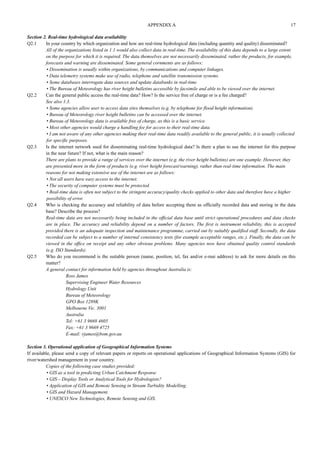
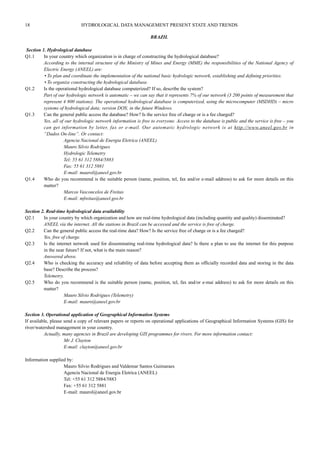
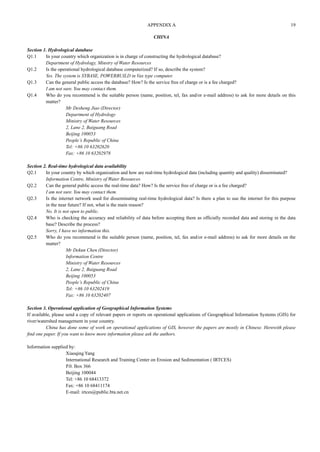
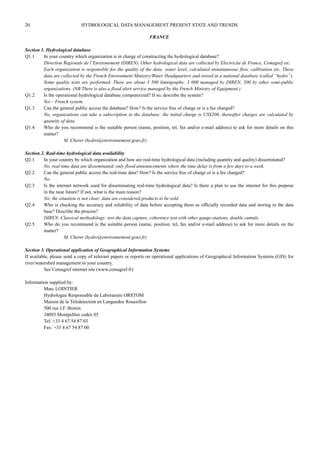
Answers to Questionnaire I . . . . . . . . . . . . . . . . . . . . . . . . . . . . . . . . . . . . . . . . . . . . . . . . . . . . . . . . . . . . . . . . . . . . . . . . 16 
Answers to Questionnaire II . . . . . . . . . . . . . . . . . . . . . . . . . . . . . . . . . . . . . . . . . . . . . . . . . . . . . . . . . . . . . . . . . . . . . . . 28 
Appendix B . . . . . . . . . . . . . . . . . . . . . . . . . . . . . . . . . . . . . . . . . . . . . . . . . . . . . . . . . . . . . . . . . . . . . . . . . . . . . . . . . . . . 41 
The hydrological observation system in Japan . . . . . . . . . . . . . . . . . . . . . . . . . . . . . . . . . . . . . . . . . . . . . . . . . . . . . . . . . 41 
Appendix C . . . . . . . . . . . . . . . . . . . . . . . . . . . . . . . . . . . . . . . . . . . . . . . . . . . . . . . . . . . . . . . . . . . . . . . . . . . . . . . . . . . . 43 
Examples of practical hydrological databases . . . . . . . . . . . . . . . . . . . . . . . . . . . . . . . . . . . . . . . . . . . . . . . . . . . . . . . . . . 43 
Bureau of Meteorology, Australia . . . . . . . . . . . . . . . . . . . . . . . . . . . . . . . . . . . . . . . . . . . . . . . . . . . . . . . . . . . . . . . . . . . 43 
Ministry of land, Infrastructure and Transport, Japan . . . . . . . . . . . . . . . . . . . . . . . . . . . . . . . . . . . . . . . . . . . . . . . . . . . . 43 
United States Geological Survey . . . . . . . . . . . . . . . . . . . . . . . . . . . . . . . . . . . . . . . . . . . . . . . . . . . . . . . . . . . . . . . . . . . . 50 
Global Runoff Data Centre . . . . . . . . . . . . . . . . . . . . . . . . . . . . . . . . . . . . . . . . . . . . . . . . . . . . . . . . . . . . . . . . . . . . . . . . 52 
Appendix D . . . . . . . . . . . . . . . . . . . . . . . . . . . . . . . . . . . . . . . . . . . . . . . . . . . . . . . . . . . . . . . . . . . . . . . . . . . . . . . . . . . . 53 
The application of Geographical Information Systems in operational hydrology . . . . . . . . . . . . . . . . . . . . . . . . . . . . . . 53 
Rhine River Geographical Information System . . . . . . . . . . . . . . . . . . . . . . . . . . . . . . . . . . . . . . . . . . . . . . . . . . . . . . . . 53 
River management in Japan . . . . . . . . . . . . . . . . . . . . . . . . . . . . . . . . . . . . . . . . . . . . . . . . . . . . . . . . . . . . . . . . . . . . . . . 53 
Water quality data management in South Africa . . . . . . . . . . . . . . . . . . . . . . . . . . . . . . . . . . . . . . . . . . . . . . . . . . . . . . . . 54 
Links with distributed hydrological models (United States) . . . . . . . . . . . . . . . . . . . . . . . . . . . . . . . . . . . . . . . . . . . . . . . 54
FOREWORD 
The key to providing accurate, timely and often life-saving information and forecasts on flooding and drought lie in hydrological data 
management. With the expansion of computerization and global information networks, recent years have witnessed a consequent increase 
in the scope and forms of data management undertaken. Geographical information systems (GIS) have evolved since their introduction in 
the 1960s, to become sophisticated analytical tools, enabling detailed consideration of the many factors affecting river basins and their 
management. In this application, GIS rely on strong hydrological databases. This important area is the subject of this report. 
In order to present a review of the current state of hydrological data management, to offer recommendations on setting up, 
maintaining and utilizing such databases and to look at likely future trends, the Commission for Hydrology (CHy) of the World 
Meteorological Organization (WMO), at its tenth session in 1996, requested Mr Akira Terakawa, Director of the Chubu Construction 
Engineering Office (Nagoya, Japan) and expert in data management, to prepare a report on hydrological data management. A draft report 
was published in 2000. 
The report, which uses as its basis answers to questionnaires sent to members of the Working Group on Basic Systems of the 
Commission for Hydrology, outlines the establishment and aims of hydrological databases and looks at operational examples from 
Australia, Japan and the United States. The increasingly important application of GIS to operational hydrology is also reviewed — again 
making use of research from a range of countries. 
I should like to place on record the gratitude of the World Meteorological Organization to Mr A. Terakawa for the time and 
effort he has devoted to the preparation of this valuable report and to the Advisory Committee who provided valuable information in 
compiling this report. 
(G.O.P. Obasi) 
Secretary-General
SUMMARY 
The importance of hydrological databases, their basic character-isitics 
and how they are exploited in operational hydrology cannot 
be underestimated. Forecasting and managing flood and drought 
events, as well as day-to-day river basin management would be 
impossible without both real-time and historical databases and the 
tools, such as Geographical Information Systems (GIS), to analyse 
them. 
This report, prepared for the World Meteorological 
Organization’s Commission on Hydrology (CHy) Working Group 
on Basic Systems details the present state and trends in construct-ing 
databases for hydrological data, the real-time utilization of the 
data and the application of GIS to operational hydrology in various 
countries. 
Following a brief Introduction, Chapter 2 catalogues the 
relationship between real-time and historical data. The essential 
characteristics of a range of countries’ hydrological databases are 
given. Constructing a database involves a number of stages and these 
are outlined. An effective database also requires making provision 
for maintenance and updating. The issue of public access is 
explored, and finally, Chapter 2, describes examples of working 
hydrological databases from Australia, Japan and the United States. 
In Chapter 3 GIS — its development and current trends — 
are described. The importance of GIS to operational hydrology is 
outlined and its practical application in various situations, from 
management of the Rhine River to assessing and disseminating data 
on water quality in South Africa, is presented. 
RÉSUMÉ 
L’importance des bases de données hydrologiques, leurs caractéris-tiques 
fondamentales et l’utilité qu’elles présentent pour 
l’hydrologie opérationnelle ne sauraient être sous-estimées. Il serait 
en effet impossible de prévoir et de gérer les crues et les situations 
de sécheresse ou même d’assurer la gestion quotidienne des 
bassins hydrographiques si l’on ne disposait pas de bases de 
données – actuelles et anciennes — et des outils pour les analyser 
tels que les systèmes d’information géographique (SIG). 
Elaboré à l’intention du Groupe de travail des systèmes de 
base relevant de la Commission d’hydrologie (CHy) de 
l’Organisation météorologique mondiale, le présent rapport décrit 
la situation actuelle et les évolutions constatées en ce qui concerne 
la constitution de bases de données hydrologiques, l’exploitation 
en temps réel de ces données et l’application des SIG à l’hydrolo-gie 
opérationnelle dans divers pays. 
Après une brève introduction, le chapitre 2 décrit la 
manière dont les données obtenues en temps réel se rattachent aux 
données anciennes. Il énonce aussi les caractéristiques essentielles 
des bases de données hydrologiques d’un certain nombre de pays. 
La construction d’une base de données se fait en plusieurs étapes, 
présentées ici, étant entendu qu’une base de données digne de ce 
nom doit être mise à jour régulièrement. Le chapitre 2 aborde aussi 
la question de l’accès du public aux bases de données et décrit 
enfin des exemples de bases de données hydrologiques exploitées 
en Australie, au Japon et aux Etats-Unis d’Amérique. 
Le chapitre 3 est consacré aux systèmes d’information 
géographique et à leur évolution. Il souligne l’importance qu’ils 
revêtent pour l’hydrologie opérationnelle et présente diverses appli-cations 
pratiques, qu’il s’agisse par exemple de gérer les eaux du 
Rhin ou bien d’évaluer la qualité de l’eau en Afrique du Sud et de 
diffuser les données qui s’y rapportent. 
РЕЗЮМЕ 
LJÊÌÓÒÚ¸ ·‡Á „ˉÓÎӄ˘ÂÒÍËı ‰‡ÌÌ˚ı, Ëı ÓÒÌÓ‚Ì˚ı ı‡‡ÍÚÂËÒÚËÍ, 
‡ Ú‡ÍÊ ÚÓ„Ó, ͇ÍËÏ Ó·‡ÁÓÏ ÓÌË ÔËÏÂÌfl˛ÚÒfl ‚ ÓÔÂ‡ÚË‚ÌÓÈ 
„ˉÓÎÓ„ËË, ÌÂθÁfl ̉ÓÓˆÂÌË‚‡Ú¸. EÓ„ÌÓÁËÓ‚‡ÌË ̇‚Ó‰ÌÂÌËÈ Ë 
Á‡ÒÛı Ë ÛÔ‡‚ÎÂÌË ÔË Ëı ̇ÒÚÛÔÎÂÌËË, ‡ Ú‡ÍÊ Ôӂ҉̂ÌÓ 
„ÛÎËÓ‚‡ÌË ˜Ì˚ı ·‡ÒÒÂÈÌÓ‚ ·˚ÎÓ ·˚ Ì‚ÓÁÏÓÊÌ˚Ï ·ÂÁ ·‡Á Í‡Í 
ÓÔÂ‡ÚË‚Ì˚ı, Ú‡Í Ë ËÒÚÓ˘ÂÒÍËı ‰‡ÌÌ˚ı Ë Ú‡ÍËı ËÌÒÚÛÏÂÌÚÓ‚, Í‡Í 
„ÂÓ„‡Ù˘ÂÒÍË ËÌÙÓχˆËÓÌÌ˚ı ÒËÒÚÂÏ˚ (ÉÀE), ÔËÏÂÌflÂÏ˚ ‰Îfl 
Ëı ‡Ì‡ÎËÁ‡. 
Ç ‰‡ÌÌÓÏ ÓÚ˜ÂÚÂ, ÔÓ‰„ÓÚÓ‚ÎÂÌÌÓÏ ‰Îfl ‡·Ó˜ÂÈ „ÛÔÔ˚ ÔÓ 
ÓÒÌÓ‚Ì˚Ï ÒËÒÚÂÏ‡Ï ÄÓÏËÒÒËË ÔÓ „ˉÓÎÓ„ËË (ÄÉË) ÇÒÂÏËÌÓÈ 
ÅÂÚÂÓÓÎӄ˘ÂÒÍÓÈ É„‡ÌËÁ‡ˆËË, ÔÓ‰Ó·ÌÓ ÓÔËÒ˚‚‡˛ÚÒfl 
ÒÛ˘ÂÒÚ‚Û˛˘Â ÒÓÒÚÓflÌËÂ Ë ÚẨÂ̈ËË ‚ Ú‡ÍËı ӷ·ÒÚflı, Í‡Í 
ÒÓÁ‰‡ÌË ·‡Á „ˉÓÎӄ˘ÂÒÍËı ‰‡ÌÌ˚ı, ÓÔÂ‡ÚË‚ÌÓ ËÒÔÓθÁÓ‚‡ÌË 
‰‡ÌÌ˚ı Ë ÔËÏÂÌÂÌË ÉÀE ‚ ÓÔÂ‡ÚË‚ÌÓÈ „ˉÓÎÓ„ËË, ‚ ‡Á΢Ì˚ı 
ÒÚ‡Ì‡ı. 
EÓÒΠÍ‡ÚÍÓ„Ó ‚‚‰ÂÌËfl ‚ „·‚ 2 ÒËÒÚÂχÚËÁËÛ˛ÚÒfl 
‚Á‡ËÏÓÒ‚flÁË ÏÂÊ‰Û ÓÔÂ‡ÚË‚Ì˚ÏË Ë ËÒÚÓ˘ÂÒÍËÏË ‰‡ÌÌ˚ÏË. 
E˂ӉflÚÒfl ‚‡ÊÌ˚ ı‡‡ÍÚÂËÒÚËÍË fl‰‡ ·‡Á „ˉÓÎӄ˘ÂÒÍËı 
‰‡ÌÌ˚ı, Ëϲ˘ËıÒfl ‚ ÌÂÍÓÚÓ˚ı ÒÚ‡Ì‡ı. EÓÁ‰‡ÌË ·‡Á˚ ‰‡ÌÌ˚ı 
Ú·ÛÂÚ ÔÓıÓʉÂÌËfl fl‰‡ ˝Ú‡ÔÓ‚, Ë ÓÌË Ú‡ÍÊ ‚Í‡ÚˆÂ 
ÓÔËÒ˚‚‡˛ÚÒfl. ÑÎfl ˝ÙÙÂÍÚË‚ÌÓÈ ·‡Á˚ ‰‡ÌÌ˚ı Ú‡ÍÊ Ú·ÛÂÚÒfl 
Ó·ÂÒÔ˜ÂÌË ‰Îfl  ÔÓ‰‰ÂʇÌËfl ‚ ‡·Ó˜ÂÏ ÒÓÒÚÓflÌËË Ë 
Ó·ÌÓ‚ÎÂÌËfl. ÀÒÒΉÛÂÚÒfl ÔÓ·ÎÂχ Ó·˘ÂÒÚ‚ÂÌÌÓ„Ó ‰ÓÒÚÛÔ‡ Í ·‡Á‡Ï 
Ë, ̇ÍÓ̈, ‚ „·‚ 2 Ô˂ӉflÚÒfl ÔËÏÂ˚ ·‡Á „ˉÓÎӄ˘ÂÒÍËı 
‰‡ÌÌ˚ı, ‡·ÓÚ‡˛˘Ëı ‚ Ä‚ÒÚ‡ÎËË, ÜÔÓÌËË Ë ‚ EÓ‰ËÌÂÌÌ˚ı OÚ‡Ú‡ı. 
Ç „·‚ 3 ÓÔËÒ˚‚‡˛ÚÒfl ÉÀE, ‡ Ú‡ÍÊ Ëı ‡Á‚ËÚËÂ Ë 
ÒÓ‚ÂÏÂÌÌ˚ ÚẨÂ̈ËË. Ä‡ÚÍÓ ı‡‡ÍÚÂËÁÛÂÚÒfl ‚‡ÊÌÓÒÚ¸ ÉÀE ‰Îfl 
ÓÔÂ‡ÚË‚ÌÓÈ „ˉÓÎÓ„ËË, ‡ Ú‡ÍÊ Ô‰ÓÒÚ‡‚Îfl˛ÚÒfl ҂‰ÂÌËfl Ó· Ëı 
Ô‡ÍÚ˘ÂÒÍËı ÔËÏÂÌÂÌËflı ‚ ‡Á΢Ì˚ı ÒËÚÛ‡ˆËflı, ̇˜Ë̇fl ÓÚ 
„ÛÎËÓ‚‡ÌËfl ÂÍË EÂÈÌ ‰Ó ÓÔËÒ‡ÌËfl ‰ÓÒÚÛÔ‡ Ë ‡ÒÔÓÒÚ‡ÌÂÌËfl 
ËÌÙÓχˆËË Ó Í‡˜ÂÒÚ‚Â ‚Ó‰˚ ‚ UÊÌÓÈ ÄÙËÍÂ.
viii SUMMARY 
RESUMEN 
No se puede subestimar la importancia de las bases de datos 
hidrológicos, de sus características básicas ni de la manera en que 
se explotan en la hidrología operativa. La predicción y la gestión de 
inundaciones y sequías, así como la ordenación cotidiana de las 
cuencas fluviales, no serían posible sin bases de datos en tiempo 
real e históricos y sin instrumentos, como los sistemas de informa-ción 
geográfica (SIG) para analizarlos. 
En el presente informe, preparado para el Grupo de trabajo 
sobre sistemas básicos de la Comisión de Hidrología (CHi) de la 
Organización Meteorológica Mundial se describen el estado actual 
y las tendencias de la elaboración de bases de datos con fines 
hidrológicos, su utilización en tiempo real y la aplicación de los 
SIG a la hidrología operativa en diversos países. 
Tras una breve introducción, en el Capítulo 2 se analiza la 
relación entre datos en tiempo real e históricos y se resumen las 
principales características de las bases de datos hidrológicos de una 
serie de países. Para elaborar una base de datos hay que seguir 
varias fases, que también se exponen. Para que una base de datos 
sea eficaz hay que tomar asimismo disposiciones sobre su manten-imiento 
y actualización. Se examina la cuestión del acceso público 
y, por último, en el Capítulo 2 se dan también ejemplos de cómo 
funcionan bases de datos hidrológicos de Australia, Japón y 
Estados Unidos. 
En el Capítulo 3 se describen dos SIG, su desarrollo y las 
tendencias actuales. Se señala la importancia de los SIG para la 
hidrología operativa y se presentan sus aplicaciones prácticas en 
diversas situaciones, desde la ordenación del río Rin hasta la evalu-ación 
y difusión de datos sobre la calidad del agua en Sudáfrica.
INTRODUCTION 
1.1 THE IMPORTANCE OF HYDROLOGICAL 
DATA 
CHAPTER 1 
Hydrological observations are, in a broad sense, a method of clari-fying 
quantitatively each process in the water cycle, encompassing 
an extremely wide range of phenomena. The prevention of disas-ters 
caused by floods and droughts would be impossible without 
rational forecasting technology based on an understanding of the 
rainfall runoff phenomenon and statistical analysis of past hydro-logical 
data, which cannot be achieved without hydrological 
observations. 
And whether intentional or not, human, social and 
economic activities have a great impact on the hydrological cycle. 
For example, large-scale changes in land use and/or the construc-tion 
of structures intended to control the hydrological cycle 
change natural runoff patterns. It is extremely important to collect 
and to analyse hydrological data continuously over long periods of 
time in order to evaluate these effects and to take appropriate miti-gation 
measures. 
Thanks to the rapid growth of data communication 
networks in recent years, it is now possible to use these networks 
to disseminate hydrological data and allow its on-line use by the 
public. Information of this kind is extremely beneficial, because, 
when a disaster is forecasted or actually occurs, users can obtain 
real-time data and analyse it appropriately in order to prevent or to 
minimize the disaster. 
The accumulation and active use of hydrological data in 
this way plays an extremely important role in total watershed 
management, including flood control, water use and environmen-tal 
conservation. 
1.2 STRUCTURE OF THIS REPORT 
This report describes hydrological databases and the application of 
Geographical Information Systems (GIS) to operational hydrol-ogy. 
The report aims to contribute to the effective utilization of 
hydrological information by giving information on the construc-tion 
and maintenance of hydrological databases, their control and 
the formation of networks linking databases of different types for 
effective dissemination. 
It also reports how, in response to recent developments, 
GIS can be used in the field of operational hydrology to present 
hydrological information in more easily understandable forms and 
how to incorporate and integrate pertinent geographical to further 
the analytical process. 
Practical examples of hydrological databases and their 
operation, from Europe, South Africa, Japan, Australia and the 
United States, are outlined.
2 HYDROLOGICAL DATA MANAGEMENT PRESENT STATE AND TRENDS 
HYDROLOGICAL DATABASES 
2.1 HYDROLOGICAL DATABASES OUTLINED 
2.1.1 Need for a database 
CHAPTER 2 
Thanks to rapid advances in computerization in recent years, 
much topographical and geological data is now digitized. 
Improved analytical models now permit detailed hydrological 
analysis of the various physical mechanisms and processes in the 
hydrological cycle. At the same time, the spread of data communi-cation 
networks allows hydrological data to be obtained, analysed, 
and applied to real-time forecasting over large communication 
networks. The ability to refer to both historical data and real-time 
observation data facilitates improved forecasting and planning. 
With improvements in analytical capacity the construction and 
maintenance of hydrological databases becomes ever more valuable. 
To understand present conditions and to forecast future 
trends not only for the hydrological cycle in a single river basin but 
also for a much broader watershed, both historical hydrological data 
and real-time hydrological data should be used to form a database. 
This data can be made accessible to the public. (Rees, H.G. 1999a). 
2.1.2 Hydrological observation data: types and units 
Hydrological observation data types, units and quantity vary 
widely from country to country. They also vary according to the 
purposes for which the data is collected. 
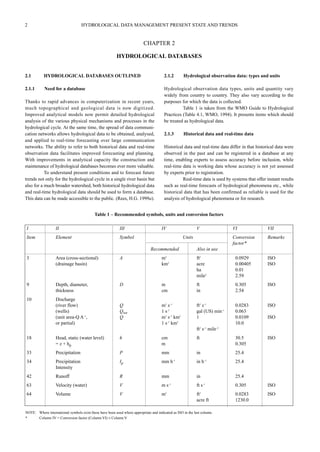
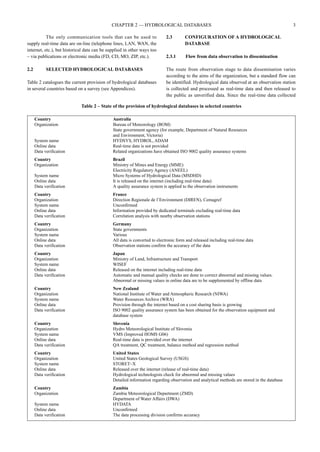
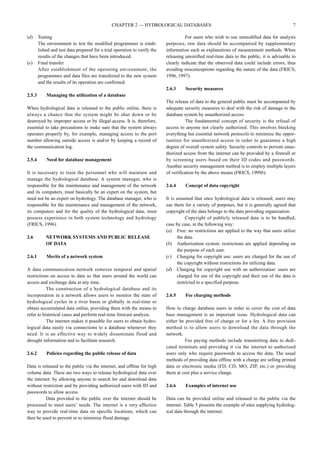
Table 1 is taken from the WMO Guide to Hydrological 
Practices (Table 4.1, WMO, 1994). It presents items which should 
be treated as hydrological data. 
2.1.3 Historical data and real-time data 
Historical data and real-time data differ in that historical data were 
observed in the past and can be registered in a database at any 
time, enabling experts to assess accuracy before inclusion, while 
real-time data is working data whose accuracy is not yet assessed 
by experts prior to registration. 
Real-time data is used by systems that offer instant results 
such as real-time forecasts of hydrological phenomena etc., while 
historical data that has been confirmed as reliable is used for the 
analysis of hydrological phenomena or for research. 
Table 1 – Recommended symbols, units and conversion factors 
I II III IV V VI VII 
Item Element Symbol Units Conversion Remarks 
factor* 
Recommended Also in use 
3 Area (cross-sectional) A m2 ft2 0.0929 ISO 
(drainage basin) km2 acre 0.00405 ISO 
ha 0.01 
mile2 2.59 
9 Depth, diameter, D m ft 0.305 ISO 
thickness cm in 2.54 
10 Discharge 
(river flow) Q m3 s–1 ft3 s–1 0.0283 ISO 
(wells) Qwe 1 s–1 gal (US) min–1 0.063 
(unit area-Q A–1, Q m3 s–1 km2 1 0.0109 ISO 
or partial) 1 s–1 km2 10.0 
ft3 s–1 mile–2 
18 Head, static (water level) h cm ft 30.5 ISO 
= z + hp m 0.305 
33 Precipitation P mm in 25.4 
34 Precipitation Ip mm h–1 in h–1 25.4 
Intensity 
42 Runoff R mm in 25.4 
63 Velocity (water) V m s–1 ft s–1 0.305 ISO 
64 Volume V m3 ft3 0.0283 ISO 
acre ft 1230.0 
NOTE: Where international symbols exist these have been used where appropriate and indicated as ISO in the last column. 
* Column IV = Conversion factor (Column VI) × Column V
CHAPTER 2 — HYDROLOGICAL DATABASES 3 
The only communication tools that can be used to 
supply real-time data are on-line (telephone lines, LAN, WAN, the 
internet, etc.), but historical data can be supplied in other ways too 
– via publications or electronic media (FD, CD, MO, ZIP, etc.). 
2.2 SELECTED HYDROLOGICAL DATABASES 
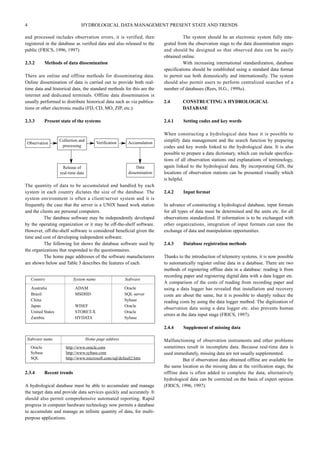
Table 2 catalogues the current provision of hydrological databases 
in several countries based on a survey (see Appendices). 
2.3 CONFIGURATION OF A HYDROLOGICAL 
DATABASE 
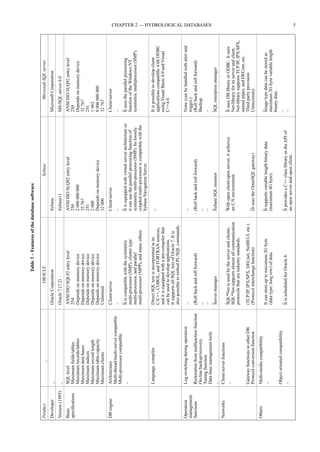
2.3.1 Flow from data observation to dissemination 
The route from observation stage to data dissemination varies 
according to the aims of the organization, but a standard flow can 
be identified. Hydrological data observed at an observation station 
is collected and processed as real-time data and then released to 
the public as unverified data. Since the real-time data collected 
Table 2 – State of the provision of hydrological databases in selected countries 
Country Australia 
Organization Bureau of Meteorology (BOM) 
State government agency (for example, Department of Natural Resources 
and Environment, Victoria) 
System name HYDSYS, HYDROL, ADAM 
Online data Real-time data is not provided 
Data verification Related organizations have obtained ISO 9002 quality assurance systems 
Country Brazil 
Organization Ministry of Mines and Energy (MME) 
Electricity Regulatory Agency (ANEEL) 
System name Micro Systems of Hydrological Data (MSDHD) 
Online data It is released on the internet (including real-time data) 
Data verification A quality assurance system is applied to the observation instruments 
Country France 
Organization Direction Regionale de l’Environment (DIREN), Cemagref 
System name Unconfirmed 
Online data Information provided by dedicated terminals excluding real-time data 
Data verification Correlation analysis with nearby observation stations 
Country Germany 
Organization State governments 
System name Various 
Online data All data is converted to electronic form and released including real-time data 
Data verification Observation stations confirm the accuracy of the data 
Country Japan 
Organization Ministry of Land, Infrastructure and Transport 
System name WISEF 
Online data Released on the internet including real-time data 
Data verification Automatic and manual quality checks are done to correct abnormal and missing values. 
Abnormal or missing values in online data are to be supplemented by offline data 
Country New Zealand 
Organization National Institute of Water and Atmospheric Research (NIWA) 
System name Water Resources Archive (WRA) 
Online data Provision through the internet based on a cost sharing basis is growing 
Data verification ISO 9002 quality assurance system has been obtained for the observation equipment and 
database system 
Country Slovenia 
Organization Hydro Meteorological Institute of Slovenia 
System name VMS (Improved HOMS G06) 
Online data Real-time data is provided over the internet 
Data verification QA treatment, QC treatment, balance method and regression method 
Country United States 
Organization United States Geological Survey (USGS) 
System name STORET–X 
Online data Released over the internet (release of real-time data) 
Data verification Hydrological technologists check for abnormal and missing values 
Detailed information regarding observation and analytical methods are stored in the database 
Country Zambia 
Organization Zambia Meteorological Department (ZMD) 
Department of Water Affairs (DWA) 
System name HYDATA 
Online data Unconfirmed 
Data verification The data processing division confirms accuracy
4 HYDROLOGICAL DATA MANAGEMENT PRESENT STATE AND TRENDS 
and processed includes observation errors, it is verified, then 
registered in the database as verified data and also released to the 
public (FRICS, 1996, 1997). 
2.3.2 Methods of data dissemination 
There are online and offline methods for disseminating data. 
Online dissemination of data is carried out to provide both real-time 
data and historical data, the standard methods for this are the 
internet and dedicated terminals. Offline data dissemination is 
usually performed to distribute historical data such as via publica-tions 
or other electronic media (FD, CD, MO, ZIP, etc.). 
2.3.3 Present state of the systems 
Collection and 
processing 
The quantity of data to be accumulated and handled by each 
system in each country dictates the size of the database. The 
system environment is often a client/server system and it is 
frequently the case that the server is a UNIX based work station 
and the clients are personal computers. 
The database software may be independently developed 
by the operating organization or it may be off-the-shelf software. 
However, off-the-shelf software is considered beneficial given the 
time and cost of developing independent software. 
The following list shows the database software used by 
the organizations that responded to the questionnaires. 
The home page addresses of the software manufacturers 
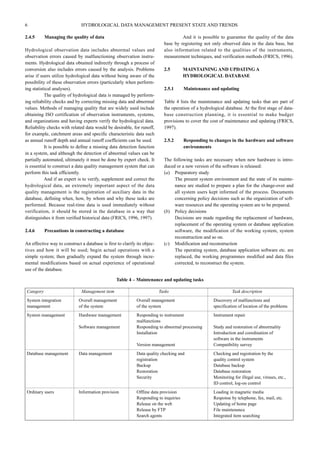
are shown below and Table 3 describes the features of each. 
2.3.4 Recent trends 
A hydrological database must be able to accumulate and manage 
the target data and provide data services quickly and accurately. It 
should also permit comprehensive automated reporting. Rapid 
progress in computer hardware technology now permits a database 
to accumulate and manage an infinite quantity of data, for multi-purpose 
applications. 
The system should be an electronic system fully inte-grated 
from the observation stage to the data dissemination stages 
and should be designed so that observed data can be easily 
obtained online. 
With increasing international standardization, database 
specifications should be established using a standard data format 
to permit use both domestically and internationally. The system 
should also permit users to perform centralized searches of a 
number of databases (Rees, H.G., 1999a). 
2.4 CONSTRUCTING A HYDROLOGICAL 
DATABASE 
2.4.1 Setting codes and key words 
When constructing a hydrological data base it is possible to 
simplify data management and the search function by preparing 
codes and key words linked to the hydrological data. It is also 
possible to prepare a data dictionary, which can include specifica-tions 
of all observation stations ond explanations of terminology, 
again linked to the hydrological data. By incorporating GIS, the 
locations of observation stations can be presented visually which 
is helpful. 
2.4.2 Input format 
In advance of constructing a hydrological database, input formats 
for all types of data must be determined and the units etc. for all 
observations standardized. If information is to be exchanged with 
other organizations, integration of input formats can ease the 
exchange of data and manipulation opportunities. 
2.4.3 Database registration methods 
Thanks to the introduction of telemetry systems, it is now possible 
to automatically register online data in a database. There are two 
methods of registering offline data in a database: reading it from 
recording paper and registering digital data with a data logger etc. 
A comparison of the costs of reading from recording paper and 
using a data logger has revealed that installation and recovery 
costs are about the same, but it is possible to sharply reduce the 
reading costs by using the data logger method. The digitization of 
observation data using a data logger etc. also prevents human 
errors at the data input stage (FRICS, 1997). 
2.4.4 Supplement of missing data 
Malfunctioning of observation instruments and other problems 
sometimes result in incomplete data. Because real-time data is 
used immediately, missing data are not usually supplemented. 
But if observation data obtained offline are available for 
the same location as the missing data at the verification stage, the 
offline data is often added to complete the data, alternatively 
hydrological data can be corrected on the basis of expert opinion 
(FRICS, 1996, 1997). 
Observation Verification Accumulation 
Data 
dissemination 
Release of 
real-time data 
Country System name Software 
Australia ADAM Oracle 
Brazil MSDHD SQL server 
China Sybase 
Japan WISEF Oracle 
United States STORET-X Oracle 
Zambia HYDATA Sybase 
Software name Home page address 
Oracle http://www.oracle.com 
Sybase http://www.sybase.com 
SQL http://www.microsoft.com/sql/default2.htm
CHAPTER 2 — HYDROLOGICAL DATABASES 5 
Table 3 – Features of the database software 
Product _ ORACLE Sybase Microsoft SQL server 
Developer _ Oracle Corporation Sybase Microsoft Corporation 
Version (1995) _ Oracle 7 (7.2) Sybase11 MS-SQL server 6.0 
Basic SQL level ANSI/ISO SQL92 entry level ANSI/ISO SLQ92 entry level ANSI/ISO SLQ92 entry level 
specifications Maximum fields/tables 254 250 250 
Maximum records/tables Depends on memory device 2 000 000 000 Depends on memory device 
Maximum data bases Depends on memory device 32 767 32 767 
Maximum indices Depends on memory device 251 251 
Maximum record length Depends on memory device 2 000 1 962 
Maximum table capacity Depends on memory device Depends on memory device 8 000 000 000 
Maximum clients Unlimited 32 000 32 767 
DB engine Architecture Client/server Client/server Client/server 
Multi-thread/multi-server compatible _ _ _ 
Multi-processor compatible _ _ _ 
_ It is compatible with the symmetric It is equipped with virtual server architecture so It uses the parallel processing 
multi-processor (SMP), cluster type it can use the parallel processing function of function of the Windows NT 
multi-processor, and parallel symmetric multi-processor (SMP). Its loosely symmetric multiprocessor (SMP). 
multi-processor (MPP), and many others. coupled multi-processor is compatible with the 
Sybase Navigation Server. 
Language, compiler Direct SQL text is incorporated in its _ It is possible to develop client 
C/C++, COBOL, and FORTRAN sources, applications compatible with ODBC 
and it is equipped with a pre-compiler that using Visual Basic 4.0 and Visual 
can be used to develop applications. C++4.0. 
It supports all SQL text of Oracle 7. It is 
also possible to embed PL/SQL commands. 
Operation Log switching during operation _ _ None (can be handled with alert and 
management trigger.) 
functions Restoration from malfunction function (Roll back and roll forward) (Roll back and roll forward) (Roll back and roll forward) 
On-line backup/recovery _ _ Backup 
Tuning function _ _ _ 
Data base management tools _ _ _ 
_ Server manager Sybase SQL monitor SQL enterprise manager 
Networks Client/server functions _ _ _ 
_ SQL*Net is used by the server and clients. With open client/open server, it achieves It uses DB library or ODBC. It uses 
SQL*Net supports almost all communication an C/S environment. Net-library for its server and client. 
protocols that are industry standards. Net-library supports TCP/IP, IPX/SPX, 
named pipes, and DECnet, etc. 
Gateway functions to other DB (TCP/IP, IPX/SPX, DECnet, NetBEUI, etc.) _ Third party provision. 
Protocol conversion function (Protocol interchange function) (It uses the OmniSQL gateway) Unnecessary. 
Others Multi-media compatibility _ _ 
_ It can store up to maximum 2G byte It supports variable length binary data Image type data can be stored as 
(data type: long row) of data. (maximum 4G byte). maximum 2G byte variable length 
binary data. 
Object oriented compatibility _ _ _ 
_ It is scheduled for Oracle 8. It provides a C++ class library as the API of _ 
an open server and open client.
6 HYDROLOGICAL DATA MANAGEMENT PRESENT STATE AND TRENDS 
2.4.5 Managing the quality of data 
Hydrological observation data includes abnormal values and 
observation errors caused by malfunctioning observation instru-ments. 
Hydrological data obtained indirectly through a process of 
conversion also includes errors caused by the analysis. Problems 
arise if users utilize hydrological data without being aware of the 
possibility of these observation errors (particularly when perform-ing 
statistical analyses). 
The quality of hydrological data is managed by perform-ing 
reliability checks and by correcting missing data and abnormal 
values. Methods of managing quality that are widely used include 
obtaining ISO certification of observation instruments, systems, 
and organizations and having experts verify the hydrological data. 
Reliability checks with related data would be desirable, for runoff, 
for example, catchment areas and specific characteristic data such 
as annual runoff depth and annual runoff coefficients can be used. 
It is possible to define a missing data detection function 
in a system, and although the detection of abnormal values can be 
partially automated, ultimately it must be done by expert check. It 
is essential to construct a data quality management system that can 
perform this task efficiently. 
And if an expert is to verify, supplement and correct the 
hydrological data, an extremely important aspect of the data 
quality management is the registration of auxiliary data in the 
database, defining when, how, by whom and why these tasks are 
performed. Because real-time data is used immediately without 
verification, it should be stored in the database in a way that 
distinguishes it from verified historical data (FRICS, 1996, 1997). 
2.4.6 Precautions in constructing a database 
An effective way to construct a database is first to clarify its objec-tives 
and how it will be used; begin actual operations with a 
simple system; then gradually expand the system through incre-mental 
modifications based on actual experience of operational 
use of the database. 
And it is possible to guarantee the quality of the data 
base by registering not only observed data in the data base, but 
also information related to the qualities of the instruments, 
measurement techniques, and verification methods (FRICS, 1996). 
2.5 MAINTAINING AND UPDATING A 
HYDROLOGICAL DATABASE 
2.5.1 Maintenance and updating 
Table 4 lists the maintenance and updating tasks that are part of 
the operation of a hydrological database. At the first stage of data-base 
construction planning, it is essential to make budget 
provisions to cover the cost of maintenance and updating (FRICS, 
1997). 
2.5.2 Responding to changes in the hardware and software 
environments 
The following tasks are necessary when new hardware is intro-duced 
or a new version of the software is released: 
(a) Preparatory study 
The present system environment and the state of its mainte-nance 
are studied to prepare a plan for the change-over and 
all system users kept informed of the process. Documents 
concerning policy decisions such as the organization of soft-ware 
resources and the operating system are to be prepared. 
(b) Policy decisions 
Decisions are made regarding the replacement of hardware, 
replacement of the operating system or database application 
software, the modification of the working system, system 
reconstruction and so on. 
(c) Modification and reconstruction 
The operating system, database application software etc. are 
replaced, the working programmes modified and data files 
corrected, to reconstruct the system. 
Table 4 – Maintenance and updating tasks 
Category Management item Tasks Task description 
System integration Overall management Overall management Discovery of malfunctions and 
management of the system of the system specification of location of the problems 
System management Hardware management Responding to instrument Instrument repair 
malfunctions 
Software management Responding to abnormal processing Study and restoration of abnormality 
Installation Introduction and coordination of 
software in the instruments 
Version management Compatibility survey 
Database management Data management Data quality checking and Checking and registration by the 
registration quality control system 
Backup Database backup 
Restoration Database restoration 
Security Monitoring for illegal use, viruses, etc., 
ID control, log-on control 
Ordinary users Information provision Offline data provision Loading in magnetic media 
Responding to inquiries Response by telephone, fax, mail, etc. 
Release on the web Updating of home page 
Release by FTP File maintenance 
Search agents Integrated item searching
(d) Testing 
CHAPTER 2 — HYDROLOGICAL DATABASES 7 
The environment to test the modified programmes is estab-lished 
and test data prepared for a trial operation to verify the 
results of the changes that have been introduced. 
(e) Final transfer 
After establishment of the operating environment, the 
programmes and data files are transferred to the new system 
and the results of its operation are confirmed. 
2.5.3 Managing the utilization of a database 
When hydrological data is released to the public online, there is 
always a chance that the system might be shut down or be 
destroyed by improper access or by illegal access. It is, therefore, 
essential to take precautions to make sure that the system always 
operates properly by, for example, managing access to the port 
number allowing outside access is and/or by keeping a record of 
the communication log. 
2.5.4 Need for database management 
It is necessary to train the personnel who will maintain and 
manage the hydrological database. A system manager, who is 
responsible for the maintenance and management of the network 
and its computers, must basically be an expert on the system, but 
need not be an expert on hydrology. The database manager, who is 
responsible for the maintenance and management of the network, 
its computers and for the quality of the hydrological data, must 
possess experience in both system technology and hydrology 
(FRICS, 1996). 
2.6 NETWORK SYSTEMS AND PUBLIC RELEASE 
OF DATA 
2.6.1 Merits of a network system 
A data communication network removes temporal and spatial 
restrictions on access to data so that users around the world can 
access and exchange data at any time. 
The construction of a hydrological database and its 
incorporation in a network allows users to monitor the state of 
hydrological cycles in a river basin or globally in real-time or 
obtain accumulated data online, providing them with the means to 
refer to historical cases and perform real-time forecast analysis. 
The internet makes it possible for users to obtain hydro-logical 
data easily via connections to a database whenever they 
need. It is an effective way to widely disseminate flood and 
drought information and to facilitate research. 
2.6.2 Policies regarding the public release of data 
Data is released to the public via the internet, and offline for high 
volume data. There are two ways to release hydrological data over 
the internet: by allowing anyone to search for and download data 
without restriction and by providing authorized users with ID and 
passwords to allow access. 
Data provided to the public over the internet should be 
processed to meet users’ needs. The internet is a very effective 
way to provide real-time data on specific locations, which can 
then be used to prevent or to minimize flood damage. 
For users who wish to use unmodified data for analysis 
purposes, raw data should be accompanied by supplementary 
information such as explanations of measurement methods. When 
releasing unverified real-time data to the public, it is advisable to 
clearly indicate that the observed data could include errors, thus 
avoiding misconceptions regarding the nature of the data (FRICS, 
1996, 1997). 
2.6.3 Security measures 
The release of data to the general public must be accompanied by 
adequate security measures to deal with the risk of damage to the 
database system by unauthorized access. 
The fundamental concept of security is the refusal of 
access to anyone not clearly authorized. This involves blocking 
everything but essential network protocols to minimize the oppor-tunities 
for unauthorized access in order to guarantee a high 
degree of overall system safety. Security controls to prevent unau-thorized 
access from the internet can be provided by a firewall or 
by screening users based on their ID codes and passwords. 
Another security management method is to employ multiple layers 
of verification by the above means (FRICS, 1999b). 
2.6.4 Concept of data copyright 
It is assumed that once hydrological data is released, users may 
use them for a variety of purposes, but it is generally agreed that 
copyright of the data belongs to the data providing organization. 
Copyright of publicly released data is to be handled, 
case by case, in the following way: 
(a) Free: no restrictions are applied to the way that users utilize 
the data. 
(b) Authorization system: restrictions are applied depending on 
the purpose of each user. 
(c) Charging for copyright use: users are charged for the use of 
the copyright without restrictions for utilizing data. 
(d) Charging for copyright use with an authorization: users are 
charged for use of the copyright and their use of the data is 
restricted to a specified purpose. 
2.6.5 Fee charging methods 
How to charge database users in order to cover the cost of data 
base management is an important issue. Hydrological data can 
either be provided free of charge or for a fee. A free provision 
method is to allow users to download the data through the 
network. 
Fee paying methods include transmitting data to dedi-cated 
terminals and providing it via the internet to authorized 
users only who require passwords to access the data. The usual 
methods of providing data offline with a charge are selling printed 
data or electronic media (FD, CD, MO, ZIP, etc.) or providing 
them at cost plus a service charge. 
2.6.6 Examples of internet use 
Data can be provided online and released to the public via the 
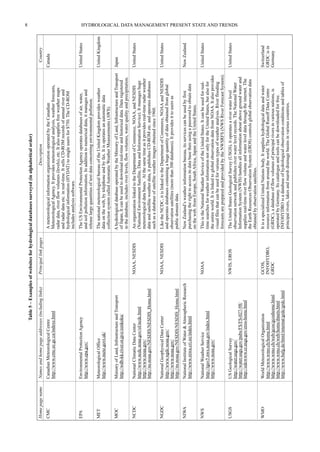
internet. Table 5 presents the example of sites supplying hydrolog-ical 
data through the internet.
Home page name Names and home page addresses (including links) Principal link pages Description Country 
CMC Canadian Meteorological Centre A meteorological information organization operated by the Canadian Canada 
http://www.cmc.ec.gc.ca/indexe.html Meteorological Agency. It provides meteorological analysis, weather forecasts, 
radar data, river flow volumes (levels), etc. It also supplies free weather maps 
and radar data etc. in real-time. It sells CD-ROM records of annual river and 
hydrological information (HYDAT) to single users for $750. The CD-ROM 
includes analysis software. 
EPA Environmental Protection Agency The US Environmental Protection Agency operates databases of air, water, United States 
http://www.epa.gov/ and soil pollution information. In addition to numerical data, it manages and 
release large quantities of text data concerning environmental pollution. 
MET Meteorological Office The national meteorological bureau of the United Kingdom provides weather United Kingdom 
http://www.meto.govt.uk/ data on the web, by telephone and by fax. It is operates an automatic data 
collection system called Automatic Weather Measurements (AWS). 
MOC Ministry of Land, Infrastructure and Transport A hydrological database operated by the Ministry of Land, Infrastructure and Transport Japan 
http://wdb-kk.river.or.jp/e/zenkoku/ of Japan, It can be used to download real-time and historical data. Data registered 
in the database, includes river levels, flow volumes, water quality and precipitation. 
NCDC National Climatic Data Center NOAA, NESDIS An organization linked to the Department of Commerce, NOAA, and NESDIS United States 
http://www.ncdc.noaa.gov/ol/ncdc.html (National Environment Satellite, Data and Information Service). It manages huge 
http://www.noaa.gov/ meteorological data bases. At the same time as it provides real-time radar weather 
http://ns.noaa.gov/NESDIS/NESDIS_Home.html data and satellite weather data, it publishes CD-ROM etc. and operates databases 
such as a database of satellite weather images obtained since 1960. 
NGDC National Geophysical Data Center NOAA, NESDIS Like the NCDC, it is linked to the Department of Commerce, NOAA and NESDIS United States 
http://www.ngdc.noaa.gov/ and operates databases containing a huge quantity of data obtained from global 
http://www.noaa.gov/ observation satellites (more than 300 databases). It provides it to users as 
http://ns.noaa.gov/NESDIS/NESDIS_Home.html public domain data. 
NIWA National Institute of Water & Atmospheric Research New Zealand’s weather information bureau, its services can be used by first New Zealand 
http://www.niwa.cri.nz/index.html purchasing the right to access its data base then using a password to obtain data 
on the web. from Europe, South Africa, Japan and the United States. 
NWS National Weather Service NOAA This is the National Weather Service of the United States. It can be used for real- United States 
http://tgsv5.nws.noaa.gov/index.html time searches for weather information not only for the United States, but also for 
http://www.noaa.gov/ the entire world. It is linked to global observation data from NOAA. It also provides 
visual files that can be used for various types of weather analysis. River flooding 
forecasts are prepared and provided by the NWSRFS (NWS River Forecast System). 
USGS US Geological Survey NWIS, EROS The United States Geological Survey (USGS), it operates a river water level United States 
http://water.usgs.gov/ observation network and publishes river water level records. The National Water 
http://water.usgs.gov/pubs/FS/FS-027-98/ Information System (NWIS) handles all information about above ground water and 
http://edcwww.cr.usgs.gov/eros-home.html supplies real-time river flow volume and water level data through the internet. The 
the Earth Resources Observation System (EROS) controls global observation data 
obtained by observation satellites. 
WMO World Meteorological Organization GCOS, It is a specialized United Nations body. It supplies hydrological data and water Switzerland 
http://www.wmo.ch/home.html INFOHYDRO, resource information from around the world. The Global Runoff Data Centre GRDC is in 
http://www.wmo.ch/web/gcos/gcoshome.html GRDC (GRDC), a database of flow volumes of principal rivers in various nations, is Germany 
http://www.wmo.ch/web/homs/ihnets.html operated by Germany. Its catalogue and tools can be downloaded for free. 
http://www.bafg.de/html/internat/grdc/grdc.html INFOHYDRO is a database of hydrological observation conditions and tables of 
principal rivers, lakes and marsh drainage basins in various countries. 
8 HYDROLOGICAL DATA MANAGEMENT PRESENT STATE AND TRENDS 
Table 5 – Examples of websites for hydrological databases surveyed (in alphabetical order)
CHAPTER 2 — HYDROLOGICAL DATABASES 9 
2.7 EXAMPLES OF PRACTICAL HYDROLOGICAL 
DATABASES 
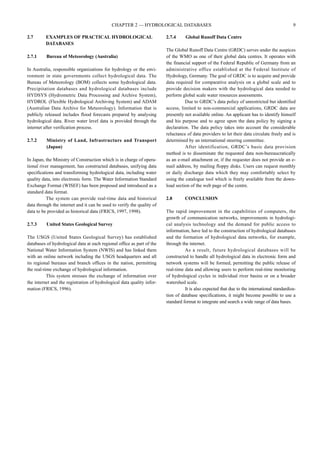
2.7.1 Bureau of Meteorology (Australia) 
In Australia, responsible organizations for hydrology or the envi-ronment 
in state governments collect hydrological data. The 
Bureau of Meteorology (BOM) collects some hydrological data. 
Precipitation databases and hydrological databases include 
HYDSYS (Hydrometric Data Processing and Archive System), 
HYDROL (Flexible Hydrological Archiving System) and ADAM 
(Australian Data Archive for Meteorology). Information that is 
publicly released includes flood forecasts prepared by analysing 
hydrological data. River water level data is provided through the 
internet after verification process. 
2.7.2 Ministry of Land, Infrastructure and Transport 
(Japan) 
In Japan, the Ministry of Construction which is in charge of opera-tional 
river management, has constructed databases, unifying data 
specifications and transforming hydrological data, including water 
quality data, into electronic form. The Water Information Standard 
Exchange Format (WISEF) has been proposed and introduced as a 
standard data format. 
The system can provide real-time data and historical 
data through the internet and it can be used to verify the quality of 
data to be provided as historical data (FRICS, 1997, 1998). 
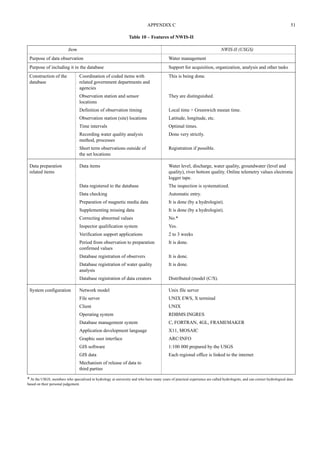
2.7.3 United States Geological Survey 
The USGS (United States Geological Survey) has established 
databases of hydrological data at each regional office as part of the 
National Water Information System (NWIS) and has linked them 
with an online network including the USGS headquarters and all 
its regional bureaus and branch offices in the nation, permitting 
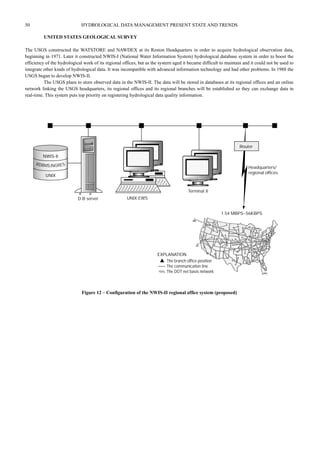
the real-time exchange of hydrological information. 
This system stresses the exchange of information over 
the internet and the registration of hydrological data quality infor-mation 
(FRICS, 1996). 
2.7.4 Global Runoff Data Centre 
The Global Runoff Data Centre (GRDC) serves under the auspices 
of the WMO as one of their global data centres. It operates with 
the financial support of the Federal Republic of Germany from an 
administrative office established at the Federal Institute of 
Hydrology, Germany. The goal of GRDC is to acquire and provide 
data required for comparative analysis on a global scale and to 
provide decision makers with the hydrological data needed to 
perform global scale water resources assessments. 
Due to GRDC’s data policy of unrestricted but identified 
access, limited to non-commercial applications, GRDC data are 
presently not available online. An applicant has to identify himself 
and his purpose and to agree upon the data policy by signing a 
declaration. The data policy takes into account the considerable 
reluctance of data providers to let their data circulate freely and is 
determined by an international steering committee. 
After identification, GRDC’s basic data provision 
method is to disseminate the requested data non-bureaucratically 
as an e-mail attachment or, if the requester does not provide an e-mail 
address, by mailing floppy disks. Users can request monthly 
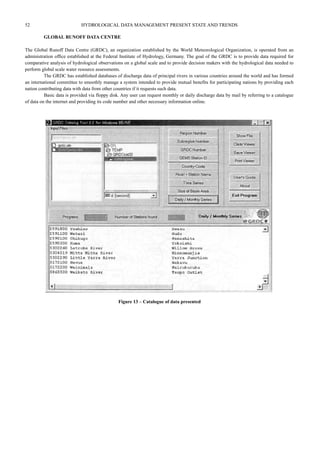
or daily discharge data which they may comfortably select by 
using the catalogue tool which is freely available from the down-load 
section of the web page of the centre. 
2.8 CONCLUSION 
The rapid improvement in the capabilities of computers, the 
growth of communication networks, improvements in hydrologi-cal 
analysis technology and the demand for public access to 
information, have led to the construction of hydrological databases 
and the formation of hydrological data networks, for example, 
through the internet. 
As a result, future hydrological databases will be 
constructed to handle all hydrological data in electronic form and 
network systems will be formed, permitting the public release of 
real-time data and allowing users to perform real-time monitoring 
of hydrological cycles in individual river basins or on a broader 
watershed scale. 
It is also expected that due to the international standardiza-tion 
of database specifications, it might become possible to use a 
standard format to integrate and search a wide range of data bases.
3.1 GEOGRAPHICAL INFORMATION SYSTEMS 
OUTLINED 
3.1.1 Definition and special features of GIS 
Geographical Information Systems (GIS) are tools used to link 
data including maps, text, numerical data, and images, etc. The 
concept allows searching, integration and analysis functions to be 
perfomed on information of various types by computer. Because 
hydrological data are, in most cases, spatial data the introduction 
of GIS for their effective management is a smart way to respond to 
user needs. 
3.1.2 History of GIS development 
During the 1960s, computer use in the United States expanded to 
universities, governmental bodies and private companies. During 
this period, various innovations were introduced in the field of 
GIS. In 1966, the Canada Geographic Information System (CGIS) 
was completed and began to operate as a grid/cell type land infor-mation 
system. 
In the 1970s, the foundation technologies of today’s GIS 
were almost complete with the spreading use of the vector overlay 
method (which had replaced the grid/cell method), CAD technol-ogy, 
automated cartography, the digitalization of measurement 
results, graphic devices and database technology. 
In the 1980s, GIS was influenced far more by transfor-mations 
in the computer world than by theoretical and 
technological progress within the GIS field itself. Progress in both 
packages of specialized GIS and related software has permitted 
users to establish systems at lower cost and in a shorter time than 
developing their own systems. 
Consequently, GIS systems are now used by many orga-nizations. 
GIS systems used for planning, analysis and decision 
making support include systems for statistical data or natural 
resource data, systems for individual project development and 
planning and systems for risk management. Those used to contin-uously 
maintain data to manage specific geographical matters 
include facility management, land and building management and 
residential registration management (JACIC, 1993). 
3.1.3 GIS standardization trends 
The ISO/TC211 is a specialized committee established by the 
International Organization for Standardization (ISO); the Open 
GIS Consortium (OGC) is an organization established by leading 
American GIS vendors and computer vendors. Both were estab-lished 
in 1994 aiming at standardization in the field of numerical 
geographical data. 
Standardization is essential to protect users from making 
unnecessary investment and to allow users to use data more effe-tively. 
Thanks to such organizations, efforts to standardize 
geographical information can now be seen in many countries. 
3.1.4 Introduction of GIS related software 
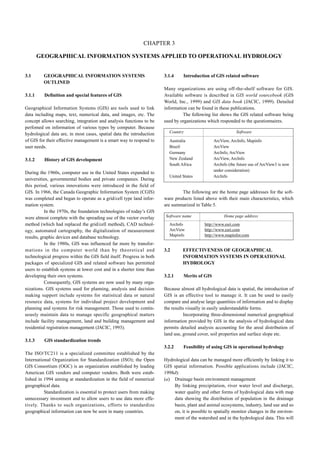
Many organizations are using off-the-shelf software for GIS. 
Available software is described in GIS world sourcebook (GIS 
World, Inc., 1999) and GIS data book (JACIC, 1999). Detailed 
information can be found in these publications. 
The following list shows the GIS related software being 
used by organizations which responded to the questionnaires. 
The following are the home page addresses for the soft-ware 
products listed above with their main characteristics, which 
are summarized in Table 5. 
3.2 EFFECTIVENESS OF GEOGRAPHICAL 
INFORMATION SYSTEMS IN OPERATIONAL 
HYDROLOGY 
3.2.1 Merits of GIS 
Because almost all hydrological data is spatial, the introduction of 
GIS is an effective tool to manage it. It can be used to easily 
compare and analyse large quantities of information and to display 
the results visually in easily understandable forms. 
Incorporating three-dimensional numerical geographical 
information provided by GIS in the analysis of hydrological data 
permits detailed analysis accounting for the areal distribution of 
land use, ground cover, soil properties and surface slope etc. 
3.2.2 Feasibility of using GIS in operational hydrology 
Hydrological data can be managed more efficiently by linking it to 
GIS spatial information. Possible applications include (JACIC, 
1998d): 
(a) Drainage basin environment management 
By linking precipitation, river water level and discharge, 
water quality and other forms of hydrological data with map 
data showing the distribution of population in the drainage 
basin, plant and animal ecosystems, industry, land use and so 
on, it is possible to spatially monitor changes in the environ-ment 
of the watershed and in the hydrological data. This will 
CHAPTER 3 
GEOGRAPHICAL INFORMATION SYSTEMS APPLIED TO OPERATIONAL HYDROLOGY 
Country Software 
Australia ArcView, ArcInfo, Mapinfo 
Brazil ArcView 
Germany ArcInfo, ArcView 
New Zealand ArcView, ArcInfo 
South Africa ArcInfo (the future use of ArcView3 is now 
under consideration) 
United States ArcInfo 
Software name Home page address 
ArcInfo http://www.esri.com 
ArcView http://www.esri.com 
Mapinfo http://www.mapinfor.com
CHAPTER 3 — THE APPLICATION OF GIS TO OPERATIONAL HYDROLOGY 11 
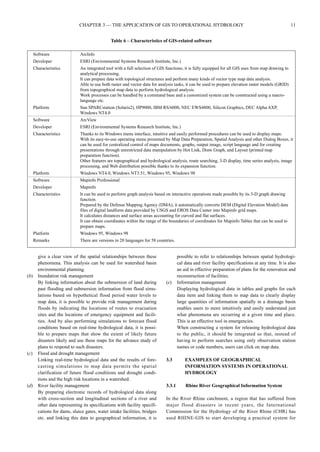
Table 6 – Characteristics of GIS-related software 
Software ArcInfo 
Developer ESRI (Environmental Systems Research Institute, Inc.) 
Characteristics An integrated tool with a full selection of GIS functions, it is fully equipped for all GIS uses from map drawing to 
analytical processing. 
It can prepare data with topological structures and perform many kinds of vector type map data analysis. 
Able to use both raster and vector data for analysis tasks, it can be used to prepare elevation raster models (GRID) 
from topographical map data to perform hydrological analysis. 
Work processes can be handled by a command base and a customized system can be constructed using a macro-language 
give a clear view of the spatial relationships between these 
phenomena. This analysis can be used for watershed basin 
environmental planning. 
(b) Inundation risk management 
By linking information about the submersion of land during 
past flooding and submersion information from flood simu-lations 
based on hypothetical flood period water levels to 
map data, it is possible to provide risk management during 
floods by indicating the locations of routes to evacuation 
sites and the locations of emergency equipment and facili-ties. 
And by also performing simulations to forecast flood 
conditions based on real-time hydrological data, it is possi-ble 
to prepare maps that show the extent of likely future 
disasters likely and use these maps for the advance study of 
plans to respond to such disasters. 
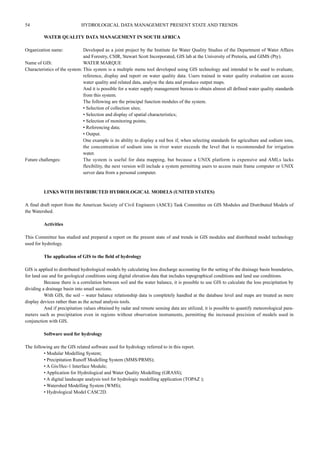
(c) Flood and drought management 
Linking real-time hydrological data and the results of fore-casting 
simulations to map data permits the spatial 
clarification of future flood conditions and drought condi-tions 
and the high risk locations in a watershed. 
(d) River facility management 
By preparing electronic records of hydrological data along 
with cross-section and longitudinal sections of a river and 
other data representing its specifications with facility specifi-cations 
for dams, sluice gates, water intake facilities, bridges 
etc. and linking this data to geographical information, it is 
possible to refer to relationships between spatial hydrologi-cal 
data and river facility specifications at any time. It is also 
an aid in effective preparation of plans for the renovation and 
reconstruction of facilities. 
(e) Information management 
Displaying hydrological data in tables and graphs for each 
data item and linking them to map data to clearly display 
large quantities of information spatially in a drainage basin 
enables users to more intuitively and easily understand just 
what phenomena are occurring at a given time and place. 
This is an effective tool in emergencies. 
When constructing a system for releasing hydrological data 
to the public, it should be integrated so that, instead of 
having to perform searches using only observation station 
names or code numbers, users can click on map data. 
3.3 EXAMPLES OF GEOGRAPHICAL 
INFORMATION SYSTEMS IN OPERATIONAL 
HYDROLOGY 
3.3.1 Rhine River Geographical Information System 
In the River Rhine catchment, a region that has suffered from 
major flood disasters in recent years, the International 
Commission for the Hydrology of the River Rhine (CHR) has 
used RHINE-GIS to start developing a practical system for 
etc. 
Platform Sun SPARCstation (Solaris2), HP9000, IBM RS/6000, NEC EWS4800, Silicon Graphics, DEC Alpha AXP, 
Windows NT4.0 
Software ArcView 
Developer ESRI (Environmental Systems Research Institute, Inc.) 
Characteristics Thanks to its Windows menu interface, intuitive and easily performed procedures can be used to display maps. 
With its easy-to-use operating menu presented by Map Data Preparation, Spatial Analysis and other Dialog Boxes, it 
can be used for centralized control of maps documents, graphs, output image, script language and for creating 
presentations through unrestricted data manipulation by Hot Link, Draw Graph, and Layout (printed map 
preparation function). 
Other features are topographical and hydrological analysis, route searching, 3-D display, time series analysis, image 
processing, and Web distribution possible thanks to its expansion function. 
Platform Windows NT4.0, Windows NT3.51, Windows 95, Windows 98 
Software Mapinfo Professional 
Developer Mapinfo 
Characteristics It can be used to perform graph analysis based on interactive operations made possible by its 3-D graph drawing 
function. 
Prepared by the Defense Mapping Agency (DMA), it automatically converts DEM (Digital Elevation Model) data 
files of digital landform data provided by USGS and EROS Data Center into Mapinfo grid maps. 
It calculates distances and surface areas accounting for curved and flat surfaces. 
It can obtain coordinates within the range of the boundaries of coordinates for Mapinfo Tables that can be used to 
prepare maps. 
Platform Windows 95, Windows 98 
Remarks There are versions in 20 languages for 58 countries.
12 HYDROLOGICAL DATA MANAGEMENT PRESENT STATE AND TRENDS 
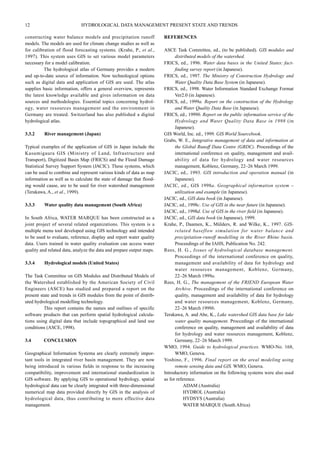
constructing water balance models and precipitation runoff 
models. The models are used for climate change studies as well as 
for calibration of flood forecasting systems. (Krahe, P., et al., 
1997). This system uses GIS to set various model parameters 
necessary for a model calibration. 
The hydrological atlas of Germany provides a modern 
and up-to-date source of information. New technological options 
such as digital data and application of GIS are used. The atlas 
supplies basic information, offers a general overview, represents 
the latest knowledge available and gives information on data 
sources and methodologies. Essential topics concerning hydrol-ogy, 
water resources management and the environment in 
Germany are treated. Switzerland has also published a digital 
hydrological atlas. 
3.3.2 River management (Japan) 
Typical examples of the application of GIS in Japan include the 
Kasumigaura GIS (Ministry of Land, Infrastructure and 
Transport), Digitized Basin Map (FRICS) and the Flood Damage 
Statistical Survey Support System (JACIC). These systems, which 
can be used to combine and represent various kinds of data as map 
information as well as to calculate the state of damage that flood-ing 
would cause, are to be used for river watershed management 
(Terakawa, A., et al., 1999). 
3.3.3 Water quality data management (South Africa) 
In South Africa, WATER MARQUE has been constructed as a 
joint project of several related organizations. This system is a 
multiple menu tool developed using GIS technology and intended 
to be used to evaluate, reference, display and report water quality 
data. Users trained in water quality evaluation can access water 
quality and related data, analyze the data and prepare output maps. 
3.3.4 Hydrological models (United States) 
The Task Committee on GIS Modules and Distributed Models of 
the Watershed established by the American Society of Civil 
Engineers (ASCE) has studied and prepared a report on the 
present state and trends in GIS modules from the point of distrib-uted 
hydrological modelling technology. 
This report contains the names and outlines of specific 
software products that can perform spatial hydrological calcula-tions 
using digital data that include topographical and land use 
conditions (ASCE, 1998). 
3.4 CONCLUSION 
Geographical Information Systema are clearly extremely impor-tant 
tools in integrated river basin management. They are now 
being introduced in various fields in response to the increasing 
compatibility, improvement and international standardization in 
GIS software. By applying GIS to operational hydrology, spatial 
hydrological data can be clearly integrated with three-dimensional 
numerical map data provided directly by GIS in the analysis of 
hydrological data, thus contributing to more effective data 
management. 
REFERENCES 
ASCE Task Committee, ed., (to be published). GIS modules and 
distributed models of the watershed. 
FRICS, ed., 1996. Water data bases in the United States: fact-finding 
survey report (in Japanese). 
FRICS, ed., 1997. The Ministry of Construction Hydrology and 
Water Quality Data Base System (in Japanese). 
FRICS, ed., 1998. Water Information Standard Exchange Format 
Ver2.0 (in Japanese). 
FRICS, ed., 1999a. Report on the construction of the Hydrology 
and Water Quality Data Base (in Japanese). 
FRICS, ed., 1999b. Report on the public information service of the 
Hydrology and Water Quality Data Base in 1998 (in 
Japanese). 
GIS World, Inc. ed., 1999. GIS World Sourcebook. 
Grabs, W. E., Integrative management of data and information at 
the Global Runoff Data Centre (GRDC). Proceedings of the 
international conference on quality, management and avail-ability 
of data for hydrology and water resources 
management, Koblenz, Germany, 22–26 March 1999. 
JACIC, ed., 1993. GIS introduction and operation manual (in 
Japanese). 
JACIC, ed., GIS 1998a. Geographical information system – 
utilization and example (in Japanese). 
JACIC, ed., GIS data book (in Japanese). 
JACIC, ed., 1998c. Use of GIS in the near future (in Japanese). 
JACIC, ed., 1998d. Use of GIS in the river field (in Japanese). 
JACIC, ed., GIS data book (in Japanese), 1999. 
Krahe, P., Daamen, K., Mülders, R. and Wilke, K., 1997. GIS-related 
baseflow simulation for water balance and 
precipitation-runoff modelling in the River Rhine basin. 
Proceedings of the IAHS, Publication No. 242. 
Rees, H. G., Issues of hydrological database management. 
Proceedings of the international conference on quality, 
management and availability of data for hydrology and 
water resources management, Koblenz, Germany, 
22–26 March 1999a. 
Rees, H. G., The management of the FRIEND European Water 
Archive. Proceedings of the international conference on 
quality, management and availability of data for hydrology 
and water resources management, Koblenz, Germany, 
22–26 March 1999b. 
Terakawa, A. and Abe, K., Lake watershed GIS data base for lake 
water quality management. Proccedings of the international 
conference on quality, management and availability of data 
for hydrology and water resources management, Koblenz, 
Germany, 22–26 March 1999. 
WMO, 1994. Guide to hydrological practices. WMO-No. 168, 
WMO, Geneva. 
Yoshino, F., 1996. Final report on the areal modeling using 
remote sensing data and GIS. WMO, Geneva. 
Introductory information on the following systems were also used 
as for reference. 
ADAM (Australia) 
HYDROL (Australia) 
HYDSYS (Australia) 
WATER MARQUE (South Africa)
QUESTIONNAIRE I SURVEY FIELD 
APPENDIX A 
QUESTIONNAIRE I 
In April 1998, the first questionnaire was sent to the Commission for Hydrology Working Group Members and Advisory Members intro-duced 
from the WMO secretariat. The following countries responded: Australia, Brazil, China, France, Germany, New Zealand, Slovenia, 
South Africa, Uzbekistan, Vietnam and Zambia. 
QUESTIONNAIRE I 
Section 1. Hydrological database 
Q1.1 In your country which organization is in charge of constructing the hydrological database? 
Q1.2 Is the operational hydrological database computerized? If so, describe the system? 
Q1.3 Can the general public access the database? How? Is the service free of charge or is a fee charged? 
Q1.4 Who do you recommend is the suitable person (name, position, tel, fax and/or e-mail address) to ask for more details on this 
matter? 
Section 2. Real-time hydrological data availability 
Q2.1 In your country by which organization and how are real-time hydrological data (including quantity and quality) disseminated? 
Q2.2 Can the general public access the real-time data? How? Is the service free of charge or is a fee charged? 
Q2.3 Is the internet network used for disseminating real-time hydrological data? Is there a plan to use the internet for this purpose 
in the near future? If not, what is the main reason? 
Q2.4 Who is checking the accuracy and reliability of data before accepting them as officially recorded data and storing in the data 
base? Describe the process? 
Q2.5 Who do you recommend is the suitable person (name, position, tel, fax and/or e-mail address) to ask for more details on the 
matter? 
Section 3. Operational application of Geographical Information Systems 
If available, please send a copy of relevant papers or reports on operational applications of Geographical Information Systems (GIS) for 
river/watershed management in your country.
14 HYDROLOGICAL DATA MANAGEMENT PRESENT STATE AND TRENDS 
QUESTIONNAIRE II 
QUESTIONNAIRE II SURVEY FIELD 
Additional information was requested via a second questionnaire, sent in May 1999. Responses were collected from the following 
countries: Australia, Brazil, New Zealand, Slovenia and the United States. 
QUESTIONNAIRE II 
We would like to ask your cooperation in answering the following questions regarding the hydrological data and database system, with 
descriptions in English and selecting relevant answers with a cross [ ]. The hydrological data refer to those of climate, rainfail, runoff, 
sediment, water quality, etc. If the question relates to material you consider confidential please write “Confidential” on the relevant item. 
Section 1. Standardization of hydrological data 
Q1.1 In the course of recording and processing data, two types of data, analog and digital data, are prepared. The analog data includes 
manually recorded data, recording sheets of automatic recorders, etc., and the digital data are those recorded by electronic media 
such as telemeter, data logger, etc. Regarding the analog and digital data, please answer the following. 
(a) Which data are treated as official or formal? 
[ ] analog data [ ] digital data [ ] depends on the kind of data 
(b) If the last answer is selected, please specify. 
Q1.2 In the case of international rivers which flow through more than two countries, it would be beneficial to share the hydrological 
data mutually among the countries concerned. In this regard, please answer the following. 
(a) Do you have international river(s)? 
[ ] yes [ ] no 
(b) If yes, is there any activity to standardize the hydrological database among the countries concerned? 
[ ] yes [ ] no 
(c) If yes, please give the following. 
(i) Name of the international river. 
(ii) Name of the organization for promoting standardization of the database. 
(iii) Names of member countries of the organization. 
Section 2. Hydrological database 
Q2.1 Regarding the features of your hydrological database system, please answer the following. 
(a) Name or type of database. 
(b) Kinds of data handled. 
(c) Time intervals of updating. 
(d) Type and name of computer system (hardware). 
(e) Operating system. 
(f) Name of database application. 
(g) Name of GIS application. 
(h) Protocol of database network. 
(i) Configuration (or system diagram) of database system. Please provide a copy. 
Q2.2 Regarding the services of your database system, please answer the following. 
(a) Are the real-time hydrological data offered to external clients? 
[ ] yes with charge [ ] yes without charge [ ] no 
(b) Are the historical data offered to external clients? 
[ ] yes with charge [ ] yes without charge [ ] no 
(c) If you charge for offering data, please describe the charging system or provide the tariff for reference. 
Q2.3 Regarding the use of your data, please answer the following. 
(a) Is the copyright reserved in your hydrological data? 
[ ] yes [ ] no 
(b) Are there any conditions or regulations to follow when using your data? 
[ ] yes [ ] no 
(c) If yes, please describe below. 
(d) Please describe the general features of the database application used in your database system.
APPENDIX A 15 
Q2.4 Regarding the real-time hydrological data system, please answer the following. 
(a) How do you adjust and/or correct for the lack of observation and abnormal records in your real-time hydrological data system? 
(b) Do you have any established measures to adjust/correct real-time data automatically? 
[ ] yes [ ] no 
(c) If yes, please outline the system. 
Q2.5 Regarding the quality control of hydrological data, please answer the following. 
(a) Please outline your quality control system for hydrological data. 
(b) Is any international standard such as ISO applied to the quality control of data? 
[ ] yes [ ] no 
(c) If yes, which standards (IS0 9002 for instance) are applied to which part of the quality control system? 
Q2.6 Regarding the training of database-keeping staff and clients, please answer the following. 
(a) Do you carry out training of database-keeping staff and clients? 
[ ] yes for both the database-keeping staff and clients [ ] yes for database-keeping staff only 
[ ] yes for clients only [ ] no 
(b) If yes, please outline your training programme. 
Q2.7 Regarding the network system for the hydrological database, please answer the following. 
(a) Do you classify clients depending on the degree of accessibility (full or partial access) to the data? 
[ ] yes [ ] no 
(b) If yes, what are the criteria for classification? 
(c) Do you have any regulation for regular change and control of the password to secure your database system? 
[ ] yes [ ] no 
(d) Do you separate data for public use from other data? 
[ ] yes [ ] no 
(e) If yes, what are the principles or criteria for the separation? 
(f) Do you establish a separate database system for public use? 
[ ] yes [ ] no 
(g) What measures are you taking to protect the system from computer viruses and hackers? 
(h) What is the backup system to secure the database from losses due to hardware crashing, earthquake, fire and other troubles? 
Section 3. Application of GIS to hydrological database 
Q3.1 Regarding the application of GIS to the hydrological database system, please answer the following. 
(a) Do you have GIS linked to the hydrological database? 
[ ] yes [ ] no 
(b) If yes, is the GIS standardized, for example, in compliance with ISO or TC211? 
[ ] yes [ ] no 
(c) If yes, please describe the applied standards. 
(d) Please outline the features of the GIS application you are using. 
(e) If you establish GIS with the hydrological database, what advantages do you expect in hydrological data management in practice?
16 HYDROLOGICAL DATA MANAGEMENT PRESENT STATE AND TRENDS 
ANSWERS TO QUESTIONNAIRE I 
AUSTRALIA 
Section 1. Hydrological database 
Q1.1 In your country which organization is in charge of constructing the hydrological database? 
In Australia, water resources management is a State Govemment responsibility. Therefore, most hydrological data are collected 
by State Government water or environmental agencies. Because flood warning is a national responsibility of the Bureau of 
Meteorology (a Federal Government agency), the Bureau also collects some hydrological data, however this is usually a joint 
responsibility with the State agencies. A list of some of the agencies who collect and store hydrological data is given below: 
• Federal Government agencies: Bureau of Meteorology 
• State Government agencies: Department of Natural Resources and Environment – Victoria, Department of Land and 
Water Conservation – New South Wales; Department of Lands, Planning and Environment – Northern Territory; Department of 
Natural Resources – Queensland; Water and Rivers Commission – Western Australia; Ecowise Environmental – Australian 
Capital Territory; Department of Environment, Heritage and Aboriginal Affairs – South Australia; Department of Primary 
Industries and Fisheries – Tasmania 
• Other State-based Agencies: Hydro-Electric Commission – Tasmania, Melbourne Water, Murray-Darling Basin Commission, 
Snowy Mountains Hydro-Electric Authority, Sydney Water, Brisbane City Council 
Q1.2 Is the operational hydrological database computerized? If so, describe the system? 
The following computerised precipitation database and hydrological databases are used in Australia: 
• HYDSYS (information attached) 
• HYDROL (information attached) 
• ADAM (information attached) 
Q1.3 Can the general public access the database? How? Is the service free of charge or is a fee charged? 
There are a variety of answers to this question. Currently, there is no direct access for the general public to the databases (for 
example via the internet). However, sorne examples of what is occurring include: 
• The Bureau of Meteorology is currently developing an internet based access regime for obtaining rainfall data, this system 
will be on a charge for use basis (see attachment). 
• The NSW DLWC has produced a CD-ROM of their data which can bc purchased. 
• Most agencies charge for data, but the charge is usually only related to the handling of the data. 
• Most agencies can provide data via ftp facilities once it bas been purchased. 
Q1.4 Who do you recommend is the suitable person (name, position, tel, fax and/or e-mail address) to ask for more details on this 
matter? 
A general contact for information on ADAM (Bureau of Meteorology) and general information on the hydrological databases 
held by agencies throughout Australia is: 
Ross James 
Supervising Engineer Water Resources 
Hydrology Unit 
Bureau of Meteorology 
GPO Box 1289K 
Melbourne Vic. 3001 
Australia 
Tel: +61 3 9669 4605 
Fax: +61 3 9669 4725 
E-mail: rjames@bom.gov.au 
Contacts for the two hydrological databases are: 
HYDSYS: Peter Heweston (Manager) 
HYDSYS Pty Ltd 
PO Box 3476 
Western Creek ACT 2611 
Australia 
Tel: 61 6 288 2302 
Fax: 61 6 288 9061 
E-mail: 100032.503@compuserve.com 
HYDROL: Mark Willis (Database Manager) 
Phone: +61 3 6230 5687 
Fax: +61 3 6234 2360 
E-mail: mark.willis@oa.hydro.com.au
APPENDIX A 17 
Section 2. Real-time hydrological data availability 
Q2.1 In your country by which organization and how are real-time hydrological data (including quantity and quality) disseminated? 
All of the organizations listed in 1.1 would also collect data in real-time. The availability of this data depends to a large extent 
on the purpose for which it is required. The data themselves are not necessarily disseminated, rather the products, for example, 
forecasts and warning are disseminated. Some general cornments are as follows: 
• Dissemination is usually within organizations, by communications and computer linkages. 
• Data telemetry systems make use of radio, telephone and satellite transmission systems. 
• Some databases interrogate data sources and update databanks in real-time. 
• The Bureau of Meteorology has river height bulletins accessible by facsimile and able to be viewed over the internet. 
Q2.2 Can the general public access the real-time data? How? Is the service free of charge or is a fee charged? 
See also 1.3. 
• Some agencies allow user to access data sites themselves (e.g. by telephone for flood height information). 
• Bureau of Meteorology river height bulletins can be accessed over the internet. 
• Bureau of Meteorology data is available free of charge, as this is a basic service. 
• Most other agencies would charge a handling fee for access to their real-time data. 
• I am not aware of any other agencies making their real-time data readily available to the general public, it is usually collected 
for specific purposes. 
Q2.3 Is the internet network used for disseminating real-time hydrological data? Is there a plan to use the internet for this purpose 
in the near future? If not, what is the main reason? 
There are plans to provide a range of services over the internet (e.g. the river height bulletins) are one example. However, they 
are presented more in the form of products (e.g. river height forecast/warning), rather than real-time information. The main 
reasons for not making extensive use of the internet are as follows: 
• Not all users have easy access to the internet. 
• The security of computer systems must be protected. 
• Real-time data is often not subject to the stringent accuracy/quality checks applied to other data and therefore have a higher 
possibility of error. 
Q2.4 Who is checking the accuracy and reliability of data before accepting them as officially recorded data and storing in the data 
base? Describe the process? 
Real-time data are not necessarily being included in the official data base until strict operational procedures and data checks 
are in place. The accuracy and reliability depend on a number of factors. The first is instrument reliability, this is accepted 
provided there is an adequate inspection and maintenance programme, carried out by suitably qualified staff. Secondly, the data 
recorded can be subject to a number of internal consistency tests (for example acceptable ranges, etc.). Finally, the data can be 
viewed in the office on receipt and any other obvious problems. Many agencies now have obtained quality control standards 
(e.g. ISO Standards). 
Q2.5 Who do you recommend is the suitable person (name, position, tel, fax and/or e-mai address) to ask for more details on this 
matter? 
A general contact for information held by agencies throughout Australia is: 
Ross James 
Supervising Engineer Water Resources 
Hydrology Unit 
Bureau of Meteorology 
GPO Box 1289K 
Melbourne Vic. 3001 
Australia 
Tel: +61 3 9669 4605 
Fax: +61 3 9669 4725 
E-mail: rjames@bom.gov.au 
Section 3. Operational application of Geographical Information Systems 
If available, please send a copy of relevant papers or reports on operational applications of Geographical Information Systems (GIS) for 
river/watershed management in your country. 
Copies of the following case studies provided: 
• GIS as a tool in predicting Urban Catchment Response 
• GIS – Display Tools or Analytical Tools for Hydrologists? 
• Application of GIS and Remote Sensing in Stream Turbidity Modelling. 
• GIS and Hazard Management. 
• UNESCO New Technologies, Remote Sensing and GIS.
18 HYDROLOGICAL DATA MANAGEMENT PRESENT STATE AND TRENDS 
BRAZIL 
Section 1. Hydrological database 
Q1.1 In your country which organization is in charge of constructing the hydrological database? 
According to the internal structure of the Ministry of Mines and Energy (MME) the responsibilities of the National Agency of 
Electric Energy (ANEEL) are: 
• To plan and coordinate the implementation of the national basic hydrologic network, establishing and defining priorities. 
• To organize constructing the hydrological database. 
Q1.2 Is the operational hydrological database computerized? If so, describe the system? 
Part of our hydrologic network is automatic – we can say that it represents 7% of our network (3 200 points of measurement that 
represent 4 800 stations). The operational hydrological database is computerized, using the microcomputer (MSDHD) – micro 
systems of hydrological data; version DOS; in the future Windows. 
Q1.3 Can the general public access the database? How? Is the service free of charge or is a fee charged? 
Yes, all of our hydrologic network information is free to everyone. Access to the database is public and the service is free – you 
can get information by letter, fax or e-mail. Our automatic hydrologic network is at http://www.aneel.gov.br in 
“Dados On-line”. Or contact: 
Agencia Nacional de Energia Eletrica (ANEEL) 
Mauro Silvio Rodrigues 
Hydrologic Telemetry 
Tel: 55 61 312 5884/5883 
Fax: 55 61 312 5881 
E-mail: maurol@aneel.gov.br 
Q1.4 Who do you recommend is the suitable person (name, position, tel, fax and/or e-mail address) to ask for more details on this 
matter? 
Marcos Vasconcelos de Freitas 
E-mail: mfreitas@aneel.gov.br 
Section 2. Real-time hydrological data availability 
Q2.1 In your country by which organization and how are real-time hydrological data (including quantity and quality) disseminated? 
ANEEL via the internet. All the stations in Brazil can be accessed and the service is free of charge. 
Q2.2 Can the general public access the real-time data? How? Is the service free of charge or is a fee charged? 
Yes, free of charge. 
Q2.3 Is the internet network used for disseminating real-time hydrological data? Is there a plan to use the internet for this purpose 
in the near future? If not, what is the main reason? 
Answered above. 
Q2.4 Who is checking the accuracy and reliability of data before accepting them as officially recorded data and storing in the data 
base? Describe the process? 
Telemetry. 
Q2.5 Who do you recommend is the suitable person (name, position, tel, fax and/or e-mai address) to ask for more details on this 
matter? 
Mauro Silvio Rodrigues (Telemetry) 
E-mail: mauro@aneel.gov.br 
Section 3. Operational application of Geographical Information Systems 
If available, please send a copy of relevant papers or reports on operational applications of Geographical Information Systems (GIS) for 
river/watershed management in your country. 
Actually, many agencies in Brazil are developing GIS programmes for rivers. For more information contact: 
Mr J. Clayton 
E-mail: clayton@aneel.gov.br 
Information supplied by: 
Mauro Silvio Rodrigues and Valdemar Santos Guimaraes 
Agencia Nacional de Energia Eletrica (ANEEL) 
Tel: +55 61 312 5884/5883 
Fax: +55 61 312 5881 
E-mail: maurol@aneel.gov.br
APPENDIX A 19 
CHINA 
Section 1. Hydrological database 
Q1.1 In your country which organization is in charge of constructing the hydrological database? 
Department of Hydrology, Minstry of Water Resources 
Q1.2 Is the operational hydrological database computerized? If so, describe the system? 
Yes. The system is SYBASE, POWERBUILD in Vax type computer. 
Q1.3 Can the general public access the database? How? Is the service free of charge or is a fee charged? 
I am not sure. You may contact them. 
Q1.4 Who do you recommend is the suitable person (name, position, tel, fax and/or e-mail address) to ask for more details on this 
matter? 
Mr Desheng Jiao (Director) 
Department of Hydrology 
Ministry of Water Resources 
2, Lane 2, Baiguang Road 
Beijing 100053 
People’s Republic of China 
Tel: +86 10 63202620 
Fax: +86 10 63202978 
Section 2. Real-time hydrological data availability 
Q2.1 In your country by which organization and how are real-time hydrological data (including quantity and quality) disseminated? 
Information Centre, Ministry of Water Resources 
Q2.2 Can the general public access the real-time data? How? Is the service free of charge or is a fee charged? 
I am not sure. You may contact them. 
Q2.3 Is the internet network used for disseminating real-time hydrological data? Is there a plan to use the internet for this purpose 
in the near future? If not, what is the main reason? 
No. It is not open to public. 
Q2.4 Who is checking the accuracy and reliability of data before accepting them as officially recorded data and storing in the data 
base? Describe the process? 
Sorry, I have no information this. 
Q2.5 Who do you recommend is the suitable person (name, position, tel, fax and/or e-mail address) to ask for more details on the 
matter? 
Mr Dekun Chen (Director) 
Information Centre 
Ministry of Water Resources 
2, Lane 2, Baiguang Road 
Beijing 100053 
People’s Republic of China 
Tel: +86 10 63202419 
Fax: +86 10 63202407 
Section 3. Operational application of Geographical Information Systems 
If available, please send a copy of relevant papers or reports on operational applications of Geographical Information Systems (GIS) for 
river/watershed management in your country. 
China has done some of work on operational applications of GIS, however the papers are mostly in Chinese. Herewith please 
find one paper. If you want to know more information please ask the authors. 
Information supplied by: 
Xiaoqing Yang 
International Research and Training Center on Erosion and Sedimentation ( IRTCES) 
P.0. Box 366 
Beijing 100044 
Tel: +86 10 68413372 
Fax: +86 10 68411174 
E-mail: irtces@public.bta.net.cn
20 HYDROLOGICAL DATA MANAGEMENT PRESENT STATE AND TRENDS 
FRANCE 
Section 1. Hydrological database 
Q1.1 In your country which organization is in charge of constructing the hydrological database? 
Direction Regionale de l’Environement (DIREN). Other hydrological data are collected by Electricite de France, Cemagref etc. 
Each organization is responsible for the quality of the data: water level, calculated instantaneous flow, calibration etc. These 
data are collected by the French Environment Ministry/Water Headquarters and stored in a national database (called “hydro”). 
Some quality tests are performed. There are about 3 500 limnigraphs: 3 000 managed by DIREN, 500 by other semi-public 
organizations. (NB There is also a flood alert service managed by the French Ministry of Equipment.) 
Q1.2 Is the operational hydrological database computerized? If so, describe the system? 
Yes – French system. 
Q1.3 Can the general public access the database? How? Is the service free of charge or is a fee charged? 
No, organizations can take a subscription to the database: the initial charge is US$200, thereafter charges are calculated by 
quantity of data. 
Q1.4 Who do you recommend is the suitable person (name, position, tel, fax and/or e-mail address) to ask for more details on this 
matter? 
M. Cherer (hydro@environnement.gouv.fr) 
Section 2. Real-time hydrological data availability 
Q2.1 In your country by which organization and how are real-time hydrological data (including quantity and quality) disseminated? 
No, real-time data are disseminated, only flood announcements where the time delay is from a few days to a week. 
Q2.2 Can the general public access the real-time data? How? Is the service free of charge or is a fee charged? 
No. 
Q2.3 Is the internet network used for disseminating real-time hydrological data? Is there a plan to use the internet for this purpose 
in the near future? If not, what is the main reason? 
No, the situation is not clear: data are considered products to be sold. 
Q2.4 Who is checking the accuracy and reliability of data before accepting them as officially recorded data and storing in the data 
base? Describe the process? 
DIREN. Classical methodology: test the data capture, coherence test with other gauge-stations, double cumuls. 
Q2.5 Who do you recommend is the suitable person (name, position, tel, fax and/or e-mail address) to ask for more details on the 
matter? 
M. Cherer (hydro@environnement.gouv.fr) 
Section 3. Operational application of Geographical Information Systems 
If available, please send a copy of relevant papers or reports on operational applications of Geographical Information Systems (GIS) for 
river/watershed management in your country. 
See Cemagref internet site (www.cemagref.fr) 
Information supplied by: 
Marc LOINTIER 
Hydrologue Responsable du Laboratoire ORSTOM 
Maison de la Teledetection en Languedoc Roussillon 
500 rue J.F. Breton 
34093 Montpellier cedex 05 
Tel: +33 4 67 54 87 03 
Fax: +33 4 67 54 87 00
GERMANY 
Section 1. Hydrological database 
Q1.1 In your country which organization is in charge of constructing the hydrological database? 
Hydrological data are managed in Germany at different levels. According to our federal state system each individual state (total 
of 16) is responsible for all water affairs within the state. The Federal Republic of Germany itself deals with waterways for 
navigation and coastal water systems. Therefore in Germany more than one hydrological database exists. A hydrological data-base 
exists in each federal state (called Länder) and an additional one at the Bundesanstalt für Gewässerkunde (Federal 
Institute of Hydrology). The latter is responsible for waterways of navigation. 
Q1.2 Is the operational hydrological database computerized? If so, describe the system? 
All hydrological databases in Germany are computerized. The systems used are UNIX and DOS. 
Q1.3 Can the general public access the database? How? Is the service free of charge or is a fee charged? 
The general public has access to the database on request. The charge of the service depends on the service required. Usually 
the costs are very low or the service is rendered without any charge. 
Q1.4 Who do you recommend is the suitable person (name, position, tel, fax and/or e-mail address) to ask for more details on this 
matter? 
The person responsible for the data base of the Bundesanstalt für Gewässerkunde is: 
Dr R. Neuhaus 
Bundesanstalt für Gewässerkunde 
Postfach 309, 56003 Koblenz 
Germany 
Tel: +49 261 1306 5212 
Fax: +49 261 1306 5280 
E-mail: neuhaus@koblenz.bfg.bund400.de 
Section 2. Real-time hydrological data availability 
Q2.1 In your country by which organization and how are real-time hydrological data (including quantity and quality) disseminated? 
Real-time data are available via internet, videotext, telephone, etc. 
Q2.2 Can the general public access the real-time data? How? Is the service free of charge or is a fee charged? 
The general public has alsa access via internet. 
Q2.3 Is the internet network used for disseminating real-time hydrological data? Is there a plan to use the internet for this purpose 
in the near future? If not, what is the main reason? 
See Q2.1. 
Q2.4 Who is checking the accuracy and reliability of data before accepting them as officially recorded data and storing in the data 
base? Describe the process? 
The hydrological service dealing with the measuring station concerned is responsible for checking the data. 
Q2.5 Who do you recommend is the suitable person (name, position, tel, fax and/or e-mail address) to ask for more details on the 
matter? 
Depending on the measuring station concerned the hydrological service is responsible for further information. 
Section 3. Operational application of Geographical Information Systems 
If available, please send a copy of relevant papers or reports on operational applications of Geographical Information Systems (GIS) for 
river/watershed management in your country. 
Please find enclosed three reports on operational applications of GIS in Germany. GIS is widely used in various projects in 
Germany. For further information a report Abnormalities of the weather in Germany in 1997, including the flood event on the River Oder 
is also attached. 
Information supplied by: 
Professor Dr K. Hofius 
Commission for Hydrology, Office of the President 
Bundesanstalt für Gewässerkunde 
(Federal Institute of Hydrology) 
Postfach 309, D-56003 Koblenz 
Gerrnany 
Tel: +49 1306 5313 
E-mail: hoflus@koblenz.bfg.bund400.de 
APPENDIX A 21
22 HYDROLOGICAL DATA MANAGEMENT PRESENT STATE AND TRENDS 
NEW ZEALAND 
Section 1. Hydrological database 
Q1.1 In your country which organization is in charge of constructing the hydrological database? 
In New Zealand, the National Institute of Water and Atmospheric Research Ltd (NIWA) is responsible for maintaining and 
enhancing national water quality and quantity databases. The national databases and data collection networks are collectively 
referred to as the Water Resources Archive (WRA). The primary data source for the WRA is NIWA’s field offices in 14 locations 
around New Zealand. Local government agencies have their own local networks and databases and contribute their data to the WRA. 
Q1.2 Is the operational hydrological database computerized? If so, describe the system? 
The Hydrometric Database, a component of the WRA, is computerized. The software, called “Tideda”, was developed by NIWA 
and its predecessors, for storage and analysis of hydrological data. Please see the HOMS description of Tideda. 
Q1.3 Can the general public access the database? How? Is the service free of charge or is a fee charged? 
Most of the data in the WRA are available to the public since their collection and storage was funded (mostly) by the New 
Zealand government. Data is mainly sent by mailing disks or by e-mail. Direct access by internet is being established. A CD-ROM 
of WRA data (1905–95) was very popular. Minimal costs are charged for NIWA staff time required to process data requests. 
Q1.4 Who do you recommend is the suitable person (name, position, tel, fax and/or e-mail address) to ask for more details on this 
matter? 
Charles Pearson 
Project Director of Hydrology 
National Institute of Water and Atmospheric Research Ltd (NIWA) 
Tel: +64 3 348 8987 
Fax: +64 3 348 5548 
E-mail: c-pearson@niwa.cri.nz 
Section 2. Real-time hydrological data availability 
Q2.1 In your country by which organization and how are real-time hydrological data (including quantity and quality) disseminated? 
NIWA and regional councils operate hydrometric networks on a real-time basis. The New Zealand Meteorological Service Ltd 
operates three radars for storm rainfall warnings. Most transfer of data is by radio telemetry, although there is now a move to 
include use of the internet. Data are only disseminated during flood events or upon request. Otherwise real-time data are used 
internally for checking operation of hydrometric recorders. 
Q2.2 Can the general public access the real-time data? How? Is the service free of charge or is a fee charged? 
If particular clients require real-time data, they must pay for this to be set up (e.g. hydropower companies pay for real-time 
hydro reservoir data for selling electricity on NZ’s deregulated electricity market). 
Q2.3 Is the internet network used for disseminating real-time hydrological data? Is there a plan to use the internet for this purpose 
in the near future? If not, what is the main reason? 
The internet is now being used for automatically transferring real-time data to paying clients. By 2001 users will be able to 
extract provisional (unchecked) real-time data using an internet interface to the Water Resources Archive. 
Q2.4 Who is checking the accuracy and reliability of data before accepting them as officially recorded data and storing in the data 
base? Describe the process? 
We have a Telarc-accredited ISO 9002 quality assurance programme for data collection and database activities. New methods 
are being developed using neural networks for real-time data checking. 
Q2.5 Who do you recommend is the suitable person (name, position, tel, fax and/or e-mail address) to ask for more details on the 
matter? 
See Q1.4. 
Section 3. Operational application of Geographical Information Systems 
If available, please send a copy of relevant papers or reports on operational applications of Geographical Information Systems (GIS) for 
river/watershed management in your country. 
GIS is used extensively in New Zealand by staff of central goverment, local government, universities and private companies, for 
catchment resource management. 
Information supplied by: 
Charles Pearson 
Project Director of Hydrology 
National Institute of Water and Atmospheric Research Ltd (NIWA) 
PO Box 8602, Christchurch 
New Zealand 
Tel: +64 3 348 8987 
Fax: +64 3 348 5548 
E-mail: c-pearson@niwa.cri.nz
APPENDIX A 23 
SLOVENIA 
Section 1. Hydrological database 
Q1.1 In your country which organization is in charge of constructing the hydrological database? 
Republic of Slovenia, Ministry of the Environment and Physical Planning Hydrometeorological Institute of Slovenia, Vojkova lb, 
1001 Ljubljana p.p. 2549, Tel: +386 61 327 461, Fax: +386 61 133 13 96 
Q1.2 Is the operational hydrological database computerized? If so, describe the system? 
Yes, interface with procedures for encoding, listing inquiring and producing simple statistics and reports. Database consists of 
several RMS files containing hourly and daily values (water levels, discharges, water temperature, suspended material), data on 
the network, hydrometry data, rating curves. Database is in operation since 1989 and is written in FORTRAN running under 
VMS. It is a Slovenian product based on HOMS G06 data architecture with several modifications. 
Q1.3 Can the general public access the database? How? Is the service free of charge or is a fee charged? 
Not directly. Requests need to be sent in writing. The service is charged for according to the costs. 
Q1.4 Who do you recommend is the suitable person (name, position, tel, fax and/or e-mail address) to ask for more details on this 
matter? 
Anton Muzic or Joze Miklavcic 
Adviser to the Director Expert Assitant 
Tel: +386 61 327 461 Tel: +386 61 327 461 
Fax: +386 61 133 13 96 Fax: +386 61 133 13 96 
E-mail: tone.muzic@rzs-hm.si E-mail: joze.miklavcic@rzs-hm.si 
Section 2. Real-time hydrological data availability 
Q2.1 In your country by which organization and how are real-time hydrological data (including quantity and quality) disseminated? 
Republic of Slovenia, Ministry of the Environment and Physical Planning Hydrometeorological Institute of Slovenia, Vojkova lb, 
1001 Ljubljana p.p. 2549, Tel: +386 61 327 461, Fax: +386 61 133 13 96, (http://www.rzs-hm.si/podatki/ vode.html), 
TELETEXT, computer network for water quality and quantity. 
Q2.2 Can the general public access the real-time data? How? Is the service free of charge or is a fee charged? 
The service is free of charge. 
Q2.3 Is the internet network used for disseminating real-time hydrological data? Is there a plan to use the internet for this purpose 
in the near future? If not, what is the main reason? 
Yes. 
Q2.4 Who is checking the accuracy and reliability of data before accepting them as officially recorded data and storing in the data 
base? Describe the process? 
The Department for Observations and Measurements and the Department for Basic Processing of Hydrological Data of the 
Hydrometeorological Institute of Slovenia. QA procedures, QC procedures, balance method, regression method control. 
Q2.5 Who do you recommend is the suitable person (name, position, tel, fax and/or e-mail address) to ask for more details on the 
matter? 
Anton Muzic or Marjan Bat 
Adviser to the Director Adviser to the Director 
Tel: +386 61 327 461 Tel: +386 61 327 461 
Fax: +386 61 133 13 96 Fax: +386 61 133 13 96 
E-mail: tone.muzic@rzs-hm.si E-mail: marjan.bat@rzs-hm.si 
Section 3. Operational application of Geographical Information Systems 
If available, please send a copy of relevant papers or reports on operational applications of Geographical Information Systems (GIS) for 
river/watershed management in your country. 
There are no operational GIS in use. At this moment we use only digitized pictures of the drainage network and watersheds, as 
ACAD DWG FILES (digitized maps – scale 1:25 000).
24 HYDROLOGICAL DATA MANAGEMENT PRESENT STATE AND TRENDS 
UZBEKISTAN 
Section 1. Hydrological database 
Q1.1 In your country which organization is in charge of constructing the hydrological database? 
The main administration of Hydrometeorology of the Cabinet of Ministers of the Republic of Uzbekistan (Glavgidromet) 
Q1.2 Is the operational hydrological database computerized? If so, describe the system? 
Glavgidromet has an operative hydrological database prepared partially on PC in DOS and partially on paper. 
Q1.3 Can the general public access the database? How? Is the service free of charge or is a fee charged? 
General public cannot access the real-time data. There is no free of charge access to database services. 
Q1.4 Who do you recommend is the suitable person (name, position, tel, fax and/or e-mail address) to ask for more details on this 
matter? 
Lyudmila Vasilina (Tel: 7 3712 35-87-55) and Mikhail Torsky (Tel: 7 371 133-43-47) can give more detailed information 
concerning the hydrological database. The information about water resources quality parameters can be obtained from Tatiana 
Ososkova (Tel: 7 371 133-61-17). 
Section 2. Real-time hydrological data availability 
Q2.1 In your country by which organization and how are real-time hydrological data (including quantity and quality) disseminated? 
In the Republic of Uzbekistan Glavgidromet distributes the hydrological data on quantitative and qualitative parameters by the 
publication of yearbooks on the rivers and reservoirs regime and materials on the hydrochemical regime of surface water 
bodies.Glavgidromet also issues forecasts of rivers as well, free of charge and charged, depending on the status of organizations 
being served. 
Q2.2 Can the general public access the real-time data? How? Is the service free of charge or is a fee charged? 
For access to the real-time hydrological databases the computing systern “ARM-Gydrolog” has been developed in 
Glavgidromet. But access to the real-time data on qualitative parameters does not exist. 
Q2.3 Is the internet network used for disseminating real-time hydrological data? Is there a plan to use the internet for this purpose 
in the near future? If not, what is the main reason? 
The internet network is not widely used in Glavgidromet because of financial embarrassment. 
Q2.4 Who is checking the accuracy and reliability of data before accepting them as officially recorded data and storing in the data 
base? Describe the process? 
The accuracy and reliability of the rivers and reservoirs regime data are controlled by the Department of Hydrology of the 
Surface System Administration. The accuracy and reliability of the hydrochemical regime and surface water pollution data are 
checked by the Laboratory of the Surface Water Pollution of the Environmental Pollution Monitoring Administration of 
Glavgidromet. 
Q2.5 Who do you recommend is the suitable person (name, position, tel, fax and/or e-mail address) to ask for more details on the 
matter? 
Nail Sagdeev (Tel: 7 371 235-82-25) and Tatiana Ososkova (Tel: 7 371 133-61-17). 
Section 3. Operational application of Geographical Information Systems 
If available, please send a copy of relevant papers or reports on operational applications of Geographical Information Systems (GIS) for 
river/watershed management in your country. 
Unfortunately, we have no publications on GIS application in Glavgidromet. Consultations on operative application of GIS can 
be given by Mikhail Arushanov – Chief of the Information Technologies Development Service of Information Communication 
and Processing Administration of Glavgidrornet (Tel: 7 371 235 81 04).
VIETNAM 
Section 1. Hydrological database 
Q1.1 In your country which organization is in charge of constructing the hydrological database? 
In Vietnam, the Hydrometeorological Service (HMS) is in charge of constructing the hydrological database (including quantity 
and quality) 
Q1.2 Is the operational hydrological database computerized? If so, describe the system? 
Some of them are computerized. 
Q1.3 Can the general public access the database? How? Is the service free of charge or is a fee charged? 
Some can be accessed. The service is charged. 
Q1.4 Who do you recommend is the suitable person (name, position, tel, fax and/or e-mail address) to ask for more details on this 
matter? 
Mr Phung Ngoc Diep, Director, International Cooperation Department, HMS. 
Section 2. Real-time hydrological data availability 
Q2.1 In your country by which organization and how are real-time hydrological data (including quantity and quality) disseminated? 
The Hydrometeorological Service (HMS). 
Q2.2 Can the general public access the real-time data? How? Is the service free of charge or is a fee charged? 
See Q1.3. 
Q2.3 Is the internet network used for disseminating real-time hydrological data? Is there a plan to use the internet for this purpose 
in the near future? If not, what is the main reason? 
Not yet, access to the internet is not widespread. 
Q2.4 Who is checking the accuracy and reliability of data before accepting them as officially recorded data and storing in the data 
base? Describe the process? 
Department of Network Operation in HMS. 
Q2.5 Who do you recommend is the suitable person (name, position, tel, fax and/or e-mail address) to ask for more details on the 
matter? 
Mr Phung Ngoc Diep, Director, International Cooperation Department, HMS. 
Section 3. Operational application of Geographical Information Systems 
If available, please send a copy of relevant papers or reports on operational applications of Geographical Information Systems (GIS) for 
river/watershed management in your country. 
Information supplied by: 
Vvtuan@netnam.org.vn 
APPENDIX A 25
26 HYDROLOGICAL DATA MANAGEMENT PRESENT STATE AND TRENDS 
ZAMBIA 
Section 1. Hydrological database 
Q1.1 In your country which organization is in charge of constructing the hydrological database? 
In our country there are four organizations in charge of constructing hydrological databases. However, the Department of 
Water Affairs (DWA) is the main custodian of the hydrological data and the Zambia Meteorological Department (ZMD) is 
responsible for rainfall data and other climatological data. The other two, the Zambezi River Autority (ZRA) and the Zambia 
Electricity Supply Corporation (ZESCO) only cover areas of their interest i.e., the Kariba Dam and the Zambezi Basin. 
Q1.2 Is the operational hydrological database computerized? If so, describe the system? 
The operational hydrological databases in these organizations are all computerized. 
• ZESCO and DWA uses HYDATA 
• ZRA uses HYDATA and SYBASE which is a SADC regional database which ZRA is hosting on its behalf 
• ZMD uses CLICOM and HOMS component G06.3.01 (still on trial) 
HYDATA is a hydrological database designed for use on modern PCs. The system incorporates its own integrity checking and 
backup facility where by all the database files are interrogated and copied onto floppy diskettes. The database has the 
capacity to store data for up to 1 000 stations. Each station may be one of the six types: (a) event, (b) gauging and rating, 
(c) flow, (d) general, (e) rainfall and (f) storage. 
CLICOM in designed in almost the same way as HYDATA cxcept it is for climatological and rainfall parameters. 
Q1.3 Can the general public access the database? How? Is the service free of charge or is a fee charged? 
The data and information is given out free of charge by ZRA, DWA, ZESCO and ZNM. However, they all reserve the right to 
decide which data can be given out. An enquirer therefore has to put his/her request in writing explaining what type of data and 
information is required and giving reasons why they tbey need the data. For data in the regional database, SYBASE, the enquirer 
is expected to obtain perrmission from the respective riparian country who will authorise ZRA to give out the data. 
Q1.4 Who do you recommend is the suitable person (name, position, tel, fax and/or e-mail address) to ask for more details on this 
matter? 
The Chief Executive The Officer in Charge 
Zambezi River Authority DWA 
P.O. Box 130233 Shekiabeki Road 
0101 Lusaka Lusaka 
Tel: 260-1-228 401 Tel: 260-1-223 135 
Fax: 260-1-227 498 E-mail: hydro@zamnet.zm 
E-mail: zaraho@zamnet.zm 
SADC Project Manager 
ZESCO Ltd 
P.O. Box 33304 
Lusaka 
Tel: 260-1-228 084/5/6 
Fax: 260-1-229 542 
E-mail: sadcaaa@zamnet.zm 
Section 2. Real-time hydrological data availability 
Q2.1 In your country by which organization and how are real-time hydrological data (including quantity and quality) disseminated? 
Some institutions have subscriptions to, ZRA, ZMD and DWA and the information is disseminated by telephone, fax, e-mail and 
by mail on a weekly or ten day basis. 
Q2.2 Can the general public access the real-time data? How? Is the service free of charge or is a fee charged? 
The general public can not access the real-time data; most of the reporting stations are not in a network neither does the 
telemetry system function properly in the organizations. 
Q2.3 Is the internet network used for disseminating real-time hydrological data? Is there a plan to use the internet for this purpose 
in the near future? If not, what is the main reason? 
Although all the organizations are connected to the internet, the internet is not yet used for disseminating real-time data. Yes, 
future plans are to use it. The problems as of now is that the telemetry system is not in good order and it is quite costly to 
introduce the system, since most of the reporting stations are in remote locations. 
Q2.4 Who is checking the accuracy and reliability of data before accepting them as officially recorded data and storing in the data 
base? Describe the process? 
The accuracy and reliability of the data is checked by the data processing section within the organization especially for 
HYDATA. For the SYBASE the quality control of the data is the responsibility of the respective riparian countries of the Zambezi 
River Basin. 
Q2.5 Who do you recommend is the suitable person (name, position, tel, fax and/or e-mail address) to ask for more details on the matter? 
(No answer)
Section 3. Operational application of Geographical Information Systems 
If available, please send a copy of relevant papers or reports on operational applications of Geographical Information Systems (GIS) for 
river/watershed management in your country. 
There are no report or papers on the case of operational applications of GIS for rivers/watershed management. The system has 
just been introduced in Zambia. The GIS and remote sensing equipment and software is ready in place and literature is being 
procured. The development of a GIS database commenced through the ZACPRO 6 Project, phase 1.2: Sector studies at ZRA. 
ZMD has METEOSAT and NOAA satellite receivers and some GIS software which could be used for operational applications 
in watershed management. However, there are also no reports or papers on this. 
Information supplied by: 
Z. P. Daka 
Hydrometeorologist 
Meteorological Department 
P.O. Box 30200 
10101 Lusaka 
Zambia 
APPENDIX A 27
28 HYDROLOGICAL DATA MANAGEMENT PRESENT STATE AND TRENDS 
ANSWERS TO QUESTIONNAIRE II 
AUSTRALIA 
Please note where possible the answers to the questions cover the meteorological data collection by the national meteorological organization 
and the hydrometeorological data collection by the eight main state government water agencies. 
Section 1. Standardization of hydrological data 
Q1.1 In the course of recording and processing data, two types of data, analog and digital data, are prepared. The analog data includes 
manually recorded data, recording sheets of automatic recorders, etc., and the digital data are those recorded by electronic media 
such as telemeter, data logger, etc. Regarding the analog and digital data, please answer the following. 
(a) Which data are treated as official or formal? 
[ ] analog data [ ] digital data [x] depends on the kind of data 
(b) If the last answer is selected, please specify. 
From some stations digital data is received for real-time operational purposes. The analog data is received later and after 
quality control may replace the digital data in the data archive. 
Q1.2 In the case of international rivers which flow through more than two countries, it would be beneficial to share the hydrological 
data mutually among the countries concerned. In this regard, please answer the following. 
(a) Do you have international river(s)? 
[ ] yes [x] no 
(b) If yes, is there any activity to standardize the hydrological database among the countries concerned? 
[ ] yes [ ] no 
(c) If yes, please give the following. 
(i) Name of the international river. 
(ii) Name of the organization for promoting standardization of the database. 
(iii) Names of member countries of the organization. 
Section 2. Hydrological database 
Q2.1 Regarding the features of your hydrological database system, please answer the following. 
(a) Name or type of database. 
Meteorology: Oracle 
Hydrology: most agencies use a proprietry package called HYDSYS 
(b) Kinds of data handled. 
Meteorology: all meteorological variables 
Hydrology: rainfall, surface water data, groundwater data and water quality data 
(c) Time intervals of updating. 
Meteorology: regular and ongoing 
Hydrology: regular and ongoing 
(d) Type and name of computer system (hardware). 
Meteorology: HP 9000 Series 800 servers 
Hydrology: Intel based desktop computers 
(e) Operating system. 
Meteorology: HP Unix 
Hydrology: MS Windows 
(f) Name of database application. 
Meteorology: Oracle 
Hydrology: proprietry system using DB III files 
(g) Name of GIS application. 
Meteorology: no GIS linked to the database system but ArcInfo and ArcView are used. 
Hydrology: simple proprietry mapping package in the database system. ArcInfo, ArcView and MapInfo are also used to display 
data and network information 
(h) Protocol of database network. 
Meteorology: TCP/IP and SQL 
Hydrology: Windows networking and proprietry HYDSYS file and record control management 
(i) Configuration (or system diagram) of database system. Please provide a copy. 
Too large and complex to provide. 
Q2.2 Regarding the services of your database system, please answer the following. 
(a) Are the real-time hydrological data offered to external clients? 
[ ] yes with charge [ ] yes without charge [ ] no 
Yes, but arrangements and possible charges vary between organizations.
(b) Are the historical data offered to external clients? 
[x] yes with charge [x] yes without charge [ ] no 
Depends on the different agencies and the use of the data. 
(c) If you charge for offering data, please describe the charging system or provide the tariff for reference. 
If a charge is applied then it is usually just to cover the cost of extracting and preparing the data in the format required. 
Charging rates vary between agencies providing the data. 
Q2.3 Regarding the use of your data, please answer the following. 
(a) Is the copyright reserved in your hydrological data? 
[x] yes [ ] no 
(b) Are there any conditions or regulations to follow when using your data? 
[x] yes [ ] no 
(c) If yes, please describe below. 
Data are not to be sold or passed on to a third party without permission of the copyright holder. 
(d) Please describe the general features of the database application used in your database system. 
• Extracts data; 
• Range of standard analyses: hourly totals, daily totals, monthly totals; 
• Storm events, annual series, distribution fitting, flow duration; 
• Statistical summaries, intensity frequency duration, double mass curves; 
• Range of presentations: tabulations, graphs; 
• Export of data in a range of formats. 
Q2.4 Regarding the real-time hydrological data system, please answer the following. 
(a) How do you adjust and/or correct for the lack of observation and abnormal records in your real-time hydrological data system? 
Manual intervention 
(b) Do you have any established measures to adjust/correct real-time data automatically? 
[x] yes [ ] no 
(c) If yes, please outline the system. 
Simple bounds checking and rate of change checks to highlight possible values in error. 
Q2.5 Regarding the quality control of hydrological data, please answer the following. 
(a) Please outline your quality control system for hydrological data. 
• Varies between the agencies but will often include some or all of the following: 
• Check against neighbouring station; 
• Use of long-term check gauges to verify TBRG operation; 
• Double mass curves; 
• Reasonable value checks based on long term station statisties; 
• Volume balance between neighbouring flow stations; 
• Visual inspection of plotted data. 
(b) Is any international standard such as ISO applied to the quality control of data? 
[x] yes [ ] no 
Some State water agencies have ISO certification for their data management others do not. The national meteorological agency 
does not apply ISO standards. 
(c) If yes, which standards (IS0 9002 for instance) are applied to which part of the quality control system? 
Information is not available. 
Q2.6 Regarding the training of database-keeping staff and clients, please answer the following. 
(a) Do you carry out training of database-keeping staff and clients? 
[ ] yes for both the database-keeping staff and clients [x] yes for database-keeping staff only 
[ ] yes for clients only [ ] no 
(b) If yes, please outline your training programme. 
Varies between agencies but consists of: 
• In-house training; 
• External course provided by educational institutions; 
• Courses provided by the database developers and software suppliers. 
Q2.7 Regarding the network system for the hydrological database, please answer the following. 
(a) Do you classify clients depending on the degree of accessibility (full or partial access) to the data? 
[x] yes [ ] no 
(b) If yes, what are the criteria for classification? 
External clients do not have direct access to the database. 
Internal users are classified depending on their need to read, update or create data files. 
(c) Do you have any regulation for regular change and control of the password to secure your database system? 
[x] yes [ ] no 
APPENDIX A 29
30 HYDROLOGICAL DATA MANAGEMENT PRESENT STATE AND TRENDS 
(d) Do you separate data for public use from other data? 
[x] yes [ ] no 
(e) If yes, what are the principles or criteria for the separation? 
Some water agencies collect data for commercial operations or for use in operational water supply management. This data may 
be confidential and may not be made available to the public. 
(f) Do you establish a separate database system for public use? 
[ ] yes [x] no 
But data products may be generated from the main database system made available to the public, e.g. by the internet. 
(g) What measures are you taking to protect the system from computer viruses and hackers? 
Firewalls to exclude external access, regular backups and regular software checks. 
(h) What is the backup system to secure the database from losses due to hardware crashing, earthquake, fire and other troubles? 
This will vary from agency to agency but will generally consist of: 
• Backup to tape and CD; 
• Some organizations hold hold backups at another secure location; 
• Some organizations run duplicate databases. 
Section 3. Application of GIS to hydrological database 
Q3.1 Regarding the application of GIS to the hydrological database system, please answer the following. 
(a) Do you have GIS linked to the hydrological database? 
[ ] yes [x] no 
But GIS systems are used to display data and network information extracted from the databases. 
(b) If yes, is the GIS standardized, for example, in compliance with ISO or TC211? 
[x] yes [ ] no 
(c) If yes, please describe the applied standards. 
Standard GIS packages are used such as ArcInfo, ArcView and MapInfo. So the standards applied are whatever standards are 
built into them. 
(d) Please outline the features of the GIS application you are using. 
• Standard mapping and spatial presentation features; 
• Rainfall and runoff analyses such as isohyetal type analyses or polygon analyses. 
(e) If you establish GIS with the hydrological database, what advantages do you expect in hydrological data management in practice? 
• Network design; 
• Presentation and analysis of data for quality control purposes; 
• Improved and more rapid presentation of data; 
• Presentation of real-time data.
BRAZIL 
Section 1. Standardization of hydrological data 
Q1.1 In the course of recording and processing data, two types of data, analog and digital data, are prepared. The analog data includes 
manually recorded data, recording sheets of automatic recorders, etc., and the digital data are those recorded by electronic media 
such as telemeter, data logger, etc. Regarding the analog and digital data, please answer the following. 
(a) Which data are treated as official or formal? 
[x] analog data [x] digital data [ ] depends on the kind of data 
(b) If the last answer is selected, please specify. 
Q1.2 In the case of international rivers which flow through more than two countries, it would be beneficial to share the hydrological 
data mutually among the countries concerned. In this regard, please answer the following. 
(a) Do you have international river(s)? 
[x] yes [ ] no 
(b) If yes, is there any activity to standardize the hydrological database among the countries concerned? 
[x] yes [ ] no 
(c) If yes, please give the following. 
(i) Name of the international river. 
Prata (Paraná) River and some of its tributaries. 
(ii) Name of the organization for promoting standardization of the database. 
Comite Internacional de Cooperação (CIC). 
(iii) Names of member countries of the organization. 
Argentina, Brazil, Bolivia, Paraguay and Uruguay. 
Section 2. Hydrological database 
Q2.1 Regarding the features of your hydrological database system, please answer the following. 
(a) Name or type of database. 
SQL server 
(b) Kinds of data handled. 
Level, discharge, rain, water quality and sediment 
(c) Time intervals of updating. 
Approximately three months 
(d) Type and name of computer system (hardware). 
ALR – Intel Pentium II dual processors 
(e) Operating system. 
Windows NT server 
(f) Name of database application. 
Hidro-1.0 
(g) Name of GIS application. 
ArcView 
(h) Protocol of database network. 
TCP/IP 
(i) Configuration (or system diagram) of database system. Please provide a copy. 
Q2.2 Regarding the services of your database system, please answer the following. 
(a) Are the real-time hydrological data offered to external clients? 
[x] yes with charge [ ] yes without charge [ ] no 
(b) Are the historical data offered to external clients? 
[ ] yes with charge [x] yes without charge [ ] no 
(c) If you charge for offering data, please describe the charging system or provide the tariff for reference. 
Q2.3 Regarding the use of your data, please answer the following. 
(a) Is the copyright reserved in your hydrological data? 
[x] yes [ ] no 
(b) Are there any conditions or regulations to follow when using your data? 
[x] yes [ ] no 
(c) If yes, please describe below. 
(d) Please describe the general features of the database application used in your database system. 
Georeferenced hydrometerological data, consist data, cross link regular data and geographical data, tabular input and output, 
statistical data. 
Q2.4 Regarding the real-time hydrological data system, please answer the following. 
(a) How do you adjust and/or correct for the lack of observation and abnormal records in your real-time hydrological data system? 
Through comparison graphics. 
APPENDIX A 31
32 HYDROLOGICAL DATA MANAGEMENT PRESENT STATE AND TRENDS 
. 
TMedSedimentos 
TBacia 
+Bacia 
TSubBacia 
+SubBacia 
+Rio +Rio 
Estação 
Estação 
TEstacaoPluviometrica TEstacaoFluviometrica 
Usuário 
Hidro 
Usuário 
Hidro 
Ambiente Externo 
TResumoMedDescLiq 
TEqucaDescLiq 
TTabelaCotaVazao 
TCotasMes 
TMunicipio 
TChuvasMes 
TClimaMes 
+Municipio +Municipio 
+Responsavel 
TEntidade 
TCotasDuplasMes 
TVazoesMes 
TPerfil 
TRio 
TEstado 
TMedQualAgua 
+Estacao 
+Estado 
+Responsavel 
+Operadora 
+Operadora 
+Estacao 
+Estacao 
+Estacao 
+Estacao 
+Estacao 
+Estacao 
+Estacao 
+Estacao 
+Estacao 
+Estacao 
Servidor de 
Banco de Dados 
(Oracle) 
Banco de 
Dados GIS 
Banco de 
Dados 
Hidrometeoro-lógico 
Central 
Banco de 
Dados 
Hidrometeoro-lógico 
Local 
(Access) 
Mapas Internet 
Dados enviados 
para a ANEEL 
Estação 
Usuário 
Hidro 
Firewall 
ANEEL 
Intranet 
ANEEL 
Figure 1 – Overview of Brazil’s hydrological database 
Figure 2 – Brazil’s hydrological database configuration
APPENDIX A 33 
(b) Do you have any established measures to adjust/correct real-time data automatically? 
[x] yes [ ] no 
(c) If yes, please outline the system. 
Q2.5 Regarding the quality control of hydrological data, please answer the following. 
(a) Please outline your quality control system for hydrological data. 
Historical data quality is being analysed. 
(b) Is any international standard such as ISO applied to the quality control of data? 
[x] yes [ ] no 
(c) If yes, which standards (IS0 9002 for instance) are applied to which part of the quality control system? 
In implementation. 
Q2.6 Regarding the training of database-keeping staff and clients, please answer the following. 
(a) Do you carry out training of database-keeping staff and clients? 
[ ] yes for both the database-keeping staff and clients [x] yes for database-keeping staff only 
[ ] yes for clients only [ ] no 
(b) If yes, please outline your training programme. 
Q2.7 Regarding the network system for the hydrological database, please answer the following. 
(a) Do you classify clients depending on the degree of accessibility (full or partial access) to the data? 
[x] yes [ ] no 
(b) If yes, what are the criteria for classification? 
Government bodies have free access to the database. 
(c) Do you have any regulation for regular change and control of the password to secure your database system? 
[ ] yes [x] no 
(d) Do you separate data for public use from other data? 
[x] yes [ ] no 
(e) If yes, what are the principles or criteria for the separation? 
Government bodies have free access to the database. 
(f) Do you establish a separate database system for public use? 
[ ] yes [x] no 
(g) What measures are you taking to protect the system from computer viruses and hackers? 
Firewall, proxy server and virus protection software. 
(h) What is the backup system to secure the database from losses due to hardware crashing, earthquake, fire and other troubles? 
Backup on CD-ROM, DAT tape and use of a safe room. 
Section 3. Application of GIS to hydrological database 
Q3.1 Regarding the application of GIS to the hydrological database system, please answer the following. 
(a) Do you have GIS linked to the hydrological database? 
[x] yes [ ] no 
(b) If yes, is the GIS standardized, for example, in compliance with ISO or TC211? 
[x] yes [ ] no 
(c) If yes, please describe the applied standards. 
ArcView 
(d) Please outline the features of the GIS application you are using. 
Spatial analysis, river analysis 
(e) If you establish GIS with the hydrological database, what advantages do you expect in hydrological data management in practice? 
Publish online data on internet and other media.
34 HYDROLOGICAL DATA MANAGEMENT PRESENT STATE AND TRENDS 
NEW ZEALAND 
Section 1. Standardization of hydrological data 
Q1.1 In the course of recording and processing data, two types of data, analog and digital data, are prepared. The analog data includes 
manually recorded data, recording sheets of automatic recorders, etc., and the digital data are those recorded by electronic media 
such as telemeter, data logger, etc. Regarding the analog and digital data, please answer the following. 
(a) Which data are treated as official or formal? 
[ ] analog data [x] digital data [ ] depends on the kind of data 
(b) If the last answer is selected, please specify. 
Q1.2 In the case of international rivers which flow through more than two countries, it would be beneficial to share the hydrological 
data mutually among the countries concerned. In this regard, please answer the following. 
(a) Do you have international river(s)? 
[ ] yes [x] no 
(b) If yes, is there any activity to standardize the hydrological database among the countries concerned? 
[ ] yes [ ] no 
(c) If yes, please give the following. 
(i) Name of the international river. 
(ii) Name of the organization for promoting standardization of the database. 
(iii) Names of member countries of the organization. 
Section 2. Hydrological database 
Q2.1 Regarding the features of your hydrological database system, please answer the following. 
(a) Name or type of database. 
“Tideda” 
(b) Kinds of data handled. 
Water levels (groundwater, lake, river, estuary, sea), discharges, sediment concentrations, rainfall. 
(c) Time intervals of updating. 
Various, but usually three-monthly. Some data are updated to the (raw) datbases in real-time (every 15 minutes or one hour). 
(d) Type and name of computer system (hardware). 
Dell Pentium Optiplex GX1 PII 350, 64 Mhz, memegory, 9 Gb 
(e) Operating system. 
Windows NT 
(f) Name of database application. 
“Tideda” 
(g) Name of GIS application. 
ArcView 
(h) Protocol of database network. 
TCP/IP 
(i) Configuration (or system diagram) of database system. Please provide a copy. 
Not available 
Q2.2 Regarding the services of your database system, please answer the following. 
(a) Are the real-time hydrological data offered to external clients? 
[x] yes with charge [ ] yes without charge [ ] no 
(b) Are the historical data offered to external clients? 
[x] yes with charge [ ] yes without charge [ ] no 
(c) If you charge for offering data, please describe the charging system or provide the tariff for reference. 
Charging for historical data is only for the time taken for the database operator to copy the data onto a file and send it to the 
client by either internet or by copying the file to a diskette or CD-ROM and posting it to the client. For real-time data, clients 
usually bave a contract whereby they pay for the whole package of the costs for the time associated with collection and trans-mission 
of the data to their offices. 
Q2.3 Regarding the use of your data, please answer the following. 
(a) Is the copyright reserved in your hydrological data? 
[x] yes [ ] no 
(b) Are there any conditions or regulations to follow when using your data? 
[x] yes [ ] no 
(c) If yes, please describe below. 
Data funded by commercial operators are owned by those agencies and their permission must be obtained by a third party 
wishing to use the data. 
Data funded by the New Zealand Government are owned by the New Zealand Government and are freely available for the good 
of all. Acknowledgement of this is is often required when using the data for commercial and scientific purposes.
APPENDIX A 35 
(d) Please describe the general features of the database application used in your database system. 
Data are transferred by radio to local field offices, and then by internet automatically to the central raw hydrological database. 
These data are disseminated to real-time users. After quality assurance procedures carried out at the central and local offices, 
the data are transferred to a confirmed hydrological database. 
Q2.4 Regarding the real-time hydrological data system, please answer the following. 
(a) How do you adjust and/or correct for the lack of observation and abnormal records in your real-time hydrological data system? 
A gap is left as a gap, unless a client specifically wishes for it to be detected and corrected. This is done manually by correlation 
with neighbouring stations. Some research has been done here on automating this using neural network procedures. 
(b) Do you have any established measures to adjust/correct real-time data automatically? 
[ ] yes [x] no 
(c) If yes, please outline the system. 
But we are working towards this using neural networks. 
Q2.5 Regarding the quality control of hydrological data, please answer the following. 
(a) Please outline your quality control system for hydrological data. 
This will be too long. I will send you a separate document about this. You can also read about our QA system in a paper in the 
Hydrological Sciences Journal in 1987 by Mosley and McKerchar. 
(b) Is any international standard such as ISO applied to the quality control of data? 
[x] yes [ ] no 
(c) If yes, which standards (IS0 9002 for instance) are applied to which part of the quality control system? 
IS0 9002 to the whole system. 
Q2.6 Regarding the training of database-keeping staff and clients, please answer the following. 
(a) Do you carry out training of database-keeping staff and clients? 
[x] yes for both the database-keeping staff and clients [ ] yes for database-keeping staff only 
[ ] yes for clients only [ ] no 
(b) If yes, please outline your training programme. 
Occasional courses and in-house training programmes. 
Q2.7 Regarding the network system for the hydrological database, please answer the following. 
(a) Do you classify clients depending on the degree of accessibility (full or partial access) to the data? 
[ ] yes [x] no 
(b) If yes, what are the criteria for classification? 
(c) Do you have any regulation for regular change and control of the password to secure your database system? 
[x] yes [ ] no 
(d) Do you separate data for public use from other data? 
[x] yes [ ] no 
(e) If yes, what are the principles or criteria for the separation? 
Based on data ownership – private versus government. 
(f) Do you establish a separate database system for public use? 
[x] yes [ ] no 
Planned for WWW access only. Otherwise we provide the data. 
(g) What measures are you taking to protect the system from computer viruses and hackers? 
We have firewalls established by our IT group. 
(h) What is the backup system to secure the database from losses due to hardware crashing, earthquake, fire and other troubles? 
Regular backups are made. Data are stored in different buildings also. 
Section 3. Application of GIS to hydrological database 
Q3.1 Regarding the application of GIS to the hydrological database system, please answer the following. 
(a) Do you have GIS linked to the hydrological database? 
[x] yes [ ] no 
(b) If yes, is the GIS standardized, for example, in compliance with ISO or TC211? 
[x] yes [ ] no 
(c) If yes, please describe the applied standards. 
ArcView and ArcInfo 
(d) Please outline the features of the GIS application you are using. 
ArcView and ArcInfo 
(e) If you establish GIS with the hydrological database, what advantages do you expect in hydrological data management in practice? 
Easier to visualize location of monitoring stations and to make network decisions.
36 HYDROLOGICAL DATA MANAGEMENT PRESENT STATE AND TRENDS 
SLOVENIA 
Section 1. Standardization of hydrological data 
Q1.1 In the course of recording and processing data, two types of data, analog and digital data, are prepared. The analog data includes 
manually recorded data, recording sheets of automatic recorders, etc., and the digital data are those recorded by electronic media 
such as telemeter, data logger, etc. Regarding the analog and digital data, please answer the following. 
(a) Which data are treated as official or formal? 
[x] analog data [ ] digital data [ ] depends on the kind of data 
(b) If the last answer is selected, please specify. 
Q1.2 In the case of international rivers which flow through more than two countries, it would be beneficial to share the hydrological 
data mutually among the countries concerned. In this regard, please answer the following. 
(a) Do you have international river(s)? 
[x] yes [ ] no 
(b) If yes, is there any activity to standardize the hydrological database among the countries concerned? 
[x] yes [ ] no 
(c) If yes, please give the following. 
(i) Name of the international river. 
The Soèa in the Adriatic basin and the Sava, Drava and Mura rivers in the Danube basin. 
(ii) Name of the organization for promoting standardization of the database. 
NEDHYCOS, Danube Commission 
(iii) Names of member countries of the organization. 
Mediterranean countries and the Danube basin countries. 
Section 2. Hydrological database 
Q2.1 Regarding the features of your hydrological database system, please answer the following. 
(a) Name or type of database. 
INDEX FILES 
(b) Kinds of data handled. 
Hourly data (water levels), daily data (water levels, discharges, water temperatures, concentrations of suspended material, 
quantities of transported material), rating curves, hydrometric measurements, inventory of gauging stations 
(c) Time intervals of updating. 
12 months (official – controlled data) 
(d) Type and name of computer system (hardware). 
MicroVAX 3100 - 80 
(e) Operating system. 
Open VMS VAX V5.5-1 
(f) Name of database application. 
Hydrological Data Bank (BHP) 
(g) Name of GIS application. 
(h) Protocol of database network. 
(i) Configuration (or system diagram) of database system. Please provide a copy. 
Attached 
Q2.2 Regarding the services of your database system, please answer the following. 
(a) Are the real-time hydrological data offered to external clients? 
[ ] yes with charge [x] yes without charge [ ] no 
(b) Are the historical data offered to external clients? 
[ ] yes with charge [x] yes without charge [ ] no 
(c) If you charge for offering data, please describe the charging system or provide the tariff for reference. 
Although “without charge”, the HMZ charges data users for the staff time used for carrying out services and for the costs of 
materials, handling and mailing. 
Q2.3 Regarding the use of your data, please answer the following. 
(a) Is the copyright reserved in your hydrological data? 
[x] yes [ ] no 
(b) Are there any conditions or regulations to follow when using your data? 
[x] yes [ ] no 
(c) If yes, please describe below. 
According to the policy guidelines for the dissemination of data and costing of services (GRDC — Global Runoff Data Centre, 
Federal Institute of Hydrology, Koblenz, Germany). 
(d) Please describe the general features of the database application used in your database system. 
H–Q transformations; monthly and yearly tables, graphics; statistical analyses of time series.
APPENDIX A 37 
Q2.4 Regarding the real-time hydrological data system, please answer the following. 
(a) How do you adjust and/or correct for the lack of observation and abnormal records in your real-time hydrological data system? 
We do not! We use only logical controls of data. 
(b) Do you have any established measures to adjust/correct real-time data automatically? 
[ ] yes [x] no 
(c) If yes, please outline the system. 
Q2.5 Regarding the quality control of hydrological data, please answer the following. 
(a) Please outline your quality control system for hydrological data. 
Water balance, correlation to the neighbouring gauging station. 
(b) Is any international standard such as ISO applied to the quality control of data? 
[ ] yes [x] no (WMO recommendations) 
(c) If yes, which standards (IS0 9002 for instance) are applied to which part of the quality control system? 
Q2.6 Regarding the training of database-keeping staff and clients, please answer the following. 
(a) Do you carry out training of database-keeping staff and clients? 
[ ] yes for both the database-keeping staff and clients [ ] yes for database-keeping staff only 
[ ] yes for clients only [x] no 
(b) If yes, please outline your training programme. 
Q2.7 Regarding the network system for the hydrological database, please answer the following. 
BHP is not connected to the network system! 
(a) Do you classify clients depending on the degree of accessibility (full or partial access) to the data? 
[ ] yes [x] no 
(b) If yes, what are the criteria for classification? 
(c) Do you have any regulation for regular change and control of the password to secure your database system? 
[ ] yes [x] no 
(d) Do you separate data for public use from other data? 
[ ] yes [x] no 
(e) If yes, what are the principles or criteria for the separation? 
(f) Do you establish a separate database system for public use? 
[ ] yes [x] no 
(g) What measures are you taking to protect the system from computer viruses and hackers? 
(h) What is the backup system to secure the database from losses due to hardware crashing, earthquake, fire and other troubles? 
We use OPEN WMS – backup utility and we keep three copies of the database on different media and in different locations. 
Section 3. Application of GIS to hydrological database 
Q3.1 Regarding the application of GIS to the hydrological database system, please answer the following. 
(a) Do you have GIS linked to the hydrological database? 
[ ] yes [x] no 
(b) If yes, is the GIS standardized, for example, in compliance with ISO or TC211? 
[ ] yes [x] no 
(c) If yes, please describe the applied standards. 
(d) Please outline the features of the GIS application you are using. 
(e) If you establish GIS with the hydrological database, what advantages do you expect in hydrological data management in practice? 
At this moment we run two separate systems: 
• controlled, official data (in databank); 
• real-time data which are used in prognostic services (flood forecasting and warning system) and are disseminated to the public 
through the internet and TV. In exceptional cases real-time data could be used to fill gaps in the analog data series. As a rule, 
real-time data are not offered to external clients.
38 HYDROLOGICAL DATA MANAGEMENT PRESENT STATE AND TRENDS 
RATING 
CURVES 
CONSTRUCTION 
HIDROMETRICAL 
MEASUREMENT 
+ + 
+ 
DATA 
DATA FLOW 
MAINTENANCE 
DATA 
MAINTENANCE 
DATA 
MAINTENANCE 
CALCULATION 
OF 
HIDROMETRICAL 
MEASUREMENT 
INVENTOY 
CALCULATED 
DATA 
MANUAL 
INPUT 
CORRECTIONS 
MANUAL 
INPUT 
CORRECTIONS 
MANUAL 
INPUT 
CORRECTIONS 
DATA 
MAINTENANCE 
MANUAL 
INPUT 
CORRECTIONS 
DATA 
MAINTENANCE 
MANUAL 
INPUT 
CORRECTIONS 
DATA 
MAINTENANCE 
MANUAL 
INPUT 
CORRECTIONS 
DIGITIZING 
AUTOMATIC 
GAUGING 
STATIONS 
INVENTORY 
TABELAR PRESENTATION 
OF H/Q DEPENDENCY 
RATING CURVES 
FORMULAS 
LEGEND: 
PROCESS 
FILES ON 
DISK 
INVENTORY 
STATION 
CARACTERISTICS 
REPORT 
STATIONS 
DATA 
TYPES 
INVENTORY 
DATA TYPE 
DEFINITIONS 
REPORT 
CHECKING 
PRESENCE 
OF 
STATION 
CHECKING 
PRESENCE 
OF 
DATA TYPE 
TRANSFORMATION 
OF HOURLY 
WATER LEVEL DATA 
TO 
DISCHARGE 
HOURLY DATA 
OPERATIONAL 
LEVEL 
TRANSFORMATION 
OF 
WATER LEVEL 
DATA 
TRANSFORMATION 
OF DAILY 
WATER LEVEL DATA 
TO 
DISCHARGE 
HOURLY DATA 
ARCHIVE 
LEVEL 
HOURLY DATA 
ARCHIVE 
LEVEL 
DAILY DATA 
OPERATIONAL 
LEVEL 
H 
H 
Q 
Q 
ARCHIVING 
INVENTORY 
MONTHLY TABLES 
MONTHLY GRAPHICS 
STATISTICS 
INVENTORY 
MONTHLY TABLES 
MONTHLY GRAPHICS 
STATISTICS 
ARCHIVING 
Hydrological Data Base - Data Stream Chart 
REPUBLIC OF SLOVENIA 
MINISTRY OF THE ENVIRONMENT AND PHYSICAL 
PLANNING 
HYDROMETEOROLOGICAL INSTITUTE OF SLOVENIA 
Vojkova 1b, 1001 Ljana p.p. 2549 
Tel.: + 386 61 327 461 Fax + 386 61 133 13 96 
Figure 3 – Sovenia’s hydrological database
APPENDIX A 39 
UNITED STATES 
Section 1. Standardization of hydrological data 
Q1.1 In the course of recording and processing data, two types of data, analog and digital data, are prepared. The analog data includes 
manually recorded data, recording sheets of automatic recorders, etc., and the digital data are those recorded by electronic media 
such as telemeter, data logger, etc. Regarding the analog and digital data, please answer the following. 
(a) Which data are treated as official or formal? 
[x] analog data [x] digital data [ ] depends on the kind of data 
(b) If the last answer is selected, please specify. 
Both analog and digital data are official. All field notes and digital films are archived. 
Q1.2 In the case of international rivers which flow through more than two countries, it would be beneficial to share the hydrological 
data mutually among the countries concerned. In this regard, please answer the following. 
(a) Do you have international river(s)? 
[x] yes [ ] no 
(b) If yes, is there any activity to standardize the hydrological database among the countries concerned? 
[x] yes [ ] no 
(c) If yes, please give the following. 
(i) Name of the international river. 
Many rivers between the US, Canada and Mexico. 
(ii) Name of the organization for promoting standardization of the database. 
International Joint Commission (US, Canada) 
(iii) Names of member countries of the organization. 
Section 2. Hydrological database 
Q2.1 Regarding the features of your hydrological database system, please answer the following. 
(a) Name or type of database. 
National Water Information System (NWIS) 
(b) Kinds of data handled. 
River stage, river discharge, precipitation, groundwater levels, water chemistry, suspended sediment, biology 
(c) Time intervals of updating. 
15 minutes, daily and periodic 
(d) Type and name of computer system (hardware). 
Data General and Sun servers 
Personal computer desktops (many brands) 
(e) Operating system. 
DG and Sun mix 
(f) Name of database application. 
Ingres 
(g) Name of GIS application. 
ESRI, ArcInfo 
(h) Protocol of database network. 
Operational database distributed on 46 servers nationwide 
(i) Configuration (or system diagram) of database system. Please provide a copy. 
Q2.2 Regarding the services of your database system, please answer the following. 
(a) Are the real-time hydrological data offered to external clients? 
[ ] yes with charge [x] yes without charge [ ] no 
(b) Are the historical data offered to external clients? 
[ ] yes with charge [x] yes without charge [ ] no 
(c) If you charge for offering data, please describe the charging system or provide the tariff for reference. 
Q2.3 Regarding the use of your data, please answer the following. 
(a) Is the copyright reserved in your hydrological data? 
[ ] yes [x] no 
(b) Are there any conditions or regulations to follow when using your data? 
[ ] yes [x] no 
(c) If yes, please describe below. 
(d) Please describe the general features of the database application used in your database system. 
The NWIS database is an internal system for day-to-day processing. Public access of real-time and historical data is via the 
internet. 
Q2.4 Regarding the real-time hydrological data system, please answer the following.
40 HYDROLOGICAL DATA MANAGEMENT PRESENT STATE AND TRENDS 
(a) How do you adjust and/or correct for the lack of observation and abnormal records in your real-time hydrological data system? 
We do not estimate missing data real-time. We use various thresholds to check for anomalies. 
(b) Do you have any established measures to adjust/correct real-time data automatically? 
[ ] yes [x] no 
(c) If yes, please outline the system. 
Q2.5 Regarding the quality control of hydrological data, please answer the following. 
(a) Please outline your quality control system for hydrological data. 
All data are checked and reviewed at the state office. A subset of data are reviewed every three years at the national level. 
(b) Is any international standard such as ISO applied to the quality control of data? 
[ ] yes [x] no 
(c) If yes, which standards (IS0 9002 for instance) are applied to which part of the quality control system? 
Q2.6 Regarding the training of database-keeping staff and clients, please answer the following. 
(a) Do you carry out training of database-keeping staff and clients? 
[ ] yes for both the database-keeping staff and clients [x] yes for database-keeping staff only 
[ ] yes for clients only [ ] no 
Some informal training for major clients. 
(b) If yes, please outline your training programme. 
Training courses programme is offered periodically at the regional and national level, usually when the software is upgraded. 
Q2.7 Regarding the network system for the hydrological database, please answer the following. 
(a) Do you classify clients depending on the degree of accessibility (full or partial access) to the data? 
[ ] yes [x] no 
All clients have equal access through the internet. 
(b) If yes, what are the criteria for classification? 
(c) Do you have any regulation for regular change and control of the password to secure your database system? 
[x] yes [ ] no 
(d) Do you separate data for public use from other data? 
[x] yes [ ] no 
(e) If yes, what are the principles or criteria for the separation? 
Public access is through the internet. 
(f) Do you establish a separate database system for public use? 
[x] yes [ ] no 
(g) What measures are you taking to protect the system from computer viruses and hackers? 
(h) What is the backup system to secure the database from losses due to hardware crashing, earthquake, fire and other troubles? 
Daily backups, weekly and monthly backup tapes secured offsite. We are in the process of installing redundancies, servers for 
processing and survey data. 
Section 3. Application of GIS to hydrological database 
Q3.1 Regarding the application of GIS to the hydrological database system, please answer the following. 
(a) Do you have GIS linked to the hydrological database? 
[ ] yes [x] no 
(b) If yes, is the GIS standardized, for example, in compliance with ISO or TC211? 
[ ] yes [ ] no 
(c) If yes, please describe the applied standards. 
(d) Please outline the features of the GIS application you are using. 
(e) If you establish GIS with the hydrological database, what advantages do you expect in hydrological data management in practice?
THE HYDROLOGICAL OBSERVATION SYSTEM IN JAPAN 
INTRODUCTION 
APPENDIX B 
In Japan, the national government and regional governments that manage the country’s rivers acquire data from hydrological observations 
and utilize this data in information systems constructed for a variety purposes. Table 7 shows the numbers of telemetry observation 
stations operated by the Ministry of Land, Infrastructure and Transport 
The Foundation of River and Basin Integrated Communications (FRICS), a non-profit organization for the public dissemination 
of hydrologic data, processes the precipitation, radar data and data from telemetry observation stations so that it can be easily understood. 
It provides the processed data to a wide range of users through its dedicated terminals. With the present observation system, data can be 
obtained online or offline depending on the purpose for which it is to be used. 
Table 7 – Radar sites and telemetry observation stations operated by the Ministry of Land, Infrastructure and Transport 
Radar Precipitation Water level Water quality Snow depth 
observation observation observation observation 
stations stations stations stations 
Hokkaido 4 210 168 13 – 
Tohoku 3 225 208 22 21 
Kanto 4 196 185 20 – 
Hokuriku 3 133 78 9 21 
Chubu 2 212 148 15 – 
Kinki 2 153 113 18 3 
Chugoku 2 161 111 13 19 
Shikoku 2* 124 55 – – 
Kyushu 3 244 208 2 – 
Okinawa 1 15 7 – – 
National total 26* 1 653 1 281 112 64 
Prefectures – 1 139 1 148 0 0 
Total 26* 2 792 2 429 112 64 
* lncluding 1 under construction (April 1999) 
SYSTEM CONFIGURATION AND FUNCTIONS 
Administration centre 
The heart of the system is the administration centre (Ministry of Land, Infrastructure and Transport) where real-time data from the main 
river networks is monitored. The centre edits and prints the data collected from the regional control centres. 
Regional construction bureau (control centre) 
The control centre collects data for river networks from the sub-centre in its administrative area, then edits and prints the collected data. 
Sub-centre (general works office or integrated dam control office) 
A sub-centre controls several monitoring stations for integrated management of a single river network. The sub-centre also collects data 
directly from its gauging station. The sub-centre then processes, displays, and records the collected data. 
Monitoring station (general works office or dam operation office) 
A work office or dam operation office not assigned as a sub-centre serves as a monitoring station. The monitoring station collects data 
from its administration area and transmits the data to the sub-centre.
42 HYDROLOGICAL DATA MANAGEMENT PRESENT STATE AND TRENDS 
Regional construction bureau 
(control center) 
The system collects data, including rainfall and water levels, using special equipment (radar rain gauges and telemetry devices) positioned along a 
river or in a river basin. Data is relayed to specified destinations through a dedicated microwave line linking the Ministry of Land, Infrastructure and 
Transport and the regional construction bureaus. Through the system, hydrological data can be transmitted quickly to support action against floods 
and drought. The system also assists in daily river administration. Rainfall, water levels and other hydrological data are disseminated to municipali-ties 
along the river and to mass media via FRICS. The data are helpful in flood prevention activities, issuing warnings and preparing for evacuations. 
Gauging station 
Figure 4 – Configuration of Japan’s river information system 
Integrated dom control office (sub-center) 
Telemetry rain gauge 
Dam control office (monitor station) 
Main work office (sub-center) 
Radar rain gauge 
Mass media 
Ministry of Construction (administration-center) 
Telemetry rain gauge 
Telemetry water 
quality sensor 
Telemetry water level gauge 
Fondation of River & 
Basin Integrated Communications 
General work 
(monitor station) 
A radar rain gauge measures rainfall from radio waves reflected on raindrops. The intensity of reflected waves (echoes) from rain-drops 
in the air is measured to monitor the actual rainfall amount. 
Telemetry rain gauge network 
As instructed by the monitoring station, measured rainfall data is encoded and transmitted through a telemetry line. Rain gauges are 
installed at appropriate points in a watershed, to collect detailed rainfall information. 
Telemetry water level station 
Water level information is important for flood forecasting and flood prevention activities. The data is also necessary for water supply 
control at the drought season. A telemetry water level station continuously collects water level data from gauges and transmits the data to 
the monitoring station or sub-centre. 
Telemetry water quality observation network 
This system transmits encoded water quality data through a telemetry line as instructed by the monitoring station. Telemetry stations are 
installed at important points in each river network. The stations periodically collect and transmit water quality data (temperature, pH, 
conductivity and dissolved oxygen).
APPENDIX C 
EXAMPLES OF PRACTICAL HYDROLOGICAL DATABASES 
BUREAU OF METEOROLOGY, AUSTRALIA 
In Australia, bodies responsible for hydrology or the environment in state governments acquire hydrological data. The public release of 
data not only involves the direct provision of hydrological data; it is also analysed and released as flood level warning data. After river 
water level information has been verified, it is provided over the internet. 
HYDSYS, HYDROL and ADAM have been constructed as precipitation databases and hydrological databases. The following 
are the special features of these databases. 
Hydrometric Data Processing and Archive System (HYDSYS) 
• Import data from any logger; 
• Keep 25 000 station years of data online; 
• Analyse a year of continuous data in 3 seconds; 
• Edit and review data with a powerful graphical data editor; 
• Produce powerful reports and graphs; 
• Compute flows, loads, runoff and much more; 
• Use a standard Pentium PC. 
Australian Data Archive for Meteorology (ADAM) 
There are four ORACLE databases set up on UNIX servers in head office that go together and provide differing functionality for ADAM. 
These are: 
• ADAM – This database is the entry point for users to access the climatological data. It is a read only database in so far as there 
are no routine updating processes for tables. There are some tables in ADAM, but it is generally used as a way of accessing the 
corporate database CADAM, which retains all of the data. 
• CADAM – Contains all of the quality controlled data, as well as being the initial repository for data collected from real-time 
sources which are awaiting quality control. 
• QADAM – The quality control of climatological data is performed in QADAM. The processes usually involve extraction of 
data from CADAM, reference to documents, analysis, charts, etc., for quality purposes, rectification of incorrect data, resetting 
of quality flags, and then transference of quality controlled data back to CADAM. 
• DADAM – It is used for developing new forms, menus, applications etc. 
Flexible Hydrological Archiving System (HYDROL) 
This is a totally integrated time-series database management, analysis and modelling tool. The systern combines the utility of real-time 
data acquisition and archiving, with easy-to-use data editing and maintenance functions and powerful analysis and modelling capabilities. 
MINISTRY OF LAND, INFRASTRUCTURE AND TRANSPORT, JAPAN 
ln Japan, the Ministry of Land, Infrastructure and Transport that manages rivers considered to be of national importance is increasing the 
efficiency of domestic use of hydrological and water quality databases by carrying out national integration of databases and data specifica-tions, 
preparing electronic hydrological and water quality data, retaining high quality hydrological and water quality data, speeding up its 
acquisition and statistical processing and making more advanced use of hydrological and water quality data. 
Water Information Standard Exchange Format (WISEF) has been proposed as a format to be used to provide an integrated data-base 
format. 
In addition to its internal use, this system is intended to provide data to a wide range of users outside the ministry by offering 
data both online (internet) and offline, providing both real-time and historical data, verifying the quality of the data, speeding up data 
provision and serving as an outlet for river related data including that obtained by other ministries, agencies and organizations (construc-tion 
of hydrological and water quality databases as standards for Japan). 
To introduce this system, the following pages present the system configuration (Figure 5), the data quality confirmation procedure 
(Figure 6), the public database (Table 8), the database entry format (Table 9), and the Ministry of Land, Infrastructure and Transport Hydrological 
and Water Quality Database homepage and sample pages (Figures 7 to 11).
44 HYDROLOGICAL DATA MANAGEMENT PRESENT STATE AND TRENDS 
General Public 
Water Information Integrated WWW 
Information Provided by 
Other Organizations 
Hydrological Database 
Provided by MLIT 
INTERNET 
FIREWALL 
Real-time Data Certified Data 
Stations Telemetering System 
In-house 
Database 
MLIT In-house LAN 
Figure 5 – System configuration 
Original data 
Original data 
Data being 
processed 
Quality level 2 
AQC (Automatic Quality Check) 
Data being 
processed 
Quality level 3 
MQC (Manual Quality Check) 
normal value No correction 
Statistical data 
Quality level 4 
Quality level 1 
Instrument inspection 
records 
Telemeter data 
Electronic 
logger data 
Sensor 
abnormal 
Yes 
Sensor abnormality 
correction 
Precipitation 
Precipitation 
or water level 
Water 
level 
Correction possible 
Yes 
Yes 
Yes 
Yes 
No 
No 
Correction 
Treated as 
missing data 
Automatic checking 
programme 
Flagging 
AQC error 
Conformation it is a 
Conforming data 
No correction 
Correction 
Missing data 
Non-conforming data 
AQC error 
flag 
No 
Conformity 
No 
No 
No 
Off 
AQC error 
Error 
possible 
Figure 6 – Data quality confirmation procedure
APPENDIX C 45 
Table 8 – Public database 
Publicly released verified data 
Observation station Observed values 
Water level, Name of water level/discharge observation station, Verified hourly water level, daily peak water level. Water level 
flow volume river system name, river name, location (region, duration data*, verified hourly discharge, daily average discharge, 
latitude/longitude, kilometre post), elevation of gauge daily peak discharge, flow regime. For the time being, representative 
datum zero (historical), standard water level (high water observation stations; as plans are completed, the number of stations 
level, present designated water level). whose data is released will increase. 
Precipitation Name of precipitation observation station, river system Verified hourly precipitation, daily precipitation, annual 
name, river name, location (region, latitude/longitude), statistical precipitation data. For the time being, representative 
elevation. observation stations; as plans are completed, the number of stations 
whose data is released will increase. 
Water quality Name of water quality observation station, river system Verified water quality measurement item observation data, daily 
(sampling) name, river name, location (region, latitude/longitude, data. Annual statistical water quality data. As plans are 
kilometre post), environmental standard values. completed, the number of stations whose data is released will 
increase. 
Groundwater Name of groundwater level/quality observation station, Verified daily data, annual statistical data. As preparations are 
level/quality river system name, river name, location (region, completed, the number of stations whose data is released will 
latitude/longitude). increase. 
Dams, etc. Dam name, river system name, river name, location Verified reservoir level, inflow discharge, outflow discharge, 
(region, latitude/longitude). percentage of storage. As preparations are completed, the number 
of dams whose data is released will increase. 
Weather, etc. Observation station name, location (region, Temperature, atmosphere pressure, wave height, wave direction, 
latitude/longitude). tide level, accumulated snow depth, daily sunlight, wind direction, 
wind speed. As preparations are completed, the number of stations 
whose data is released will increase. 
* The discharge is prepared after H-Q type verification, so its release is delayed betweeen six months and a year and a half. 
Publicly released real-time data 
Observation station Observed values 
Water level, Name of water level/discharge observation station, Hourly water levels. For the time being, representative observation 
flow volume river system name, river name, location (region, stations; as plans are completed, the number of stations whose data 
latitude/longitude, kilometre post), elevation of gauge is released will increase. 
datum zero (historical), standard water level (high water 
level, present designated water level). 
Precipitation Name of precipitation observation station, river system Hourly precipitation. For the time being, representative 
name, river name, location (region, latitude/longitude), observation stations; as plans are completed, the number of stations 
elevation. whose data is released will increase. 
Water quality Name of water quality observation station, river system Water quality (automatic water quality monitoring systems) 
name, river name, location (region, latitude/longitude, As plans are completed, the number of stations whose data is 
kilometre post), environmental standard. released will increase. 
Dams, etc. Dam name, river system name, river name, location Reservoir level, inflow discharge, outflow discharge, percentage of 
(region, latitude/longitude). storage. As plans are completed, the number of dams whose data 
is released will increase. 
Weather, etc. Observation station name, location (region, Tide levels. As planss are completed, the number of stations whose 
latitude/longitude). data is released will increase.
46 HYDROLOGICAL DATA MANAGEMENT PRESENT STATE AND TRENDS 
1) Basic specifications 
Table 9 – Database entry format 
• Text shall be ASCII code; 
• It must be possible to enter and output data with spreadsheet software; 
• The format must have high extensibility and flexibility. 
2) File specifications 
• The file specifications: DOS standard text file; 
• The text code: half size text ASCII; 
• Extension: wsf. 
3) Data specifications 
• Date, time: western calendar years: month, day, hour, minute; 
• Water level: recorded as values in metre units based on the reference elevation (zero level); 
• Precipitation: recorded in mm; 
• Discharge: recorded in m3/s. 
4) Basic configuration 
The observation station category, data quality information etc. are registered as station text while the observation values are registered as 
data text. Hydrological data is registered by a repetitive station text + data text registration process. 
FILE, EOF and OED text are fixed form data attached to the beginning and end of each datum. 
Header Description 
FILE Only one is recorded at the beginning of the file. It corresponds to EOF. 
EOF Only one is recorded at the end of the file. Lines coming after EOF are invalid. 
COM Comment line. It can be recorded on all lines within a file. It has no effect ory processing. 
STATION Station: enter in the sequence: 
[1] observation station category. 
[2] database registration code. 
[3] quality code. 
[4] sensor code. 
Following station: enter the following codes and values (they are effective until the next station): 
[1] observation station category – water level/discharge observation station: (H), precipitation observation station: (R), 
water quality observation station: (WQ), groundwater level observation station: (GH), groundwater quality observation station: 
(GWQ), dam: (DAM), intake volume: (PUMP), meteorological observation station: (MET), oceanographic 
phenomena: (OCE). 
[2] Database registration code. 
[3] Quality code – original: (1), sensor corrected: (2), AQC complete: (3), verified: (4), publication approved: (5). 
[4] Sensor code – telemeter (1), electronic logger: (2), self-recorder: (3), normal: (4), other (5). 
DATA Data set name 
Lines following the data line and preceding the OED line are data recording lines. (Input in the sequence: year, month, day, 
hour, minute, observed value. 
EOD Recorded on the line following the final data recording line.
APPENDIX C 47 
Figure 7 – Water information system homepage 
Figure 8 – Water information system menu
48 HYDROLOGICAL DATA MANAGEMENT PRESENT STATE AND TRENDS 
Figure 9 – Water information system rainfall (real-time) 
Figure 10 – Water information system rainfall (real-time)
APPENDIX C 49 
Figure 11 – Water information system rainfall (real-time)
50 HYDROLOGICAL DATA MANAGEMENT PRESENT STATE AND TRENDS 
UNITED STATES GEOLOGICAL SURVEY 
The USGS constructed the WATSTORE and NAWDEX at its Reston Headquarters in order to acquire hydrological observation data, 
beginning in 1971. Later it constructed NWIS-I (National Water Information System) hydrological database system in order to boost the 
efficiency of the hydrological work of its regional offices, but as the systern aged it became difficult to maintain and it could not be used to 
integrate other kinds of hydrological data. It was incompatible with advanced information technology and had other problems. In 1988 the 
USGS began to develop NWIS-II. 
The USGS plans to store observed data in the NWIS-II. The data will be stored in databases at its regional offices and an online 
network linking the USGS headquarters, its regional offices and its regional branches will be established so they can exchange data in 
real-time. This system puts top priority on registering hydrological data quality information. 
RDBMS:INGRES 
Router 
NWIS-II 
UNIX 
Headquarters/ 
regional offices 
1.54 MBPS~56KBPS 
Terminal X 
D B server UNIX EWS 
EXPLANATION 
The branch office position 
The communication line 
The DOT net basis network 
Figure 12 – Configuration of the NWIS-II regional office system (proposed)
APPENDIX C 51 
Table 10 – Features of NWIS-II 
Item NWIS-II (USGS) 
Purpose of data observation Water management 
Purpose of including it in the database Support for acquisition, organization, analysis and other tasks 
Construction of the Coordination of coded items with This is being done. 
database related government departments and 
agencies 
Observation station and sensor They are distinguished. 
locations 
Definition of observation timing Local time + Greenwich meean time. 
Observation station (site) locations Latitude, longitude, etc. 
Time intervals Optimal times. 
Recording water quality analysis Done very strictly. 
method, processes 
Short term observations outside of Registration if possible. 
the set locations 
Data preparation Data items Water level, discharge, water quality, groundwater (level and 
related items quality), river bottom quality. Online telemetry values electronic 
logger tape. 
Data registered to the database The inspection is systematized. 
Data checking Automatic entry. 
Preparation of magnetic media data It is done (by a hydrologist). 
Supplementing missing data It is done (by a hydrologist). 
Correcting abnormal values No.* 
Inspector qualification system Yes. 
Verification support applications 2 to 3 weeks 
Period from observation to preparation It is done. 
confirmed values 
Database registration of observers It is done. 
Database registration of water quality It is done. 
analysts 
Database registration of data creators Distributed (model (C/S). 
System configuration Network model Unix file server 
File server UNIX EWS, X terminal 
Client UNIX 
Operating system RDBMS:INGRES 
Database management system C, FORTRAN, 4GL, FRAMEMAKER 
Application development language X11, MOSAIC 
Graphic user interface ARC/INFO 
GIS software 1:100 000 prepared by the USGS 
GIS data Each regional office is linked to the internet 
Mechanism of release of data to 
third parties 
* At the USGS, members who specialized in hydrology at university and who have many years of practical experience are called hydrologists, and can correct hydrological data 
based on their personal judgement.
52 HYDROLOGICAL DATA MANAGEMENT PRESENT STATE AND TRENDS 
GLOBAL RUNOFF DATA CENTRE 
The Global Runoff Data Centre (GRDC), an organization established by the World Meteorological Organization, is operated from an 
administration office established at the Federal Institute of Hydrology, Germany. The goal of the GRDC is to provide data required for 
comparative analysis of hydrological observations on a global scale and to provide decision makers with the hydrological data needed to 
perform global scale water resource assessments. 
The GRDC has established databases of discharge data of principal rivers in various countries around the world and has formed 
an international committee to smoothly manage a system intended to provide mutual benefits for participating nations by providing each 
nation contributing data with data from other countries if it requests such data. 
Basic data is provided via floppy disk. Any user can request monthly or daily discharge data by mail by referring to a catalogue 
of data on the internet and providing its code number and other necessary information online. 
Figure 13 – Catalogue of data presented
APPENDIX D 
THE APPLICATION OF GEOGRAPHICAL INFORMATION SYSTEMS 
IN OPERATIONAL HYDROLOGY 
RIVER RHINE GEOGRAPHICAL INFORMATION SYSTEM 
Organization name: International Commission for the Hydrology of the River Rhine (CHR/KHR) 
GIS name: RHINE-GIS 
Features of the system: The drainage basin of the Rhine River has suffered severe flood disasters in recent years. In response, 
CHR/KHR began to develop a practical system to calculate water balance models and precipitation runoff 
models using GIS. This system uses GIS to set the constants needed to perform hydraulic calculations. 
In the Rhine River basin, topographical and hydrological data have been digitized to develop a GIS system 
with the cooperation of neighbouring nations. 
RHINE-GIS registers monthly average precipitation and precipitation at monthly, daily, three-hour, and six-hour 
precipitation intervals, and meteorological and weather data such as air temperature, humidity, wind 
speed, hours of sunlight etc. 
And in the Rhine River basin in Germany, daily and hourly data observed at 500 observation stations from 
1961 to 1990 have been registered, while in the Moselle River basin, daily data observed at 90 observation 
stations between 1971 and 1980 have been registered. 
RIVER MANAGEMENT IN JAPAN 
In Japan, the Ministry of Land, Infrastructure and Transport, JACIC, and FRICS have developed a number of systems including the following. 
Kasumigaura GIS (Ministry of Land, Infrastructure and Transport) 
A GIS database for the Lake Kasumigaura basin has been developed, as a research project, aimed at sharing data among related national, 
prefectural and municipal administrative organizations. The system was designed so that users can retrieve various types of information 
conceming quantity and quality of water by clicking on the location on the map shown on the monitor display, thus providing an overview 
of current watershed conditions. 
Mesh geographical data for a base map is based on a digital map prepared by the Geographical Survey Institute, which covers 
the area with a 50 m mesh for elevation, 100 m for land use and l km for surface soil and geology. Point data such as hydrological data are 
entered against the location of the observation point, while the area data such as amount of municipal water supply in each municipality 
are entered against the municipal location. 
The framework of the GIS database utilizes EXCEL (Microsoft) and ArcView3 (ESRI), both of which can be run on Windows. 
Great importance is attached to ease of operation and data updating rather than having a highly advanced analysing capability. In order to 
disseminate the contents of the database through the internet the data is transformed into HTML format. 
This GIS database can be used in constructing and evaluating a model to simulate water and pollutants movement in the water-shed. 
This is a useful tool in estimating the impact of land use changes in the basin on lake water quality and to compare the effects of 
various measures for reducing the pollutants load in the basin. 
Water damage statistical survey support system (JACIC) 
This system has been established to quickly survey the state of flood damage immediately after a flood has occurred. A user can draw the 
inundated district with a mouse to use numerical information for pre-recorded 100 m meshes to estimate the total number of victims, 
effected households and value of the damage. 
Digitized basin map (FRICS) 
This system, which converts information about the ground in a river watershed into numerical form that can be used by GIS, can be used 
to display maps presenting freely combined information of many kinds. 
The watershed environment data that is handled includes regulations concerning urban planning districts and housing land 
preparation, flood hazard maps and inundation analysis results, maps of past inundation areas, locations of past liquefaction, hydrogeolog-ical 
maps, groundwater level observation wells, past land use, and topographical categorizations, and so on. This data can be applied as 
basic data for the preparation of river improvement: measures and to clarify the links between ground conditions and both flooding and 
liquefaction that occurs during earthquakes.
54 HYDROLOGICAL DATA MANAGEMENT PRESENT STATE AND TRENDS 
WATER QUALITY DATA MANAGEMENT IN SOUTH AFRICA 
Organization name: Developed as a joint project by the Institute for Water Quality Studies of the Department of Water Affairs 
and Forestry, CSIR, Stewart Scott Incorporated, GIS lab at the University of Pretoria, and GIMS (Pty). 
Name of GIS: WATER MARQUE 
Characteristics of the system: This system is a multiple menu tool developed using GIS technology and intended to be used to evaluate, 
reference, display and report on water quality data. Users trained in water quality evaluation can access 
water quality and related data, analyse the data and produce output maps. 
And it is possible for a water supply management bureau to obtain almost all defined water quality standards 
from this system. 
The following are the principal function modules of the system. 
• Selection of collection sites; 
• Selection and display of spatial characteristics; 
• Selection of monitoring points; 
• Referencing data; 
• Output. 
One example is its ability to display a red box if, when selecting standards for agriculture and sodium ions, 
the concentration of sodium ions in river water exceeds the level that is recommended for irrigation 
water. 
Future challenges: The system is useful for data mapping, but because a UNIX platform is expensive and AMLs lacks 
flexibility, the next version will include a system permitting users to access main frame computer or UNIX 
server data frorn a personal computer. 
LINKS WITH DISTRIBUTED HYDROLOGICAL MODELS (UNITED STATES) 
A final draft report from the American Society of Civil Engineers (ASCE) Task Committee on GIS Modules and Distributed Models of 
the Watershed. 
Activities 
This Committee has studied and prepared a report on the present state of and trends in GIS modules and distributed model technology 
used for hydrology. 
The application of GIS to the field of hydrology 
GIS is applied to distributed hydrological models by calculating loss discharge accounting for the setting of the drainage basin boundaries, 
for land use and for geological conditions using digital elevation data that includes topographical conditions and land use conditions. 
Because there is a correlation between soil and the water balance, it is possible to use GIS to calculate the loss precipitation by 
dividing a drainage basin into smail sections. 
With GIS, the soil – water balance relationship data is completely handled at the database level and maps are treated as mere 
display devices rather than as the actual analysis tools. 
And if precipitation values obtained by radar and remote sensing data are utilized, it is possible to quantify meteorological para-meters 
such as precipitation even in regions without observation instruments, permitting the increased precision of models used in 
conjunction with GIS. 
Software used for hydrology 
The following are the GIS related software used for hydrology referred to in this report. 
• Modular Modelling System; 
• Precipitation Runoff Modelling System (MMS/PRMS); 
• A Gis/Hec-1 Interface Module; 
• Application for Hydrological and Water Quality Modelling (GRASS); 
• A digital landscape analysis tool for hydrologic modelling application (TOPAZ ); 
• Watershed Modelling System (WMS); 
• Hydrological Model CASC2D.
WMO Report 
No. No. 
332 No. 1 — Manual for estimation of probable maximum precipitation (Second edition) 
337 No. 2 — Automatic collection and transmission of hydrological observations* 
341 No. 3 — Benefit and cost analysis of hydrological forecasts. A state-of-the-art report 
356 No. 4 — Applications of hydrology to water resources management* 
419 No. 5 — Meteorological and hydrological data required in planning the development of water resources* 
425 No. 6 — Hydrological forecasting practices* 
429 No. 7 — Intercomparison of conceptual models used in operational hydrological forecasting 
433 No. 8 — Hydrological network design and information transfer 
461 No. 9 — Casebook of examples of organization and operation of Hydrological Services 
464 No. 10 — Statistical information on activities in operational hydrology* 
476 No. 11 — Hydrological application of atmospheric vapour-flux analyses* 
513 No. 12 — Applications of remote sensing to hydrology 
519 No. 13 — Manual on stream gauging — Volume 1: Field work — Volume 2: Computation of discharge 
559 No. 14 — Hydrological data transmission 
560 No. 15 — Selection of distribution types for extremes of precipitation 
561 No. 16 — Measurement of river sediments 
576 No. 17 — Case studies of national hydrological data banks (planning, development and organization) 
577 No. 18 — Flash flood forecasting 
580 No. 19 — Concepts and techniques in hydrological network design 
587 No. 20 — Long-range water-supply forecasting 
589 No. 21 — Methods of correction for systematic error in point precipitation measurement for operational use 
635 No. 22 — Casebook on operational assessment of areal evaporation 
646 No. 23 — Intercomparison of models of snowmelt runoff 
650 No. 24 — Level and discharge measurements under difficult conditions 
655 No. 25 — Tropical hydrology 
658 No. 26 — Methods of measurement and estimation of discharges at hydraulic structures 
680 No. 27 — Manual on water-quality monitoring 
683 No. 28 — Hydrological information referral service — INFOHYDRO Manual 
686 No. 29 — Manual on operational methods for the measurement of sediment transport 
704 No. 30 — Hydrological aspects of combined effects of storm surges and heavy rainfall on river flow 
705 No. 31 — Management of groundwater observation programmes 
717 No. 32 — Cost-benefit assessment techniques and user requirements for hydrological data 
718 No. 33 — Statistical distributions for flood frequency analysis 
740 No. 34 — Hydrological models for water-resources system design and operation 
749 No. 35 — Snow cover measurements and areal assessment of precipitation and soil moisture 
773 No. 36 — Remote sensing for hydrology — Progress and prospects 
754 No. 37 — Hydrological aspects of accidental pollution of water bodies 
779 No. 38 — Simulated real-time intercomparison of hydrological models 
804 No. 39 — Applications of remote sensing by satellite, radar and other methods to hydrology 
803 No. 40 — Land surface processes in large-scale hydrology 
806 No. 41 — An overview of selected techniques for analysing surface-water data networks 
813 No. 42 — Meteorological systems for hydrological purposes 
884 No. 43 — Current operational applications of remote sensing in hydrology 
885 No. 44 — Areal modelling in hydrology using remote sensing data and geographical information system 
886 No. 45 — Contaminants in rivers and streams — Prediction of travel time and longitudinal dispersion 
887 No. 46 — Precipitation estimation and forecasting 
948 No. 47 — Manual on sediment mangement and measurement 
* Out of print 
OPERATIONAL HYDROLOGY REPORTS

Hydrological Data Management: Present State and Trends-Wmo no964

  • 1.
    WORLD METEOROLOGICAL ORGANIZATION OPERATIONAL HYDROLOGY REPORT No. 48 HYDROLOGICAL DATA MANAGEMENT: PRESENT STATE AND TRENDS By A. Terakawa WMO-No. 964 Secretariat of the World Meteorological Organization – Geneva – Switzerland
  • 2.
    The World MeteorologicalOrganization (WMO), of which 187* States and Territories are Members, is a specialized agency of the United Nations. The purposes of the Organization are: (a) To facilitate worldwide cooperation in the establishment of networks of stations for the making of meteorological observations as well as hydrological and other geophysical observations related to meteorology, and to promote the establishment and maintenance of centres charged with the provision of meteorological and related services; (b) To promote the establishment and maintenance of systems for the rapid exchange of meteorological and related infor-mation; (c) To promote standardization of meteorological and related observations and to ensure the uniform publication of observations and statistics; (d) To further the application of meteorology to aviation, shipping, water problems, agriculture and other human activi-ties; (e) To promote activities in operational hydrology and to further close cooperation between Meteorological and Hydrological Services; and (f) To encourage research and training in meteorology and, as appropriate, in related fields and to assist in coordinating the international aspects of such research and training. (Convention of the World Meteorological Organization, Article 2) The Organization consists of the following: The World Meteorological Congress, the supreme body of the Organization, brings together the delegates of Members once every four years to determine general policies for the fulfilment of the purposes of the Organization, to approve long-term plans, to authorize maximum expenditures for the following financial period, to adopt Technical Regulations relating to international meteorological and operational hydrological practice, to elect the President and Vice-Presidents of the Organization and members of the Executive Council and to appoint the Secretary-General; The Executive Council, composed of 36 directors of national Meteorological or Hydrometeorological Services, meets at least once a year to review the activities of the Organization and to implement the programmes approved by Congress; The six regional associations (Africa, Asia, South America, North and Central America, South-West Pacific and Europe), composed of Members, coordinate meteorological and related activities within their respective Regions; The eight technical commissions, composed of experts designated by Members, study matters within their specific areas of competence (technical commissions have been established for basic systems, instruments and methods of observa-tion, atmospheric sciences, aeronautical meteorology, agricultural meteorology, marine meteorology, hydrology, and climatology); The Secretariat, headed by the Secretary-General, serves as the administrative, documentation and information centre of the Organization. It prepares, edits, produces and distributes the publications of the Organization, carries out the duties specified in the Convention and other Basic Documents and provides secretariat support to the work of the constituent bodies of WMO described above. ________ * On 31 December 2003. THE WORLD METEOROLOGICAL ORGANIZATION
  • 3.
    WORLD METEOROLOGICAL ORGANIZATION OPERATIONAL HYDROLOGY REPORT No. 48 HYDROLOGICAL DATA MANAGEMENT: PRESENT STATE AND TRENDS By A. Terakawa WMO-No. 964 Secretariat of the World Meteorological Organization – Geneva – Switzerland 2003
  • 4.
    ACKNOWLEDGEMENTS An AdvisoryCommittee, chaired by Dr Yamada, comprising the following members was established to provide useful information for the preparation of this report. Name Affiliation Dr Tadashi Yamada Professor, Faculty of Science and Engineering, Chuo University Mr Yoshiyuki Imamura Assistant Director, River Planning Division, River Bureau, Ministry of Land, Infrastructure and Transport Mr Makoto Kaneki Head, Hydrology Division, River Department, Public Works Research Institute, Ministry of Land, Infrastructure and Transport Mr Shinichi Kasuya Director, Research Department, Japan Construction Information Center (JACIC) Dr Tadahiko Nakao Director, Institute of River and Basin Integrated Communication System, Foundation of River and Basin Integrated Communications (FRICS) Mr Eiji Otsuki Assistant Director, River Information Measures Section, River Planning Division, River Bureau, Ministry of Land, Infrastructure and Transport Dr Ryosuke Shibasaki Professor, Center for Spatial Information Science (CSIS), Tokyo University Dr Kaoru Takara Professor, Flood Disaster Laboratory, Disaster Prevention Research Institute, Kyoto University Copyright in this electronic file and its contents is vested in WMO. It must not be altered, copied or passed on to a third party or posted electronically without WMO's written permission. © 2003, World Meteorological Organization ISBN: 92-63-10964-8 NOTE The designations employed and the presentation of material in this publication do not imply the expression of any opinion whatsoever on the part of the Secretariat of the World Meteorological Organization concerning the legal status of any country, territory, city or area, or of its authorities, or concerning the delimitation of its frontiers or boundaries.
  • 5.
    Page CONTENTS Foreword. . . . . . . . . . . . . . . . . . . . . . . . . . . . . . . . . . . . . . . . . . . . . . . . . . . . . . . . . . . . . . . . . . . . . . . . . . . . . . . . . . . . . v Summary (English, French, Russian and Spanish) . . . . . . . . . . . . . . . . . . . . . . . . . . . . . . . . . . . . . . . . . . . . . . . . . . . vii CHAPTER 1 — INTRODUCTION . . . . . . . . . . . . . . . . . . . . . . . . . . . . . . . . . . . . . . . . . . . . . . . . . . . . . . . . . . . . . . . . 1 1.1 The importance of hydrological data . . . . . . . . . . . . . . . . . . . . . . . . . . . . . . . . . . . . . . . . . . . . . . . . . . . . . . . . 1 1.2 Structure of this report . . . . . . . . . . . . . . . . . . . . . . . . . . . . . . . . . . . . . . . . . . . . . . . . . . . . . . . . . . . . . . . . . . . 1 CHAPTER 2 — HYDROLOGICAL DATABASES . . . . . . . . . . . . . . . . . . . . . . . . . . . . . . . . . . . . . . . . . . . . . . . . . . . 2 2.1 Hydrological databases outlined . . . . . . . . . . . . . . . . . . . . . . . . . . . . . . . . . . . . . . . . . . . . . . . . . . . . . . . . . . . 2 2.1.1 Need for a database . . . . . . . . . . . . . . . . . . . . . . . . . . . . . . . . . . . . . . . . . . . . . . . . . . . . . . . . . . . . . . . . . . . . . . . 2 2.1.2 Hydrological observation data: types and units . . . . . . . . . . . . . . . . . . . . . . . . . . . . . . . . . . . . . . . . . . . . . . . . . 2 2.1.3 Historical data and real-time data . . . . . . . . . . . . . . . . . . . . . . . . . . . . . . . . . . . . . . . . . . . . . . . . . . . . . . . . . . . . 2 2.2 Selected hydrological databases . . . . . . . . . . . . . . . . . . . . . . . . . . . . . . . . . . . . . . . . . . . . . . . . . . . . . . . . . . . . 3 2.3 Configuration of a hydrological database . . . . . . . . . . . . . . . . . . . . . . . . . . . . . . . . . . . . . . . . . . . . . . . . . . . . 3 2.3.1 Flow from data observation to dissemination . . . . . . . . . . . . . . . . . . . . . . . . . . . . . . . . . . . . . . . . . . . . . . . . . . . 3 2.3.2 Methods of data dissemination . . . . . . . . . . . . . . . . . . . . . . . . . . . . . . . . . . . . . . . . . . . . . . . . . . . . . . . . . . . . . . 4 2.3.3 Present state of the systems . . . . . . . . . . . . . . . . . . . . . . . . . . . . . . . . . . . . . . . . . . . . . . . . . . . . . . . . . . . . . . . . . 4 2.3.4 Recent trends . . . . . . . . . . . . . . . . . . . . . . . . . . . . . . . . . . . . . . . . . . . . . . . . . . . . . . . . . . . . . . . . . . . . . . . . . . . . 4 2.4 Constructing a hydrological database . . . . . . . . . . . . . . . . . . . . . . . . . . . . . . . . . . . . . . . . . . . . . . . . . . . . . . . 4 2.4.1 Setting codes and key words . . . . . . . . . . . . . . . . . . . . . . . . . . . . . . . . . . . . . . . . . . . . . . . . . . . . . . . . . . . . . . . . 4 2.4.2 Input format . . . . . . . . . . . . . . . . . . . . . . . . . . . . . . . . . . . . . . . . . . . . . . . . . . . . . . . . . . . . . . . . . . . . . . . . . . . . . 4 2.4.3 Database registration methods . . . . . . . . . . . . . . . . . . . . . . . . . . . . . . . . . . . . . . . . . . . . . . . . . . . . . . . . . . . . . . 4 2.4.4 Supplement of missing data . . . . . . . . . . . . . . . . . . . . . . . . . . . . . . . . . . . . . . . . . . . . . . . . . . . . . . . . . . . . . . . . 4 2.4.5 Managing the quality of data . . . . . . . . . . . . . . . . . . . . . . . . . . . . . . . . . . . . . . . . . . . . . . . . . . . . . . . . . . . . . . . . 6 2.4.6 Precautions in constructing a database . . . . . . . . . . . . . . . . . . . . . . . . . . . . . . . . . . . . . . . . . . . . . . . . . . . . . . . . 6 2.5 Maintaining and updating a hydrological database . . . . . . . . . . . . . . . . . . . . . . . . . . . . . . . . . . . . . . . . . . . . 6 2.5.1 Maintenance and updating . . . . . . . . . . . . . . . . . . . . . . . . . . . . . . . . . . . . . . . . . . . . . . . . . . . . . . . . . . . . . . . . . 6 2.5.2 Responding to changes in the hardware and software environments . . . . . . . . . . . . . . . . . . . . . . . . . . . . . . . . . 6 2.5.3 Managing the utilization of a database . . . . . . . . . . . . . . . . . . . . . . . . . . . . . . . . . . . . . . . . . . . . . . . . . . . . . . . . 7 2.5.4 Need for data base management . . . . . . . . . . . . . . . . . . . . . . . . . . . . . . . . . . . . . . . . . . . . . . . . . . . . . . . . . . . . . 7 2.6 Network systems and public release of data . . . . . . . . . . . . . . . . . . . . . . . . . . . . . . . . . . . . . . . . . . . . . . . . . . 7 2.6.1 Merits of a network system . . . . . . . . . . . . . . . . . . . . . . . . . . . . . . . . . . . . . . . . . . . . . . . . . . . . . . . . . . . . . . . . . 7 2.6.2 Policies regarding the public release of data . . . . . . . . . . . . . . . . . . . . . . . . . . . . . . . . . . . . . . . . . . . . . . . . . . . . 7 2.6.3 Security measures . . . . . . . . . . . . . . . . . . . . . . . . . . . . . . . . . . . . . . . . . . . . . . . . . . . . . . . . . . . . . . . . . . . . . . . . 7 2.6.4 Concept of data copyright . . . . . . . . . . . . . . . . . . . . . . . . . . . . . . . . . . . . . . . . . . . . . . . . . . . . . . . . . . . . . . . . . . 7 2.6.5 Fee charging methods . . . . . . . . . . . . . . . . . . . . . . . . . . . . . . . . . . . . . . . . . . . . . . . . . . . . . . . . . . . . . . . . . . . . . 7 2.6.6 Examples of internet use . . . . . . . . . . . . . . . . . . . . . . . . . . . . . . . . . . . . . . . . . . . . . . . . . . . . . . . . . . . . . . . . . . . 7 2.7 Examples of practical hydrological databases . . . . . . . . . . . . . . . . . . . . . . . . . . . . . . . . . . . . . . . . . . . . . . . . 9 2.7.1 Bureau of Meteorology (Australia) . . . . . . . . . . . . . . . . . . . . . . . . . . . . . . . . . . . . . . . . . . . . . . . . . . . . . . . . . . . 9 2.7.2 Ministry of Land, Infrastructure and Transport (Japan) . . . . . . . . . . . . . . . . . . . . . . . . . . . . . . . . . . . . . . . . . . . 9 2.7.3 United States Geological Survey . . . . . . . . . . . . . . . . . . . . . . . . . . . . . . . . . . . . . . . . . . . . . . . . . . . . . . . . . . . . . 9 2.7.4 Global Runoff Data Centre . . . . . . . . . . . . . . . . . . . . . . . . . . . . . . . . . . . . . . . . . . . . . . . . . . . . . . . . . . . . . . . . . 9 2.8 Conclusion . . . . . . . . . . . . . . . . . . . . . . . . . . . . . . . . . . . . . . . . . . . . . . . . . . . . . . . . . . . . . . . . . . . . . . . . . . . . . 9 CHAPTER 3 — GEOGRAPHICAL INFORMATION SYSTEMS APPLIED TO OPERATIONAL HYDROLOGY 10 3.1 Geographical Information Systems outlined . . . . . . . . . . . . . . . . . . . . . . . . . . . . . . . . . . . . . . . . . . . . . . . . . . 10 3.1.1 Definition and special features of GIS . . . . . . . . . . . . . . . . . . . . . . . . . . . . . . . . . . . . . . . . . . . . . . . . . . . . . . . . . 10 3.1.2 History of GIS development . . . . . . . . . . . . . . . . . . . . . . . . . . . . . . . . . . . . . . . . . . . . . . . . . . . . . . . . . . . . . . . . . 10 3.1.3 GIS standardization trends . . . . . . . . . . . . . . . . . . . . . . . . . . . . . . . . . . . . . . . . . . . . . . . . . . . . . . . . . . . . . . . . . . 10 3.1.4 Introduction of GIS related software . . . . . . . . . . . . . . . . . . . . . . . . . . . . . . . . . . . . . . . . . . . . . . . . . . . . . . . . . . 10
  • 6.
    iv CONTENTS 3.2Effectiveness of Geographical Information Systems in operational hydrology . . . . . . . . . . . . . . . . . . . . . . 10 3.2.1 Merits of GIS . . . . . . . . . . . . . . . . . . . . . . . . . . . . . . . . . . . . . . . . . . . . . . . . . . . . . . . . . . . . . . . . . . . . . . . . . . . . 10 3.2.2 Feasibility of using GIS in operational hydrology . . . . . . . . . . . . . . . . . . . . . . . . . . . . . . . . . . . . . . . . . . . . . . . 10 3.3 Examples of Geographical Information Systems in operational hydrology . . . . . . . . . . . . . . . . . . . . . . . . 11 3.3.1 Rhine River Geographical Information System . . . . . . . . . . . . . . . . . . . . . . . . . . . . . . . . . . . . . . . . . . . . . . . . . 11 3.3.2 River management (Japan) . . . . . . . . . . . . . . . . . . . . . . . . . . . . . . . . . . . . . . . . . . . . . . . . . . . . . . . . . . . . . . . . . 12 3.3.3 Water quality data management (South Africa) . . . . . . . . . . . . . . . . . . . . . . . . . . . . . . . . . . . . . . . . . . . . . . . . . 12 3.3.4 Hydrological models (United States) . . . . . . . . . . . . . . . . . . . . . . . . . . . . . . . . . . . . . . . . . . . . . . . . . . . . . . . . . 12 3.4 Conclusion . . . . . . . . . . . . . . . . . . . . . . . . . . . . . . . . . . . . . . . . . . . . . . . . . . . . . . . . . . . . . . . . . . . . . . . . . . . . . 12 References . . . . . . . . . . . . . . . . . . . . . . . . . . . . . . . . . . . . . . . . . . . . . . . . . . . . . . . . . . . . . . . . . . . . . . . . . . . . . . . . . . . . 12 APPENDICES . . . . . . . . . . . . . . . . . . . . . . . . . . . . . . . . . . . . . . . . . . . . . . . . . . . . . . . . . . . . . . . . . . . . . . . . . . . . . . . . . 13 Appendix A . . . . . . . . . . . . . . . . . . . . . . . . . . . . . . . . . . . . . . . . . . . . . . . . . . . . . . . . . . . . . . . . . . . . . . . . . . . . . . . . . . . 13 Questionnaire I . . . . . . . . . . . . . . . . . . . . . . . . . . . . . . . . . . . . . . . . . . . . . . . . . . . . . . . . . . . . . . . . . . . . . . . . . . . . . . . . . 13 Questionnaire I survey field . . . . . . . . . . . . . . . . . . . . . . . . . . . . . . . . . . . . . . . . . . . . . . . . . . . . . . . . . . . . . . . . . . . . . . . . 13 Questionnaire II . . . . . . . . . . . . . . . . . . . . . . . . . . . . . . . . . . . . . . . . . . . . . . . . . . . . . . . . . . . . . . . . . . . . . . . . . . . . . . . . . 14 Questionnaire II survey field . . . . . . . . . . . . . . . . . . . . . . . . . . . . . . . . . . . . . . . . . . . . . . . . . . . . . . . . . . . . . . . . . . . . . . . 14 Answers to Questionnaire I . . . . . . . . . . . . . . . . . . . . . . . . . . . . . . . . . . . . . . . . . . . . . . . . . . . . . . . . . . . . . . . . . . . . . . . . 16 Answers to Questionnaire II . . . . . . . . . . . . . . . . . . . . . . . . . . . . . . . . . . . . . . . . . . . . . . . . . . . . . . . . . . . . . . . . . . . . . . . 28 Appendix B . . . . . . . . . . . . . . . . . . . . . . . . . . . . . . . . . . . . . . . . . . . . . . . . . . . . . . . . . . . . . . . . . . . . . . . . . . . . . . . . . . . . 41 The hydrological observation system in Japan . . . . . . . . . . . . . . . . . . . . . . . . . . . . . . . . . . . . . . . . . . . . . . . . . . . . . . . . . 41 Appendix C . . . . . . . . . . . . . . . . . . . . . . . . . . . . . . . . . . . . . . . . . . . . . . . . . . . . . . . . . . . . . . . . . . . . . . . . . . . . . . . . . . . . 43 Examples of practical hydrological databases . . . . . . . . . . . . . . . . . . . . . . . . . . . . . . . . . . . . . . . . . . . . . . . . . . . . . . . . . . 43 Bureau of Meteorology, Australia . . . . . . . . . . . . . . . . . . . . . . . . . . . . . . . . . . . . . . . . . . . . . . . . . . . . . . . . . . . . . . . . . . . 43 Ministry of land, Infrastructure and Transport, Japan . . . . . . . . . . . . . . . . . . . . . . . . . . . . . . . . . . . . . . . . . . . . . . . . . . . . 43 United States Geological Survey . . . . . . . . . . . . . . . . . . . . . . . . . . . . . . . . . . . . . . . . . . . . . . . . . . . . . . . . . . . . . . . . . . . . 50 Global Runoff Data Centre . . . . . . . . . . . . . . . . . . . . . . . . . . . . . . . . . . . . . . . . . . . . . . . . . . . . . . . . . . . . . . . . . . . . . . . . 52 Appendix D . . . . . . . . . . . . . . . . . . . . . . . . . . . . . . . . . . . . . . . . . . . . . . . . . . . . . . . . . . . . . . . . . . . . . . . . . . . . . . . . . . . . 53 The application of Geographical Information Systems in operational hydrology . . . . . . . . . . . . . . . . . . . . . . . . . . . . . . 53 Rhine River Geographical Information System . . . . . . . . . . . . . . . . . . . . . . . . . . . . . . . . . . . . . . . . . . . . . . . . . . . . . . . . 53 River management in Japan . . . . . . . . . . . . . . . . . . . . . . . . . . . . . . . . . . . . . . . . . . . . . . . . . . . . . . . . . . . . . . . . . . . . . . . 53 Water quality data management in South Africa . . . . . . . . . . . . . . . . . . . . . . . . . . . . . . . . . . . . . . . . . . . . . . . . . . . . . . . . 54 Links with distributed hydrological models (United States) . . . . . . . . . . . . . . . . . . . . . . . . . . . . . . . . . . . . . . . . . . . . . . . 54
  • 7.
    FOREWORD The keyto providing accurate, timely and often life-saving information and forecasts on flooding and drought lie in hydrological data management. With the expansion of computerization and global information networks, recent years have witnessed a consequent increase in the scope and forms of data management undertaken. Geographical information systems (GIS) have evolved since their introduction in the 1960s, to become sophisticated analytical tools, enabling detailed consideration of the many factors affecting river basins and their management. In this application, GIS rely on strong hydrological databases. This important area is the subject of this report. In order to present a review of the current state of hydrological data management, to offer recommendations on setting up, maintaining and utilizing such databases and to look at likely future trends, the Commission for Hydrology (CHy) of the World Meteorological Organization (WMO), at its tenth session in 1996, requested Mr Akira Terakawa, Director of the Chubu Construction Engineering Office (Nagoya, Japan) and expert in data management, to prepare a report on hydrological data management. A draft report was published in 2000. The report, which uses as its basis answers to questionnaires sent to members of the Working Group on Basic Systems of the Commission for Hydrology, outlines the establishment and aims of hydrological databases and looks at operational examples from Australia, Japan and the United States. The increasingly important application of GIS to operational hydrology is also reviewed — again making use of research from a range of countries. I should like to place on record the gratitude of the World Meteorological Organization to Mr A. Terakawa for the time and effort he has devoted to the preparation of this valuable report and to the Advisory Committee who provided valuable information in compiling this report. (G.O.P. Obasi) Secretary-General
  • 9.
    SUMMARY The importanceof hydrological databases, their basic character-isitics and how they are exploited in operational hydrology cannot be underestimated. Forecasting and managing flood and drought events, as well as day-to-day river basin management would be impossible without both real-time and historical databases and the tools, such as Geographical Information Systems (GIS), to analyse them. This report, prepared for the World Meteorological Organization’s Commission on Hydrology (CHy) Working Group on Basic Systems details the present state and trends in construct-ing databases for hydrological data, the real-time utilization of the data and the application of GIS to operational hydrology in various countries. Following a brief Introduction, Chapter 2 catalogues the relationship between real-time and historical data. The essential characteristics of a range of countries’ hydrological databases are given. Constructing a database involves a number of stages and these are outlined. An effective database also requires making provision for maintenance and updating. The issue of public access is explored, and finally, Chapter 2, describes examples of working hydrological databases from Australia, Japan and the United States. In Chapter 3 GIS — its development and current trends — are described. The importance of GIS to operational hydrology is outlined and its practical application in various situations, from management of the Rhine River to assessing and disseminating data on water quality in South Africa, is presented. RÉSUMÉ L’importance des bases de données hydrologiques, leurs caractéris-tiques fondamentales et l’utilité qu’elles présentent pour l’hydrologie opérationnelle ne sauraient être sous-estimées. Il serait en effet impossible de prévoir et de gérer les crues et les situations de sécheresse ou même d’assurer la gestion quotidienne des bassins hydrographiques si l’on ne disposait pas de bases de données – actuelles et anciennes — et des outils pour les analyser tels que les systèmes d’information géographique (SIG). Elaboré à l’intention du Groupe de travail des systèmes de base relevant de la Commission d’hydrologie (CHy) de l’Organisation météorologique mondiale, le présent rapport décrit la situation actuelle et les évolutions constatées en ce qui concerne la constitution de bases de données hydrologiques, l’exploitation en temps réel de ces données et l’application des SIG à l’hydrolo-gie opérationnelle dans divers pays. Après une brève introduction, le chapitre 2 décrit la manière dont les données obtenues en temps réel se rattachent aux données anciennes. Il énonce aussi les caractéristiques essentielles des bases de données hydrologiques d’un certain nombre de pays. La construction d’une base de données se fait en plusieurs étapes, présentées ici, étant entendu qu’une base de données digne de ce nom doit être mise à jour régulièrement. Le chapitre 2 aborde aussi la question de l’accès du public aux bases de données et décrit enfin des exemples de bases de données hydrologiques exploitées en Australie, au Japon et aux Etats-Unis d’Amérique. Le chapitre 3 est consacré aux systèmes d’information géographique et à leur évolution. Il souligne l’importance qu’ils revêtent pour l’hydrologie opérationnelle et présente diverses appli-cations pratiques, qu’il s’agisse par exemple de gérer les eaux du Rhin ou bien d’évaluer la qualité de l’eau en Afrique du Sud et de diffuser les données qui s’y rapportent. РЕЗЮМЕ Ç‡ÊÌÓÒÚ¸ ·‡Á „ˉÓÎӄ˘ÂÒÍËı ‰‡ÌÌ˚ı, Ëı ÓÒÌÓ‚Ì˚ı ı‡‡ÍÚÂËÒÚËÍ, ‡ Ú‡ÍÊ ÚÓ„Ó, ͇ÍËÏ Ó·‡ÁÓÏ ÓÌË ÔËÏÂÌfl˛ÚÒfl ‚ ÓÔÂ‡ÚË‚ÌÓÈ „ˉÓÎÓ„ËË, ÌÂθÁfl ̉ÓÓˆÂÌË‚‡Ú¸. EÓ„ÌÓÁËÓ‚‡ÌË ̇‚Ó‰ÌÂÌËÈ Ë Á‡ÒÛı Ë ÛÔ‡‚ÎÂÌË ÔË Ëı ̇ÒÚÛÔÎÂÌËË, ‡ Ú‡ÍÊ Ôӂ҉̂ÌÓ „ÛÎËÓ‚‡ÌË ˜Ì˚ı ·‡ÒÒÂÈÌÓ‚ ·˚ÎÓ ·˚ Ì‚ÓÁÏÓÊÌ˚Ï ·ÂÁ ·‡Á Í‡Í ÓÔÂ‡ÚË‚Ì˚ı, Ú‡Í Ë ËÒÚÓ˘ÂÒÍËı ‰‡ÌÌ˚ı Ë Ú‡ÍËı ËÌÒÚÛÏÂÌÚÓ‚, Í‡Í „ÂÓ„‡Ù˘ÂÒÍË ËÌÙÓχˆËÓÌÌ˚ı ÒËÒÚÂÏ˚ (ÉÀE), ÔËÏÂÌflÂÏ˚ ‰Îfl Ëı ‡Ì‡ÎËÁ‡. Ç ‰‡ÌÌÓÏ ÓÚ˜ÂÚÂ, ÔÓ‰„ÓÚÓ‚ÎÂÌÌÓÏ ‰Îfl ‡·Ó˜ÂÈ „ÛÔÔ˚ ÔÓ ÓÒÌÓ‚Ì˚Ï ÒËÒÚÂÏ‡Ï ÄÓÏËÒÒËË ÔÓ „ˉÓÎÓ„ËË (ÄÉË) ÇÒÂÏËÌÓÈ ÅÂÚÂÓÓÎӄ˘ÂÒÍÓÈ É„‡ÌËÁ‡ˆËË, ÔÓ‰Ó·ÌÓ ÓÔËÒ˚‚‡˛ÚÒfl ÒÛ˘ÂÒÚ‚Û˛˘Â ÒÓÒÚÓflÌËÂ Ë ÚẨÂ̈ËË ‚ Ú‡ÍËı ӷ·ÒÚflı, Í‡Í ÒÓÁ‰‡ÌË ·‡Á „ˉÓÎӄ˘ÂÒÍËı ‰‡ÌÌ˚ı, ÓÔÂ‡ÚË‚ÌÓ ËÒÔÓθÁÓ‚‡ÌË ‰‡ÌÌ˚ı Ë ÔËÏÂÌÂÌË ÉÀE ‚ ÓÔÂ‡ÚË‚ÌÓÈ „ˉÓÎÓ„ËË, ‚ ‡Á΢Ì˚ı ÒÚ‡Ì‡ı. EÓÒΠÍ‡ÚÍÓ„Ó ‚‚‰ÂÌËfl ‚ „·‚ 2 ÒËÒÚÂχÚËÁËÛ˛ÚÒfl ‚Á‡ËÏÓÒ‚flÁË ÏÂÊ‰Û ÓÔÂ‡ÚË‚Ì˚ÏË Ë ËÒÚÓ˘ÂÒÍËÏË ‰‡ÌÌ˚ÏË. E˂ӉflÚÒfl ‚‡ÊÌ˚ ı‡‡ÍÚÂËÒÚËÍË fl‰‡ ·‡Á „ˉÓÎӄ˘ÂÒÍËı ‰‡ÌÌ˚ı, Ëϲ˘ËıÒfl ‚ ÌÂÍÓÚÓ˚ı ÒÚ‡Ì‡ı. EÓÁ‰‡ÌË ·‡Á˚ ‰‡ÌÌ˚ı Ú·ÛÂÚ ÔÓıÓʉÂÌËfl fl‰‡ ˝Ú‡ÔÓ‚, Ë ÓÌË Ú‡ÍÊ ‚Í‡ÚˆÂ ÓÔËÒ˚‚‡˛ÚÒfl. ÑÎfl ˝ÙÙÂÍÚË‚ÌÓÈ ·‡Á˚ ‰‡ÌÌ˚ı Ú‡ÍÊ Ú·ÛÂÚÒfl Ó·ÂÒÔ˜ÂÌË ‰Îfl  ÔÓ‰‰ÂʇÌËfl ‚ ‡·Ó˜ÂÏ ÒÓÒÚÓflÌËË Ë Ó·ÌÓ‚ÎÂÌËfl. ÀÒÒΉÛÂÚÒfl ÔÓ·ÎÂχ Ó·˘ÂÒÚ‚ÂÌÌÓ„Ó ‰ÓÒÚÛÔ‡ Í ·‡Á‡Ï Ë, ̇ÍÓ̈, ‚ „·‚ 2 Ô˂ӉflÚÒfl ÔËÏÂ˚ ·‡Á „ˉÓÎӄ˘ÂÒÍËı ‰‡ÌÌ˚ı, ‡·ÓÚ‡˛˘Ëı ‚ Ä‚ÒÚ‡ÎËË, ÜÔÓÌËË Ë ‚ EÓ‰ËÌÂÌÌ˚ı OÚ‡Ú‡ı. Ç „·‚ 3 ÓÔËÒ˚‚‡˛ÚÒfl ÉÀE, ‡ Ú‡ÍÊ Ëı ‡Á‚ËÚËÂ Ë ÒÓ‚ÂÏÂÌÌ˚ ÚẨÂ̈ËË. Ä‡ÚÍÓ ı‡‡ÍÚÂËÁÛÂÚÒfl ‚‡ÊÌÓÒÚ¸ ÉÀE ‰Îfl ÓÔÂ‡ÚË‚ÌÓÈ „ˉÓÎÓ„ËË, ‡ Ú‡ÍÊ Ô‰ÓÒÚ‡‚Îfl˛ÚÒfl ҂‰ÂÌËfl Ó· Ëı Ô‡ÍÚ˘ÂÒÍËı ÔËÏÂÌÂÌËflı ‚ ‡Á΢Ì˚ı ÒËÚÛ‡ˆËflı, ̇˜Ë̇fl ÓÚ „ÛÎËÓ‚‡ÌËfl ÂÍË EÂÈÌ ‰Ó ÓÔËÒ‡ÌËfl ‰ÓÒÚÛÔ‡ Ë ‡ÒÔÓÒÚ‡ÌÂÌËfl ËÌÙÓχˆËË Ó Í‡˜ÂÒÚ‚Â ‚Ó‰˚ ‚ UÊÌÓÈ ÄÙËÍÂ.
  • 10.
    viii SUMMARY RESUMEN No se puede subestimar la importancia de las bases de datos hidrológicos, de sus características básicas ni de la manera en que se explotan en la hidrología operativa. La predicción y la gestión de inundaciones y sequías, así como la ordenación cotidiana de las cuencas fluviales, no serían posible sin bases de datos en tiempo real e históricos y sin instrumentos, como los sistemas de informa-ción geográfica (SIG) para analizarlos. En el presente informe, preparado para el Grupo de trabajo sobre sistemas básicos de la Comisión de Hidrología (CHi) de la Organización Meteorológica Mundial se describen el estado actual y las tendencias de la elaboración de bases de datos con fines hidrológicos, su utilización en tiempo real y la aplicación de los SIG a la hidrología operativa en diversos países. Tras una breve introducción, en el Capítulo 2 se analiza la relación entre datos en tiempo real e históricos y se resumen las principales características de las bases de datos hidrológicos de una serie de países. Para elaborar una base de datos hay que seguir varias fases, que también se exponen. Para que una base de datos sea eficaz hay que tomar asimismo disposiciones sobre su manten-imiento y actualización. Se examina la cuestión del acceso público y, por último, en el Capítulo 2 se dan también ejemplos de cómo funcionan bases de datos hidrológicos de Australia, Japón y Estados Unidos. En el Capítulo 3 se describen dos SIG, su desarrollo y las tendencias actuales. Se señala la importancia de los SIG para la hidrología operativa y se presentan sus aplicaciones prácticas en diversas situaciones, desde la ordenación del río Rin hasta la evalu-ación y difusión de datos sobre la calidad del agua en Sudáfrica.
  • 11.
    INTRODUCTION 1.1 THEIMPORTANCE OF HYDROLOGICAL DATA CHAPTER 1 Hydrological observations are, in a broad sense, a method of clari-fying quantitatively each process in the water cycle, encompassing an extremely wide range of phenomena. The prevention of disas-ters caused by floods and droughts would be impossible without rational forecasting technology based on an understanding of the rainfall runoff phenomenon and statistical analysis of past hydro-logical data, which cannot be achieved without hydrological observations. And whether intentional or not, human, social and economic activities have a great impact on the hydrological cycle. For example, large-scale changes in land use and/or the construc-tion of structures intended to control the hydrological cycle change natural runoff patterns. It is extremely important to collect and to analyse hydrological data continuously over long periods of time in order to evaluate these effects and to take appropriate miti-gation measures. Thanks to the rapid growth of data communication networks in recent years, it is now possible to use these networks to disseminate hydrological data and allow its on-line use by the public. Information of this kind is extremely beneficial, because, when a disaster is forecasted or actually occurs, users can obtain real-time data and analyse it appropriately in order to prevent or to minimize the disaster. The accumulation and active use of hydrological data in this way plays an extremely important role in total watershed management, including flood control, water use and environmen-tal conservation. 1.2 STRUCTURE OF THIS REPORT This report describes hydrological databases and the application of Geographical Information Systems (GIS) to operational hydrol-ogy. The report aims to contribute to the effective utilization of hydrological information by giving information on the construc-tion and maintenance of hydrological databases, their control and the formation of networks linking databases of different types for effective dissemination. It also reports how, in response to recent developments, GIS can be used in the field of operational hydrology to present hydrological information in more easily understandable forms and how to incorporate and integrate pertinent geographical to further the analytical process. Practical examples of hydrological databases and their operation, from Europe, South Africa, Japan, Australia and the United States, are outlined.
  • 12.
    2 HYDROLOGICAL DATAMANAGEMENT PRESENT STATE AND TRENDS HYDROLOGICAL DATABASES 2.1 HYDROLOGICAL DATABASES OUTLINED 2.1.1 Need for a database CHAPTER 2 Thanks to rapid advances in computerization in recent years, much topographical and geological data is now digitized. Improved analytical models now permit detailed hydrological analysis of the various physical mechanisms and processes in the hydrological cycle. At the same time, the spread of data communi-cation networks allows hydrological data to be obtained, analysed, and applied to real-time forecasting over large communication networks. The ability to refer to both historical data and real-time observation data facilitates improved forecasting and planning. With improvements in analytical capacity the construction and maintenance of hydrological databases becomes ever more valuable. To understand present conditions and to forecast future trends not only for the hydrological cycle in a single river basin but also for a much broader watershed, both historical hydrological data and real-time hydrological data should be used to form a database. This data can be made accessible to the public. (Rees, H.G. 1999a). 2.1.2 Hydrological observation data: types and units Hydrological observation data types, units and quantity vary widely from country to country. They also vary according to the purposes for which the data is collected. Table 1 is taken from the WMO Guide to Hydrological Practices (Table 4.1, WMO, 1994). It presents items which should be treated as hydrological data. 2.1.3 Historical data and real-time data Historical data and real-time data differ in that historical data were observed in the past and can be registered in a database at any time, enabling experts to assess accuracy before inclusion, while real-time data is working data whose accuracy is not yet assessed by experts prior to registration. Real-time data is used by systems that offer instant results such as real-time forecasts of hydrological phenomena etc., while historical data that has been confirmed as reliable is used for the analysis of hydrological phenomena or for research. Table 1 – Recommended symbols, units and conversion factors I II III IV V VI VII Item Element Symbol Units Conversion Remarks factor* Recommended Also in use 3 Area (cross-sectional) A m2 ft2 0.0929 ISO (drainage basin) km2 acre 0.00405 ISO ha 0.01 mile2 2.59 9 Depth, diameter, D m ft 0.305 ISO thickness cm in 2.54 10 Discharge (river flow) Q m3 s–1 ft3 s–1 0.0283 ISO (wells) Qwe 1 s–1 gal (US) min–1 0.063 (unit area-Q A–1, Q m3 s–1 km2 1 0.0109 ISO or partial) 1 s–1 km2 10.0 ft3 s–1 mile–2 18 Head, static (water level) h cm ft 30.5 ISO = z + hp m 0.305 33 Precipitation P mm in 25.4 34 Precipitation Ip mm h–1 in h–1 25.4 Intensity 42 Runoff R mm in 25.4 63 Velocity (water) V m s–1 ft s–1 0.305 ISO 64 Volume V m3 ft3 0.0283 ISO acre ft 1230.0 NOTE: Where international symbols exist these have been used where appropriate and indicated as ISO in the last column. * Column IV = Conversion factor (Column VI) × Column V
  • 13.
    CHAPTER 2 —HYDROLOGICAL DATABASES 3 The only communication tools that can be used to supply real-time data are on-line (telephone lines, LAN, WAN, the internet, etc.), but historical data can be supplied in other ways too – via publications or electronic media (FD, CD, MO, ZIP, etc.). 2.2 SELECTED HYDROLOGICAL DATABASES Table 2 catalogues the current provision of hydrological databases in several countries based on a survey (see Appendices). 2.3 CONFIGURATION OF A HYDROLOGICAL DATABASE 2.3.1 Flow from data observation to dissemination The route from observation stage to data dissemination varies according to the aims of the organization, but a standard flow can be identified. Hydrological data observed at an observation station is collected and processed as real-time data and then released to the public as unverified data. Since the real-time data collected Table 2 – State of the provision of hydrological databases in selected countries Country Australia Organization Bureau of Meteorology (BOM) State government agency (for example, Department of Natural Resources and Environment, Victoria) System name HYDSYS, HYDROL, ADAM Online data Real-time data is not provided Data verification Related organizations have obtained ISO 9002 quality assurance systems Country Brazil Organization Ministry of Mines and Energy (MME) Electricity Regulatory Agency (ANEEL) System name Micro Systems of Hydrological Data (MSDHD) Online data It is released on the internet (including real-time data) Data verification A quality assurance system is applied to the observation instruments Country France Organization Direction Regionale de l’Environment (DIREN), Cemagref System name Unconfirmed Online data Information provided by dedicated terminals excluding real-time data Data verification Correlation analysis with nearby observation stations Country Germany Organization State governments System name Various Online data All data is converted to electronic form and released including real-time data Data verification Observation stations confirm the accuracy of the data Country Japan Organization Ministry of Land, Infrastructure and Transport System name WISEF Online data Released on the internet including real-time data Data verification Automatic and manual quality checks are done to correct abnormal and missing values. Abnormal or missing values in online data are to be supplemented by offline data Country New Zealand Organization National Institute of Water and Atmospheric Research (NIWA) System name Water Resources Archive (WRA) Online data Provision through the internet based on a cost sharing basis is growing Data verification ISO 9002 quality assurance system has been obtained for the observation equipment and database system Country Slovenia Organization Hydro Meteorological Institute of Slovenia System name VMS (Improved HOMS G06) Online data Real-time data is provided over the internet Data verification QA treatment, QC treatment, balance method and regression method Country United States Organization United States Geological Survey (USGS) System name STORET–X Online data Released over the internet (release of real-time data) Data verification Hydrological technologists check for abnormal and missing values Detailed information regarding observation and analytical methods are stored in the database Country Zambia Organization Zambia Meteorological Department (ZMD) Department of Water Affairs (DWA) System name HYDATA Online data Unconfirmed Data verification The data processing division confirms accuracy
  • 14.
    4 HYDROLOGICAL DATAMANAGEMENT PRESENT STATE AND TRENDS and processed includes observation errors, it is verified, then registered in the database as verified data and also released to the public (FRICS, 1996, 1997). 2.3.2 Methods of data dissemination There are online and offline methods for disseminating data. Online dissemination of data is carried out to provide both real-time data and historical data, the standard methods for this are the internet and dedicated terminals. Offline data dissemination is usually performed to distribute historical data such as via publica-tions or other electronic media (FD, CD, MO, ZIP, etc.). 2.3.3 Present state of the systems Collection and processing The quantity of data to be accumulated and handled by each system in each country dictates the size of the database. The system environment is often a client/server system and it is frequently the case that the server is a UNIX based work station and the clients are personal computers. The database software may be independently developed by the operating organization or it may be off-the-shelf software. However, off-the-shelf software is considered beneficial given the time and cost of developing independent software. The following list shows the database software used by the organizations that responded to the questionnaires. The home page addresses of the software manufacturers are shown below and Table 3 describes the features of each. 2.3.4 Recent trends A hydrological database must be able to accumulate and manage the target data and provide data services quickly and accurately. It should also permit comprehensive automated reporting. Rapid progress in computer hardware technology now permits a database to accumulate and manage an infinite quantity of data, for multi-purpose applications. The system should be an electronic system fully inte-grated from the observation stage to the data dissemination stages and should be designed so that observed data can be easily obtained online. With increasing international standardization, database specifications should be established using a standard data format to permit use both domestically and internationally. The system should also permit users to perform centralized searches of a number of databases (Rees, H.G., 1999a). 2.4 CONSTRUCTING A HYDROLOGICAL DATABASE 2.4.1 Setting codes and key words When constructing a hydrological data base it is possible to simplify data management and the search function by preparing codes and key words linked to the hydrological data. It is also possible to prepare a data dictionary, which can include specifica-tions of all observation stations ond explanations of terminology, again linked to the hydrological data. By incorporating GIS, the locations of observation stations can be presented visually which is helpful. 2.4.2 Input format In advance of constructing a hydrological database, input formats for all types of data must be determined and the units etc. for all observations standardized. If information is to be exchanged with other organizations, integration of input formats can ease the exchange of data and manipulation opportunities. 2.4.3 Database registration methods Thanks to the introduction of telemetry systems, it is now possible to automatically register online data in a database. There are two methods of registering offline data in a database: reading it from recording paper and registering digital data with a data logger etc. A comparison of the costs of reading from recording paper and using a data logger has revealed that installation and recovery costs are about the same, but it is possible to sharply reduce the reading costs by using the data logger method. The digitization of observation data using a data logger etc. also prevents human errors at the data input stage (FRICS, 1997). 2.4.4 Supplement of missing data Malfunctioning of observation instruments and other problems sometimes result in incomplete data. Because real-time data is used immediately, missing data are not usually supplemented. But if observation data obtained offline are available for the same location as the missing data at the verification stage, the offline data is often added to complete the data, alternatively hydrological data can be corrected on the basis of expert opinion (FRICS, 1996, 1997). Observation Verification Accumulation Data dissemination Release of real-time data Country System name Software Australia ADAM Oracle Brazil MSDHD SQL server China Sybase Japan WISEF Oracle United States STORET-X Oracle Zambia HYDATA Sybase Software name Home page address Oracle http://www.oracle.com Sybase http://www.sybase.com SQL http://www.microsoft.com/sql/default2.htm
  • 15.
    CHAPTER 2 —HYDROLOGICAL DATABASES 5 Table 3 – Features of the database software Product _ ORACLE Sybase Microsoft SQL server Developer _ Oracle Corporation Sybase Microsoft Corporation Version (1995) _ Oracle 7 (7.2) Sybase11 MS-SQL server 6.0 Basic SQL level ANSI/ISO SQL92 entry level ANSI/ISO SLQ92 entry level ANSI/ISO SLQ92 entry level specifications Maximum fields/tables 254 250 250 Maximum records/tables Depends on memory device 2 000 000 000 Depends on memory device Maximum data bases Depends on memory device 32 767 32 767 Maximum indices Depends on memory device 251 251 Maximum record length Depends on memory device 2 000 1 962 Maximum table capacity Depends on memory device Depends on memory device 8 000 000 000 Maximum clients Unlimited 32 000 32 767 DB engine Architecture Client/server Client/server Client/server Multi-thread/multi-server compatible _ _ _ Multi-processor compatible _ _ _ _ It is compatible with the symmetric It is equipped with virtual server architecture so It uses the parallel processing multi-processor (SMP), cluster type it can use the parallel processing function of function of the Windows NT multi-processor, and parallel symmetric multi-processor (SMP). Its loosely symmetric multiprocessor (SMP). multi-processor (MPP), and many others. coupled multi-processor is compatible with the Sybase Navigation Server. Language, compiler Direct SQL text is incorporated in its _ It is possible to develop client C/C++, COBOL, and FORTRAN sources, applications compatible with ODBC and it is equipped with a pre-compiler that using Visual Basic 4.0 and Visual can be used to develop applications. C++4.0. It supports all SQL text of Oracle 7. It is also possible to embed PL/SQL commands. Operation Log switching during operation _ _ None (can be handled with alert and management trigger.) functions Restoration from malfunction function (Roll back and roll forward) (Roll back and roll forward) (Roll back and roll forward) On-line backup/recovery _ _ Backup Tuning function _ _ _ Data base management tools _ _ _ _ Server manager Sybase SQL monitor SQL enterprise manager Networks Client/server functions _ _ _ _ SQL*Net is used by the server and clients. With open client/open server, it achieves It uses DB library or ODBC. It uses SQL*Net supports almost all communication an C/S environment. Net-library for its server and client. protocols that are industry standards. Net-library supports TCP/IP, IPX/SPX, named pipes, and DECnet, etc. Gateway functions to other DB (TCP/IP, IPX/SPX, DECnet, NetBEUI, etc.) _ Third party provision. Protocol conversion function (Protocol interchange function) (It uses the OmniSQL gateway) Unnecessary. Others Multi-media compatibility _ _ _ It can store up to maximum 2G byte It supports variable length binary data Image type data can be stored as (data type: long row) of data. (maximum 4G byte). maximum 2G byte variable length binary data. Object oriented compatibility _ _ _ _ It is scheduled for Oracle 8. It provides a C++ class library as the API of _ an open server and open client.
  • 16.
    6 HYDROLOGICAL DATAMANAGEMENT PRESENT STATE AND TRENDS 2.4.5 Managing the quality of data Hydrological observation data includes abnormal values and observation errors caused by malfunctioning observation instru-ments. Hydrological data obtained indirectly through a process of conversion also includes errors caused by the analysis. Problems arise if users utilize hydrological data without being aware of the possibility of these observation errors (particularly when perform-ing statistical analyses). The quality of hydrological data is managed by perform-ing reliability checks and by correcting missing data and abnormal values. Methods of managing quality that are widely used include obtaining ISO certification of observation instruments, systems, and organizations and having experts verify the hydrological data. Reliability checks with related data would be desirable, for runoff, for example, catchment areas and specific characteristic data such as annual runoff depth and annual runoff coefficients can be used. It is possible to define a missing data detection function in a system, and although the detection of abnormal values can be partially automated, ultimately it must be done by expert check. It is essential to construct a data quality management system that can perform this task efficiently. And if an expert is to verify, supplement and correct the hydrological data, an extremely important aspect of the data quality management is the registration of auxiliary data in the database, defining when, how, by whom and why these tasks are performed. Because real-time data is used immediately without verification, it should be stored in the database in a way that distinguishes it from verified historical data (FRICS, 1996, 1997). 2.4.6 Precautions in constructing a database An effective way to construct a database is first to clarify its objec-tives and how it will be used; begin actual operations with a simple system; then gradually expand the system through incre-mental modifications based on actual experience of operational use of the database. And it is possible to guarantee the quality of the data base by registering not only observed data in the data base, but also information related to the qualities of the instruments, measurement techniques, and verification methods (FRICS, 1996). 2.5 MAINTAINING AND UPDATING A HYDROLOGICAL DATABASE 2.5.1 Maintenance and updating Table 4 lists the maintenance and updating tasks that are part of the operation of a hydrological database. At the first stage of data-base construction planning, it is essential to make budget provisions to cover the cost of maintenance and updating (FRICS, 1997). 2.5.2 Responding to changes in the hardware and software environments The following tasks are necessary when new hardware is intro-duced or a new version of the software is released: (a) Preparatory study The present system environment and the state of its mainte-nance are studied to prepare a plan for the change-over and all system users kept informed of the process. Documents concerning policy decisions such as the organization of soft-ware resources and the operating system are to be prepared. (b) Policy decisions Decisions are made regarding the replacement of hardware, replacement of the operating system or database application software, the modification of the working system, system reconstruction and so on. (c) Modification and reconstruction The operating system, database application software etc. are replaced, the working programmes modified and data files corrected, to reconstruct the system. Table 4 – Maintenance and updating tasks Category Management item Tasks Task description System integration Overall management Overall management Discovery of malfunctions and management of the system of the system specification of location of the problems System management Hardware management Responding to instrument Instrument repair malfunctions Software management Responding to abnormal processing Study and restoration of abnormality Installation Introduction and coordination of software in the instruments Version management Compatibility survey Database management Data management Data quality checking and Checking and registration by the registration quality control system Backup Database backup Restoration Database restoration Security Monitoring for illegal use, viruses, etc., ID control, log-on control Ordinary users Information provision Offline data provision Loading in magnetic media Responding to inquiries Response by telephone, fax, mail, etc. Release on the web Updating of home page Release by FTP File maintenance Search agents Integrated item searching
  • 17.
    (d) Testing CHAPTER2 — HYDROLOGICAL DATABASES 7 The environment to test the modified programmes is estab-lished and test data prepared for a trial operation to verify the results of the changes that have been introduced. (e) Final transfer After establishment of the operating environment, the programmes and data files are transferred to the new system and the results of its operation are confirmed. 2.5.3 Managing the utilization of a database When hydrological data is released to the public online, there is always a chance that the system might be shut down or be destroyed by improper access or by illegal access. It is, therefore, essential to take precautions to make sure that the system always operates properly by, for example, managing access to the port number allowing outside access is and/or by keeping a record of the communication log. 2.5.4 Need for database management It is necessary to train the personnel who will maintain and manage the hydrological database. A system manager, who is responsible for the maintenance and management of the network and its computers, must basically be an expert on the system, but need not be an expert on hydrology. The database manager, who is responsible for the maintenance and management of the network, its computers and for the quality of the hydrological data, must possess experience in both system technology and hydrology (FRICS, 1996). 2.6 NETWORK SYSTEMS AND PUBLIC RELEASE OF DATA 2.6.1 Merits of a network system A data communication network removes temporal and spatial restrictions on access to data so that users around the world can access and exchange data at any time. The construction of a hydrological database and its incorporation in a network allows users to monitor the state of hydrological cycles in a river basin or globally in real-time or obtain accumulated data online, providing them with the means to refer to historical cases and perform real-time forecast analysis. The internet makes it possible for users to obtain hydro-logical data easily via connections to a database whenever they need. It is an effective way to widely disseminate flood and drought information and to facilitate research. 2.6.2 Policies regarding the public release of data Data is released to the public via the internet, and offline for high volume data. There are two ways to release hydrological data over the internet: by allowing anyone to search for and download data without restriction and by providing authorized users with ID and passwords to allow access. Data provided to the public over the internet should be processed to meet users’ needs. The internet is a very effective way to provide real-time data on specific locations, which can then be used to prevent or to minimize flood damage. For users who wish to use unmodified data for analysis purposes, raw data should be accompanied by supplementary information such as explanations of measurement methods. When releasing unverified real-time data to the public, it is advisable to clearly indicate that the observed data could include errors, thus avoiding misconceptions regarding the nature of the data (FRICS, 1996, 1997). 2.6.3 Security measures The release of data to the general public must be accompanied by adequate security measures to deal with the risk of damage to the database system by unauthorized access. The fundamental concept of security is the refusal of access to anyone not clearly authorized. This involves blocking everything but essential network protocols to minimize the oppor-tunities for unauthorized access in order to guarantee a high degree of overall system safety. Security controls to prevent unau-thorized access from the internet can be provided by a firewall or by screening users based on their ID codes and passwords. Another security management method is to employ multiple layers of verification by the above means (FRICS, 1999b). 2.6.4 Concept of data copyright It is assumed that once hydrological data is released, users may use them for a variety of purposes, but it is generally agreed that copyright of the data belongs to the data providing organization. Copyright of publicly released data is to be handled, case by case, in the following way: (a) Free: no restrictions are applied to the way that users utilize the data. (b) Authorization system: restrictions are applied depending on the purpose of each user. (c) Charging for copyright use: users are charged for the use of the copyright without restrictions for utilizing data. (d) Charging for copyright use with an authorization: users are charged for use of the copyright and their use of the data is restricted to a specified purpose. 2.6.5 Fee charging methods How to charge database users in order to cover the cost of data base management is an important issue. Hydrological data can either be provided free of charge or for a fee. A free provision method is to allow users to download the data through the network. Fee paying methods include transmitting data to dedi-cated terminals and providing it via the internet to authorized users only who require passwords to access the data. The usual methods of providing data offline with a charge are selling printed data or electronic media (FD, CD, MO, ZIP, etc.) or providing them at cost plus a service charge. 2.6.6 Examples of internet use Data can be provided online and released to the public via the internet. Table 5 presents the example of sites supplying hydrolog-ical data through the internet.
  • 18.
    Home page nameNames and home page addresses (including links) Principal link pages Description Country CMC Canadian Meteorological Centre A meteorological information organization operated by the Canadian Canada http://www.cmc.ec.gc.ca/indexe.html Meteorological Agency. It provides meteorological analysis, weather forecasts, radar data, river flow volumes (levels), etc. It also supplies free weather maps and radar data etc. in real-time. It sells CD-ROM records of annual river and hydrological information (HYDAT) to single users for $750. The CD-ROM includes analysis software. EPA Environmental Protection Agency The US Environmental Protection Agency operates databases of air, water, United States http://www.epa.gov/ and soil pollution information. In addition to numerical data, it manages and release large quantities of text data concerning environmental pollution. MET Meteorological Office The national meteorological bureau of the United Kingdom provides weather United Kingdom http://www.meto.govt.uk/ data on the web, by telephone and by fax. It is operates an automatic data collection system called Automatic Weather Measurements (AWS). MOC Ministry of Land, Infrastructure and Transport A hydrological database operated by the Ministry of Land, Infrastructure and Transport Japan http://wdb-kk.river.or.jp/e/zenkoku/ of Japan, It can be used to download real-time and historical data. Data registered in the database, includes river levels, flow volumes, water quality and precipitation. NCDC National Climatic Data Center NOAA, NESDIS An organization linked to the Department of Commerce, NOAA, and NESDIS United States http://www.ncdc.noaa.gov/ol/ncdc.html (National Environment Satellite, Data and Information Service). It manages huge http://www.noaa.gov/ meteorological data bases. At the same time as it provides real-time radar weather http://ns.noaa.gov/NESDIS/NESDIS_Home.html data and satellite weather data, it publishes CD-ROM etc. and operates databases such as a database of satellite weather images obtained since 1960. NGDC National Geophysical Data Center NOAA, NESDIS Like the NCDC, it is linked to the Department of Commerce, NOAA and NESDIS United States http://www.ngdc.noaa.gov/ and operates databases containing a huge quantity of data obtained from global http://www.noaa.gov/ observation satellites (more than 300 databases). It provides it to users as http://ns.noaa.gov/NESDIS/NESDIS_Home.html public domain data. NIWA National Institute of Water & Atmospheric Research New Zealand’s weather information bureau, its services can be used by first New Zealand http://www.niwa.cri.nz/index.html purchasing the right to access its data base then using a password to obtain data on the web. from Europe, South Africa, Japan and the United States. NWS National Weather Service NOAA This is the National Weather Service of the United States. It can be used for real- United States http://tgsv5.nws.noaa.gov/index.html time searches for weather information not only for the United States, but also for http://www.noaa.gov/ the entire world. It is linked to global observation data from NOAA. It also provides visual files that can be used for various types of weather analysis. River flooding forecasts are prepared and provided by the NWSRFS (NWS River Forecast System). USGS US Geological Survey NWIS, EROS The United States Geological Survey (USGS), it operates a river water level United States http://water.usgs.gov/ observation network and publishes river water level records. The National Water http://water.usgs.gov/pubs/FS/FS-027-98/ Information System (NWIS) handles all information about above ground water and http://edcwww.cr.usgs.gov/eros-home.html supplies real-time river flow volume and water level data through the internet. The the Earth Resources Observation System (EROS) controls global observation data obtained by observation satellites. WMO World Meteorological Organization GCOS, It is a specialized United Nations body. It supplies hydrological data and water Switzerland http://www.wmo.ch/home.html INFOHYDRO, resource information from around the world. The Global Runoff Data Centre GRDC is in http://www.wmo.ch/web/gcos/gcoshome.html GRDC (GRDC), a database of flow volumes of principal rivers in various nations, is Germany http://www.wmo.ch/web/homs/ihnets.html operated by Germany. Its catalogue and tools can be downloaded for free. http://www.bafg.de/html/internat/grdc/grdc.html INFOHYDRO is a database of hydrological observation conditions and tables of principal rivers, lakes and marsh drainage basins in various countries. 8 HYDROLOGICAL DATA MANAGEMENT PRESENT STATE AND TRENDS Table 5 – Examples of websites for hydrological databases surveyed (in alphabetical order)
  • 19.
    CHAPTER 2 —HYDROLOGICAL DATABASES 9 2.7 EXAMPLES OF PRACTICAL HYDROLOGICAL DATABASES 2.7.1 Bureau of Meteorology (Australia) In Australia, responsible organizations for hydrology or the envi-ronment in state governments collect hydrological data. The Bureau of Meteorology (BOM) collects some hydrological data. Precipitation databases and hydrological databases include HYDSYS (Hydrometric Data Processing and Archive System), HYDROL (Flexible Hydrological Archiving System) and ADAM (Australian Data Archive for Meteorology). Information that is publicly released includes flood forecasts prepared by analysing hydrological data. River water level data is provided through the internet after verification process. 2.7.2 Ministry of Land, Infrastructure and Transport (Japan) In Japan, the Ministry of Construction which is in charge of opera-tional river management, has constructed databases, unifying data specifications and transforming hydrological data, including water quality data, into electronic form. The Water Information Standard Exchange Format (WISEF) has been proposed and introduced as a standard data format. The system can provide real-time data and historical data through the internet and it can be used to verify the quality of data to be provided as historical data (FRICS, 1997, 1998). 2.7.3 United States Geological Survey The USGS (United States Geological Survey) has established databases of hydrological data at each regional office as part of the National Water Information System (NWIS) and has linked them with an online network including the USGS headquarters and all its regional bureaus and branch offices in the nation, permitting the real-time exchange of hydrological information. This system stresses the exchange of information over the internet and the registration of hydrological data quality infor-mation (FRICS, 1996). 2.7.4 Global Runoff Data Centre The Global Runoff Data Centre (GRDC) serves under the auspices of the WMO as one of their global data centres. It operates with the financial support of the Federal Republic of Germany from an administrative office established at the Federal Institute of Hydrology, Germany. The goal of GRDC is to acquire and provide data required for comparative analysis on a global scale and to provide decision makers with the hydrological data needed to perform global scale water resources assessments. Due to GRDC’s data policy of unrestricted but identified access, limited to non-commercial applications, GRDC data are presently not available online. An applicant has to identify himself and his purpose and to agree upon the data policy by signing a declaration. The data policy takes into account the considerable reluctance of data providers to let their data circulate freely and is determined by an international steering committee. After identification, GRDC’s basic data provision method is to disseminate the requested data non-bureaucratically as an e-mail attachment or, if the requester does not provide an e-mail address, by mailing floppy disks. Users can request monthly or daily discharge data which they may comfortably select by using the catalogue tool which is freely available from the down-load section of the web page of the centre. 2.8 CONCLUSION The rapid improvement in the capabilities of computers, the growth of communication networks, improvements in hydrologi-cal analysis technology and the demand for public access to information, have led to the construction of hydrological databases and the formation of hydrological data networks, for example, through the internet. As a result, future hydrological databases will be constructed to handle all hydrological data in electronic form and network systems will be formed, permitting the public release of real-time data and allowing users to perform real-time monitoring of hydrological cycles in individual river basins or on a broader watershed scale. It is also expected that due to the international standardiza-tion of database specifications, it might become possible to use a standard format to integrate and search a wide range of data bases.
  • 20.
    3.1 GEOGRAPHICAL INFORMATIONSYSTEMS OUTLINED 3.1.1 Definition and special features of GIS Geographical Information Systems (GIS) are tools used to link data including maps, text, numerical data, and images, etc. The concept allows searching, integration and analysis functions to be perfomed on information of various types by computer. Because hydrological data are, in most cases, spatial data the introduction of GIS for their effective management is a smart way to respond to user needs. 3.1.2 History of GIS development During the 1960s, computer use in the United States expanded to universities, governmental bodies and private companies. During this period, various innovations were introduced in the field of GIS. In 1966, the Canada Geographic Information System (CGIS) was completed and began to operate as a grid/cell type land infor-mation system. In the 1970s, the foundation technologies of today’s GIS were almost complete with the spreading use of the vector overlay method (which had replaced the grid/cell method), CAD technol-ogy, automated cartography, the digitalization of measurement results, graphic devices and database technology. In the 1980s, GIS was influenced far more by transfor-mations in the computer world than by theoretical and technological progress within the GIS field itself. Progress in both packages of specialized GIS and related software has permitted users to establish systems at lower cost and in a shorter time than developing their own systems. Consequently, GIS systems are now used by many orga-nizations. GIS systems used for planning, analysis and decision making support include systems for statistical data or natural resource data, systems for individual project development and planning and systems for risk management. Those used to contin-uously maintain data to manage specific geographical matters include facility management, land and building management and residential registration management (JACIC, 1993). 3.1.3 GIS standardization trends The ISO/TC211 is a specialized committee established by the International Organization for Standardization (ISO); the Open GIS Consortium (OGC) is an organization established by leading American GIS vendors and computer vendors. Both were estab-lished in 1994 aiming at standardization in the field of numerical geographical data. Standardization is essential to protect users from making unnecessary investment and to allow users to use data more effe-tively. Thanks to such organizations, efforts to standardize geographical information can now be seen in many countries. 3.1.4 Introduction of GIS related software Many organizations are using off-the-shelf software for GIS. Available software is described in GIS world sourcebook (GIS World, Inc., 1999) and GIS data book (JACIC, 1999). Detailed information can be found in these publications. The following list shows the GIS related software being used by organizations which responded to the questionnaires. The following are the home page addresses for the soft-ware products listed above with their main characteristics, which are summarized in Table 5. 3.2 EFFECTIVENESS OF GEOGRAPHICAL INFORMATION SYSTEMS IN OPERATIONAL HYDROLOGY 3.2.1 Merits of GIS Because almost all hydrological data is spatial, the introduction of GIS is an effective tool to manage it. It can be used to easily compare and analyse large quantities of information and to display the results visually in easily understandable forms. Incorporating three-dimensional numerical geographical information provided by GIS in the analysis of hydrological data permits detailed analysis accounting for the areal distribution of land use, ground cover, soil properties and surface slope etc. 3.2.2 Feasibility of using GIS in operational hydrology Hydrological data can be managed more efficiently by linking it to GIS spatial information. Possible applications include (JACIC, 1998d): (a) Drainage basin environment management By linking precipitation, river water level and discharge, water quality and other forms of hydrological data with map data showing the distribution of population in the drainage basin, plant and animal ecosystems, industry, land use and so on, it is possible to spatially monitor changes in the environ-ment of the watershed and in the hydrological data. This will CHAPTER 3 GEOGRAPHICAL INFORMATION SYSTEMS APPLIED TO OPERATIONAL HYDROLOGY Country Software Australia ArcView, ArcInfo, Mapinfo Brazil ArcView Germany ArcInfo, ArcView New Zealand ArcView, ArcInfo South Africa ArcInfo (the future use of ArcView3 is now under consideration) United States ArcInfo Software name Home page address ArcInfo http://www.esri.com ArcView http://www.esri.com Mapinfo http://www.mapinfor.com
  • 21.
    CHAPTER 3 —THE APPLICATION OF GIS TO OPERATIONAL HYDROLOGY 11 Table 6 – Characteristics of GIS-related software Software ArcInfo Developer ESRI (Environmental Systems Research Institute, Inc.) Characteristics An integrated tool with a full selection of GIS functions, it is fully equipped for all GIS uses from map drawing to analytical processing. It can prepare data with topological structures and perform many kinds of vector type map data analysis. Able to use both raster and vector data for analysis tasks, it can be used to prepare elevation raster models (GRID) from topographical map data to perform hydrological analysis. Work processes can be handled by a command base and a customized system can be constructed using a macro-language give a clear view of the spatial relationships between these phenomena. This analysis can be used for watershed basin environmental planning. (b) Inundation risk management By linking information about the submersion of land during past flooding and submersion information from flood simu-lations based on hypothetical flood period water levels to map data, it is possible to provide risk management during floods by indicating the locations of routes to evacuation sites and the locations of emergency equipment and facili-ties. And by also performing simulations to forecast flood conditions based on real-time hydrological data, it is possi-ble to prepare maps that show the extent of likely future disasters likely and use these maps for the advance study of plans to respond to such disasters. (c) Flood and drought management Linking real-time hydrological data and the results of fore-casting simulations to map data permits the spatial clarification of future flood conditions and drought condi-tions and the high risk locations in a watershed. (d) River facility management By preparing electronic records of hydrological data along with cross-section and longitudinal sections of a river and other data representing its specifications with facility specifi-cations for dams, sluice gates, water intake facilities, bridges etc. and linking this data to geographical information, it is possible to refer to relationships between spatial hydrologi-cal data and river facility specifications at any time. It is also an aid in effective preparation of plans for the renovation and reconstruction of facilities. (e) Information management Displaying hydrological data in tables and graphs for each data item and linking them to map data to clearly display large quantities of information spatially in a drainage basin enables users to more intuitively and easily understand just what phenomena are occurring at a given time and place. This is an effective tool in emergencies. When constructing a system for releasing hydrological data to the public, it should be integrated so that, instead of having to perform searches using only observation station names or code numbers, users can click on map data. 3.3 EXAMPLES OF GEOGRAPHICAL INFORMATION SYSTEMS IN OPERATIONAL HYDROLOGY 3.3.1 Rhine River Geographical Information System In the River Rhine catchment, a region that has suffered from major flood disasters in recent years, the International Commission for the Hydrology of the River Rhine (CHR) has used RHINE-GIS to start developing a practical system for etc. Platform Sun SPARCstation (Solaris2), HP9000, IBM RS/6000, NEC EWS4800, Silicon Graphics, DEC Alpha AXP, Windows NT4.0 Software ArcView Developer ESRI (Environmental Systems Research Institute, Inc.) Characteristics Thanks to its Windows menu interface, intuitive and easily performed procedures can be used to display maps. With its easy-to-use operating menu presented by Map Data Preparation, Spatial Analysis and other Dialog Boxes, it can be used for centralized control of maps documents, graphs, output image, script language and for creating presentations through unrestricted data manipulation by Hot Link, Draw Graph, and Layout (printed map preparation function). Other features are topographical and hydrological analysis, route searching, 3-D display, time series analysis, image processing, and Web distribution possible thanks to its expansion function. Platform Windows NT4.0, Windows NT3.51, Windows 95, Windows 98 Software Mapinfo Professional Developer Mapinfo Characteristics It can be used to perform graph analysis based on interactive operations made possible by its 3-D graph drawing function. Prepared by the Defense Mapping Agency (DMA), it automatically converts DEM (Digital Elevation Model) data files of digital landform data provided by USGS and EROS Data Center into Mapinfo grid maps. It calculates distances and surface areas accounting for curved and flat surfaces. It can obtain coordinates within the range of the boundaries of coordinates for Mapinfo Tables that can be used to prepare maps. Platform Windows 95, Windows 98 Remarks There are versions in 20 languages for 58 countries.
  • 22.
    12 HYDROLOGICAL DATAMANAGEMENT PRESENT STATE AND TRENDS constructing water balance models and precipitation runoff models. The models are used for climate change studies as well as for calibration of flood forecasting systems. (Krahe, P., et al., 1997). This system uses GIS to set various model parameters necessary for a model calibration. The hydrological atlas of Germany provides a modern and up-to-date source of information. New technological options such as digital data and application of GIS are used. The atlas supplies basic information, offers a general overview, represents the latest knowledge available and gives information on data sources and methodologies. Essential topics concerning hydrol-ogy, water resources management and the environment in Germany are treated. Switzerland has also published a digital hydrological atlas. 3.3.2 River management (Japan) Typical examples of the application of GIS in Japan include the Kasumigaura GIS (Ministry of Land, Infrastructure and Transport), Digitized Basin Map (FRICS) and the Flood Damage Statistical Survey Support System (JACIC). These systems, which can be used to combine and represent various kinds of data as map information as well as to calculate the state of damage that flood-ing would cause, are to be used for river watershed management (Terakawa, A., et al., 1999). 3.3.3 Water quality data management (South Africa) In South Africa, WATER MARQUE has been constructed as a joint project of several related organizations. This system is a multiple menu tool developed using GIS technology and intended to be used to evaluate, reference, display and report water quality data. Users trained in water quality evaluation can access water quality and related data, analyze the data and prepare output maps. 3.3.4 Hydrological models (United States) The Task Committee on GIS Modules and Distributed Models of the Watershed established by the American Society of Civil Engineers (ASCE) has studied and prepared a report on the present state and trends in GIS modules from the point of distrib-uted hydrological modelling technology. This report contains the names and outlines of specific software products that can perform spatial hydrological calcula-tions using digital data that include topographical and land use conditions (ASCE, 1998). 3.4 CONCLUSION Geographical Information Systema are clearly extremely impor-tant tools in integrated river basin management. They are now being introduced in various fields in response to the increasing compatibility, improvement and international standardization in GIS software. By applying GIS to operational hydrology, spatial hydrological data can be clearly integrated with three-dimensional numerical map data provided directly by GIS in the analysis of hydrological data, thus contributing to more effective data management. REFERENCES ASCE Task Committee, ed., (to be published). GIS modules and distributed models of the watershed. FRICS, ed., 1996. Water data bases in the United States: fact-finding survey report (in Japanese). FRICS, ed., 1997. The Ministry of Construction Hydrology and Water Quality Data Base System (in Japanese). FRICS, ed., 1998. Water Information Standard Exchange Format Ver2.0 (in Japanese). FRICS, ed., 1999a. Report on the construction of the Hydrology and Water Quality Data Base (in Japanese). FRICS, ed., 1999b. Report on the public information service of the Hydrology and Water Quality Data Base in 1998 (in Japanese). GIS World, Inc. ed., 1999. GIS World Sourcebook. Grabs, W. E., Integrative management of data and information at the Global Runoff Data Centre (GRDC). Proceedings of the international conference on quality, management and avail-ability of data for hydrology and water resources management, Koblenz, Germany, 22–26 March 1999. JACIC, ed., 1993. GIS introduction and operation manual (in Japanese). JACIC, ed., GIS 1998a. Geographical information system – utilization and example (in Japanese). JACIC, ed., GIS data book (in Japanese). JACIC, ed., 1998c. Use of GIS in the near future (in Japanese). JACIC, ed., 1998d. Use of GIS in the river field (in Japanese). JACIC, ed., GIS data book (in Japanese), 1999. Krahe, P., Daamen, K., Mülders, R. and Wilke, K., 1997. GIS-related baseflow simulation for water balance and precipitation-runoff modelling in the River Rhine basin. Proceedings of the IAHS, Publication No. 242. Rees, H. G., Issues of hydrological database management. Proceedings of the international conference on quality, management and availability of data for hydrology and water resources management, Koblenz, Germany, 22–26 March 1999a. Rees, H. G., The management of the FRIEND European Water Archive. Proceedings of the international conference on quality, management and availability of data for hydrology and water resources management, Koblenz, Germany, 22–26 March 1999b. Terakawa, A. and Abe, K., Lake watershed GIS data base for lake water quality management. Proccedings of the international conference on quality, management and availability of data for hydrology and water resources management, Koblenz, Germany, 22–26 March 1999. WMO, 1994. Guide to hydrological practices. WMO-No. 168, WMO, Geneva. Yoshino, F., 1996. Final report on the areal modeling using remote sensing data and GIS. WMO, Geneva. Introductory information on the following systems were also used as for reference. ADAM (Australia) HYDROL (Australia) HYDSYS (Australia) WATER MARQUE (South Africa)
  • 23.
    QUESTIONNAIRE I SURVEYFIELD APPENDIX A QUESTIONNAIRE I In April 1998, the first questionnaire was sent to the Commission for Hydrology Working Group Members and Advisory Members intro-duced from the WMO secretariat. The following countries responded: Australia, Brazil, China, France, Germany, New Zealand, Slovenia, South Africa, Uzbekistan, Vietnam and Zambia. QUESTIONNAIRE I Section 1. Hydrological database Q1.1 In your country which organization is in charge of constructing the hydrological database? Q1.2 Is the operational hydrological database computerized? If so, describe the system? Q1.3 Can the general public access the database? How? Is the service free of charge or is a fee charged? Q1.4 Who do you recommend is the suitable person (name, position, tel, fax and/or e-mail address) to ask for more details on this matter? Section 2. Real-time hydrological data availability Q2.1 In your country by which organization and how are real-time hydrological data (including quantity and quality) disseminated? Q2.2 Can the general public access the real-time data? How? Is the service free of charge or is a fee charged? Q2.3 Is the internet network used for disseminating real-time hydrological data? Is there a plan to use the internet for this purpose in the near future? If not, what is the main reason? Q2.4 Who is checking the accuracy and reliability of data before accepting them as officially recorded data and storing in the data base? Describe the process? Q2.5 Who do you recommend is the suitable person (name, position, tel, fax and/or e-mail address) to ask for more details on the matter? Section 3. Operational application of Geographical Information Systems If available, please send a copy of relevant papers or reports on operational applications of Geographical Information Systems (GIS) for river/watershed management in your country.
  • 24.
    14 HYDROLOGICAL DATAMANAGEMENT PRESENT STATE AND TRENDS QUESTIONNAIRE II QUESTIONNAIRE II SURVEY FIELD Additional information was requested via a second questionnaire, sent in May 1999. Responses were collected from the following countries: Australia, Brazil, New Zealand, Slovenia and the United States. QUESTIONNAIRE II We would like to ask your cooperation in answering the following questions regarding the hydrological data and database system, with descriptions in English and selecting relevant answers with a cross [ ]. The hydrological data refer to those of climate, rainfail, runoff, sediment, water quality, etc. If the question relates to material you consider confidential please write “Confidential” on the relevant item. Section 1. Standardization of hydrological data Q1.1 In the course of recording and processing data, two types of data, analog and digital data, are prepared. The analog data includes manually recorded data, recording sheets of automatic recorders, etc., and the digital data are those recorded by electronic media such as telemeter, data logger, etc. Regarding the analog and digital data, please answer the following. (a) Which data are treated as official or formal? [ ] analog data [ ] digital data [ ] depends on the kind of data (b) If the last answer is selected, please specify. Q1.2 In the case of international rivers which flow through more than two countries, it would be beneficial to share the hydrological data mutually among the countries concerned. In this regard, please answer the following. (a) Do you have international river(s)? [ ] yes [ ] no (b) If yes, is there any activity to standardize the hydrological database among the countries concerned? [ ] yes [ ] no (c) If yes, please give the following. (i) Name of the international river. (ii) Name of the organization for promoting standardization of the database. (iii) Names of member countries of the organization. Section 2. Hydrological database Q2.1 Regarding the features of your hydrological database system, please answer the following. (a) Name or type of database. (b) Kinds of data handled. (c) Time intervals of updating. (d) Type and name of computer system (hardware). (e) Operating system. (f) Name of database application. (g) Name of GIS application. (h) Protocol of database network. (i) Configuration (or system diagram) of database system. Please provide a copy. Q2.2 Regarding the services of your database system, please answer the following. (a) Are the real-time hydrological data offered to external clients? [ ] yes with charge [ ] yes without charge [ ] no (b) Are the historical data offered to external clients? [ ] yes with charge [ ] yes without charge [ ] no (c) If you charge for offering data, please describe the charging system or provide the tariff for reference. Q2.3 Regarding the use of your data, please answer the following. (a) Is the copyright reserved in your hydrological data? [ ] yes [ ] no (b) Are there any conditions or regulations to follow when using your data? [ ] yes [ ] no (c) If yes, please describe below. (d) Please describe the general features of the database application used in your database system.
  • 25.
    APPENDIX A 15 Q2.4 Regarding the real-time hydrological data system, please answer the following. (a) How do you adjust and/or correct for the lack of observation and abnormal records in your real-time hydrological data system? (b) Do you have any established measures to adjust/correct real-time data automatically? [ ] yes [ ] no (c) If yes, please outline the system. Q2.5 Regarding the quality control of hydrological data, please answer the following. (a) Please outline your quality control system for hydrological data. (b) Is any international standard such as ISO applied to the quality control of data? [ ] yes [ ] no (c) If yes, which standards (IS0 9002 for instance) are applied to which part of the quality control system? Q2.6 Regarding the training of database-keeping staff and clients, please answer the following. (a) Do you carry out training of database-keeping staff and clients? [ ] yes for both the database-keeping staff and clients [ ] yes for database-keeping staff only [ ] yes for clients only [ ] no (b) If yes, please outline your training programme. Q2.7 Regarding the network system for the hydrological database, please answer the following. (a) Do you classify clients depending on the degree of accessibility (full or partial access) to the data? [ ] yes [ ] no (b) If yes, what are the criteria for classification? (c) Do you have any regulation for regular change and control of the password to secure your database system? [ ] yes [ ] no (d) Do you separate data for public use from other data? [ ] yes [ ] no (e) If yes, what are the principles or criteria for the separation? (f) Do you establish a separate database system for public use? [ ] yes [ ] no (g) What measures are you taking to protect the system from computer viruses and hackers? (h) What is the backup system to secure the database from losses due to hardware crashing, earthquake, fire and other troubles? Section 3. Application of GIS to hydrological database Q3.1 Regarding the application of GIS to the hydrological database system, please answer the following. (a) Do you have GIS linked to the hydrological database? [ ] yes [ ] no (b) If yes, is the GIS standardized, for example, in compliance with ISO or TC211? [ ] yes [ ] no (c) If yes, please describe the applied standards. (d) Please outline the features of the GIS application you are using. (e) If you establish GIS with the hydrological database, what advantages do you expect in hydrological data management in practice?
  • 26.
    16 HYDROLOGICAL DATAMANAGEMENT PRESENT STATE AND TRENDS ANSWERS TO QUESTIONNAIRE I AUSTRALIA Section 1. Hydrological database Q1.1 In your country which organization is in charge of constructing the hydrological database? In Australia, water resources management is a State Govemment responsibility. Therefore, most hydrological data are collected by State Government water or environmental agencies. Because flood warning is a national responsibility of the Bureau of Meteorology (a Federal Government agency), the Bureau also collects some hydrological data, however this is usually a joint responsibility with the State agencies. A list of some of the agencies who collect and store hydrological data is given below: • Federal Government agencies: Bureau of Meteorology • State Government agencies: Department of Natural Resources and Environment – Victoria, Department of Land and Water Conservation – New South Wales; Department of Lands, Planning and Environment – Northern Territory; Department of Natural Resources – Queensland; Water and Rivers Commission – Western Australia; Ecowise Environmental – Australian Capital Territory; Department of Environment, Heritage and Aboriginal Affairs – South Australia; Department of Primary Industries and Fisheries – Tasmania • Other State-based Agencies: Hydro-Electric Commission – Tasmania, Melbourne Water, Murray-Darling Basin Commission, Snowy Mountains Hydro-Electric Authority, Sydney Water, Brisbane City Council Q1.2 Is the operational hydrological database computerized? If so, describe the system? The following computerised precipitation database and hydrological databases are used in Australia: • HYDSYS (information attached) • HYDROL (information attached) • ADAM (information attached) Q1.3 Can the general public access the database? How? Is the service free of charge or is a fee charged? There are a variety of answers to this question. Currently, there is no direct access for the general public to the databases (for example via the internet). However, sorne examples of what is occurring include: • The Bureau of Meteorology is currently developing an internet based access regime for obtaining rainfall data, this system will be on a charge for use basis (see attachment). • The NSW DLWC has produced a CD-ROM of their data which can bc purchased. • Most agencies charge for data, but the charge is usually only related to the handling of the data. • Most agencies can provide data via ftp facilities once it bas been purchased. Q1.4 Who do you recommend is the suitable person (name, position, tel, fax and/or e-mail address) to ask for more details on this matter? A general contact for information on ADAM (Bureau of Meteorology) and general information on the hydrological databases held by agencies throughout Australia is: Ross James Supervising Engineer Water Resources Hydrology Unit Bureau of Meteorology GPO Box 1289K Melbourne Vic. 3001 Australia Tel: +61 3 9669 4605 Fax: +61 3 9669 4725 E-mail: rjames@bom.gov.au Contacts for the two hydrological databases are: HYDSYS: Peter Heweston (Manager) HYDSYS Pty Ltd PO Box 3476 Western Creek ACT 2611 Australia Tel: 61 6 288 2302 Fax: 61 6 288 9061 E-mail: 100032.503@compuserve.com HYDROL: Mark Willis (Database Manager) Phone: +61 3 6230 5687 Fax: +61 3 6234 2360 E-mail: mark.willis@oa.hydro.com.au
  • 27.
    APPENDIX A 17 Section 2. Real-time hydrological data availability Q2.1 In your country by which organization and how are real-time hydrological data (including quantity and quality) disseminated? All of the organizations listed in 1.1 would also collect data in real-time. The availability of this data depends to a large extent on the purpose for which it is required. The data themselves are not necessarily disseminated, rather the products, for example, forecasts and warning are disseminated. Some general cornments are as follows: • Dissemination is usually within organizations, by communications and computer linkages. • Data telemetry systems make use of radio, telephone and satellite transmission systems. • Some databases interrogate data sources and update databanks in real-time. • The Bureau of Meteorology has river height bulletins accessible by facsimile and able to be viewed over the internet. Q2.2 Can the general public access the real-time data? How? Is the service free of charge or is a fee charged? See also 1.3. • Some agencies allow user to access data sites themselves (e.g. by telephone for flood height information). • Bureau of Meteorology river height bulletins can be accessed over the internet. • Bureau of Meteorology data is available free of charge, as this is a basic service. • Most other agencies would charge a handling fee for access to their real-time data. • I am not aware of any other agencies making their real-time data readily available to the general public, it is usually collected for specific purposes. Q2.3 Is the internet network used for disseminating real-time hydrological data? Is there a plan to use the internet for this purpose in the near future? If not, what is the main reason? There are plans to provide a range of services over the internet (e.g. the river height bulletins) are one example. However, they are presented more in the form of products (e.g. river height forecast/warning), rather than real-time information. The main reasons for not making extensive use of the internet are as follows: • Not all users have easy access to the internet. • The security of computer systems must be protected. • Real-time data is often not subject to the stringent accuracy/quality checks applied to other data and therefore have a higher possibility of error. Q2.4 Who is checking the accuracy and reliability of data before accepting them as officially recorded data and storing in the data base? Describe the process? Real-time data are not necessarily being included in the official data base until strict operational procedures and data checks are in place. The accuracy and reliability depend on a number of factors. The first is instrument reliability, this is accepted provided there is an adequate inspection and maintenance programme, carried out by suitably qualified staff. Secondly, the data recorded can be subject to a number of internal consistency tests (for example acceptable ranges, etc.). Finally, the data can be viewed in the office on receipt and any other obvious problems. Many agencies now have obtained quality control standards (e.g. ISO Standards). Q2.5 Who do you recommend is the suitable person (name, position, tel, fax and/or e-mai address) to ask for more details on this matter? A general contact for information held by agencies throughout Australia is: Ross James Supervising Engineer Water Resources Hydrology Unit Bureau of Meteorology GPO Box 1289K Melbourne Vic. 3001 Australia Tel: +61 3 9669 4605 Fax: +61 3 9669 4725 E-mail: rjames@bom.gov.au Section 3. Operational application of Geographical Information Systems If available, please send a copy of relevant papers or reports on operational applications of Geographical Information Systems (GIS) for river/watershed management in your country. Copies of the following case studies provided: • GIS as a tool in predicting Urban Catchment Response • GIS – Display Tools or Analytical Tools for Hydrologists? • Application of GIS and Remote Sensing in Stream Turbidity Modelling. • GIS and Hazard Management. • UNESCO New Technologies, Remote Sensing and GIS.
  • 28.
    18 HYDROLOGICAL DATAMANAGEMENT PRESENT STATE AND TRENDS BRAZIL Section 1. Hydrological database Q1.1 In your country which organization is in charge of constructing the hydrological database? According to the internal structure of the Ministry of Mines and Energy (MME) the responsibilities of the National Agency of Electric Energy (ANEEL) are: • To plan and coordinate the implementation of the national basic hydrologic network, establishing and defining priorities. • To organize constructing the hydrological database. Q1.2 Is the operational hydrological database computerized? If so, describe the system? Part of our hydrologic network is automatic – we can say that it represents 7% of our network (3 200 points of measurement that represent 4 800 stations). The operational hydrological database is computerized, using the microcomputer (MSDHD) – micro systems of hydrological data; version DOS; in the future Windows. Q1.3 Can the general public access the database? How? Is the service free of charge or is a fee charged? Yes, all of our hydrologic network information is free to everyone. Access to the database is public and the service is free – you can get information by letter, fax or e-mail. Our automatic hydrologic network is at http://www.aneel.gov.br in “Dados On-line”. Or contact: Agencia Nacional de Energia Eletrica (ANEEL) Mauro Silvio Rodrigues Hydrologic Telemetry Tel: 55 61 312 5884/5883 Fax: 55 61 312 5881 E-mail: maurol@aneel.gov.br Q1.4 Who do you recommend is the suitable person (name, position, tel, fax and/or e-mail address) to ask for more details on this matter? Marcos Vasconcelos de Freitas E-mail: mfreitas@aneel.gov.br Section 2. Real-time hydrological data availability Q2.1 In your country by which organization and how are real-time hydrological data (including quantity and quality) disseminated? ANEEL via the internet. All the stations in Brazil can be accessed and the service is free of charge. Q2.2 Can the general public access the real-time data? How? Is the service free of charge or is a fee charged? Yes, free of charge. Q2.3 Is the internet network used for disseminating real-time hydrological data? Is there a plan to use the internet for this purpose in the near future? If not, what is the main reason? Answered above. Q2.4 Who is checking the accuracy and reliability of data before accepting them as officially recorded data and storing in the data base? Describe the process? Telemetry. Q2.5 Who do you recommend is the suitable person (name, position, tel, fax and/or e-mai address) to ask for more details on this matter? Mauro Silvio Rodrigues (Telemetry) E-mail: mauro@aneel.gov.br Section 3. Operational application of Geographical Information Systems If available, please send a copy of relevant papers or reports on operational applications of Geographical Information Systems (GIS) for river/watershed management in your country. Actually, many agencies in Brazil are developing GIS programmes for rivers. For more information contact: Mr J. Clayton E-mail: clayton@aneel.gov.br Information supplied by: Mauro Silvio Rodrigues and Valdemar Santos Guimaraes Agencia Nacional de Energia Eletrica (ANEEL) Tel: +55 61 312 5884/5883 Fax: +55 61 312 5881 E-mail: maurol@aneel.gov.br
  • 29.
    APPENDIX A 19 CHINA Section 1. Hydrological database Q1.1 In your country which organization is in charge of constructing the hydrological database? Department of Hydrology, Minstry of Water Resources Q1.2 Is the operational hydrological database computerized? If so, describe the system? Yes. The system is SYBASE, POWERBUILD in Vax type computer. Q1.3 Can the general public access the database? How? Is the service free of charge or is a fee charged? I am not sure. You may contact them. Q1.4 Who do you recommend is the suitable person (name, position, tel, fax and/or e-mail address) to ask for more details on this matter? Mr Desheng Jiao (Director) Department of Hydrology Ministry of Water Resources 2, Lane 2, Baiguang Road Beijing 100053 People’s Republic of China Tel: +86 10 63202620 Fax: +86 10 63202978 Section 2. Real-time hydrological data availability Q2.1 In your country by which organization and how are real-time hydrological data (including quantity and quality) disseminated? Information Centre, Ministry of Water Resources Q2.2 Can the general public access the real-time data? How? Is the service free of charge or is a fee charged? I am not sure. You may contact them. Q2.3 Is the internet network used for disseminating real-time hydrological data? Is there a plan to use the internet for this purpose in the near future? If not, what is the main reason? No. It is not open to public. Q2.4 Who is checking the accuracy and reliability of data before accepting them as officially recorded data and storing in the data base? Describe the process? Sorry, I have no information this. Q2.5 Who do you recommend is the suitable person (name, position, tel, fax and/or e-mail address) to ask for more details on the matter? Mr Dekun Chen (Director) Information Centre Ministry of Water Resources 2, Lane 2, Baiguang Road Beijing 100053 People’s Republic of China Tel: +86 10 63202419 Fax: +86 10 63202407 Section 3. Operational application of Geographical Information Systems If available, please send a copy of relevant papers or reports on operational applications of Geographical Information Systems (GIS) for river/watershed management in your country. China has done some of work on operational applications of GIS, however the papers are mostly in Chinese. Herewith please find one paper. If you want to know more information please ask the authors. Information supplied by: Xiaoqing Yang International Research and Training Center on Erosion and Sedimentation ( IRTCES) P.0. Box 366 Beijing 100044 Tel: +86 10 68413372 Fax: +86 10 68411174 E-mail: irtces@public.bta.net.cn
  • 30.
    20 HYDROLOGICAL DATAMANAGEMENT PRESENT STATE AND TRENDS FRANCE Section 1. Hydrological database Q1.1 In your country which organization is in charge of constructing the hydrological database? Direction Regionale de l’Environement (DIREN). Other hydrological data are collected by Electricite de France, Cemagref etc. Each organization is responsible for the quality of the data: water level, calculated instantaneous flow, calibration etc. These data are collected by the French Environment Ministry/Water Headquarters and stored in a national database (called “hydro”). Some quality tests are performed. There are about 3 500 limnigraphs: 3 000 managed by DIREN, 500 by other semi-public organizations. (NB There is also a flood alert service managed by the French Ministry of Equipment.) Q1.2 Is the operational hydrological database computerized? If so, describe the system? Yes – French system. Q1.3 Can the general public access the database? How? Is the service free of charge or is a fee charged? No, organizations can take a subscription to the database: the initial charge is US$200, thereafter charges are calculated by quantity of data. Q1.4 Who do you recommend is the suitable person (name, position, tel, fax and/or e-mail address) to ask for more details on this matter? M. Cherer (hydro@environnement.gouv.fr) Section 2. Real-time hydrological data availability Q2.1 In your country by which organization and how are real-time hydrological data (including quantity and quality) disseminated? No, real-time data are disseminated, only flood announcements where the time delay is from a few days to a week. Q2.2 Can the general public access the real-time data? How? Is the service free of charge or is a fee charged? No. Q2.3 Is the internet network used for disseminating real-time hydrological data? Is there a plan to use the internet for this purpose in the near future? If not, what is the main reason? No, the situation is not clear: data are considered products to be sold. Q2.4 Who is checking the accuracy and reliability of data before accepting them as officially recorded data and storing in the data base? Describe the process? DIREN. Classical methodology: test the data capture, coherence test with other gauge-stations, double cumuls. Q2.5 Who do you recommend is the suitable person (name, position, tel, fax and/or e-mail address) to ask for more details on the matter? M. Cherer (hydro@environnement.gouv.fr) Section 3. Operational application of Geographical Information Systems If available, please send a copy of relevant papers or reports on operational applications of Geographical Information Systems (GIS) for river/watershed management in your country. See Cemagref internet site (www.cemagref.fr) Information supplied by: Marc LOINTIER Hydrologue Responsable du Laboratoire ORSTOM Maison de la Teledetection en Languedoc Roussillon 500 rue J.F. Breton 34093 Montpellier cedex 05 Tel: +33 4 67 54 87 03 Fax: +33 4 67 54 87 00
  • 31.
    GERMANY Section 1.Hydrological database Q1.1 In your country which organization is in charge of constructing the hydrological database? Hydrological data are managed in Germany at different levels. According to our federal state system each individual state (total of 16) is responsible for all water affairs within the state. The Federal Republic of Germany itself deals with waterways for navigation and coastal water systems. Therefore in Germany more than one hydrological database exists. A hydrological data-base exists in each federal state (called Länder) and an additional one at the Bundesanstalt für Gewässerkunde (Federal Institute of Hydrology). The latter is responsible for waterways of navigation. Q1.2 Is the operational hydrological database computerized? If so, describe the system? All hydrological databases in Germany are computerized. The systems used are UNIX and DOS. Q1.3 Can the general public access the database? How? Is the service free of charge or is a fee charged? The general public has access to the database on request. The charge of the service depends on the service required. Usually the costs are very low or the service is rendered without any charge. Q1.4 Who do you recommend is the suitable person (name, position, tel, fax and/or e-mail address) to ask for more details on this matter? The person responsible for the data base of the Bundesanstalt für Gewässerkunde is: Dr R. Neuhaus Bundesanstalt für Gewässerkunde Postfach 309, 56003 Koblenz Germany Tel: +49 261 1306 5212 Fax: +49 261 1306 5280 E-mail: neuhaus@koblenz.bfg.bund400.de Section 2. Real-time hydrological data availability Q2.1 In your country by which organization and how are real-time hydrological data (including quantity and quality) disseminated? Real-time data are available via internet, videotext, telephone, etc. Q2.2 Can the general public access the real-time data? How? Is the service free of charge or is a fee charged? The general public has alsa access via internet. Q2.3 Is the internet network used for disseminating real-time hydrological data? Is there a plan to use the internet for this purpose in the near future? If not, what is the main reason? See Q2.1. Q2.4 Who is checking the accuracy and reliability of data before accepting them as officially recorded data and storing in the data base? Describe the process? The hydrological service dealing with the measuring station concerned is responsible for checking the data. Q2.5 Who do you recommend is the suitable person (name, position, tel, fax and/or e-mail address) to ask for more details on the matter? Depending on the measuring station concerned the hydrological service is responsible for further information. Section 3. Operational application of Geographical Information Systems If available, please send a copy of relevant papers or reports on operational applications of Geographical Information Systems (GIS) for river/watershed management in your country. Please find enclosed three reports on operational applications of GIS in Germany. GIS is widely used in various projects in Germany. For further information a report Abnormalities of the weather in Germany in 1997, including the flood event on the River Oder is also attached. Information supplied by: Professor Dr K. Hofius Commission for Hydrology, Office of the President Bundesanstalt für Gewässerkunde (Federal Institute of Hydrology) Postfach 309, D-56003 Koblenz Gerrnany Tel: +49 1306 5313 E-mail: hoflus@koblenz.bfg.bund400.de APPENDIX A 21
  • 32.
    22 HYDROLOGICAL DATAMANAGEMENT PRESENT STATE AND TRENDS NEW ZEALAND Section 1. Hydrological database Q1.1 In your country which organization is in charge of constructing the hydrological database? In New Zealand, the National Institute of Water and Atmospheric Research Ltd (NIWA) is responsible for maintaining and enhancing national water quality and quantity databases. The national databases and data collection networks are collectively referred to as the Water Resources Archive (WRA). The primary data source for the WRA is NIWA’s field offices in 14 locations around New Zealand. Local government agencies have their own local networks and databases and contribute their data to the WRA. Q1.2 Is the operational hydrological database computerized? If so, describe the system? The Hydrometric Database, a component of the WRA, is computerized. The software, called “Tideda”, was developed by NIWA and its predecessors, for storage and analysis of hydrological data. Please see the HOMS description of Tideda. Q1.3 Can the general public access the database? How? Is the service free of charge or is a fee charged? Most of the data in the WRA are available to the public since their collection and storage was funded (mostly) by the New Zealand government. Data is mainly sent by mailing disks or by e-mail. Direct access by internet is being established. A CD-ROM of WRA data (1905–95) was very popular. Minimal costs are charged for NIWA staff time required to process data requests. Q1.4 Who do you recommend is the suitable person (name, position, tel, fax and/or e-mail address) to ask for more details on this matter? Charles Pearson Project Director of Hydrology National Institute of Water and Atmospheric Research Ltd (NIWA) Tel: +64 3 348 8987 Fax: +64 3 348 5548 E-mail: c-pearson@niwa.cri.nz Section 2. Real-time hydrological data availability Q2.1 In your country by which organization and how are real-time hydrological data (including quantity and quality) disseminated? NIWA and regional councils operate hydrometric networks on a real-time basis. The New Zealand Meteorological Service Ltd operates three radars for storm rainfall warnings. Most transfer of data is by radio telemetry, although there is now a move to include use of the internet. Data are only disseminated during flood events or upon request. Otherwise real-time data are used internally for checking operation of hydrometric recorders. Q2.2 Can the general public access the real-time data? How? Is the service free of charge or is a fee charged? If particular clients require real-time data, they must pay for this to be set up (e.g. hydropower companies pay for real-time hydro reservoir data for selling electricity on NZ’s deregulated electricity market). Q2.3 Is the internet network used for disseminating real-time hydrological data? Is there a plan to use the internet for this purpose in the near future? If not, what is the main reason? The internet is now being used for automatically transferring real-time data to paying clients. By 2001 users will be able to extract provisional (unchecked) real-time data using an internet interface to the Water Resources Archive. Q2.4 Who is checking the accuracy and reliability of data before accepting them as officially recorded data and storing in the data base? Describe the process? We have a Telarc-accredited ISO 9002 quality assurance programme for data collection and database activities. New methods are being developed using neural networks for real-time data checking. Q2.5 Who do you recommend is the suitable person (name, position, tel, fax and/or e-mail address) to ask for more details on the matter? See Q1.4. Section 3. Operational application of Geographical Information Systems If available, please send a copy of relevant papers or reports on operational applications of Geographical Information Systems (GIS) for river/watershed management in your country. GIS is used extensively in New Zealand by staff of central goverment, local government, universities and private companies, for catchment resource management. Information supplied by: Charles Pearson Project Director of Hydrology National Institute of Water and Atmospheric Research Ltd (NIWA) PO Box 8602, Christchurch New Zealand Tel: +64 3 348 8987 Fax: +64 3 348 5548 E-mail: c-pearson@niwa.cri.nz
  • 33.
    APPENDIX A 23 SLOVENIA Section 1. Hydrological database Q1.1 In your country which organization is in charge of constructing the hydrological database? Republic of Slovenia, Ministry of the Environment and Physical Planning Hydrometeorological Institute of Slovenia, Vojkova lb, 1001 Ljubljana p.p. 2549, Tel: +386 61 327 461, Fax: +386 61 133 13 96 Q1.2 Is the operational hydrological database computerized? If so, describe the system? Yes, interface with procedures for encoding, listing inquiring and producing simple statistics and reports. Database consists of several RMS files containing hourly and daily values (water levels, discharges, water temperature, suspended material), data on the network, hydrometry data, rating curves. Database is in operation since 1989 and is written in FORTRAN running under VMS. It is a Slovenian product based on HOMS G06 data architecture with several modifications. Q1.3 Can the general public access the database? How? Is the service free of charge or is a fee charged? Not directly. Requests need to be sent in writing. The service is charged for according to the costs. Q1.4 Who do you recommend is the suitable person (name, position, tel, fax and/or e-mail address) to ask for more details on this matter? Anton Muzic or Joze Miklavcic Adviser to the Director Expert Assitant Tel: +386 61 327 461 Tel: +386 61 327 461 Fax: +386 61 133 13 96 Fax: +386 61 133 13 96 E-mail: tone.muzic@rzs-hm.si E-mail: joze.miklavcic@rzs-hm.si Section 2. Real-time hydrological data availability Q2.1 In your country by which organization and how are real-time hydrological data (including quantity and quality) disseminated? Republic of Slovenia, Ministry of the Environment and Physical Planning Hydrometeorological Institute of Slovenia, Vojkova lb, 1001 Ljubljana p.p. 2549, Tel: +386 61 327 461, Fax: +386 61 133 13 96, (http://www.rzs-hm.si/podatki/ vode.html), TELETEXT, computer network for water quality and quantity. Q2.2 Can the general public access the real-time data? How? Is the service free of charge or is a fee charged? The service is free of charge. Q2.3 Is the internet network used for disseminating real-time hydrological data? Is there a plan to use the internet for this purpose in the near future? If not, what is the main reason? Yes. Q2.4 Who is checking the accuracy and reliability of data before accepting them as officially recorded data and storing in the data base? Describe the process? The Department for Observations and Measurements and the Department for Basic Processing of Hydrological Data of the Hydrometeorological Institute of Slovenia. QA procedures, QC procedures, balance method, regression method control. Q2.5 Who do you recommend is the suitable person (name, position, tel, fax and/or e-mail address) to ask for more details on the matter? Anton Muzic or Marjan Bat Adviser to the Director Adviser to the Director Tel: +386 61 327 461 Tel: +386 61 327 461 Fax: +386 61 133 13 96 Fax: +386 61 133 13 96 E-mail: tone.muzic@rzs-hm.si E-mail: marjan.bat@rzs-hm.si Section 3. Operational application of Geographical Information Systems If available, please send a copy of relevant papers or reports on operational applications of Geographical Information Systems (GIS) for river/watershed management in your country. There are no operational GIS in use. At this moment we use only digitized pictures of the drainage network and watersheds, as ACAD DWG FILES (digitized maps – scale 1:25 000).
  • 34.
    24 HYDROLOGICAL DATAMANAGEMENT PRESENT STATE AND TRENDS UZBEKISTAN Section 1. Hydrological database Q1.1 In your country which organization is in charge of constructing the hydrological database? The main administration of Hydrometeorology of the Cabinet of Ministers of the Republic of Uzbekistan (Glavgidromet) Q1.2 Is the operational hydrological database computerized? If so, describe the system? Glavgidromet has an operative hydrological database prepared partially on PC in DOS and partially on paper. Q1.3 Can the general public access the database? How? Is the service free of charge or is a fee charged? General public cannot access the real-time data. There is no free of charge access to database services. Q1.4 Who do you recommend is the suitable person (name, position, tel, fax and/or e-mail address) to ask for more details on this matter? Lyudmila Vasilina (Tel: 7 3712 35-87-55) and Mikhail Torsky (Tel: 7 371 133-43-47) can give more detailed information concerning the hydrological database. The information about water resources quality parameters can be obtained from Tatiana Ososkova (Tel: 7 371 133-61-17). Section 2. Real-time hydrological data availability Q2.1 In your country by which organization and how are real-time hydrological data (including quantity and quality) disseminated? In the Republic of Uzbekistan Glavgidromet distributes the hydrological data on quantitative and qualitative parameters by the publication of yearbooks on the rivers and reservoirs regime and materials on the hydrochemical regime of surface water bodies.Glavgidromet also issues forecasts of rivers as well, free of charge and charged, depending on the status of organizations being served. Q2.2 Can the general public access the real-time data? How? Is the service free of charge or is a fee charged? For access to the real-time hydrological databases the computing systern “ARM-Gydrolog” has been developed in Glavgidromet. But access to the real-time data on qualitative parameters does not exist. Q2.3 Is the internet network used for disseminating real-time hydrological data? Is there a plan to use the internet for this purpose in the near future? If not, what is the main reason? The internet network is not widely used in Glavgidromet because of financial embarrassment. Q2.4 Who is checking the accuracy and reliability of data before accepting them as officially recorded data and storing in the data base? Describe the process? The accuracy and reliability of the rivers and reservoirs regime data are controlled by the Department of Hydrology of the Surface System Administration. The accuracy and reliability of the hydrochemical regime and surface water pollution data are checked by the Laboratory of the Surface Water Pollution of the Environmental Pollution Monitoring Administration of Glavgidromet. Q2.5 Who do you recommend is the suitable person (name, position, tel, fax and/or e-mail address) to ask for more details on the matter? Nail Sagdeev (Tel: 7 371 235-82-25) and Tatiana Ososkova (Tel: 7 371 133-61-17). Section 3. Operational application of Geographical Information Systems If available, please send a copy of relevant papers or reports on operational applications of Geographical Information Systems (GIS) for river/watershed management in your country. Unfortunately, we have no publications on GIS application in Glavgidromet. Consultations on operative application of GIS can be given by Mikhail Arushanov – Chief of the Information Technologies Development Service of Information Communication and Processing Administration of Glavgidrornet (Tel: 7 371 235 81 04).
  • 35.
    VIETNAM Section 1.Hydrological database Q1.1 In your country which organization is in charge of constructing the hydrological database? In Vietnam, the Hydrometeorological Service (HMS) is in charge of constructing the hydrological database (including quantity and quality) Q1.2 Is the operational hydrological database computerized? If so, describe the system? Some of them are computerized. Q1.3 Can the general public access the database? How? Is the service free of charge or is a fee charged? Some can be accessed. The service is charged. Q1.4 Who do you recommend is the suitable person (name, position, tel, fax and/or e-mail address) to ask for more details on this matter? Mr Phung Ngoc Diep, Director, International Cooperation Department, HMS. Section 2. Real-time hydrological data availability Q2.1 In your country by which organization and how are real-time hydrological data (including quantity and quality) disseminated? The Hydrometeorological Service (HMS). Q2.2 Can the general public access the real-time data? How? Is the service free of charge or is a fee charged? See Q1.3. Q2.3 Is the internet network used for disseminating real-time hydrological data? Is there a plan to use the internet for this purpose in the near future? If not, what is the main reason? Not yet, access to the internet is not widespread. Q2.4 Who is checking the accuracy and reliability of data before accepting them as officially recorded data and storing in the data base? Describe the process? Department of Network Operation in HMS. Q2.5 Who do you recommend is the suitable person (name, position, tel, fax and/or e-mail address) to ask for more details on the matter? Mr Phung Ngoc Diep, Director, International Cooperation Department, HMS. Section 3. Operational application of Geographical Information Systems If available, please send a copy of relevant papers or reports on operational applications of Geographical Information Systems (GIS) for river/watershed management in your country. Information supplied by: Vvtuan@netnam.org.vn APPENDIX A 25
  • 36.
    26 HYDROLOGICAL DATAMANAGEMENT PRESENT STATE AND TRENDS ZAMBIA Section 1. Hydrological database Q1.1 In your country which organization is in charge of constructing the hydrological database? In our country there are four organizations in charge of constructing hydrological databases. However, the Department of Water Affairs (DWA) is the main custodian of the hydrological data and the Zambia Meteorological Department (ZMD) is responsible for rainfall data and other climatological data. The other two, the Zambezi River Autority (ZRA) and the Zambia Electricity Supply Corporation (ZESCO) only cover areas of their interest i.e., the Kariba Dam and the Zambezi Basin. Q1.2 Is the operational hydrological database computerized? If so, describe the system? The operational hydrological databases in these organizations are all computerized. • ZESCO and DWA uses HYDATA • ZRA uses HYDATA and SYBASE which is a SADC regional database which ZRA is hosting on its behalf • ZMD uses CLICOM and HOMS component G06.3.01 (still on trial) HYDATA is a hydrological database designed for use on modern PCs. The system incorporates its own integrity checking and backup facility where by all the database files are interrogated and copied onto floppy diskettes. The database has the capacity to store data for up to 1 000 stations. Each station may be one of the six types: (a) event, (b) gauging and rating, (c) flow, (d) general, (e) rainfall and (f) storage. CLICOM in designed in almost the same way as HYDATA cxcept it is for climatological and rainfall parameters. Q1.3 Can the general public access the database? How? Is the service free of charge or is a fee charged? The data and information is given out free of charge by ZRA, DWA, ZESCO and ZNM. However, they all reserve the right to decide which data can be given out. An enquirer therefore has to put his/her request in writing explaining what type of data and information is required and giving reasons why they tbey need the data. For data in the regional database, SYBASE, the enquirer is expected to obtain perrmission from the respective riparian country who will authorise ZRA to give out the data. Q1.4 Who do you recommend is the suitable person (name, position, tel, fax and/or e-mail address) to ask for more details on this matter? The Chief Executive The Officer in Charge Zambezi River Authority DWA P.O. Box 130233 Shekiabeki Road 0101 Lusaka Lusaka Tel: 260-1-228 401 Tel: 260-1-223 135 Fax: 260-1-227 498 E-mail: hydro@zamnet.zm E-mail: zaraho@zamnet.zm SADC Project Manager ZESCO Ltd P.O. Box 33304 Lusaka Tel: 260-1-228 084/5/6 Fax: 260-1-229 542 E-mail: sadcaaa@zamnet.zm Section 2. Real-time hydrological data availability Q2.1 In your country by which organization and how are real-time hydrological data (including quantity and quality) disseminated? Some institutions have subscriptions to, ZRA, ZMD and DWA and the information is disseminated by telephone, fax, e-mail and by mail on a weekly or ten day basis. Q2.2 Can the general public access the real-time data? How? Is the service free of charge or is a fee charged? The general public can not access the real-time data; most of the reporting stations are not in a network neither does the telemetry system function properly in the organizations. Q2.3 Is the internet network used for disseminating real-time hydrological data? Is there a plan to use the internet for this purpose in the near future? If not, what is the main reason? Although all the organizations are connected to the internet, the internet is not yet used for disseminating real-time data. Yes, future plans are to use it. The problems as of now is that the telemetry system is not in good order and it is quite costly to introduce the system, since most of the reporting stations are in remote locations. Q2.4 Who is checking the accuracy and reliability of data before accepting them as officially recorded data and storing in the data base? Describe the process? The accuracy and reliability of the data is checked by the data processing section within the organization especially for HYDATA. For the SYBASE the quality control of the data is the responsibility of the respective riparian countries of the Zambezi River Basin. Q2.5 Who do you recommend is the suitable person (name, position, tel, fax and/or e-mail address) to ask for more details on the matter? (No answer)
  • 37.
    Section 3. Operationalapplication of Geographical Information Systems If available, please send a copy of relevant papers or reports on operational applications of Geographical Information Systems (GIS) for river/watershed management in your country. There are no report or papers on the case of operational applications of GIS for rivers/watershed management. The system has just been introduced in Zambia. The GIS and remote sensing equipment and software is ready in place and literature is being procured. The development of a GIS database commenced through the ZACPRO 6 Project, phase 1.2: Sector studies at ZRA. ZMD has METEOSAT and NOAA satellite receivers and some GIS software which could be used for operational applications in watershed management. However, there are also no reports or papers on this. Information supplied by: Z. P. Daka Hydrometeorologist Meteorological Department P.O. Box 30200 10101 Lusaka Zambia APPENDIX A 27
  • 38.
    28 HYDROLOGICAL DATAMANAGEMENT PRESENT STATE AND TRENDS ANSWERS TO QUESTIONNAIRE II AUSTRALIA Please note where possible the answers to the questions cover the meteorological data collection by the national meteorological organization and the hydrometeorological data collection by the eight main state government water agencies. Section 1. Standardization of hydrological data Q1.1 In the course of recording and processing data, two types of data, analog and digital data, are prepared. The analog data includes manually recorded data, recording sheets of automatic recorders, etc., and the digital data are those recorded by electronic media such as telemeter, data logger, etc. Regarding the analog and digital data, please answer the following. (a) Which data are treated as official or formal? [ ] analog data [ ] digital data [x] depends on the kind of data (b) If the last answer is selected, please specify. From some stations digital data is received for real-time operational purposes. The analog data is received later and after quality control may replace the digital data in the data archive. Q1.2 In the case of international rivers which flow through more than two countries, it would be beneficial to share the hydrological data mutually among the countries concerned. In this regard, please answer the following. (a) Do you have international river(s)? [ ] yes [x] no (b) If yes, is there any activity to standardize the hydrological database among the countries concerned? [ ] yes [ ] no (c) If yes, please give the following. (i) Name of the international river. (ii) Name of the organization for promoting standardization of the database. (iii) Names of member countries of the organization. Section 2. Hydrological database Q2.1 Regarding the features of your hydrological database system, please answer the following. (a) Name or type of database. Meteorology: Oracle Hydrology: most agencies use a proprietry package called HYDSYS (b) Kinds of data handled. Meteorology: all meteorological variables Hydrology: rainfall, surface water data, groundwater data and water quality data (c) Time intervals of updating. Meteorology: regular and ongoing Hydrology: regular and ongoing (d) Type and name of computer system (hardware). Meteorology: HP 9000 Series 800 servers Hydrology: Intel based desktop computers (e) Operating system. Meteorology: HP Unix Hydrology: MS Windows (f) Name of database application. Meteorology: Oracle Hydrology: proprietry system using DB III files (g) Name of GIS application. Meteorology: no GIS linked to the database system but ArcInfo and ArcView are used. Hydrology: simple proprietry mapping package in the database system. ArcInfo, ArcView and MapInfo are also used to display data and network information (h) Protocol of database network. Meteorology: TCP/IP and SQL Hydrology: Windows networking and proprietry HYDSYS file and record control management (i) Configuration (or system diagram) of database system. Please provide a copy. Too large and complex to provide. Q2.2 Regarding the services of your database system, please answer the following. (a) Are the real-time hydrological data offered to external clients? [ ] yes with charge [ ] yes without charge [ ] no Yes, but arrangements and possible charges vary between organizations.
  • 39.
    (b) Are thehistorical data offered to external clients? [x] yes with charge [x] yes without charge [ ] no Depends on the different agencies and the use of the data. (c) If you charge for offering data, please describe the charging system or provide the tariff for reference. If a charge is applied then it is usually just to cover the cost of extracting and preparing the data in the format required. Charging rates vary between agencies providing the data. Q2.3 Regarding the use of your data, please answer the following. (a) Is the copyright reserved in your hydrological data? [x] yes [ ] no (b) Are there any conditions or regulations to follow when using your data? [x] yes [ ] no (c) If yes, please describe below. Data are not to be sold or passed on to a third party without permission of the copyright holder. (d) Please describe the general features of the database application used in your database system. • Extracts data; • Range of standard analyses: hourly totals, daily totals, monthly totals; • Storm events, annual series, distribution fitting, flow duration; • Statistical summaries, intensity frequency duration, double mass curves; • Range of presentations: tabulations, graphs; • Export of data in a range of formats. Q2.4 Regarding the real-time hydrological data system, please answer the following. (a) How do you adjust and/or correct for the lack of observation and abnormal records in your real-time hydrological data system? Manual intervention (b) Do you have any established measures to adjust/correct real-time data automatically? [x] yes [ ] no (c) If yes, please outline the system. Simple bounds checking and rate of change checks to highlight possible values in error. Q2.5 Regarding the quality control of hydrological data, please answer the following. (a) Please outline your quality control system for hydrological data. • Varies between the agencies but will often include some or all of the following: • Check against neighbouring station; • Use of long-term check gauges to verify TBRG operation; • Double mass curves; • Reasonable value checks based on long term station statisties; • Volume balance between neighbouring flow stations; • Visual inspection of plotted data. (b) Is any international standard such as ISO applied to the quality control of data? [x] yes [ ] no Some State water agencies have ISO certification for their data management others do not. The national meteorological agency does not apply ISO standards. (c) If yes, which standards (IS0 9002 for instance) are applied to which part of the quality control system? Information is not available. Q2.6 Regarding the training of database-keeping staff and clients, please answer the following. (a) Do you carry out training of database-keeping staff and clients? [ ] yes for both the database-keeping staff and clients [x] yes for database-keeping staff only [ ] yes for clients only [ ] no (b) If yes, please outline your training programme. Varies between agencies but consists of: • In-house training; • External course provided by educational institutions; • Courses provided by the database developers and software suppliers. Q2.7 Regarding the network system for the hydrological database, please answer the following. (a) Do you classify clients depending on the degree of accessibility (full or partial access) to the data? [x] yes [ ] no (b) If yes, what are the criteria for classification? External clients do not have direct access to the database. Internal users are classified depending on their need to read, update or create data files. (c) Do you have any regulation for regular change and control of the password to secure your database system? [x] yes [ ] no APPENDIX A 29
  • 40.
    30 HYDROLOGICAL DATAMANAGEMENT PRESENT STATE AND TRENDS (d) Do you separate data for public use from other data? [x] yes [ ] no (e) If yes, what are the principles or criteria for the separation? Some water agencies collect data for commercial operations or for use in operational water supply management. This data may be confidential and may not be made available to the public. (f) Do you establish a separate database system for public use? [ ] yes [x] no But data products may be generated from the main database system made available to the public, e.g. by the internet. (g) What measures are you taking to protect the system from computer viruses and hackers? Firewalls to exclude external access, regular backups and regular software checks. (h) What is the backup system to secure the database from losses due to hardware crashing, earthquake, fire and other troubles? This will vary from agency to agency but will generally consist of: • Backup to tape and CD; • Some organizations hold hold backups at another secure location; • Some organizations run duplicate databases. Section 3. Application of GIS to hydrological database Q3.1 Regarding the application of GIS to the hydrological database system, please answer the following. (a) Do you have GIS linked to the hydrological database? [ ] yes [x] no But GIS systems are used to display data and network information extracted from the databases. (b) If yes, is the GIS standardized, for example, in compliance with ISO or TC211? [x] yes [ ] no (c) If yes, please describe the applied standards. Standard GIS packages are used such as ArcInfo, ArcView and MapInfo. So the standards applied are whatever standards are built into them. (d) Please outline the features of the GIS application you are using. • Standard mapping and spatial presentation features; • Rainfall and runoff analyses such as isohyetal type analyses or polygon analyses. (e) If you establish GIS with the hydrological database, what advantages do you expect in hydrological data management in practice? • Network design; • Presentation and analysis of data for quality control purposes; • Improved and more rapid presentation of data; • Presentation of real-time data.
  • 41.
    BRAZIL Section 1.Standardization of hydrological data Q1.1 In the course of recording and processing data, two types of data, analog and digital data, are prepared. The analog data includes manually recorded data, recording sheets of automatic recorders, etc., and the digital data are those recorded by electronic media such as telemeter, data logger, etc. Regarding the analog and digital data, please answer the following. (a) Which data are treated as official or formal? [x] analog data [x] digital data [ ] depends on the kind of data (b) If the last answer is selected, please specify. Q1.2 In the case of international rivers which flow through more than two countries, it would be beneficial to share the hydrological data mutually among the countries concerned. In this regard, please answer the following. (a) Do you have international river(s)? [x] yes [ ] no (b) If yes, is there any activity to standardize the hydrological database among the countries concerned? [x] yes [ ] no (c) If yes, please give the following. (i) Name of the international river. Prata (Paraná) River and some of its tributaries. (ii) Name of the organization for promoting standardization of the database. Comite Internacional de Cooperação (CIC). (iii) Names of member countries of the organization. Argentina, Brazil, Bolivia, Paraguay and Uruguay. Section 2. Hydrological database Q2.1 Regarding the features of your hydrological database system, please answer the following. (a) Name or type of database. SQL server (b) Kinds of data handled. Level, discharge, rain, water quality and sediment (c) Time intervals of updating. Approximately three months (d) Type and name of computer system (hardware). ALR – Intel Pentium II dual processors (e) Operating system. Windows NT server (f) Name of database application. Hidro-1.0 (g) Name of GIS application. ArcView (h) Protocol of database network. TCP/IP (i) Configuration (or system diagram) of database system. Please provide a copy. Q2.2 Regarding the services of your database system, please answer the following. (a) Are the real-time hydrological data offered to external clients? [x] yes with charge [ ] yes without charge [ ] no (b) Are the historical data offered to external clients? [ ] yes with charge [x] yes without charge [ ] no (c) If you charge for offering data, please describe the charging system or provide the tariff for reference. Q2.3 Regarding the use of your data, please answer the following. (a) Is the copyright reserved in your hydrological data? [x] yes [ ] no (b) Are there any conditions or regulations to follow when using your data? [x] yes [ ] no (c) If yes, please describe below. (d) Please describe the general features of the database application used in your database system. Georeferenced hydrometerological data, consist data, cross link regular data and geographical data, tabular input and output, statistical data. Q2.4 Regarding the real-time hydrological data system, please answer the following. (a) How do you adjust and/or correct for the lack of observation and abnormal records in your real-time hydrological data system? Through comparison graphics. APPENDIX A 31
  • 42.
    32 HYDROLOGICAL DATAMANAGEMENT PRESENT STATE AND TRENDS . TMedSedimentos TBacia +Bacia TSubBacia +SubBacia +Rio +Rio Estação Estação TEstacaoPluviometrica TEstacaoFluviometrica Usuário Hidro Usuário Hidro Ambiente Externo TResumoMedDescLiq TEqucaDescLiq TTabelaCotaVazao TCotasMes TMunicipio TChuvasMes TClimaMes +Municipio +Municipio +Responsavel TEntidade TCotasDuplasMes TVazoesMes TPerfil TRio TEstado TMedQualAgua +Estacao +Estado +Responsavel +Operadora +Operadora +Estacao +Estacao +Estacao +Estacao +Estacao +Estacao +Estacao +Estacao +Estacao +Estacao Servidor de Banco de Dados (Oracle) Banco de Dados GIS Banco de Dados Hidrometeoro-lógico Central Banco de Dados Hidrometeoro-lógico Local (Access) Mapas Internet Dados enviados para a ANEEL Estação Usuário Hidro Firewall ANEEL Intranet ANEEL Figure 1 – Overview of Brazil’s hydrological database Figure 2 – Brazil’s hydrological database configuration
  • 43.
    APPENDIX A 33 (b) Do you have any established measures to adjust/correct real-time data automatically? [x] yes [ ] no (c) If yes, please outline the system. Q2.5 Regarding the quality control of hydrological data, please answer the following. (a) Please outline your quality control system for hydrological data. Historical data quality is being analysed. (b) Is any international standard such as ISO applied to the quality control of data? [x] yes [ ] no (c) If yes, which standards (IS0 9002 for instance) are applied to which part of the quality control system? In implementation. Q2.6 Regarding the training of database-keeping staff and clients, please answer the following. (a) Do you carry out training of database-keeping staff and clients? [ ] yes for both the database-keeping staff and clients [x] yes for database-keeping staff only [ ] yes for clients only [ ] no (b) If yes, please outline your training programme. Q2.7 Regarding the network system for the hydrological database, please answer the following. (a) Do you classify clients depending on the degree of accessibility (full or partial access) to the data? [x] yes [ ] no (b) If yes, what are the criteria for classification? Government bodies have free access to the database. (c) Do you have any regulation for regular change and control of the password to secure your database system? [ ] yes [x] no (d) Do you separate data for public use from other data? [x] yes [ ] no (e) If yes, what are the principles or criteria for the separation? Government bodies have free access to the database. (f) Do you establish a separate database system for public use? [ ] yes [x] no (g) What measures are you taking to protect the system from computer viruses and hackers? Firewall, proxy server and virus protection software. (h) What is the backup system to secure the database from losses due to hardware crashing, earthquake, fire and other troubles? Backup on CD-ROM, DAT tape and use of a safe room. Section 3. Application of GIS to hydrological database Q3.1 Regarding the application of GIS to the hydrological database system, please answer the following. (a) Do you have GIS linked to the hydrological database? [x] yes [ ] no (b) If yes, is the GIS standardized, for example, in compliance with ISO or TC211? [x] yes [ ] no (c) If yes, please describe the applied standards. ArcView (d) Please outline the features of the GIS application you are using. Spatial analysis, river analysis (e) If you establish GIS with the hydrological database, what advantages do you expect in hydrological data management in practice? Publish online data on internet and other media.
  • 44.
    34 HYDROLOGICAL DATAMANAGEMENT PRESENT STATE AND TRENDS NEW ZEALAND Section 1. Standardization of hydrological data Q1.1 In the course of recording and processing data, two types of data, analog and digital data, are prepared. The analog data includes manually recorded data, recording sheets of automatic recorders, etc., and the digital data are those recorded by electronic media such as telemeter, data logger, etc. Regarding the analog and digital data, please answer the following. (a) Which data are treated as official or formal? [ ] analog data [x] digital data [ ] depends on the kind of data (b) If the last answer is selected, please specify. Q1.2 In the case of international rivers which flow through more than two countries, it would be beneficial to share the hydrological data mutually among the countries concerned. In this regard, please answer the following. (a) Do you have international river(s)? [ ] yes [x] no (b) If yes, is there any activity to standardize the hydrological database among the countries concerned? [ ] yes [ ] no (c) If yes, please give the following. (i) Name of the international river. (ii) Name of the organization for promoting standardization of the database. (iii) Names of member countries of the organization. Section 2. Hydrological database Q2.1 Regarding the features of your hydrological database system, please answer the following. (a) Name or type of database. “Tideda” (b) Kinds of data handled. Water levels (groundwater, lake, river, estuary, sea), discharges, sediment concentrations, rainfall. (c) Time intervals of updating. Various, but usually three-monthly. Some data are updated to the (raw) datbases in real-time (every 15 minutes or one hour). (d) Type and name of computer system (hardware). Dell Pentium Optiplex GX1 PII 350, 64 Mhz, memegory, 9 Gb (e) Operating system. Windows NT (f) Name of database application. “Tideda” (g) Name of GIS application. ArcView (h) Protocol of database network. TCP/IP (i) Configuration (or system diagram) of database system. Please provide a copy. Not available Q2.2 Regarding the services of your database system, please answer the following. (a) Are the real-time hydrological data offered to external clients? [x] yes with charge [ ] yes without charge [ ] no (b) Are the historical data offered to external clients? [x] yes with charge [ ] yes without charge [ ] no (c) If you charge for offering data, please describe the charging system or provide the tariff for reference. Charging for historical data is only for the time taken for the database operator to copy the data onto a file and send it to the client by either internet or by copying the file to a diskette or CD-ROM and posting it to the client. For real-time data, clients usually bave a contract whereby they pay for the whole package of the costs for the time associated with collection and trans-mission of the data to their offices. Q2.3 Regarding the use of your data, please answer the following. (a) Is the copyright reserved in your hydrological data? [x] yes [ ] no (b) Are there any conditions or regulations to follow when using your data? [x] yes [ ] no (c) If yes, please describe below. Data funded by commercial operators are owned by those agencies and their permission must be obtained by a third party wishing to use the data. Data funded by the New Zealand Government are owned by the New Zealand Government and are freely available for the good of all. Acknowledgement of this is is often required when using the data for commercial and scientific purposes.
  • 45.
    APPENDIX A 35 (d) Please describe the general features of the database application used in your database system. Data are transferred by radio to local field offices, and then by internet automatically to the central raw hydrological database. These data are disseminated to real-time users. After quality assurance procedures carried out at the central and local offices, the data are transferred to a confirmed hydrological database. Q2.4 Regarding the real-time hydrological data system, please answer the following. (a) How do you adjust and/or correct for the lack of observation and abnormal records in your real-time hydrological data system? A gap is left as a gap, unless a client specifically wishes for it to be detected and corrected. This is done manually by correlation with neighbouring stations. Some research has been done here on automating this using neural network procedures. (b) Do you have any established measures to adjust/correct real-time data automatically? [ ] yes [x] no (c) If yes, please outline the system. But we are working towards this using neural networks. Q2.5 Regarding the quality control of hydrological data, please answer the following. (a) Please outline your quality control system for hydrological data. This will be too long. I will send you a separate document about this. You can also read about our QA system in a paper in the Hydrological Sciences Journal in 1987 by Mosley and McKerchar. (b) Is any international standard such as ISO applied to the quality control of data? [x] yes [ ] no (c) If yes, which standards (IS0 9002 for instance) are applied to which part of the quality control system? IS0 9002 to the whole system. Q2.6 Regarding the training of database-keeping staff and clients, please answer the following. (a) Do you carry out training of database-keeping staff and clients? [x] yes for both the database-keeping staff and clients [ ] yes for database-keeping staff only [ ] yes for clients only [ ] no (b) If yes, please outline your training programme. Occasional courses and in-house training programmes. Q2.7 Regarding the network system for the hydrological database, please answer the following. (a) Do you classify clients depending on the degree of accessibility (full or partial access) to the data? [ ] yes [x] no (b) If yes, what are the criteria for classification? (c) Do you have any regulation for regular change and control of the password to secure your database system? [x] yes [ ] no (d) Do you separate data for public use from other data? [x] yes [ ] no (e) If yes, what are the principles or criteria for the separation? Based on data ownership – private versus government. (f) Do you establish a separate database system for public use? [x] yes [ ] no Planned for WWW access only. Otherwise we provide the data. (g) What measures are you taking to protect the system from computer viruses and hackers? We have firewalls established by our IT group. (h) What is the backup system to secure the database from losses due to hardware crashing, earthquake, fire and other troubles? Regular backups are made. Data are stored in different buildings also. Section 3. Application of GIS to hydrological database Q3.1 Regarding the application of GIS to the hydrological database system, please answer the following. (a) Do you have GIS linked to the hydrological database? [x] yes [ ] no (b) If yes, is the GIS standardized, for example, in compliance with ISO or TC211? [x] yes [ ] no (c) If yes, please describe the applied standards. ArcView and ArcInfo (d) Please outline the features of the GIS application you are using. ArcView and ArcInfo (e) If you establish GIS with the hydrological database, what advantages do you expect in hydrological data management in practice? Easier to visualize location of monitoring stations and to make network decisions.
  • 46.
    36 HYDROLOGICAL DATAMANAGEMENT PRESENT STATE AND TRENDS SLOVENIA Section 1. Standardization of hydrological data Q1.1 In the course of recording and processing data, two types of data, analog and digital data, are prepared. The analog data includes manually recorded data, recording sheets of automatic recorders, etc., and the digital data are those recorded by electronic media such as telemeter, data logger, etc. Regarding the analog and digital data, please answer the following. (a) Which data are treated as official or formal? [x] analog data [ ] digital data [ ] depends on the kind of data (b) If the last answer is selected, please specify. Q1.2 In the case of international rivers which flow through more than two countries, it would be beneficial to share the hydrological data mutually among the countries concerned. In this regard, please answer the following. (a) Do you have international river(s)? [x] yes [ ] no (b) If yes, is there any activity to standardize the hydrological database among the countries concerned? [x] yes [ ] no (c) If yes, please give the following. (i) Name of the international river. The Soèa in the Adriatic basin and the Sava, Drava and Mura rivers in the Danube basin. (ii) Name of the organization for promoting standardization of the database. NEDHYCOS, Danube Commission (iii) Names of member countries of the organization. Mediterranean countries and the Danube basin countries. Section 2. Hydrological database Q2.1 Regarding the features of your hydrological database system, please answer the following. (a) Name or type of database. INDEX FILES (b) Kinds of data handled. Hourly data (water levels), daily data (water levels, discharges, water temperatures, concentrations of suspended material, quantities of transported material), rating curves, hydrometric measurements, inventory of gauging stations (c) Time intervals of updating. 12 months (official – controlled data) (d) Type and name of computer system (hardware). MicroVAX 3100 - 80 (e) Operating system. Open VMS VAX V5.5-1 (f) Name of database application. Hydrological Data Bank (BHP) (g) Name of GIS application. (h) Protocol of database network. (i) Configuration (or system diagram) of database system. Please provide a copy. Attached Q2.2 Regarding the services of your database system, please answer the following. (a) Are the real-time hydrological data offered to external clients? [ ] yes with charge [x] yes without charge [ ] no (b) Are the historical data offered to external clients? [ ] yes with charge [x] yes without charge [ ] no (c) If you charge for offering data, please describe the charging system or provide the tariff for reference. Although “without charge”, the HMZ charges data users for the staff time used for carrying out services and for the costs of materials, handling and mailing. Q2.3 Regarding the use of your data, please answer the following. (a) Is the copyright reserved in your hydrological data? [x] yes [ ] no (b) Are there any conditions or regulations to follow when using your data? [x] yes [ ] no (c) If yes, please describe below. According to the policy guidelines for the dissemination of data and costing of services (GRDC — Global Runoff Data Centre, Federal Institute of Hydrology, Koblenz, Germany). (d) Please describe the general features of the database application used in your database system. H–Q transformations; monthly and yearly tables, graphics; statistical analyses of time series.
  • 47.
    APPENDIX A 37 Q2.4 Regarding the real-time hydrological data system, please answer the following. (a) How do you adjust and/or correct for the lack of observation and abnormal records in your real-time hydrological data system? We do not! We use only logical controls of data. (b) Do you have any established measures to adjust/correct real-time data automatically? [ ] yes [x] no (c) If yes, please outline the system. Q2.5 Regarding the quality control of hydrological data, please answer the following. (a) Please outline your quality control system for hydrological data. Water balance, correlation to the neighbouring gauging station. (b) Is any international standard such as ISO applied to the quality control of data? [ ] yes [x] no (WMO recommendations) (c) If yes, which standards (IS0 9002 for instance) are applied to which part of the quality control system? Q2.6 Regarding the training of database-keeping staff and clients, please answer the following. (a) Do you carry out training of database-keeping staff and clients? [ ] yes for both the database-keeping staff and clients [ ] yes for database-keeping staff only [ ] yes for clients only [x] no (b) If yes, please outline your training programme. Q2.7 Regarding the network system for the hydrological database, please answer the following. BHP is not connected to the network system! (a) Do you classify clients depending on the degree of accessibility (full or partial access) to the data? [ ] yes [x] no (b) If yes, what are the criteria for classification? (c) Do you have any regulation for regular change and control of the password to secure your database system? [ ] yes [x] no (d) Do you separate data for public use from other data? [ ] yes [x] no (e) If yes, what are the principles or criteria for the separation? (f) Do you establish a separate database system for public use? [ ] yes [x] no (g) What measures are you taking to protect the system from computer viruses and hackers? (h) What is the backup system to secure the database from losses due to hardware crashing, earthquake, fire and other troubles? We use OPEN WMS – backup utility and we keep three copies of the database on different media and in different locations. Section 3. Application of GIS to hydrological database Q3.1 Regarding the application of GIS to the hydrological database system, please answer the following. (a) Do you have GIS linked to the hydrological database? [ ] yes [x] no (b) If yes, is the GIS standardized, for example, in compliance with ISO or TC211? [ ] yes [x] no (c) If yes, please describe the applied standards. (d) Please outline the features of the GIS application you are using. (e) If you establish GIS with the hydrological database, what advantages do you expect in hydrological data management in practice? At this moment we run two separate systems: • controlled, official data (in databank); • real-time data which are used in prognostic services (flood forecasting and warning system) and are disseminated to the public through the internet and TV. In exceptional cases real-time data could be used to fill gaps in the analog data series. As a rule, real-time data are not offered to external clients.
  • 48.
    38 HYDROLOGICAL DATAMANAGEMENT PRESENT STATE AND TRENDS RATING CURVES CONSTRUCTION HIDROMETRICAL MEASUREMENT + + + DATA DATA FLOW MAINTENANCE DATA MAINTENANCE DATA MAINTENANCE CALCULATION OF HIDROMETRICAL MEASUREMENT INVENTOY CALCULATED DATA MANUAL INPUT CORRECTIONS MANUAL INPUT CORRECTIONS MANUAL INPUT CORRECTIONS DATA MAINTENANCE MANUAL INPUT CORRECTIONS DATA MAINTENANCE MANUAL INPUT CORRECTIONS DATA MAINTENANCE MANUAL INPUT CORRECTIONS DIGITIZING AUTOMATIC GAUGING STATIONS INVENTORY TABELAR PRESENTATION OF H/Q DEPENDENCY RATING CURVES FORMULAS LEGEND: PROCESS FILES ON DISK INVENTORY STATION CARACTERISTICS REPORT STATIONS DATA TYPES INVENTORY DATA TYPE DEFINITIONS REPORT CHECKING PRESENCE OF STATION CHECKING PRESENCE OF DATA TYPE TRANSFORMATION OF HOURLY WATER LEVEL DATA TO DISCHARGE HOURLY DATA OPERATIONAL LEVEL TRANSFORMATION OF WATER LEVEL DATA TRANSFORMATION OF DAILY WATER LEVEL DATA TO DISCHARGE HOURLY DATA ARCHIVE LEVEL HOURLY DATA ARCHIVE LEVEL DAILY DATA OPERATIONAL LEVEL H H Q Q ARCHIVING INVENTORY MONTHLY TABLES MONTHLY GRAPHICS STATISTICS INVENTORY MONTHLY TABLES MONTHLY GRAPHICS STATISTICS ARCHIVING Hydrological Data Base - Data Stream Chart REPUBLIC OF SLOVENIA MINISTRY OF THE ENVIRONMENT AND PHYSICAL PLANNING HYDROMETEOROLOGICAL INSTITUTE OF SLOVENIA Vojkova 1b, 1001 Ljana p.p. 2549 Tel.: + 386 61 327 461 Fax + 386 61 133 13 96 Figure 3 – Sovenia’s hydrological database
  • 49.
    APPENDIX A 39 UNITED STATES Section 1. Standardization of hydrological data Q1.1 In the course of recording and processing data, two types of data, analog and digital data, are prepared. The analog data includes manually recorded data, recording sheets of automatic recorders, etc., and the digital data are those recorded by electronic media such as telemeter, data logger, etc. Regarding the analog and digital data, please answer the following. (a) Which data are treated as official or formal? [x] analog data [x] digital data [ ] depends on the kind of data (b) If the last answer is selected, please specify. Both analog and digital data are official. All field notes and digital films are archived. Q1.2 In the case of international rivers which flow through more than two countries, it would be beneficial to share the hydrological data mutually among the countries concerned. In this regard, please answer the following. (a) Do you have international river(s)? [x] yes [ ] no (b) If yes, is there any activity to standardize the hydrological database among the countries concerned? [x] yes [ ] no (c) If yes, please give the following. (i) Name of the international river. Many rivers between the US, Canada and Mexico. (ii) Name of the organization for promoting standardization of the database. International Joint Commission (US, Canada) (iii) Names of member countries of the organization. Section 2. Hydrological database Q2.1 Regarding the features of your hydrological database system, please answer the following. (a) Name or type of database. National Water Information System (NWIS) (b) Kinds of data handled. River stage, river discharge, precipitation, groundwater levels, water chemistry, suspended sediment, biology (c) Time intervals of updating. 15 minutes, daily and periodic (d) Type and name of computer system (hardware). Data General and Sun servers Personal computer desktops (many brands) (e) Operating system. DG and Sun mix (f) Name of database application. Ingres (g) Name of GIS application. ESRI, ArcInfo (h) Protocol of database network. Operational database distributed on 46 servers nationwide (i) Configuration (or system diagram) of database system. Please provide a copy. Q2.2 Regarding the services of your database system, please answer the following. (a) Are the real-time hydrological data offered to external clients? [ ] yes with charge [x] yes without charge [ ] no (b) Are the historical data offered to external clients? [ ] yes with charge [x] yes without charge [ ] no (c) If you charge for offering data, please describe the charging system or provide the tariff for reference. Q2.3 Regarding the use of your data, please answer the following. (a) Is the copyright reserved in your hydrological data? [ ] yes [x] no (b) Are there any conditions or regulations to follow when using your data? [ ] yes [x] no (c) If yes, please describe below. (d) Please describe the general features of the database application used in your database system. The NWIS database is an internal system for day-to-day processing. Public access of real-time and historical data is via the internet. Q2.4 Regarding the real-time hydrological data system, please answer the following.
  • 50.
    40 HYDROLOGICAL DATAMANAGEMENT PRESENT STATE AND TRENDS (a) How do you adjust and/or correct for the lack of observation and abnormal records in your real-time hydrological data system? We do not estimate missing data real-time. We use various thresholds to check for anomalies. (b) Do you have any established measures to adjust/correct real-time data automatically? [ ] yes [x] no (c) If yes, please outline the system. Q2.5 Regarding the quality control of hydrological data, please answer the following. (a) Please outline your quality control system for hydrological data. All data are checked and reviewed at the state office. A subset of data are reviewed every three years at the national level. (b) Is any international standard such as ISO applied to the quality control of data? [ ] yes [x] no (c) If yes, which standards (IS0 9002 for instance) are applied to which part of the quality control system? Q2.6 Regarding the training of database-keeping staff and clients, please answer the following. (a) Do you carry out training of database-keeping staff and clients? [ ] yes for both the database-keeping staff and clients [x] yes for database-keeping staff only [ ] yes for clients only [ ] no Some informal training for major clients. (b) If yes, please outline your training programme. Training courses programme is offered periodically at the regional and national level, usually when the software is upgraded. Q2.7 Regarding the network system for the hydrological database, please answer the following. (a) Do you classify clients depending on the degree of accessibility (full or partial access) to the data? [ ] yes [x] no All clients have equal access through the internet. (b) If yes, what are the criteria for classification? (c) Do you have any regulation for regular change and control of the password to secure your database system? [x] yes [ ] no (d) Do you separate data for public use from other data? [x] yes [ ] no (e) If yes, what are the principles or criteria for the separation? Public access is through the internet. (f) Do you establish a separate database system for public use? [x] yes [ ] no (g) What measures are you taking to protect the system from computer viruses and hackers? (h) What is the backup system to secure the database from losses due to hardware crashing, earthquake, fire and other troubles? Daily backups, weekly and monthly backup tapes secured offsite. We are in the process of installing redundancies, servers for processing and survey data. Section 3. Application of GIS to hydrological database Q3.1 Regarding the application of GIS to the hydrological database system, please answer the following. (a) Do you have GIS linked to the hydrological database? [ ] yes [x] no (b) If yes, is the GIS standardized, for example, in compliance with ISO or TC211? [ ] yes [ ] no (c) If yes, please describe the applied standards. (d) Please outline the features of the GIS application you are using. (e) If you establish GIS with the hydrological database, what advantages do you expect in hydrological data management in practice?
  • 51.
    THE HYDROLOGICAL OBSERVATIONSYSTEM IN JAPAN INTRODUCTION APPENDIX B In Japan, the national government and regional governments that manage the country’s rivers acquire data from hydrological observations and utilize this data in information systems constructed for a variety purposes. Table 7 shows the numbers of telemetry observation stations operated by the Ministry of Land, Infrastructure and Transport The Foundation of River and Basin Integrated Communications (FRICS), a non-profit organization for the public dissemination of hydrologic data, processes the precipitation, radar data and data from telemetry observation stations so that it can be easily understood. It provides the processed data to a wide range of users through its dedicated terminals. With the present observation system, data can be obtained online or offline depending on the purpose for which it is to be used. Table 7 – Radar sites and telemetry observation stations operated by the Ministry of Land, Infrastructure and Transport Radar Precipitation Water level Water quality Snow depth observation observation observation observation stations stations stations stations Hokkaido 4 210 168 13 – Tohoku 3 225 208 22 21 Kanto 4 196 185 20 – Hokuriku 3 133 78 9 21 Chubu 2 212 148 15 – Kinki 2 153 113 18 3 Chugoku 2 161 111 13 19 Shikoku 2* 124 55 – – Kyushu 3 244 208 2 – Okinawa 1 15 7 – – National total 26* 1 653 1 281 112 64 Prefectures – 1 139 1 148 0 0 Total 26* 2 792 2 429 112 64 * lncluding 1 under construction (April 1999) SYSTEM CONFIGURATION AND FUNCTIONS Administration centre The heart of the system is the administration centre (Ministry of Land, Infrastructure and Transport) where real-time data from the main river networks is monitored. The centre edits and prints the data collected from the regional control centres. Regional construction bureau (control centre) The control centre collects data for river networks from the sub-centre in its administrative area, then edits and prints the collected data. Sub-centre (general works office or integrated dam control office) A sub-centre controls several monitoring stations for integrated management of a single river network. The sub-centre also collects data directly from its gauging station. The sub-centre then processes, displays, and records the collected data. Monitoring station (general works office or dam operation office) A work office or dam operation office not assigned as a sub-centre serves as a monitoring station. The monitoring station collects data from its administration area and transmits the data to the sub-centre.
  • 52.
    42 HYDROLOGICAL DATAMANAGEMENT PRESENT STATE AND TRENDS Regional construction bureau (control center) The system collects data, including rainfall and water levels, using special equipment (radar rain gauges and telemetry devices) positioned along a river or in a river basin. Data is relayed to specified destinations through a dedicated microwave line linking the Ministry of Land, Infrastructure and Transport and the regional construction bureaus. Through the system, hydrological data can be transmitted quickly to support action against floods and drought. The system also assists in daily river administration. Rainfall, water levels and other hydrological data are disseminated to municipali-ties along the river and to mass media via FRICS. The data are helpful in flood prevention activities, issuing warnings and preparing for evacuations. Gauging station Figure 4 – Configuration of Japan’s river information system Integrated dom control office (sub-center) Telemetry rain gauge Dam control office (monitor station) Main work office (sub-center) Radar rain gauge Mass media Ministry of Construction (administration-center) Telemetry rain gauge Telemetry water quality sensor Telemetry water level gauge Fondation of River & Basin Integrated Communications General work (monitor station) A radar rain gauge measures rainfall from radio waves reflected on raindrops. The intensity of reflected waves (echoes) from rain-drops in the air is measured to monitor the actual rainfall amount. Telemetry rain gauge network As instructed by the monitoring station, measured rainfall data is encoded and transmitted through a telemetry line. Rain gauges are installed at appropriate points in a watershed, to collect detailed rainfall information. Telemetry water level station Water level information is important for flood forecasting and flood prevention activities. The data is also necessary for water supply control at the drought season. A telemetry water level station continuously collects water level data from gauges and transmits the data to the monitoring station or sub-centre. Telemetry water quality observation network This system transmits encoded water quality data through a telemetry line as instructed by the monitoring station. Telemetry stations are installed at important points in each river network. The stations periodically collect and transmit water quality data (temperature, pH, conductivity and dissolved oxygen).
  • 53.
    APPENDIX C EXAMPLESOF PRACTICAL HYDROLOGICAL DATABASES BUREAU OF METEOROLOGY, AUSTRALIA In Australia, bodies responsible for hydrology or the environment in state governments acquire hydrological data. The public release of data not only involves the direct provision of hydrological data; it is also analysed and released as flood level warning data. After river water level information has been verified, it is provided over the internet. HYDSYS, HYDROL and ADAM have been constructed as precipitation databases and hydrological databases. The following are the special features of these databases. Hydrometric Data Processing and Archive System (HYDSYS) • Import data from any logger; • Keep 25 000 station years of data online; • Analyse a year of continuous data in 3 seconds; • Edit and review data with a powerful graphical data editor; • Produce powerful reports and graphs; • Compute flows, loads, runoff and much more; • Use a standard Pentium PC. Australian Data Archive for Meteorology (ADAM) There are four ORACLE databases set up on UNIX servers in head office that go together and provide differing functionality for ADAM. These are: • ADAM – This database is the entry point for users to access the climatological data. It is a read only database in so far as there are no routine updating processes for tables. There are some tables in ADAM, but it is generally used as a way of accessing the corporate database CADAM, which retains all of the data. • CADAM – Contains all of the quality controlled data, as well as being the initial repository for data collected from real-time sources which are awaiting quality control. • QADAM – The quality control of climatological data is performed in QADAM. The processes usually involve extraction of data from CADAM, reference to documents, analysis, charts, etc., for quality purposes, rectification of incorrect data, resetting of quality flags, and then transference of quality controlled data back to CADAM. • DADAM – It is used for developing new forms, menus, applications etc. Flexible Hydrological Archiving System (HYDROL) This is a totally integrated time-series database management, analysis and modelling tool. The systern combines the utility of real-time data acquisition and archiving, with easy-to-use data editing and maintenance functions and powerful analysis and modelling capabilities. MINISTRY OF LAND, INFRASTRUCTURE AND TRANSPORT, JAPAN ln Japan, the Ministry of Land, Infrastructure and Transport that manages rivers considered to be of national importance is increasing the efficiency of domestic use of hydrological and water quality databases by carrying out national integration of databases and data specifica-tions, preparing electronic hydrological and water quality data, retaining high quality hydrological and water quality data, speeding up its acquisition and statistical processing and making more advanced use of hydrological and water quality data. Water Information Standard Exchange Format (WISEF) has been proposed as a format to be used to provide an integrated data-base format. In addition to its internal use, this system is intended to provide data to a wide range of users outside the ministry by offering data both online (internet) and offline, providing both real-time and historical data, verifying the quality of the data, speeding up data provision and serving as an outlet for river related data including that obtained by other ministries, agencies and organizations (construc-tion of hydrological and water quality databases as standards for Japan). To introduce this system, the following pages present the system configuration (Figure 5), the data quality confirmation procedure (Figure 6), the public database (Table 8), the database entry format (Table 9), and the Ministry of Land, Infrastructure and Transport Hydrological and Water Quality Database homepage and sample pages (Figures 7 to 11).
  • 54.
    44 HYDROLOGICAL DATAMANAGEMENT PRESENT STATE AND TRENDS General Public Water Information Integrated WWW Information Provided by Other Organizations Hydrological Database Provided by MLIT INTERNET FIREWALL Real-time Data Certified Data Stations Telemetering System In-house Database MLIT In-house LAN Figure 5 – System configuration Original data Original data Data being processed Quality level 2 AQC (Automatic Quality Check) Data being processed Quality level 3 MQC (Manual Quality Check) normal value No correction Statistical data Quality level 4 Quality level 1 Instrument inspection records Telemeter data Electronic logger data Sensor abnormal Yes Sensor abnormality correction Precipitation Precipitation or water level Water level Correction possible Yes Yes Yes Yes No No Correction Treated as missing data Automatic checking programme Flagging AQC error Conformation it is a Conforming data No correction Correction Missing data Non-conforming data AQC error flag No Conformity No No No Off AQC error Error possible Figure 6 – Data quality confirmation procedure
  • 55.
    APPENDIX C 45 Table 8 – Public database Publicly released verified data Observation station Observed values Water level, Name of water level/discharge observation station, Verified hourly water level, daily peak water level. Water level flow volume river system name, river name, location (region, duration data*, verified hourly discharge, daily average discharge, latitude/longitude, kilometre post), elevation of gauge daily peak discharge, flow regime. For the time being, representative datum zero (historical), standard water level (high water observation stations; as plans are completed, the number of stations level, present designated water level). whose data is released will increase. Precipitation Name of precipitation observation station, river system Verified hourly precipitation, daily precipitation, annual name, river name, location (region, latitude/longitude), statistical precipitation data. For the time being, representative elevation. observation stations; as plans are completed, the number of stations whose data is released will increase. Water quality Name of water quality observation station, river system Verified water quality measurement item observation data, daily (sampling) name, river name, location (region, latitude/longitude, data. Annual statistical water quality data. As plans are kilometre post), environmental standard values. completed, the number of stations whose data is released will increase. Groundwater Name of groundwater level/quality observation station, Verified daily data, annual statistical data. As preparations are level/quality river system name, river name, location (region, completed, the number of stations whose data is released will latitude/longitude). increase. Dams, etc. Dam name, river system name, river name, location Verified reservoir level, inflow discharge, outflow discharge, (region, latitude/longitude). percentage of storage. As preparations are completed, the number of dams whose data is released will increase. Weather, etc. Observation station name, location (region, Temperature, atmosphere pressure, wave height, wave direction, latitude/longitude). tide level, accumulated snow depth, daily sunlight, wind direction, wind speed. As preparations are completed, the number of stations whose data is released will increase. * The discharge is prepared after H-Q type verification, so its release is delayed betweeen six months and a year and a half. Publicly released real-time data Observation station Observed values Water level, Name of water level/discharge observation station, Hourly water levels. For the time being, representative observation flow volume river system name, river name, location (region, stations; as plans are completed, the number of stations whose data latitude/longitude, kilometre post), elevation of gauge is released will increase. datum zero (historical), standard water level (high water level, present designated water level). Precipitation Name of precipitation observation station, river system Hourly precipitation. For the time being, representative name, river name, location (region, latitude/longitude), observation stations; as plans are completed, the number of stations elevation. whose data is released will increase. Water quality Name of water quality observation station, river system Water quality (automatic water quality monitoring systems) name, river name, location (region, latitude/longitude, As plans are completed, the number of stations whose data is kilometre post), environmental standard. released will increase. Dams, etc. Dam name, river system name, river name, location Reservoir level, inflow discharge, outflow discharge, percentage of (region, latitude/longitude). storage. As plans are completed, the number of dams whose data is released will increase. Weather, etc. Observation station name, location (region, Tide levels. As planss are completed, the number of stations whose latitude/longitude). data is released will increase.
  • 56.
    46 HYDROLOGICAL DATAMANAGEMENT PRESENT STATE AND TRENDS 1) Basic specifications Table 9 – Database entry format • Text shall be ASCII code; • It must be possible to enter and output data with spreadsheet software; • The format must have high extensibility and flexibility. 2) File specifications • The file specifications: DOS standard text file; • The text code: half size text ASCII; • Extension: wsf. 3) Data specifications • Date, time: western calendar years: month, day, hour, minute; • Water level: recorded as values in metre units based on the reference elevation (zero level); • Precipitation: recorded in mm; • Discharge: recorded in m3/s. 4) Basic configuration The observation station category, data quality information etc. are registered as station text while the observation values are registered as data text. Hydrological data is registered by a repetitive station text + data text registration process. FILE, EOF and OED text are fixed form data attached to the beginning and end of each datum. Header Description FILE Only one is recorded at the beginning of the file. It corresponds to EOF. EOF Only one is recorded at the end of the file. Lines coming after EOF are invalid. COM Comment line. It can be recorded on all lines within a file. It has no effect ory processing. STATION Station: enter in the sequence: [1] observation station category. [2] database registration code. [3] quality code. [4] sensor code. Following station: enter the following codes and values (they are effective until the next station): [1] observation station category – water level/discharge observation station: (H), precipitation observation station: (R), water quality observation station: (WQ), groundwater level observation station: (GH), groundwater quality observation station: (GWQ), dam: (DAM), intake volume: (PUMP), meteorological observation station: (MET), oceanographic phenomena: (OCE). [2] Database registration code. [3] Quality code – original: (1), sensor corrected: (2), AQC complete: (3), verified: (4), publication approved: (5). [4] Sensor code – telemeter (1), electronic logger: (2), self-recorder: (3), normal: (4), other (5). DATA Data set name Lines following the data line and preceding the OED line are data recording lines. (Input in the sequence: year, month, day, hour, minute, observed value. EOD Recorded on the line following the final data recording line.
  • 57.
    APPENDIX C 47 Figure 7 – Water information system homepage Figure 8 – Water information system menu
  • 58.
    48 HYDROLOGICAL DATAMANAGEMENT PRESENT STATE AND TRENDS Figure 9 – Water information system rainfall (real-time) Figure 10 – Water information system rainfall (real-time)
  • 59.
    APPENDIX C 49 Figure 11 – Water information system rainfall (real-time)
  • 60.
    50 HYDROLOGICAL DATAMANAGEMENT PRESENT STATE AND TRENDS UNITED STATES GEOLOGICAL SURVEY The USGS constructed the WATSTORE and NAWDEX at its Reston Headquarters in order to acquire hydrological observation data, beginning in 1971. Later it constructed NWIS-I (National Water Information System) hydrological database system in order to boost the efficiency of the hydrological work of its regional offices, but as the systern aged it became difficult to maintain and it could not be used to integrate other kinds of hydrological data. It was incompatible with advanced information technology and had other problems. In 1988 the USGS began to develop NWIS-II. The USGS plans to store observed data in the NWIS-II. The data will be stored in databases at its regional offices and an online network linking the USGS headquarters, its regional offices and its regional branches will be established so they can exchange data in real-time. This system puts top priority on registering hydrological data quality information. RDBMS:INGRES Router NWIS-II UNIX Headquarters/ regional offices 1.54 MBPS~56KBPS Terminal X D B server UNIX EWS EXPLANATION The branch office position The communication line The DOT net basis network Figure 12 – Configuration of the NWIS-II regional office system (proposed)
  • 61.
    APPENDIX C 51 Table 10 – Features of NWIS-II Item NWIS-II (USGS) Purpose of data observation Water management Purpose of including it in the database Support for acquisition, organization, analysis and other tasks Construction of the Coordination of coded items with This is being done. database related government departments and agencies Observation station and sensor They are distinguished. locations Definition of observation timing Local time + Greenwich meean time. Observation station (site) locations Latitude, longitude, etc. Time intervals Optimal times. Recording water quality analysis Done very strictly. method, processes Short term observations outside of Registration if possible. the set locations Data preparation Data items Water level, discharge, water quality, groundwater (level and related items quality), river bottom quality. Online telemetry values electronic logger tape. Data registered to the database The inspection is systematized. Data checking Automatic entry. Preparation of magnetic media data It is done (by a hydrologist). Supplementing missing data It is done (by a hydrologist). Correcting abnormal values No.* Inspector qualification system Yes. Verification support applications 2 to 3 weeks Period from observation to preparation It is done. confirmed values Database registration of observers It is done. Database registration of water quality It is done. analysts Database registration of data creators Distributed (model (C/S). System configuration Network model Unix file server File server UNIX EWS, X terminal Client UNIX Operating system RDBMS:INGRES Database management system C, FORTRAN, 4GL, FRAMEMAKER Application development language X11, MOSAIC Graphic user interface ARC/INFO GIS software 1:100 000 prepared by the USGS GIS data Each regional office is linked to the internet Mechanism of release of data to third parties * At the USGS, members who specialized in hydrology at university and who have many years of practical experience are called hydrologists, and can correct hydrological data based on their personal judgement.
  • 62.
    52 HYDROLOGICAL DATAMANAGEMENT PRESENT STATE AND TRENDS GLOBAL RUNOFF DATA CENTRE The Global Runoff Data Centre (GRDC), an organization established by the World Meteorological Organization, is operated from an administration office established at the Federal Institute of Hydrology, Germany. The goal of the GRDC is to provide data required for comparative analysis of hydrological observations on a global scale and to provide decision makers with the hydrological data needed to perform global scale water resource assessments. The GRDC has established databases of discharge data of principal rivers in various countries around the world and has formed an international committee to smoothly manage a system intended to provide mutual benefits for participating nations by providing each nation contributing data with data from other countries if it requests such data. Basic data is provided via floppy disk. Any user can request monthly or daily discharge data by mail by referring to a catalogue of data on the internet and providing its code number and other necessary information online. Figure 13 – Catalogue of data presented
  • 63.
    APPENDIX D THEAPPLICATION OF GEOGRAPHICAL INFORMATION SYSTEMS IN OPERATIONAL HYDROLOGY RIVER RHINE GEOGRAPHICAL INFORMATION SYSTEM Organization name: International Commission for the Hydrology of the River Rhine (CHR/KHR) GIS name: RHINE-GIS Features of the system: The drainage basin of the Rhine River has suffered severe flood disasters in recent years. In response, CHR/KHR began to develop a practical system to calculate water balance models and precipitation runoff models using GIS. This system uses GIS to set the constants needed to perform hydraulic calculations. In the Rhine River basin, topographical and hydrological data have been digitized to develop a GIS system with the cooperation of neighbouring nations. RHINE-GIS registers monthly average precipitation and precipitation at monthly, daily, three-hour, and six-hour precipitation intervals, and meteorological and weather data such as air temperature, humidity, wind speed, hours of sunlight etc. And in the Rhine River basin in Germany, daily and hourly data observed at 500 observation stations from 1961 to 1990 have been registered, while in the Moselle River basin, daily data observed at 90 observation stations between 1971 and 1980 have been registered. RIVER MANAGEMENT IN JAPAN In Japan, the Ministry of Land, Infrastructure and Transport, JACIC, and FRICS have developed a number of systems including the following. Kasumigaura GIS (Ministry of Land, Infrastructure and Transport) A GIS database for the Lake Kasumigaura basin has been developed, as a research project, aimed at sharing data among related national, prefectural and municipal administrative organizations. The system was designed so that users can retrieve various types of information conceming quantity and quality of water by clicking on the location on the map shown on the monitor display, thus providing an overview of current watershed conditions. Mesh geographical data for a base map is based on a digital map prepared by the Geographical Survey Institute, which covers the area with a 50 m mesh for elevation, 100 m for land use and l km for surface soil and geology. Point data such as hydrological data are entered against the location of the observation point, while the area data such as amount of municipal water supply in each municipality are entered against the municipal location. The framework of the GIS database utilizes EXCEL (Microsoft) and ArcView3 (ESRI), both of which can be run on Windows. Great importance is attached to ease of operation and data updating rather than having a highly advanced analysing capability. In order to disseminate the contents of the database through the internet the data is transformed into HTML format. This GIS database can be used in constructing and evaluating a model to simulate water and pollutants movement in the water-shed. This is a useful tool in estimating the impact of land use changes in the basin on lake water quality and to compare the effects of various measures for reducing the pollutants load in the basin. Water damage statistical survey support system (JACIC) This system has been established to quickly survey the state of flood damage immediately after a flood has occurred. A user can draw the inundated district with a mouse to use numerical information for pre-recorded 100 m meshes to estimate the total number of victims, effected households and value of the damage. Digitized basin map (FRICS) This system, which converts information about the ground in a river watershed into numerical form that can be used by GIS, can be used to display maps presenting freely combined information of many kinds. The watershed environment data that is handled includes regulations concerning urban planning districts and housing land preparation, flood hazard maps and inundation analysis results, maps of past inundation areas, locations of past liquefaction, hydrogeolog-ical maps, groundwater level observation wells, past land use, and topographical categorizations, and so on. This data can be applied as basic data for the preparation of river improvement: measures and to clarify the links between ground conditions and both flooding and liquefaction that occurs during earthquakes.
  • 64.
    54 HYDROLOGICAL DATAMANAGEMENT PRESENT STATE AND TRENDS WATER QUALITY DATA MANAGEMENT IN SOUTH AFRICA Organization name: Developed as a joint project by the Institute for Water Quality Studies of the Department of Water Affairs and Forestry, CSIR, Stewart Scott Incorporated, GIS lab at the University of Pretoria, and GIMS (Pty). Name of GIS: WATER MARQUE Characteristics of the system: This system is a multiple menu tool developed using GIS technology and intended to be used to evaluate, reference, display and report on water quality data. Users trained in water quality evaluation can access water quality and related data, analyse the data and produce output maps. And it is possible for a water supply management bureau to obtain almost all defined water quality standards from this system. The following are the principal function modules of the system. • Selection of collection sites; • Selection and display of spatial characteristics; • Selection of monitoring points; • Referencing data; • Output. One example is its ability to display a red box if, when selecting standards for agriculture and sodium ions, the concentration of sodium ions in river water exceeds the level that is recommended for irrigation water. Future challenges: The system is useful for data mapping, but because a UNIX platform is expensive and AMLs lacks flexibility, the next version will include a system permitting users to access main frame computer or UNIX server data frorn a personal computer. LINKS WITH DISTRIBUTED HYDROLOGICAL MODELS (UNITED STATES) A final draft report from the American Society of Civil Engineers (ASCE) Task Committee on GIS Modules and Distributed Models of the Watershed. Activities This Committee has studied and prepared a report on the present state of and trends in GIS modules and distributed model technology used for hydrology. The application of GIS to the field of hydrology GIS is applied to distributed hydrological models by calculating loss discharge accounting for the setting of the drainage basin boundaries, for land use and for geological conditions using digital elevation data that includes topographical conditions and land use conditions. Because there is a correlation between soil and the water balance, it is possible to use GIS to calculate the loss precipitation by dividing a drainage basin into smail sections. With GIS, the soil – water balance relationship data is completely handled at the database level and maps are treated as mere display devices rather than as the actual analysis tools. And if precipitation values obtained by radar and remote sensing data are utilized, it is possible to quantify meteorological para-meters such as precipitation even in regions without observation instruments, permitting the increased precision of models used in conjunction with GIS. Software used for hydrology The following are the GIS related software used for hydrology referred to in this report. • Modular Modelling System; • Precipitation Runoff Modelling System (MMS/PRMS); • A Gis/Hec-1 Interface Module; • Application for Hydrological and Water Quality Modelling (GRASS); • A digital landscape analysis tool for hydrologic modelling application (TOPAZ ); • Watershed Modelling System (WMS); • Hydrological Model CASC2D.
  • 65.
    WMO Report No.No. 332 No. 1 — Manual for estimation of probable maximum precipitation (Second edition) 337 No. 2 — Automatic collection and transmission of hydrological observations* 341 No. 3 — Benefit and cost analysis of hydrological forecasts. A state-of-the-art report 356 No. 4 — Applications of hydrology to water resources management* 419 No. 5 — Meteorological and hydrological data required in planning the development of water resources* 425 No. 6 — Hydrological forecasting practices* 429 No. 7 — Intercomparison of conceptual models used in operational hydrological forecasting 433 No. 8 — Hydrological network design and information transfer 461 No. 9 — Casebook of examples of organization and operation of Hydrological Services 464 No. 10 — Statistical information on activities in operational hydrology* 476 No. 11 — Hydrological application of atmospheric vapour-flux analyses* 513 No. 12 — Applications of remote sensing to hydrology 519 No. 13 — Manual on stream gauging — Volume 1: Field work — Volume 2: Computation of discharge 559 No. 14 — Hydrological data transmission 560 No. 15 — Selection of distribution types for extremes of precipitation 561 No. 16 — Measurement of river sediments 576 No. 17 — Case studies of national hydrological data banks (planning, development and organization) 577 No. 18 — Flash flood forecasting 580 No. 19 — Concepts and techniques in hydrological network design 587 No. 20 — Long-range water-supply forecasting 589 No. 21 — Methods of correction for systematic error in point precipitation measurement for operational use 635 No. 22 — Casebook on operational assessment of areal evaporation 646 No. 23 — Intercomparison of models of snowmelt runoff 650 No. 24 — Level and discharge measurements under difficult conditions 655 No. 25 — Tropical hydrology 658 No. 26 — Methods of measurement and estimation of discharges at hydraulic structures 680 No. 27 — Manual on water-quality monitoring 683 No. 28 — Hydrological information referral service — INFOHYDRO Manual 686 No. 29 — Manual on operational methods for the measurement of sediment transport 704 No. 30 — Hydrological aspects of combined effects of storm surges and heavy rainfall on river flow 705 No. 31 — Management of groundwater observation programmes 717 No. 32 — Cost-benefit assessment techniques and user requirements for hydrological data 718 No. 33 — Statistical distributions for flood frequency analysis 740 No. 34 — Hydrological models for water-resources system design and operation 749 No. 35 — Snow cover measurements and areal assessment of precipitation and soil moisture 773 No. 36 — Remote sensing for hydrology — Progress and prospects 754 No. 37 — Hydrological aspects of accidental pollution of water bodies 779 No. 38 — Simulated real-time intercomparison of hydrological models 804 No. 39 — Applications of remote sensing by satellite, radar and other methods to hydrology 803 No. 40 — Land surface processes in large-scale hydrology 806 No. 41 — An overview of selected techniques for analysing surface-water data networks 813 No. 42 — Meteorological systems for hydrological purposes 884 No. 43 — Current operational applications of remote sensing in hydrology 885 No. 44 — Areal modelling in hydrology using remote sensing data and geographical information system 886 No. 45 — Contaminants in rivers and streams — Prediction of travel time and longitudinal dispersion 887 No. 46 — Precipitation estimation and forecasting 948 No. 47 — Manual on sediment mangement and measurement * Out of print OPERATIONAL HYDROLOGY REPORTS