HYDROGEN
PEROXIDE
Presentation by:
Neha R. Lolayekar
11th A
Roll No. :12
INTRODUCTION
Hydrogen Peroxide was discovered by a French
chemist J.L. Thenard in 1818.
Its molecular formula is H2O2
PREPARATION OF H2O2
H2O2 can be prepared in laboratory by:
1. The action of cold, dilute sulphuric acid on sodium.
2. The action of cold, dilute sulphuric acid on barium peroxide.
PREPARATION OF H2O2
1. FROM SODIUM PEROXIDE[MERCK’S PROCESS]
Hydrogen peroxide is prepared by adding calculated amount of
sodium peroxide to ice cold dilute solution of sulphuric acid. The
addition is carried out slowly in small amounts with constant
stirring.
Na2O2+H2SO4→Na2SO4+H2O2
upon cooling, crystals of Na2SO4 .10H2O separate out. The
crystals of Na2SO4 .10H2O are decanted leaving behind
solution of hydrogen peroxide.
PREPARATION OF H2O2
2. FROM BARIUM PEROXIDE
In this method, a paste of hydrated barium peroxide is prepared in ice
cold water and is treated with about 20% ice cold solution of
sulphuric acid.
BaO2.8H2O+H2SO4→BaSO4+H2O2+8H2O
The white precipitate of BaSO4 is removed by filtration leaving
behind about 5% solution of H2O2.
MANUFACTURE OF H2O2
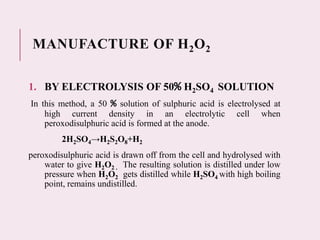
1. BY ELECTROLYSIS OF 50% H2SO4 SOLUTION
In this method, a 50 % solution of sulphuric acid is electrolysed at
high current density in an electrolytic cell when
peroxodisulphuric acid is formed at the anode.
2H2SO4→H2S2O8+H2
peroxodisulphuric acid is drawn off from the cell and hydrolysed with
water to give H2O2 . The resulting solution is distilled under low
pressure when H2O2 gets distilled while H2SO4 with high boiling
point, remains undistilled.
MANUFACTURE OF H2O2
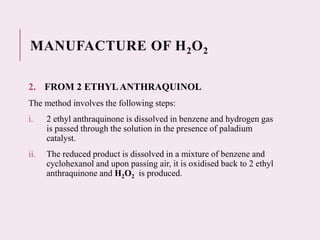
2. FROM 2 ETHYLANTHRAQUINOL
The method involves the following steps:
i. 2 ethyl anthraquinone is dissolved in benzene and hydrogen gas
is passed through the solution in the presence of paladium
catalyst.
ii. The reduced product is dissolved in a mixture of benzene and
cyclohexanol and upon passing air, it is oxidised back to 2 ethyl
anthraquinone and H2O2 is produced.
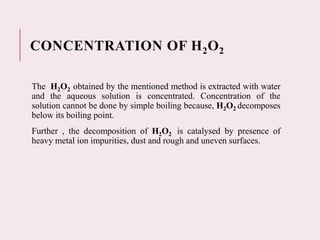
CONCENTRATION OF H2O2
The H2O2 obtained by the mentioned method is extracted with water
and the aqueous solution is concentrated. Concentration of the
solution cannot be done by simple boiling because, H2O2 decomposes
below its boiling point.
Further , the decomposition of H2O2 is catalysed by presence of
heavy metal ion impurities, dust and rough and uneven surfaces.
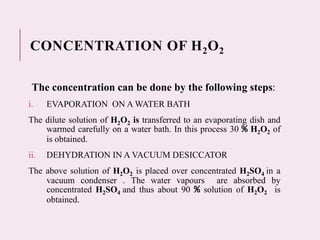
CONCENTRATION OF H2O2
The concentration can be done by the following steps:
i. EVAPORATION ON A WATER BATH
The dilute solution of H2O2 is transferred to an evaporating dish and
warmed carefully on a water bath. In this process 30 % H2O2 of
is obtained.
ii. DEHYDRATION IN A VACUUM DESICCATOR
The above solution of H2O2 is placed over concentrated H2SO4 in a
vacuum condenser . The water vapours are absorbed by
concentrated H2SO4 and thus about 90 % solution of H2O2 is
obtained.
CONCENTRATION OF H2O2
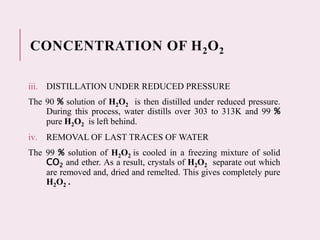
iii. DISTILLATION UNDER REDUCED PRESSURE
The 90 % solution of H2O2 is then distilled under reduced pressure.
During this process, water distills over 303 to 313K and 99 %
pure H2O2 is left behind.
iv. REMOVAL OF LAST TRACES OF WATER
The 99 % solution of H2O2 is cooled in a freezing mixture of solid
CO2 and ether. As a result, crystals of H2O2 separate out which
are removed and, dried and remelted. This gives completely pure
H2O2 .
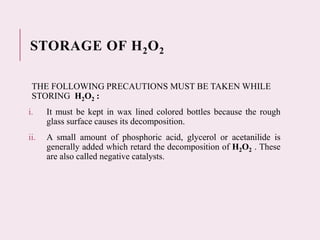
STORAGE OF H2O2
THE FOLLOWING PRECAUTIONS MUST BE TAKEN WHILE
STORING H2O2 :
i. It must be kept in wax lined colored bottles because the rough
glass surface causes its decomposition.
ii. A small amount of phosphoric acid, glycerol or acetanilide is
generally added which retard the decomposition of H2O2 . These
are also called negative catalysts.
PROPERTIES OF H2O2
PHYSICAL PROPERTIES:
i. Pure H2O2 is a thick syrupy liquid with pale blue color.
ii. It is more viscous, less volatile and dense than water.
iii. Its density is 1.44g/cm3
iv. Its melting point is 272.4K and boiling point is 358K at 68mm of
Hg pressure.
v. It is completely miscible with water, alcohol and ether in all
proportions. It forms a hydrate with water as H2O2.
H2O[m.p.221K]
PROPERTIES OF H2O2
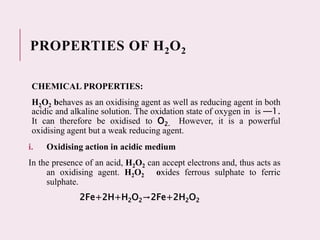
CHEMICAL PROPERTIES:
H2O2 behaves as an oxidising agent as well as reducing agent in both
acidic and alkaline solution. The oxidation state of oxygen in is ─1.
It can therefore be oxidised to O2. However, it is a powerful
oxidising agent but a weak reducing agent.
i. Oxidising action in acidic medium
In the presence of an acid, H2O2 can accept electrons and, thus acts as
an oxidising agent. H2O2 oxides ferrous sulphate to ferric
sulphate.
2Fe+2H+H2O2→2Fe+2H2O2
PROPERTIES OF H2O2
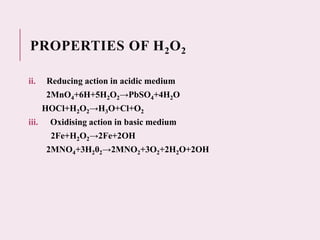
ii. Reducing action in acidic medium
2MnO4+6H+5H2O2→PbSO4+4H2O
HOCl+H2O2→H3O+Cl+O2
iii. Oxidising action in basic medium
2Fe+H2O2→2Fe+2OH
2MNO4+3H202→2MNO2+3O2+2H2O+2OH
PROPERTIES OF H2O2
iv. Reducing action in basic medium
I2+H2O2+ 2OH→2I+ 2H2O+O2
2MNO4+3H202→2MNO2+3O2+2H2O+2OH
USES OF H2O2
i. It is used in industry as a bleaching agent for textiles, paper, pulp,
straw, leather, oils, fats etc.
ii. Domestically, it is used as a hair bleach and as a mild
disinfectant.
iii. It is used in the manufacture of many inorganic compounds such
as sodium perborates and percarbonates which are important
constituent of high quality detergents.
iv. It is used as an antiseptic for washing wounds, teeth and ears
under the name perhydrol.
v. It is used for the production of epioxides, propylene oxide and
polyurethanes.
USES OF H2O2
vi. It is used for the synthesis of hydroquinone, pharmaceuticals,
food products like tartaric acid.
vii. It is used as an antichlor in bleaching.
viii. It is used for restoring the color of lead paintings.
ix. It is used for preserving milk and wines.
x. Recently H2O2 is used in environmental chemistry such as in
pollution control treatment of domestic and industrial effluents,
oxidation of cyanides and restoration of aerobic conditions to
sewage waste.
STRUCTURE OF H2O2
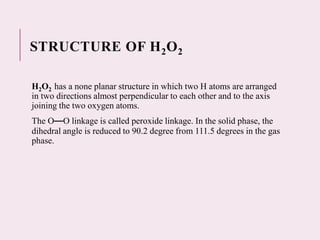
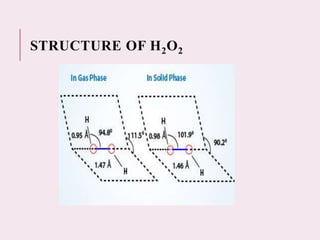
H2O2 has a none planar structure in which two H atoms are arranged
in two directions almost perpendicular to each other and to the axis
joining the two oxygen atoms.
The O─O linkage is called peroxide linkage. In the solid phase, the
dihedral angle is reduced to 90.2 degree from 111.5 degrees in the gas
phase.
STRUCTURE OF H2O2
STRENGTH OF H2O2
The strength of H2O2 is expressed in terms of
weight or volume as:
i. AS WEIGHT PERCENTAGE
The weight percentage of H2O2 gives the weight of
H2O2 in 100g of solution.
ii. AS VOLUME
The strength of H2O2 is commonly expressed as
volume. This commonly refers to the volume of
oxygen which a solution of H2O2 will give.
HYDROGEN PEROXIDE

HYDROGEN PEROXIDE

  • 1.
    HYDROGEN PEROXIDE Presentation by: Neha R.Lolayekar 11th A Roll No. :12
  • 2.
    INTRODUCTION Hydrogen Peroxide wasdiscovered by a French chemist J.L. Thenard in 1818. Its molecular formula is H2O2
  • 3.
    PREPARATION OF H2O2 H2O2can be prepared in laboratory by: 1. The action of cold, dilute sulphuric acid on sodium. 2. The action of cold, dilute sulphuric acid on barium peroxide.
  • 4.
    PREPARATION OF H2O2 1.FROM SODIUM PEROXIDE[MERCK’S PROCESS] Hydrogen peroxide is prepared by adding calculated amount of sodium peroxide to ice cold dilute solution of sulphuric acid. The addition is carried out slowly in small amounts with constant stirring. Na2O2+H2SO4→Na2SO4+H2O2 upon cooling, crystals of Na2SO4 .10H2O separate out. The crystals of Na2SO4 .10H2O are decanted leaving behind solution of hydrogen peroxide.
  • 5.
    PREPARATION OF H2O2 2.FROM BARIUM PEROXIDE In this method, a paste of hydrated barium peroxide is prepared in ice cold water and is treated with about 20% ice cold solution of sulphuric acid. BaO2.8H2O+H2SO4→BaSO4+H2O2+8H2O The white precipitate of BaSO4 is removed by filtration leaving behind about 5% solution of H2O2.
  • 6.
    MANUFACTURE OF H2O2 1.BY ELECTROLYSIS OF 50% H2SO4 SOLUTION In this method, a 50 % solution of sulphuric acid is electrolysed at high current density in an electrolytic cell when peroxodisulphuric acid is formed at the anode. 2H2SO4→H2S2O8+H2 peroxodisulphuric acid is drawn off from the cell and hydrolysed with water to give H2O2 . The resulting solution is distilled under low pressure when H2O2 gets distilled while H2SO4 with high boiling point, remains undistilled.
  • 7.
    MANUFACTURE OF H2O2 2.FROM 2 ETHYLANTHRAQUINOL The method involves the following steps: i. 2 ethyl anthraquinone is dissolved in benzene and hydrogen gas is passed through the solution in the presence of paladium catalyst. ii. The reduced product is dissolved in a mixture of benzene and cyclohexanol and upon passing air, it is oxidised back to 2 ethyl anthraquinone and H2O2 is produced.
  • 8.
    CONCENTRATION OF H2O2 TheH2O2 obtained by the mentioned method is extracted with water and the aqueous solution is concentrated. Concentration of the solution cannot be done by simple boiling because, H2O2 decomposes below its boiling point. Further , the decomposition of H2O2 is catalysed by presence of heavy metal ion impurities, dust and rough and uneven surfaces.
  • 9.
    CONCENTRATION OF H2O2 Theconcentration can be done by the following steps: i. EVAPORATION ON A WATER BATH The dilute solution of H2O2 is transferred to an evaporating dish and warmed carefully on a water bath. In this process 30 % H2O2 of is obtained. ii. DEHYDRATION IN A VACUUM DESICCATOR The above solution of H2O2 is placed over concentrated H2SO4 in a vacuum condenser . The water vapours are absorbed by concentrated H2SO4 and thus about 90 % solution of H2O2 is obtained.
  • 10.
    CONCENTRATION OF H2O2 iii.DISTILLATION UNDER REDUCED PRESSURE The 90 % solution of H2O2 is then distilled under reduced pressure. During this process, water distills over 303 to 313K and 99 % pure H2O2 is left behind. iv. REMOVAL OF LAST TRACES OF WATER The 99 % solution of H2O2 is cooled in a freezing mixture of solid CO2 and ether. As a result, crystals of H2O2 separate out which are removed and, dried and remelted. This gives completely pure H2O2 .
  • 11.
    STORAGE OF H2O2 THEFOLLOWING PRECAUTIONS MUST BE TAKEN WHILE STORING H2O2 : i. It must be kept in wax lined colored bottles because the rough glass surface causes its decomposition. ii. A small amount of phosphoric acid, glycerol or acetanilide is generally added which retard the decomposition of H2O2 . These are also called negative catalysts.
  • 12.
    PROPERTIES OF H2O2 PHYSICALPROPERTIES: i. Pure H2O2 is a thick syrupy liquid with pale blue color. ii. It is more viscous, less volatile and dense than water. iii. Its density is 1.44g/cm3 iv. Its melting point is 272.4K and boiling point is 358K at 68mm of Hg pressure. v. It is completely miscible with water, alcohol and ether in all proportions. It forms a hydrate with water as H2O2. H2O[m.p.221K]
  • 13.
    PROPERTIES OF H2O2 CHEMICALPROPERTIES: H2O2 behaves as an oxidising agent as well as reducing agent in both acidic and alkaline solution. The oxidation state of oxygen in is ─1. It can therefore be oxidised to O2. However, it is a powerful oxidising agent but a weak reducing agent. i. Oxidising action in acidic medium In the presence of an acid, H2O2 can accept electrons and, thus acts as an oxidising agent. H2O2 oxides ferrous sulphate to ferric sulphate. 2Fe+2H+H2O2→2Fe+2H2O2
  • 14.
    PROPERTIES OF H2O2 ii.Reducing action in acidic medium 2MnO4+6H+5H2O2→PbSO4+4H2O HOCl+H2O2→H3O+Cl+O2 iii. Oxidising action in basic medium 2Fe+H2O2→2Fe+2OH 2MNO4+3H202→2MNO2+3O2+2H2O+2OH
  • 15.
    PROPERTIES OF H2O2 iv.Reducing action in basic medium I2+H2O2+ 2OH→2I+ 2H2O+O2 2MNO4+3H202→2MNO2+3O2+2H2O+2OH
  • 16.
    USES OF H2O2 i.It is used in industry as a bleaching agent for textiles, paper, pulp, straw, leather, oils, fats etc. ii. Domestically, it is used as a hair bleach and as a mild disinfectant. iii. It is used in the manufacture of many inorganic compounds such as sodium perborates and percarbonates which are important constituent of high quality detergents. iv. It is used as an antiseptic for washing wounds, teeth and ears under the name perhydrol. v. It is used for the production of epioxides, propylene oxide and polyurethanes.
  • 17.
    USES OF H2O2 vi.It is used for the synthesis of hydroquinone, pharmaceuticals, food products like tartaric acid. vii. It is used as an antichlor in bleaching. viii. It is used for restoring the color of lead paintings. ix. It is used for preserving milk and wines. x. Recently H2O2 is used in environmental chemistry such as in pollution control treatment of domestic and industrial effluents, oxidation of cyanides and restoration of aerobic conditions to sewage waste.
  • 18.
    STRUCTURE OF H2O2 H2O2has a none planar structure in which two H atoms are arranged in two directions almost perpendicular to each other and to the axis joining the two oxygen atoms. The O─O linkage is called peroxide linkage. In the solid phase, the dihedral angle is reduced to 90.2 degree from 111.5 degrees in the gas phase.
  • 19.
  • 20.
    STRENGTH OF H2O2 Thestrength of H2O2 is expressed in terms of weight or volume as: i. AS WEIGHT PERCENTAGE The weight percentage of H2O2 gives the weight of H2O2 in 100g of solution. ii. AS VOLUME The strength of H2O2 is commonly expressed as volume. This commonly refers to the volume of oxygen which a solution of H2O2 will give.