A
Presentation on
OXIDATION
Contents
 Introduction
❑Types of oxidative reactions
❑Liquid phase oxidation with oxidizing agents
❑Non-metallic Oxidizing agents such as:
1. Hydrogen peroxide
2. sodium hypochlorite
3. Oxygen gas
4. ozonolysis
Introduction
• Oxidation is a process of addition of oxygen and removal of
hydrogen or loss of an electron during a reaction by a molecule,
atom or ion.
• Oxidation occurs when the oxidation state of a molecule, atom or
ion is increased.
• The opposite process is called reduction, reduction is a process
of removal of oxygen and addition of hydrogen.
• Reduction occurs when there is a gain of electrons or the
oxidation state of an atom, molecule, or ion decreases.
• Oxidation and reduction always occur in pair, Therefore whenever
something is oxidised,something is reduced.
• Oxidation and reduction together are called "REDOX
REACTION"
Types of oxidative reactions
• In the organic chemical industry, oxidation constitutes one of the
most powerful tools used in the synthesis of chemical
compounds.
• The principle types of oxidative reactions may be as follows:
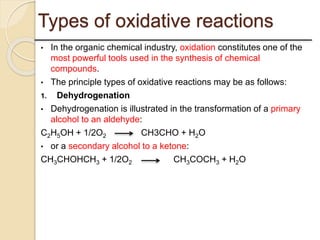
1. Dehydrogenation
• Dehydrogenation is illustrated in the transformation of a primary
alcohol to an aldehyde:
C2H5OH + 1/2O2 CH3CHO + H2O
• or a secondary alcohol to a ketone:
CH3CHOHCH3 + 1/2O2 CH3COCH3 + H2O
Types of oxidative reactions
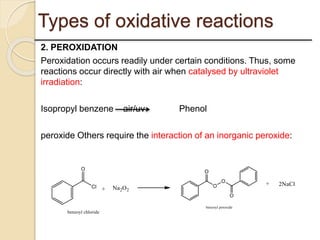
2. PEROXIDATION
Peroxidation occurs readily under certain conditions. Thus, some
reactions occur directly with air when catalysed by ultraviolet
irradiation:
Isopropyl benzene air/uv Phenol
peroxide Others require the interaction of an inorganic peroxide:
Types of Oxidative Reactions
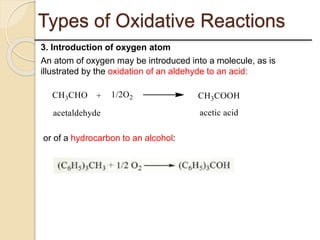
3. Introduction of oxygen atom
An atom of oxygen may be introduced into a molecule, as is
illustrated by the oxidation of an aldehyde to an acid:
or of a hydrocarbon to an alcohol:
Liquid phase oxidation with
oxidizing agents
 Liquid-phase oxidation is discussed in terms of the free radical
chain mechanism proposed by BOLLAND and his co-workers.
 It is a process in which air or oxygen gas is contacted with the
liquid reagent.
 In Liquid phase oxidation H2O2 is being used more frequently as
an oxidizing agent in place of traditional oxygen transfer agents.
 This scheme was devised for certain oxidations in which
hydroperoxide is the major product.
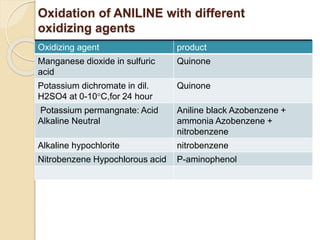
Oxidation of ANILINE with different
oxidizing agents
Oxidizing agent product
Manganese dioxide in sulfuric
acid
Quinone
Potassium dichromate in dil.
H2SO4 at 0-10C,for 24 hour
Quinone
Potassium permangnate: Acid
Alkaline Neutral
Aniline black Azobenzene +
ammonia Azobenzene +
nitrobenzene
Alkaline hypochlorite nitrobenzene
Nitrobenzene Hypochlorous acid P-aminophenol
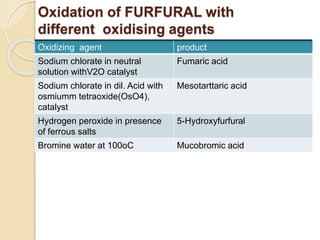
Oxidation of FURFURAL with
different oxidising agents
Oxidizing agent product
Sodium chlorate in neutral
solution withV2O catalyst
Fumaric acid
Sodium chlorate in dil. Acid with
osmiumm tetraoxide(OsO4),
catalyst
Mesotarttaric acid
Hydrogen peroxide in presence
of ferrous salts
5-Hydroxyfurfural
Bromine water at 100oC Mucobromic acid
Non-metallic oxidizing agent
• Non-metals act as oxidizing agent because they tend to accept
electrons i.e. reduction.
• The substance which itself gets reduced by causing oxidation of
others is an oxidizing agent.
• e.g., nonmetals.
Hydrogen peroxide (H2O2)
• Hydrogen peroxide H2O2 Pure form, it is a pale blue, clear
liquid,slightly more viscous than water.
• It is the simplest peroxide (a compound with an oxygen–oxygen
single bond).
• It is used as an oxidizer, bleaching agent and antiseptic.
• Concentrated hydrogen peroxide, or "high-test peroxide", is a
reactive oxygen species and has been used as a propellant in
rocketry. Its chemistry is dominated by the nature of its unstable
peroxide bond.
• It is unstable and slowly decomposes in the presence of light.
Because of its instability, It is typically stored with a stabilizer in a
weakly acidic solution.
• It is found in biological systems including the human body.
• Enzymes that decompose hydrogen peroxide are classified as
peroxidases.
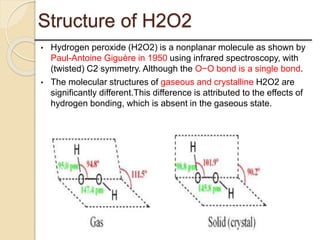
Structure of H2O2
• Hydrogen peroxide (H2O2) is a nonplanar molecule as shown by
Paul-Antoine Giguère in 1950 using infrared spectroscopy, with
(twisted) C2 symmetry. Although the O−O bond is a single bond.
• The molecular structures of gaseous and crystalline H2O2 are
significantly different.This difference is attributed to the effects of
hydrogen bonding, which is absent in the gaseous state.
PRODUCTION
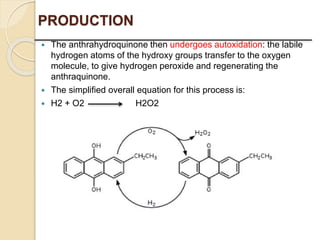
 The anthrahydroquinone then undergoes autoxidation: the labile
hydrogen atoms of the hydroxy groups transfer to the oxygen
molecule, to give hydrogen peroxide and regenerating the
anthraquinone.
 The simplified overall equation for this process is:
 H2 + O2 H2O2
Decomposition
 Hydrogen peroxide is thermodynamically unstable and
decomposes to form water and oxygen.
 The rate of decomposition increases with rise in temperature,
concentration and pH, with cool, dilute, acidic solutions showing
the best stability.
 H2O2 H2O + O2
APPLICATION:
 mild antiseptic used on the skin
 prevent infection of minor cuts, scrapes, and burns
 used as a mouth rinse
 cold sores, gingivitis
Organic reaction
• Hydrogen peroxide is frequently used as an oxidizing agent.
Example is oxidation of thioethers to sulfoxides.
• Ph-S-CH3 + H2O2 Ph-S(O)-CH3 + H2O
• Hydrogen peroxide is a weak acid, forming hydroperoxide or
peroxide salts with many metals.
• It also converts metal oxides into the corresponding peroxides.
For example: upon treatment with hydrogen peroxide, chromic
acid forms an unstable blue peroxide CrO(O2)2.
• This kind of reaction is used industrially to produce
peroxoanions. For example, reaction with borax leads to
sodium perborate, a bleach used in detergent industry.
Sodium hypochlorite(NaOCl)
• It may also be viewed as the sodium salt of hypochlorous acid.
• The anhydrous compound is unstable and may decompose
explosively.
• It can be crystallized as a pentahydrate.
• NaOCl·5H2O,a pale greenish-yellow solid which is not
explosive and is stable if kept refrigerated
• Dilute solution commonly known as liquid bleach or simply
bleach, a household chemical widely used (since the 18th
century) as a disinfectant or a bleaching agent.
• The compound in solution is unstable and easily decomposes,
liberating chlorine, which is the active principle of such
products. Indeed, sodium hypochlorite is the oldest and still
most important chlorine-based bleach.
• While sodium hypochlorite is non-toxic.
Oxidation of organic
compounds
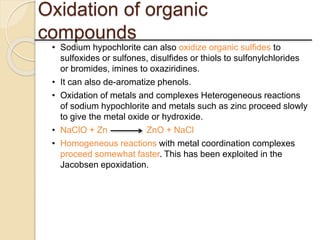
• Sodium hypochlorite can also oxidize organic sulfides to
sulfoxides or sulfones, disulfides or thiols to sulfonylchlorides
or bromides, imines to oxaziridines.
• It can also de-aromatize phenols.
• Oxidation of metals and complexes Heterogeneous reactions
of sodium hypochlorite and metals such as zinc proceed slowly
to give the metal oxide or hydroxide.
• NaClO + Zn ZnO + NaCl
• Homogeneous reactions with metal coordination complexes
proceed somewhat faster. This has been exploited in the
Jacobsen epoxidation.
Other reactions
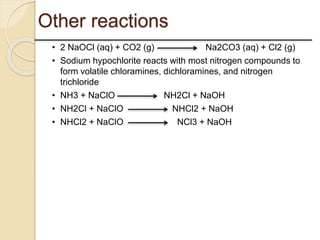
• 2 NaOCl (aq) + CO2 (g) Na2CO3 (aq) + Cl2 (g)
• Sodium hypochlorite reacts with most nitrogen compounds to
form volatile chloramines, dichloramines, and nitrogen
trichloride
• NH3 + NaClO NH2Cl + NaOH
• NH2Cl + NaClO NHCl2 + NaOH
• NHCl2 + NaClO NCl3 + NaOH
Production
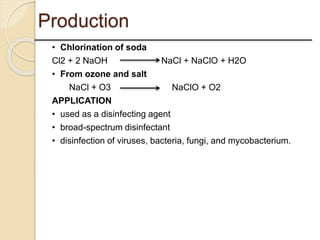
• Chlorination of soda
Cl2 + 2 NaOH NaCl + NaClO + H2O
• From ozone and salt
NaCl + O3 NaClO + O2
APPLICATION
• used as a disinfecting agent
• broad-spectrum disinfectant
• disinfection of viruses, bacteria, fungi, and mycobacterium.
References
• https://www.slideshare.net/AikanGupta/oxidation-unit-
process1-pharmaceutical-process-chemistry
• https://www.slideshare.net/anamilyas391/oxidation-
pharmaceutical-process-chemistry-249234306
• https://www.slideshare.net/ShubhamSharma1678/oxidatio
n-process-chemistry-mpharm
THANK YOU
OXIDATION.pptx
OXIDATION.pptx
OXIDATION.pptx
OXIDATION.pptx

OXIDATION.pptx

  • 1.
  • 2.
    Contents  Introduction ❑Types ofoxidative reactions ❑Liquid phase oxidation with oxidizing agents ❑Non-metallic Oxidizing agents such as: 1. Hydrogen peroxide 2. sodium hypochlorite 3. Oxygen gas 4. ozonolysis
  • 3.
    Introduction • Oxidation isa process of addition of oxygen and removal of hydrogen or loss of an electron during a reaction by a molecule, atom or ion. • Oxidation occurs when the oxidation state of a molecule, atom or ion is increased. • The opposite process is called reduction, reduction is a process of removal of oxygen and addition of hydrogen. • Reduction occurs when there is a gain of electrons or the oxidation state of an atom, molecule, or ion decreases. • Oxidation and reduction always occur in pair, Therefore whenever something is oxidised,something is reduced. • Oxidation and reduction together are called "REDOX REACTION"
  • 4.
    Types of oxidativereactions • In the organic chemical industry, oxidation constitutes one of the most powerful tools used in the synthesis of chemical compounds. • The principle types of oxidative reactions may be as follows: 1. Dehydrogenation • Dehydrogenation is illustrated in the transformation of a primary alcohol to an aldehyde: C2H5OH + 1/2O2 CH3CHO + H2O • or a secondary alcohol to a ketone: CH3CHOHCH3 + 1/2O2 CH3COCH3 + H2O
  • 5.
    Types of oxidativereactions 2. PEROXIDATION Peroxidation occurs readily under certain conditions. Thus, some reactions occur directly with air when catalysed by ultraviolet irradiation: Isopropyl benzene air/uv Phenol peroxide Others require the interaction of an inorganic peroxide:
  • 6.
    Types of OxidativeReactions 3. Introduction of oxygen atom An atom of oxygen may be introduced into a molecule, as is illustrated by the oxidation of an aldehyde to an acid: or of a hydrocarbon to an alcohol:
  • 7.
    Liquid phase oxidationwith oxidizing agents  Liquid-phase oxidation is discussed in terms of the free radical chain mechanism proposed by BOLLAND and his co-workers.  It is a process in which air or oxygen gas is contacted with the liquid reagent.  In Liquid phase oxidation H2O2 is being used more frequently as an oxidizing agent in place of traditional oxygen transfer agents.  This scheme was devised for certain oxidations in which hydroperoxide is the major product.
  • 8.
    Oxidation of ANILINEwith different oxidizing agents Oxidizing agent product Manganese dioxide in sulfuric acid Quinone Potassium dichromate in dil. H2SO4 at 0-10C,for 24 hour Quinone Potassium permangnate: Acid Alkaline Neutral Aniline black Azobenzene + ammonia Azobenzene + nitrobenzene Alkaline hypochlorite nitrobenzene Nitrobenzene Hypochlorous acid P-aminophenol
  • 9.
    Oxidation of FURFURALwith different oxidising agents Oxidizing agent product Sodium chlorate in neutral solution withV2O catalyst Fumaric acid Sodium chlorate in dil. Acid with osmiumm tetraoxide(OsO4), catalyst Mesotarttaric acid Hydrogen peroxide in presence of ferrous salts 5-Hydroxyfurfural Bromine water at 100oC Mucobromic acid
  • 10.
    Non-metallic oxidizing agent •Non-metals act as oxidizing agent because they tend to accept electrons i.e. reduction. • The substance which itself gets reduced by causing oxidation of others is an oxidizing agent. • e.g., nonmetals.
  • 11.
    Hydrogen peroxide (H2O2) •Hydrogen peroxide H2O2 Pure form, it is a pale blue, clear liquid,slightly more viscous than water. • It is the simplest peroxide (a compound with an oxygen–oxygen single bond). • It is used as an oxidizer, bleaching agent and antiseptic. • Concentrated hydrogen peroxide, or "high-test peroxide", is a reactive oxygen species and has been used as a propellant in rocketry. Its chemistry is dominated by the nature of its unstable peroxide bond. • It is unstable and slowly decomposes in the presence of light. Because of its instability, It is typically stored with a stabilizer in a weakly acidic solution. • It is found in biological systems including the human body. • Enzymes that decompose hydrogen peroxide are classified as peroxidases.
  • 12.
    Structure of H2O2 •Hydrogen peroxide (H2O2) is a nonplanar molecule as shown by Paul-Antoine Giguère in 1950 using infrared spectroscopy, with (twisted) C2 symmetry. Although the O−O bond is a single bond. • The molecular structures of gaseous and crystalline H2O2 are significantly different.This difference is attributed to the effects of hydrogen bonding, which is absent in the gaseous state.
  • 13.
    PRODUCTION  The anthrahydroquinonethen undergoes autoxidation: the labile hydrogen atoms of the hydroxy groups transfer to the oxygen molecule, to give hydrogen peroxide and regenerating the anthraquinone.  The simplified overall equation for this process is:  H2 + O2 H2O2
  • 14.
    Decomposition  Hydrogen peroxideis thermodynamically unstable and decomposes to form water and oxygen.  The rate of decomposition increases with rise in temperature, concentration and pH, with cool, dilute, acidic solutions showing the best stability.  H2O2 H2O + O2 APPLICATION:  mild antiseptic used on the skin  prevent infection of minor cuts, scrapes, and burns  used as a mouth rinse  cold sores, gingivitis
  • 15.
    Organic reaction • Hydrogenperoxide is frequently used as an oxidizing agent. Example is oxidation of thioethers to sulfoxides. • Ph-S-CH3 + H2O2 Ph-S(O)-CH3 + H2O • Hydrogen peroxide is a weak acid, forming hydroperoxide or peroxide salts with many metals. • It also converts metal oxides into the corresponding peroxides. For example: upon treatment with hydrogen peroxide, chromic acid forms an unstable blue peroxide CrO(O2)2. • This kind of reaction is used industrially to produce peroxoanions. For example, reaction with borax leads to sodium perborate, a bleach used in detergent industry.
  • 16.
    Sodium hypochlorite(NaOCl) • Itmay also be viewed as the sodium salt of hypochlorous acid. • The anhydrous compound is unstable and may decompose explosively. • It can be crystallized as a pentahydrate. • NaOCl·5H2O,a pale greenish-yellow solid which is not explosive and is stable if kept refrigerated • Dilute solution commonly known as liquid bleach or simply bleach, a household chemical widely used (since the 18th century) as a disinfectant or a bleaching agent. • The compound in solution is unstable and easily decomposes, liberating chlorine, which is the active principle of such products. Indeed, sodium hypochlorite is the oldest and still most important chlorine-based bleach. • While sodium hypochlorite is non-toxic.
  • 17.
    Oxidation of organic compounds •Sodium hypochlorite can also oxidize organic sulfides to sulfoxides or sulfones, disulfides or thiols to sulfonylchlorides or bromides, imines to oxaziridines. • It can also de-aromatize phenols. • Oxidation of metals and complexes Heterogeneous reactions of sodium hypochlorite and metals such as zinc proceed slowly to give the metal oxide or hydroxide. • NaClO + Zn ZnO + NaCl • Homogeneous reactions with metal coordination complexes proceed somewhat faster. This has been exploited in the Jacobsen epoxidation.
  • 18.
    Other reactions • 2NaOCl (aq) + CO2 (g) Na2CO3 (aq) + Cl2 (g) • Sodium hypochlorite reacts with most nitrogen compounds to form volatile chloramines, dichloramines, and nitrogen trichloride • NH3 + NaClO NH2Cl + NaOH • NH2Cl + NaClO NHCl2 + NaOH • NHCl2 + NaClO NCl3 + NaOH
  • 19.
    Production • Chlorination ofsoda Cl2 + 2 NaOH NaCl + NaClO + H2O • From ozone and salt NaCl + O3 NaClO + O2 APPLICATION • used as a disinfecting agent • broad-spectrum disinfectant • disinfection of viruses, bacteria, fungi, and mycobacterium.
  • 20.
  • 21.