
SUBMITTED BY
AKHILESH UIKAY
CLASS X ”B”
GUIDED BY
“MITRA SIR”
2
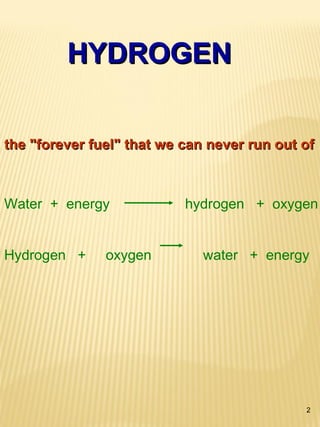
the "forever fuel" that we can never run out ofthe "forever fuel" that we can never run out of
HYDROGENHYDROGEN
Water + energy hydrogen + oxygen
Hydrogen + oxygen water + energy
3
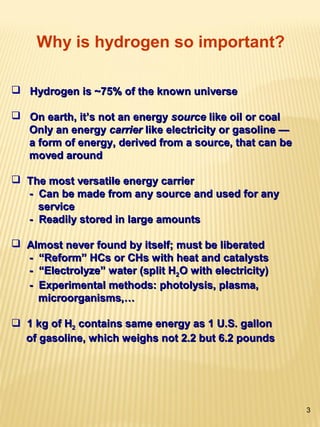
 Hydrogen is ~75% of the known universeHydrogen is ~75% of the known universe
 On earth, it’s not an energyOn earth, it’s not an energy sourcesource like oil or coallike oil or coal
Only an energyOnly an energy carriercarrier like electricity or gasoline —like electricity or gasoline —
a form of energy, derived from a source, that can bea form of energy, derived from a source, that can be
moved aroundmoved around
 The most versatile energy carrierThe most versatile energy carrier
- Can be made from any source and used for any- Can be made from any source and used for any
serviceservice
- Readily stored in large amounts- Readily stored in large amounts
 Almost never found by itself; must be liberatedAlmost never found by itself; must be liberated
- “Reform” HCs or CHs with heat and catalysts- “Reform” HCs or CHs with heat and catalysts
- “Electrolyze” water (split H- “Electrolyze” water (split H22O with electricity)O with electricity)
- Experimental methods: photolysis, plasma,- Experimental methods: photolysis, plasma,
microorganisms,…microorganisms,…
 1 kg of H1 kg of H22 contains same energy as 1 U.S. galloncontains same energy as 1 U.S. gallon
of gasoline, which weighs not 2.2 but 6.2 poundsof gasoline, which weighs not 2.2 but 6.2 pounds
Why is hydrogen so important?
4
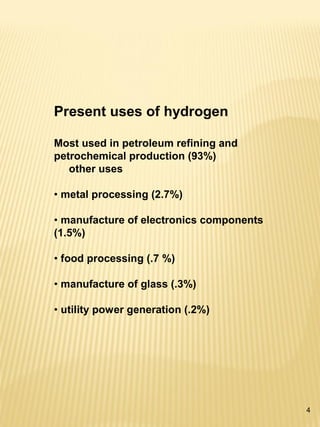
Present uses of hydrogen
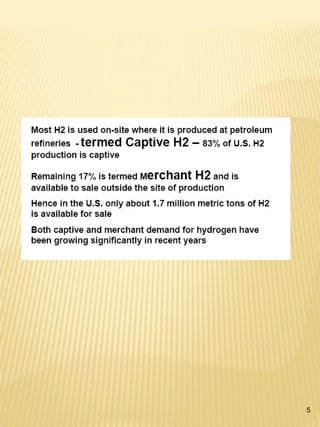
Most used in petroleum refining and
petrochemical production (93%)
other uses
• metal processing (2.7%)
• manufacture of electronics components
(1.5%)
• food processing (.7 %)
• manufacture of glass (.3%)
• utility power generation (.2%)
5
6
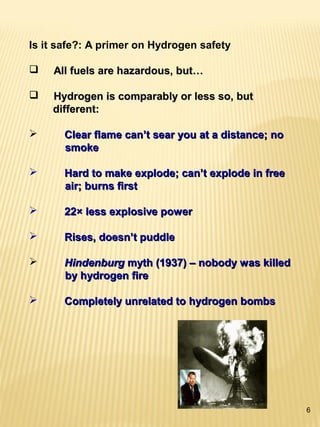
Is it safe?: A primer on Hydrogen safety
 All fuels are hazardous, but…All fuels are hazardous, but…
 Hydrogen is comparably or less so, butHydrogen is comparably or less so, but
different:different:
 Clear flame can’t sear you at a distance; noClear flame can’t sear you at a distance; no
smokesmoke
 Hard to make explode; can’t explode in freeHard to make explode; can’t explode in free
air; burns firstair; burns first
 22× less explosive power22× less explosive power
 Rises, doesn’t puddleRises, doesn’t puddle
 HindenburgHindenburg myth (1937) – nobody was killedmyth (1937) – nobody was killed
by hydrogen fireby hydrogen fire
 Completely unrelated to hydrogen bombsCompletely unrelated to hydrogen bombs
7
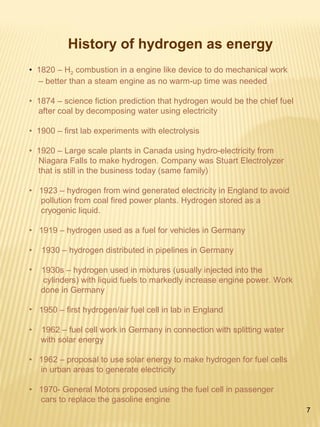
History of hydrogen as energy
• 1820 – H2 combustion in a engine like device to do mechanical work
– better than a steam engine as no warm-up time was needed
• 1874 – science fiction prediction that hydrogen would be the chief fuel
after coal by decomposing water using electricity
• 1900 – first lab experiments with electrolysis
• 1920 – Large scale plants in Canada using hydro-electricity from
Niagara Falls to make hydrogen. Company was Stuart Electrolyzer
that is still in the business today (same family)
• 1923 – hydrogen from wind generated electricity in England to avoid
pollution from coal fired power plants. Hydrogen stored as a
cryogenic liquid.
• 1919 – hydrogen used as a fuel for vehicles in Germany
• 1930 – hydrogen distributed in pipelines in Germany
• 1930s – hydrogen used in mixtures (usually injected into the
cylinders) with liquid fuels to markedly increase engine power. Work
done in Germany
• 1950 – first hydrogen/air fuel cell in lab in England
• 1962 – fuel cell work in Germany in connection with splitting water
with solar energy
• 1962 – proposal to use solar energy to make hydrogen for fuel cells
in urban areas to generate electricity
• 1970- General Motors proposed using the fuel cell in passenger
cars to replace the gasoline engine
8
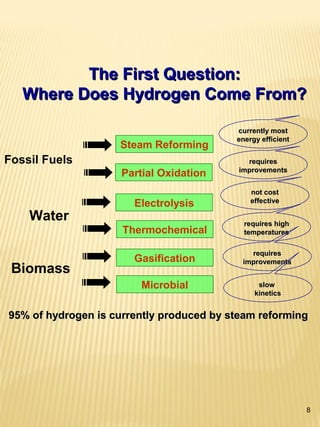
The First Question:The First Question:
Where Does Hydrogen Come From?Where Does Hydrogen Come From?
95% of hydrogen is currently produced by steam reforming95% of hydrogen is currently produced by steam reforming
Partial Oxidation
Steam Reforming
Electrolysis
Thermochemical
Fossil Fuels
Water
Biomass
currently mostcurrently most
energy efficientenergy efficient
requiresrequires
improvementsimprovements
not costnot cost
effectiveeffective
requires highrequires high
temperaturestemperatures
Gasification
Microbial
requiresrequires
improvementsimprovements
slowslow
kineticskinetics
9
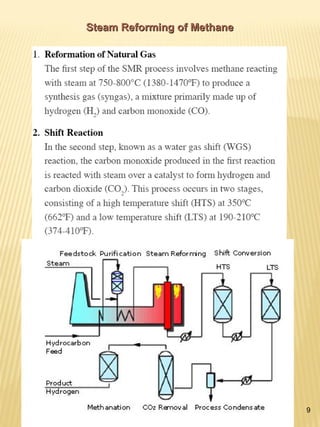
Steam Reforming of MethaneSteam Reforming of Methane
10
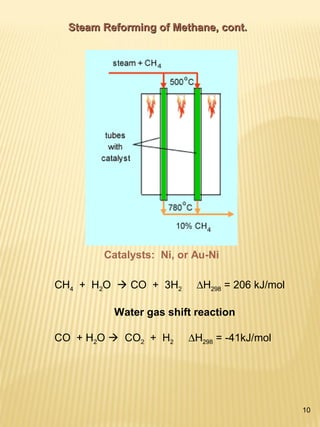
Steam Reforming of Methane, cont.Steam Reforming of Methane, cont.
CH4 + H2O  CO + 3H2 ∆H298 = 206 kJ/mol
Water gas shift reaction
CO + H2O  CO2 + H2 ∆H298 = -41kJ/mol
Catalysts: Ni, or Au-Ni
11
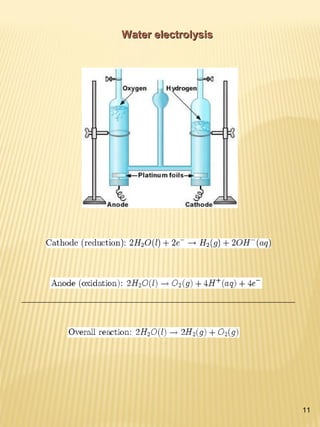
Water electrolysisWater electrolysis
12
13
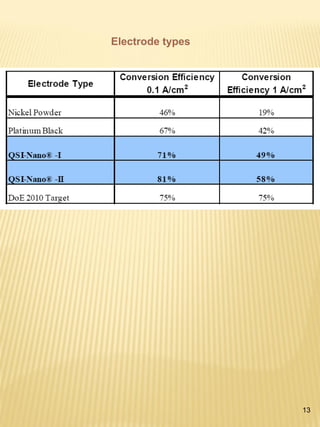
Electrode types
14
15
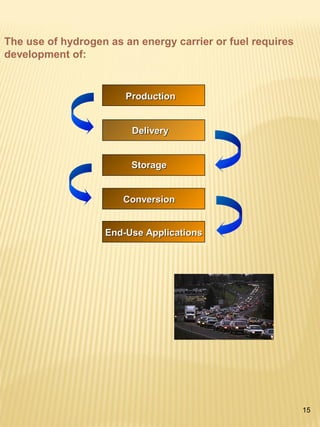
The use of hydrogen as an energy carrier or fuel requires
development of:
ProductionProduction
DeliveryDelivery
StorageStorage
ConversionConversion
End-Use ApplicationsEnd-Use Applications
16
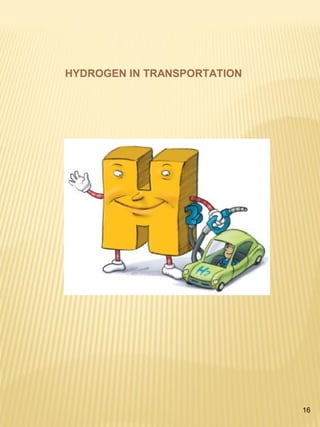
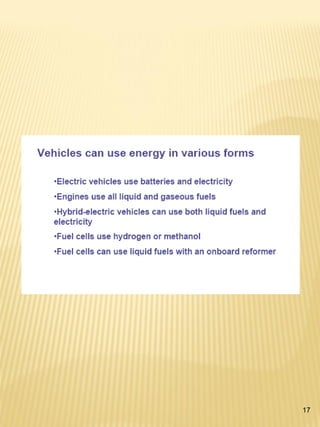
HYDROGEN IN TRANSPORTATION
17
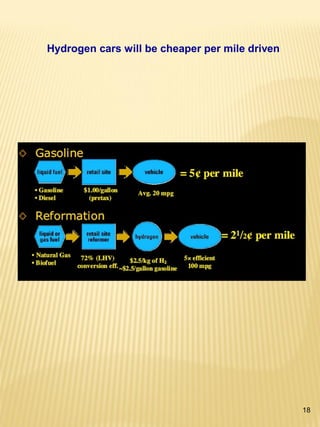
18
Hydrogen cars will be cheaper per mile driven
19
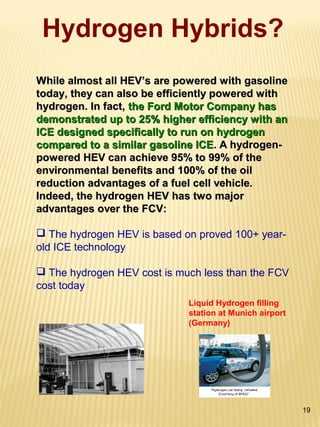
Hydrogen Hybrids?
While almost all HEV’s are powered with gasolineWhile almost all HEV’s are powered with gasoline
today, they can also be efficiently powered withtoday, they can also be efficiently powered with
hydrogen. In fact,hydrogen. In fact, the Ford Motor Company hasthe Ford Motor Company has
demonstrated up to 25% higher efficiency with andemonstrated up to 25% higher efficiency with an
ICE designed specifically to run on hydrogenICE designed specifically to run on hydrogen
compared to a similar gasoline ICEcompared to a similar gasoline ICE. A hydrogen-. A hydrogen-
powered HEV can achieve 95% to 99% of thepowered HEV can achieve 95% to 99% of the
environmental benefits and 100% of the oilenvironmental benefits and 100% of the oil
reduction advantages of a fuel cell vehicle.reduction advantages of a fuel cell vehicle.
Indeed, the hydrogen HEV has two majorIndeed, the hydrogen HEV has two major
advantages over the FCV:advantages over the FCV:
 The hydrogen HEV is based on proved 100+ year-
old ICE technology
 The hydrogen HEV cost is much less than the FCV
cost today
Liquid Hydrogen filling
station at Munich airport
(Germany)
20
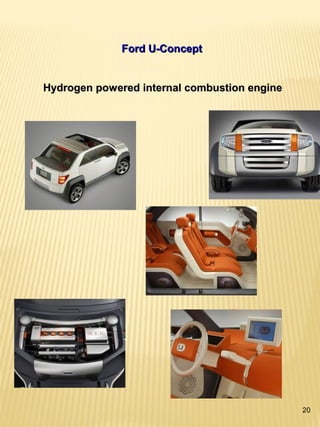
Ford U-ConceptFord U-Concept
Hydrogen powered internal combustion engineHydrogen powered internal combustion engine
21
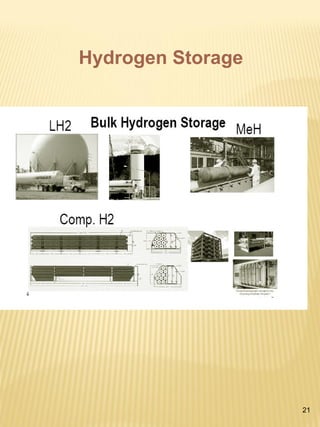
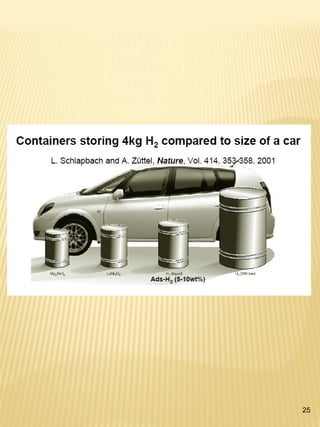
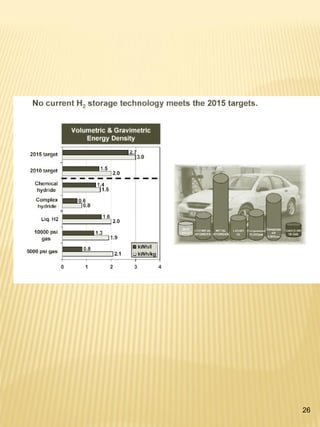
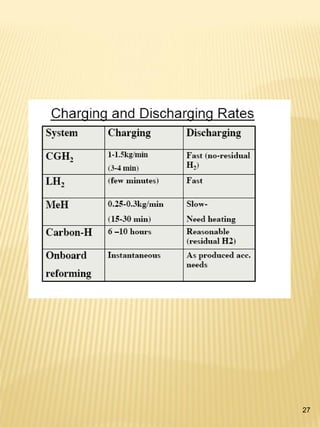
Hydrogen Storage
22
23
24
25
26
27
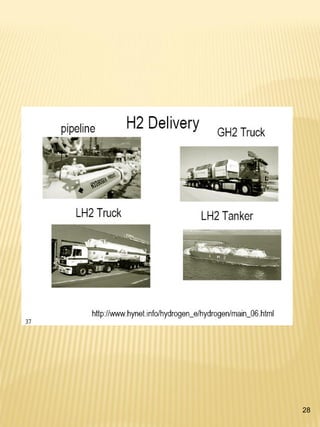
28
THANK YOU
29

Hydrogen and its properties

  • 1.
    SUBMITTED BY AKHILESH UIKAY CLASSX ”B” GUIDED BY “MITRA SIR”
  • 2.
    2 the "forever fuel"that we can never run out ofthe "forever fuel" that we can never run out of HYDROGENHYDROGEN Water + energy hydrogen + oxygen Hydrogen + oxygen water + energy
  • 3.
    3  Hydrogen is~75% of the known universeHydrogen is ~75% of the known universe  On earth, it’s not an energyOn earth, it’s not an energy sourcesource like oil or coallike oil or coal Only an energyOnly an energy carriercarrier like electricity or gasoline —like electricity or gasoline — a form of energy, derived from a source, that can bea form of energy, derived from a source, that can be moved aroundmoved around  The most versatile energy carrierThe most versatile energy carrier - Can be made from any source and used for any- Can be made from any source and used for any serviceservice - Readily stored in large amounts- Readily stored in large amounts  Almost never found by itself; must be liberatedAlmost never found by itself; must be liberated - “Reform” HCs or CHs with heat and catalysts- “Reform” HCs or CHs with heat and catalysts - “Electrolyze” water (split H- “Electrolyze” water (split H22O with electricity)O with electricity) - Experimental methods: photolysis, plasma,- Experimental methods: photolysis, plasma, microorganisms,…microorganisms,…  1 kg of H1 kg of H22 contains same energy as 1 U.S. galloncontains same energy as 1 U.S. gallon of gasoline, which weighs not 2.2 but 6.2 poundsof gasoline, which weighs not 2.2 but 6.2 pounds Why is hydrogen so important?
  • 4.
    4 Present uses ofhydrogen Most used in petroleum refining and petrochemical production (93%) other uses • metal processing (2.7%) • manufacture of electronics components (1.5%) • food processing (.7 %) • manufacture of glass (.3%) • utility power generation (.2%)
  • 5.
  • 6.
    6 Is it safe?:A primer on Hydrogen safety  All fuels are hazardous, but…All fuels are hazardous, but…  Hydrogen is comparably or less so, butHydrogen is comparably or less so, but different:different:  Clear flame can’t sear you at a distance; noClear flame can’t sear you at a distance; no smokesmoke  Hard to make explode; can’t explode in freeHard to make explode; can’t explode in free air; burns firstair; burns first  22× less explosive power22× less explosive power  Rises, doesn’t puddleRises, doesn’t puddle  HindenburgHindenburg myth (1937) – nobody was killedmyth (1937) – nobody was killed by hydrogen fireby hydrogen fire  Completely unrelated to hydrogen bombsCompletely unrelated to hydrogen bombs
  • 7.
    7 History of hydrogenas energy • 1820 – H2 combustion in a engine like device to do mechanical work – better than a steam engine as no warm-up time was needed • 1874 – science fiction prediction that hydrogen would be the chief fuel after coal by decomposing water using electricity • 1900 – first lab experiments with electrolysis • 1920 – Large scale plants in Canada using hydro-electricity from Niagara Falls to make hydrogen. Company was Stuart Electrolyzer that is still in the business today (same family) • 1923 – hydrogen from wind generated electricity in England to avoid pollution from coal fired power plants. Hydrogen stored as a cryogenic liquid. • 1919 – hydrogen used as a fuel for vehicles in Germany • 1930 – hydrogen distributed in pipelines in Germany • 1930s – hydrogen used in mixtures (usually injected into the cylinders) with liquid fuels to markedly increase engine power. Work done in Germany • 1950 – first hydrogen/air fuel cell in lab in England • 1962 – fuel cell work in Germany in connection with splitting water with solar energy • 1962 – proposal to use solar energy to make hydrogen for fuel cells in urban areas to generate electricity • 1970- General Motors proposed using the fuel cell in passenger cars to replace the gasoline engine
  • 8.
    8 The First Question:TheFirst Question: Where Does Hydrogen Come From?Where Does Hydrogen Come From? 95% of hydrogen is currently produced by steam reforming95% of hydrogen is currently produced by steam reforming Partial Oxidation Steam Reforming Electrolysis Thermochemical Fossil Fuels Water Biomass currently mostcurrently most energy efficientenergy efficient requiresrequires improvementsimprovements not costnot cost effectiveeffective requires highrequires high temperaturestemperatures Gasification Microbial requiresrequires improvementsimprovements slowslow kineticskinetics
  • 9.
    9 Steam Reforming ofMethaneSteam Reforming of Methane
  • 10.
    10 Steam Reforming ofMethane, cont.Steam Reforming of Methane, cont. CH4 + H2O  CO + 3H2 ∆H298 = 206 kJ/mol Water gas shift reaction CO + H2O  CO2 + H2 ∆H298 = -41kJ/mol Catalysts: Ni, or Au-Ni
  • 11.
  • 12.
  • 13.
  • 14.
  • 15.
    15 The use ofhydrogen as an energy carrier or fuel requires development of: ProductionProduction DeliveryDelivery StorageStorage ConversionConversion End-Use ApplicationsEnd-Use Applications
  • 16.
  • 17.
  • 18.
    18 Hydrogen cars willbe cheaper per mile driven
  • 19.
    19 Hydrogen Hybrids? While almostall HEV’s are powered with gasolineWhile almost all HEV’s are powered with gasoline today, they can also be efficiently powered withtoday, they can also be efficiently powered with hydrogen. In fact,hydrogen. In fact, the Ford Motor Company hasthe Ford Motor Company has demonstrated up to 25% higher efficiency with andemonstrated up to 25% higher efficiency with an ICE designed specifically to run on hydrogenICE designed specifically to run on hydrogen compared to a similar gasoline ICEcompared to a similar gasoline ICE. A hydrogen-. A hydrogen- powered HEV can achieve 95% to 99% of thepowered HEV can achieve 95% to 99% of the environmental benefits and 100% of the oilenvironmental benefits and 100% of the oil reduction advantages of a fuel cell vehicle.reduction advantages of a fuel cell vehicle. Indeed, the hydrogen HEV has two majorIndeed, the hydrogen HEV has two major advantages over the FCV:advantages over the FCV:  The hydrogen HEV is based on proved 100+ year- old ICE technology  The hydrogen HEV cost is much less than the FCV cost today Liquid Hydrogen filling station at Munich airport (Germany)
  • 20.
    20 Ford U-ConceptFord U-Concept Hydrogenpowered internal combustion engineHydrogen powered internal combustion engine
  • 21.
  • 22.
  • 23.
  • 24.
  • 25.
  • 26.
  • 27.
  • 28.
  • 29.